Anschluss
On 12 March 1938, after a prolonged period of economic stagnation, political dictatorship and intense Nazi propaganda inside Austria, German troops entered the country, with the enthusiastic support of most of the population; Austria was incorporated into Germany the next day.[1] In April the annexation was retroactively approved in a plebiscite, from which Jews and Roma were excluded, manipulated to show that about 99 per cent of Austrians wanted the union.[1]
About 192,000 Jews lived in Austria in 1938, almost 4 per cent of the population, and the great majority of them in Vienna.[1] For them, the New York wall texts say, the Anschluss was a disaster: overnight Jewish families like the Ephrussi were identified by the Nazis, expelled from their homes and businesses and stripped of their property, and many were arrested, interned or killed.[2] The Ephrussi bank and the Palais, the curators write, were immediately seized.[2] The scale of what followed can be measured in a single figure: by December 1939, through emigration under duress, the Jewish population of Austria had been reduced to about 57,000.[1]
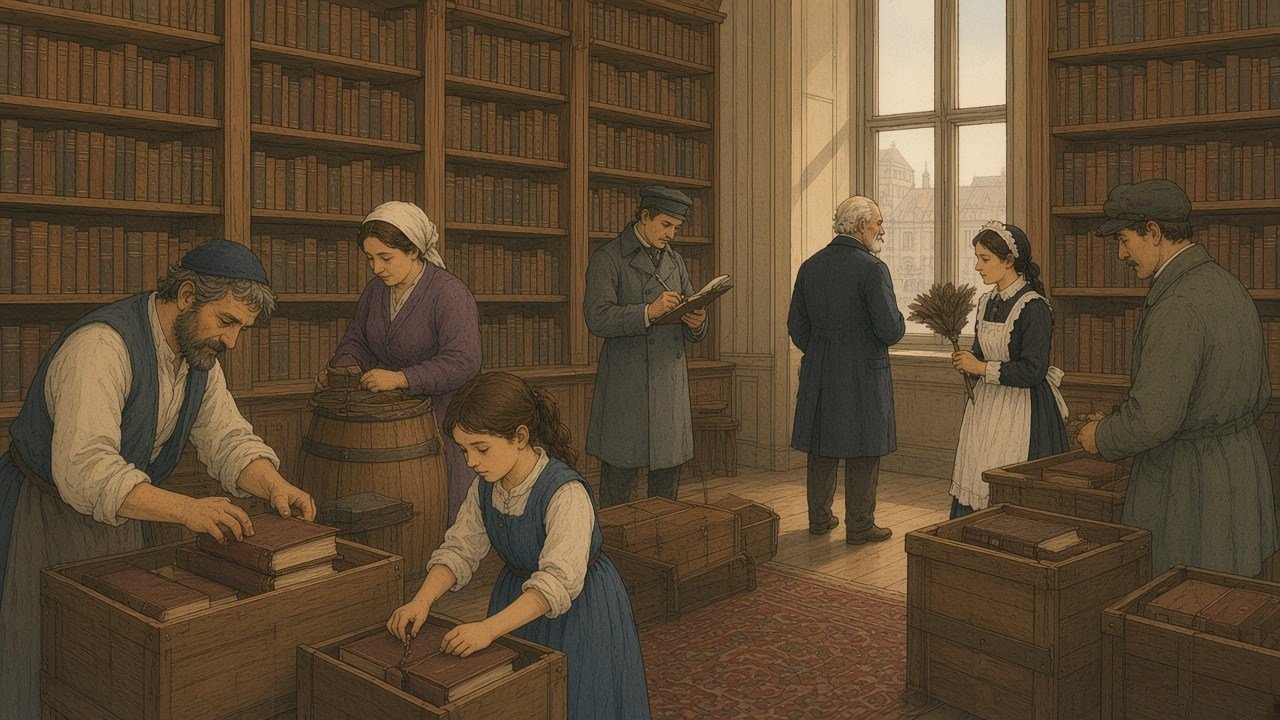
Following the Anschluss, the United States Holocaust Memorial Museum notes, the Germans quickly extended anti-Jewish legislation to Austria.[1] “Aryanisation”, in the Jewish Museum Berlin’s definition, was the expropriation or confiscation of Jewish people’s property, their businesses, shops, homes, land, stocks and cash, and its transfer to non-Jewish individuals or companies or to the state.[3] Those who wished to leave the country had to pay the Reich Flight Tax, and many sold their possessions to pay it.[4]
Arrest and renunciation
The Ephrussi were among the most conspicuous Jewish families in Vienna, and they were dealt with early. Jablonka quotes de Waal’s description of the Palais in those weeks: “The house wasn’t theirs anymore. It was full of people, some in uniform and some in suits. People counting rooms, making lists of objects and pictures, taking things away.”[4] An exhibition review describes the first page of the nine-page Gestapo inventory of the household, now in the family archive.[5]
On 18 April 1938, according to the New York wall texts, the Gestapo arrested Viktor Ephrussi and his youngest son, Rudolf.[2] Under threat of internment in a concentration camp, Viktor was forced to sign away all his assets: the businesses, the homes, works of art, jewellery, porcelain and furniture.[2] The Austrian Art Restitution Advisory Board, summarising the provenance dossier in its decision of 2019, puts it in legal language: after the Anschluss the Nazi regime took from Viktor the family’s assets and the bank; Viktor and Rudolf were arrested by the Gestapo; and Viktor, as head of the bank, had to sign a declaration renouncing his entire property.[6] The Board’s earlier decision of 2000 records that in 1938 his property was confiscated by the Gestapo and forfeited to the Land Österreich.[7] Father and son were released after their businesses had been expropriated.[2]
The family’s case is unusual in how much of it was documented. The Board’s decision of 2019 records that all the works of art and the library in the Vienna Palais were afterwards distributed among state collections or sold at auction.[6] The Telegraph interview with Edmund de Waal adds that Viktor had to sign over his bank shares to pay the Reich Flight Tax, which de Waal calculated at nearly £3 million in present-day money, for “permission” to leave the country.[8] An American magazine essay on the New York exhibition says that Viktor’s business was sold at a bargain-basement price.[9]
The bank in other hands
The bank of Ephrussi & Co. did not survive the year under its own name. On 12 August 1938, Jablonka writes, the Ephrussi company name was struck from the commercial register.[4] An AFP report on the 2019 exhibition summed up the speed of the family’s fall: its property was seized, its home occupied and its bank erased from the business register.[10] Melichar adds that Steinhäusser bought out not only Viktor’s share but Weiner’s 60 per cent.[11] The University of Vienna thesis says that Carl August Steinhäusser, a partner in the firm since 1922, took over the business in 1938.[12] Among the objects shown in New York was a gold pocket watch presented to Viktor in 1938, when he was compelled to retire and the Ephrussi businesses were “aryanised”.[5] The watch was a token of long service, handed to an old man by the firm that had just been taken from him.
The Palais became Nazi offices. The New York curators say that the building was occupied by Nazi administrative departments and that its collections were distributed to German and Austrian museums and dealers.[2] In 1934 the Ring outside had already been renamed in honour of Karl Lueger: the address of the Palais from 27 April 1934 was Dr.-Karl-Lueger-Ring 14.[13][14] The family of Ignaz von Ephrussi had been living for four years at an address named after the man who had made antisemitism respectable in Vienna.
Escape to Kövecses
Elisabeth was not in Vienna when the Anschluss came, and she could have stayed away. Instead, Leo Carey writes, she took the considerable risk of returning to Vienna to help her parents flee to a family estate in Czechoslovakia.[15] By marriage she had acquired Dutch nationality, Jablonka notes.[4] The Hoover archivist who catalogued her letters to Voegelin put it more sharply: she was able to enter Austria in 1938 on her Dutch passport, “a courageous move considering the family’s Jewish origins”.[16] Her friend Eric Voegelin was leaving Vienna at the same moment; the Hoover Institution notes that he fled after Hitler’s annexation of Austria in 1938 and settled in the United States.[17] Viktor and Emmy left the Palais they had lived in since 1899 and went to Kövecses, the country house in what is now Slovakia where their children had spent their summers.[2][6]
Rudolf, released from Gestapo custody, emigrated to the United States in 1939, where Iggie was already living.[2] Gisela and her family had reached Mexico in 1938.[2] Of the household that had filled the Palais at the turn of the century, almost nothing remained in Vienna by the summer of 1938 except the furniture, the pictures, the library and the vitrine in Emmy’s dressing room, and the servants who had to watch them being counted, packed and carried away. One of those servants, according to the family story, was a maid called Anna.[2][4]
References
OpenClose
- United States Holocaust Memorial Museum, Holocaust Encyclopedia, “Austria” *
- The Jewish Museum, New York, “The Hare with Amber Eyes,” exhibition wall texts and Ephrussi family tree (2021) *
- Jewish Museum Berlin, “Expropriation (‘Aryanization’)” *
- Ivan Jablonka, “The Ephrussi Treasure,” Books & Ideas (La Vie des idées) *
- Frances Brent, “How a Collection of Japanese Netsuke Sheds Light on a Jewish Family’s Tumultuous History,” Moment, 11 April 2022 *
- Kunstrückgabebeirat (Austrian Art Restitution Advisory Board), decision “Ephrussi Viktor,” 12 April 2019 *
- Kunstrückgabebeirat (Austrian Art Restitution Advisory Board), decision “Ephrussi Viktor,” 27 March 2000 *
- Chris Harvey, “Edmund de Waal interview: ‘I feel bereft after selling my family treasures’,” The Daily Telegraph, 2020, reprinted by the Commission for Looted Art in Europe *
- “Family Saga,” The Magazine Antiques, 19 November 2021 *
- AFP, “The rediscovered memories of a Viennese Jewish family,” RFI, 14 November 2019 *
- Peter Melichar, “Wer war Alexander Weiner?,” Wiener Zeitung, 31 October 2021 *
- Master’s thesis on the Ephrussi family, University of Vienna, Phaidra repository o:1912906 (excerpt consulted) *
- Wien Geschichte Wiki (City of Vienna), “Ignaz Ephrussi” *
- Wien Geschichte Wiki (City of Vienna), “Ephrussipalais” *
- Leo Carey, “Coming Back,” The New York Review of Books, 24 April 2014 *
- Hoover Institution Archives, “Connections,” Hoover Archivists’ Musings, 15 February 2011 *
- Hoover Institution, “The Hoover Archives acquires additional letters by Eric Voegelin,” 4 February 2011 *
The family tree, timeline, places, glossary and select bibliography for the whole history are on the Ephrussi index page.