Elly Kadoorie’s marriage to Laura Mocatta joined a Baghdadi trader to an old London Sephardi family. Their household moved between Hong Kong, England and Shanghai until a fire in 1919 ended it.
By the 1890s Elly Kadoorie was a man of means, and it was in London that he found a wife. The marriage he made there shaped the family as much as any business decision. Laura Mocatta brought a connection with one of the oldest Jewish families in England, a sharp and independent mind, and a habit of writing things down. Her sons would found the family’s twentieth-century fortunes, and her name would be given to schools in Baghdad. Her life in the East lasted a little over twenty years and ended violently in Shanghai.
A Marriage in London
The family’s Heritage Project describes Laura Kadoorie, born Mocatta, as coming from a prestigious London Sephardi Jewish family, and as a keen diarist, painter and adventurous traveller. She met Elly in London in the early 1890s, and they were married at the West London Synagogue in 1897[1]. The local historians of Historic Shanghai put the match more bluntly: Elly “married well”, since the Mocattas were a very old and very wealthy Sephardi family, well known for their philanthropy[2].
Not every source agrees even on her name. The Science Museum Group’s biographical record of her elder son names his mother as Laura Samuel[3]. The Heritage Project, which holds the family’s papers, and Historic Shanghai both call her Laura Mocatta, and this history follows them[1][2]. The discrepancy is noted here because the Science Museum record is otherwise one of the fullest published accounts of Lawrence’s life, and readers who meet the other name should know that it refers to the same woman.
The Mocattas
The Mocattas were among the oldest Jewish families in England. The Encyclopaedia Judaica’s entry, reproduced by the Jewish Virtual Library, describes them as an English family of Marrano origin: the founder, Moses Mocatta, came from Amsterdam, appears in a synagogue list of Bevis Marks in London in 1671, and was a diamond broker and merchant[4]. The British Museum’s record of the family firm dates its foundation to 1671, in Camomile Street, and records that Abraham Mocatta was admitted as a broker on the Royal Exchange in 1710[5]. With the Goldsmids the family founded Mocatta and Goldsmid, “later bullion brokers to the Bank of England, engaging in enormous transactions”; one Mocatta daughter, Rachel, was the mother of Sir Moses Montefiore[4]. Nine generations of the family presided over the firm, the British Museum says, and no member of the family has been actively involved in it since the death of Edward Mocatta in 1976[5].
The family also had a particular tie to the synagogue where Laura was married. The Judaica entry notes that nine of the twenty-four founders of the Reform Congregation were Mocattas[4], and the West London Synagogue, founded on 15 April 1840 by twenty-four men from families such as the Mocattas, Montefiores, Henriques and Goldsmids, was the first Reform congregation in Britain, though it took the name Reform only later[6][7]. Frederick David Mocatta, who died in 1905, was in the Judaica’s words “the representative ideal of late Victorian Anglo-Jewry”, active in both the Charity Organization Society and the Jewish Board of Guardians[4]. The sources consulted do not say exactly how Laura was related to these men, and no line of descent is offered here. The University of Washington’s Stroum Center, whose researcher worked in the Kadoorie archive, describes her simply as born in London to “an aristocratic family known for their philanthropic involvement in the arts”[8].
For a Baghdadi merchant who had arrived in the East as a teenager, the marriage was a social step into the old Anglo-Jewish establishment. For the Kadoories’ later public life it mattered in more practical ways too. It tied the family to London, where the sons would be educated, where Elly kept business interests, and where the family’s philanthropy in Palestine and Iraq would be negotiated with British officials[2][9].
Three Sons
The couple settled in Hong Kong around 1897[1]. Their first son, Lawrence, was born on 2 June 1899. The Science Museum record says that he was born Lawrence Kelly, the name under which his father then traded, and gives his birthplace as Upper Richmond Road, Hong Kong[3]. The Independent’s obituary, by Derek Davies, also gives Hong Kong and the same date[10]. The Los Angeles Times, carrying a Reuters report, noted that he was born less than a year after the British signed the 99-year lease on the New Territories, whose expiry in 1997 would mark Hong Kong’s return to China[11]. Lawrence lived just long enough to see the handover negotiated, though not completed.
A second son, Victor, was born in 1900 and died in infancy, and a third, Horace, was born in 1902[1]. The Science Museum record says instead that it was the youngest son who died in infancy, which cannot be squared with Horace’s long life; the Heritage Project’s order is followed here[3][1]. The University of Hong Kong’s citation for his honorary degree says that Horace was born in London, on 28 September 1902[12].
The brothers were very different. Lawrence became the businessman, the negotiator with governments and the face of China Light and Power; Horace became the hotelier, the gardener and the patron of farmers. The New York Times obituary of Horace in 1995 summed up the division by saying that Lawrence “took the lead in business affairs” while Horace chaired The Hongkong and Shanghai Hotels for thirty-five years[13]. The division began in the family’s Shanghai years, when Horace ran the household and Lawrence worked alongside their father[3].
England, Canada and Shanghai
Around 1910 the family moved to England. Elly went back east in 1911, and opened a new head office in Shanghai, the city that would be the centre of his business for the rest of his life[3][1]. The boys stayed on in England for school. The Science Museum record names Ascham St Vincent’s in Eastbourne and Clifton College in Bristol[3].
The First World War interrupted their education in an unexpected way. In 1914, the same record says, the family met for a reunion at Banff in Canada; unable to return to England, the boys went on to Shanghai, where they attended the cathedral school[3]. From that point Shanghai, rather than Hong Kong or London, was their home. The Los Angeles Times obituary of Lawrence says simply that he was educated in Shanghai and Britain[11].
The House on Bubbling Well Road
The Kadoories’ Shanghai home stood in the western part of the International Settlement, on Bubbling Well Road, the broad avenue that is now Nanjing West Road. The Heritage Project gives the address as 161 Bubbling Well Road[1]. Historic Shanghai places it on the eastern part of the road, opposite Cecile Court, the house of the family’s great friends the McBains; that three-storey mansion, built in 1906 on ten acres of land, was later sold to the Kadoorie-controlled hotel company and converted into the Majestic Hotel[2]. The two houses faced each other across the road. One would become a famous hotel. The other would burn.
A Liberated Woman
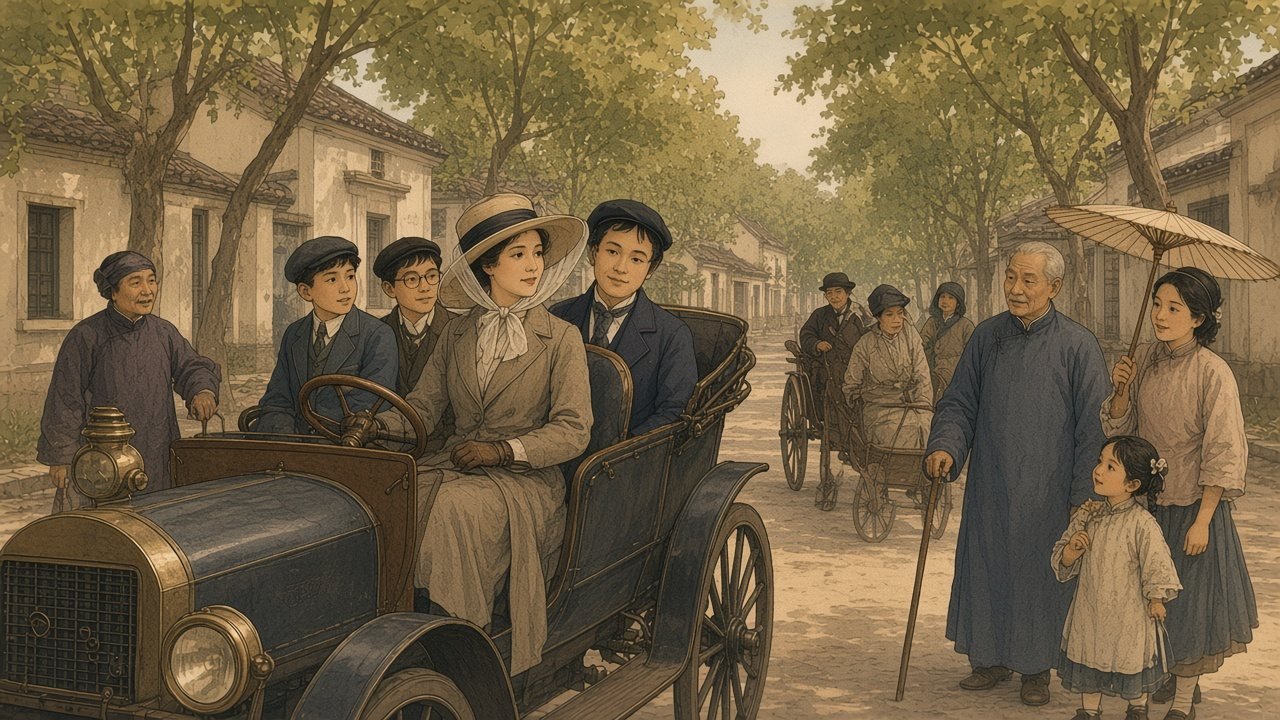
Laura’s life in Shanghai is known mainly through brief descriptions, though her diaries survive in the family archive[1]. Historic Shanghai records that she “was said to be the most liberated woman in Shanghai, driving motorcars, shooting, and agitating for men’s clubs to open their ranks to women”[2]. The phrase “was said to be” is the historians’ own, and it is a fair warning: much of what is told about Laura comes from family memory rather than contemporary record. But the picture is consistent with the Heritage Project’s description of a painter and adventurous traveller, and with the way her husband later chose to commemorate her, by founding schools and workshops for girls in Baghdad.
The Fire of 1919
In February 1919 a fire broke out in the house on Bubbling Well Road. According to Historic Shanghai, Laura lost her life after running back inside to rescue the governess[2]. The Heritage Project records simply that in 1919 she died in a fire in the family home at 161 Bubbling Well Road[1]. Elly and his sons buried her in the Jewish cemetery on Bubbling Well Road, and left for London, where the boys had been at school[2].
A Disputed Date
Even the year of Laura’s death is not quite settled. The Stroum Center gives her dates as 1865 to 1918[8]. The Heritage Project and Historic Shanghai both put the fire in 1919, and Historic Shanghai names the month as February[1][2]. The family archive’s own account is followed here, but the earlier date is recorded because it appears in an academic publication drawn from the same archive. If the Stroum Center’s year of birth is right, Laura was about thirty-two when she married and about fifty-three or fifty-four when she died; no other source consulted gives a year of birth.
Her death fell in a season of fires. Barely a year later, in May 1920, fire destroyed the upper floors of a newly opened Jewish country club further west along the same road, a building in whose construction Elly had been the driving force; a contemporary headline in the North-China Herald suspected incendiarism[2]. The rebuilding of that club would produce the family’s most famous house, as the chapter on Marble Hall describes.
Sons as Partners
The Science Museum record says that after their mother’s death the two brothers “took on the responsibility of building up the Kadoorie name in Asia”[3]. Lawrence studied law at Lincoln’s Inn in London and then became his father’s aide-de-camp; Horace, in Shanghai, ran the family home[3]. In 1927 the firm was renamed Sir Elly Kadoorie & Sons, to mark the sons’ entry into the business[1]. By then Elly had been knighted, and the Encyclopaedia Judaica records his appointment as a Knight Commander of the Order of the British Empire in 1926[14].
What Laura Left
Elly never remarried in the sources consulted for this history. Laura’s memory is most visible in Baghdad. The Encyclopaedia Judaica records that in 1911, while she was still alive, he established a school there named in her honour, and in 1922, three years after her death, a girls’ sewing school, also named after her[14]. The Heritage Project dates the renaming of the Alliance Israélite Universelle’s girls’ school in Baghdad as the Lady Laura Kadoorie School and Atelier for Girls to 1912, and says that for a time it played an important part in the emancipation of women in Baghdad by providing non-denominational education and promoting a culture of independence[1]. Those schools, and the rest of the brothers’ philanthropy, are the subject of the next two chapters.
Her name travelled further. In 1920, the year after her death, a Jewish hospital in the Balat quarter of Istanbul that the family supported was renamed the Laura Kadoorie Or Hayim Hospital, as the chapter on philanthropy describes[8]. The Stroum Center’s study of Elly’s correspondence observes that he “fashioned himself as a champion for Women’s rights, with an emphasis on education in a global sense”[8]; how much of that conviction came from Laura the letters do not say, but the pattern of his giving after 1919 suggests that her memory was never far from it. The Heritage Project’s archive preserves her image too: among its photographs is an artist’s sketch of Laura made around 1910, in the years just before the move to Shanghai[1].
References
OpenClose
- Hong Kong Heritage Project, “Kadoorie Family: A Short History”, Hong Kong Heritage Project online collection (accessed 16 November 2026) *
- Historic Shanghai, “Tour Report: Inside Marble Hall, The Kadoorie Mansion” *
- Science Museum Group Collection, “Lawrence Kadoorie 1899–1993”, biographical record *
- Jewish Virtual Library, “Mocatta” (from the Encyclopaedia Judaica) *
- British Museum, Collections Online, “Mocatta & Goldsmid” (biographical record) *
- West London Synagogue, “Our History” *
- JCR-UK (JewishGen), “West London Synagogue of British Jews (Reform): History” *
- Stroum Center for Jewish Studies, University of Washington, “From Baghdad to Hong Kong: Jewish Philanthropy and the Kadoorie Family” *
- The Hongkong and Shanghai Hotels, Limited, Tradition Well Served: 150 Years (Hong Kong: HSH, 2016), anniversary magazine with a chairman’s letter by Sir Michael Kadoorie *
- Derek Davies, “Obituary: Lord Kadoorie”, The Independent, 26 August 1993 *
- Reuters, “Lord Kadoorie; First Peer in Hong Kong”, Los Angeles Times, 26 August 1993 *
- University of Hong Kong, “Horace KADOORIE – Citation”, Honorary Graduates *
- “Horace Kadoorie, Philanthropist, 92”, The New York Times, 26 April 1995 *
- Rudolph Loewenthal, “Kadoorie”, Encyclopaedia Judaica, 2nd edn (Detroit: Macmillan Reference, 2007), reprinted at Encyclopedia.com *
The family tree, timeline, places, glossary and select bibliography for the whole history are on the Kadoorie index page.