HISTORICAL CONTEXT · WARS OF RELIGION
Papal Armada, Maritime Slaughter, and the Deification of Crusading Violence
Contents
- I. The Fall of Cyprus and the Forging of the League
- II. The Collision in the Gulf of Patras
- III. Five Hours of Slaughter at Sea
- IV. Liturgical Triumphalism: Our Lady of Victory
- V. Theological Contrast: The Healing of Malchus vs. The Sword of Flesh
- VI. Chronology & Primary Sources
- Bibliography & Primary Sources
I. The Fall of Cyprus and the Forging of the League
In 1570, Ottoman forces invaded the Venetian-held island of Cyprus, culminating in the horrific eleven-month siege of Famagusta. When the city surrendered under terms of honorable safe conduct, the Ottoman commander Lala Mustafa Pasha reneged on his oath: the Venetian commander Marco Antonio Bragadin was bound, his ears and nose sliced off, and after two weeks of public torment, he was flayed alive in the town square. His skin, stuffed with straw, was paraded through the Levant.
News of this atrocity horrified Southern Europe. Pope Pius V (Michele Ghislieri), a fierce inquisitor and Counter-Reformation zealot, seized the moment to forge the Holy League (*Sacra Liga*), uniting the maritime republics of Venice and Genoa with the vast resources of Philip II’s Spain. Pius declared the expedition a holy crusade, granting plenary indulgences to all who served and presenting a colossal consecrated blue silk banner (*estendardo*) emblazoned with the crucified Christ to the expedition’s supreme commander, Don John of Austria, the twenty-four-year-old illegitimate half-brother of Philip II.
II. The Collision in the Gulf of Patras
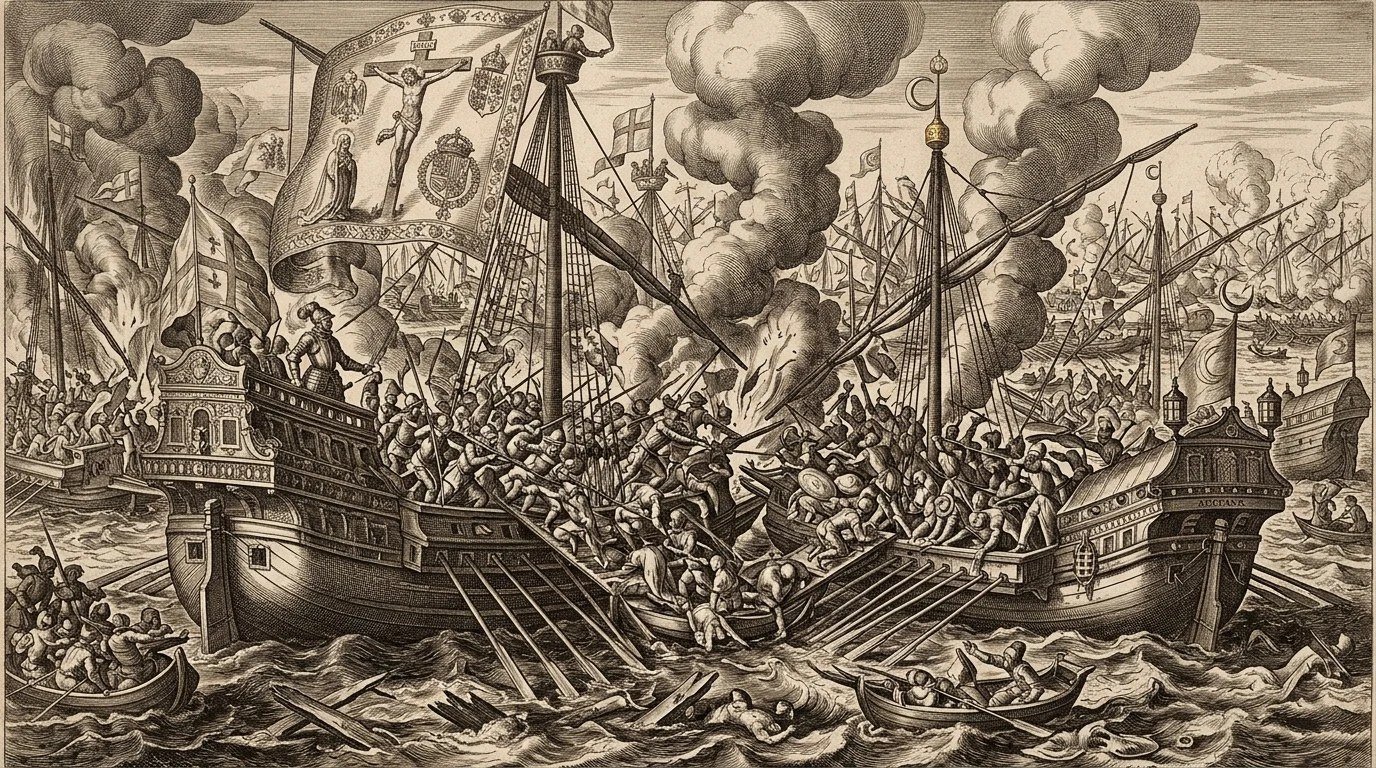
On the morning of Sunday, 7 October 1571, the two colossal armadas encountered one another at the entrance to the Gulf of Corinth, off the Curzolari islands near Lepanto (Nafpaktos). The Holy League deployed 206 galleys, six massive Venetian gun platforms known as *galleasses*, and 28,000 veteran infantry—including thousands of Spanish tercios, Italian arquebusiers, and German mercenaries. Facing them was the Ottoman grand fleet of Müezzinzade Ali Pasha, comprising 222 war galleys and 34,000 troops, alongside thousands of enslaved Christian oarsmen chained to the rowing benches.
As the fleets closed, Don John stood on the prow of his flagship *Real*, holding a crucifix aloft, while Franciscan and Jesuit chaplains moved among the decks granting general absolution to soldiers clutching muskets and boarding pikes. On the Ottoman flagship *Sultana*, Ali Pasha unfurled the sacred Green Banner of the Caliphs, embroidered twenty-eight thousand times in golden calligraphy with the name of God.
III. Five Hours of Slaughter at Sea
The battle was decided by raw firepower and horrific hand-to-hand melee. The six Venetian galleasses, bristling with heavy bronze cannons on all four sides, disrupted the Ottoman center, sinking dozens of galleys before they could close. When the opposing flagships, the *Real* and the *Sultana*, collided prow-to-prow, their forecastles formed an elevated floating slaughterhouse.
Three times Spanish infantry boarded the *Sultana*; three times they were thrown back by Janissary archers. On the fourth assault, Ali Pasha was struck in the head by an arquebus ball. As he lay dying, a Spanish galley slave severed his head and raised it on a pike. Panic convulsed the Ottoman center. By late afternoon, the sea was crimson with blood and clogged with burning wreckage, drifting oars, and thrashing drowning men. Over thirty thousand Ottoman sailors and soldiers had perished; twelve thousand Christian galley slaves were liberated from Ottoman chains; and the Holy League lost over seven thousand men, including the wounded Spanish writer Miguel de Cervantes, who lost the use of his left hand.
IV. Liturgical Triumphalism and Our Lady of Victory
When news of the slaughter reached Rome, Pope Pius V reportedly wept with joy, quoting the Gospel of John: “There was a man sent from God whose name was John” (referring to Don John of Austria). The papacy declared 7 October an annual feast day of ‘Our Lady of Victory’ (later transformed into the Feast of Our Lady of the Rosary).
In churches across Italy and Spain, Te Deums were sung, triumphal arches erected, and grand baroque frescoes commissioned showing angels guiding Spanish cannonballs into Turkish sailors. Mass butchery—over thirty thousand souls extinguished in a single afternoon—was celebrated as a sacrament of divine providence, demonstrating how completely Christendom had substituted imperial bloodlust for the Sermon on the Mount.
V. Theological Contrast between the Healing of Malchus and the Sword of Flesh
The glorification of Lepanto stands as a profound theological indictment of carnal religion. In the Garden of Gethsemane, when Peter drew an iron sword to protect his Master from unlawful arrest, cutting off the ear of the high priest’s servant Malchus, Jesus issued an absolute prohibition against retaliatory violence:
“Then Jesus said to him: ‘Return your sword to its place, for all those who take up the sword will perish by the sword.’ And touching the ear, he healed him.” — Matthew 26:52, Luke 22:51
If Christ refused to allow a sword to be drawn in direct defense of his own physical person, upon what biblical authority could Renaissance pontiffs consecrate naval armadas to slaughter thousands of sailors in the Mediterranean? Writing to the Corinthian congregation, the apostle Paul dismantled the entire concept of holy war:
“For though we walk in the flesh, we do not wage warfare according to what we are in the flesh. For the weapons of our warfare are not fleshly, but powerful by God for overturning strongly entrenched things.” — 2 Corinthians 10:3–4
VI. Chronology & Primary Sources
The principal archival sources for Lepanto include the official dispatches of Don John of Austria in the Archive of Simancas, the Venetian state reports (*Relazioni*) of Sebastiano Venier, and contemporary chronicles by Ferrante Caracciolo and Marco Antonio Arroyo.
- 1 July 1570: Ottoman invasion of Cyprus begins; siege of Nicosia and Famagusta.
- 25 May 1571: Pope Pius V proclaims the Holy League between Spain, Venice, and the Papacy.
- 1 August 1571: Fall of Famagusta; martyrdom of Marco Antonio Bragadin.
- 16 September 1571: Allied Holy League fleet sails from Messina.
- 7 October 1571: Battle of Lepanto; Ottoman navy destroyed; 30,000 casualties.
- March 1573: Venice signs separate peace with the Ottoman Empire, ceding Cyprus.
Bibliography & Primary Sources
The following primary archival records and scholarly editions underlie this monograph: