The Theory of Plate Tectonics
1. At a glance
The theory of plate tectonics is the unifying framework of modern earth science, and its acceptance between the 1950s and the late 1960s is one of the most consequential scientific revolutions of the twentieth century. The theory states that the outer shell of the Earth, the lithosphere, is broken into a small number of rigid plates that move relative to each other, and that the motion of the plates is responsible for the major features of the Earth’s surface: the continents, the ocean basins, the mountain ranges, the earthquakes, and the volcanoes. The theory developed in stages over more than a century, beginning with Alfred Wegener’s hypothesis of continental drift in 1912, advancing through the post-war discoveries of mid-ocean ridges and seafloor spreading, and culminating in the synthesis of plate tectonics in the late 1960s. The acceptance of the theory is a model for how a scientific revolution unfolds: it required decades of new data, the failure of alternative hypotheses, and the development of a new theoretical framework that could accommodate the new data.
2. Wegener and the hypothesis of continental drift
Alfred Wegener was a German meteorologist and polar researcher who, in 1912, published the first edition of his hypothesis of continental drift. Wegener was not the first to notice that the Atlantic coastlines of Africa and South America fit together like pieces of a puzzle; that observation had been made by Francis Bacon in 1620, by Alexander von Humboldt in 1801, by Antonio Snider-Pellegrini in 1858, and by several others in between. Wegener was, however, the first to assemble the geological, palaeontological, and palaeoclimatic evidence into a single coherent hypothesis, and he was the first to propose a physical mechanism for the motion. Wegener’s hypothesis was, in this sense, the first modern hypothesis of continental drift, and Wegener is, in the history of science, the principal early proponent of the hypothesis.
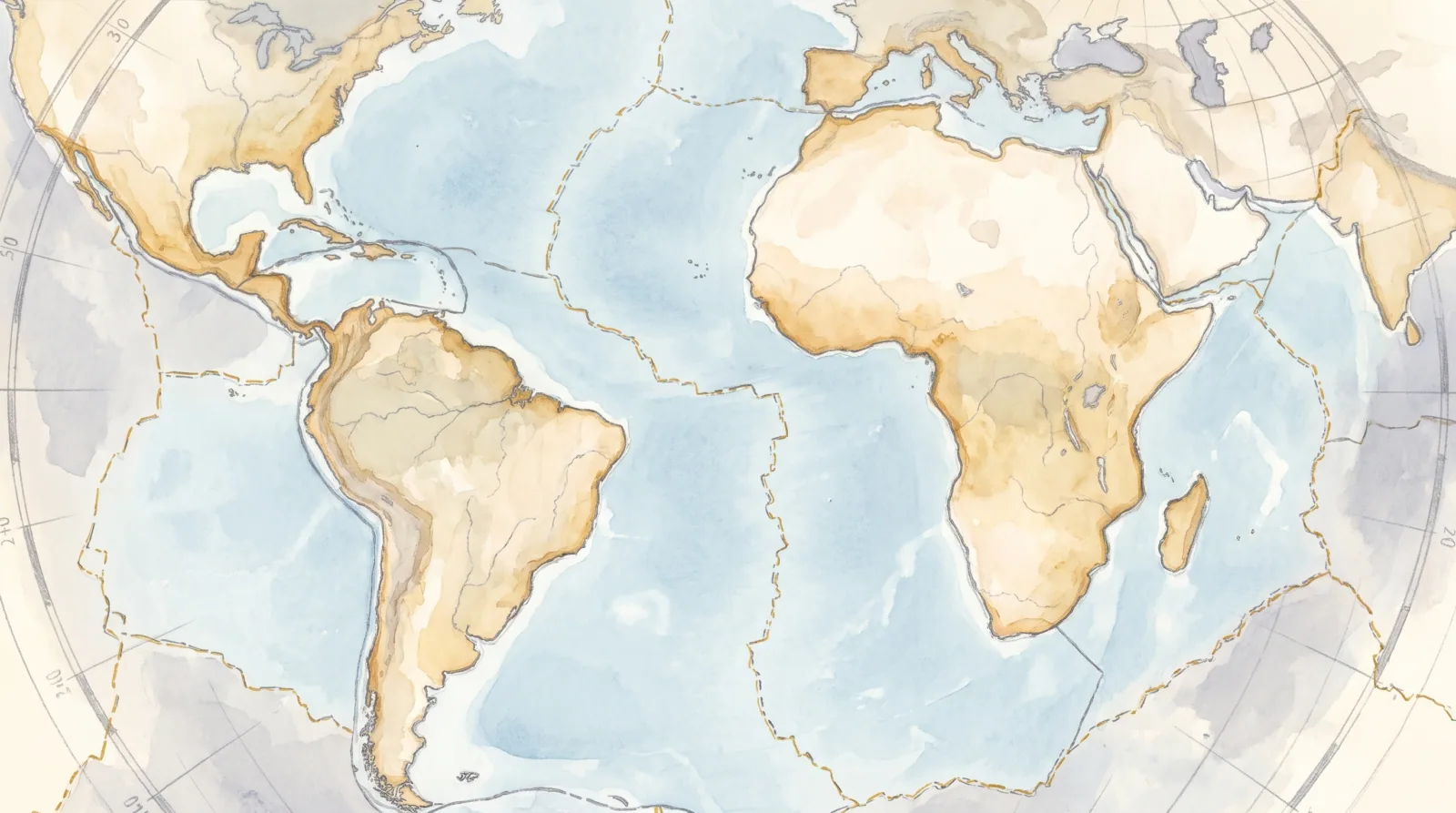
Wegener’s evidence was of four kinds. First, the geometric fit of the Atlantic coastlines of Africa and South America was strikingly close, especially when matched at the edge of the continental shelf rather than at the modern coastline. Second, the geological structures of the African and South American coasts matched across the Atlantic: the Cape Fold Belt of South Africa matched the Sierra de la Ventana of Argentina, the Brazilian coastal ranges matched the West African coastal ranges, and the stratigraphic sequences of the two coasts matched in detail. Third, the fossil record showed that several terrestrial species had been distributed across the southern continents in patterns that were incompatible with the present configuration of the continents. The late Palaeozoic and early Mesozoic distribution of the Mesosaurus, a freshwater reptile, the Cynognathus, a terrestrial reptile, and the Glossopteris, a seed fern, was, in particular, distributed across South America, Africa, India, Australia, and Antarctica, a distribution that could not be explained by dispersal across the present ocean basins. Fourth, the palaeoclimatic record showed that the southern continents had shared a common glacial history in the late Carboniferous and early Permian, with glacial deposits and glacial erratics distributed across South America, Africa, India, Australia, and Antarctica in a pattern that could not be explained by the present configuration of the continents.
Wegener’s proposed mechanism was, however, weak. Wegener proposed that the continents ploughed through the oceanic crust under the influence of the Earth’s rotation, and he proposed a force, the Polfluchtkraft, that he claimed was sufficient to drive the motion. The mechanism was, however, rejected by most of Wegener’s contemporaries, and the rejection of the mechanism was the principal reason for the initial rejection of the hypothesis. The rejection of Wegener’s mechanism was, in turn, the principal reason for the long delay in the acceptance of the hypothesis, and the rejection of Wegener’s mechanism was, in this sense, the principal reason for the scientific controversy of the mid-twentieth century.
Wegener’s hypothesis was, in any event, the 19th and early 20th century foundation of plate tectonics, and Wegener is, in the history of science, the principal early proponent of the hypothesis. Wegener’s hypothesis was rejected by most of his contemporaries in the 1920s and 1930s, and the rejection was, in turn, the principal reason for the long delay in the acceptance of the hypothesis. Wegener’s hypothesis was, however, vindicated by the post-war discoveries of mid-ocean ridges and seafloor spreading, and Wegener is, in the history of science, the principal early proponent of the hypothesis of continental drift.
3. Holmes and the mantle convection hypothesis
Arthur Holmes, the British geologist, was Wegener’s principal early defender in the English-speaking world, and Holmes was, in the 1920s and 1930s, the principal proponent of a subdivision scheme. Holmes proposed that the motion of the continents was driven by convection currents within the Earth’s mantle, and Holmes proposed a physical mechanism for the motion that was, in its essentials, the mechanism that would later be confirmed by the post-war discoveries. Holmes’s hypothesis was, however, rejected by most of Holmes’s contemporaries, and the rejection of the hypothesis was, in turn, the principal reason for the long delay in the acceptance of the subdivision scheme.
Holmes’s principal publication was his 1928 paper “Radioactivity and the Earth’s Surface Contraction,” in which he proposed that the heat generated by the radioactive decay of uranium, thorium, and potassium within the Earth’s interior was sufficient to drive convection currents within the mantle. Holmes argued that the heat was sufficient to drive the convection, and he argued that the convection was sufficient to drive the motion of the continents. Holmes’s hypothesis was, however, rejected by most of his contemporaries, and the rejection of the hypothesis was, in turn, the principal reason for the long delay in the acceptance of the subdivision scheme.
Holmes’s hypothesis was, in any event, the 1920s and 1930s foundation of plate tectonics, and Holmes is, in the history of science, the principal proponent of the mantle convection hypothesis. Holmes’s hypothesis was rejected by most of his contemporaries in the 1920s and 1930s, and the rejection was, in turn, the principal reason for the long delay in the acceptance of the subdivision scheme. Holmes’s hypothesis was, however, vindicated by the post-war discoveries of mid-ocean ridges and seafloor spreading, and Holmes is, in the history of science, the principal proponent of the mantle convection hypothesis.
4. Mid-ocean ridges and seafloor spreading
The post-war major discoveries that led to the acceptance of plate tectonics were the discovery of the mid-ocean ridges, the discovery of seafloor spreading, and the discovery of magnetic reversals on the ocean floor. The three discoveries together constituted the empirical foundation of plate tectonics, and the three discoveries together were, in the 1950s and 1960s, the principal discoveries of marine geology and geophysics.
The mid-ocean ridges were first mapped by the post-war oceanographic expeditions led by Maurice Ewing, Bruce Heezen, and Marie Tharp. The mid-ocean ridges were found to be a continuous chain of underwater mountains that ran through all the major ocean basins: the Mid-Atlantic Ridge, the East Pacific Rise, the Indian Ocean Ridge, and the Antarctic Ridge. The mid-ocean ridges were, in their scale, the largest geological feature of the Earth’s surface, and the mid-ocean ridges were, in their length, more than 60,000 kilometres. The mid-ocean ridges were, in their geological character, the principal site of volcanic activity on the Earth’s surface, and the mid-ocean ridges were, in their heat flow, the principal site of heat loss from the Earth’s interior.
Seafloor spreading was first proposed by Harry Hess in 1962. Hess proposed that new ocean floor was generated at the mid-ocean ridges by the upwelling of mantle material, and that the new ocean floor was carried away from the ridges by the motion of the seafloor. Hess proposed, in addition, that the ocean floor was consumed at the ocean trenches, where the ocean floor was subducted back into the mantle. Hess’s proposal was, in its essentials, the mechanism that would later be confirmed as the mechanism of plate tectonics, and Hess’s proposal was, in its postulation, the principal theoretical advance of the post-war period.
The magnetic reversals on the ocean floor were first discovered by Fred Vine and Drummond Matthews in 1963. Vine and Matthews proposed that the ocean floor was imprinted with a pattern of magnetic reversals, with bands of normal polarity alternating with bands of reversed polarity. The pattern was, in its symmetry, symmetric about the mid-ocean ridges, and the pattern was, in its width, proportional to the rate of seafloor spreading. Vine and Matthews’ discovery was, in its consequences, the principal empirical confirmation of seafloor spreading, and Vine and Matthews’ discovery was, in this sense, the principal empirical confirmation of plate tectonics.
5. The plate tectonic synthesis
The plate tectonic synthesis was assembled in the late 1960s, principally by the Canadian geophysicist J. Tuzo Wilson, the American geophysicist Jason Morgan, the French geophysicist Xavier Le Pichon, and the British geophysicist Dan McKenzie. The synthesis combined the post-war discoveries of mid-ocean ridges, seafloor spreading, and magnetic reversals with the earlier geological evidence of Wegener and the earlier theoretical proposals of Holmes into a single coherent framework. The framework, plate tectonics, was, in its postulation, the principal theoretical achievement of twentieth-century earth science, and the framework was, in its consequences, the principal theoretical achievement of twentieth-century geological studies.
The plate tectonic framework stated that the Earth’s lithosphere is broken into a small number of rigid plates that move relative to each other, and that the motion of the plates is responsible for the major features of the Earth’s surface. The principal plates were, in the original framework, the Pacific Plate, the North American Plate, the South American Plate, the Eurasian Plate, the African Plate, the Indian-Australian Plate, the Antarctic Plate, and several smaller plates. The plates were bounded by three kinds of boundaries: divergent boundaries, where new ocean floor is generated at mid-ocean ridges; convergent boundaries, where ocean floor is consumed at ocean trenches; and transform boundaries, where plates slide past each other. The plate boundaries were, in this sense, the principal sites of geological activity on the Earth’s surface, and the plate boundaries were, in this sense, the principal sites of earthquakes, volcanoes, and mountain ranges.
The plate tectonic framework was, in addition, a quantitative framework. The motion of the plates could be described by the Euler pole of each plate, the point on the Earth’s surface about which the plate rotates, and the rate of rotation of the plate. The motion of the plates could be measured by the magnetic reversal pattern on the ocean floor, by the satellite laser ranging of the Earth’s surface, and by the global positioning system. The motion of the plates was, in this sense, a measurable phenomenon, and the plate tectonic framework was, in this sense, a quantitative framework.
6. Implications for geology
The plate tectonic framework has, since the late 1960s, transformed the earth sciences. The framework has provided a unified explanation for the major features of the Earth’s surface: the continents, the ocean basins, the mountain ranges, the earthquakes, and the volcanoes. The framework has, in addition, provided a unified explanation for the major features of the Earth’s interior: the core, the mantle, the lithosphere, and the asthenosphere. The framework has, in addition, provided a unified explanation for the major features of the Earth’s history: the assembly and breakup of supercontinents, the opening and closing of ocean basins, and the distribution of fossils and geological formations.
The plate tectonic framework has, in particular, transformed the study of earthquakes. The framework has shown that earthquakes are concentrated at plate boundaries, and the framework has shown that the magnitude and frequency of earthquakes are determined by the rate and direction of plate motion. The framework has, in addition, provided a basis for the assessment of earthquake hazard, and the framework has, in this sense, been the basis of modern seismic hazard maps. The framework has, in addition, been the basis of modern earthquake prediction research, and the framework has been the basis of modern earthquake early warning systems.
The plate tectonic framework has, in addition, transformed the study of volcanoes. The framework has shown that volcanoes are concentrated at plate boundaries, and the framework has shown that the composition and style of volcanism are determined by the type of plate boundary. The framework has, in addition, provided a basis for the assessment of volcanic hazard, and the framework has, in this sense, been the basis of modern volcanic hazard maps. The framework has, in addition, been the basis of modern volcano monitoring research, and the framework has been the basis of modern volcano early warning systems.
The plate tectonic framework has, in addition, transformed the study of mountain ranges. The framework has shown that mountain ranges are formed at convergent plate boundaries, and the framework has shown that the height and extent of the orogens are determined by the rate and direction of plate motion. The framework has, in addition, provided a basis for the reconstruction of past plate configurations, and the framework has been the basis of modern palaeogeographic reconstructions. The framework has, in this sense, been the basis of modern studies of the assembly and breakup of supercontinents.
7. Implications for the Earth system
The plate tectonic framework has, in addition to its implications for geology, transformed the study of the Earth system as a whole. The framework has shown that the Earth’s climate is influenced by the configuration of the continents, and the framework has shown that the configuration of the continents is influenced by plate motion. The framework has, in addition, shown that the Earth’s biosphere is influenced by the configuration of the continents, and the framework has shown that the configuration of the continents is influenced by plate motion. The framework has, in addition, shown that the Earth’s oceans are influenced by the configuration of the continents, and the framework has shown that the configuration of the continents is influenced by plate motion.
The plate tectonic framework has, in particular, been the basis of the modern understanding of the supercontinent cycle. The supercontinent cycle is the cycle of assembly and breakup of supercontinents, with a period of approximately 400 to 500 million years. The most recent supercontinent, Pangaea, was assembled in the late Carboniferous and early Permian and began to break up in the Jurassic. The previous supercontinent, Gondwana, was assembled in the late Precambrian and began to break up in the early Jurassic. The supercontinent cycle has, in this sense, has been the basis of the modern understanding of the long-term evolution of the Earth’s surface.
The plate tectonic framework has, in addition, been the basis of the modern understanding of the long-term carbon cycle. The carbon cycle is the cycle of exchange of carbon between the Earth’s surface and the Earth’s interior, and the carbon cycle is, in its long-term components, regulated by the motion of the plates. The motion of the plates is, in turn, regulated by the mantle convection, and the convection cycle is, in turn, regulated by the heat loss from the Earth’s interior. The plate tectonic framework has, in this sense, been the basis of the modern understanding of the long-term carbon cycle.
The plate tectonic framework has, in addition, been the basis of the modern understanding of the long-term evolution of life. The framework has shown that the distribution of fossils is influenced by the configuration of the continents, and the framework has shown that the evolution of life is influenced by the configuration of the continents. The framework has, in addition, been the basis of the modern understanding of the evolution of biodiversity, and the framework has been the basis of the modern understanding of the evolution of marine and terrestrial ecosystems.
8. The scientific revolution
The acceptance of plate tectonics between the 1950s and the late 1960s is one of the most consequential scientific revolutions of the twentieth century, and the acceptance is a model for how a scientific revolution unfolds. The revolution required decades of new data: the post-war mapping of the ocean floor, the post-war measurement of magnetic reversals, the post-war development of radiometric techniques, the post-war development of geochronological instruments. The revolution required, in addition, the development of new theoretical frameworks: the mantle convection hypothesis of Holmes, the seafloor spreading hypothesis of Hess, the magnetic reversal hypothesis of Vine and Matthews, the plate tectonic framework of Wilson, Morgan, Le Pichon, and McKenzie. The revolution required, in addition, the failure of alternative hypotheses: the contracting Earth hypothesis, the expanding Earth hypothesis, the fixist hypothesis, and several other alternatives.
The scientific revolution of plate tectonics is, in this sense, a model of how a scientific revolution unfolds in the modern period. The revolution required decades of new data, accumulating in stages over a generation. The revolution required, in addition, the development of new theoretical frameworks, accumulating in stages over the same generation. The revolution required, in addition, the failure of alternative hypotheses, and the failure of alternative hypotheses was, in turn, the principal reason for the eventual acceptance of the new framework. The revolution is, in this sense, a model of how a scientific revolution unfolds in the modern period.
The scientific revolution of plate tectonics has, in addition, transformed the earth sciences. The transformation has been the transformation of a descriptive and qualitative discipline into a quantitative and predictive discipline. The transformation has been the transformation of a discipline that was based on the study of the continents into a discipline that is based on the study of the whole Earth. The transformation has been the transformation of a discipline that was based on the study of the present into a discipline that is based on the study of the present and the past. The transformation has, in this sense, been the transformation of the earth sciences into a modern discipline.
The scientific revolution of plate tectonics has, in addition, transformed the relationship between the earth sciences and the other sciences. The transformation has been the integration of the earth sciences with the other natural sciences, the integration of the earth sciences with the applied sciences, and the integration of the earth sciences with the social sciences. The transformation has, in this sense, been the transformation of the earth sciences into a modern interdisciplinary field. The transformation has, in addition, been the basis of the modern discipline of Earth system science, and the transformation has, in this sense, been the basis of the modern study of the Earth as a system.
9. Continuing questions
The plate tectonic framework has, since the late 1960s, been the principal framework of the earth sciences, and the framework has, in this sense, been remarkably successful. The framework has, however, a number of continuing questions that remain unresolved. The principal continuing questions are the driving mechanism of plate motion, the origin and evolution of plate tectonics on the early Earth, the relationship between plate tectonics and the mantle convection, and the role of plate tectonics in the long-term evolution of the Earth’s surface.
The driving mechanism of plate motion is the principal continuing question. The plate motion is, in the post-war period, attributed to the mantle convection, and the mantle convection is, in turn, attributed to the heat loss from the Earth’s interior. The mantle convection is, however, complex and poorly understood, and the relationship between the mantle convection and the plate motion is, in turn, complex and poorly understood. The relationship is, in this sense, a continuing question that remains the subject of active research.
The origin and evolution of plate tectonics on the early Earth is, in addition, a continuing question. The plate tectonics is, in the present, a well-established phenomenon, and the plate tectonics is, in the recent geological past, a well-documented phenomenon. The plate tectonics is, however, on the early Earth, a poorly understood phenomenon, and the plate tectonics is, on the early Earth, the subject of continuing research. The origin and evolution of plate tectonics on the early Earth is, in this sense, a continuing question that remains the subject of active research.
The relationship between plate tectonics and the mantle convection is, in addition, a continuing question. The plate tectonics is, in the present, a well-established phenomenon, and the mantle convection is, in the present, a well-established phenomenon. The relationship between the plate tectonics and the mantle convection is, however, complex and poorly understood, and the relationship is, in turn, the subject of continuing research. The relationship is, in this sense, a continuing question that remains the subject of active research.
The role of plate tectonics in the long-term evolution of the Earth’s surface is, in addition, a continuing question. The plate tectonics is, in the present, a well-established phenomenon, and the long-term evolution of the Earth’s surface is, in the present, a well-documented phenomenon. The role of the plate tectonics in the long-term evolution is, however, the subject of continuing research, and the role is, in turn, the subject of continuing research. The role is, in this sense, a continuing question that remains the subject of active research.
10. Methods and instruments
The empirical foundation of plate tectonics was, in the post-war period, built up by a small number of methods and instruments that transformed, by 20th century standards, the resolution and the precision of the available data. The principal methods were the ocean floor depth measurements of the post-war oceanographic expeditions, the magnetic surveys of the ocean floor by the post-war marine geophysical expeditions, the radiometric dating of rocks and minerals by the post-war geochronological laboratories, and the satellite geodesy and laser ranging of the Earth’s surface by the post-war geodetic satellites. The four methods together constituted the empirical foundation of plate tectonics, and the four methods together were, in this sense, the principal methods of the post-war earth sciences.
The ocean floor depth measurements were, in particular, a major technological achievement. The post-war oceanographic expeditions used echo-sounding instruments to measure the depth of the ocean floor, and the post-war expeditions produced the first systematic maps of the ocean floor. The maps were, in their resolution, the highest resolution maps of the ocean floor ever produced, and the maps were, in their coverage, the most complete maps of the ocean floor ever produced. The maps were, in this sense, the principal empirical contribution of the post-war oceanographic expeditions, and the maps were the basis of the post-war discovery of the mid-ocean ridges.
The magnetic surveys of the ocean floor were, in addition, a major technological achievement. The post-war marine geophysical expeditions used magnetometers towed behind research vessels to measure the magnetic field of the ocean floor, and the post-war expeditions produced the first systematic maps of the magnetic field of the ocean floor. The maps were, in their resolution, the highest resolution maps of the magnetic field of the ocean floor ever produced, and the maps were, in their coverage, the most complete maps of the magnetic field of the ocean floor ever produced. The maps were, in this sense, the principal empirical contribution of the post-war marine geophysical expeditions, and the maps were the basis of the post-war discovery of the magnetic reversals on the ocean floor.
The radiometric dating of rocks and minerals was, in addition, a major technological achievement. The post-war geochronological laboratories used mass spectrometric techniques to measure the radioactive decay of uranium, thorium, potassium, and rubidium in rocks and minerals, and the post-war laboratories produced the first systematic radiometric ages for rocks and minerals from the ocean floor and the continental crust. The ages were, in their precision, the highest precision radiometric ages ever produced, and the ages were, in their coverage, the most complete radiometric ages ever produced. The ages were, in this sense, the principal empirical contribution of the post-war geochronological laboratories, and the ages were the basis of the post-war development of the geological time scale.
The satellite geodesy and laser ranging of the Earth’s surface were, in addition, a major technological achievement. The post-war geodetic satellites used satellite geodesy and laser ranging to measure the position of points on the Earth’s surface, and the post-war satellites produced the first systematic measurements of the plate motion. The measurements were, in their precision, the highest precision geodetic measurements ever produced, and the measurements were, in their coverage, the most complete geodetic measurements ever produced. The measurements were, in this sense, the principal empirical contribution of the post-war geodetic satellites, and the measurements were the basis of the post-war confirmation of the plate motion.
11. Cultural and intellectual reception
The acceptance of plate tectonics was, in addition to its scientific implications, a cultural and intellectual event. The acceptance required, in the first instance, a generational change in the personnel of the earth sciences. The older generation of geologists, who had been trained in the fixist tradition, was reluctant to accept the new framework, and the older generation was, in turn, gradually replaced by a younger generation of geologists who had been trained in the new framework. The generational change was, in this sense, a necessary condition for the acceptance of the new framework, and the generational change was, in this sense, the principal cultural contribution of the post-war period.
The acceptance required, in the second instance, a change in the institutional structure of the earth sciences. The post-war earth sciences were reorganised into a small number of research centres, marine geophysical institutes, and university departments, and the post-war earth sciences were, in turn, funded by a small number of national agencies. The institutional change was, in this sense, a necessary condition for the acceptance of the new framework, and the institutional change was, in this sense, the principal institutional contribution of the post-war period.
The acceptance required, in the third instance, a change in the publication structure of the earth sciences. The post-war earth sciences developed a small number of high-impact journals, and the post-war earth sciences developed a small number of international conferences. The publication change was, in this sense, a necessary condition for the acceptance of the new framework, and the publication change was, in this sense, the principal publication contribution of the post-war period.
The acceptance of plate tectonics has, in addition, transformed the relationship between the earth sciences and the public. The post-war earth sciences were, in the 1960s and 1970s, a subject of substantial public interest, and the post-war earth sciences were, in the 1960s and 1970s, the subject of substantial public funding. The public interest and the public funding were, in this sense, the basis of the post-war expansion of the earth sciences, and the public interest and the public funding were, in this sense, the principal public contribution of the post-war period. The platform economy of the modern earth sciences is, in this sense, a direct inheritance of the post-war public interest in the earth sciences.
12. The contemporary research frontier
The contemporary research frontier of plate tectonics is dominated by three large questions: the dynamics of the mantle, the geochemistry of the mantle-crust system, and the coupling between plate tectonics and surface processes. The three questions are, in the modern study of plate tectonics, the principal research questions, and the three questions are, in the modern study of plate tectonics, the principal research frontiers. The three questions are, in this sense, the principal research frontiers of the modern plate tectonics, and the three questions are, in this sense, the principal research frontiers of the modern earth sciences.
The dynamics of the mantle is, in particular, the principal research frontier. The dynamics of the mantle involves the post-war study of the mantle convection, the post-war study of the mantle plumes, the post-war study of the mantle anisotropy, and the post-war study of the mantle heterogeneity. The four studies together constitute the post-war study of the mantle dynamics, and the four studies together constitute the post-war study of the mantle dynamics. The four studies are, in this sense, the principal post-war studies of the mantle dynamics, and the four studies are the principal post-war contributions of the mantle dynamics.
The geochemistry of the mantle-crust system is, in addition, the principal research frontier. The geochemistry involves the post-war study of the geochemistry of the mid-ocean ridge basalts, the post-war study of the geochemistry of the ocean island basalts, the post-war study of the geochemistry of the continental crust, and the post-war study of the geochemistry of the subduction zone. The four studies together constitute the post-war study of the mantle-crust system, and the four studies together constitute the post-war study of the geochemistry of the Earth.
The coupling between plate tectonics and surface processes is, in addition, the principal research frontier. The coupling involves the post-war study of the coupling between plate tectonics and climate, the post-war study of the coupling between plate tectonics and erosion, the post-war study of the coupling between plate tectonics and sedimentation, and the post-war study of the coupling between plate tectonics and life. The four studies together constitute the post-war study of the Earth system, and the four studies together constitute the post-war study of the Earth system science.
The contemporary research frontier of plate tectonics is, in summary, a frontier that combines the traditional techniques of the earth sciences with the modern techniques of the Earth system science. The frontier is, in this sense, a frontier that combines the techniques of the post-war earth sciences with the techniques of the modern Earth system science, and the frontier is the principal research frontier of the modern earth sciences.
Sources
- Plate tectonics
- Alfred Wegener
- Seafloor spreading
- United States Geological Survey – USGS, official source on the geological framework of plate tectonics
- WorldCat – OCLC union catalogue, consulted for printed monograph references on plate tectonics
- Arthur Holmes
- Mid-ocean ridge


