The Tel Dan Stele
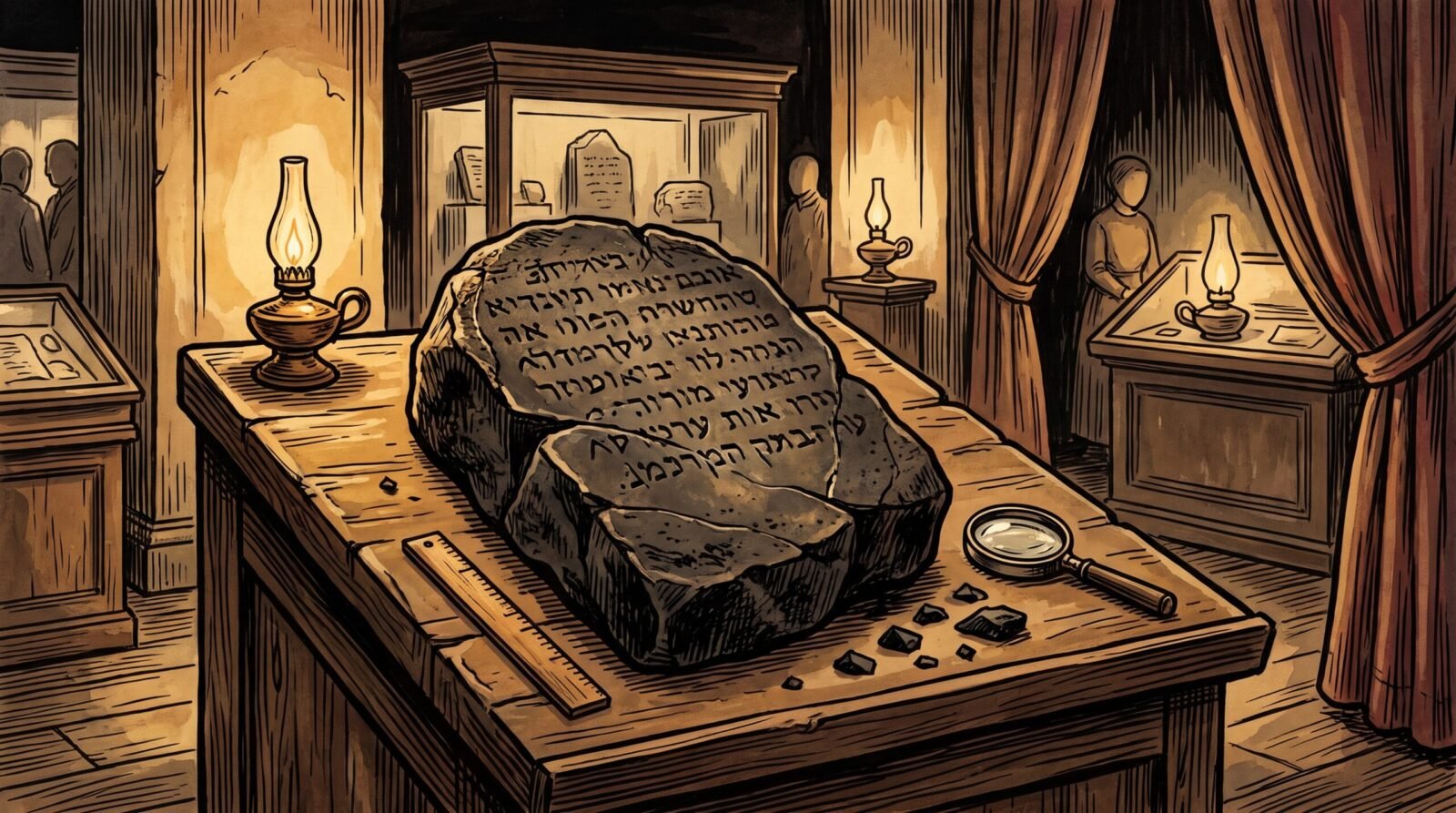
In July 1993, an archaeologist named Gila Cook, working on the long running excavation of Tel Dan in northern Israel, brushed the dirt from a black basalt fragment that had been reused as building material in an ancient wall. The fragment was small, no larger than a handspan, and was inscribed with thirteen lines of weathered Aramaic script. Within a few weeks, the reading of one of those lines would upend a debate that had divided biblical archaeology for more than a century. The fragment was the first fragment of what would be called the Tel Dan Stele, and the words that had so shocked the small world of Levantine epigraphy were a single Aramaic compound that translates, in its plain sense, as the House of David.
This is a long essay about that fragment and the two that followed it in June 1994, about the inscription that the three fragments preserve, about the king who almost certainly set it up, about the war it records, and about what it tells us about the historicity of the Davidic dynasty and about the practice of writing monumental inscriptions in the southern Levant in the ninth century BCE. The Tel Dan Stele is, by a long margin, the most important Aramaic inscription of the late Iron Age, and it is also one of the most important finds in the whole history of biblical archaeology. It has changed the terms of the debate about whether King David was a historical figure and, if so, what his kingdom looked like. It has changed, more quietly but no less profoundly, the practice of reading Iron Age royal inscriptions and the way scholars approach the relationship between text and material culture.
What follows is structured in five parts. The opening section traces the discovery and the early reading of the inscription, from the first fragment in 1993 to the publication by Avraham Biran and Joseph Naveh of the three fragments together in 1995 and 1996. The second section examines the inscription itself, the script and language, the physical form of the stele, and the way the three fragments fit together. The third section considers the historical setting of the inscription, the war that it records, the identity of the king who set it up, and the political situation in the southern Levant in the late ninth century BCE. The fourth section addresses the significance of the House of David reference and what it tells us about the Davidic dynasty as a contemporary political category. The closing section traces the aftermath of the discovery, the disputes over dating and translation, and the place of the Tel Dan Stele in the wider archaeology of the Iron Age Levant.
The Discovery
The site of Tel Dan had been excavated intermittently since the nineteenth century, but it was Avraham Biran, an archaeologist at Hebrew Union College in Jerusalem, who began the modern, continuous campaign of excavation in 1966. Biran directed the dig for more than three decades, through the 1967 war and its aftermath, and the site became one of the most productive archaeological enterprises in modern Israel. By the time Gila Cook found the first fragment of the stele in July 1993, the site had yielded the remains of a Canaanite city, an Israelite city, and a Roman city, together with a long sequence of fortification walls, gates, and domestic structures.
The fragment was found in what archaeologists call a secondary context, that is, in a place where the original had been moved and reused rather than the place where it had originally stood. In this case the basalt fragment had been incorporated into the fabric of a wall at the site of the Iron Age city gate, where it had been used as building material. The discovery of an inscription in secondary context is common enough at Levantine sites, particularly at sites that have been destroyed and rebuilt many times, but it always complicates the dating and interpretation of the inscription itself. The original stele might have been set up elsewhere, possibly at a different site, and brought to Tel Dan for reuse at a later date.
The first fragment was a single piece, with thirteen partially preserved lines of text, and it was published in 1993 by Biran and his colleague Joseph Naveh, an epigrapher at the Hebrew University of Jerusalem, in the Israel Exploration Journal. The reading was immediately controversial, but the reading of the phrase House of David in lines eight and nine was quickly confirmed by a number of independent scholars. The New York Times ran a story on the discovery on August 6, 1993, and the academic and popular response was immediate. The Times story quoted Biran as saying that there had never before been found a reference to the House of David other than in the Bible. The story correctly identified the inscription as the first extra biblical reference to the Davidic dynasty.
In June 1994, the excavation team found two more fragments, designated B1 and B2, at the same location. The two new fragments joined the first one to give a longer text, although significant parts of the inscription remained missing. The three fragments were published together in 1995 and 1996 by Biran and Naveh, and the full text was made available for study by other scholars. The publication triggered a wave of articles, commentaries, and conferences on the inscription, and the Tel Dan Stele became one of the most discussed ancient inscriptions in the world.
The fragments are now on display at the Israel Museum in Jerusalem, on loan from the Israel Antiquities Authority. The Israel Antiquities Authority holds the official custody of the fragments, and they are catalogued as 1993-3162 and 1996-125. The stele has been the subject of a series of conservation efforts, including advanced digital imaging at the Jerusalem Institute for Research and Digital Documentation of Cultural Heritage at the Hadassah Academic College. The fragments are small enough to fit in a museum case and have been loaned for temporary display abroad, including at the Jewish Museum in New York in 2024 and 2025.
The story of the discovery is also a story of the people who made it. Gila Cook, the volunteer who found the first fragment, was a member of Biran’s excavation team and had been working at Tel Dan for several seasons. The discovery was not, in the strict sense, an accident. It was the result of years of systematic work at the site, the careful excavation of layer after layer of the tell, and the painstaking removal of rubble from the Iron Age gate area where the fragment had been reused. The fragment might have been missed by a less careful team, or it might have been discarded along with the rest of the basalt rubble had it not been for Cook’s eye and her willingness to spend an extra few minutes examining a small piece of dark stone.
Avraham Biran himself was one of the most experienced archaeologists working in Israel at the time of the discovery. He had been trained at the Johns Hopkins University and at Hebrew Union College, and he had directed the Tel Dan excavations for more than a quarter century by 1993. His colleague Joseph Naveh, the epigrapher who worked with him on the inscription, was one of the leading authorities on ancient Semitic inscriptions in the world, and had published widely on Hebrew, Aramaic, Phoenician, and Moabite epigraphy. The collaboration between Biran and Naveh was, in many ways, an ideal pairing. Biran knew the stratigraphy and the material culture of Tel Dan, and Naveh knew the scripts and the languages of the inscriptions found there.
The Inscription
The Tel Dan Stele is written on a fragment of black basalt, a hard volcanic stone that was a common material for monumental inscriptions in the Levant in the Iron Age. The stele was originally a single piece, probably about a metre in height and considerably wider, but only three fragments survive. The surviving text covers parts of thirteen lines on Fragment A and additional lines on Fragments B1 and B2. The total preserved text is roughly fifty legible letters, plus a number of partially preserved letters that allow for partial restoration of the missing portions.
The script of the inscription is Old Aramaic, written in the Phoenician alphabet that was in use across the Levant in the Iron Age. The letter forms are consistent with a date in the ninth century BCE, and the language is a dialect of Aramaic that is close to the Aramaic of other ninth century inscriptions from the region, including the Mesha Stele from Moab and the various Aramaic inscriptions from Syria. The script is the same script that was used to write Hebrew and Phoenician at the period, although the language is Aramaic, not Hebrew.
The inscription begins with a fragmentary word that may be a verb in the past tense, possibly to kill or to cut off, and continues with a description of the actions of the unnamed king who set up the stele. The text refers to the killing of Jehoram, the son of Ahab, king of Israel, and of Ahaziahu, the son of Joram, whom the inscription identifies as king of the House of David. The reading of Ahaziahu as king of Judah is consistent with the biblical account in 2 Kings 8 and 9, which describes the death of Ahaziah of Judah in the course of the revolt of Jehu against the house of Ahab. The biblical account, however, attributes the killing to Jehu, while the Tel Dan Stele appears to attribute it to the unnamed king of Aram.
The inscription then continues with a description of the military campaign of the unnamed king. The text mentions Israel, the king of Israel, and the king of the House of David, and it describes the unnamed king as having cut off the cities and the territory of the king of Israel. The text also refers to the god Hadad, who is the storm god of the Aramaic pantheon and who was the principal deity of Damascus. The presence of Hadad in the inscription is consistent with the identification of the author as a king of Aram Damascus.
The text then becomes fragmentary and difficult to read. The final preserved lines mention further military actions and possibly a reference to a treaty or alliance between the unnamed king and the king of the House of David. The text is too fragmentary to allow a complete reconstruction, but the surviving portions are sufficient to establish that the inscription is a victory stele, recording the military achievements of the unnamed king.
The script and the language of the inscription are the basis for the dating. The letter forms of Old Aramaic developed in known directions over the centuries of the Iron Age, and the forms on the Tel Dan Stele are characteristic of the late ninth or early eighth century BCE. The mention of a king of the House of David in a context that matches the historical setting of the late ninth century, as described in the books of Kings, supports a dating to that period. Most scholars now date the inscription to the period between about 870 and 750 BCE, with a concentration of opinion in the late ninth century.
The translation of the inscription has been a collaborative project that has involved dozens of specialists in North America, Europe, Israel, and East Asia. The first published translation, by Biran and Naveh in 1993, was based on the first fragment alone and was necessarily tentative. The 1995 and 1996 publications, with the additional fragments, allowed a fuller reading. Since then, the inscription has been the subject of several major publications, including a special issue of the Israel Exploration Journal in 1999 and a comprehensive study by the epigrapher Joseph Naveh published posthumously in 2000. The most recent comprehensive treatment, by the Israeli epigrapher Israel Finkelstein and the French historian Christophe Lemard, has refined the reading further and has placed the inscription in its wider context.
The inscription also includes a number of orthographic and linguistic features that are characteristic of the Aramaic of the period. The use of the verb forms and the personal pronouns is consistent with the Old Aramaic of the late ninth century, and the vocabulary includes terms that are well attested in other Aramaic inscriptions of the period. The inscription is, in short, a typical example of the monumental Aramaic of its period, and it provides important evidence for the development of the Aramaic language and script in the southern Levant.
The War and the King
The political setting of the Tel Dan Stele is the late ninth century BCE, when the southern Levant was dominated by three regional powers, the kingdom of Israel in the north, the kingdom of Judah in the south, and the kingdom of Aram Damascus in what is now southern Syria. The three kingdoms were linked by complex alliances and rivalries, and the period was one of nearly constant warfare. The biblical books of Kings and Chronicles preserve a detailed narrative of the period, although the narrative is preserved from a Judahite perspective and is not always consistent with the material evidence.
The kingdom of Israel in the ninth century was ruled by the Omride dynasty, founded by Omri and continued by his son Ahab and his grandsons Ahaziah and Jehoram. The Omrides were one of the most powerful dynasties in the history of the northern kingdom, and they built the capital at Samaria into a major regional centre. The Omrides were also closely allied with the Phoenician kingdom of Tyre, through the marriage of Ahab to Jezebel of Tyre, and with the kingdom of Judah, through the marriage of Athaliah, the daughter of Ahab and Jezebel, to Jehoram of Judah.
The kingdom of Aram Damascus was, in this period, one of the great powers of the ancient Near East. Its kings had been major players in the international politics of the region since at least the late tenth century BCE, and they were a constant threat to both Israel and Judah. The most famous of the Aramean kings of Damascus was Hazael, who ruled from approximately 842 to 806 BCE and who is mentioned in several biblical passages and in Assyrian inscriptions. Hazael was the principal regional rival of the Omride dynasty and is the king most likely to have been the author of the Tel Dan Stele.
The biblical account of the period describes a conflict between Hazael and the Omride dynasty that culminated in the killing of both the king of Israel and the king of Judah. According to 2 Kings 8 and 9, Hazael killed the king of Israel in his bed during a visit to Damascus, and the killing was followed by the revolt of Jehu, who killed the remaining members of the Omride house and established a new dynasty in Israel. The revolt of Jehu is also described in the Mesha Stele from Moab, which records the revolt of Mesha, the king of Moab, against the king of Israel in the aftermath of the death of Ahab.
The Tel Dan Stele appears to record a different version of these events. The inscription attributes the killing of both the king of Israel and the king of Judah to the unnamed king of Aram Damascus, who is most likely Hazael. The biblical account attributes the killing of the king of Israel to Hazael but attributes the killing of the king of Judah to Jehu, in the course of the revolt. The discrepancy may reflect different perspectives on the same events, or it may reflect a conflation in the biblical account of two distinct episodes, one in which Hazael killed the king of Israel and one in which Jehu killed the king of Judah.
The discrepancy is one of the reasons that the Tel Dan Stele is so important for biblical scholarship. It provides an external witness to the events of the late ninth century that is independent of the biblical account, and it allows scholars to compare the two versions and to reconstruct the events with greater confidence. The Tel Dan Stele does not prove that the biblical account is correct in all its details, but it does prove that the events recorded in the biblical account actually took place, and it provides a framework for understanding the political dynamics of the period.
Hazael was one of the most consequential kings of Aram Damascus and one of the most consequential figures in the history of the southern Levant. He came to the throne by what may have been a coup, since the biblical account in 2 Kings 8 describes him as having been a military commander under his predecessor Ben Hadad, who is sometimes identified with the Ben Hadad of the Mesha Stele. The biblical account describes how the prophet Elisha instructed Hazael to take the throne by suffocating his predecessor, and the account may preserve a folk memory of how Hazael actually came to power. Hazael reigned for nearly four decades, and during his reign Aram Damascus was the dominant power in the southern Levant. The Assyrian king Shalmaneser III mentions him in his inscriptions from the battle of Qarqar in 853 BCE, where Hazael led a coalition that opposed the Assyrian advance.
The war recorded in the Tel Dan Stele was part of a longer conflict between Aram Damascus and the Omride dynasty of Israel. The biblical account in 1 Kings 22 and 2 Kings 8 to 10 describes several episodes in this conflict, including a battle at Ramoth Gilead in which Ahab of Israel was killed, and a subsequent campaign by Hazael that conquered much of the Transjordan and threatened Jerusalem. The Tel Dan Stele is consistent with this general picture but provides additional detail about the involvement of the king of Judah in the conflict, and about the use of the term House of David as a designation for the Judahite monarchy.
The House of David Reference
The single most important phrase in the Tel Dan Stele is the Aramaic compound bytdwd, the House of David. The phrase appears in the inscription in a context that refers to the king of Judah, and it identifies the king of Judah as a member of the dynasty that had been founded by David two or three centuries earlier. The phrase is the earliest extra biblical reference to the Davidic dynasty and is the principal reason that the Tel Dan Stele has attracted so much attention from biblical scholars and from the wider public.
The phrase bytdwd is significant for several reasons. First, it confirms that the Davidic dynasty was a real political entity in the late ninth century BCE. Before the discovery of the Tel Dan Stele, the existence of the Davidic dynasty had been attested only in the Hebrew Bible, and the historicity of David and his dynasty had been debated by scholars for more than a century. Some scholars, often called the Copenhagen school or the minimalists, had argued that David and Solomon were literary figures rather than historical rulers and that the United Monarchy described in the books of Samuel and Kings was a later ideological construct rather than a historical reality. The Tel Dan Stele does not settle the question of the United Monarchy, but it does confirm that a dynasty named for David existed in the southern Levant in the late ninth century BCE, more than a century after the period in which David is traditionally placed.
Second, the phrase bytdwd tells us something about the way the Davidic dynasty was perceived by its contemporaries. The fact that an Aramaic king, presumably an enemy of the dynasty, used the phrase to refer to the kingdom of Judah shows that the Davidic origin of the Judahite monarchy was a recognised political category. The use of the phrase by an outsider, rather than by a Judahite source, gives the phrase a particular weight. It is the way the dynasty was named by those who did not belong to it.
Third, the phrase bytdwd is linguistically interesting. The compound is a typical Iron Age construct in which a personal name is used to designate a dynasty or a kingdom. The same construction is used in the Mesha Stele, where Mesha refers to the dynasty of Omri, and in other inscriptions of the period. The construction shows that the Aramaic and Moabite scribes of the ninth century were familiar with the Davidic dynasty and with the political categories of the southern Levant.
The reading of bytdwd has been disputed by some scholars, particularly by members of the Copenhagen school who argue that the reading is uncertain and that the phrase may be a different word entirely. The most common alternative reading is btdwd, a personal name, but the alternative reading has not been widely accepted. The reading of bytdwd as the House of David is now the consensus view, and the alternative readings have been largely abandoned.
The significance of the House of David reference is not that it proves the historical David in the sense that the biblical narrative describes. The Davidic dynasty may have been a much smaller and less important political entity than the books of Samuel and Kings suggest, and the United Monarchy may have been a later idealisation rather than a historical reality. But the Tel Dan Stele does prove that a dynasty named for David existed in the southern Levant in the late ninth century BCE, and that the dynasty was recognised as such by its neighbours. The biblical figure of David is, in this sense, a historical figure, even if the details of his reign are uncertain.
The Aftermath
The discovery of the Tel Dan Stele has had a profound effect on the field of biblical archaeology and on the wider study of the Iron Age Levant. The inscription is now a standard part of the curriculum in biblical archaeology and in the study of the ancient Near East, and it has been the subject of a vast secondary literature. The principal questions raised by the discovery have been the dating of the inscription, the identity of the author, the reading of the House of David reference, and the relationship of the inscription to the biblical narrative.
The dating of the inscription has been the subject of considerable debate. The earliest proposed date is around 870 BCE, on the basis of the letter forms and the political context, and the latest is around 750 BCE, on the basis of the development of the Aramaic script. The Copenhagen school has proposed even later dates, in the eighth or seventh century, but these proposals have not been widely accepted. The consensus view is that the inscription dates to the late ninth or early eighth century BCE.
The identity of the author has been less controversial. Most scholars accept that the author is Hazael, the king of Aram Damascus, on the basis of the political context and the reference to the god Hadad. The inscription does not name its author, and there is no direct evidence for the identification, but the circumstantial evidence is strong. Hazael was the principal regional rival of the Omride dynasty, and the inscription records a victory over both Israel and Judah that fits the historical setting of his reign.
The reading of the House of David reference has been the most discussed question in the secondary literature. The reading bytdwd is now the consensus, but the reading has been challenged by some scholars who argue that the letters could be read differently. The challenge has not been sustained, and the reading is now accepted by the great majority of scholars in the field. The challenges are useful in that they have forced a more careful study of the inscription and have led to better photographs and more rigorous readings.
The relationship of the inscription to the biblical narrative is the question that has attracted the most attention. The inscription is not, in itself, a proof or a disproof of the biblical narrative. It is a witness to the events of the late ninth century BCE that is independent of the biblical account, and it allows scholars to compare the two versions and to reconstruct the events with greater confidence. The inscription confirms that the events described in the biblical account took place, and it provides a framework for understanding the political dynamics of the period. It does not confirm the details of the biblical narrative, but it does not contradict them either.
The Tel Dan Stele is, in the end, a small fragment of a larger inscription that has had an outsized effect on the study of the biblical world. It is the earliest extra biblical reference to the Davidic dynasty and one of the most important inscriptions of the Iron Age Levant. It has changed the way scholars think about the historicity of the biblical narrative and the way they approach the political history of the southern Levant. It has also been the subject of a wider cultural conversation about the relationship between archaeology and the Bible, a conversation that is unlikely to end as long as people are interested in the origins of the biblical tradition and the history of the ancient Near East.
The cultural resonance of the Tel Dan Stele goes well beyond the discipline of biblical archaeology. The House of David reference has been cited in popular history books, in religious education, in journalism, and in political discourse. The stele has become one of the most visited objects in the Israel Museum, and it has been the subject of several major exhibitions abroad. The temporary loan to the Jewish Museum in New York in 2024 and 2025, for example, drew record crowds and extensive media coverage. The stele has, in this sense, become a cultural artefact as well as an archaeological one.
What makes the Tel Dan Stele so culturally resonant is not just the House of David reference but the way that reference comes to us. The stele was found by a volunteer working on an archaeological dig that had been running for nearly three decades. The inscription was published by an archaeologist and an epigrapher who had been working together for many years. The reading of the House of David was confirmed by independent scholars working in several different countries. The digital imaging that has allowed the inscription to be studied in detail was done by specialists in Jerusalem. The temporary display in New York was a collaboration between the Israel Museum, the Israel Antiquities Authority, and the Jewish Museum. The story of the Tel Dan Stele is, in this sense, a story of how modern scholarship produces new knowledge about the ancient world, and how that knowledge can change the way we think about the most familiar stories of the biblical tradition.
For the future, the Tel Dan Stele will continue to be studied, and new technologies will allow new readings. The advanced imaging work at the Hadassum Academic College, for example, has revealed details of the inscription that were not visible in earlier photography, and similar work in the future will probably reveal more. The fragments may also be joined by new finds, though the chances of finding additional fragments of the same stele are small. The most likely future development is not new fragments but new readings of the existing fragments, made possible by improved digital imaging and by the gradual accumulation of comparative data from other Iron Age inscriptions. The Tel Dan Stele will remain, for the foreseeable future, one of the most studied inscriptions of the ancient Near East, and one of the most important witnesses we have to the political history of the southern Levant in the ninth century BCE.
There is also a quiet lesson in the Tel Dan Stele about how inscriptions survive. The stele was not preserved by being kept in a temple or a palace. It was preserved by being broken and reused as building material in a wall that stood for two thousand eight hundred years. The basalt survived where papyrus and parchment would have perished. The wall survived where free standing monuments would have been knocked down. The reuse that destroyed the stele as a monument also preserved it for modern discovery. That is, perhaps, the deepest irony of the Tel Dan Stele. The stele was meant to commemorate a victory that the king of Aram Damascus believed would last forever. It was broken instead, and the broken pieces became the foundation of a wall that lasted longer than the kingdom that the king had built. The wall has been excavated, the fragments have been pieced together, and the inscription has been read. What was meant to be permanent became a ruin, and the ruin became a witness.
References
- “Tel Dan stele” - encyclopaedic summary of the inscription, its discovery, and its interpretation, accessed 2026.
- Tel Dan Stele exhibition page - The Jewish Museum, New York, exhibition overview and provenance information, accessed 2026.
- 3,000-Year-Old Artifact Inscribed with Earliest Mention of the House of David - The Jewish Museum, press release for the 2024 to 2025 loan exhibition, November 2024.
- The Tel Dan Stele with House of David - The Jewish Museum, scholarly collection text for the 2024 to 2025 loan, November 2024.
- From Israeli Site, News of House of David - New York Times, news report on the discovery of the first fragment, August 6, 1993.
- Imaging the Tel Dan Stele - Jerusalem Institute for Research and Digital Documentation of Cultural Heritage at the Hadassah Academic College, summary of the multispectral imaging programme, accessed 2026.
- “Hazael” - encyclopaedic summary of the king of Aram Damascus who most likely authored the inscription, accessed 2026.
- “Avraham Biran” - biographical summary of the archaeologist who directed the Tel Dan excavations, accessed 2026.
- “Joseph Naveh” - biographical summary of the epigrapher who co published the inscription, accessed 2026.
- “House of David” - encyclopaedic summary of the Davidic dynasty and its historical attestation, accessed 2026.
- “Mesha Stele” - encyclopaedic summary of the related Moabite inscription for comparison, accessed 2026.
- “Tel Dan” - encyclopaedic summary of the archaeological site in northern Israel, accessed 2026.
- “Books of Kings” - encyclopaedic summary of the biblical narrative covering the period of the Tel Dan Stele, accessed 2026.
- “Aram Damascus” - encyclopaedic summary of the Aramaic kingdom that the inscription commemorates, accessed 2026.
- “Israel Museum” - encyclopaedic summary of the holding institution in Jerusalem, accessed 2026.


