The Oxyrhynchus Papyri
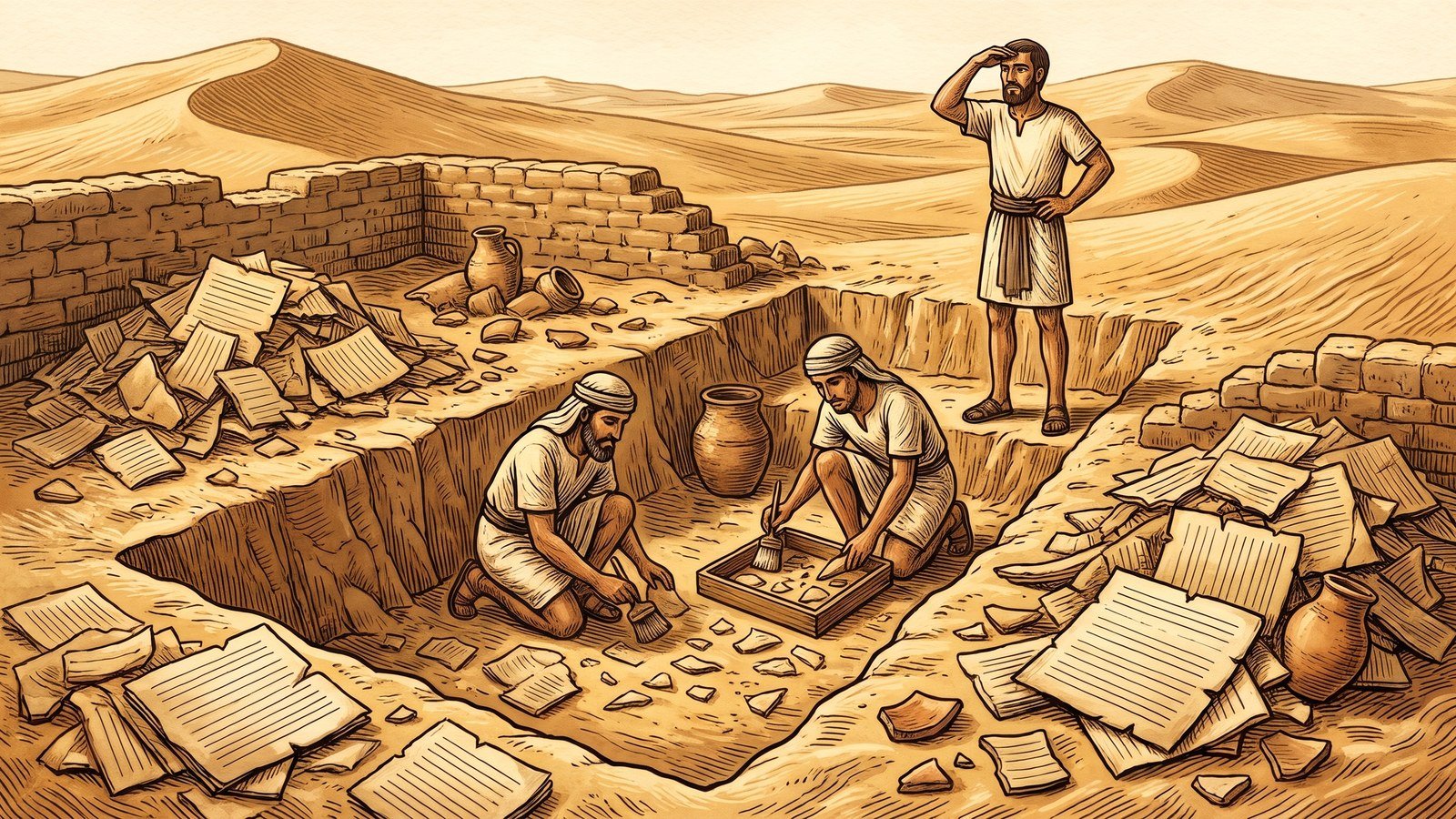
On 12 January 1897, the second day of the first season of excavation at a rubbish tip outside the walls of a dead town in the Faiyum, two Oxford scholars picked up a scrap of papyrus about fourteen centimetres long and read on it a short sequence of sayings of Jesus that no canonical Gospel contained. The leaf turned out to be the oldest surviving witness to the Gospel of Thomas, and it became the first item in a series that would run to eighty-eight volumes and distribute the ordinary paperwork of a Roman provincial town across museums and libraries in every country with money to buy them.
The City That Was Thrown Away
Oxyrhynchus stood on the western side of the Nile, on the Bahr Yussuf, the branch of the river that runs south through Middle Egypt and ends in Lake Moeris and the marshes of the Faiyum. The Greeks who governed Egypt named their towns after the animals they found in the region, and this one took its name from the fish with the pointed snout that lived in the lake, so that the place became known as the City of the Sharp-Nosed Fish. Under the Egyptians the settlement had been called Per-Medjed; under the Ptolemies and the Romans it became the chief town of its district in the Faiyum, and for something like a thousand years the people who lived there wrote their letters, kept their accounts, copied their textbooks and disputed their theology in Greek, under a Macedonian dynasty and then under Roman rule.
The writing surface was the reason all of this survives where it does. Across the whole Greek-speaking world books and documents were written on a paper made from the papyrus reed, a plant that grew thickly in the marshes of Egypt and was rare anywhere else; the craft of making it died out in Egypt itself about the tenth century AD, and the reed can now be found chiefly in the Sudd, the great swamp of southern Sudan. Papyrus was first recovered in Europe in the eighteenth century, as a curiosity rather than as a text, when the remains of a Greek library on papyrus rolls were uncovered at Herculaneum under the debris of a volcanic eruption. It took another hundred years for anyone to go looking for such material properly.
It was, by the standards of the Roman provinces, a large and well-to-do town. Its walls ran for something near three miles, with five or more gates. Colonnaded streets, each about a mile long, crossed in a central square. On the east side were quays, where the produce of the lake and the desert came aboard; on the west the road ran out into the sand towards the camel routes and the oases. There was a grand temple of Serapis, and a theatre which Flinders Petrie partly cleared in 1922, measured roughly four hundred feet across and estimated to seat more than eleven thousand people, a figure that has been used to guess at a population of perhaps thirty thousand inhabitants. The fishery of the Oxyrhynchus fish was a matter of local pride, and the fish was held to be the incarnation of a god, which in due course produced a quarrel with the neighbouring city of the dogs and, according to Plutarch, an actual war.
The town was thrown away rather than destroyed. After the Muslim conquest of Egypt in 641 the canal system on which the whole southern half of the Faiyum depended fell out of repair, the water levels fell, and Oxyrhynchus was abandoned. The village of el-Bahnasa now stands on part of the site, and for centuries afterwards the ground beyond the old walls was treated as a place to dump rubbish and to dig soil for manure, the prized sebakh that Egyptian farmers took from the mounds and spread on their fields. What the diggers wanted was fertiliser. What they found was the archive of a Roman city.
The dumps were not a single heap but a group of mounds lying north-west of the modern village, marked on the survey plans as the Roman mounds, where there had never been houses at all. The richest of them was numbered K 20 on the plan that Grenfell and Hunt drew, and identified in their black notebook as Kom Gamman, a mound crowned by the tomb of a medieval sheikh, Ali Gamman. It had been receiving rubbish for at least six hundred years, from the first century AD onwards, and because the tomb sat on top of it, Grenfell and Hunt were unable to work it thoroughly; an Italian team obtained permission to dig it in the 1930s. A second mound, numbered 23, carries the tomb of Abu Teir. Travellers had noticed these heaps long before anyone thought to excavate them: the French traveller Vivant Denon drew the site in 1798 and, as it happens, put his sketch in the middle of precisely the ground that would yield the richest papyri a century later.
Peasants working the sebakh had been turning up papyrus for generations and selling it to Western museums, but those finds were chance pieces, detached from their context and from one another. What changed in the 1890s was the recognition that the mounds were not random rubbish but an archive, and that an archive could be dug in order. Grenfell and Hunt surveyed the site and reduced it to a plan on which the mounds were numbered. The revised plan they drew in 1908, with the great zone marked as the Roman mounds, proved so good that it remained the reference for the next three quarters of a century. They intended to publish it themselves and never did; it appeared only in 1983, in the fiftieth volume of the series.
Two features of the Egyptian desert made the place a preservative of a kind no library could match. The first was aridity: in this part of Egypt it simply does not rain, and anything lying above the reach of ground water and out of the reach of insects will survive for a very long time. The second was quantity. The town threw away everything. Ledger, lease, marriage contract, letter, school exercise, theological treatise, second thoughts and rubbish: all of it went onto the same heaps, and the heaps grew to a depth that the excavators reckoned at about thirty feet, with the best material lying some twenty feet down in the tallest mounds. What came down from that depth was not a library. It was a midden that happened to contain the remains of books.
Grenfell and Hunt and the Midden
The money came from the Egypt Exploration Fund, founded in 1882 by the traveller and novelist Amelia Edwards with the help of Reginald Stuart Poole of the British Museum, and renamed the Egypt Exploration Society in 1919. Grenfell, then a young fellow of Queen’s College, Oxford, had petitioned the Fund in 1895 for a branch of its work devoted to the preservation and study of papyri, and had gone digging for it alongside David Hogarth at Bacchias and at Karanis. By the time he proposed the site at Oxyrhynchus he had the Fund’s confidence and a partner. Arthur Surridge Hunt had been his friend since they shared a scholarship at Queen’s College and had spent their summer holidays in 1889 mountaineering in the Tyrol. Grenfell was the classicist, impatient and imaginative; Hunt was the archaeologist, cautious, practical and endlessly precise. The two of them between them produced the most consequential body of Greek texts published in the twentieth century.
The first season of excavation began in the winter of 1896 and closed in April 1897. The workforce numbered around two hundred men and boys, hired from the neighbouring villages. The diggers loosened the undisturbed soil with picks and carried the sifted earth away in baskets; on some days more than thirty baskets came out of the trenches filled with papyrus. Grenfell and Hunt sorted each day’s haul overnight in the mud-brick house that served as their base, so that the baskets could be sent back out to the diggers at dawn, and they made up metal tins on site for packing the fragments as they were found. They numbered the tins in a simple consecutive sequence, which recorded nothing about which mound any fragment had come from, since the numbering was never linked to the excavation records.
The conditions were ferocious, and the two men wrote about them with a mixture of grievance and affection. The dust was appalling enough that the photographs look like a sandstorm. Hunt’s shopping list for the desert, drawn up before he had any idea what he was walking into, included medicines, fish-hooks, a copy of The Old Curiosity Shop and a revolver with forty cartridges. Fragile objects were packed in whatever tin came to hand, and one roll of papyrus is said to have travelled home in an old Huntley and Palmer’s Best biscuit tin. Grenfell’s own habits supplied more of the packing material than his correspondents realised: he ordered five hundred Best Egyptian Cigarettes from a London dealer in April 1896 at a cost of one pound seven shillings and sixpence, and the robust small tins the cigarettes came in turned out to be exactly the right size for the safe packing of small fragile objects, so that a few of them survive in the keeping of the Oxyrhynchus Papyri Project today. The finds were collected in baskets, then boxed and shipped back to Oxford.
On the second day of that first season the two men lifted a leaf out of the rubbish that carried sayings of Jesus. Grenfell and Hunt recognised at once that the text was not from any of the four canonical Gospels, and they dated it on internal grounds to before AD 140, noting parallels with Clement of Alexandria. They published it separately and at once, as a small booklet from the Fund titled Sayings of Our Lord from an Early Greek Papyrus, and the announcement caused a considerable stir, because the Victorian dream of a lost saying-book of Jesus seemed to have come true. The leaf measured something like 140 to 148 by 90 to 95 millimetres, was written in uncial letters in a reformed documentary hand, and carried a single column of twenty-one lines to a page. It became no. 1 of the Oxyrhynchus Papyri, and the Fund gave it to the Bodleian Library in November 1900, where it is now MS. Gr. th. e. 7 (P).
The first volume of The Oxyrhynchus Papyri appeared in 1898, the year after the digging stopped, and set a standard that the series has never dropped. Its hundred and fifty-eight texts were drawn from the twelve or thirteen hundred documents Grenfell and Hunt could examine at Oxford in good or fair preservation, and from a hundred and fifty rolls in the Gizeh Museum. Their report on the first season’s work came out within months of their return, and the excavation notebook for the second season, 1902-3, survives as the only one of its kind: trenches and finds kept in the field rather than reconstructed afterwards in the study.
They did not dig without interruption. They left Oxyrhynchus at the end of April 1897 and did not return until February 1903, the second season of work there being followed by further campaigns that carried the excavation into the next decade and out of it in 1907. The gap was not idleness: Grenfell and Hunt were excavating at other sites in the Fayum and elsewhere in Egypt, and the Oxyrhynchus seasons had to be fitted around those commitments and around the long, slow business of sorting, translating and printing what came up.
The scale of the harvest was not grasped at the time. The material came in hundreds of boxes of fragments, many of them no larger than a cornflake, and it is estimated that at least half a million papyri still remain at Oxyrhynchus to be conserved, transcribed, deciphered and catalogued. Since 1898 something over five thousand documents have been collated and printed, which scholars reckon represents between one and two per cent of the whole. The Fund had also arranged for published volumes to be distributed widely: in 1914 it made a special distribution of the series to institutions across the world, so that the fragments of a single provincial town ended up in the British Museum, the Ashmolean, the Egyptian Museum in Cairo, libraries in Philadelphia and Berkeley, and dozens of smaller collections besides.
What Was Inside
Only about one document in ten is literary. The rest is the working archive of a provincial society: codes and edicts, registers of official correspondence, census returns, tax assessments, petitions, court records, sales, leases, wills, bills, accounts, inventories, horoscopes and private letters. The language is mostly Greek, but demotic, hieratic, Coptic, Latin and Arabic occur as well, along with a small number of texts in Hebrew, Aramaic, Syriac and Pahlavi. It is the rubbish that carries the city, and the rubbish is what makes the city legible. Tax rolls and accounts record how the administration of the province was financed and how the catch from the lake was sold; registers of official correspondence preserve the traffic of government; and the letters carry the ordinary business of households, harvests, prices and quarrels between neighbours. From that material the shape of a Roman provincial town can be reconstructed in a way that no fragment of a famous poem allows.
The literature, though a tenth of the quantity, is what first made the site famous. A single poem of Sappho survives from the second book of her collection, its tiny round hand carrying some of the informal features of cursive documentary writing, and the find landed in the middle of a revival of interest in Sappho among critics and poets. There are poems by Alcman, Ibycus and Simonides, a play of Aeschylus, fragments of the Catalogue of Women of Hesiod, Plato’s Phaedo and Phaedrus, a romantic tale of Iolaus, an oracle of the potter and a treatise on the art of love by a woman named Philaenis, one of the few technical works of the ancient world believed to have been written by a woman. The book trade shows itself too, in the shape of the title-tags that hung from the outside of a roll and told a reader what was inside.
Among the most suggestive items is a list of epigrams from the late first century AD, P.Oxy. LIV 3724. It is a working index rather than a literary volume: at least three hands are at work, two of them writing incipits, one of them careless and semi-cursive, the other quick and fluent. An inexperienced writer added a recipe for a cough mixture in the upper centre of the sheet in awkward upright capitals and then crossed it out. In the first column one epigram is copied in full; across the sheet and on the back, a hundred and seventy-five epigram openings are listed, of which thirty-one belong to poems already known, two ascribed to Asclepiades and twenty-seven to the Epicurean philosopher Philodemus. This is what a poetry book looks like when nobody thought it was a poem: a list made for use by a copyist or a reader in a hurry, with an unrelated remedy squeezed in above it.
And there is the schoolroom. A papyrus roll from the second half of the first century AD carries nothing but a writing exercise: a professional Latin scribe copied two lines of the eleventh book of Virgil’s Aeneid an uncertain number of times, and on the reverse, with the papyrus turned through ninety degrees, someone wrote a Greek register, the sheet having been cut between the joins of a documentary roll and reused for its blank back. A set of fragments records a scribe demonstrating his talents, writing the same line in a cramped chancery hand, then larger, then in heavy archaic uncials, the line being a fictitious verse invented for practice because it contains every letter of the alphabet. A copy of the fourth book of the Institutes of Gaius is in the series too, one of the oldest known manuscripts of the Roman law, written in a clear Roman cursive and furnished with a numeration in the upper margin that shows it was the nineteenth column of the roll, each book having occupied a roll of its own. And a little textbook on mythology, P.Oxy. LXV 4460, lists the gods in order of birth from Cronus, with a learned note on Athena, who was conceived, the copyist explains, when Zeus swallowed Metis, Wisdom itself. Such things were disposable by definition. A pupil’s copy of a textbook was written, corrected, used up and thrown out, and it is exactly that unregardedness that has kept them where they were, legible and complete, while every library in the ancient Mediterranean has vanished.
The tags make that plain. Ancient rolls had no spines, so a book was identified by a label of papyrus or parchment, a sillybos, glued or tied to the outside of the roll and left hanging down so that the title faced outwards while the roll stood in its container. About half a dozen such tags from Oxyrhynchus have been published, among them one for Tryphon’s book On the Dialect of the Laconians, which probably explained the language of poets like Alcman, and one for the ninth book of Hermarchus’s treatise Against Empedocles, a work of the pupil of Epicurus whose original ran to twenty-two books.
A private letter of about AD 170 shows the trade at work. Its sender asks for copies of books six and seven of Hypsicrates’ work on the people mocked in comedy, and for prose epitomes of Thersagoras on the myths in tragedy; the reply, appended by the agent, reports that Demetrius the bookseller has them, and that Diodorus also has some which the writer has not got. The same networks carried books, and scholars, between Alexandria and the provincial town.
The biblical material was there from the start, and the Oxyrhynchus papyri remain the most numerous sub-group of the earliest copies of the New Testament. Fragments of John, Matthew, James, Revelation and Jude came up across the seasons: P.Oxy. 2 and P.Oxy. 208 with 1781 for John, P.Oxy. 2385 for Matthew 19, P.Oxy. 1229 for James 1:15-18, P.Oxy. 1078 for Revelation, and P.Oxy. 2684 for Jude 4-5 and 7-8, a leaf of the late third or early fourth century written in an unusually small codex format. To these must be added the apocryphal leaves, P.Oxy. 654 and P.Oxy. 655, found in 1904, which turned out to be further portions of the same Gospel of Thomas as the famous first find.
That first find has taken up most of the theological energy spent on Oxyrhynchus, and it has been read more carefully than anything else in the series. The leaf carries logia 26 to 28 on its recto and logia 29 to 33 on its verso, and it was eventually realised that the sayings are the numbering of the Gospel of Thomas, the apocryphal collection discovered at Nag Hammadi in Upper Egypt in 1945. The Oxford papyrus is therefore the oldest manuscript of that Gospel, and it carries a text that differs from the Coptic version in places where the later manuscript can be checked. What Grenfell and Hunt had published in 1897 as a Victorian curiosity turned out to be a witness to a lost form of the sayings, independent of the canonical Gospels and not heretical, circulating in Egypt in the second century.
The patristic material is quieter but no less interesting. P.Oxy. XV 1785 is a fragmentary leaf of the fifth century, apparently from a collection of discourses which remain anonymous; the style of the fragment on the recto, which concerns concupiscence and cites a series of biblical instances, recalls P.Oxy. 1603, now identified as the homily of (Pseudo-)Chrysostom on the beheading of the Forerunner, though efforts to trace 1785 itself among the works of that voluminous author have not succeeded. Other fragments of homilies cast in a similar mould are P.Oxy. 1601 and 1602. The Oxyrhynchus papyri thus hold, in a rubbish tip, a leaf of a sermon on the beheading of John the Baptist.
The Greek Psalms run through the series from the earliest period. P.Oxy. LXXVII 5101 is probably the earliest extant copy of the Septuagint Psalms, a roll of the first or second century which is of textual interest precisely because it writes the name of God in the old Hebrew letters rather than translating it. P.Oxy. XV 1779 is a leaf from a small papyrus codex of the Psalms, where the abbreviated divine name with a stroke above it shows that the book was intended for Christian use; it is now in Ohio, having passed through the Egypt Exploration Fund and the hands of several collections before reaching the Museum of the Bible in Washington in 2014. P.Oxy. LX 4011 carries Psalm 75 written interlinearly, in the Ashmolean. Other biblical leaves from the mounds include Psalms 83 and 84, Psalm 90, Ecclesiastes 6 and 7, the Decalogue at P.Oxy. LXV 4442 and Esther 6 and 7 at P.Oxy. LXV 4443.
The same economy of material produced its occasional shocks. An apocalyptic text called the Oracle of the Potter, P.Oxy. XXII 2332, was written in a tight, crabbed cursive of the late third century on the back of the legal proceedings of a court case of AD 284. It gives a version of a prophecy already known from two papyri in Vienna, an Egyptian original composed in Demotic, in which the voice of a potter promises a golden age and the reduction of the upstart city by the sea, which is Alexandria, to a place where fishermen dry their nets. A prophecy against the empire, copied onto the back of a court record, in a town where nothing of that sort would be said in public.
One habit runs through all of it, and it matters for what follows. Papyrus was expensive enough to be worth reusing and cheap enough to be written on without thought, so scribes wrote in the margins of a finished text, on the back of a document that had already done its work, and on sheets cut down from larger rolls. The Philaenis on the art of love, P.Oxy. XXIX 2891, was written by a woman who calls herself a daughter of Okymenes of Samos and who treats her subject systematically, from the making of passes and seduction through flattery to the art of kissing and the use of cosmetics. An elegy on the gods and their boy loves, P.Oxy. LIV 3723, was written on the back of a reused tax document trimmed down into what has been called a pocket-roll, its verses concerned with Apollo and Hyacinthus and with Heracles and Hylas, and possibly with the love of Hadrian for Antinoos, who drowned in the Nile. An account of fishing revenues, P.Oxy. XLIX 3495, was used as the verso of another text. The biblical and the commercial were not separate worlds. They were the same sheet of reed, bought and sold, written on and written over, and thrown away together.
A Discipline Invented
What Grenfell and Hunt began was not merely a dig. They invented a way of handling the material that made it publishable at scale, and in doing so they created a discipline. The method was collaborative to the point of self-effacement: sixteen substantial volumes appeared jointly, each editor revising what the other had written, Grenfell contributing ideas and intuitions and Hunt contributing control and critical judgement. Every text was printed in Greek with a translation, a note on its physical form, its date and its provenance, and an edition of the paleography beside it. The result was a series that could be read by a papyrologist in Tokyo as easily as by a lawyer in Cairo, and it set the house style for every similar corpus that followed.
The series itself grew without interruption. The volumes were called parts until Volume XXXIII in 1968, the first to be published under the auspices of the British Academy; Volume LXV appeared in 1998, a century after the first, and Volume LXXXVIII in 2025. Alongside the series, the excavated material was catalogued by the location of the find, with an online table of contents listing the type of content of each papyrus or fragment, and the papyri themselves are now scattered through institutions across the world, a substantial number in the Bodleian and the Ashmolean at Oxford, and others in Liverpool, Manchester, Cairo and Washington.
The partnership itself did not survive the century. Grenfell’s health had been fragile for years; a third nervous breakdown in 1920 ended his working life. He had held the chair of papyrology at Oxford from 1908, and the professorship lapsed during his illness. He died on 18 May 1926 in Oxford and was buried in Holywell Cemetery. Hunt served in the First World War as an officer in the fourth battalion of the Oxfordshire and Buckinghamshire Light Infantry. He married in January 1918 and lost his only child a few months later, which clouded the last years of his life; he worked on until his death in Oxford on 18 June 1934. Neither man was killed in the war, and the series carried on without either of them.
It carried on because there were others. Edgar Lobel, born 1889 and living until 1982, was the giant of the literary papyri of Oxyrhynchus, and his association with the collection spanned nearly seventy years, from the days of Grenfell and Hunt to the present generation of editors. Colin Roberts, lecturer in papyrology at Oxford and principal contributor between 1941 and 1957, later served as secretary to the delegates of Oxford University Press and published a further group of theological texts in 1982. John Barns, Professor of Egyptology at Oxford and attached to Queen’s College like Grenfell, Hunt and Lobel, contributed throughout the 1950s and 1960s and acted as unofficial curator of the collection. Eric Turner, John Rea and Peter Parsons carried the work into the late twentieth and early twenty-first centuries.
The site itself had a later history of its own. Three years after Grenfell and Hunt left Oxyrhynchus for the last time, an Italian team under Ermenegildo Pistelli resumed work there and continued until 1913; Evaristo Breccia directed a further stretch of excavation from 1927 to 1939, and it was an Italian team that in the 1930s obtained permission to tackle the mound at Kom Gamman, which Grenfell and Hunt had been unable to work because the tomb of Ali Gamman sat on top of it. The site was surveyed again with Kuwait funding in the 1980s, under the direction of Geza Fehervari, whose final report on the excavations at el-Bahnasa appeared in 2006 and included aerial photographs taken by flying a camera from a kite. In 1998 the hundredth anniversary of the first volume was marked by an exhibition in the Eric North Room of the Ashmolean Museum.
The surprise that runs through this history is that the mundane material turned out to be the rarer prize. The classical world left behind no actual books. The great library of Alexandria is gone, and the twenty-eight public libraries of imperial Rome have disappeared without trace; what survives elsewhere is copy upon copy, the chance survivals of the Middle Ages. Oxyrhynchus has no library. It has the discarded paperwork of a town, and from that paperwork the ancient economy, the law, the schoolroom and the household can be reconstructed in a way that no fragment of a famous poem can. The poems are the treasure that brought the excavators; the tax returns are the treasure that stayed.
Why a Midden Saved the Bible
The argument of this history is a simple one, and it is worth stating plainly because it runs against the habits of a discipline taught to admire the survival of texts. Manuscript texts survive because somebody valued them, and the more the New Testament is admired for having survived at all, the less it is noticed that its earliest Egyptian witnesses survived precisely because nobody valued them. A saying-book of Jesus that stood outside the four canonical Gospels was not a book any authority was obliged to keep. It was a curiosity, and curiosities go into the waste. The sheet went into the rubbish with the broken pots and the stale receipts, and the rubbish went onto a mound in the Faiyum, and the mound stayed dry, and the sheet stayed there for eighteen hundred years until a man with a pick and a torch looked down into a trench and recognised the letters.
The physical circumstances are the other half of the argument, and they are not mysterious. In this part of Egypt it never rains, and the deep rubbish mounds stood well above the reach of the groundwater that would have rotted the reed. Sand and dry air are not a scriptorium, but they are a very fine safe. Add to that the fact that papyrus writing itself died out about the tenth century AD, so that after that date there was no mechanism by which a discarded text on papyrus could re-enter circulation. A text that was thrown away had, from the tenth century onwards, no way back: out of circulation for ever, and in that condition safe.
The biblical fragments themselves confirm the pattern. Early Christian books at Oxyrhynchus were written on the backs of commercial documents, in margins left over from other work, on sheets trimmed from rolls that had served some other purpose. The Christian scribe of the third century was not producing a luxury item for a library; he was using the material that was to hand, in the town where he lived, alongside the people who were paying tax and litigating and writing to their brothers. That is why the earliest witnesses to the New Testament are so numerous and so fragmentary. They are not the survival of a fortunate library. They are the survival of a working scrap of a working town.
The tip did not stop. The sebakh was still being dug in the twentieth century, and Rendel Harris, buying for Woodbrooke College in Birmingham in the winter of 1922-3, noted that the best papyri were coming out about twenty feet down in the high mounds, and that more and more of them were being carried away. He complained of the railway running across the Bahr Yusuf, of the sebakh line going round the back of the town, and of trains going out in the dark before dawn. The material he rescued went to London and was published by Enoch Powell in 1936. Everything else was spread on the fields, or carted away, or burnt.
There is a second, quieter point about what the midden preserved. The Oxyrhynchus leaves are not only witnesses to what was written but to the conditions of the writing. In the case of the Psalms they carry the Greek Septuagint at a point before the text had settled into its received form, in a roll of the first or second century that writes the divine name in Hebrew characters rather than Greek ones. To recover that is to recover not a quotation but a working copy, made by someone who expected to use it, on a sheet he had bought or been given.
What the tip yields, then, is not the Bible as a monument but the Bible as a working text, along with the grain receipts and the love manuals and the school exercises that were being worked at the same time and in the same hands. The fragments were thrown away because they were finished with, and they were finished with in the richest provincial town of the Faiyum, and the town was thrown away in turn. What survives of the second-century Church in Egypt comes, in large part, from a rubbish tip in the desert.
References
- Oxyrhynchus: A City and its Texts - online version of the exhibition held in the Eric North Room, Ashmolean Museum, Oxford, 1998; introduced by John Rea
- The Site: Excavations and Finds - Oxyrhynchus Papyri Project, University of Oxford
- Scribes and Scholars - Oxyrhynchus Papyri Project, University of Oxford
- Daily Life - Oxyrhynchus Papyri Project, University of Oxford
- After Grenfell and Hunt - Oxyrhynchus Papyri Project, University of Oxford
- Waste Paper City - Peter J. Parsons, abridged by Gideon Nisbet, 1997
- Location-List of the Oxyrhynchus Papyri - Oxyrhynchus Papyri Project, University of Oxford
- The Oxyrhynchus Papyri - Sustainable Digital Scholarship, University of Oxford
- About Us - Egypt Exploration Society, London
- The Oxyrhynchus Papyri: volume LXXVII - edited by A. Benaissa, Egypt Exploration Society, Oxford, 2011
- The Oxyrhynchus Papyri: volume LXXXVIII - Egypt Exploration Society, Oxford, 2025
- Sayings of Our Lord from an Early Greek Papyrus - Bernard P. Grenfell and Arthur S. Hunt, Egypt Exploration Fund, London, 1897
- The Oxyrhynchus Papyri, Volume XV - edited by B. P. Grenfell and A. S. Hunt, Oxford, 1912
- Psalms Fragment (P.Oxy. 1779; Rahlfs 2073) - Museum of the Bible, Washington DC
- Oxyrhynchus Research Project - University of Oxford, current excavation and research site
- “Oxyrhynchus Papyri”
- “Oxyrhynchus”
- “Papyrus Oxyrhynchus 1”
- “Bernard Pyne Grenfell”
- “Arthur Surridge Hunt”
- P.Oxy. I 1 (Logia Iesou; later identified as the Gospel of Thomas) - Bodleian Library, Oxford, MS. Gr. th. e. 7 (P)
- P.Oxy. LXXVII 5101 (Septuagint Psalms, first or second century AD) - published in The Oxyrhynchus Papyri, volume LXXVII, Oxford, 2011
- P.Oxy. XV 1779 (Psalms, Christian codex) - United Theological Seminary, Dayton, Ohio
- P.Oxy. LX 4011 (Psalm 75, written interlinearly) - Ashmolean Museum, Oxford
- P.Oxy. XXIV 2386 (Psalms 83-84) - Ashmolean Museum, Oxford
- P.Oxy. XV 1785 and P.Oxy. XIII 1603 (fragments of homilies; 1603 identified as Pseudo-Chrysostom 772, De decollatione Praecursoris) - published in The Oxyrhynchus Papyri, volumes XV and XIII, Oxford


