Holden’s proposal
The opportunity to enter smelting came through a man named Edward R. Holden, a smelter operator who approached Meyer Guggenheim in the late 1880s for capital to build a new plant at Denver. Meyer agreed at first to invest, and then, characteristically, took over the project. According to the 1918 history of Colorado, he investigated the cost of transport, the availability of limestone for flux and the supply of coal, and recast the enterprise entirely.[1] Rather than a minority share in someone else’s smelter, the Guggenheims would build and own their own.
The site they chose was Pueblo, on the Arkansas river in southern Colorado, a railway junction with access to coal from the fields to the south and to ore from the mining districts of the mountains, New Mexico and, increasingly, Mexico. In 1888 work began on what was called the Philadelphia smelter, after the family’s home city, operated by a company called the Philadelphia Smelting and Refining Company.[2][3] The plant had six great furnaces, each, according to the Dictionary of American History, with a daily capacity of sixty tons of ore.[4] Its cost is given in the 1918 history as $1,250,000, a large sum for a family whose capital had come from embroidery and two mines.[1]
The dates in the sources differ by a year. The Jewish Encyclopedia and the Dictionary of American History say the smelter was built in 1888; the Mining Foundation of the Southwest says it was completed in 1889, and the Encyclopedia of World Biography gives 1889 as the year Meyer built a large smelter in Colorado.[2][4][5][6] Construction began in 1888 and the furnaces were blown in the following year, and the two dates refer to different stages of the same project.
Six furnaces on the Arkansas
The first months were difficult. The family histories tell of costly mistakes, furnaces that did not work as expected, and a period in which the Guggenheims were losing money on smelting while the A.Y. and Minnie supplied the capital to keep going.[7][8] Benjamin, who had learned smelting at Leadville, was in charge at Pueblo for a time, and William worked there after his studies. The brothers recruited experienced superintendents and metallurgists from rival plants, often by offering them a share in the profits, and the hiring of expert managers, many of them trained in Germany or at the leading American mining schools, became one of the hallmarks of the Guggenheim enterprises.[7][9]
Once the plant was running, it was profitable. The Guggenheims smelted their own ore from Leadville and bought ore from other mines on terms competitive with the established smelters. The Pueblo smelter grew in size and capacity through the early 1890s, and the 1918 history describes it as a low-cost refining centre that prospered even through the financial panic of 1893.[1] The Encyclopedia of World Biography sums up the outcome: Meyer had turned the processing of ore into a hedge against the risks of mining it.[6]
A smelter of the kind the Guggenheims built at Pueblo worked by melting ore in a blast furnace with coke as fuel and with fluxes, limestone and iron ore among them, that combined with the waste rock to form a slag. Silver-lead ores were particularly suited to the process, because the molten lead collected the silver and gold as it sank to the bottom of the furnace, where it could be tapped off as base bullion, while the slag was drawn off above.[4][9] The art of the smelter lay in mixing ores of different kinds in the right proportions, so that a plant with access to many sources of ore, siliceous and basic, rich in lead and poor, had an advantage over one that depended on a single district. This was one reason why the Guggenheims were so anxious to secure supplies of Mexican ore, and later to own Mexican mines.[7][1]
Mexico and the McKinley tariff
Much of the ore smelted at Pueblo came from Mexico, whose silver-lead mines were among the richest in the world and whose ores mixed well with those of Colorado in the furnace. In 1890 the United States Congress passed the McKinley Tariff, which raised duties on many imports, among them lead in ore. The Mining Foundation of the Southwest says that the duty was in part an attempt by the Guggenheims’ competitors to stem the supply of rich Mexican silver to their smelter.[5] If so, it misfired. Rather than pay the tariff, the Guggenheims went to Mexico and built smelters there.[3][5]
The decision took Daniel Guggenheim to Mexico City, where he negotiated with the government of Porfirio Díaz, the president who ruled Mexico for most of the period from 1876 to 1911 and who was eager to attract foreign capital. The concessions he obtained allowed the family to build a smelter at Monterrey, in the north-east of the country, and a second at Aguascalientes, in the centre.[2][7] The Jewish Encyclopedia, written within a decade of these events, says that the firm built the first complete smelter in Mexico at Monterrey, and another at Aguascalientes.[2] The Encyclopedia of World Biography dates the Mexican venture to 1895, and other accounts date the first Monterrey plant to 1891 or 1892; the projects were planned and built over several years, and the dates refer to different stages.[6][7]
The Mexican plants were enormously profitable. Labour was cheaper, ore was close at hand, and the Guggenheims bought or leased mines to supply their furnaces. One account says that by 1895 the family’s smelting operations in Mexico were producing more than a million dollars a year and had made the family one of Mexico’s leading industrial concerns.[3] The Mexican business also drew the family into the politics of the Porfirian state, whose favours to foreign investors would become one of the grievances of the revolution that broke out in 1910.[7][10]
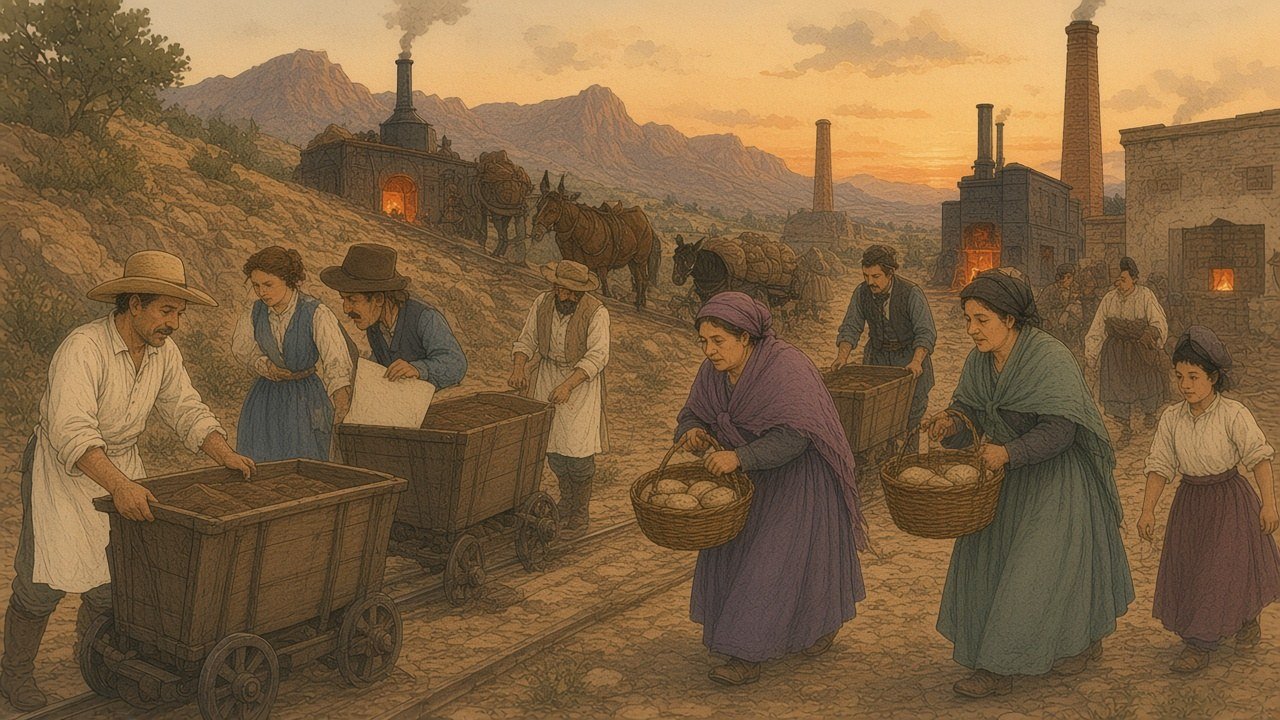
The Mexican ventures were the most profitable that the family had yet undertaken. The smelter at Monterrey, the Gran Fundición Nacional Mexicana, was followed by a larger plant at Aguascalientes, and the family acquired mines in several Mexican states to feed them.[7][10] The concessions they won from the government of Porfirio Díaz, which welcomed foreign capital in the belief that it would modernise the country, gave them advantages over their competitors, and the cheapness of Mexican labour made the plants unusually profitable.[7][4] The family histories describe Daniel negotiating directly with Díaz and his ministers, and the friendship between the Guggenheims and the Mexican regime was so close that the revolution which overthrew Díaz in 1911 put their properties at risk for most of the following decade.[7][10] The sources do not agree on every date or every figure of the early Mexican operations, and they are given here in the round terms that the family historians use.[7][10][4]
Perth Amboy and the refining trade
The product of a smelter was not pure metal but base bullion, a mixture of lead, silver and other metals that had still to be refined. To refine their own bullion the Guggenheims built a refinery at Perth Amboy, in New Jersey, close to the port of New York. The Jewish Encyclopedia says that it was found necessary to build refining works, which was done at Perth Amboy, and that by this time the firm had become the most important silver-smelting company in the world.[2] The refinery later handled copper as well as lead and silver, and it became one of the largest in the country.[6]
With mines in Colorado and Mexico, smelters at Pueblo, Monterrey and Aguascalientes and a refinery on the east coast, the Guggenheims had built in less than a decade an integrated metals business that took ore from the ground and delivered refined metal to the market. They had done it during a period of sharp fluctuations in the price of silver, which collapsed after the repeal of the Sherman Silver Purchase Act in 1893 and ruined many of their competitors.[3][7] The family’s control of costs at every stage and the diversity of its sources of ore allowed it to survive where others failed.
The partnership remade
In 1895 Meyer, now in his late sixties, retired from active management.[6] The firm passed into the hands of his sons, with Daniel as its acknowledged leader, Isaac as its financial officer, and Murry and Solomon in charge of important parts of the business. The structure of the partnership was revised, but its principle of equal shares among the active brothers was kept.[7][8] Benjamin and William, who had done much of the practical work in Colorado, were increasingly unhappy with an arrangement in which their elder brothers took the decisions, and their discontent would come to a head at the end of the decade.[7]
In 1899 the brothers also founded a separate company to look for new mining properties, the Guggenheim Exploration Company, soon known as Guggenex. The Jewish Encyclopedia explains that the firm had become interested in many mines, and that a separate company was formed to represent this side of its activity.[2] The Encyclopedia of World Biography presents it as a defensive move, taken when the other smelting companies were combining against the Guggenheims.[6] Guggenex would hire some of the best mining engineers in the world, among them John Hays Hammond, and its explorations would take the family to Alaska, Chile and Africa.[7][9] The combination it was formed to resist was the American Smelting and Refining Company, and the struggle for its control is the subject of the next chapter.
References
OpenClose
- Wilbur Fiske Stone (ed.), History of Colorado, vol. 1 (Chicago: S. J. Clarke, 1918), print *
- Isidore Singer et al., “Guggenheim, Meyer,” Jewish Encyclopedia (New York: Funk and Wagnalls, 1901 to 1906) *
- “Daniel Guggenheim,” biographical entries reprinted at Encyclopedia.com *
- “Smelters,” Dictionary of American History, reprinted at Encyclopedia.com *
- Mining Foundation of the Southwest, “Meyer Guggenheim,” American Mining Hall of Fame *
- “Meyer Guggenheim,” Encyclopedia of World Biography, reprinted at Encyclopedia.com *
- Irwin Unger and Debi Unger, The Guggenheims. A Family History (New York: HarperCollins, 2005), print *
- John H. Davis, The Guggenheims. An American Epic (New York: William Morrow, 1978), print *
- Harvey O’Connor, The Guggenheims. The Making of an American Dynasty (New York: Covici, Friede, 1937), print *
- Thomas F. O’Brien, The Revolutionary Mission. American Enterprise in Latin America, 1900 to 1945 (Cambridge: Cambridge University Press, 1996), print *
The family tree, timeline, places, glossary and select bibliography for the whole history are on the Guggenheim index page.