The 1975 New Finds at Sinai and the Sinai Palimpsests Project
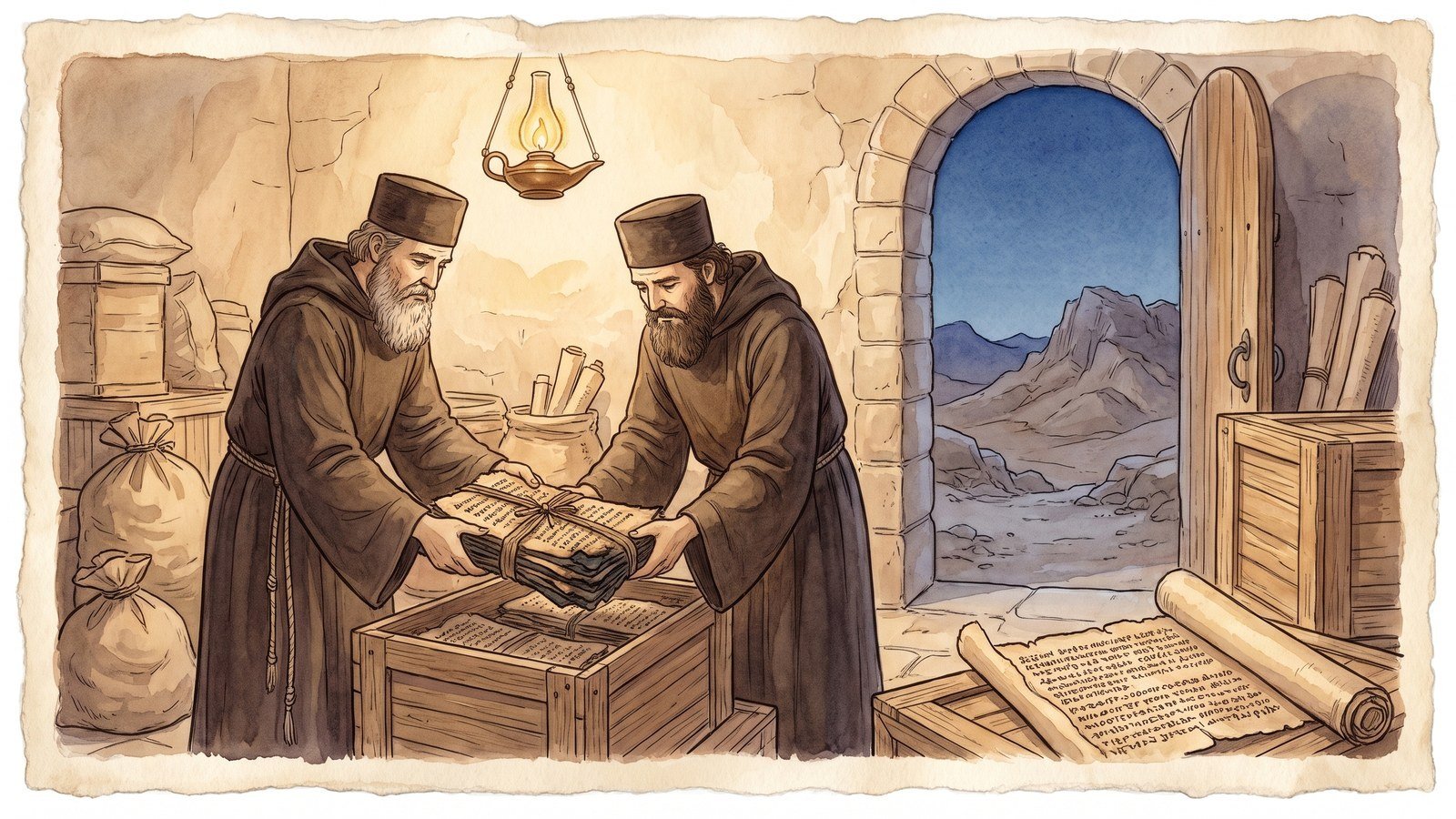
In May 1975, during work to clear and repair part of the fortified Monastery of Saint Catherine at the foot of Mount Sinai, the monks opened a room beneath the chapel of Saint George in the northern wall and found it filled with debris. Among the rubble lay a large quantity of manuscripts and fragments of manuscripts on parchment and paper: more than a thousand items, many of them damaged, written in Greek, Syriac, Arabic, Georgian, Slavonic, Latin, Armenian, Ethiopic and Christian Palestinian Aramaic, and in the rare script of the Caucasian Albanians. They had evidently been placed there long before, perhaps after a collapse or a fire, and forgotten. The collection has since been known as the New Finds of Sinai.12 Its contents include missing leaves of Codex Sinaiticus, additional leaves of the earliest Slavonic books, and a series of palimpsests whose erased texts have been recovered over the following decades. The most systematic of these recoveries was carried out by the Sinai Palimpsests Project between 2011 and 2017. This article describes the monastery and its library, the discovery of 1975, the principal contents of the New Finds, and the methods and results of the palimpsest project.3
At a glance
- 548–565: The fortified monastery at the foot of Mount Sinai is built under Justinian I.
- 4th–10th centuries: Manuscripts in many languages accumulate in the monastery’s library.
- 1844–1859: Tischendorf removes leaves and then the bulk of Codex Sinaiticus.
- 1892: Agnes Smith Lewis and Margaret Dunlop Gibson identify the Syriac Sinaiticus palimpsest.
- May 1975: Monks clearing a room below the chapel of St George find a large deposit of manuscripts.
- 1985–2005: Catalogues of the Arabic, Slavonic, Syriac, Greek and Georgian new finds appear.
- 2008: The Caucasian Albanian palimpsests are published.
- 2011–2017: The Sinai Palimpsests Project images some 74 palimpsests with spectral methods.
- 2018: The project’s images and catalogue are released online.
The Monastery and Its Library
A Fortified Monastery
The Monastery of Saint Catherine stands at about 1,550 metres above sea level in a narrow valley at the foot of the mountain that Christian tradition has identified, since at least the fourth century, with the biblical Mount Sinai. Hermits had lived in the area from an early date, and a small church was associated with the site of the burning bush. Between about 548 and 565 the emperor Justinian I built the fortified walls and the basilica that still stand, to protect the monks and to secure the frontier. The monastery has been continuously inhabited since then, and it is one of the oldest Christian monasteries in continuous use.45
The monastery’s long existence in a dry climate, under the protection successively of Byzantine emperors, Muslim rulers and Ottoman sultans, allowed its library to survive with relatively few losses. Its monks and visitors came from many parts of the Christian world, including Greece, Syria, Palestine, Georgia, Armenia, Egypt, the Slavic lands and western Europe, and they brought or copied books in their own languages. The result is a collection of manuscripts unequalled in its range of languages and in the number of its early books.67
Earlier Discoveries
The library had attracted scholars long before 1975. The most famous episode is that of Constantin von Tischendorf, who in 1844 took away forty-three leaves of a fourth-century Greek Bible and in 1859 obtained the larger part of the manuscript, which was presented to the Russian tsar and in 1933 sold by the Soviet government to the British Museum. This is Codex Sinaiticus, described in The Fourth-Century Bible from Mount Sinai.8910
In 1892 two Scottish scholars, the twin sisters Agnes Smith Lewis and Margaret Dunlop Gibson, photographed in the library a Syriac palimpsest whose lower text proved to be one of the earliest copies of the Gospels in Syriac. The manuscript, now known as the Syriac Sinaiticus, remains at the monastery. Their discovery made Sinai known as a place where erased texts of great importance might still be found beneath later writing.111213
In the twentieth century the library was catalogued and photographed by several expeditions. Between 1949 and 1950 the Library of Congress, with the American Foundation for the Study of Man, microfilmed a large part of the collection, and in the 1950s and 1960s expeditions from Princeton, the University of Michigan and Alexandria studied and photographed the illuminated manuscripts and icons. By 1975 the library was therefore one of the best-studied monastic collections in the Christian world. That a large and previously unknown deposit could still be found within its walls was correspondingly unexpected.14
The Discovery of 1975
The Room beneath the Chapel of Saint George
The discovery was made in the course of building work in the northern part of the monastery. When a room below the chapel of Saint George was cleared, the workers found that a lower space was filled with fallen material and debris, among which were manuscripts and fragments. The room had apparently been used, perhaps in the eighteenth century, as a place for storing damaged books and leaves that the monks did not wish to destroy, and it may have been sealed after a collapse. The precise date and reason for the deposit are not known.1516
The monastery kept the find under its own control. The material was removed, cleaned and stored under the supervision of the archbishop and the librarian, and access was granted gradually to specialist scholars who could prepare catalogues for each language. This was a different course from that taken in the nineteenth century, when manuscripts had left the library, and it reflected the monastery’s determination that the New Finds should be studied in place.17
Size and Composition
Estimates of the size of the New Finds vary according to how fragments are counted. The Greek part alone was catalogued by Panayotis Nikolopoulos in 1999, who described some 1,100 items, among them several hundred codices or substantial parts of codices and many smaller fragments.18 The Syriac, Arabic, Georgian and Slavonic material was catalogued separately. In total the deposit includes many thousands of leaves, ranging in date from about the fourth century to the eighteenth, with the majority from the period before about 1100.192021
The Principal Contents
Leaves of Codex Sinaiticus
The most celebrated items in the New Finds are leaves and fragments of Codex Sinaiticus that Tischendorf had not seen. They comprise about a dozen leaves and a larger number of fragments from the Old Testament, preserved in varying states, some of them complete leaves and others small pieces. Their discovery confirmed that parts of the codex had remained at Sinai after Tischendorf’s visits and showed that the manuscript had been damaged and dispersed within the monastery itself.2223
The leaves were examined during the Codex Sinaiticus Project, an international collaboration between the British Library, Leipzig University Library, the National Library of Russia and the monastery, which between 2005 and 2009 photographed and published all the surviving parts of the manuscript online. In 2009, during the conservation survey that formed part of that project, the conservator Nikolas Sarris found a further fragment of the codex reused in the binding of a later book in the monastery library. The New Finds leaves, with this fragment, are now part of the complete digital edition of the codex.2425
Relations with the Earlier Controversy
The leaves of Codex Sinaiticus found in 1975 had a particular significance for the monastery because of the long dispute about Tischendorf’s removal of the main part of the manuscript in 1859. The monastery has maintained that the codex was lent rather than given, while the Russian imperial government regarded it as a gift in return for which it made payments and gifts to the community. The discovery of further leaves at Sinai did not settle that dispute, but it gave the monastery its own portion of the codex beyond the fragments that had always remained there, and it was one of the reasons for the monastery’s participation in the Codex Sinaiticus Project, in which all the holding institutions took part on equal terms.2627
The Slavonic Manuscripts
The Slavonic part of the New Finds was catalogued by Ioannis Tarnanidis in 1988. It contains about forty items, among them some of the oldest surviving manuscripts in the Glagolitic script, the alphabet devised in the ninth century for the mission of Cyril and Methodius. They include additional leaves of the two Glagolitic manuscripts already known at Sinai, the Psalter known as the Psalterium Sinaiticum and the prayer book known as the Euchologium Sinaiticum, both of the eleventh century, as well as further Glagolitic and early Cyrillic books.2829
These manuscripts are among the most important witnesses to the earliest Slavonic liturgical and biblical texts and to the language now called Old Church Slavonic. Their discovery enlarged a corpus that had been fixed for a century and provided new evidence for the language and spelling of the earliest Slavonic books. The work of Cyril and Methodius and the history of the Slavonic Bible are described in Cyril and Methodius, the Slavonic Bible and the Gennadius Bible of 1499.30
The Syriac and Christian Palestinian Aramaic Fragments
The Syriac New Finds were catalogued by Sebastian Brock in 1995. They include fragments of biblical books, liturgical texts, hymns and patristic works, many of them older than the tenth century. Among them are additional fragments of texts already known from the older collection and several hitherto unknown works.31
Of particular interest are manuscripts in Christian Palestinian Aramaic, a Western Aramaic dialect used by Christian communities in Palestine and Transjordan between about the fifth and the thirteenth centuries and written in a form of the Syriac script. The surviving literature in this dialect is small and consists mostly of translations of biblical and liturgical texts from Greek. The New Finds, and particularly the palimpsests among them, have added considerably to it. Several Christian Palestinian Aramaic texts have been found as the lower writing of later manuscripts, including passages of the Old and New Testaments.3233
The Georgian Manuscripts
The Georgian New Finds were catalogued in 2005 by a team led by Zaza Aleksidze. They form one of the largest groups among the New Finds, and many of the items are very early. Georgian monks were present at Sinai from at least the ninth century and produced a large literature there, both original and translated. The New Finds include biblical texts, lectionaries, hymnals and patristic translations in the earliest Georgian scripts, some of them palimpsests with still earlier lower texts.3435
The Caucasian Albanian Palimpsests
The most unexpected result of the study of the Georgian New Finds was the identification of texts in the language and script of the Caucasian Albanians, a people of the eastern Caucasus whose Christian kingdom flourished in late antiquity in the region of the present Republic of Azerbaijan. The Caucasian Albanian alphabet was known only from a few short inscriptions and from an alphabet list in an Armenian manuscript, and no book in the language had been known to survive.36
In the 1990s Zaza Aleksidze recognised that the lower text of two Georgian palimpsests among the New Finds was written in this script. With Jost Gippert, Wolfgang Schulze and Jean-Pierre Mahé, he deciphered the text, and in 2008 the team published the palimpsests in two volumes. The Albanian text proved to be a lectionary with readings from the Old and New Testaments and a substantial part of the Gospel of John. It is the only known body of literature in the language and has made it possible to describe the grammar of Caucasian Albanian, which is related to the modern Udi language.3738
The Arabic and Greek Manuscripts
The Arabic New Finds were catalogued by Ioannis Meimaris in 1985. They include Christian Arabic manuscripts from the ninth century onwards, among them translations of the Bible and of patristic and liturgical works, and documents relating to the history of the monastery. Some of these are among the earliest Christian texts in Arabic and provide evidence for the transition of the Christian communities of Palestine and Sinai from Greek and Aramaic to Arabic in the centuries after the Islamic conquest.39
The Greek New Finds, catalogued by Nikolopoulos, form the largest part of the deposit. They include biblical manuscripts, lectionaries, liturgical books, hymnography, lives of saints and patristic texts, some of them in uncial script of the period before the ninth century. Among them are many palimpsests, in which earlier Greek or other texts lie beneath the visible writing.40
Latin, Armenian and Ethiopic Material
Smaller groups of the New Finds are in Latin, Armenian and Ethiopic. The Latin fragments reflect the presence of western monks and pilgrims at Sinai, a presence attested in late antiquity by the account of the pilgrim Egeria, who visited the mountain in the 380s, and later by the visits of crusaders and western pilgrims. Some of the Latin material is very early and includes biblical and liturgical texts. The Armenian and Ethiopic fragments are fewer, but they too show that monks and visitors from those churches used and left books at Sinai. Most of these smaller groups have been studied in connection with the palimpsest project rather than in separate catalogues.4142
The Languages of the Library
The variety of languages in the New Finds reflects the history of the monastery’s community. In late antiquity its monks were mainly Greek-speaking, but they included Syriac and Aramaic speakers from Syria and Palestine. From the ninth century Georgian monks were present in significant numbers, and Arabic became increasingly common among the Christian population of the region after the Islamic conquests of the seventh century. Slavonic monks and pilgrims came from the Balkans and later from Russia. Each of these groups brought its own books and produced new ones, so that the library came to contain texts in more than a dozen languages.4344
The coexistence of these languages had consequences for the transmission of the texts. Books were translated at Sinai from Greek into Georgian and Arabic, and scribes sometimes copied texts in one language into manuscripts that had previously held another. Bilingual manuscripts, with Greek and Arabic or Greek and Georgian in parallel columns, are found in both the older collection and the New Finds. The library is therefore not only a repository of separate traditions but a record of their interaction, and the New Finds have added substantially to the evidence for it.454647
Palimpsests
Reused Parchment
A palimpsest is a manuscript whose original writing has been scraped or washed away so that the parchment could be used again. In the Middle Ages parchment was expensive, and monastic scribes frequently reused the leaves of older books that had become damaged or whose language or contents were no longer needed. The leaves were cleaned, often turned and folded to a new size, and written over. Traces of the earlier writing often remained, sometimes faintly visible to the eye and sometimes detectable only under ultraviolet light or by other means.48
Sinai is unusually rich in palimpsests. Its monks wrote and copied in many languages, and as communities changed and languages fell out of use, books in one language were reused for another. A Greek book might be written over a Christian Palestinian Aramaic one, a Georgian over a Caucasian Albanian, an Arabic over a Syriac. The lower texts are therefore often older and rarer than the upper ones, and they include works in languages that survive nowhere else in written form.4950
Earlier Methods
The first readers of palimpsests relied on the naked eye and on chemical reagents. In the nineteenth century scholars applied solutions that temporarily darkened the remains of the earlier ink, often at the cost of permanent staining of the parchment. In the twentieth century ultraviolet lamps and ultraviolet photography made it possible to see faded writing without damaging the leaf. These methods produced important results at Sinai, including the reading of the Syriac Sinaiticus, but many lower texts remained illegible.5152
The Sinai Palimpsests Project
Organisation
The Sinai Palimpsests Project was undertaken by the Monastery of Saint Catherine in partnership with the Early Manuscripts Electronic Library, a non-profit organisation based in California, and the UCLA Library. Its director was Michael Phelps of the Early Manuscripts Electronic Library, and its scholarly director was Claudia Rapp of the University of Vienna. The imaging was carried out at the monastery between 2011 and 2017, and the results were made available online in 2018 through a portal hosted by UCLA.5354
The project’s aim was to image every palimpsest in the monastery library, both from the old collection and from the New Finds, and to identify and describe the lower texts. Its team of imaging scientists photographed some seventy-four palimpsests, comprising about 6,800 pages, and a team of some two dozen specialists in different languages and fields studied the resulting images.5556
Spectral Imaging
The method used was multispectral imaging. Each page was photographed many times under light of different narrow wavelengths, from the ultraviolet through the visible to the infrared, and with light falling on the page from different angles. Because the remains of erased ink and the parchment react differently to different wavelengths, the images could be combined and processed by computer to enhance the contrast of the lower writing. The processing was carried out by imaging scientists including Roger Easton and Keith Knox, who had worked on the Archimedes Palimpsest in Baltimore.5758
The images produced by these methods can make the lower text legible where it is completely invisible to the eye. They do not replace the work of the scholar, since the enhanced images often show overlapping writing, damaged surfaces and faint traces that require expert reading. The value of the project lay in combining the imaging with the participation of specialists who could identify and interpret what the images revealed.5960
The Imaging Process at the Monastery
The imaging was carried out in the monastery itself, in a workroom where a camera system was set up above a cradle for the manuscript. For each page the team captured a sequence of images under illumination from light-emitting diodes of narrow wavelength bands, as well as images taken with light from a low angle to show the texture of the surface and with light passing through the parchment from behind. A single page could require several dozen exposures. The raw images were sent to the processing team, who applied statistical methods to combine them and to separate the traces of the lower writing from the upper text and the parchment.6162
The processed images were then passed to the scholars, who worked remotely and returned to the team with requests for further processing when particular areas remained unclear. The cycle of imaging, processing and reading made it possible to refine the results for difficult pages. The method had been developed on a smaller scale in earlier projects and was applied at Sinai to an entire collection of palimpsests for the first time.63
Christian Palestinian Aramaic Texts
Among the most numerous discoveries of the project were lower texts in Christian Palestinian Aramaic. Before the project the surviving literature in this dialect consisted of a limited number of manuscripts, many of them themselves palimpsests, together with inscriptions. The project identified many further texts, including portions of the Old Testament and the Gospels, lectionaries and hymns. Because Christian Palestinian Aramaic was spoken in the region where the Gospels are set, its biblical translations are of particular interest for the history of the Aramaic language, although they were translated from Greek and do not preserve any independent Aramaic tradition of the sayings of Jesus.646566
Results
The project identified more than three hundred lower texts in ten languages: Greek, Latin, Syriac, Christian Palestinian Aramaic, Arabic, Georgian, Armenian, Caucasian Albanian, Coptic and Ethiopic. Among the discoveries were further Caucasian Albanian texts, many new texts in Christian Palestinian Aramaic, and a number of Greek texts of non-biblical character, including medical texts attributed to the school of Hippocrates and other classical works not otherwise known from Sinai. In Latin, the project identified several early texts, some of them among the earliest Latin manuscripts in the Eastern Mediterranean.676869
For biblical studies the results are significant in two ways. First, many of the lower texts are early copies of biblical books in translation, especially in Christian Palestinian Aramaic, Syriac and Georgian, and they add to the evidence for the history of those versions. Second, the palimpsests show how biblical and liturgical books moved between communities and languages in the monastery, and how texts that had ceased to be read in one language were replaced by texts in another.7071
The scholarly results of the project were presented at a conference in Vienna and published in 2023 in a volume edited by Claudia Rapp, Giulia Rossetto, Jana Grusková and Grigory Kessel. In the same year Giulia Rossetto published an inventory of the Greek palimpsests of Sinai with an account of their lower texts.7273
Access and Conservation
The New Finds and the palimpsests remain in the monastery’s library, which was renovated and reopened in 2017. The monastery has insisted that its manuscripts should be studied in place and through digital images rather than removed, and the cataloguing of the New Finds and the palimpsest project were both carried out on this basis. The portal of the Sinai Palimpsests Project provides images and descriptions to registered scholars, and selected images have been made freely available.7475
Conservation of the New Finds has been a long process. Many of the leaves were found crumpled, torn or stuck together, and some had suffered from damp or insects. Before they could be catalogued or imaged they had to be cleaned and stabilised. The monastery has worked with conservators from Greece and elsewhere on this task, and the condition of the material has influenced the order in which different groups have been studied.7677
Significance
The discovery of 1975 and the work that followed have changed the understanding of the monastery’s library and of the Christian literatures represented in it. The New Finds added substantially to the known manuscripts of Codex Sinaiticus, the earliest Slavonic books, Christian Palestinian Aramaic literature and early Georgian and Arabic Christianity, and they revealed the only surviving books in Caucasian Albanian. The palimpsest project showed that a large part of the monastery’s earliest literature lay hidden beneath later writing and that modern imaging could recover it.787980
For the history of the Bible these discoveries are significant chiefly as evidence of translation. The Bible at Sinai was read in many languages, and the remains of these translations, in many cases the earliest that survive, show how the biblical text was carried from Greek and Syriac into the languages of the Caucasus, the Slavs, the Arabs and the Christian Aramaic communities of Palestine. They give the monastery an importance for the transmission of the biblical text that extends well beyond the single great Greek codex for which it is best known.8182
Conclusion
The New Finds of Sinai were discovered by chance in 1975, in a room below the chapel of Saint George that had been filled with damaged books and debris and forgotten. They comprise many thousands of leaves in more than ten languages, among them missing parts of Codex Sinaiticus, early Glagolitic manuscripts and the unique Caucasian Albanian palimpsests. Their cataloguing over the following decades, language by language, and the spectral imaging of the monastery’s palimpsests between 2011 and 2017, have recovered texts that were unknown or thought lost. The material remains at the monastery, where it continues to be conserved and studied, and the work of identifying its contents is not yet complete.838485
Notes
- Panayotis G. Nikolopoulos, The New Finds of Sinai (Athens: Ministry of Culture and Mount Sinai Foundation, 1999). *
- Holy Monastery of Saint Catherine, official website. *
- UCLA Library and Early Manuscripts Electronic Library, Sinai Palimpsests Project. *
- ““Justinian I””. *
- ““Saint Catherine’s Monastery””. *
- Kurt Weitzmann and George Galavaris, The Monastery of Saint Catherine at Mount Sinai: The Illuminated Greek Manuscripts, vol. I (Princeton: Princeton University Press, 1990). *
- Holy Monastery of Saint Catherine, official website. *
- ““Codex Sinaiticus””. *
- ““Constantin von Tischendorf””. *
- David C. Parker, Codex Sinaiticus: The Story of the World’s Oldest Bible (London: British Library; Peabody: Hendrickson, 2010). *
- ““Syriac Sinaiticus””. *
- Agnes Smith Lewis, In the Shadow of Sinai: A Story of Travel and Research from 1895 to 1897 (Cambridge: Macmillan and Bowes, 1898). *
- Janet Soskice, Sisters of Sinai: How Two Lady Adventurers Found the Hidden Gospels (London: Chatto and Windus, 2009). *
- Kurt Weitzmann and George Galavaris, The Monastery of Saint Catherine at Mount Sinai: The Illuminated Greek Manuscripts, vol. I (Princeton: Princeton University Press, 1990). *
- Panayotis G. Nikolopoulos, The New Finds of Sinai (Athens: Ministry of Culture and Mount Sinai Foundation, 1999). *
- Holy Monastery of Saint Catherine, official website. *
- Panayotis G. Nikolopoulos, The New Finds of Sinai (Athens: Ministry of Culture and Mount Sinai Foundation, 1999). *
- Panayotis G. Nikolopoulos, The New Finds of Sinai (Athens: Ministry of Culture and Mount Sinai Foundation, 1999). *
- Panayotis G. Nikolopoulos, The New Finds of Sinai (Athens: Ministry of Culture and Mount Sinai Foundation, 1999). *
- Sebastian P. Brock, Catalogue of Syriac Fragments (New Finds) in the Library of the Monastery of Saint Catherine, Mount Sinai (Athens: Mount Sinai Foundation, 1995). *
- Zaza Aleksidze, Mzekala Shanidze, Lily Khevsuriani and Michael Kavtaria, Catalogue of Georgian Manuscripts Discovered in 1975 at St Catherine’s Monastery on Mount Sinai (Athens: Mount Sinai Foundation, 2005). *
- David C. Parker, Codex Sinaiticus: The Story of the World’s Oldest Bible (London: British Library; Peabody: Hendrickson, 2010). *
- ““Codex Sinaiticus””. *
- David C. Parker, Codex Sinaiticus: The Story of the World’s Oldest Bible (London: British Library; Peabody: Hendrickson, 2010). *
- Nikolas Sarris, “The Discovery of a New Fragment of Codex Sinaiticus”, in Scot McKendrick, David Parker, Amy Myshrall and Cillian O’Hogan, eds, Codex Sinaiticus: New Perspectives on the Ancient Biblical Manuscript (London: British Library, 2015). *
- David C. Parker, Codex Sinaiticus: The Story of the World’s Oldest Bible (London: British Library; Peabody: Hendrickson, 2010). *
- ““Constantin von Tischendorf””. *
- Ioannis C. Tarnanidis, The Slavonic Manuscripts Discovered in 1975 at St Catherine’s Monastery on Mount Sinai (Thessaloniki: St Catherine’s Monastery and Hellenic Association for Slavic Studies, 1988). *
- ““Glagolitic script””. *
- Ioannis C. Tarnanidis, The Slavonic Manuscripts Discovered in 1975 at St Catherine’s Monastery on Mount Sinai (Thessaloniki: St Catherine’s Monastery and Hellenic Association for Slavic Studies, 1988). *
- Sebastian P. Brock, Catalogue of Syriac Fragments (New Finds) in the Library of the Monastery of Saint Catherine, Mount Sinai (Athens: Mount Sinai Foundation, 1995). *
- ““Christian Palestinian Aramaic””. *
- Christa Müller-Kessler, “Christian Palestinian Aramaic and Its Significance to the Western Aramaic Dialect Group”, Journal of the American Oriental Society 119 (1999), 631–636. *
- Zaza Aleksidze, Mzekala Shanidze, Lily Khevsuriani and Michael Kavtaria, Catalogue of Georgian Manuscripts Discovered in 1975 at St Catherine’s Monastery on Mount Sinai (Athens: Mount Sinai Foundation, 2005). *
- ““Georgian scripts””. *
- ““Caucasian Albanian script””. *
- Jost Gippert, Wolfgang Schulze, Zaza Aleksidze and Jean-Pierre Mahé, The Caucasian Albanian Palimpsests of Mount Sinai, 2 vols, Monumenta Palaeographica Medii Aevi, Series Ibero-Caucasica 2 (Turnhout: Brepols, 2008). *
- ““Caucasian Albanian script””. *
- Ioannis E. Meimaris, Katalogos ton neon aravikon cheirographon tis Ieras Monis Agias Aikaterinis tou Orous Sina (Athens: Ethnikon Idryma Erevnon, 1985). *
- Panayotis G. Nikolopoulos, The New Finds of Sinai (Athens: Ministry of Culture and Mount Sinai Foundation, 1999). *
- Claudia Rapp, Giulia Rossetto, Jana Grusková and Grigory Kessel, eds, New Light on Old Manuscripts: The Sinai Palimpsests and Other Advances in Palimpsest Studies, Veröffentlichungen zur Byzanzforschung 45 (Vienna: Austrian Academy of Sciences Press, 2023). *
- Giulia Rossetto, Greek Palimpsests at Sinai: Inventory and New Discoveries (Vienna: Austrian Academy of Sciences Press, 2023). *
- Kurt Weitzmann and George Galavaris, The Monastery of Saint Catherine at Mount Sinai: The Illuminated Greek Manuscripts, vol. I (Princeton: Princeton University Press, 1990). *
- Holy Monastery of Saint Catherine, official website. *
- Panayotis G. Nikolopoulos, The New Finds of Sinai (Athens: Ministry of Culture and Mount Sinai Foundation, 1999). *
- Zaza Aleksidze, Mzekala Shanidze, Lily Khevsuriani and Michael Kavtaria, Catalogue of Georgian Manuscripts Discovered in 1975 at St Catherine’s Monastery on Mount Sinai (Athens: Mount Sinai Foundation, 2005). *
- Ioannis E. Meimaris, Katalogos ton neon aravikon cheirographon tis Ieras Monis Agias Aikaterinis tou Orous Sina (Athens: Ethnikon Idryma Erevnon, 1985). *
- ““Palimpsest””. *
- Giulia Rossetto, Greek Palimpsests at Sinai: Inventory and New Discoveries (Vienna: Austrian Academy of Sciences Press, 2023). *
- Claudia Rapp, Giulia Rossetto, Jana Grusková and Grigory Kessel, eds, New Light on Old Manuscripts: The Sinai Palimpsests and Other Advances in Palimpsest Studies, Veröffentlichungen zur Byzanzforschung 45 (Vienna: Austrian Academy of Sciences Press, 2023). *
- Agnes Smith Lewis, In the Shadow of Sinai: A Story of Travel and Research from 1895 to 1897 (Cambridge: Macmillan and Bowes, 1898). *
- ““Palimpsest””. *
- UCLA Library and Early Manuscripts Electronic Library, Sinai Palimpsests Project. *
- Claudia Rapp, Giulia Rossetto, Jana Grusková and Grigory Kessel, eds, New Light on Old Manuscripts: The Sinai Palimpsests and Other Advances in Palimpsest Studies, Veröffentlichungen zur Byzanzforschung 45 (Vienna: Austrian Academy of Sciences Press, 2023). *
- ““Multispectral imaging””. *
- Claudia Rapp, Giulia Rossetto, Jana Grusková and Grigory Kessel, eds, New Light on Old Manuscripts: The Sinai Palimpsests and Other Advances in Palimpsest Studies, Veröffentlichungen zur Byzanzforschung 45 (Vienna: Austrian Academy of Sciences Press, 2023). *
- Claudia Rapp, Giulia Rossetto, Jana Grusková and Grigory Kessel, eds, New Light on Old Manuscripts: The Sinai Palimpsests and Other Advances in Palimpsest Studies, Veröffentlichungen zur Byzanzforschung 45 (Vienna: Austrian Academy of Sciences Press, 2023). *
- Giulia Rossetto, Greek Palimpsests at Sinai: Inventory and New Discoveries (Vienna: Austrian Academy of Sciences Press, 2023). *
- Claudia Rapp, Giulia Rossetto, Jana Grusková and Grigory Kessel, eds, New Light on Old Manuscripts: The Sinai Palimpsests and Other Advances in Palimpsest Studies, Veröffentlichungen zur Byzanzforschung 45 (Vienna: Austrian Academy of Sciences Press, 2023). *
- ““Multispectral imaging””. *
- Claudia Rapp, Giulia Rossetto, Jana Grusková and Grigory Kessel, eds, New Light on Old Manuscripts: The Sinai Palimpsests and Other Advances in Palimpsest Studies, Veröffentlichungen zur Byzanzforschung 45 (Vienna: Austrian Academy of Sciences Press, 2023). *
- ““Christian Palestinian Aramaic””. *
- Christa Müller-Kessler, “Christian Palestinian Aramaic and Its Significance to the Western Aramaic Dialect Group”, Journal of the American Oriental Society 119 (1999), 631–636. *
- Claudia Rapp, Giulia Rossetto, Jana Grusková and Grigory Kessel, eds, New Light on Old Manuscripts: The Sinai Palimpsests and Other Advances in Palimpsest Studies, Veröffentlichungen zur Byzanzforschung 45 (Vienna: Austrian Academy of Sciences Press, 2023). *
- UCLA Library and Early Manuscripts Electronic Library, Sinai Palimpsests Project. *
- Claudia Rapp, Giulia Rossetto, Jana Grusková and Grigory Kessel, eds, New Light on Old Manuscripts: The Sinai Palimpsests and Other Advances in Palimpsest Studies, Veröffentlichungen zur Byzanzforschung 45 (Vienna: Austrian Academy of Sciences Press, 2023). *
- Giulia Rossetto, Greek Palimpsests at Sinai: Inventory and New Discoveries (Vienna: Austrian Academy of Sciences Press, 2023). *
- Claudia Rapp, Giulia Rossetto, Jana Grusková and Grigory Kessel, eds, New Light on Old Manuscripts: The Sinai Palimpsests and Other Advances in Palimpsest Studies, Veröffentlichungen zur Byzanzforschung 45 (Vienna: Austrian Academy of Sciences Press, 2023). *
- ““Christian Palestinian Aramaic””. *
- Claudia Rapp, Giulia Rossetto, Jana Grusková and Grigory Kessel, eds, New Light on Old Manuscripts: The Sinai Palimpsests and Other Advances in Palimpsest Studies, Veröffentlichungen zur Byzanzforschung 45 (Vienna: Austrian Academy of Sciences Press, 2023). *
- Giulia Rossetto, Greek Palimpsests at Sinai: Inventory and New Discoveries (Vienna: Austrian Academy of Sciences Press, 2023). *
- UCLA Library and Early Manuscripts Electronic Library, Sinai Palimpsests Project. *
- Holy Monastery of Saint Catherine, official website. *
- Nikolas Sarris, “The Discovery of a New Fragment of Codex Sinaiticus”, in Scot McKendrick, David Parker, Amy Myshrall and Cillian O’Hogan, eds, Codex Sinaiticus: New Perspectives on the Ancient Biblical Manuscript (London: British Library, 2015). *
- Panayotis G. Nikolopoulos, The New Finds of Sinai (Athens: Ministry of Culture and Mount Sinai Foundation, 1999). *
- Panayotis G. Nikolopoulos, The New Finds of Sinai (Athens: Ministry of Culture and Mount Sinai Foundation, 1999). *
- Claudia Rapp, Giulia Rossetto, Jana Grusková and Grigory Kessel, eds, New Light on Old Manuscripts: The Sinai Palimpsests and Other Advances in Palimpsest Studies, Veröffentlichungen zur Byzanzforschung 45 (Vienna: Austrian Academy of Sciences Press, 2023). *
- Jost Gippert, Wolfgang Schulze, Zaza Aleksidze and Jean-Pierre Mahé, The Caucasian Albanian Palimpsests of Mount Sinai, 2 vols, Monumenta Palaeographica Medii Aevi, Series Ibero-Caucasica 2 (Turnhout: Brepols, 2008). *
- Claudia Rapp, Giulia Rossetto, Jana Grusková and Grigory Kessel, eds, New Light on Old Manuscripts: The Sinai Palimpsests and Other Advances in Palimpsest Studies, Veröffentlichungen zur Byzanzforschung 45 (Vienna: Austrian Academy of Sciences Press, 2023). *
- ““Codex Sinaiticus””. *
- Panayotis G. Nikolopoulos, The New Finds of Sinai (Athens: Ministry of Culture and Mount Sinai Foundation, 1999). *
- UCLA Library and Early Manuscripts Electronic Library, Sinai Palimpsests Project. *
- Claudia Rapp, Giulia Rossetto, Jana Grusková and Grigory Kessel, eds, New Light on Old Manuscripts: The Sinai Palimpsests and Other Advances in Palimpsest Studies, Veröffentlichungen zur Byzanzforschung 45 (Vienna: Austrian Academy of Sciences Press, 2023). *


