The Origins of Chutzpah
1. A word and an attitude
Chutzpah is among the best-known Yiddish words in English, yet its history is older and more ambivalent than the slang sense of “nerve” suggests. In rabbinic Hebrew and Aramaic the noun ḥuṣpâ named impudence and brazen-faced presumption, as Gotthard Deutsch’s entry in the Jewish Encyclopedia already summarised a century ago. In Yiddish it kept that largely pejorative force as khutspe. Only after it entered American English, carried by Ashkenazi immigrants and popularised by mid-twentieth-century lexicographers and lawyers, did it acquire the admiring sense of audacious self-confidence that dictionaries now often record first.[1][2][3][4]

This essay traces both the word and the attitude. It begins with the Semitic root and the lexicographic record, from the Talmudic dictionaries through Ben-Yehuda, and with the earliest rabbinic attestations, including the Mishnah’s warning that in the footsteps of the Messiah “impudence will increase” and the Talmud’s remark that chutzpah is effective “even toward Heaven”. It then turns to narrative cases of holy audacity—Honi the Circle-Drawer, Abraham at Sodom, Moses after the golden calf, and Job—before following the word through Yiddish into the English of the Lower East Side, the stage and the American courts. A final group of sections treats modern Hebrew and Israeli usage, Alan Dershowitz’s book of 1991, and the Hasidic and post-Holocaust tradition of bringing a lawsuit against God, from Levi Yitzchak of Berdichev to Elie Wiesel.[5][6]
2. Hebrew and Aramaic roots
The Jewish Encyclopedia entry by Gotthard Deutsch, published at the beginning of the twentieth century, treats ḥuẓpa as an Aramaic word for “impudence”, already common in the Talmud, in later rabbinic literature and in everyday speech. In Biblical Aramaic only the related verb appears: twice in the Book of Daniel, in the sense of being strict or urgent. From the earliest strata of Talmudic literature both the verb ḥaẓaf, “to be brazen-faced”, and the noun ḥuẓpa are used in legal maxims and moral sayings. A man would not be so impudent, the sages argue, as to fell a tree that was not his, or to sign a document with his father’s name alone as a ruse against forgery.[1]
Modern etymological notices agree on the path into English. Merriam-Webster derives the word from Yiddish khutspe, itself from Late Hebrew ḥuṣpāh, and dates the first known English use to 1867. The Online Etymology Dictionary gives 1892 and glosses the Yiddish as “impudence, gall”, from Hebrew hutspah. Behind both stands a Semitic root associated with uncovering or acting insolently: to be barefaced is, in this imagery, to cast off shame. Deutsch’s bibliography points the reader to Levy’s Neuhebräisches Wörterbuch, Kohut’s Aruch Completum, Jastrow’s Talmudic dictionary and Lampronti’s Paḥad Yiẓḥaḳ—the standard philological apparatus for the word in rabbinic Aramaic and Hebrew.[2][3][4][1]
3. In the dictionaries
Marcus Jastrow’s Dictionary of the Targumim, the Talmud Babli and Yerushalmi, and the Midrashic Literature, which Deutsch cites, places ḥuṣpâ firmly among the common nouns of rabbinic Aramaic. The Jewish Encyclopedia’s own treatment, drawing on that tradition, already distinguishes the legal and proverbial uses of the word from any later slang sense. Eliezer Ben-Yehuda’s great historical dictionary of Hebrew, now available through the Ben-Yehuda Project, gives חֻצְפָּה as a feminine noun meaning the quality of the insolent—German Frechheit, French arrogance—and illustrates it from Midrash Rabbah on Genesis, from Alshekh’s commentary on Job, and from medieval correspondence. Ben-Yehuda’s notes quote the two Talmudic sayings already familiar from Sanhedrin: that chutzpah is monarchy without a crown, and that it is effective even against Heaven; a footnote records the Aramaic form חוצפא and the Sotah prophecy that in the footsteps of the Messiah chutzpah will increase.[7][1][6][5]
The Jewish English Lexicon, edited by Sarah Bunin Benor, treats chutzpah as a word of textual Hebrew, Yiddish, modern Hebrew and Aramaic origin that has spread well beyond Jewish networks in North America, Britain, South Africa and Australasia. Its brief definitions—“guts, confidence” and “nerve, audacity”—already register the English ambivalence. The lexicon’s dictionary list runs from Rosten’s Joys of Yiddish through Sol Steinmetz, Joyce Eisenberg and Ellen Scolnic, Lewis Glinert’s Joys of Hebrew and Chaim Weiser’s Frumspeak, a reminder that the word now sits in several overlapping Jewish Englishes as well as in the general vocabulary.[8]
4. In the footprints of the Messiah
The earliest classical Jewish source usually cited for the noun is Mishnah Sotah 9:15, a long chain of laments for the decline of piety after the destruction of the Temple and the deaths of successive sages. Near the end of that chapter Rabbi Eliezer the Great is reported as saying that in the footsteps of the Messiah—be-ʿiqvot meshiaḥa—ḥuṣpâ will increase, prices will soar, the vine will yield fruit yet wine will be dear, the kingdom will turn to heresy and there will be none to give reproof. Wisdom will putrefy, those who fear sin will be despised, and truth will be absent. The face of the generation will be like the face of a dog; a son will no longer be ashamed before his father.[5]
The parallel passage in the Babylonian Talmud, Sotah 49b, preserves the same prophecy in the context of mourning for a lost world of learning and restraint. Deutsch’s encyclopedia entry summarises the line as “In the foot-prints of the Messiah [before the arrival of the Messiah] impudence will increase.” In that register chutzpah is not wit or enterprise; it is a symptom of social and moral disorder, listed alongside the collapse of deference between the young and the old. Ben-Yehuda’s footnote cites the same Aramaic wording, confirming that the lexicographers read the mishnaic and talmudic passages as a single tradition of meaning.[9][1][7]
5. Even toward Heaven
The Talmud also records a more paradoxical valuation. On Sanhedrin 105a, Rav Naḥman says that impudence is effective even toward Heaven—chutzpah, afilu kelapei shemaya, mehanya. His proof is the story of Balaam: God first forbids him to go with Balak’s messengers, yet after Balaam persists the command is revised and he is told to rise and go with them. On the same page Rav Sheshet adds that chutzpah is “monarchy without a crown”, an assertion of authority that lacks the formal insignia of rule. Deutsch renders the first saying as “Impudence succeeds even with God” and the second as “Impudence is a kingdom without a crown.” Ben-Yehuda quotes both, in Hebrew paraphrase, as mashal, proverb.[6][1][7]
Those lines do not simply praise brazenness. They notice that sheer insistence can move even divine decree, and that audacity can exercise a kind of power. Later Jewish teaching has drawn on this ambivalence. Writers on “holy chutzpah” or hutzpah klapei shamayim treat bold speech before God as a form of moral seriousness rather than as mere cheek, provided it is offered in the service of justice or compassion rather than of self-advancement.[10][4]
6. Honi the Circle-Drawer
The Mishnah’s most famous narrative of prayer that borders on presumption is the story of Ḥoni Ha-Me’aggel, Honi the Circle-Drawer, in Ta’anit 3:8. When the people ask him to pray for rain and his first prayer brings none, he draws a circle, stands inside it and swears by God’s great name that he will not move until mercy is shown to the children of Israel. Rain begins as a trickle; he refuses it as insufficient. It then falls in torrents; he refuses that too, insisting on “mild and benevolent rain of blessing”. Only when the rain falls in the usual manner does he relent, and even then the people must ask him to pray for it to stop. Shimon ben Shetach later tells him that, were he not Honi, a decree of ostracism would have been warranted, because such public pressure on Heaven risks the desecration of the Name if the prayer fails.[11][12][13]
The Gemara on Ta’anit 23a expands the scene. Honi presents himself before God as “like a member of Your household”, a ben bayit, and takes an oath not to leave the circle until the people are answered. His students fear that the first light rain is only enough to dissolve the oath; the subsequent downpour drives the people to higher ground. A Torat Har Etzion study of the mishnaic and parallel sources stresses Honi’s extraordinary self-confidence—he tells the people to bring in their Passover ovens before any rain has fallen—and the narrative’s deliberate complication: rain does not come at once, and the right rain comes only after two refusals. The story is thus both a model of audacious intercession and a warning about its limits. Later readers who speak of chutzpah toward Heaven often have Honi, as much as Abraham, in mind.[12][13][11]
7. Abraham and Sodom
The biblical scene most often read through that lens is Abraham’s bargaining with God over the fate of Sodom and Gomorrah in Genesis 18. When God discloses the coming judgment, Abraham comes forward and asks whether the Judge of all the earth will sweep away the innocent with the guilty. He begins with fifty righteous people and steps the number down—forty-five, forty, thirty, twenty, finally ten—each time pressing the principle that the place should be spared for the sake of the righteous within it. “Far be it from You to do such a thing,” he says, “to bring death upon the innocent as well as the guilty… Shall not the Judge of all the earth deal justly?”[14]
Alana Alpert, writing for My Jewish Learning, describes the episode as Abraham challenging God, advocating both for the people of the city and for God’s own standing as a God of justice, and notes that a midrash treats this confrontation as the highest exemplar of intentional prayer. The Hebrew Bible itself does not use the later word ḥuṣpâ; the attitude, however, is plain. Abraham argues from within the covenant rather than against it, and the text presents God as willing to be addressed in those terms. For later readers the scene became a model of speaking truth even toward Heaven.[10][14]
8. Moses, Job and holy argument
A second biblical pattern of confrontation appears after the golden calf. In Exodus 32, when God declares an intention to destroy the people and make of Moses a great nation instead, Moses intercedes. He asks what the Egyptians will say if Israel is wiped out in the wilderness, recalls the oath to Abraham, Isaac and Israel, and pleads that God turn from fierce anger and relent. The text states that the Lord renounced the punishment planned for the people. The argument is not insolence for its own sake; it is advocacy that appeals to God’s reputation and to the patriarchal covenant. Later Jewish tradition has often paired this scene with Abraham’s bargaining as evidence that the covenantal relationship includes the right, and sometimes the duty, to argue.[15]
The Book of Job carries the pattern further into lament and accusation. After his losses, Job opens his mouth and curses the day of his birth; the long dialogues that follow put divine justice itself under examination. Job’s friends defend a simpler moral calculus; Job refuses it. The divine speeches from the whirlwind do not answer every charge, yet the book ends by preferring Job’s speech to that of his comforters. Ben-Yehuda’s dictionary cites Alshekh’s commentary on Job in connection with ḥuṣpâ, a reminder that early modern Hebrew exegetes could hear the word’s moral charge in Job’s boldness. In the twentieth century, writers looking for a language of protest after catastrophe returned to Job as readily as to Abraham or Moses.[16][7]
Taken together, Honi, Abraham, Moses and Job sketch a tradition in which audacity before God is neither automatically virtuous nor automatically forbidden. The Talmud can warn that chutzpah will proliferate as a sign of decline, and in the same literature can record that it moves Heaven. The difference lies in the object of the insistence: self-advancement on the one hand, the defence of the people or of justice on the other. That distinction would matter again when Hasidic masters and Holocaust survivors staged their own lawsuits against God.[6][5][11]
9. From Yiddish into English
Ashkenazi Jews carried the word into Yiddish as khutspe (חוצפּה), where it retained the classical force of gall and effrontery. In the speech of Eastern European communities, and later in the immigrant quarters of New York’s Lower East Side, it named behaviour that disregarded manners, social convention and the feelings of others. Michael Wex, a contemporary writer on Yiddish, has insisted that in Yiddish there is “nothing good” about chutzpah: it is an unambiguously negative quality, the self-regard of a person unable to see that other people are as real as he is. That severity helps to explain why some Yiddish speakers later felt that English had diluted the word.[17][2]
The route into English followed the migration. Merriam-Webster’s first dated use is 1867; Etymonline gives 1892. By the early twentieth century the word was available to journalists and novelists describing the immigrant world that also produced the Forverts and the Yiddish theatre. Dictionaries still mark the ch as the rasping back-of-the-throat consonant of Yiddish and Hebrew, though many English speakers soften or drop it. The spelling varies—chutzpah, chutzpa, hutzpah, hutzpa—but the core sense of conspicuous boldness remains.[2][3][18]
For learners of Yiddish the word is a useful reminder that Yiddish did not invent every term that English now treats as a Yiddishism. Like other Hebraisms in the language discussed at the Czernowitz conference, chutzpah arrived in Yiddish already freighted with rabbinic meaning; Yiddish then gave it the colloquial bite that made it travelable into American slang. Benjamin Harshav, who spent a career describing the lost Jewish worlds of Eastern Europe, treated such words as compressed cultural history rather than as mere colour. The same holds for the prose worlds of Mendele Moykher-Sforim and Sholem Aleichem, in which social cheek and communal judgement are constant themes, even when the word itself is not foregrounded.[4]
10. The American journey
The chronology of English attestation is short but dense. Merriam-Webster’s 1867 dating places the word in American print a generation before the great wave of East European Jewish immigration; Etymonline’s 1892 date coincides with that wave’s acceleration. By the years when the Forverts was teaching American manners on East Broadway, Yiddish loanwords were already seasoning English journalism and fiction. The Jewish English Lexicon’s regional map—North America, Britain, South Africa, Australasia—shows how thoroughly the word later travelled with English itself, not only with Yiddish speakers.[2][3][8]
What changed in America was less the phonetics than the evaluation. In the Yiddish-speaking street and in the advice columns of the Yiddish press, khutspe remained a rebuke. In English, especially as second- and third-generation speakers lost the full force of the Yiddish negative, the same syllables could praise a politician, an entrepreneur or a performer for daring. Entwisle notes that outside communities that still speak Yiddish, the English meaning is mostly positive. The Oxford English Dictionary’s approving sense, often cited in such discussions, belongs to that later layer. The older sense never disappeared; it simply ceased to be the only one available to English speakers.[17][2][18]
11. Rosten and the orphan
The definition that fixed chutzpah in the English-speaking imagination belongs to Leo Rosten. In The Joys of Yiddish, published by McGraw-Hill in 1968, Rosten glossed the word as “gall, brazen nerve, effrontery, incredible ‘guts,’ presumption plus arrogance such as no other word and no other language can do justice to.” He then offered the illustration that is now quoted almost whenever the word is explained: chutzpah is “that quality enshrined in a man who, having killed his mother and father, throws himself on the mercy of the court because he is an orphan.” Merriam-Webster and the Online Etymology Dictionary both treat this as the classic definition.[2][3][19][20]
Rosten’s book was a popular lexicon of Yiddish words and phrases that had entered American English, written for general readers rather than as a scholarly dictionary. It helped to naturalise dozens of terms; chutzpah was among the most successful. The orphan anecdote, however, should not be mistaken for a piece of ancient Yiddish folklore first recorded by Rosten. Commentators have noted that comparable jokes about a self-made orphan pleading for mercy circulated in earlier American humour, and one account attributes a version involving a boy in Arkansas to the nineteenth-century humorist Artemus Ward (Charles Farrar Browne). The attribution is informal and the details vary; what is secure is that Rosten made the story the standard English definition of the Yiddish word, and that under his influence it came to stand for shamelessness so complete that it leaves its hearers momentarily speechless.[17][19]
12. Stage, screen and Borscht Belt
Long before Rosten’s lexicon, American entertainment had been preparing an audience for Yiddish spice. Vaudeville, the Yiddish theatre of the Lower East Side, radio comedy and the Catskills resorts collectively known as the Borscht Belt trained generations of listeners to hear Jewish cadence as a form of wit. Words such as schlemiel, kibitz and chutzpah moved from in-group speech into the general comic vocabulary. When Judge Alex Kozinski and Eugene Volokh later opened their Yale Law Journal essay with a lawyer’s three-question joke, they were drawing on that tradition: the punchline works because the audience already recognises the pattern of brazen self-interest that English had learned to call chutzpah.[20]
Film and television completed the transfer. By the late twentieth century a character could be praised for chutzpah without any suggestion that the speaker knew Yiddish. The word’s comic usefulness—short, harsh, slightly foreign—made it a favourite of reviewers and headline writers. That popularity, in turn, fed back into the dictionaries’ positive definitions. What had been a rebuke in the mouth of a Yiddish-speaking neighbour became, on the American stage, a round of applause for nerve.[4][2]
13. Modern Hebrew and Israeli speech
In modern Hebrew, חוצפה (ḥutzpá) remains, in formal and semi-formal use, a word of censure. Speakers exclaim “eizeh ḥutzpá!”—“what nerve!”—at queue-cutting, rudeness or the violation of expected deference. Ben-Yehuda’s entry, rooted in classical sources, already fixed the negative core: the quality of the ḥatzuf, the insolent person. Israeli public life, however, is often described, by Israelis themselves, as saturated with a more ambivalent chutzpah: a readiness to speak without ceremony to officials, teachers and strangers. Linguistic and anthropological observers have treated the term as one of Israel’s key cultural metaphors, naming both the behaviour that is criticised and the frankness that is sometimes prized.[7][4]
The dual valence is therefore not only an American story. In Israel the negative sense predominates in reprimand, yet colloquial speech can shade into reluctant admiration when boldness challenges rigid hierarchy. That pattern resembles the English shift without simply copying it. Hebrew speakers who borrow the English approving sense back into Hebrew conversation are, in effect, completing a circle that began with Aramaic ḥuṣpâ, passed through Yiddish khutspe and American chutzpah, and returned to the revived national language that Ben-Yehuda helped to build.[7][8][4]
Israeli literature and journalism have long played with that circle. Satirists mock the politician whose ḥutzpá outruns his competence; novelists allow a sympathetic character a moment of necessary cheek; army slang and school slang mint their own intensifiers. None of this requires the American orphan joke, though many bilingual Israelis know it. The local drama is enough: a small country, a loud public sphere, and a classical word still capable of sting. When English-language coverage of Israel reaches for “chutzpah” as explanation, it is often translating that native reprimand—and sometimes, without noticing, softening it into admiration.[4][7]
14. Courts, politics and Dershowitz
Legal and political English absorbed the word readily. In their 1993 Yale Law Journal essay “Lawsuit, Shmawsuit”, Judge Alex Kozinski and Eugene Volokh reported that chutzpah had appeared in 112 reported American cases, all but eleven of them since 1980. They preferred the explanation that Yiddish was replacing Latin as the spice of legal argot to the alternative that the amount of chutzpah in the system had suddenly increased. The ABA Journal, revisiting the subject when Justice Elena Kagan used the word from the bench, noted that the Supreme Court’s first use came from Justice Antonin Scalia in National Endowment for the Arts v. Finley (1998), and that Kagan later applied it to candidates who refused public funds yet objected to their disbursement to others.[20]
Harvard law professor Alan M. Dershowitz made the term the title of his 1991 book Chutzpah, published by Little, Brown, in which he urged American Jews to shed what he called a self-imposed second-class posture and to assert their interests without apology. Brust quotes Dershowitz’s more upbeat gloss—boldness, defying tradition, raising eyebrows—and Publishers Weekly summarised the book as an anecdotal challenge to defensiveness in American Jewish life. In Dershowitz’s hands the American positive sense becomes a programme: chutzpah as civic virtue for a minority that, in his view, had learned too well to defer.[20][21]
The courtroom career of the word thus recapitulates the larger semantic history. Judges reach for it when a litigant’s position seems to invert ordinary fairness—the orphan joke in legal dress. At the same time, advocates and memoirists reach for it when they want to praise unapologetic claim-making. Between Kozinski and Volokh’s count of 112 opinions and the Supreme Court citations of the late 1990s and 2010s, chutzpah completed its journey from immigrant slang to the working vocabulary of American public law.[20]
15. A lawsuit against Heaven
The Hasidic master Levi Yitzchak of Berdichev (1740–1809), a disciple of the Maggid of Mezritch, became legendary as the sanegor, the defence advocate, of the Jewish people. Folk tradition and song preserve his din toyre mit got—a lawsuit against God—in which he demands to know what Heaven has against Israel while other nations thrive. The Posen Library prints the Yiddish-Hebrew text of “A Din Toyre mit Gott / Der kadish fun rabi Levi Yitshok”, opening with the greeting “Good morning, Master of the universe!” and the declaration that Levi Yitzchak has come to hold judgement concerning the people Israel. Arthur Green’s intellectual biography, Defender of the Faithful, presents him as a mystic who also claimed that a righteous individual could implant a new will within God—an extreme formulation of the older idea that insistence moves Heaven.[22][23][6]
The Berdichever’s lawsuit ends, in the traditional tellings, with Kaddish: after accusing, the advocate proclaims God’s sovereignty. That double movement—protest and affirmation—reappears in modern memory of the Holocaust. Elie Wiesel’s play The Trial of God, published in English translation by Marion Wiesel in 1979, relocates a remembered Auschwitz trial of God to a pogrom-scarred Russian village in 1649. Kirkus, reviewing the book on publication, noted that Wiesel had witnessed such a trial in the camps and had reshaped it as a Purimspiel-like parable in which a stranger, clearly Satan, arrives to serve as counsel for the defence. The dramatic form differs from Levi Yitzchak’s folk song, yet the structure is kin: God is summoned, charged and, in the surrounding tradition of the story, still addressed in prayer.[24]
Writers on Avrom Sutzkever and on the destroyed Yiddish worlds of Eastern Europe have often returned to this inheritance when describing spiritual resistance. The point for the history of chutzpah is narrow but important. The word’s American comic and legal senses do not exhaust it. In the Hasidic and post-Holocaust registers, hutzpah klapei shamayim names a seriousness that can accuse God without abandoning the relationship—an attitude already latent in Abraham, Moses, Job and Honi, and given vernacular form in Yiddish song and modern drama.[22][24][11]
16. Admired boldness
In American English the evaluative charge of the word continued to shift. Dictionaries still list nerve and gall among the synonyms, yet they also record “supreme self-confidence”, and writers who compare English with Yiddish often note how far the approving sense has moved from Yiddish censure. The approving dictionary sense and Wex’s insistence on the Yiddish negative now sit side by side in the same language, available to different speakers for different purposes.[2][17][18]
The history of the word therefore runs in several directions at once. In the Mishnah and in much of the Yiddish tradition, ḥuṣpâ / khutspe names a failure of shame. In the Talmudic saying about Heaven, in Honi’s circle, in the readings of Abraham, Moses and Job, in Levi Yitzchak’s din toyre and in Wiesel’s stage trial, the same root can name a willingness to speak when deference would be easier. English and, in a different key, Israeli Hebrew have tended to favour versions of the second reading without always remembering the first. For anyone who meets the word only as a compliment, the rabbinic and Yiddish sources remain the necessary corrective; for anyone who meets it only as an insult, the American career of the word—from the immigrant street and the Borscht Belt to the Supreme Court—shows how far a borrowed term can travel.[1][4][20]
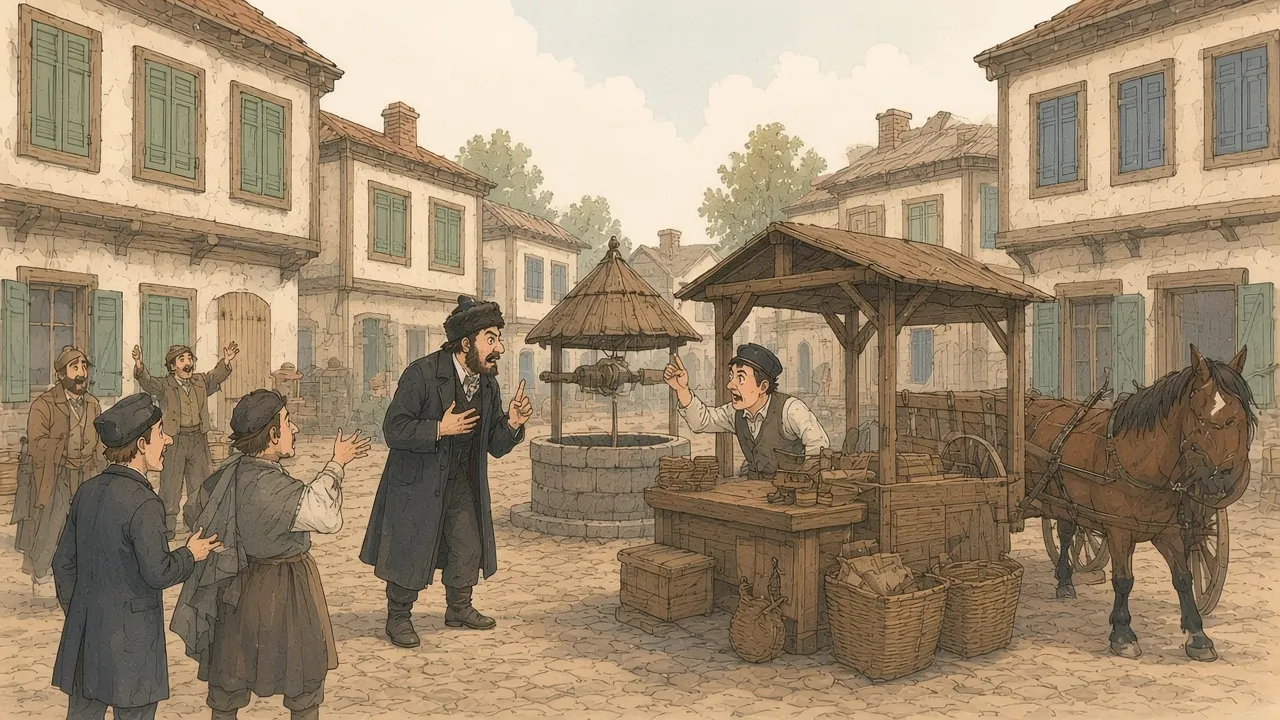
What remains constant is the bodily intuition that the shtetl anecdote still captures: someone smaller or poorer speaking up, finger raised, against a figure of wealth or office, while neighbours watch in astonished amusement. Whether that scene is read as scandal or as courage depends on the language, the century and the stakes. The word that names it has kept both possibilities open for two thousand years.[4]
The lexicographic trail can be followed one step further in the reference works that Deutsch listed but did not quote at length. Jastrow’s dictionary, compiled for readers of the Talmud and midrash, treats the noun and the related verb as ordinary items of rabbinic vocabulary rather than as curiosities. Kohut’s Aruch Completum and Levy’s Neuhebräisches Wörterbuch likewise place ḥuṣpâ among the working terms of late antique Jewish speech. When Ben-Yehuda built his historical dictionary of Hebrew, he was therefore not inventing a classical pedigree for a slang word; he was restoring to modern Hebrew a lemma that the rabbinic corpus had never lost. The Ben-Yehuda Project’s online entry makes that continuity visible: the same page carries Midrash Rabbah, Alshekh on Job, a medieval letter of complaint about scholarly insolence, and the two Sanhedrin sayings.[1][7]
Even-Shoshan’s modern Hebrew dictionary, the standard desk reference for Israeli readers in the later twentieth century, continues the pejorative line that Ben-Yehuda recorded. In schoolrooms and newsrooms alike, חוצפה names behaviour that oversteps. The cultural complication, documented by observers of Israeli public life, is that the same society which rebukes chutzpah also practises a conversational directness that outsiders often hear as exactly that. Bus queues, government offices and radio phone-ins supply daily occasions for the exclamation “eizeh ḥutzpá!”, and the exclamation itself becomes part of the social regulation of boldness. The word polices the line it also describes.[7][4]
Honi’s story rewards a slower reading because the Mishnah and the Gemara do not simply celebrate him. Shimon ben Shetach’s threatened ostracism is not a comic aside; it marks the difference between a charism that the community trusts and a method that would be intolerable in anyone else. The Torat Har Etzion analysis notes the narrative’s deliberate friction: the ovens are brought in before any cloud has formed, the first prayer fails, the circle is drawn, and even then the rain arrives in the wrong measure twice. Honi’s chutzpah works, but the text makes the reader feel the risk. That risk is precisely what later talk of hutzpah klapei shamayim inherits—an insistence that is powerful because it might have been blasphemous had it failed.[11][12][13]
The Gemara’s language of the ben bayit, the household member, sharpens the point. Honi does not claim to be God’s equal; he claims a familiar’s standing, the right of someone who lives in the house to speak urgently to its master. Scholarly discussion of the metaphor has stressed how unusual such a claim is in the rabbinic imagination of prayer. Ordinary petition bows; Honi negotiates. The rain that finally comes “in the usual manner” restores a kind of normality, yet the people must still ask him to pray for it to cease. The episode ends not with triumph but with the problem of too much answered prayer—an irony that keeps the story from becoming a simple charter for presumptuous piety.[12][13]
Moses’ intercession after the calf can be set beside Abraham’s without collapsing the two. Abraham argues from justice—“Shall not the Judge of all the earth deal justly?”—while Moses argues from reputation and promise: what will Egypt say, and what of the oath to the patriarchs? Both speeches assume that God can be addressed in the second person with reasons. Exodus records that the Lord renounced the planned destruction; Genesis records the stepwise concession from fifty to ten. Neither narrative uses the rabbinic noun, yet both supplied later ages with scripts for holy argument. When Hasidic storytellers cast Levi Yitzchak as Israel’s advocate, they were extending a role that the Torah had already rehearsed.[15][14][22]
Job’s contribution is different again. Where Abraham and Moses speak for others, Job speaks from his own ruin. The curse of his birth-day, the refusal of his friends’ explanations, and the demand to confront God belong to a literature of protest that modern Jewish thought has found indispensable. Alshekh’s early modern commentary, cited by Ben-Yehuda under חוצפה, shows that Hebrew readers could already hear Job’s boldness under that heading. In the century of the Holocaust, Job returned as a companion text for those who would neither deny God nor excuse history. Wiesel’s dramatised trial is one heir of that companionship; the quieter habit of reading Job in mourning houses is another.[16][7][24]
The American journey of the word is also a journey through print. Nineteenth-century newspapers and novels experimented with Yiddishisms as local colour; by the early twentieth century the Forverts and its rivals were themselves part of the American press system, read by hundreds of thousands. English-language reporters covering the Lower East Side borrowed freely. The slightly later world of Isaac Bashevis Singer, writing in Yiddish for the Forverts under pen-names before his English fame, belonged to the same bilingual ecology in which khutspe could be heard in the kitchen and chutzpah read in a magazine. Rosten’s achievement in 1968 was not to invent that ecology but to codify it for a mass audience that no longer needed to know Yiddish in order to enjoy its loot.[19][2]
Vaudeville and the Borscht Belt mattered because they trained the ear. A Catskills audience that laughed at a comic’s nerve was learning to attach pleasure to the same quality that a Yiddish-speaking parent might still call shameful. Hollywood and network television then nationalised the joke. By the time Kozinski and Volokh counted judicial opinions, the word no longer required a gloss in most American courtrooms; the Georgia Court of Appeals in 1972 had still been early enough that the aptness of the usage—for a break-in at a sheriff’s office—could be savoured as novelty. Two decades later the novelty had worn into habit.[20]
Dershowitz’s Chutzpah belongs to a recognisable genre of American Jewish argument: the call to drop apologetic habits and to exercise rights with the same confidence other groups are assumed to possess. Whether one accepts his diagnosis or not, the book’s title signalled how far the English sense had moved. Brust’s ABA Journal piece quotes the upbeat gloss—boldness, defying tradition, raising eyebrows—expressly to contrast it with Rosten’s orphan. The courtroom and the bestseller list were now using the same word for opposite moral lessons: one for gall that ought to lose, one for nerve that ought to win.[20][21][19]
Kozinski and Volokh’s larger claim, that Yiddish was seasoning American legal prose as Latin once had, helps to explain why chutzpah spread so easily among judges who were not Jewish. Scalia’s Catholic schooling and Kagan’s Upper West Side childhood are biographical colour; the professional cause is the demand for vividness in judicial style. A word that makes a bench smile is a word that gets reused. The 112 opinions of 1993 were a floor, not a ceiling. Each reuse loosened the word a little further from its Yiddish reprimand and fixed it a little more firmly as American English for outrageous nerve—sometimes condemned, sometimes envied.[20]
Levi Yitzchak’s din toyre sits at the other end of the tonal spectrum. The Posen Library text opens in greeting and moves at once to indictment: what does Heaven want of Israel; why the repeated commands addressed only to this people; why the suffering. Green’s biography emphasises both the ecstatic prayer and the realist streak in the Berdichever’s thought—the willingness to face exile as a fact while still demanding that God answer for it. The folk song’s refusal to leave the spot—“I will not move from my place”—echoes Honi’s circle across six centuries. In both cases the advocate plants himself and will not yield until Heaven responds.[22][23][11]
Wiesel’s Trial of God translates that posture into the key of catastrophe. Kirkus recorded the biographical seed—an actual trial of God witnessed in the camps—and the artistic choice to set the parable in 1649, after a pogrom, as a Purimspiel within a Purimspiel. The stranger who defends God is Satan; the survivors’ questions are not answered by theology so much as staged. Readers of Avrom Sutzkever, who know how Yiddish poetry bore witness in the ruins of Vilna, will recognise the same refusal to let destruction have the last word without a hearing. The play does not resolve the charge; it insists that the charge be spoken.[24]
Across these settings—the dictionary, the study house, the shtetl anecdote, the immigrant press, the comedy stage, the Israeli bus queue, the American opinion and the Hasidic song—the word keeps a family resemblance. Someone speaks more boldly than the situation seems to allow. Neighbours draw breath. Whether the breath becomes a laugh, a rebuke or a prayer depends on what is at stake and who is listening. That is why a single English borrowing has been able to serve as insult, compliment and theological term without quite settling into any one of them.[4][8]
The Hebrew and Yiddish printing culture that carried rabbinic books from Italy and Amsterdam into Eastern Europe, and later into New York, also carried the pages on which ḥuṣpâ was discussed and joked about. A word that lives in print as well as in speech is harder to erase. Ben-Yehuda’s dictionary, Jastrow’s lexicon, the Yiddish press and Rosten’s bestseller are chapters of that print history. So, in a different register, are the Yale Law Journal and the Supreme Court reporter. Chutzpah became an English word not only because immigrants spoke it, but because clerks, comedians and lexicographers kept writing it down.[7][19][20]
A further strand in the American story is the advice literature and business writing that seized on chutzpah as a virtue of entrepreneurs. Manuals and magazine features began to recommend “a little chutzpah” as the difference between a stalled career and a breakthrough, quietly completing the word’s migration from immigrant rebuke to managerial compliment. That usage would have startled a Yiddish-speaking grandmother; it does not startle a reader of contemporary English. The dictionaries followed the practice, as dictionaries do, by recording the approving sense alongside the older gall and nerve.
None of these later senses cancels the rabbinic memory. A student who meets ḥuṣpâ first in Sotah or Sanhedrin, or who hears Honi’s oath inside the circle, already knows that the word can wound as well as embolden. A reader of Levi Yitzchak’s din toyre, or of Wiesel’s play, knows that it can also pray. The English borrowing is successful precisely because it is thin enough to travel and thick enough to remember. Between the shtetl market stall and the Supreme Court reporter, between Ben-Yehuda’s lexicon and Rosten’s joke, the same three syllables keep doing different kinds of work.
That is the sober conclusion of a long philological and cultural history. Chutzpah began as a name for shamelessness in Aramaic and rabbinic Hebrew; it travelled through Yiddish as a living insult; it entered English as colour and stayed as concept. Along the way it gathered biblical and Hasidic stories of argument with Heaven, Israeli habits of blunt speech, American comic timing and judicial wit. To ask what the word “really” means is to miss the point. It means what its speakers need it to mean, under pressure from a tradition that never quite lets the negative sense die.
The illustrations that editors choose for such an essay tend, for good reason, toward the market square rather than the dictionary page. A stallholder with his finger raised, a rich man clutching his coat, neighbours catching their breath: the tableau makes visible what the philology only names. Chutzpah is not merely a lemma in Jastrow or Ben-Yehuda, nor only a punchline in Rosten. It is a social drama, played out wherever hierarchy meets cheek, and the Jewish languages have been unusually willing both to condemn the drama and to keep a seat for it at the table of sacred argument.
Timeline
Mishnah Sotah 9:15 warns that in the footsteps of the Messiah impudence will increase.
Ḥoni Ha-Me’aggel draws a circle and bargains with Heaven for the right rain.
Rav Naḥman: chutzpah is effective even toward Heaven; Rav Sheshet: it is monarchy without a crown.
Abraham bargains with God over the fate of Sodom, from fifty righteous to ten.
Moses intercedes after the golden calf; the punishment is renounced.
Levi Yitzchak of Berdichev, remembered for a din toyre against God on behalf of Israel.
Merriam-Webster dates the first English use to 1867; Etymonline gives 1892.
Gotthard Deutsch’s entry “ḤUẒPA” summarises the Talmudic usages.
Leo Rosten publishes the orphan definition that becomes standard in English.
Elie Wiesel’s play is published in English translation.
Alan M. Dershowitz’s book urges assertive Jewish public life in America.
Kozinski and Volokh count 112 American opinions using “chutzpah”.
Justice Scalia uses “chutzpah” in National Endowment for the Arts v. Finley.
Justice Kagan uses the word in a campaign-finance dissent, noted by the ABA Journal.
References
- Gotthard Deutsch, “ḤUẒPA”, Jewish Encyclopedia (1901 - 1906) *
- “chutzpah”, Merriam-Webster Dictionary *
- “chutzpah”, Online Etymology Dictionary *
- “Chutzpah” *
- Mishnah Sotah 9:15, Sefaria *
- Sanhedrin 105a, Sefaria *
- Eliezer Ben-Yehuda, “חֻצְפָּה”, Milon ha-Ivrit ha-Yeshanah ve-ha-Ḥadashah, Ben-Yehuda Project *
- “chutzpah”, Jewish English Lexicon *
- Sotah 49b, Sefaria *
- Alana Alpert, “Challenging the Heavens”, My Jewish Learning *
- Mishnah Ta’anit 3:8, Sefaria *
- Ta’anit 23a, Sefaria *
- “The Story of Choni Ha-me’agel in the Mishna and in Parallel Sources”, Torat Har Etzion *
- Genesis 18:23 - 33, Sefaria *
- Exodus 32:7 - 14, Sefaria *
- Job 3, Sefaria *
- Tim Entwisle, “Are you confident in the meaning of chutzpah?”, Word of the Week, 2 February 2013 *
- “chutzpah”, Dictionary.com *
- “Leo Rosten” *
- Richard Brust, “Chutzpah: Yiddish Term Makes a Showing at the Supreme Court”, ABA Journal, 1 October 2011 *
- Publishers Weekly, notice for Alan M. Dershowitz, Chutzpah (Little, Brown, 1991) *
- “A Din Toyre mit Gott / Der kadish fun rabi Levi Yitshok”, The Posen Library of Jewish Culture and Civilization *
- Arthur Green, Defender of the Faithful: The Life and Thought of Rabbi Levi Yitshak of Berdychiv, Brandeis University / Tauber Institute *
- Kirkus Reviews, review of Elie Wiesel, The Trial of God (1979) *
Select bibliography
- Leo Rosten, The Joys of Yiddish (New York: McGraw-Hill, 1968).
- Alan M. Dershowitz, Chutzpah (Boston: Little, Brown, 1991).
- Elie Wiesel, The Trial of God, translated by Marion Wiesel (New York: Random House, 1979).
- Arthur Green, Defender of the Faithful: The Life and Thought of Rabbi Levi Yitshak of Berdychiv (Waltham, MA: Brandeis University Press).
- Marcus Jastrow, A Dictionary of the Targumim, the Talmud Babli and Yerushalmi, and the Midrashic Literature (New York: G. P. Putnam’s Sons, 1903).
- Eliezer Ben-Yehuda, Milon ha-Ivrit ha-Yeshanah ve-ha-Ḥadashah (Jerusalem and Berlin, ongoing fascicles; Ben-Yehuda Project online).
- Gotthard Deutsch, “ḤUẒPA”, in The Jewish Encyclopedia, ed. Isidore Singer (New York: Funk & Wagnalls, 1901–1906).
- Alex Kozinski and Eugene Volokh, “Lawsuit, Shmawsuit”, Yale Law Journal 103 (1993).
- Michael Wex, Born to Kvetch: Yiddish Language and Culture in All of Its Moods (New York: St Martin’s Press, 2005).