Hummus and the Long Table
1. A bowl in the middle of the table
On a weekday evening in a flat in Beirut, a house in Nazareth, a kitchen in Amman or a semi-detached house in north London, a family sits down to eat and somebody puts a wide, shallow bowl in the middle of the table. Its contents are pale and smooth, the colour of sand after rain. A spoon has been drawn around it so that the paste rises at the rim and dips in the centre, and the hollow holds a pool of green olive oil, a scatter of whole chickpeas, a dusting of red pepper and perhaps a few leaves of parsley. Nobody is served a portion. Bread is torn by hand and passed along, and every person at the table, from the grandparent at one end to the youngest child who has to kneel on a chair to reach, eats from the same bowl. That bowl is hummus, and it is one of the few dishes on earth that is at once ancient in its ingredients, comparatively recent in its familiar form, and almost universally understood as something to be shared.
This essay is about that bowl. It follows the chickpea from the stony hills of south-eastern Anatolia, where its wild ancestor still grows, through the fields of the first farmers and the kitchens of the Roman and Byzantine Mediterranean, into the recipe collections of medieval Baghdad, Aleppo, Damascus and Cairo, and on to the copper basins of the small shops that made and sold hummus in the cities of the Ottoman Levant. It follows sesame, the other great ingredient, from its homeland in South Asia to the grinding stones of the Near East, and asks how a paste of crushed chickpeas came to be married to a paste of crushed sesame, sharpened with lemon and garlic and finished with oil. It looks at the science of the bowl, at what happens inside a chickpea when it is soaked, boiled and crushed, and why a good hummus is smooth rather than gritty. And it follows hummus out of the Levant, in the luggage of migrants and in the refrigerated lorries of the food industry, to the supermarkets of London and New York, and into the quarrels about ownership that have made it, improbably, a matter of national pride.
What the word means
The first thing to say about the name is that in Arabic it simply means “chickpea”. The dish that English speakers call hummus is, in full, ḥummuṣ bi-ṭaḥīna, “chickpeas with tahini”, and in the Levant the short form is a kind of affectionate abbreviation, as though one were to call a bowl of porridge “oats”[1][2]. In Turkish the dish is humus and the pulse is nohut; in Greek the dish is choumous and the pulse is revythi; in modern Hebrew the dish and the pulse share the borrowed Arabic name, pronounced with a guttural first consonant. The word has wandered far from its origin, and in British supermarkets it has acquired a second spelling, houmous, which reproduces the French transcription of the Arabic vowel. The history of the word, and of its cousins in Aramaic and Hebrew, is the subject of the fourth chapter.
The ambiguity matters because it shapes every argument about the dish. When people say that hummus is ten thousand years old they usually mean that the chickpea is, and that is true, or nearly so. When they say that hummus is mentioned in the Bible they are confusing a Hebrew word for vinegar with an Arabic word for a pulse. When they say that hummus is a medieval dish they are pointing, quite rightly, to recipes for mashed chickpeas in Arabic cookery books of the thirteenth and fourteenth centuries, but those recipes are not quite the dish in the bowl on the family table. And when they say that hummus belongs to one nation rather than another, they are making a claim about the twentieth century, not about the deep past. Each of these claims has some truth in it, and each will be examined in its place.
A dish of four things
At its simplest, the hummus of the modern Levant is made of four things besides salt and water. There are chickpeas, soaked and boiled until they are completely soft. There is tahini, a paste of hulled and roasted sesame seeds ground until their oil runs. There is lemon juice. And there is garlic, crushed raw. These are pounded or blended together, loosened with some of the cooking water or with iced water, and then spread in a bowl and dressed with olive oil. Cumin is common, and so are paprika, sumac, chopped parsley and a handful of whole chickpeas kept back for the top. Beyond this simple core lies an enormous range of local practice, from the warm Antakya and Tarsus hummus finished with sizzling butter or slices of cured beef, to the Jerusalem and Jaffa bowls crowned with warm whole chickpeas in a lemon and garlic sauce, to the Beirut plates scattered with fried pine nuts and minced lamb[3][4].
Each of the four ingredients has a long history of its own, and their meeting is not something that can be dated precisely. Chickpeas were domesticated in the Neolithic and spread across the ancient world. Sesame reached the Near East from South Asia before the end of the Bronze Age, and sesame oil and sesame pastes were common in the cooking of the medieval Arab world. The lemon arrived later, travelling west from its homeland in the foothills of the Himalaya and the hills of north-east India through Persia and the Islamic world. Garlic is the oldest companion of all, cultivated in the Near East since antiquity. What can be said with some confidence is that recipes combining mashed chickpeas with tahini, vinegar or citrus and a good deal of seasoning appear in Arabic cookbooks of the thirteenth and fourteenth centuries, that something close to the familiar bowl was being made and sold in the cities of Ottoman Syria and Palestine by the nineteenth century, and that the dish was carried around the world in the twentieth[5][1].
The family table
This is also an essay about a table and the people around it. Hummus is eaten in many ways. It is a breakfast dish in the shops of Jaffa, Jerusalem and Antakya, where workers eat it early in the morning with raw onion, pickles and hot bread. It is a meze, one of a dozen small plates set out before a meal in Lebanon or Cyprus. It is a sandwich filling, a dip for raw vegetables, and, in the supermarkets of Britain and the United States, a snack scooped from a plastic tub with a cracker. But it is above all a shared dish, and its proper place is the middle of a table where several generations eat together. In a culture of hospitality the size of the bowl is a measure of welcome, and the habit of eating from it with bread, rather than with a fork, makes every meal a little communal.
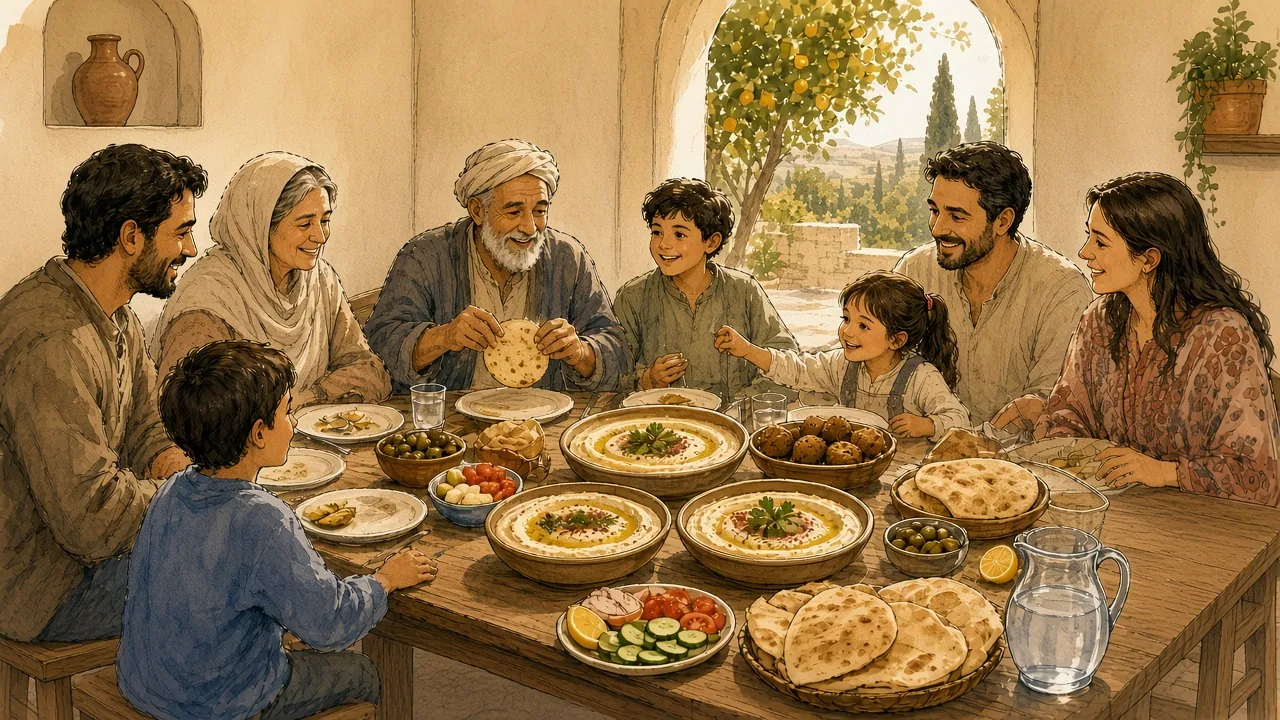
The image at the head of this essay is of such a table. There is a grandmother passing a bowl and a grandfather tearing bread; there are parents and children reaching in. It is not a photograph of any particular family but an attempt to show the kind of scene in which hummus is most at home. The chapters that follow explain how that scene came to be possible: how a wild plant of the Anatolian hills became a crop, how the crop became a staple, how the staple was turned by skilled cooks into a delicacy, how the delicacy became an everyday food of the cities, and how it then left home.
The shape of the essay
The second and third chapters are about the chickpea as a plant. They begin with its wild ancestor, Cicer reticulatum, a rare annual of the limestone and basalt hills of south-eastern Turkey, and with the archaeologists and plant scientists who have tried to understand why the first farmers of the Fertile Crescent chose such an awkward plant and how they made it into a crop[6][7]. They then follow the domesticated chickpea across the ancient world, into the Iliad and the agricultural writings of the Romans, and explain why it has been so valuable to farmers in dry lands, chiefly because, like other legumes, it carries its own supply of nitrogen in the nodules on its roots[8][9][10].
The fourth chapter is about words: the Arabic ḥimmaṣ and ḥummuṣ, the Aramaic ḥimṣa of the Talmud, the Hebrew ḥimṣa of the lexicographers, the Latin cicer that gave English “chickpea”, and the persistent but mistaken idea that hummus appears in the Book of Ruth[11][12]. The fifth is about sesame and tahini, from the archaeology of sesame in the Indus valley and at Megiddo to the stone mills of the Levant[13][14]. The sixth turns to the medieval Arabic cookery books, the earliest substantial body of written recipes for chickpea dishes, and reads their instructions closely[15][16][17].
The seventh and eighth chapters describe the hummus shops and household kitchens of the modern Levant and its neighbours, from Damascus and Beirut to Jaffa, Acre and Jerusalem, and from Cairo to Antakya, Tarsus, Nicosia and the Greek islands[18][3][19]. The ninth chapter is about chemistry: soaking and boiling, starch and protein, oil and water, and the remarkable cooking liquid that vegan bakers now call aquafaba[20][21]. The tenth follows hummus into the factories and the diaspora, from a small business in Queens to the British hummus shortage of 2017[22][23]. The eleventh tells the story of the “hummus wars” between Lebanese and Israeli promoters, with their giant plates and their talk of trademarks[24][25]. The twelfth looks at nutrition and at the global trade in chickpeas, in which India, Australia, Canada and Turkey are the great players[26][27]. The last chapter returns to the table.
Throughout, the aim is to separate what is known from what is merely repeated. Hummus has attracted a great deal of folklore, much of it charming and some of it politically motivated. The evidence is often thinner than the confident statements on menus and packaging suggest, and where it is thin this essay says so. But the history that does survive is richer and stranger than the legends, and it begins with a small, wrinkled seed shaped, as the Romans noticed, like the head of a ram.
2. The wild chickpea of the Anatolian hills
The wild ancestor of the chickpea is not an impressive plant. Cicer reticulatum is a low, spreading annual, a few hand-spans high, with small toothed leaflets, sticky glandular hairs and a scattering of violet flowers. Its pods are short and swollen and usually hold one or two seeds, which are dark, angular and roughly textured, more like grains of gravel than the plump cream-coloured peas of the grocer’s shop. It grows on rocky slopes and the margins of oak woodland in a small area of south-eastern Turkey, between roughly 37 and 39 degrees north and 38 and 44 degrees east, in the provinces around Diyarbakır, Mardin and Şanlıurfa[6][7]. Botanists who have gone looking for it describe days of searching on hot stony hillsides for a plant whose seeds are camouflaged against the soil[28][29].
That the ancestor of one of the world’s great pulses should be so rare and so localised is a puzzle. Most of the wild progenitors of the founder crops of Near Eastern agriculture, the wheats, barley, lentil, pea and flax, have wide ranges across the Fertile Crescent and beyond, and the first farmers who took them into cultivation could find them in many places. The wild chickpea is an exception. As Zohar Kerem and his colleagues put it in a paper of 2007, it “is a rare species reported from only several locations in south-eastern Turkey”[6]. Whoever first cultivated it either lived close to that small area or obtained seed from people who did.
A crop wild relative
In the language of modern plant breeding, Cicer reticulatum is a crop wild relative, a species closely enough related to a cultivated plant that it can be crossed with it and can lend it useful genes. Together with its sister species Cicer echinospermum, which grows in the same region, it forms the primary gene pool of the chickpea. The genus Cicer as a whole is larger than one might expect: with the recent description of Cicer turcicum, a new annual species found at a single site in south-east Anatolia during collecting expeditions of 2013 to 2018, it comprises ten annual and thirty-six perennial species, many of them rare mountain plants of Central Asia and the Middle East[30].
The value of these wild plants became painfully clear when geneticists began to sequence the cultivated chickpea. In 2018 an international team led by Eric von Wettberg and Douglas Cook reported that cultivated chickpea had passed through what they called “an extreme domestication-related genetic bottleneck”, so that the crop carries only a small fraction of the genetic diversity of its wild relatives[7]. The following year a study led by Rajeev Varshney of the International Crops Research Institute for the Semi-Arid Tropics sequenced 429 chickpea lines from 45 countries and estimated a fourfold reduction in diversity between wild plants and traditional landraces, a loss of about eighty per cent[31]. A crop with so little diversity is vulnerable to new diseases and to changes in climate, and the plant breeders’ answer has been to go back to the hills.
The collecting missions that followed were large and carefully organised. Von Wettberg and his Turkish and international colleagues sampled seeds from 371 plants and DNA from 839 more at 21 sites, chosen to cover the widest possible range of soils and altitudes, and deposited the material in national and international genebanks[28]. According to the Crop Trust, which supported related work through its Crop Wild Relatives project, the collections represent twelve genetic populations and expand the diversity available to breeders roughly fortyfold[32]. One of the incidental discoveries was that the wild plants’ seed coats tend to match the colour of the soil on which they grow, a camouflage against seed-eating animals that the cultivated plant, protected by farmers, has lost[7].
The earliest chickpeas
The archaeological record of the chickpea is thin, for good reasons. Pulses are rarely preserved unless they are charred, and charred chickpeas are hard to tell apart from charred seeds of other legumes unless they are well preserved. The reliable marks of domestication, a pod that does not split open and a seed coat that becomes smooth, seldom survive at all[33]. Nevertheless a handful of sites give an outline of the story.
Diyarbakır
Open in Google MapsMardin
Open in Google MapsÇayönü
Open in Google MapsGöbekli Tepe
Open in Google MapsTell el-Kerkh
Open in Google MapsHöyücek
Open in Google MapsThe most important early find was made at Tell el-Kerkh, a mound in the Rouj basin at the northern edge of the Ghab valley in north-west Syria, about fifty kilometres from the Mediterranean coast. There, in levels of the early Pre-Pottery Neolithic B dated by radiocarbon to between about 8750 and 8300 BC, archaeobotanists Ken-ichi Tanno and George Willcox identified 138 chickpea specimens and more than four hundred remains of faba bean, most of them from deposits around a hearth of placed stones[33]. The chickpeas showed a wide range of shapes, from the angular form of the wild plant to the more rounded shape of cultivated varieties. Tell el-Kerkh lies about 260 kilometres from the nearest known stands of the wild chickpea, which suggests that people had already carried the plant out of its native range, and Tanno and Willcox concluded that “the use and domestication of these pulses is perhaps earlier than was previously supposed”[33].
Other finds fill in the picture. Chickpeas are reported from Pre-Pottery Neolithic sites in south-eastern Turkey and the northern Levant, and about five hundred chickpeas were found at the Pottery Neolithic site of Höyücek in south-western Turkey, far to the west of the wild range[33]. By the Bronze Age the chickpea was established across the Near East and the eastern Mediterranean, and it had begun its long journey eastward across Iran to Central Asia and the Indian subcontinent and southward into Ethiopia. The genomic study of 2019 supports this broad pattern, identifying the eastern Mediterranean and the Fertile Crescent as the primary centre of origin, with migration to Central Asia and then, probably in parallel, to South Asia and East Africa[31].
An awkward crop
Why did the first farmers bother? The question has been asked most sharply by Shahal Abbo of the Hebrew University and his colleagues, who argued in 2003 that chickpea domestication did not fit the standard model in which wild plants were taken into cultivation quickly and easily[34]. In the wild, Cicer reticulatum germinates in autumn and grows through the winter rains, as most annual plants of the region do. But winter-sown chickpeas in the Levant are devastated by a fungal disease, ascochyta blight, which can destroy an entire crop in a wet season. At some point early farmers began to sow chickpeas in spring instead, so that the plants grew through the dry early summer and escaped the disease. The cost was severe: the summer crop yields, by the estimates Kerem and Abbo cite, between ten and ninety per cent less than its potential, because the plants run short of water[6]. And the change required the selection of plants that no longer needed a period of winter cold before they would flower, a slow and uncertain process.
Kerem and his colleagues proposed that the reward lay in the seed itself. Comparing seventy-three cultivated lines from twenty-five countries with fifteen accessions of the wild ancestor, they found that the cultivated seeds contained far more free tryptophan, an essential amino acid, about 1.10 milligrams per gram of dry seed against 0.33 in the wild plant[6][35]. Tryptophan is the precursor of the brain chemical serotonin, and the authors suggested, cautiously, that early farmers may have noticed the satisfying quality of chickpea meals and persisted with an awkward crop for that reason. The hypothesis is debated, but it has the merit of taking seriously the possibility that Neolithic people chose plants for their taste and nourishment as well as for their yields.
Whatever the motive, the chickpea that emerged from this process was a distinctive plant. It was sown in spring, grown on stored soil moisture and harvested at the start of the summer. Its pods, unlike those of wild lentils and peas, did not burst open and scatter their seeds, a trait that in the chickpea’s case was already largely present in the wild ancestor[6]. Its seeds became larger and smoother. And its place in the farming year, after the winter cereals had been sown and before the summer drought, gave it a role that it still plays in the dry farming systems of the Mediterranean and West Asia.
Desi and kabuli
Over thousands of years of cultivation the chickpea diversified into two main types, known today by names that come from the subcontinent. The desi type, from a Hindi word meaning “of the country”, has small, angular seeds with thick, coloured seed coats, brown, black, green or speckled, and is grown above all in India, Pakistan, Bangladesh and Ethiopia. It is thought to be closer to the wild ancestor[36]. The kabuli type, named after the city of Kabul, from which it was supposedly brought to India, has large, rounded, cream-coloured seeds with thin coats, and is the chickpea of the Mediterranean, the Middle East, North Africa and the Americas. Kabuli seeds are often described as shaped like an owl’s head; the Romans, as the next chapter shows, saw a ram[37][9].
The difference is not only one of appearance. Plant anatomists at ICRISAT have shown that the two types differ in the structure of the seed coat itself: in kabuli seeds the outer layer develops as a single row of palisade cells without the thickened walls of the desi type, which makes the coat thinner and the seed quicker to absorb water[37]. For the cook this has practical consequences. Kabuli chickpeas soak and soften more readily, their skins slip off more easily, and their flesh yields the smooth, pale paste on which a good hummus depends. Desi chickpeas are usually split and dehulled to make chana dal, or ground into the flour called besan, gram flour, used in pakoras and in the batters and breads of South Asia.
The hummus of the Levant is therefore a kabuli dish, made from the large pale chickpea that the Mediterranean world selected over many centuries. The bowl on the family table is the end product of a long series of choices made by farmers who never wrote anything down: the decision to sow in spring, the preference for larger seeds and thinner coats, the patient maintenance of seed stocks from one year to the next. Those choices began in the hills of south-eastern Anatolia, among plants that still grow there, unregarded, beside the paths that the botanists walk.
The hills today
Those hills are now part of one of the most closely studied agricultural landscapes in the world. Within a few days’ walk of the wild chickpea stands lie the sites of Çayönü, Göbekli Tepe and Nevalı Çori, which have transformed understanding of the beginnings of settled life in the region, and the wild ancestors of einkorn wheat have been traced by geneticists to the nearby Karacadağ mountains. The wild chickpea’s narrow range places it at the very centre of this world, and its rarity makes it vulnerable. Overgrazing and changes in land use threaten many wild Cicer species, several of which are listed as endangered[30]. The genebank collections made in the 2010s, held in Turkey, Australia, the United States and at ICARDA, are an insurance policy against the loss of these populations[32].

The insurance matters because the chickpea of the twenty-first century faces new pressures. As the twelfth chapter shows, chickpea farming has spread to Australia, Canada and the northern plains of the United States, where the crop meets climates and diseases very different from those of its homeland. Breeders looking for heat tolerance, drought tolerance and resistance to pests have found useful traits in the wild relatives; Cicer turcicum, for example, showed the highest heat tolerance in a screening of wild and cultivated annual species[30]. In a sense the farmers of the twenty-first century are returning to the same hills as the farmers of the tenth millennium BC, and for similar reasons: to find in a rare wild plant something worth the trouble of cultivating.
3. Ram’s head and pigeon pea
By the time writing began, the chickpea was already an old crop. It appears in the archaeological record of Bronze Age towns across the Levant, Anatolia and Mesopotamia, usually in small quantities alongside the more abundant lentils, peas and faba beans, and it travelled with farmers westward around the shores of the Mediterranean and eastward across the Iranian plateau. Its history in this period is mostly a history of charred seeds in excavated storage pits and hearths. But when the Greeks and Romans began to write about agriculture and diet, the chickpea entered literature, and the first descriptions of it tell us a good deal about how it was grown and eaten.
A simile in the Iliad
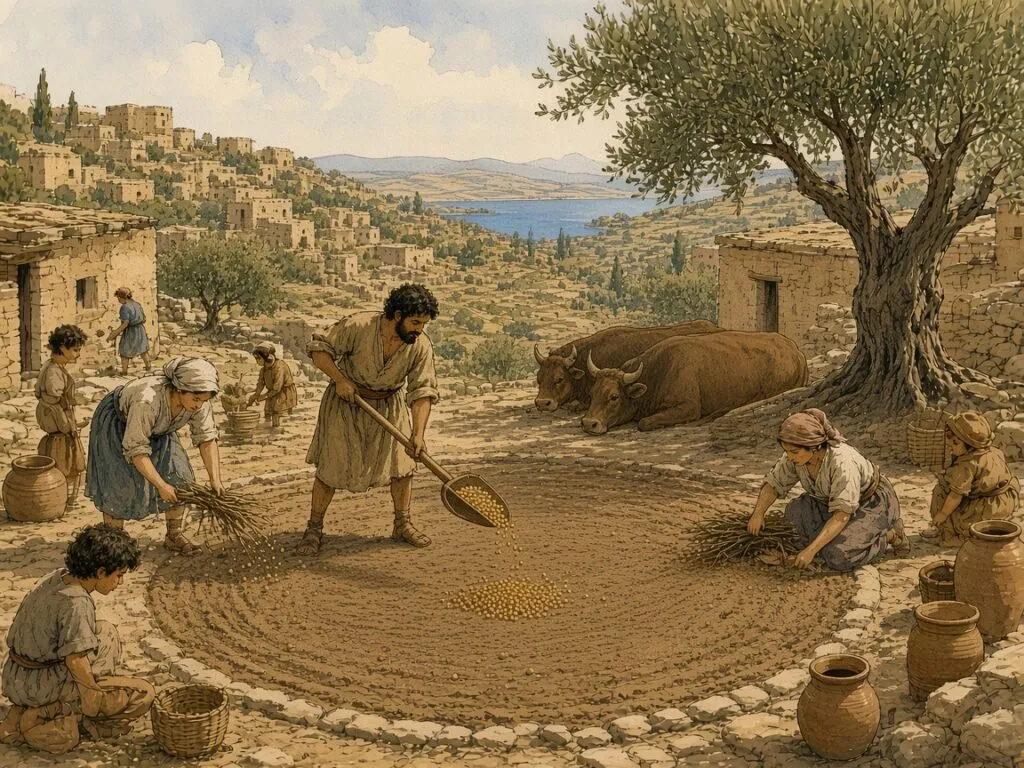
The earliest appearance of the chickpea in European literature is in a simile in the thirteenth book of the Iliad. The Trojan Helenus has shot an arrow at Menelaus, which strikes the plate of his corslet and glances off. Homer compares it to the seeds that bounce from a winnower’s shovel: “as from a broad shovel in a great threshing-floor the dark-skinned beans or pulse leap before the shrill wind and the might of the winnower”, so the arrow sprang away[8]. The translation quoted here, by A. T. Murray, renders the second kind of seed as “pulse”, but the Greek word is erebinthoi, the ordinary Greek name for chickpeas, and the pairing of beans and chickpeas on the threshing floor is a glimpse of the agricultural world of the poet’s audience. The scene is ordinary and vivid. The harvested plants have been beaten on a hard circular floor of beaten earth or stone, and the winnower tosses the mixture into the wind so that the chaff blows away and the heavy seeds fall back, rattling and leaping.
The word erebinthos survived into Byzantine Greek, and the modern Greek revythi descends from it. The Greeks also gave the chickpea a place in comedy and in popular speech, where roasted chickpeas were a cheap snack eaten at the theatre and in the street. By the Hellenistic period the chickpea was one of the ordinary foods of the Greek world, a pulse eaten boiled, roasted or made into a soup, and it was taken for granted in the dietary literature of the physicians.
Pliny and the varieties
The Roman encyclopaedist Pliny the Elder devoted a short chapter of his Natural History, completed in the 70s AD, to “the several kinds of chick-pease”. His account, in the old English translation of John Bostock and H. T. Riley, is worth quoting at length. “The chick-pea is naturally salt,” Pliny begins, “for which reason it is apt to scorch the ground, and should only be sown after it has been steeped a day in water. This plant presents considerable differences in reference to size, colour, form, and taste. One variety resembles in shape a ram’s head, from which circumstance it has received the name of ‘arietinum;’ there are both the white and the black arietinum. There is also the columbine chick-pea, by some known as the ‘pea of Venus;’ it is white, round, and smooth, being smaller than the arietinum, and is employed in the observances of the night festivals or vigils”[9].
Several details here are remarkable. The salty quality that Pliny noticed is real: the leaves and stems of the chickpea plant are covered in glandular hairs that secrete an acid exudate, rich in malic and oxalic acids, which can sting the skin and rot the boots of people walking through a field, as the nineteenth-century editors observed in their footnote[9]. The advice to steep the seed in water before sowing is a sound agricultural practice in dry soils. And the name arietinum, from aries, a ram, is the source of the modern botanical name. When Linnaeus named the plant Cicer arietinum in the eighteenth century he was taking up Pliny’s image of a seed with a beak and two rounded cheeks like the head of a ram with curled horns[38]. The white and black varieties Pliny distinguishes correspond broadly to the pale kabuli and the dark desi types of the modern crop.
Cicero and the chickpea
The Latin word cicer gave its name to one of the most famous families in Roman history. Plutarch, writing his Life of Cicero in the early second century AD, explains that the first of the family to be called Cicero “seems to have been worthy of note”, and that “cicer is the Latin name for chick-pea, and this ancestor of Cicero, as it would seem, had a faint dent in the end of his nose like the cleft of a chick-pea, from which he acquired his surname”[39]. The orator’s friends urged him to drop such a homely name when he entered public life, but he replied that he would make it more illustrious than the names of the great noble families, and when he dedicated a piece of silver plate as quaestor in Sicily he had his first two names inscribed and, “instead of the third, by way of jest”, ordered the engraver to cut a chick-pea[39][40].
The story is a reminder of how familiar the chickpea was to the Romans. It was a food of ordinary people, sold roasted in the streets and in the theatre, and the Latin poets mention it as a cheap and plebeian dish. Horace, in one of his satires, mocks the politician who squanders his fortune on handouts of chickpeas, beans and lupins to win the favour of the crowd[41]. The pulse was cheap, filling and easily stored, and it was a staple of the urban poor throughout the Mediterranean.
Galen on the pulse
The great physician Galen of Pergamon, writing in the second century AD, discussed the chickpea in his treatise On the Properties of Foodstuffs, a survey of the foods of the Roman world arranged according to their effects on the body[42]. Galen grouped chickpeas with the other pulses as foods that are filling and nourishing but windy, so that, like beans, they cause flatulence. He knew them both as a green vegetable, picked while still soft in the pod, and as a dried seed that could be boiled or roasted, and like other physicians of his time he attributed medicinal effects to the cooking water. His remarks about flatulence would be repeated for well over a thousand years in the medical literature of Byzantium, the Islamic world and medieval Europe, and they reflect a real property of pulses, which contain sugars of the raffinose family that human enzymes cannot digest and that are fermented by bacteria in the large intestine.
Galen’s classification of foods according to their “qualities”, hot or cold, wet or dry, was inherited by the physicians of the Islamic world, who translated his works into Arabic in ninth-century Baghdad. The medieval Arabic cookery books discussed in the sixth chapter often begin with dietary advice drawn from this tradition, and their recipes for chickpea dishes sometimes include spices or other ingredients intended to correct the supposed “windiness” of the pulse. When a thirteenth-century cook in Aleppo or Cairo added cinnamon, caraway or ginger to mashed chickpeas, he was following a medical theory that went back, through Arabic translations, to Galen and beyond.
Roots that feed the soil
The ancient farmers who grew chickpeas did not know why pulses improved the soil, but they knew that they did. Roman agricultural writers recommended legumes as a preparation for cereals and noted that some of them could be ploughed in as green manure. The explanation, discovered in the late nineteenth century, lies in the roots. Like other members of the pea family, the chickpea forms a partnership with soil bacteria, in its case species of the genus Mesorhizobium, which enter the root hairs and induce the plant to form small swellings called nodules. Inside the nodules the bacteria convert nitrogen from the air into ammonia, which the plant uses to make proteins, and in return the plant supplies the bacteria with sugars[10].
The quantities involved are significant. A review of nitrogen fixation by chickpea in West Asia, North Africa and the semi-arid tropics, prepared by scientists of ICRISAT, reported studies in which the crop fixed an average of about one hundred kilograms of nitrogen per hectare, less than lentil, field pea or faba bean in the same trials but still a substantial contribution[10]. Part of that nitrogen leaves the field in the harvested seed, which is why chickpeas are so rich in protein; part remains in the roots and stubble and feeds the following crop. The chickpea is also, as the same review notes, an efficient scavenger of the nitrogen already in the soil[10].
For farmers in dry lands this is a double benefit. A crop that needs little nitrogen fertiliser is cheap to grow, and a crop that leaves nitrogen behind improves the yield of the wheat or barley that follows. ICARDA, the international agricultural research centre for the dry areas, promotes the kabuli chickpea in rotations with wheat and teff precisely for this reason, describing it as a crop that “improves soil fertility and health through nitrogen fixation” and has a low carbon footprint[43]. The spring-sown, summer-harvested chickpea of the Levant fits neatly into such a rotation, using the moisture stored in the soil after the winter rains and leaving the field ready for the next autumn’s cereal.
A food of the poor and the fasting
Across the late antique and medieval Mediterranean the chickpea kept the character that it had in Pliny’s time. It was cheap and nourishing, and it was a food of the poor, of soldiers and of travellers, carried as dried seed and cooked in a pot or roasted on a griddle. It was also, in the Christian East and West, a food of fasting. On the many days of the year when the churches forbade meat and often dairy products and eggs as well, pulses were a principal source of protein, and the chickpea, with its rich flavour and its capacity to absorb oil and spices, was one of the most valued. In the Greek world the custom survives in dishes such as the slow-baked chickpea stew of Sifnos, discussed in the eighth chapter, and in the soups and stews eaten during Lent[19].
The same qualities made the chickpea a natural ingredient in the cooking of the Islamic world, where it was eaten by rich and poor alike. In the medieval Arabic cookbooks it appears in meat stews, in rice dishes, in soups and in pickles, and, most interestingly for this essay, in cold dishes of mashed chickpeas mixed with sharp and aromatic seasonings. Before turning to those recipes, however, it is worth pausing over the words themselves, because the vocabulary of the chickpea is a small history in its own right.
4. Words for a seed
Food words travel more freely than almost any others. They move with traders and soldiers, with cooks who change employers and with brides who marry into another town, and they are borrowed, shortened, misheard and reinterpreted as they go. The vocabulary of the chickpea and of hummus is a good example. It includes a Semitic root shared by Arabic, Aramaic and Hebrew, a Latin word that gave its name to a Roman orator and, by a curious route, to English, a Persian word that spread across Central Asia and the Turkish world, and a set of modern borrowings that carried the Arabic name of the dish around the globe in the second half of the twentieth century.
The Arabic root
In classical Arabic the chickpea is ḥimmaṣ or ḥimmiṣ, a word built on the consonants ḥ, m and ṣ. The medieval dictionaries and the cookery books discussed in the sixth chapter use this form, and the dish of seasoned mashed chickpeas that appears in thirteenth- and fourteenth-century recipe collections is called ḥimmaṣ kasā or a similar name[44][16]. In the spoken Arabic of the Levant and Egypt the vowels shifted, and the everyday word became ḥummuṣ, the form that has passed into most other languages. Strictly speaking, as the historian Ari Ariel has pointed out, “the word hummus is just the Arab word for chick pea, it has nothing to do with preparation”[2]. The full name of the dish, ḥummuṣ bi-ṭaḥīna, means chickpeas with tahini, and in Damascus or Beirut one might equally order ḥummuṣ bi-l-laḥma, with meat, or speak of ḥummuṣ ḥabb, whole chickpeas.
The second element of the name is equally plain. Ṭaḥīna comes from the Arabic verb ṭaḥana, to grind or mill, the same root that gives ṭāḥūn and ṭāḥūna, a mill. Tahini is therefore simply “the ground stuff”, a name that recalls the stone mills in which sesame was crushed. The word has also travelled, giving tahin in Turkish, tachini in Greek and tahini in English, the final vowel reflecting the pronunciation of the Levant and of the Greek-speaking world through which many English speakers first met it.
The Aramaic ḥimṣa
Arabic was not the only Semitic language with a word for chickpea built on these consonants. In the Aramaic of the Babylonian Talmud the chickpea is ḥimṣa, plural ḥimṣe, and Marcus Jastrow’s great dictionary of Talmudic Aramaic and Hebrew, published in 1903, defines the word as “a species of small peas (Cicer Arietanus)” and compares it explicitly with the Arabic ḥummuṣ[11]. The most memorable passage in which it occurs is a domestic anecdote in tractate Yevamot. The Babylonian sage Rav, the story goes, had a difficult wife. “When he would say to her: Prepare me lentils, she would prepare him peas; if he asked her for peas, she would prepare him lentils”[45]. The word rendered “peas” in this modern translation is the plural ḥimṣe, and the joke depends on the fact that lentils and chickpeas were both everyday pulses of the Babylonian Jewish kitchen, cooked in similar ways and easily substituted for one another.
The Aramaic word passed into the Hebrew of the rabbinic period and of the Middle Ages, and the modern Hebrew dictionaries record ḥimṣa as a learned word for chickpea; Ernest Klein’s etymological dictionary of Hebrew gives it the simple definition “chick-pea”[46]. In everyday modern Hebrew, however, the chickpea and the dish are both called ḥumus, a direct borrowing of the Arabic, pronounced with the guttural ḥ that most Hebrew speakers render as a rough “kh”. The borrowing reflects the history traced in the seventh and eleventh chapters: the Jewish settlers of the late Ottoman and Mandate periods learned the dish from their Arab neighbours, and they took the Arabic name with it[18].
Hummus in the Book of Ruth
A popular story holds that hummus is mentioned in the Hebrew Bible. In the second chapter of the Book of Ruth, the landowner Boaz invites the young widow Ruth to share the meal of his reapers: “Come over here and partake of the meal, and dip your morsel in the vinegar”[12]. The Hebrew word translated as vinegar is ḥomeṣ, which shares two consonants and a similar sound with ḥummuṣ, and some enthusiasts have suggested that Boaz was really offering Ruth a bowl of hummus. A chef in the Golan Heights told a BBC journalist in 2017 that hummus was “a Jewish food”, adding, “It was mentioned in our bible 3,500 years ago”[1].
The suggestion does not survive scrutiny. The Hebrew ḥomeṣ belongs to the root ḥ-m-ṣ, “to be sour, to ferment, to be leavened”, which also gives ḥameṣ, the leavened bread forbidden at Passover, and the modern ḥumṣa, acid[47]. Dipping bread in vinegar, or in a sour wine mixed with water, was an ordinary refreshment for labourers in the heat of the harvest in the ancient Mediterranean, much as the Roman soldier’s posca was sour wine and water, and the modern commentary Daʿat Miqra has suggested that the word may here mean something like soured milk[47]. Whether the Aramaic ḥimṣa and the Arabic ḥimmaṣ derive from the same root as the Hebrew word for vinegar is a separate question. Klein thought that they probably did, but the Hebrew linguist David Curwin, who has discussed the problem on his Balashon blog, notes that the Aramaic word for leaven has a different consonant, which may point to separate origins[47]. Either way, the dish of the reapers in the Book of Ruth was not hummus. The persistence of the story shows how strongly people want old foods to have ancient pedigrees, and how readily a similarity of sound is taken for a proof of descent.
Cicer and the chickpea in English
The Latin word cicer, which named the family of Cicero, descended into the Romance languages as Italian cece and French chiche. In French the pulse is the pois chiche, the “chiche pea”, and the phrase passed into English in the sixteenth century as “chiche pease” or “chich pease”. English speakers, who no longer recognised the French word, remade the first element into “chick”, and by the eighteenth century the plant was a chick-pea, a name that seems to suggest small birds but has nothing to do with them. The botanical Latin of Linnaeus preserves the older form in the genus name Cicer[38].
The Spanish word garbanzo, which English speakers in the Americas often use, has a less certain origin. It has been traced by different scholars to a Basque compound, to a Greek or late Latin form related to erebinthos, and to Arabic, and the question remains open. Its Portuguese equivalent, grão de bico, “beaked grain”, describes the shape of the seed in much the same way as the Roman arietinum. The English word “gram”, used in India for the chickpea and other pulses, also comes from Portuguese, from grão, grain, picked up by English traders from their Portuguese predecessors on the west coast of India.
Nohut and revythi
Further east a different word spread. The Persian name for the chickpea is nokhod, and from Persian it passed into the Turkic languages as nohut and its relatives, into Armenian, into Russian as nut, and across Central Asia. The Ottoman Turkish kitchen therefore used nohut for the pulse, and when the Levantine dish of mashed chickpeas with tahini became popular in Turkey in the twentieth century it was given the Arabic name humus, which distinguished the prepared dish from the raw ingredient. In Antakya and Tarsus, the two Turkish cities most closely associated with the dish, humus refers to the preparation, while the chickpeas from which it is made are nohut[3][4].
The Greek erebinthos, which Homer used, became revythi in modern Greek, and the Sifnos chickpea stew is accordingly revythada[48]. The prepared dish of mashed chickpeas and tahini is called choumous, again a borrowing of the Arabic, and it is commonly eaten in Cyprus and in the Greek communities of the eastern Mediterranean, while on the mainland it often appears as a restaurant dish of foreign origin. In South Asia, where the desi chickpea predominates, the Hindi and Urdu chana, the Bengali chhola and the Punjabi chhole all derive from Sanskrit caṇaka, an ancient name for the pulse.
The word goes global
The English word hummus is a late arrival. It appears in English writing only in the middle of the twentieth century, as Middle Eastern restaurants opened in British and American cities and as cookery writers began to introduce the cooking of the region to English-speaking readers. Claudia Roden’s A Book of Middle Eastern Food, published in 1968, did much to familiarise British readers with the dish, and its recipe for “hummus bi tahina” helped to fix the spelling[49][50]. In British supermarkets the alternative spelling houmous, borrowed from French, competes with hummus to this day, and English also has humous and hoummos, each a slightly different attempt to render the Arabic vowels.
The spread of the word is itself evidence of the dish’s journey. Where the borrowing is old, as in Turkish and Greek, it was made in the eastern Mediterranean world, among neighbours who shared many dishes. Where it is recent, as in English, French, German or Japanese, it was made in the age of migration and global food industries described in the tenth chapter. And in every language the word for the dish is distinct from the native word for the pulse, which shows that the prepared dish was recognised everywhere as something specific, a particular way of treating chickpeas that came, with its name, from the Arabic-speaking Levant.
5. Sesame and the mill
If the chickpea is the body of hummus, tahini is its voice. A paste of chickpeas alone is heavy and floury, and it is the sesame paste, rich in oil and faintly bitter, that gives the dish its silkiness, its nutty depth and the slightly clinging quality that makes it coat a piece of bread. Where the chickpea is a Near Eastern plant, sesame is a stranger to the region. Its wild relatives grow in South Asia, and it reached the Levant along the trade routes of the Bronze Age, becoming in the course of the next three thousand years one of the most important oilseeds of the Near East and of the Islamic world.
A plant from the east
Sesamum indicum, cultivated sesame, is a tall annual herb with pale bell-shaped flowers and upright capsules that split open when ripe, scattering small flat seeds. For a long time its origin was disputed, and some botanists looked to Africa, where many other species of Sesamum grow. Studies of the past few decades have settled the question in favour of South Asia. In a review of the archaeological evidence published in 2003, the archaeobotanist Dorian Fuller of University College London summarised the botanical studies which “indicate that cultivated sesame derives from wild populations native to South Asia, especially the western Indian peninsula, or the Punjab and parts of Pakistan”, populations that have been called Sesamum malabaricum[51]. Reviewing finds from twenty-two archaeological sites, Fuller concluded that cultivated sesame was established in north-western South Asia by the time of the Harappan civilisation, in the third millennium BC, and “had spread west to Mesopotamia before 2000 BC”[51]. Dorothea Bedigian, the leading historian of the plant, reached similar conclusions in a long series of studies[13][52][53].
Sesame had great advantages for the farmers who adopted it. It grows in the heat of summer, when the winter cereals have been harvested, and it tolerates drought once established. Its seeds contain roughly half their weight in oil, and the oil, pressed cold or after roasting, keeps well without turning rancid, thanks to natural antioxidants peculiar to the sesame seed. In the irrigated lands of Mesopotamia, where the olive grew poorly, sesame became the principal source of vegetable oil, used for cooking, for lighting, for anointing the body and for medicine[52].
Sesame in the Bronze Age Levant
In the Levant, where the olive flourished, sesame took longer to establish itself, but recent research has shown that it was being eaten there much earlier than once believed. In a study published in 2021, a team led by Ashley Scott and Philipp Stockhammer of the University of Munich, working with Christina Warinner of Harvard, analysed food remains trapped in the dental calculus of people buried at Megiddo, a Bronze Age city in the Jezreel valley, and at the Early Iron Age site of Tel Erani[14]. The calculus preserved minute fragments of proteins and plant tissues, and among them were sesame proteins from individuals at both sites. “This suggests that sesame had become a staple food in the Levant by the 2nd millennium BCE,” Stockhammer concluded[54][55]. The same study found traces of turmeric, soy and banana, evidence of a long-distance trade in foods between South Asia and the eastern Mediterranean three and a half thousand years ago[14].
Stockhammer imagined the scene in a market at Megiddo: traders selling “not only wheat, millet or dates, which grow throughout the region, but also carafes of sesame oil and bowls of a bright yellow spice”[54]. Whether the people of Megiddo ate their sesame as oil, as whole roasted seeds or as a crushed paste cannot be determined from the proteins in their teeth, and it would be rash to imagine them eating anything like tahini. But the finding pushes the history of sesame in the region back by many centuries and makes it plain that the two essential ingredients of hummus, chickpeas and sesame, were both available to Levantine cooks by the second millennium BC.
The oil of Mesopotamia
In Mesopotamia the written record is richer. Cuneiform texts of the third and second millennia BC refer frequently to an oil plant called in Akkadian šamaššammū, and the identification of this word has been the subject of a long scholarly argument. Some Assyriologists took it to mean flax, whose seed gives linseed oil, but Bedigian and Jack Harlan argued in 1986, on botanical and textual grounds, that it must mean sesame, a summer crop that matched the agricultural calendar described in the texts[13]. Their view has become widely accepted, and it implies that sesame oil was a staple of the Mesopotamian economy, issued in rations to workers and used in temple offerings.
The Akkadian word may survive, in altered form, in the Greek sēsamon, from which the Latin sesamum and the English sesame descend, and in the Arabic simsim. The plant spread from Mesopotamia into Egypt, where sesame seeds have been found in New Kingdom contexts, and into the Mediterranean, where Greek and Roman writers knew it as an exotic oilseed used in confectionery and medicine[52]. By late antiquity it was cultivated in Syria, Palestine and Egypt, and in the Islamic period it became one of the characteristic crops of the irrigated summer agriculture that spread across the Muslim world.
Crushing the seed
The making of tahini has changed surprisingly little over the centuries, though the machines have grown larger. The process has four stages. First the seeds are soaked in water, often salted, so that the thin outer husks loosen; the seeds are then beaten or rubbed and the husks floated away, leaving the pale hulled kernels. Second, the kernels are roasted, gently for a pale tahini or more deeply for a darker and more bitter one. Third, they are cooled and cleaned of any remaining husks. And fourth, they are ground between millstones, slowly and with care to avoid overheating, until the cell walls break and the oil runs out, carrying the finely milled particles of seed with it in a thick, pourable paste[53].
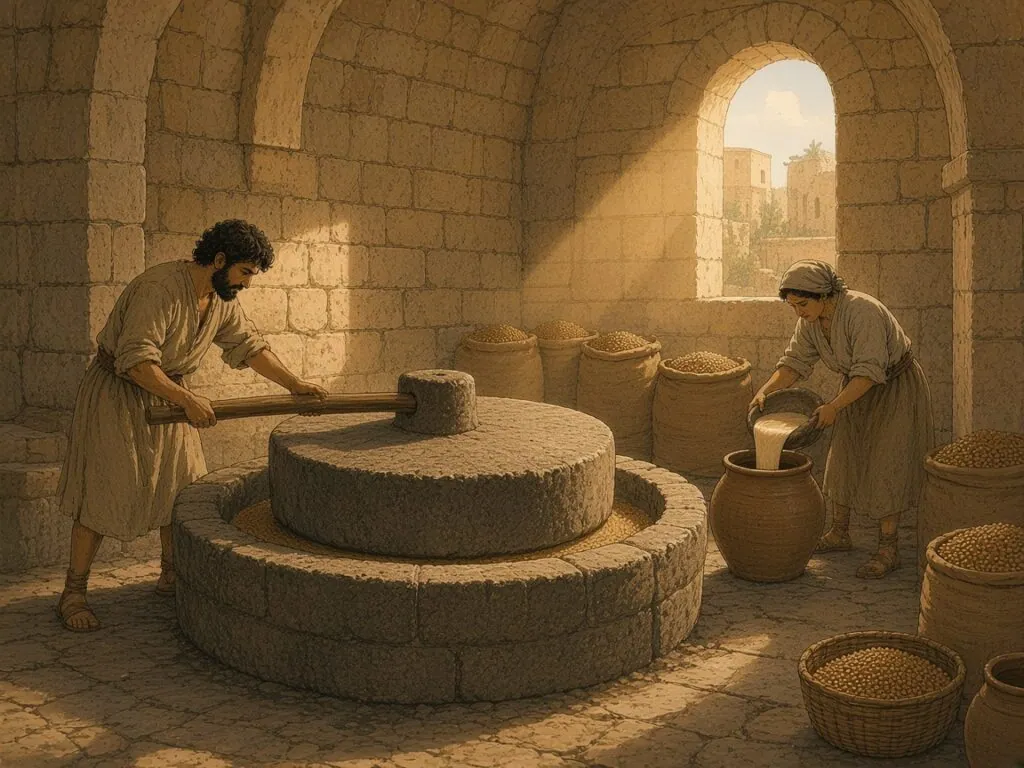
The traditional mills of the Levant were stone mills turned by animals or by water, and later by engines. In the old cities of Nablus, Tripoli, Aleppo and Damascus, tahini makers worked in the same quarters as the makers of halva, the sweet confection of tahini and sugar or syrup whipped with an extract of soapwort root, and of sesame oil. The finished tahini was sold from large earthenware jars or tin containers, and households bought it by weight. Today most of the world’s tahini is made in factories, but the principle is unchanged, and many producers still advertise their stone-ground product. The sesame itself increasingly comes from Africa: Sudan, Ethiopia and Nigeria are among the leading exporters, and the white sesame of the Humera region of Ethiopia is especially prized by tahini makers for its mild flavour.
The quality of tahini depends on the fineness of its grind. Food scientists studying tahini and similar pastes have shown that the size of the milled particles determines its flow and texture: finer particles make a smoother, more fluid paste, while coarser ones make it stiffer and grainier[56]. A well-made tahini separates on standing into a layer of oil above and a dense paste below, and has to be stirred before use. When it is mixed with water or lemon juice it does something surprising, first seizing into a thick, almost solid mass and then, as more liquid is added, loosening into a smooth cream that is paler than the original paste. The ninth chapter explains why.
Tahini in the medieval kitchen
Sesame and its products appear throughout the medieval Arabic cookery books. Sesame oil, shīraj, was a common cooking fat in Baghdad and elsewhere, and sesame seeds were sprinkled on breads and sweets. Tahini, the ground paste, was used as a sauce and as a thickening and flavouring agent in cold dishes and dips, and it appears in recipes for the seasoned chickpea purées discussed in the next chapter[44][16]. A fourteenth-century Egyptian recipe for ḥimmaṣ kasā, translated by Nawal Nasrallah, calls for “boiled chickpeas” pounded “into fine mush”, with “vinegar, sweet olive oil, tahini”, black pepper and a long list of herbs, nuts and spices[44]. The combination of chickpea and tahini was therefore known in the kitchens of Mamluk Cairo, even if the dish as a whole was rather different from the modern hummus.
Tahini also had a long life outside the hummus bowl. In the modern Levant it is the base of ṭarāṭūr, a sauce of tahini thinned with lemon juice, water and garlic, eaten with falafel, grilled meat, fried cauliflower and fish. It is mixed with grape or carob molasses as a sweet spread for bread, a breakfast dish in Lebanon, Syria and Turkey. It thickens the aubergine purée known as mutabbal or bābā ghannūj. And it is the essential ingredient of halva, which travelled with the Ottoman Empire into the Balkans and with Jewish migrants into eastern Europe and America, where the dense slabs of sesame halva sold in delicatessens are cousins of the tahini in the hummus bowl.
A marriage of two pastes
The meeting of chickpea and sesame in a single dish is, in one sense, unsurprising. Both were cheap staples of the eastern Mediterranean, both could be ground into pastes in the same mortars and mills, and both had been eaten in the region for millennia. In another sense it is a stroke of culinary genius, because the two ingredients complement one another so well. The chickpea supplies starch, protein and a sweet, earthy flavour; the sesame supplies fat, a roasted bitterness and a smooth texture. Lemon or vinegar adds acidity, garlic adds pungency, and salt draws the flavours together. The result is more than the sum of its parts, a dish that is filling without being heavy and rich without being greasy.
Who first made this marriage cannot be known. The cookery books of the thirteenth and fourteenth centuries show that it had been made by then, at least in the kitchens of the wealthy. The following chapter examines those books in detail and asks what their recipes can and cannot tell us about the history of hummus.
6. The caliphs’ kitchens
Between the tenth and the fifteenth centuries, cooks and scribes in the Arabic-speaking world produced the largest body of written recipes to survive from anywhere before the early modern period. Collections were compiled in Baghdad, Aleppo, Damascus, Cairo, Córdoba and Murcia, copied and recopied, expanded and abridged, and read by courtiers, physicians, merchants and anyone else who could afford a manuscript and a well-stocked kitchen. As the Library of Arabic Literature’s description of Charles Perry’s translation of one of them puts it, with the exception of four Babylonian and Roman specimens, cookbooks “did not appear on the world literary scene until Arabic speakers began compiling their recipe collections in the tenth century, peaking in popularity in the thirteenth century”[17]. These books are the earliest substantial written evidence for the cooking of the Near East, and they contain the earliest known recipes for dishes of mashed chickpeas resembling hummus.
Ibn Sayyār al-Warrāq
The oldest surviving Arabic cookbook is the Kitāb al-Ṭabīkh, the Book of Cookery, compiled in Baghdad in the tenth century by a scribe and copyist known as Ibn Sayyār al-Warrāq. The epithet al-warrāq means a stationer or bookseller, and the author seems to have been a professional man of letters who gathered recipes from the kitchens of the Abbasid caliphs and their courtiers, from earlier written collections now lost and from the poems in which Baghdadi gourmets celebrated their favourite dishes. Nawal Nasrallah’s English translation, published by Brill in 2007 under the title Annals of the Caliphs’ Kitchens, runs to almost nine hundred pages and is a monument of scholarship[15].
Al-Warrāq’s book is a work of a culture that took food extremely seriously. It opens with chapters on kitchen equipment and hygiene and on the medical properties of foods, following the Galenic theory described in the third chapter, and then proceeds through breads, cold dishes, stews, roasts, fish, sweets and drinks. Chickpeas appear frequently, as an ingredient in stews of meat and vegetables, in soups and in the cold dishes, bawārid, which were served at the beginning of a meal. The medical chapters discuss the qualities of the chickpea, its nourishing and its windy effects, and recommend spices to temper it[15]. What al-Warrāq does not contain, so far as the published translation shows, is a recipe that a modern reader would immediately recognise as hummus. Chickpeas were everywhere in the Abbasid kitchen, but the dish of mashed chickpeas with sesame paste was not yet prominent among the fashionable recipes of the court.
Al-Baghdādī and his successors
The second great Baghdadi cookbook was completed in 1226 by Muḥammad ibn al-Ḥasan ibn Muḥammad ibn al-Karīm, usually called al-Baghdādī. Shorter and more personal than al-Warrāq’s compilation, it was for a long time the only medieval Arabic cookbook known to English-speaking readers, through the translation made by A. J. Arberry in 1939 and the revised version published by Charles Perry in 2005[57]. Al-Baghdādī wrote for a cultivated reader who cooked for pleasure, and his recipes are precise and economical. Many of them use chickpeas, typically cooked with meat in sour or sweet stews, and his collection shows the chickpea as an indispensable background ingredient of the Baghdadi table.
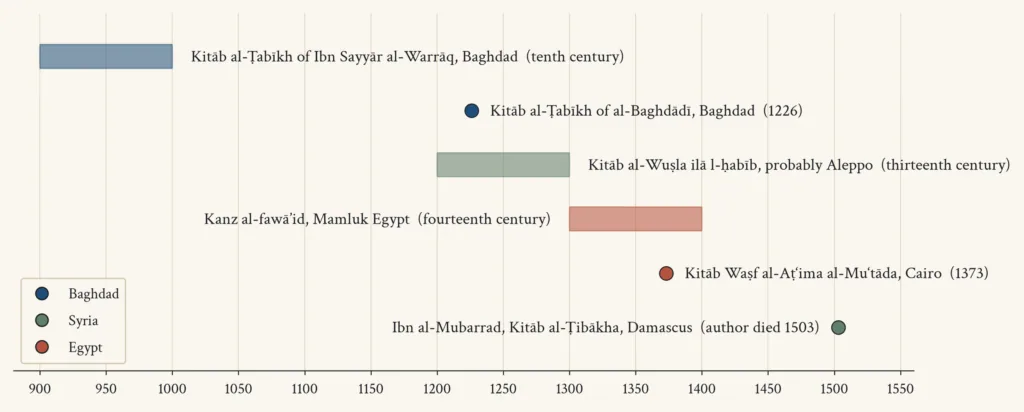
Al-Baghdādī’s book had a remarkable afterlife. In fourteenth-century Cairo an anonymous author expanded it into a much larger collection, the Kitāb Waṣf al-Aṭʿima al-Muʿtāda, the Book of the Description of Familiar Foods, dated 1373, which Perry translated in the volume Medieval Arab Cookery[58][60]. It is in this Egyptian expansion that one of the best-known recipes for ḥimmaṣ kasā appears. In Perry’s translation, as quoted by modern cooks who have reconstructed it, the cook is told to take chickpeas and pound them fine after boiling them, and then to add vinegar, oil, tahini, pepper, mint, parsley, dry thyme, walnuts, hazelnuts, almonds, pistachios, cinnamon, toasted caraway, dry coriander, salt, salted lemons and olives[58]. The dish was spread on a plate and served cold.
The Syrian cookbook
The richest of the medieval cookbooks from Syria is the Kitāb al-Wuṣla ilā l-ḥabīb fī waṣf al-ṭayyibāt wa-l-ṭīb, the Book of the Link with the Beloved, on the Description of Good Dishes and Perfumes. Compiled in the thirteenth century, probably in Aleppo, it has been attributed to the Aleppine historian Ibn al-ʿAdīm, but its authorship has been disputed and it may be the work of a member of the Ayyubid ruling family[5]. Charles Perry’s bilingual edition and translation, published in the Library of Arabic Literature in 2017 as Scents and Flavors, contains 635 recipes, arranged like a meal, from perfumes and appetisers through main dishes and sweets to the soaps with which diners washed their hands[17][61].
The Wuṣla includes a chickpea purée flavoured with tahini and sour citrus, and the journalist Mahmoud Habboush, writing in New Lines Magazine in 2023, argued that it was the earliest recipe in the medieval corpus to resemble modern hummus closely[5]. As the magazine’s editor summarised it, the recipe “predictably incorporates tahini, chickpeas and lemon”[5]. The argument is attractive, because the Wuṣla comes from the very region, northern Syria, where the hummus of the modern Levant is most deeply rooted. But it should be weighed with care. The Syrian collection is roughly contemporary with the Egyptian books discussed below, and all of them draw on a common stock of recipes that circulated across the Ayyubid and Mamluk world.
The Treasure Trove
The largest of the medieval collections from Egypt is the Kanz al-fawāʾid fī tanwīʿ al-mawāʾid, the Treasure Trove of Benefits and Variety at the Table, an anonymous compilation of the Mamluk period, usually dated to the fourteenth century. It survives in only five manuscripts, and Nawal Nasrallah’s English translation, published by Brill in 2017, makes its 832 recipes available to English-speaking readers for the first time[16][62]. The book is practical in tone. It gives rules for the cleanliness of the cook and kitchen, including the advice to keep a separate knife for chopping onion and garlic, recipes for the foamy barley beers called fuqqāʿ, and a large number of dishes for every course[44].
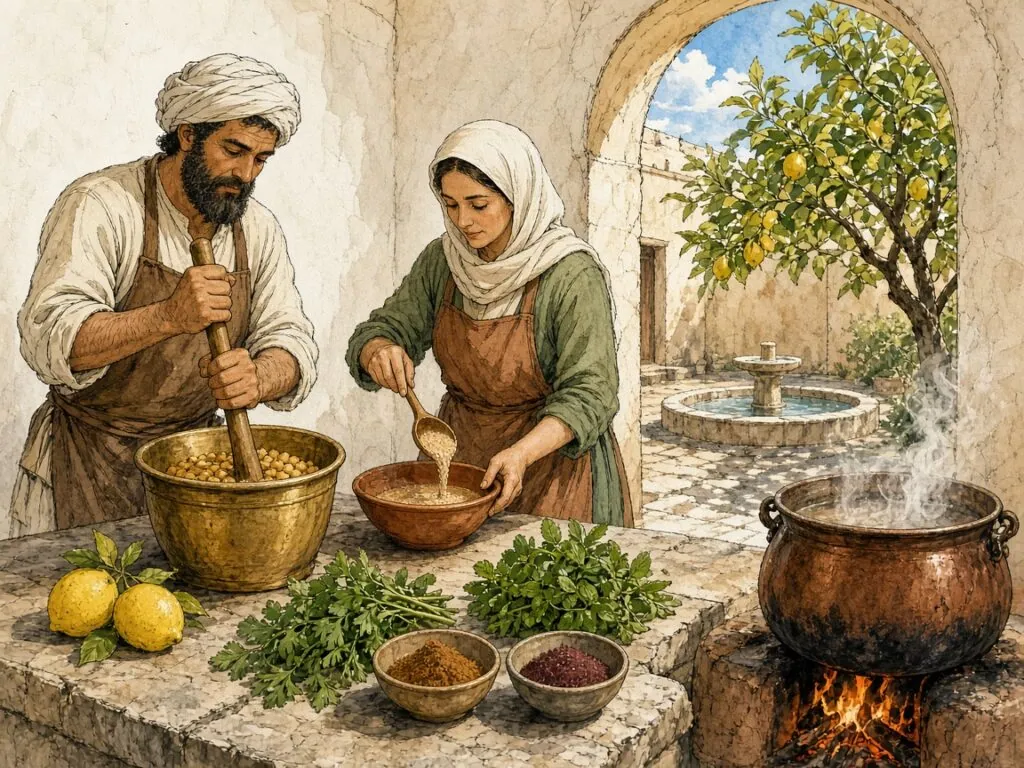
According to the historical cook Max Miller, who reconstructed one of them, the Kanz contains ten recipes for ḥimmaṣ, all more elaborate than modern hummus[44]. The most complex, in Nasrallah’s translation, reads in full: “Take boiled chickpeas and pound them into fine mush. Add vinegar, sweet olive oil, tahini, black pepper, atraf tib, mint, Macedonian parsley, and a bit of dried rue. Also add walnuts, almonds, pistachios, and hazelnuts – all pounded as well as Ceylon cinnamon, toasted caraway seeds, coriander, salt, lemon preserved in salt, and olives. Mix it all, spread the mix in a bowl or plate, set it aside for a day and then serve. It will come out good, God willing”[44]. Aṭrāf al-ṭīb, the “tips of perfume”, was a spice blend that might include spikenard, bay leaves, nutmeg, mace, cardamom, cloves, rosebuds, long pepper, ginger and black pepper.
This recipe is close enough to modern hummus to be recognisable and different enough to be startling. The chickpeas are boiled and pounded, and they are mixed with tahini, oil and something sour. But the souring agent is vinegar rather than fresh lemon juice, the citrus element is salt-preserved lemon, there is no garlic, and the purée is loaded with nuts, herbs and aromatic spices that would bewilder a modern customer in a Jerusalem hummus shop. It is a dish of the rich, not of the street, and it belongs to a medieval taste for complex seasoning in which sour, aromatic and slightly bitter flavours were layered together. It is also a dish meant to be made in advance and served cold, which suggests that it was one of the cold relishes set out at the start of a banquet.
Ibn al-Mubarrad in Damascus
The last of the medieval Arabic cookbooks is also the shortest. Yūsuf ibn ʿAbd al-Hādī, known as Ibn al-Mubarrad or Ibn al-Mabrad, was a prolific Damascene scholar of the late Mamluk period who died in 1503, and among his many works is a brief Kitāb al-Ṭibākha, a Book of Cookery, which Charles Perry translated in 1985[59][60]. It is a modest collection, more a list of everyday dishes than a guide to court cuisine, and it is valuable precisely because it records the food of an ordinary prosperous household in Damascus at the end of the Middle Ages. Chickpeas appear in it, as they do in every cookbook of the region, as a staple ingredient in stews and other dishes. Ibn al-Mubarrad’s book stands at the threshold of the Ottoman period, when Damascus became a provincial capital of a vast empire, and the city’s cooks were exposed to new influences from Istanbul and beyond.
What the cookbooks tell us
The medieval cookbooks establish three things beyond reasonable doubt. First, the combination of mashed chickpeas and tahini was known in the cuisine of the Ayyubid and Mamluk world by the thirteenth and fourteenth centuries, in Syria and in Egypt. Second, the dishes made from this combination were cold relishes, prepared in advance and seasoned with sour ingredients, oil, herbs, spices and nuts. Third, they bore a name, ḥimmaṣ kasā, that identified them as preparations of chickpeas, though the meaning of the second word is uncertain.
What the cookbooks cannot tell us is how such dishes were eaten by ordinary people, or how the elaborate ḥimmaṣ kasā of the medieval elite became the simpler hummus of the modern Levant. Charles Perry has warned against reading the medieval recipes as direct ancestors of modern dishes. “The thing you have to bear in mind about historical cookbooks,” he told the BBC in 2017, “is that they tend to record fashionable dishes, and fashionable dishes eventually become unfashionable, so a modern dish that somewhat resembles an ancient one may not have a historical connection”[1]. The historian Ari Ariel has pointed out that “the earliest recipe I’ve seen for hummus that includes tahini is from an Egyptian cookbook”, but the question whether the medieval recipes are hummus or merely resemble it remains open[1].
Perry himself has suggested a different line of argument, based not on recipes but on serving. The traditional way of presenting hummus in much of the Middle East is in a shallow bowl with a raised edge, the paste whisked briskly around with a pestle so that it mounds up against the rim. This not only presents the hummus conveniently for scooping with bread but also proves that it has the right texture, neither too stiff nor too slack. “The practice of whipping hummus up against the wall of the bowl indicates a sophisticated urban product, not an ancient folk dish,” Perry told the BBC. “I’m inclined to think hummus was developed for the Turkish rulers in Damascus,” and he associated it with that city in the eighteenth century, “because it was the largest city with a sophisticated ruling class”[1]. He also gave some credit to Beirut, “a sophisticated city throughout the Middle Ages, one with a vigorous culinary tradition”, where “lemons were abundant”[1].
Between the books and the bowl
Between the last medieval cookbook and the first modern descriptions of hummus shops lies a gap of several centuries in the written evidence. The cooking of the Ottoman Arab provinces in the sixteenth, seventeenth and eighteenth centuries is known mainly from chronicles, travel accounts, guild registers and court records rather than from cookbooks, and none of these sources has yet yielded a detailed description of hummus bi-tahina. It is likely that in this period the dish was simplified and popularised, moving out of the banqueting hall and into the shops and households of the cities. The nuts and aromatic spices of the medieval recipes fell away; fresh lemon juice, increasingly abundant from the coastal groves, replaced vinegar and preserved lemon; garlic was added; and the purée, now smoother and more fluid, was served in the raised-edge bowls that Perry describes.
This reconstruction is plausible, but it remains a reconstruction. The history of hummus between the Mamluks and the late Ottomans is still largely unwritten, and it may yet be clarified by work in Ottoman archives, in Arabic manuscripts of the period and in the records of the guilds that regulated food sellers in the great cities. What can be described with more confidence is the world that emerged at the end of this period, in the nineteenth and early twentieth centuries, when hummus was sold in small specialist shops in Damascus, Beirut, Jerusalem and Jaffa, and when travellers and, later, sociologists began to write about it.
7. Morning in the hummus shop
In the old cities of the Levant, the day begins early and so does the hummus. Long before the shops of the market open, the cook of a small hummus shop has lit the fire under a deep pot of chickpeas that have soaked overnight, and by dawn the first customers are standing at the counter or crowded onto benches at a few small tables. There are labourers on their way to work, market porters, taxi drivers, students and old men who have come for the company as much as for the food. The cook pounds the hot chickpeas in a heavy mortar or works them in a machine, stirs in the tahini, lemon juice and garlic, and slaps a portion into a shallow bowl, spreading it with a few turns of a spoon so that it rises against the rim. Olive oil is poured into the hollow, a handful of whole chickpeas is added, and the bowl goes out with a basket of hot bread, a plate of raw onion wedges, green chillies, pickled cucumbers and turnips coloured pink with beetroot. By early afternoon the pot is empty and the shop is closed.
This is the world of the ḥummuṣīya, the hummus shop, and it is in such places, more than in any household or banqueting hall, that the modern dish took shape. A well-known saying holds that “kings eat hummus in the morning”, and the BBC writer Dan Savery Raz, describing the hummus shops of Israel and Palestine in 2012, explained that many Arab hummus eateries are open only until two in the afternoon, “following the traditional Arabic saying that ‘kings eat hummus in the morning’, referring to the tradition of cooking a pot of chickpeas overnight and savouring the freshest portion at dawn”[63]. Hummus, on this view, is a food that should be eaten fresh, warm and early, and the best shops make it in small batches and sell out before lunch.
The urban breakfast
The hummus shop belongs to a larger culture of the street breakfast, fuṭūr, which developed in the great cities of the Ottoman Arab provinces in the eighteenth and nineteenth centuries. Its basis was the cooked pulse, eaten hot with bread, oil and pickles. In Cairo and Alexandria the pulse was the faba bean, simmered overnight in a narrow-necked pot, the qidra, and mashed with oil, lemon and cumin to make fūl mudammas, still the national breakfast of Egypt. In Damascus, Aleppo, Beirut, Jerusalem and the coastal towns of Palestine the chickpea and the faba bean were both sold, often in the same shops, and the menu included hummus with tahini, fūl with oil and lemon, and a range of combinations and toppings[18][63].
The shops were small and specialised. A good hummus shop sold almost nothing else: hummus, fūl, perhaps falafel fried in a deep pan by the door, bread, pickles, raw onions and tea. Their equipment was simple and durable. The chickpeas were pounded in a mortar of stone or wood, or, in Antakya and Tarsus, crushed with a wooden mallet in a beaten copper bowl, a technique that the Turkish Ministry of Culture now describes in the official registration of Tarsus hummus as a geographical indication[3]. The finished hummus was served in shallow bowls of glazed earthenware or tinned copper, and in many shops it was spread with the back of a spoon or a pestle in the swirling motion that Charles Perry regarded as the signature of a sophisticated urban dish[1].
The choice of toppings
What went on top of the hummus defined both the dish and the shop. The simplest topping is olive oil, often with a pinch of paprika or ground cumin and a little chopped parsley. A richer one, called in Levantine Arabic musabbaḥa or msabbaḥa and in Israeli Hebrew masabacha, consists of whole chickpeas cooked until very soft and served warm in a sauce of tahini, lemon juice and garlic, sometimes spooned over a base of smooth hummus and sometimes served on their own. The name is often explained by the image of the chickpeas swimming in their sauce. At Abu Hassan, also known as Ali Caravan, a hummus shop in the Ajami neighbourhood of Jaffa that has been a place of pilgrimage since it opened in 1966, queues form each day for “warm plates of masabacha”, which the BBC described as “recognisable by its red colour, thanks to the added paprika”[63].
Other toppings bring the hummus closer to a full meal. Ḥummuṣ bi-l-laḥma, hummus with meat, is crowned with small pieces of lamb or minced meat fried in butter or oil with pine nuts and spices, and in Lebanon and Syria it may be made with qawarma, lamb preserved in its own fat, a traditional store of meat for the winter. Ḥummuṣ bi-l-fūl, also called mashawsha in parts of Palestine, combines hummus with mashed faba beans, and the combination is a speciality of several famous shops in the Galilee; the BBC singled out Abu Adham in the village of Kfar Yasif near Acre, where people travel for hours to eat its “famous hummus with fuul”[63]. Hard-boiled eggs, chopped tomato, green chilli sauce, sumac, pine nuts and fried cauliflower all appear on the hummus bowls of different towns and different shops.
Closely related to hummus is fatteh, a dish of torn and toasted or fried bread soaked in the hot cooking liquid of the chickpeas and layered with whole chickpeas, yoghurt mixed with tahini and garlic, and a final pouring of sizzling butter or ghee with pine nuts. Fatteh is especially associated with Damascus, where it is a breakfast and a festive dish, and it shows how the same ingredients, chickpeas, sesame paste, garlic, sour dairy and bread, could be recombined into very different preparations. Balīla, warm whole chickpeas dressed with cumin, lemon and oil, is a simpler cousin, sold from carts and eaten in winter.
Jerusalem, Jaffa and Acre
The hummus shops of Palestine have been studied more closely than those of any other region, largely because of their role in the history traced in the eleventh chapter. The Israeli sociologist Dafna Hirsch, in an influential article of 2011, reconstructed the “cultural biography” of hummus in Palestine and Israel from the Mandate period to the present[18][64]. She drew on the ethnography of Gustaf Dalman, the German scholar who recorded Palestinian rural life in the 1920s, who mentioned hummus “as a beloved dish yet not one eaten on a regular basis”, and who noted that in poorer villages hummus was often made without tahini, “which was the more expensive ingredient”[18]. In the towns the picture was different. Restaurants serving hummus, and sometimes fūl or roasted meat as well, “could be found in urban commercial centers like Haifa, Jaffa, and Jerusalem and were often intended to cater to visitors from out of town”[18].

Some of these shops became institutions. In Jerusalem the hummus shops of the Old City, near the Damascus Gate and along the Via Dolorosa and the Al-Wad road, have fed generations of residents and pilgrims. The BBC reported in 2012 that locals regard Abu Shukri, on Al-Wad Road, as serving “the best hummus in the Holy City”, so admired that Jordanians ordered large frozen tubs of it from across the border[63]. In 2017 the BBC writer Diana Spechler watched a cook named Nader Tarawe prepare hummus at Akramawi, “a 65-year-old hummus joint by Damascus Gate”[1]. In Acre, the old port city of the Galilee coast, there are said to be nearly thirty hummus places, of which the most famous, Hummus Said, serves its hummus “drenched in olive oil, which is made from the owner’s own olive press”[63]. Abu George, another Acre shop, is run by a Maronite Christian family[1].
The cooks of these shops are often reticent about their methods. The proportions of chickpea and tahini, the length of soaking and cooking, the amount and timing of lemon and garlic, whether the chickpeas are peeled, whether iced water is added: all are matters of house style and closely guarded habit. When Spechler asked the cooks she met what their secret ingredient was, from the cook at Akramawi to the family at Abu George and the young owners of a Jerusalem hummus shop who gave their leftovers to the homeless each night, almost all of them gave the same answer. “Almost everyone answered, ‘Love’”[1].
Damascus and Beirut
The hummus shops of Damascus and Beirut have left fewer traces in the English-language literature, but they are no less important. Damascus, as Perry argued, is the most plausible birthplace of the modern dish, the largest city of the region with a sophisticated ruling class and a long tradition of fine cooking[1]. Its old quarters had, and in many cases still have, specialist shops selling hummus, fūl and fatteh in the morning, and its cooks developed the rich Damascene versions of these dishes, with ghee, pine nuts and meat. The Syrian civil war that began in 2011 damaged or destroyed many of the old shops of Aleppo and other cities, and the displacement of millions of Syrians carried their cooks and their recipes to Turkey, Lebanon, Jordan and Europe.
Beirut, too, has a long tradition of hummus. Its cooks are known for a very smooth, pale hummus, often seasoned generously with lemon and garlic and decorated with paprika, parsley and a pool of oil, served as one of the many small dishes of the Lebanese meze table. The Lebanese meze, with its dozens of small plates of salads, dips, pickles, fried and grilled dishes, has become one of the best-known expressions of Levantine hospitality, and hummus is its most familiar component. In this setting hummus is not a breakfast of workers but a shared appetiser, eaten slowly over drinks and conversation, and the Lebanese claim to the dish, examined in the eleventh chapter, rests in large part on the international success of this restaurant culture[24].
Wiping and dipping
How hummus is eaten matters as much as how it is made. In most of the Levant it is eaten with bread, never with a fork, and the technique is learned in childhood. A piece of flatbread is torn off, folded between the fingers into a scoop, and drawn through the hummus from the rim towards the centre, so that it picks up paste, oil and topping together. Hirsch notes that in Israel this action is called “wiping” in Hebrew, “distinct from Palestinian ‘dipping’”, and that the Israeli manner of eating hummus, with its emphasis on vigorous, informal, shared eating from a common plate, came to express qualities that Israelis liked to associate with themselves[18]. In Palestinian and other Arab practice, hummus is usually one dish among several, and the bread moves between bowls; in Israeli hummus shops it has often become a main course, eaten in a large portion with raw onion and pickles.
These differences of manner are small, but they illustrate a larger point. Hummus is not a single fixed recipe but a family of practices, varying from town to town and from community to community, in its making, its toppings, its accompaniments and its place in the day and in the meal. The hummus shop is the place where these practices are most vividly displayed, and where the dish is most fully itself: fresh, warm, made by hand and eaten among strangers who share, for the length of a breakfast, a common taste.
Bread and pickles
No account of the hummus shop would be complete without its bread and its pickles. The bread is usually a round, pocketed flatbread, khubz in Arabic and pita in Hebrew and English, baked in a very hot oven so that it puffs up and separates into two layers. In the best shops it arrives straight from a nearby bakery, still hot, and is used both as a scoop and as a wrapper. In Antakya hummus is eaten with pide, a Turkish flatbread, together with tomatoes and pickles[4], and among the Druze of the Galilee and the Carmel the thin, wide saj bread baked on a domed griddle is preferred[63].
The pickles, ṭurshī, are an essential counterpoint to the richness of the hummus. Pickled cucumbers, chillies and turnips, the last stained a vivid pink by slices of beetroot added to the brine, sit beside the bowl with wedges of raw onion and sometimes whole green chillies or a fiery sauce. Their sharpness cuts the fat of the tahini and the oil and refreshes the palate between mouthfuls. In some shops a hot sauce of lemon, garlic and green chilli is served alongside, to be spooned over the hummus to taste. The combination of soft, rich purée, hot bread and sharp, crunchy pickles is the essence of the hummus breakfast, and it is reproduced, in one form or another, wherever hummus is taken seriously.
8. One dish, many tables
Travel a few hundred kilometres in any direction from Damascus and the hummus changes. The proportions of chickpea and tahini shift, the lemon grows sharper or gentler, garlic advances or retreats, and the bowl acquires new toppings and new companions. In some places hummus is eaten cold, in others warm or even hot; in some it is a breakfast, in others a meze, a side dish or a meal in itself. These variations are not corruptions of a single original but local expressions of a shared tradition, shaped by the ingredients, the habits and the histories of different communities. This chapter makes a short tour of them, from Lebanon and Syria to Palestine, Israel and Jordan, south to Egypt, north to the Turkish cities of Antakya and Tarsus, and west to Cyprus and the Greek islands.
Lebanon and Syria
The Lebanese style of hummus is the one that most of the world knows best, because Lebanese restaurants carried it to Paris, London, New York, Montreal, São Paulo and Sydney in the twentieth century. It is very smooth, pale and fairly loose, made with peeled chickpeas and a generous proportion of tahini, sharpened with plenty of lemon and garlic, and served cool or at room temperature as one of the many dishes of the meze. It is decorated with care: a swirl, a pool of olive oil, a sprinkling of paprika or sumac, a few whole chickpeas and a little chopped parsley. For a more substantial dish it is topped with minced lamb or small pieces of meat fried in butter with pine nuts, the ḥummuṣ bi-l-laḥma of Beirut restaurants.
Syrian hummus is close to Lebanese but often richer and more varied. In Damascus hummus belongs to a family of morning dishes that includes fatteh and fūl, and ghee and pine nuts are common finishes. In Aleppo, with its strong tradition of spiced and sour cooking, hummus may be seasoned with the coarse red pepper of the region and with cumin, and it is eaten alongside other dips of aubergine, red pepper and walnut. Charles Perry’s view that hummus as we know it was most probably developed in Damascus, the largest and most sophisticated city of the Ottoman Levant, gives Syrian hummus a claim to being the classic form from which the others descend[1].
Palestine and Jordan
Palestinian hummus is above all the hummus of the hummus shop, described in the previous chapter: warm or freshly made, eaten early in the day, served with raw onion, pickles, green chilli sauce and hot bread. It is often topped with whole chickpeas in a lemon and garlic sauce, the msabbaḥa, or combined with mashed faba beans, and in the Galilee and the coastal towns it is sometimes finished with a generous pool of olive oil from local presses[63]. In Palestinian homes hummus is often bought from a local shop rather than made from scratch, and, as Dafna Hirsch noted, in the 2000s Israeli industrial hummus had made inroads into Palestinian kitchens as well[18].
Jordanian hummus shares much with Palestinian practice, not least because a large proportion of Jordan’s population is of Palestinian origin. In Amman the morning hummus and fūl shop is an institution, and the combination of hummus and falafel with bread, mint, tomatoes and pickles makes a cheap and filling breakfast. When an Israeli hummus brand opened a temporary hummus shop in Jaffa in 2007 to promote its product, it chose a Jordanian chef, Nehad Al-Han, to run it, a decision that Hirsch interprets as an attempt to borrow the authenticity of Arab hummus-making for an industrial product[18].
Israel and its many communities
In Israel hummus has developed into a remarkably varied food culture, shaped both by the Palestinian hummus shops from which Jewish Israelis learned the dish and by the traditions of Jewish communities from across the Middle East and North Africa. As the BBC writer Dan Savery Raz observed in 2012, “Jewish immigrants from countries such as Iraq, Yemen and Morocco each brought with them their own unique hummus habits”: Iraqi Jews served hummus with sabich, fried aubergine and boiled eggs, while Moroccans favoured a vegetarian chickpea soup[63]. In Tel Aviv’s Yemenite Quarter hummus is served hot with skhug, the fierce green or red chilli paste of Yemeni Jewish cooking, and among the Druze of the Carmel and the Galilee it comes with thin bread and the local wild thyme, zaʿtar[63].
The most popular style in Israeli hummus shops is served warm in a large bowl, “sprinkled with parsley, cumin and other spices”, with “the consistency of a very thick soup”, and scooped up “with hot pita bread, raw onion and pickled cucumbers”[63]. Israeli hummus is often a main course rather than a side dish, eaten in quantity for breakfast or lunch, and its gourmet culture, with its guidebooks, its arguments about the best shops and its tours, is one of the phenomena that Hirsch set out to explain[18]. The BBC also noted that the dish suited the Jewish dietary laws, since it “complements vegetarian, dairy and meat dishes” and so can be served at almost any meal[63].
Egypt and the faba bean
In Egypt the chickpea plays second fiddle to the faba bean. The national breakfast is fūl mudammas, slow-cooked faba beans mashed with oil, lemon, cumin and sometimes tahini, and the national street food is ṭaʿmiyya, the Egyptian falafel, made from faba beans rather than chickpeas. Hummus bi-tahina is eaten in Egypt, especially in restaurants and as part of a spread of salads and dips, but it does not have the central place that it holds in the Levant.
The chickpea has its own distinctive Egyptian forms. In winter, street vendors in Cairo and Alexandria sell ḥummuṣ al-shām, “Syrian chickpeas”, a hot drink of chickpeas cooked in a spicy tomato broth with garlic, cumin and chilli, served in a glass with lemon and drunk with a spoon for the chickpeas[65]. The name itself, which attributes the dish to Syria, is a small piece of evidence for the long-standing Egyptian habit of borrowing dishes from the Levant, which Charles Perry cited when he argued that “historically, Egypt has been more likely to adopt Syrian dishes than vice versa”[1]. And yet the earliest known recipes for hummus with tahini come from Egyptian cookbooks of the Mamluk period, a reminder that culinary influence in the medieval Islamic world ran in many directions[16][1].
Antakya and Tarsus
In Turkey hummus is closely identified with two cities near the Syrian border, Antakya, the ancient Antioch, in the province of Hatay, and Tarsus, in the province of Mersin. Both have large Arabic-speaking populations and long connections with the cities of northern Syria, and both have developed distinctive hummus traditions. For the Antakya food writer Erol İğde, hummus is not a meze but a meal: “Hummus is my dish. I say dish, because hummus, for us people of Antakya, is a meal, not a meze,” he wrote in Turkish, and it is quite normal in Antakya to make a whole meal of a plate of hummus[4].
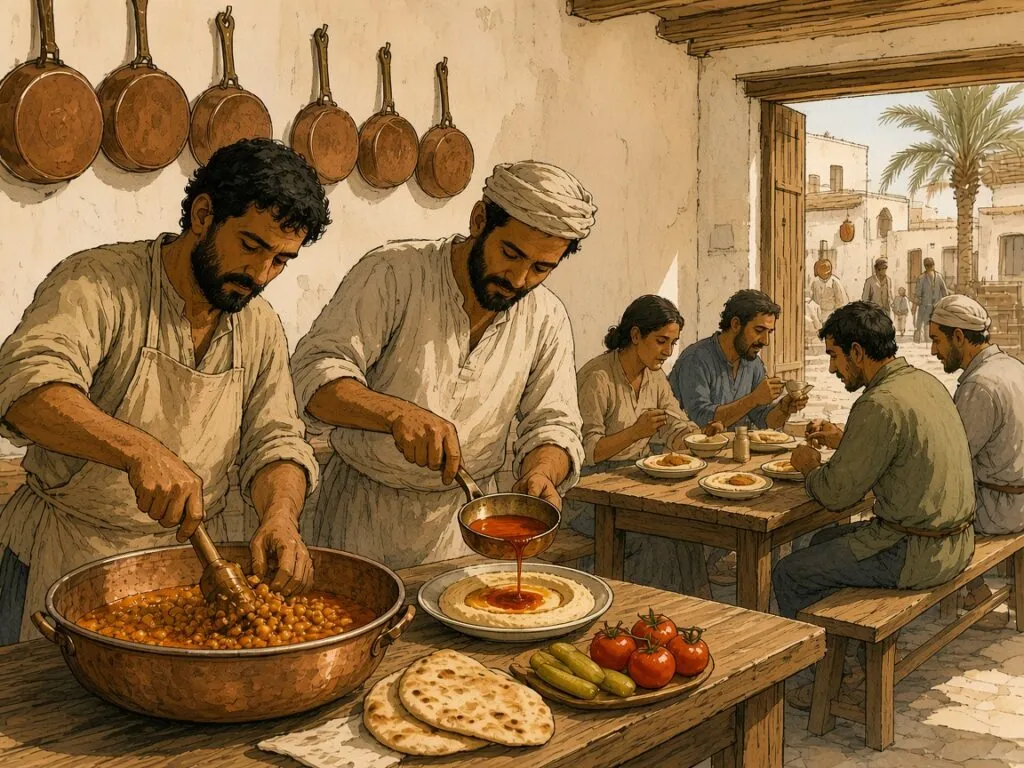
İğde’s history of the hummus makers of Antakya is a valuable record of the trade. He found no information in the published records of the late Ottoman period about specialist hummus sellers, but a statistical table of the tradesmen of Antakya for 1935, published in 1939, listed twelve shops under the heading “Hummusiye ve sair yemek yapanlar”, makers of hummus and other dishes, with twenty workers between them[4]. In 2012 the chamber of commerce recorded ten tradesmen working as hummus makers in the city, and one family business beside the Orthodox church had been selling hummus and mashed faba beans for about ninety years, the fourth generation of its family to do so[4]. İğde also recalls the shop of a cantankerous hummus maker named Ammi Hasip, whose hummus was as smooth as putty at a time when cooks had to peel the boiled chickpeas by hand and press them through a colander, before electric machines made such smoothness easy[4].
In Antakya hummus is eaten with pide, the Turkish flatbread, with tomatoes and with pickles, and it is often finished with pine nuts or slices of pastırma, the spiced cured beef of Anatolia, fried in butter and poured over the top[4]. İğde’s own recipe soaks the chickpeas overnight with a little salt and bicarbonate of soda, cooks them until soft, rests them for a day in the refrigerator and then blends them for at least fifteen minutes with tahini and some of the cooking water, adding lemon and garlic only to the portion to be served[4].
Tarsus hummus has an official status. It is registered in Turkey as a geographical indication, number 226, and the registration describes it as a dish made by crushing cooked chickpeas with a wooden mallet in a hammered copper bowl, adding tahini, lemon juice or citric acid, garlic and spices, and pouring over it oil heated with red pepper flakes, with pastırma as an optional addition; it is served hot[3]. The tahini is made from local sesame grown in the Çukurova plain. The registration dates the first hummus-making in Tarsus to the 1920s and identifies the distinctive feature of the dish as its slightly coarse texture, the result of crushing rather than blending, and its service while hot[3]. Antakya and Tarsus have, in the words of a Turkish news agency, been unable to “share” the dish between them, each claiming its own version as the best[66].
Cyprus and the Greek islands
In Cyprus hummus is eaten by both Greek and Turkish Cypriots, usually as part of the meze, and its presence reflects the island’s long connections with the Levantine coast, from which it lies only about a hundred kilometres. Greek Cypriot tavernas serve it alongside taramosalata, tahini sauce and tzatziki, and the Cypriot tahini sauce, a loose dip of tahini, lemon, garlic and water, is itself a staple of the island’s table.

On the Greek mainland and the islands the chickpea is eaten in quite different ways. The most celebrated is the revythada of Sifnos, a small island of the western Cyclades, a simple stew of chickpeas, onions, olive oil and bay leaves baked overnight in a lidded clay pot, the skepastaria, and eaten for Sunday lunch[19][48]. On Saturday afternoon the pots are prepared and carried to a wood-fired oven, often a shared one; the oven door is sealed with damp rags; and the chickpeas cook slowly until the next day[19]. The National Geographic writer Ella Buchan watched the Sifnian farmer George Narlis prepare the dish and recorded his conviction that its secret lay in simplicity, with no heavy spices, so that the eater tastes the pulse itself. “We need to understand the ingredients — the chickpeas — not the strong flavours of the spices,” he said[19]. The island’s gastronomic tradition, as the Greek tourism authority describes it, is closely linked to its pottery and to slow cooking in wood-fired ovens[67].
The revythada is not hummus, but it belongs to the same Mediterranean family of chickpea dishes and the same culture of shared tables. Like the Levantine hummus bowl, the Sifnian clay pot is a dish for a family and for a community, prepared with care, cooked slowly and eaten together. It is a reminder that the chickpea has been made into festive and communal food in many different ways around the shores of the Mediterranean, and that the purée with tahini is only one of them.
A map of styles
Taken together, these regional traditions suggest a rough map. At the centre, in Syria, Lebanon, Palestine and Jordan, lies the classic cold or warm purée of chickpeas with tahini, lemon and garlic, eaten with bread and finished with oil, whole chickpeas, meat or faba beans according to local taste. To the north, in Antakya and Tarsus, the dish becomes a hot meal, crushed in copper and finished with butter, chilli oil or cured beef. To the south, in Egypt, the faba bean dominates and the chickpea appears in hot soups and drinks. To the west, in Cyprus and Greece, the purée gives way to stews and soups baked in clay. And in Israel the Palestinian dish has been combined with the habits of Jewish immigrants from Iraq, Yemen, Morocco and elsewhere to form a new and inventive food culture of its own. The map is not fixed. It has been redrawn in the past century by migration, war and the food industry, and it continues to change as cooks in Beirut, Tel Aviv, Istanbul and London experiment with the dish.
Beirut
Open in Google MapsDamascus
Open in Google MapsAleppo
Open in Google MapsAcre
Open in Google MapsJaffa
Open in Google MapsJerusalem
Open in Google MapsAmman
Open in Google MapsNicosia
Open in Google MapsTarsus
Open in Google MapsAntakya
Open in Google MapsCairo
Open in Google MapsSifnos
Open in Google Maps9. The chemistry of a smooth bowl
Anyone who has made hummus at home knows that it can go wrong. It can be grainy, with gritty fragments of chickpea skin and unbroken flesh; it can be heavy and pasty, sticking to the roof of the mouth; it can be thin and runny, or bitter, or flat. A good hummus shop produces, day after day, something smooth, light and almost fluffy, which holds its shape in the bowl and yet melts in the mouth. The difference lies partly in ingredients and partly in skill, but behind both lies a set of physical and chemical processes that food scientists have begun to describe in some detail. This chapter follows a chickpea from the sack to the bowl and explains what happens to it at each stage.
Inside a dry chickpea
A dry kabuli chickpea is a seed in a state of suspended animation. Beneath its thin seed coat lie two large cotyledons, the seed leaves, which make up almost all of its bulk and which store the food that the seedling would use to germinate. The cotyledons are built of thousands of closely packed cells, each enclosed in a wall of cellulose, hemicelluloses and pectin, and the cells are glued to one another by a layer of pectin called the middle lamella. Inside each cell, starch granules are embedded in a matrix of storage proteins, with small droplets of oil and a variety of minor compounds, including minerals, vitamins, phytic acid and the oligosaccharides responsible for the chickpea’s notorious windiness[26].
The proportions of these components vary with the variety and the growing conditions. A study of a Mexican kabuli variety used for hummus, the Blanco Sinaloa, found that the raw seeds contained about nineteen per cent protein and a little over ten per cent lipid, with the remainder made up mostly of starch and fibre[68]. Chickpeas are, on average, somewhat richer in fat than most other pulses, which contributes to their buttery flavour and to the smoothness of the purée. Their seed coats, as the second chapter explained, differ in structure between the thin-skinned kabuli and the thick-skinned desi types, which is one reason why kabuli chickpeas are preferred for hummus[37].
Soaking and softening
The first step in making hummus from dried chickpeas is soaking, usually overnight. Water enters the seed through a small pore near the scar where it was attached to the pod and then spreads through the seed coat and into the cotyledons. As the cells hydrate, the seed swells to roughly twice its dry weight, the cell walls soften and the starch granules and proteins take up water. Soaking reduces the cooking time considerably and makes it more even, and food scientists working on the pulses of the Middle East found long ago that soaking “reduced both the cooking time and its variation for all pulses tested”[69].
Many cooks add bicarbonate of soda to the soaking water, the cooking water or both, and the practice has a sound scientific basis. The same study found that soaking in a solution of sodium bicarbonate “further decreased cooking time for chickpea and lentil”[69], and a later study of chickpea breeding lines grown at five locations in the Çukurova plain of southern Turkey examined the effect of soaking in salt and bicarbonate solutions on seed hydration and cooking quality[70]. The explanation lies in the chemistry of pectin. Under alkaline conditions the long pectin chains of the cell walls and the middle lamella break down more readily on heating, by a reaction known as beta-elimination, so the cells separate and the tissue softens. Bicarbonate also counteracts the effect of hard water, whose calcium and magnesium ions form cross-links between pectin chains and make pulses stubbornly firm. The Antakya food writer Erol İğde soaks his chickpeas with a teaspoon of bicarbonate and a tablespoon of salt for at least eight hours[4], and many Levantine cooks add a pinch more to the cooking pot.
Bicarbonate has costs as well as benefits. Too much gives the chickpeas a soapy taste and a mushy, disintegrating texture, and alkaline conditions destroy some of the B vitamins, especially thiamine. The amount matters more than the principle, and a pinch does most of the work that a spoonful would do. Cooks therefore use it sparingly, and some prefer to rely on long soaking and long, gentle cooking alone.
Boiling and the starch
When soaked chickpeas are boiled, several things happen at once. The proteins of the cotyledon cells denature and coagulate, as egg white does, losing their native structure. The starch granules, heated in the presence of water, swell and lose their crystalline order in the process called gelatinisation, which for chickpea starch takes place at temperatures in the region of sixty to seventy-five degrees Celsius. And the pectin of the middle lamella gradually dissolves, so that the cells come apart. In a well-cooked chickpea, the flesh can be crushed between the tongue and the roof of the mouth, and under a microscope it is seen to consist of separated cells, each still enclosed in its wall and packed with gelatinised starch.
This tendency of cooked legume cells to separate along their middle lamella, rather than to break open, has important consequences both for texture and for nutrition. A purée made by gently crushing well-cooked chickpeas consists largely of intact cells, which feel slightly grainy on the tongue; a purée made by vigorous blending ruptures many more cells and releases their starch and protein, which makes it smoother, stickier and more viscous. Researchers at Imperial College London and King’s College London tested this distinction directly in 2024, preparing two hummus meals with the same amount of starch, one made from intact chickpea cells and the other from ruptured cells, and feeding them to fifteen healthy volunteers[21]. Blood insulin and the gut hormone GIP rose significantly less after the meal of intact cells, and laboratory digestion experiments confirmed that the starch in intact cells was digested more slowly, because the cell walls acted as a physical barrier to digestive enzymes[21].
The texture of a hummus therefore depends in part on how far the cook goes in breaking the cells. The traditional hummus of Tarsus, crushed with a mallet in a copper bowl, is officially described as having a slightly rough texture, “pürüzlü”, which the registration of its geographical indication treats as one of its distinctive features[3]. The silky hummus of Beirut restaurants, by contrast, is blended at length, and İğde’s Antakya recipe calls for at least fifteen minutes in a food processor[4]. Before electric machines, a smooth hummus required peeling every chickpea by hand and pressing the flesh through a sieve or colander, a laborious process that İğde recalled from his childhood[4].
The question of skins
Chickpea skins are the enemy of smoothness. Even after long cooking they remain tough and fibrous, and if they are blended into the purée they leave tiny flecks that can be felt on the tongue. Cooks have three ways of dealing with them. They can rub the cooked chickpeas between their hands under water, so that the loosened skins float to the surface and can be skimmed off; they can cook the chickpeas with bicarbonate until the skins separate of their own accord; or they can blend the chickpeas for so long, and so hot, that the skins are pulverised. The first method is the most laborious and produces the finest result, and it is still used in many hummus shops and households. The thin coat of the kabuli chickpea, a product of thousands of years of selection, makes all three methods easier than they would be with the thick-skinned desi types[37].
The tahini emulsion
The most interesting chemistry in the hummus bowl happens when tahini meets water. Tahini is not an emulsion but a suspension: a dense mass of fine particles of sesame protein and fibre, produced by grinding, dispersed in a continuous phase of sesame oil released from the crushed seeds. The particle size of the grind controls its flow, so that finer tahini is smoother and more fluid, as studies of sesame and sunflower tahini have shown[56]. When a little water or lemon juice is stirred into tahini, the paste suddenly stiffens and becomes almost solid, and it may look curdled. As more liquid is added, it loosens again and becomes a smooth, pale, pourable cream.
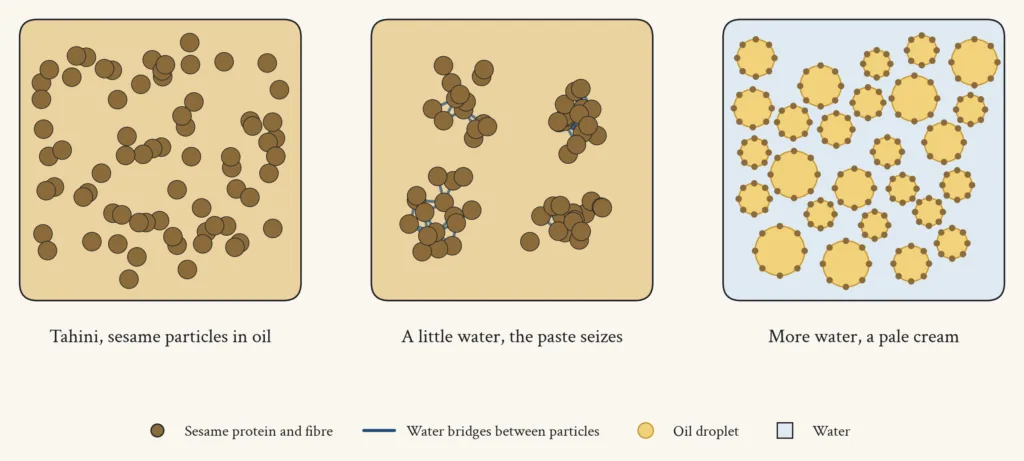
The explanation lies in the behaviour of the particles. The sesame particles are hydrophilic, attracted to water. A small amount of water forms bridges between them, binding them together into a stiff network within the oil, so that the paste seizes. With more water, the particles become fully hydrated and the system inverts: water becomes the continuous phase and the oil is broken into tiny droplets, stabilised by the sesame proteins and by fine particles that sit at the surfaces of the droplets. The result is an oil-in-water emulsion, in which the droplets scatter light and make the mixture paler than the original paste, just as the fat droplets of milk make it white. The acid of the lemon juice also affects the sesame proteins, changing their charge and their ability to hold water, which is one reason why tahini sauce thickens differently with lemon than with plain water.
In hummus, this tahini emulsion is mixed with the chickpea purée, and the result is a complex material that food scientists describe as a dispersion of solid particles and aggregates in a fluid matrix. A study of a commercial Spanish hummus found, by scanning electron microscopy, that its structure consisted of “a solid matrix of coarse aggregates” dispersed in an oily liquid phase, with the oil enveloping the particle aggregates[71]. The Mexican study of Blanco Sinaloa hummus found that the paste behaved as a weak gel, solid-like at rest, with a viscosity that changed with stirring and with time; sterilisation, by gelatinising more of the starch and denaturing more of the protein, made it much firmer[68]. These measurements put numbers to something every hummus maker knows: that a good hummus holds its swirl in the bowl but flows when it is spread on bread.
Aquafaba
The water in which chickpeas have been cooked is a remarkable substance in its own right. It is cloudy, slightly viscous and faintly foamy, and Levantine cooks have long used a little of it to loosen hummus to the right consistency, as İğde instructs his readers to do[4]. In the 2010s home cooks and bakers discovered that it could be whipped like egg white into a stable foam, and that it could be used to make meringues, mayonnaise and other preparations without eggs. They named it aquafaba, from the Latin for “bean water”, and it spread rapidly through online communities of vegan cooks.
Scientists soon began to investigate it. A study of aquafaba recovered from ten commercial brands of canned chickpeas, published in 2018, noted that “this solution has recently been shown to produce stable foams and emulsions, and can act as a thickener”, and set out methods to characterise its composition and explain its functional properties[20]. Later work identified the key components as soluble proteins and saponins leached from the chickpeas during cooking, together with starch and other carbohydrates, and showed that natural nanoparticles in aquafaba can stabilise emulsions of oil in water[72]. These are the same components that help to give hummus its smooth, emulsified texture when a little cooking water is beaten into it.
Temperature and time
Hummus changes as it cools and as it ages. When gelatinised starch is chilled, its molecules gradually re-associate in a process called retrogradation, which makes the paste firmer and slightly crumbly and contributes to the stiff texture of hummus straight from the refrigerator. Warm hummus, fresh from the cooking pot and the mortar, is softer, more fluid and more aromatic, which is why the hummus shops of the Levant and of Antakya and Tarsus insist on serving it fresh and why Tarsus hummus is defined as a dish eaten hot[3]. Some cooks deliberately exploit retrogradation: İğde’s recipe rests the boiled chickpeas in the refrigerator for a day before blending[4], and the fourteenth-century cook of the Kanz al-fawāʾid was told to set his ḥimmaṣ kasā aside for a day before serving[44].
Raw garlic also changes with time. When garlic is crushed, an enzyme acts on a sulphur-containing compound in the cloves to produce allicin and related compounds, which give raw garlic its sharp, pungent bite. These compounds are unstable, and over hours they break down and mellow, especially in the presence of acid. Many cooks therefore crush the garlic into the lemon juice and leave it for a few minutes before adding it to the hummus, which softens its harshness, and they add garlic and lemon only to the portion about to be served, as İğde recommends, so that their flavours remain fresh[4].
The cook’s knowledge
None of this chemistry is needed to make good hummus. The cooks of the hummus shops of Damascus, Jaffa and Antakya learned their craft by watching and doing, and they knew from experience how long to soak, how much bicarbonate to add, how to tell when the chickpeas were done, how much tahini and lemon a batch needed, and how to judge the right consistency by the way the paste moved under the spoon. What science adds is an understanding of why their methods work, and a way of explaining to the home cook why a hummus made from tinned chickpeas, blended briefly and served cold from the refrigerator, will never quite match a hummus made from freshly cooked chickpeas, peeled, blended at length while still warm and eaten at once. In that difference lies much of the gulf between the hummus of the Levantine shop and the hummus of the supermarket tub, a gulf that the next chapter explores.
10. Tubs, cans and the diaspora
For most of its history hummus was a fresh food, made in the morning and eaten the same day, in the household kitchen or the specialist shop. It travelled with people, as a recipe and a habit, rather than as a product. In the second half of the twentieth century that changed. Hummus was canned, then packed in plastic tubs and refrigerated, and it became an industrial food sold in supermarkets across Europe, North America and Australia. At the same time, the migrations that followed the wars and upheavals of the Middle East carried millions of people, and their cooking, to new homes far from the eastern Mediterranean. This chapter follows the dish out of the shop and into the factory, the supermarket and the diaspora kitchen.
The first cans
The industrial history of hummus begins in Israel. Dafna Hirsch, whose work on the hummus shops of Palestine was discussed in the seventh chapter, found that a key moment in the adoption of hummus into the Jewish Israeli diet was “the industrialization of hummus by the Telma food company”[18]. Telma’s canned hummus was first marketed in 1958 and, in Hirsch’s words, “enjoyed spectacular success: By 1968, the company had advertised the production of its 15,000,000th can!”, at a time when the population of Israel “amounted to no more than three million people”[18]. A tin of hummus could be stored in the cupboard, carried on a military exercise or a hike, and opened at short notice for unexpected guests.
Telma did more than sell hummus. According to Hirsch, “it was Telma that first defined hummus as a ‘national dish’ in the framework of its publicity campaign”, with an advertisement that contrasted the Eastern European dishes of the immigrants’ past with the new food of their present: “Knish or verenikas. Not all your guests are familiar with these Eastern European dishes. But everybody eats hummus enthusiastically—hummus, the Israeli national dish”[18]. Industrial hummus, falafel and sometimes gefilte fish represented “Israeli cuisine” at food exhibitions and “Israel weeks” abroad from the late 1950s onwards[18]. The cans, in other words, carried an idea of national identity as well as a cooked paste of chickpeas, and the claim that they made was to be contested, half a century later, in the dispute described in the next chapter.
Hirsch traced a later and more surprising turn in the marketing of industrial hummus. By the 2000s Israeli consumers had come to regard hummus made by Arab cooks as better and more authentic than hummus made by Jews, and the manufacturers responded. In 2007 Tzabar, one of the two leading Israeli brands, opened a makeshift hummus shop in Old Jaffa for a Jordanian cook, Nehad Al-Han, as part of a campaign for a new product line, “The hummus of Nehad the Jordanian”; a team from the company had sampled dozens of Jordanian hummus restaurants before choosing him and crowning him “the king of Jordanian hummus”[18]. “More hummus products bearing the names of Israeli Arab hummus chefs were to follow”, Hirsch notes, which reflected and reinforced a trend that considered Arab-made hummus superior[18]. The factory, having helped to turn hummus into an Israeli national dish, now sold it back to its customers with the prestige of its Arab origins.
From Queens to the supermarket
In the United States hummus remained a food of immigrant communities and health-food shops until the late twentieth century. Its rise to the status of a mass-market product is closely linked to one company. Sabra, according to a 2012 profile in Fast Company, was “founded in 1986 to serve a local community of predominately Jewish customers in Queens, New York”[73]. On 31 March 2008 PepsiCo and Strauss announced that they had completed the formation of a joint venture to operate Sabra, with PepsiCo’s Frito-Lay North America division and Strauss each owning half of the business[22].
The announcement gives a snapshot of the American hummus market at that moment. Sabra was described as “the top-selling and fastest-growing maker of hummus”, with sales of $65 million in 2007, and total US sales of hummus had grown in that year to $192 million[22]. The partners saw hummus as a healthy snack that would complement Frito-Lay’s chips, and the press release noted that Sabra’s hummus was made with soybean and canola oils rather than olive oil[22]. Its distribution was then concentrated in the north-eastern states and Florida. Within a few years it was national. By 2012 the company’s chief executive, Ronen Zohar, presided over sales that had risen, according to Fast Company, “from $16 million to $800 million in just six years”, and Sabra claimed more than half of the American hummus market[73].
The American hummus of the supermarket was a different food from the hummus of the Levantine shop. It was eaten cold, as a dip, with raw vegetables, crackers or crisps, rather than warm, with bread, as a meal. It came in many flavours. Zohar told Fast Company that he would personally never have made hummus with spinach and artichoke, but that it had become one of the company’s most popular products, alongside versions with jalapeño, chipotle, basil pesto and “Asian fusion” seasonings[73]. Later products extended the range to dessert hummus flavoured with chocolate or cookie dough, which many cooks from the Levant regard as a contradiction in terms. Erol İğde, writing in Antakya, observed that hummus, a meal eaten with bread, tomato and pickles in the eastern Mediterranean, had become in America and Europe “a meze eaten with crisps”, and that the largest producers of hummus in the world were now in the United States, with a production volume of four to four and a half hundred million dollars[4]. He attributed this to the migrations from the troubled Middle East to the United States after the 1960s[4].
A cookbook in London
In Britain the decisive figure was a writer rather than a manufacturer. Claudia Roden was born in Cairo into a Jewish family with roots in Aleppo and Istanbul, and she was studying art in London when the Suez Crisis of 1956 forced her family to leave Egypt[74]. As the exiled community dispersed, its members exchanged recipes as keepsakes, and Roden began to collect them. “One of the things that people were saying [as they were fleeing Egypt] was, ‘Do you remember that dish you made? Can you give me the recipe?’ Which really meant, ‘Give me the recipe as something to remember you by’”, she recalled[74]. She extended her collection by research in the British Library, where she was shown thirteenth-century Arabic cookbooks from Baghdad, Damascus and Spain, and by interviews with cooks from across the region[50].
The result, A Book of Middle Eastern Food, was published in 1968[49]. Roden remembered that the British public was at first more amused than enthusiastic. “When I wrote about hummus, people joked about the name”, confusing it with the humus of the garden compost heap, and “there wasn’t any pita in stores, so I gave a recipe for pita, how to make it… And people asked, ‘How can bread have a pouch?’”[74]. Yet the book gradually became a classic, and for many British cooks it was the first encounter with chickpeas, tahini and the dishes made from them. Fifty years later the Australian Broadcasting Corporation described it as the book that “introduced new flavours — including hummus — to bland British kitchens”[50].
The supermarkets followed the cooks. According to The Guardian, Waitrose “was the first British supermarket to stock hummus in the 1980s, with others following in the next decade”[23]. By the 2010s hummus was an everyday food in Britain. A survey in 2013 marked Britain as “the hummus capital of Europe, with 41% of people having pots in the fridge”, almost twice as many as in any other country[23], and an estimated twelve thousand tonnes of the dip were eaten in the country each year[75]. The chef Yotam Ottolenghi, whose cookbooks did much to spread a taste for Levantine food in the 2010s, put the matter gently: “It’s good that hummus has become so popular in the UK, although in the Middle East it’s not a dip eaten from a tub but a meal – and people often don’t know how a really good one tastes”[23].
The hummus crisis of 2017
The scale of the British appetite became front-page news in April 2017, when hummus disappeared from the shelves of several large supermarkets. Customers had complained of a metallic taste, and Sainsbury’s and Marks & Spencer withdrew some lines after what Sainsbury’s described as “taste issues”[23]. Shoppers from York to Essex posted photographs of empty shelves online, and one branch of Sainsbury’s stuck a recipe to an empty shelf, helpfully noting where to find the chickpeas, tahini and herbs[76]. The newspapers called it a hummus crisis, and the episode briefly exposed the hidden structure of the industry. As The Guardian reported, the epicentre of the crisis lay in “a cluster of unremarkable industrial units off the A40 in west London”, belonging to Bakkavor, a food manufacturer founded in Iceland that made hummus and other dips on an industrial scale for most of the leading British supermarkets, which sold them under their own brands[23].
The cause of the metallic taste was never made fully clear. Bakkavor admitted to a strange taste but stressed that there was no food-safety issue, and the Food Standards Agency confirmed that it had seen no indication of a safety concern[23]. A Scandinavian supermarket that had also removed hummus from its shelves suggested that the flavour came from chickpeas imported from Canada, while The Guardian, citing a technical work on food packaging, noted that metallic flavours in foods can be caused by chemical reactions affecting fats and oils, usually a combination of hydrolysis and oxidation[23]. Whatever the cause, the lesson drawn by commentators was that a few large manufacturers made almost all of Britain’s supermarket hummus, so that a single faulty batch could empty the shelves of the whole country.
The lesson was repeated two years later. In November 2019 Zorba Delicacies, a manufacturer in Ebbw Vale in south Wales that employed 450 people and supplied hummus to thousands of stores, extended a product recall after salmonella was suspected in an ingredient supplied by a third party[75]. The Food Standards Agency warned consumers not to eat eighty product ranges supplied by the company to various supermarkets[75]. As The Guardian observed, the recall “highlights how different supermarkets rely on single suppliers to make similar products”[75].
The diaspora kitchen
Behind the industrial story lies a human one. The hummus of Paris, London, Sydney, Detroit and Berlin has been shaped above all by the people who brought it there. Lebanese emigrants, who had been leaving their mountains for the Americas, West Africa and Australia since the nineteenth century, opened restaurants that introduced the meze table to cities around the world, and the Lebanese civil war of 1975 to 1990 sent a new wave of emigrants abroad. Palestinians displaced in 1948 and 1967 carried their cooking to Jordan, the Gulf, Europe and the Americas. Jewish emigrants from Iraq, Syria, Egypt and Yemen took their hummus to Israel and beyond, as Roden’s own story shows[74]. More recently, the Syrian civil war that began in 2011 displaced millions of people, and Syrian cooks have opened restaurants and bakeries in Istanbul, Gaziantep, Amman, Berlin and many other cities.

For these communities, hummus is often a food of memory and of hospitality, served to guests and prepared for family gatherings in much the way it was at home. Roden’s account of her collection captures the emotional weight of such food. Recipes exchanged at the moment of exile were not simply instructions but tokens of a vanished life, and the dishes cooked from them, in small flats in London or Paris, were ways of recreating a home that could not be revisited[74][50]. Many diaspora cooks still make their hummus from dried chickpeas, peeling them by hand and seasoning the paste to their own taste, and many look on the supermarket tub with some disdain.
The meeting of the industrial and the domestic has produced a curious double life for the dish. In the supermarkets of Britain and the United States, hummus is a cheap, convenient, mildly flavoured spread, available in dozens of variants and eaten as a healthy snack. In the restaurants and kitchens of the diaspora, and in the hummus shops of the Levant, it remains a warm, fresh, carefully made dish, the centre of a meal. The two forms share a name and a few ingredients, but they belong to different worlds of eating. The tension between them, between hummus as a product and hummus as a heritage, lies at the heart of the dispute that the next chapter describes.
11. The hummus wars
In the autumn of 2008 a dispute broke out that would make hummus, for a few years, an item of international news. It was conducted through press conferences, legal threats and, most memorably, giant plates of hummus prepared in front of television cameras and adjudicators from Guinness World Records. Journalists called it the “hummus war”, and the name stuck. The episode was often comic, and many of its participants treated it as such. But it raised serious questions about the ownership of food, the relationship between cuisine and national identity, and the commercial value of a shared heritage, questions that scholars such as Ari Ariel and Dafna Hirsch have since examined in detail[24][18].
A threat to sue
The dispute began with a businessman. On 6 October 2008 Fadi Abboud, then president of the Association of Lebanese Industrialists, announced that Lebanon planned to take action against Israel for marketing hummus, falafel and other dishes as Israeli products[77]. Abboud argued that these foods were historically Lebanese and that their appropriation had cost Lebanese producers profits “estimated at tens of millions of dollars annually”[77]. He proposed to base his case on what he called “the feta precedent”: in 2002 the European Commission had granted Greece a protected designation of origin for feta, the white brined cheese, so that similar cheeses made elsewhere had to be sold under other names[77][78]. “What we have been trying to do is just what the Greeks have done with feta cheese”, Abboud explained[78].
The legal basis of the claim was weak. A protected designation of origin applies to a product made in a defined place by defined methods, such as a cheese from a particular region, and is granted under European law to producers within the European Union or to countries with which it has agreements. Hummus, a dish made across the eastern Mediterranean from chickpeas grown largely in India, Canada, Australia and Turkey, hardly fitted the model. The BBC writer Diana Spechler summarised the outcome briefly: the Lebanese industrialists sued for infringement of food copyright, “the Lebanese government petitioned the EU to recognise hummus as Lebanese”, and “both efforts proved ineffectual”[1]. Foreign Policy, reporting the announcement in 2008, predicted that the case was unlikely to win the Lebanese government much credit even at home[77].
Abboud’s real concern was commercial. He maintained, according to CNN, that Israeli companies were depriving Lebanese firms of huge potential earnings by exporting hummus made from traditional Lebanese recipes, and he estimated the global hummus market at a billion dollars[78]. The Israeli manufacturers had indeed built a substantial export business, and, as the previous chapter showed, the largest hummus company in the United States was half-owned by an Israeli food group[22]. For Lebanese producers, who saw the dish as part of their own national cuisine and who had built a successful export trade in canned and bottled Lebanese foods, the spectacle of hummus sold abroad as Israeli was both a commercial threat and an affront.
The battle of the plates
Since the courts offered little prospect of success, the dispute moved to another arena. In October 2009 Lebanese cooks prepared a plate of hummus so large that it entered the Guinness World Records, weighing about two thousand kilograms[1][79]. The Lebanese organiser, Fady Jreissati, was explicit about its purpose. “Lebanon is trying to win a battle against Israel by registering this new Guinness World Record and telling the whole world that hummus is a Lebanese product, it’s part of our traditions”, he said[79]. In the same campaign Lebanese cooks set a record for the largest bowl of tabbouleh, the parsley and bulgur salad, which was also enlisted in what the Australian Broadcasting Corporation called “the cultural cuisine campaign”[80][81].

The response came from Abu Ghosh, an Arab village in the hills west of Jerusalem known for its hummus restaurants. Its leading figure was Jawdat Ibrahim, an Arab Israeli restaurateur who, as the Associated Press noted, “became a millionaire after winning a lottery in the U.S.”[79]. On 8 January 2010, using a satellite dish borrowed from a nearby broadcasting station, some fifty cooks prepared more than four tonnes of hummus, and the Guinness adjudicator Jack Brockbank, sent from London, recorded its weight at 4,090 kilograms[79][80]. Hundreds of people, Arabs and Jews, gathered around the dish, many of them dancing as a singer performed an Arabic love song to the chickpea paste[79]. Ibrahim played down the conflict. “Competition is a healthy thing”, he said. “Today we have the hummus. Hopefully, we will have the talks for peace in our region”[79].
The Lebanese reply was not long in coming. Abboud, who had by then become Lebanon’s minister of tourism, told the Associated Press that his country would beat the new record with an even bigger plate, adding, “This way they can learn how to do hummus”[79]. On 8 May 2010, at Ain Saade near Beit Mery in the hills east of Beirut, the chef Ramzi Choueiri and some three hundred students of Al-Kafaat University produced a plate of hummus weighing 10,452 kilograms[25][78]. The figure was chosen deliberately: it matches the area of Lebanon in square kilometres[80][1]. The hummus was served on a ceramic plate 7.17 metres across, which itself set a record as the largest of its kind[25]. According to local media cited by CNN, the dish used eight tonnes of boiled chickpeas, two tonnes of tahini, two tonnes of lemon juice and seventy kilograms of olive oil[78].
Onlookers cheered as a giant screen displaying the weight passed the Israeli figure of 4,090 kilograms and stopped at 10,452[82]. One of the organisers, Chantal Tohme, told Voice of America that the occasion was meant to be fun but that its participants also wanted to set the record straight. “It is more than about the Guinness World Record. It is about proving that hummus is Lebanese”, she said[82]. A sous-chef, Alain Abou, insisted that taste mattered as well as quantity, and summed up the spirit of the day in a phrase that the international press relished: “We will beat it not in the army, but in the hummus”[82]. Brockbank, the Guinness judge, described the event diplomatically as “a lesson in large-scale catering for students”[82]. When the BBC revisited the story in 2017, Lebanon still held the record[1], and the same weekend the organisers set out to make the largest plate of falafel as well[80][83].
The language of war
The press coverage of these events was full of military metaphors. Journalists wrote of “broadsides”, “counter-attacks” and “shots across the bows”, and a newscaster on Israel’s Army Radio referred to the contest as “the third Lebanon war”, an allusion to the real wars fought between Israel and Lebanon in 1982 and 2006[79][80]. The jokes had an edge, for Israel and Lebanon had been officially at war for six decades, and the two military campaigns had left widespread devastation in Lebanon[79]. A contest of plates allowed citizens of both countries to express national pride and rivalry in a harmless way, but it also reflected the deeper conflict in which it was set.
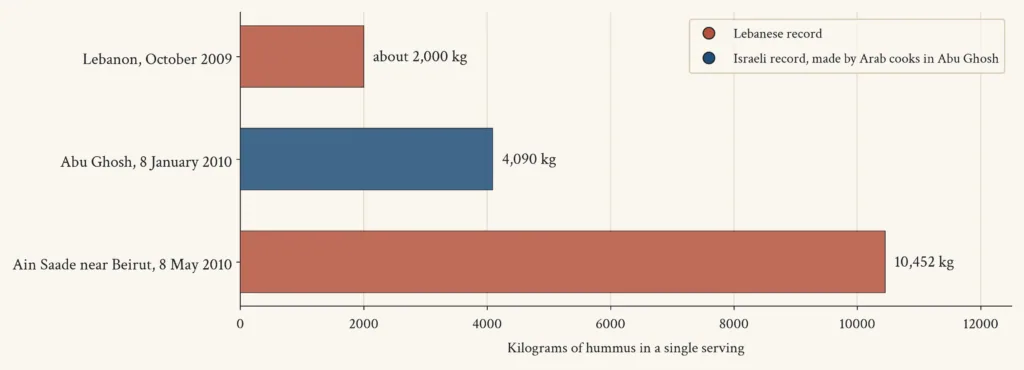
The participants themselves were not divided along simple national lines. The Israeli record was set by Arab cooks in an Arab village, under the direction of an Arab restaurateur; the AP noted that the chefs responsible were drawn from Israel’s Arab minority, about a fifth of its population[79]. Many Israelis, too, rejected the claim that hummus was Israeli. Shooky Galili, an Israeli blogger whose hummus website carried the motto “give chickpeas a chance”, told CNN that “trying to make a copyright claim over hummus is like claiming for the rights to bread or wine”, and that “hummus is a centuries old Arab dish – nobody owns it, it belongs to the region”[78]. He hoped that the rivalry would prove beneficial in the end. “If you enter any good hummus restaurant in this region, you will see Jews and Muslims, Palestinians and Israelis sitting at the same table, eating the same food”[78].
Ownership and authenticity
The historian Ari Ariel, then teaching Hebrew and Judaic studies at New York University, published the most thorough scholarly analysis of the dispute in the journal Gastronomica in 2012[24][84]. Ariel placed the hummus war in a wider context of debates about culinary nationalism, the process by which dishes shared across a region come to be claimed as the property of a particular nation. In a radio interview the same year he described his interest in how foods are “indigenized” and in what makes a dish “authentic”, and offered some deflating observations. “Migration provokes changes in foodways”, he said, and he reminded listeners, as the fourth chapter noted, that the name itself says nothing about how the dish is prepared[2]. As an American, he added, “I think in America we all understand that nothing is truly authentic”[2].
Hirsch’s work, discussed in the seventh and tenth chapters, explains why the dish had become so charged in Israel. She showed how hummus, adopted by Jewish settlers from Palestinians, was gradually “nationalized” from the late 1950s onwards, with the help of the canning industry, the army and the schools, and how its Arab identity was for a time obscured[18]. She then traced a reversal from the late 1980s onwards, in which Israeli connoisseurs came to prize hummus made by Arab cooks as the most authentic, a development she described, in the title of her article, as “the return of the repressed Arab”[18]. The Israeli hummus culture that the Lebanese industrialists regarded as an act of appropriation was thus, from within, a complex and ambivalent phenomenon, in which the Arab origins of the dish were simultaneously denied and celebrated.
Other observers took a lighter view. The scholar Liora Gvion, author of a study of Palestinian food in Israel, told the BBC that the question of origins was “an old and stupid debate that is not worth one’s attention”[1]. The film-maker Oren Rosenfeld, director of a documentary on hummus, dismissed the Lebanese records as interesting but not to be taken seriously, and offered a formula that has been widely quoted since: “Hummus is a Middle Eastern food claimed by all and owned by none”[1]. And a Haifa tour guide whom Spechler met at a Jerusalem hummus shop, who ate hummus five times a week and owned a dog named Hummus, insisted that it came from Syria, Lebanon, Israel and Palestine alike, and that what mattered was not its origin but the way it had been “co-opted and sold commercially in grocery stores in plastic containers”, which he wanted labelled as “fake hummus”[1].
What the war revealed
The hummus war ended, if it ended at all, without a winner. No court or European body awarded hummus to Lebanon, and no Israeli manufacturer changed the name of its product. The record plates were eaten or distributed, and the journalists moved on. Yet the episode revealed several things about the place of hummus in the modern world.
It showed, first, how much the dish had changed in value. A food once eaten by the poor for breakfast had become a global commodity worth, by the estimates of its promoters, a billion dollars a year, and a symbol of national identity worth fighting over in public[78][77]. It showed, second, how far the industrial forms of hummus described in the previous chapter had become the focus of national claims, for the dispute was fundamentally about labels on tubs in foreign supermarkets rather than about the bowls of hummus served in Beirut or Abu Ghosh. And it showed, third, the limits of national categories when applied to a regional food. The medieval cookbooks examined in the sixth chapter come from Baghdad, Damascus, Aleppo and Cairo; the chickpea was domesticated in what is now Turkey; tahini was pressed in Nablus, Tripoli and Damascus; and the modern hummus shop flourished in Jaffa, Beirut, Damascus and Antakya alike. Any attempt to assign the dish to a single modern nation must ignore most of this history.
The most widely shared response to the dispute among those who make hummus for a living was perhaps the one Spechler heard when she asked cooks about their secret ingredient. Across lines of nationality and religion, from Arab cooks in Jerusalem to a Maronite Christian family in Acre and young Jewish hummus makers in a Jerusalem neighbourhood, the answer was almost always the same[1]. The war of the plates was conducted in the name of nations, but the dish itself continued to be made, as it always had been, by individual cooks for the people at their tables.
12. Nourishment and trade
For most of its history the chickpea was valued as cheap, filling food, the protein of people who could not afford much meat, and the dried seed was traded in local markets rather than across oceans. Today hummus is marketed in Europe and North America as a health food, and the chickpeas from which it is made travel thousands of kilometres from the fields of Australia, Canada, India and Turkey to the factories that turn them into paste. This chapter looks at two sides of the modern chickpea: what the science of nutrition says about hummus, and how the global trade in chickpeas works.
What the nutritionists say
Hummus has a strong reputation as a healthy food, and much of that reputation is deserved. Chickpeas are rich in protein, dietary fibre and complex carbohydrates, and they supply useful amounts of folate, iron, magnesium and potassium. Tahini adds fat, largely unsaturated, together with protein, calcium and other minerals, and olive oil and lemon juice add their own nutrients. A review of the nutritional value of chickpeas and hummus published in 2016 found that consumers of chickpeas and hummus had “higher nutrient intakes of dietary fiber, polyunsaturated fatty acids, vitamin A, vitamin E, vitamin C, folate, magnesium, potassium, and iron as compared to non-consumers”, and that hummus consumers also scored higher on a standard index of diet quality[26].
The same review noted emerging evidence that chickpeas and hummus “may play a beneficial role in weight management and glucose and insulin regulation, as well as have a positive impact on some markers of cardiovascular disease”[26]. It calculated that four tablespoons of traditional hummus a day, about a hundred kilocalories, would provide roughly two cups of legumes a week, the amount recommended by the American dietary guidelines[26]. A later and more extensive review, published in 2020, concluded that “the consumption of hummus and/or its respective ingredients has been shown to improve postprandial glycemic control, fasting lipids, appetite control, and daily food intake compared to other commonly consumed foods”[85]. Among the studies it summarised was one in which an afternoon snack of hummus led healthy adults to eat about 250 kilocalories less of sugary desserts in the evening than a snack of a granola bar[85].
These reviews should be read with care. Both were supported by the hummus industry. The 2016 review was funded through an unrestricted educational grant from the Sabra Dipping Company, and two of its authors sat on Sabra’s scientific advisory board[26]. The 2020 review was supported by Sabra, one of its authors was employed by the company and another was a member of its scientific advisory board[85]. Industry funding does not mean that the findings are wrong, and both reviews summarise a substantial body of independent research. But it does mean that their emphasis on the benefits of hummus, and their recommendations to include it in the American diet, should be weighed with an awareness of who paid for them.
Independent research points in a similar direction, though with more caution. A systematic review and meta-analysis of randomised controlled trials, published in 2023, identified twelve studies involving 182 participants that compared chickpeas with foods such as wheat, potatoes, pasta and rice[86]. It found that chickpeas were more effective than potatoes and wheat in reducing the rise in blood glucose after a meal, which the authors attributed to “low starch digestibility, high fiber, protein, and hormonal effects”, while noting that the statistical significance of the benefits for insulin varied between studies[86]. The trial of intact and ruptured chickpea cells described in the ninth chapter adds a further refinement: the way hummus is made, and in particular how far its cells are broken, affects how quickly its starch is digested and how strongly the body responds[21].
Salt, fat and the tub
Not every assessment of hummus has been so warm. In 2016 the British campaign group Consensus Action on Salt and Health included hummus among a number of healthy-sounding savoury products that it described as “salt and fat traps”, and it found that a hundred grams of the dip contained on average 280 kilocalories, almost fifteen per cent of the recommended daily intake for women[76]. The criticism applied above all to supermarket hummus, which is often made with cheaper vegetable oils rather than olive oil, contains more added oil and salt than many home recipes, and is eaten in generous quantities from the tub with crisps or crackers. The press release of 2008 announcing the Sabra joint venture noted, as a selling point, that Sabra’s hummus was made with soybean and canola oils[22].
The difference between the tub and the shop is again worth stressing. A traditional bowl of hummus in the Levant is made from freshly cooked chickpeas, tahini, lemon and garlic, with olive oil poured on top at the table, and is eaten with bread, raw vegetables and pickles as a meal in itself. Its nutritional profile depends on the proportions the cook chooses, and above all on the amount of tahini and oil. Even the industry-funded reviews cautioned that the additional fat in hummus “contributes additional calories to the diet”, and that the evidence for the specific effects of hummus on health, as distinct from the effects of chickpeas and other legumes, was still limited[26][85]. Hummus is a nourishing food, rich in fibre and plant protein, but like any food it is healthiest when eaten as part of a varied diet and in sensible amounts.
A food for billions
In much of the world the chickpea is not a health food or a fashionable dip but a staple. India is by far the largest producer and consumer, and chickpeas, as chana dal, besan flour and whole cooked chana, are central to the diets of hundreds of millions of people in South Asia. A press release from the University of Vermont in 2018 noted that in India, Pakistan and Ethiopia, “1 in 5 of the world’s people depend on them as their primary source of protein”[29]. Most of the world’s chickpeas are of the small, dark desi type, eaten whole or split and milled into flour, rather than the large, pale kabuli chickpeas preferred for hummus[37][31].

The scale of production is enormous. According to FAOSTAT figures compiled by AgricultureID, India produced about 11.04 million tonnes of chickpeas in 2024, harvested from nearly 9.6 million hectares[87]. Australia came a distant second with about 2.27 million tonnes, followed by Türkiye with 575,000 tonnes, Ethiopia with about 444,000 tonnes, and Canada, Mexico, the United States and Pakistan, each with between about 200,000 and 290,000 tonnes[87]. The United States Department of Agriculture’s Foreign Agricultural Service recorded Indian production at 11.9 million tonnes in 2021, an increase of more than half since 2012[27]. Production figures from different sources and years vary, and they fluctuate considerably with the weather, but the dominance of India is clear in all of them[88].
The exporters
The pattern of trade is different from the pattern of production. India grows most of the world’s chickpeas but consumes almost all of them, and in some years it has been the largest importer as well. The great exporters are countries that grow chickpeas chiefly for sale abroad. The Foreign Agricultural Service reported in 2023 that Australia, India and Canada were the top three exporters, accounting for more than forty per cent of world exports in 2022[27].
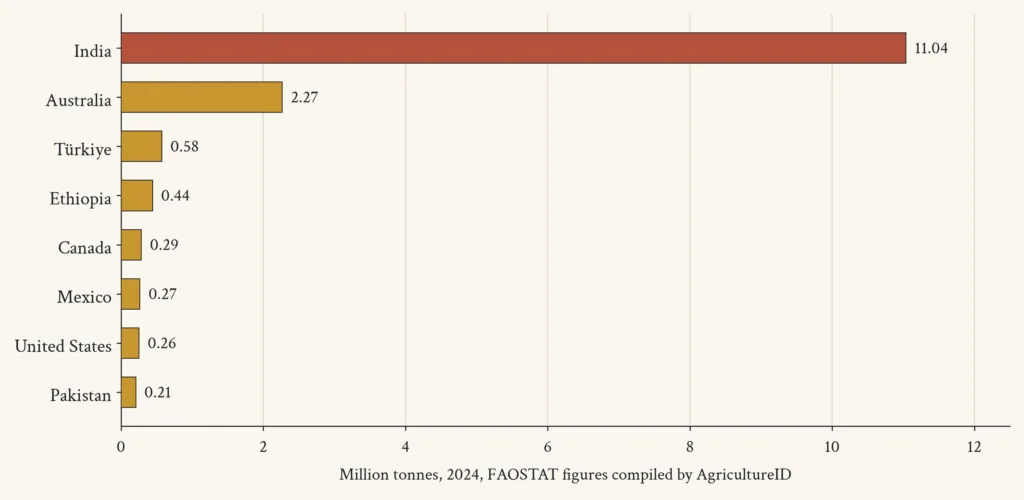
Australia is the most striking case. Chickpeas are grown there mainly in the grain belts of northern New South Wales and Queensland, often in rotation with wheat, and almost the entire crop is exported. According to the Foreign Agricultural Service, Australian production rose from 813,000 tonnes in 2012 to more than two million tonnes in 2017, when India was its largest market, taking more than $1.1 billion of chickpeas, or 62 per cent of its exports[27]. Then India imposed tariffs to limit imports, and Australian exports to India fell to less than one per cent of their former level, a blow that, in the Service’s words, “emphasized the importance of diversifying export markets”[27]. Australia has nonetheless remained the largest exporter, with about a third of global exports over the past decade, and in 2022 Bangladesh and Pakistan took nearly eighty per cent of its trade[27].
Canada is another major exporter, though its production is smaller and more variable. Chickpeas there are grown primarily in Saskatchewan, “which accounts for around 80 percent of production”, and the crop fell from 214,000 tonnes in 2020 to 76,000 tonnes in 2021 because of reduced area and poor yields[27]. Turkey, the homeland of the wild chickpea, averaged more than 520,000 tonnes a year over the decade to 2022 and more than doubled its exports, while also importing chickpeas, chiefly from Mexico and Russia[27]. The European Union, by contrast, grows few chickpeas: its production fell from 38,000 tonnes in 2012 to 3,200 tonnes in 2022, and it relies on imports, mainly from Mexico and Turkey[27].
This pattern explains some of the episodes described in earlier chapters. A Scandinavian supermarket suspected that the metallic taste of the hummus withdrawn in 2017 came from Canadian chickpeas[23], and in early 2018 the University of Vermont noted reports that the price of hummus had risen in Britain because drought in India had reduced the chickpea harvest[29]. The hummus in a British supermarket tub may be made from chickpeas grown in Saskatchewan, Queensland, Mexico or Turkey, pressed with sesame from Sudan, Ethiopia or India, and seasoned with lemons from Spain. In this respect the industrial hummus of the twenty-first century is a truly global food, whatever national claims are made for it.
Politics of the pulse
The chickpea trade is also shaped by politics. India’s tariffs, applied after 2017 to limit imports, reshaped the trade of Australia, Canada and the United States[27]. In June 2019 India imposed retaliatory tariffs on twenty-eight American products, including chickpeas, in response to American duties on steel and aluminium and the ending of India’s preferential trade status; the Foreign Agricultural Service reported that American chickpea exports to India, worth $6.4 million in 2019, came to a halt by 2022, before the tariffs on chickpeas were repealed in September 2023[27]. American production, which had risen to a high of 580,000 tonnes in 2018 on the strength of exports, fell back to 166,000 tonnes in 2022[27].
For farmers, these swings are a reminder that a crop grown mainly for export depends on decisions made far away. For the hummus industry, they mean that the price and availability of its principal ingredient can change suddenly for reasons that have nothing to do with the weather or the quality of the harvest. And for the consumers of hummus in Europe and North America, they reveal how closely their snack is connected to the food security of South Asia, where a poor harvest or a change in policy can move the price of a staple eaten by hundreds of millions of people.
The future of the chickpea
The chickpea faces serious challenges. As the second chapter explained, the domesticated chickpea passed through a severe genetic bottleneck during its domestication, and the study of wild chickpeas collected in south-eastern Turkey, led by Eric Bishop von Wettberg and published in 2018, found that more than ninety-three per cent of the genetic variation in the wild plants was missing from modern chickpea breeding programmes[7][29]. This lack of diversity, the researchers warned, threatened the ability of the crop to adapt as the conditions in which it is grown become “hotter, with a changing palette of pests, diseases, and weather patterns”[29]. A study of 429 chickpea accessions from forty-five countries, published in 2019, mapped the genetic diversity of the crop in unprecedented detail and identified genes associated with yield, drought tolerance and other traits[31].
The solution that plant scientists propose lies largely in the wild relatives. The wild chickpeas of the Anatolian hills carry genes for drought resistance, heat tolerance and resistance to insect pests, including the pod borer, which could be bred into cultivated varieties[29][32]. The Crop Trust and its partners have collected and conserved wild chickpea relatives in seed banks, and breeders have begun to cross them with domesticated lines[32][89]. A new wild species, Cicer turcicum, described from Turkey in 2021, has added to the pool of potentially useful genes[30]. Yet the wild populations are themselves vulnerable. As von Wettberg observed, they are “threatened by habitat fragmentation and loss of native landscapes”, and some of the places where his team collected seeds in 2013 had since become a war zone[29].
The chickpea also has advantages that may become more important in a warming world. As a legume it fixes its own nitrogen, reducing the need for synthetic fertilisers whose manufacture consumes large amounts of energy, and it improves the soil for the cereal crops that follow it in rotation[10]. It is relatively tolerant of drought and can be grown on residual soil moisture after the rainy season, as it has been for millennia in the dry lands of the Middle East and South Asia[89]. And as a source of plant protein it offers an alternative to meat, whose production makes heavy demands on land, water and the climate. The rising popularity of hummus in the West is one small part of a broader shift towards plant-based diets, in which the chickpea, one of the oldest of all crops, may play a growing role.
13. Return to the long table
We began at a table, with a bowl of hummus set down among the plates of a family dinner, and it is to the table that we return. Between that first bowl and this one, the essay has travelled a long way: to the limestone hills of south-eastern Turkey where the wild chickpea still grows, to the Neolithic villages of the Fertile Crescent, to the epics of Homer and the encyclopaedia of Pliny, to the stone mills where sesame was crushed into tahini, to the kitchens of the caliphs and the sultans, to the morning hummus shops of Damascus, Jaffa and Antakya, to the laboratories where food scientists measure the behaviour of oil droplets, to the factories off the A40 and the fields of Saskatchewan, and to the giant plates of the hummus war. It is worth asking, at the end, what this long journey tells us about the bowl on the table.
What we know
Some things are now reasonably clear. The chickpea was domesticated in the northern Fertile Crescent, in the region of south-eastern Turkey where its wild ancestor still grows, some ten thousand years ago, and it spread with the first farmers across the Near East and the Mediterranean and eastwards to India[6][33][7]. It was valued by the Greeks and Romans, who knew it as erebinthos and cicer, and by farmers in dry lands everywhere for its ability to feed the soil as well as the people[8][9][10]. Sesame, domesticated in South Asia, reached the Levant by the Bronze Age, and its oil and paste were familiar in the region long before the first written recipes[52][14].
The medieval Arabic cookbooks of Baghdad, Aleppo, Damascus and Cairo contain many recipes for chickpeas, including purées seasoned with vinegar, herbs, spices, nuts and, in at least one fourteenth-century Egyptian collection, tahini, which are the closest known written ancestors of the modern dish[16][44][17]. The hummus bi-tahina of the modern Levant, smooth, whipped and dressed with lemon and garlic, was a dish of the towns and their specialist shops, which seems to have taken its familiar form in the cities of Ottoman Syria and Palestine, perhaps by the eighteenth or nineteenth century, though the evidence for its exact history remains thin[1][18]. In the twentieth century it was adopted and industrialised in Israel, carried around the world by migrants, popularised by writers such as Claudia Roden, and transformed into a mass-market product in the supermarkets of Europe and North America[18][50][22].
What we do not know
Much remains uncertain. We do not know who first combined puréed chickpeas with tahini, lemon and garlic, or where, or when. The medieval cookbooks record the dishes of wealthy households, not the everyday food of the poor, and the gap of several centuries between the last of them and the first modern descriptions of hummus shops is largely empty of evidence. The claims that hummus is mentioned in the Bible, or that it belongs by right to one modern nation rather than another rest on misreadings, legends or politics rather than on historical evidence[46][1]. As Charles Perry remarked to the BBC, “Nobody can say who invented hummus, or when. Or where, particularly given the eagerness with which people in the Middle East borrow one another’s dishes”[1].
This uncertainty is not a failure of research but a feature of the history of food. Everyday dishes rarely leave records of their invention. They emerge gradually from the practices of many cooks, are refined and varied in many kitchens, and acquire their names and their fixed forms long after their origins have been forgotten. Hummus is typical in this respect. What we can trace with some confidence is the history of its ingredients, of the techniques used to prepare them, and of the meanings that people have attached to the dish in particular times and places. The history of hummus is less a story of invention than a story of accumulation, in which each age has added something to the bowl.
A dish for sharing
One thing that emerges clearly from this history is that hummus has almost always been a food for sharing. The medieval cookbooks prescribe chickpea purées for the tables of the wealthy, where they were served among many other dishes for guests to sample[17][15]. In the hummus shops of the Levant, strangers sit side by side at long tables, each with a bowl of hummus, a basket of bread and a plate of onions and pickles, and share salt, oil and conversation[18][63]. On the Lebanese meze table, hummus is one of many small dishes set in the middle for everyone to reach. And in the family dinner with which this essay began, the bowl sits at the centre, where every hand can reach it with a piece of bread.
This communal character is built into the way hummus is eaten. A bowl of hummus is not divided into portions but shared from a single dish, and the bread that scoops it serves as plate, spoon and fork together. To eat hummus in the traditional way is to eat with others, from the same bowl, and the gestures of sharing, passing the bread, tearing a piece for a child, pushing the bowl towards a guest, are part of the meal. The Israeli blogger Shooky Galili had this in mind when he hoped that the hummus restaurants of the region, where “Jews and Muslims, Palestinians and Israelis” sit at the same table eating the same food, might show that the people of the Middle East have more in common than divides them[78].
The table and its guests
It would be naive to pretend that a dish can resolve conflicts that have resisted generations of diplomacy. The hummus war showed how readily a shared food can become a marker of division, and the history of hummus in Israel and Palestine is inseparable from the history of the land and its peoples[18][24]. The cooks of Jaffa and Jerusalem, Beirut and Damascus, Antakya and Gaziantep have lived through wars, displacement and economic hardship, and the hummus shops that fed their cities have been destroyed as well as built. The earthquake that struck southern Turkey and northern Syria in February 2023 devastated Antakya, including the old commercial streets where its hummus makers had worked for generations, and many of its cooks have had to rebuild their trade in temporary premises and new neighbourhoods.
Yet the persistence of the dish through all of this is itself remarkable. Wherever the cooks of the region have gone, to Istanbul or Berlin, London or Detroit, they have taken hummus with them, and they have continued to make it for their families and their guests. Erol İğde, writing about the hummus makers of Antakya, remembered with longing the shops of his childhood and the taste of a plate of hummus eaten fresh and warm with flatbread, and he described hummus not as a meze but as a meal and a part of daily life[4]. Claudia Roden remembered how the exiled Jews of Egypt exchanged recipes as tokens of remembrance[74]. In both cases, the dish carried memories of a place and of the people who had shared it.
Reading a bowl
The history traced in this essay also offers a way of looking more closely at any particular bowl of hummus. Its texture says something about the cook’s methods: a slightly rough paste suggests chickpeas crushed by hand or briefly blended, as in the copper bowls of Tarsus, while a silky, almost whipped purée speaks of peeled chickpeas and long blending, the style of the Beirut restaurant and the modern Antakya kitchen[3][4]. Its temperature says something about its place in the day: a warm bowl is a breakfast or a lunch from a specialist shop, a cool one an appetiser on the meze table or a dip from the refrigerator. Its colour, pale or beige, depends on the proportion of tahini, on the fineness of the emulsion and on whether the sesame was lightly or darkly roasted[56].
Its toppings, too, tell a story of place. Whole chickpeas and a pool of olive oil are almost universal. Fūl, the stewed faba beans, point towards Egypt, Jerusalem and the morning shops of the Levant; pine nuts fried in butter or ghee and morsels of lamb recall the richer dishes of Damascus and Beirut; pine nuts or pastırma fried in butter mark the hummus of Antakya, and oil heated with red pepper flakes the hot hummus of Tarsus[3]; a fierce green chilli paste suggests the Yemenite Jewish cooking of Tel Aviv[63][4]. And the way it is served, in a shallow clay dish with a raised rim, swirled so that the paste mounds up against the edge, is itself, as Charles Perry argued, a sign of a refined urban dish rather than an ancient folk food[1]. A bowl of hummus, read with attention, is a small map of the region and its history.
The last bowl
Imagine, then, the table once more. It is evening, and the family has gathered: grandparents, parents, children, perhaps a neighbour or two. The bowls of hummus have been set out, swirled with the back of a spoon so that the oil gathers in the hollows, sprinkled with paprika and cumin and a few whole chickpeas. There is bread, warm and soft; there are olives, pickles, a salad of tomatoes and cucumbers, a plate of lemon wedges, perhaps falafel or grilled meat. Someone tears a piece of bread and draws it through the nearest bowl; someone else reaches across to the bowl at the far end; a child is shown how to fold the bread into a scoop. The conversation turns to the day’s news, to the family’s plans, to stories of other meals at other tables.
Nothing in this scene requires a knowledge of the domestication of the chickpea, the chemistry of the tahini emulsion or the history of the medieval cookbooks. But all of these lie behind it. The chickpeas in the bowl are the descendants of a wild plant that grew on the hills of Anatolia ten thousand years ago; the tahini comes from a seed that reached the Levant from South Asia in the Bronze Age; the method of making the paste was refined over centuries by cooks in palaces, shops and homes; and the dish itself has travelled around the world, been canned and tubbed and fought over, and returned to the table unchanged in its essentials. A bowl of hummus is a small thing, but it holds a very long history, and it is at its best, as it always has been, when it is shared.
References
- Diana Spechler, Who invented hummus, BBC Travel (12 December 2017) *
- Heritage Radio Network, A Taste of the Past, Hummus Wars, with Ari Ariel (2012) *
- Republic of Türkiye Ministry of Culture and Tourism, Kültür Portalı, Tarsus Humusu, geographical indication 226 *
- Erol İğde, Humus sevdası, Antakya Gastronomi Derneği *
- Kareem Shaheen, The true origins of hummus, New Lines Magazine (24 March 2023) *
- Zohar Kerem, Simcha Lev-Yadun, Avi Gopher, Pnina Weinberg and Shahal Abbo, Chickpea domestication in the Neolithic Levant through the nutritional perspective, Journal of Archaeological Science 34 (2007), 1289 to 1293 *
- Eric J. B. von Wettberg and others, Ecology and genomics of an important crop wild relative as a prelude to agricultural innovation, Nature Communications 9 (2018), article 649 *
- Homer, Iliad, book 13, translated by A. T. Murray, Perseus Digital Library, Tufts University *
- Pliny the Elder, Natural History, book 18, chapter 32, The several kinds of chick-pease, translated by John Bostock and H. T. Riley, Perseus Digital Library *
- ICRISAT Open Access Repository, Symbiotic nitrogen fixation by chickpea in West Asia, North Africa and the semi-arid tropics *
- Marcus Jastrow, Dictionary of the Targumim, the Talmud Babli and Yerushalmi, entry ḥimṣa, Sefaria *
- Ruth 2.14, Sefaria *
- Dorothea Bedigian and Jack R. Harlan, Evidence for cultivation of sesame in the ancient world, Economic Botany 40 (1986), 137 to 154 *
- Ashley Scott, Philipp W. Stockhammer and others, Exotic foods reveal contact between South Asia and the Near East during the second millennium BCE, Proceedings of the National Academy of Sciences 118 (2021) *
- Nawal Nasrallah, Annals of the Caliphs’ Kitchens, Ibn Sayyār al-Warrāq’s tenth-century Baghdadi cookbook, Brill (2007) *
- Nawal Nasrallah, Treasure Trove of Benefits and Variety at the Table, a fourteenth-century Egyptian cookbook, Brill (2017) *
- Charles Perry, editor and translator, Scents and Flavors, a Syrian cookbook, Library of Arabic Literature, NYU Press (2017) *
- Dafna Hirsch, Hummus is best when it is fresh and made by Arabs, the gourmetization of hummus in Israel and the return of the repressed Arab, American Ethnologist 38 (2011), 617 to 630 *
- National Geographic, Exploring the flavours of Sifnos, Greece’s gourmet island *
- Composition and properties of aquafaba, water recovered from commercially canned chickpeas, PubMed Central (2018) *
- Impact of chickpea hummus on postprandial blood glucose, insulin and gut hormones in healthy humans combined with mechanistic studies of food structure, rheology and digestion kinetics, Food Research International (2024) *
- PepsiCo, PepsiCo and Strauss Group complete formation of North American joint venture (31 March 2008) *
- The Guardian, Hummus crisis sheds light on secret world of mass food production (29 April 2017) *
- Ari Ariel, The Hummus Wars, Gastronomica 12, no. 1 (2012), 34 to 42 *
- Guinness World Records, Largest serving of hummus *
- Taylor C. Wallace, Robert Murray and Kathleen M. Zelman, The nutritional value and health benefits of chickpeas and hummus, Nutrients 8 (2016), 766 *
- USDA Foreign Agricultural Service, Spotlight, global chickpea exports rise (23 October 2023) *
- Eric von Wettberg, Behind the scenes, the hunt for wild chickpeas, Springer Nature Research Communities (2018) *
- University of Vermont, Genetic limits threaten chickpeas, a globally critical food *
- Cengiz Toker, Jens Berger and others, Cicer turcicum, a new Cicer species and its potential to improve chickpea, Frontiers in Plant Science 12 (2021) *
- Rajeev K. Varshney and others, Resequencing of 429 chickpea accessions from 45 countries provides insights into genome diversity, domestication and agronomic traits, Nature Genetics 51 (2019), 857 to 864 *
- Crop Trust, Crop Wild Relatives project, chickpea *
- Ken-ichi Tanno and George Willcox, The origins of cultivation of Cicer arietinum and Vicia faba, early finds from Tell el-Kerkh, north-west Syria, Vegetation History and Archaeobotany 15 (2006), 197 to 204 *
- Abraham Gopher, Tel Aviv University profile, listing Abbo, Shtienberg, Lichtenzveig, Lev-Yadun and Gopher, The chickpea, summer cropping, and a new model for pulse domestication in the ancient Near East, Quarterly Review of Biology 78 (2003) *
- Tel Aviv University research portal, abstract of Kerem and others, Chickpea domestication in the Neolithic Levant (2007) *
- CGIAR Genebanks, Chickpea crop profile *
- ICRISAT Open Access Repository, The anatomical structure of desi and kabuli chickpea seed coats *
- Pliny the Elder, Naturalis Historia, liber 18, Latin text, Perseus Digital Library *
- Plutarch, Life of Cicero, chapter 1, translated by Bernadotte Perrin, Perseus Digital Library *
- Plutarch, Life of Cicero, Loeb Classical Library translation, LacusCurtius, University of Chicago *
- Horace, Satires, book 2, satire 3, Latin text, Perseus Digital Library *
- Galen, On the Properties of Foodstuffs, introduction, translation and commentary by Owen Powell, Cambridge University Press (2003) *
- ICARDA, Kabuli chickpea, climate-smart crops *
- Max Miller, Tasting History, Hummus kassa, quoting the Kanz al-fawāʾid in the translation of Nawal Nasrallah *
- Babylonian Talmud, Yevamot 63a, William Davidson edition, Sefaria *
- Ernest Klein, A Comprehensive Etymological Dictionary of the Hebrew Language, entry ḥimṣa, Sefaria *
- David Curwin, Balashon, Hebrew language detective, chametz *
- eKathimerini, Original Sifnos chickpea stew, revithada, in a clay pot *
- Penguin Books, Claudia Roden, A New Book of Middle Eastern Food *
- ABC News Australia, Claudia Roden on how her Book of Middle Eastern Food changed the way we eat (10 June 2018) *
- Dorian Q. Fuller, Further evidence on the prehistory of sesame, Asian Agri-History 7 (2003), record in the FAO AGRIS database *
- Dorothea Bedigian, History and lore of sesame in Southwest Asia, Economic Botany 58 (2004), 330 to 353 *
- Dorothea Bedigian, editor, Sesame, the genus Sesamum, CRC Press (2010) *
- Ludwig Maximilian University of Munich, Archaeology, the aroma of distant worlds (2020) *
- Harvard Gazette, Ancient tooth tartar provides glimpse into early trade and menu items (2021) *
- The influence of particle size distribution on sunflower tahini rheology and structure, Journal of Food Process Engineering (2014) *
- Muḥammad ibn al-Ḥasan al-Baghdādī, A Baghdad Cookery Book, translated by Charles Perry, Prospect Books (2005) *
- Maxime Rodinson, A. J. Arberry and Charles Perry, Medieval Arab Cookery, Prospect Books *
- Charles Perry, Kitāb al-Ṭibākha, a fifteenth-century cookbook, Petits Propos Culinaires 21 (1985) *
- Eat Like a Sultan, Medieval Arab food bibliography *
- Charles Perry, Scents and Flavors, a Syrian cookbook, Project MUSE *
- Royal Asiatic Society, A treasure trove of Egyptian cookery, report of a lecture by Nawal Nasrallah (2019) *
- BBC Travel, Hunting for hummus in Israel (2012) *
- Open University of Israel research portal, Dafna Hirsch, Hummus is best when it is fresh and made by Arabs (2011) *
- Cairo Gossip, Warm up with classic Egyptian winter foods *
- Anadolu Ajansı, Doğu Akdeniz’in paylaşılamayan lezzeti, humus (2018) *
- Visit Greece, The gastronomy of Sifnos *
- Characterization of nutritional and functional properties of Blanco Sinaloa chickpea, and study of the rheological behavior of hummus pastes, Journal of Food Science and Technology (2019), PubMed Central *
- Influence of pretreatment on cooking quality parameters of dry food legumes, Journal of the Science of Food and Agriculture 44 (1988) *
- Effect of location and soaking treatments on the cooking quality of some chickpea breeding lines, International Journal of Food Science and Technology (2003) *
- Characterization of commercial Spanish hummus formulation, nutritional composition, rheology, and structure, International Journal of Food Properties 20 (2017) *
- Composition, characterisation and emulsifying properties of natural nanoparticles in chickpea aquafaba, Food Hydrocolloids (2024) *
- Lydia Dishman, Dip into innovation, how Sabra’s CEO is going to put hummus in every US fridge, Fast Company (26 November 2012) *
- Epicurious, How one food writer put hummus in every supermarket *
- The Guardian, UK hummus supplier extends product recall over salmonella scare (4 November 2019) *
- The Guardian, Hummus shortages after shops remove dip from sale over taste issues (25 April 2017) *
- Foreign Policy, Who owns hummus (8 October 2008) *
- CNN, Lebanon claims latest title in Hummus War (9 May 2010) *
- Associated Press via CNBC, Israeli chefs take hummus world record (8 January 2010) *
- ABC News Australia, Lebanon revives humungous hummus battle (9 May 2010) *
- BBC Arabic, al-ḥummuṣ wa-l-tabbūla li-man, who do hummus and tabbouleh belong to (24 September 2009) *
- Voice of America, Lebanon hummus platter wins Guinness World Record (2010) *
- Los Angeles Times, Lebanon, chefs snatch back hummus title from Israel, win falafel record (10 May 2010) *
- Gastronomica, Spring 2012, volume 12, number 1, contents *
- Erin J. Reister, Leah N. Belote and Holly J. Leidy, The benefits of including hummus and hummus ingredients into the American diet to promote diet quality and health, a comprehensive review, Nutrients 12 (2020), 3678 *
- Effectiveness of chickpeas on blood sugar, a systematic review and meta-analysis of randomized controlled trials, PubMed Central *
- AgricultureID, Chickpeas production, trade and price statistics, compiled from FAOSTAT *
- FAO, FAOSTAT crop production, yield, harvested area and processed, data catalogue *
- Crop Trust, Knowledge hub, chickpea *