Tel Aviv, the Hill of Spring
1. A new city beside an old one
Tel Aviv is usually described as a new city, and in one sense the description is exact. Its founders could name the day on which it began: 11 April 1909, when the members of a Jewish housing society gathered on the dunes north of Jaffa and divided their land by lot. The city has kept that date as its birthday ever since, and within forty years the suburb laid out that afternoon had become a city of some 210,000 people, the undisputed centre of Jewish life in Palestine and the place where the State of Israel was proclaimed.[1][2]
In another sense the description is misleading. Tel Aviv did not rise from an empty coast. It was born beside Jaffa, one of the oldest ports of the eastern Mediterranean, and it began as one of that town’s neighbourhoods, separating from it only gradually. Its first residents were Jewish householders of Jaffa, its land had been bought from Arab owners on the dunes north of the town, and its people continued for years to work, trade and shop in the older port. The city’s self-image as a Hebrew town created from the sand has therefore always coexisted with a more entangled history of two communities, two economies and, after 1948, a single municipality that absorbed the older town.[3][4][5]
This essay follows that history from the late Ottoman period to the present. It treats the founding in detail: the Jewish suburbs that preceded Tel Aviv, the Ahuzat Bayit society and its land, the lottery of 1909 and the naming of the town in 1910. It then traces the growth of the township under the British Mandate, the planning of Patrick Geddes and the modernist architecture later known as the White City, the institutions of municipal and civic life, the war of 1948 and the union with Jaffa, and the later changes brought by immigration, political violence and protest. Where historians disagree, particularly over the relationship between Tel Aviv and Jaffa and over the events of 1948, the disagreement is stated rather than resolved by assertion.
A note on names is necessary at the outset. The town appears in the sources first as Ahuzat Bayit, then as Tel Aviv, and since 1950 officially as Tel Aviv–Yafo. Jaffa is the English form of Arabic Yafa and Hebrew Yafo. The Arabic quarter immediately north of old Jaffa, which bordered Tel Aviv along the shore, is rendered here as Manshiyya, and the Arab village whose lands later carried Tel Aviv University as al-Shaykh Muwannis. These are conventional transliterations rather than claims about which name is correct.
2. Jaffa before Tel Aviv
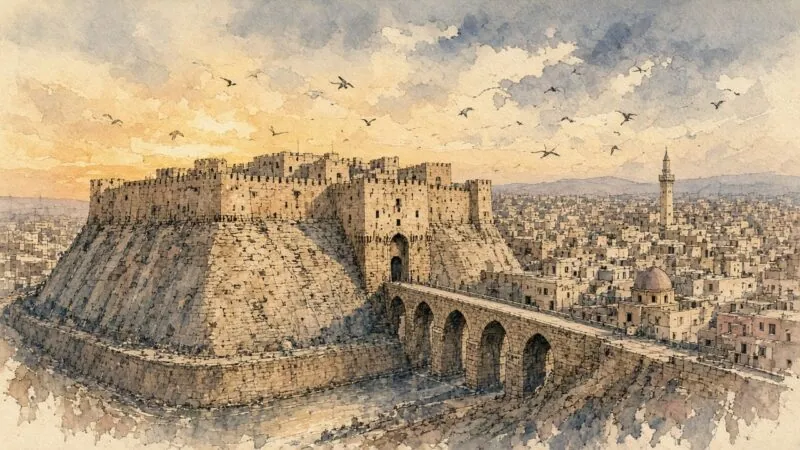
In the middle of the nineteenth century Jaffa was a small town on a sandstone hill above an exposed anchorage. After the Ottoman reconquest of 1840–41 and the administrative reforms of the Tanzimat, it expanded well beyond its old walls. It became the principal sea gate of southern Palestine: the first railway in the region, from Jaffa to Jerusalem, opened in 1892, and the citrus groves of the hinterland made the town the export centre for a fruit that took its name. Its harbour remained notoriously difficult, and as late as 1938 a member of the House of Commons could repeat, as something he had been told, that Jaffa was listed at Lloyd’s as “the worst port in the world”.[3][6]
The Jaffa orange, the thick-skinned Shamouti variety, arose before 1844 as a bud mutation in a local grove and was propagated by Arab farmers. Its rind protected it on long voyages, and under the Mandate the combined efforts of Arab growers, Jewish settlers and European marketers made it the great majority of Palestine’s citrus exports.[7]
Jaffa also grew as a social and political centre, and new quarters spread north and south along the coast and east into the groves. To the north-east a group of German Templers, members of a Protestant millenarian society from Württemberg, founded the agricultural colony of Sarona in 1871, a small European settlement that would later lie inside Tel Aviv and become, after 1948, the core of the government and military compound known as the Kirya.[8][9] The town’s Arab merchants and professionals sustained a public life of their own: the newspaper Filastin, founded in Jaffa in 1911 by the cousins ʿIsa al-ʿIsa and Yusuf al-ʿIsa, became one of the most important Arabic papers in the country and, within a few years, a persistent critic of Zionist settlement.[10][4]
The Jewish community of Jaffa grew with the port. After the start of the First Aliyah in 1882, the wave of immigration from Eastern Europe that founded the early agricultural colonies, the town became the main point of entry for Jewish immigrants and the place where many of them stayed. The Jewish population is estimated to have grown fivefold or more in a few years, to about six thousand, and its growth produced a demand for new housing outside the old town.[1]
Mark LeVine’s study of the two towns argues that the contrast between a backward Jaffa and a modern Tel Aviv, long familiar in Zionist writing, was part of the way the new town defined itself, and that it obscured both the ties between them and the modernising ambitions of Jaffa itself.[4]
3. Neve Tzedek and the first suburbs
The first Jewish building outside Jaffa took place not on the northern dunes but on the slope immediately north-east of the old town. Neve Tzedek, whose name may be rendered “abode of justice”, is usually dated to 1887, when forty-eight families, among them those of Aharon Chelouche and Shimon Rokach, began to build there on land bought from Arab owners; the UNESCO nomination for the White City gives a later date of 1896, a discrepancy that the sources consulted here do not explain. Its houses were of sandstone, generally of two storeys with tiled roofs, set along narrow lanes on a hill sloping towards the sea.[11][12]
Neve Shalom followed next to it before the end of the century, and several other small Jewish quarters were added before the Second Aliyah began in 1904.[1] These were private developments rather than planned towns, and they allowed Jewish families to live outside the crowded old town while remaining dependent on Jaffa for work and services. Neve Tzedek’s founders were predominantly Mizrahi and Sephardi Jews, and the quarter adjoined the Arab district of Manshiyya along the shore.[11][13]
The UNESCO nomination treats Neve Tzedek as the first nucleus of the later city, and in architectural terms the description is fair. The lanes of Neve Tzedek, however, embodied a different idea of urban life from the one the founders of Ahuzat Bayit set out to realise. They were extensions of Jaffa. The next project was conceived as something more deliberate: a modern garden suburb with wide streets, public utilities and its own rules, designed from the outset as a Jewish and Hebrew-speaking place.[12][14]
The pressure that produced it came from immigration. The Second Aliyah, the wave of some thirty-five to forty thousand immigrants who arrived between 1904 and 1914, is best remembered for its socialist pioneers and the first collective farms, but a substantial part of it settled in Jaffa. The new wave, in the yearbook account, exacerbated the housing shortage, and it was among the established Jewish householders of Jaffa that the idea of a new quarter took shape.[15][1][16]
4. The Ahuzat Bayit society
The society that founded Tel Aviv was created in Jaffa in 1906. It began as a homebuilders’ association of middle-class Jewish residents and soon took the name Ahuzat Bayit, usually translated as “homestead”. A report published for the city’s twenty-fifth anniversary in 1934 names among the early initiators Meir Dizengoff, Akiva Aryeh Weiss, Yehezkel Danin and David Smilansky, and explains the motive in plainly economic terms: rents in Jaffa were rising with Jewish immigration, and a residential quarter of their own seemed to the founders an economic advantage as well as a national one.[1][16][14]
The founders were not pioneers in the sense that the word acquired in the labour movement. The 1934 account describes them as businessmen, teachers and others living in Jaffa, and their aim was a garden suburb on the dunes within easy distance of the sea.[16] Dizengoff, born in Bessarabia in 1861, had been active in the Hovevei Zion movement in Odessa and Kishinev, had first come to Palestine in 1892 to manage a short-lived glass factory under the auspices of Baron Edmond de Rothschild, and after co-founding the Geulah land-purchase company in 1904 had settled permanently in Jaffa in 1905. His background was typical of the Russian-Jewish professional milieu from which many of the founders came, and which is described more fully in the Nekud essay on the Jews of Odessa.[17]
The decisive problem was money. The society applied to the Jewish National Fund, the Zionist land-purchase agency, for a loan, and the contemporary report of 1934 gives its size as 300,000 francs, repayable over eighteen years at four per cent. The loan was not unconditional. In September 1907 Arthur Ruppin, one of the principal architects of Zionist settlement policy, wrote to the Fund’s directors in Cologne warning that the members’ wish to use every square metre of their land might leave the suburb without sufficient green space and public buildings, and he proposed that the loan contract require the building plan to be submitted for approval. In February 1909 he reported that building permits and title documents had been obtained and that the plan, still under revision, would be ready by March.[16][18]
The land itself lay on the dunes north-east of Jaffa and was bought from Arab owners. Foreign Jews had been barred by the Ottoman authorities from buying land since 1893, and Zionist purchases of the period commonly relied on Ottoman-subject Jews buying on others’ behalf or on other forms of nominal ownership.[15] The sources differ on the area of the original purchase. A later Israeli yearbook speaks of about five hectares divided into sixty plots, whereas the anniversary report of 1934 gives a figure of 140 dunams, about fourteen hectares, which may include land acquired for later expansion. The difference is a reminder that even the founding facts of the city have been transmitted through accounts written for different purposes.[1][16]
5. The lottery of April 1909
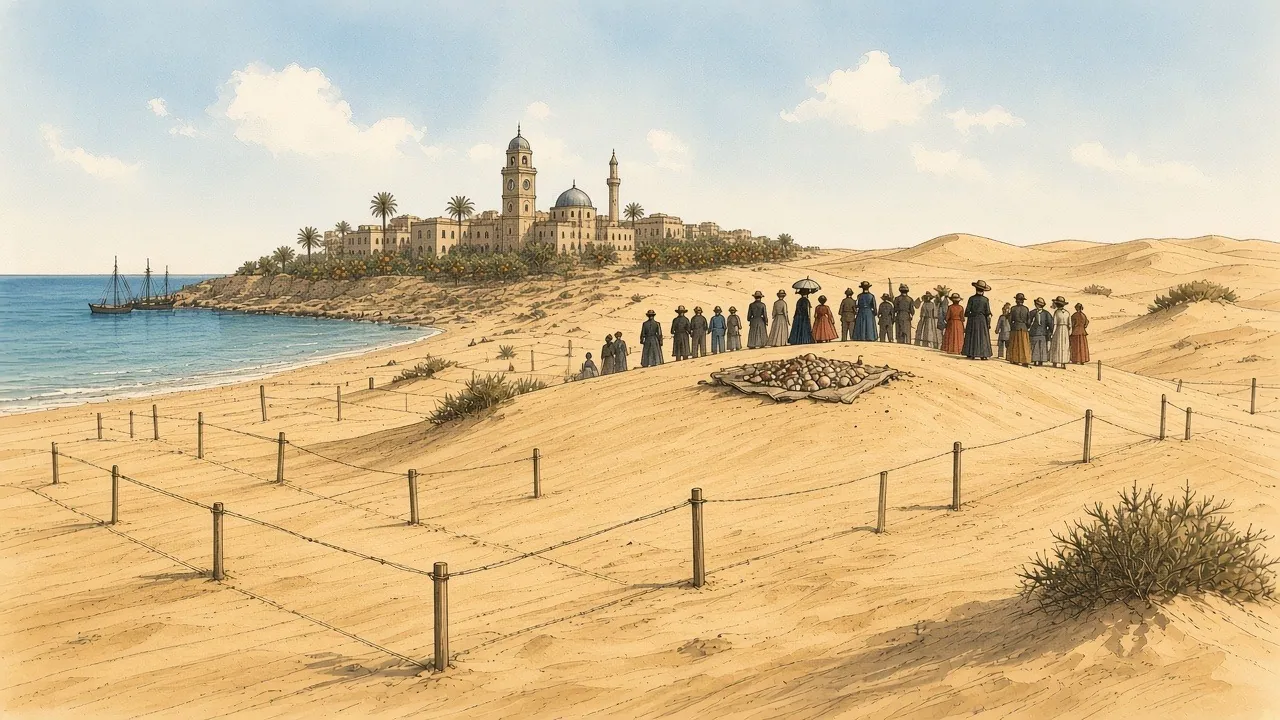
On 11 April 1909 the members of the society gathered on the dunes to divide their land. The account preserved in the Israeli yearbook literature describes a picnic at the site and a lottery to apportion the plots. Later tradition supplies the detail that the lots were drawn with seashells, one set marked with the names of the families and another with the numbers of the plots.[1][19]
There were sixty plots and sixty-six families. The discrepancy was resolved, according to the same yearbook account, by subdividing six of the plots. The future mayor drew plot number 43, on what became Rothschild Boulevard; the house built on it for Meir and Zina Dizengoff would later become the city’s first art museum and the hall in which the State of Israel was declared.[1][2]
The date has been observed as the city’s birthday ever since, and the scene became one of the founding images of the city’s story: a town created by lot on open sand, by private citizens and without a sovereign. Maoz Azaryahu’s study of the myths that have shaped the city’s identity follows the story of a place that grew, in the familiar telling, from a sand dune into a metropolis.[20] The image of emptiness is, however, an interpretation. The land had owners, from whom it had been bought; Jaffa lay a short walk away; and the society’s members were Jaffa residents who would continue to rely on the older town. Mark LeVine’s history makes this point at length, arguing that the narrative of a city rising from the sands served to separate Tel Aviv conceptually from the Arab region in which it grew.[4][1]
The houses themselves were built quickly. The streets had been laid out with the plots, building began soon afterwards, and a year later, according to the anniversary account of 1934, there were some sixty houses and about three hundred inhabitants. The first public building was the new home of the Herzliya Hebrew Gymnasium, founded in Jaffa in 1905 as the first secondary school to teach entirely in Hebrew. Its cornerstone was laid in the summer of 1909 at the head of the main street, which the founders had already named after Theodor Herzl.[16][14][21]
6. Naming the suburb
The suburb did not long remain Ahuzat Bayit. The founders wanted a name that would express a national purpose, and in May 1910 a general meeting of the residents voted on a list of proposals. According to the protocol published by Alter Droyanov in his documentary Book of Tel Aviv of 1936, as cited by Azaryahu, the name Tel Aviv received twenty votes, Neve Yafo (“Jaffa Haven”) fifteen and Herzliya six; New Jaffa had also been considered. Both Azaryahu, citing the protocol, and the yearbook account date the meeting to 21 May 1910.[14][1]
The chosen name came from Nahum Sokolow, who had used it as the Hebrew title of his translation of Herzl’s utopian novel Altneuland; the translation appeared in 1902, the same year as the German original. Tel Aviv also appears in the book of Ezekiel as the name of a place by the river Chebar in Babylonia where the exiled prophet came among the captives. In Hebrew a tel is a mound formed by the ruins of earlier settlements, and aviv means spring; Sokolow’s title thus rendered Herzl’s “old-new” in two words, the ancient mound and the new season.[1][22][5]
The founders’ own explanation linked the name directly to Herzl. In the words of the committee quoted by Azaryahu, “with this name our leader Herzl expressed the hope of our future in the Land of Israel: A tell where the buds of spring blossom.” In the debate Menachem Sheinkin pointed out the connection with Altneuland, and the name Herzliya was set aside because it was not a Hebrew word and had already been given to the Gymnasium; it was used in 1924 for a new settlement to the north. The memory of Herzl was nevertheless inscribed throughout the suburb: its main street had already been named after him in January 1909, and in February 1910 the general assembly of residents deliberated on names for the other five streets.[14]
Herzl himself never visited Tel Aviv, which was founded five years after his death. Azaryahu’s study of his commemoration shows how the town nevertheless made him its patron, and how from the early 1920s Tel Aviv was celebrated as “the first Hebrew city”, a phrase that expressed both civic pride and an ideological programme. Hebrew was to be the language of its school and its public life, and the town’s identity was defined less by any single institution than by the claim that here, for the first time, Jews were building a city of their own in their own language. The wider history of that language revival is the subject of the Nekud essay on the emergence of Modern Hebrew.[14][23]
7. A Hebrew suburb, 1910–1914
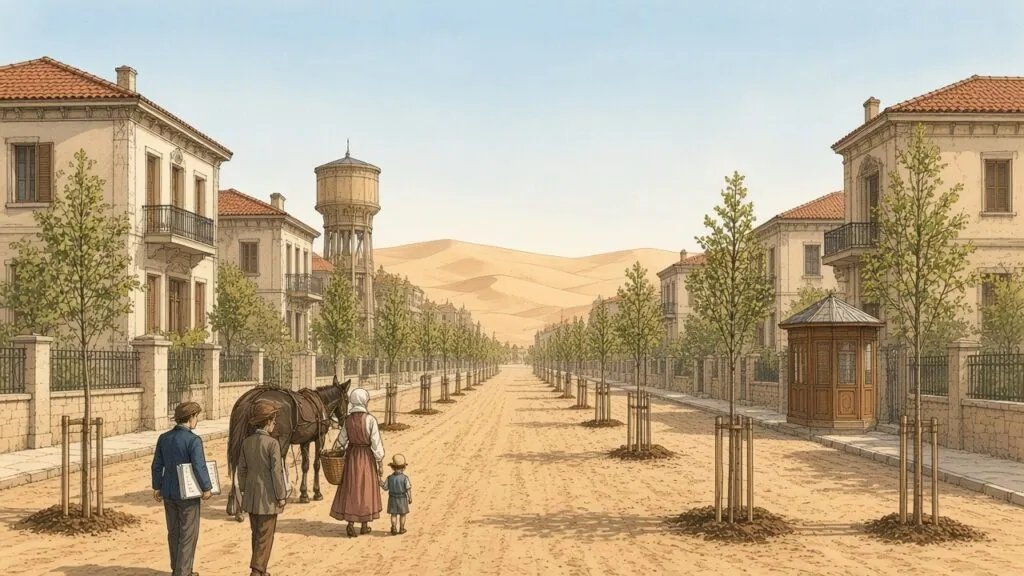
For its first five years Tel Aviv remained a small residential suburb. The anniversary account of 1934 records about a hundred houses and a thousand inhabitants in 1913, and some 140 houses and 1,500 residents when war broke out in 1914; the yearbook account gives the higher figure of about two thousand people by 1914, by which time the built-up area, enlarged by neighbouring Jewish quarters and new purchases, extended over more than a hundred hectares.[16][1] The differences are modest, but the surviving accounts do not agree exactly.
The suburb’s character was set by its houses, its school and its street plan. The Gymnasium building, designed by the architect Joseph Barsky with a façade whose motifs alluded to the ancient Temple, was completed for the school year of 1910 and closed the vista at the end of Herzl Street. The cross street that became Rothschild Boulevard had first been planned as Rehov HaAm, the “Street of the People”, and was renamed in 1910 after Baron Edmond de Rothschild. A photograph from the Jewish National Fund archive shows the suburb’s first kiosk and first street lamp at the corner of Herzl Street and the boulevard in the same year.[21][24][18]
Ruppin’s concern for green space and public buildings anticipated a long argument about what kind of place the suburb should be.[18] Anat Helman’s history of the Mandate-era city describes Tel Aviv as a form of practical Zionism quite distinct from the agricultural settlements and organised labour usually associated with the movement: urban, middle-class and created largely through informal daily practices of consumption, leisure and sociability.[23]
That dependence was also political. Tel Aviv had no legal identity of its own under Ottoman law. Its residents’ committee, headed from 1911 by Dizengoff, managed the suburb’s internal affairs, but authority over land, taxation and security lay with the Ottoman administration of the district of Jaffa. The suburb was thus a private Jewish neighbourhood within an Ottoman Arab town, and the distinction between it and the town was social and linguistic before it was administrative.[17][4]
8. War and expulsion, 1914–1918
The First World War brought the suburb close to extinction. The Ottoman Empire entered the war in November 1914, and Ahmed Djemal Pasha, commander of the Fourth Army and governor of Syria and Palestine, treated the Zionist community with growing suspicion, the more so as some Jews served with British forces and, from 1915, the NILI network gathered intelligence for them. Foreign nationals and others regarded as potential security risks were expelled from strategic areas, and the extension of military service to non-Muslims drew Jewish men into labour battalions.[25]
At the end of March 1917, as British forces advanced from Sinai, the Ottoman authorities ordered the evacuation of the Jewish population of Jaffa and Tel Aviv; the yearbook account gives the date of the order as 28 March. Estimates of the number of people affected range from about eight to nine thousand. The order was carried out in the days before Passover, and the deportees were dispersed northwards to the Jewish settlements of the Galilee and the coast, to places such as Kfar Saba and Tiberias and, in smaller numbers, further afield. Accounts written since have stressed the hunger and disease suffered in exile, and a number of the deportees died before they could return. The scale of that mortality is uncertain, and some of the figures circulating in later literature cannot be checked against contemporary records.[1][25]
The motives for the deportation remain debated. The Ottoman authorities presented it as a military measure for a coastal town exposed to British attack, and some historians have read it in that light, as a product of strategic anxiety rather than a policy aimed at the Jews as such. Others have emphasised that its weight fell almost entirely on the Jewish community and that it was received at the time, and remembered afterwards, as an act of persecution. The question of how far Arab residents of Jaffa were also moved is treated differently in different accounts.[25]
The return began after the British conquest of southern Palestine in November 1917. The suburb that its people came back to was materially poorer but politically transformed. On 2 November 1917 the British government had issued the Balfour Declaration, favouring “the establishment in Palestine of a national home for the Jewish people” while stating that nothing should be done to prejudice the civil and religious rights of the existing non-Jewish communities, and the military administration that followed would, within a few years, become a Mandate under the League of Nations with that commitment incorporated in its terms.[1][3]
9. The riots of 1921 and separation
The British military administration gave way in July 1920 to a civil government under the first High Commissioner, Herbert Samuel, and the formal Mandate followed. Jewish immigration resumed. The Third Aliyah, of some thirty-five to forty thousand people between 1919 and 1923, brought young labour Zionists in particular, and many of the newcomers passed through Jaffa, where the Zionist Commission maintained an Immigration House in the Ajami quarter to shelter new arrivals until work was found for them.[26] Arab opposition to immigration and to the promise of a national home was by then organised and explicit: a congress held in Haifa in December 1920 demanded an end to Jewish immigration and to land sales to Jews.[27]
The violence that broke out in Jaffa on 1 May 1921 began, according to the official inquiry, with a clash between two rival Jewish May Day processions, one of Jewish communists and one of the labour movement, on the sandy ground between Tel Aviv and Manshiyya. It quickly became an attack by Arab crowds on Jews in Jaffa, including an assault on the immigrants’ hostel, where the commission found that thirteen Jews were killed or mortally wounded and twenty-four wounded. Disturbances spread over the following days to the Jewish colonies inland. The commission, chaired by the Chief Justice, Sir Thomas Haycraft, put the total casualties at forty-seven Jews killed and 146 wounded, and forty-eight Arabs killed and seventy-three wounded, most of the Arab casualties having been caused by the military in suppressing the riots.[26][28]
The commission’s conclusions are important both for what they said and for how they have been read. It found that “the racial strife was begun by Arabs”, and it described the police as “half-trained and inefficient”. It identified the fundamental cause of the outbreak as Arab “discontent with, and hostility to, the Jews, due to political and economic causes, and connected with Jewish immigration”, and it urged that the Zionist leaders “abandon and repudiate all pretensions” going beyond the declared policy of the government, reminding the immigrants that they were seeking a home “in a country at present overwhelmingly Arab”. The report has accordingly been cited both as a record of an Arab attack on Jews and as early official recognition of Arab grievances against Zionist policy; the two readings are not incompatible, and both are grounded in its text.[26][28]
The report also offers a contemporary description of the suburb. “Tel Aviv”, its authors wrote, “is a well-built quarter with a town hall and municipality of its own, and is not unlike a small modern Continental suburb.”[26] The riots hastened the separation that the description implied. The yearbook account speaks of a Jewish migration to Tel Aviv that left Jaffa “almost devoid of Jewish residents and especially commercial interests”, although the census of 1931 still counted 7,209 Jews in Jaffa. On 11 May 1921, ten days after the outbreak, the Mandatory authorities gave Tel Aviv the status of a township, with the right to establish a local police force and court.[1][29]
10. From township to municipality
As a township under the Local Councils Ordinance, Tel Aviv acquired a council with powers of local taxation and administration and, according to the account published in 1934, a police force of its own; the yearbook account adds a local court. Its territory was extended in the following years by the transfer of the Jewish quarters of northern Jaffa, among them Neve Tzedek and Neve Shalom. The yearbook account dates this transfer to 1922, while the anniversary report places the incorporation of the older Jewish quarters in 1923, the year in which elections were held to the first council of the enlarged township and in which women were given the vote.[16][1] The census taken by the Mandate government in 1922 counted 15,185 inhabitants.[29]
The boundary created in these years was not a clean line between a Jewish and an Arab town. Several Jewish neighbourhoods founded on the agricultural land south and east of Tel Aviv, among them Shapira, begun in 1924, and Florentin, built from the late 1920s largely by immigrants from Salonika, remained within the jurisdiction of Jaffa until 1948. The architect and critic Sharon Rotbard has described them as paying taxes to the Arab municipality while sending their children to schools in Tel Aviv, and the border zone as a place both of encounter and, more often, of conflict.[30][31]
The middle of the decade brought a boom and a slump. The Fourth Aliyah, of about 82,000 immigrants between 1924 and 1929, came largely from Poland, where inflation and the fiscal reforms of 1924 had ruined many Jewish traders. Unlike the labour pioneers of the previous wave, its members were mostly families of modest capital who wanted to live in towns, and Tel Aviv absorbed a large share of them.[32] The anniversary account describes a building boom in 1925 and 1926 followed by a severe slump in 1927; the report attributes the collapse to land speculation, uneconomic investment and a disastrous credit system, yet records that the population, about 34,000 in 1925 according to the yearbook, had grown to some 38,000 by 1927.[16][1]
The politics of the township reflected its social composition. Only property owners could vote in the early elections, and in December 1925 Dizengoff, who had led the council since 1911, resigned at the climax of a conflict between the city’s property owners and its workers, which came to a head over the approval of a new town plan; the workers’ party, headed by the new mayor, David Bloch, held power until 1928. Dizengoff returned that year and remained mayor until his death in 1936. In May 1934, during his second tenure, Tel Aviv was granted the status of a municipality, and by then it had grown well beyond the scale of a suburb; the census of 1931 counted 46,101 inhabitants, of whom 45,564 were Jews.[33][17][1][29]
11. The Geddes plan
The plan that shaped the northern city was the work of a Scottish biologist and town planner who was in his seventies when he drew it. Patrick Geddes had been invited to Palestine in 1925 for the opening ceremony of the Hebrew University in Jerusalem, for which he had earlier prepared designs; Dizengoff took the opportunity to approach him for a master plan for Tel Aviv. The Hebrew University enters the city’s history at this point only incidentally, as the occasion of Geddes’s visit, but the consequences of that visit were lasting.[33][34]
Geddes spent two months surveying the town and its region and produced a sixty-four-page report and a plan for a city of a hundred thousand inhabitants. His survey included Jaffa, but, as Yael Allweil and Noa Zemer have shown, his clients wished to use modern planning to distance Tel Aviv from the older town, and the political conflict between Jews and Arabs, land owned by Western settlers and the transition to British rule all helped to confine its scope. Geddes described the town as standing at a crossroads between its original detached cottages with small gardens and the tenement blocks and shacks that were spreading with immigration, and he declared his purpose to be to continue “the Garden Village Tel Aviv began with” and to better it.[33]
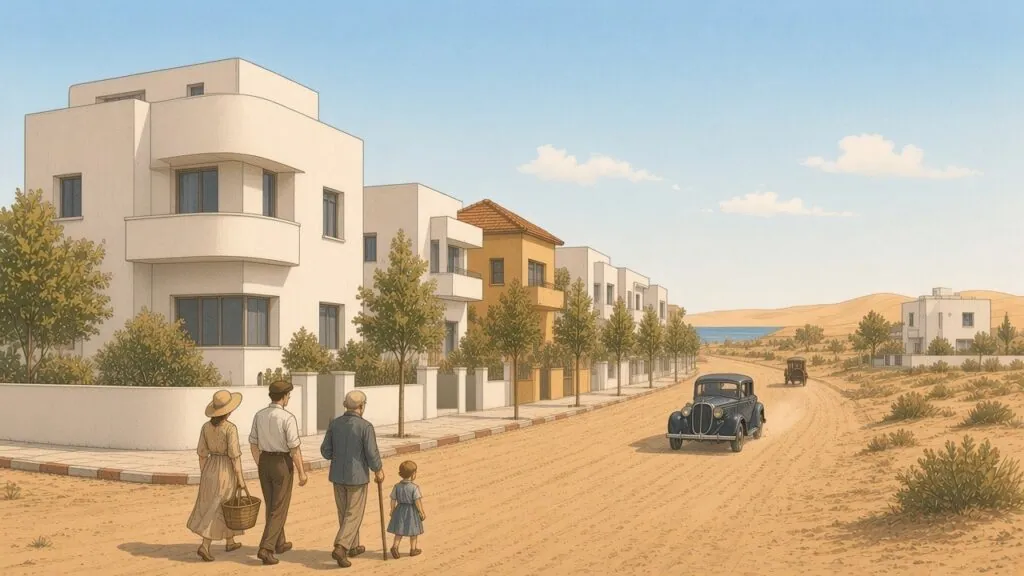
The plan’s basic unit was the house. A standard plot of 560 square metres was to carry a single or semi-detached house of no more than two dwellings, covering a third of the plot and no more than nine metres high, with much of the remainder left for gardens. Houses were grouped into large home-blocks, each surrounding a small public garden with playgrounds and other shared facilities; through traffic was confined to “mainways” around the blocks, while narrow “homeways” and footpaths led inwards without crossing them.[33] UNESCO’s description of the White City treats this plan as the urban framework within which the modernist buildings of the following decades were set.[12]
The plan’s political history was as complex as its geometry. The rapid growth of shack neighbourhoods and of a large population of poor renters threatened the dominance of the homeowners and developers whom Dizengoff represented, and he hoped that planning would meet the challenge. The municipal council approved the master plan on 6 April 1926, during the labour administration that followed his resignation, and the planning board of the Mandatory government approved it as a legal document in 1927. It remained, in the authors’ account, the city’s only approved overall master plan until the adoption of the plan known as TA5000 in 2016.[33]
Allweil and Zemer argue that Geddes’s worker housing, often assumed never to have been built, was in fact realised in self-built home-block dwellings across the city, alongside the better-known workers’ residences designed by Arieh Sharon. Their reading treats the plan less as a garden-city ornament than as an instrument of housing policy in a city whose population, and whose class politics, were changing faster than its institutions.[33]
12. The first Hebrew city
By the 1930s Tel Aviv had become the centre of Jewish cultural as well as economic life in Palestine, a position it owed less to any single foundation than to the concentration in one place of readers, audiences, schools and publishers.[1] The anniversary account of 1934 records that in 1931 the city had ninety-two schools with 12,321 pupils, about half of all Jewish schoolchildren in the country.[16] The poet Hayim Nahman Bialik, the most celebrated Hebrew writer of the age, settled in Tel Aviv in 1924 after leaving Soviet Russia and Berlin, bringing with him the publishing house Dvir, which he had co-founded in Berlin two years earlier; he lived in the city until his death in 1934.[35]
Theatre followed the writers. The yearbook account notes the founding of the Ohel theatre and the decision of Habimah, created in Moscow in 1918, to make Tel Aviv its permanent home; it dates that decision to 1931, although other accounts place the company’s move in 1928, and the sources do not agree on the date.[1][19] In the visual arts, Yitzhak Frenkel opened the Histadrut Art Studio in the city in 1926, described as the first school in Mandatory Palestine to teach modern art, and a municipal art museum was founded in 1932. Dizengoff had donated his house on Rothschild Boulevard after the death of his wife, Zina, in 1930; the building was enlarged and in 1936 became the home of the Tel Aviv Museum of Art.[19][2]
Public festivity was as characteristic of the city as high culture. The Purim carnival became one of the city’s signature celebrations, and the anniversary account explains its name, Adloyada, by the Talmudic licence to drink on Purim until one “knew not the difference between cursing Haman and blessing Mordecai”. The same report describes the plans to mark the city’s twenty-fifth year during the Levant Fair, the trade exhibition then held in the city.[16]
Helman’s study treats such events, together with cafés, the beach, shops and the habits of consumption and leisure, as the ground on which a new urban Hebrew identity was formed. In her account the city’s formative decades are best understood not through its myths or through the institutions of formal high culture alone, but through the ordinary practices of a middle-class population that was inventing a way of life in Hebrew as it went.[23] On this reading, the image of Tel Aviv as young, secular and modern, which later generations came to regard as its essential character, grew out of everyday habits before it was articulated as an ideal.
13. The Fifth Aliyah and the White City
The decade that made Tel Aviv a city began with the economic crisis of the late 1920s and ended with war. Between 1929 and 1939 the Fifth Aliyah brought nearly a quarter of a million Jewish immigrants to Palestine, the largest of the pre-state waves. After 1933 it included many refugees from Nazi Germany, a substantial number of them professionals and people of some means who were able, under the Haavara transfer agreement, to bring part of their assets with them.[36] The city absorbed a large share of them. The yearbook account gives a population of 45,564 Jews in 1931, about 120,000 in 1935 and 150,000 in 1937; the report of 1934, written at the height of what it called “the German era”, counted more than ten thousand houses, factories, offices and shops and a population of eighty to eighty-five thousand.[1][16]
The architecture of this boom is the basis of the city’s modern reputation. UNESCO’s evaluation describes an ensemble constructed from the early 1930s to the 1950s by architects trained and practising in Europe before they immigrated, and it identifies the main influences as the teachings of the Bauhaus, the work of Le Corbusier and that of Erich Mendelsohn. The buildings it describes are mostly three or four storeys high, with flat roofs, rendered walls in a range from cream to white, strip windows smaller than their European models, deep balconies for shade and, in many cases, ground floors raised on pilotis to let the sea breeze through. In the central zone of the nominated area, 400 of some 1,750 buildings had been listed for protection.[12]
The same evaluation cautions that the label “Bauhaus style”, often applied to Tel Aviv, “is not necessarily appropriate”; the city represents a variety of European trends mingled with local building traditions and adapted to the climate. It notes that nineteen of the architects had studied at the Bauhaus. The architect and critic Sharon Rotbard puts the point more sharply: in his account only a handful of local architects had studied there, mostly for a semester or two, only two were active in Tel Aviv, and the school that supplied the city with the largest number of its architects was the University of Ghent. He adds that Arieh Sharon, the most prominent of the Bauhaus graduates, objected in 1984 to the appropriation of the name.[12][30]
The disagreement matters because the term “White City” is itself an interpretation. Rotbard dates his own critique to the municipal festival “Bauhaus in Tel Aviv” of 1994, which he regarded as inflating a national story, and argues that the image of a white, European and modern city detached from its surroundings depended on omitting Jaffa and the poorer southern districts, which he calls the “Black City”.[30][37] His critique is avowedly polemical, and its central metaphor is borrowed from Frantz Fanon’s description of the colonial city; it is cited here as a significant argument about how the city has been narrated, not as a neutral description. What is not in dispute is the scale and coherence of the building stock itself, which was the product of a particular moment: a rapid influx of educated immigrants, a generation of European-trained architects and the plot rules inherited from Geddes, under which each free-standing building was set in its own garden and covered no more than a third of its lot.[12][33]

14. 1936, strike, port and demolition
The relationship between the two towns broke down in 1936. In April of that year killings of Jews in and around Jaffa opened what became the Arab revolt of 1936–39, and the Arab national committees declared a general strike in protest against Jewish immigration and land purchase and against British policy. The strike lasted for months, and the violence that accompanied it drove Jewish residents and businesses out of Jaffa and its border districts into Tel Aviv.[38][39]
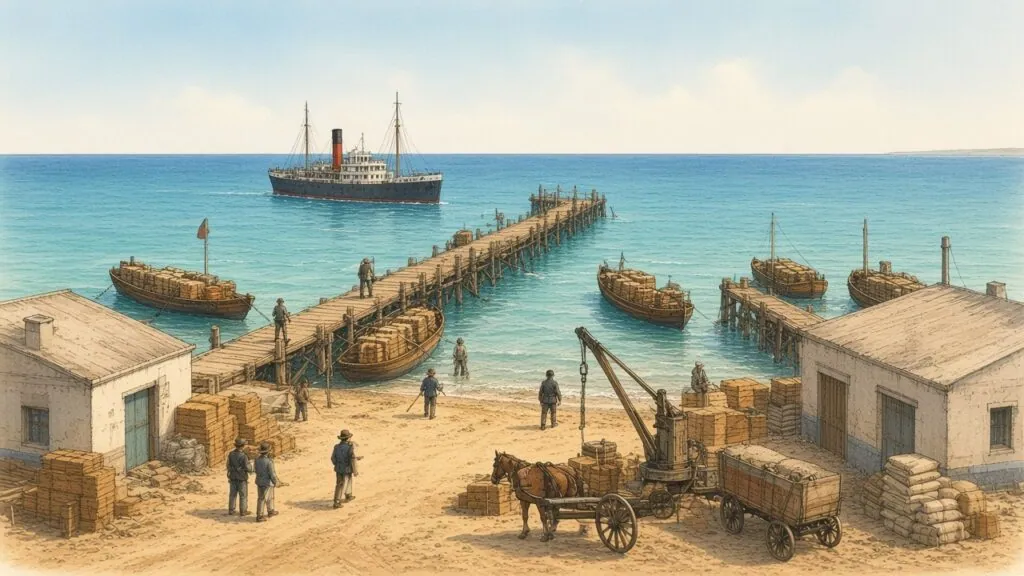
The consequences for Jaffa’s port were immediate. The Colonial Secretary told the House of Commons in 1938 that it had been “virtually closed for several months during 1936” as a result of the strike. Jewish trading interests responded by promoting an alternative port at Tel Aviv, and a company, Marine Trust Limited, was incorporated in 1936 to build it. The government approved the scheme on condition that it should cost neither the government nor the municipality anything, and it provided no financial assistance; by 1938 the port had been opened to all classes of goods and to passengers, with customs services provided by the administration.[6] The yearbook account dates the opening of the Tel Aviv port to 1936.[1] What began as an emergency measure acquired a larger meaning: for the first time Tel Aviv had a gateway to the sea that did not pass through Jaffa.
In Jaffa itself the British authorities answered the revolt with force. In the summer of 1936 Royal Engineers blew up houses in the old city to drive two roads through it to the port. Asked in the Commons whether the old city had been destroyed without adequate warning, the Colonial Secretary, William Ormsby-Gore, replied that only “a certain limited number of houses” had been demolished “to enable two new roads to the port to be constructed through the labyrinth of the old city”, after due warning, and that a special compensatory allowance was being paid to the displaced families. In December he was more direct: “In the military interests, and in the interests of peace and order in Jaffa, it was decided to dynamite two lines through the town.” He announced that £15,000 had been authorised to build houses for a hundred Arab families made homeless by the demolitions, and about £5,000 towards the relief of Jewish refugees in Tel Aviv from Jaffa and elsewhere.[40][39]
The official statements give no total for the number of houses destroyed, and the figures in later secondary accounts vary too widely to be relied upon. The record does establish the character of the operation, which was military rather than municipal, although another member recalled that it had been explained at the time partly as slum clearance. It also shows how far the urban fabric of the two towns had become an object of security policy.[39]
The year also brought a change of leadership. Dizengoff died on 23 September 1936. His successor, Israel Rokach, had been born in Neve Tzedek, the son of one of its founders, and had sat on the council since 1922 and served as Dizengoff’s deputy since 1929. Reference works differ on whether his mayoralty should be dated from his appointment in the autumn of 1936 or from 1937, but he held the office until 1953, through the revolt, the Second World War, the war of 1948 and the first years of the state.[14][17][41]
15. War, internment and partition
By 1939 Tel Aviv had some 160,000 inhabitants, slightly more than a third of the Jewish population of Palestine, and the yearbook account calls it the undisputed heart of Jewish Palestine in economic, cultural and even political life; of the major institutions of the Yishuv, only the Chief Rabbinate and the Jewish Agency had their seats in Jerusalem.[1] The Second World War touched it directly. On 9 September 1940 Italian aircraft bombed the city. The figures given for the dead differ: a contemporary report by the Jewish Telegraphic Agency, citing an official announcement nine days later, gave 119 killed, 105 of them Jews and fifty-five of them children, while a later account in Haaretz gives a total of 137; the later figure may include those who died of their wounds, but the sources consulted for this essay do not explain the difference.[42][43]
The war also ended the German presence on the city’s edge. The Templer colony of Sarona, whose community had by the 1930s become aligned with National Socialism, was interned by the Mandatory authorities in 1939, and most of its residents were deported to internment in Australia by 1941. After the war the site passed to British military use and in 1947 became a Jewish military base, Camp Yehoshua; after independence it became the Kirya, the government and military district at the centre of the modern city.[8]
The last years of the Mandate brought the city into conflict with the British as well as with its neighbours. Jewish underground organisations operated from the city, and in 1947 the British held Rokach for several months, together with the mayors of Ramat Gan and Netanya and other Jewish leaders, on suspicion of aiding activity against the government.[41] The relationship with Jaffa was by then governed by security as much as by commerce, and the strip of mixed and contested land between the two towns, which included Manshiyya and the Jewish quarters south of Tel Aviv that remained under Jaffa’s jurisdiction, was the most sensitive part of it.[30][13]
On 29 November 1947 the General Assembly of the United Nations adopted Resolution 181, recommending the partition of Palestine into a Jewish state, an Arab state and an international regime for Jerusalem. The plan placed Tel Aviv in the Jewish state but excluded Jaffa from it. The Jewish section of the coastal plain, in the words of the resolution, included “the towns of Haifa and Tel-Aviv, leaving Jaffa as an enclave of the Arab State”; the boundary of the enclave was drawn along the western edge of the Jewish quarters south of Tel Aviv and the continuation of Herzl Street.[44] Gabriel Schwake notes that an international border was thus to run between Arab Manshiyya and Jewish Neve Tzedek.[13]
The Jewish Agency accepted the plan, with reservations; the Arab Higher Committee rejected it outright, and civil war followed almost immediately. The frontier between the two towns became a front line. The yearbook account records that Tel Aviv was shelled continually from Jaffa; on the other side of the line, as the next section describes, Jewish forces pressed on Jaffa’s outer quarters and the villages around it. The Arab state envisaged by the resolution was never established, and the fate of its Jaffa enclave was decided by force.[1][45]
16. The fall of Jaffa and the declaration
The fall of Jaffa in the spring of 1948 is the most contested episode in the history of the two towns, and the sources need to be distinguished with care. The sequence of military events is reasonably well established. In late April the Haganah, the main Jewish military organisation, launched Operation Hametz, dated by Palquest, the interactive encyclopaedia of the Institute for Palestine Studies, from 24 April to 13 May, with the aim of capturing the Arab villages on either side of the railway between Jaffa and its hinterland and so isolating the city, then home, by that account, to some seventy thousand people, without a frontal assault.[46]
The frontal assault came instead from the Irgun, the Revisionist underground, which attacked Manshiyya, the quarter projecting northwards along the shore towards Tel Aviv, on 25 April. Palquest describes the attack as accompanied by “massive and indiscriminate shelling of the residential and commercial sections of Jaffa, causing large-scale civilian panic and flight by land and sea”. Manshiyya fell after some eighty hours of fighting, at dawn on 29 April. The British, who were still responsible for the country, then intervened against the Irgun, which agreed to come under Haganah command on the Jaffa front. The Haganah’s units took Salama, Yazur and the northern and eastern suburbs, including Abu Kabir, in the following days, despite a successful counter-attack at Tall al-Rish by a battalion of the Arab Liberation Army.[46]
Jaffa surrendered to the Haganah on 13 May 1948. The British, who had escorted civilians leaving the city along the road to Lydda and Ramla, withdrew the next day.[46][1] The scale of the exodus is not in doubt. Adam Raz, writing from documents in the Israel State Archives, puts the number of Arabs who remained in the city after its surrender at about four thousand, out of a pre-war Arab population of close to seventy thousand; the planning historian Gabriel Schwake gives a similar fall, from seventy or eighty thousand to four thousand.[47][13]
The explanation of that exodus is where interpretation begins. Palquest, citing the official History of the Haganah, stresses the prolonged mortar shelling of the city centre and the cumulative effect of the fall of the surrounding villages on the morale of the population. Itamar Radai, in a study of the city’s collapse, does not deny Jewish military pressure but argues that it does not explain on its own why the largest Arab city in Palestine fell so quickly, and he examines the underlying social and military weakness of Arab Jaffa in the months of inter-communal war.[46][48] The yearbook account, written from an Israeli perspective, records that Tel Aviv was shelled continually from Jaffa until Jewish forces surrounded the old town and most of its residents fled.[1] These accounts differ in emphasis and in what they treat as cause, but not in the basic chronology. The City Museum of Tel Aviv-Yafo, in its permanent exhibition, uses the plain formula that Jaffa was “captured and subsequently annexed”.[5]
On the afternoon of 14 May 1948, the day after Jaffa’s surrender, the members of the People’s Council gathered at four o’clock in the hall of the Tel Aviv Museum, the former Dizengoff house on Rothschild Boulevard, to hear David Ben-Gurion read the declaration of the establishment of the State of Israel, eight hours before the end of the British Mandate. The declaration closes with the words that it was signed “in the city of Tel-Aviv, on this Sabbath eve”, and the building has since been preserved as Independence Hall, reopened to the public in its restored form in 1978.[2][49] On consecutive days, therefore, the older city surrendered and the younger one became the setting for the declaration of a state.
17. Tel Aviv–Yafo
The Arabs who remained in Jaffa after its surrender lived for the first months under military government. Adam Raz’s study of documents in the Israel State Archives shows that the authorities decided to concentrate them in the Ajami quarter. “It will be best to have special areas for the Jews and areas for the Arabs,” the military governor, Meir Laniado, told the city’s Arab committee in July 1948. An official of the Ministry of Minority Affairs protested that the quarter was about to be closed off with barbed wire, and the historian Yoav Gelber later wrote that the plan to fence it had been rescinded. Raz argues that this is incorrect: Ajami was fenced for months, and in February 1949 the ministry was still trying to obtain permits for residents “to exit the barbed wire”. One resident, Ismail Abu Shehadeh, recalled fences with three gates and permits required even to work in the orchards around the city.[47]
The empty houses of Jaffa and of its suburbs did not remain empty. Gabriel Schwake notes that the war left Tel Aviv almost double its former size, with a large number of abandoned Arab villages and neighbourhoods already occupied by Jewish immigrants, farmland formerly owned by Arabs, and transit camps for newcomers.[13] Many of the immigrants housed in Jaffa came from Iraq, Yemen and North Africa, and the old Arab houses of Ajami and other quarters were subdivided among families in conditions of severe overcrowding.[3] In 1950 Tel Aviv and Jaffa were merged into a single municipality, which took the name Tel Aviv–Yafo; the City Museum’s permanent exhibition describes the name as designating “the 1950 union of two very different cities”.[1][5]
The union was followed by planning that treated much of the older fabric as expendable. In 1951 Rokach’s administration invited the American planner Aaron Horowitz to prepare a new master plan, and in 1959 Horowitz issued a slum reconstruction plan that designated twenty-nine neighbourhoods for evacuation and rebuilding. The plan was never formally adopted, but the areas it identified became the targets of renewal projects for decades. Manshiyya and Neve Tzedek had been declared slums in 1954. In 1960 the municipality created the Ahuzot HaHof company to redevelop Manshiyya as a business district; an international competition in 1962 drew 152 entries from thirty-three countries, most of them proposing the complete demolition of both quarters. Between 1961 and 1970, 2,616 dwellings were evacuated in Manshiyya, with compensation for their occupants, and in 1974 the Charles Clore Park was laid out over the ruins of its houses.[13]
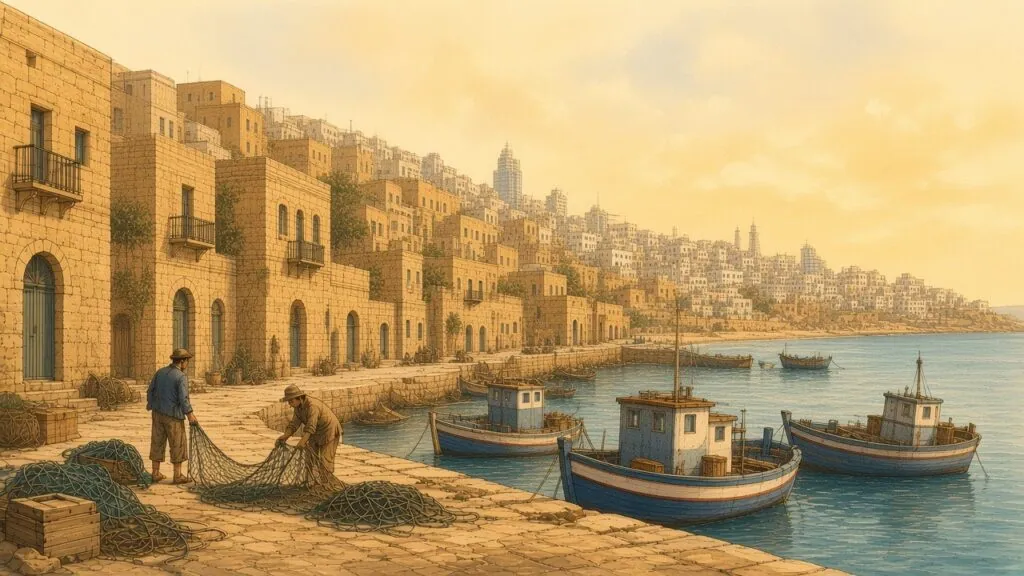
Neve Tzedek survived the competition and was later revived by small-scale investment and by artists drawn to its low rents, becoming one of the most sought-after districts in the city. Schwake contrasts the two outcomes: one neighbourhood erased by a large corporate project that produced an unsuccessful office district, the other regenerated by its residents.[13] Rotbard’s judgement of the same period is harsher. He notes that much of old Jaffa was demolished, that Manshiyya and the surrounding villages were flattened and that the street names of Jaffa were changed to Hebrew, and he regards these losses as a gap in the city’s history that should be acknowledged.[30] Restoration of the surviving old town, begun in the early 1960s, turned its alleys and port into a centre of galleries, studios and tourism.[3]
18. The metropolis of the new state
Tel Aviv was not the capital of the new state, but in its first period the Kirya, on the former Templer lands, housed provisional government ministries as well as the general staff, and it remained the country’s military headquarters after the civilian ministries moved to Jerusalem.[8][9] The city became instead the commercial, financial and cultural centre of the country, and its institutions multiplied. One of the most important was a university of its own. Tel Aviv University’s official history records that Haim Levanon, deputy mayor and then mayor from 1953 to 1959, campaigned for a second Israeli university in the city, and that on 16 August 1953 the municipal council resolved to turn a small biological institute into an academic institute that would form the core of a future university. Its first home was at Abu Kabir, in the south of the city, in what the historian Zvi Yavetz remembered as “the miserable shacks of Abu Kabir”; in 1955 the cornerstone of the School of Law and Economics was laid in Ramat Aviv, on a plot that the municipality, encouraged by Rokach, had designated for the university.[50]
The Ramat Aviv campus stands on the lands of al-Shaykh Muwannis, an Arab village of about 2,240 inhabitants in 1948, according to Mandate statistics, on the north bank of the Yarkon. The village was emptied in late March 1948 after Irgun members kidnapped several of its leaders, and its residents fled, mostly to Jaffa and further east. The former residence of the village sheikh survives on the campus and is known as the Green House.[51] The university’s published history of its foundation does not mention the village.[50]
The physical city changed with the institutions. On 31 July 1959 the Jewish Telegraphic Agency reported that demolition workers were tearing down the Herzliya Gymnasium, the founding public building of the suburb, to make way for an office building; the site had been sold to a group of investors headed by the industrialist Mordechai Meyer, himself a graduate of the school. The Shalom Meir Tower that replaced it was inaugurated in 1965 and was for a time the tallest building in the Middle East.[52][53]
The city’s place in national life also made it a target. During the Gulf War of 1991 Iraq fired Scud missiles at Israel, and a study by George Lewis, Steve Fetter and Lisbeth Gronlund estimated that about thirty of them were aimed at Tel Aviv and found that most of the casualties and damage suffered in Israel occurred in the Tel Aviv area. Many residents left the city during the attacks; the authors cite contemporary reports of a daily exodus that caused massive traffic jams, and of badly damaged homes that were empty when the missiles struck.[54]
19. Immigration, assassination and terror
The 1990s changed the city’s population and its politics. Between 1990 and 1999 more than seven hundred thousand immigrants arrived in Israel from the collapsing Soviet Union, 185,227 of them in 1990 alone.[55] Government housing programmes sought to direct many of them to development towns in the Negev and Galilee in order to relieve congestion in centres such as Tel Aviv, but the newcomers left a lasting mark on the city’s cultural life; the Gesher Theatre, which has worked in Jaffa since 1991, built its repertoire on Russian-origin productions translated into Hebrew.[55][19]
The decade was also one of political hope and political violence, and both found their stage in Tel Aviv. The Oslo Accords of 1993 divided the country, and on 4 November 1995 supporters of the agreements filled the city’s main civic square, Kikar Malchei Yisrael, at a rally intended to show public support for the government. Yitzhak Rabin, the prime minister, had not at first been enthusiastic about the idea but agreed to speak. At the end of the rally, as he returned to his car, he was shot in the back by a Jewish assassin and killed.[56] A week later, after the seven days of mourning, an estimated 250,000 people gathered there for a memorial ceremony, and the city renamed the site Yitzhak Rabin Square.[57]
The city was also a principal target of Palestinian suicide bombings in the 1990s and during the Second Intifada that began in 2000. On 19 October 1994 a Hamas bomber blew up a bus on Dizengoff Street near Dizengoff Square, killing twenty-two people.[58] On 1 June 2001 a suicide bomber attacked the crowd waiting outside the Dolphinarium discothèque on the seafront, killing twenty-one people, most of them teenage immigrants from the former Soviet Union, and wounding more than a hundred. Dina Kraft, writing for the Jewish Telegraphic Agency ten years later, described the attack as a formative moment for the country’s Russian-speaking community and its initiation into the realities of the Israeli–Palestinian conflict.[59]
The intifada also changed the city’s labour market and its southern neighbourhoods. Rotbard, who lived in the Shapira quarter from the 1990s, recalls that Palestinian workers from the West Bank and Gaza had rented rooms there during the working week until the closure of the territories after 2000, and that they were replaced by migrant workers from Eastern Europe, Turkey and South and East Asia and, by the end of the decade, by thousands of asylum seekers from Darfur and Eritrea.[30] In his account this diversity persists in the southern neighbourhoods of what he calls the Black City, in sharp contrast to the population of the city’s wealthier and whiter districts, and it is matched by visible inequalities in planning, building rights and public services between north and south.
Municipal politics in this period was dominated by a single figure. Ron Huldai, a former air force pilot and brigadier-general who had been principal of the Herzliya Gymnasium, was elected mayor in 1998 and re-elected repeatedly, most recently in a contest held in February 2024 after a postponement caused by the war; his tenure saw the elimination of the city’s budget deficit and a period of intense construction of towers, of which the Azrieli Center, whose circular tower was completed in 1999, became the most familiar.[60][61]
20. Heritage and its critics
The architectural reputation of the city was confirmed internationally on 5 July 2003, when the World Heritage Committee inscribed “the White City of Tel-Aviv – the Modern Movement” on the World Heritage List under criteria (ii) and (iv). The committee described the White City as “a synthesis of outstanding significance of the various trends of the Modern Movement in architecture and town planning in the early part of the 20th century”, adapted to the cultural and climatic conditions of the place, and as an outstanding example of new town planning. The inscribed property comprises three separate zones, the central White City, a second zone and the area around Bialik Street, with a combined area of 140.37 hectares and a common buffer zone of 197 hectares.[62][63]
The committee’s decision was not unconditional praise. It encouraged the state to monitor development trends in the city and to improve the control of changes to the existing fabric, and it recommended that height limits be proposed for the property and its buffer zone. The evaluation that preceded it noted that some 210 buildings had then been restored under conservation guidelines, at a rate of about fifty a year, and it listed the municipal plans, ordinances and conservation plan by which the city proposed to protect the area.[62][12]
Heritage designation also changed the value of the older districts. Neve Tzedek, saved from demolition in the 1960s, became in Schwake’s account one of the most desired neighbourhoods in Tel Aviv; its population almost doubled in less than a decade, and between 1990 and 2010 its housing stock grew by about a quarter while its residential floor area increased by 240 per cent. He attributes the regeneration to small-scale investment, the arrival of artists and the municipality’s promotion of the area as a centre for dance and culture.[13] Sarona, the Templer colony that had become part of the Kirya, was restored in the 2010s as a commercial and leisure quarter after compensation was agreed with the families of its former residents.[8]
The critics of the White City narrative argue that such celebrations have their costs. Rotbard’s book, first written in Hebrew, published in English by the MIT Press and reissued by Pluto Press with a new postscript, contends that the story of a white, modern city built on empty dunes erased Jaffa from the city’s self-understanding, and he connects that narrative with the neglect of the southern and eastern neighbourhoods that he groups under the name Black City.[37][30] Mark LeVine makes a related argument for the period before 1948, treating Tel Aviv and Jaffa as a single contested region whose history cannot be written from either national perspective alone.[4] These are interpretations rather than findings of fact, and other historians, among them Azaryahu and Helman, have treated the city’s myths more as objects of cultural analysis than as instruments of exclusion. Together they make clear that the history of the city is also a history of how it has been described.[20][23]
21. Protest and war, 2011–2026
In the twenty-first century Tel Aviv became the country’s principal arena of mass protest. In July 2011 young people began pitching tents along the central walk of Rothschild Boulevard, the avenue laid out by the founders a century earlier, in protest against the cost of housing and rents; within a week tent encampments had appeared across the country.[64] On 3 September 2011 the movement reached its peak, when, according to the Guardian, about 430,000 people demonstrated across Israel, up to 300,000 of them in Tel Aviv, in what the paper called the biggest demonstration in the country’s history. Daphni Leef, one of the organisers of the original encampment, described the summer as one of “new Israeli hope born of despair, alienation and impossible gaps”.[65]
A decade later the city was the centre of a different movement. In January 2023 the government announced a programme of judicial reform, and protests against it were held every week for months, with the largest gatherings in Tel Aviv and frequent blockades of the Ayalon highway and Kaplan Street.[66] On 25 March 2023, according to Israeli media estimates reported by the Guardian, around 200,000 people demonstrated in the city.[67]
The attack by Hamas on southern Israel on 7 October 2023 and the war that followed transformed the plaza outside the Tel Aviv Museum of Art into the focus of the national campaign for the return of the 251 people taken captive. Families of the hostages and their supporters gathered there for rallies, weekly Sabbath assemblies and vigils; a clock counted the time since the attack. The last hostage, Ran Gvili, a police officer whose remains were recovered in Gaza, was returned on 26 January 2026, and the next day the clock was stopped after 844 days. In August 2026 Huldai unveiled signage formally naming the site Hostages Square. The Jewish Telegraphic Agency noted that the square still carried a political charge, as protesters had met there in July to demand an official inquiry into the failures of 7 October, an issue in the campaign for the elections set for 27 October.[68]
The metropolitan area was again under missile attack in June 2025, during the war between Israel and Iran. The BBC reported that Iranian missiles struck Rishon LeZion, just south of Tel Aviv, and the neighbouring city of Ramat Gan in a single night in which three people were killed across the country.[69] The history of the city in these years is still being written, and it would be premature to assess it. It is already clear, however, that the city’s streets and squares, from Rothschild Boulevard to Kaplan Street and Hostages Square, have repeatedly served as the setting for the country’s largest public debates.
22. Two histories of one city
The city that began as sixty plots on the dunes north of Jaffa now lies at the centre of a continuous metropolitan area on the coastal plain. Its history can be told, and has been told, as the realisation of an idea: a Hebrew city built by Jews in their own language, founded by lot rather than by conquest, planned by a Scottish visionary, adorned with modern architecture and crowned by the declaration of a state in its first mayor’s house. Every element of that story has documentary support. The lottery took place; the name was chosen by vote in a general meeting; the Geddes plan was approved; the White City was built; the state was declared on Rothschild Boulevard.[1][14][33][2]
The same documents support a second story, which the first has often left out. The land was bought from Arab owners in the hinterland of an Arab town; the suburb depended on Jaffa for its first decades and defined itself against it; the separation of the two was hastened by the riots of 1921 and 1936, by the building of a rival port and by a British decision to dynamite two roads through the old city; and in 1948 Jaffa was captured, most of its inhabitants left, and the few thousand who remained were for months confined behind barbed wire before the city was merged with its former suburb. Several of the older quarters absorbed by the union were then declared slums, and Manshiyya was demolished.[4][39][46][47][13]
The two stories are not alternatives. They describe the same places and, for the most part, the same events, and the disagreements between historians concern weight, cause and meaning more than chronology. The City Museum’s formula, that the name Tel Aviv–Yafo “designates the 1950 union of two very different cities”, is accurate as far as it goes, and the history of the city since then has been in part a history of how that union has been understood.[5]
What distinguishes Tel Aviv among the cities of the region is the speed of its development and the extent to which it was made, from the beginning, by its own residents and their institutions rather than by a state. That civic character survives in its municipal politics, its cultural life and its readiness to fill its streets in protest. Its founders’ hope, as their committee put it in 1910, was for “a tell where the buds of spring blossom”; the mound beneath that phrase has turned out to contain more layers than they imagined, and a full history of the city must give an account of all of them.[14]
Timeline
After the Ottoman reconquest of 1840–41 and the Tanzimat reforms, Jaffa grows beyond its walls.
German Templers found the agricultural colony of Sarona north-east of Jaffa.
Jewish building begins on the slope north-east of old Jaffa (UNESCO gives 1896).
The Jaffa–Jerusalem railway opens.
A homebuilders’ society of Jaffa Jews is formed and takes the name Ahuzat Bayit.
Sixty plots on the dunes are allocated among sixty-six families; the date becomes the city’s birthday.
A general meeting adopts the name Tel Aviv, after Sokolow’s Hebrew title for Herzl’s Altneuland.
The Ottoman authorities expel the Jews of Jaffa and Tel Aviv; they return after the British conquest.
Violence in Jaffa kills 47 Jews and 48 Arabs; on 11 May Tel Aviv becomes a township.
Patrick Geddes surveys the town; the council approves his plan in 1926 and the Mandatory board in 1927.
Tel Aviv receives the status of a municipality during its twenty-fifth year.
The general strike closes Jaffa port; a port opens at Tel Aviv; British engineers blow roads through old Jaffa; Dizengoff dies.
Italian aircraft bomb the city; contemporary figures give 119 dead.
UN Resolution 181 places Tel Aviv in the Jewish state and leaves Jaffa as an Arab enclave.
Jaffa surrenders to the Haganah; next day the State of Israel is declared in the former Dizengoff house.
Tel Aviv and Jaffa are merged in a single municipality.
Manshiyya is evacuated and demolished; Charles Clore Park is laid out over its ruins.
Iraqi missiles strike the Tel Aviv area during the Gulf War.
Prime Minister Yitzhak Rabin is assassinated after a rally; the square is renamed after him.
The White City is inscribed on UNESCO’s World Heritage List.
Tent protests on Rothschild Boulevard (2011) and mass demonstrations against judicial reform (2023).
The plaza outside the Tel Aviv Museum of Art is formally named Hostages Square.
References
- “Tel Aviv: From Spring Hill to Independence”, Jewish Virtual Library (from Israel Yearbook & Almanac 1999) *
- “Independence Hall”, Jewish Virtual Library *
- “Jaffa” *
- Mark LeVine, Overthrowing Geography: Jaffa, Tel Aviv, and the Struggle for Palestine, 1880 - 1948 (University of California Press, 2005) *
- “Permanent Exhibition”, City Museum Tel Aviv-Yafo *
- “Palestine (Tel-Aviv and Jaffa)”, House of Commons debate, 18 May 1938, Hansard vol. 336 *
- “Jaffa orange” *
- “Sarona (colony)” *
- “HaKirya” *
- Emanuel Beska, “Filastin’s Changing Attitude toward Zionism before World War I”, Jerusalem Quarterly 72 *
- “Neve Tzedek” *
- “White City of Tel-Aviv - the Modern Movement”, nomination file and ICOMOS evaluation, UNESCO World Heritage Centre (no. 1096) *
- Gabriel Schwake, “Antifragility and the Right to the City: The Regeneration of Al Manshiya and Neve Tzedek, Tel Aviv-Jaffa”, 17th IPHS Conference, Delft, 2016 *
- Maoz Azaryahu, “Herzl in Tel Aviv: A Commemorative Journey”, University of Haifa *
- “Second Aliyah” *
- “Tel Aviv Celebrates Twenty-fifth Year”, Jewish Telegraphic Agency, 4 March 1934 *
- “Meir Dizengoff” *
- “The Founding of the Ahuzat Bayit Neighbourhood and the Beginning of Tel Aviv” (Hebrew), Keren Kayemeth LeIsrael - Jewish National Fund *
- “Tel Aviv” *
- Maoz Azaryahu, Tel Aviv: Mythography of a City (Syracuse University Press, 2007) *
- “Herzliya Hebrew Gymnasium” *
- “The Old New Land” *
- Anat Helman, Young Tel Aviv: A Tale of Two Cities (Brandeis University Press, 2010) *
- “Rothschild Boulevard” *
- “1917 Jaffa deportation” *
- Palestine: Disturbances in May, 1921. Reports of the Commission of Inquiry with Correspondence Relating Thereto, Cmd. 1540 (London: HMSO, 1921) *
- “Jaffa riots” *
- “Haycraft Commission (1921)”, Encyclopedia of the Modern Middle East and North Africa, via Encyclopedia.com *
- E. Mills, Census of Palestine 1931, vol. II, Tables (Alexandria, 1933), partial English text *
- Daniel Jonas Roche, “Sharon Rotbard discusses White City, Black City”, The Architect’s Newspaper, 3 January 2024 *
- “Florentin, Tel Aviv” *
- “Fourth Aliyah” *
- Yael Allweil and Noa Zemer, “Housing-Based Urban Planning? Sir Patrick Geddes’ Modern Masterplan for Tel Aviv, 1925”, Urban Planning 4.3 (2019), 167 - 185 *
- “Patrick Geddes” *
- “Hayim Nahman Bialik” *
- “Fifth Aliyah” *
- Sharon Rotbard, White City, Black City: Architecture and War in Tel Aviv and Jaffa (MIT Press, 2015; new edn, Pluto Press) *
- “1936 - 1939 Arab revolt in Palestine” *
- “Demolitions, Jaffa (Re-housing)”, House of Commons, 16 December 1936, Hansard *
- “Jaffa (Demolition of Houses)”, House of Commons, 24 June 1936, Hansard *
- “Israel Rokach” *
- “Death Toll 119 in Tel Aviv Bombing”, Jewish Telegraphic Agency, 18 September 1940 *
- “1940: Italy Bombs Tel Aviv During WWII”, Haaretz, 9 September 2013 *
- United Nations General Assembly Resolution 181 (II), 29 November 1947, Internet Modern History Sourcebook, Fordham University *
- “United Nations Partition Plan for Palestine” *
- “Operation Hametz”, Palquest: Interactive Encyclopedia of the Palestine Question, Institute for Palestine Studies *
- Adam Raz, “Arab citizens behind barbed wire”, Haaretz, 28 May 2020 (PDF hosted by Akevot Institute) *
- Itamar Radai, “Jaffa, 1948: The Fall of a City”, Journal of Israeli History 30.1 (2011), 23 - 43 (record, Open University of Israel) *
- “Israeli Declaration of Independence” *
- “The Evolution of Tel Aviv University”, Tel Aviv University *
- “Al-Shaykh Muwannis” *
- “14-story Office Building to Replace Herzliah Gymnasium in Tel Aviv”, Jewish Telegraphic Agency, 31 July 1959 *
- “Shalom Meir Tower” *
- George N. Lewis, Steve Fetter and Lisbeth Gronlund, Casualties and Damage from Scud Attacks in the 1991 Gulf War, DACS Working Paper, MIT, March 1993 *
- “1990s post-Soviet aliyah” *
- “1995”, Yitzhak Rabin Center *
- “At Site of Rabin’s Assassination, 250,000 Memorialize Slain Leader”, Jewish Telegraphic Agency, November 1995 *
- “Dizengoff Square” *
- Dina Kraft, “Ten years after the Dolphinarium attack, a turning point for Israel’s Russian-speaking immigrants”, Jewish Telegraphic Agency, 24 May 2011 *
- “Ron Huldai” *
- “Azrieli Center” *
- Decision 27 COM 8C.23, World Heritage Committee, 2003 *
- “White City of Tel-Aviv - the Modern Movement”, UNESCO World Heritage List *
- Harriet Sherwood, “Israelis set up tent cities in protest at housing costs”, The Guardian, 22 July 2011 *
- Harriet Sherwood, “Israeli protests: 430,000 take to streets to demand social justice”, The Guardian, 4 September 2011 *
- “2023 Israeli judicial reform protests” *
- “Israel defence minister urges pause in judicial overhaul as thousands rally in Tel Aviv”, The Guardian, 25 March 2023 *
- Deborah Danan, “‘History cannot be erased’: ‘Hostages Square’ in Tel Aviv is formalized in official name change”, Jewish Telegraphic Agency, 13 August 2026 *
- Tom Bennett, “‘It’s heavy on the heart’: Israelis survey damage in city hit by Iranian missile”, BBC News, 14 June 2025 *
Select bibliography
- Yael Allweil and Noa Zemer, “Housing-Based Urban Planning? Sir Patrick Geddes’ Modern Masterplan for Tel Aviv, 1925”, Urban Planning 4.3 (2019), 167–185.
- Maoz Azaryahu, Tel Aviv: Mythography of a City (Syracuse: Syracuse University Press, 2007).
- Alter Droyanov (ed.), Sefer Tel Aviv [The Book of Tel Aviv] (Tel Aviv, 1936).
- Anat Helman, Young Tel Aviv: A Tale of Two Cities (Waltham, MA: Brandeis University Press, 2010).
- Mark LeVine, Overthrowing Geography: Jaffa, Tel Aviv, and the Struggle for Palestine, 1880–1948 (Berkeley: University of California Press, 2005).
- Barbara E. Mann, A Place in History: Modernism, Tel Aviv, and the Creation of Jewish Urban Space (Stanford: Stanford University Press, 2006).
- Palestine: Disturbances in May, 1921. Reports of the Commission of Inquiry with Correspondence Relating Thereto, Cmd. 1540 (London: HMSO, 1921).
- Itamar Radai, “Jaffa, 1948: The Fall of a City”, Journal of Israeli History 30.1 (2011), 23–43.
- Sharon Rotbard, White City, Black City: Architecture and War in Tel Aviv and Jaffa (Cambridge, MA: MIT Press, 2015).