The School of Paris
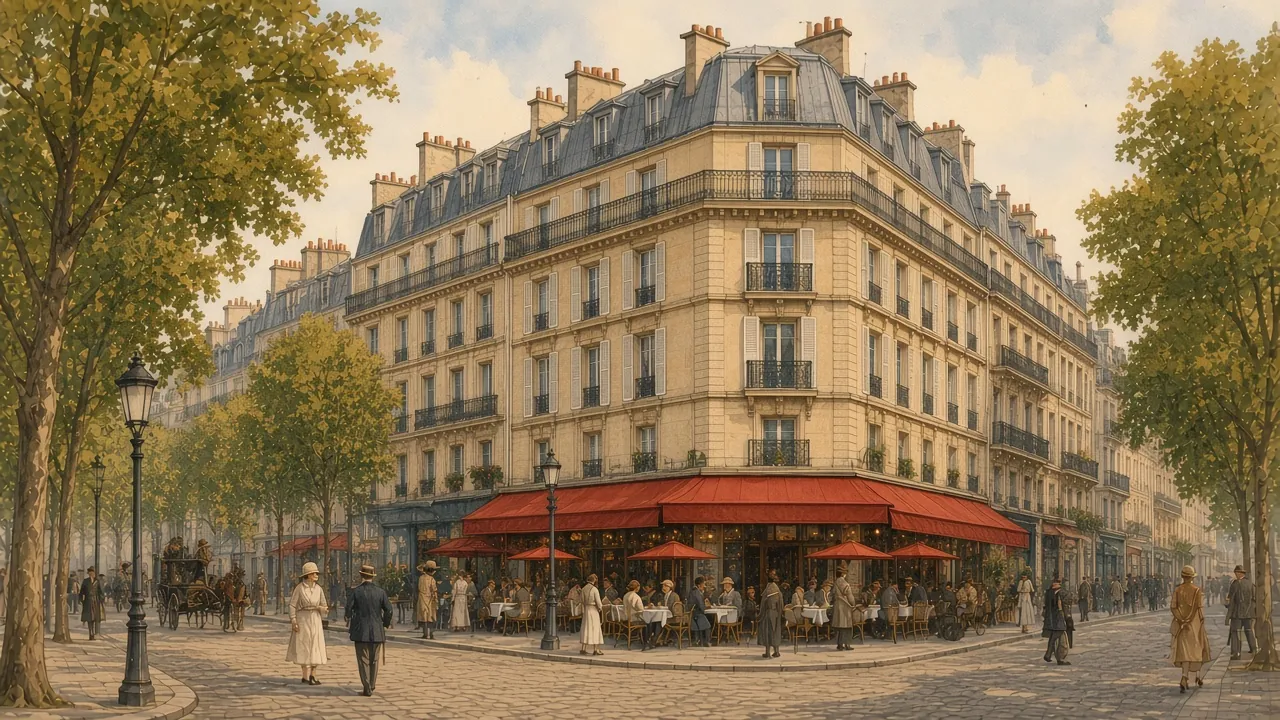
In the first decades of the twentieth century Paris drew painters and sculptors from across Europe and beyond on a scale that had no earlier parallel. They came to study in the private academies, to see the collections of the Louvre and the Musée du Luxembourg, to exhibit at the independent salons and to live, often poorly, in rented studios first in Montmartre and then, in growing numbers, on the Left Bank in Montparnasse. Among them were French-born artists who reshaped painting and sculpture from within the city, and a much larger company of foreigners. Many of the newcomers were Jews from the Russian Empire, Poland, Romania and Central Europe; others came from Italy, Spain and the Netherlands, and a smaller number from Asia and the Americas. Critics later gathered these careers under a single name, the School of Paris, or École de Paris. The name did not describe a shared style, a manifesto or a teaching institution. It named a place and a historical concentration, and it was applied after the fact.[1][2]
The essay therefore moves in chronological order, but it pauses, where the material requires it, to follow a single career across several decades before returning to the common timeline. That method is a compromise. A purely biographical structure would dissolve the city into a sequence of separate lives; a purely thematic one would drag the same painters through repeated discussions of exile, dealers and war. By giving certain artists chapters of their own, and by reserving other chapters for institutions, quarrels and aftermaths, the account tries to keep both the pictures and the circumstances in view.
This special feature follows the foundation and history of that grouping from the late nineteenth-century conditions that made Paris an artistic capital to the postwar decades in which a second, largely abstract School of Paris was identified. It explains how the critic André Warnod used the phrase in 1925, and how the term was later stretched, narrowed and contested.[3] It describes the move from Montmartre to Montparnasse, the academies, dealers and salons that structured artistic life, and the principal artists whose work is most often attached to the name, distinguishing those who stood at the centre of the designation from figures who belong to the wider history of Parisian modernism. It then turns to the First World War and the interwar years, to the campaign against foreign artists, to the Occupation and the destruction of Jewish artistic life in France, and to the painters of the years after 1945. The list of names treated here is not exhaustive. An interactive timeline at the end of the essay gathers the principal dates.
1. A name given after the fact
The phrase École de Paris sounds institutional. In French usage an école may be a teaching body, as the École des Beaux-Arts was, or a lineage of practice attached to a city or a master, as historians speak of the School of Fontainebleau or the School of Barbizon. Neither sense fits the artists who worked in Paris between about 1900 and 1940 and who were later grouped under that heading. They did not enrol in a single academy of that name, issue a joint programme or paint in one recognisable manner. The Musée d’art et d’histoire du Judaïsme, introducing its 2021 exhibition on the subject, stated the point directly: these figures did not belong to a school in the traditional sense, since they shared neither style nor aesthetic, but were linked by a common history, by particular journeys and, for some, by a shared fate.[4] The Jewish Museum Berlin, presenting the same generation in 2023 as Paris Magnétique, repeated the warning.[5] The term describes neither an art school nor a stylistic movement. It names a cosmopolitan scene that formed in the French capital and that, when it was first popularised, was used to answer nationalist and xenophobic voices rather than to found a new doctrine.
The critic who gave the name its lasting currency was André Warnod. On 27 January 1925 he published an article in the daily paper Comœdia in which he wrote that the École de Paris existed.[3][2][6] Later art historians, he said, would be better placed than his contemporaries to define its character and to study the elements of its make-up, but it was already possible to affirm its existence and its power of attraction, which brought artists to Paris from all around the world. He returned to the argument that October in the introduction to his book Les Berceaux de la jeune peinture, whose subtitle presented Montmartre and Montparnasse as the cradles of young painting.[7] Warnod’s wording is important for what it does not do. He did not list a canon of members, did not isolate a formal trait that united them and did not claim to have discovered a movement comparable to Cubism or Fauvism. He asserted a fact of concentration and of magnetism. Paris, in his account, was not merely the place where certain foreigners happened to work. It was a centre whose pull itself required a name.
The occasion for that naming was not a salon opening or the launch of a journal. It was a dispute about who counted as a French artist and who was merely a guest. Foreign painters and sculptors had been numerous in Paris since before 1914, but their visibility increased after the war, in the cafés and galleries of Montparnasse and in the independent salons. Some French critics treated that visibility as a threat to a national school. Warnod’s article was a reply. He wanted the foreigners who worked in Paris to be recognised as part of contemporary French artistic life rather than as an alien intrusion upon it, and he named Picasso, Pascin and Foujita among those whose contribution could no longer be ignored. The phrase he chose sounded conservative. By calling the phenomenon a school he borrowed the dignity of older art-historical language for a population that official culture still found easy to set aside.
The term stuck, and its very looseness guaranteed that it would be stretched. In later writing it has been used for almost any ambitious art made in the French capital in the first four decades of the century, and sometimes beyond. Under that wide definition Henri Matisse, André Derain, Maurice de Vlaminck, Georges Braque and Fernand Léger belong to the School of Paris simply because they worked in the city and helped to define its modern reputation. Photographers who lived there, including Man Ray, Brassaï and André Kertész, are sometimes added. So elastic a usage has a descriptive convenience: it reminds the reader that Paris was, for a period, the principal meeting place of the Western avant-garde. It also blurs distinctions that matter historically. Matisse and Braque were French artists whose careers unfolded inside the institutions, friendships and markets of their own country. Picasso, though Spanish, became so central to the story of modern painting that he is as often treated as a law unto himself as he is as a member of any school. The artists for whom Warnod’s phrase was most necessary were those whose foreignness, poverty or Jewishness made their place in French art a subject of argument.
A narrower and more defensible use of the name therefore concentrates on the immigrant generation that settled in Paris, above all in Montparnasse, from about 1905 to the outbreak of the Second World War. In that sense the core figures include Amedeo Modigliani, Marc Chagall, Chaïm Soutine, Jules Pascin, Moïse Kisling, Jacques Lipchitz, Ossip Zadkine, Chana Orloff and, among non-Jewish foreigners of the same quarters, Constantin Brancusi, Tsuguharu Foujita and Kees van Dongen. Juan Gris, Alexander Archipenko and Sonia Delaunay stand nearby, each with a different relation to Cubism, to sculpture or to the decorative arts. The Metropolitan Museum of Art’s survey of the subject emphasises the international traffic of styles around conventional genres—portraiture, the figure, landscape, cityscape and still life—rather than a single formal programme.[8][1] That is the usage followed in most museum exhibitions devoted to the Jewish artists of the circle, and it is the usage that gives the phrase a historical outline instead of an unbounded prestige.
Even within that narrower circle there was no common manner. Modigliani elongated the figure and reduced the eye to an almond or a blank slit. Soutine twisted landscape and carcass into a convulsive impasto. Chagall combined memories of Vitebsk with a colouristic freedom learned in part from the Paris avant-garde. Pascin drew with a nervous, satirical line. Kisling painted smooth, highly coloured portraits that sold readily in the 1920s. Foujita joined a fine Japanese graphic discipline to European oil technique. Brancusi refined sculpture toward ovoid and soaring essences. Lipchitz and Zadkine took Cubist analysis into three dimensions in different ways. To call all of these artists members of one school is to speak of a shared city, a shared set of dealers, cafés and exhibiting rooms, and a shared exposure to the risks of foreignness in France. It is not to claim that a visitor could identify a School of Paris picture by its brushwork alone.
The phrase also acquired a darker life. Once Warnod had put it into circulation, hostile critics used it as a label for what they regarded as an invasion. Distinctions were drawn between an École française, rooted in national tradition, and an École de Paris imagined as cosmopolitan, rootless and, in the more poisonous versions of the argument, essentially Jewish. Louis Vauxcelles, who had earlier given Fauvism and Cubism their names, wrote with open contempt of immigrant colourists in Montparnasse. Other writers, including Camille Mauclair, treated the foreign presence as a symptom of cultural decline.[9][10] Waldemar George, himself a Jew, came to distrust a term that seemed to him to let any artist claim a French identity while undermining French tradition.[9] These debates belong to the later 1920s and the 1930s and are treated in their place below. They are mentioned here because they show that the name was never only a convenience for later historians. It was a stake in a contemporary quarrel about belonging.
A further clarification follows from the same history. A large proportion of the foreign artists in Montparnasse were Jews, and some contemporaries spoke of an École juive as a subdivision or even a rival of the École de Paris. The artists themselves did not form a Jewish school. Their training, subjects and ambitions differed widely. Modigliani came from an educated Sephardi family in Livorno and painted nudes and portraits that owe more to Italian, African and Cycladic sources than to any Jewish iconography. Chagall made memory of the Pale and of Yiddish idiom central to his art. Soutine almost never treated explicitly Jewish themes, though his biography cannot be separated from the world that produced him. To notice the Jewish presence is necessary, because it shaped patterns of migration, networks of friendship and the virulence of the attacks upon the group. To treat Jewishness as a stylistic key that opens every canvas is to repeat, in milder language, a confusion that hostile critics encouraged.
Chronology is likewise a matter of judgement rather than of foundation statutes. Picasso’s first Paris exhibition, arranged by the dealer Ambroise Vollard in 1901, is a convenient marker for the beginning of the period in which the city became magnetic for young foreigners. The years around 1905 to 1914, when Fauvism and Cubism broke in close succession and when many of the future Montparnasse artists arrived, form the opening phase. The war interrupted the colony; the 1920s restored and enlarged it; the economic crisis of the early 1930s and the rise of the European far right darkened its prospects; the German occupation of 1940 ended it as a living community. Some accounts close the story there. Others extend the School of Paris to about 1960 in order to include the abstract painters who worked in the city after the Liberation and who were sometimes called a second or new School of Paris. That later grouping had different stylistic concerns and a different critical vocabulary, and it is treated separately at the end of this essay. What the two periods share is not a style but a fact: for much of the twentieth century, to speak of modern art in Europe was still, for many observers, to speak of Paris.
The pages that follow therefore use the name with those limits in view. They do not pretend that every artist who rented a studio between the Sacré-Cœur and the Lion de Belfort belonged to a single movement, and they do not offer a directory of every name that has ever been attached to the label. They try to explain how the concentration formed, how it was organised by schools, dealers and salons, how its best-known figures differed from one another, and how war, ideology and later taste have altered the meaning of the phrase. The School of Paris, in this sense, is a historical problem before it is a list of masterpieces.
2. Paris as an art capital
Paris had not always been the unchallenged centre of European art, but by the last third of the nineteenth century it possessed a concentration of training, display, commerce and argument that no other city matched.[6] The Louvre offered an encyclopaedic collection of earlier painting and sculpture, rearranged and enlarged across the century into a public museum of unmatched range. The Musée du Luxembourg showed work by living artists who had received official recognition. The École des Beaux-Arts, descended from the royal academy, trained painters and sculptors in drawing from the antique and from the life model, and it prepared them for the Prix de Rome and for a career in decorative commissions and salon painting. Around these state institutions grew a dense world of private ateliers, colour merchants, framers, foundries and illustrated papers. A young artist who arrived in the city entered not a single school but an entire trade.
The official Salon, organised for much of the century under academic supervision, remained the great public exhibition through which reputations were made and pictures sold. Its juries, however, excluded work that departed too far from accepted finish and subject, and the resulting grievances produced a sequence of alternatives. The Salon des Refusés of 1863, authorised by Napoleon III after protests against the jury, showed Édouard Manet’s Déjeuner sur l’herbe and made the conflict between independent painting and official taste a public drama. In 1884 the Société des Artistes Indépendants was founded on the principle of exhibition without jury or prizes; Georges Seurat’s Un dimanche après-midi à l’Île de la Grande Jatte was shown there in 1886 and became a landmark of Neo-Impressionism. The Société Nationale des Beaux-Arts offered another, more moderate secession. In 1903 the Salon d’Automne was established, and two years later it provided the setting in which a room of brilliantly coloured pictures by Henri Matisse, André Derain, Maurice de Vlaminck and their companions earned the nickname of fauves, or wild beasts. These institutions mattered because they gave newcomers a calendar and a room. An immigrant who could not hope for state purchases or church commissions could still send work to the Indépendants or the Automne and be seen by critics, dealers and other painters.
The commercial apparatus of modern art also took its mature form in Paris. Paul Durand-Ruel had already shown that a dealer could sustain Impressionist painters through years of hostility by buying in quantity, staging group exhibitions and cultivating collectors abroad, especially in the United States. Ambroise Vollard, who opened his gallery in the 1890s, published albums of prints and gave early exhibitions to Cézanne, to Picasso in 1901 and to Matisse in 1904. Berthe Weill, one of the few women dealers of the period, showed young and often unsaleable artists in a small gallery and was among the first to exhibit Picasso, Matisse and, later, Modigliani.[11] The existence of such intermediaries meant that an artist did not have to pass through the Beaux-Arts and the official Salon in order to find a public. It also meant that reputation could be made quickly, lost quickly and, in the case of foreign painters without family capital, could fail to translate into a living.
What the newcomers came to see was not only the old masters but a recent French painting that had already broken with academic finish. The Impressionists had shifted attention to contemporary subjects and to the direct notation of light. Seurat and Paul Signac had systematised colour in the dotted touch of Neo-Impressionism. Paul Cézanne, working largely in isolation at Aix-en-Provence but shown in Paris by Vollard, had treated nature as a construction of coloured planes and had thereby given the next generation a method for holding a picture together without traditional modelling. Paul Gauguin had left for Brittany and then for the South Pacific in search of a more summary, decorative language. Vincent van Gogh, Dutch-born and for a time a resident of Paris, had charged colour and contour with a personal intensity that later painters, Soutine among them, would recognise as a precedent. None of these artists belonged to the School of Paris in Warnod’s later sense, but their work formed the inheritance against which the younger foreigners measured themselves. To come to Paris after 1900 was to come to the city in which those arguments were most fully stocked and most fiercely continued.
The physical city reinforced the professional one. Nineteenth-century Paris had been rebuilt under Georges-Eugène Haussmann into a network of boulevards, apartments and cafés that made display and encounter part of everyday movement. The Universal Exhibitions of 1889 and 1900 advertised French industry and culture to the world and left behind both monuments and spare buildings. The iron wine rotunda that Alfred Boucher later reassembled as the core of La Ruche came from the exhibition of 1900, a typical example of how spectacle could be recycled into cheap studio space.[12][13] Cafés served as informal offices. In Montmartre and later in Montparnasse a table at a well-chosen terrace could do the work that a club or a court academy performed in other cities: it allowed painters, poets, models and dealers to find one another without introduction.
Paris was also, by comparison with many of the places from which artists emigrated, relatively open. The French Republic after 1870 did not confine Jews to a pale of settlement or close the capital to them by residence permits of the kind that governed movement in the Russian Empire. Foreigners could enrol in private academies without the religious tests or numerus clausus that limited access to official schools further east. Living was not cheap for the poor, but a room in a wooden studio building on the edge of the city cost less than a respectable lodging in the centre, and a meal could be stretched by credit from a sympathetic café owner. These advantages should not be romanticised. Foreign artists remained subject to police registration, to the risk of expulsion and, in wartime, to internment as enemy aliens. They had no automatic right to exhibit in official spaces or to receive state support. The city’s openness was real and it was conditional, and both facts shaped the colony that formed there.
Other capitals offered pieces of the same apparatus without the whole. Munich and Vienna had strong academies and secessionist exhibitions; Berlin, after 1900, developed an aggressive dealing culture and journals such as Herwarth Walden’s Der Sturm; London had museums and a market but a weaker hold on the European avant-garde; New York was only beginning to build the collections and galleries that would later draw the centre of gravity across the Atlantic. Paris combined a deep historical museum, a recent revolutionary painting, a cluster of independent salons, a dealer network already practised in selling difficult art, and a reputation, constantly repeated in the provincial and foreign press, that made the journey itself a credential. For a young painter in Vitebsk, Livorno, Kraków or Barcelona, to say that one was going to Paris was to announce a professional intention.
The city’s magnetism therefore predated the generation that Warnod named. It was the product of institutions assembled across a century, of scandals and secessions that had already educated a public in the idea of the independent artist, and of a market that could, at least for a few, convert notoriety into income. When foreign artists began to arrive in large numbers after 1900, they were not founding Paris as an art capital. They were entering a capital that already existed and, by their presence, changing what that capital meant. The next question is where, within the city, they first found rooms in which to work.
3. Montmartre before Montparnasse
Montmartre, on the Right Bank, was the first Parisian quarter to serve as a large colony for independent artists of the modern period. The hill had kept something of a village character after the surrounding plain had been absorbed into the Haussmannian city. Vineyards and gardens survived on its slopes; windmills that had once ground gypsum and grain remained as landmarks; and the streets around place du Tertre and rue Lepic mixed studios, cabarets, cheap lodgings and the houses of long-settled families. For painters the combination of low rents, unusual views and a night-time economy of entertainment was practical rather than picturesque. Suzanne Valadon, who had modelled for Pierre-Auguste Renoir and Henri de Toulouse-Lautrec before becoming a painter herself, lived and worked on the hill. Her son Maurice Utrillo made its streets and white walls the principal subject of his art. Toulouse-Lautrec, a generation earlier, had already treated the dance halls and cabarets of the quarter as modern history painting. By 1900 an ambitious newcomer knew that Montmartre was a place where an artist could live among other artists and find subjects that the official Salon still regarded as marginal.
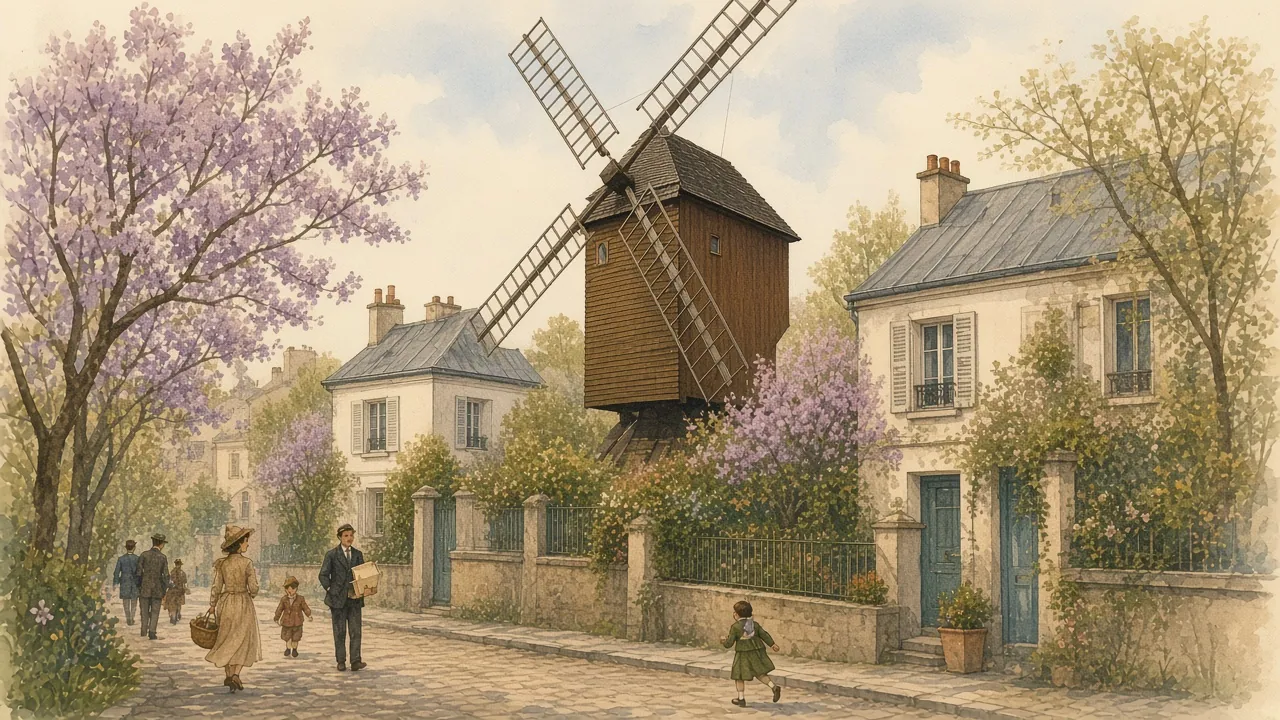
The wooden mill now known as the Moulin Radet, standing above the site associated with the old Moulin de la Galette, is the most familiar emblem of that landscape. Renoir had painted a Sunday afternoon dance there in 1876, a picture later known as Bal du moulin de la Galette, now in the Musée d’Orsay. The painting belongs to Impressionism, not to the School of Paris, but it fixed an image of the hill as a place of popular leisure that later residents inherited and sometimes contradicted. The everyday Montmartre of the early twentieth century was harsher than Renoir’s dappled scene. Rooms were cold, water was inconvenient, and many of the foreign painters who arrived after 1900 were poorer than the French Impressionists had been at the same age. What they found on the hill was not a rustic idyll but a working district at the edge of a great city, close enough to the centre for dealers and poets to visit and cheap enough for a beginner to remain.
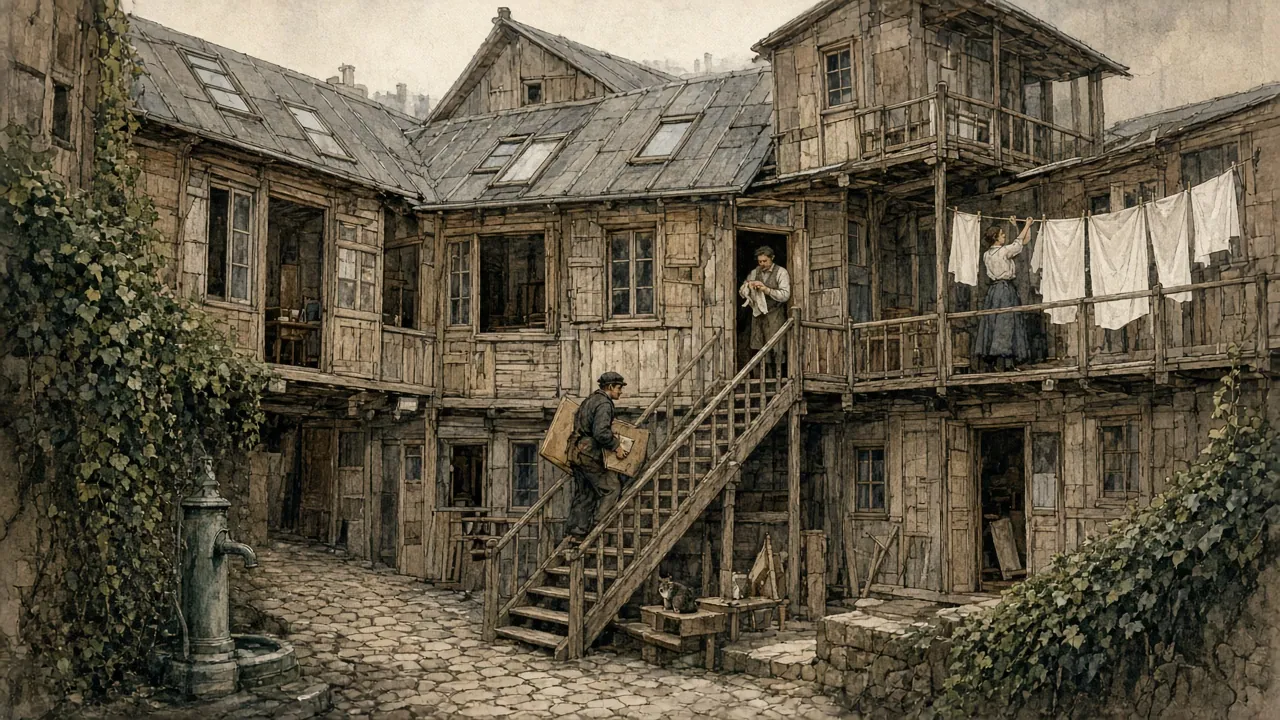
The building that concentrated this life most densely was the Bateau-Lavoir, on what is now place Émile-Goudeau, then place Ravignan.[14] It was a ramshackle wooden structure, converted from earlier industrial use, whose corridors and stacked studios reminded occupants of the laundry boats moored along the Seine, and it was from that resemblance that it took its name. The poet Max Jacob, who lodged there, helped to give the nickname currency. Studios were small, poorly heated and awkwardly lit, but they were numerous, and the building functioned as a vertical village. Pablo Picasso moved there in 1904 and remained through the years in which he painted the work that led to Les Demoiselles d’Avignon of 1907 and to his collaboration with Georges Braque.[15][16] Juan Gris took a studio in the building. Kees van Dongen worked on the hill in the same years. Fernande Olivier, Picasso’s companion, later published memoirs that are among the most detailed accounts of daily life in those rooms. The building burned in 1970, not long after it had been listed, and what stands on the site today is a later reconstruction. The historical Bateau-Lavoir lives in photographs, memoirs and the work made inside it.
Montmartre was also a literary colony. Guillaume Apollinaire, who would become the most articulate critic and poet of the pre-war avant-garde, moved through its studios and cafés and wrote about the painters he met there with a mixture of advocacy and invention. He coined or popularised names, including Cubism and later Orphism, that helped to organise public discussion even when the artists themselves were wary of labels. André Salmon and Max Jacob belonged to the same conversational world. The traffic between poets and painters was not ornamental. In a city where many foreign artists spoke imperfect French, a poet who could explain a new picture to a journalist or a collector performed a practical service. The same conversation could distort. Apollinaire’s generosity with names and analogies sometimes attributed to painters intentions they did not claim. The historian has to use his testimony with that caution, but not to discard it. Without the poets of Montmartre the early reception of Cubism and of Picasso’s circle would have been thinner and slower.
The hill’s entertainment economy supplied both income and imagery. Models recruited from dance halls and from the streets posed in the studios; café-concerts and cabarets such as the Lapin Agile offered evenings in which painters, writers and performers shared tables. Van Dongen painted the fashionable and the disreputable with a Fauve high key that later settled into a more commercial portrait manner. The risk, for later memory, is to treat this nightlife as the essence of the School of Paris. It was one setting among others, important because it made Montmartre visible to journalists and tourists, less important than the work done in daylight in cramped rooms. Many of the Eastern European arrivals of the next decade would in any case find the hill already crowded and its rents less inviting than those of the Left Bank.
A shift of gravity toward Montparnasse was under way before 1914. Studios in the fifteenth and fourteenth arrondissements, including the complex at La Ruche, offered more space for sculptors and, in some cases, better light. The cafés along the boulevard du Montparnasse began to attract the same mixture of artists and writers that had earlier filled the establishments of the Butte. The move was gradual rather than a sudden evacuation. Picasso himself later worked on the boulevard de Clichy and then in other quarters; he was never only a Montmartre painter. Utrillo and Valadon remained closely tied to the hill, and their art continued to record its streets long after Cubism had become an affair of the Left Bank and of the dealers around the rue La Boétie. Montmartre did not cease to matter. It ceased to be the sole address of the avant-garde.
The hill’s older entertainment industry had already trained a public to look at pictures of modern leisure. Posters by Toulouse-Lautrec, and the illustrated press that reproduced cabaret celebrities, meant that a painter arriving in 1904 inherited not a blank village but a visual economy in which the quarter was already famous. That fame was a resource and a distortion. It drew visitors who paid for portraits and for drinks; it also encouraged later writers to treat every studio as an annex of the Moulin Rouge. The serious work of the Bateau-Lavoir years took place at a deliberate distance from that traffic, even when the same streets supplied models and gossip.
Place Ravignan itself, a small, sloping square lined with trees and with the low buildings that later memoirs describe as looking like a ship’s superstructure, offered neither monumental views nor official dignity. It offered proximity. A painter could borrow charcoal from a neighbour, hear a poem read aloud on a landing, and walk downhill to the city in half an hour. That ordinary density, more than any single scandal, is what made Montmartre, for a few years, the most consequential artistic address in Europe.
What Montmartre contributed to the later idea of a School of Paris was therefore a prototype rather than a completed society. It showed that a poor, mixed, half-bohemian quarter could sustain radical work at a short distance from museums and official schools. It housed the invention of Cubism, which would remain the most consequential formal episode in the city’s early twentieth-century art even when many of the immigrant painters of Montparnasse took other paths. It also established a pattern of memoir and myth—the leaky studio, the loyal poet, the all-night café—that later writing about Montparnasse would repeat, sometimes at the expense of less photogenic facts about money, training and migration. The next part of the story is those facts: who came, from where, and under what pressures.
4. Arrival and the routes of migration
The foreign artists who settled in Paris between the 1890s and the 1930s did not arrive as a single wave or for a single reason. Some came from neighbouring countries with well-established academic routes to the French capital. Others left empires in which their legal status, their language or their religion limited the chance of a professional life. A smaller number travelled from much further away, drawn by reputation rather than expelled by crisis. To understand the School of Paris as a social formation rather than as a list of styles, these different routes have to be kept distinct. The Italian, Spanish and Dutch arrivals did not share the same legal disabilities as Jews from the Pale of Settlement, and the Japanese painter Tsuguharu Foujita did not cross the world for the same reasons that Chaïm Soutine left a shtetl in what is now Belarus.[17]
From the Russian Empire the journey was often an escape as well as a vocation. After the partitions of Poland, the majority of the Tsar’s Jewish subjects were confined to the Pale of Settlement, a belt of western and southern provinces in which residence, occupation and education were restricted by statute and by administrative practice. Access to the imperial capitals required special permits. Quotas limited Jewish enrolment in gymnasia and universities, especially after the reaction that followed the assassination of Alexander II in 1881 and the pogroms of that year. Further outbreaks of violence, including the Kishinev pogrom of 1903 and the wave that accompanied the revolution of 1905, made the insecurity of Jewish life in the Empire a matter of international report. Not every artist who later worked in Montparnasse was a direct fugitive from a riot. Many left in search of training that was simply unavailable to them at home, or available only on humiliating terms. The effect was the same: Paris offered schools that would take their fees, museums that did not ask for a residence permit at the door, and a city in which a Jew could walk without the special disabilities of the Pale.
The geography of this emigration can be traced in birthplaces. Chagall was born in Vitebsk, in the north-eastern Pale, in 1887, and reached Paris in 1910 or 1911 with a stipend from the lawyer and Duma deputy Maksim Vinaver.[18][17] Soutine was born in Smilovichi, near Minsk, in 1893, studied in Vilna and arrived in 1913. Michel Kikoïne and Pinchus Krémègne, close companions of Soutine from the same region, followed similar paths. Ossip Zadkine was born in Vitebsk province in 1888 and came to Paris in 1909. Jacques Lipchitz was born in Druskininkai, in present-day Lithuania, in 1891 and arrived the same year as Zadkine. Chana Orloff was born in what is now Ukraine in 1888, emigrated with her family to Ottoman Palestine and reached Paris in 1910 to study dressmaking before turning to sculpture. Sonia Delaunay, born Sarah Stern at Gradizhsk in 1885 and raised in St Petersburg, came by way of Germany.[19] These biographies are not interchangeable, but they share a corridor: from the towns and cities of the western Empire, sometimes via Vilna, Kraków or Munich, to a rented studio in Paris.
From Austrian Galicia and from the Kingdom of Poland under Russian rule came another group, often already familiar with German or Polish art schools. Moïse Kisling was born in Kraków in 1891, studied at the Academy of Fine Arts there under Józef Pankiewicz, who encouraged his pupils to look toward Paris, and arrived in 1910. Mela Muter, born Maria Melania Klingsland in Warsaw in 1876, reached Paris as early as 1901 and thus belonged to an older cohort than Kisling or Soutine.[4][5] Louis Marcoussis, born Ludwik Kazimierz Markus in Warsaw in 1878 or 1883 according to differing records, settled in Paris before the war and became one of the Polish Cubists of the city. Alice Halicka, born in Kraków, married Marcoussis and exhibited in the same circles. The Galician and Polish routes were slightly different from the Litvak one: Kraków’s academy already offered a professional formation, and Paris was chosen as an advancement rather than as a first opening.
Romania and the Hungarian lands supplied sculptors and painters who complicate any simple map of the Pale. Constantin Brancusi, born in 1876 at Hobița in rural Oltenia, trained in Craiova and at the School of Fine Arts in Bucharest before walking much of the way to Paris in 1904, a journey that later became legendary and that should be stated with care: he travelled by stages, not as a folk tale of unbroken pilgrimage.[20] He was not Jewish, and his motives were those of a highly trained sculptor seeking the centre of his art. Jules Pascin, by contrast, was born Julius Mordecai Pincas in 1885 at Vidin, on the Danube in Bulgaria, into a Sephardi merchant family; he studied and drew for the satirical weekly Simplicissimus in Munich before reaching Paris on Christmas Eve 1905.[21] His route was Balkan, Germanic and already professional. He arrived as a working draughtsman, not as a student fresh from a provincial school.
The Italian and Spanish routes were of another kind again. Amedeo Modigliani was born in Livorno in 1884 into a Sephardi family of educated, if financially unstable, circumstances. He studied in Italy, saw the frescoes and sculptures of his own peninsula, and came to Paris in 1906 because that was where modern painting was being redefined, not because Livorno had become uninhabitable. Picasso, born in Málaga in 1881 and trained in Barcelona, first visited Paris in 1900 and settled more continuously from 1904; Juan Gris, born José Victoriano González in Madrid in 1887, arrived in 1906.[15] Their Spain was not the Pale. They faced the ordinary difficulties of foreigners—language, money, the need to find dealers—but not the statutory confinement that shaped Jewish emigration from the Russian Empire. To place them beside Soutine as fellow members of a School of Paris is accurate as a description of shared streets and exhibitions. It is misleading if it implies a shared politics of departure.
From the Netherlands came Kees van Dongen, born in Delfshaven in 1877, who settled in Paris in the late 1890s and became associated with the Fauves before developing a career as a portraitist of fashionable society.[22] From Japan came Foujita, born in Tokyo in 1886, the son of a general, trained at the Tokyo School of Fine Arts, who arrived in 1913. Foujita’s presence is a useful limit-case for the category. He was a foreigner in Montparnasse, a celebrity of the 1920s and a painter whom Warnod named expressly, yet his class background, his national origin and his later wartime career in Japan separate him from the Eastern European Jews with whom he shared cafés. The School of Paris, even in its narrower sense, was never only a Jewish emigration, and to describe it honestly is to keep that plurality in view without using it to dilute the Jewish majority within the poorest studios.
Practical conditions on arrival were often harsh. Many newcomers spoke little French. They took rooms in buildings such as La Ruche, where rents were low and neighbours could translate, lend materials and explain how to submit work to a salon. They enrolled at the Académie Julian, the Académie Colarossi or the Académie de la Grande Chaumière, not always for long, because the life class there was a way of entering a professional milieu as well as a method of study.[6] They carried identity papers that had to be renewed, and they remained deportable. During the First World War, artists who were nationals of enemy states faced internment; after the war, and especially in the 1930s, French governments tightened controls on foreigners in the labour market and in public life. The image of Paris as a city that simply opened its arms to talent is a later consolation. It opened its academies and its cheap rooms, and it reserved the right to close its frontier.
Networks of origin persisted inside the city. Painters from the Vilna region found one another; Polish artists clustered around certain cafés and dealers; sculptors shared foundries and models. Yiddish was heard in La Ruche alongside Russian, Polish, Italian and heavily accented French. These networks could be a shelter and a limitation. They helped a newcomer to survive the first winter, and they could also confine reputations within an immigrant milieu that French critics already regarded with suspicion. The most successful figures eventually moved beyond them, into French-speaking friendships, into contracts with established dealers and, in some cases, into naturalisation. Chagall became a French citizen in 1937. Others never secured that protection, a fact that would become lethal after 1940.
Language marked these routes as clearly as passports did. Italian and Spanish speakers could often acquire French through Romance kinship and through the existing Mediterranean communities of the city. Yiddish- and Russian-speaking arrivals faced a steeper climb, and many remained more comfortable in the languages of home long after they had learned enough French to deal with a landlord or a dealer. The resulting multilingualism of Montparnasse—heard in studios, in La Ruche’s stair and at certain café tables—was not a picturesque garnish. It shaped who could explain their work to a critic, who needed a poet as intermediary, and who remained, in print, an object of description rather than a voice.
The routes into Paris therefore explain both the richness and the vulnerability of the colony. They brought to one city a range of training, memory and subject-matter that no national school could have generated from within. They also gathered, in a few streets of Montparnasse, a population whose right to remain could be revoked by a change of statute or of regime. The institutions that received them—the paid academies, the independent salons and the private dealers—are the next part of the machinery that made a School of Paris possible.
5. Academies, dealers and salons
The private academies of Paris did the work that official schools would not do for foreigners, for women and for students who had no intention of competing for the Prix de Rome. The Académie Julian, founded in 1868 by the painter Rodolphe Julian, accepted men and women, offered life classes throughout the week and prepared candidates for the Beaux-Arts examinations if they wished, without requiring them to follow the whole state curriculum.[6] It became a destination for Scandinavians, Americans, Eastern Europeans and many others who wanted disciplined drawing from the model in the centre of the art world. The Académie Colarossi, in the rue de la Grande-Chaumière, offered a similar regime and was likewise open to women at a time when the École des Beaux-Arts still limited their access. These were businesses as well as schools. Students paid by the month or by the class, and the quality of instruction varied with the visiting massiers and professors. What they reliably provided was a room, a model and a crowd of other beginners among whom friendships and rivalries could form.
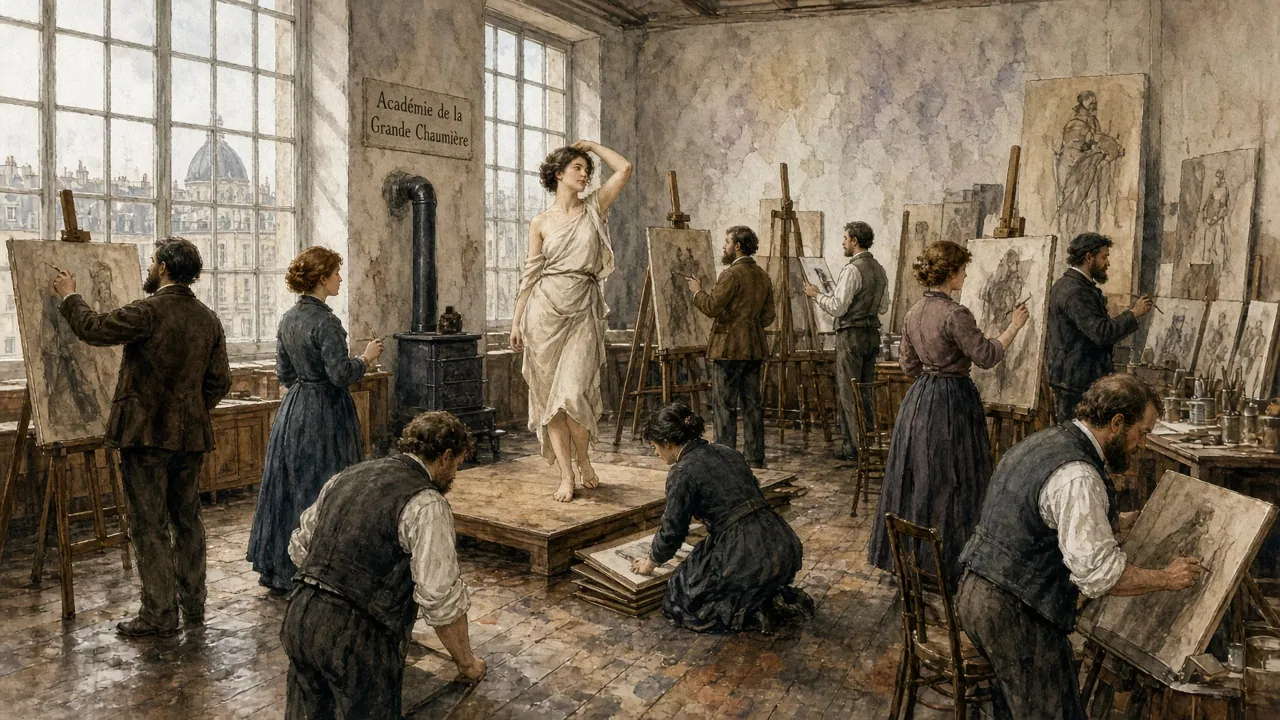
The Académie de la Grande Chaumière, established in 1904 at number 14 in the same street as Colarossi, belonged to the next phase of this economy. It stood in Montparnasse rather than in the older academic quarter, and it attracted the generation that was already looking toward independent painting rather than toward the official career. Instructors associated with it at various times included the sculptor Antoine Bourdelle, whose teaching emphasised construction and rhythm in the figure, and later painters of more modern reputation. Olga Boznańska, the Polish portraitist, taught there. The school’s croquis sessions, in which a model held short poses, trained a rapid notation that suited artists who would not spend years on a single academic figure. For an immigrant with limited money, a few months at the Grande Chaumière could be enough to learn how Parisian studios worked, where to buy canvas and which salons accepted unjuried submissions.
Matisse himself opened a school in January 1908, first in the former Couvent des Oiseaux and then in rooms at the Hôtel Biron, the eighteenth-century mansion that also housed Auguste Rodin. The Académie Matisse was small and short-lived, closing around 1911, but it is a reminder that the transmission of modern painting in Paris did not run only through large commercial academies.[23] Among those who studied with him were the German painter Hans Purrmann, the American Max Weber and Sarah Stein, sister-in-law of Gertrude Stein. Matisse insisted on drawing and on a disciplined use of colour rather than on imitation of his own recent Fauve pictures. The school’s brevity is as instructive as its existence. By 1911 the most advanced arguments in Parisian painting were moving too quickly to be housed for long in a single master’s atelier, and Matisse himself was entering a new phase of work for Russian patrons.
Beyond the studios stood the exhibiting calendar. The Salon des Indépendants, with its rule of neither jury nor prizes, remained the most accessible large show for a newcomer. The Salon d’Automne, founded in 1903, was more selective but still far more open than the official Salon, and it carried a prestige that the Indépendants, precisely because they accepted almost everyone, could not always match. In 1923 the Salon des Tuileries was added to this ecology. Sending in pictures required frames, cartage and hanging fees that poor artists struggled to meet; friends carried one another’s work, and dealers sometimes advanced the cost for painters they hoped to sign. A favourable notice in a daily paper such as Comœdia or Gil Blas, or in a journal such as Guillaume Apollinaire’s Les Soirées de Paris, could matter more than a medal. The salons were not only places of display. They were labour markets in which a critic, a collector or a dealer might stop in front of a canvas by an unknown foreigner and decide to enquire after the address.
The dealers who made those enquiries formed a second, decisive institution. Ambroise Vollard has already been mentioned as a pioneer in the 1890s and early 1900s. Daniel-Henry Kahnweiler, a German from Mannheim, opened a small gallery in the rue Vignon in 1907 and soon bound Picasso, Braque, Derain, Vlaminck, van Dongen and later Juan Gris to exclusive contracts.[24] Kahnweiler paid his artists a regular stipend in exchange for their production, a practice that gave them a measure of security and gave him control of a tightly held stock. Because he was German, the French state sequestered his gallery when war broke out in 1914, and the stock was later sold at auction in a series of sales that dispersed Cubist pictures and damaged the artists’ prices. Léonce Rosenberg, through his Galerie de l’Effort Moderne, stepped into part of that vacancy and continued to support Cubist and related work. His brother Paul Rosenberg, with a gallery in the rue La Boétie, became Picasso’s principal dealer in the interwar years and also handled other leading modernists; he fled to New York after 1940, taking part of his stock and helping to shift the market westward.
A different kind of dealer served the poorer painters of Montparnasse. Léopold Zborowski, a Polish poet who had come to Paris before the war, became the principal supporter of Modigliani and, for a time, of Soutine. He was not a gallery owner on the scale of the Rosenbergs. He advanced money, found rooms, arranged sittings and sold pictures as he could, sometimes to his own lasting debt. Paul Guillaume, who began with African sculpture and with the patronage of the collector and poet Guillaume Apollinaire’s circle, exhibited Modigliani and Soutine and helped to introduce their work to a richer clientele, including the American collector Albert C. Barnes, whose purchases of Soutine in the 1920s transformed that painter’s material life. Berthe Weill continued to show the young and the unsaleable.[11] Adolphe Basler, Pierre Loeb of the Galerie Pierre, Jeanne Bucher and the Galerie Bing belonged to later phases of the same network, linking the pre-war colony to the Surrealists and, after 1945, to abstract painters such as Maria Helena Vieira da Silva and Zao Wou-Ki.
These commercial relationships were not merely a background to style. They determined who could afford to go on working and whose pictures circulated in reproduction. Kahnweiler’s contracts help to explain why Picasso and Braque, during the crucial Cubist years, exhibited so little in the large salons: their dealer preferred to sell privately to a small group of collectors, among them the Russians Sergei Shchukin and Ivan Morozov and the Americans Leo and Gertrude Stein. Zborowski’s relative poverty helps to explain why Modigliani, despite a growing reputation among artists, died without financial security. Barnes’s intervention helps to explain why Soutine, almost unknown to the general public in 1922, could suddenly pay his debts and leave the worst rooms of La Ruche. A history of the School of Paris that attended only to canvases and ignored these intermediaries would miss the mechanism by which a foreign painter became, or failed to become, a name.
Collectors and salon hosts completed the machinery. The Steins—Gertrude, her brother Leo and their brother Michael with his wife Sarah—kept open rooms in which new pictures were hung and argued over, and their Saturday evenings gave isolated artists a glimpse of a cosmopolitan audience. Shchukin and Morozov, buying in bulk from Matisse, Picasso and others before 1914, removed a large body of Parisian modernism to Moscow, where it would later form the core of Russian museum holdings. After the war, American collectors became more numerous. The traffic was two-way: pictures left Paris, and the city’s reputation as the place where such pictures were made grew stronger abroad, drawing still more students in the opposite direction.
The hanging of the large independent salons was itself a social art. Works were grouped, sometimes by nationality or by friendship, more often by the accidents of arrival and of the hanging committee’s patience. A foreign painter might find a canvas skied, placed too high to be judged fairly, or set beside pictures that made it look crude or timid. Complaints about hanging are a refrain in memoirs and letters; they should be read as evidence that the salons mattered, not merely as grumbling. If they had not mattered, no one would have quarrelled about the wall.
The academies, salons and galleries did not create a school in Warnod’s later sense. They created the conditions under which a school-like concentration could persist. A painter could learn to draw in the rue de la Grande-Chaumière, hang a canvas at the Indépendants, meet a poet who knew a dealer, and, if luck and talent aligned, exchange the insecurity of piece sales for a contract. Most newcomers never travelled the whole of that path. The ones who did became the names around which the idea of a School of Paris would later be organised. Among the French artists who had already altered the city’s painting before many of those newcomers arrived, none was more important than Matisse.
6. Matisse and the Fauves
Henri Matisse was born on 31 December 1869 at Le Cateau-Cambrésis, in the industrial north of France, and trained first in law before entering the studio of Gustave Moreau at the École des Beaux-Arts. Moreau’s teaching, unusually liberal for an official professor, encouraged close looking at the Old Masters and a personal use of colour. Matisse copied in the Louvre, painted still lifes of a sombre Dutch tonality and, in the late 1890s, lightened his palette under the influence of Impressionism and of Signac’s Neo-Impressionism. Luxe, Calme et Volupté, painted in 1904 after a stay with Signac at Saint-Tropez and now in the Musée d’Orsay, applies divided colour to a pastoral bathing scene whose title quotes Baudelaire. It is a transitional picture, still tied to Neo-Impressionist method, already moving toward the flatter, more arbitrary colour that would shortly be called Fauve.
The name itself was coined in mockery. At the Salon d’Automne of 1905, room VII contained works by Matisse, Derain, Vlaminck, van Dongen and others whose high, unmodulated colour and summary drawing startled visitors.[25][23] Among Matisse’s exhibits was Woman with a Hat, a portrait of his wife Amélie now in the San Francisco Museum of Modern Art, in which the face is constructed from patches of green, yellow and vermilion that do not describe local flesh tones. The Open Window, painted at Collioure that summer and now in the National Gallery of Art in Washington, treats the view through a balcony as a construction of complementary colours rather than as a receding landscape. Louis Vauxcelles, noticing a Renaissance-style sculpture in the same room, remarked that it was Donatello among the wild beasts, donatello parmi les fauves. The label, like Cubism a few years later, outlived the joke. Fauvism as a group style lasted only a short time, roughly from 1905 to 1907 or 1908, but it established colour as an independent structural force in Parisian painting and made Matisse, overnight, the most conspicuous figure of the new art.
Derain and Vlaminck had reached a related intensity by another route. The two men worked together at Chatou, on the Seine west of Paris, and painted the river, its barges and its suburban restaurants in strokes of pure colour laid side by side.[26][27] Derain joined Matisse at Collioure in the summer of 1905, and the pictures they produced there—fishing boats, the harbour, the mountains behind the town—are among the canonical Fauve landscapes. In 1906 Vollard sent Derain to London, where he painted the Thames, Westminster and Hyde Park in the same high key, a deliberate reply to Monet’s earlier London series and a demonstration that Fauve colour could be applied to a northern city as well as to Mediterranean light. Vlaminck, more self-taught and more inclined to proclaim his independence of museums, pushed the same language toward a rawness that later settled, after he abandoned Fauvism, into a darker and more conservative manner. Van Dongen, Dutch-born and already in Paris, brought Fauve colour to the figure and to the nightlife of Montmartre before becoming, in the 1910s and 1920s, a painter of elongated, fashionable portraits. These artists were colleagues and rivals rather than pupils. Fauvism had no manifesto and no membership list.
Matisse did not remain a Fauve. Le Bonheur de vivre, painted in 1905–06 and now in the Barnes Foundation, organises nudes in a landscape of saturated, enclosed colour and linear rhythm; it looks back to pastoral tradition and forward to the large decorations of the following years. The Blue Nude of 1907, a reclining figure whose contour and volume are built from cool colour, provoked outrage when shown at the Indépendants and again in America at the Armory Show of 1913. In 1909–10 Matisse painted Dance and Music for the Moscow mansion of Sergei Shchukin, monumental canvases in which a handful of figures, a strong outline and a few large colour fields carry the entire expressive burden. The versions now in the Hermitage, together with related works, mark a shift from the broken touch of 1905 toward a decorative classicism that would remain one of his poles. The Red Studio of 1911, in the Museum of Modern Art in New York, flattens his working room into a single field of Venetian red against which pictures, sculptures and furniture appear as schematic signs of a life devoted to making.
Two journeys to Morocco in 1912 and 1913, and the years spent in Nice from 1917 onward, further altered the work. The Moroccan pictures treat gardens, doorways and clothed figures with a new calm and with a light that is observed as well as invented. The Nice interiors—odalisques, screens, violets, the sea beyond a shuttered window—have sometimes been read as a retreat from avant-garde combat into a private hedonism. They are better understood as a continuation of Matisse’s central problem, the reconciliation of figure, pattern and the surface of the canvas, under conditions of prolonged looking. He was not a member of the Montparnasse immigrant colony, and he did not share its poverty or its legal insecurity. He exhibited alongside some of its painters and was admired by others, Chagall among them, for the emancipation of colour. To include him in a history of the School of Paris is necessary because he defined the French modern painting against which foreigners measured themselves. To enrol him as one more name in Warnod’s list would be to flatten a career that belongs first to the history of French art.
The distinction is practical as well as patriotic. Matisse had a dealer, a growing international clientele and, after the difficult early years, a household that could support concentrated work. He taught, briefly, as has been seen. He argued, in notes of 1908 published as “Notes d’un peintre”, that colour and composition should serve expression rather than the mere copying of appearances, a statement that became one of the most widely read documents of modern painting. None of this resembles the situation of a newly arrived sculptor at La Ruche. The Fauve episode, however, did touch the immigrant world directly. Van Dongen’s passage through the group gave a foreign painter a place at the centre of a French scandal. The high colour of 1905 licensed later artists, including Chagall and Kisling, to treat hue as something other than description. And the speed with which a mocking phrase became a historical category offered a precedent, twenty years later, for the equally unstable name École de Paris.
Shchukin’s commissions give a useful measure of Matisse’s distance from the Montparnasse immigrant economy. A Moscow merchant could order monumental canvases, pay for them and hang them in a palace staircase, while a painter at La Ruche might be unable to afford the cartage of a salon submission. The comparison is not a moral against Matisse, who had known lean years and who earned his patrons by the force of the work. It is a reminder that “Paris” named, at the same moment, several art worlds stacked in one city, communicating through exhibitions and through conversation but not sharing a single degree of security.
The 1908 “Notes d’un peintre” repay rereading in this light. Matisse wrote that he wanted an art of balance, purity and serenity, without troubling or depressing subject-matter, something like a good armchair for a tired businessman. The sentence has been mocked as bourgeois and defended as a claim for painting’s autonomous calm. Either way, it is remote from Soutine’s carcasses and from Chagall’s burning synagogues of 1938. The School of Paris, if the name is stretched to include both Matisse and those painters, must be understood as a city of adjoining rooms rather than as a shared temperament.
Derain’s later career illustrates another fate available to French painters of the same generation. After Cubism had appeared he moved toward a more sombre, classicising manner, studying the Old Masters and painting figures and landscapes that seemed to many contemporaries a betrayal of his Fauve brilliance. Vlaminck followed a parallel, more bitter course and in the 1930s and 1940s expressed himself with a conservatism that shaded into political rancour; his conduct under the Occupation has remained a subject of severe historical judgement. These afterlives matter for the present story because they show that “French” and “modern” did not remain aligned. By the interwar years some of the original Fauves had become spokesmen for a return to tradition, while much of the most adventurous painting in Paris was being done by foreigners whom those same voices were prepared to treat as outsiders. The next rupture, Cubism, would be even harder to nationalise, because its principal inventor was a Spaniard working in a wooden building on a Paris hill.
7. Picasso, Cubism and companions
Pablo Ruiz Picasso was born in Málaga on 25 October 1881, the son of a drawing teacher, and trained in Barcelona, where the café Els Quatre Gats gave him an early bohemian audience. He first visited Paris in 1900, at the time of the Universal Exhibition, and in 1901 Vollard gave him a show in the rue Laffitte.[15] Between that date and 1904 he moved back and forth between Spain and France, painting the thin, monochrome figures of the so-called Blue Period—beggars, blind men, women with children—whose pathos and attenuated drawing still look toward fin-de-siècle Symbolism as much as toward the century to come. From about 1904 to 1906, now settled at the Bateau-Lavoir, he lightened the palette into the rose and ochre of the circus pictures, harlequins and acrobats that dealers and poets found easier to love. The Portrait of Gertrude Stein, painted in 1905–06 and now in the Metropolitan Museum of Art, already hardens the face toward the mask-like simplicity that would shortly serve a more radical purpose.
Les Demoiselles d’Avignon, painted in Paris in June and July 1907 after months of drawings and now in the Museum of Modern Art in New York, is the hinge of this career and one of the hinges of modern art.[15][16] The canvas, more than eight feet high, presents five nudes in a shallow space, their bodies faceted and compressed, two of the heads on the right violently recast in forms that register Picasso’s looking at Iberian stone carvings and at African and Oceanic masks then visible in Parisian ethnographic collections, notably at the Trocadéro. The title, which attaches the figures to a street in Barcelona’s brothel district, was not used at first and became current around the time of the picture’s first public exhibition in 1916. Kahnweiler later called the painting the beginning of Cubism. Other observers have resisted that label, because the work is stylistically disunited and because the collaborative Cubism of Picasso and Braque took a further two years to clarify. What is not in doubt is the shock it produced among the few who saw it in the studio, and the permission it gave for a figure to be constructed from broken planes rather than from observed contour.
Georges Braque, born at Argenteuil in 1882 and trained in Le Havre as well as in Paris, had come through a Fauve phase before seeing what Picasso was doing. In 1908 he painted landscapes at L’Estaque, near Marseille, in which houses and trees are reduced to ochre and green volumes; Vauxcelles, reviewing them, spoke of cubes, and the name Cubism entered circulation.[28] From 1909 until the outbreak of war the two men worked in a closeness that is rare in the history of painting, looking at each other’s canvases, sometimes omitting signatures, and pushing a shared analysis of objects through what historians later divided into Analytic and Synthetic phases. In the Analytic pictures of 1910–12, such as Picasso’s portrait of Kahnweiler or Braque’s canvases of glasses, violins and tabletops, the object is broken into a scaffold of small, tilted planes, the palette is restricted to greys, ochres and greens, and space becomes a shallow shimmer rather than a box receding to a vanishing point. In 1912 both artists introduced pasted paper—Braque’s fruit-dish with a wood-grain wallpaper, Picasso’s Still Life with Chair Caning, with its printed oilcloth and rope frame—and thereby invented collage as a high-art procedure. Letters, numbers and fragments of newspaper entered the picture as facts rather than as illusions.
Juan Gris, who arrived from Madrid in 1906 and at first earned a living as an illustrator, joined this enterprise with a clearer geometry and a more systematic colour.[29] His Portrait of Picasso of 1912, and the still lifes of the following years, organise bottles, guitars and checkerboards into architectures that can seem, by comparison with Picasso’s restlessness, almost classical. Gris worked under contract to Kahnweiler and remained, until his early death in 1927, the most theoretically consistent of the Cubist painters. Fernand Léger, born at Argentan in 1881, took another path out of the same years.[30] His Contrastes de formes of 1913 treat volumes as tubular and mechanical, and after he was mobilised and served at the front he painted The Card Players of 1917 and The City of 1919, pictures in which the human figure and the modern street are rebuilt from disks, stencilled lettering and unmodulated colour. Léger had occupied a studio at La Ruche from 1908, a fact that ties this French painter to the same building as Chagall and Soutine without making him an artist of the same kind.
Cubism was never the private property of a single studio, and by 1912 a wider circle—Albert Gleizes, Jean Metzinger, Robert Delaunay, Francis Picabia, the Duchamp brothers and others—exhibited as the Section d’Or. Picasso and Braque did not take part. The distinction is worth keeping. The salon Cubists published treatises, sought a public and, in Gleizes and Metzinger’s Du Cubisme of 1912, tried to explain the new painting as a philosophical method. Picasso and Braque, protected and somewhat isolated by Kahnweiler, worked with less explanation and with a fiercer loyalty to the motif in front of them, however transformed. Apollinaire, writing across both groups, supplied much of the public language, including later the name Orphism for the Delaunays’ turn toward colour and light. The resulting map is untidy, as contemporary movements usually are. What matters for the School of Paris is that Cubism established, in the years just before the war, the most powerful new syntax available in the city, and that foreigners as well as French painters had to decide what to do with it.
Some absorbed it and passed through. Chagall used its shattered planes and tilted space in pictures such as I and the Village without surrendering narrative or memory.[18][17] Lipchitz and Archipenko translated its faceting into sculpture. Others, including Modigliani and Soutine, took little from it as a system, though neither could have been unaware of it. Picasso himself never became a typical figure of the Montparnasse immigrant world. He was Spanish, not a refugee from the Pale; he found dealers early; he moved, after the Bateau-Lavoir, through a succession of more adequate studios; and by the 1920s he was wealthy enough to stand outside the economic precariousness that defined so many of his neighbours’ lives. He remains indispensable to this history because the city in which the School of Paris formed was also the city in which Cubism was invented, and because later debates about foreignness in French art could never quite decide whether the Spaniard who had changed painting was a trophy or a problem.
The Steins’ Saturday evenings, at which early works by Picasso and Matisse hung in rooms that also received poets, collectors and the merely curious, gave Cubism a private public before it had a salon public. Leo Stein’s later estrangement from Picasso and Gertrude Stein’s continued advocacy are part of the social history of the pictures; they are not an explanation of the pictures. What the evenings demonstrate is that the most radical painting in Paris around 1906–08 was being argued over in apartments as much as in official rooms, and that an American family could, for a few years, serve as a clearing house for reputations that French institutions had not yet decided how to handle.
Braque’s pre-war still lifes of musical instruments deserve emphasis beside the more famous figure pictures. Violins, clarinets and sheet music allowed both him and Picasso to test how an object known by touch as well as by sight might be disassembled and re-spelled on a flat surface. The choice of motif was not incidental. A guitar or a violin is already a constructed thing, a box designed to resonate; Cubism, in these canvases, rhymes its own constructedness with that of the instrument. Léger’s tubular forms after 1913 take a related modern object-world—factory chimneys, stencilled letters, the city as machinery—and give it a more public, almost mural, scale. The distance between a small Braque violin and Léger’s The City is the distance between a table and a street, not between two unrelated arts.
The war broke the partnership. Braque was mobilised, gravely wounded at Carency in 1915 and spent a long convalescence before returning to work in a more measured, post-Cubist manner. Picasso, as a Spanish national, was not called up. He remained in Paris and in Avignon, painted the portrait of Ambroise Vollard in 1915 in a meticulous pointillist-Cubist hybrid, and in 1917 went to Rome with Jean Cocteau to design Parade for Sergei Diaghilev’s Ballets Russes, a journey that confirmed his growing classicism. Léger’s wartime experience entered his painting as a fascination with machinery and with the collective figure of the soldier and the worker. Gris, also a Spaniard, stayed and continued to refine Synthetic Cubism under difficult material conditions. The movement that had been a daily conversation in a few studios became, after 1918, a language that could be taught, sold and, in the retour à l’ordre of the early 1920s, partly recanted. Its inventors went on working, but they no longer worked as a pair, and the city that had housed their experiment now housed a much larger and more visibly foreign colony on the other bank of the river.
8. The Delaunays and colour
Robert Delaunay was born in Paris in 1885 and therefore stands, by birth, among the French painters of his generation rather than among the immigrants of Montparnasse. His early work passed through Impressionist and Neo-Impressionist influences before he began, around 1909, a series of pictures of the church of Saint-Séverin in which Gothic interior space is bent and coloured toward a personal construction. The Eiffel Tower then became his great motif. In canvases of 1910 and after, the tower tilts, fragments and reforms against the roofs of the Champ de Mars, a modern monument treated not as a stable emblem but as an object seen in successive glances. The City of Paris of 1910–12, a large triptych-like composition, combines the tower, the river and the Three Graces in a deliberately ambitious bid to paint the metropolis as both allegory and sensation. These pictures are Cubist in their broken planes and independent in their insistence on colour as the primary agent of structure.
Sonia Delaunay, born Sarah Stern at Gradizhsk, in present-day Ukraine, in 1885 and brought up in St Petersburg, arrived at this language by a different road.[19] She studied in Germany before settling in Paris and in 1910 married Robert. Her earliest notable works in the city already treat patchwork, folk textile and the unexpected juxtaposition of colours as serious pictorial means. In 1913 she and Robert became associated with the poetry of Blaise Cendrars; she bound his prose poem La Prose du Transsibérien et de la petite Jehanne de France into a folded, two-metre sheet of simultaneous colour, one of the period’s most successful unions of text and abstract design. The same year she painted Prismes électriques, taking the new street lighting of Paris as a source of circular, radiating colour, and she appeared at the Bal Bullier in a dress constructed on the same principle of simultaneous contrast. The word simultané, borrowed in part from the colour theory of Michel-Eugène Chevreul and from the rhetoric of modern speed, became the couple’s emblem.
Apollinaire, always ready with a name, called their art Orphism, evoking both Orpheus and a painting that would work on the senses as music does, without obligatory reference to objects.[31][32][19] The label has never been a perfect fit. Robert’s Windows series of 1912, the Fenêtres simultanées, still takes the view through a window as a starting point even as it dissolves that view into stained rectangles of colour. Sonia’s electric prisms are closer to non-figuration, yet they remain attached to an experience of the modern city. What distinguished the Delaunays from Picasso and Braque was not a wish to abandon the world but a wish to reconstruct it through colour relations rather than through the analysis of volume. In that respect they stand nearer to Matisse than to Kahnweiler’s Cubists, though their rhythm and their urban motifs are their own.
The war sent them to Spain and Portugal, where Sonia opened a design workshop, Casa Sonia, applying simultaneous colour to interiors, clothing and decorative objects. The move from easel to design was not a fall from purity. It followed from her training and from a conviction that modern colour should enter daily life. After their return to Paris she opened the Boutique simultanée and, through the 1920s, worked with dressmakers, embroiderers and, at times, with the world of fashion and performance, including collaborations connected with the Ballets Russes milieu. Robert continued to paint disks, circular forms and, later, rhythmical compositions that moved further into abstraction. He died at Montpellier in 1941. Sonia lived until 1979, long enough to see a late-century revaluation that placed her not as her husband’s decorative collaborator but as a central inventor of abstract colour in Western art.
Their place in a history of the School of Paris is therefore double. Robert, French-born and Cubist-adjacent, belongs to the wide sense of the term: a Parisian modernist whose principal subjects were the monuments and lights of his own city. Sonia, an immigrant Jewish artist who became a French citizen and who moved fluently between painting, dress and interior design, belongs also to the narrower sense, though her success and her versatility separate her from the struggling painters of La Ruche. Together they demonstrate that abstraction in Paris did not have to wait for the years after 1945. It was already being practised, in colour rather than in gesture, in the decade before the First World War, and it was being practised by a husband and wife whose national origins illustrate the city’s mixture more neatly than any programme could have arranged.
Robert’s Hommage to Blériot of 1914, painted after Louis Blériot’s Channel flight had already become a popular modern myth, extends the Eiffel Tower pictures into a celebration of aviation, with circular forms, propeller-like rhythms and the tower itself caught in a wheel of colour. The picture is useful because it shows how far Orphism, if the name is retained, remained attached to public events and to the iconography of technological modernity, rather than withdrawing into a private music of shapes. In the same pre-war moment Sonia’s applications of simultaneous colour to bookbinding, waistcoats and household objects were not sidelines. They tested whether a pictorial idea could survive contact with use, a test that Cubist collage approached from the opposite direction by bringing fragments of use into the picture.
The years in Portugal produced a body of work that is still under-exhibited beside the Paris pictures. Sonia’s market and still-life paintings of 1915–16 construct heaps of fruit, pottery and popular fabrics from large, abutting colours, a constructive gaiety that has little to do with wartime austerity and a great deal to do with looking at Iberian popular art with a modern eye. Robert painted windows, disks and Portuguese townscapes in which heat and tile are translated into the same circular grammar he had used for Parisian electric light. When they returned to Paris, the Boutique simultanée and Sonia’s collaboration with fashion houses, including work shown in the orbit of the 1925 Exposition internationale des arts décoratifs, placed her at a crossing of painting and design that later histories of “pure” modernism were inclined to treat as a descent. The present essay treats it as an expansion. A school defined by Parisian modernity cannot, without inconsistency, honour the Eiffel Tower in oil and ignore the same modernity when it is sewn into a coat.
Robert’s later Disks and Rhythms of the 1930s push further into non-figuration, organising circular and cadenced forms that no longer need the tower as an alibi. After his death in 1941, Sonia’s long widowhood was also a long working life: stage design, mosaics, a commissioned car, and paintings that returned to colour as an architectural force. Late public works, including contributions to institutional interiors, made visible to a wide audience an art that had begun, before 1914, in a private dialogue between two painters and a few poets. The Delaunays thus bookend the larger story. They show abstraction beginning inside the first School of Paris’s chronological frame, and they show a foreign-born woman artist remaining central to Parisian modernism long after Montparnasse’s figurative colony had been destroyed or dispersed.
The Delaunays also help to correct a map that would place all innovation in painting and all foreignness in Montparnasse. They lived and worked in various Left Bank and other addresses; their intellectual friendships ran toward poets—Cendrars, Apollinaire—and toward a European discussion of simultaneity that included Italian Futurists even when personal relations were wary. Their art is urban without being café art, abstract without being doctrinaire, and decorative without apology. In a story too easily divided between tragic immigrant painters and triumphant French masters, they occupy a third position that the name School of Paris, at its most elastic, was meant to hold: the position of artists who used Paris as both subject and instrument.
9. Montparnasse and La Ruche
By about 1910 the centre of independent artistic life in Paris was moving from the Butte Montmartre to the Left Bank quarter of Montparnasse.[33] The reasons were practical. Rents on the hill had risen as tourists and night establishments multiplied; studios large enough for sculpture were scarce; and a cluster of private academies had already established themselves in the rue de la Grande-Chaumière, a short walk from the boulevard du Montparnasse. The fourteenth and fifteenth arrondissements still contained workshops, market gardens and leftover exhibition buildings, and they offered a mixture of cheap rooms and good north light that sculptors in particular required. The shift was never absolute. Utrillo continued to paint Montmartre streets, and Picasso moved among several addresses. Yet the cafés, dealers’ gossip and the nightly circulation of models and poets increasingly ran along the axis that joined the Gare Montparnasse to the observatory and, westward, to the studios of Vaugirard.
No building concentrated that life more densely than La Ruche, at 2 passage Dantzig in the fifteenth arrondissement. In 1902 the sculptor Alfred Boucher, who had enjoyed official success and wished to help younger artists, reassembled on a plot he had bought at Vaugirard a polygonal iron-and-brick rotunda left over from the Universal Exhibition of 1900, where it had served as a wine pavilion and had been constructed by teams associated with Gustave Eiffel.[12][13] Around this three-storey hive, with its large glazed studios and a ribbed roof rising to a lantern, he added further pavilions in a garden of acacias. Sculptors tended to take the ground floor, where they could move stone and plaster; painters climbed to the better-lit rooms above. Rents were low, sometimes deferred. At its most crowded the complex and its annexes housed well over a hundred studios. The artists themselves supplied the name, comparing the circular building and its busy cells to a beehive.
The list of those who lived or worked there reads like a cross-section of the future School of Paris, though it is important not to turn the building into a myth of constant collaboration. Fernand Léger took a studio in 1908. Marc Chagall arrived in 1910 or 1911 and painted, in those cramped rooms, some of the first pictures in which Vitebsk memory and Parisian modernism meet, including I and the Village of 1911.[18][17] Alexander Archipenko and Henri Laurens worked there as sculptors. Chaïm Soutine endured some of his poorest years in the complex and, according to later accounts, obtained animal carcasses from the nearby Vaugirard slaughterhouses to paint in his studio, to the distress of neighbours. Moïse Kisling and Michel Kikoïne, Soutine’s companions from the Vilna years, belonged to the same orbit. Ossip Zadkine and, at times, Constantin Brancusi were associated with the place, as were poets including Blaise Cendrars and Max Jacob. Modigliani visited friends there more often than he resided. The building was not a manifesto and not a closed society. It was an address at which an immigrant without money could find a room, a translator and a first introduction to the city’s exhibiting habits.
The cafés of the boulevard performed a complementary function. Le Dôme, which had opened at the end of the nineteenth century, and La Rotonde, which opened in 1911 under Victor Libion, stood almost opposite each other at the crossing of the boulevard du Montparnasse and the boulevard Raspail. Libion became famous for allowing impoverished artists to sit for long hours over a single coffee and, at times, for accepting a drawing in lieu of payment. Le Select opened in 1925, the year of Warnod’s article; La Coupole, a vast brasserie with decorated pillars, followed in 1927 and announced that Montparnasse had become a destination as well as a refuge. These establishments were not interchangeable. The Dôme had a reputation, especially before 1914, as a meeting place for German and Scandinavian artists; the Rotonde drew a more Latin and Slavic crowd; the later houses served a mixed public of painters, tourists and the fashionable people who came to look at them. Credit, gossip, the borrowing of models and the first approach of a dealer all passed across their tables.
Other streets completed the map. The rue de la Grande-Chaumière held the academies already described. The Cité Falguière, a lane of studios near La Ruche, housed Modigliani at one period and other sculptors and painters who needed space and quiet. The Impasse Ronsin, further into the fifteenth arrondissement, became the long-term address of Brancusi, whose white studio, filled with soaring and ovoid plaster forms on stacked wooden bases, was itself a work he arranged and rearranged until the end of his life.[34][20] Dealers did not, as a rule, open their principal galleries in Montparnasse; the more prosperous premises lay north of the river, in the rue La Boétie and around the Madeleine. The quarter supplied production and sociability. The right bank, increasingly, supplied money.
Daily life in these streets was less picturesque than later memoirs suggest. Rooms were cold, infestation was common, and many painters depended on a single sympathetic restaurant or on parcels from home. Models, often women who also worked in cafés or music halls, were paid irregularly and formed their own networks of information about which artists paid and which did not. The police required foreigners to carry papers, and raids were not unknown. Yet the concentration was real and productive. A sculptor could walk from a life class to a foundry; a painter could carry a wet canvas to a café and find, on some evenings, a critic willing to look at it. The same density made the colony visible, and visibility was a mixed blessing. By the mid-1920s Montparnasse had become a subject for illustrated papers, and the foreignness of its artists a subject for polemic.
Writers supplied the quarter with a verbal legend that painters could not entirely control. Memoirs by Jean Cocteau, André Salmon, Fernande Olivier, Kiki de Montparnasse and later Marevna have fixed scenes of unpaid bills, borrowed coats and sudden generosity. These texts are indispensable and unreliable in equal measure. They preserve names, addresses and atmospheres; they also arrange lives into anecdotes that flatter the narrator’s intimacy with genius. The present essay uses them as collateral evidence, not as a substitute for pictures, contracts and dates.
A quieter infrastructure supported the cafés’ theatre. Colour merchants, stretcher-makers, plaster-casters and the foundries that turned clay and plaster into bronze were as necessary as any critic. Sculptors in particular depended on this trade. The romantic image of the isolated creator dissolves as soon as one asks how a limestone head was moved down a staircase, or how a bronze was paid for before it was sold. La Ruche’s mixture of cheap rooms and shared facilities was, among other things, a way of socialising those costs.
The war of 1914 scattered the quarter without destroying it. Enemy nationals faced internment; French artists were mobilised; some of the Eastern Europeans returned home and could not easily come back until the 1920s. After 1918 the colony reconstituted itself on a larger scale, swollen by new arrivals fleeing civil war, pogroms and economic collapse in the former Russian Empire and by Americans and other Westerners drawn by a favourable exchange rate. The Montparnasse of the 1920s was therefore both a continuation of La Ruche’s pre-war poverty and something more conspicuous: a recognised international scene, complete with celebrities such as Foujita and with tourists in search of bohemia. Warnod’s name, when it came in 1925, attached itself to this visible world. The next chapters examine the painters and sculptors who, more than any general label, gave that world its lasting artistic substance, beginning with the Italian who remains, for many readers, its most immediately recognisable figure.
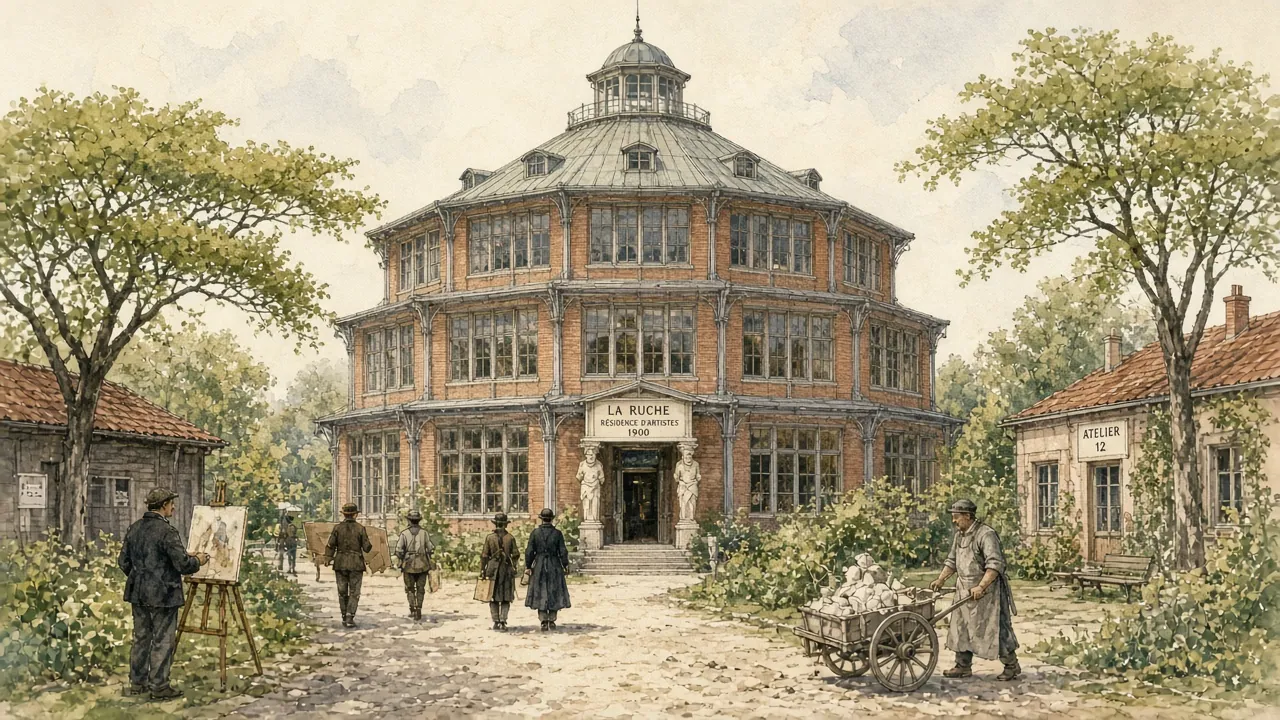
10. Modigliani
Amedeo Modigliani was born in Livorno on 12 July 1884, the fourth child of a Sephardi family whose fortunes had declined. He studied in Italy, saw the frescoes and sculptures of his own peninsula, and arrived in Paris in 1906, not as a refugee from violence but as a young painter convinced that the modern argument was being conducted there. He enrolled at the Académie Colarossi, drew compulsively, and moved through the studios of Montmartre, including the circle around the Bateau-Lavoir, before settling more lastingly on the Left Bank. Early portraits and drawings already show a search for simplification, but the decisive turn in his work came through sculpture.
Between about 1909 and 1914 Modigliani carved a series of limestone heads and caryatids, working in a manner closely related to that of Constantin Brancusi, whom he knew and admired. The heads, of which Woman’s Head in the Metropolitan Museum of Art is a characteristic example, have elongated oval faces, attenuated noses, and eyes reduced to slits or shallow incisions. They draw on African and Cycladic sculpture as these were then visible in Paris, and on a personal ideal of archaic calm. Stone was expensive, dust was dangerous to a man already troubled by tuberculosis, and the physical labour of carving in poor rooms was severe. By the middle of the war he had largely abandoned sculpture for painting, taking into oil the elongations and mask-like simplifications he had found in stone. The paintings are not coloured sculptures, but they are unthinkable without that sculptural discipline.
From 1916 the Polish poet and dealer Léopold Zborowski became his principal support, advancing money, finding models and attempting to create a market. The portraits of these years—of Zborowski himself, of Max Jacob, of Chaim Soutine, of the painter Moïse Kisling, of Jeanne Hébuterne—reduce the sitter to a few decisive relations of neck, shoulder and oval head, often against a flat, unmodulated ground. The eyes are frequently left without pupils, a device that can seem blank or interior according to the canvas. These are not society portraits in the manner van Dongen would perfect. They are reconstructions of persons as linear architecture, and they vary more than a casual glance suggests: some are tender, some are satirical, some, especially the portraits of men from the Montparnasse circle, have a gaunt severity.
The nudes of 1916 and 1917, including the reclining figures of which one, now widely known as Nu couché, has become among the most famous pictures of the century, apply the same elongation to the whole body. Torsos are stretched, hips and shoulders simplified into long curves, and the faces retain the mask-like oval of the stone heads. In December 1917 Berthe Weill gave Modigliani a solo exhibition in her small gallery.[11] A nude visible from the street, painted with a frankness that included pubic hair, prompted police intervention and the temporary closure of the show. The scandal did little for Modigliani’s immediate income. It did confirm that his nudes were being seen as a provocation rather than as a continuation of a long European tradition of the reclining Venus, a tradition he in fact knew well and had stripped of its mythological alibis.
Jeanne Hébuterne, a young painter whom he met in 1917, became his companion and the mother of a daughter, also named Jeanne, born in November 1918. During the last year of the war the pair lived in the south of France, at Nice and Cagnes, where Zborowski had sent Modigliani in the hope that a better climate would spare his lungs and that new portraits might be sold. The portraits of Hébuterne from these months, and pictures such as the Portrait de Dédie of 1918, now in the Centre Pompidou, show a slightly fuller colour and a domestic quiet that the Paris nudes do not attempt. They returned to Paris as his health failed. On 24 January 1920 Modigliani died in the Hôpital de la Charité of tuberculous meningitis, aged thirty-five.[11] The next day Hébuterne, twenty-one years old and pregnant, killed herself by jumping from a window at her parents’ home. He was buried at Père-Lachaise; she was at first refused burial beside him and was later moved there.
Modigliani’s posthumous fame was rapid and, in commercial terms, transformative. The same pictures that Zborowski had struggled to sell began to command high prices, and a romantic legend—the handsome, doomed Italian, the uncomprehending official world, the faithful companion—settled over the work. The legend is not entirely false, but it has made the paintings harder to see. Modigliani was a trained artist with a clear, even narrow, set of formal problems, which he pursued with remarkable consistency once he had found them. He was not an Expressionist in Soutine’s sense, nor a Cubist, nor a painter of Jewish memory in Chagall’s sense, though he was a Jew and though he painted Jewish friends. His Italian education, his looking at African and archaic sculpture, and his years among the studios of Montparnasse are all present in the work. He belongs at the centre of any account of the School of Paris because he was a foreigner who made, in Paris and from Parisian encounters, a style that is instantly recognisable and that could not have been formed in Livorno alone.
Before Jeanne Hébuterne, the English poet and journalist Beatrice Hastings was Modigliani’s companion and a frequent sitter, from about 1914 to 1916.[11] The portraits of Hastings are among his most various treatments of a single person: sometimes almost tender, sometimes caricatural, they record a relationship that was intellectually charged and personally stormy. Hastings later wrote about him with a mixture of loyalty and score-settling that historians use cautiously, as they use all intimate testimony. What the canvases themselves show is an artist testing how far his new vocabulary of neck, oval and blank eye could accommodate a sitter he knew too well to generalise entirely.
Sculpture continued to haunt the paintings even after he laid the chisel aside. Standing and kneeling caryatids, drawn and painted in oil and gouache, translate the architectural burden of a stone support into a fleshy, almost dancing figure, arms raised as if to hold up an invisible entablature. These works make explicit something that the portraits only imply: that Modigliani thought of the human body as a load-bearing form, a column or a caryatid, rather than as a psychological theatre. The same thinking organises the seated nudes, in which crossed legs and elongated torsos lock into a few large curves. Comparisons with African and Cycladic sources are justified and should not be prefaced by mystification. He looked at what Paris made available in museums, shops and other studios, as Picasso and Brancusi did, and he extracted a linear elegance that was his own rather than a copy of any single mask or idol.
Among the portraits of fellow artists, those of Jacques Lipchitz and his wife Berthe, of Soutine, and of the dealer Paul Guillaume form a small museum of the colony’s faces, each reduced to Modigliani’s grammar and yet differentiated by posture and by the temperature of the colour. Guillaume, who would later handle his work more systematically than Zborowski could, appears both shrewd and mask-like. The pictures are documents as well as formal exercises. They record who sat, who paid or promised to pay, and who belonged to the immediate circle in the years when Cubism was already an established language that Modigliani declined to speak.
He also belongs there because his career displays, in compressed form, the institutions described above. He drew at Colarossi, exhibited with Weill, depended on a poet-dealer of limited means, was ignored by the official market and was discovered, too late for himself, by collectors who had learned to see simplification as modern rather than as unfinished. The speed of his afterlife, compared with the slowness of his living success, would be repeated, with variations, for other members of the circle. It is one of the structural facts of the School of Paris that several of its most celebrated artists became famous as legends of poverty before they became, for museums and auction houses, names of great price.
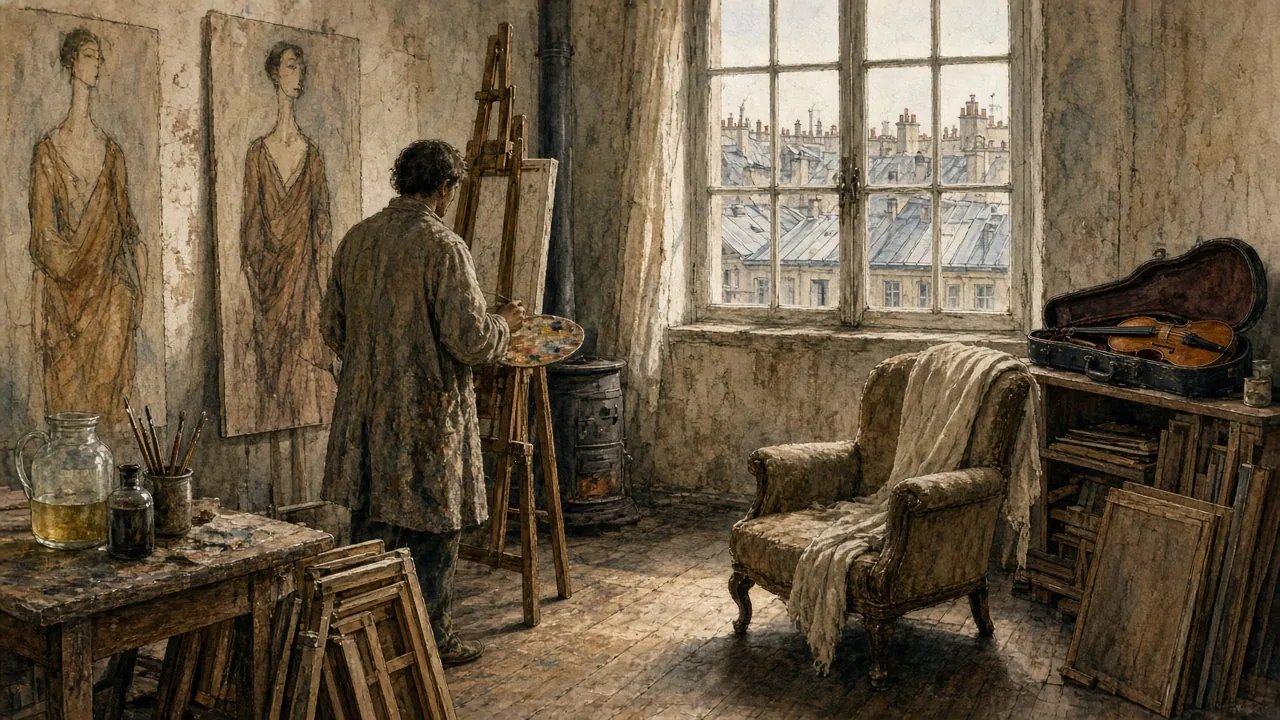
11. Chagall
Marc Chagall was born Moyshe Shagal in Vitebsk, in the north-eastern Pale of Settlement, on 24 June 1887 according to the Julian calendar then in use, and he remained, through a long life and many addresses, a painter whose first city never left his pictures.[17] He attended heder, then a municipal school that Jews entered only with difficulty, and he studied with Yehudah Pen, a local painter of careful genre scenes, before leaving for St Petersburg. There, after obtaining the permits that a Jew needed to reside in the imperial capital, he studied at the school directed by Léon Bakst, whose knowledge of contemporary French painting and of stage design opened a European horizon. In 1910 or 1911, with a stipend from the lawyer and Duma deputy Maksim Vinaver, he reached Paris and took a studio at La Ruche.[18][17]
The pictures of that first Paris stay are among the most important painted by any foreign artist in the city before 1914. I and the Village, of 1911, now in the Museum of Modern Art in New York, sets the profile of a man against that of a cow or goat, their eyes joined by a thin line, while around them float a milkmaid, a row of wooden houses, some upside down, and the circular geometries of a remembered Vitebsk reorganised by a painter who had looked hard at Cubism.[18][17] The title was supplied by Blaise Cendrars. Paris Through the Window, of 1913, now in the Solomon R. Guggenheim Museum, places a two-faced figure, a parachutist, an inverted train and a pair of lovers against a window that opens onto the Eiffel Tower and a sky of arbitrary colour. Self-Portrait with Seven Fingers, also of 1913, shows the painter at his easel, a Vitebsk street in one part of the canvas and the tower in another, the extra fingers a private joke about skill and about a lucky date he liked to claim. Homage to Apollinaire and related works of the same years adopt the circular, simultaneous colour of Robert Delaunay without abandoning narrative. Apollinaire, who visited the studio, called the art surnaturel, a word that later histories have sometimes read as a step toward Surrealism. Chagall’s own sources were more mixed: Cubist structure, Fauve permission to free colour from description, Russian folk and shop-sign painting, and the Yiddish idioms of his childhood, some of which appear in the pictures as literalised metaphors.
In June 1914 he travelled to Berlin for a one-man exhibition at Herwarth Walden’s gallery Der Sturm, then went on to Russia to visit his family. War broke out and he remained, as he later put it, stuck. In 1915 he married Bella Rosenfeld, the daughter of a Vitebsk jeweller; their daughter Ida was born in 1916. He served in a military supply office in the capital and exhibited in both St Petersburg and Moscow. After the revolutions of 1917 he was appointed, under Anatoly Lunacharsky’s Commissariat of Enlightenment, plenipotentiary for art in the Vitebsk region, and he founded a People’s Art College that attracted, among others, Kazimir Malevich and El Lissitzky. The school’s brief, intense life ended in conflict. Chagall argued that revolutionary art was art that revolutionised form, not merely art that depicted workers; the Suprematists, more radical in their rejection of the figure, won the students. He left for Moscow, where in 1920 he painted a set of murals for the State Yiddish Chamber Theatre, including Introduction to the Yiddish Theatre and panels of Music, Dance, Drama and Literature. These works, now among the treasures of the Tretyakov Gallery and of related collections, stand the religious and artisanal types of the old Jewish world on their heads and recast them for a secular stage. In 1922 he left Soviet Russia, spent a year in Berlin learning etching, in part with Hermann Struck, and in September 1923 returned to Paris with Bella and Ida.
The second Paris period made him famous and, in time, prosperous. The dealer Ambroise Vollard commissioned illustrations to Gogol’s Dead Souls, to La Fontaine’s Fables and to the Bible, projects that occupied Chagall for years and that expanded his graphic range. He painted bouquets, lovers, views of Paris in which the tower and the bridges appear beside hovering figures, and remembered Vitebsk streets that grew, as he wrote, more legendary as the real town receded. In 1931 he and Bella spent several months in Palestine, a journey that fed the biblical etchings and confirmed an interest in Jewish renewal that he also expressed through support for museum projects in Tel Aviv and Vilna. He became a French citizen in 1937. The paintings of the later 1930s darken. White Crucifixion, of 1938, now in the Art Institute of Chicago, places a distinctly Jewish Jesus at the centre of a canvas ringed by scenes of synagogues in flames, refugees and fleeing figures, a response to the violence against Jews in Europe that does not abandon his established vocabulary of floating bodies and sharp colour. It is one of the few major pictures by a School of Paris artist that looks directly, before the war, at the political disaster overtaking the world from which so many of them had come.
In June 1940, after the German occupation of Paris, the Chagalls fled to the unoccupied zone. They were stripped of French citizenship and stood in danger of delivery to the Germans under Vichy’s antisemitic statutes. With the help of friends in New York and of the Emergency Rescue Committee directed by Varian Fry in Marseille, and with an invitation connected to Alfred H.[17][18] Barr Jr and the Museum of Modern Art, they left France in May 1941, travelling by way of Spain and Portugal, and reached New York on 21 June. Pierre Matisse, Henri Matisse’s son, became Chagall’s New York dealer. Bella died in September 1944. The American years produced paintings of war and of memory, including work that responded to the destruction of European Jewry, and they placed Chagall among Yiddish writers and cultural organisations in New York as well as among the émigré painters who had made the same crossing.
He returned to France in 1948, settled first in Orgeval and then in the south, and from the 1950s lived mainly at Saint-Paul-de-Vence with Valentina Brodsky, whom he married in 1952. The late career is vast and uneven: lithographs in great number, ceramics, tapestries, mosaics, and stained-glass windows for buildings that include the synagogue of the Hadassah Medical Centre in Jerusalem, cathedrals and churches in France and elsewhere, and the United Nations. In 1964 he painted a new ceiling for the Paris Opéra, a state commission that marked his absorption into official French culture. A national museum devoted to his Biblical Message was established in Nice. He died in 1985.
Chagall’s relation to the School of Paris is both central and awkward. He lived at La Ruche, knew the poets and painters of pre-war Montparnasse, absorbed Cubism and Delaunay’s colour, and was named by later historians as a typical figure of the immigrant generation. He also spent eight formative years away from Paris, built a myth of Vitebsk that no purely Parisian category can contain, and lived long enough to become a global official artist whose late decorative work has little to do with the precarious colony of 1911. To treat him only as a School of Paris painter is to ignore the Russian and Jewish theatres of his career. To omit him from that school is to ignore the years in which Paris gave him a language for memories that Vitebsk alone had not taught him how to paint. The balance is the point. He is one of the artists for whom Warnod’s phrase is both useful and insufficient, and the insufficiency is as historically revealing as the use.
12. Soutine
Chaïm Soutine was born in 1893 in Smilovichi, a small town near Minsk, into a poor Jewish family, and the facts of that childhood—its piety, its want, and the resistance he met when he tried to draw—have been repeated so often that they risk becoming a substitute for looking at the pictures. He studied in Vilna, where he met Michel Kikoïne and Pinchus Krémègne, and in 1913 he reached Paris. He lived at La Ruche in conditions of real misery, copied in the Louvre, and formed a friendship with Modigliani, who painted his portrait and who introduced him to Zborowski. Unlike Chagall, Soutine did not construct a folklore of the shtetl. Unlike Modigliani, he did not reduce the figure to a linear type. His art, from the first independent canvases, is an art of thick paint, twisted drawing and an almost physical identification with the motif, whether that motif is a person, a tree, a carcass or a row of houses.
The years at Céret, in the foothills of the Pyrenees, from 1919 to about 1922, produced a group of landscapes that are among the most extreme pictures painted in France in those years.[35] Houses lean and slide, trees coil, roads rear up, and the pigment is laid in ridges and swirls that make the surface itself seem unstable. The Old Mill, of about 1922–23, now in the Museum of Modern Art, belongs to this family of images even if its date and exact site have been discussed by cataloguers; what matters is the conversion of a Provençal or Catalan hillside town into a convulsion of earth-coloured paint. These are not Cubist landscapes. They do not analyse volume into planes. They are closer to the late landscapes of van Gogh and to a personal reading of El Greco’s stormy skies and elongated forms, filtered through a temperament that found no rest in geometry. Soutine later destroyed some of the Céret canvases he judged unsuccessful, a reminder that the wildness of the pictures was compatible with a severe, even anxious, standard of finish as he understood it.
Portraiture and the figure of the worker in uniform became, in the 1920s, another of his great subjects. He painted pastry cooks, grooms, page boys and choirboys, young men and boys whose white or red garments gave him large fields of colour to disturb with sudden greens and bruised shadows. The faces are often lopsided, the hands oversized or awkwardly attached, the pose frontal and vulnerable. The Pastry Chef, sometimes called The Pastry Chef (Baker Boy), painted around 1919 and now in the Barnes Foundation, is the most famous of the series because of what it did for his life as well as for what it is as a picture. In 1922 or early 1923 the dealer Paul Guillaume showed work by Soutine to the American collector Albert C. Barnes, who bought the pastry cook and then a large group of other canvases, at a stroke removing Soutine from the worst of his poverty. The exact number of pictures Barnes acquired has been variously stated; the Foundation’s holdings remain one of the essential places in which to see Soutine in quantity. The intervention did not make him a public celebrity in France overnight, but it changed the material basis of his work and allowed him to leave the most squalid rooms.
The carcass paintings extend the same viscerality to the side of beef and to plucked fowl. Soutine looked repeatedly at Rembrandt’s Slaughtered Ox in the Louvre and arranged, with the help of slaughterhouses at Vaugirard, to have animal carcasses brought to the studio, where they hung and decayed as he painted them. Neighbours complained of the smell; stories of police visits have attached themselves to the episode and should be treated as reported anecdote rather than as a fully documented police record. What the pictures themselves show is a painter determined to match, in oil, the glistening reds, the hanging weight and the passage from living form to matter. They are not allegories with a written programme. They are acts of looking pushed to a point at which the difference between a side of beef and a landscape of twisting trees begins to collapse into a common excitement of pigment.
Other patrons and dealers entered his life after Barnes. The interior designer and collector Madeleine Castaing, with her husband Marcellin, supported him, housed him at times, and sat for a portrait of about 1929, now in the Metropolitan Museum of Art, in which her tense, alert face and twisted hands are set against a stormy ground.[35] Zborowski continued to handle work when he could. Soutine painted in Cagnes, at Chartres—where the cathedral and the surrounding streets appear in several canvases—and in the countryside, always returning to a small number of motifs that he could worry into new states of paint. He was naturalised as a French citizen in 1933, a protection that would prove insufficient in its practical effect once the Occupation began.
During the war, as a Jew in occupied and then Vichy France, he lived in hiding, moving between the countryside and places of temporary shelter, in poor health and in fear of arrest. In August 1943 a perforated ulcer forced an emergency journey to Paris for surgery. He died on 9 August, at the age of fifty, not in a camp but as a direct consequence of illness aggravated by flight.[35][36] He was buried at the Cimetière du Montparnasse. Hersh Fenster later included him among the martyred artists of the Paris colony, a decision that has sometimes been questioned because Soutine was not deported, and that remains understandable because he died as a hunted man whose last years were shaped by the same persecutions that sent others to Drancy and beyond.
The Chartres pictures and the landscapes painted near Cagnes after the Céret years show that Soutine was not only a painter of carcasses and of kitchen staff. Cathedral streets, windswept trees and the red roofs of the south are put through the same wringer of distorted drawing, but the emotional weather changes: some canvases are almost exultant in their heaving greens, others are claustrophobic. He returned to certain motifs as a musician returns to a phrase, not because he lacked invention but because the problem he had set himself—how far a thing could be bent without ceasing to be itself—required repetition.
His relations with other painters of the colony were real and limited. Friendship with Modigliani is documented in portraits and in reliable testimony; stories of café encounters with Pascin have the flavour of literary set pieces and should not be overworked. What the pictures reveal more clearly than the anecdotes is independence. Standing before a Soutine, one does not think first of a group or of a programme. One thinks of a person looking hard at a hanging ox or at a boy in a white toque, and of paint asked to do more than describe.
Soutine’s place in the School of Paris is at once obvious and singular. He was a poor Jewish immigrant of the La Ruche generation, a friend of Modigliani, a client of Zborowski and Guillaume, and a painter whom hostile critics could cite as an example of foreign excess. He was also, of all the major figures in this story, the least assimilable to a group style. He took almost nothing from Cubism as a system. He did not share Chagall’s narrative folklore or Modigliani’s linear elegance. Later American painters, Willem de Kooning among them, would recognise in his loaded brush and his refusal to calm the figure a precedent for their own work, a reception that belongs to the afterlife of the pictures rather than to their making. In Paris in the 1920s he stood slightly aside even from the colony that housed him, a painter whose loyalty was to certain old pictures in the Louvre and to the stubborn, physical problem of getting a motif to live in paint. That stubbornness is his contribution to the history sketched here. It shows that the School of Paris, even at its most sociable, could contain an art that was essentially solitary.
13. Pascin, Kisling and Foujita
Three painters of the Montparnasse years—Jules Pascin, Moïse Kisling and Tsuguharu Foujita—illustrate how wide the School of Paris could be without becoming meaningless. All three were foreigners; all three were famous in the 1920s; all three worked figuratively; and none of them can be mistaken for either of the others. To treat them together is not to suggest a common style. It is to show, by contrast, the different uses to which a career in Paris could be put, and the different kinds of success and damage the city dispensed.
Jules Pascin was born Julius Mordecai Pincas in 1885 at Vidin, on the Bulgarian Danube, into a Sephardi merchant family.[21] He drew early, worked in Vienna and, more importantly, in Munich, where he contributed to the satirical weekly Simplicissimus and moved in a graphic world that already included some of the sharpness of Grosz and the decorative line of Jugendstil. He reached Paris on 24 December 1905, a professional draughtsman rather than a student. The drawings and watercolours of the following years—café scenes, brothels, adolescents, the bored and the available—have a nervous, apparently negligent line that conceals a considerable graphic intelligence. He became an American citizen after a period in the United States during the First World War, married the painter Hermine David, and returned to Paris in 1920, living for a time at 3 rue Joseph-Bara, a street that also housed Kisling and, at moments, Zborowski.
The paintings of the 1920s, often of young women reclining or seated in interiors of a brown-gold haze, are softer than the drawings and have sometimes been dismissed as merely erotic. At their best they are studies of listlessness and of the slight cruelty of looking, closer to a modern pastorale than to pornography, though they do not pretend to innocence. Pascin was a conspicuous figure on the route between Montparnasse and Montmartre, a giver of parties, a wearer of a bowler hat in many recollections, and a man whose generosity and self-destruction were noted by contemporaries including Youki Desnos. On 2 June 1930, on the eve of a significant exhibition of his work, he killed himself in his studio on the boulevard de Clichy. He was forty-four. The suicide has fixed him in memory as a martyr of pleasure, a role that does no more justice to the drawings than the Modigliani legend does to the nudes. His contribution to the School of Paris is a graphic modernity that comes as much from Munich and from the illustrated press as from the French avant-garde, and a reminder that not every foreigner in Montparnasse was a poor student of painting freshly arrived from the Pale.
Moïse Kisling, born in Kraków in 1891, arrived by a more academic road.[37] He studied at the Academy of Fine Arts in his native city under Józef Pankiewicz, a painter who had looked toward France and who encouraged his pupils to continue there. Kisling reached Paris in 1910, settled among the Poles and the La Ruche generation, and became a close friend of Modigliani, who painted him with a characteristic elongated elegance. In 1914 Kisling volunteered for the French Foreign Legion, was wounded at the Battle of the Somme in 1915, and was later naturalised as a French citizen, a sequence that gave him a moral and legal standing in France that many of his companions never obtained. The war service is not a footnote. It shaped how French critics could speak of him, and it distinguished his public position from that of artists who remained enemy aliens or undeportable only by luck.
His painting of the 1920s is smooth, brightly coloured and highly finished, especially in the portraits of women with large, dark eyes and in the nudes that found ready buyers. Flowers, Provençal landscapes and figures treated with a lyrical clarity made him one of the commercially successful painters of Montparnasse, a fact that later taste, suspicious of charm, has sometimes held against him. The pictures are not trivial because they are pleasing. They record a decision, conscious or not, to reconcile the freedoms of Parisian colour with a salon finish that collectors understood. Kisling’s studio became a meeting place; his portraits document a society as well as a style. In 1940 he left France for the United States, painted and exhibited there, and returned after the war to Sanary-sur-Mer, where he died in 1953. If Modigliani represents the tragic economy of the School of Paris and Soutine its solitary extreme, Kisling represents a third possibility: the immigrant who fought for France, sold pictures, and made a durable if unfashionable body of figurative work at the centre of the quarter’s social life.
Tsuguharu Foujita, later Léonard Foujita, was born in Tokyo in 1886, the son of a general, and trained at the Tokyo School of Fine Arts before arriving in Paris in 1913.[38] He is the clearest demonstration that the School of Paris was not simply an Eastern European Jewish phenomenon, even if that phenomenon was its demographic core. Foujita’s success in the 1920s was spectacular. He developed a technique that joined a fine, almost calligraphic black outline, learned in part from Japanese ink painting and print design, to an oil surface of unusual milky smoothness, often a pearly white ground on which cats, women and self-portraits appear with a precision that French critics found both exotic and modern. The self-portraits, with their fringe, round spectacles and carefully presented persona, made him a recognisable public figure, as famous in illustrated papers as any painter of the decade.
He painted nudes that rivalled Modigliani’s in notoriety without resembling them in form, and he cultivated friendships across the Montparnasse cafés, including with Pascin and with Kiki de Montparnasse, who appears in the memoirs of the quarter as model, singer and emblem. Warnod named him expressly in 1925 as evidence that the School of Paris existed. The naming was accurate as a description of celebrity and of foreignness; it was less useful as a description of style, because nothing in Foujita’s best work looks like Soutine or Chagall. In the 1930s he travelled widely, returned at times to Japan, and during the Second World War produced work in the service of the Japanese state, a chapter of his career that has been the subject of severe postwar criticism and that cannot be folded into a simply festive account of 1920s Montparnasse. He returned to France after the war, was baptised Léonard, and died in 1968. A chapel he decorated at Reims remains a late monument to his French afterlife.
Pascin’s American years, including work made in the southern United States and in the Caribbean, widened his subject-matter beyond Parisian interiors without changing his fundamental interest in the hanging, slightly slack human figure. Those pictures complicate a purely Montparnasse reading of his career, just as Foujita’s later Japanese years complicate a purely Parisian one. Kisling’s portraits of children and his Provençal landscapes after the war likewise show an artist who had resources outside the legend of the Rotonde. The School of Paris was a phase and an address in each of these lives, not the whole of them.
What the 1920s market rewarded in all three was recognisability: Pascin’s haze, Kisling’s large-eyed finish, Foujita’s milky outline. Recognisability is not a vice, but it is a pressure, and it helps to explain why later criticism, especially after abstraction had claimed the prestige of difficulty, treated them as charming rather than as central. A historical account can afford to be more patient. Charm was one of the goods the city sold; so was anguish; so was formal experiment. The colony produced all three, sometimes in the same street and in the same year.
Taken together, the three careers warn against any single plot. Pascin brought a Central European graphic culture to Paris and died by his own hand at the moment of a public success he could not face. Kisling used academic training, military service and a gift for the pleasing figure to build a professional life that survived exile and return. Foujita converted a Japanese formation into a Parisian fashion and later into a nationalist wartime practice that troubles his place in the legend of cosmopolitan freedom. All three exhibited, sold and were seen in the same streets. None of them painted like the others. The School of Paris, if the name is to remain historically honest, must be large enough to hold that disagreement.
14. Sculpture
Sculpture in the Paris of the early twentieth century had its own geography, its own technical constraints and its own relation to the name École de Paris. Stone and plaster demand space, money and, for bronze, a foundry; a sculptor could not live by the same improvisations that allowed a painter to work on cardboard in a hotel room. The studios of La Ruche, the Cité Falguière and the Impasse Ronsin therefore matter in this chapter not as colourful addresses but as practical conditions.[34][20] Five figures—Constantin Brancusi, Jacques Lipchitz, Ossip Zadkine, Alexander Archipenko and Chana Orloff—show how sculpture in the city moved from Rodin’s inheritance toward Cubist analysis, toward essential form and toward a modern portraiture in three dimensions. They were not a group. They shared, at most, a set of problems and a city in which those problems could be pursued.
Constantin Brancusi was born in 1876 at Hobița, in rural Oltenia, trained in Craiova and at the School of Fine Arts in Bucharest, and reached Paris in 1904 after a journey undertaken in stages.[20] He worked briefly in Rodin’s studio and left it with the remark, later widely quoted, that nothing could grow in the shade of a great tree, a saying that should be treated as reported rather than as a stenographic record, but that accurately describes his need to escape a modelled, muscular conception of sculpture. The Kiss, developed from 1907–08 in several versions, reduces an embrace to a block in which two eyes, a single line and the continuity of the stone do the work of anecdote. Sleeping Muse, in alabaster and in bronze, ovoid and detached from a body, asks the viewer to accept an egg-like head as a sufficient image of rest. Bird in Space, pursued through many versions in marble and polished bronze from the 1920s onward, refines a creature into a soaring taper. When a bronze version was stopped by United States customs in 1926 on the ground that it was not sculpture but a dutiable object, the ensuing case, Brancusi v. United States, decided in 1928, became a legal landmark in the recognition of abstract art.
Brancusi’s studio at the Impasse Ronsin was itself a composition. He arranged plaster versions, marble originals and wooden bases of different heights in groups that he photographed carefully, and he bequeathed the contents to the French state on condition that the studio be reconstituted. The present reconstruction beside the Centre Pompidou is the result of that wish, twice rebuilt. He was Romanian, not Jewish, and he lived a more secluded life than the café artists of the boulevard du Montparnasse, but Warnod’s generation knew him as one of the foreigners who had altered the art of the city. He died in Paris in 1957. His work stands at a tangent to the School of Paris as a social category and at the centre of modern sculpture as a formal history. Both placements are just.
Jacques Lipchitz, born Chaim Jacob Lipchitz in 1891 at Druskininkai, then in the Russian Empire and now in Lithuania, arrived in Paris in 1909 and passed through the École des Beaux-Arts and the Académie Julian before finding his way to Cubism.[39][6] His bronzes of the mid-1910s and early 1920s translate the faceted planes of Picasso and Gris into interlocking volumes that can be walked around, their hollows and projections designed to catch light as a painted cube catches a highlight. Portrait commissions, including a head of Jean Cocteau, show that this language could accommodate likeness without returning to nineteenth-century modelling. In the later 1920s and 1930s his forms opened and became more transparent, with what he called transparencies in which space passes through the sculpture. Mythological and biblical subjects entered the work as the political weather darkened. In 1941 he fled France, crossing into Spain and reaching the United States, where he continued to work on a large scale. Figures such as The Prayer and later public monuments belong to that American continuation. Lipchitz is a core sculptor of the School of Paris in the narrow sense: a Jewish immigrant, a Cubist, a Montparnasse resident and an exile of 1940–41.
Ossip Zadkine, born in 1888 in the Vitebsk region, came to Paris in 1909 and developed a sculpture in wood and bronze that owes something to Cubism and more to a personal, often baroque, piercing of the figure.[40] Musical instruments, oracles and recumbent forms are cut through with voids so that the body becomes a system of tunnels and inner silhouettes. He married the painter Valentine Prax, taught, and during the Occupation took refuge in the United States, returning after the war. The Destroyed City, unveiled in Rotterdam in 1953, a bronze figure whose torso is torn open in a silent cry, is his most public work and one of the few sculptures by a School of Paris artist to become a civic memorial to wartime destruction. Zadkine’s Paris studio is now a museum. His path—Vitebsk, Montparnasse, New York, return—rhymes with Chagall’s without resembling Chagall’s art, and it shows how sculpture, as much as painting, carried the colony’s history into the postwar city.
Alexander Archipenko, born in Kyiv in 1887, reached Paris in 1908 and worked at La Ruche.[41] His Médrano figures and related constructions of the early 1910s combine concave and convex forms, coloured planes and, at times, materials other than bronze, in a sculptural Cubism that is more playful and more concerned with the void as a positive shape than Lipchitz’s contemporary work. He exhibited with the Section d’Or. After the war he spent time in Germany and then emigrated to the United States, where he taught and continued to produce a large body of work. Archipenko’s relative eclipse in French popular memory, compared with Brancusi or even Zadkine, is a useful caution: the School of Paris, seen from Paris, has always privileged some foreigners over others, and a sculptor who left early for America could slip from the local story without slipping from the history of modern sculpture.
Chana Orloff was born in 1888 at Tsaré-Constantinovska, in what is now Ukraine, emigrated with her family to Ottoman Palestine in 1905, and arrived in Paris in 1910, initially to study dressmaking at a professional school before turning to sculpture.[42] The sequence matters. She came with a trade, not only with an artistic vocation, and she made her living, in part, as a portrait sculptor of writers, musicians and fellow artists. Her bronzes of the 1920s—stout, simplified figures, mothers and children, portraits with a robust frontality—avoid both Rodin’s flicker and Brancusi’s extreme reduction. She was part of the Montparnasse milieu, a friend of other Jewish artists of the colony, and a woman who secured a professional place in a field even more male in its institutions than painting. In 1942 she fled to Switzerland; her Paris studio was ransacked. She returned after the Liberation and worked until her death in 1968. Because she does not fit the tragic masculine legend of Modigliani or Soutine, she has been easier to leave in the second rank of surveys. She belongs in the first rank of any account that takes the School of Paris to be a social as well as a stylistic fact.
The technical life of sculpture also helps to explain reputations. A bronze edition can circulate in a way that a single oil cannot, but only after someone has paid the founder. Painters could, in extremity, work on cardboard; sculptors could not improvise a stone. This economic difference, more than any mystery of temperament, is one reason sculptors of the colony often accepted portrait commissions that painters of equal ambition might refuse. Orloff’s clientele, Lipchitz’s heads of writers and Brancusi’s occasional portraits, including sitters from the world of patrons rather than of cafés, belong to this practical history as well as to the history of form.
These five careers do not exhaust Parisian sculpture of the period. Henri Laurens, a French artist closely tied to Cubism and to La Ruche, worked in a related language of constructed volumes. Ossip Zadkine’s contemporaries included other wood-carvers and portraitists who have not entered the general manuals. What the five show is that the foreign colony was as consequential in three dimensions as on canvas, that Cubism was only one of the available methods, and that the same historical pressures—migration, war, the Occupation, flight to America—shaped sculptors’ lives even when their materials forced upon them a slower, more expensive practice than painting. The next chapter returns to painters who were French by birth or formation and who shared streets, subjects and sometimes exhibitions with the immigrants, without sharing their legal vulnerability.
15. Painters of the French circle
A history of the School of Paris that mentioned only immigrants would misdescribe the city they entered. French-born painters, and painters who had arrived so early or assimilated so thoroughly that their Frenchness was not in dispute, shared streets, dealers and exhibitions with the newcomers and supplied much of the art against which the foreigners were judged. Maurice Utrillo, Suzanne Valadon, Marie Laurencin, Kees van Dongen, André Derain and Maurice de Vlaminck belong to this contextual circle. Van Dongen was Dutch; the others were French. None of them, except van Dongen in some listings, stands at the centre of Warnod’s category, and Derain and Vlaminck would later be claimed for a nationalist École française. They cannot be omitted, because their pictures and their public fortunes are part of the same Paris.
Maurice Utrillo was born in Paris in 1883, the son of Suzanne Valadon, and he is the rare painter of this story whose subject was almost exclusively the city itself.[43] After a youth marked by alcoholism, he began to paint under his mother’s supervision, at first in the open air and then, increasingly, from postcards and from memory in the studio. The so-called white period, roughly from 1909 to 1914, produced views of Montmartre streets and suburban churches in which plaster walls, zinc roofs and empty squares are built from thick, pale pigment that seems to mimic the mortar it depicts. Impasse Cottin, the rue du Mont-Cenis, the Lapin Agile and countless corners of the eighteenth arrondissement recur with an obsessiveness that is the opposite of Impressionist variety. The pictures are not naïve, though they have been loved for a seeming simplicity. They are constructions of a limited set of architectural types, organised with a sure sense of the canvas’s rectangle, and they record a Montmartre already slipping from village into souvenir. Utrillo was institutionalised at intervals, legally protected at times by his family, and in later decades repeated his motifs with diminishing intensity. He remains, at his best, the great painter of the hill’s walls, a local artist against whom the internationalism of the Bateau-Lavoir can be measured.
Suzanne Valadon, born Marie-Clémentine Valadon at Bessines-sur-Gartempe in 1865, reached painting by a route almost unavailable to women of her class: she modelled for Puvis de Chavannes, Renoir and Toulouse-Lautrec, learned by watching, and began to draw and then to paint with a robustness that startled those who expected from a former model a borrowed Impressionism.[44] Her nudes are heavy, unidealised and firmly outlined; her still lifes and portraits, including images of Utrillo, have a similar frankness. The Blue Room, of 1923, now in the Centre Pompidou, shows a woman in striped pyjamas reclining on a bed with books and cigarettes, a modern odalisque without mythological excuse. Valadon exhibited at the Indépendants and the Automne, earned the respect of Degas, who bought her drawings, and supported herself and her son through years in which either career alone would have been difficult. She is not an artist of the immigrant School of Paris. She is essential to any account of painting in Montmartre in the same years, and she is one of the few French women of the older generation whose work stands comparison, in ambition and in toughness, with that of the men around her.
Marie Laurencin, born in Paris in 1883, moved in the pre-war circle of Picasso and Apollinaire, with whom she had a long relationship, and she appears in several group portraits of that world, including her own Groupe d’artistes of 1908, which gathers Apollinaire, Picasso, Fernande Olivier and herself in a flattened, decorative arrangement.[45] Her mature manner—pastel harmonies of grey, rose and pale blue, oval-faced women and animals in an idyllic space—has been easy to patronise as charming. It was also a deliberate alternative to Cubist severity, a way of remaining modern without adopting a language she did not want. She designed for the Ballets Russes, spent the war years in Spain after marrying the German artist Otto von Wätjen, and returned to a successful interwar career. Like Kisling, she has suffered from later suspicion of sweetness. Like Kisling, she documented a social world as well as an inner one. Her place here is as a French painter who was inside the avant-garde’s friendships and outside its dominant formal programmes.
Kees van Dongen, born in Delfshaven in 1877, settled in Paris at the end of the 1890s and passed through anarchist and Fauve milieus before becoming, in the 1910s and 1920s, the most sought-after portraitist of a certain Parisian and international society.[22] The Fauve pictures—high-keyed figures, dance-hall scenes, the memory of a Russian opera season—retain a bite that the later portraits of elongated women with kohl eyes and jewel-like highlights sometimes exchange for a more marketable glamour. He exhibited with the Fauves in 1905, lived on the hill and later in more comfortable quarters, and occupied a position that Warnod could cite as foreign and that French hosts could adopt as fashionable. Van Dongen’s career is a reminder that not every foreign painter in Paris was poor, and that the line between the avant-garde and the luxury trade was porous.
André Derain and Maurice de Vlaminck have already appeared as inventors of Fauvism. Their later paths belong to this chapter because they show how French painters of the same generation could move away from the freedoms of 1905 toward a more conservative idea of tradition, and how that move would later be politicised. Derain, after the London pictures of 1906 and a period of interest in Cubism, turned to a darker, more heavily modelled painting based on study of the Old Masters. He designed for the ballet, painted figures and landscapes of a deliberate classicism, and became, for some interwar critics, a model of French measure against foreign excess. Vlaminck, more vehement in temperament, likewise abandoned Fauve colour for stormy, dark landscapes of the Île-de-France, painted with a loaded brush that has its own power but that he accompanied, increasingly, with polemics against modernism. During the Occupation he published texts and took part in a notorious studio visit to Germany organised for French artists; after the Liberation he faced a profession’s reckoning, even if his legal penalties were limited. These facts do not erase the brilliance of the Chatou and Collioure pictures. They complicate any story in which “French art” and “freedom” remain naturally aligned, and they help to explain why, by the 1930s, an attack on the School of Paris could present itself as a defence of a national school that some former Fauves were prepared to embody.
Utrillo’s dependence on postcards, often cited as a curiosity or as a symptom of illness, is also a fact about method. Painting a street from a cheap reproduction allowed him to work indoors, to repeat a view until the walls sat correctly on the canvas, and to treat the city as a set of already flat images ready to be rebuilt in pigment. The procedure is closer than it looks to the modern habit of working from photographs, and it gives his best pictures their peculiar combination of topographical loyalty and dreamlike emptiness. Valadon’s looking, by contrast, was almost aggressively present-tense: bodies in rooms, tables with fruit, the weight of a person in a chair. Mother and son, living for years in a knot of mutual care and exasperation, produced opposite accounts of the same hill.
Van Dongen’s later portraits of politicians, actors and women of fashion have been used to accuse him of frivolity. Some of them are frivolous. Others, in their very slickness, are documents of a social type as precise as Utrillo’s plaster walls: the international face of the 1920s, lengthened and enamelled for public appearance. They belong in this history because they show one possible end of Fauve colour—its absorption into luxury—just as Vlaminck’s later landscapes show another possible end, the conversion of modernist energy into a rhetoric of native soil.
The six painters of this chapter therefore do different kinds of contextual work. Utrillo and Valadon root the story in a Montmartre that was a workplace and a motif, not only a legend. Laurencin shows a French woman navigating the pre-war avant-garde on her own formal terms. Van Dongen embodies the foreigner as fashionable success. Derain and Vlaminck mark the road from Fauve insurrection to interwar and wartime invocations of tradition. Together they prevent the School of Paris from being isolated as a purely immigrant enclave. The enclave existed. It existed inside a French art world that had its own quarrels, its own nostalgias and its own capacities for both hospitality and rejection.
16. Women of the School of Paris
Women painted, sculpted, dealt and organised in the Paris of the School of Paris, and they have been slower to enter general accounts than their male contemporaries. Some have already appeared in this essay because their work is indispensable to particular chapters: Sonia Delaunay as a pioneer of abstract colour and of design, Suzanne Valadon as a painter of unidealised figures in Montmartre, Marie Laurencin as a member of the Picasso-Apollinaire circle, Chana Orloff as a sculptor of portraits and of monumental simplicity. This chapter does not repeat those careers. It turns to painters who have remained, even in specialist literature, less securely placed, and it asks what their relative invisibility reveals about the category itself.
Mela Muter, born Maria Melania Klingsland in Warsaw in 1876, belongs to an older cohort than Soutine or Kisling.[4][5] She reached Paris in 1901, exhibited at the Indépendants from 1902 and at the Automne from 1905, and thus had a public existence in the city before many of the men later treated as founders of the immigrant school had arrived. She painted portraits, maternities, landscapes and old people with a sober, constructive solidity, looking toward Cézanne rather than toward Fauve hedonism or Cubist fracture. Time spent in Brittany and, later, in the south, including Avignon, supplied motifs of rivers, bridges and weathered faces. She was Jewish, Polish and professionally established, a combination that ought to have guaranteed her a firm place in surveys of the École de Paris and has not always done so, perhaps because she does not fit the legend of the young arrival at La Ruche and perhaps because her seriousness lacks the easily summarised stylisation of a Modigliani or a Chagall. She lived until 1967, long enough to see her earlier world destroyed and only partly remembered.
Maria Blanchard, born in Santander in 1881, came to painting against the additional obstacle of a congenital physical disability that affected her growth and gait, and that contemporaries noted with a mixture of respect and pity that now makes their testimony uncomfortable. She studied in Madrid and Paris, passed through a Cubist phase in the 1910s—still lifes and figures built from tilted planes and strong colour—and then returned to a figurative art of children, working women and domestic scenes painted with a gravity that has nothing to do with sentimentality. She exhibited with the salon Cubists and was taken seriously by dealers and critics who could see that her Cubism was not a borrowed fashion. She died in Paris in 1932, before the worst of the decade’s politics and before the postwar rearrangements of reputation. Like Juan Gris, she was a Spanish artist in Paris whose Cubism had a clarifying, almost moral, character; unlike Gris, she has not remained a fixture of Cubist textbooks. Her career is one of the best arguments for treating the School of Paris as a field of many modernisms rather than as a single expressive type.
Alice Halicka, born in Kraków, married Louis Marcoussis and painted, after an early Cubist moment, scenes of memory, of Jewish life and of a more decorative figuration. She published a memoir, Hier, that is a primary source for the social world of Polish artists in Paris. Marevna, born Maria Vorobieff in Cheboksary in 1892, painted the colony from the inside, including group portraits of Modigliani, Rivera, Ehrenburg and others, and later wrote a memoir of Montparnasse that, like Halicka’s, must be used with the caution due to all self-witnessing, and that remains valuable for names, studios and atmospheres no official archive recorded. Marie Vassilieff, born in Smolensk in 1884, ran an academy and, during the First World War, a canteen in Montparnasse that fed artists of many nationalities; her painted and constructed portraits, sometimes almost puppet-like in their stylisation, and her role as an organiser make her a figure of infrastructure as well as of style. These women were not satellites. They were producers of pictures and of the social tissue that allowed pictures to be made.
Other names surface as soon as one consults the catalogues of the musée d’art et d’histoire du Judaïsme or the literature that has grown around Hersh Fenster’s memorial volume. Chana Kowalska, born in Poland in 1899, arrived in the 1920s, painted, wrote, and was active on the political left; she was arrested in 1941 and did not survive the war. Her letters from prison, presented in recent exhibitions, are documents of intimacy and of political faith, not merely footnotes to a massacre. Women such as these were numerous enough that any claim to have covered “all the best-known artists” of the School of Paris must immediately qualify itself. The best-known names have been, for decades, disproportionately male. The historical colony was not.
Why the imbalance persisted is not a mystery of talent. Life classes and academies admitted women, as Julian and Colarossi had long done, but dealers, critics and collectors reproduced older hierarchies of seriousness. Memoirs written by men assigned women the roles of model, mistress, muse or manager more readily than that of colleague. The immigrant colony’s own solidarity, real as it was, did not automatically extend equal exhibition opportunities to its female members. And later museum practice, until quite recently, followed the market and the memoirs. The exhibitions of the last two decades in Paris, Berlin and elsewhere have begun to correct the record, not by inventing a separate women’s School of Paris but by hanging Muter, Blanchard, Halicka, Orloff and Kowalska in the same argument as Modigliani and Soutine.
A further name belongs to the edge of this chapter and to the centre of a later one. Maria Helena Vieira da Silva, born in Lisbon in 1908, arrived in Paris in the late 1920s, studied sculpture with Bourdelle and painting with Friesz and Léger, and developed, after the war, a labyrinthine urban abstraction that made her one of the principal figures of the second School of Paris.[46] She is mentioned here only to mark continuity. Women did not appear in the postwar abstract moment as newcomers to the city’s art. Some of them, and some of their predecessors, had been working there since before 1914.
The difficulty of reconstruction is partly archival. Women artists were less often given monographic catalogues in their lifetimes, less often photographed in the studio for illustrated papers, and more often recorded, when they were recorded, as someone’s wife or pupil. Halicka’s memoir and Marevna’s are therefore more than colourful supplements. They are among the reasons historians can now name female contemporaries at all. Museum acquisitions in recent decades, including those assembled at the mahJ, have begun to supply the other necessity: pictures on walls, not only names in lists.
None of this requires a compensatory exaggeration. Not every neglected painter is a missing modernist of the first rank, and not every woman in Montparnasse was primarily a painter. What the evidence does require is that surveys stop treating the absence of women from older narratives as a reflection of the past’s actual population. The population included Muter before Soutine arrived, Blanchard at the centre of salon Cubism, Orloff in the foundry and the portrait studio, and Kowalska in the political and pictorial life of the 1930s. An École de Paris written without them is not a tighter category. It is a thinner description.
The conclusion is modest and documentary. A history of the School of Paris that confined women to a single late paragraph would repeat the distortion it ought to describe. A history that pretended the distribution of fame was accidental would be naïve. The artists discussed in this chapter, together with those already treated elsewhere in the essay, are not a complete list. They are enough to show that the colony’s modernity included women who used Cubism, portraiture, memory, political painting and, later, abstraction, and that the category École de Paris is unintelligible if it is imagined as a brotherhood of unfortunate men.
17. War, boom and the crash
The First World War did not create the School of Paris, but it interrupted the colony, sorted its members by passport, and altered the market that had begun to sustain them. When mobilisation was declared in August 1914, French artists of military age left their studios. Braque was wounded at Carency in 1915 and trepanned; Derain served; Léger fought at the front and found in the breech of a gun, as he later recalled, a confirmation of his interest in cylindrical form. Apollinaire, who had been born in Rome and had obtained French naturalisation, enlisted, received a shrapnel wound to the head in 1916, and died in the influenza pandemic on 9 November 1918, two days before the Armistice. His death removed the poet who had done most to explain the pre-war avant-garde to a wider public. Foreign artists faced a different sorting. Nationals of the Central Powers risked internment as enemy aliens; some left for neutral countries or for home. Spaniards, as neutrals, could remain: Picasso and Gris stayed and worked. Immigrants from the Russian Empire were in a more ambiguous position, especially after 1917, when the revolutions at home cut off money, mail and the possibility of easy return. Several who had gone east in 1914, Chagall among them, did not see Paris again until the 1920s.
The war also damaged the dealer system that had given Cubism its private economy. Kahnweiler’s German nationality led to the sequestration of his gallery and, after the war, to the dispersal of his stock at public auction in sales that historians of the market still regard as a disaster for prices and for the integrity of a carefully built oeuvre.[24] Léonce Rosenberg and others attempted to fill the gap. Artists who had been paid stipends found themselves, for a time, without that regularity. The material history of Cubism and of the foreign colony cannot be separated from this legal accident of citizenship.
After 1918 Paris filled again, more densely than before. The city was still, by general consent, the capital of modern art. The exchange rate, especially for Americans, made living and buying pictures advantageous. New arrivals from the former Russian Empire, from Poland and from the Balkans joined those who had remained or returned. Americans—painters, writers, collectors—became a noticeable presence in Montparnasse, and their memoirs have sometimes overstated their importance relative to the Eastern European artists who had been there since before the war. What is not overstated is the expansion of the market. Paul Guillaume, Zborowski, the Rosenbergs and a growing number of smaller dealers sold to French and foreign collectors. Barnes’s purchases of Soutine have already been described. Other Americans bought Modigliani after 1920, when death had clarified his reputation. Foujita’s celebrity, Kisling’s sales and the nightly visibility of the boulevard cafés produced a boom that illustrated papers were happy to treat as a renaissance.
The boom had a geography. Galleries clustered on the Right Bank, particularly in the rue La Boétie, while production remained, for the poorer artists, a Left Bank affair. The Salon des Tuileries, founded in 1923, added another large exhibition to the calendar. The Salon des Indépendants and the Salon d’Automne continued, now so large that a serious picture could easily be lost on the walls. Private galleries and studio visits mattered more. So did the new illustrated weeklies and the fashion for being seen in Montparnasse. La Coupole, opening in 1927, symbolised the moment at which a quarter of cheap studios became a destination for people who did not paint. Some artists profited from the attention. Others found that the legend of bohemia was easier to sell than their pictures.
André Warnod’s article of January 1925, and his book later that year, belong to this phase of expansion and of argument. He was naming a phenomenon that had become too visible to ignore, and he was naming it against voices that wished to ignore it or to denounce it. The Venice Biennale of 1928 devoted a room to the School of Paris separate from the representation of French art, an institutional splitting that recognised the foreigners as a collective while refusing to fold them unambiguously into the national school.[2] Exhibitions in Paris and abroad in the late 1920s and early 1930s used the label with increasing confidence, even as its meaning remained unsettled.
The Wall Street crash of 1929 and the depression that followed did not immediately empty the studios, but they contracted the market on which many painters had come to depend, especially those whose buyers were American or whose work had been treated as a fashionable speculation. Dealers reduced advances. Collectors stopped buying. Artists who had never been secure returned to a deeper insecurity; some who had been secure discovered that celebrity was not a contract. The political atmosphere darkened in parallel. The riots of 6 February 1934 in Paris, the growth of far-right leagues, and the polarisation that produced the Popular Front in 1936 made the foreigner, and especially the foreign Jew, a more explicit target in public speech. Decrees in the later 1930s tightened the regulation of foreign labour and of residence. For painters this could mean difficulty in obtaining or renewing papers, in exhibiting, or in taking paid work as teachers or decorators.
The American presence in 1920s Paris has generated its own literature, much of it written by the visitors themselves. Painters from the United States took studios, studied in the private academies and bought, or hoped to buy, a share in the city’s prestige. Their importance for the School of Paris as defined in this essay is mainly economic and social rather than stylistic: they thickened the audience in the cafés, they wrote the first widely read English memoirs of the quarter, and their collectors at home, Barnes foremost among them, removed significant pictures across the Atlantic. To treat Montparnasse in the 1920s as an American invention would invert the chronology. The Eastern European and Mediterranean colony was in place before the favourable exchange rate of the decade, and it remained after many Americans had gone home.
Official spectacle continued to advertise Paris as a capital of the arts even as the independent colony argued about who belonged there. The Exposition internationale des arts décoratifs of 1925, the year of Warnod’s article, presented a luxury modernism of furniture, pavilions and design that Sonia Delaunay could enter more easily than Soutine. The International Exhibition of 1937, for which Picasso painted Guernica, staged national pavilions in a Europe already preparing for war. Between those two fairs the School of Paris lived its most visible and its most vulnerable years: visible because dealers, magazines and tourists had found it, vulnerable because visibility invited the nationalist reply that the next chapter examines.
The Spanish Civil War and then the approach of a new European war added further displacements. Some artists became politically active; others tried to remain within the studio. Picasso painted Guernica in 1937 for the Spanish Republican pavilion at the Paris International Exhibition, a work that stands outside the School of Paris as a social category and that nevertheless was made in the same city, in the same year that Chagall received French citizenship and that the Exhibition’s official displays offered competing images of national culture. The coincidence is worth noting without being forced into an allegory. Paris in 1937 was still a place where a Spanish painter could produce the most famous political picture of the century and where an immigrant from Vitebsk could finally hold a French passport. It was also a place where xenophobic criticism of foreign artists had already had two decades to rehearse its arguments. Those arguments are the subject of the next chapter. The present one needs only to mark the sequence: mobilisation and internment; a postwar boom fuelled by dealers, Americans and publicity; a crash that removed the boom’s material base; and a decade in which law and politics made the colony’s legal foothold less sure than its cafés had ever suggested.
18. Jewish artists and the debate
The Jewishness of many foreign artists in Paris was not a secret, a discovery of later historians, or a stylistic key that opens every canvas. It was a demographic fact that contemporaries discussed, sometimes with sympathy, often with hostility, and that became, in the 1920s and 1930s, a political charge. One French study of the interwar years has estimated that more than five hundred Jewish artists were working in Paris, of whom a substantial minority have been documented in biographical dictionaries and in museum exhibitions. They came, as earlier chapters have shown, by different routes and they painted in different manners. What they shared, in the eyes of their enemies, was foreignness, success or the appearance of success, and a supposed incompatibility with a national tradition imagined as Latin, measured and rural.
André Warnod’s naming of an École de Paris in 1925 was intended, in this climate, as a defence.[3][9] He argued that foreign artists were part of the city’s living art and that their presence confirmed Paris’s magnetism rather than its decline. The phrase was promptly turned around. Critics who wished to protect an École française used École de Paris as a label for what they regarded as an occupation of French walls by outsiders. The distinction was not merely taxonomic. It organised exhibitions, reviews and the language of dealers. It allowed a painter to be praised as French by temperament even if he had once been a Fauve, and a neighbour to be dismissed as Parisian only in the accidental sense of having rented a room.
Louis Vauxcelles, who had given Fauvism and Cubism their names, wrote of immigrant colourists in Montparnasse in terms that borrowed the imagery of infestation and disguise. Camille Mauclair, in essays of the late 1920s and around 1930, including material associated with La Farce de l’art vivant, attacked modern painting as a fraud and associated its dealers and many of its practitioners with a foreign, frequently Jewish, conspiracy against French taste.[9][10] He could speak of a pictorial International and of a detachment from the French soil, language that mixed aesthetic conservatism with the conspiratorial habits of the anti-Dreyfusard right. Such prose did not need to be universally believed in order to do damage. It set terms that milder journalists echoed, and it made the Jewish immigrant painter a convenient figure for wider anxieties about the market, about abstraction or expressionist distortion, and about the lost primacy of a certain idea of France.
Waldemar George, born Jerzy Waldemar Jarocinski and himself Jewish, occupied a more complicated position.[9] He wrote intelligently about modern artists, including foreigners, and he also came to distrust a term that seemed to him to allow anyone to claim Frenchness while undermining a tradition he wished to define more narrowly. His trajectory, which moved toward a defence of Latin measure and, at times, toward positions compatible with authoritarian aesthetics, is a warning against treating the debate as a simple clash between generous cosmopolitans and obvious bigots. People inside the art world, including some Jews, could internalise the demand for a national school and could use the School of Paris as a name for what they feared.
The attacks were not only verbal. They affected hanging committees, purchases and the tone in which a foreign name was pronounced in a salon review. They drew strength from economic resentment after 1929, when pictures that had been expensive were suddenly unsaleable and when it was easy to blame speculators rather than a world crash. They drew strength, too, from a longer French history of antisemitism that had not ended with the Dreyfus Affair. The immigrant artist, visible in Montparnasse, often poor and occasionally successful, could be made to stand for the dealer, the collector and the critic as well, a compression of roles that bore little relation to the actual poverty of La Ruche.
It is necessary, against this hostility, not to invent a symmetrical Jewish aesthetic. There was no Jewish style of the School of Paris. Chagall’s memory-images, Soutine’s impasto, Modigliani’s linear nudes, Lipchitz’s Cubist bronzes and Orloff’s portraits do not share a morphology that could be derived from religious tradition or from a common psychology of exile. Some artists treated Jewish subjects; many did not. Some remained close to Yiddish-speaking milieus; others assimilated quickly and preferred not to be identified first as Jews. The hostile critic who saw a single foreign essence in all of them was not looking at pictures. He was looking for a people.
Museum scholarship has clarified the debate without ending it. The 1985 exhibition The Circle of Montparnasse: Jewish Artists in Paris, 1905–1945, organised by Kenneth E. Silver and Romy Golan at the Jewish Museum in New York, remains a foundational account of the colony as a Jewish and immigrant phenomenon, and Golan’s later book Modernity and Nostalgia has shown how interwar French art criticism used ruralism, classicism and appeals to the soil as weapons against a cosmopolitan modernism. These studies matter because they move the discussion from anecdote to documentation. They also show that the attack on foreign painters was part of a larger cultural politics, not a series of isolated insults in café reviews.
It would be equally inaccurate to suppose that every French critic was hostile or that every reservation about the market was a coded antisemitism. Some observers worried, without racial fantasy, that a boom in reputations was being driven by fashion and by speculative buying. Those worries were sometimes justified by the crash. The distinguishing mark of the xenophobic campaign was not scepticism about prices. It was the conversion of aesthetic disagreement into a theory of national contamination, in which Jewishness and foreignness explained, in advance, whatever a writer disliked on the wall. Once that conversion had been made, no picture could clear the painter of the charge, because the charge was not about the picture.
The artists’ own responses varied. A few wrote or spoke in defence of their place in French art. Many simply continued to work, exhibited where they could, and relied on dealers who remained willing to sell their pictures. Naturalisation, when it could be obtained, was a practical shield as well as an emotional claim: Chagall’s citizenship of 1937 and Kisling’s earlier naturalisation after military service belong to this history of paper as well as of paint. Others never secured that shield. The debate of the 1930s therefore had a future that its participants could only partly imagine. When the German army entered Paris in June 1940, and when the Vichy government began to publish statutes that defined and excluded Jews, the rhetorical distinction between an École française and an École de Paris became, for many of the people it had targeted, a matter of papers, yellow stamps and deportation lists. The next chapter is that transformation of criticism into policy and of policy into death and flight.
19. Occupation and destruction
German troops entered Paris on 14 June 1940. In the months that followed, the Vichy government, without waiting for every German order, issued the Statut des Juifs of 3 October 1940, which defined Jewishness by ancestry and excluded Jews from a wide range of public professions and cultural positions.[47] A second statute in 1941 tightened the definition and the exclusions. Jewish artists could no longer teach in state schools, sit on salon juries or rely on the ordinary liberties of exhibition and sale. Foreign Jews, already subject to surveillance as foreigners, were doubly exposed. The Montparnasse colony, which had always been visible, became intelligible to the police as a list of names and addresses.
Some artists fled quickly. Jacques Lipchitz crossed into Spain and reached the United States in 1941. Moïse Kisling left for America in 1940. Marc and Bella Chagall, as described above, reached New York in June 1941 with the help of the Emergency Rescue Committee in Marseille, a network associated with Varian Fry that also assisted other writers and artists.[17][18] Ossip Zadkine likewise spent the Occupation years in the United States. These flights were not simple. They required visas, money, luck and, often, the willingness of officials to look away or to be persuaded. Many who wished to leave could not obtain the necessary papers before the exits closed.
Those who remained faced registration, the confiscation of studios and, from 1942, the mass round-ups that fed the camp at Drancy and the trains that left for Auschwitz and other killing centres. The Vélodrome d’Hiver round-up of 16–17 July 1942, carried out by French police, was the most notorious of these operations in Paris, but it was not the only one. Jewish artists were arrested at home, in the street and after denunciation. The memorial work of Hersh Fenster, whose book Undzere farpaynikte kinstler, later known in French as Nos artistes martyrs, was published in Paris in 1951, documented dozens of painters and sculptors of the colony who died between 1940 and 1945.[36][47] Recent museum work, notably at the musée d’art et d’histoire du Judaïsme, has returned to Fenster’s volume not as a complete census but as a primary act of naming. The exact total remains a matter of ongoing documentation; what is not in doubt is that a substantial part of the Jewish artistic population of Montparnasse was murdered.
Among those who perished were artists of very different reputations. Otto Freundlich, born in Pomerania in 1878, a painter and sculptor of abstract compositions and a veteran of pre-war Parisian modernism, hid in the Pyrenees, was arrested, and died in 1943 after deportation; his work had already been mocked in Nazi exhibitions of so-called degenerate art. Adolphe Feder, born in Odessa in 1886, painted figures and landscapes and was deported to Auschwitz, where he was killed in 1943. Henri Epstein, another painter of the immigrant generation, was likewise deported and murdered. Chana Kowalska, arrested in 1941, did not survive. Other names—less familiar because they had less time to build museum reputations—fill Fenster’s pages and the wall lists of later exhibitions. To mention only the famous would repeat, in the register of mourning, the same hierarchy of celebrity that already distorts the peacetime story.
Max Jacob, the poet and sometime painter who had been at the centre of the Bateau-Lavoir circle, a convert to Catholicism and a figure of French letters, was arrested in 1944 because of his Jewish birth and died at Drancy on 5 March 1944. His death is a reminder that conversion, fame and deep entanglement with French culture were not protections. Chaïm Soutine, as already noted, died in Paris in August 1943 after surgery undertaken while he was living in hiding. He was not deported; he died as a consequence of illness and flight. Whether he belongs on a list of martyrs is a question of definition. That his last years were produced by the same regime of persecution is not.
Picasso remained in occupied Paris, a Spanish national whose fame gave him a peculiar, watched freedom. He did not exhibit publicly in the official salons of the Occupation in the manner of artists who sought accommodation, and he continued to work. Matisse, in poor health, spent the war years largely in the south. Their contrasting situations—the foreigner who stayed and the French master who withdrew—have generated a large literature. They belong to this chapter only as coordinates. The School of Paris, in the narrow sense that Warnod had named, did not stay and work through the Occupation as a community. It was broken: by flight, by murder, by hiding and by death from illness under duress.
Studios were looted. The Mobel-Aktion and related German and Vichy mechanisms for seizing Jewish property extended to furniture, pictures and the contents of workshops. Orloff’s studio was ransacked after she fled to Switzerland. Other interiors simply disappeared into the warehouses of plunder. The destruction was therefore not only of persons but of the material trace of a quarter’s work—drawings, plasters, unfinished canvases—that no later restitution has fully recovered.
The Emergency Rescue Committee, working from Marseille with Varian Fry and a small staff, and in cooperation with American museum figures including Alfred H. Barr Jr, assembled lists of writers and artists thought to be in particular danger. Chagall’s inclusion on such a list, and the invitation that helped him obtain a visa, illustrate both the possibility of rescue and its narrowness. Rescue required that someone in New York or Marseille already know a name. Artists without an international reputation, without a dealer in correspondence with America, or without the money for passage, did not become famous exceptions. They became, if they were arrested, entries in later memorial volumes.
Otto Freundlich’s fate has a cruel fame among those entries because his work had already been singled out in Germany. A photograph of his sculpture Der Neue Mensch was reproduced on the cover of the guide to the National Socialist exhibition of so-called degenerate art in 1937.[48] He had long been part of the Parisian abstract and Cubist milieux; he hid in the eastern Pyrenees, was denounced and arrested in 1943, and died after deportation. Adolphe Feder, born in Odessa, painted portraits and scenes that belong to the figurative heart of the immigrant school; he was deported and murdered in 1943. Rudolf Levy, a painter of the older German-Jewish modern generation who had lived in Paris, was arrested in Italy in 1943 and died in 1944. These biographies differ in every artistic particular. They converge in the administrative fact of arrest under a regime that had decided such people should not live.
Looting accompanied arrest. German services and Vichy agencies inventoried Jewish apartments and studios, seizing pictures, furniture and working materials. Some works later surfaced in restitution cases; many did not. The loss included unfinished sculptures, sketchbooks and the ordinary contents of rooms that no photograph had recorded. When historians now reconstruct the School of Paris from museum masterpieces, they are reconstructing it from what escaped. Fenster’s insistence on naming the less famous dead is, among other things, an insistence that escape should not be the only criterion of historical importance.
When Paris was liberated in August 1944, the colony that reassembled was not the colony of 1938. Too many were dead; too many remained abroad; too many who returned were marked by what they had seen. Fenster’s book, compiled in Yiddish and addressed first to a Jewish public, insisted that the dead be remembered as artists, not only as victims. That insistence is the right note on which to leave this chapter. The Occupation did not merely interrupt the School of Paris. It ended the historical conditions—legal residence, however precarious; public exhibition; the everyday life of studios and cafés—that had made the name possible. What came after, under the same name or under the title of a second school, was a different formation, built by survivors, by newcomers and by French painters who had passed the war inside the country, in a city that was no longer the unchallenged centre of the art world.
20. The second School of Paris
The phrase “second School of Paris,” or “new School of Paris,” does not describe a resurrection of Montparnasse figuration. It names a different population, a different stylistic argument and a different moment in the city’s history, and it should be used with the same caution that the first name requires. In its broadest sense it has been applied to almost any independent art made in Paris around and after the Second World War. In a stricter sense, which the art historian Claire Maingon has recommended, it refers to painters who developed and publicly defended non-figurative tendencies in those years: among them Jean Bazaine, Alfred Manessier, Roger Bissière, and colleagues such as Jean Le Moal and Maurice Estève.[49] A parallel, sometimes overlapping account emphasises lyrical abstraction, tachisme and art informel—gestural or stained painting opposed to geometric abstraction—and includes Maria Helena Vieira da Silva, Nicolas de Staël, Serge Poliakoff, Hans Hartung, Pierre Soulages and, from 1948, Zao Wou-Ki.[50] Charles Estienne used the term Nouvelle École de Paris in 1952 to distinguish this postwar avant-garde.[49][51] The two definitions are not identical. Both are retrospective groupings, and both were used, in part, to assert that Paris remained a living centre after the Occupation and in the face of New York’s rise.
The wartime origins of the stricter French group lie in a refusal of official realism. During the Occupation, when the German regime and its collaborators treated modernist experiment as degenerate or as foreign, painters such as Bazaine organised exhibitions of a modern, often nearly abstract art that claimed continuity with French colour and with the landscape without submitting to propaganda anecdote. The Salon de Mai, conceived by the critic Gaston Diehl in 1943 and established as a recurring exhibition after the Liberation, gathered artists who shared a commitment to modernity rather than a single style; figurative and non-figurative painters hung together.[49] The Salon des Réalités Nouvelles, founded in 1946, was more strictly reserved for abstract art.[49] These institutions did for the postwar generation some of the work that the Indépendants and the Automne had done before 1914: they provided a calendar, a public and a sense of collective existence without a manifesto.
Jean Bazaine, born in 1904, moved from a more figurative beginning toward a painting in which landscape—sea, forest, the Île-de-France—dissolves into a mosaic of coloured patches that still seem to breathe weather and depth. He wrote as well as painted, and he was an organiser, a role that made him, for contemporaries, a moral as well as a pictorial presence in the years of reconstruction. Alfred Manessier, born in 1911, followed a related path with a more explicit spiritual pressure. His abstractions, often built from stained, interlocking colours, have been compared, including by himself in practice, to the light of stained glass, a medium he also worked in for churches after the war. The religious destination of some of this work distinguishes it from the secular gaity or anguish of pre-war Montparnasse and from the existential rhetoric that surrounded art informel. Roger Bissière, born in 1886 and thus older than most of the group, had taught, designed, and after the war developed small, luminous compositions, sometimes in egg tempera or in a grid of coloured signs, that look both modern and medieval, like fragments of a wall painting. These three painters, together with their closest colleagues, represent the part of the second school that claimed a specifically French, and sometimes Christian, continuity for abstraction.
Nicolas de Staël, born in St Petersburg in 1914 into an aristocratic family that fled the Revolution, stands slightly apart, as Soutine stood apart, by the force of a short career. He served in the Foreign Legion at the beginning of the Second World War, lived in difficult circumstances, and in the late 1940s and early 1950s produced paintings in which slabs of thick colour—knife-laid, butting against one another—construct landscapes, footballers, studios and, increasingly, recognisable motifs without abandoning the authority of the abstract surface. The football pictures of 1952, inspired by a night match at the Parc des Princes, are among the most persuasive reconciliations of event and abstraction in European painting of the period. In 1955, working at Antibes on a large cycle, he killed himself. He was forty-one. De Staël’s Russian origin, his Parisian career and his international success make him, for some writers, a bridge between the immigrant story of the first school and the postwar abstract moment. The bridge should not be overloaded. He did not come from the Pale or from La Ruche; he came from exile of another class, and his art answers questions set by Braque, by landscape and by the material of paint, not by the debates of 1925.
Maria Helena Vieira da Silva, born in Lisbon in 1908, arrived in Paris in 1928, studied sculpture with Bourdelle and painting with Othon Friesz and Léger, and spent the war years in Brazil before returning.[46] Her mature pictures build cities, libraries and corridors from lattices of small planes, a space that seems both architectural and mental, closer to a remembered Lisbon or a nocturnal Paris than to a view from a window. Paris, la nuit, of 1951, is one of several canvases in which the city becomes a shimmering grid of lights. She became a French citizen and, with her husband Arpad Szenes, occupied a place in the postwar studios and galleries—Pierre Loeb’s among them—that recalls, in happier material circumstances, the dealer-artist relationships of the earlier colony. She is one of the few women whom surveys of the second school have not been able to treat as an afterthought.
Zao Wou-Ki, born in Beijing in 1920, reached Paris in 1948 and remained, becoming a French citizen in 1964.[52] His painting moved from a still figurative, Klee-influenced manner toward large oils in which signs that recall, without copying, the gestures of Chinese calligraphy float in fields of coloured atmosphere, often titled only by a date. Works such as 30.11.61 announce themselves as days in a working life rather than as views of named places, yet they continue to suggest landscape—mist, water, horizon—without describing it. His presence, together with that of Chu Teh-Chun, who arrived in 1955, extended the old fact of Paris as a destination for foreign artists into a new geopolitical world, one in which China, not the Pale, supplied some of the most gifted newcomers. Dealers and collectors in France and, later, in Asia made his reputation international.
Hans Hartung, born in Leipzig in 1904, had already developed a language of swift, graphic signs before the war.[53] He left Germany, fought in the Foreign Legion, was wounded and lost a leg, and was naturalised as a French citizen in 1946. His paintings of the late 1940s and 1950s, with their looping, scratching, spraying and later their great dark bundles of strokes, treat gesture as both record and construction. In 1960 he shared the painting prize at the Venice Biennale with Jean Fautrier, a public confirmation of the standing of Parisian abstraction.[2] Pierre Soulages, born in Rodez in 1919, pursued from the late 1940s a different severity: broad strokes of black, or of near-black, laid with a house-painter’s tools as well as with brushes, so that light is returned by the ridges and troughs of the paint.[54] The later series he called outrenoir, beyond black, from 1979, lies outside the chronological core of the second school, but the authority of black as a colour rather than as an absence is already present in the works of the 1950s. He died in 2022, the longest-lived witness of this generation. Serge Poliakoff, born in Moscow in 1900, reached Paris by a wandering route that included music as well as painting, and from the 1940s constructed compositions of interlocking, irregular coloured forms, carefully fitted, without Hartung’s speed or Soulages’s bars. He died in 1969.
These artists did not share a café in the sense that Modigliani and Soutine had done, though Saint-Germain-des-Prés and certain galleries—Jeanne Bucher, Pierre Loeb, later Maeght and others—provided meeting grounds. They did share a historical situation: a ruined Europe, a contested claim that Paris was still the capital of painting, and a rivalry, increasingly explicit, with American Abstract Expressionism. For a decade or more the claim was plausible. European and American collectors bought the work; the Venice Biennale recognised it; photographs of studios in the 1950s show a confidence that does not look provisional. The turning point often cited is the Venice Biennale of 1964, at which Robert Rauschenberg, supported by a well-organised American presentation, received the major painting prize.[51] Whether or not one year can carry so much meaning, the larger shift is not in dispute. By the late 1960s New York, not Paris, was the city to which ambitious young artists most often thought of going, and the second School of Paris began its long passage through critical neglect and partial rediscovery.
To include this generation in an essay on the School of Paris is justified by usage and by continuity of place. It is not justified if it implies that Soulages or Bazaine inherited Modigliani’s problems, or that Zao Wou-Ki’s arrival in 1948 repeated Soutine’s in 1913 except in details. The first school was a largely figurative, largely immigrant, largely pre-1940 formation centred on Montmartre and Montparnasse and scarred by xenophobia and genocide. The second was a largely abstract, mixed French and foreign formation centred on other quarters and other galleries, scarred by the war in different ways and ended by a shift in the geography of prestige. What they share is the city’s recurrent power to attract artists from elsewhere and to give their work a name that sounds more unified than the work ever was.
21. Legacy and contested boundaries
The name School of Paris has outlived the conditions that produced it, and that longevity is part of what makes the name difficult. It survives in museum rooms, in auction catalogues, in the titles of exhibitions and in the everyday speech of people who mean, by it, something as large as modern art in France or as small as a group of Jewish painters in Montparnasse. The preceding chapters have tried to keep those meanings distinct: a retrospective critical grouping, not a founded academy; a concentration of foreign, often Jewish, artists that André Warnod named in 1925 in a defensive and descriptive spirit; a wider Parisian modernism that includes Matisse, Picasso, Braque and the French Fauves as context rather than as identical cases; and a postwar abstract formation that borrowed the prestige of the phrase without inheriting the first colony’s streets or its dangers. To collapse these senses into one another is convenient. It is not accurate.
The boundaries will remain contested because they were never drawn by the artists themselves. Picasso did not apply for membership; Soutine did not leave a manifesto of affiliation; Soulages did not inherit a chair from Kisling. Curators decide, by hanging and by labelling, who belongs. The Metropolitan Museum of Art’s survey treats the School of Paris as the international traffic of styles in the capital between about 1900 and 1940.[8][1] The musée d’art et d’histoire du Judaïsme and the Jewish Museum Berlin have insisted, in exhibitions of the last few years, on the Jewish immigrant generation as the historical core of the narrower designation, and on the need to hang lesser-known figures—Halicka, Kowalska, Muter—beside the celebrity names. Both approaches are defensible. They answer different questions. The first asks what made Paris a capital. The second asks who paid for that capital’s romance, in insecurity and, after 1940, in lives.
Physical traces of the colony remain, altered and incomplete. La Ruche still stands in the passage Dantzig, preserved through the Fondation La Ruche-Seydoux, and it continues to house artists, a continuity that is rare among the legendary studios of early modernism.[55] The Bateau-Lavoir on place Émile-Goudeau is a reconstruction; the wooden warren in which Les Demoiselles d’Avignon was painted burned in 1970.[15][16][14] Brancusi’s studio, reconstituted beside the Centre Pompidou according to the terms of his bequest, offers the most carefully staged survival of a working interior. Zadkine’s house and garden are a museum. The cafés of the boulevard du Montparnasse still occupy their corners, though their publics have changed. These sites can be visited without confusing them for the social world that once filled them. They are useful as topography, not as time machines.
In collections, the afterlife of the work has been uneven in ways that later taste has only partly corrected. Modigliani’s nudes and portraits, once unsaleable except through the precarious efforts of Zborowski, became among the most expensive pictures of the twentieth century. Chagall’s long career carried him from La Ruche to official French commissions and to a dedicated museum. Soutine, more slowly, entered the first rank of museum modernism, and his loaded surfaces were studied by later painters, including Americans who saw in them a precedent for gesture without geometry. Brancusi’s reputation never depended on the Montparnasse legend and has not suffered from its revisions. Others—Kisling, Pascin, Muter, Blanchard, many of Fenster’s names—have moved in and out of visibility with exhibitions and with the market’s appetite for rediscovery. A history that followed only auction prices would misrepresent both the colony’s inner hierarchy and the violence that cut some careers short.
The shift of prestige from Paris to New York after 1945, already visible in the second school’s later years, changed what the first school could mean. Once Paris ceased to be the obvious destination for an ambitious young artist, the École de Paris could be remembered as a completed episode rather than as a living claim. That completion has advantages. It allows the murdered and the exiled to be named without the consolation that the café tables were simply taken by the next arrivals. It also has a cost. It can freeze the colony into a legend of the 1920s—the bowler hat, the unpaid bill at the Rotonde, the doomed Italian—and thereby hide the slower facts of training, dealing, naturalisation and criticism that this essay has tried to restore.
Influence, in the strict sense of later artists looking at earlier ones, is easier to assert than to prove, and it should be stated with reserve. Soutine’s paint handling has been cited, with reason, in discussions of Willem de Kooning and of a broader transatlantic expressionism; the connection runs through exhibitions and through documented looking rather than through a simple line of descent. Modigliani’s elongations have had a long popular afterlife and a more specific one in modern sculpture’s interest in archaic and African sources, an interest he shared with Brancusi rather than invented. Chagall’s combination of memory, colour and floating space belongs as much to the history of Jewish visual culture and of public decoration as to the history of easel painting in France. The second school’s abstractions—Soulages’s blacks, Hartung’s signs, Zao’s dated atmospheres, Vieira da Silva’s lattices—entered European painting’s ordinary vocabulary even when critical fashion moved elsewhere. None of these afterlives requires the name School of Paris in order to be real. The name is a historical instrument, not the cause of the pictures.
What remains useful in the name is precisely what made it contentious. It records that, for a few decades, Paris gathered artists who would not have met in Vitebsk, Livorno, Kraków, Tokyo or Hobița, and that the gathering produced work which cannot be reduced to a national school. It records, equally, that the gathering was never innocent of power: of dealers’ contracts, of police registers, of newspaper campaigns and of statutes. An honest use of the phrase therefore holds together admiration and qualification. The School of Paris was not a style. It was not an academy. It was not only Jewish and not only foreign, though without Jewish foreigners it would not have been named as it was. It does not include every artist mentioned in this essay on the same terms. Picasso and Matisse belong to the history of Parisian modernism at a scale that overflows any quarter or any critic’s article; Modigliani, Soutine, Chagall, Lipchitz and their companions belong to the narrower history that Warnod was trying to make visible; Bazaine, Soulages and Zao Wou-Ki belong to a later argument about whether Paris still held the centre.
Teaching extended the afterlife in another direction. Zadkine’s pupils, Archipenko’s American classes, and the example of Brancusi’s studio as a place one visited rather than a school one joined, transmitted methods without reconstituting a school. In painting, the second generation’s academies and informal critiques in Saint-Germain-des-Prés performed a similar function for abstraction. Influence, here, means something sober: a younger artist saw how a surface was made and tried to make one of their own. It does not mean that the School of Paris secretly continued, under another name, into the present.
The list treated here is not exhaustive. Painters and sculptors of real quality—Kikoïne, Krémègne, Mondzain, Hayden, Epstein, Feder, Indenbaum, Mane-Katz, and many women besides those named—have received only passing notice or none. Their omission is a limit of space and of the brief to cover the best-known figures substantively, not a judgement that they lie outside the story. Further research, and further hanging, will continue to alter the balance of names. What should not alter is the shape of the problem: a city, a migration, a set of institutions, a quarrel about belonging, a destruction, and a disputed inheritance. The School of Paris, understood in that shape, remains one of the central episodes in the history of art in the twentieth century, not because the name is tidy, but because the history it tries to hold is not.
22. Timeline
The Salon des Refusés exhibited works rejected by the official jury, an early public breach in the monopoly of the academic Salon.
The Société des Artistes Indépendants was founded, offering exhibition without a jury and becoming a lasting venue for independent painting.
Pablo Picasso first visited Paris during the Exposition Universelle, returning to settle more permanently in the following years.
The sculptor Alfred Boucher established the studio colony La Ruche at 2 passage Dantzig, later a dense address for immigrant artists.
The Salon d’Automne was founded, providing a major annual alternative to the official Salon.
Room VII of the Salon d’Automne, containing works by Matisse, Derain, Vlaminck, van Dongen and others, prompted the nickname Fauves.
Amedeo Modigliani settled in Paris, working first in Montmartre before becoming a central figure of Montparnasse.
Picasso painted Les Demoiselles d’Avignon in Paris in June and July, a work now in the Museum of Modern Art, New York.
Marc Chagall reached Paris from Vitebsk with support arranged through Maksim Vinaver and entered the circle around La Ruche.
Mobilisation, internment of enemy nationals and the sequestration of Kahnweiler’s stock interrupted the pre-war colony.
Berthe Weill’s exhibition of Modigliani nudes was closed by the police, an episode often cited in accounts of his public career.
Modigliani died in Paris on 24 January; Jeanne Hébuterne took her own life the following day.
Albert C. Barnes, guided by Paul Guillaume, bought a large group of Soutine’s paintings, transforming the artist’s market.
On 27 January André Warnod wrote in Comœdia that the École de Paris existed; in October he restated the argument in Les Berceaux de la jeune peinture.
A separate room associated with the School of Paris appeared at the Venice Biennale, a sign that the name had entered international exhibition language.
Jules Pascin died by suicide in Paris on the day of an exhibition opening, at the height of his interwar fame.
German troops entered Paris on 14 June. The Vichy Statut des Juifs of 3 October defined Jewishness by ancestry and began the exclusion of Jewish artists from public life.
Marc and Bella Chagall reached New York in June, among artists helped by Varian Fry and the Emergency Rescue Committee.
The Vélodrome d’Hiver round-up of 16–17 July and later arrests fed Drancy and the deportation trains. Many artists of the colony were seized.
Soutine died in Paris on 9 August after surgery undertaken while he was in hiding. Otto Freundlich died after deportation; his sculpture Der Neue Mensch had been mocked in Nazi exhibitions.
Paris was liberated in August. The colony that reassembled was no longer that of 1938.
The Salon des Réalités Nouvelles provided a postwar forum for geometric and abstract art in Paris.
Hersh Fenster published Undzere farpaynikte kinstler (Nos artistes martyrs), naming painters and sculptors of the colony who had died between 1940 and 1945.
The critic Charles Estienne wrote of a nouvelle École de Paris, a largely abstract grouping distinct from the interwar figurative colony.
Hartung shared the painting prize at Venice in 1960 with Jean Fautrier; Robert Rauschenberg’s prize in 1964 is often cited as a marker of New York’s rising prestige.
References
- “School of Paris” *
- Encyclopedia.com, “School of Paris” *
- Sotheby’s, “L’École de Paris” *
- Musée d’art et d’histoire du Judaïsme, “Chagall, Modigliani, Soutine… Paris as a School, 1905-1940” *
- Jewish Museum Berlin, “Paris Magnétique. 1905 - 1940” *
- “20th century French art” *
- André Warnod, Les Berceaux de la jeune peinture (Albin Michel, 1925) *
- The Metropolitan Museum of Art, Heilbrunn Timeline of Art History, “School of Paris” *
- Kenneth E. Silver and Romy Golan, The Circle of Montparnasse: Jewish Artists in Paris 1905 - 1945 (Universe Books / The Jewish Museum, 1985) *
- Romy Golan, Modernity and Nostalgia: Art and Politics in France between the Wars (Yale University Press, 1995) *
- “Amedeo Modigliani” *
- Encyclopædia Universalis, “La Ruche” *
- “La Ruche (residence)” *
- “Bateau-Lavoir” *
- “Pablo Picasso” *
- “Cubism” *
- YIVO Encyclopedia of Jews in Eastern Europe, “Chagall, Marc” *
- “Marc Chagall” *
- “Sonia Delaunay” *
- “Constantin Brâncuși” *
- “Jules Pascin” *
- “Kees van Dongen” *
- “Henri Matisse” *
- “Daniel-Henry Kahnweiler” *
- “Fauvism” *
- “André Derain” *
- “Maurice de Vlaminck” *
- “Georges Braque” *
- “Juan Gris” *
- “Fernand Léger” *
- “Orphism (art)” *
- “Robert Delaunay” *
- “Montparnasse” *
- Centre Pompidou, “Brancusi’s studio” *
- “Chaim Soutine” *
- Hersh Fenster, Undzere farpaynikte kinstler / Nos artistes martyrs (Paris, 1951) *
- “Moïse Kisling” *
- “Tsuguharu Foujita” *
- “Jacques Lipchitz” *
- “Ossip Zadkine” *
- “Alexander Archipenko” *
- Musée d’art et d’histoire du Judaïsme, “The School of Paris in the museum's collections” *
- “Maurice Utrillo” *
- “Suzanne Valadon” *
- “Marie Laurencin” *
- “Maria Helena Vieira da Silva” *
- Musée d’art et d’histoire du Judaïsme, “Hersh Fenster and the lost shtetl of Montparnasse” *
- Jewish Museum Berlin, “The painter Otto Freundlich and his socially utopian composition” *
- Encyclopædia Universalis, “La seconde école de Paris” *
- “Nicolas de Staël” *
- Apollo Magazine, “The fall and rise of the second School of Paris” *
- “Zao Wou-Ki” *
- “Hans Hartung” *
- “Pierre Soulages” *
- Fondation La Ruche-Seydoux, “La Fondation” *