Every Town Has Three Names
Introduction. A Region That Answers to Many Names

Ask a train conductor in Bratislava, a retired schoolteacher in Sopron and an elderly woman in Vienna for directions to the same city on the Danube, and you could hear three different answers that all point to one place: Bratislava, Pozsony, Pressburg. Older Slovaks may remember a fourth, Prešporok, which was the ordinary Slovak name until 1919, and scholars of the Renaissance will add a fifth, Istropolis, the learned Greek-flavoured coinage that gave its name to the city’s fifteenth-century university.[1] None of these names is a mistake. Each of them belongs to a community that lived in the city, governed it, traded through it, worshipped in it or wrote about it, and each is a small archive of that community’s claim on the place.
Central Europe is the part of the world where this ordinary fact of human geography becomes extraordinary in its density. Between the Baltic and the Adriatic, between the Alps and the Dnieper, lies a belt of land where the borders of states and the borders of languages have almost never coincided. The Holy Roman Empire, the Habsburg Monarchy, the Polish-Lithuanian Commonwealth, the Kingdom of Hungary, the Kingdom of Prussia and the Russian Empire all ruled parts of it for centuries, and each layered its own administrative language over a population that frequently spoke something else at home. Then came the twentieth century, which redrew the map in 1918 to 1920, again in 1938 to 1941, again in 1945, and again, more quietly, in 1989 to 1991. Each redrawing brought a new official language, a new set of road signs, a new post office stamp, a new line on the railway timetable. Hundreds of towns now carry, in living memory or in archives, names in German and in one or more Slavic languages (Polish, Czech, Slovak, Ukrainian, Belarusian, Russian, Slovene, Croatian, Serbian), in Hungarian, in Romanian, in Lithuanian, Latvian or Estonian, in Italian, in Latin, and in Yiddish.
This essay is an attempt to walk through that landscape of names slowly. It is long because the subject is long. A single town can carry five or six historical names, and the reasons it changed from one to the next can involve medieval settlement law, Counter-Reformation politics, an imperial census, a peace treaty signed in a French palace, a Nazi Gauleiter’s decree, a Soviet Politburo resolution, a Polish committee of linguists, and a twenty-first-century parliament voting during a war. To understand why a town in Upper Silesia was called Zabrze, then Hindenburg, then Zabrze again, one has to know something about the cult of a First World War field marshal, about the plebiscite of 1921, and about the westward movement of the Polish border in 1945.[2] Multiply that by several thousand towns and villages and the scale of the story becomes clear.
Why place names matter so much here
Most people experience place names as neutral labels. A name is how you find the right platform at the station, how you address a letter, how you fill in the line for “place of birth” on a form. In Central Europe that last example is the giveaway. A person born in 1930 in the city now called Lviv could, without moving house, have lived successively in Poland, the Soviet Union, Nazi-occupied territory, the Soviet Union again and independent Ukraine, and the official name of the city would have shifted from Lwów to Lvov (or Lviv in Ukrainian Soviet usage), to Lemberg, back to Lvov, and to Lviv.[3] Which of those names belongs on a passport is not a technical question. It is a statement about history, sovereignty and belonging, and it is read that way by everyone who sees it.
Place names in this region have therefore been an instrument of policy for at least two centuries. States have used them to assert that a territory is theirs, to erase the traces of a previous population, to honour new heroes, to signal a break with an old regime, and, more recently, to signal respect for minorities who remain. Minorities and exiles, in turn, have used names to resist: the insistence on saying Pozsony in Budapest, Lemberg in Vienna or Wilno in Warsaw has often been an act of memory and sometimes an act of revisionism. Tourists, map-makers, airline websites and international organisations have had to pick a side, often without realising they were doing so.
The plan of this essay
The essay is in three parts. The first part, “Foundations and Upheavals”, explains the vocabulary of names (endonyms and exonyms), the deep historical layers from which Central European names come, the imperial structures that kept many names in use at once, the nationalising policies of the nineteenth and early twentieth centuries, and then the great ruptures: the settlements of 1918 to 1920, the Nazi renamings, the population transfers and renaming commissions of 1945 and after, and the communist fashion for naming cities after leaders.
The second part, “Country by Country”, is the backbone of the work. It moves through the region state by state: Poland, Czechia, Slovakia, Ukraine, the three Baltic states, the Russian exclave of Kaliningrad (with a detour to Vyborg), Belarus, Romania and Moldova, Slovenia and Croatia, Serbia and Bosnia and Herzegovina, Hungary, and the Italian borderlands around Trieste and Bolzano. Each chapter opens with a short historical introduction and a table of the principal towns, giving the modern official name alongside the main historical or foreign-language equivalents. The tables are followed by essay prose on the most interesting cases.
The third part, “Names in the Present”, turns to the Yiddish map that vanished with the Holocaust, to bilingual signage law as it works today in Austria, Poland, Slovakia, Germany and elsewhere, to the politics of maps and memory, and to the recurring linguistic patterns that allow a reader to guess, often correctly, how a German name and a Slavic name for the same town are related. A conclusion draws the threads together, and a quick-reference table lists the major cities across languages and eras.
A note on conventions
Throughout, a town is introduced by its present official name, with diacritics, followed by the main alternatives. That is a convention, not a judgement: it reflects where a reader can find the place on a current map. When the essay discusses a historical period, it generally uses the name in official use at the time, so that Breslau appears in a paragraph about the eighteenth century and Wrocław in a paragraph about 1946. English has its own traditional exonyms for a few places (Prague, Warsaw, Cracow, Vienna, Belgrade), and these are used where they are still the normal English forms. Transliteration from Cyrillic follows the common modern English practice for each language, so Ukrainian place names are given in their Ukrainian romanisation (Kyiv, Lviv, Chernivtsi) rather than in forms derived from Russian.
Where the essay gives a date, a number or a quotation, it is drawn from the sources listed in the numbered references at the end. Where the sources disagree, the disagreement is mentioned. Place names are a field in which confident errors are common; many widely circulated lists repeat forms that were never used, or that belong to a different town with a similar name. Part of the work behind this essay was checking such lists, and some of the most instructive mistakes are discussed along the way.
One last point before setting out. It is tempting to think of the many names of a Central European town as a sign of confusion or conflict. Sometimes they were. But for much of the region’s history they were simply a sign of coexistence. A merchant in eighteenth-century Kaschau knew perfectly well that his Slovak customers said Košice and his Hungarian customers said Kassa, and he used whichever name kept the conversation going. The modern habit of insisting that a place has one true name, and that all others are errors or insults, is itself a historical development, and one of the aims of this essay is to show where it came from.
A Note on Names, Spelling and Sources
Which name comes first
Any book about the place names of Central Europe must decide, on every page, what to call the places it discusses. There is no neutral solution. To call a city Breslau in a sentence about the eighteenth century and Wrocław in a sentence about the twenty-first is historically accurate but can confuse a reader who does not know that they are the same place. To call it Wrocław throughout is clear but anachronistic, since no one used that form as an official name before 1945. To call it Breslau throughout would be both anachronistic for the present and, in contemporary Poland, offensive to many readers.
This book follows a simple rule. Each place is first introduced by its present official name, in the official language of the state where it lies today, followed by its most important names in other languages. After that, the present official name is generally used, except where the historical context makes another name clearer or where the name itself is the subject of discussion. So the book speaks of Wrocław, German Breslau, and then of Wrocław; but when it quotes a German document of 1938 or discusses the city’s German-speaking past, it may speak of Breslau. The aim is not to take a side in any dispute, but to help the reader follow the story.
Where English has a well-established exonym for a place, such as Warsaw, Prague, Vienna, Cracow or Kiev, the book uses the established modern English form. In some cases, as discussed in Chapter 24, that form has itself changed in recent decades: Kraków has largely replaced Cracow, and Kyiv has replaced Kiev. The book uses the newer forms, which are now standard in most English-language publications, and mentions the older ones where relevant.
Spelling and diacritics
Names are printed, as far as possible, with the full diacritics of the language concerned: Łódź, not Lodz; Brașov, not Brasov; Košice, not Kosice; Székesfehérvár, not Szekesfehervar. Romanian names are spelled with the comma-below letters ș and ț, which are the correct forms, rather than the cedilla forms ş and ţ that were widely used for technical reasons until recently, a story told in Chapter 26. Names in languages written in Cyrillic are transliterated according to the official national systems where they exist (for Ukrainian and Belarusian) and according to common English practice for Russian. Yiddish names are given in the standard YIVO romanisation where possible, which sometimes differs from older spellings found in English sources.
The tables
Each country chapter in Part Two includes a table of the principal towns and cities with their names in the main languages of the region’s history. These tables are intended as a reading aid rather than a complete gazetteer. Not every language had a distinct name for every place; where a column is empty, the language either used the official name unchanged or had no traditional form in common use. Some forms, especially Latin names and older exonyms, were used only in particular periods or by particular groups, and some were literary rather than everyday forms. Readers who need precise information about a particular name in a particular period should consult the specialised historical gazetteers of each country, and the national place-name commissions whose work is described in this book.
The tables have been checked against current reference works, and a number of forms that circulate in popular lists have been corrected. Two examples illustrate the kind of error that is easy to make. The Hungarian name of Chișinău, the capital of Moldova, is sometimes given as Kisjenő; but Kisjenő is in fact the Hungarian name of a different town, Chișineu-Criș in Arad County, Romania, and the usual Hungarian form for Chișinău is Kisinyov, taken from Russian. Similarly, Ptuj in Slovenia is sometimes said to have the Italian name Poetovio; but Poetovio was the Roman Latin name of the town, not an Italian one. Such errors are small, but in a subject where every name carries a history, accuracy matters.
Sources
The book draws on a wide range of sources: national legislation and official gazettes, the published decisions of place-name commissions, parliamentary records, reports of the United Nations Group of Experts on Geographical Names, scholarly articles in onomastics, news reports for recent events, and standard reference works, including the major encyclopaedias in English and in the languages of the region. Numbered references in the text point to the list of sources at the end of the book. Where sources disagree about a date or a figure, the text says so, or gives the figure from the most authoritative source available. Where a fact could not be verified, it has been left out.
Part One. Foundations and Upheavals
Chapter 1. Endonyms, Exonyms and the Restless Toponym
Two words worth knowing
Geographers who study names, and the United Nations Group of Experts on Geographical Names that tries to standardise them internationally, use a simple pair of terms. An endonym is the name a place has in a language spoken in that place, typically the local official language. An exonym is a name used for the place in a language that is not spoken there, or not in an official capacity.[4] Warszawa is the Polish endonym for the capital of Poland; Warsaw (English), Varsovie (French) and Warschau (German) are exonyms. München is an endonym; Munich and Monaco di Baviera are exonyms.
The distinction sounds tidy, and for most of the world it is. Central Europe breaks it. Consider Bolzano in northern Italy. To a German-speaking resident it is Bozen, and German is an official language of the province of South Tyrol, spoken by a majority of its inhabitants; to an Italian-speaking resident it is Bolzano, Italian is official too and, in the city itself, the majority language. Both names are endonyms.[5] Or take Cluj-Napoca in Romania, where a large Hungarian-speaking community has lived for centuries. For a local Hungarian the city is Kolozsvár, and in Hungarian that is plainly a name used by people who live there. Romanian law treats Cluj-Napoca as the official name, but whether Kolozsvár is an endonym or an exonym depends on whether you define “local language” by the state or by the speaker.[6]
The ambiguity matters because exonyms carry political weight. In the late twentieth century there was a strong current in international standardisation favouring the reduction of exonyms: maps for international use should give the local official name. Many national bodies, by contrast, defend their traditional exonyms as part of their linguistic heritage. Poland’s Commission for the Standardisation of Geographical Names outside the Republic of Poland maintains official lists of Polish names for foreign places, and in 2023 it went further than most such bodies by recommending that the Russian city of Kaliningrad be called only Królewiec in Polish, and that the Polish use of the name Kaliningrad be discouraged altogether.[7] That decision, discussed in a later chapter, shows how an exonym can become a political act.
How names change
Place names change for a handful of recurring reasons, and almost all of them are visible in Central Europe.
The first is plain linguistic evolution. A Slavic settlement name heard by German-speaking settlers in the thirteenth century was written down in a German spelling, pronounced with German sounds and gradually reshaped until it became an independent German name. Gdańsk is the classic example. The first written record, in the life of Saint Adalbert written soon after his death in 997, calls it urbs Gyddanyzc; later documents give Kdanzk, Gdanzc, Danceke, Danzc, Danczk, Danczik and Danczig, among other spellings.[8] The German name Danzig and the Polish name Gdańsk are thus two descendants of a single early name, which diverged as speakers of different languages wore it smooth in different ways.
The second is translation. Many towns founded or refounded under medieval German town law received names that existed side by side in two languages because one was a translation of the other. Czech Kutná Hora and German Kuttenberg both mean something like “mine mountain”; Slovak Banská Bystrica and German Neusohl share the mining element in the Slovak and the “new” element in the German but are otherwise unrelated; Polish Jelenia Góra and German Hirschberg both mean “deer mountain”. Translation is also the commonest technique of deliberate renaming, as the Polish renaming commission of 1946 discovered when it turned German Eichberg into Dębogóra, “oak mountain”.[9]
The third is commemoration. Towns are named after rulers, saints, generals and politicians. Theresienstadt (Czech Terezín) was founded in 1780 and named after Maria Theresa by her son Joseph II; Karlsburg was a German name given to Alba Iulia in honour of Emperor Charles VI; Hindenburg replaced Zabrze in 1915; Stalinogród replaced Katowice in 1953.[10][11][2][12] Commemorative names are the most vulnerable of all, because the reputations of the people they honour rise and fall with regimes.
The fourth is administrative rationalisation. Modern states dislike ambiguity. When the Kingdom of Hungary passed its 1898 law on settlement names, its stated principle was that every settlement should have one official name and each name should belong to only one settlement. The practical problem was real: one official register in 1863 listed eighteen villages called Kisfalud, and in north-eastern Hungary there were around eighty villages called Újfalu. The cure, however, was frequently Magyarisation, as Slavic, Romanian and German village names were replaced by Hungarian ones.[13][14]
The fifth is erasure. Sometimes a state wants not merely a new name but the disappearance of the old one and the memory attached to it. The Nazi renaming of East Prussian villages in 1938, the Soviet renaming of almost every settlement in the Kaliningrad region after 1946, and to a lesser extent the Polish renaming of the former German territories after 1945 all belong partly to this category.[15][16]
The sixth is restoration. A name abandoned for political reasons can be revived when the politics change. Gottwaldov became Zlín again on 1 January 1990, Karl-Marx-Stadt became Chemnitz after a local referendum in 1990, Kirovohrad became Kropyvnytskyi in 2016 (a new name rather than a restoration, as it happens), and Ukraine’s parliament renamed 327 settlements in a single resolution in September 2024.[17][18][19][20]
Who decides
Behind each of these mechanisms stands a decision-maker. In the Middle Ages it was usually nobody in particular: names were shaped by speech, by the clerks who wrote charters and by the merchants who carried them abroad. From the eighteenth century onward the state took over. Habsburg cadastral surveys, Prussian ordnance maps, Russian provincial gazetteers, Hungarian postal registers and the military mapping offices of every army in the region all fixed spellings, chose between alternatives, and in doing so gave some names official life and condemned others to a private existence.
The twentieth century added specialised committees. Hungary’s National Municipal Registration Committee (Országos Községi Törzskönyvbizottság) worked county by county from 1898 until the First World War.[13] The East Prussian commission that prepared the 1938 renamings was led by the ministerial official Heinrich Harmjanz and included a Slavicist, a Germanist and specialists in Lithuanian and Old Prussian names.[15] Poland’s Commission for the Determination of Place Names, established in January 1946, combined linguists of the first rank, among them Kazimierz Nitsch, Mikołaj Rudnicki, Stanisław Rospond and Witold Taszycki, with officials from the transport, postal and defence ministries.[9] Ukraine’s parliament now acts on recommendations from the Ukrainian Institute of National Memory and the National Commission on State Language Standards.[21]
The presence of scholars on these bodies is a reminder that renaming is rarely arbitrary. Even the most ideological commissions sought historical precedents, linguistic plausibility and, where possible, a name that local people might actually use. That does not make the results innocent, but it does make them intelligible.
The restless toponym
One theme recurs throughout this essay: in Central Europe a place name is never quite at rest. Even a name that has been official for eighty years, like Wrocław, sits on top of older forms (Vratislavia, Presslaw, Breslau) that are still printed on old maps, carved on gravestones and remembered in family stories. Every name is a palimpsest, and the job of the historian of names is to read the faded layers without pretending that any one of them is the only real text.
Chapter 2. Layers Beneath the Map
Roman and pre-Roman foundations
The oldest stratum of names in Central Europe that can be read with confidence is Roman. Along the Danube frontier, the province of Pannonia and the Adriatic coast, Latin names attached themselves to forts, colonies and municipal towns, and some of them survive in learned use to this day. Ptuj in Slovenia was Poetovio; under the emperor Trajan it became Colonia Ulpia Traiana Poetovio, and the legion XIII Gemina had a base there.[22] Szombathely in western Hungary was Savaria, Székesfehérvár is still called Alba Regia in Latin (a medieval rather than an ancient coinage), Sremska Mitrovica in Serbia was Sirmium, an imperial capital of the Tetrarchy, and Belgrade was Singidunum, a name with Celtic roots that the Romans adopted.[23][24][25][26]
Cluj-Napoca is the clearest case of a Roman name revived for political purposes. Napoca was the Roman town on the site, and in 1974 the Ceaușescu regime added it to the name Cluj to emphasise Romanian claims to continuity with Roman Dacia.[6] The double-barrelled result is a monument less to the Romans than to a twentieth-century theory of national origins, and it has never become the usual spoken name; people in Romania mostly say simply Cluj.
The Slavic settlement layer
From the sixth and seventh centuries onward, Slavic-speaking communities settled across a vast area from the Baltic to the Adriatic and from the Elbe to the Dnieper. Their naming habits produced the dense network of names that underlies most of the region’s map. Slavic toponymy is rich in descriptive and possessive formations. Names ending in -ice/-ice/-yce often denote the descendants or people of a founder (Katowice, Gliwice, Myslowice); names in -ov, -ów, -ow and -in are typically possessive, “belonging to so-and-so”; names built on words like gród, hrad or grad (“fortified place”), góra or hora (“mountain”), brod (“ford”), most (“bridge”), bystrica (“swift stream”) and luka (“meadow”) describe the landscape.
Several of these names travelled a long way west. Leipzig derives from a Slavic name meaning roughly “place of lime trees”; Berlin’s name is most often explained from Polabian. Even where the Slavic population was long ago absorbed into German-speaking society, the place names remained, which is why a map of Saxony, Brandenburg or Mecklenburg is full of names in -itz, -ow and -in. That inheritance became politically awkward in the 1930s, when the National Socialist regime set out to purge “foreign-sounding” names, and some of the strangest episodes in the history of Central European naming involve the attempted Germanisation of names that had been German for centuries but did not sound German enough.[27]
The medieval German settlement and the dual name
From the twelfth century onward, the movement historians call the Ostsiedlung brought German-speaking settlers, along with Flemish, Dutch and other western colonists, into Silesia, Pomerania, Bohemia, Moravia, Upper Hungary, Transylvania and the Baltic lands.[28] They were usually invited by local rulers, Slavic and Hungarian as well as German, who wanted to raise revenues by founding towns under western legal models, above all the law of Magdeburg. The settlement of German colonists in Transylvania began in the mid twelfth century, the root of the community known as the Transylvanian Saxons, and the Spiš region of present-day Slovakia acquired its Zipser Germans in the same broad era.[29][30]
The new towns often received German names, but they usually stood beside existing Slavic or Hungarian settlements whose names continued in use. This is the origin of the most characteristic feature of the Central European map: the dual or triple name that is not a translation, not a corruption, but simply a parallel tradition. Hungarian Kassa, Slovak Košice and German Kaschau are related; Hungarian Besztercebánya, Slovak Banská Bystrica and German Neusohl are not. Romanian Sibiu, German Hermannstadt and Hungarian Nagyszeben derive from different sources; so do Romanian Brașov, German Kronstadt and Hungarian Brassó (the last related to the Romanian form). In the Baltic lands, the names imposed by the German crusading orders and the towns of the Hanseatic League (Reval, Dorpat, Mitau, Libau, Windau) stood over Estonian, Latvian and Livonian names (Tallinn, Tartu, Jelgava, Liepāja, Ventspils) that only became official in the twentieth century.[31][32][33]
Latin as the language of record
Until the nineteenth century, a great deal of administration in the region was written in Latin. In Hungary, Latin was the language of the Diet and of administration until the 1840s, and Latin names for towns were as important as vernacular ones in charters, maps and university matriculation records. Bratislava was Posonium, Košice was Cassovia, Zagreb was Zagrabia, Cluj was Claudiopolis, Sibiu was Cibinium, Wrocław was Wratislavia, Gdańsk was Gedanum, and Lviv was Leopolis.[3][29] These Latin forms are not mere scholarly curiosities. They often preserve the form of the name in the period when it was first recorded, and in a region where several vernaculars competed, Latin offered a neutral ground that no single nationality owned.
The Jewish layer
From the late Middle Ages onward, and above all after the great migration of Ashkenazi Jews into the Polish-Lithuanian Commonwealth, a further layer of names took shape. Jews in the region spoke Yiddish, a Germanic language written in Hebrew script, and they had their own names for the towns where they lived. Often the Yiddish name was a version of the German or Polish one, adapted to Yiddish phonology: Kraków became Kroke, Lviv became Lemberik or Lemberg, Vilnius became Vilne, Kaunas became Kovne, Chernivtsi became Tshernovits.[3][34] Sometimes the Yiddish name preserved an older form that the official language had abandoned. Whole regions had Yiddish names too: Lite for the Lithuanian lands, the region whose Jews are known as Litvaks, and Galitsye for Galicia.[34]
The Yiddish names are among the most poignant of all Central European toponyms, because the communities that used them were destroyed in the Holocaust. Today many of them survive only in memorial books, in the surnames of descendants scattered across the world, and in the names of Hasidic dynasties: Belz, Ger (Góra Kalwaria), Satmar (Satu Mare), Munkatsh (Mukachevo), Bobov (Bobowa), Vizhnitz (Vyzhnytsia). A Hasidic family in Brooklyn or Jerusalem may carry the Yiddish name of a small Carpathian town more faithfully than anyone now living in the town itself. A later chapter returns to this vanished map.
Armenians, Greeks and others
Smaller communities left traces too. Lviv had an Armenian cathedral and an Armenian name for the city (Lvov, Ilov); Hungarian had its own form, Ilyvó.[3] Kamianets-Podilskyi had Armenian, Polish, Ukrainian and Jewish quarters. Romanian and Hungarian names coexisted with Saxon German ones in Transylvania, and along the Danube a Serbian, a Hungarian and a German name could all belong to the same Vojvodina town. Even Swedish appears in the region’s toponymy: in Estonia, the coastal Swedish population had their own names, and Finnish Viipuri, now Russian Vyborg, was Viborg to Swedish speakers. In what was once Swedish Pomerania, beyond the area discussed here, Swedish administrative usage left a mark on German names.
These layers do not cancel each other. They lie on top of one another, and the history of Central European place names is largely the story of how modern states tried, with varying success, to choose one layer and declare it the only true surface.
Chapter 3. Empires of Many Tongues
The Holy Roman Empire and its eastern margins
For most of its long existence the Holy Roman Empire had no single official language in the modern sense. Latin was the language of the imperial chancery for centuries, German increasingly took over from the late Middle Ages, and the kingdoms and principalities within the empire used whatever vernacular their ruling class and their courts preferred. The Kingdom of Bohemia, which included Bohemia, Moravia and, for long periods, Silesia and Lusatia, belonged to the empire while retaining a strong Czech-speaking culture. Its towns, many of them founded or refounded under German law in the thirteenth century, carried Czech and German names side by side: Praha and Prag, Plzeň and Pilsen, Olomouc and Olmütz, Kutná Hora and Kuttenberg.[35][36][37][38]
Neither name was the “real” one. A charter might use Latin (Praga, Olomucium), a guild record German, a sermon Czech. The balance shifted with demography, politics and religion. After the defeat of the Bohemian estates at the White Mountain in 1620 and the Catholic and Habsburg reconstruction that followed, German became the dominant language of administration and of the urban elite, but the Czech names persisted among the population and were revived as standard written forms by the Czech national movement of the nineteenth century.
The Polish-Lithuanian Commonwealth
To the north-east, the Polish-Lithuanian Commonwealth, formally joined by the Union of Lublin in 1569, was one of the largest states in Europe. Its official languages were Latin and Polish, with Ruthenian (the ancestor of modern Ukrainian and Belarusian) used in the chanceries of the Grand Duchy of Lithuania for much of the early modern period. Lithuanian, the language of the dynasty’s ancestors, was spoken mainly by peasants. Yiddish was the language of a large and growing Jewish population. German was spoken in the towns of Royal Prussia, including Gdańsk, Toruń and Elbląg, which were part of the Polish Crown but had German-speaking burgher elites.
The result was a map on which a single town could have Polish, Ruthenian, Lithuanian, Yiddish and Latin names, and on which the Polish name was often the official one even where few local people spoke Polish at home. Vilnius was Wilno in Polish, Vilnius in Lithuanian, Vilne in Yiddish and Vilna in Latin and Russian usage; Hrodna was Grodno; Brest was Brześć Litewski; Kaunas was Kowno; Navahrudak was Nowogródek.[39][40][41] The partitions of 1772, 1793 and 1795 divided this territory among Russia, Prussia and Austria, and each partitioning power brought its own administrative language.[42]
The Habsburg Monarchy as a multilingual state
The Habsburg lands were the great school of multilingual administration in Central Europe. The dynasty ruled, at its greatest extent, Austrian hereditary lands with German, Slovene and Italian speakers; the Bohemian crown lands with Czechs and Germans; Galicia with Poles, Ukrainians and Jews; Bukovina with Ukrainians, Romanians, Germans, Jews and others; and, through the separate Kingdom of Hungary, Hungarians, Slovaks, Romanians, Serbs, Croats, Rusyns and Germans.
Habsburg administration did not try to suppress local names in any systematic way until the nineteenth century, and even then the Austrian half of the monarchy remained remarkably tolerant of multiple names. The Austrian constitution of December 1867 guaranteed the equality of the “nationalities” (Volksstämme) and of the languages “customary in the land” in school, office and public life. In practice this meant that official gazetteers, railway timetables and postmarks in Bohemia, Galicia, Carniola and the Littoral often carried two or more names. A postmark from Ljubljana before 1918 could read “Laibach Ljubljana”; one from Lviv could read “Lemberg Lwów”.
There were limits. German remained the language of the army’s command, of the central ministries and of much higher education, and German names were used in most official documents of the central state. But the Austrian model of a state that accepted, and sometimes even printed, multiple names for the same place is important because it shows that the modern insistence on one name per place was not inevitable. Many of the bitterest naming conflicts of the twentieth century began when the successor states abandoned that model.
The Kingdom of Hungary after 1867
The Compromise of 1867 created the Dual Monarchy, giving the Kingdom of Hungary extensive self-government. Hungary’s political leaders pursued a very different language policy from Austria’s. Although the Nationalities Law of 1868 granted some rights to minority languages, the dominant trend from the 1870s onward was Magyarisation: the promotion of the Hungarian language in administration, schools and public life.[43] The policy is the subject of the next chapter, but its effect on place names was already visible before 1898. Hungarian names had been the official names of most towns in the kingdom for a long time, and the Slovak, Romanian, Serbian and German names that local people used were increasingly treated as merely colloquial.
Prussia and the German Empire
Prussia’s relationship to non-German names was, until the late nineteenth century, closer to the Austrian than to the Hungarian model. The Prussian kingdom absorbed large Polish-speaking territories in the partitions, and Polish remained in use in Posen (Poznań), West Prussia and Upper Silesia. German names were official, but many of them were simply Germanised spellings of Slavic names, and in Upper Silesia most places had two locally used names, one German and one Polish.[15] Under Bismarck’s Kulturkampf of the 1870s and the Germanisation policies that followed, the German state increasingly restricted the use of Polish in schools and administration, and in the province of Posen some villages received new German names, a trend that intensified in the early twentieth century.[44]
The Russian Empire
The Russian Empire, which acquired most of the former Commonwealth, Bessarabia, Finland and the Baltic provinces between 1721 and 1815, imposed Russian as the language of administration everywhere except, for long periods, in the Baltic provinces (where German remained dominant among the nobility and in the towns until the Russification measures of the 1880s) and in the Grand Duchy of Finland. Official names were given in Russian, typically as Russian adaptations of local forms: Vilna, Kovno, Grodno, Minsk, Kishinev, Dvinsk, Yuryev.
Some Russian names were imperial creations. Dorpat, the Estonian city of Tartu, was officially renamed Yuryev in 1893, reviving the name of an eleventh-century fortress attributed to Prince Yaroslav the Wise, whose baptismal name was Yuri.[32] Daugavpils, known in German as Dünaburg, was renamed Dvinsk in 1893.[45] Yekaterinoslav (now Dnipro) was named after Catherine the Great, Yelisavetgrad (now Kropyvnytskyi) after the Empress Elizabeth.[46][19] These names belonged to an imperial project of Russian state-building on the frontier, and they became prime targets for renaming once the empire collapsed.
Coexistence and its fragility
The imperial era should not be romanticised. Each of these states practised discrimination, and each eventually adopted nationalising policies. But under all of them, for most of their history, multiple names coexisted in everyday use, and the state’s choice of an official name did not prevent people from using their own. What changed in the late nineteenth and twentieth centuries was not the existence of a dominant official name but the belief that only one name was legitimate, and that other names were not merely unofficial but hostile.
Chapter 4. The State Takes the Pen. Magyarisation, Germanisation and Russification
From coexistence to correction
In the second half of the nineteenth century the governments of Central Europe discovered that place names could be corrected. The idea arrived with the modern bureaucratic state, with its censuses, postal systems, railways, conscription registers and school maps, all of which needed a single authoritative form for each place. It arrived at the same moment as modern nationalism, which taught that a language was the soul of a nation and that the land belonged to the nation whose soul it expressed. Put those two ideas together and a name on a railway station becomes a statement about whose country this is.
Three great nationalising projects shaped the names of the region before 1914: Magyarisation in the Kingdom of Hungary, Germanisation in Prussia and the German Empire, and Russification in the western provinces of the Russian Empire. They differed in method and intensity, and historians still debate how coercive each of them really was. But they left the same kind of mark on the map: names chosen not because local people used them but because the state wished them to.
Magyarisation and the 1898 law
Hungarian nationalism in the nineteenth century faced a demographic problem. Hungarian speakers were a minority, or close to it, within their own kingdom. Overall, the share of the kingdom’s population that spoke Hungarian as its first language rose substantially between 1880 and 1910, partly through assimilation and partly through migration, but the 1910 census still found that a large majority of the non-Hungarian population could not speak Hungarian at all.[43] Hungarian governments responded with policies that promoted the language in public life, culminating in the school laws of 1907 associated with the education minister Albert Apponyi, which expected all primary school pupils to read, write and count in Hungarian by the end of the fourth year.[43]
Place names were a quieter but equally telling field. Act IV of 1898 on the names of settlements and other places established the principle “one settlement, one name; one name, one settlement” and created the National Municipal Registration Committee to apply it.[14][13] The committee went through the kingdom county by county. Pest-Pilis-Solt-Kiskun was completed in 1900; Békés, Jász-Nagykun-Szolnok, Hajdú and Heves followed in 1901; Ung and Bereg in the north-east in 1904; and by the outbreak of the First World War fifty-nine counties had been done.[13]
The administrative logic was genuine. The kingdom had roughly twelve thousand settlements and a great many duplicate names, which caused confusion for post, railways and military service.[13] But the remedy, in many minority areas, was to replace Slavic, Romanian or German names with Hungarian ones. In Bereg and Ung counties more than half of the settlements had received new official names by 1904. One example has become a textbook case: four Rusyn villages, Verbiás, Bablyuk, Ploszkópatak and Petruszavica, were united under the official name Verebes, from the Hungarian word for “sparrow”, although none of the original names had anything to do with sparrows.[13] Elsewhere, Bereg’s Klokocsó became Lakatosfalva because Lakatos was the commonest surname among the inhabitants.[13] Documents from Transcarpathia record Holubina becoming Galambos (both mean “dove-place”), Tisova becoming Csendes, and Pilipecz becoming Fülöpfalva.[14]
Some of these changes were translations, some were adaptations, some were inventions. All of them were official only until 1918 to 1920, when the territories concerned passed to Czechoslovakia, Romania and the Kingdom of Serbs, Croats and Slovenes. The successor states then carried out their own regularisations, often reversing the Hungarian ones, sometimes inventing new names of their own.
Germanisation in Prussia
The Prussian and German states had a long history of Germanising non-German names, but the most dramatic campaigns came late. In the province of Posen (Poznań) and in West Prussia, the colonisation policies of the Prussian Settlement Commission from 1886 onward created German settlements on purchased Polish estates, and some places received new German names. The Kulturkampf and the language laws of the 1870s and 1880s pushed Polish out of schools and administration.[44]
Upper Silesia, where most places had both a German and a Polish name in local use, was a particular battleground. After the plebiscite of 1921 and the division of the region in 1922, the part that went to Poland made the Polish forms official, while the part that stayed in Germany kept the German ones.[15] On the German side, renaming continued in the Weimar Republic and accelerated sharply after 1933. In the Opole (Oppeln) region alone, 1,088 place names were changed in 1936; 359 in the Breslau area and 178 in the Liegnitz area followed in 1937 and 1938.[15]
East Prussia saw the most systematic campaign. In the district of Lötzen (Giżycko), 47 percent of villages had already been renamed in the Weimar years and another 36 percent after 1933. Gauleiter Erich Koch issued an order in August 1937 for the “Germanisation of foreign-language names”, and on 16 July 1938 more than 1,500 East Prussian place names were changed, most of them of Old Prussian, Lithuanian or Polish origin.[15] Some changes simply translated or shortened names; others replaced them outright. Pillkallen became Schloßberg, Stallupönen became Ebenrode, and the river name Scheschuppe became Ostfluß.[15] In some districts up to 70 percent of the place names had been changed by the time the operation was complete. The renamings also reached into Lusatia, where Sorbian-derived names were targeted, and into the Polish areas annexed after 1939.[27]
The irony of the East Prussian renamings is that they were so short-lived in practice. Within seven years the region was divided between Poland and the Soviet Union, the German population was gone, and the new administrations gave the villages Polish and Russian names. But in Germany itself, the 1938 names have survived in some official contexts, a fact that troubles historians who would prefer the last pre-Nazi names to be used when referring to the lost villages.[15]
Russification
In the Russian Empire, Russification of names worked differently because the official language had always been Russian, so most towns already had Russian official forms. The issue was not so much replacement as the suppression of the local language’s written forms. After the uprising of 1863 in the former Polish lands, Polish was pushed out of public life in the “Western Krai” (Lithuania, Belarus and right-bank Ukraine), the Lithuanian press ban of 1864 to 1904 forbade publishing Lithuanian in the Latin alphabet, and the Ems Ukaz of 1876 restricted printing in Ukrainian.
In the Baltic provinces, where German had long been the language of administration and the towns were known everywhere by their German names, the Russification measures of the 1880s and 1890s replaced German with Russian in administration and education. This is when Dorpat became Yuryev (1893) and Dünaburg, long known in Russian as Dinaburg, became Dvinsk (1893).[32][45] The Estonian and Latvian forms, Tartu and Daugavpils, were the names of the peasantry and the rising national intelligentsia; they would become official only after independence in 1918 to 1920.
What these policies had in common
The three policies were different in their ideological framing, but they shared a crucial assumption: that the map should express the identity of the state, and that the state had the right and the duty to make it do so. That assumption would outlive the empires that held it. Every successor state of 1918 applied it in reverse, and the totalitarian regimes of the 1930s and 1940s applied it with unprecedented thoroughness.
Chapter 5. Successor States. The Map of 1918 to 1920
A new grammar of sovereignty
When the Habsburg, Hohenzollern and Romanov empires collapsed at the end of the First World War, the map of Central Europe was redrawn on the principle of national self-determination, imperfectly applied. Poland was reconstituted; Czechoslovakia, the Kingdom of Serbs, Croats and Slovenes (later Yugoslavia), Lithuania, Latvia and Estonia were created; Romania doubled in size; Austria and Hungary were reduced to small states. The peace treaties signed in and around Paris (Versailles with Germany in 1919, Saint-Germain with Austria in 1919, Trianon with Hungary on 4 June 1920) fixed most of the new borders, while others were settled by plebiscites, wars and faits accomplis.[47][48]
Each new or enlarged state regarded the old official names as relics of foreign domination. The first thing many of them did, often before borders were even settled, was to change the language of the signs.
Trianon and the Hungarian map
No treaty did more to multiply the names of Central Europe than Trianon. The Kingdom of Hungary lost about 72 percent of its territory. The new Hungary retained 28 percent of the land and 36 percent of the population of the pre-war kingdom, and 3.3 million Hungarians found themselves living as minorities in neighbouring states.[47] Overnight, Kassa became Košice, Pozsony became Bratislava, Kolozsvár became Cluj, Nagyvárad became Oradea, Temesvár became Timișoara, Szabadka became Subotica, Újvidék became Novi Sad, and Fiume, after a period as a free state, became Italian.
For Hungarians these were not foreign places with foreign names. They were Hungarian towns that now officially bore names in other languages, while Hungarian-speaking majorities or large minorities still lived in many of them. That is why Hungarian usage today continues to refer to them by their Hungarian names, and why the question of whether those names are endonyms or exonyms is so delicate. In 1910 Kolozsvár, Nagyvárad, Szabadka and Kassa all had Hungarian-speaking majorities or pluralities, according to Hungarian census figures. The Trianon borders followed strategic, economic and railway logic as much as ethnic lines.
Bratislava, 1919
The most famous single act of renaming in this period is the choice of the name Bratislava. Before 1919 the city’s official name was Pozsony; in English it was usually called Pressburg, from the German Preßburg; in Slovak it was Prešporok and in Czech Prešpurk, both derived from the German.[1] The name Bratislava had been used only by some Slovak patriots. It goes back to the nineteenth-century scholar Pavol Jozef Šafárik, who read the name of a ruler called Braslav in medieval sources as Bratislav; the place called Brezalauspurc, “Braslav’s castle”, first recorded in 907 in connection with the battle in which a Bavarian army was defeated by the Hungarians, is usually identified with the city, although its precise location is debated.[1]
While the city’s future was still uncertain, Slovak Americans proposed calling it Wilsonov or Wilsonstadt after President Woodrow Wilson, in gratitude for his role in the creation of Czechoslovakia.[1] That suggestion went nowhere. On 16 March 1919 the name Bratislava became official, with the explicit aim that a Slavic name would support the case for the city’s inclusion in Czechoslovakia.[1] At that point the city’s population was predominantly German- and Hungarian-speaking; it would take decades, and the expulsions and population exchanges after the Second World War, for it to become overwhelmingly Slovak.
Interwar renaming across the region
The pattern repeated itself across the new states, with local variations.
In Poland, the restoration of independence brought the official revival of Polish names throughout the former Prussian partition (Poznań for Posen, Bydgoszcz for Bromberg, Toruń for Thorn) and in the parts of Upper Silesia awarded to Poland in 1922 (Katowice for Kattowitz, Królewska Huta for Königshütte, which was merged with neighbouring communities into the city of Chorzów from 1934)[49]. In the east, the Polish state used Polish names for Lwów, Wilno, Stanisławów and Tarnopol, places whose populations were mixed Polish, Ukrainian, Belarusian, Lithuanian and Jewish.
In Czechoslovakia, Czech names replaced German ones as the primary official forms in Bohemia and Moravia, although in districts with a German majority the law on languages provided for German alongside Czech. Small territorial transfers created new naming questions; the Hlučín region (German Hultschiner Ländchen), transferred from Germany to Czechoslovakia in 1920, is an example.
In the Kingdom of Serbs, Croats and Slovenes, the former Hungarian towns of the Vojvodina received Serbian names, and some new commemorative names appeared. Veliki Bečkerek (Hungarian Nagybecskerek) was renamed Petrovgrad in honour of King Peter I by a town council decision of 29 September 1934, confirmed on 18 February 1935.[50] In Slovenia, Laibach became exclusively Ljubljana, Marburg an der Drau became Maribor, Cilli became Celje.
In Romania, the newly acquired Transylvania, Banat, Bukovina and Bessarabia saw Romanian names made official everywhere. Czernowitz in Bukovina became Cernăuți, and Kishinev in Bessarabia became Chișinău, now in its Romanian rather than Russian form.[51][52]
In the Baltic states, the end of German and Russian rule brought the triumph of the native names: Tallinn rather than Reval, Tartu rather than Yuryev or Dorpat, Daugavpils from 1920 rather than Dvinsk, Jelgava rather than Mitau, Liepāja rather than Libau.[45][32] Lithuania lost Vilnius to Poland after the episode of the so-called Republic of Central Lithuania and governed from Kaunas, while gaining the Memel Territory, which it occupied in January 1923 and called the Klaipėda Region.[39][53]
Italy’s new frontier
On the Adriatic and in the Alps, Italy gained South Tyrol, Trieste, Gorizia, Istria and, eventually, Fiume. In South Tyrol the result was one of the most systematic renaming campaigns of the century. The nationalist geographer Ettore Tolomei had prepared, before Italy even acquired the territory, a list of Italian names for the region’s places: the Prontuario dei nomi locali dell’Alto Adige, published in 1916 by the Royal Italian Geographical Society, gave Italian forms for more than ten thousand place names.[54] Many were invented or loosely adapted from German or Ladin originals. In 1923, three years after the formal annexation, Italian names largely based on the Prontuario were made official by decree, Italian became mandatory in government, and maps and postcards had to show the Italian names.[55]
Fiume had a stranger fate. Claimed by both Italy and the Kingdom of Serbs, Croats and Slovenes, seized by Gabriele D’Annunzio’s legionaries in 1919, it was recognised as the Free State of Fiume by the Treaty of Rapallo on 12 November 1920 and existed as a nominally independent state until 1924, when it was annexed by Italy.[56] Its Croatian name, Rijeka, a translation of the Italian (“river”), became official only after 1945.
The interwar plebiscites
Not every border was imposed. Plebiscites in Carinthia (1920), Upper Silesia (1921) and Sopron (1921) allowed local voters to choose, and their results show that language and national allegiance did not always coincide. In the Carinthian plebiscite zone, where Slovene speakers made up about 70 percent of the population, 59 percent of those who voted chose to remain in Austria; about 40 percent of the Slovenes in the zone voted for Carinthian unity.[57] Sopron, Ödenburg to its German-speaking inhabitants, voted on 14 December 1921, with 65 percent choosing Hungary, and earned the title Civitas Fidelissima, “the most loyal town”. Western Hungary’s German-speaking fringe became the Austrian province of Burgenland, a name associated with the German names of the four western Hungarian counties that ended in -burg: Pressburg, Wieselburg, Ödenburg and Eisenburg.[58][59]
A fragile settlement
The interwar map lasted twenty years. The names chosen in 1918 to 1923 became the “historic” names that later regimes would either overturn or restore, and so they matter enormously. But they were also, in many cases, names imposed by new majorities on populations that still used others. That tension would be exploited by the revisionist powers of the 1930s, Germany and Hungary above all, and it would explode in the renaming of the Second World War.
Chapter 6. The Nazi Map. Litzmannstadt, Gotenhafen and Auschwitz
Names as weapons
The National Socialist regime treated place names as a front in a war that began long before 1939. Inside Germany, as the previous chapter showed, it purged thousands of Slavic, Baltic and Lithuanian names from the map of East Prussia, Silesia and Lusatia in the mid-1930s. Once the war began, the same logic was applied to conquered territory, with a ferocity that matched the regime’s plans for the populations living there. Nazi officials argued that foreign-language place names constituted a national threat and might lead world opinion to mistake the nationality of a territory.[15] The renaming of occupied places was therefore not a cosmetic measure. It was part of the programme of conquest, expulsion and murder.
The annexed Polish lands
After the invasion of Poland in September 1939, Germany annexed large parts of western and northern Poland directly into the Reich, creating the Reichsgau Wartheland around Posen and the Reichsgau Danzig-West Prussia, and attaching other districts to East Prussia and Silesia. The rest of German-occupied Poland became the General Government, with its capital in Kraków (Krakau).[60]
In the annexed lands, Polish names were replaced across the board. Many towns simply resumed the German names they had carried before 1919: Posen for Poznań, Bromberg for Bydgoszcz, Thorn for Toruń, Hohensalza for Inowrocław (a name originally introduced by Prussia on 5 December 1904 and reimposed in 1939).[61] But in many places the German administration wanted names that sounded more emphatically German, or that honoured German heroes, and it invented them.
The most notorious is Litzmannstadt. Łódź, a great textile city with a large Jewish population, was incorporated into the Reichsgau Wartheland on 9 November 1939 and renamed on 11 April 1940 after Karl Litzmann, a German general of the First World War who had fought near the city in 1914 and later became a Nazi party member.[62] The Germans had previously used the name Lodz or Lodsch; Litzmannstadt was a pure ideological creation. The name became inseparable from the ghetto that the occupiers established in the city, where more than two hundred thousand Jews were imprisoned before being deported to extermination camps.[62] To this day, historians and survivors speak of the “Litzmannstadt Ghetto”, and the name carries an almost unbearable weight.
Gdynia, the port that interwar Poland built from a fishing village into a major harbour as an alternative to the Free City of Danzig, was renamed Gotenhafen, “harbour of the Goths”, after the ancient Germanic people who had once lived in the region.[63] The new name served an ideology that claimed the Baltic coast for the Germans on the strength of a migration-period presence fifteen centuries earlier. Under that name the port appears in the history of the war at sea; it was from Gotenhafen that the liner Wilhelm Gustloff sailed in January 1945 on the evacuation voyage that ended in one of the deadliest maritime disasters in history.[64]
Płock, one of the oldest Polish cities and once a royal seat, was annexed into the Regierungsbezirk Zichenau (the German name for Ciechanów) and on 21 May 1941 renamed Schröttersburg, after the Prussian official Friedrich Leopold von Schrötter.[65][66] In the General Government, the city of Zamość was designated for German colonisation under Generalplan Ost, with the new name Himmlerstadt in honour of Heinrich Himmler.[67]
Auschwitz and Oświęcim
No single German place name has become as universally known as Auschwitz. Yet it was not an invention of the Nazi period. Oświęcim is an old Polish town in Lesser Poland; fourteenth-century German-speaking merchants called it Auswintz, and by the fifteenth century this had become Auschwitz.[68] The town belonged for long periods to the Habsburg Monarchy, and the German name was in normal official use under Austrian rule. After 1918 it was Polish Oświęcim, and the Polish army built barracks on its outskirts.
When Germany annexed the area in 1939, the German name was restored, and in 1940 the former Polish army barracks were turned into the core of what became the Auschwitz concentration camp, later expanded with the extermination camp at Birkenau, known in Polish as Brzezinka, and the Monowitz labour camp.[68][69] The camp complex took the town’s German name, and in the decades after 1945 the word Auschwitz came to stand for the Holocaust as a whole.
This creates a naming problem with no clean solution. The town is Oświęcim, a living Polish community with its own history, and its inhabitants understandably do not want to be defined by the camp. The camp was a German creation and is called by its German name, Auschwitz-Birkenau, including in the official name of the state museum and of the UNESCO World Heritage inscription, partly to make clear that it was a German, not a Polish, institution. Polish diplomacy has campaigned for years against the phrase “Polish death camps”, and the persistence of the German name for the camp is in part a guarantee of historical accuracy. Thus a single place carries two names that point to different realities: Oświęcim the town, and Auschwitz the camp.
Theresienstadt
Terezín in Bohemia is the reverse case: a German name of Habsburg origin, attached to a fortress town, that became the name of a Nazi ghetto and camp. Emperor Joseph II ordered the fortress built on 10 January 1780 and named it Theresienstadt after his mother Maria Theresa.[10] Its Czech name, Terezín, is a direct adaptation. The Nazis used the fortress as a ghetto from November 1941, deporting Czech Jews there first and then Jews from Germany, Austria and elsewhere, and presenting it in propaganda as a model settlement while tens of thousands died there or were sent on to extermination camps.[70] Here too the German name is used for the camp and the Czech name for the town.
Czechoslovakia, Hungary and the revisions of 1938 to 1941
The dismemberment of Czechoslovakia in 1938 and 1939 brought another wave of renaming. The Sudeten districts annexed by Germany after the Munich Agreement saw German names made exclusive. The First Vienna Award of 2 November 1938 gave Hungary southern Slovakia and parts of Carpathian Ruthenia, and the Second Vienna Award of 30 August 1940 gave it Northern Transylvania.[71] In each case Hungarian names returned: Košice became Kassa again, Komárno became Komárom, Uzhhorod became Ungvár, Mukachevo became Munkács, Cluj became Kolozsvár, Oradea became Nagyvárad.
Bratislava itself remained the capital of the Slovak State, a German client state, but its suburb of Petržalka, known in German as Engerau and in Hungarian as Pozsonyligetfalu, was annexed to the German Reich in 1938.[72] In occupied Yugoslavia, the Italian-annexed Province of Ljubljana was called Provincia di Lubiana, while northern Slovenia was annexed to Germany and its towns resumed their German names: Marburg an der Drau, Cilli, Krainburg, Pettau.[73]
The short life of Nazi names
Almost all of these names disappeared within a few years. Litzmannstadt, Gotenhafen and Schröttersburg reverted to Łódź, Gdynia and Płock as soon as the German forces left. Himmlerstadt was never even fully implemented. The Hungarian names in southern Slovakia, Northern Transylvania and Carpathian Ruthenia were reversed in 1944 and 1945.
What did not disappear was the memory. The Nazi names became part of the vocabulary of the Holocaust and of the occupation, and they survive in the titles of books, the names of trials and museums, and the testimonies of survivors. When the name Litzmannstadt or Auschwitz is spoken today, it does not refer to a town; it refers to what was done there.
Chapter 7. 1945. Moving the Map West
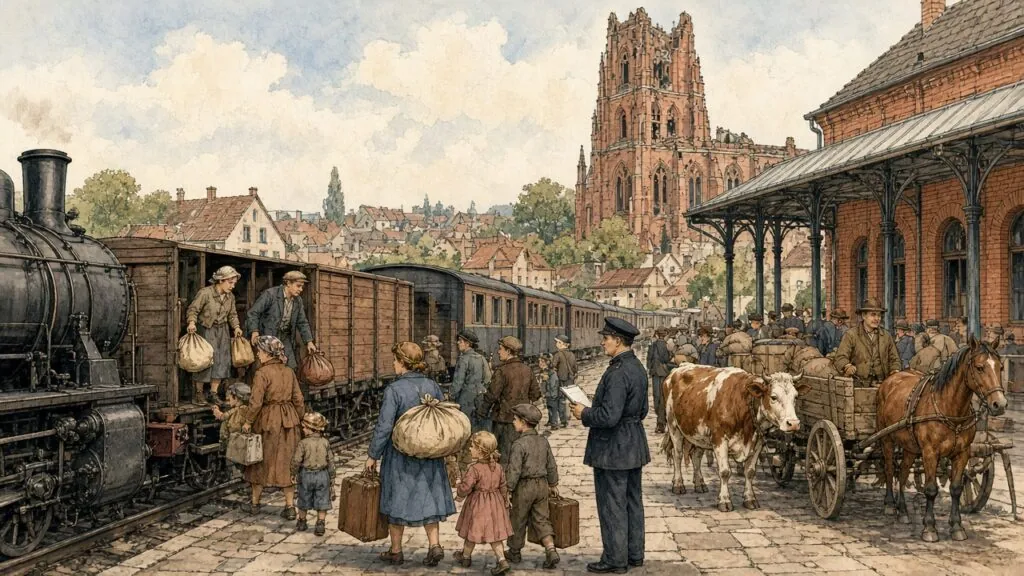
The great displacement
At the end of the Second World War the Allied leaders agreed, at Yalta and Potsdam, to move Poland bodily westward. The Soviet Union kept the eastern territories of interwar Poland, roughly up to the line proposed after the First World War by the British Foreign Secretary Lord Curzon, and Poland was compensated with the German lands east of the Oder and the Lusatian Neisse, plus the southern part of East Prussia and the former Free City of Danzig.[74][75] The northern part of East Prussia, including Königsberg, went to the Soviet Union. Czechoslovakia was restored within its pre-Munich borders, minus Carpathian Ruthenia, which the Soviet Union annexed.
These border changes came with population transfers on a scale without precedent in modern European history. Millions of Germans fled or were expelled from Poland, Czechoslovakia, Hungary, Romania and Yugoslavia between 1944 and 1950; the Potsdam Conference endorsed “orderly and humane” transfers on 2 August 1945, though in practice many expulsions were neither.[76][77] Poles were moved from the territories annexed by the Soviet Union into the former German lands; Ukrainians were moved from Poland into the Soviet Union, and in 1947 those remaining in south-eastern Poland were deported to the new western territories in Operation Vistula.[78]
The result was that, across a vast area, the people who had used one set of names left, and people who had never used those names arrived. Close to five million settlers came to Poland’s new western and northern territories between 1945 and 1950.[9] They needed names for the towns, villages, streams and hills where they now lived, and the state needed names for its maps, railways and post offices.
The Polish renaming commission
The Polish state called the new lands the Recovered Territories (Ziemie Odzyskane), a phrase that expressed the official claim that they were historically Polish lands returning home after centuries of German rule.[79] The claim was partly true and partly myth. Silesia had been ruled by the Polish Piast dynasty in the Middle Ages, and Upper Silesia, Warmia and Masuria still had Polish-speaking communities in 1945. But much of Pomerania, Lower Silesia and East Brandenburg had been German-speaking for centuries.
In the first months after the war, naming was chaotic. Local officials and settlers kept German names, Polonised their spelling and pronunciation (Zechow to Czechów, Boyadel to Bojadła, Poberow to Pobierowo), translated them literally (Eichberg to Dębogóra, Grünwalde to Zielenica, Linde to Lipka), named places after their topography, or chose names honouring local people or events.[9] Some places received several different names from different authorities.
To bring order, the Polish government established the Commission for the Determination of Place Names (Komisja Ustalania Nazw Miejscowości) in January 1946. It was chaired by the geographer Stanisław Srokowski, the former director of the Baltic Institute, and its members included the linguists Kazimierz Nitsch, Mikołaj Rudnicki, Stanisław Rospond and Witold Taszycki and the historian Władysław Semkowicz.[9] Its decisions had to be accepted by the ministries for public administration and for the Recovered Territories and were published in the official gazette, Monitor Polski. By the end of 1946 the commission had adopted about 4,400 place names, and by June 1947 it had named nearly all railway stations and settlements with more than five hundred inhabitants.[9]
The commission’s preferred method was to find a historical Slavic or Polish name in medieval documents and revive it. For the major cities this was straightforward: Breslau became Wrocław, the old Polish form; Stettin became Szczecin; Danzig became Gdańsk; Kolberg became Kołobrzeg; Oppeln became Opole; Liegnitz became Legnica. All of these Polish forms had long been in use in Polish-language writing. For thousands of villages that had no documented Slavic name, the commission resorted to translation, phonetic adaptation or invention. One village in East Prussia, Drengfurt, first renamed Dryfort, was renamed Srokowo in 1950 in honour of the commission’s chairman after his death.[9]
The commission’s work has been criticised as politically driven, and it was. But it was also philologically serious, and many of its revived medieval names were genuinely older than the German forms they replaced. Its legacy is the map of western and northern Poland as it exists today, in which nearly every place name is either a revived historical form or a mid-twentieth-century creation, and in which the German names survive only in history books, in the memory of expellees and their descendants, and, for some places in Opole Silesia, on bilingual signs.
Czechoslovakia and the Sudeten borderlands
Czechoslovakia’s situation was different. Almost all towns in the Sudeten borderlands already had official Czech names, because Czech had been an official language since 1918 and Czech names had existed alongside German ones for centuries. Liberec, Ústí nad Labem, Karlovy Vary, Cheb and Opava did not need inventing. The change after 1945 was the disappearance of the people who used the German names. Around three million Sudeten Germans were expelled, and with them went the everyday use of Reichenberg, Aussig, Karlsbad, Eger and Troppau.[77]
For smaller places the story was more complicated. Some hamlets with only German names received Czech names; others were never resettled at all. Hundreds of villages in the borderlands, especially along the Bavarian and Austrian frontiers that became the Iron Curtain, were abandoned and later demolished, so that their German names now refer to places that no longer exist.[80]
Kaliningrad and the total renaming
The most radical renaming of 1945 to 1947 took place in the northern part of East Prussia, which became the Kaliningrad Oblast of the Russian Soviet Federative Socialist Republic. In 1946 Königsberg was renamed Kaliningrad, in honour of Mikhail Kalinin, the nominal head of the Soviet state, who had died that June.[16] The remaining German population was expelled in 1947 and 1948, and the territory was resettled from Russia, Belarus and Ukraine.[81]
The Soviet authorities did not attempt to revive older Baltic or Old Prussian names. They gave the towns entirely new Russian names, many commemorating Soviet military leaders and soldiers who had fallen in the East Prussian campaign. Insterburg became Chernyakhovsk, after General Ivan Chernyakhovsky; Gumbinnen became Gusev, after a captain killed in the fighting; Preußisch Eylau became Bagrationovsk, after the general of the Napoleonic wars; Tilsit became Sovetsk; Pillau became Baltiysk; Cranz became Zelenogradsk; Rauschen became Svetlogorsk in 1947.[82][83][84][85][86][87][88] A later chapter examines this region in detail.
The new map stabilises
By about 1950 the map of Central Europe had been rewritten. In most places the new names have lasted, and they are now as unquestioned in daily use as any old name. A child born in Wrocław in 1950 grew up with no reason to say Breslau; a child born in Kaliningrad in 1950 might never have heard the word Königsberg. Yet the old names did not die. They lived on in emigration, in archives, in the speech of the few who remained, and in a culture of memory that would find new voices after 1989.
Chapter 8. Red Names. Stalin Cities and Their Undoing
The fashion for leaders
The communist regimes that came to power across Central and Eastern Europe after 1945 inherited from the Soviet Union a habit of naming cities after living or recently dead leaders. The Soviet Union had begun the practice early. Petrograd became Leningrad in 1924, Tsaritsyn became Stalingrad in 1925, and in Ukraine Yuzovka, the steel town founded by the Welsh industrialist John Hughes, became Stalin in 1924 and later Stalino.[89] Yekaterinoslav became Dnipropetrovsk in 1926 after the Ukrainian party leader Grigory Petrovsky; Yelisavetgrad went through the names Zinovievsk and Kirovo before becoming Kirovohrad; and in 1946 Königsberg became Kaliningrad.[46][19][16]
The satellite states followed. In the early 1950s, at the height of the Stalin cult, almost every country in the bloc gave his name to a city, usually a newly built or newly industrialised one that embodied the socialist future. These names have become emblems of an era, and their reversal after Stalin’s death, or after 1989, is one of the most telling episodes in the history of political naming.
Stalinogród
The Polish case came in March 1953, days after Stalin’s death on 5 March. On 7 March the authorities renamed Katowice, the capital of the Upper Silesian industrial district, as Stalinogród, “Stalin’s town”.[12] The choice of Katowice was deliberate: it was a working-class, industrial city, and it lay in a region where the Polish claim to formerly German lands was still a live political issue.
The name was deeply unpopular. It lasted only until 10 December 1956, a few months after the political thaw of October 1956 brought Władysław Gomułka to power, when Katowice regained its name.[12] The episode lasted less than four years, but it remains a vivid part of local memory, and the brief existence of Stalinogród on letters, stamps and railway signs is now a favourite topic of Silesian historians and collectors.
Orașul Stalin
Romania went further, choosing a historic city rather than a new one. On 22 August 1950 Brașov, the Transylvanian city known in German as Kronstadt and in Hungarian as Brassó, was renamed Orașul Stalin, “Stalin City”, and a party resolution described Stalin in the conventional extravagant language of the cult.[90] The renaming was ironic in a city with a deep Saxon German heritage, a medieval Black Church and a skyline of Gothic towers. The city’s name reverted to Brașov in 1960.[90]
Sztálinváros and Stalinstadt
In Hungary, the regime chose to build a new city on the Danube south of Budapest as the centrepiece of its industrialisation programme. Construction began in 1949 on the site of the village of Dunapentele, which was renamed Sztálinváros, “Stalin city”, in 1951.[91] After the revolution of 1956 and the subsequent cautious de-Stalinisation, the government renamed the city in 1961 with a deliberately neutral name, Dunaújváros, “Danube new town”.[91]
East Germany followed the same pattern. The new steel town built near Fürstenberg on the Oder was named Stalinstadt in 1953, shortly after Stalin’s death, and renamed Eisenhüttenstadt, “iron-works city”, in 1961 during de-Stalinisation.[92] The neutral industrial names chosen for both Dunaújváros and Eisenhüttenstadt show how regimes that no longer wished to celebrate Stalin, but could not admit any loss of faith in the socialist project, resolved the problem: they named the cities after what they made.
Gottwaldov and Karl-Marx-Stadt
Not every communist name was Stalinist. In Czechoslovakia, the shoe-manufacturing town of Zlín, built up into a modernist company town by the Baťa firm, was renamed Gottwaldov in 1949 after Klement Gottwald, the first communist president of Czechoslovakia. The name lasted for four decades, and on 1 January 1990, weeks after the Velvet Revolution, the city’s name was changed back to Zlín.[17] The name Gottwaldov survives in the memory of older Czechs and Slovaks and on enamel signs and products of the era.
In East Germany, Chemnitz, the great Saxon manufacturing city, was renamed Karl-Marx-Stadt on 10 May 1953 by decision of the government, to mark the industrial heritage of the city and the Karl Marx Year commemorating the 135th anniversary of his birth and the 70th anniversary of his death.[18] At the renaming ceremony the official words declared that the city bore “the proud and mandatory name Karl-Marx-Stadt”.[18] The name survived de-Stalinisation because Marx, unlike Stalin, remained the philosophical foundation of the state. After the fall of the Berlin Wall, a referendum on 23 April 1990 produced a 76 percent vote for the old name, and on 1 June 1990 the city officially became Chemnitz again.[18] The giant bronze head of Marx in the city centre was kept, and has become an unlikely emblem of the city.
Leninváros, Titograd, Kardeljevo and Dimitrovgrad
Other leaders were honoured too. In Hungary the new chemical town of Tiszaszederkény was renamed Leninváros in 1970; in 1991 it became Tiszaújváros, again a neutral “new town on the Tisza”.[93] In Yugoslavia, which broke with Stalin in 1948, the honours went to domestic figures: Podgorica, the capital of Montenegro, became Titograd in 1946 and regained its old name in 1992; the Croatian port of Ploče was named Kardeljevo, after the party ideologist Edvard Kardelj, from 1950 to 1954 and again from 1980 to 1990.[94][95] In Serbia, the border town of Caribrod (Tsaribrod) took the name of the Bulgarian communist leader Georgi Dimitrov and is still officially called Dimitrovgrad.[96]
The Soviet case and Ukraine
Inside the Soviet Union, the communist naming system lasted until 1991 and in parts of the region long afterwards. Ukraine’s western territories, annexed in 1939 and 1945, received a mixture of Soviet names and Russian-language forms of Ukrainian names. Stanisławów became Stanislav and then, in 1962, Ivano-Frankivsk in honour of the writer Ivan Franko; Proskurov became Khmelnytskyi in 1954, honouring the seventeenth-century Cossack leader Bohdan Khmelnytsky on the three-hundredth anniversary of the Pereiaslav agreement with Muscovy; Krystynopol, named in the eighteenth century by a Polish magnate after his wife, became Chervonohrad, “red city”, in 1951.[97][98][99] Mariupol on the Sea of Azov was Zhdanov from 1948 to 1989.[100]
Some of these Soviet names had a Ukrainian national content (Franko and Khmelnytsky were Ukrainian heroes), and they survived the end of communism. Others did not. Ukraine’s decommunisation laws, signed by President Petro Poroshenko on 15 May 2015, required the renaming of places named after communist figures, and by 2016 some 987 cities and villages had been renamed, along with more than fifty thousand streets.[101] Dnipropetrovsk became Dnipro and Kirovohrad became Kropyvnytskyi in 2016.[46][19] After the full-scale Russian invasion of 2022, a further law of April 2023 prohibited names glorifying the Russian imperial project, and on 19 September 2024 the Verkhovna Rada renamed 327 settlements and four districts in one resolution, among them Chervonohrad, which became Sheptytskyi after the Greek Catholic metropolitan Andrey Sheptytsky.[20][102]
What the red names teach
The communist names were the most explicitly political names Central Europe ever had. They were chosen to honour individuals, they were imposed from above with little regard for local preference, and they were therefore vulnerable to the death or disgrace of their honorees. That vulnerability makes them a useful measure of political change: the date on which a Stalin name disappeared is a precise indicator of the date on which a regime decided it could live without Stalin.
The red names also left a lasting lesson about the limits of political naming. Almost none of them took root in popular affection. When people were given the chance to vote or speak freely, as in Chemnitz in 1990, they chose the old names. The exceptions, like Ivano-Frankivsk and Khmelnytskyi, are names whose honorees had meaning to local people independent of the regime that chose them.
Part Two. Country by Country
Chapter 9. Poland. Recovered Territories and Partitioned Memories
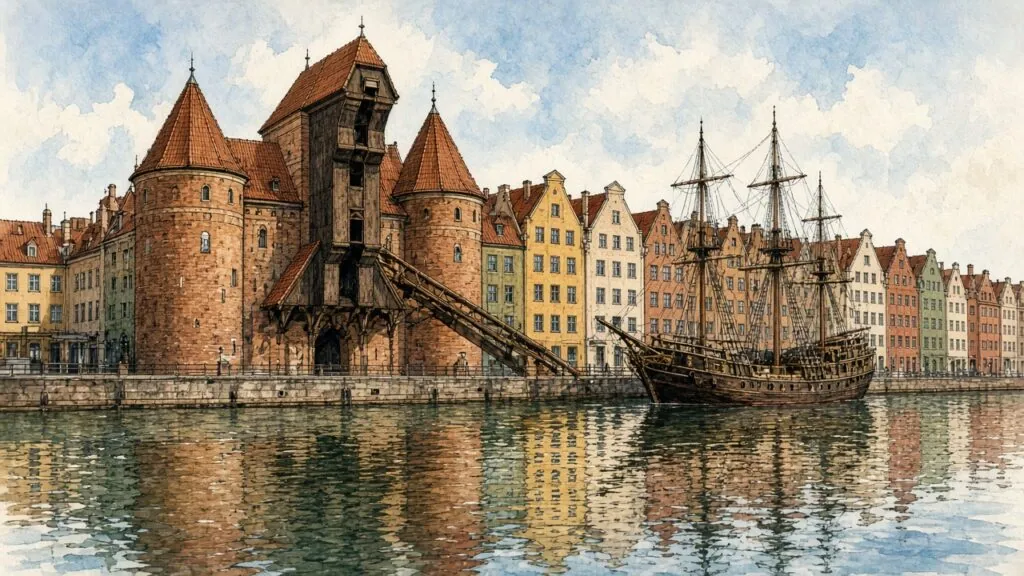

A state that moved
No country in Central Europe has had its map rewritten as thoroughly as Poland. The Polish-Lithuanian Commonwealth disappeared from the map in the partitions of 1772, 1793 and 1795, its lands divided among Russia, Prussia and Austria.[42] For more than a century Polish towns carried official names in Russian, German or (in Austrian Galicia, increasingly) Polish. The Second Polish Republic, reborn in 1918, stretched far to the east, taking in Lwów, Wilno, Grodno and Stanisławów, while its western border left Breslau, Stettin, Danzig and most of Upper Silesia outside. In 1945 the whole country shifted westward by roughly two hundred kilometres, losing the eastern borderlands (the Kresy) to the Soviet Union and gaining the German lands east of the Oder and Neisse.[74][79]
As a result, modern Poland contains three distinct naming landscapes. The core of the country, the lands that were Polish before the partitions and after 1918, has names that are overwhelmingly Polish, with German, Russian and Yiddish exonyms layered on top. The former Prussian partition, which includes Poznań, Bydgoszcz and Toruń, has Polish names that alternated with German official forms from the late eighteenth century until 1919 and again during the occupation. The Recovered Territories, the former eastern Germany, had German official names until 1945 and Polish names determined after 1945 by the renaming commission described in Chapter 7. The table below gives the principal cities.
| Modern official name | German | Other historical and foreign forms | Notes |
|---|---|---|---|
| Wrocław | Breslau | Czech Vratislav; Latin Wratislavia, Vratislavia; Yiddish Bresloy | German until 1945 |
| Gdańsk | Danzig | Kashubian Gduńsk; Latin Gedanum; early Gyddanyzc (997) | Free City 1920 to 1939 |
| Szczecin | Stettin | Latin Sedinum | German until 1945 |
| Poznań | Posen | Latin Posnania | Prussian 1793 to 1919 |
| Bydgoszcz | Bromberg | (German from Braheberg, “hill on the Brahe”) | Prussian 1772 to 1920 |
| Toruń | Thorn | Prussian 1793 to 1920 | |
| Olsztyn | Allenstein | Prussian Warmia | German 1772 to 1945 |
| Katowice | Kattowitz | Stalinogród (1953 to 1956) | Polish from 1922 |
| Gliwice | Gleiwitz | Czech Hlivice | German until 1945 |
| Bytom | Beuthen O.S. | Silesian Bytōm | German until 1945 |
| Zabrze | Hindenburg O.S. (1915 to 1945) | Earlier German Zabrze | German until 1945 |
| Opole | Oppeln | Czech Opolí | German until 1945 |
| Zielona Góra | Grünberg in Schlesien | German until 1945 | |
| Gorzów Wielkopolski | Landsberg an der Warthe | Briefly Kobylagóra (1945) | German until 1945 |
| Jelenia Góra | Hirschberg im Riesengebirge | German until 1945 | |
| Wałbrzych | Waldenburg | Czech Valbřich | German until 1945 |
| Legnica | Liegnitz | Czech Lehnice | German until 1945 |
| Kołobrzeg | Kolberg | Kashubian Kòlbrzég | German until 1945 |
| Koszalin | Köslin | Kashubian Kòszalëno | German until 1945 |
| Słupsk | Stolp | Kashubian Stôłpsk | German until 1945 |
| Elbląg | Elbing | Polish crown 1454 to 1772 | |
| Malbork | Marienburg | Teutonic Order capital | |
| Świnoujście | Swinemünde | Low German Swienemünn | German until 1945 |
| Kłodzko | Glatz | Czech Kladsko | Bohemian until 1742 |
| Nysa | Neisse | Czech Nisa | German until 1945 |
| Racibórz | Ratibor | Czech Ratiboř | German until 1945 |
| Cieszyn | Teschen | Czech Těšín | Divided 1920 |
| Bielsko-Biała | Bielitz-Biala | Czech Bílsko-Bělá | Merged 1951 |
| Kraków | Krakau | Latin Cracovia; Yiddish Kroke; English Cracow | Austrian 1846 to 1918 |
| Warszawa | Warschau | English Warsaw; Yiddish Varshe; Russian Varshava | Russian 1815 to 1915 |
| Łódź | Lodsch; Litzmannstadt (1940 to 1945) | Yiddish Lodzh | Russian partition |
| Przemyśl | Premissel | Ukrainian Peremyshl; Latin Premislia; Yiddish Pshemishl | Austrian 1772 to 1918 |
| Chełm | Cholm | Ukrainian and Russian Kholm; Yiddish Khelm | Russian partition |
| Białystok | Bialystok | Belarusian Biełastok; Yiddish Byalistok; Lithuanian Balstogė; Russian Belostok | Russian 1807 to 1915 |
Wrocław and Breslau
Wrocław is the most studied example of how a city’s name and identity can change completely within a single lifetime. Founded as a stronghold on the Oder at a crossing of trade routes, it was long thought to take its name from Vratislav I, a duke of Bohemia in the early tenth century; in the twelfth century a Czech-influenced Latin form, Vratislavia, appears in documents, and by the fifteenth century the Early New High German form Breslau had emerged.[103] The city passed from Piast Polish rule to the Bohemian crown, to the Habsburgs and, in 1741, to Prussia. For most of the modern era Breslau was a great German city, the capital of Silesia, with a university, a prosperous bourgeoisie and, until the Nazi period, one of the largest Jewish communities in Germany.
In 1945 the city was declared a fortress (Festung Breslau) and held out under siege until days before the German surrender, suffering enormous destruction. It became part of Poland under the Potsdam settlement, most German residents fled or were expelled, and Polish settlers arrived, many of them from Lwów in the territories annexed by the Soviet Union.[103] The Polish form Wrocław, long used in Polish writing, became the official name. The arrival of the Lwów population brought institutions with it: the Ossolineum library and parts of Lwów’s university and academic life were re-established in Wrocław, and the city’s post-war identity was shaped by a sense that one lost city had been transplanted into another.
For decades the communist state’s narrative stressed the city’s Piast, Slavic origins and downplayed its German centuries. Since 1989 Wrocław has embraced its multi-layered past with remarkable openness. Its marketing as “the meeting place” and its programme as European Capital of Culture in 2016 played on the coexistence of German, Polish, Czech and Jewish heritage. The name Breslau now appears without anxiety in museum exhibitions and guidebooks, and the city has become a model for how a Polish city can acknowledge its German past without threatening its Polish present.
Gdańsk and Danzig
Gdańsk was first mentioned in 997 in the life of Saint Adalbert as urbs Gyddanyzc, and its name was then written in a bewildering variety of ways: Kdanzk in 1148, Gdanzc in 1188, Danceke in 1228, Gdańsk in 1236, Danzc in 1263, Danczk in 1311, Danczik in 1399, Danczig in 1414.[8] The German form Danzig and the Polish form Gdańsk are therefore cousins, both descendants of the early Slavic name. Kashubian speakers, whose language is native to the region, say Gduńsk.
Gdańsk was a Hanseatic city with a German-speaking burgher class and, for long periods, a loyal member of the Polish crown, enjoying extensive autonomy under the Polish kings from 1454 until the partitions. It became Prussian in 1793, was a free city under Napoleon from 1807 to 1814, and again a Free City under League of Nations protection from 1920 to 1939.[8][104] Its population in that interwar period was overwhelmingly German-speaking, and the struggle between Poland and Germany over the city’s status was one of the proximate causes of the Second World War, which began with the German attack on the Polish garrison at Westerplatte on 1 September 1939.[8]
The name had real political consequences. Interwar Polish usage insisted on Gdańsk, German usage on Danzig; the League’s official documents used Danzig, as did most English writing. When Günter Grass, a native of the city, wrote his novels of pre-war Danzig, he kept the German name; Polish translations used Gdańsk. After 1945 the city was rebuilt, its historic centre painstakingly reconstructed, and the name Gdańsk became inseparable from the shipyard strikes of 1980 and the Solidarity movement. English usage shifted decisively to Gdańsk in those years. Today, Danzig is the name of a historical city that existed until 1945, while Gdańsk names both that city and its successor.
Szczecin and Stettin
Szczecin, historically known in English by its German name Stettin, lies on the Oder near the Baltic.[105] Like Gdańsk, its two names are related, both deriving from an early Slavic Pomeranian form. Stettin was the capital of the Duchy of Pomerania, Swedish from 1648 to 1720, then Prussian, and the birthplace of the future Catherine the Great. In 1945 its assignment to Poland was not at first certain, because it lies west of the Oder, and the city’s transfer to Polish administration took several months. Its Polish name was formally adopted, and its German population was replaced by settlers. Today it is the capital of the West Pomeranian Voivodeship, and the metropolitan area extends across the border into German Brandenburg and Mecklenburg, where the old name remains in everyday German use.[105]
The Prussian partition. Poznań, Bydgoszcz, Toruń
Poznań, German Posen and Latin Posnania, is one of the cradles of the Polish state, the seat of the first Polish bishopric in 968.[106] It was Prussian from the Second Partition until the Greater Poland Uprising of 1918 to 1919 restored it to Poland, and German again under the occupation, when it became the capital of the Reichsgau Wartheland. The German form Posen is an adaptation of the Polish name and has the same root. Poznań’s history of Prussian rule left deep marks on the city’s architecture, including the imperial castle built for Wilhelm II, but its name was never in dispute among its Polish population.
Bydgoszcz‘s German name Bromberg is a different matter. It comes from Braheberg, “hill on the Brahe”, the German name of the River Brda, and was used by the Teutonic Knights during their brief occupation of the town from 1331 to 1337.[107] It is thus a name with its own medieval pedigree, not an adaptation of the Polish one. Toruń, German Thorn, was founded by the Teutonic Knights in 1233; from the fifteenth century the monosyllabic German form Thorn came into use.[108] It was the birthplace of Nicolaus Copernicus, whose nationality has been argued over by German and Polish historians in a debate that mirrors the debate about the city’s names.
Upper Silesia. Katowice, Gliwice, Bytom, Zabrze, Opole, Racibórz
Upper Silesia is the region where the German and Polish naming systems were most closely intertwined, because the region’s population included German speakers, Polish speakers and speakers of the Silesian dialect or language who often used both systems at once. Most places had both a German and a Polish name in local use.[15] After the 1921 plebiscite and the partition of the region in 1922, Katowice went to Poland, while Gliwice (Gleiwitz), Bytom (Beuthen), Zabrze, Opole (Oppeln) and Racibórz (Ratibor) stayed in Germany until 1945.
Zabrze’s history illustrates the politics of the era. In 1915, in the middle of the First World War, it was renamed Hindenburg in honour of the victor of Tannenberg, Field Marshal Paul von Hindenburg, with Emperor Wilhelm II approving the change on 21 February 1915.[2] In the 1921 plebiscite, a majority in Hindenburg voted to remain in Germany, and in the Third Silesian Uprising of May 1921 Polish insurgents captured the town and held it until the end of the uprising.[2] It stayed German, under its new name, until 1945, when it became Zabrze again.
Gliwice is remembered for the staged attack on its radio station on 31 August 1939, one of the false-flag incidents the Nazi regime used as a pretext for invading Poland. Bytom, called Beuthen O.S. (Oberschlesien) in German to distinguish it from Beuthen an der Oder, is one of the oldest towns in the region, with town rights from 1254.[109] Opole, the seat of a Piast duchy in the Middle Ages, is today the capital of the voivodeship in which most of Poland’s German minority lives, and it is in the Opole region that bilingual Polish-German place-name signs are most common, a subject discussed in Chapter 22.[110] Racibórz, German Ratibor and Czech Ratiboř, sits close to the Czech border, and its trilingual naming reflects centuries of Bohemian, Polish and German rule.[111]
Lower Silesia and Lubusz. Jelenia Góra, Wałbrzych, Legnica, Zielona Góra, Gorzów
The cities of Lower Silesia show how the renaming commission dealt with places whose German names had no direct Polish predecessor in common use. Jelenia Góra is a literal translation of the German Hirschberg, “deer mountain”.[112] Zielona Góra, “green mountain”, likewise translates Grünberg in Schlesien.[113] Wałbrzych is a Polish adaptation of Waldenburg; in the local Lower Silesian German dialect the town was Walmbrig or Walmbrich, and Czech has Valbřich.[114] Legnica, German Liegnitz and Czech Lehnice, was a ducal capital whose Polish name was well established in medieval sources.[115]
Gorzów Wielkopolski shows the uncertainties of 1945. Its German name, Landsberg an der Warthe, dates back to 1257. In Polish, the name Gorzów eventually stuck, beating the alternative post-war proposal Kobylagóra (“mare mountain”), which survives today as the name of a street; the suffix Wielkopolski, “of Greater Poland”, was added because the town belonged to the Poznań (Greater Poland) voivodeship from 1946 to 1950.[116] The suffix thus records a short administrative arrangement that has long since lapsed, and the city now lies in the Lubusz Voivodeship.
Pomerania and the Baltic coast. Kołobrzeg, Koszalin, Słupsk, Świnoujście
Along the Pomeranian coast, the German names were mostly adaptations of older Slavic Pomeranian names, and the Polish forms are revivals. Kołobrzeg (German Kolberg, Kashubian Kòlbrzég) is the site of a medieval bishopric founded in the year 1000, one of the oldest in Poland; its name means “by the shore”. Kolberg had a powerful place in German national mythology because of its resistance to Napoleon’s armies in 1807, and in 1945 Goebbels commissioned an expensive propaganda film, Kolberg, about that siege, released when the real town was about to fall.[117][118] Koszalin (German Köslin, Kashubian Kòszalëno) and Słupsk (German Stolp, Kashubian Stôłpsk) also have Kashubian names that reflect the indigenous West Slavic population of the region.[119][120] Świnoujście, German Swinemünde, Low German Swienemünn, means “mouth of the Świna”, exactly as the German does.[121]
The Order’s towns. Elbląg, Malbork, Olsztyn
In the lands of the former Teutonic Order, the German names are usually the original ones. Elbląg derives from the German Elbing, the name the Teutonic Knights gave both to the river and to the citadel they founded on its banks in 1237.[122] Malbork, German Marienburg, “Mary’s castle”, was the seat of the Grand Masters of the Order; in June 1945 the Polish authorities renamed it with the historic Polish form, Malbork, which had developed in Polish usage during the centuries when the castle served as a residence of the Polish kings.[123] Olsztyn, German Allenstein, received municipal rights from the cathedral chapter of Warmia in October 1353, and Copernicus administered the chapter’s estates from its castle.[124]
Kłodzko and Nysa
Kłodzko, German Glatz and Czech Kladsko, is a reminder that not all of Silesia’s history is German-Polish. The Kłodzko Land was culturally and traditionally part of Bohemia and was administered as part of Silesia only periodically in the Middle Ages, becoming permanently Silesian under Prussian rule from 1763.[125] Its Czech name and its Czech-speaking minority survived into the twentieth century, and in 1945 Czechoslovakia briefly claimed the area. Nysa, German Neisse, took its name from the river, which itself has a Czech form, Nisa.
Cieszyn and Bielsko-Biała
Cieszyn, German Teschen and Czech Těšín, is a town divided in two. The Olza River formed the border after the Czechoslovak-Polish conflict over Cieszyn Silesia in 1919 and 1920, so that the old town on the east bank became Polish Cieszyn, and the western suburbs became Czech Český Těšín.[126] Few places show more clearly that names follow borders: two halves of one town, separated by a footbridge, carry two officially different names that are in origin the same name.
Bielsko-Biała is another composite. The towns of Bielsko (German Bielitz) in Austrian Silesia and Biała (German Biala) in Galicia faced each other across the Biała River, which formed the historic border between Silesia and Lesser Poland; they were merged in 1951. The German-speaking enclave around Bielitz was one of the most compact German-speaking islands in pre-war Poland.[127]
Kraków, Warsaw and Łódź
The historic Polish heartland had its own exonyms. Kraków, the old royal capital, is Krakau in German and Dutch, Krakov in Czech and Slovak, Cracovia in Latin, Italian, Spanish and Romanian, Krakkó in Hungarian, Krokuva in Lithuanian and Kroke in Yiddish. Until the 2000s the traditional English form Cracow was more common in English than the borrowed forms Krakow and Kraków.[60] The change in English usage is a small example of a wider shift in which English has increasingly adopted endonyms with or without diacritics.
Warsaw, Warszawa in Polish, was the capital of Congress Poland under Russian rule from 1815 to 1915, and its Russian name Varshava appeared on official documents and railway timetables. Its German name is Warschau, its Yiddish name Varshe.[128] Łódź, the great textile city, has a name meaning “boat”; its Yiddish name was Lodzh, and the Nazi name Litzmannstadt has been discussed in Chapter 6.[62]
The eastern edge. Przemyśl, Chełm, Białystok
Poland’s eastern cities are shaped by long contact with Ukrainian, Belarusian, Russian and Jewish populations. Przemyśl was the capital of a semi-independent principality of Peremyshl under Kyivan Rus’ in the eleventh century; its names include Czech Přemyšl, German Premissel, Latin Premislia, Ukrainian and Russian Peremyshl, and Yiddish Pshemishl.[129] Chełm, known in Ukrainian and Russian as Kholm, was a seat of the medieval Ruthenian king Daniel of Galicia, and to Yiddish speakers it was Khelm, the town of the “wise men of Chelm” of Jewish folklore. Białystok has names in Belarusian (Biełastok), Yiddish (Byalistok), Lithuanian (Balstogė) and Russian (Belostok), and it was the birthplace of Ludwik Zamenhof, the creator of Esperanto, who wrote about the city’s quarrelling language communities as the inspiration for his universal language.[130]
These eastern towns are, in a sense, the counterpart to the Recovered Territories. In the west, Poland acquired cities whose German names were replaced; in the east, Poland lost cities whose Polish names were replaced, and kept cities whose Ukrainian, Belarusian and Yiddish names now survive mostly in the memory of minorities and of the diaspora.
Chapter 10. Czechia. The Bohemian Crown and the Emptied Borderlands
Two languages, one land
The Czech lands, Bohemia, Moravia and the small Czech part of Silesia, had for most of their history two everyday languages, Czech and German, and two parallel sets of place names. German-speaking settlers arrived in large numbers from the thirteenth century, invited by the Přemyslid kings to found towns and open mines, and they settled especially in the mountainous borderlands that ring Bohemia and in a number of inland “language islands” such as the area around Jihlava. Czech remained the language of most of the interior. Towns were frequently bilingual, and over the centuries the balance between the two languages shifted with politics, religion and economics.
The nineteenth century turned this coexistence into competition. The Czech national revival restored Czech as a language of literature, science and politics, and Czech and German nationalists fought over schools, signs, theatres and the language of administration. In 1918 Czechoslovakia made Czech names primary across Bohemia and Moravia; in 1938 the Munich Agreement gave the German-majority borderlands, the Sudetenland, to Germany; in 1945 to 1946 the German population of roughly three million was expelled.[131][77] What makes the Czech case distinctive is that almost every town already had an established Czech name, so the post-war change was not mainly a renaming but the disappearance of the people who used the German names.
| Modern official name | German | Other forms | Notes |
|---|---|---|---|
| Praha | Prag | English Prague; Latin Praga | Capital |
| Brno | Brünn | Yiddish Brin; Latin Bruna | Moravian capital until 1948 |
| Ostrava | Ostrau (Mährisch-Ostrau, Polnisch-Ostrau) | Polish Ostrawa | Moravian and Silesian halves |
| Plzeň | Pilsen | Gives its name to pilsner | |
| Liberec | Reichenberg | Sudeten German capital 1938 to 1945 | |
| Olomouc | Olmütz | Latin Olomucium | Archbishopric from 1777 |
| České Budějovice | Budweis | Early Budwoyz (1265) | Budweiser beer |
| Hradec Králové | Königgrätz | Battle of 1866 | |
| Ústí nad Labem | Aussig | Elbe port | |
| Pardubice | Pardubitz | ||
| Karlovy Vary | Karlsbad | English Carlsbad | Spa |
| Mariánské Lázně | Marienbad | Spa | |
| Františkovy Lázně | Franzensbad | Spa | |
| Teplice | Teplitz, Teplitz-Schönau | Teplice-Šanov until 1948 | Spa |
| Děčín | Tetschen (with Bodenbach, Czech Podmokly) | Elbe crossing | |
| Chomutov | Komotau | ||
| Most | Brüx | Old town demolished for mining | |
| Karviná | Karwin | Polish Karwina | Cieszyn Silesia |
| Opava | Troppau | Polish Opawa | Capital of Austrian Silesia |
| Jihlava | Iglau | German language island | |
| Znojmo | Znaim | ||
| Cheb | Eger | Egerland | |
| Český Krumlov | Krumau, Böhmisch Krumau | UNESCO site | |
| Kutná Hora | Kuttenberg | Silver mines | |
| Terezín | Theresienstadt | Founded 1780 | |
| Aš | Asch | Westernmost town | |
| Špindlerův Mlýn | Spindlermühle, Spindelmühle | Mountain resort |
Prague
Prague is the one Czech city with a well-established English exonym. To Czechs it is Praha, to Germans Prag, to Latin chroniclers Praga.[35] For centuries it was a city of three peoples, Czechs, Germans and Jews, each with its own institutions and, in a sense, its own city. Franz Kafka, a German-speaking Jew who also knew Czech, was born in Prague in 1883; the writer and essayist Egon Erwin Kisch, the poet Rainer Maria Rilke and the novelist Franz Werfel were also Prague Germans. The city’s German-language university, separated from the Czech university in 1882, survived until 1945. Today the German name Prag is simply the German word for the city, used without any political charge.
Brno and Olomouc
Brno, the Moravian capital, is Brünn in German, Brin in Yiddish and Bruna in Latin, and its locals historically spoke a mixed German dialect called Brünnerisch that borrowed heavily from Czech.[132] Brno was the capital of Moravia from the Middle Ages until 1948, and before the Second World War it had a substantial German-speaking population. Its most famous native German speaker might be the geneticist Gregor Mendel, an Augustinian friar of Silesian origin who conducted his experiments in the monastery garden of Old Brno; its most famous native Czech, perhaps, the composer Leoš Janáček, who adopted the city as his own. After the war the German population was driven out in the infamous Brno death march of May 1945.
Olomouc, German Olmütz, was the seat of a bishopric that became an archdiocese in 1777, and the capital of Moravia before Brno.[37] Its German name entered diplomatic history with the Punctation of Olmütz in 1850, at which Prussia was forced to back down before Austria. Like most Czech-German pairs, Olomouc and Olmütz are versions of the same original name, the German form having arisen by adaptation.
Ostrava
Ostrava, German Ostrau and Polish Ostrawa, is a double city. The Ostravice River divided Moravian Ostrava (Moravská Ostrava, German Mährisch-Ostrau) on one bank from Silesian Ostrava (Slezská Ostrava, historically Polnisch-Ostrau in German) on the other.[133] The first written mention of Silesian Ostrava dates from 1229, of Moravian Ostrava from 1267.[133] In the nineteenth century coal mining and the Vítkovice ironworks turned the area into the industrial heart of the Habsburg Monarchy, drawing Czech, German, Polish and Jewish workers and entrepreneurs. The double German name, with its contrast between “Moravian” and “Polish” Ostrau, records the linguistic diversity of the region on the border between Moravia and Silesia.
Plzeň, České Budějovice and the names of beer
Two Bohemian city names have become world brands. Plzeň, German Pilsen, gave its name to pilsner beer, first brewed there in 1842.[36] České Budějovice, German Budweis, gave its name to the Budweiser beer of the local Budvar brewery, and the word Budweiser, adopted by an American brewery in the nineteenth century, has been the subject of trademark disputes for more than a century.[134] The city’s name appears in the founding records of the royal town in 1265 as Budwoyz, later adapted to Budweis in German.[134] The Czech adjective České, “Bohemian”, distinguishes it from Moravské Budějovice.
Liberec and the Sudeten capital
Liberec, German Reichenberg, was the second city of Bohemia in the late nineteenth century, a textile centre with an overwhelmingly German-speaking population. Its name appears in medieval forms such as Reichenberg in 1385 to 1399 and Rychmberg in 1410; the Czech Liberec developed from the German.[135] After the Munich Agreement Reichenberg became the capital of the Reichsgau Sudetenland, and Konrad Henlein, leader of the Sudeten German Party, governed from there. After 1945 its German population was expelled and the city became Czech. The town hall, built in a Flemish Renaissance style modelled on Vienna’s, remains a striking reminder of Reichenberg’s former wealth.
The spa towns. Karlovy Vary, Mariánské Lázně, Františkovy Lázně, Teplice
The spa towns of western Bohemia, the “spa triangle” of Karlsbad, Marienbad and Franzensbad, were among the most famous resorts in Europe. Karlovy Vary, German Karlsbad and formerly Carlsbad in English, takes its name from the emperor Charles IV, who according to legend discovered its hot springs; both the Czech and German names mean “Charles’s baths” or “Charles’s hot springs”.[136] Mariánské Lázně, German Marienbad, means “Mary’s baths”; Františkovy Lázně, German Franzensbad, honours Emperor Francis.[137][138] In each case the Czech name is a translation of the German, made official in Czechoslovakia after 1918.
Teplice, German Teplitz, is a Czech name meaning “warm springs”, adopted into German. Until 1948 it was officially Teplice-Šanov, German Teplitz-Schönau, after a merger in 1895 with the neighbouring spa of Šanov (Schönau).[139] The dropping of the second element in 1948 shows how post-war Czech authorities simplified names that had reflected German-era administrative arrangements.
The northern borderlands. Ústí nad Labem, Děčín, Chomutov, Most
The Elbe valley and the brown-coal basin of northern Bohemia were among the most heavily German parts of the Czech lands. Ústí nad Labem, German Aussig, and Děčín, German Tetschen, stand on the Elbe, which Czech calls Labe.[140][141] Ústí was the site of a massacre of German civilians in July 1945, one of the most notorious episodes of the post-war expulsions. Děčín grew together with Podmokly (German Bodenbach) on the opposite bank, and the combined German form Tetschen-Bodenbach records the twin towns.[141]
Most, German Brüx, has one of the strangest histories of any town in the region. Its Czech name means “bridge”, and the German Brüx is an adaptation related to Brücke, “bridge”.[142] Under communist rule the historic town was demolished to make way for open-cast coal mining and replaced by a planned socialist city nearby.[142] Only the Gothic church of the Assumption was saved, moved in one piece along rails to a new site. Here a name survived while the place itself was destroyed. Chomutov, German Komotau, belonged to the same coal-mining region.[143]
Karviná and Opava. The Silesian corner
Czech Silesia is a small territory, the remnant of the Austrian Duchy of Silesia that remained to the Habsburgs after Prussia took most of Silesia in 1742. Opava, German Troppau and Polish Opawa, was its capital; the Czech, German and Polish forms all derive from the name of the local river.[144] Karviná, German Karwin and Polish Karwina, lies in the part of Cieszyn Silesia that went to Czechoslovakia in 1920, where a substantial Polish minority still lives.[145] Bilingual Czech-Polish signs are found in several municipalities of this area today. Nearby, the Hlučín region, German Hultschiner Ländchen, transferred from Germany to Czechoslovakia in 1920, had a population that spoke a Moravian dialect but often identified with Germany.
The south. Jihlava, Znojmo, Český Krumlov
Jihlava, German Iglau, was the centre of the largest German language island in the interior of the Czech lands and an important medieval mining town. The composer Gustav Mahler spent his childhood there.[146] Znojmo, German Znaim, in southern Moravia near the Austrian border, was famous for its wine and pickled gherkins.[147] Český Krumlov, German Krumau or Böhmisch Krumau, is one of the best-preserved small towns in Central Europe, now a UNESCO World Heritage Site; the painter Egon Schiele lived there briefly in 1911.[148] Its name, from a German root meaning “crooked meadow”, referring to the bend of the Vltava, was adapted into Czech, and the adjective Český distinguishes it from Moravský Krumlov.
Kutná Hora
Kutná Hora, German Kuttenberg, was one of the richest towns in medieval Europe because of its silver mines, and the Prague groschen was minted there. Both names refer to mining.[38] It was at Kutná Hora in 1409 that King Wenceslas IV issued the decree that gave the Bohemian “nation” a majority of votes at the University of Prague, a decision often remembered as an early landmark of Czech-German rivalry.
Hradec Králové and Pardubice
Hradec Králové, German Königgrätz, means “the queen’s castle”, from its status as a dowry town of the Bohemian queens; the German name is an adaptation that keeps the royal element.[149] In English and German historiography, the Prussian victory over Austria near the city on 3 July 1866 is known as the Battle of Königgrätz (in French and some other traditions, Sadowa). Pardubice, German Pardubitz, a little to the south, is an example of a Czech name lightly Germanised with the ending -itz.[150]
Cheb, Aš and the Egerland
At the far western tip of Bohemia lies the Egerland, an area with a distinctive German dialect and culture. Cheb, German Eger, was a free imperial city mortgaged to Bohemia in 1322; its German name is the name of the river Ohře, called Eger in German.[151] Aš, German Asch, is the westernmost town of the Czech Republic, in a panhandle almost surrounded by Germany.[152] Both towns were almost entirely German-speaking before 1945, and both were emptied of their populations after the war. Their Czech names, while older in written use than many people suppose, came into everyday use only with the new settlers.
Terezín and Špindlerův Mlýn
Terezín, German Theresienstadt, has been discussed in Chapter 6. Špindlerův Mlýn, German Spindlermühle, the mountain resort in the Giant Mountains (Krkonoše, German Riesengebirge), takes its name from a mill belonging to the Špindler family.[153] Its Czech and German names are direct equivalents, both meaning “Spindler’s mill”, and the resort is one of the most popular skiing destinations in the country.
The vanished villages
The most poignant aspect of Czech toponymy after 1945 is not renaming but disappearance. Many villages in the borderlands were never resettled after the expulsion of their German inhabitants, especially in the zone along the Iron Curtain, where the communist state cleared a security belt. Hundreds of villages were demolished. Lists of German names for places in the Czech Republic mark many entries with a note indicating that the settlement no longer exists.[80] In the Šumava and the Ore Mountains one can still find the foundations of churches, cellars and farmhouses in the woods, places whose names now live only on old maps and in the memories of expellees.
Chapter 11. Slovakia. Upper Hungary and the Three-Name Town
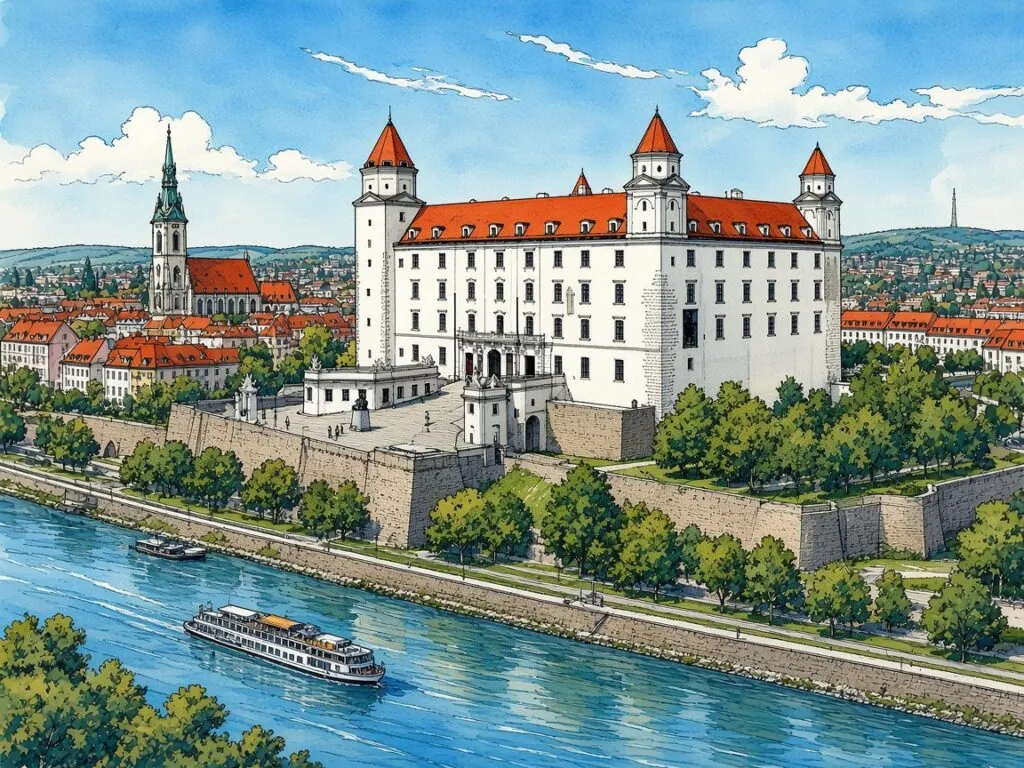
A land with a borrowed name
For nine centuries the territory of modern Slovakia was the northern part of the Kingdom of Hungary, and Hungarians called it, at least from the eighteenth century, Felvidék, “the Upland”, or Upper Hungary. It had no administrative existence of its own; it was divided into Hungarian counties, and the Hungarian names of those counties and their towns were the official ones. Slovak speakers formed the majority in most of the territory, Hungarian speakers in the south along the Danube and the lowlands, and German speakers in the old mining and merchant towns and in the Spiš region, where the Zipser Germans had settled in the Middle Ages.[30] Rusyns lived in the north-east, Jews in towns and villages throughout. The result was a land in which nearly every town of consequence had three names, Slovak, Hungarian and German, and a Latin one besides.
In 1918 to 1920 the territory became part of Czechoslovakia, and the Slovak names became official. The First Vienna Award of 1938 returned the Hungarian-majority south to Hungary until 1945. After the war, Czechoslovakia sought to expel its Hungarian minority as it expelled its Germans; that plan was only partly carried out, through a population exchange with Hungary and internal deportations. Today Slovakia’s Hungarian minority, numbering several hundred thousand, lives mostly in the south, and bilingual Slovak-Hungarian signs are a familiar sight there, governed by a minority-language law discussed in Chapter 22.[154]
| Modern official name | Hungarian | German | Other forms |
|---|---|---|---|
| Bratislava | Pozsony | Pressburg (Preßburg) | Slovak Prešporok until 1919; Czech Prešpurk; Latin Posonium; humanist Istropolis |
| Košice | Kassa | Kaschau | Latin Cassovia |
| Prešov | Eperjes | Preschau | Polish Preszów |
| Žilina | Zsolna | Sillein | Polish Żylina |
| Banská Bystrica | Besztercebánya | Neusohl | |
| Nitra | Nyitra | Neutra | Latin Nitria |
| Trnava | Nagyszombat | Tyrnau | Latin Tyrnavia |
| Trenčín | Trencsén | Trentschin | Roman Laugaricio; Polish Trenczyn |
| Martin | Turócszentmárton | Turz-Sankt Martin | Turčiansky Svätý Martin until 1951 |
| Poprad | Poprád | Deutschendorf | |
| Komárno | Komárom (Révkomárom) | Komorn | Serbian Komoran |
| Levoča | Lőcse | Leutschau | |
| Kežmarok | Késmárk | Kesmark, Käsmark | Polish Kieżmark; Yiddish Kezmark |
| Bardejov | Bártfa | Bartfeld | Polish Bardejów |
| Banská Štiavnica | Selmecbánya | Schemnitz | |
| Zvolen | Zólyom | Altsohl | Latin Zolium |
| Dunajská Streda | Dunaszerdahely | Niedermarkt | |
| Nové Zámky | Érsekújvár | Neuhäusel | Turkish Uyvar; Latin Novum Castrum |
| Rožňava | Rozsnyó | Rosenau | Latin Rosnavia |
| Spišská Nová Ves | Igló | (Zipser) Neudorf | |
| Štúrovo | Párkány | Named after Ľudovít Štúr (1948) |
Bratislava, Pozsony, Pressburg
The capital’s names have been introduced in Chapter 5. To repeat the essentials: the Hungarian name Pozsony is first recorded in the charter of the abbey of Pannonhalma in 1002; the German Preßburg or Pressburg was the usual international name; the Slovak Prešporok and Czech Prešpurk derived from the German; and Bratislava, a nineteenth-century coinage based on Šafárik’s reading of a medieval ruler’s name, became official on 16 March 1919.[1] The humanist name Istropolis, “Danube city” (from the Greek Istros, the Danube), was used for the university founded by King Matthias Corvinus, the Academia Istropolitana.
What makes Bratislava unique among European capitals is that for two and a half centuries, from 1536 to 1783, it was the capital of the Kingdom of Hungary, while Buda was in Ottoman hands, and the coronation city of Hungarian kings from 1563 to 1830. Eleven Hungarian kings and eight queens were crowned in St Martin’s Cathedral, including Maria Theresa. To Hungarians, Pozsony is therefore a city of national memory. To Austrians, Pressburg is a suburb of Vienna’s cultural world, less than an hour away. To Slovaks, Bratislava is the capital of their state since 1993. Each name tells the truth about one of these relationships.
Before 1919 the city was linguistically mixed, with German speakers forming the largest group, followed by Hungarians and Slovaks; it became overwhelmingly Slovak only after the departures and expulsions of the Second World War and its aftermath. Its borough of Petržalka, across the Danube, was the village of Engerau in German and Pozsonyligetfalu in Hungarian; it was annexed to Germany in 1938 and returned in 1945.[72]
Košice, Kassa, Kaschau
Košice is the metropolis of eastern Slovakia, and its names show the typical relationship of Slovak and Hungarian forms. The Hungarian Kassa arose from an earlier Slavic form by a vowel change typical of the way old Slavic names were borrowed into Hungarian; the Latin form Cassovia became common in the fifteenth century, and the German name is Kaschau.[155] Kassa was one of the great cities of Hungarian history: the Rákóczi princes, leaders of the anti-Habsburg uprisings, are buried in its Gothic cathedral of St Elisabeth, and Ferenc Rákóczi’s remains were brought there with great ceremony in 1906.
The city’s population was predominantly Hungarian-speaking in 1910, but Slovak and German speakers were numerous and the city’s identity was fluid. Interwar Czechoslovak censuses recorded a Hungarian population of 15 to 20 percent, while the ethnic Hungarian parties won 35 to 45 percent of the vote in parliamentary elections, a gap that reflects the ambiguous identities of a bilingual population.[154] The city returned to Hungary as Kassa from 1938 to 1945, and the “Košice Government Programme” of April 1945, proclaimed there by the restored Czechoslovak government, laid down the principle of collective punishment of Germans and Hungarians.
Prešov, Žilina and Banská Bystrica
Prešov, Hungarian Eperjes and German Preschau, the centre of the Šariš region, has a name that some derive from the Hungarian eper, “strawberry”; the historic form Eperies survives in the name of a modern shopping centre in the city.[156] Žilina, Hungarian Zsolna, German Sillein and Polish Żylina, is the main city of north-western Slovakia.[157] Banská Bystrica, Hungarian Besztercebánya and German Neusohl, was one of the great mining towns of the Hungarian kingdom, and in 1944 the centre of the Slovak National Uprising against the German occupation and the Slovak State. Its main square is named after the uprising.[158] Its three names are partly independent: the Slovak and Hungarian both include the element meaning “mine” (banská, bánya) and the name of the Bystrica stream, while the German Neusohl means “new Sohl”, from the German name of the nearby Zvolen (Altsohl, “old Sohl”).[159]
Nitra, Trnava and Trenčín
Nitra is one of the oldest names in Slovakia and the subject of great national significance: it was the seat of the Principality of Nitra under Pribina in the ninth century, and the first Christian church in the lands of the western Slavs is traditionally said to have been consecrated there. The name, recorded in the ninth century as Nitraua, derives from the river; it is Nyitra in Hungarian, Neutra in German and Nitria in Latin.[160] Slovak historiography has treated Nitra as a cradle of statehood, and the city’s names have been entangled in disputes about Great Moravia and the origins of the Slovak nation.
Trnava, Hungarian Nagyszombat and German Tyrnau, takes its Slovak name from the Slavic word for thornbush. Its Hungarian name, recorded as Sumbot in 1211, means “great Saturday” and refers to its weekly market fairs.[161] With its many churches and its university, founded in 1635, Trnava was called “Little Rome” (parva Roma). Trenčín, Hungarian Trencsén and German Trentschin, has the most northerly Roman inscription in Central Europe: carved on the castle rock in 179 AD, it records the place as Laugaricio and commemorates a victory of the Roman legion during the Marcomannic Wars.[162]
Martin and the Slovak national movement
Martin, in the Turiec valley, was until 1951 called Turčiansky Svätý Martin, Hungarian Turócszentmárton, German Turz-Sankt Martin, Latin Sanctus Martinus or Martinopolis.[163] It was the cultural centre of the Slovak national movement: the Memorandum of the Slovak Nation was adopted there in 1861, the cultural society Matica slovenská was founded there, and the Slovak National Library and Matica slovenská are still based there.[163] The shortening of the name in 1951, by removing the religious “Svätý” (Saint), reflected the anti-clerical spirit of the communist era; the regional adjective was also dropped. The same period saw numerous religiously derived place names across Czechoslovakia simplified or secularised.
The Spiš towns. Levoča, Kežmarok, Poprad, Spišská Nová Ves
The Spiš region, Hungarian Szepes and German Zips, was the home of the Zipser Germans, who settled there in the Middle Ages and formed an urban league of Spiš towns with special privileges. Several of these towns were pawned by King Sigismund to Poland in 1412 and remained under Polish administration until 1772, so that they also have Polish names. Levoča, Hungarian Lőcse and German Leutschau, was the leading town of the region, with a great Gothic altar by Master Paul of Levoča.[164] Kežmarok, German Kesmark or Käsmark and Hungarian Késmárk, had a Polish form, Kieżmark, and a Yiddish one, Kezmark.[165] Poprad, German Deutschendorf, “German village”, and Hungarian Poprád, grew around the railway in the nineteenth century and absorbed several older Zipser towns.[166] Spišská Nová Ves, German (Zipser) Neudorf and Hungarian Igló, combines an older Slavic settlement called Iglov with a newer German colony called Villa Nova, Neudorf or Nová Ves, “new village”.[167] Its Hungarian name continues the Slavic Iglov, while its Slovak and German names continue the colony’s name.
Bardejov and Banská Štiavnica
Bardejov, Hungarian Bártfa and German Bartfeld, is a beautifully preserved Gothic and Renaissance town in the north-east, a UNESCO site. Its name has been connected with a Slavic word for “hatchet”; the Hungarian form acquired the suffix -fa, “tree”, later, and changed its final consonant.[168] It also has Rusyn, Ukrainian and Polish forms. Banská Štiavnica, German Schemnitz and Hungarian Selmecbánya, was the richest silver-mining town in the kingdom; a mining school founded there in 1735 by Samuel Mikovíny was the first in the kingdom, and with the support of Maria Theresa it was transformed into an Academy of Mining.[169] To drain the mines, local scientists including Maximilian Hell designed a network of reservoirs known as tajchy.[169]
The Hungarian south. Komárno, Dunajská Streda, Nové Zámky, Rožňava, Štúrovo
The southern towns are those where Hungarian names are still in everyday use by much of the population. Komárno, Hungarian Komárom and German Komorn, was once a single town spanning both banks of the Danube; the Trianon border along the river divided it, so that Komárno is in Slovakia and Komárom in Hungary, connected by the Elisabeth Bridge.[170][171] Hungarians often call the Slovak half Révkomárom or Észak-Komárom, “north Komárom”.[170] Dunajská Streda, Hungarian Dunaszerdahely and German Niedermarkt, is the most Hungarian town in Slovakia. Its Slovak and Hungarian names both mean “Danube Wednesday”, after its market day.[172]
Nové Zámky, Hungarian Érsekújvár, German Neuhäusel, Turkish Uyvar and Latin Novum Castrum, was a fortress built by the archbishops of Esztergom against the Ottomans in the sixteenth century; it fell to the Ottomans in 1663, and its Slovak name means “new castles”.[173] Rožňava, Hungarian Rozsnyó and German Rosenau, has a German name meaning “rose meadow”, rendered in Latin as Rosnavia.[174] Štúrovo, opposite Esztergom across the Danube, was called Párkány in Hungarian; in 1948 it was renamed after Ľudovít Štúr, the codifier of the Slovak literary language, a name chosen to assert a Slovak identity in a town whose population was mainly Hungarian.[175]
A layered present
Slovakia is today one of the countries where the multiple naming of the past is most visible in everyday life. In the south, Hungarian names stand beside Slovak ones on municipal signs; in Bratislava, Austrian visitors still say Pressburg, Hungarian visitors Pozsony. The coexistence is not always comfortable, and the law on state and minority languages has been a recurrent source of friction between Bratislava and Budapest. But the very existence of bilingual signs shows that the three-name town is not a thing of the past.
Chapter 12. Ukraine. Galicia, Volhynia, Bukovina and Transcarpathia
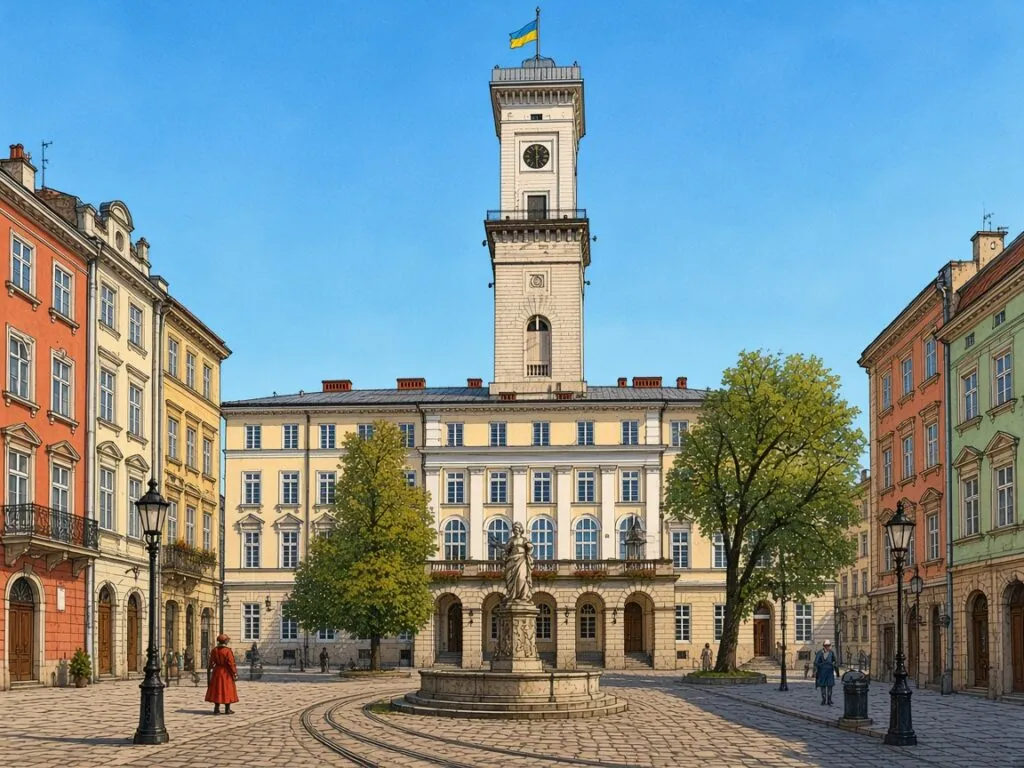
Four borderlands and a capital
Western Ukraine is the most name-dense region in Europe. Within a few hundred kilometres one can travel from Galicia, ruled by Poland for four centuries and by Austria from 1772 to 1918, to Volhynia, under Polish and then Russian rule, to Bukovina, Austrian from 1775 and Romanian between the world wars, and across the Carpathians to Transcarpathia, which belonged to Hungary for most of a millennium, to Czechoslovakia between the wars, to Hungary again from 1939 and to the Soviet Union from 1945. Each of these regions had a Ukrainian (or Rusyn) majority in the countryside, but its towns were often dominated by Poles, Germans, Romanians, Hungarians or Jews, and their official names changed with every change of sovereign.
Further east, in the lands that were part of the Russian Empire from the seventeenth or eighteenth century, the naming history is different: Russian forms dominated official usage, and many towns received imperial or Soviet commemorative names. Ukraine’s independence in 1991, the decommunisation laws of 2015 and the decolonisation law of 2023, followed by the mass renaming of September 2024, have transformed the map again.[101][20] Ukraine is the one country in the region where the renaming of places is not a historical topic but an active, ongoing process.
| Modern official name | Polish | German | Russian | Other forms |
|---|---|---|---|---|
| Lviv | Lwów | Lemberg | Lvov | Latin Leopolis; Yiddish Lemberik; Hungarian Ilyvó; Armenian Ilov |
| Kyiv | Kijów | Kiew | Kiev | |
| Chernivtsi | Czerniowce | Czernowitz | Chernovtsy | Romanian Cernăuți; Yiddish Tshernovits |
| Ivano-Frankivsk | Stanisławów | Stanislau | Stanislav | Ukrainian Stanyslaviv; renamed 1962 |
| Ternopil | Tarnopol | Tarnopol | Ternopol | Founded 1540 |
| Uzhhorod | Użhorod | Ungwar | Uzhgorod | Hungarian Ungvár; Czech and Slovak Užhorod |
| Mukachevo | Mukaczewo | Munkatsch | Mukachevo | Hungarian Munkács; Yiddish Munkatsh |
| Berehove | Bereg Saski | Bergsaß | Beregovo | Hungarian Beregszász; Yiddish Beregsaz |
| Lutsk | Łuck | Luzk | Lutsk | Yiddish Loytsk |
| Rivne | Równe | Rowno | Rovno | |
| Drohobych | Drohobycz | Drohobytsch | Drogobych | Yiddish Drohobitsh |
| Stryi | Stryj | Stryj | Stryy | |
| Kolomyia | Kołomyja | Kolomea | Kolomyya | |
| Kamianets-Podilskyi | Kamieniec Podolski | Kamenez-Podolsk | Kamenets-Podolsky | Romanian Camenița; Latin Camenecium |
| Khmelnytskyi | Płoskirów | Proskurov (until 1954) | ||
| Zhytomyr | Żytomierz | Schytomyr | Zhitomir | |
| Vinnytsia | Winnica | Winniza | Vinnitsa | Yiddish Vinitse |
| Odesa | Odessa | Odessa | Odessa | Earlier Khadjibey |
| Kharkiv | Charków | Charkiw | Kharkov | |
| Dnipro | Dniepr | Dnipro | Dnepr | Yekaterinoslav; Dnipropetrovsk 1926 to 2016 |
| Kropyvnytskyi | Kropywnycki | Kropivnitsky | Yelisavetgrad; Zinovievsk; Kirovo; Kirovohrad | |
| Bilhorod-Dnistrovskyi | Białogród nad Dniestrem | Akkerman | Belgorod-Dnestrovsky | Greek Tyras; Genoese Moncastro; Turkish Akkerman; Romanian Cetatea Albă |
Lviv, Lwów, Lemberg
Lviv was founded in the thirteenth century by King Daniel of Galicia and named after his son Leo (Lev); the Ukrainian Lviv, Polish Lwów, Russian Lvov and Latin Leopolis all mean “Leo’s city”, while the German Lemberg, the Yiddish Lemberik and similar forms are adaptations with a German shape.[3] The city passed to Poland in the fourteenth century and became one of the great cities of the Polish crown, home to Poles, Ruthenians, Armenians and Jews, each with its own cathedral or synagogue and its own name for the city. Hungarian has the form Ilyvó and Armenian Lvov and Ilov.[3]
From 1772 to 1918 the city was Lemberg, the capital of the Austrian crown land of Galicia and Lodomeria, a bilingual Polish-German city whose Ukrainian population formed a growing national movement. Between 1918 and 1939 it was Lwów, the capital of the Lwów Voivodeship in the Second Polish Republic, after a bitter Polish-Ukrainian struggle for the city in 1918 and 1919.[3] In September 1939 it was annexed by the Soviet Union; under German occupation from 1941 to 1944 it was again Lemberg, the capital of the District of Galicia, and the scene of the murder of nearly all its Jewish population; from 1944 it was Soviet Lvov, Ukrainian Lviv, and from 1991 the great city of independent western Ukraine.
The city also had its own urban dialect. Interwar Lwów produced a distinctive Polish sociolect, the Lwów dialect or bałak, with Ukrainian, Yiddish and German borrowings, celebrated in radio comedy and song.[3] After 1945 most of the Polish population left for Poland, many of them settling in Wrocław, and Lwów became a city of memory for Poles, just as Breslau became a city of memory for Germans. The reverse mirror between the two cities, each now inhabited largely by people whose families came from elsewhere, is one of the most striking features of the post-war map.
Kyiv
Kyiv lies outside Central Europe proper, but its name is the most famous example of the politics of transliteration. For most of the twentieth century English used the Russian-derived spelling Kiev. After independence the Ukrainian government adopted Kyiv as the official romanisation, and in the 2010s and especially after 2014 the Ukrainian government and civil society campaigned for international adoption of the form. In 2019 the United States Board on Geographic Names adopted Kyiv, and major news organisations followed.[176][177] After the full-scale invasion of 2022, using Kiev came to be widely seen as a political choice. The Polish name is Kijów, the German Kiew.
Chernivtsi, Czernowitz, Cernăuți
If any single city could stand for the multilingual culture of the Habsburg east, it would be Czernowitz. The city became Austrian in 1775 with the annexation of Bukovina; until 1848 it was the centre of Galicia’s Bukovina District, and then the capital of the Duchy of Bukovina.[51] It had a German-language university, founded in 1875, a large and prosperous Jewish community that mostly spoke German, a Ukrainian and Romanian hinterland, and Polish and Armenian minorities. It was known, somewhat ironically, as “Little Vienna”.
In 1908 the city hosted the Czernowitz Conference on the Yiddish language, which declared Yiddish to be a national language of the Jewish people. After the First World War Bukovina was united with Romania, and the city’s name became Cernăuți.[51] Romanian rule brought Romanianisation of schools and public life. In 1940 the Soviet Union occupied northern Bukovina; Romania recovered it in 1941, and during the war the city’s Jews were deported and murdered in large numbers, although the mayor Traian Popovici saved many thousands by obtaining exemptions. From 1944 the city was Soviet Chernovtsy, Ukrainian Chernivtsi, and the German, Jewish and Romanian worlds of the city vanished almost completely.[51]
The poet Paul Celan, born Paul Antschel in Czernowitz in 1920, wrote in German, the language of his mother and of his mother’s murderers. The poet Rose Ausländer, also born in the city, wrote again and again of its vanished multilingual world. Through such writers, the name Czernowitz has become a literary symbol, a name for a lost world of German-Jewish culture in the east, quite separate from the real Ukrainian city that bears the name Chernivtsi today.
Ivano-Frankivsk and Ternopil
Stanisławów was built in the seventeenth century as a fortress of the Polish Potocki family and named after one of them. It passed to Austria in 1772, when its name was rendered as Stanislau in German, and to Poland in 1921 under the Peace of Riga; after the war it remained in the Ukrainian SSR as Stanislav, and in 1962 it was renamed Ivano-Frankivsk after the Ukrainian writer Ivan Franko.[97] The Soviet renaming had a curious double effect: it erased the name of a Polish magnate and replaced it with the name of a Ukrainian national poet, so that the name survived both the end of Soviet rule and the decommunisation laws.
Ternopil, known until 1944 mostly as Tarnopol, was founded in 1540 by the Polish commander and hetman Jan Amor Tarnowski, whose name it bears.[178] The Ukrainian Ternopil is an adaptation of the Polish name that reinterprets its first element as tern, “thorn”, rather than as the family name.
Transcarpathia. Uzhhorod, Mukachevo, Berehove
Transcarpathia has had more changes of sovereignty in the twentieth century than almost any other region in Europe: Hungarian until 1918, Czechoslovak until 1938 and 1939, Hungarian until 1944, briefly the independent Carpatho-Ukraine for a single day in March 1939, Soviet from 1945 and Ukrainian from 1991. People joke that an old man in Uzhhorod could have lived in five or six states without leaving his village.
Uzhhorod’s earliest known name is the Hungarian Ungvár, “castle on the Ung” (the Uzh River); the Slavic name Uzhhorod was coined in Slavophile circles in the early nineteenth century as a literal translation of Ungvár.[179] It is thus a case in which the Slavic name is a translation of the Hungarian, rather than the reverse. Mukachevo is Munkács in Hungarian and Munkatsh in Yiddish, and the name of a celebrated Hasidic dynasty; its castle of Palanok was famously defended by Ilona Zrínyi against the Habsburgs in the 1680s.[180] Berehove, Hungarian Beregszász, is the centre of the Hungarian minority in Ukraine, with a Hungarian plurality; it also has Czech and Slovak (Berehovo), Russian (Beregovo), Yiddish (Beregsaz), German (Bergsaß) and Polish (Bereg Saski) forms, the last two recalling the medieval Saxon settlers who gave the town the Hungarian second element “Szász”, “Saxon”.[181]
Volhynia and Galicia. Lutsk, Rivne, Drohobych, Stryi, Kolomyia
Lutsk, first mentioned in 1085, was the capital of Volhynia under Lithuanian and Polish rule; it is Łuck in Polish and Loytsk in Yiddish.[182] Rivne, Polish Równe, was spelled Rovno in Ukrainian as well as Russian until 1991; the change to Rivne reflects the Ukrainian vowel shift by which o in a closed syllable becomes i.[183] That same rule explains why Lvov becomes Lviv and Kharkov becomes Kharkiv.
Drohobych, Polish Drohobycz and Yiddish Drohobitsh, was the home of the writer and artist Bruno Schulz, murdered there in 1942 by a Gestapo officer, and of the Ukrainian writer Ivan Franko, born in a nearby village.[184] Stryi takes its name from the river Stryi; in Polish and German it was Stryj, and in old documents the name appears in many spellings.[185] Kolomyia, Polish Kołomyja, was known in German as Kolomea.[186]
Kamianets-Podilskyi and the Podolian frontier
Kamianets-Podilskyi, Polish Kamieniec Podolski, Russian Kamenets-Podolsky, Romanian Camenița and Latin Camenecium, was a fortress town on the Smotrych River, a bulwark of the Polish Commonwealth against the Ottomans, who held it from 1672 to 1699.[187] It had Polish, Ukrainian, Armenian and Jewish communities, and its Armenian population traced its origins to the thirteenth century, when a Galician prince invited Armenians to help defend the frontier.[187] The town’s distinctive name means “stone place of Podolia”, and it is an outstanding example of a name that is broadly the same in every language, adapted to each one’s phonology.
Khmelnytskyi, Zhytomyr, Vinnytsia
Khmelnytskyi was Proskurov (Ukrainian Proskuriv) until 1954, when it was renamed to mark the three-hundredth anniversary of the treaty negotiated by Bohdan Khmelnytsky with Muscovy.[98] Its Polish name was Płoskirów. Zhytomyr is Żytomierz in Polish and Zhitomir in Russian.[188] Vinnytsia appeared in English as Winnica or Winnicza, from Polish, before the nineteenth century, then as the Russian-derived Vinnitsa until the 1990s; its German name is Winniza, its Yiddish Vinitse.[189] The history of English spellings of Vinnytsia is a neat summary of the history of political power in the region: Polish, then Russian, then Ukrainian.
Odesa, Kharkiv and the east
Odesa was founded by a decree of Catherine II in 1794 on the site of the Ottoman fortress of Khadjibey and given a name derived from the ancient Greek colony of Odessos, which was thought to have stood nearby.[190] The double s of the traditional spelling Odessa reflects Russian; Ukrainian has one s, and the official romanisation Odesa is now standard in English. Kharkiv, Russian Kharkov, has followed the same path from Russian-derived to Ukrainian-derived English spelling.[191]
Dnipro and Kropyvnytskyi
The renamings of these two cities in 2016 were among the most significant results of the decommunisation laws. Dnipro was founded as Yekaterinoslav in 1787, named Dnipropetrovsk in 1926 after the communist leader Grigory Petrovsky, and renamed Dnipro in 2016, a name that kept the river but dropped the man.[46] Kropyvnytskyi has had perhaps the most complicated name history of any Ukrainian city: it grew around the Fortress of St Elizabeth, built in 1754, and became Yelisavetgrad; it was renamed Zinovievsk in 1924 after the Bolshevik Grigory Zinoviev, Kirovo in 1934 after Sergei Kirov (once Zinoviev had fallen from favour), and Kirovohrad in 1939; in 2016 it received the entirely new name Kropyvnytskyi, after the nineteenth-century Ukrainian playwright Marko Kropyvnytsky.[19] The choice of a cultural figure rather than a return to the imperial Yelisavetgrad was a deliberate decision to avoid both Soviet and Russian imperial associations.
Bilhorod-Dnistrovskyi, the white fortress
Bilhorod-Dnistrovskyi, on the Dniester estuary, is a town whose name has meant “white fortress” in almost every language in which it has been known. It was the ancient Greek colony of Tyras; to the Byzantines it was Maurokastron, to the Genoese Moncastro; to the Ottomans, who held it from 1484, it was Akkerman, “white fortress” in Turkish; to the Romanians and Moldavians, Cetatea Albă, “white citadel”; and in Russian and Ukrainian, Belgorod-Dnestrovsky and Bilhorod-Dnistrovskyi, “white city on the Dniester”.[192] It belonged to Moldavia, the Ottoman Empire, Russia, Romania (1918 to 1940 and 1941 to 1944) and the Soviet Union before becoming Ukrainian. In this case, every regime translated rather than replaced, and the meaning has survived two and a half thousand years of conquest.
Renaming as resistance
Ukraine’s recent renamings belong to a different category from most of those in this essay. They were carried out by a democratic parliament, under conditions of war, as part of an effort to remove the symbols of a state that is attempting to conquer the country. In April 2023 a law banned names glorifying the Russian imperial project, and on 19 September 2024 the Verkhovna Rada renamed 327 settlements and four districts, with 281 votes in favour.[20] The ten cities renamed included Novomoskovsk, which became Samar after the original Cossack settlement; Krasnohrad, which became Berestyn; Pervomaiskyi in Kharkiv Oblast, which became Zlatopil; and Chervonohrad, which became Sheptytskyi.[20][193] Five proposed renamings, including Pavlohrad and Yuzhne, were removed from the resolution after objections, and further renamings remain under discussion.[193][194] The map of Ukraine is still being drawn.
Chapter 13. The Baltic States. Hanseatic German, Polish, Russian and the Native Names
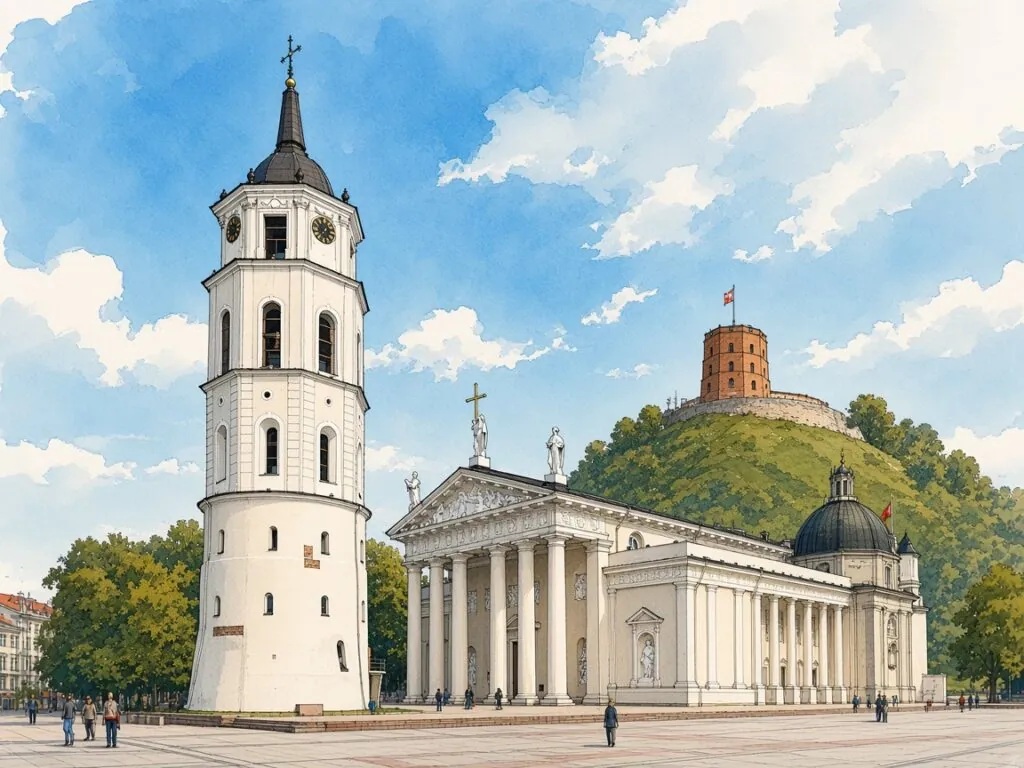
Three nations, many masters
Lithuania, Latvia and Estonia have the most dramatic contrast in the region between the official names of the past and the official names of the present. For seven centuries, from the crusades of the thirteenth century until the First World War, the towns of what are now Latvia and Estonia were known internationally almost exclusively by their German names, given by the crusading orders, the bishops and the Hanseatic merchants who ruled them: Reval, Dorpat, Pernau, Mitau, Libau, Windau, Dünaburg, Wenden, Wolmar, Fellin, Arensburg, Wesenberg. The Baltic German nobility and burghers kept German as the language of the towns even under Swedish and then Russian rule, until the Russification of the 1880s and 1890s. The Estonian and Latvian peasant majorities had their own names for the same places, and when Estonia and Latvia became independent in 1918 those names became official.[195]
Lithuania’s history is different. It was a great medieval power in its own right, the Grand Duchy of Lithuania, joined with Poland in the Commonwealth. Its elite became Polish-speaking over the early modern period, and its towns had Polish names (Wilno, Kowno, Troki, Szawle, Poniewież) as well as Lithuanian, Belarusian, Yiddish and, in the Russian imperial period, Russian ones. On the coast, the Klaipėda region, Memelland, belonged to Prussia until 1920 and had German names. Independence in 1918 made the Lithuanian forms official, but the loss of Vilnius to Poland between 1920 and 1939 meant that the capital’s Lithuanian name was, for twenty years, a claim rather than an administrative fact.
Under Soviet rule from 1940 to 1941 and from 1944 to 1991, the native names generally remained official, with Russian forms used alongside them; the Soviet state did not attempt a systematic renaming of the Baltic towns comparable to that of Kaliningrad, although there were exceptions.
| Modern official name | German | Polish | Russian | Other forms |
|---|---|---|---|---|
| Vilnius (LT) | Wilna | Wilno | Vilna, Vilno | Yiddish Vilne; Belarusian Vilnia; Latin Vilna |
| Kaunas (LT) | Kauen | Kowno | Kovno | Yiddish Kovne |
| Klaipėda (LT) | Memel | Kłajpeda | Klaipeda | Officially Memel 1252 to 1923 and 1939 to 1945 |
| Šiauliai (LT) | Schaulen | Szawle | Shavli | Latvian Šauļi; historic Saule |
| Panevėžys (LT) | Ponewesch | Poniewież | Ponevezh | Yiddish Ponevezh |
| Trakai (LT) | Traken (Tracken) | Troki | Troki | |
| Šilutė (LT) | Heydekrug | Szyłokarczma | Shilute | Earlier Lithuanian Šilokarčiama |
| Rīga (LV) | Riga | Ryga | Riga | |
| Daugavpils (LV) | Dünaburg | Dyneburg | Dvinsk (1893 to 1920) | Earlier Russian Dinaburg, Borisoglebov |
| Liepāja (LV) | Libau | Lipawa | Libava | |
| Jelgava (LV) | Mitau | Mitawa | Mitava | |
| Ventspils (LV) | Windau | Windawa | Vindava | |
| Rēzekne (LV) | Rositten | Rzeżyca | Rezhitsa | Latgalian Rēzne |
| Cēsis (LV) | Wenden | Kieś | Tsesis | Estonian Võnnu; Livonian Venden |
| Valmiera (LV) | Wolmar | Wolmar | Volmar | |
| Kuldīga (LV) | Goldingen | Kuldyga | Goldingen | |
| Valka (LV) and Valga (EE) | Walk | Wałk | Valk | Divided in 1920 |
| Tallinn (EE) | Reval | Rewel | Revel | Scandinavian Lindanisa; Old East Slavic Kolyvan |
| Tartu (EE) | Dorpat | Dorpat | Yuryev (1893 to 1919), Derpt | Earliest Tarbatu |
| Pärnu (EE) | Pernau | Parnawa | Pernov | Latin Perona |
| Narva (EE) | Narwa | Narwa | Narva | |
| Kuressaare (EE) | Arensburg | Arensburg | Kingissepa (1952 to 1988) | Latin arx aquilae |
| Haapsalu (EE) | Hapsal | Gapsal | Swedish Hapsal | |
| Viljandi (EE) | Fellin | Felin | Fellin | |
| Rakvere (EE) | Wesenberg | Rakovor |
Vilnius, Wilno, Vilne
Vilnius is the most contested city name in the Baltic world, because it was claimed by three national movements: Lithuanian, Polish and Belarusian, and it was the capital of a fourth culture, the Jewish world of the Litvaks, which called it Vilne and the “Jerusalem of Lithuania”. The earliest forms of the name derive from the River Vilnia; a letter of 1325 includes the form Wilno (“Datum Wilno”), which is still used in Polish today.[39] The city’s names in other languages include Latin Vilna, Polish Wilno, Belarusian Vilnia, German Wilna, Latvian Viļņa, Ukrainian Vilno, Yiddish Vilne and Hebrew Vilna.[39]
Between the wars the city was Polish. After a short Polish-Lithuanian war and the creation of the so-called Republic of Central Lithuania, which was annexed by Poland in 1922, Wilno became a provincial capital of Poland, and Lithuania regarded Kaunas as its temporary capital.[39][196] By the 1931 Polish census the city’s population was overwhelmingly Polish, with a very significant Jewish minority, and Lithuanian speakers were a small group.[39] In October 1939 the Soviet Union handed the city to Lithuania; in 1940 the Soviet Union annexed Lithuania; and between 1941 and 1944, under German occupation, most of the city’s Jews were murdered, many of them in the forest of Ponary, Lithuanian Paneriai. After 1944 most of the Polish population was resettled in Poland. Soviet Vilnius became the capital of the Lithuanian SSR and, in 1990 to 1991, of independent Lithuania.
The result is that Vilnius has been transformed, in less than a century, from a Polish-Jewish city to a Lithuanian city. Each of its names corresponds to one of its pasts. For Poles, Wilno is the city of Adam Mickiewicz, of the university where he studied, and of Józef Piłsudski, whose heart is buried in the Rasos cemetery. For Jews, Vilne is the city of the Vilna Gaon, Elijah ben Solomon, the eighteenth-century sage who gave his name to a style of Jewish learning, and of the YIVO Institute for Jewish Research, which had its headquarters there from its founding in 1925 until the war.[197] For Lithuanians, Vilnius is the historic capital of the Grand Duchy and the modern capital of the nation. The Lithuanian state recognises the Polish minority’s place in the region, and bilingual street signs in Polish have been a recurring issue in local politics.
Kaunas, Kowno, Kovne
Kaunas was, until Lithuanian independence, generally known in English as Kovno, the traditional Slavicised form. The Polish name is Kowno, Belarusian Kowna and Kawnas, Yiddish Kovne, and the German names include Kaunas and Kauen.[196] Between 1920 and 1939, when Vilnius was part of Poland, Kaunas served as Lithuania’s temporary capital, and it was transformed by an ambitious building programme of modernist architecture, now recognised as a UNESCO World Heritage Site. In 1940 the Japanese consul in Kaunas, Chiune Sugihara, issued transit visas that saved thousands of Jewish refugees, and during the German occupation the Kovno Ghetto became one of the major sites of the Holocaust in Lithuania.
Klaipėda and Memel
Klaipėda, German Memel, is the only important Lithuanian port. The Teutonic Knights built a castle there in the land of the Curonians and named it Memelburg, later shortened to Memel; from 1252 to 1923 and from 1939 to 1945 the town was officially called Memel.[198] The Lithuanian name Klaipėda had long been used by Lithuanian speakers in the region of Lithuania Minor (Prussian Lithuania). Under the Treaty of Versailles the Memel Territory was detached from Germany and administered by the Allies; in January 1923 Lithuania seized it in the Klaipėda Revolt, and in March 1939 Germany forced its return.[53] Hitler visited the town after the annexation, and the episode was one of the last steps before the outbreak of war. After 1945 the region was incorporated into the Lithuanian SSR, and Klaipėda became the sole official name.
Nearby Šilutė, German Heydekrug, was earlier called Šilokarčiama in Lithuanian. The German name referred to an inn (Krug) on the heathland (Heide), and the older Lithuanian name was a partial translation with the same meaning; the modern name Šilutė is a shortened Lithuanian form.[199]
Šiauliai, Panevėžys and Trakai
Šiauliai, German Schaulen and Polish Szawle, takes its founding date from the Battle of Saule on 22 September 1236, in which the Lithuanians and Semigallians defeated the Livonian Brothers of the Sword.[200] Panevėžys, Polish Poniewież, is known in the Jewish world for the Ponevezh Yeshiva, re-established in Bnei Brak in Israel after the Holocaust; its Yiddish name thus lives on in a Tel Aviv suburb.[201] Trakai, Polish Troki, the medieval capital of Lithuania with its island castle, was first recorded in 1337 in German as Tracken, derived from the Lithuanian word for “glade”. It was home to Karaims (Karaites), Tatars, Lithuanians, Russians, Jews and Poles.[202]
Riga
Riga is one of the few major Baltic cities whose name is almost identical in all the region’s languages. Founded by Bishop Albert in 1201, it was the largest city of the Baltic provinces and a Hanseatic metropolis, with a German-speaking elite and a Latvian and Russian working population. Its name in Latvian is Rīga, in German and Russian Riga, in Polish Ryga.[203] Under the Soviet Union it remained Riga, and the main difference in its naming history lies in the streets: German, then Latvian, then Russian, then again Latvian street names in successive regimes.
Daugavpils, Dünaburg, Dvinsk
Daugavpils, on the Daugava, is the second city of Latvia and the centre of the Latgale region, which belonged for two centuries to Polish Livonia and has a distinct Latgalian language and Catholic culture. Its name history is one of the most elaborate in the Baltics: Dünaburg from 1275 to 1656, Borisoglebov from 1656 to 1667 under a brief Russian occupation, Dinaburg from 1667 to 1893, Dvinsk from 1893 to 1920, and Daugavpils since 1920.[45] Both the German Dünaburg and the Latvian Daugavpils mean “Daugava castle” (Düna is the German name for the Daugava), and the Russian Dvinsk derives from the Russian name for the river, Zapadnaya Dvina. Its Yiddish names, Dvinsk and Dinaburg, show that Jewish usage followed the official forms.[45]
The Courland and Livonian towns. Liepāja, Jelgava, Ventspils, Kuldīga, Cēsis, Valmiera, Rēzekne
The German names of the towns of Courland and Livonia were the official forms until 1917. Jelgava, the capital of the Duchy of Courland, was officially Mitau until 1917.[33] Liepāja was Libau, a name thought to derive from the river Līva; the Latvianised forms Libava and Lībava preceded the modern Liepāja, which means “linden place”.[204] Ventspils was Windau in German and Vindava in Russian, and the Latvian Ventspils, “Venta castle”, has been used since the Second World War.[205] Kuldīga was Goldingen.[206] Cēsis, German Wenden, Livonian Venden, Estonian Võnnu and Polish Kieś, was the seat of the Livonian Order’s master and gave its name to the Battle of Cēsis in 1919, in which Estonian and Latvian forces defeated the Baltic German Landeswehr.[207] Valmiera, German Wolmar, grew around a castle built by the Livonian Order in the second half of the thirteenth century.[208] Rēzekne, Latgalian Rēzne and German Rositten, is Rzeżyca in Polish.[209]
Valka and Valga, a town divided
Valka and Valga are the Latvian and Estonian halves of a single town, known in German as Walk, first mentioned in 1286 and from 1419 the seat of the diet of the Livonian Confederation. In 1920 the border between the new states of Latvia and Estonia was drawn through the town by an international arbitration commission headed by the British colonel Stephen Tallents.[210] The larger part, Valga, went to Estonia, the smaller part, Valka, to Latvia. Since both countries joined the Schengen area the border has become invisible again, and the twin towns market themselves with the slogan “one town, two countries”.[211]
Tallinn, Reval, Lindanisa
Tallinn was known for most of its history, and in most of the world until the first half of the twentieth century, as Reval.[31] The German and Scandinavian name Reval (Latin Revalia) came into use after the Danish conquest in 1219, and is related to the name of the Estonian county of Rävala. The Estonian name Tallinn is widely explained as Taani-linna, “Danish castle”. Before the thirteenth century, Scandinavians used the name Lindanisa or Lindanäs, and Old East Slavic chronicles call a place Kolyvan, which may be related.[31] Reval received Lübeck law in 1248 and became a Hanseatic city. Until 1918 its official name was Reval in German, Revel in Russian; under the Estonian Republic it became Tallinn, and the earlier spelling Tallin (with one n) was used in Soviet times and later corrected.
Tartu, Dorpat, Yuryev
Tartu has already appeared in Chapter 4. From the thirteenth century until the end of the nineteenth it was known as Dorpat, a variant of the earliest attested Estonian form Tarbatu, and between 1893 and 1919 it was officially Yuryev in Russian, after the baptismal name of Yaroslav the Wise.[32] Its university, founded by the Swedish king Gustav II Adolf in 1632, was the main German-language university of the Russian Empire in the nineteenth century, and as Yuryev University it was Russified in the 1890s. In 1919 it became the national university of Estonia.
Pärnu, Narva, Kuressaare, Haapsalu, Viljandi, Rakvere
The smaller Estonian towns repeat the pattern. Pärnu was Pernau in German, Perona in Latin; there were once two towns, Old Pärnu, founded by the bishop of Ösel-Wiek, and Embeke, later Neu-Pernau, founded by the Teutonic Order.[212] Narva, German Narwa, faces the Russian fortress of Ivangorod across the river; it was nearly completely destroyed in 1944 and, in the Soviet era, its original inhabitants were not allowed to return, so that today it is a predominantly Russian-speaking city.[213] Haapsalu was Hapsal in Swedish and German, and Viljandi was Fellin; Rakvere was first recorded as Wesenbergh in 1252, a Middle Low German adaptation of the Estonian Tarvanpea, and was widely known as Wesenberg until the early twentieth century.[214][215][216]
Kuressaare, on the island of Saaremaa, has the most interesting naming history. Its German name Arensburg, from a Middle High German word for “eagle”, rendered the Latin arx aquilae, “eagle castle”. During the Soviet occupation the town was officially renamed Kingissepa from 1952 to 1988, after Viktor Kingissepp, a native Bolshevik executed in 1922.[217] The restoration of Kuressaare in 1988, three years before independence, was one of the early signs of the Estonian national revival.
Names in the Baltic memory
The Baltic case shows the persistence of native names under centuries of foreign official usage. Latvian and Estonian peasants called their towns by their own names throughout the long era when the official names were German, and when the opportunity came, those names became official. The Baltic German names, by contrast, have become historical exonyms, used in German but no longer by anyone who lives in the region. The German community that used them left in 1939 to 1941, resettled by agreement between Nazi Germany and the Soviet Union, and the names went with them.
Chapter 14. Kaliningrad. The Total Renaming of East Prussia’s North
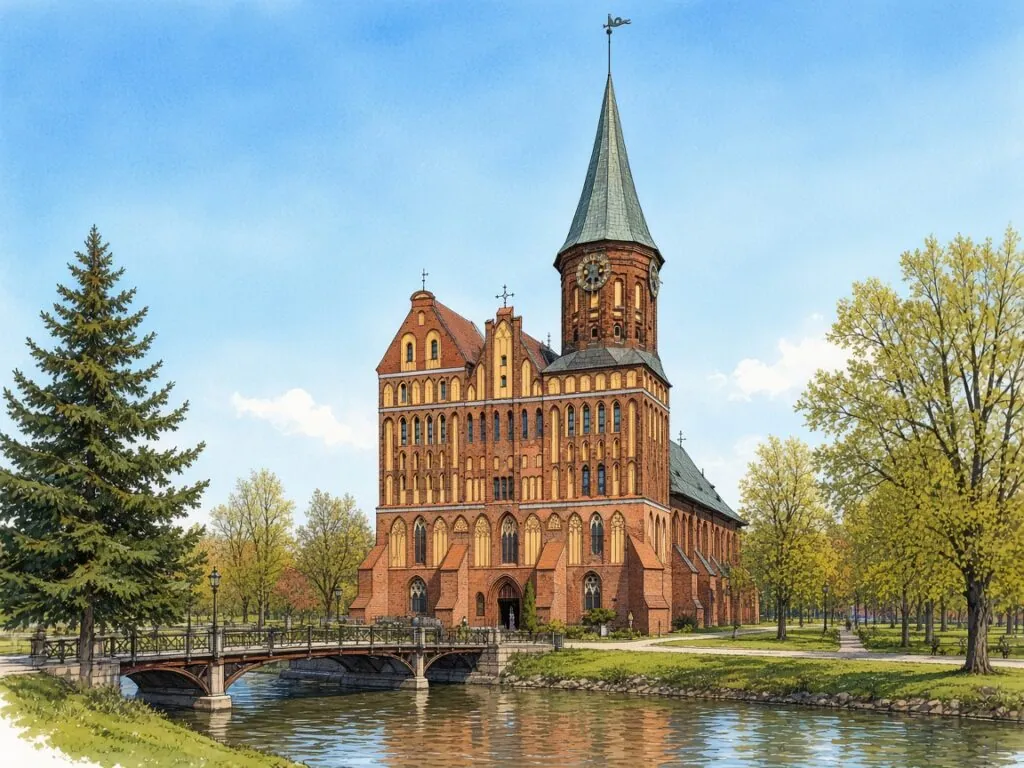
A province without its past
The northern third of East Prussia, assigned to the Soviet Union at Potsdam, offers the clearest example in Europe of a complete break between a place and its names. Before 1945 the region had been German for centuries, with Lithuanian-speaking communities in the north-east (Prussian Lithuania, or Lithuania Minor) and traces of the extinct Old Prussian language in many place names. After 1945 its German population fled, died or was expelled, the last of them between 1947 and 1948, and the territory was resettled with people from Russia, Belarus and Ukraine who had no connection to the old names.[81] The Soviet authorities chose not to revive older Baltic names or to adapt the German ones, but to give almost every settlement a brand-new Russian name. The effect was to create a province with no visible past.
There is an irony here. In 1938 the Nazi regime had already radically renamed about a third of the place names in this area, replacing Old Prussian and Lithuanian names with invented German ones.[81] Within a decade the German names in turn were swept away. The region therefore experienced two total renamings, in opposite directions, within ten years.
| Modern Russian name | German (until 1946) | Lithuanian | Polish | Notes |
|---|---|---|---|---|
| Kaliningrad | Königsberg | Karaliaučius | Królewiec | Renamed 1946 after Mikhail Kalinin; Polish official exonym Królewiec since 2023 |
| Sovetsk | Tilsit | Tilžė | Tylża | Renamed 1946 |
| Chernyakhovsk | Insterburg | Įsrutis | Wystruć | After General Ivan Chernyakhovsky |
| Baltiysk | Pillau | Piliava | Piława | Base of the Baltic Fleet |
| Gusev | Gumbinnen | Gumbinė | Gąbin | After Captain Sergei Gusev |
| Zelenogradsk | Cranz | Krantas | Zielenogradsk; post-war Polish proposals Koronowo, Kranc | Renamed 1946 |
| Svetlogorsk | Rauschen | Renamed 1947 | ||
| Bagrationovsk | Preußisch Eylau | Prūsų Ylava | Pruska Iława, Iławka | After General Pyotr Bagration |
| Neman | Ragnit | Ragainė | Ragneta | |
| Mamonovo | Heiligenbeil | Święta Siekierka, Świętomiejsce | After the Soviet commander Nikolay Mamonov |
Königsberg
Königsberg was founded in 1255 by the Teutonic Knights during the Northern Crusades, on the site of an Old Prussian settlement called Twangste, and named in honour of King Ottokar II of Bohemia, who took part in the campaign; the name means “king’s mountain”.[16] The Polish name Królewiec and the Lithuanian Karaliaučius are both translations of the German, built on the words for “king” in each language. In 1454 the city was briefly incorporated into the Kingdom of Poland as the capital of a Królewiec Voivodeship, and from 1525 it was the capital of the Duchy of Prussia, a Polish fief, until the Hohenzollerns gained full sovereignty in 1657.[16] The first Prussian king was crowned there in 1701.
Königsberg was a city of learning. Its university, the Albertina, founded in 1544, was where Immanuel Kant spent his entire career; he was born, lived and died in the city and is buried beside its cathedral. It was also an early centre of Lithuanian printing: the first book in Lithuanian, the catechism of Martynas Mažvydas, was printed there in 1547. The city was devastated by British bombing in August 1944 and by the Soviet siege of April 1945.
In 1946 it was renamed Kaliningrad in honour of Mikhail Kalinin, the chairman of the Presidium of the Supreme Soviet, who had died that June, and repopulated with Soviet citizens starting in 1946.[16] Kalinin had no connection with the city. The Soviet state systematically demolished the ruins of old Königsberg, including the royal castle, whose remains were blown up in the late 1960s; the vast unfinished House of the Soviets now stands on the site.
The Polish decision of 2023
The name Kaliningrad has been controversial since the end of the Soviet Union. In Russia there have been occasional proposals to restore Königsberg or adopt a neutral name, none of them successful. In Lithuania the traditional name Karaliaučius has always been used. In Poland, the official exonym list long gave both Kaliningrad and the historic Królewiec.
In April 2023, a year after the full-scale Russian invasion of Ukraine, the Polish Commission for the Standardisation of Geographical Names outside the Republic of Poland resolved that only the Polish name Królewiec should be recommended for the city, and that the Polish use of the name Kaliningrad was not recommended; the region should be called obwód królewiecki rather than obwód kaliningradzki. The resolution, taken at the commission’s 125th meeting on 12 April 2023, was announced on 9 May 2023.[7] The minutes record thirteen votes in favour, none against and one abstention, and the commission went on to rename the Polish exonym for the Kaliningrad shipping canal as well.[218]
The commission set out its reasoning in unusually political language. It noted that the city was traditionally known in Poland as Królewiec; that the Russian name was an artificial creation unconnected with the city or the region; that naming a large city near Poland’s border after Kalinin, who shared responsibility for the Katyn massacre of Polish officers in 1940, had an emotional and negative character in Poland; that geographical names have symbolic functions; and that the war against Ukraine and Russian information warfare called for a different approach to imposed names.[7] The Polish government endorsed the change, stressing that it did not affect the region’s status as Russian territory.[219] The Kremlin reacted angrily.[220]
The episode is a reminder that exonyms are not neutral, and that a state can, by changing what its own language calls a place in another country, make a powerful statement without altering anything on the ground.
Tilsit, Insterburg, Gumbinnen and the commemorative names
The other towns of the region were renamed in 1946 and 1947 in a mixture of political, military and descriptive styles. Tilsit, on the Neman, where Napoleon and Tsar Alexander I signed the peace treaty of 1807 on a raft in the middle of the river, and where Tilsit cheese originated, was renamed Sovetsk, “Soviet town”, in honour of Soviet rule.[85] Its Lithuanian name is Tilžė and its Polish name Tylża.
Insterburg, founded in 1337 by the Teutonic Knights on the site of an Old Prussian fortification, became Chernyakhovsk in honour of General Ivan Chernyakhovsky, who commanded the Third Belorussian Front in the East Prussian offensive and was killed in February 1945. Its Lithuanian name is Įsrutis and its Polish name Wystruć.[82] Gumbinnen, whose name has been derived from the Lithuanian word for “pumpkin”, became Gusev, after Captain Sergei Ivanovich Gusev, killed in action near the town in January 1945 and posthumously named a Hero of the Soviet Union.[83] Heiligenbeil, “holy axe”, became Mamonovo after the Soviet commander Nikolay Mamonov, killed near Pułtusk in October 1944.[221] Preußisch Eylau, site of the bloody battle of 1807 between Napoleon and the Russian and Prussian armies, became Bagrationovsk, after the Russian general Pyotr Bagration, who fought at Eylau and died after Borodino.[84] The choice of Bagration connected the new Soviet province with an older Russian military tradition.
Pillau, Cranz, Rauschen and Ragnit
Other names were descriptive. Pillau, the port at the entrance to the Vistula Lagoon, became Baltiysk, “Baltic town”, and is now the main base of the Russian Baltic Fleet and the westernmost town in Russia.[86] Cranz, the most fashionable seaside resort of East Prussia, whose German name derived from the Old Prussian word for “coast”, was renamed Zelenogradsk, “green town”, in 1946.[87] Rauschen, another resort on the Sambian coast, became Svetlogorsk, “bright hill town”, in 1947.[88] Ragnit, an old castle town on the Neman founded on the site of a settlement of the Baltic Skalvians, took the name of the river, Neman; its Lithuanian name is Ragainė and its Polish name Ragneta.[222]
A note on the Polish names
Lists of Polish names for the towns of the Kaliningrad region need to be used with care. Some forms, like Królewiec for Königsberg, Tylża for Tilsit and Wystruć for Insterburg, are long-established. Others were proposed after 1945, when Polish geographers considered names for the whole of former East Prussia, and some of these are rarely used. One such list, for example, gives Koronowo and Kranc alongside Zielenogradsk for Cranz; but Koronowo is also the name of an unrelated town in Kuyavia, the former German Crone an der Brahe, and the identical spelling has caused confusion in compiled tables.[223] Where a modern Polish exonym is officially standardised, it is safer to use the form in the national register maintained by the Polish geodetic authorities.[224]
Vyborg, Viipuri, Viborg
Although it lies outside Central Europe, the city of Vyborg, on the Gulf of Finland, belongs naturally beside Kaliningrad, as the other major city whose name and population were completely changed by the Soviet annexations of the 1940s. Vyborg Castle was founded during the Third Swedish Crusade in 1293 by the Swedish marshal Torkel Knutsson, on the site of an older Karelian fort. The Swedish name Viborg may be interpreted as “holy fort”, and the Finnish Viipuri is an adaptation of it.[225] The Russian name Vyborg is a further adaptation.
The city was Swedish until 1710, Russian until 1917, and the second city of independent Finland until 1940, when it was ceded to the Soviet Union after the Winter War. Finland recaptured it in 1941 and lost it again in 1944. Its Finnish population was evacuated to Finland, and the city was resettled from the Soviet Union. As with Königsberg, the old name lives on in the country that lost it: Finns still speak of Viipuri, Swedes of Viborg, and the city’s library, designed by Alvar Aalto, is a pilgrimage site for architects from all over the world.
Chapter 15. Belarus. Between Wilno and Moscow
A country of shifting orthographies
Belarus is the least known of the region’s naming landscapes in the West, yet it is among the most complicated. The territory was the heart of the medieval Grand Duchy of Lithuania, whose chancery language was Ruthenian, the ancestor of Belarusian. Under the Polish-Lithuanian Commonwealth its elite became Polish-speaking and its towns had Polish names. After the partitions it became part of the Russian Empire’s “Northwestern Krai”, with Russian official names. Between the wars the western half belonged to Poland, the eastern half to the Belarusian Soviet Socialist Republic. In 1939 the Soviet Union annexed the western half. Throughout, the towns had large Jewish populations, often a majority, who used Yiddish names.
A further complication is linguistic. Belarusian has two competing orthographies, the official Soviet-era norm (narkamaŭka) and the older classical orthography (taraškievica), which differ in their spelling of some place names, and several systems of romanisation. Most Belarusians speak Russian in daily life, and the official romanisation of place names follows Belarusian forms, so that the capital’s region is officially Minsk but other cities appear in Western sources in both Belarusian and Russian forms: Hrodna and Grodno, Mahilyow and Mogilev, Homyel and Gomel, Vitsyebsk and Vitebsk.
| Belarusian (romanised) | Russian | Polish | Lithuanian | Yiddish | Other |
|---|---|---|---|---|---|
| Minsk | Minsk | Mińsk (Mińsk Litewski) | Minskas | Minsk | Old East Slavic Mensk |
| Hrodna | Grodno | Grodno | Gardinas | Grodne | German Garten; Latin Grodna; taraškievica Horadnia |
| Brest | Brest (Brest-Litovsk) | Brześć (Brześć Litewski, Brześć nad Bugiem) | Brasta | Brisk | Old East Slavic Berestye |
| Vitsyebsk | Vitebsk | Witebsk | Vitebskas | Vitebsk | |
| Mahilyow | Mogilev | Mohylew | Mogiliovas | Molev | |
| Homyel | Gomel | Homel | Gomelis | Homl | |
| Baranavichy | Baranovichi | Baranowicze | Baranovičiai | Baranovitsh | |
| Pinsk | Pinsk | Pińsk | Pinskas | Pinsk | |
| Lida | Lida | Lida | Lyda | Lide | |
| Navahrudak | Novogrudok | Nowogródek | Naugardukas | Navaradok | |
| Nyasvizh | Nesvizh | Nieśwież | Nesvyžius | Nesvizh |
Minsk
Minsk is first mentioned in the Primary Chronicle under the year 1067 in the form Menesk. Medieval and early modern sources also have Mensk and Menesk, and the later form Minsk may reflect the influence of Ukrainian dialects or a conflation with the Polish town of Mińsk Mazowiecki; when Belarus was under Lithuanian and Polish rule, the forms Mińsk Litewski and Mińsk Białoruski were used to distinguish it from the Masovian town.[226] Belarusian national activists in the twentieth century sometimes revived Mensk as a more authentic Belarusian form. The city was almost completely destroyed in the Second World War and rebuilt as a Soviet showpiece capital, and its large Jewish community, which made up a large part of the pre-war population, was annihilated in the Minsk ghetto.
Hrodna, Grodno
Hrodna, Russian and Polish Grodno, sits close to the Polish and Lithuanian borders on the Neman. In classical Belarusian orthography it is Horadnia. In Latin it was Grodna, in Lithuanian it is Gardinas, in Latvian Grodņa, in German Garten and in Yiddish Grodne.[40] Grodno was a royal residence of the Commonwealth, where Sejms met in the late eighteenth century, including the Sejm of 1793 that ratified the Second Partition. It belonged to interwar Poland, was annexed by the Soviet Union in 1939 and, after 1945, remained in the Byelorussian SSR, although its Polish community remains the largest in Belarus.
Brest, Brest-Litovsk, Brisk
Brest’s name history encapsulates the politics of the region. Its Old East Slavic name was Berestye. In the Commonwealth it was known in Polish as Brześć, historically Brześć Litewski, “Lithuanian Brest”, to distinguish it from Brześć Kujawski in central Poland; when it became part of the Russian Empire in the Third Partition it was called Brest-Litovsk, a Russian calque of the Polish name.[227] Under that name it entered world history with the Union of Brest in 1596, which created the Greek Catholic Church, and the Treaty of Brest-Litovsk of March 1918, by which Soviet Russia left the First World War. The city was officially Brest-Litovsk from the 1600s to 1923; under interwar Poland it became Brześć nad Bugiem, “Brest on the Bug”, from 1923 to 1939, and since then simply Brest.[227]
To Yiddish speakers the city was Brisk, a name that lives on in the term “Brisker” for the followers of the influential Soloveitchik family of rabbis and their analytical method of Talmud study.[227] As with Belz, Ger and Ponevezh, a small town’s Yiddish name survives as the name of a religious tradition carried to Jerusalem and New York.
Vitsyebsk, Mahilyow and Homyel
Vitsyebsk, Russian Vitebsk and Polish Witebsk, is known worldwide as the birthplace of Marc Chagall, whose paintings of its wooden houses, synagogues and floating lovers have made it one of the most recognised small cities in art. It takes its name from the river Vitba.[228] Mahilyow, Russian Mogilev and Polish Mohylew, and Homyel, Russian Gomel and Polish Homel, are the other great cities of eastern Belarus, both with large pre-war Jewish populations.[229][230] All three have appeared in English mostly in their Russian forms, a habit that is slowly changing as Belarusian romanisations become more widely known.
Baranavichy, Pinsk and Lida
Baranavichy, Polish Baranowicze, grew from a railway junction in the late nineteenth century and remains an important rail hub.[231] Pinsk, in the Pripet marshes of Polesia, had a Jewish majority before the war; Chaim Weizmann, the first president of Israel, grew up nearby and studied there. Lida, with its fourteenth-century castle built by Grand Duke Gediminas, is a reminder of the Lithuanian past of these lands.[232][233]
Navahrudak and Nyasvizh
Navahrudak, Russian Novogrudok, Polish Nowogródek, Lithuanian Naugardukas and Yiddish Navaradok, was an early capital of the Grand Duchy of Lithuania and is associated with Adam Mickiewicz, the Polish national poet, who was born nearby and grew up in the town.[41] The opening line of his epic Pan Tadeusz, “Lithuania, my fatherland”, written in Polish by a poet from what is now Belarus, is perhaps the best possible illustration of how differently the national categories of the nineteenth century map onto the places of this region.
Nyasvizh, Russian Nesvizh and Polish Nieśwież, belonged in the fifteenth century to the Kiszka family and later to the Radziwiłłs, who remained there until 1813; their castle is now a World Heritage Site.[234] The Radziwiłłs were among the richest magnates of the Commonwealth, Lithuanian in origin, Polish in culture, ruling over a Belarusian and Jewish population. Their town’s four names (Belarusian, Russian, Polish, Yiddish) are a fair summary of the society they governed.
A quiet map
Unlike Poland, Lithuania and Ukraine, Belarus has carried out no large-scale renaming since independence. Soviet street names remain common, and the country’s government has shown little interest in decommunisation. The main naming debates are about language: whether names should be written in Belarusian or Russian, and in which orthography and romanisation. That question, apparently technical, is in fact a question about national identity, and it is likely to become more pressing whenever Belarusian politics change.
Chapter 16. Romania and Moldova. Transylvania, Bukovina and Bessarabia
Three historical regions, three naming systems
Modern Romania was assembled from territories with very different histories. The Old Kingdom (Wallachia and Moldavia, united in 1859) had Romanian names throughout. Transylvania, the Banat, Crișana and Maramureș, which joined Romania in 1918 to 1920, had for centuries been part of the Kingdom of Hungary or the autonomous Principality of Transylvania, and their towns had Hungarian, German (Saxon or Swabian) and Romanian names, with Hungarian or German usually official before 1918. Bukovina was Austrian from 1775 to 1918, with German as the language of administration; Bessarabia, the eastern half of historic Moldavia, was Russian from 1812 to 1918, with Russian official names.[235][236]
In Transylvania the three-name pattern is especially well preserved. The medieval Saxon colonists founded the “seven cities” (Siebenbürgen, which became the German name for Transylvania itself), and the Hungarian nobility and the Székely, a Hungarian-speaking community with a distinctive history, governed the land alongside them. The Romanian majority in the countryside had its own names. Large Hungarian communities remain today, especially in Cluj and in the Székely Land (Harghita and Covasna counties), and bilingual Romanian-Hungarian signs are common. The Saxon community, by contrast, largely emigrated to Germany in the 1970s, 1980s and early 1990s, so the German names of Transylvanian towns survive mainly as a historical and cultural heritage.[29][237]
| Modern official name | Hungarian | German | Other forms |
|---|---|---|---|
| Cluj-Napoca | Kolozsvár | Klausenburg | Latin Claudiopolis; Roman Napoca; Yiddish Kloyznburg |
| Timișoara | Temesvár | Temeswar (Temeschburg) | Serbian Temišvar |
| Brașov | Brassó | Kronstadt | Latin Corona; Saxon Kruhnen; Orașul Stalin 1950 to 1960 |
| Sibiu | Nagyszeben | Hermannstadt | Latin Cibinium; Saxon Hermestatt |
| Oradea | Nagyvárad | Großwardein | Latin Varadinum |
| Arad | Arad | Arad | Serbian Arad |
| Târgu Mureș | Marosvásárhely | Neumarkt am Mieresch | |
| Satu Mare | Szatmárnémeti | Sathmar | Romanian Sătmar until 1925; Yiddish Satmar |
| Baia Mare | Nagybánya | Frauenbach | Latin Rivulus Dominarum |
| Alba Iulia | Gyulafehérvár | Karlsburg (earlier Weißenburg) | Roman Apulum; Slavonic Bălgrad |
| Sighișoara | Segesvár | Schäßburg | Saxon Schäsbrich; Latin Castrum Sex |
| Mediaș | Medgyes | Mediasch | Latin Media |
| Bistrița | Beszterce | Bistritz (archaic Nösen) | Saxon Bästerts |
| Miercurea Ciuc | Csíkszereda | Szeklerburg | |
| Sfântu Gheorghe | Sepsiszentgyörgy | Sankt Georgen | |
| Suceava | Szucsáva | Suczawa, Sotschen | Polish Suczawa |
| Chișinău (Moldova) | Kisinyov | Kischinau | Russian Kishinev; Gagauz Kişinöv |
| Tiraspol (Moldova) | Romanian also Tirișpolea; Greek Tyras + polis | ||
| Bălți (Moldova) | Russian Beltsy; Polish Bielce |
Cluj-Napoca, Kolozsvár, Klausenburg
Cluj-Napoca is the unofficial capital of Transylvania and, for some decades before the Compromise of 1867, was the official capital of the Grand Principality of Transylvania.[6] Its Hungarian name Kolozsvár, its German name Klausenburg, its Latin name Claudiopolis, its Italian Clausemburgo, its Turkish Kaloşvar and its Yiddish Kloyznburg are all related to or derived from the same root as Cluj.[6] King Matthias Corvinus, the most celebrated of Hungary’s Renaissance kings, was born in Kolozsvár in 1443, a fact that gives the city a special place in Hungarian national memory.[6] In 1488 he ordered that the city council be composed half of Hungarians and half of Saxons, a characteristic example of the power-sharing arrangements of pre-modern Transylvania.
The addition of Napoca in 1974, under Nicolae Ceaușescu’s national-communist dictatorship, was intended to emphasise the city’s pre-Roman and Roman roots and, by implication, the Romanian claim to continuity in Transylvania since antiquity.[6] After the end of communism, the nationalist politician Gheorghe Funar became mayor and governed for twelve years, in a period remembered for symbolic confrontations with the Hungarian community;[6] his defeat in June 2004 opened a period of rapid economic growth and a calmer politics of names.[6] The Czech exonym Kluž, which some readers may find surprising, is in fact the standard Czech name for the city, alongside the older Czech form Kološvár.[238]
Timișoara, Temesvár, Temeswar
Timișoara, on the Bega in the Banat, was recorded as Temeswar in 1315, a form that is the origin of both the Hungarian Temesvár and the German Temeswar.[239] Under Ottoman rule from 1552 to 1716 and Habsburg military administration thereafter, the Banat was resettled by German-speaking Catholic colonists, the Danube Swabians, as well as Serbs, Romanians, Hungarians and others, and the city became a cosmopolitan Habsburg town with German as its main language; in 1771 it published the first German newspaper in south-eastern Europe.[239][240] Its Serbian name is Temišvar. In December 1989 Timișoara was the starting point of the Romanian Revolution, when protests in defence of the Hungarian Reformed pastor László Tőkés turned into a national uprising.[239]
Brașov, Kronstadt, Brassó
Brașov is known in German as Kronstadt (also Brasau), in Hungarian as Brassó, in Latin as Corona and in the Saxon dialect as Kruhnen.[90] The German and Latin names refer to a crown, and a crown on a tree stump appears in the city’s coat of arms. The Romanian and Hungarian names, according to one theory, derive from a Turkic word for “white water” with a Slavic suffix.[90] The city’s episode as Orașul Stalin from 22 August 1950 to 1960 has been discussed in Chapter 8.[90] The Black Church, the largest Gothic church in the region, is a monument of the Saxon community that once dominated the city.
Sibiu, Hermannstadt, Nagyszeben
Sibiu was the leading city of the Transylvanian Saxons, the seat of their autonomous political body, the Saxon University, and known in German as Hermannstadt.[241] Its Latin name was Cibinium, after the Cibin River, and its Hungarian name Nagyszeben means “Greater Szeben”, from the same root.[241] The German name is entirely different, and probably derives from a personal name. In 2007 Sibiu was European Capital of Culture alongside Luxembourg.[241] In 2014 its long-serving mayor Klaus Iohannis, a member of the small German minority, was elected President of Romania, an event that gave the name Hermannstadt a moment of international visibility it had not had for decades.
Oradea, Arad and the western border
Oradea, Hungarian Nagyvárad and German Großwardein, takes its Romanian name from the Hungarian, which means “great castle”; the Hungarian is often shortened to Várad.[242] It was a major centre of Hungarian culture and Jewish life before the Second World War, and the setting of the early career of the Hungarian poet Endre Ady. Arad, which has the same name in Romanian, Hungarian, Serbian and German, is remembered in Hungary as the place where thirteen Hungarian generals of the 1848 to 1849 revolution were executed by the Austrians on 6 October 1849.[243]
Satu Mare and Baia Mare
Satu Mare, Hungarian Szatmárnémeti and German Sathmar, is a curious case of a Romanian name that looks like a translation but is not. Satu Mare means “big village” in Romanian; it replaced an older Romanian name, Sătmar, adapted from the Hungarian, in 1925.[244] The Yiddish forms Satmar and Satmer gave their name to one of the largest Hasidic dynasties in the world, now based in Williamsburg, Brooklyn, and Kiryas Joel, New York.[244] Baia Mare, “great mine”, is a translation of the Hungarian Nagybánya; its German name was Frauenbach and its Latin Rivulus Dominarum, “stream of the ladies”.[245] Nagybánya was the home of a famous artists’ colony founded in 1896, which played an important role in modern Hungarian painting.
Alba Iulia, Gyulafehérvár, Karlsburg
Alba Iulia was the Roman camp of Apulum, and among Slavic speakers it was known as Bălgrad, “white city”.[11] Its Hungarian name Gyulafehérvár means “Gyula’s white castle”, and its older German name Weißenburg also means “white castle”. In the eighteenth century the Habsburgs rebuilt the fortress, and the Saxons renamed the town Karlsburg in honour of Emperor Charles VI.[11] The modern Romanian name Alba Iulia combines the Latin alba, “white”, with Iulia, after the Hungarian Gyula. On 1 December 1918 the union of Transylvania with Romania was proclaimed there, and in 1922 King Ferdinand and Queen Marie were crowned there as monarchs of Greater Romania.[11] The town’s names, all of which mean or contain “white”, recall Bilhorod-Dnistrovskyi and Belgrade.
The Saxon towns. Sighișoara, Mediaș, Bistrița
Sighișoara, Hungarian Segesvár and German Schäßburg, is the best-preserved inhabited medieval citadel in the region; its Latin names Castrum Sex or Saxoburgum and its Yiddish Shesburg testify to its varied past.[246] It is also, according to tradition, the birthplace of Vlad III, the prince known as Dracula. Mediaș, German Mediasch and Hungarian Medgyes, and Bistrița, German Bistritz (archaically Nösen) and Hungarian Beszterce, complete the list of important Saxon towns.[247][248] Bistritz is the town where Jonathan Harker stays on his way to Count Dracula’s castle in Bram Stoker’s novel, and the German name thus has an unexpected literary afterlife in English.
The Székely Land. Târgu Mureș, Miercurea Ciuc, Sfântu Gheorghe
The towns of the Székely Land have Hungarian-speaking majorities and are the places where Hungarian names are most visibly alive in Romania today. Târgu Mureș, Hungarian Marosvásárhely and German Neumarkt am Mieresch, means “market on the Mureș” in both Romanian and Hungarian.[249] Miercurea Ciuc, Hungarian Csíkszereda, means “Ciuc Wednesday”, after its market day; its German name was Szeklerburg.[250] Sfântu Gheorghe, Hungarian Sepsiszentgyörgy and German Sankt Georgen, is named after St George; the Hungarian prefix sepsi recalls the area where the ancestors of the local Székely population lived before settling there.[251] The Romanian names in these cases are literal translations of the Hungarian, and in each town bilingual signs are standard.
Suceava and Bukovina
Suceava was the capital of the Principality of Moldavia from the late fourteenth to the late sixteenth century, under rulers including Stephen the Great.[252] As part of Austrian Bukovina it was known in German as Suczawa or Sotschen and in Hungarian as Szucsáva.[252] Southern Bukovina, with Suceava and its painted monasteries, became Romanian in 1918 and remained so after 1940, while northern Bukovina, with Chernivtsi, was annexed by the Soviet Union and is now in Ukraine.
Moldova. Chișinău, Tiraspol, Bălți
The Republic of Moldova, consisting mostly of historic Bessarabia, has its own naming problem: the coexistence of Romanian and Russian. Chișinău was known in English as Kishinev, from its Russian form, because the name entered English while the city was part of the Russian Empire.[52] The Kishinev pogrom of 1903 made that name notorious worldwide. The Gagauz Latin alphabet writes it Kişinöv.[52] The Hungarian name is Kisinyov, an adaptation of the Russian form.[253] One widely circulated table gives the Hungarian name of Chișinău as “Kisjenő”, but that is the Hungarian name of a completely different place, the small town of Chișineu-Criș in Arad County, Romania; the similarity of the Romanian names has evidently confused the compilers.[254]
Tiraspol, the capital of the unrecognised breakaway state of Transnistria, was founded by the Russian general Alexander Suvorov in 1792. Its name combines two Greek words, Tyras, the ancient name of the Dniester, and polis, “city”.[255] The city is officially Tiraspol in Romanian, but a folk Romanian form, Tirișpolea, also exists. Bălți, Russian Beltsy and Polish Bielce, is Moldova’s second city.[256] Between 1940 and 1989 Moldovan was officially written in Cyrillic, and the Latin script was restored in 1989, a change that altered the written form of every place name in the republic.
The politics of Romanian bilingualism
Romania’s approach to minority-language names has changed considerably since 1989. The Law on Local Public Administration, Law No. 215 of 23 April 2001, provides that in administrative units where citizens belonging to a national minority make up more than 20 percent of the inhabitants, local authorities must ensure the use of the minority language in dealings with the public, and bilingual place-name signs follow the same threshold.[257][258] Hungarian names now appear on signs in hundreds of localities in Transylvania. The threshold produces its own paradoxes. In Cluj-Napoca, the historic centre of Hungarian culture in Transylvania, Hungarians make up well under a fifth of the population, so the law does not require bilingual official signs there, and the absence of the name Kolozsvár on the city’s entry signs has been a recurring subject of activism and litigation.[259] In the Székely towns, by contrast, the Romanian and Hungarian names stand side by side as a matter of course. The 20 percent rule, like the thresholds in Slovakia, Poland and Austria discussed in Chapter 22, turns a demographic statistic into a question of public visibility.
Chapter 17. Slovenia and Croatia. Habsburg Alps and Venetian Shores
Where three worlds met
Slovenia and Croatia lie where the German-speaking Alpine world, the Hungarian plain and the Italian and Venetian Mediterranean meet the South Slavic lands. Slovenia’s territory belonged for centuries to the Habsburg crown lands of Carniola, Styria, Carinthia and the Littoral, where German was the language of the nobility, the towns and administration, and Slovene the language of the countryside. Its far north-east, Prekmurje, belonged to Hungary. Croatia was a kingdom in personal union with Hungary from 1102, with a strong tradition of its own Diet (Sabor), while Dalmatia and Istria were ruled for centuries by Venice, which left Italian names on every coastal town. After 1797 the coast passed to Austria; after 1918 most of the region became part of the Kingdom of Serbs, Croats and Slovenes, while Istria, Zadar, Rijeka and other areas went to Italy. After 1945 the whole region became Yugoslav, and the Italian population of Istria and the coastal towns largely left in an exodus that continued into the 1950s.
The result is a map with three distinct kinds of foreign name. In inland Slovenia and northern Croatia, the old official names were German (Laibach, Marburg, Cilli, Agram, Warasdin, Karlstadt). On the coast, they were Italian (Capodistria, Pola, Fiume, Zara, Spalato, Ragusa, Sebenico). In the Pannonian north-east, they were Hungarian (Muraszombat, Lendva, Eszék, Varasd). Bilingual official arrangements survive today for the Italian minority in Slovene and Croatian Istria and for the Hungarian minority in Prekmurje.
| Modern official name | German | Italian | Hungarian | Latin and other |
|---|---|---|---|---|
| Ljubljana (SI) | Laibach | Lubiana | Latin Labacum; Roman Emona | |
| Maribor (SI) | Marburg an der Drau | Marburgo | Latin Marburgum | |
| Celje (SI) | Cilli | Cilli | Roman Celeia | |
| Kranj (SI) | Krainburg | |||
| Koper (SI) | Capodistria | Ancient Aegida, Justinopolis | ||
| Ptuj (SI) | Pettau | Latin Poetovio | ||
| Novo Mesto (SI) | Rudolfswerth | Novo Mesto | Medieval Růdolfswerde | |
| Jesenice (SI) | Aßling | |||
| Bled (SI) | Veldes (Feldes) | |||
| Postojna (SI) | Adelsberg | Postumia | ||
| Murska Sobota (SI) | Olsnitz | Muraszombat | ||
| Lendava (SI) | Lindau (Unter-Limbach) | Lendva (Alsólendva) | ||
| Zagreb (HR) | Agram | Zagabria | Zágráb | Latin Zagrabia |
| Rijeka (HR) | Sankt Veit am Flaum | Fiume | Fiume (originally Szentvit) | Slovene Reka |
| Osijek (HR) | Esseg | Eszék | Roman Mursa; Turkish Ösek | |
| Pula (HR) | Pola | Roman Pietas Iulia | ||
| Split (HR) | Spalato | Spalato | Greek Aspalathos | |
| Dubrovnik (HR) | Ragusa | Ragusa | Latin Ragusium | |
| Zadar (HR) | Zara | Zara | Roman Iadera | |
| Šibenik (HR) | Sebenico | Sebenico | ||
| Varaždin (HR) | Warasdin | Varasd | Latin Varasdinum | |
| Karlovac (HR) | Karlstadt | Carlovizza | Károlyváros | Latin Carolostadium |
| Slavonski Brod (HR) | Brod an der Save | Bród | Brod na Savi until 1934 | |
| Vukovar (HR) | Wukowar | Vukovár | ||
| Rovinj (HR) | Rovigno | Latin Ruginium | ||
| Poreč (HR) | Parenzo | Latin Parentium | ||
| Opatija (HR) | Sankt Jakobi | Abbazia |
Ljubljana, Laibach, Lubiana
Ljubljana’s Roman predecessor was Emona. In medieval times both the river and the town were called Laibach in German; in Italian the city is Lubiana, and in Latin Labacum.[260] The origin of the name Ljubljana is debated; it is usually connected with the river, and folk etymology associates it with the Slavic root for “love” (ljub-), so that Slovenes are fond of calling their capital “the beloved”. As the capital of the Habsburg Duchy of Carniola, the city was officially Laibach until 1918, although Ljubljana was the Slovene name throughout and appeared on bilingual signs in the late nineteenth century.
In the Napoleonic period Ljubljana was the capital of the Illyrian Provinces from 1809 to 1813, when French rule promoted the use of Slovene in schools, and the name Laibach was also given to the Congress of Laibach of 1821, at which the Holy Alliance discussed the suppression of revolutions in Italy. During the Second World War the city was annexed by Italy as the capital of the Provincia di Lubiana.[73] In the 1980s the Slovene industrial band Laibach deliberately adopted the German name of the city to provoke reflection on totalitarian aesthetics; the name was at first banned in Yugoslavia. It is perhaps the only case in which a historical exonym was revived by an avant-garde rock group.
Maribor and Celje
Maribor was first mentioned as a castle in 1164, as a settlement in 1209 and as a town in 1254.[261] Its German name is Marburg an der Drau (“Marburg on the Drava”), to distinguish it from Marburg an der Lahn in Hesse; it is also Marburgum in Latin and Marburgo in Italian. The Slovene name Maribor was coined in 1836 by the poet Stanko Vraz, in the spirit of Illyrianism, as an artificial Slovene creation modelled on the German name. Until 1918 the town had a German-speaking majority, but at the end of the war Rudolf Maister and his volunteers secured it for the new State of Slovenes, Croats and Serbs, and the city became Slovene.[261] Celje, German Cilli, was the Roman Celeia and the seat of the Counts of Celje, a medieval dynasty that rivalled the Habsburgs.[262]
Kranj, Jesenice, Bled and Postojna
The Upper Carniolan towns all had German names in the Habsburg era. Kranj, German Krainburg, gave its name to Carniola itself (Krain in German, Kranjska in Slovene).[263] Jesenice, German Aßling, was an iron-working town.[264] Bled, German Veldes or, in older sources, Feldes, is the lake resort with the island church famous throughout the world.[265] Postojna, German Adelsberg and Italian Postumia, is known for its cave system; under Italian rule between the wars, when it lay inside Italy’s borders, the official name was Postumia.[266]
Koper and the Slovene coast
Koper, Italian Capodistria (anciently written Capo d’Istria, “head of Istria”), was known in antiquity as Aegida and Justinopolis.[267] A Venetian town for centuries, it became part of Yugoslavia after the Second World War, through the Free Territory of Trieste’s Zone B, and most of its Italian population left. Today Slovenia’s coastal municipalities are officially bilingual, with Italian as a co-official language, so that Capodistria remains an official name alongside Koper. The same applies to Izola (Isola) and Piran (Pirano).
Ptuj and Novo Mesto
Ptuj, German Pettau, Latin Poetovio, is the oldest town in Slovenia.[22] A note on tables is appropriate here. Some compilations give “Poetovio” as the Italian name of Ptuj, but Poetovio is the Latin name of the Roman town, and the Italian-language encyclopedia simply uses the Slovene name Ptuj alongside the German Pettau.[268] The Italian column for Ptuj is therefore left blank in the table above. Novo Mesto was attested in 1365 as Růdolfswerde, named after Duke Rudolf IV of Austria, who founded it; it was Rudolfswerd in 1392 and Noua Mesta in 1419, and the German name was later spelled Rudolfswerth.[269] The Slovene name means simply “new town”.
Prekmurje. Murska Sobota and Lendava
Prekmurje, the region “beyond the Mur”, belonged to Hungary until 1919. Murska Sobota, Hungarian Muraszombat and German Olsnitz, means “Saturday market on the Mur” in both Slovene and Hungarian.[270] Lendava, formerly Dolnja Lendava, Hungarian Lendva (formerly Alsólendva) and German Lindau (formerly Unter-Limbach), has a Hungarian community, and Hungarian is an official language of the municipality alongside Slovene.[271]
Zagreb, Agram, Zágráb
Zagreb’s former German name Agram reflects an older reconstructed Slavic form of the name; its Italian name is Zagabria and its Hungarian name Zágráb.[272] Until 1918 the city was officially known in German contexts as Agram, and the name appears in the notorious Agram treason trial of 1909, in which Serbs of Croatia were tried on charges of conspiracy, and in the Agram earthquake of 1880. The use of Agram declined rapidly after 1918, and today it survives mainly in historical writing and in older German usage.
Rijeka, Fiume, Sankt Veit am Flaum
Rijeka is one of the most interesting cases in the entire region, because all of its names mean the same thing. Rijeka is Croatian for “river”; Fiume is Italian for “river”; and the German Sankt Veit am Flaum (or Pflaum), now obsolete, means “Saint Vitus on the river”, the river name being derived from the Latin flumen.[273][274] In Hungarian the city was also called Fiume, and originally Szentvit, after the same saint; the Slovene name is Reka.[275] Under the Hungarian crown from 1779, Fiume was the Kingdom of Hungary’s only sea port, and it flourished as a cosmopolitan city with an Italian-speaking majority. Its later history has been covered in Chapter 5: the D’Annunzio adventure, the Free State of Fiume from 1920 to 1924, and Italian rule until 1945.[56] After the war most Italians left, and Rijeka became a Croatian city. In 2020 it was European Capital of Culture, together with Galway.[274]
Osijek, Vukovar and Slavonski Brod
The towns of Slavonia, on the Pannonian plain, had German and Hungarian names and, under the Ottomans, Turkish ones. Osijek was the Roman Mursa, and is Eszék in Hungarian, Esseg in German and Ösek in Turkish.[276] Vukovar, Hungarian Vukovár and German Wukowar, was devastated in the siege of 1991 during the Croatian War of Independence, and its name has become synonymous in Croatia with suffering and resistance.[277] Slavonski Brod, “Slavonian Brod”, was Brod an der Save in the Austrian period and Brod na Savi until 1934, when the current name was adopted.[278] Its counterpart across the Sava in Bosnia is Bosanski Brod, now officially Brod in the Republika Srpska.
Varaždin and Karlovac
Varaždin, Hungarian Varasd, Latin Varasdinum and German Warasdin, was for a time the capital of all of Croatia, after the ban Ferenc Nádasdy chose it as his official residence.[279] Karlovac was founded in 1579 as a fortress on the Habsburg Military Frontier against the Ottomans and named after its founder, Archduke Charles II of Austria; its German name Karlstadt or Carlstadt, Hungarian Károlyváros, means “Charles’s town”, as does the Croatian.[280]
The Dalmatian and Istrian coast. Split, Zadar, Šibenik, Dubrovnik, Pula, Rovinj, Poreč, Opatija
On the coast, the Italian or Venetian name was the official one for centuries, and most coastal towns have Latin, Italian and Croatian names that are related. Split was Spalato in Italian, from the Greek Aspalathos; the city grew within the walls of the palace that the emperor Diocletian built for his retirement in 305.[281] Zadar, Italian Zara and Roman Iadera, was assigned to Italy by the Treaty of Rapallo in 1920 and remained an Italian enclave on the Yugoslav coast until 1947.[282] Šibenik was Sebenico, and successfully resisted Ottoman threats from the late fifteenth century under Venetian rule.[283]
Dubrovnik was known historically as Ragusa, founded, according to tradition, by refugees from Epidaurum (Ragusa Vecchia, modern Cavtat) in the seventh century.[284] For more than four centuries it was the independent Republic of Ragusa, a maritime power whose motto was Libertas. The two names coexisted for centuries: Ragusa was the official Latin and Italian name, Dubrovnik the Slavic one, derived from a word for oak wood. The city became officially Dubrovnik in the twentieth century.
Pula, Italian Pola, is the largest city in Istria; Greek tradition attributed the foundation of Polai to the Colchians pursuing Jason and Medea.[285] It was the main base of the Austro-Hungarian navy. Rovinj is Rovigno in Venetian and Italian, Rygínion in Ancient Greek and Ruginium in Latin, and the Istriot language, still spoken by a few hundred people, calls it Ruvèigno.[286] Poreč is Italian Parenzo and Latin Parentium.[287] Opatija, Italian Abbazia and German Sankt Jakobi, was declared the first climatic seaside resort on the Austrian Riviera in 1889; its Croatian and Italian names both mean “abbey”.[288] In Croatian Istria several municipalities are officially bilingual, with Italian names appearing beside Croatian ones.
A layered coastline
The coast of Slovenia and Croatia is perhaps the place in Central Europe where foreign exonyms still feel most natural to outsiders: an Italian tourist in Rovinj says Rovigno, an Austrian in Opatija may still say Abbazia, and older English writing uses Ragusa and Spalato. Unlike German names in Poland or Czechia, Italian names on the Adriatic have never been fully politically neutralised, because of the post-war exodus and the memory of the foibe killings. But they are also an established part of the cultural landscape, protected by bilingual arrangements and kept alive by a still-present Italian minority.
Chapter 18. Serbia’s Vojvodina and Bosnia and Herzegovina. Frontier Towns of Three Empires

The Military Frontier and the Pannonian mosaic
The Vojvodina, the plain north of the Danube and Sava that is now an autonomous province of Serbia, was for centuries a frontier between the Habsburg and Ottoman empires. After the Habsburg reconquest at the end of the seventeenth and in the early eighteenth century, the region was resettled by Serbs, Hungarians, Germans (Danube Swabians), Slovaks, Romanians, Rusyns and others, and it became one of the most ethnically mixed regions in Europe.[289][240] Its towns had Serbian, Hungarian and German names, often several in each language, and Latin names derived from Habsburg charters. Under Hungarian administration after 1867 the Hungarian forms were official; after 1918 the Serbian ones.
Bosnia and Herzegovina has a different history: four centuries of Ottoman rule from the fifteenth century, Austro-Hungarian occupation in 1878 and annexation in 1908, Yugoslav rule from 1918, and the war of 1992 to 1995. Its place names are mostly Slavic, with Turkish influence, and the main naming conflicts are recent ones arising from the war and from the division of the country into two entities.
| Modern official name | Hungarian | German | Other forms |
|---|---|---|---|
| Beograd (Belgrade) | Nándorfehérvár | Belgrad (historically Griechisch Weißenburg) | Roman Singidunum; Latin Alba Graeca, Alba Bulgarica; Venetian Castelbianco |
| Novi Sad | Újvidék | Neusatz (an der Donau) | Latin Neoplanta |
| Subotica | Szabadka | Maria-Theresiopel | Sent-Maria 1743; Maria-Theresiapolis 1779 |
| Zrenjanin | Nagybecskerek | Großbetschkerek | Serbian Veliki Bečkerek; Petrovgrad 1935 to 1946 |
| Sombor | Zombor | Rusyn Zombor | |
| Pančevo | Pancsova | Pantschowa | Romanian Panciova |
| Vršac | Versec | Werschetz | Romanian Vârșeț |
| Kikinda | Nagykikinda | Großkikinda | Latin Magna Kikinda; Romanian Chichinda Mare |
| Sremska Mitrovica | Szávaszentdemeter | Roman Sirmium | |
| Petrovaradin | Pétervárad | Peterwardein | Medieval Peturwarod |
| Sarajevo | Szarajevó | Sarajewo | Ottoman Saraybosna |
| Banja Luka | |||
| Tuzla | From Turkish tuzla, “salt mine” | ||
| Jajce | |||
| Bihać |
Belgrade, the white city
Belgrade, Serbian Beograd, “white city”, has carried names meaning “white fortress” in almost every language that has touched it. The Roman fortress was Singidunum. Medieval sources give Alba Bulgarica in Latin, Griechisch Weißenburg in German, Nándorfehérvár in Hungarian and Castelbianco in Venetian, all variations on “white fortress” or “Bulgar white fortress”.[26] The Hungarian Nándorfehérvár, literally “white castle of the Nándor”, the old Hungarian term for the Bulgarians, distinguishes it from other “white castles” such as Székesfehérvár and Gyulafehérvár (Alba Iulia).
Belgrade’s most famous moment in Hungarian memory is the siege of 1456, when the Hungarian commander John Hunyadi defended Nándorfehérvár against the Ottoman Sultan Mehmed II. The church tradition of ringing bells at noon, associated with prayers for the defenders during the siege, has remained widespread to this day.[26] The city changed hands repeatedly between Habsburgs and Ottomans in the seventeenth and eighteenth centuries, and became the capital of autonomous and then independent Serbia in the nineteenth century.
Novi Sad, Neusatz, Újvidék
Novi Sad, “new plantation” or “new garden”, grew up opposite the Habsburg fortress of Petrovaradin at the end of the seventeenth century. Its Latin name Neoplanta comes from the Habsburg charter granting it city rights in 1748, its German name was Neusatz or Neusatz an der Donau, and its Hungarian name is Újvidék.[290] All three essentially mean “new settlement”. In the nineteenth century Novi Sad was the cultural capital of the Serbs of the Habsburg Monarchy, called the “Serbian Athens”, home of Matica srpska. During the Hungarian occupation in the Second World War, the Novi Sad raid of January 1942 saw Hungarian forces murder more than a thousand Serbs and Jews, an event that still shapes local memory.
Subotica and Maria-Theresiopel
Subotica, Hungarian Szabadka, has one of the most interesting name histories in the region. Its Serbian name derives from subota, “Saturday”, probably from a market day, and scholars debate whether the Hungarian Szabadka derives from the Slavic diminutive sobotka or from the Hungarian szabad, “free”.[291] In 1743 the town was officially called Sent-Maria, and in 1779, when Maria Theresa made it a free royal town, it was renamed Maria-Theresiapolis, most commonly spelled in German as Maria-Theresiopel or Theresiopel.[291] The official imperial name did not take root among the locals, who continued to use Szabadka and Subotica, and after 1918 the Serbian form became official. The city’s spectacular Art Nouveau town hall, built when it was a Hungarian city, is one of the most remarkable buildings in Serbia.
Zrenjanin, Petrovgrad and Veliki Bečkerek
Zrenjanin was known under Austria-Hungary as Nagybecskerek in Hungarian, Großbetschkerek in German and Veliki Bečkerek in Serbian.[50] By a town council decision of 29 September 1934, confirmed on 18 February 1935, it was renamed Petrovgrad after King Peter I of Serbia, the “Great Liberator”. In 1946, under the new communist authorities, it was renamed Zrenjanin after the Partisan hero Žarko Zrenjanin, killed in 1942.[50] The city thus went from a Hungarian name, to a royal Serbian name, to a communist Serbian name, in little more than a generation, and the last of these has survived the end of communism.
Sombor, Pančevo, Vršac, Kikinda
The smaller Vojvodina towns preserve the multilingual pattern. Sombor is Zombor in Hungarian and in Pannonian Rusyn.[292] Pančevo is Pantschowa in German, Pancsova in Hungarian and Panciova in Romanian.[293] Vršac, Hungarian Versec, Romanian Vârșeț and German Werschetz, was a major centre of the Danube Swabians and of Banat wine-growing.[294] Kikinda is called “Great Kikinda” in several languages: Nagykikinda in Hungarian, Gross Kikinda or Großkikinda in German, Magna Kikinda in Latin and Chichinda Mare in Romanian.[295] The German names largely vanished after 1944 to 1945, when the Danube Swabian population of the Vojvodina fled, was expelled or was interned in camps where many died.
Sremska Mitrovica and Petrovaradin
Sremska Mitrovica, Hungarian Szávaszentdemeter, was the Roman Sirmium, one of the four capitals of the Roman Empire under the Tetrarchy and the birthplace of several emperors.[25] Its modern name combines the region, Srem (Latin Syrmia), with Mitrovica, from St Demetrius, whose name also appears in the Hungarian form. Petrovaradin, opposite Novi Sad, was first recorded in 1237 as Peturwarod (Pétervárad), after a Hungarian lord named Peter; it was Varadin or Petervaradin under the Ottomans and Peterwardein under the Habsburgs, whose great fortress there was the scene of Prince Eugene of Savoy’s victory over the Ottomans in 1716.[296]
Sarajevo and the Ottoman layer
Sarajevo’s name comes from the Turkish saray, “palace”; the official name during four hundred years of Ottoman rule was Saraybosna, “palace of Bosnia”, which remains the city’s name in Turkish.[297] Under Austro-Hungarian rule it was Sarajewo in German, and in 1914 it became world-famous as the place where Archduke Franz Ferdinand was assassinated.[297] Tuzla‘s name is the Ottoman Turkish word for a salt mine, referring to the salt deposits beneath the city; its older Slavic name was Soli, “salts”.[298] Jajce, whose name means “little egg”, was the last capital of the medieval Bosnian kingdom and the place where the Anti-Fascist Council of the National Liberation of Yugoslavia met on 29 November 1943 and laid the foundations of Tito’s Yugoslavia.[299]
Renaming after the Bosnian war
The war of 1992 to 1995 and the Dayton settlement produced a wave of renaming in the Serb-dominated entity, the Republika Srpska. The prefix “Bosanski” (Bosnian) was removed from towns such as Bosanski Brod and Bosanski Novi, and some towns received the prefix “Srpski” (Serbian). Bosanski Brod became Srpski Brod and then simply Brod.[300] The Serb-held suburbs of Sarajevo were constituted as Srpsko Sarajevo, “Serbian Sarajevo”. Foča, a town that had been ethnically cleansed of its Bosniak population, was renamed Srbinje, “place of the Serbs”, in 1994.[301]
In 2004 the Constitutional Court of Bosnia and Herzegovina ruled that the use of the prefix “Srpski” was unconstitutional; Srbinje reverted to Foča, and Srpsko Sarajevo became Istočno Sarajevo, “East Sarajevo”.[301][302] The court’s decision is one of the clearest examples in Europe of a judicial body ruling that a place name expressed ethnic exclusion incompatible with the constitutional order. It shows that in post-war societies, the choice of a name can be a continuation of ethnic cleansing by other means, and that undoing such names is part of building a shared state.
Chapter 19. Hungary. The Kingdom’s Core and its German Burghers
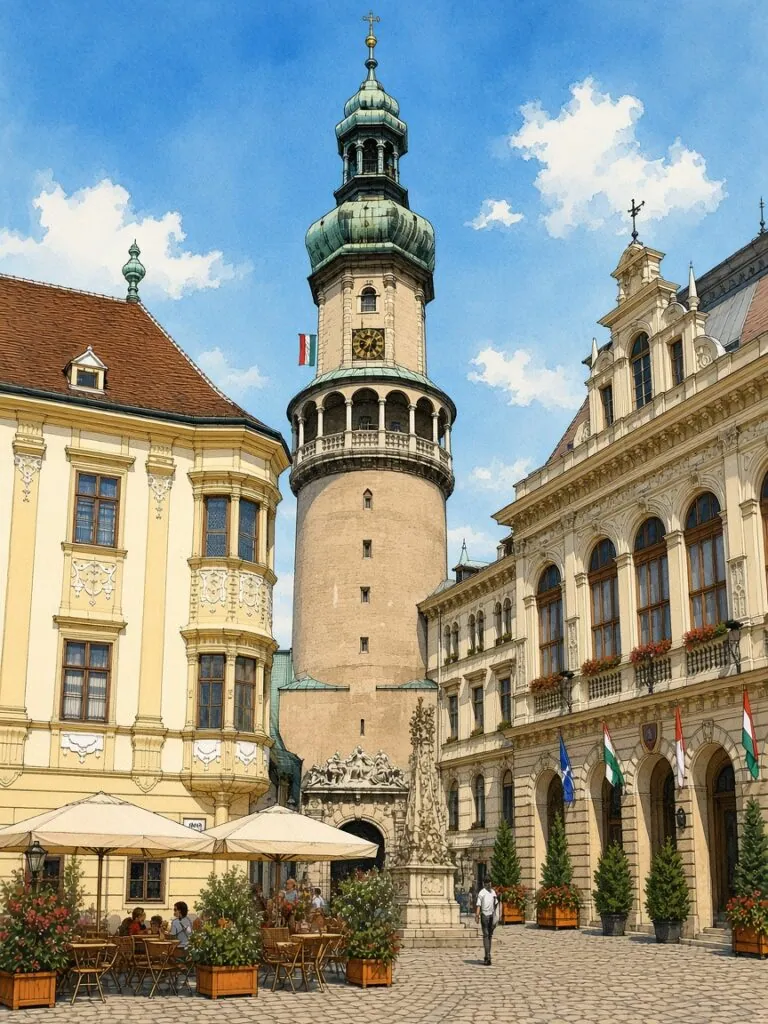
A country that kept its names but lost its towns
Hungary is the mirror image of its neighbours. While Poland, Czechoslovakia, Romania and Yugoslavia acquired towns whose names they changed, Hungary lost towns whose names it had made official. Within its post-Trianon borders, by contrast, Hungary’s place names have been remarkably stable. Almost every town has carried its Hungarian name continuously for centuries; the exceptions are the communist-era renamings discussed in Chapter 8 (Sztálinváros and Leninváros) and a handful of administrative mergers.
But Hungary’s towns also have German names, because for centuries a large share of the urban population spoke German. After the expulsion of the Ottomans at the end of the seventeenth century, the Habsburgs and Hungarian landlords settled German-speaking colonists across the depopulated plains, and many towns, including Buda itself, had German-speaking majorities in the eighteenth century. The German names of Hungarian towns were therefore not exonyms imposed from outside but the everyday names of a large part of the population. They faded in the nineteenth century through Magyarisation and assimilation, and after 1945 a large part of Hungary’s German minority was expelled to Germany. Today they survive in German usage, on bilingual signs in some German minority villages, and in the vocabulary of history.
| Modern official name | German | Other forms |
|---|---|---|
| Budapest | Ofen (Buda) and Pest | Latin Aquincum (Roman), Buda and Pestinum; Slovak Budapešť; Croatian Budimpešta |
| Győr | Raab | Roman Arrabona; Latin Iaurinum |
| Sopron | Ödenburg | Roman Scarbantia |
| Szombathely | Steinamanger | Roman Savaria |
| Pécs | Fünfkirchen | Latin Quinque Ecclesiae, Roman Sopianae; Croatian Pečuh; Slovak Päťkostolie |
| Szeged | Szegedin, Segedin | Serbian Segedin |
| Debrecen | Debrezin | |
| Székesfehérvár | Stuhlweißenburg | Latin Alba Regia; Croatian Stolni Biograd |
| Esztergom | Gran | Latin Strigonium; Slovak Ostrihom |
| Eger | Erlau | |
| Vác | Waitzen | Yiddish Vaytsen |
| Mosonmagyaróvár | Wieselburg-Ungarisch Altenburg | |
| Kőszeg | Güns | Croatian and Slovene Kiseg |
| Komárom | Komorn | Roman Brigetio; Slovak Komárno |
| Dunaújváros | Dunapentele; Sztálinváros 1951 to 1961 | |
| Tiszaújváros | Tiszaszederkény; Leninváros 1970 to 1991 |
Budapest, Ofen and Pest
The Hungarian capital came into existence under its present name only in 1873, when the separate towns of Buda, Óbuda and Pest were officially unified.[303] Before then, the twin towns were sometimes referred to colloquially as Pest-Buda. In German, Buda was Ofen, a name meaning “oven” that probably translates a Slavic word for the same thing (peć), which may in turn underlie the name Pest; the Roman town on the site of Óbuda was Aquincum. Until the mid nineteenth century Pest and Buda had large German-speaking populations, and German was the language of commerce and much of the press. The rapid Magyarisation of the capital in the second half of the century made Budapest the centre of Hungarian national culture.
Győr, Sopron, Szombathely, Kőszeg. The western rim
The towns of western Hungary lie along the old frontier with Austria and kept their German names longest. Győr, German Raab, was the Roman Arrabona, a name derived from Ara Bona, “good altar”, and later contracted.[304] Its German name comes from the river Rába (German Raab). Sopron, German Ödenburg, the Roman Scarbantia, voted to remain in Hungary in the plebiscite of 14 December 1921 and is known as Civitas Fidelissima.[58] Szombathely, German Steinamanger, was the Roman Savaria, capital of the province of Pannonia Superior; its Hungarian name means “Saturday place”, from its market, and its German name means “stone on the meadow”, referring to the Roman ruins.[23] Kőszeg, German Güns, Croatian and Slovene Kiseg and Slovak Kysak, is famous for its heroic resistance to the Ottoman army in 1532.[305]
Pécs, Fünfkirchen
Pécs offers one of the most beautiful examples of a translated name. Its later Latin name was Quinque Ecclesiae, “five churches”; the German Fünfkirchen, the Slovak Päťkostolie and the Italian Cinquechiese all mean the same thing.[306] The Hungarian Pécs may derive from a Slavic word for “five”. The Roman town was Sopianae, and its early Christian necropolis is a World Heritage Site. Croatian and Serbian speakers call it Pečuh and Pečuj. Pécs was under Ottoman rule from 1543 to 1686, and the mosque of Pasha Qasim still stands on its main square, converted into a church.
Székesfehérvár and Esztergom, the royal cities
Székesfehérvár and Esztergom were the two royal centres of medieval Hungary. Székesfehérvár, German Stuhlweißenburg, Latin Alba Regia, Croatian Stolni Biograd and Serbian Stoni Beograd, means “white castle of the seat (throne)”: all its names combine the elements of “seat” and “white castle”.[24] It was the coronation and burial city of the Árpád kings. Esztergom, German Gran and Slovak Ostrihom, was the medieval Strigonium, the seat of the primate of Hungary, and the birthplace of Stephen, the first king of Hungary, who according to tradition was crowned there around the year 1000.[307] The German Gran comes from the name of the river Hron (Garam in Hungarian), which flows into the Danube opposite the town.
Eger, Vác, Szeged and Debrecen
Eger, German Erlau, from Erlen-au, “alder grove”, is famous in Hungary for its defence against the Ottomans in 1552 under Captain István Dobó.[308] Its Hungarian name may also derive from the word for alder (éger). Vác, German Waitzen, had a large Jewish community whose Yiddish name for the town was Vaytsen.[309] Szeged‘s name in many languages adds the suffix -in to the Hungarian: Romanian Seghedin, German Szegedin or Segedin, Serbo-Croatian Segedin, Italian Seghedino, Polish Segedyn.[310] Debrecen, the great Calvinist city of the east, where the Hungarian Declaration of Independence was proclaimed in 1849, is called Debrezin in German.
Mosonmagyaróvár and Komárom
Mosonmagyaróvár is a twentieth-century compound of two towns, Moson (German Wieselburg) and Magyaróvár (German Ungarisch-Altenburg), merged in 1939; the German name of the merged town combines both.[311] Moson gave its name to the old Moson county, Wieselburg in German, one of the four “-burg” counties whose names are associated with the origin of the name Burgenland. Komárom, German Komorn, was the Roman Brigetio; before 1920 it was a single town spanning both banks of the Danube, and the Trianon border divided it into Komárom in Hungary and Komárno in Slovakia.[171][170]
German names in today’s Hungary
Hungary’s German minority, the remnant of the Danube Swabians and other German-speaking communities after the post-war expulsions, still lives in villages around Budapest, in the Pécs area (the “Swabian Turkey”, Schwäbische Türkei) and along the western border. Under Hungary’s minority laws, villages with minority self-governments can display bilingual signs, and German names such as Wudersch (Budaörs) or Werischwar (Pilisvörösvár) appear on entry signs. Croatian, Slovak, Serbian, Romanian, Slovene and other minorities have similar rights. Hungary’s own experience as the state whose nationals became minorities in six neighbouring countries has made it a strong advocate of minority-language naming rights abroad, and this sometimes gives its domestic minority-language arrangements an element of diplomatic demonstration.
Chapter 20. Italy’s Eastern Edge. Trieste, Gorizia and Bolzano
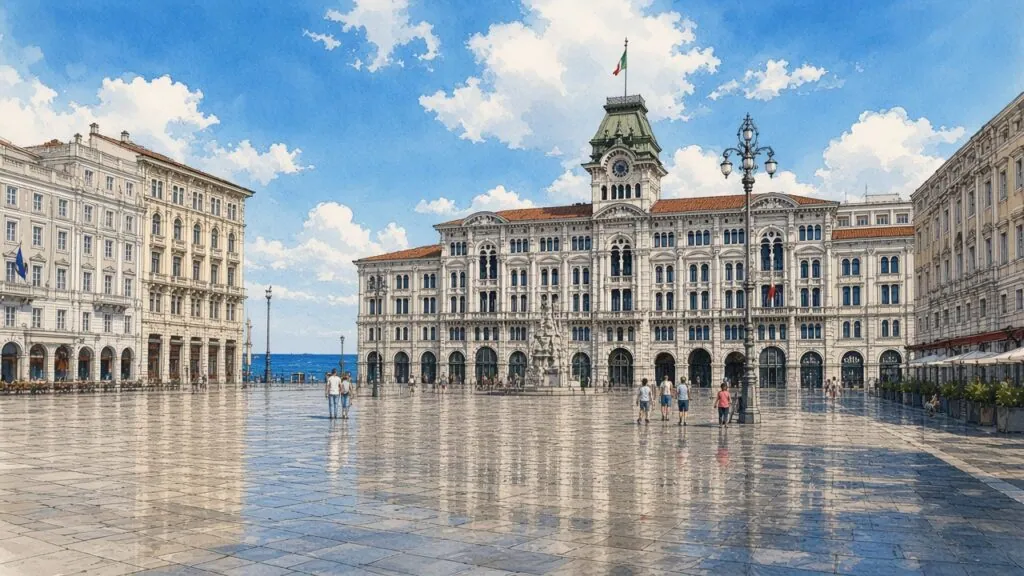
The Habsburg legacy south of the Alps
Italy’s north-eastern provinces belonged to the Habsburg Monarchy until 1918 and form the south-western margin of the Central European naming world. Trieste was Austria’s great port; Gorizia (German Görz, Slovene Gorica) was the capital of a Habsburg county; and South Tyrol, with its capital Bolzano (German Bozen), was part of the Tyrol until it was annexed by Italy after the First World War. In each of these places Italian, German, Slovene, Friulian and, in the Dolomites, Ladin names coexist, and the history of their relationships is the history of the Italian state’s changing attitude to its linguistic minorities.
| Modern official name | German | Slovene | Other forms |
|---|---|---|---|
| Trieste | Triest | Trst | Friulian Triest; Latin Tergeste |
| Gorizia | Görz | Gorica | Friulian Gurize |
| Nova Gorica (Slovenia) | Nova Gorica | Founded after 1947 | |
| Bolzano / Bozen | Bozen | Bocen | Ladin Bulsan |
| Merano / Meran | Meran | Meran | |
| Bressanone / Brixen | Brixen | Ladin Porsenù | |
| Vipiteno / Sterzing | Sterzing | ||
| Brunico / Bruneck | Bruneck | Ladin Bornech |
Trieste, Triest, Trst
Trieste, Friulian Triest and Slovene Trst, belonged as Triest to the Habsburg Monarchy from 1382 until 1918.[312] Made a free port in 1719, it grew in the nineteenth century into the monarchy’s most important seaport and the fourth largest city of Austria-Hungary after Vienna, Budapest and Prague.[312] Its population was mixed: Italian-speaking in the city centre, Slovene-speaking in the suburbs and surrounding Karst villages, with German-speaking officials and merchants and Greek, Serbian, Jewish and Armenian communities. James Joyce lived there for more than a decade and wrote much of Dubliners and A Portrait of the Artist as a Young Man in the city; Italo Svevo, its great novelist, wrote in Italian under a pen name that means “Italus the Swabian”.
After 1918 the city became Italian, and under Fascism the Slovene and Croatian minorities of the region were subjected to forced Italianisation, including the Italianisation of surnames and place names. After 1945 Trieste was claimed by Yugoslavia; from 1947 to 1954 it was the core of the Free Territory of Trieste under Allied and Yugoslav administration, and in 1954 Zone A, including the city, was assigned to Italy. The Slovene name Trst became a slogan of Yugoslav claims, as in the post-war chant “Trst je naš” (“Trieste is ours”). Today Slovene is a protected minority language in the provinces of Trieste and Gorizia, and bilingual signs exist in several municipalities around the city.
Gorizia and Nova Gorica
Gorizia, Slovene Gorica, Friulian Gurize and German Görz, takes its name from the Slovene word for “little hill”; as early as 1127 the local ruler called himself Graf von Görz, Count of Gorizia.[313] Under the Habsburgs the town was the capital of the County of Gorizia and Gradisca, a multilingual society of Italians, Friulians, Slovenes and Germans. The Paris Peace Treaty of 1947 drew the Italian-Yugoslav border so that the old town remained in Italy while much of its hinterland, including the railway station, went to Yugoslavia. With Tito’s special support, Yugoslavia began building a new town called Nova Gorica, “New Gorica”, on its side of the border, planned according to the principles of modernist architecture.[313][314]
For decades the border ran between the two towns, through the square in front of the station. After Slovenia joined the Schengen area in 2007 the border controls disappeared, and in 2025 Nova Gorica and Gorizia were jointly European Capital of Culture, the first time a cross-border pair of towns had held the title. The two names, Gorizia and Nova Gorica, are now symbols of reconciliation, but the naming of the new town in 1947 was itself a political act: it claimed the name of the old town for the Slovene side of the border.
Bolzano, Bozen and the Tolomei names
South Tyrol is the clearest case in Western Europe of an officially imposed renaming that has survived to the present. As discussed in Chapter 5, Ettore Tolomei’s Prontuario dei nomi locali dell’Alto Adige, published in 1916, proposed Italian names for more than ten thousand places in a region where Italian speakers were then a very small minority, and in 1923 these names, almost entirely based on the Prontuario, were made official by decree.[54][55] Many were artificial. Some adapted Latin or Ladin forms; others were simple translations or phonetic approximations. Tolomei, who claimed to have been the first to climb a peak on the Austrian border that he renamed Vetta d’Italia, “Summit of Italy”, was ennobled by the king as Conte della Vetta.[54]
Bolzano itself had an Italian name long before Tolomei, as did Merano and some other towns, so the issue affects mainly villages, hamlets, mountains and valleys. Under Fascism the region’s German-speaking population was subjected to a policy of Italianisation that included Italian-only schools and signs and the settlement of Italian workers in a new industrial zone of Bolzano.[55] In 1939 Hitler and Mussolini agreed on the South Tyrol Option, under which the German-speaking population had to choose between emigrating to the Reich and staying as Italians.
After the war, the Gruber-De Gasperi Agreement of September 1946 between Italy and Austria recognised the rights of the German-speaking population and created the autonomous region of Trentino-Alto Adige/Südtirol.[315] The second autonomy statute of 1972 gave the province of Bolzano extensive self-government, and German and Italian (and in some valleys Ladin) are official languages. The province’s official name, Provincia autonoma di Bolzano – Alto Adige / Autonome Provinz Bozen – Südtirol, contains both languages, and most places have official names in both. Bolzano/Bozen railway station and the Free University of Bozen-Bolzano display the double name as a matter of course.[5]
The question of which of Tolomei’s names should be kept has remained unresolved for decades. German-speaking South Tyroleans regard many of them as fascist inventions; Italian-speaking residents and Italian governments have defended them as part of the established legal toponymy. Disputes have flared over signs on Alpine hiking paths that showed only German names, and over provincial legislation on toponymy. In a region where two languages each have a good claim to be the local one, both Bolzano and Bozen are endonyms, and the debate is less about which name is correct than about whose history the landscape remembers.
Merano and the spa culture
Merano, German Meran, was a renowned spa town of the Austro-Hungarian Empire in the nineteenth century, attracting scientists, writers and artists with its mild Alpine climate.[316] Its German and Italian names are close variants of a single original. Like the Bohemian spas, Merano was part of the culture of the Habsburg leisure classes, and it remains predominantly German-speaking, with an Italian minority.
The wider lesson
The Italian north-east shows that renaming is not only a story of the communist east. A democratic Western European state still carries an official toponymy created in large part by a nationalist geographer, imposed by a fascist government, and only partly accommodated to the region’s majority language through post-war autonomy. At the same time, the region’s bilingual institutions show how far a state can go in accepting that a place has two legitimate names.
Part Three. Names in the Present
Chapter 21. The Yiddish Map. Shtetl Names and the Geography of Memory
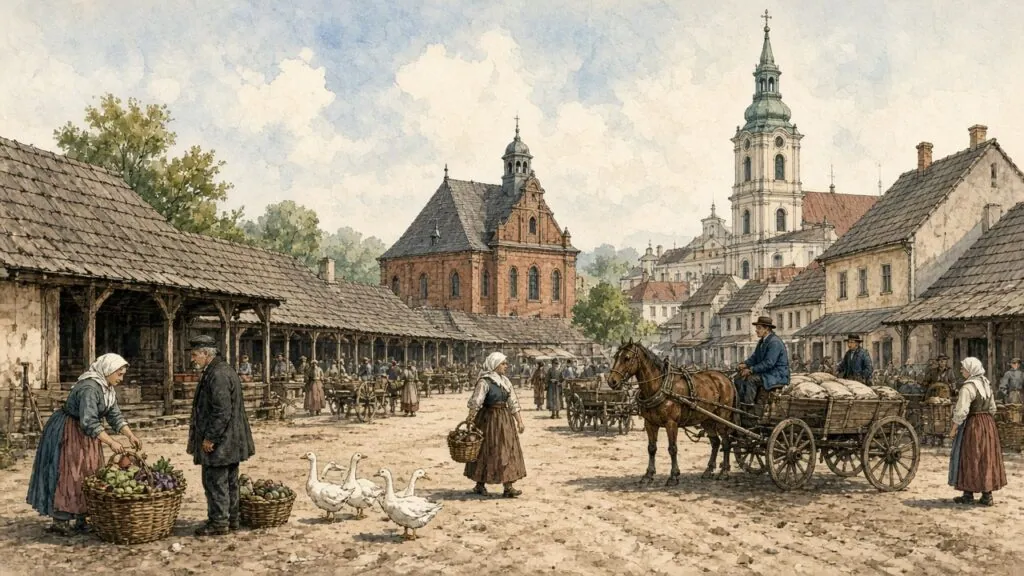
A parallel geography
For several centuries, a large part of Central and Eastern Europe had a second map laid over the official one: the map of Yiddish-speaking Jewry. It covered the Polish-Lithuanian Commonwealth and its successor territories, Galicia, Bukovina, the Hungarian north-east, Bessarabia and the Russian Pale of Settlement, and it named cities, towns and villages in a language that no state recognised as official. That map had its own regions: Lite, the Lithuanian lands, whose Jews were Litvaks; Poyln, Poland; Galitsye, Galicia; Ukraine; Besarabye; and smaller districts.[34] It had its own capitals, above all Vilne, “the Jerusalem of Lithuania”, and Varshe, the largest Jewish city in Europe before the Second World War. And it had a characteristic settlement type, the shtetl.
The word shtetl is a Yiddish diminutive of shtot, “town”, meaning “little town”. It refers to small market towns with substantial Ashkenazi Jewish populations, found mainly in the areas that formed the nineteenth-century Pale of Settlement in the Russian Empire, as well as in Galicia and Hungary.[317] Officially there were no Jewish municipalities: the shtetl was, in the language of the state, a miasteczko in Polish, a miestelis in Lithuanian or a mestechko in Russian bureaucratic terminology.[317] The Jewish community, the kehilla, existed alongside the Christian town authorities, with its own institutions, and its own names for the town and its streets.
How Yiddish names were formed
Yiddish names were mostly adaptations of the local official or vernacular name, filtered through Yiddish phonology and spelled in the Hebrew alphabet. The patterns are recognisable. Polish names ending in -ów became -ev or -iv in Yiddish (Berdyczów became Berditshev), names in -ice and -yce often became -its or -itsh, and Polish nasal vowels were rendered as -on- or -en-. Lublin stayed Lublin; Kraków became Kroke; Warszawa became Varshe; Łódź became Lodzh; Białystok became Byalistok; Przemyśl became Pshemishl; Drohobycz became Drohobitsh.[60][130][129][184]
In the Lithuanian and Belarusian lands, Yiddish followed the Slavic or Russian form of the name: Vilnius was Vilne, Kaunas was Kovne, Panevėžys was Ponevezh, Grodno was Grodne, Brest was Brisk.[39][196][201][40][227] In the Habsburg lands, Yiddish names were often close to the German: Lemberg was Lemberik, Czernowitz was Tshernovits, Brünn was Brin.[3][132] In the Hungarian north-east and Transylvania, Yiddish usually followed Hungarian: Munkács became Munkatsh, Szatmár became Satmar, Máramarossziget became Siget, Beregszász became Beregsaz.[180][244][318][181]
Sometimes the Yiddish name preserved an older form that the official name had abandoned. The Yiddish name for Daugavpils, Dvinsk, followed the Russian form of 1893 to 1920, but its older Yiddish forms Dinaburg and Denenburg preserve earlier official names.[45] The Yiddish name for Oświęcim was Oshpitsin, a form quite different from both the Polish name and the German Auschwitz.
Names that became dynasties
The most remarkable afterlife of Yiddish place names is in the names of Hasidic dynasties. Hasidism, the religious revival movement that began in the eighteenth century in Podolia, was organised around charismatic leaders (rebbes or tzaddikim), whose courts were usually identified by the town where they lived. When a rebbe’s descendants succeeded him, the dynasty kept the town’s name. After the Holocaust, the surviving dynasties re-established themselves in New York, London, Antwerp, Jerusalem and Bnei Brak, and the names of small Central European towns became the names of communities with tens of thousands of members.
The movement’s founder, the Baal Shem Tov, lived in Medzhybizh, Yiddish Mezhbizh, in Podolia, and the town is known as the birthplace of Hasidism.[319] The Ger dynasty, once the largest Hasidic group in Poland, took its name from Góra Kalwaria near Warsaw, a town of religious significance for both Catholic Christians and Hasidic Jews.[320] The Belz dynasty was founded by Shalom Rokeach, who became the first Belzer rebbe in the town of Belz in Galicia.[321] The Bobov dynasty comes from Bobowa near Gorlice, Yiddish Bobov.[322] The Vizhnitz dynasty comes from Vyzhnytsia in Bukovina, German Wischnitz, Romanian Vijnița, Yiddish Vizhnitz.[323] The Satmar dynasty, one of the largest Hasidic groups in the world today, comes from Satu Mare, Hungarian Szatmárnémeti, Yiddish Satmar or Satmer.[244] The Munkatsh dynasty comes from Mukachevo.
A visitor to Williamsburg in Brooklyn will see signs referring to Satmar institutions; a visitor to Bnei Brak in Israel will find the Ponevezh Yeshiva, named after the Lithuanian town of Panevėžys.[201] “Brisker” is the name of the analytical method of Talmud study associated with the Soloveitchik family, who were rabbis of Brisk, Brest in Belarus.[227] In these communities, the Yiddish name of a Central European town is spoken every day, while in the town itself the name may be unknown.
A song and a confusion
Yiddish place names have also had an afterlife in song, sometimes with surprising results. The famous Yiddish song “Beltz, mayn shtetele”, a tender evocation of a happy childhood in a small town, is often assumed to refer to Belz in Galicia, the seat of the Hasidic dynasty. In fact it was composed for a town whose Yiddish name sounds similar, Belts, the Bessarabian town now called Bălți in Moldova.[321] The two places are hundreds of kilometres apart in different historical regions, but in Yiddish their names are almost identical, and the song has attached itself to both. It is a small parable of how the Yiddish map, cut off from the places it described, has become a map of memory rather than of geography.
Chelm and the geography of folklore
Some Yiddish place names belong to folklore. Chełm, Yiddish Khelm, in eastern Poland, is the town of the “wise men of Chelm” (khelemer khakhomim), the legendary fools whose absurd reasoning is the subject of countless Jewish jokes and stories. The real Chełm was an important Jewish community, destroyed in the Holocaust, but the Khelm of folklore exists in a world of its own, comparable to the Gotham of English tradition or the Schilda of German. Similarly, Berdychiv, Yiddish Berditshev, a city with one of the largest Jewish populations in the Russian Empire and an important role in Hasidism, became in Yiddish and Russian Jewish humour a byword for the archetypal Jewish town.[324]
The memorial books
After the Holocaust, survivors from hundreds of towns compiled memorial books, known as yizkor books, recording the history, institutions, personalities and destruction of their communities. Most are written in Yiddish or Hebrew, some with sections in English or other languages.[325] The titles of these books are a vast gazetteer of the Yiddish map: the books of Kovne and Varshe, of Brisk, of Khelm, of Pshemishl and of Drohobitsh, and of hundreds of shtetlekh whose Yiddish names appear nowhere else in print. For historians and genealogists, the yizkor books are an indispensable source, and their place names often need careful decoding to be matched with modern official names.
Genealogy and the problem of matching names
The practical consequence of this vanished map is a recurring problem for genealogists and historians. A family document from the 1890s might give a town’s name in Yiddish (in Hebrew letters), Russian (in Cyrillic), Polish or German. An emigration record at Ellis Island might give a phonetic English spelling of any of these. A modern map gives the current official name, which may be in a different language from all of them. Resources such as the JewishGen gazetteer exist precisely to match these forms, and online communities of researchers spend much of their time resolving the ambiguities created by a century of border changes and renamings.
The towns of the Yiddish map have not disappeared. Most of them still exist, under their Polish, Ukrainian, Belarusian, Lithuanian, Hungarian, Slovak or Romanian names. What disappeared was the community that used the Yiddish names, and with it the Yiddish map itself. In a sense, every Yiddish place name is now an exonym: a name for a place used by people who no longer live there.
Chapter 22. Two Names on One Sign. Bilingual Signage Law Today

The sign as a political object
A town sign at the entrance to a village is one of the most modest objects in public space. It is also one of the most contested. In Central Europe, where minorities live in thousands of communities on the wrong side of twentieth-century borders, a second name on a village sign tells everyone who passes that another language belongs here too. To some residents it is a gesture of recognition and respect; to others it is a provocation or a threat, a reminder of a past they wish forgotten, or a foothold for a neighbouring state’s claims. Few administrative questions in Europe have produced as much passion as the question of which names appear on these small rectangles of metal.
Since the 1990s, most Central European states have adopted legal frameworks allowing or requiring bilingual signs where minorities live, often under the influence of the Council of Europe‘s Framework Convention for the Protection of National Minorities and the European Charter for Regional or Minority Languages. These laws typically use a numerical threshold, a percentage of the local population that must belong to the minority, and they differ widely in their details. This chapter looks at several of the most instructive cases.
Carinthia and the Ortstafelstreit
The most famous dispute over bilingual signs in Europe took place in the Austrian province of Carinthia, home to a Slovene-speaking minority in the south of the province. Article 7 of the Austrian State Treaty of 15 May 1955 guaranteed the rights of the Slovene and Croatian minorities in Austria, including the provision that in the administrative and judicial districts of Carinthia, Burgenland and Styria with Slovene, Croatian or mixed populations, topographical terminology and inscriptions should be in the minority language as well as in German.[57][326]
Implementation proved explosive. In 1972 the federal government’s attempt to put up bilingual signs in a list of localities provoked the “town sign storm” (Ortstafelsturm), in which German nationalist activists tore down the new signs; bilingual signs in 205 municipalities were swept away.[327] In 1976 the Ethnic Groups Act set a threshold of 25 percent of Slovene speakers for a bilingual sign, a solution that was never fully implemented. In 2001 the Constitutional Court lifted that quota, finding it too high, and suggested a figure closer to 10 percent. The ruling led to an open conflict between the governor of Carinthia, Jörg Haider, and the president of the court, Ludwig Adamovich; Haider responded with symbolic gestures such as moving signs a few metres so that they technically stood outside the area covered by the ruling.[327] The dispute dragged on for nearly a decade.
The resolution came in 2011. After talks led by the state secretary Josef Ostermayer with mayors, German homeland associations, political parties and Slovene organisations, an agreement was reached on 26 April 2011.[328] On 6 July 2011 the National Council passed an amendment to the Ethnic Groups Act providing for mandatory bilingual signs in 164 Carinthian localities: all localities listed in the existing Carinthian topography regulation, all localities covered by a ruling of the Constitutional Court, and all localities with at least 17.5 percent of mixed-language population.[329] The figure of 17.5 percent was explicitly a compromise between the old 25 percent and the 10 percent suggested by the court.[330][328] The law also clarified that the obligation applied only to place-name signs and official direction signs, not to street names, maps or the signs of the railway and postal companies, but that municipalities remained free to put up additional bilingual signs by resolution of the municipal council, and that existing bilingual signs outside the legal list would not be removed.[329]
Since then, the conflict has largely subsided, and some municipalities have used their autonomy to add bilingual signs beyond the legal minimum.[328] A scholarly study has published all 164 villages with their German and Slovene names, their etymology and their typology, a reminder that each pair of names is a small piece of shared history.[326] The Carinthian case shows how much political energy can be spent on a question that seems, to outsiders, purely symbolic, and how a compromise number can end a conflict that principles could not.
Opole Silesia and the Polish minority law
Poland’s minority law, the Act of 6 January 2005 on National and Ethnic Minorities and on the Regional Language, allows municipalities (gminas) with significant linguistic minorities to introduce an auxiliary language in official dealings and to adopt additional minority-language names for localities.[331] The auxiliary-language provisions apply where a minority makes up at least 20 percent of the municipality’s population according to the census; additional place names can also be introduced in other localities after local consultation. Kashubian, as a regional language, has the same rights as the minority languages.
The largest group of bilingual municipalities is in Opole Voivodeship, home of most of Poland’s German minority, where twenty-eight gminas use German as an auxiliary language. Radłów (Radlau) and Chrząstowice (Chronstau) adopted the status on 25 January 2006, among the first, and they were followed by Biała (Zülz), Izbicko (Stubendorf), Leśnica (Leschnitz), Strzeleczki (Klein Strehlitz), Dobrodzień (Guttentag) and others.[331] Bilingual signs with German names now stand at the entrances to hundreds of Silesian villages. In Pomerania, a number of gminas have adopted Kashubian; in Podlaskie, Puńsk uses Lithuanian (Punsko valsčius) and several gminas use Belarusian; in Małopolska, a number of villages have Lemko names.[331]
The German signs in Opole Silesia were controversial at first. Some were defaced or painted over, and critics worried that villages might choose the names of 1936 to 1945, created by the Nazi renaming campaign, rather than older German names. The law anticipated exactly this. Article 12 provides that the additional names may be used only in municipalities entered, on the application of the municipal council, in a register kept by the minister responsible for national minorities, and it states plainly that the additional names may not refer to names from the period 1933 to 1945 given by the authorities of the Third German Reich or of the Union of Soviet Socialist Republics.[332] The same Act sets the 20 percent threshold for the auxiliary language in Article 9.[332] The existence of these signs on the territory of the former Recovered Territories remains a striking symbol of how much Polish-German relations have changed since 1945.[110]
Slovakia’s Hungarian minority
Slovakia’s Act No. 184/1999 on the Use of Languages of National Minorities originally allowed the use of minority languages, including on signs, in municipalities where citizens belonging to a national minority made up at least 20 percent of the population, according to a government regulation listing the municipalities.[333] The law was amended by Act No. 204/2011, effective 1 July 2011, after long disputes with Hungary over Slovakia’s state language law and its 2009 amendment, which had extended the obligatory use of Slovak.[334][335][154] The threshold now stands at 15 percent. Government Regulation No. 35/2023, approved on 25 January 2023 and in force from 1 March 2023, lists the municipalities in which citizens belonging to a national minority form at least 15 percent of the population.[336] It covers 763 towns and villages with Hungarian, German, Roma, Ruthenian and Ukrainian minorities, 125 more than the previous list; most of the additions were Ruthenian and Roma communities, with only five new Hungarian ones.[337]
In practice, most of the southern municipalities along the Hungarian border display both Slovak and Hungarian names: Komárno and Komárom, Dunajská Streda and Dunaszerdahely, Štúrovo and Párkány. Disputes have flared over railway station signs, over the use of Hungarian in municipal communications, and over the question of whether historical Hungarian names that were never official in Czechoslovakia can be used. Activist campaigns have pushed for bilingual station names, and the issue reappears whenever relations between Bratislava and Budapest are tense.
Lusatia and the Sorbs
Germany’s own Slavic minority, the Sorbs of Lusatia, live in eastern Saxony and southern Brandenburg. Their two literary languages, Upper Sorbian around Bautzen and Lower Sorbian around Cottbus, are protected by both states. The city of Bautzen in Upper Lusatia is the centre of Upper Sorbian culture, and bilingual signs, including the name of the city, “Bautzen/Budyšin”, can be seen there; Cottbus, Lower Sorbian Chóśebuz, is the cultural centre of Lower Sorbian and also has bilingual signs.[338] Across the Sorbian settlement area, place-name signs give both the German and the Sorbian names, often in different colours or typefaces.
Lusatia also carries the scars of the Nazi renaming campaign. Many Sorbian-derived names were replaced in 1936 and 1937 with invented German ones. After the war, Saxony restored nearly 80 percent of the historical names, but in Brandenburg most of the Nazi-era names remained official, a striking contradiction in a state that defined itself as anti-fascist.[27] A scholar who studied the question concluded that the treatment of these names after 1945 was determined above all by German-Sorbian relations: where local authorities wanted to strengthen Sorbian identity, the old names returned; where they did not, the Nazi names stayed.[27]
Other cases
Bilingual signage regimes exist across the region, each with its own history. In Romania, the 20 percent threshold of the 2001 local administration law governs Hungarian, German, Ukrainian, Serbian and other minority names, as discussed in Chapter 16.[257] In Slovenia, the coastal municipalities of Koper, Izola and Piran are officially bilingual in Slovene and Italian, and parts of Prekmurje, including Lendava, are bilingual in Slovene and Hungarian.[271] In Croatian Istria, Italian names stand beside Croatian ones in several municipalities. In the Czech part of Cieszyn Silesia, Polish names appear on signs in municipalities with a significant Polish minority. In Italy, Slovene names appear alongside Italian ones in parts of the provinces of Trieste and Gorizia, and German and Ladin names in South Tyrol.
Not every bilingual regime has been peaceful. In Croatia, the Constitutional Act on the Rights of National Minorities mandates bilingual signs wherever more than one third of the population belongs to a minority. When this rule gave Serbian and the Cyrillic alphabet co-official status in Vukovar, a series of protests followed in late 2013, and newly installed Cyrillic signs were smashed by people who associated the script with the siege and destruction of the town in 1991.[339] In Lithuania, Polish-Lithuanian street-name plates in the Vilnius region led to court orders to remove them and to fines against local officials who did not comply. At the start of 2014 the administrative director of Šalčininkai district, Bolesław Daszkiewicz (Boleslav Daškevič in Lithuanian), was fined 43,400 litas, about 12,600 euros, calculated at 100 litas for each day of delay in carrying out a court decision to take down bilingual signs; his successor and the director of the Vilnius district administration were also fined.[340][341] These conflicts show that a bilingual sign is never only about language. It is about history, war and memory.
What the thresholds mean
The numerical thresholds used in these laws, whether 15, 17.5, 20, 25 or 33 percent, express a political compromise between two principles. One is that minorities have a right to see their language in public space. The other is that the majority language is the language of the state. Every threshold is a judgement about where one principle gives way to the other, and every census that shifts a village above or below the line can reopen the dispute. In regions where censuses themselves were contested, as in Carinthia, where Slovene identification fluctuated dramatically between censuses for political reasons, the numbers are not neutral facts but part of the conflict.[57]
Chapter 23. Rivers, Mountains and Lands. Names Larger than Towns
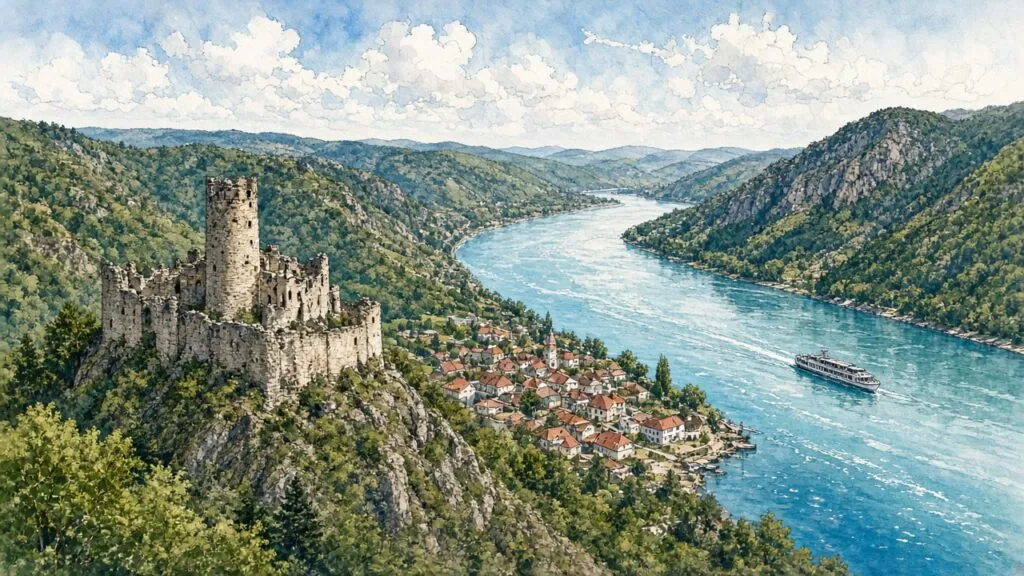
Names that outlive borders
Town names are the most visible part of the toponymic map, and the part most often changed by decree. But the map is also written in larger names: the names of rivers, mountain ranges and historical lands. These names are generally older, more stable and less political than town names. A state can rename a city overnight by publishing a decree; it is much harder to rename a river that flows through four countries, or a region whose name is used by millions of people who do not live in it. The larger names therefore preserve, more faithfully than the town names, the deep layers of the region’s linguistic history, and they show how languages that disagreed about almost everything else agreed, in their own ways, about the names of the land itself.
The rivers
The great rivers of Central Europe have names that are among the oldest words in any European language. The Danube is the clearest example. The ancient Greeks called its lower course the Istros, and in Latin it was known as Danubius or Danuvius, as well as Ister or Hister; the languages of the Danube basin all use names derived from the Latin Danubius.[342] The German Donau, the Hungarian Duna, the Slovak and Czech Dunaj, the Serbian and Croatian Dunav, the Bulgarian Dunav and the Romanian Dunărea are all descendants of this single ancient name, adapted to the sound systems of each language. Romanian stands out among the surrounding languages in treating the river as feminine.[342] The root is thought to be related to the names of other great rivers of the region, the Don, the Dnieper and the Dniester, and even of smaller ones such as the Dunajec in southern Poland.[342]
The name of the Danube even became a name for a city. In Slovene, Vienna is called Dunaj, a word that in other Slavic languages denotes the river.[343] The capital of the Habsburg Empire, seen from the Slovene lands, was simply “the city on the Danube”.
The Oder, Polish and Czech Odra, rises in the Czech Republic and flows through western Poland, forming part of the Oder–Neisse border between Poland and Germany before reaching the Szczecin Lagoon.[344] Its name, like that of its tributary the Neisse (Polish Nysa, Czech Nisa), is pre-Slavic and probably pre-Germanic. The two rivers gave their names to the line that became, in 1945, the new western border of Poland, and for decades the phrase “Oder–Neisse line” was one of the most politically charged geographical expressions in Europe. West Germany did not definitively recognise the border until the treaties of 1990, and in those decades the names of two rivers stood for the whole question of the lost eastern territories.
The Vistula, Polish Wisła and German Weichsel, is the longest river in Poland and the longest river flowing into the Baltic Sea.[345] It rises at Barania Góra in the Silesian Beskids and flows through Kraków, Warsaw and Toruń to the Gulf of Gdańsk.[345] For Poles it is the national river, as the Vltava is for Czechs. The Neman shows even more clearly how one river can carry several national names: it is the Neman in Russian, the Nioman in Belarusian, the Nemunas in Lithuanian, the Niemen in Polish and the Memel in German.[346] It rises in Belarus, flows through Lithuania past Grodno and Kaunas, and forms the northern border of Kaliningrad Oblast before draining into the Curonian Lagoon.[346] The German name Memel was also the name of the port city at the mouth of the lagoon, now Klaipėda, and the river appeared in the first verse of the old German national anthem, “von der Maas bis an die Memel”, a phrase that has become an emblem of the borders Germany lost.
The Vltava is a striking example of a river whose Czech and German names, so different in appearance, share a single origin. Both Vltava and the German Moldau are believed to derive from old Germanic words meaning “wild water”; in the Annales Fuldenses of 872 the river is called Fuldaha.[347] When Bedřich Smetana wrote his famous symphonic poem about the river, it became known internationally under its German name, Die Moldau, and many concert programmes still use that title. The Elbe, Czech Labe, which the Vltava joins north of Prague, rises in the Giant Mountains and flows through Bohemia and Germany to the North Sea at Cuxhaven.[348]
The mountains
Mountain ranges on borders usually have at least two names. The Giant Mountains, Czech Krkonoše, Polish Karkonosze, German Riesengebirge, lie along the border between Bohemia and Silesia, and the main ridge carries the Czech-Polish border.[349] Their highest peak is Sněžka in Czech and Śnieżka in Polish, the “snowy one”, known in German as Schneekoppe; it is the highest natural point of the Czech Republic.[349] The Giant Mountains are part of the wider Sudetes, a mountain system shared by the Czech Republic, Poland and Germany, stretching from near Dresden to the region of Ostrava.[350]
The name of the Sudetes has a particularly heavy history. In the twentieth century, the German-speaking population of the Bohemian borderlands came to be known as “Sudeten Germans”, and the whole of the German-speaking borderland, including areas far from the Sudetes proper, became the “Sudetenland”. It was under that name that the borderlands were annexed by Germany after the Munich Agreement of 1938. A geographical name for a mountain range had become a political name for a contested territory. In Czech usage the word “Sudety” still carries that association, and Czech geographers and politicians have generally preferred to speak of the “border regions” (pohraničí).
The Tatras, the highest mountains of the Carpathians, form a natural border between Slovakia and Poland; about three-quarters of their area lies in Slovakia.[351] Their name appears in a document of 1086 from the German king Henry IV as “Tritri” mountains, and in Polish the name Tatry is first mentioned in 1255; the Slovak form is probably a loan from Polish that later spread into Czech and Hungarian.[351] The highest peak, Gerlachovský štít, German Gerlsdorfer Spitze, Hungarian Gerlachfalvi-csúcs, has had a remarkable sequence of names, and in less than three decades of the twentieth century it was successively the highest mountain of the Kingdom of Hungary, of Czechoslovakia, of Slovakia and of Czechoslovakia again.[352] The new Czechoslovak government renamed it Štít legionárov, “Legionnaires’ Peak”, in 1923 in honour of the Czechoslovak Legions, but the name was dropped in favour of Gerlachovský štít in 1932. After the communist coup of 1948 it became Stalinov štít, “Stalin Peak”, in 1949, and its traditional name was restored in 1959.[352] Even mountains, it seems, could be enlisted in political naming campaigns, though rarely for long.
The historical lands
The names of the historical lands are among the most durable elements of the Central European map. Silesia is called Śląsk in Polish, Schlesien in German and Slezsko in Czech, and these names most likely share a common etymology, although scholars disagree over whether the name derives from the Germanic tribe of the Silingi.[353] The region today lies mostly in Poland, with small parts in the Czech Republic and Germany, but its name has survived every change of sovereignty, and its people, whether they consider themselves Polish, German, Czech or simply Silesian, continue to use it.[353]
Pomerania, Polish Pomorze, German Pommern, Kashubian Pòmòrskô, is a name of Slavic origin meaning “land by the sea” (po more).[354] It was one of the many regions where a Slavic name was absorbed into German and then returned to Slavic usage after 1945. Masuria, Polish Mazury, German Masuren, the land of lakes in the former southern East Prussia, takes its name from the Masurians, whose ancestors, the Mazurs of neighbouring Mazovia, began settling in the south-east of the former Prussian lands after the Teutonic conquest; most of them later became Lutheran.[355]
Transylvania offers perhaps the most elegant case of a name translated through several languages. The region first appears in a medieval Latin document of the Kingdom of Hungary from 1078 as ultra silvam, “beyond the forest”.[235] The Latin Transylvania was a direct translation of the Hungarian Erdő-elve, later Erdély, which was itself adopted phonetically into Romanian as Ardeal.[235] So the Romanian name of the region is a Hungarian word, and the Latin and English names are a translation of the same Hungarian word. The German name is entirely different: Siebenbürgen, “seven castles”, after the seven principal cities of the Transylvanian Saxons.[235] In Ukrainian, the region is called Zalissia, again “beyond the forest”.[235]
Bukovina is the “land of beeches”. Its official German name under Austrian rule from 1775 to 1918, die Bukowina, derived from the Polish form Bukowina, itself from the common Slavic word buk, “beech”.[236] German poets also called it das Buchenland, and Romanian literary language sometimes uses Țara Fagilor, both meaning “land of the beech trees”.[236] Divided between Romania and Ukraine since 1940, Bukovina retains its name on both sides of the border, and the beech tree remains its emblem.
Galicia, Polish Galicja, Ukrainian Halychyna, German Galizien, takes its name from the medieval city of Halych, and was first recorded in Hungarian chronicles in 1206. It became the official name of the Austrian crown land created after the first partition of Poland in 1772, the “Kingdom of Galicia and Lodomeria”, whose second name was a Latinised form of Volodymyr in Volhynia. The Austrian crown land disappeared in 1918, but the name Galicia, and the identity associated with it, survived on both sides of the Polish-Ukrainian border.[356]
Why the larger names last
The difference between town names and regional names is instructive. Town names are administrative: every town needs one official name for the post office, the railway and the register of births. States therefore have strong incentives and strong tools to control them. Regional names are cultural: no state is obliged to use them, and many historical regions have no administrative existence at all. Galicia, Bukovina, Masuria and Transylvania are not official units in any of the states that contain them. Precisely because they are not the property of any state, they survive. They belong to the people who identify with them, and to the scholars, poets and tourists who use them, and no decree can either abolish or impose them. Rivers and mountains are similar. They are older than all the states that share them, they usually cross borders, and their names, inherited from languages that disappeared long ago, have been adapted rather than replaced by each new group of speakers.
Chapter 24. Looking Across the Border. Exonyms, Memory and the Politics of Spelling
The exonym runs in both directions
Most of this book has been about names imposed on Central European places by outsiders, or by new states on places that had been someone else’s. But the exonym, the name used in one language for a place in another language’s territory, runs in both directions. If German speakers have their Breslau and Pressburg, Czech and Polish speakers have their own names for German cities, and Hungarians have theirs for Vienna. These exonyms are rarely noticed because they are not contested. Nobody in Leipzig is offended that Czechs call their city Lipsko. Yet they show that the habit of naming foreign places in one’s own language is universal, and that what makes the German names of Polish cities or the Hungarian names of Slovak towns politically charged is not their existence, but the history behind them.
Vienna is the best example. The Romans built a fort there in the first century and called it Vindobona, a borrowing of a Celtic name meaning either “white place” or “place of Vindos”.[343] The German Wien gave rise to the Czech Vídeň, the Slovak Viedeň and the Polish Wiedeń. Hungarian, however, calls the city Bécs, a name that was borrowed into Serbo-Croatian as Beč and into Ottoman Turkish as Beç.[343] And, as the previous chapter noted, Slovene calls it Dunaj, after the Danube.[343] The capital of the Habsburg Empire thus had at least four unrelated name families in the languages of its own subjects.
Prague has an equally rich set. The Czech Praha, first recorded in the chronicle of Cosmas of Prague in the early twelfth century, has been explained either as deriving from práh, “threshold”, or, in Josef Dobrovský’s theory accepted since the eighteenth century, from an old Slavic word meaning “ford” or “rapids”, referring to the crossing point of the Vltava.[35] German speakers call the city Prag, Poles Praga and Hungarians Prága. The Polish Praga is also the name of a district of Warsaw on the right bank of the Vistula, a coincidence that occasionally confuses visitors.
Budapest is a case of a name created by unification. Until 1873 there were three separate towns, Buda, Óbuda and Pest, which were merged in that year and given the new name Budapest.[303] German speakers knew Buda as Ofen and Pest as Pest; the city’s German name in the nineteenth century was therefore often Ofen-Pest or Pest-Ofen. Today Germans, like everyone else, say Budapest.
For German cities, the Slavic languages have their own names. Leipzig, whose name probably comes from a Slavic word for the lime tree, is Lipsk in Sorbian and Polish and Lipsko in Czech, forms that preserve the Slavic origin.[357] Dresden is Drježdźany in Upper Sorbian, Drážďany in Czech and Drezno in Polish.[358] Munich is Mnichov in Czech and Monachium in Polish, from the Latin. Regensburg, historically known in English as Ratisbon, is Řezno in Czech and Ratyzbona in Polish.[359] Nuremberg is Norimberk in Czech and Norymberga in Polish. These forms are used routinely in newspapers, on maps and in schools, and they are no more political than the English “Munich” or “Nuremberg”.
When exonyms become political
The exonym becomes political when it refers to a place that once belonged to the speaker’s nation and no longer does, or that the speaker’s nation once ruled. The Hungarian names of towns in Slovakia, Romania, Serbia and Ukraine are a good example. Hungarian media, schools and public institutions routinely use Hungarian names for towns that were part of the Kingdom of Hungary before 1920: Pozsony for Bratislava, Kassa for Košice, Kolozsvár for Cluj-Napoca, Nagyvárad for Oradea, Szabadka for Subotica, Ungvár for Uzhhorod. For Hungarian speakers, these are simply the names of the places in their own language, used continuously for centuries; for many Slovaks, Romanians and Serbs, they are a reminder of the Kingdom of Hungary and of the territorial grievances associated with the Treaty of Trianon. The same name is a neutral exonym to one listener and a political claim to another.
German usage is more complex. German speakers have centuries-old names for almost every town in Bohemia, Moravia, Silesia, Pomerania and East Prussia, and those names appear in history books, family records and literature. Since 1945, German public usage has gradually moved towards using the official Polish and Czech names, especially for smaller places, while retaining German names for the largest and best-known cities, such as Breslau, Danzig, Stettin, Prag, Pilsen and Brünn, in some contexts. Expellee organisations, the Landsmannschaften, long used German names exclusively, and for decades many maps published in West Germany showed the former eastern territories with German names and the note that they were “under Polish administration”. Today the usage of German names is usually a matter of style and context rather than politics; but in Poland and the Czech Republic, a German politician using the German name of a city can still provoke comment.
In Poland, the lost eastern territories, the Kresy, have generated their own nostalgic geography. The region gave rise to what historians call the Kresy myth, a set of nostalgic views about the lost borderlands.[360] Polish speakers continue to use Polish names for the cities of western Ukraine, Belarus and Lithuania: Lwów for Lviv, Wilno for Vilnius, Grodno, Stanisławów for Ivano-Frankivsk, Tarnopol for Ternopil. For older Poles, especially those born in these cities or descended from people who were, these names are tied to family memory. Lwów, a city whose Latin motto Semper fidelis, “always faithful”, appeared on its coat of arms between 1936 and 1939, and whose young defenders in 1918, the Lwów Eaglets, became heroes of Polish patriotic memory, holds a special place in this geography.[3] In contemporary Polish public usage, the Polish names of Ukrainian and Lithuanian cities are still standard exonyms, but care is often taken to avoid any suggestion of territorial claims.
A name as diplomacy. Królewiec
The Polish decision of 2023 to use Królewiec instead of Kaliningrad, discussed in Chapter 14, showed how an exonym could become an instrument of foreign policy. The Polish Commission on Standardisation of Geographical Names Outside the Republic of Poland recommended with immediate effect that the city be called Królewiec in Polish, and the oblast Obwód Królewiecki, arguing that the name Kaliningrad was unrelated to the city or the region and had an “emotional and negative” resonance in Poland, because Mikhail Kalinin had been one of the Soviet signatories of the 1940 order to execute Polish prisoners of war at Katyn.[220][7] The Commission stated that “each country has the right to use in its language traditional names constituting its cultural heritage, but it cannot be forced to use names unacceptable by it in its language”.[220] The Kremlin spokesman, Dmitry Peskov, called the decision “bordering on madness” and “a hostile act”.[220]
What makes the case remarkable is that Królewiec was not new. It was the traditional Polish name, used for centuries, a translation of Königsberg, “the king’s mountain”.[220] The Polish Commission had simply restored the older exonym in preference to the Soviet one that had been adopted into Polish usage after the war. In other words, the dispute was not about the name of the city in Russian, which no one proposed to change, but about the name of the city in Polish. It was a reminder that, in a region where every town has several names, choosing which name to use in one’s own language can be as political as changing the official name itself.
The politics of English spelling
For English speakers, the most visible changes in Central European place names over the past three decades have been changes in spelling rather than in names. In the twentieth century, English usage for most Central and Eastern European cities followed either an old traditional English form (Cracow, Warsaw, Prague) or a transliteration from Russian (Kiev, Lvov, Odessa, Kharkov). Since 1990, there has been a steady movement towards forms based on the local official language.
Kraków is a good example. Until the 2000s, the traditional English form Cracow was substantially more common in English than the forms Krakow or Kraków; since then, Kraków has gradually become the standard, while Cracow survives in some historical works and in the names of institutions.[60] Warsaw, by contrast, has never been replaced by Warszawa in English, because Warsaw is an established exonym and not merely a misspelling. The difference illustrates a general principle: English tends to abandon old forms that look like spelling variants of the local name, while retaining exonyms that look like genuine English names.
The case of Kyiv is more explicitly political. The English form Kiev was a transliteration of the Russian Kiyev, while Kyiv is a transliteration of the Ukrainian name. On 2 October 2018 the Ukrainian Ministry of Foreign Affairs, with StratCom Ukraine, launched the online campaign #KyivNotKiev, part of a wider campaign called CorrectUA, intended to persuade English-language media and organisations to use Ukrainian-derived forms and to remove linguistic relics of the Russian imperial and Soviet past.[361] Few organisations switched before 2019; Brussels Airport did so in April 2019.[361] In June 2019, at the request of the State Department and the Ukrainian embassy, the United States Board on Geographic Names adopted Kyiv as the only correct name, so that the federal government would use it exclusively; the Board’s Foreign Names Committee formally retired the conventional name Kiev at its meeting on 11 June 2019.[361][177][362] After that, Kyiv became standard in most major English-language media, including the BBC, The Guardian, the Associated Press and the Financial Times.[361] Since 2022, the use of “Kiev” in English has come to be seen by many as a political statement in itself.
The Czech Republic is a different case: a state seeking an English short name rather than a change of spelling. After Czechoslovakia dissolved on 31 December 1992, Česko was adopted as the Czech short name for the new state, and the Ministry of Foreign Affairs recommended Czechia for English.[363] The name was slow to catch on, and in 2016 the Czech government directed that Czechia be used as the official short English name; it has since been listed by the United Nations and used by the European Union, NATO, the CIA and Google Maps.[363] The case shows that the politics of naming in Central Europe includes not only the names of towns but the names of states themselves, and that the struggle to control one’s name in other languages is part of what it means to be a nation.
Exonyms and courtesy
The United Nations Group of Experts on Geographical Names has for decades encouraged states to reduce the use of exonyms in international contexts, while acknowledging that well-established exonyms form part of each language’s cultural heritage. The Polish Commission’s statement about Królewiec appealed to exactly this principle: the right of each language to its traditional names.[220] The tension between these two ideas, international simplification and national linguistic heritage, cannot be resolved by any rule. In practice, it is resolved by courtesy and context. A Polish historian writing about the sixteenth century will write Królewiec; a Polish journalist writing about Russian military exercises in 2026 will also write Królewiec, though for different reasons. A German writing a travel guide to Poland will say Wrocław; a German writing a family memoir about the 1930s will say Breslau. Both are right, because each name tells the reader which story is being told.
Chapter 25. Twin Towns on the Border Rivers. One Place, Two States, Two Names
When a border runs through the middle
The most literal form of a changing place name is the divided town: a single settlement cut in two by a new border, with each half acquiring a name of its own in the language of its new state. Central Europe has more of these than any other part of the continent. The borders of 1918 to 1920 and of 1945 were often drawn along rivers, because rivers are easy to describe in a treaty and easy to defend, and towns grow up on rivers precisely because rivers are crossing points. The result is a chain of twin towns along the Oder, the Neisse, the Olza, the Danube, the Narva and smaller streams, each pair facing the other across a bridge, each half named in a different language, and each telling its own story of a single place that history divided.
Görlitz and Zgorzelec
Görlitz, on the Lusatian Neisse, is the largest town in Upper Lusatia.[364] Its name is of Slavic origin; one explanation derives it from a Slavic word for “burned land”, referring to the clearing of forest for settlement.[364] The town is first recorded in 1071 in a document of the German king Henry IV as a small village called Goreliz.[365] For almost nine centuries it was a single town, until the Oder–Neisse line of 1945 cut it in two. Görlitz itself, on the west bank, remained in Germany and escaped serious wartime destruction; its eastern districts became the Polish town of Zgorzelec.[364][365]
The new Polish name, Zgorzelec, was a Polish reconstruction of the same Slavic root, so that the two halves of the town now carry two forms of a single name, one adapted to German over the centuries, the other recreated in Polish in the twentieth. Zgorzelec gave its name to the treaty of 1950 in which communist East Germany recognised the Oder–Neisse line as its border with Poland, a recognition that West Germany did not offer until 1970 and that united Germany confirmed only in 1990.[365] Today the two towns cooperate closely and share cultural events across the river.
Frankfurt (Oder) and Słubice
A few kilometres north of the confluence of the Neisse and the Oder lies Frankfurt (Oder), Frankfurt an der Oder, the largest German city on the river and one of the easternmost cities in modern Germany.[366] Its suburb across the river, known as the Dammvorstadt, “causeway suburb”, became Polish in 1945 under the name Słubice.[367] The Polish name was not a translation of the German one. It was a modern Polish version of Zliwitz, the name of a West Slavic settlement that had stood east of the Brandendamm causeway across the Oder in the Middle Ages.[367] The Polish authorities, looking for a Slavic name for a suburb whose German name described only its position, found one in the medieval record.
Słubice and Frankfurt now form an urban agglomeration of some 85,000 people, and since Poland’s entry into the Schengen area the bridge between them is no longer a controlled border crossing.[367] Frankfurt’s old university, the Alma Mater Viadrina, was founded in 1506; refounded in 1991 as the European University Viadrina, in close cooperation with Polish partners, it now has a campus in Słubice, the Collegium Polonicum.[366]
Guben and Gubin
Further south on the Neisse, the Lower Lusatian town of Guben, Polish and Sorbian Gubin, was divided by the Oder–Neisse line in 1945 into German Guben and Polish Gubin.[368] In this case the Polish name required no invention at all: Gubin was already the town’s name in Sorbian and in Polish, and the two halves of the town today carry the German and the Slavic forms of what is recognisably one name.[368]
Cieszyn and Český Těšín
The division of Cieszyn on the Olza, discussed in Chapter 9, was the work of the 1920 settlement of the Polish-Czechoslovak dispute over Cieszyn Silesia. The old town on the east bank became Polish Cieszyn, while the western suburbs, until then simply part of Teschen, became the Czechoslovak town of Český Těšín.[126][369] Under Austrian rule the town had been known under its Germanised name Teschen, and it was in Teschen that Maria Theresa and Frederick II signed the peace of May 1779 ending the War of the Bavarian Succession.[369][126] Three bridges now connect the twin towns.[126] The Czech half carries a name that announces its new identity, “Czech Těšín”, in the same way that German towns once added “in Schlesien” or “in Pommern” to distinguish themselves from namesakes.
Komárno and Komárom
On the Danube, the old Hungarian fortress town of Komárom was divided in 1919, a division confirmed by the Treaty of Trianon in 1920. The territory north of the river, with the historic old town, was ceded to Czechoslovakia and became Komárno; the “new town” on the right bank remained in Hungary as Komárom.[170] Since the division, Hungarians have used colloquial names to tell the two halves apart: Révkomárom, Öregkomárom (“Old Komárom”) or Észak-Komárom (“North Komárom”) for the Slovak side.[170] The name itself may come from the Slavic komár, “mosquito”, with a place-name suffix, though other interpretations exist.[170] The Elisabeth Bridge between the two towns was for decades an official border crossing. In Komárno, where Hungarians still form a large part of the population, Slovak and Hungarian names appear side by side on signs, so that the Slovak half of the town carries both names, while the Hungarian half carries only one.
Valga and Valka
In the Baltic states, one town was divided not by a river but by a line drawn across its streets. The Livonian town of Walk, as it was known in German, lay on the linguistic border between Estonian and Latvian speakers. When both nations became independent after the First World War, each claimed it. In 1920 an international arbitration commission headed by the British colonel Stephen Tallents drew a border through the town.[210] The northern part became the Estonian town of Valga and the southern part the Latvian town of Valka.[210] For decades the line was a hard frontier, and in Soviet times an internal one. Since 2007, when both states joined the Schengen area, the twin towns have advertised themselves with the slogan “One Town, Two Countries” and have restored common services such as public buses.[210] Here the two names are simply the Estonian and Latvian forms of a single original name, and the German Walk has vanished.
Narva and Ivangorod
At the north-eastern edge of the region, the river Narva forms the border between Estonia and Russia. On its west bank stands Narva, Estonia’s third-largest city, with about 51,000 inhabitants; on the east bank stands the Russian town of Ivangorod, Estonian Jaanilinn.[213][370] The two towns face each other across the river from two great fortresses: the medieval Hermann Castle in Narva, and the fortress built in 1492 by Ivan III, Grand Prince of Moscow, which gave Ivangorod its name, “Ivan’s town”.[370] The Estonian name Jaanilinn is a translation of the same idea, “John’s town”. Between the wars Ivangorod belonged to Estonia; after 1944 the Soviet administration transferred it to the Russian Federation, and since 1991 the river has once again been an international frontier. Narva itself was almost completely destroyed in 1944. Its population had been 65 percent Estonian in the census of 1934, but during the Soviet era the original inhabitants were not permitted to return, and the city became overwhelmingly Russian-speaking.[213] The name stayed the same; the people who spoke it changed. Of all the divided towns, Narva and Ivangorod show most clearly how a name can encode a claim: a Russian prince’s name on the Russian bank, its Estonian translation on the Estonian maps.
What the divided towns teach
The divided towns show, in miniature, almost every pattern described in this book. Some received names that were translations or reconstructions of the same original (Görlitz and Zgorzelec, Guben and Gubin, Walk becoming Valga and Valka). Some received names chosen from medieval records to emphasise a Slavic past (Słubice). Some acquired adjectives that announced their new state (Český Těšín). And in all of them, residents had to learn to live with a border, a customs post and two languages in what had been a single town.
Since the enlargement of the European Union in 2004 and of the Schengen area in 2007, these towns have become symbols of reconciliation rather than of division. Their bridges, once guarded, are open; their councils hold joint sessions; their tourist offices sell joint maps. On those maps, the two names stand side by side, as they do on the signs in Komárno and Cieszyn. The twin towns have become the place where the Central European habit of giving every town several names is not a source of conflict but a fact of daily life.
Chapter 26. Letters and Standards. Transliteration, Diacritics and the International Order of Names
The name behind the alphabet
A place name is not only a sequence of sounds but also a sequence of letters, and in Central Europe the letters themselves have a political history. The region is divided between the Latin alphabet, used for Polish, Czech, Slovak, Hungarian, Slovene, Croatian, Romanian, Lithuanian, Latvian, Estonian and German, and the Cyrillic alphabet, used for Ukrainian, Belarusian, Russian and Serbian. Yiddish names were written in the Hebrew alphabet; Ottoman names of Hungarian and Balkan towns in the Arabic script. Moving a name from one alphabet to another, a process called transliteration or romanisation, is never neutral. Each system of transliteration embodies a choice about which language’s spelling counts as the source, and the choice of system can change the name that foreigners use for a city as decisively as any renaming decree.
The case of Kyiv, discussed in Chapter 24, is the most famous example: the difference between Kiev and Kyiv is not a difference between two names but between transliterations of the Russian and the Ukrainian forms of the same name. The same is true of Lvov and Lviv, Kharkov and Kharkiv, Rovno and Rivne, Chernovtsy and Chernivtsi, Uzhgorod and Uzhhorod. In each case, an English form derived from Russian, the dominant language of the Soviet state, has been replaced by a form derived from Ukrainian, the language of the independent state.
National systems and international recognition
States have therefore taken a strong interest in how their names are romanised. Ukraine adopted an official transliteration system for English in 1996, stating that it was binding for Ukrainian names in legislative and official acts. A revised version, approved as Resolution 55 of the Cabinet of Ministers on 27 January 2010, became the system for transliterating all proper names, and unified the rules for official documents, maps, the signs of inhabited localities, streets, stops and metro stations.[371] It is the official system of Ukraine and is also employed by the United Nations and the foreign services of many countries.[371] In 2010, in other words, the Ukrainian state decided not only what its towns were called in Ukrainian, but how they would be spelled in every Latin-script language in the world.
Belarus followed a similar path. In 2000 the national Committee on Land Resources, Geodesy and Cartography adopted an Instruction on the transliteration of Belarusian geographical names with letters of the Latin script, which became the official standard for geographical names and was recommended for use by the Working Group on Romanization Systems of the United Nations Group of Experts on Geographical Names.[372] The instruction was significantly revised in 2007 and replaced by a new system in 2023.[372] As a result, the official romanised forms of Belarusian towns, such as Hrodna, Viciebsk or Mahilioŭ, differ sharply from the forms derived from Russian (Grodno, Vitebsk, Mogilev) that dominate English-language usage, and from the Polish forms (Grodno, Witebsk, Mohylew) that dominated before 1939.
The body that coordinates these systems internationally is the United Nations Group of Experts on Geographical Names (UNGEGN). After discussions in the 1950s and an ECOSOC resolution of 1959, the first meeting of experts was held in New York in 1960, and the first United Nations Conference on the Standardization of Geographical Names met in Geneva in 1967, confirming that national standardisation should be the basis of international standardisation.[373] Since then, the conferences have met regularly, and UNGEGN is organised in linguistic and geographical divisions; the documentation on the Carinthian sign dispute cited in Chapter 22 comes from one of its sessions.[373][328] The principle that each country determines the standard form of its own names, and the world follows, has been one of the most powerful forces behind the decline of exonyms since the 1960s.
The struggle for diacritics
For languages written in the Latin alphabet, the issue is not transliteration but diacritics. Polish ą, ę, ł, ń, ś, ź and ż; Czech and Slovak háčeks and accents (č, ř, š, ž, ů); Hungarian ö, ü and the double acute ő and ű; Romanian ă, â, î, ș and ț; Lithuanian ą, č, ė, į, š, ų, ū and ž; Latvian macrons and cedillas; Croatian and Slovene č, š, ž and đ: these marks are part of the spelling of the names, and their omission can change pronunciation and sometimes meaning. Łódź, without its diacritics, becomes Lodz, which suggests a pronunciation quite unlike the Polish [wutɕ]. Kraków without its accent is pronounced, by English speakers, with a vowel the Poles do not use.
For most of the twentieth century, typewriters, telegraphs and later computer systems outside the region could not reproduce these characters, and so the international forms of Central European names were stripped of their diacritics: Gdansk, Wroclaw, Lodz, Brasov, Timisoara, Kosice, Plzen. The development of Unicode has made the full forms technically available, and many publications now print them. Romanian provides a curious technical footnote. Its letters ș and ț are written with a comma below the letter, but early character sets and early versions of Unicode did not include these comma forms, so the visually similar letters ş and ţ with a cedilla, borrowed from Turkish, were used instead; only in 1999, at the request of the Romanian Standardization Association, was the s-comma added to Unicode.[374] For years afterwards, the names of Romanian towns such as Timișoara, Brașov or Târgu Mureș appeared in two technically different spellings, and many websites still mix them.
This book has tried throughout to print every name with its full diacritics, as each language spells it. That is not pedantry. A name stripped of its diacritics is a name adapted to the convenience of outsiders, a small modern exonym. The movement towards printing names in full is part of the same broader movement, traced throughout this book, by which the peoples of Central Europe have sought to have their places called by their own names, in their own spelling, by the rest of the world.
Gazetteers and authority
Behind every official name stands a list. Most states of the region maintain an official register of place names, often prepared by a standing commission of geographers, linguists and historians, which decides the correct form of each name, its grammatical gender and declension, and, in some countries, the form of the adjective derived from it. Poland’s commissions are the clearest example: the commission for names within Poland, whose post-war predecessor renamed the Recovered Territories, and the Commission on Standardisation of Geographical Names Outside the Republic of Poland, which publishes official Polish exonyms for the rest of the world and which, as we have seen, decided in 2023 that the Polish name for Kaliningrad was Królewiec.[7][219]
The Polish case shows that gazetteers work in two directions. Inward, they fix the official forms of domestic names, including, since 2005, the additional names in minority languages. Outward, they fix the forms in which a nation’s own language names the rest of the world. Hungary, the Czech Republic, Slovakia and other states maintain similar lists, and the lists frequently encode choices about history. When a Polish, Czech or Hungarian commission decides whether to keep a traditional exonym for a town in a neighbouring state, or to recommend the official local name instead, it is making a statement about the relationship between the two nations.
The invisible politics of the keyboard
In the twenty-first century the politics of names has moved onto screens. Search engines, mapping services and navigation apps decide, through their own policies, which name a user sees for a place, often showing the local official name and, in some cases, an exonym in the user’s language. Depending on the service and the language setting, the same place can appear under different names. These choices, made by engineers and policy teams rather than by states, are a new layer of the palimpsest. They are also a reminder that, for all the efforts of commissions and decrees, the name of a place is ultimately decided by the people who use it, in whatever language and on whatever device they happen to be using.
Chapter 27. Patterns in the Palimpsest. How Names Travel Between Languages

Reading the map as a grammar
After a tour through a dozen countries and a thousand years of history, it is worth stepping back to ask what the place names of Central Europe have in common. The answer is that, beneath the endless variety of individual names, a small number of recurring patterns explains a large part of the map. Once these patterns are recognised, a reader can often guess the German name of a Polish town, the Slovak name of a Hungarian village or the Czech name of a German city, and can understand why one name is a translation, another a phonetic adaptation and a third an invention. This chapter sets out the most important of these patterns. They are not rules, and every one of them has exceptions, but together they form something like a grammar of the Central European toponymic landscape.
Mountains and castles. Berg and burg, góra and grad
The first pattern concerns two German elements that look alike but mean different things. The German -berg means “mountain” or “hill”, while -burg means “castle” or “fortified town”. In the Slavic languages, the corresponding elements are góra, hora or gora for “mountain” and grad, gród, hrad or horod for “castle” or “fortified settlement”. Hungarian has -hegy for “mountain” and -vár for “castle”, and Romanian borrowed the Slavic grad in older names.
Where a name was translated between German and a Slavic language, these elements usually correspond. The clearest examples come from Silesia. Hirschberg, “deer mountain”, became Jelenia Góra, a word-for-word translation.[112] Grünberg in Schlesien, “green mountain”, became Zielona Góra, again a direct translation.[113] In these cases the Polish administrators of 1945 did not need to invent anything: they translated the German meaning back into Polish, often reviving a Polish form already used in the Middle Ages or in Polish-language publications of the nineteenth century.
But the resemblance between -berg and the Slavic forms can also be deceptive. Kolberg on the Pomeranian coast looks like a German “mountain” name, but its Polish name Kołobrzeg, Kashubian Kòlbrzég, reveals the real origin: a Slavic name usually explained as “by the shore”, from koło (“by”) and brzeg (“shore”), whose ending German speakers heard as -berg.[117] Königsberg, “the king’s mountain”, was translated into Polish as Królewiec, which preserves the “king” (król) but not the mountain, and into Lithuanian as Karaliaučius, both of them calques of the German name.[220][375]
The castle element is even more widespread. The Slavic grad, “castle” or “town”, lies behind dozens of names: Belgrade, Serbian Beograd, literally “white city”; Graz, in Austria, whose name, formerly also spelled Grätz, most likely derives from the Slavic gradec, “small castle”, a word that still has that meaning in Slovene.[26][376] The same Slavic diminutive lies behind the Czech Hradec Králové, the “queen’s little castle”, called Königgrätz in German, where the German -grätz is simply the Czech hradec adapted to German sounds.[149] In Pomerania, the Slavic Stargard, “old castle”, has survived in two Polish towns: Stargard, called Stargard Szczeciński from 1950 to 2016 and briefly Starogród in 1945, and Starogard Gdański, formerly Preußisch Stargard in German.[377][378]
The “white castle” is a recurring motif. Alba Iulia in Transylvania was known from the ninth to the eleventh centuries by the Slavic name Bălgrad, “white castle” or “white town”, which remained the old Romanian name of the town; its Hungarian name Gyulafehérvár means “Gyula’s white castle”, and its older German name was Weißenburg, “white castle” again.[11] Székesfehérvár in Hungary, colloquially Fehérvár, “white castle”, is Stuhlweißenburg in German, Alba Regia in Latin and Stolni Biograd in Croatian, so that four languages render the same idea of a white royal fortress in their own words.[24] The Hungarian -vár recurs across the former kingdom: Kolozsvár, Temesvár, Kaposvár (a compound of the river Kapos and vár), Segesvár, Ungvár.[379] Nové Zámky in Slovakia, “new castles”, is Érsekújvár in Hungarian, “the archbishop’s new castle”, and Neuhäusel in German.[173]
Towns and villages. Stadt and dorf, město and wieś
The second pattern concerns words for settlements. German uses -stadt for “town” and -dorf for “village”; the Slavic languages use město, miasto, mesto or mjesto for “town” and ves, wieś or vas for “village”; Hungarian uses -város for “town” and -falva or -falu for “village”. These elements often appear in parallel names.
The “new town” is the commonest of all. German Neustadt, Polish Nowe Miasto, Czech Nové Město, Slovak Nové Mesto and Slovene Novo mesto all mean exactly the same thing, and dozens of places across the region bear one of these names. But a parallel meaning does not always mean a parallel name. Novo mesto in Slovenia was founded by the Habsburg archduke Rudolf IV on 7 April 1365 as Rudolfswerth, a German name derived from its founder, and only later did the Slovene “new town” become its official name.[269] Novi Sad in Serbia, “new plantation” or “new garden”, was Neusatz in German and Újvidék in Hungarian.[290]
The “new village” pattern is equally common. Spišská Nová Ves in Slovakia, “the new village of Spiš”, was Zipser Neudorf in German, a direct translation, but in Hungarian it was Igló, a name unrelated to either.[167] The Opole Silesian municipality of Reńska Wieś is Reinschdorf in German, preserving the pattern of wieś and -dorf.[331] Such parallels show that in many cases German and Slavic settlers or administrators translated each other’s names, so that the “same” village had a German and a Slavic name with the same meaning.
The “market” names form another family. Nowy Targ in southern Poland, “new market”, was Neumarkt in German and Naymark in Yiddish; its Hungarian name was Újvásár, again “new market”.[380] Środa Śląska in Lower Silesia was Neumarkt in Schlesien in German; here the Polish name means “Wednesday”, from the market day, while the German refers to the market itself.[381]
The German -stadt also appears in names that were translated in the opposite direction. Eisenstadt, the capital of Burgenland, “iron town”, is Željezno or Željezni grad in Croatian and Železno in Slovene, both meaning “iron”; but its Hungarian name is Kismarton, a completely unrelated name, reflecting the fact that the town belonged to the Kingdom of Hungary from 1648 to 1921 and was the seat of the Esterházy family, where Joseph Haydn worked as court musician.[382] Sibiu in Transylvania is Hermannstadt in German, “Hermann’s town”, and Nagyszeben in Hungarian, “great Szeben”, after the river Cibin; the Latin was Cibinium.[241] In such cases, the German name commemorates a founder or patron, while the other names derive from a river or an older local name.
Spas. Bad, lázně, zdrój, fürdő
The third pattern belongs to one of Central Europe’s most characteristic institutions, the spa. German spa towns carry the prefix Bad, “bath”; Czech spa towns often carry Lázně, “baths”; Polish spa towns carry the suffix -Zdrój, “spring”; Slovak uses Kúpele and also the older Teplice, “warm springs”; Hungarian uses -fürdő, “bath”; Romanian uses Băile, “the baths”; and Slovene uses Toplice or Slatina, “mineral spring”.
The West Bohemian spa triangle is the classic illustration. Karlsbad, named after Charles IV, Holy Roman Emperor and King of Bohemia, who founded the town in the fourteenth century, is Karlovy Vary in Czech, where vary refers to the boiling hot springs.[136] Marienbad is Mariánské Lázně, “Mary’s Baths”, and Franzensbad, founded in 1793, is Františkovy Lázně, “Francis’s Baths”.[137][138] Here the Czech names are direct translations of the German.
In Polish Silesia and Pomerania, the post-war renaming systematically replaced the German Bad with the Polish suffix -Zdrój. Bad Reinerz became Duszniki-Zdrój, Bad Landeck became Lądek-Zdrój, Bad Salzbrunn became Szczawno-Zdrój, and Bad Polzin in Pomerania became Połczyn-Zdrój.[383][384][385][386] The history of Kudowa shows the whole process in miniature: the old Slavic Chudoba became Kudoba, then Bad Kudowa from 1818 to 1945, and finally Kudowa-Zdrój in 1945.[387] Szczawno-Zdrój had itself been renamed only a few years before the war: it had been Ober Salzbrunn until 1935, when the German authorities gave it the more prestigious spa prefix.[385]
The pattern extends across the region. Trenčianske Teplice in Slovakia, “the warm springs of Trenčín”, is Trentschin-Teplitz in German and Trencsénteplic in Hungarian, all built on the Slavic word for “warm”.[388] Teplice in northern Bohemia, German Teplitz, derives from the same root. Piešťany, Slovakia’s best-known spa, takes its name not from water but from the Slovak piesok, “sand”, after local sandbanks; it was Pistyan in German and Pöstyén in Hungarian.[389] Băile Herculane in the Romanian Banat, “the Herculean Baths”, is Herkulesbad in German, Herkulesfürdő in Hungarian and Herkulovy Lázně in Czech, all translations of the Latin Aqua Herculis.[390] Rogaška Slatina in Slovenia, “the springs of Rogatec”, is Rohitsch-Sauerbrunn in German, where Sauerbrunn, “sour spring”, translates the Slovene slatina.[391] Hungary’s Hévíz, beside Europe’s largest thermal lake, simply means “hot water”.[392]
Sound, not sense. Phonetic adaptation
The fourth and most important pattern is phonetic adaptation: the borrowing of a name from one language into another by sound rather than by meaning. Most of the famous German-Slavic name pairs are of this type, and most of them were originally Slavic names adapted to German pronunciation in the Middle Ages.
Gdańsk and Danzig are a classic pair. The Slavic name, first recorded in the tenth century as urbs Gyddanyzc, was adapted by German speakers into Danzig, a name that dropped the initial consonant cluster that German found difficult.[8] Wrocław and Breslau are another: the medieval name derives from the personal name Vratislav, long believed to be that of Duke Vratislaus I of Bohemia; a Latinised form, Vratislavia, appeared in the twelfth century, and German speakers wore the name down to Breslau, while Czech still calls the city Vratislav and Hungarian Boroszló.[103] Szczecin and Stettin share their origin in a single Slavic name, adapted differently by Polish and German speakers. Olomouc and Olmütz, Brno and Brünn, Opava and Troppau, Cheb and Eger follow the same pattern, as, in a more complicated way, does Ljubljana, whose river and town were both called Laibach in medieval German; one scholar has argued that Laibach is a combination of German and Slovene elements sharing an origin with the Slovene name.[260]
Phonetic adaptation also worked in the other direction. Slavic speakers adapted German names into Slavic forms: Leipzig itself, from the Slavic lipa, “lime tree”, was adopted into German from a Slavic original and then readapted in Czech as Lipsko.[357] In Bohemia, many German names acquired Czech forms that adapted the German sounds. The oldest recorded names of Liberec are German, Reychinberch in 1352 and Reychmberg in 1369, “rich mountain”; the Czech Liberec is a much-worn adaptation of Reichenberg, just as Rumburk adapts Rumburg.[135] In the Hungarian kingdom, Slovak, German and Hungarian names were adapted from one another in all directions over the centuries, so that it is often impossible to say which form came first.
Translation, adaptation and invention
Taken together, these patterns suggest three basic ways in which a place acquires a name in a second language. It may be translated, as when Hirschberg became Jelenia Góra or Marienbad became Mariánské Lázně. It may be adapted by sound, as when Gdańsk became Danzig or Hradec became Grätz. Or it may be given a completely unrelated name, as when the Hungarians called Spišská Nová Ves Igló, or as when the Nazi renaming campaign replaced Slavic names in East Prussia with invented German ones, or the Soviet authorities replaced every German name in the Kaliningrad region with new Russian ones.
The first two methods produce pairs of names that remain recognisably related, so that a speaker of one language can often guess the other. The third method breaks the connection. And it is striking that the third method is, more often than not, the work of modern states, while the first two were the work of centuries of ordinary speakers living side by side. The palimpsest of Central European place names records both: the slow mutual borrowing of neighbours, and the sudden erasures of the twentieth century.
Conclusion. Every Town Has Three Names
The weight of a name
Somewhere in Slovakia, a traveller who stops at the edge of a small town on the Danube may see a sign reading Štúrovo, and beneath it, smaller, Párkány. An old map in the local museum may show the same town as Párkány alone, the name it carried for centuries under the Hungarian crown, before Czechoslovakia renamed it in 1948 after Ľudovít Štúr, the codifier of the Slovak literary language. The town has not moved. Its river, its hill, its church and its bridge across to Esztergom have been in the same place for generations. What has changed, again and again, is the state that governs it, the language its officials speak and the story that the authorities wish its name to tell.
That, in the end, is what this book has been about. The changing place names of Central Europe are not a curiosity of atlases. They are a record, written in the most compressed form possible, of the political history of the region: of medieval settlement, when German, Slavic, Hungarian and Romanian speakers named and renamed the same valleys; of the multinational empires, which tolerated many names but placed one above the others; of the age of nationalism, when names became instruments of assimilation; of the successor states of 1918, which reversed the hierarchy; of the Nazi and Soviet regimes, which erased whole layers of names along with the people who had used them; of 1945, when the map of an entire region was rewritten in a few years; of the communist personality cult, which named cities after Stalin and Gottwald; and of the democratic transitions of 1989 to 1991, when many of those names were undone. In the twenty-first century, the story continues in Ukraine’s decommunisation and decolonisation laws, in the debates over bilingual signs in Carinthia, Opole Silesia and southern Slovakia, and in a Polish commission’s decision to call a Russian city by its old Polish name.
What the names reveal
Several lessons emerge from this long history. The first is that the multiplicity of names is the normal condition of Central Europe, not an aberration. For most of its history, a large part of the region was multilingual at the level of the individual town, and a single settlement routinely had two, three or four names in daily use. The modern idea that a place should have one correct name, the official name in the language of the state, is comparatively recent. It was imposed in the nineteenth and twentieth centuries by states that saw linguistic uniformity as a condition of national strength. Seen in the long perspective, it is the single official name, not the multiplicity, that requires explanation.
The second lesson is that most of the names were not invented by states but inherited from centuries of contact between neighbours. The German Danzig and the Polish Gdańsk, the German Breslau and the Polish Wrocław, the German Olmütz and the Czech Olomouc are not rival claims but variants of single names adapted to different languages. Translation pairs such as Hirschberg and Jelenia Góra or Marienbad and Mariánské Lázně show neighbours rendering each other’s meanings in their own words. The names that broke these connections, the invented names of the Nazi renaming campaign, the wholly new Russian names of the Kaliningrad region, the communist names in honour of leaders, were typically the work of modern authoritarian states acting in a hurry.
The third lesson is that the history of renaming is also a history of people. Behind each wave of new names lies a wave of human movement: the medieval German settlers; the Habsburg and Ottoman soldiers; the Jews of the shtetlekh; the expelled Germans of 1945 to 1947 and the Poles from the lost eastern lands who replaced them; the Ukrainians deported in Operation Vistula; the Hungarians exchanged between Czechoslovakia and Hungary; the Soviet settlers of Kaliningrad. When a town’s name changed, it was usually because the people who used the old name had gone, or because the state wished they would. The silence of a name that is no longer used is often the silence of a community that is no longer there.
The fourth lesson is that names, once changed, are surprisingly hard to change back, but also surprisingly hard to erase completely. None of the German names of the Recovered Territories returned as official names after 1989, and the Polish names given in 1945 to 1947 changed only in small details, such as the dropping of a regional suffix; the borders and populations they described had become permanent. But the old names survived in memory, in literature, in family documents and, in the bilingual municipalities of Opole Silesia, on the signs at the edge of the village. The communist names of Gottwaldov, Stalinstadt and Karl-Marx-Stadt disappeared within months when their populations could vote, as in Chemnitz in 1990, but Kaliningrad, Sovetsk and Chernyakhovsk remain, because the people who live there have no other names of their own to return to. A name survives as long as someone needs it.
Names as a test of tolerance
There is a final lesson, which concerns the present rather than the past. The way a state treats the second name of a town is a fairly precise measure of how it treats the minority that uses that name. In the nineteenth century, the Hungarian law of 1898, which required every settlement to have only one official name, was part of a wider policy of Magyarisation; Prussian Germanisation in the Polish lands belonged to the same family. In the twentieth century, the Nazi erasure of Slavic and Baltic names in East Prussia and Lusatia, and the Soviet erasure of German names in Kaliningrad, were the toponymic expression of regimes that did not recognise the right of other peoples to exist on the same land. In the twenty-first century, the bilingual signs of Carinthia, Opole Silesia, southern Slovakia, Transylvania and Istria are an expression of a different idea: that a state can have one official language and still allow the other languages of its citizens to be visible in public.
That idea remains fragile. The Carinthian dispute took more than half a century to settle; the anti-Cyrillic protests in Vukovar and the fines for bilingual street signs in the Vilnius region show how quickly a sign can become a battleground. Yet the trend of the past three decades is clear. In most of Central Europe, the second name on the village sign is no longer a sign of conquest or of grievance, but a reminder that the same place belongs to several histories at once.
Reading the palimpsest
A palimpsest is a manuscript whose original text was scraped off so that the parchment could be reused, but on which traces of the earlier writing remain visible beneath the new. Central Europe is a palimpsest of this kind. Each regime has tried to scrape off the names of its predecessors and write its own, and each has failed to erase them entirely. In the Kaliningrad region, the Soviet names lie over German names, which lay over Old Prussian names that are still visible in a few rivers and lakes. In Silesia, Polish names lie over German names, many of which were adaptations of older Slavic names. In Transylvania, Romanian, Hungarian and German names lie side by side, each the trace of a different layer of settlement. In the Yiddish names of Hasidic dynasties, a vanished map survives in Brooklyn, Antwerp and Bnei Brak.
To read these layers is not to take sides. It is to recognise that the history of Central Europe cannot be told in any one language, and that every town has at least three names, each of which tells a true story about it. The traveller who learns to read all three will find that the region, for all its tragedies, has an extraordinary richness: a landscape in which every hill, river and market square speaks several languages, and in which the names themselves, if one listens carefully, remember what the people who gave them have lived through.
Quick Reference. Major Cities Across Languages and Eras
The table below gathers, for convenience, the most important names of fifty major cities and towns discussed in this book. It is a reading aid, not a gazetteer: each city has more names and spellings than can be shown here, and many of the forms in the “other” column were used only by particular communities or in particular periods. A dash means that the language has no distinct traditional form in common use, or that the form is the same as the official name. Fuller tables, with sources, appear in the country chapters of Part Two.
| Official name today (country) | German | Polish | Hungarian | Other languages and historical forms | Political renamings and changes of rule |
|---|---|---|---|---|---|
| Gdańsk (Poland) | Danzig | Gdańsk | — | Kashubian Gduńsk; Latin Gedanum | Free City of Danzig 1920 to 1939; Polish since 1945 |
| Wrocław (Poland) | Breslau | Wrocław | Boroszló | Czech Vratislav; Latin Wratislavia; Yiddish Bresloy | Polish since 1945 |
| Szczecin (Poland) | Stettin | Szczecin | — | Swedish Stettin | Swedish rule in the 17th and early 18th centuries; Polish since 1945 |
| Poznań (Poland) | Posen | Poznań | — | Latin Posnania | Prussian 1793 to 1807 and 1815 to 1919 |
| Kraków (Poland) | Krakau | Kraków | Krakkó | Latin Cracovia; Yiddish Kroke; English formerly Cracow | Free City of Kraków 1815 to 1846; Austrian 1846 to 1918 |
| Warsaw (Poland) | Warschau | Warszawa | Varsó | Yiddish Varshe; Russian Varshava | Russian rule 1815 to 1915 |
| Łódź (Poland) | Lodz | Łódź | — | Yiddish Lodzh | Litzmannstadt 1940 to 1945 |
| Zabrze (Poland) | Hindenburg (1915 to 1945), earlier Zabrze | Zabrze | — | — | Polish since 1945 |
| Malbork (Poland) | Marienburg | Malbork | — | — | Renamed Malbork in 1945 |
| Kaliningrad (Russia) | Königsberg | Królewiec | — | Lithuanian Karaliaučius | Kaliningrad since 1946; Polish official exonym Królewiec since 2023 |
| Sovetsk (Russia) | Tilsit | Tylża | — | Lithuanian Tilžė | Renamed 1946 |
| Klaipėda (Lithuania) | Memel | Kłajpeda | — | — | Memel Territory 1920 to 1923; Lithuanian from 1923, German 1939 to 1945 |
| Vilnius (Lithuania) | Wilna | Wilno | — | Belarusian Vilnia; Russian Vilna; Yiddish Vilne | Polish 1922 to 1939 |
| Kaunas (Lithuania) | Kauen | Kowno | — | Russian Kovno; Yiddish Kovne | Lithuanian interwar capital |
| Riga (Latvia) | Riga | Ryga | — | Latvian Rīga; Russian Riga | — |
| Daugavpils (Latvia) | Dünaburg | Dyneburg | — | Russian Dvinsk (1893 to 1920); Yiddish Dvinsk | — |
| Tartu (Estonia) | Dorpat | Dorpat | — | Russian Yuryev (1893 to 1919) | — |
| Grodno (Belarus) | Garten (rare) | Grodno | — | Belarusian Hrodna; Yiddish Grodne | Polish 1919 to 1939 |
| Brest (Belarus) | Brest-Litowsk | Brześć | — | Yiddish Brisk | Brest-Litovsk until 1939; Polish Brześć nad Bugiem 1919 to 1939 |
| Lviv (Ukraine) | Lemberg | Lwów | Ilyvó | Russian Lvov; Yiddish Lemberik; Latin Leopolis | Austrian 1772 to 1918; Polish 1919 to 1939 |
| Ivano-Frankivsk (Ukraine) | Stanislau | Stanisławów | — | Yiddish Stanislav; Russian Stanislav | Renamed 1962 |
| Chernivtsi (Ukraine) | Czernowitz | Czerniowce | Csernovic | Romanian Cernăuți; Yiddish Tshernovits | Austrian 1775 to 1918; Romanian 1918 to 1940 |
| Uzhhorod (Ukraine) | Ungwar | Użhorod | Ungvár | Czech and Slovak Užhorod | Hungarian until 1918 and 1938 to 1944; Czechoslovak 1919 to 1938 |
| Mukachevo (Ukraine) | Munkatsch | Mukaczewo | Munkács | Yiddish Munkatsh | As Uzhhorod |
| Dnipro (Ukraine) | Jekaterinoslaw | Dniepr | — | Russian Yekaterinoslav | Dnipropetrovsk 1926 to 2016 |
| Chișinău (Moldova) | Kischinau | Kiszyniów | Kisinyov | Russian Kishinyov | Russian 1812 to 1918; Romanian 1918 to 1940 |
| Cluj-Napoca (Romania) | Klausenburg | Kluż | Kolozsvár | Latin Claudiopolis; Yiddish Kloyznburg | “Napoca” added 1974 |
| Brașov (Romania) | Kronstadt | Braszów | Brassó | Latin Corona | Orașul Stalin 1950 to 1960 |
| Sibiu (Romania) | Hermannstadt | Sybin | Nagyszeben | Latin Cibinium | — |
| Timișoara (Romania) | Temeswar | Temeszwar | Temesvár | Serbian Temišvar | Ottoman 1552 to 1716 |
| Oradea (Romania) | Großwardein | Oradea | Nagyvárad | Latin Varadinum | — |
| Satu Mare (Romania) | Sathmar | Satu Mare | Szatmárnémeti | Yiddish Satmar | Satu Mare replaced Sătmar in 1925 |
| Bratislava (Slovakia) | Pressburg | Bratysława | Pozsony | Slovak formerly Prešporok; Latin Posonium | Named Bratislava in 1919 |
| Košice (Slovakia) | Kaschau | Koszyce | Kassa | Latin Cassovia | Hungarian 1938 to 1945 |
| Prague (Czechia) | Prag | Praga | Prága | Czech Praha | — |
| Brno (Czechia) | Brünn | Brno | — | Yiddish Brin | — |
| Olomouc (Czechia) | Olmütz | Ołomuniec | — | — | — |
| Liberec (Czechia) | Reichenberg | Liberec | — | — | — |
| Karlovy Vary (Czechia) | Karlsbad | Karlowe Wary | — | English formerly Carlsbad | — |
| Zlín (Czechia) | Zlin | Zlin | — | — | Gottwaldov 1949 to 1989 |
| Vienna (Austria) | Wien | Wiedeń | Bécs | Czech Vídeň; Slovene Dunaj; Latin Vindobona | — |
| Budapest (Hungary) | Ofen (Buda) and Pest | Budapeszt | Budapest | — | Buda, Óbuda and Pest united 1873 |
| Sopron (Hungary) | Ödenburg | — | Sopron | Latin Scarbantia (Roman) | Plebiscite 1921 kept it in Hungary |
| Dunaújváros (Hungary) | — | — | Dunaújváros | — | Sztálinváros 1951 to 1961 |
| Ljubljana (Slovenia) | Laibach | Lublana | — | Italian Lubiana; Roman Emona | — |
| Maribor (Slovenia) | Marburg an der Drau | — | — | — | Name coined 1836 |
| Zagreb (Croatia) | Agram | Zagrzeb | Zágráb | — | — |
| Rijeka (Croatia) | Sankt Veit am Flaum (obsolete) | — | Fiume | Italian Fiume | Free State of Fiume 1920 to 1924; Italian 1924 to 1945 |
| Subotica (Serbia) | Maria-Theresiopel | — | Szabadka | — | — |
| Novi Sad (Serbia) | Neusatz | — | Újvidék | — | — |
| Trieste (Italy) | Triest | Triest | — | Slovene Trst; Latin Tergeste | Austrian until 1918 |
| Bolzano (Italy) | Bozen | — | — | Ladin Balsan | Italian since 1919 |
| Chemnitz (Germany) | Chemnitz | Chemnitz | — | Czech Saská Kamenice | Karl-Marx-Stadt 1953 to 1990 |
References
- Bratislava. Encyclopaedia Britannica * * * * * *
- Zabrze. Encyclopaedia Britannica * * * *
- Lviv. Encyclopaedia Britannica * * * * * * * * * *
- Toponymy. Encyclopaedia Britannica *
- Bolzano. Encyclopaedia Britannica * *
- Cluj-Napoca. Encyclopaedia Britannica * * * * * * * *
- Commission on Standardisation of Geographical Names Outside the Republic of Poland: 125th meeting (2023) * * * * *
- Gdańsk. Encyclopaedia Britannica * * * * *
- Jun Yoshioka, Imagining Their Lands as Ours: Place Name Changes on Ex-German Territories in Poland after World War II. Slavic Research Center, Hokkaido University * * * * * * *
- Terezín * *
- Alba Iulia. Encyclopaedia Britannica * * * * *
- Katowice. Encyclopaedia Britannica * * *
- On the Hungarian settlement-name law of 1898 (Americana e-journal / VIKEKKEK) * * * * * * *
- Official regularisations of settlement names in the territory of present-day Transcarpathia during the 20th century (conference presentation, Vytautas Magnus University) * * *
- O. V. Peteshova, Toponymic renamings in north-eastern Prussia in the 1930s: the structural aspect (in Russian). CyberLeninka * * * * * * * * * *
- Kaliningrad. Encyclopaedia Britannica * * * * * *
- Zlín. Encyclopaedia Britannica * *
- Chemnitz. Encyclopaedia Britannica * * * *
- Kropyvnytskyi (Kirovohrad). Encyclopaedia Britannica * * * * *
- Verkhovna Rada of Ukraine: parliament renames settlements (2024) * * * * *
- Resolution of the Verkhovna Rada No. 3984-IX on renaming settlements (zakon.rada.gov.ua) *
- Ptuj * *
- Szombathely. Encyclopaedia Britannica * *
- Székesfehérvár. Encyclopaedia Britannica * * *
- Sremska Mitrovica. Encyclopaedia Britannica * *
- Belgrade. Encyclopaedia Britannica * * * *
- On the post-1945 treatment of Nazi-era place names in Lusatia. Namenkundliche Informationen * * * *
- Ostsiedlung *
- Transylvanian Saxons. Encyclopaedia Britannica * * *
- Zipser Germans * *
- Tallinn. Encyclopaedia Britannica * * *
- Tartu. Encyclopaedia Britannica * * * * *
- Jelgava. Encyclopaedia Britannica * *
- Litvaks * * *
- Prague. Encyclopaedia Britannica * * *
- Plzeň. Encyclopaedia Britannica * *
- Olomouc. Encyclopaedia Britannica * *
- Kutná Hora. Encyclopaedia Britannica * *
- Vilnius. Encyclopaedia Britannica * * * * * * *
- Grodno (Hrodna). Encyclopaedia Britannica * * *
- Novogrudok (Navahrudak) * *
- Partitions of Poland. Encyclopaedia Britannica * *
- Magyarization. Encyclopaedia Britannica * * *
- Germanisation * *
- Daugavpils. Encyclopaedia Britannica * * * * * *
- Dnipro * * * *
- Treaty of Trianon. Encyclopaedia Britannica * *
- Treaty of Versailles. Encyclopaedia Britannica *
- Chorzów. Encyclopaedia Britannica *
- Zrenjanin * * *
- Chernivtsi. Encyclopaedia Britannica * * * *
- Chișinău. Encyclopaedia Britannica * * *
- Klaipėda Region (Memel Territory) * *
- Tolomei, Ettore. Dizionario Biografico degli Italiani, Treccani * * *
- Italianization of South Tyrol * * *
- Free State of Fiume * *
- Carinthian Slovenes * * *
- Sopron. Encyclopaedia Britannica * *
- Burgenland. Encyclopaedia Britannica *
- Kraków. Encyclopaedia Britannica * * * *
- Inowrocław. Encyclopaedia Britannica *
- Łódź. Encyclopaedia Britannica * * *
- Gdynia. Encyclopaedia Britannica *
- Wilhelm Gustloff *
- Płock. Encyclopaedia Britannica *
- Ciechanów. Encyclopaedia Britannica *
- Zamość. Encyclopaedia Britannica *
- Oświęcim. Encyclopaedia Britannica * *
- Auschwitz. Encyclopaedia Britannica *
- Theresienstadt. Encyclopaedia Britannica *
- First Vienna Award *
- Petržalka * *
- Province of Ljubljana * *
- Oder - Neisse line. Encyclopaedia Britannica * *
- Curzon Line. Encyclopaedia Britannica *
- Flight and expulsion of Germans (1944 - 1950) *
- Expulsion of Germans from Czechoslovakia * * *
- Operation Vistula. Encyclopaedia Britannica *
- ‘Recovering’ Territories: The Use of History in the Integration of the New Polish Western Borderland after World War II. Europe-Asia Studies 69 (4), 2017 * *
- Vyhnání Němců zpustošilo české pohraničí. Zaniklé obce mapuje nová publikace (The expulsion of the Germans devastated the Czech borderland; a new book maps the vanished villages). ČT24, Česká televize * *
- Kaliningrad oblast. Encyclopaedia Britannica * * *
- Chernyakhovsk * *
- Gusev, Kaliningrad Oblast * *
- Bagrationovsk * *
- Sovetsk. Encyclopaedia Britannica * *
- Baltiysk. Encyclopaedia Britannica * *
- Zelenogradsk * *
- Svetlogorsk, Kaliningrad Oblast * *
- Donetsk. Encyclopaedia Britannica *
- Brașov. Encyclopaedia Britannica * * * * *
- Dunaújváros. Encyclopaedia Britannica * *
- Eisenhüttenstadt *
- Tiszaújváros. Encyclopaedia Britannica *
- Podgorica. Encyclopaedia Britannica *
- Ploče *
- Dimitrovgrad, Serbia *
- Ivano-Frankivsk. Encyclopaedia Britannica * *
- Khmelnytskyi (Khmelnytskyy). Encyclopaedia Britannica * *
- Chervonohrad. Internet Encyclopedia of Ukraine, Canadian Institute of Ukrainian Studies *
- Mariupol. Encyclopaedia Britannica *
- Decommunization in Ukraine * *
- Ukrainian parliament votes to rename over 300 settlements. The Kyiv Independent, 2024 *
- Wrocław. Encyclopaedia Britannica * * *
- Free City of Danzig *
- Szczecin. Encyclopaedia Britannica * *
- Poznań. Encyclopaedia Britannica *
- Bydgoszcz. Encyclopaedia Britannica *
- Toruń. Encyclopaedia Britannica *
- Bytom. Encyclopaedia Britannica *
- German minority in Poland * *
- Racibórz. Encyclopaedia Britannica *
- Jelenia Góra. Encyclopaedia Britannica * *
- Zielona Góra. Encyclopaedia Britannica * *
- Wałbrzych. Encyclopaedia Britannica *
- Legnica. Encyclopaedia Britannica *
- Gorzów Wielkopolski. Encyclopaedia Britannica *
- Kołobrzeg. Encyclopaedia Britannica * *
- Kolberg (film) *
- Koszalin. Encyclopaedia Britannica *
- Słupsk. Encyclopaedia Britannica *
- Świnoujście. Encyclopaedia Britannica *
- Elbląg. Encyclopaedia Britannica *
- Malbork. Encyclopaedia Britannica *
- Olsztyn. Encyclopaedia Britannica *
- Kłodzko. Encyclopaedia Britannica *
- Cieszyn. Encyclopaedia Britannica * * * *
- Bielsko-Biała. Encyclopaedia Britannica *
- Warsaw. Encyclopaedia Britannica *
- Przemyśl. Encyclopaedia Britannica * *
- Białystok. Encyclopaedia Britannica * *
- Sudetenland. Encyclopaedia Britannica *
- Brno. Encyclopaedia Britannica * *
- Ostrava. Encyclopaedia Britannica * *
- České Budějovice. Encyclopaedia Britannica * *
- Liberec. Encyclopaedia Britannica * *
- Karlovy Vary. Encyclopaedia Britannica * *
- Mariánské Lázně. Encyclopaedia Britannica * *
- Františkovy Lázně. Encyclopaedia Britannica * *
- Teplice. Encyclopaedia Britannica *
- Ústí nad Labem. Encyclopaedia Britannica *
- Děčín. Encyclopaedia Britannica * *
- Most. Encyclopaedia Britannica * *
- Chomutov. Encyclopaedia Britannica *
- Opava. Encyclopaedia Britannica *
- Karviná. Encyclopaedia Britannica *
- Jihlava. Encyclopaedia Britannica *
- Znojmo. Encyclopaedia Britannica *
- Český Krumlov. Encyclopaedia Britannica *
- Hradec Králové. Encyclopaedia Britannica * *
- Pardubice. Encyclopaedia Britannica *
- Cheb. Encyclopaedia Britannica *
- Aš *
- Špindlerův Mlýn *
- Hungarians in Slovakia * * *
- Košice. Encyclopaedia Britannica *
- Prešov. Encyclopaedia Britannica *
- Žilina. Encyclopaedia Britannica *
- Banská Bystrica. Encyclopaedia Britannica *
- Zvolen *
- Nitra. Encyclopaedia Britannica *
- Trnava. Encyclopaedia Britannica *
- Trenčín *
- Martin, Slovakia * *
- Levoča *
- Kežmarok *
- Poprad. Encyclopaedia Britannica *
- Spišská Nová Ves * *
- Bardejov *
- Banská Štiavnica * *
- Komárno. Encyclopaedia Britannica * * * * * *
- Komárom. Encyclopaedia Britannica * *
- Dunajská Streda. Encyclopaedia Britannica *
- Nové Zámky * *
- Mesto Rožňava (Town of Rožňava), official website *
- Štúrovo *
- Kyiv. Encyclopaedia Britannica *
- U.S. Board on Geographic Names, Foreign Names Committee statement on Kyiv (2019) * *
- Ternopil. Encyclopaedia Britannica *
- Uzhhorod. Encyclopaedia Britannica *
- Mukachevo * *
- Berehove * *
- Lutsk. Encyclopaedia Britannica *
- Rivne. Encyclopaedia Britannica *
- Drohobych. Encyclopaedia Britannica * *
- Stryi *
- Kolomyia *
- Kamianets-Podilskyi * *
- Zhytomyr. Encyclopaedia Britannica *
- Vinnytsia (Vinnytsya). Encyclopaedia Britannica *
- Odesa *
- Kharkiv. Encyclopaedia Britannica *
- Bilhorod-Dnistrovskyi *
- The Verkhovna Rada renamed 328 settlements instead of 333. Hromadske Radio, 19 September 2024 * *
- Ukrainian parliament approves renaming of over 300 towns and villages. NV (The New Voice of Ukraine), 2024 *
- Baltic Germans. Encyclopaedia Britannica *
- Kaunas. Encyclopaedia Britannica * * *
- Elijah ben Solomon. Encyclopaedia Britannica *
- Klaipėda. Encyclopaedia Britannica *
- Šilutė *
- Šiauliai. Encyclopaedia Britannica *
- Panevėžys. Encyclopaedia Britannica * * *
- Trakai *
- Riga. Encyclopaedia Britannica *
- Liepāja. Encyclopaedia Britannica *
- Ventspils. Encyclopaedia Britannica *
- Kuldīga *
- Cēsis. Encyclopaedia Britannica *
- Valmiera *
- Rēzekne *
- Valka * * * *
- Valga, Estonia *
- Pärnu. Encyclopaedia Britannica *
- Narva. Encyclopaedia Britannica * * *
- Haapsalu *
- Viljandi *
- Rakvere *
- Kuressaare *
- Commission on Standardisation of Geographical Names Outside the Republic of Poland: minutes of the 125th meeting *
- Ministry of Development and Technology (Poland): Zmiana nazwy. Królewiec zamiast Kaliningrad * *
- Kaliningrad: Russia fury as Poland body recommends renaming exclave. BBC News, 10 May 2023 * * * * * * *
- Kriegsgräberstätte Heiligenbeil (russ. Mamonowo). Volksbund Deutsche Kriegsgräberfürsorge *
- Ragainė (Neman). Visuotinė lietuvių enciklopedija *
- Zelenogradsk *
- Head Office of Geodesy and Cartography (GUGiK): Aktualizacja bazy PRNG w części dotyczącej rejestru *
- Vyborg. Encyclopaedia Britannica *
- Minsk. Encyclopaedia Britannica *
- Brest. Encyclopaedia Britannica * * * * *
- Vitebsk (Vitsyebsk). Encyclopaedia Britannica *
- Mogilev (Mahilyow). Encyclopaedia Britannica *
- Gomel (Homyel). Encyclopaedia Britannica *
- Baranavichy. Encyclopaedia Britannica *
- Pinsk. Encyclopaedia Britannica *
- Lida. Encyclopaedia Britannica *
- Architectural, Residential and Cultural Complex of the Radziwill Family at Nesvizh. UNESCO World Heritage Centre *
- Transylvania. Encyclopaedia Britannica * * * * *
- Bukovina. Encyclopaedia Britannica * * *
- Hungarians in Romania *
- Cluj-Napoca. Encyclopaedia Britannica *
- Timișoara. Encyclopaedia Britannica * * *
- Danube Swabians * *
- Sibiu. Encyclopaedia Britannica * * * *
- Oradea. Encyclopaedia Britannica *
- Arad. Encyclopaedia Britannica *
- Satu Mare. Encyclopaedia Britannica * * * *
- Baia Mare. Encyclopaedia Britannica *
- Sighișoara. Encyclopaedia Britannica *
- Mediaș. Encyclopaedia Britannica *
- Bistrița. Encyclopaedia Britannica *
- Târgu Mureș. Encyclopaedia Britannica *
- Miercurea-Ciuc. Encyclopaedia Britannica *
- Sfântu Gheorghe. Encyclopaedia Britannica *
- Suceava. Encyclopaedia Britannica * *
- Chișinău. Encyclopaedia Britannica *
- Primăria orașului Chișineu-Criș (Chișineu-Criș Town Hall), official website *
- Tiraspol. Encyclopaedia Britannica *
- Bălți. Encyclopaedia Britannica *
- Romania, Law No. 215/2001 on Local Public Administration (legislatie.just.ro) * *
- Radio Free Europe/Radio Liberty report on Romania’s 2001 local administration law and minority languages *
- Study of bilingual place-name signs in Romania (DOI 10.17223/22220836/20/9) *
- Ljubljana. Encyclopaedia Britannica * *
- Maribor. Encyclopaedia Britannica * *
- Celje. Encyclopaedia Britannica *
- Kranj *
- Občina Jesenice (Municipality of Jesenice), official website *
- Bled *
- Postojna. Encyclopaedia Britannica *
- Koper. Encyclopaedia Britannica *
- Ptuj *
- Novo Mesto. Encyclopaedia Britannica * *
- Murska Sobota *
- Lendava * *
- Zagreb. Encyclopaedia Britannica *
- Rijeka. Encyclopaedia Britannica *
- Rijeka. Encyclopaedia Britannica * *
- Rijeka. Encyclopaedia Britannica *
- Osijek. Encyclopaedia Britannica *
- Vukovar *
- Slavonski Brod *
- Varaždin *
- Karlovac. Encyclopaedia Britannica *
- Split. Encyclopaedia Britannica *
- Zadar. Encyclopaedia Britannica *
- Šibenik. Encyclopaedia Britannica *
- Dubrovnik. Encyclopaedia Britannica *
- Pula. Encyclopaedia Britannica *
- Rovinj *
- Poreč *
- Opatija. Encyclopaedia Britannica *
- Vojvodina. Encyclopaedia Britannica *
- Novi Sad. Encyclopaedia Britannica * *
- Subotica. Encyclopaedia Britannica * *
- Sombor *
- Pančevo *
- Vršac *
- Kikinda *
- Petrovaradin *
- Sarajevo. Encyclopaedia Britannica * *
- Tuzla. Encyclopaedia Britannica *
- Jajce. Encyclopaedia Britannica *
- Brod, Bosnia and Herzegovina *
- Foča * *
- Istočno Sarajevo *
- Budapest. Encyclopaedia Britannica * *
- Győr. Encyclopaedia Britannica *
- Kőszeg *
- Pécs. Encyclopaedia Britannica *
- Esztergom. Encyclopaedia Britannica *
- Eger. Encyclopaedia Britannica *
- Vác *
- Szeged. Encyclopaedia Britannica *
- Mosonmagyaróvár *
- Trieste. Encyclopaedia Britannica * *
- Gorizia. Encyclopaedia Britannica * *
- Nova Gorica *
- Trentino - Alto Adige/Südtirol. Encyclopaedia Britannica *
- Merano. Encyclopaedia Britannica *
- Shtetl. Encyclopaedia Britannica * *
- Sighetu Marmației *
- Medzhybizh *
- Ger Hasidic Dynasty. YIVO Encyclopedia of Jews in Eastern Europe *
- Belz * *
- Bobowa: History. Virtual Shtetl, POLIN Museum of the History of Polish Jews *
- Vyzhnytsia *
- Berdychiv. Encyclopaedia Britannica *
- Yizkor Book Project. JewishGen, affiliate of the Museum of Jewish Heritage *
- The 164 bilingual Carinthian localities: names, etymology and typology. Namenkundliche Informationen * *
- Haus der Geschichte Österreich: The road sign agreement (2011) * *
- UNGEGN, 2nd session 2021, GEGN.2/2021/71/CRP.71: communal autonomy and bilingual signs in Carinthia * * * *
- Austrian Parliament, Parlamentskorrespondenz Nr. 693/2011: amendment to the Ethnic Groups Act on topographical signs * *
- Bilingual topographic signs in Carinthia (University of California eScholarship) *
- Rejestr gmin, na których obszarze są używane nazwy w języku mniejszości (Register of municipalities using minority-language names). Government of Poland, gov.pl * * * *
- Act of 6 January 2005 on National and Ethnic Minorities and on the Regional Language (Dz.U. 2005 nr 17 poz. 141) * *
- Council of Europe, Slovak Republic: Act No. 184/1999 Coll. on the Use of Languages of National Minorities *
- Act No. 204/2011 Coll. amending Act No. 184/1999 on the use of languages of national minorities (Slov-Lex / EPI) *
- Lawmakers pass bill on minority language use. SITA Slovak News Agency, 2011 *
- Government Regulation No. 35/2023 Coll. issuing the list of municipalities in which citizens belonging to a national minority form at least 15% of the population (EPI) *
- Office of the Plenipotentiary of the Government of the Slovak Republic for National Minorities: Na Slovensku budeme mať 763 menšinových obcí *
- Sorbian languages. Encyclopaedia Britannica *
- Anti-Cyrillic protests in Croatia *
- Draconian penalty for bilingual signboards with street names in the Vilnius Region. European Foundation of Human Rights, 8 January 2014 *
- Dėl dvikalbių lentelių Šalčininkų valdininkui skirta per 40 tūkst. litų bauda. Kauno diena *
- Danube River. Encyclopaedia Britannica * * *
- Vienna. Encyclopaedia Britannica * * * *
- Oder River. Encyclopaedia Britannica *
- Vistula River. Encyclopaedia Britannica * *
- Neman River. Encyclopaedia Britannica * *
- Vltava River. Encyclopaedia Britannica *
- Elbe River. Encyclopaedia Britannica *
- Giant Mountains. Encyclopaedia Britannica * *
- Sudetes *
- Tatra Mountains. Encyclopaedia Britannica * *
- Gerlach Peak. Encyclopaedia Britannica * *
- Silesia. Encyclopaedia Britannica * *
- Pomerania. Encyclopaedia Britannica *
- Masurian Lakeland. Encyclopaedia Britannica *
- Galicia (Eastern Europe) *
- Leipzig. Encyclopaedia Britannica * *
- Dresden. Encyclopaedia Britannica *
- Regensburg. Encyclopaedia Britannica *
- Kresy *
- What’s in a Name? #KyivNotKiev Campaign for Correct Spelling of Ukraine’s Capital. Hromadske, 7 October 2018 * * * *
- U.S. to change international database spelling to Kyiv, not Kiev. Radio Free Europe/Radio Liberty, June 2019 *
- Czech Republic. Encyclopaedia Britannica * *
- Görlitz. Encyclopaedia Britannica * * *
- Zgorzelec * * *
- Frankfurt (Oder) * *
- Słubice * * *
- Guben * *
- Český Těšín. Encyclopaedia Britannica * *
- Ivangorod * *
- Romanization of Ukrainian * *
- Romanization of Belarusian * *
- United Nations Group of Experts on Geographical Names * *
- ISO/IEC JTC1/SC2/WG2 N2117: Romanian Standards Association (ASRO) letter on Romanian comma-below letters, 1999. Unicode Consortium document register *
- Königsberg *
- Graz. Encyclopaedia Britannica *
- Stargard *
- Starogard Gdański, official town website *
- Kaposvár. Encyclopaedia Britannica *
- Nowy Targ *
- Środa Śląska, official town website *
- Eisenstadt. Encyclopaedia Britannica *
- Duszniki-Zdrój, official town website *
- Lądek-Zdrój, official town and municipality website *
- Szczawno-Zdrój, official spa municipality website * *
- Połczyn-Zdrój, official website *
- Kudowa Zdrój. Encyclopaedia Britannica *
- Základné informácie o meste (About the town). Trenčianske Teplice, official website *
- Piešťany. Encyclopaedia Britannica *
- Băile Herculane *
- Rogaška Slatina *
- Hévíz *