Archive of European Jewry
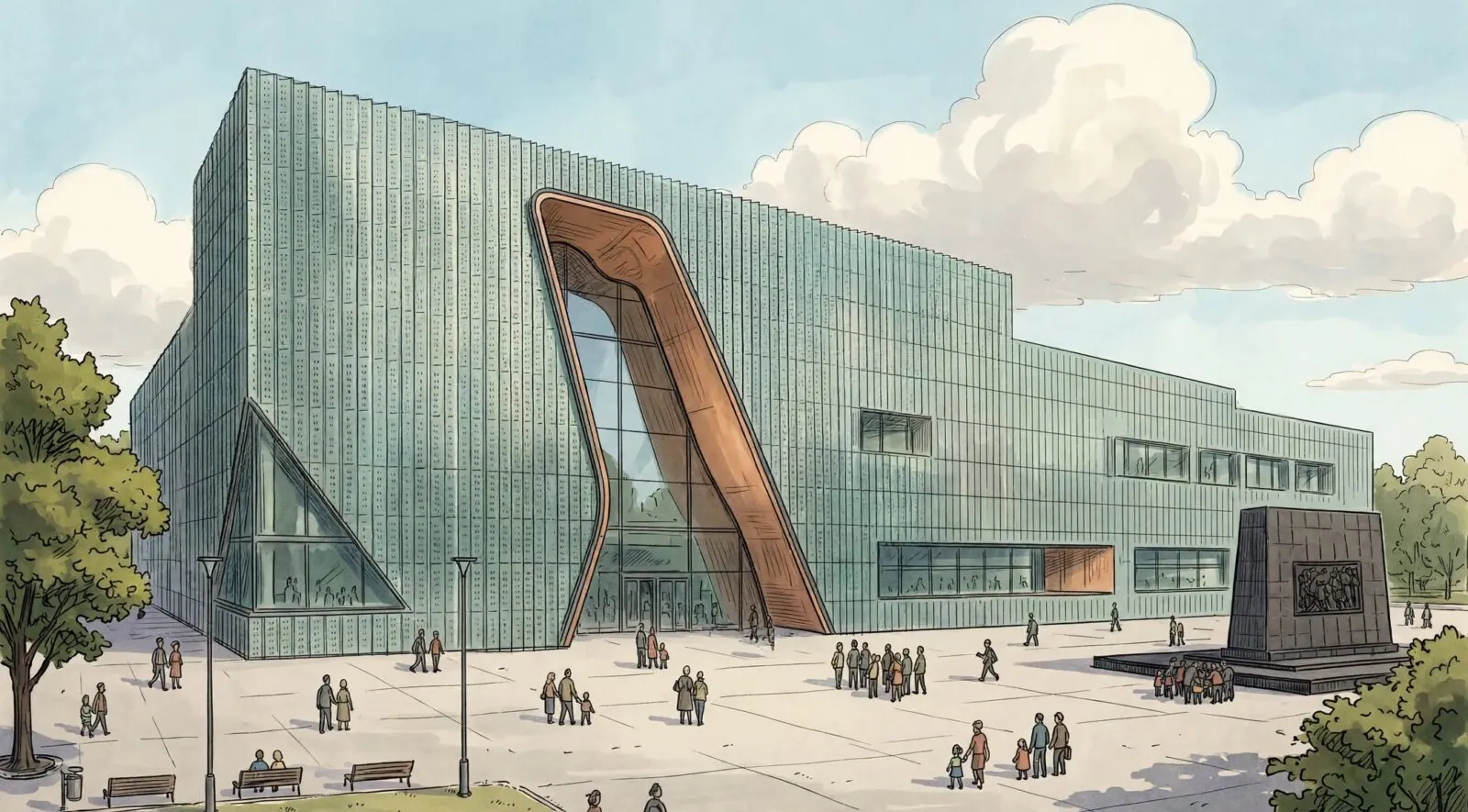
The Museum of the History of Polish Jews, known since 2014 as POLIN, stands on a large open square in the Muranów district of Warsaw, facing the Monument to the Ghetto Heroes.[1][2] Its name is the Hebrew word for Poland, and also the word that, according to a legend recorded in several versions, Jewish refugees heard on arriving in a forest in the east and understood as an instruction to rest there.[3] The building was opened to the public in April 2013, on the seventieth anniversary of the outbreak of the Warsaw ghetto uprising, and its Core Exhibition, a sequence of galleries presenting a thousand years of Jewish life in the Polish lands, opened in October 2014.[4][5]
The museum is unusual in several respects. It was founded as a partnership between the Polish Ministry of Culture, the City of Warsaw and a Jewish non-governmental organisation, the Association of the Jewish Historical Institute of Poland, an arrangement without precedent among Polish cultural institutions.[6][3] It stands in the middle of the former Warsaw ghetto, on ground covered after 1943 by the rubble of the destroyed Jewish quarter, yet it was conceived from the outset as a museum of the life of Polish Jews rather than of their death.[3][7] And from its opening it has been a subject of public argument, about how the history of Jews in Poland ought to be told, about the relation between that history and Polish national memory, and, between 2018 and 2020, about the independence of its director from the government that funded it.[8][9]
This essay describes the setting and history of the site, the origins of the project, the building, the Core Exhibition, the museum’s research and educational work, and the debates that have surrounded it. Where sources disagree on dates or figures, the disagreement is noted. An earlier Nekud essay, How Poland Became Polin, considers the medieval and early modern history to which the first galleries are devoted.
1. The Northern District before 1939
On the eve of the Second World War Warsaw had about 1.3 million inhabitants, of whom more than 350,000, or roughly 30 per cent, were Jews. It was the largest Jewish community in Europe and, after New York, the second largest in the world.[10][11] Jews lived in every part of the city, but the densest concentration was in the so-called Northern District, a band of streets north and north-west of the Saxon Garden that included Muranów, Nalewki, Gęsia, Nowolipki, Zamenhofa and Miła.[11][12]
The quarter had grown largely in the nineteenth century, when Warsaw, then the capital of the Kingdom of Poland under Russian rule, attracted migrants from the small towns of the former Commonwealth and from the Russian Pale of Settlement.[11][13] Its tenements combined dwellings, workshops and warehouses, and Nalewki Street in particular was known for its wholesale trade in textiles, haberdashery and leather goods.[11] The Great Synagogue on Tłomackie Street, completed in 1878 to the design of Leandro Marconi, served the acculturated and Polish-speaking part of the community, while dozens of smaller prayer houses and Hasidic shtiblekh served others.[14][3]
The Northern District was also a centre of Jewish politics, publishing and culture. Warsaw was the seat of the main Yiddish and Hebrew newspapers, of the headquarters of Agudas Yisroel and of many Zionist and socialist organisations, including the General Jewish Labour Bund.[11] The Association of Jewish Writers and Journalists met at 13 Tłomackie Street, and the wider Jewish quarter, which extended south into the streets around Grzybowski Square, was home to figures as different as the Yiddish novelist Isaac Bashevis Singer, who grew up on Krochmalna Street, and the paediatrician and educator Janusz Korczak, whose orphanage stood on the same street.[3]
The interwar years were, for Polish Jews, a time of great cultural vitality and of growing economic and political pressure. The Second Polish Republic guaranteed minority rights in its constitution, and Jewish parties sat in the Sejm, but the 1930s brought economic boycotts, quotas and segregated seating for Jewish students at universities, and episodes of violence.[11] These conditions, and the vitality that coexisted with them, are the subject of one of the museum’s galleries, which reconstructs a street of the period on the line of the prewar Zamenhofa Street, the axis of the Jewish quarter.[3][15]
Almost none of this district survives above ground. The buildings that now stand on the former streets of Muranów were built after the war, and the museum itself occupies a block bounded by today’s Anielewicza, Zamenhofa, Lewartowskiego and Karmelicka streets, near the site of the prewar intersection of Zamenhofa and Gęsia streets.[16][17] That intersection was, in April 1943, the scene of the first fighting of the ghetto uprising.[17][18]
2. Ghetto, deportation and uprising
The German army entered Warsaw at the end of September 1939, after a siege in which large parts of the city were damaged.[10] Within weeks the occupation authorities established a Jewish council under the engineer Adam Czerniaków, and in the following months a series of decrees required Jews to wear armbands, confiscated property, restricted movement and imposed forced labour.[10] In October 1940 the Germans ordered the creation of a ghetto, and on 16 November 1940 it was sealed. Surrounded by a wall about three metres high, it enclosed an area that included most of the Northern District and held, at its peak in 1941, an estimated 400,000 to 460,000 people, many of them deported from towns around Warsaw.[10][3][19]
Conditions inside were deadly. Official food rations were far below subsistence, and between 1940 and the middle of 1942 some 83,000 people died of starvation and disease, according to figures cited by the United States Holocaust Memorial Museum.[10] The ghetto nonetheless sustained an extensive network of welfare committees, house committees, schools held in secret, theatres, concerts and political organisations.[7][19] The historian Emanuel Ringelblum and his collaborators in the clandestine group Oyneg Shabes collected documents, diaries, reports, posters, tickets and artworks recording life in the ghetto and in occupied Poland more widely.[20][21]
Between 22 July and 21 September 1942 the SS and police, with auxiliary units, carried out the mass deportation known as the Grossaktion. Jews were assembled at the Umschlagplatz, a rail siding on Stawki Street at the northern edge of the ghetto, and transported to the killing centre at Treblinka. Estimates of the number deported in these eight weeks range from about 265,000 to more than 300,000; thousands more were killed in the ghetto itself.[10][22][3] Czerniaków took his own life on 23 July rather than cooperate with the deportation quotas.[10] The first part of the Ringelblum Archive was buried in the basement of a school at 68 Nowolipki Street during these weeks.[21]
The roughly 55,000 to 60,000 Jews who remained, many of them in workshops, began to prepare armed resistance. The Jewish Combat Organisation (ŻOB), led by Mordechai Anielewicz, and the Jewish Military Union (ŻZW), associated with the Revisionist Zionist movement, obtained small quantities of weapons from the Polish underground and through purchase.[23][24][25] When German units entered the ghetto in January 1943 to resume deportations, they met armed resistance and withdrew after several days.[10] On 19 April 1943, the eve of Passover, a force under SS General Jürgen Stroop entered the ghetto to complete its liquidation, and was met with gunfire at the intersection of Zamenhofa and Gęsia streets and elsewhere.[25][18]
The organised fighting lasted several weeks, and isolated resistance continued for longer. The Germans set fire to the ghetto block by block. Anielewicz and many fighters died on 8 May in the command bunker at 18 Miła Street.[26][18] On 16 May Stroop marked the end of the operation by blowing up the Great Synagogue on Tłomackie Street, which stood outside the ghetto boundary, and reported that the Jewish quarter of Warsaw no longer existed.[14][27] The surviving inhabitants were deported to Treblinka, Majdanek and labour camps, and in the following months the ruins were systematically demolished.[25][19] Perhaps as many as 20,000 Jews survived for a time in hiding on the so-called Aryan side of the city.[10]
The uprising became, after the war, one of the central events of Jewish memory, and the museum’s location was chosen with it in mind. But the museum’s founders deliberately treated the ghetto as one chapter of a longer history. The guide to the Core Exhibition puts the distinction in a single sentence: at the monument, visitors honour those who perished by remembering how they died; at the museum, by remembering how they and those who came before and after them lived.[3]
3. Rubble and the new Muranów
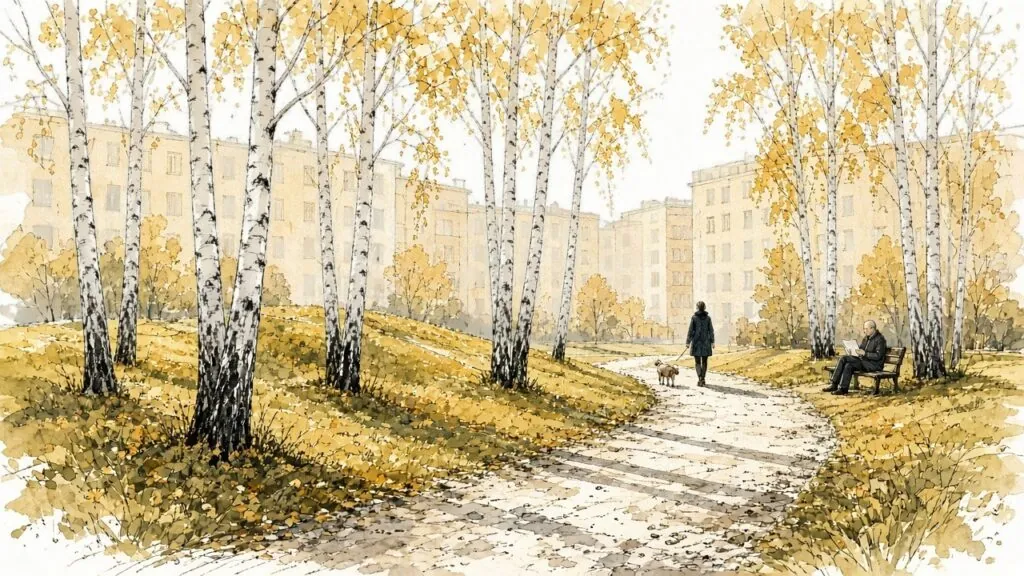
When the Red Army and Polish units entered the left-bank city in January 1945, the area of the former ghetto was a field of rubble. Its destruction in 1943 had been followed by further fighting during the Warsaw Uprising of August to October 1944 and by the German demolition of much of the rest of the city.[28][10] Surveys made after the war described heaps of debris up to three or four metres above the former street level across the Northern District.[12][29]
The planners of the reconstruction debated what to do with the site. The architect Bohdan Lachert, a leading figure of interwar Polish modernism, was commissioned in 1948 by the state Workers’ Housing Estates authority to design a residential district there.[29][30] In an interview in September 1948 he proposed that the rubble should not be removed but used as the foundation of the new district, so that the ruins would remain as a spatial sign of memory beneath it.[12] The plan accepted in December 1948 placed blocks of flats on terraces of rubble about two metres high, with slopes down to the surrounding streets that are still visible today, and the rubble was also crushed and cast into blocks for the walls.[12][30]
Lachert initially intended the buildings to be left unplastered, so that the red surface of the rubble-concrete would express what he called, according to the historian who has studied his writings, the blood of the destroyed city, and he compared the new district to a phoenix rising from ashes.[12] The adoption of socialist realism as official doctrine in 1949 led to revisions: the plan was given a more axial character, facades were plastered and decorated, and sculptural details were added under the direction of Franciszek Strynkiewicz.[12][29] South Muranów was built between 1949 and 1956 for about 40,000 residents. Its streets partly follow the lines of the prewar streets, reconstructed from the surviving underground utilities, and the estate has since been entered in the register of historic monuments as a memorial district of the Holocaust as well as a work of postwar architecture.[29][30]
The postwar Jewish community was small and was concentrated, institutionally, around the few surviving buildings of the prewar community. The Central Jewish Historical Commission, founded in Lublin in 1944, moved to Warsaw and was reorganised in 1947 as the Jewish Historical Institute, housed in the former Main Judaic Library on Tłomackie Street, next to the site of the destroyed Great Synagogue.[31][32] In September 1946 a group including the Oyneg Shabes survivor Hersz Wasser recovered the first part of the Ringelblum Archive from the ruins of 68 Nowolipki Street, and a second part was found there during construction work in 1950. The third part has never been found. The recovered documents went to the Jewish Historical Institute, where they remain.[21][33]
Several of the open spaces of the new Muranów were left where buildings of the ghetto had stood. The largest of them, between Zamenhofa, Anielewicza, Lewartowskiego and Karmelicka streets, was the site of the Monument to the Ghetto Heroes and, sixty years later, of the museum.[16][34] Kirshenblatt-Gimblett has stressed that the museum is built on the rubble of the ghetto and of the prewar Jewish neighbourhood.[35]
4. Rapoport’s monument and the square
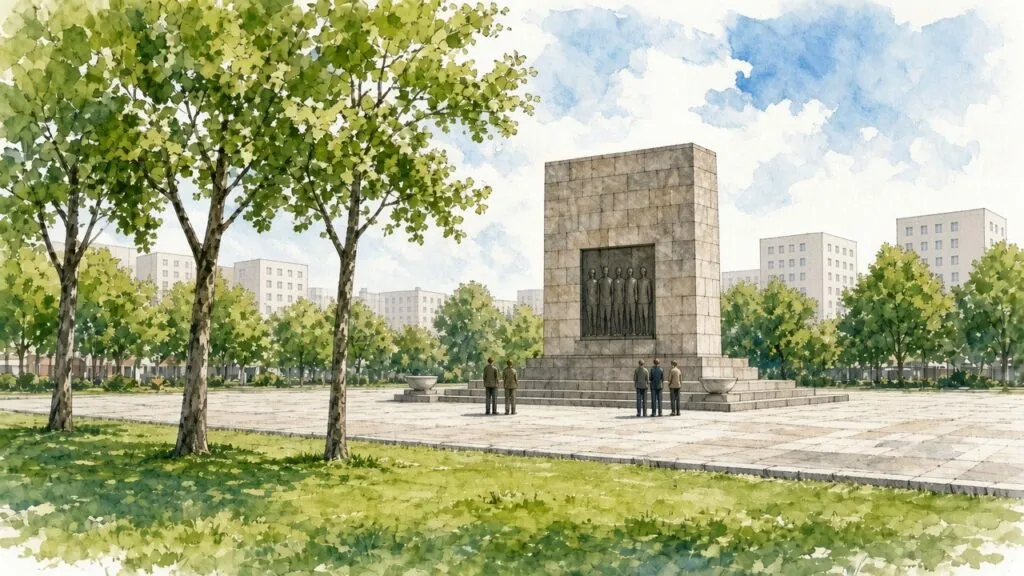
The first memorial on the site was a modest one. On 16 April 1946, shortly before the third anniversary of the uprising, a round plaque designed by the architect Leon Marek Suzin was unveiled near the place where the fighting had begun. It bore an inscription in Polish, Hebrew and Yiddish and a palm branch, and it still stands at the edge of the square.[34]
The large monument that followed was the work of the sculptor Nathan Rapoport, who was born in Warsaw in 1911, studied there and in Italy and France, and spent the war years in the Soviet Union.[36][34] Rapoport worked on models from 1943 onwards, and his design, executed with Suzin as architect, consists of a tall wall of stone, trapezoidal in plan, set on a platform built partly over the rubble of the ghetto.[34] The western face carries a bronze group of fighters, men and women with weapons, with a central figure commonly identified with Mordechai Anielewicz; the eastern face carries a low relief in stone of a column of Jews, including the old and children, walking under the guard of German helmets and bayonets towards death.[34]
The monument was unveiled in April 1948, on the fifth anniversary of the uprising, at a time when the surrounding streets were still ruins.[34][3] It was one of the first major Holocaust memorials in Europe, and it presented the uprising primarily as armed resistance rather than as martyrdom, a choice that fitted both Jewish and communist conceptions of the event while also, according to later critics, simplifying it.[34] Rapoport’s later works included a statue of Anielewicz at Kibbutz Yad Mordechai in Israel.[36][26]
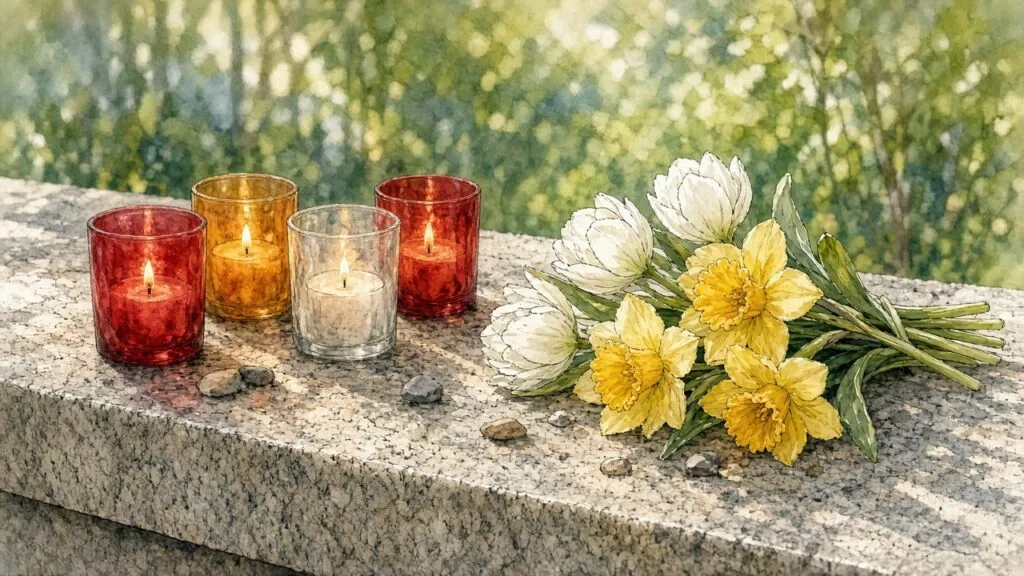
In the decades that followed, the square became a principal site of state and community commemoration. The most widely remembered moment came on 7 December 1970, when the West German chancellor Willy Brandt, in Warsaw to sign a treaty normalising relations between the two states, knelt in silence before the monument.[37] In the late communist period the anniversary of the uprising became also an occasion for unofficial commemoration. Marek Edelman, the last surviving commander of the ŻOB who remained in Poland, came each year on 19 April to lay yellow flowers, often daffodils, at the monument, a gesture that the museum later adopted for its annual educational campaign.[38][5]
In 1988, on the forty-fifth anniversary, a memorial route was laid out from the monument to the Umschlagplatz, marked by blocks of stone dedicated to individuals and events of the ghetto’s history, and a monument was erected at the Umschlagplatz itself, with stone walls inscribed with Jewish first names.[39] A mound at Miła Street marks the site of the ŻOB command bunker.[26] The museum, set on the western side of the square, thus completed a memorial complex that had grown over four decades, a relationship stated explicitly in its guide to the Core Exhibition.[3]
5. The idea of a museum, 1993–1996
The project began in the years immediately after the end of communist rule in 1989, a period in which Jewish subjects that had been marginalised or politically constrained under the Polish People’s Republic became objects of renewed public, scholarly and artistic interest.[35][40] According to the museum’s account of its own history, the idea was proposed in 1993 by Grażyna Pawlak, organisation and information director of the Jewish Historical Institute, who on her return from the opening of the United States Holocaust Memorial Museum in Washington suggested that the Association of the Institute create a museum about life that would present the history of Jews in Poland.[41] The museum’s guide to its Core Exhibition likewise dates the idea to 1993; other accounts, including a profile published by the Adam Mickiewicz Institute, give 1995 as the year in which the concept was formulated.[3][4]
The proposal was taken up by the Association of the Jewish Historical Institute of Poland, a non-governmental body associated with the Institute, and an honorary committee was formed whose co-chairs, according to the museum, were the former President of Israel, Chaim Herzog, and the American businessman and philanthropist Ronald S. Lauder.[41] In 1994 the organisers began working with Yeshayahu Weinberg, who had been the founding director of the Diaspora Museum in Tel Aviv and of the Holocaust museum in Washington and who convened an international working group to plan the new museum, and in 1996 the Association’s board appointed a project team chaired by Weinberg, with Jerzy Halbersztadt as project director; the Lauder foundation provided the first funds for its work.[41][42]
From the beginning the founders described the project as the history of a community that had lived in the Polish lands for a millennium and had numbered, on the eve of the Second World War, more than three million people, roughly a tenth of the population of Poland.[3][43]
The site was secured early. On 17 April 1997 the Mayor of Warsaw, Marcin Święcicki, granted the Association perpetual use of a plot of about 13,000 square metres on the square opposite the Monument to the Ghetto Heroes, and archaeological work on the site followed.[41]
6. A museum of life, 1996–2004
The organisers faced an unusual problem. Most of the material culture of Polish Jewry had been destroyed or dispersed during the war, and the most important collections that survived, such as those of the Jewish Historical Institute, already belonged to other institutions.[35][31] Barbara Kirshenblatt-Gimblett, who later directed the Core Exhibition, has described the museum as having been founded not on a collection of objects but on their absence; by its tenth anniversary it had assembled a collection of more than 17,000 objects by its own count, or more than 19,000 by hers.[35][5]
The answer adopted in 1998, according to the museum’s chronology, was a narrative museum, “a museum in which the point of departure would be a story rather than a collection“, in which the story would be told through reconstructed settings, texts, images, multimedia and quotations from contemporary sources, and in which original objects would be one element among several rather than the organising principle.[41][3] In 1999 a Museum Council was established under the chairmanship of Marian Turski, then chairman of the board of the Association and a historian, journalist and survivor of the Łódź ghetto and Auschwitz, who still presided over it a quarter of a century later.[41][44][35] In the same year the London firm Event Communications was selected to develop the exhibition design, work on which began in 2001.[41]
In 2002 Kirshenblatt-Gimblett, a folklorist and performance studies scholar at New York University, joined the project as a consultant, and she later became programme director of the Core Exhibition.[41][45] In 2003, according to the museum’s account, the Polish government committed itself to funding the construction of a building, the condition for the next stage of the project.[41]
The guiding conception that emerged in these years is summarised in the phrase “a museum of life“, used by the museum and widely repeated in coverage of the opening.[35][46] The Holocaust was to be presented in its chronological place, as one gallery in a sequence of eight, rather than as the culmination towards which the whole story led.[35][3] The decision was not without critics, as later chapters describe, but it determined the shape of the exhibition and the character of the institution.
7. The partnership of 2005
The legal form of the museum was settled on 25 January 2005, when an agreement was signed by the Minister of Culture, Waldemar Dąbrowski, the Mayor of Warsaw, Lech Kaczyński, and, for the Association of the Jewish Historical Institute, its vice-chairman, the historian Jerzy Tomaszewski. The agreement was concluded on the initiative of Kaczyński, and Jerzy Halbersztadt, the project director, became the museum’s first director.[41][6] The museum became a joint cultural institution of the three partners, described by the museum as the first Polish cultural institution created as a public-private partnership.[3][6]
The division of responsibilities was set out in the agreement and has been summarised in the same way in the museum’s publications since. The public partners, the ministry and the city, financed the construction of the building and undertook to cover most of the museum’s operating budget. The Association was responsible for creating and producing the Core Exhibition and for raising the money for it from donors in Poland and abroad.[3][6] The arrangement gave the private donors, many of them American and many of Polish-Jewish descent, a substantial role in the project, and it later became a point of contention when the ministry and the donors disagreed over the directorship.[8][47]
The scale of the funding has been reported in different ways. The Adam Mickiewicz Institute gave a total cost of about 330 million złoty, of which some 200 million came from public sources and 130 million from private ones.[4] Reporting at the tenth anniversary put the combined public and private investment at more than 100 million dollars over twenty years.[35] Among the private donors named in the museum’s and the press’s accounts are Taube Philanthropies and the Koret Foundation of San Francisco, the Conference on Jewish Material Claims against Germany, which provided major funding for the Holocaust gallery, and Irene Pletka, who funded the reconstruction of the Gwoździec synagogue ceiling.[48][49][50] Funds from the European Economic Area grants later supported the museum’s programmes for Jewish heritage in Poland.[51]
The agreement was made by a centre-left national government and a mayor from the conservative Law and Justice party, and participants have described Kaczyński as one of the project’s most consistent supporters, a cross-party origin later invoked by both sides in the dispute of 2018 to 2020.[52][8]
8. The architectural competition
The international architectural competition for the building was held in 2005, with participants for the second stage selected on the basis of expressions of interest. According to the museum, 119 entries were submitted in the first stage; the Adam Mickiewicz Institute, counting differently, refers to some 250 projects by more than a hundred architects from 36 countries.[41][4][42] The jury was chaired by the Polish architect Bohdan Paczowski, and its international members included the historian of architecture Kenneth Frampton.[41][42] Eleven teams were invited to the final stage, among them Studio Daniel Libeskind, whose Jewish Museum in Berlin had opened a few years earlier, Kengo Kuma and Associates, Zvi Hecker, Peter Eisenman and David Chipperfield.[42]
The winner was the Helsinki practice Lahdelma & Mahlamäki, with a design led by Rainer Mahlamäki and Ilmari Lahdelma and submitted under the name Yam Suf, the Hebrew name of the sea that the Israelites crossed in the Book of Exodus, usually translated as the Sea of Reeds.[53][42] Sources differ on the date of the decision. The architects’ account, reproduced by Dezeen, and the museum’s chronology place it in 2005, while another page of the museum’s website dates the announcement to 30 June 2006.[42][41][16] The contract with the architects was signed on 9 September 2006, and the Warsaw practice Kuryłowicz & Associates acted as the Polish partner.[41][54]
The jury’s statement, as quoted by the museum, noted that the undulating space of the hall had been compared by its creators to the parting of the Red Sea, the yam suf, which it read as a passage along the long path of Polish-Jewish history towards a peaceful future.[41] It praised the concept as realised “without unnecessary rhetoric, with simplicity and elegance“, in the words quoted by the architects.[53][42] The competition brief had included the plan of the Core Exhibition and the division of its galleries, so that the design of the building was shaped from the start by the requirements of a narrative exhibition intended, in the architects’ summary of the brief, to make use of reconstruction, moving pictures and constructed settings and only to a minor extent of historical objects.[42]
While the design was being developed, the museum made its presence felt on the site. A second competition, organised with the Bęc Zmiana Foundation, sought designs for an information pavilion on the construction site; from 29 entries a jury chaired by the curator Anda Rottenberg chose, on 1 June 2006, the Warsaw studio Centrala. The resulting pavilion, the Ohel or tent, a light blue open structure whose shape anticipated the walls of the main hall, opened in November 2006 and housed artistic, cultural and informational events.[41] Drawings for the building permit were handed to the City of Warsaw in the spring of 2008, and on 25 June 2008 the city’s development board put the construction out to tender.[42][41]
9. Glass, copper and the ravine
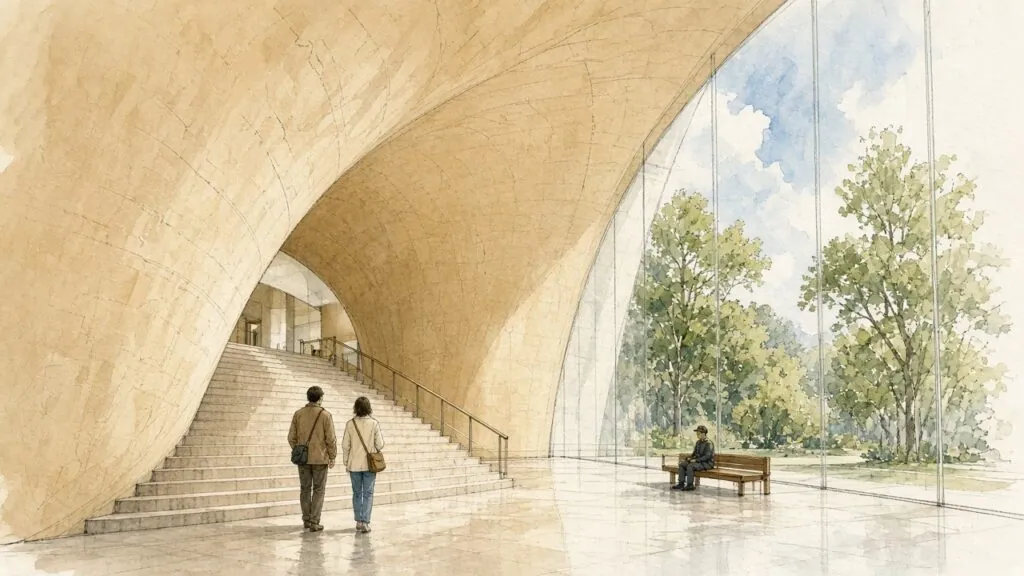
The building is a compact, nearly square block set in the park that occupies the former ghetto square, a park since named after Willy Brandt.[42][53] Its outer skin is a double facade of laminated glass panels and pre-treated, perforated copper panels. From a distance the staggered panels blend into the surroundings and break up reflections; at closer range the glass reveals clusters of letters spelling Polin in Latin and Hebrew characters, a lettering design that Dezeen attributes to the artist Klementyna Jankiewicz.[53][42][4] The architects described the aim as creating “a certain silence” around the building, which they called a monument rather than a landmark.[53]
That restraint is broken by a single opening. The main entrance, on the side of the building facing the monument, leads into the main hall, a gorge that cuts through the building from east to west. Its walls curve in bulbous, double-curved forms from the travertine floor to the ceiling, and a large glass wall at the opposite end opens the hall towards the park.[42][53] The walls are load-bearing structures of steel sprayed with concrete, about 60 centimetres thick, designed with the help of software written for the project by Markus Wikar of the architects’ office. Mahlamäki has said that, to his knowledge, the hall is the largest uniform double-curved surface yet built.[42][53]
The architects’ own descriptions allow several readings of the hall. They have linked it to the parting of the sea named in the competition entry and to the cracks or ruptures in the history of Polish Jews, while emphasising that the form is meant only to suggest such meanings and to leave visitors free to attach their own.[53][42] A bridge crosses it at first-floor level, and the guide to the Core Exhibition invites visitors to look down from it before they descend into the exhibition.[3]
The Core Exhibition occupies the lower level beneath the main hall. Its area is given in different sources as about four thousand square metres and as almost five thousand, depending on what is counted.[42][16][1] The upper floors contain temporary exhibition halls, an education centre, a library, offices, conservation workshops and storage, and an auditorium described by the museum as seating about 450 and by the architects as seating 500.[53][16]
The building has received a number of awards, which the museum lists on its website. They include an International Architecture Award of the Chicago Athenaeum for the design in 2008; the shotcrete award of 2013 for the contractor of the curved walls; the Finlandia Prize for Architecture of the Finnish Association of Architects in 2014; a place among the shortlisted works for the European Union’s Mies van der Rohe award in 2015; and the Architectural Award of the Mayor of Warsaw in 2016 for the best public building completed in the city between 2001 and 2014.[16][55][53]
10. Construction and the opening of 2013
The dates of the early construction milestones are reported inconsistently, even on the museum’s own website. Its chronology records that the foundation stone was laid on 26 June 2007 in the presence of President Lech Kaczyński, who said that the museum was a great opportunity to end a mutual lack of knowledge and to deepen reconciliation, and that the inscription on the stone placed it at the intersection of the old Gęsia and Zamenhofa streets. The page on the building and the architects’ description published by Dezeen instead date the foundation-stone ceremony to June 2009, the month in which, according to the chronology, construction began on 30 June after a tender won by Polimex-Mostostal.[41][16][42][53] The sources do not explain the discrepancy.
The shell of the building was completed in 2012, and the museum opened its doors on 19 April 2013, on the seventieth anniversary of the outbreak of the ghetto uprising.[42][4] The new building, still without its Core Exhibition, began a programme of temporary exhibitions, concerts, lectures and educational activities.[4][5]
The Core Exhibition, meanwhile, was being installed in the space beneath the main hall. The exhibition design had passed through two phases. Event Communications of London, selected in 1999, developed the original design and the detailed documentation of the exhibition’s concept, after which its work ended; Nizio Design International of Warsaw, led by Mirosław Nizio, was then chosen to finish the project and produce the exhibition on the basis of that concept.[41][53][56] Some elements were produced by specialist workshops and volunteers outside the museum, the most elaborate of them being the roof and painted ceiling of the Gwoździec synagogue, which was assembled in the exhibition space early in 2013.[41][57]
The opening of the building was accompanied by a choice that took some time to settle: the museum’s name. The institution had been known since the 1990s as the Museum of the History of Polish Jews, and in 2014 it adopted the short name POLIN, which it has used since alongside the full name.[4][1] The choice connected the institution to the legend displayed at the start of its exhibition.[3][35]
The leadership of the museum changed at the same time. Jerzy Halbersztadt, its first director, had led the institution through the years of the competition and construction until 2011.[41] In 2014 the historian Dariusz Stola of the Polish Academy of Sciences, a specialist in the history of emigration and of the communist period, was appointed director; some later reporting describes him as the museum’s first director, counting from the opening of the Core Exhibition.[35][8][58]
11. Making the Core Exhibition
The academic team of the Core Exhibition worked from 2006 to 2014 under the direction of Barbara Kirshenblatt-Gimblett, professor at New York University.[45] The team included, among others, Helena Datner, Barbara Engelking, Samuel D. Kassow, Igor Kąkolewski, Stanisław Krajewski, Jacek Leociak, Adam Teller, Marcin Wodziński, Hanna Zaremska, David Assaf, Havi Dreifuss, Jakub Petelewicz and Michael Steinlauf. Antony Polonsky of Brandeis University and Marcin Wodziński of the University of Wrocław served as chief historians.[45][17] Polonsky, the founding editor of the yearbook POLIN: Studies in Polish Jewry, described his appointment as the culmination of more than 35 years of work on the history of Jews in Poland.[17]
The exhibition the team produced is a sequence of eight galleries, which the museum’s guide describes as a journey through a “theater of history” in which the story unfolds in acts and scenes as the visitor walks.[3] Visitors encounter the words of people who lived in each period, quoted throughout, and enter reconstructed settings: a salon, a tavern, a home, a church, a synagogue, a schoolroom. Drawers can be opened, screens touched, and objects, photographs, documents and films examined.[3] The guide recommends allowing two to three hours for the whole and advises adults accompanying children under twelve to consider whether the children should visit the Holocaust gallery.[3]
The guide also states the exhibition’s central claims in plain terms. The history of Polish Jews is presented as an integral part of the history of Poland, and the history of Poland as incomplete without it. The story is described as one “of cooperation and competition, coexistence and conflict, separation and integration“.[3] This formulation, which seeks to avoid both a narrative of uninterrupted persecution and one of harmonious coexistence, was the subject of much of the subsequent debate about the exhibition.[9][59]
The Core Exhibition opened on 28 October 2014. The ceremony was attended by the President of Poland, Bronisław Komorowski, the President of Israel, Reuven Rivlin, and the Polish Prime Minister, Ewa Kopacz, and the exhibition was formally opened by Marian Turski together with a thirteen-year-old schoolgirl, Joasia Widła. More than 1,500 guests attended. “We are here!” Turski said in his speech. “That is the message: We are here!“[60][46] For the following three days, entry to the exhibition was free, and the museum ran a programme of curators’ talks, film screenings, family workshops, concerts and lectures, including one by Polonsky on the challenges faced by the creators of the exhibition.[56]
International coverage presented the opening as a sign of hope at a time of growing antisemitism in Europe.[46][61][62] In May 2015 the museum and the Jewish Historical Institute held an international conference, “From Ibrahim ibn Yakub to 6 Anielewicz Street“, to introduce the exhibition to scholars and review the state of research on the history of Jews in the Polish lands.[45]
12. The Forest and the first encounters
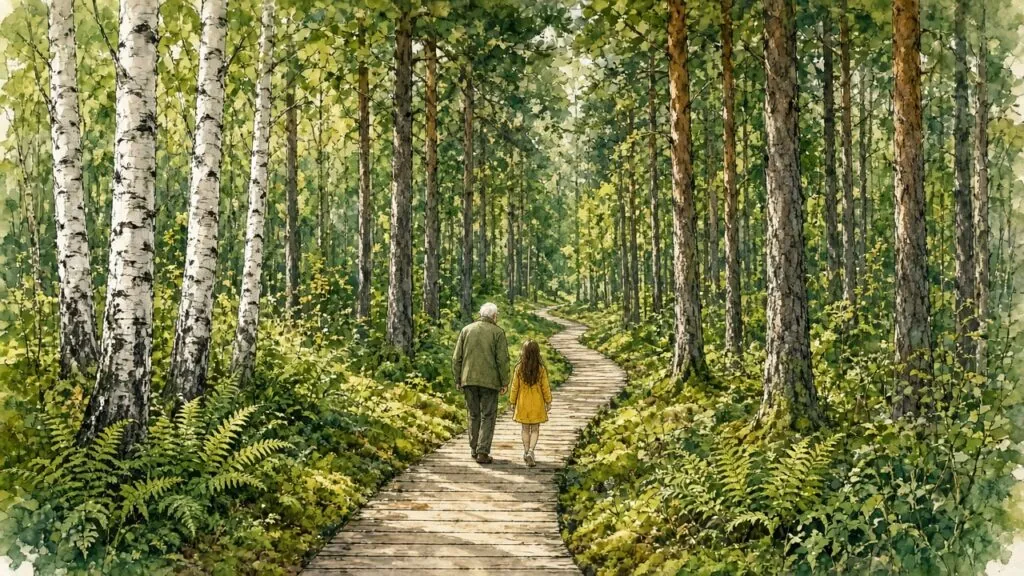
The exhibition begins below the main hall. Visitors descend a staircase into a space called the Forest, the setting for the legend of Polin. According to the version told in the guide, Jews fleeing persecution came east, and on arriving in a forest heard the word Polin, which sounded in Hebrew like “rest here“, and knew that this was where they should settle.[3] In other versions of the legend the words are spoken by birds or are found written on the trees; the story was recorded in Yiddish and Hebrew literature of the nineteenth and twentieth centuries, and the museum presents it explicitly as a legend rather than as history.[35][3][63]
The first historical gallery, First Encounters, covers the years from about 960 to 1500, the first six centuries of the story.[3][63] It begins with Ibrahim ibn Yaqub, a Jewish traveller from Córdoba sent on a diplomatic mission across Europe around 960, whose account in Arabic contains one of the earliest descriptions of the land of Mieszko, as the Polish state was then known.[3][64] The first Jews in the Polish lands, the gallery explains, were travelling merchants from western and southern Europe, using trade routes that ran through the region.[3]
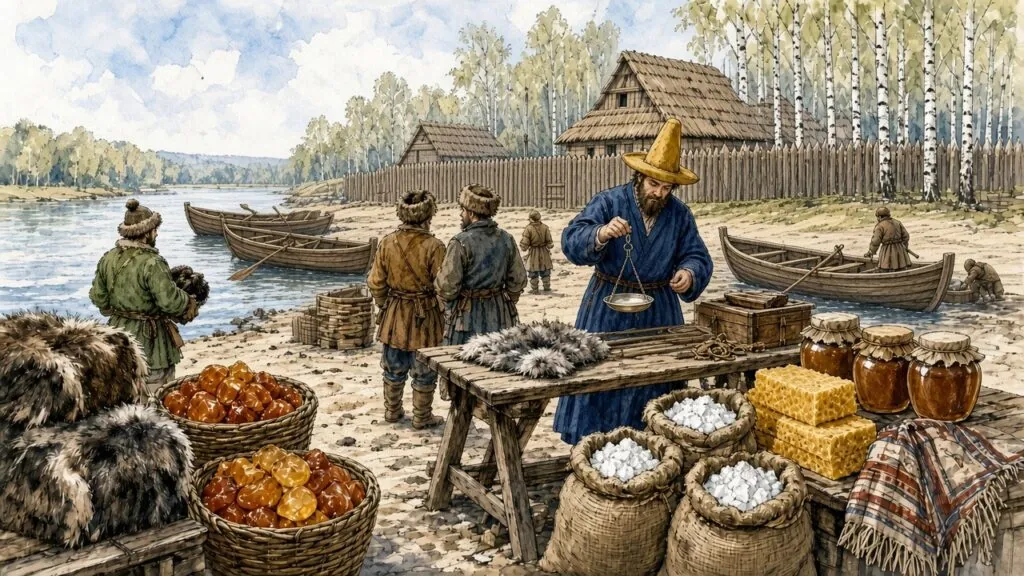
A central document of the gallery is the Statute of Kalisz, the charter proclaimed in 1264 by Bolesław the Pious, Duke of Greater Poland, which gave Jews permission to settle, to follow their religion and to engage in various occupations, guaranteed their protection from harm and even allowed them a role in the minting of coins.[3][65] Near it is displayed a coin with Hebrew letters minted in Poland in the early thirteenth century, a bracteate described by the museum as the oldest object in its collection.[3] The gallery also presents the oldest known Jewish tombstone in Poland, dated 1203, through a rubbing that visitors can make on a touch screen.[3]
The rest of the gallery describes the settlement of Jews in towns, through a hand-painted wall showing how Jewish streets were included in town plans, and the relations of Jews with rulers, through a wall tracing how successive rulers confirmed the statute in their domains.[3] It includes the legend that King Kazimierz the Great favoured the Jews out of love for a Jewish woman named Esther, and the story of the Fiszel family, bankers and physicians to the royal court.[3] By 1500, according to the gallery, Jews lived in more than a hundred places in the Polish lands, about half of them with organised communities.[3][66]
13. Paradisus Iudaeorum
The third gallery takes its name from a Latin phrase, “paradise of the Jews“. Its earliest documented use is in an anonymous satirical text of the early seventeenth century, which opened with the line “Regnum Polonorum est paradisus Judaeorum” and contrasted the condition of Jews with that of peasants, townsmen and nobles; the phrase later passed into a proverb describing the Commonwealth as heaven for the nobility, purgatory for townsmen, hell for peasants and paradise for Jews.[67] The phrase was hostile in origin, and the museum’s use of it is in part ironic. The gallery covers the period from the Union of Lublin in 1569 to the outbreak of the Khmelnytsky uprising in 1648, when the Polish-Lithuanian Commonwealth became home to the largest Jewish community in the world.[3][68]
The gallery asks what made the period a golden age for the Jews of the Commonwealth, and answers in terms of autonomy, scholarship and economic opportunity. The Commonwealth, the guide notes, was one of the largest, most diverse and most tolerant countries in Europe of the time, and was spared the religious wars of the West, although there were incidents of anti-Jewish violence.[3] Jewish communities governed themselves locally, regionally and, through the Council of Four Lands, at a national level. Representatives of the communities of Greater Poland, Lesser Poland, Red Ruthenia and Volhynia began to meet regularly in the sixteenth century, and the Council became a body that settled disputes and passed ordinances for Jewish communities across the kingdom until its abolition by the Sejm in 1764.[3][69]
Several sections are devoted to Kraków and its Jewish town of Kazimierz. An interactive model of the two towns allows visitors to explore their streets, and a presentation of the yeshiva of Rabbi Moses Isserles, known as the Remu, introduces his glosses to the Shulchan Arukh, the code of Jewish law, which adapted it to the customs of Polish Jews.[68][3] Kraków and Lublin became major centres of Hebrew printing in the sixteenth century, and the gallery displays an original book printed in Poland four hundred years ago and allows visitors to print a title page on a reconstructed hand press.[3][68]
The economic story is told through the private town of Zamość, founded by the chancellor Jan Zamoyski. Like other great landowners, Zamoyski invited Jews to settle in his town and contracted them to manage the assets of his estates, including mills, forests, fisheries, salt mines and taxes, and the gallery displays the contracts he signed with one of his Jewish managers.[3]
A map at the end of the gallery shows almost 1,200 towns in which Jews were living at the time of the census of 1764 and 1765, when the Commonwealth had about 750,000 Jewish inhabitants, compared with at most 30,000 around 1500.[3] The gallery closes with the Khmelnytsky uprising of 1648, in which Cossack and peasant forces killed large numbers of Jews in the Ukrainian lands of the Commonwealth, and with the wars of the following decades, which, the guide notes, left the Commonwealth in ruins.[3][70] Estimates of the Jewish dead in 1648 and 1649 vary widely, and older figures in the tens or hundreds of thousands have been substantially revised downwards by modern historians.[70]
14. The Jewish Town and the Gwoździec ceiling
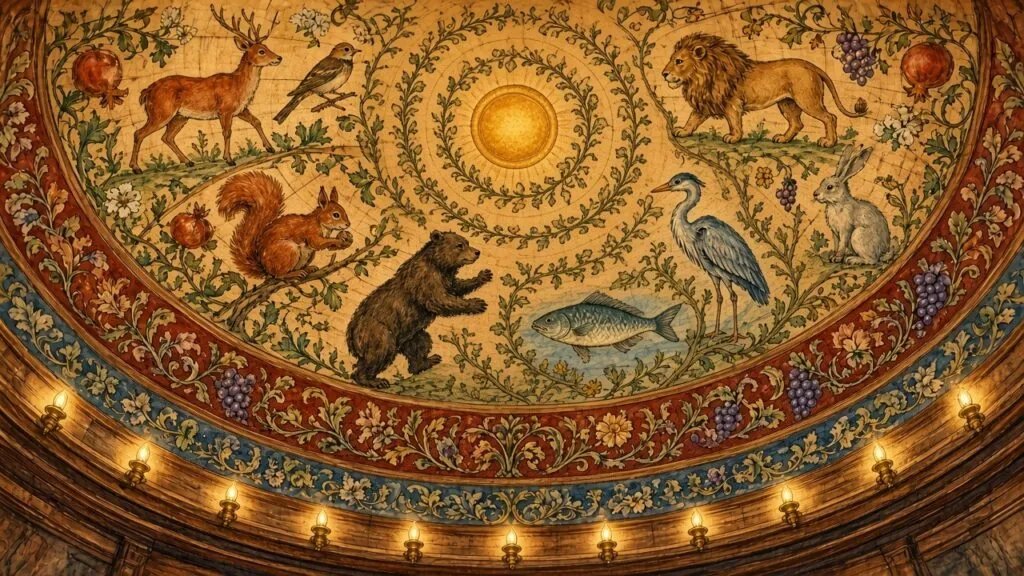
The fourth gallery, The Jewish Town, covers the period from 1648 to the first partition of 1772. It presents daily life in the small towns in which Jews formed a large proportion and sometimes a majority of the population and developed a distinctive way of life, and the everyday interactions of Jews and their neighbours in the marketplace and the tavern.[3] Visitors enter a Jewish home, often a single room in which a family slept, ate and worked, where amulets to protect a mother and newborn hang near the bed, a mezuzah case is fixed to the doorframe, and Yiddish books for women, some of them written by women, are shown with an animated film about women’s religious obligations and lives.[3]
A section on the Church considers the changing relations between the Catholic Church and Jews and the contradictions between Church policy and practice. It shows a document listing the church institutions that lent money to Jews despite warnings not to do so, and paintings illustrating a blood libel accusation, although popes had declared such accusations false.[3] A series of animated films presents the new spiritual leaders of the eighteenth century, a period of messianic yearning and of crisis in rabbinical and communal authority: Yisrael ben Eliezer, the Ba’al Shem Tov, later claimed as the founder of Hasidism; Eliyahu ben Shlomo Zalman, the Gaon of Vilna; and Mendel Lefin of the Jewish Enlightenment. Another film tells the story of Jacob Frank, the messianic claimant who converted to Catholicism with about 3,000 of his followers.[3][71][72]
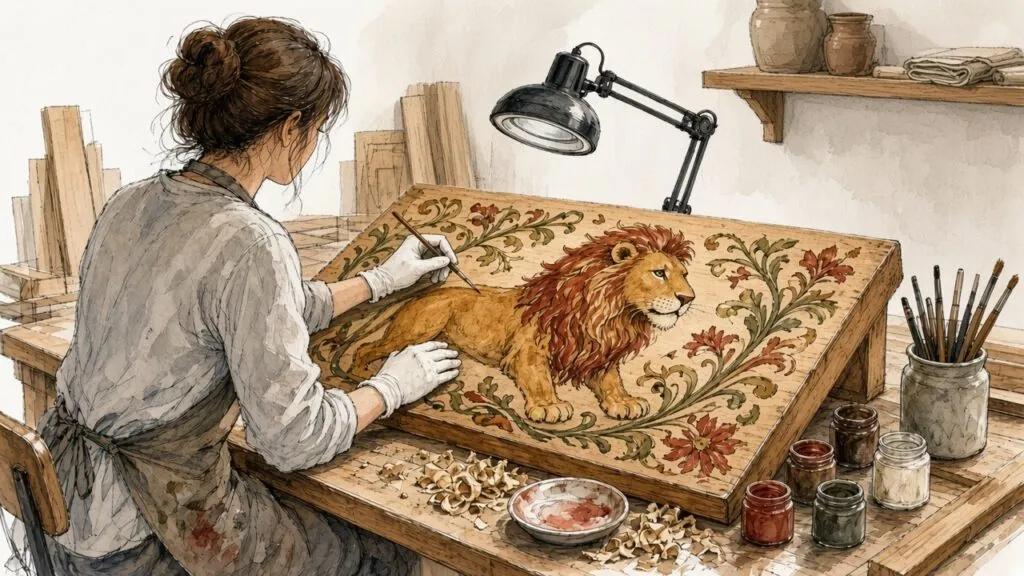
The centre of the gallery is the synagogue. Visitors stand beneath a reconstruction of the roof and painted ceiling of the wooden synagogue of Gwoździec, a town then in the Polish Commonwealth and now Hvizdets in western Ukraine.[3][73] The synagogue was one of the most elaborate of the wooden synagogues of the Commonwealth, whose painted interiors with high cupolas have been studied mainly through drawings, paintings and photographs made before their destruction.[74] According to the museum’s guide, it was built in the mid-seventeenth century and the renovation of its paintings was completed in 1729; other accounts date the paintings to the 1720s and 1730s.[3][73] The building was burned during the First World War, and what remained was destroyed in the Second; accounts differ on the circumstances.[73][74]
The reconstruction was the work of Handshouse Studio, an American educational organisation founded by Rick and Laura Brown, in partnership with the Association of the Jewish Historical Institute and the museum.[50][57] The Browns had begun to work on the wooden synagogues with students in 2004, making models of the exterior of the Zabłudów synagogue, painted panels from Gwoździec and a full-size replica of its bimah, and in 2007 they were invited by Kirshenblatt-Gimblett to discuss a reconstruction for the Core Exhibition.[75] From 2011 an international team built the roof structure using traditional tools and techniques and painted the ceiling in a series of workshops held in historic synagogues in several Polish towns.[50][76]
The number of participants is given in different sources as 296, more than 300 and almost 400.[50][76][3] The painters worked from seventeen photographs of the ceiling, a colour study of part of one panel made before its destruction, and architectural drawings of the building, and translated them onto 32 curved and flat panels.[75] The reconstruction is described by Handshouse as nearly full-scale.[74] Its imagery includes the signs of the zodiac around the base of the cupola and the messianic animals of the middle band, among them the Leviathan, the Behemoth depicted as a red ox and unicorns.[3] The project was funded by Irene Pletka and documented in the film Raise the Roof.[50][76]
15. Modernity and the Jewish street
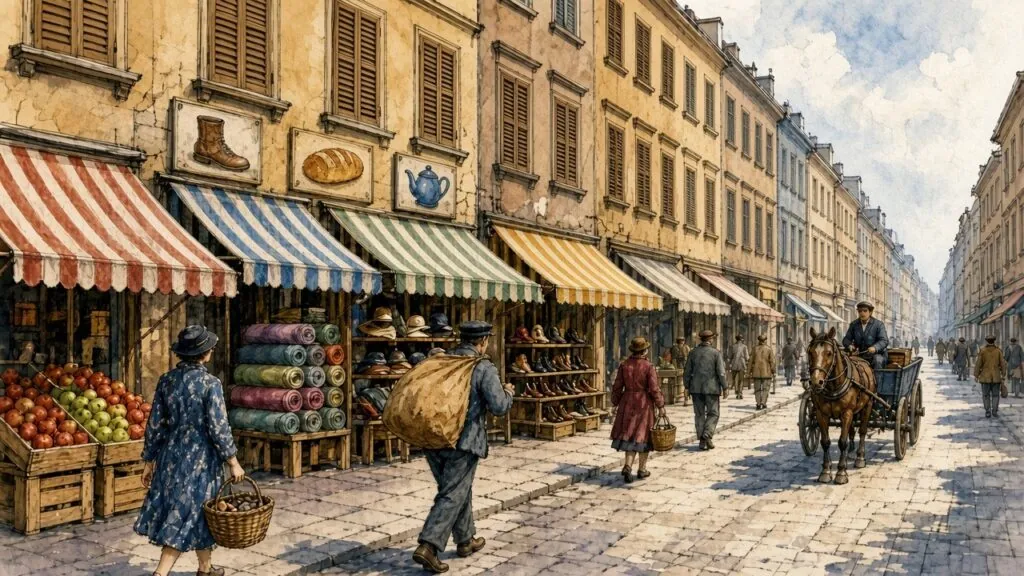
The fifth gallery, Encounters with Modernity, covers the period from the first partition of the Commonwealth in 1772 to the outbreak of the First World War. Between 1772 and 1795 Russia, Prussia and Austria divided the Commonwealth among themselves and inherited its large Jewish population. Jews became individual subjects of the monarchs, whose laws regulated their lives in increasing detail.[3][13] The portraits of the three monarchs look down on the empty throne of the last king of Poland, and screens invite visitors to discover whether they would have qualified to live in each of the three empires; the population figures show that after the partitions the Jewish population of the Russian Empire rose from about 50,000 to about 610,000.[3]
The gallery follows the main movements of the nineteenth century: the Jewish Enlightenment, represented by the scientist and journalist Hayim Selig Słonimski; the modern yeshiva, represented by Volozhin; and Hasidism, represented by its melodies at the table of a shtibl.[3][72][71] It shows the integrationists who regarded themselves as Poles of the Mosaic faith and built the Great Synagogue on Tłomackie Street, of which a scale model is displayed, accompanied by recordings of its cantor Gershon Sirota.[3][14] At its centre is a reconstructed railway station, with a panoramic painting of the building of the railway, the growth of industry and the rise of the metropolis, a symbol of the migration of Jews to the cities and of the creation of a wealthy entrepreneurial class and a poor proletariat.[3] About a third of the Jewish population left between 1880 and 1914, more than 85 per cent of them for the United States.[3]
The sixth gallery, On the Jewish Street, is devoted to the Second Polish Republic of 1918 to 1939, a period that some historians have called a second golden age for Polish Jews despite economic hardship and rising antisemitism.[3][15] Its title translates a Yiddish expression for the Jewish world and its affairs. The gallery takes the form of a multimedia street laid out on the exact line of the prewar Zamenhofa Street, from which doorways lead into rooms on politics and culture.[3][15] One room recreates 13 Tłomackie Street, the seat of the Association of Jewish Writers and Journalists, and another the Mała Ziemiańska café, where Polish writers of Jewish origin such as Julian Tuwim and Antoni Słonimski gathered.[3]
The politics section presents the three main Jewish parties of the period, the Zionists, Agudas Yisroel and the Bund, and invites visitors to take a quiz to discover which they would have voted for.[3] An archway leads to Vilna, described as the spiritual capital of the Yiddish world, and to the collectors of folklore recruited by the YIVO Institute.[3] A mezzanine presents daily life in thirteen towns across the country from Gdynia to Drohobycz and the experience of growing up in the interwar decades, including the choice of schools.[3] The museum’s figures for the Jewish population of the interwar republic vary between about 3.3 and 3.5 million, roughly a tenth of the population.[3][63][43]
16. The Holocaust gallery
The transition to the seventh gallery is abrupt. At the end of the interwar street there is no sign that war is approaching; visitors turn a corner and hear aircraft and bombs.[3] The Holocaust gallery covers the years from 1939 to 1945, and its scholarly supervision was entrusted to Barbara Engelking of the Institute of Philosophy and Sociology of the Polish Academy of Sciences and Jacek Leociak of the Institute of Literary Research, two specialists in the history and literature of the Warsaw ghetto.[49][59] Its major funding came from the Conference on Jewish Material Claims against Germany.[49]
The gallery tells the history of the Holocaust within the borders of occupied Poland and from the point of view of Jews. Its sequence, as described by the museum and by a guide who has written about visitors’ reactions, runs from a prologue on the German and Soviet invasions, through a hall on the separation and isolation of Jews up to the sealing of the Warsaw ghetto in November 1940, to two sections on the ghetto itself.[3][59] The first, arranged as a labyrinth, presents social care, the economy, disease, culture, religious life, the Jewish police and the underground, with commentary drawn from the writings of Ringelblum and Czerniaków. The second deals with the great deportation of 1942 and the uprising of 1943, and includes a map of the Umschlagplatz.[59][3][39]
Between the two ghetto sections, a passage modelled on the wooden footbridge that crossed Chłodna Street, connecting the two parts of the ghetto over an “Aryan” street, gives visitors a view from above of the so-called Aryan side. Below, the exhibition shows the German terror against Poles, the Polish Underground State, and the responses of ordinary people to the fate of the Jews, which the guide describes as ranging “from help to indifference and even betrayal“.[3][59] The organised aid of the Council to Aid Jews, Żegota, is presented here, and a section on hiding contrasts those who hid “in the light” on false papers with those who hid “in the dark” in bunkers, attics, forests and the homes of Poles.[59][3] Most of these stories, the guide notes, ended tragically.[3]
The later sections move east. After the German invasion of the Soviet Union in June 1941, mobile killing units murdered Jews in the occupied eastern territories; tree trunks evoke the Ponary forest near Vilna, where about 100,000 people, most of them Jews, were shot. In the summer of 1941 local people, encouraged by the Germans, carried out pogroms in Lwów, Jedwabne and other places.[3][77] The death camps of Kulmhof, Bełżec, Sobibór, Treblinka, Auschwitz-Birkenau and Majdanek are presented on a multimedia deportation map. The section on Auschwitz and Treblinka ends with four photographs taken secretly by members of the Sonderkommando at Birkenau, shown at their original size, and the gallery closes with an empty corridor.[3][59]
The gallery’s figures are stated plainly. Six million European Jews were murdered, three million of them Polish Jews, and about 90 per cent of Polish Jewry perished.[3][49] In 2020 the museum added an installation on the mezzanine of the gallery commemorating the roughly six hundred ghettos established in occupied Poland, with letters, diaries and drawings from the museum’s collection and that of the Jewish Historical Institute, displayed in rotation.[78]
The gallery’s treatment of Polish behaviour during the occupation has been read in opposite ways. Some conservative reviewers welcomed the presentation of German terror against Poles and the restraint with which it addressed betrayal and the Jedwabne pogrom; one regretted that it did not explain more fully that Poles risked the death penalty for hiding Jews.[9] Newer research has pointed in the other direction: in 2018 the museum hosted the launch of a study arguing that many of the Jews who went into hiding were betrayed by their neighbours, a publication that drew strong reactions in the political climate of that year.[79]
17. The postwar years, Bonds and Legacy
The eighth gallery, Postwar Years, runs from 1944 to the present. The museum’s figures for the number of Polish Jews who survived the war vary between about 300,000 and 350,000; most of them survived in the Soviet Union.[3][80] For them the most urgent question was whether to stay in Poland or to leave, and the gallery is arranged around that question, with the story of leaving on one side and the story of staying on the other. About 150,000 Jews left Poland in the second half of the 1940s, many of them for British Mandate Palestine, often because they lacked the strength to rebuild their lives where their families had been murdered, or because they were fleeing violence.[3][40] The pogrom in Kielce in July 1946, in which some forty Jews were killed, accelerated that emigration.[81]
A section on commemoration traces the making of Rapoport’s monument, which the gallery describes as having become an icon of the struggle for freedom and dignity in Poland and abroad.[3] A corridor lined with flickering television screens and loudspeakers presents the state-orchestrated antisemitic campaign of March 1968, in which the communist authorities, seeking to discredit student protests, blamed Jews, dismissed them from work and expelled them from universities.[3][82] Estimates of the number who emigrated vary: the museum has given about 13,000 and about 14,000, other accounts up to 15,000 or 20,000. Those who left received a one-way travel document stating that they were no longer Polish citizens, and the Warszawa Gdańska railway station, from which many departed, became a symbol of the period.[83][3][82][79]
After 1968, the museum states, only about 10,000 Jews remained in Poland.[3][35] The last section of the gallery presents the renewal of Jewish life on a small scale after 1989, and the wider Polish interest in Jewish history and culture expressed in festivals, Christian-Jewish dialogue, films, books, academic courses and artistic projects, through interviews with Polish Jews on questions of identity, antisemitism and Israel.[3][80]
The Core Exhibition was not a fixed installation. In later years the museum added an epilogue gallery, Bonds, which presents the connections that link people around the world to the history of Polish Jews. Its centrepiece is a set of eight short films selected from about 240 entries to an international competition held in 2019, and its installation, designed by the WWAA studio with music by Olga Mysłowska, includes several hundred small house forms suspended upside down above the visitors.[84][5] A further gallery, Legacy, opened in 2021, presents the lives and achievements of Polish Jews who made a lasting mark in many countries, among them Julian Tuwim, David Ben-Gurion, Arthur Rubinstein, Rosa Luxemburg, Raphael Lemkin, Ludwik Zamenhof and Helena Rubinstein.[85][5] Other additions have included, in 2020, Maurycy Gottlieb’s self-portrait in the attire of a Polish nobleman and, in 2021, a painting by Wilhelm Sasnal in a new space of the postwar gallery; in October 2025 it announced a grant from the Koret Foundation towards a modernisation of the Core Exhibition.[5][86]
18. Research, collections and the portals
The museum was conceived as a research institution as well as an exhibition, and it has developed a scholarly programme of conferences, publications and fellowships. Its Global Education Outreach Program, launched in 2015, has funded research, academic exchange and teaching on the history of Polish Jews, with Antony Polonsky as its chief historian.[87][88][5] The yearbook POLIN: Studies in Polish Jewry, which shares its name with the museum, is a separate publication founded in 1986 by the Institute for Polish-Jewish Studies and published by the Littman Library of Jewish Civilization, since 2025 as an annual journal in association with Liverpool University Press; Polonsky and François Guesnet chair its editorial board.[89][90]
Having started without a collection, the museum has assembled one by purchase and donation. By 2024 it numbered more than 17,000 objects according to the museum, including works of art, ritual objects, documents, photographs and personal items, many of them donated by families of Polish-Jewish origin.[5][91][35] The museum’s library and reading room serve researchers and visitors alongside the exhibition spaces.[53][2]
Two websites run by the museum have become standard reference tools. Virtual Shtetl, a portal on the history of Jewish communities in towns and villages across Poland, collects historical information, photographs and accounts of local heritage, and has been extended with contributions from regional partners.[92][2] Polish Righteous documents the Poles who helped Jews during the German occupation, including those recognised by Yad Vashem as Righteous Among the Nations.[93][94] Poles form the largest national group among those recognised, more than 7,000 by the mid-2020s, a figure that reflects both the size of the Jewish population of occupied Poland and the documentation of individual cases.[95][96] Among the best known are Irena Sendler, who helped to rescue children from the Warsaw ghetto, and the Ulma family of Markowa, killed with the Jews they were hiding in 1944.[97][98]
The museum has also used its research to support the commemoration of Jewish heritage outside Warsaw. The POLIN Award, first presented in 2015, honours people and organisations who protect the memory of Polish Jews in their localities, and a project financed by the European Economic Area grants between 2020 and 2024 supported more than 10,000 activities on Jewish cultural heritage across Poland, by the museum’s count.[5][51] The museum’s exhibitions have increasingly addressed local history, such as the 2024 exhibition on the town of Opatów seen through the paintings of Mayer Kirshenblatt, the father of the chief curator of the Core Exhibition.[99][5]
19. Education, outreach and temporary exhibitions
Education was a central purpose of the project from the outset, and the competition brief of 2005 specified a particular focus on young people.[42] The museum runs workshops and guided tours for school groups at all levels, courses for teachers and programmes for adults, and it publishes educational resources for teachers and students.[100][5] In 2022, after the Russian invasion of Ukraine brought large numbers of refugees to Warsaw, it made its offer in the Ukrainian language a permanent part of its programme.[5]
The museum has worked outside Warsaw as well. Its Museum on Wheels, a travelling exhibition housed in a mobile pavilion, visited more than a hundred small towns from 2014, bringing information about local Jewish history and inviting residents to share their own.[5] Since 2013 it has organised each April a Warsaw Ghetto Uprising campaign, in which volunteers hand out paper daffodils on the streets around 19 April, in memory of the uprising and of Edelman’s annual tribute; the museum reported that a yellow paper daffodil was pinned on its two millionth wearer in 2024, and that more than a million pupils a year take part in the campaign or in its workshops and guided tours.[5][38]
The temporary exhibitions have covered a wide range of subjects. In 2014, around the opening of the Core Exhibition, the museum showed Biographies of Things, Warsaw. Varshe, and How to Make a Museum?, an exhibition on its own creation from the idea of 1993 to the opening.[5][3] Later exhibitions included Frank Stella and the Synagogues of Old Poland in 2016, on the American painter’s series inspired by the wooden synagogues; Jukebox, Jewkbox! and Blood: Uniting and Dividing in 2017; In King Matt’s Poland in 2018, marking the centenary of Polish independence and named after the child-king of Janusz Korczak’s novel; Gdynia – Tel Aviv in 2019; Here Is Muranów in 2020, on the history of the district in which the museum stands; Wilhelm Sasnal’s Such a Landscape in 2021; What’s Cooking? on Jewish food in 2022; and, in 2023, Around Us a Sea of Fire, which marked the eightieth anniversary of the uprising by telling the story of the civilians in the ghetto and showed previously unknown photographs taken by Zbigniew Grzywaczewski and Rudolf Damec.[5]
The most consequential of them was Estranged: March ’68 and Its Aftermath, shown from 9 March to 24 September 2018, on the fiftieth anniversary of the antisemitic campaign of 1968.[83][5] The museum reported that it and the exhibition on Korczak were seen by more than 180,000 visitors together, and the Irish Times put the attendance at the 1968 exhibition alone at more than 100,000.[5][79] Its political consequences are described in the final chapter.
Attendance overall grew rapidly. The museum welcomed the millionth ticket-buying visitor to its Core Exhibition in October 2017, and by its tenth anniversary in 2024 it had been visited more than five million times, about half of the visitors coming from Poland and half from abroad.[101][35] In 2016 it received the European Museum of the Year Award of the European Museum Forum, and it has since received the prize of the European Museum Academy and Europa Nostra awards for its work on cultural heritage.[102][103][35][55] The museum’s Europa Nostra awards came in 2017, for its educational work, and in 2022, for the TISH Jewish Food Festival, first held in 2018.[5]
20. Reception and critique
The museum’s reception in Poland was shaped by the political divisions that had developed around historical memory since 1989, and in particular around three subjects: antisemitism in public life in the interwar years, Polish attitudes during the Holocaust, and the role of Jews in the communist system after the war.[9] The historian Piotr Osęka, in a survey of the Polish debate published in 2015 by the Cultures of History Forum of the University of Jena, noted that the museum had stirred up strong feeling long before its opening, with some commentators expecting it to be a place where Polish historical consciousness could mature and others fearing that it would serve as anti-Polish propaganda.[9]
When the Core Exhibition opened, Osęka observed, positive opinions prevailed, and right-wing journalists were seemingly the most enthusiastic. Conservative reviewers welcomed what they saw as the exhibition’s defence of the good name of the Polish nation and its presentation of Poland as a historical haven for Jews, and praised its handling of the ghetto benches, the Jedwabne pogrom and the Aryan side.[9] Their reservations concerned omissions: one regretted that the exhibition did not say more about the death penalty for hiding Jews, and another that it did not discuss the overrepresentation of Jews in the communist party.[9]
Critics on the left, and some Jewish critics, made the opposite complaint. The theatre scholar Joanna Krakowska argued that the exhibition idealised a tolerant, generous Poland and the loyal Polish Jew, and criticised its reliance on quotations torn from their context. The editor of the Jewish magazine Midrasz, Piotr Paziński, objected that the exhibition told the story from the perspective of Polish history, losing sight of the wider Jewish diaspora of which Polish Jewry was one part, however large.[9] Others observed that the exhibition, built over the ruins of the ghetto, bore little relation to its site, or found it overloaded with information.[9]
Scholars of museums have read the institution in more general terms. A guide who has written about visitors to the Holocaust gallery has described it, following the art historian Piotr Piotrowski’s categories, as a forum museum intended to contribute to an open society, and has quoted the journalist Konstanty Gebert’s description of it as a museum of questions.[59] International commentators tended to see the museum as a symbol of Poland’s recognition of its Jewish past after decades in which, in the phrase quoted at the tenth anniversary, that history had been kept in a communist freezer.[35][46]
The disputes over the exhibition were sharpened after 2015 by the historical policy of the Law and Justice government, which promised to restore national pride and to end what it called a pedagogy of shame.[35] The museum, with its mixed public and private foundation, became one of the institutions in which that conflict was played out.[8][104][79]
21. The directorship dispute, 2018–2020
The dispute had several sources. In January and February 2018 the Polish parliament passed, and the President signed, an amendment to the law on the Institute of National Remembrance that made it an offence, punishable by up to three years in prison, to attribute responsibility or co-responsibility for Nazi crimes to the Polish nation or state. The law caused a diplomatic crisis with Israel and protests from historians, and in June 2018 the criminal penalties were removed, leaving a civil offence.[105][106][35] Stola was among those who criticised the law publicly.[8][107]
At the same time the exhibition on March 1968 became the focus of attacks from right-wing circles, in part because it drew attention to antisemitic rhetoric in present-day Poland.[58][79] According to later reporting, the government accused Stola of politicising the museum after the exhibition, and the ministry declined to provide additional funding for it.[35][79]
Stola’s five-year term ended in February 2019. Because the three founding partners could not agree on renewing his contract, the post was advertised, and in May 2019 a competition committee voted for Stola by 11 votes out of 15.[79][58][107] The committee’s recommendation was supported by the City of Warsaw and the Association of the Jewish Historical Institute, but the Minister of Culture, Piotr Gliński, declined to formalise it. In September 2019 he said that Stola had pursued “very aggressive politics” that had damaged the institution, and cited, among other things, a dispute over a proposed conference devoted to Lech Kaczyński; the museum denied the accusations and pointed out that Stola had often stressed Kaczyński’s role as an early supporter.[58][108][109] Zygmunt Stępiński, the museum’s deputy director, became acting director.[110][107]
The standoff lasted for months. Donors in the United States and Israel reportedly withheld funding, and the refusal drew criticism in Poland and abroad; Masha Gessen wrote in the New Yorker that the ruling party had put “probably the most ambitious and successful new museum in Eastern or Central Europe in a decade into limbo“.[58][8][104] In February 2020 Stola withdrew his candidacy, saying that, seeing the damage inflicted on the museum and the threat facing it, he was prepared to accept conditions that would end the crisis, while accusing the minister of justifying his refusal with false pretexts. Stępiński was then appointed director for three years. Reports at the time noted that one of the main American donors, Tad Taube, welcomed the resolution.[58][110][47] The new director pledged to maintain the museum’s independence.[111]
The museum’s tenth anniversary in 2024 fell after the change of government at the end of 2023, and its celebrations, attended by Turski, the chief rabbi Michael Schudrich and representatives of the partners and donors, emphasised continuity.[35][48] The museum’s position in the memorial landscape of Warsaw also changed in these years. In 2018 the government established a separate institution, the Warsaw Ghetto Museum, intended to open in the former Bersohn and Bauman children’s hospital in the area of the small ghetto, and its plans were followed with concern by critics of the government’s historical policy after the minister spoke of an exhibition showing the mutual love between Poles and Jews.[112][79]
The site on which POLIN stands remains, in the meantime, a place of commemoration. Visitors to the museum pass the plaque of 1946, Rapoport’s monument and the stones of the memorial route, and the annual ceremonies of 19 April are held at the monument in front of it.[34][39][5] The museum’s founders sought to place, beside the memorial to the death of the Jews of Warsaw, an account of the thousand years of their life in the Polish lands, and the history of the institution since 2013 shows how closely that account remains bound to the arguments of the present.[3][35]
22. Timeline
Ibrahim ibn Yaqub describes the land of Mieszko in an Arabic account, one of the earliest descriptions of the Polish state.[64]
Bolesław the Pious, Duke of Greater Poland, grants Jews a charter of settlement, worship, protection and trade.[65]
The Polish-Lithuanian Commonwealth becomes home to the largest Jewish community in the world; the Council of Four Lands meets regularly.[69]
Russia, Prussia and Austria divide the Commonwealth and its Jewish population among themselves.[13]
The Great Synagogue on Tłomackie Street in Warsaw is completed.[14]
More than 350,000 Jews, about 30 per cent of the population, live in Warsaw.[10]
The German authorities seal the Warsaw ghetto, which at its peak holds an estimated 400,000 to 460,000 people.[10]
Between about 265,000 and more than 300,000 Jews are deported from the Umschlagplatz to Treblinka.[22]
Fighting begins at the intersection of Zamenhofa and Gęsia streets, near the site of the future museum.[18]
A plaque designed by Leon Marek Suzin is unveiled near the site where the fighting began.[34]
The Monument to the Ghetto Heroes by Nathan Rapoport and Leon Marek Suzin is unveiled on the rubble of the ghetto.[3]
Bohdan Lachert’s housing estate is built on terraces of ghetto rubble.[29]
The West German chancellor Willy Brandt kneels before the monument.[37]
A route of memorial stones is laid out from the monument to the Umschlagplatz, where a monument is erected.[39]
Grażyna Pawlak of the Jewish Historical Institute proposes a museum about the life of Polish Jews.[41]
The Mayor of Warsaw grants a plot of about 13,000 square metres opposite the monument.[41]
The Ministry of Culture, the City of Warsaw and the Association of the Jewish Historical Institute found the museum as a joint institution.[6]
Lahdelma & Mahlamäki win the international architectural competition; sources date the result to 2005 or to 30 June 2006.[42]
A temporary pavilion designed by Centrala opens on the site.[41]
The museum’s chronology gives 26 June 2007; other sources give June 2009, when construction began.[16]
The museum opens on the seventieth anniversary of the uprising.[4]
The Core Exhibition opens in the presence of the presidents of Poland and Israel.[60]
The museum receives the European Museum of the Year Award.[102]
The exhibition on March 1968 opens; the amendment to the law on the Institute of National Remembrance provokes an international dispute.[83]
The minister declines to reappoint Dariusz Stola after he wins the competition; Zygmunt Stępiński is appointed in February 2020.[58]
A new gallery on the lives and achievements of Polish Jews opens as an extension of the Core Exhibition.[85]
The Core Exhibition marks its tenth anniversary after more than five million visits.[35]
References
- POLIN Museum of the History of Polish Jews *
- About the Museum *
- A 1000-Year History of Polish Jews: A Short Guide to the Core Exhibition *
- POLIN Museum: Idea, Architecture and Activities *
- History of POLIN Museum 2014 - 2024 *
- Public-Private Partnership *
- Warsaw Ghetto *
- Poland’s Ruling Party Puts an Extraordinary Museum of Polish Jewish History into Limbo *
- The Polish Debate on the Core Exhibition of the POLIN Museum of the History of Polish Jews *
- Warsaw *
- Warsaw *
- Building on the Ruins: The Muranów District in Warsaw *
- Partitions of Poland *
- Great Synagogue (Warsaw) *
- On the Jewish Street (1918 - 1939) *
- The Building *
- Antony Polonsky Appointed Historian of New Polish Jewish Museum *
- Warsaw Ghetto Uprising *
- Warsaw Ghetto *
- Emanuel Ringelblum *
- The Anniversary of Discovering the Ringelblum Archive *
- Grossaktion Warsaw *
- Jewish Combat Organization *
- Jewish Military Union *
- Warsaw Ghetto Uprising *
- Mordechai Anielewicz *
- Stroop Report *
- Warsaw Uprising *
- Osiedle Muranów Południowy w rejestrze zabytków *
- Muranów Housing Estate Entered in the Register of Monuments *
- Jewish Historical Institute *
- Emanuel Ringelblum Jewish Historical Institute *
- Ringelblum Archive *
- Monument to the Ghetto Heroes *
- Poland’s Jewish Museum Marks Its First Decade, Made Tumultuous by Politics *
- Rapaport, Nathan *
- Willy Brandt *
- Marek Edelman *
- Umschlagplatz *
- Poland: Poland since 1939 *
- History: from the idea through the Ohel to the POLIN Museum *
- Museum of the History of Polish Jews by Lahdelma & Mahlamäki *
- Jewish Population of Europe in 1933: Population Data by Country *
- Museum Council *
- Conference “From Ibrahim ibn Yakub to 6 Anielewicz Street” *
- Amid Growing European Anti-Semitism, New Jewish Museum in Poland Reveals Hope *
- Poland Jewish History Museum Leadership Chaos Ends *
- In Warsaw, a Jewish Museum Turns 10, Thanks to Bay Area Donors *
- Holocaust (1939 - 1945) *
- Making/History: Reconstructing the Gwoździec Synagogue *
- Jewish Cultural Heritage *
- Jak powstało Muzeum Historii Żydów Polskich *
- Museum of the History of Polish Jews *
- Museum of the History of Polish Jews / Lahdelma & Mahlamäki + Kuryłowicz & Associates *
- Awards and Honourable Mentions *
- Grand Opening of the Core Exhibition *
- Gwoździec Re!construction: Bimah Project. Behind the Scenes *
- Former Jewish Museum Director Steps Down after Standoff with Polish Culture Ministry *
- Visitors’ Reactions to the Holocaust Gallery: From the Guide’s Notes *
- Welcome to POLIN Museum and Its Newly Opened Core Exhibition *
- Museum of the History of Polish Jews Opens in Warsaw *
- Poland’s New Jewish History Museum Opens *
- Core Exhibition *
- Ibrahim ibn Yaqub *
- Statute of Kalisz *
- History of the Jews in Poland *
- Paradisus Judaeorum *
- Paradisus Iudaeorum (1569 - 1648) *
- Council of Four Lands *
- Poland: Poland before 1795 *
- Hasidic Judaism *
- Haskalah *
- Gwoździec Synagogue *
- Gwozdziec Re!Construction *
- Browns’ Q&A *
- A Film about an Improbable Dream *
- Jedwabne pogrom *
- POLIN Museum Recalls the Jews Imprisoned in the Ghettoes across Occupied Poland *
- Warsaw Museum Intensifies Debate around Anti-Semitism *
- Postwar Years (1944 to the Present) *
- Kielce pogrom *
- 1968 Polish political crisis *
- Estranged: March ’68 and Its Aftermath *
- Bonds: New Core Exhibition Gallery *
- The Legacy Gallery *
- 10 Years Later, It’s Time for a New Opening *
- Global Education Outreach Program *
- Institute for Polish-Jewish Studies *
- POLIN *
- Polin: Studies in Polish Jewry Now Published in Journal Format *
- POLIN Museum Collection *
- Virtual Shtetl *
- Polish Righteous *
- Righteous Among the Nations *
- Polish Righteous Among the Nations *
- Yad Vashem *
- Irena Sendler *
- Ulma family *
- Exhibition (post)JEWISH… Shtetl Opatów through the Eyes of Mayer Kirshenblatt *
- Workshops for Schools *
- One Million Visitors at POLIN Museum *
- The European Museum of the Year Award *
- POLIN Museum of the History of Polish Jews Wins Prestigious EMA Prize *
- The Polish Government’s War on Jewish History *
- Amendment to the Act on the Institute of National Remembrance *
- Poland Holocaust Law: Government U-turn on Jail Threat *
- Why the Polish Jewish Museum’s Leader Is in Exile *
- Poland: Ousting Jewish Museum Head Who Criticized Holocaust Law Not Political *
- Piotr Gliński *
- Polish Jewish History Museum Chooses New Director, Ending Controversy *
- New Director of Poland’s Jewish Museum Vows Independence *
- Warsaw Ghetto Museum *