The Jews of Łódź
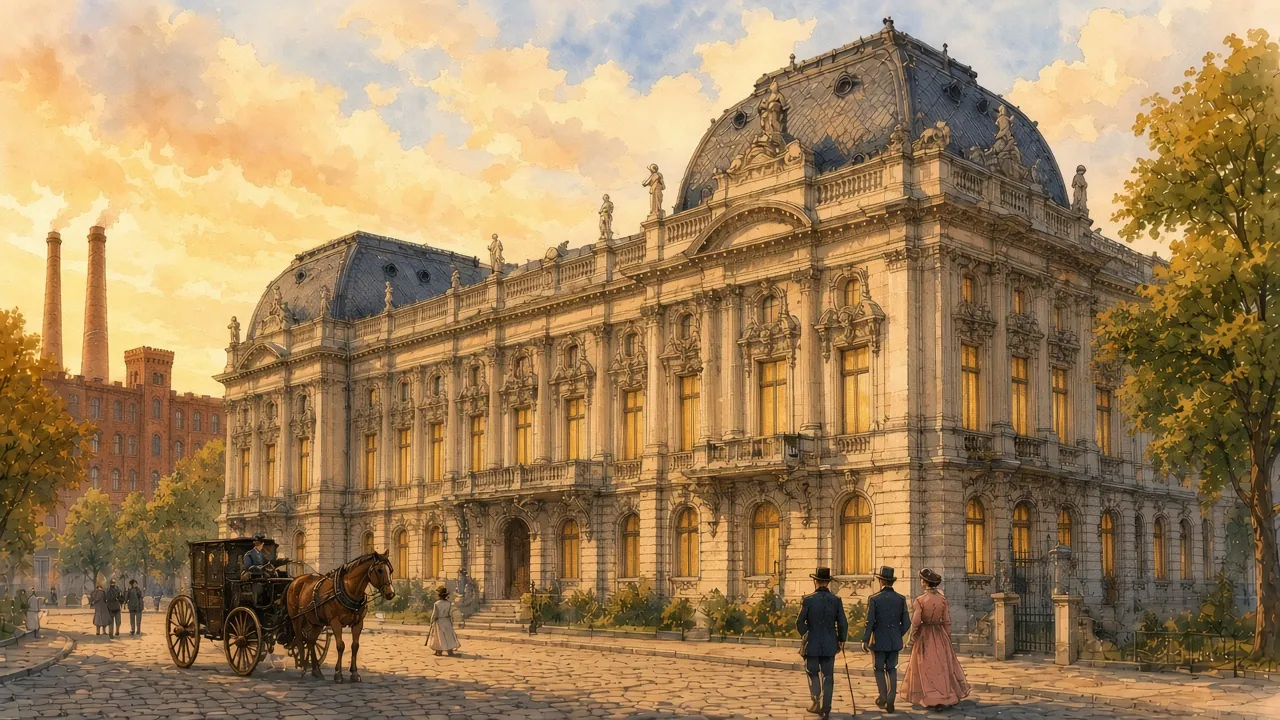
Łódź, in the centre of Poland, is a city whose modern history begins late and moves quickly. For most of the five centuries after its foundation it was a small agricultural town owned by the bishops of Kujawy. In the 1820s the government of the Kingdom of Poland chose it as a site for textile manufacture, and within two generations it had become the second city of the country and one of the largest centres of cotton and wool production in the Russian Empire.[1][2] Contemporaries called it the “Polish Manchester” and the “Promised Land“, the title of a novel by Władysław Reymont about the fortunes made and lost in its mills.[3][4]
The Jews of Łódź grew with the city. From a handful of families at the end of the eighteenth century, the community became by the beginning of the twentieth the second largest Jewish population in Poland after Warsaw, numbering about a third of the inhabitants of the city.[5][6] Jews were mill owners, merchants, weavers, tailors, porters, rabbis, journalists, socialists, Zionists, poets and actors. They built synagogues and schools, founded Yiddish and Hebrew newspapers, and played a large part in the labour movement of the industrial city.[7]
Under German occupation from 1939 the Jews of Łódź were confined in the first of the large ghettos to be sealed and the last of them to be destroyed. More than 200,000 people passed through it between 1940 and 1944. Most of them died of hunger and disease inside the ghetto or were murdered at Chełmno and Auschwitz.[8][9] The survivors and those who returned from the Soviet Union made the city, for a few years after 1945, the main centre of Jewish life in Poland, before emigration, political pressure and the campaign of 1968 reduced the community to a small remnant.[10]
This essay follows the history of the city and of its Jewish community from the medieval village to the present. It draws on general and Jewish encyclopedias, the publications of memorial institutions, local museums and the city’s own heritage material. Where the sources disagree on dates or numbers, the essay gives the range or names the disagreement.
1. A Bishops’ Town
The first written record of Łódź dates from 1332, when a village called Łodzia is mentioned in a document issued by the duke of Łęczyca and Dobrzyń. It belonged at that time, and for several centuries afterwards, to the bishops of Kujawy, whose seat was at Włocławek.[1][11] The surrounding country was a region of forest, small rivers and modest farms, lying on the watershed between the Vistula and the Oder basins. The streams that rise there, among them the Łódka and the Jasień, were too small for navigation, but they would later supply water to bleaching yards and mills.[12]
The grant of town rights came in stages. The city’s own heritage material recognises four founding documents. The first, a charter of the cathedral chapter dated 1414, refers to the settlement under another name. The second, and the one that is normally treated as the founding act, is a privilege of King Władysław II Jagiełło issued at Przedbórz in 1423, which allowed the bishop to establish a town at Łódź under Magdeburg law. A document of Bishop Jakub Pella in 1424 and a confirmation of 1433 completed the arrangement.[11][13] The exact day of the royal privilege is given as 29 July in the municipal account and as 15 July in some other summaries, and the difference has not been resolved in the sources used here.[11][1]
For the next four hundred years Łódź remained a small market town with an agricultural economy. Its inhabitants were mainly farmers who held land in the fields around the town and paid dues to the bishop. A wooden church, a town hall and a market square at the place now called the Old Market formed its centre. The population rarely exceeded a few hundred people. Wars, fires and epidemics in the seventeenth century reduced it further, and at the end of the eighteenth century the town had fewer than two hundred inhabitants living in some forty houses.[1][6]
Łódź was one of many small private towns of the Polish-Lithuanian Commonwealth, and its history in this period is that of a modest local market. Weekly markets and annual fairs brought farmers, artisans and traders from the surrounding villages, and the town’s craftsmen, among them shoemakers, potters and weavers working for local customers, were organised in guilds. The bishops appointed officials to administer their property and to collect dues, and the town council handled its own affairs under the supervision of the owner.[11][1] Nothing in this history suggested the city that would emerge in the nineteenth century, and visitors who came to Łódź in the 1820s described it as a poor and neglected town of wooden houses.[2]
There is no evidence of an organised Jewish community in this period. Jews in the region lived mainly in the older towns of the Łęczyca and Sieradz lands, such as Łęczyca itself, Piotrków and Zgierz, and the episcopal owners of Łódź do not appear to have encouraged their settlement.[5] This absence is important for what followed. When large-scale Jewish settlement came in the nineteenth century, it came to a place without an older Jewish quarter, without an established communal hierarchy and without an inherited set of local privileges. The rules under which Jews lived in Łódź were set by the governments of the partition period rather than by medieval custom.[2]
2. Prussian and Russian Rule
The partitions of Poland at the end of the eighteenth century changed the status of Łódź several times within a single generation. In the Second Partition of 1793 the region passed to Prussia and was included in the new province of South Prussia. In 1796, as part of a wider policy, the Prussian state confiscated the estates of the Church, and Łódź ceased to be a bishops’ town and became a government town.[14][15]
Prussian officials recorded the population with some care. Their surveys counted 191 inhabitants in 1793, among them eleven Jews. The Jewish residents were tenants, small traders and craftsmen who rented property in the town. They had no synagogue of their own and buried their dead in neighbouring communities.[5][2]
After Napoleon’s defeat of Prussia, Łódź was included in 1807 in the Duchy of Warsaw, a client state of France governed by the king of Saxony. The Duchy introduced the Napoleonic Code, abolished serfdom in law and created a central administration on the French model. It also restricted the civil rights of Jews for a period of ten years, a measure that was extended in practice after 1815.[16][17] The Congress of Vienna then gave most of the Duchy, including Łódź, to the new Kingdom of Poland, whose king was the Russian emperor. The Kingdom, known also as Congress Poland, kept its own government, army, currency and administration until the uprising of 1830–1831, and a separate status in reduced form for several decades after that.[18]
The new government in Warsaw inherited the former church estates and was looking for ways to develop the economy of the Kingdom, which had lost its access to its traditional markets in Prussia and Austria. It was this combination of state ownership of land, an active administration and new customs borders that made the transformation of Łódź possible.[1][19]
The number of Jews in the town grew slowly in these years. By 1809 there were 98 Jews in Łódź. They founded a house of prayer in that year and obtained land for a cemetery in 1811. For some time the small community depended on older neighbouring communities for its rabbinical needs and became fully independent only later.[5][6]
3. The Factory Settlement
In 1820 the government of the Kingdom of Poland issued a decree designating Łódź as a factory town. The policy was associated with Rajmund Rembieliński, the president of the provincial commission of Mazovia, and with the minister Stanisław Staszic, who believed that the Kingdom needed manufacturing towns settled by skilled immigrants.[1][20] Officials surveyed the government lands around the old town and prepared plots for weavers and spinners, who were offered building materials, exemptions from taxes and dues, and freedom from military service for a period.[11]
The first settlement, the New Town, was laid out south of the old market in 1821–1823. Its centre was an octagonal market square, today Freedom Square, from which the long road to Piotrków ran south. Along this road the officials marked out narrow plots for cloth weavers. Further south, along the Jasień, a second settlement called Łódka was planned for linen and cotton weavers and spinners, who needed water for bleaching and dyeing.[21][22]
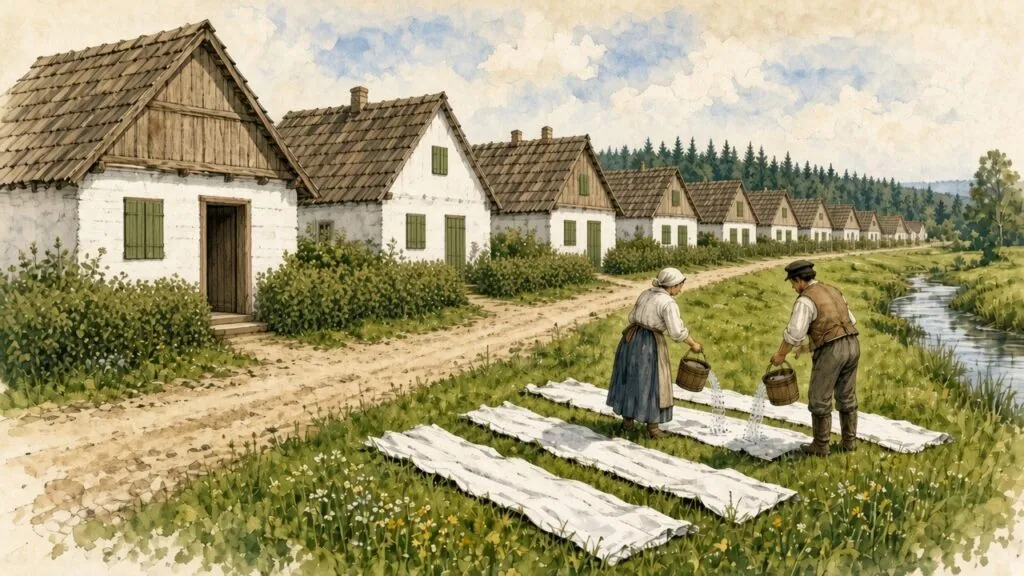
The settlers came mostly from Silesia, Saxony, Bohemia and other German-speaking lands, with a smaller number from Polish regions. They were Lutherans and Catholics, and the town acquired a Protestant church and a German-speaking population that would form a significant part of its inhabitants until 1945.[1][23] The customs border with Russia was lowered in 1822, which opened the large Russian market to cloth from the Kingdom, and the weavers of Łódź prospered in the following years. The number of inhabitants rose to about 4,000 in 1830.[2]
The uprising of 1830–1831 against Russian rule and the high tariff that Russia imposed on the Kingdom afterwards brought a crisis. Many cloth weavers left. The town survived the crisis by shifting from wool to cotton, which was spun and woven for the domestic market, and by the gradual change from handloom weaving in homes to production in larger workshops with powered machinery.[1][24]
The cotton industry needed large amounts of capital, which few of the original settlers had, and it brought to the fore a small number of entrepreneurs who were able to combine credit, machinery and labour on a scale that the town had not known before. Their names, Geyer, Scheibler, Grohman and later Poznański, are still visible in the street names, palaces and factory buildings of the city.[20]
The physical form of the early factory town can still be read in the plan of the city centre. The long, narrow plots laid out for the weavers along Piotrkowska Street and the neighbouring streets determined the shape of the later tenement houses, which were built deep into the plots with a sequence of courtyards behind the street front. Some of the wooden houses of the weavers survived into the twentieth century, and a few have been moved to the open-air section of the Central Museum of Textiles.[24][22] The government also provided the settlers with a town hall, schools and churches, and the octagonal market became the administrative centre of the New Town, while the Old Town around the old market, with its Jewish population, remained the commercial centre of the poorer north.[21][2]
4. The Jewish Quarter
The early Jewish population of Łódź was small, and it was not among the groups invited to the new factory settlement. The government’s settlement policy was directed at Christian craftsmen from abroad, and the rules of the new town included restrictions on Jewish residence.[2][5] In 1820 there were 259 Jews among the 767 inhabitants of the old town, a third of the population. They lived mainly in the old town around the market, were engaged in trade, crafts and the leasing of taverns and mills, and served as intermediaries between the town and the countryside.[5]
From 1825 the authorities began to confine the Jews of Łódź to a defined district. Under regulations of 1825 and 1827 Jews were allowed to live only in a few streets of the old town, centred on Wolborska and Nadrzeczna streets, and were barred from the new settlements of the weavers. The rule was not unusual in the Kingdom of Poland, where a number of towns had areas in which Jews were forbidden to live, but in Łódź it applied to the entire area of the expanding factory town.[2][6] A Jew who wished to live outside the district needed special permission, which was granted mainly to wealthy merchants and to people who were judged useful to industry, and which could depend on conditions of wealth, education and European dress.[6]
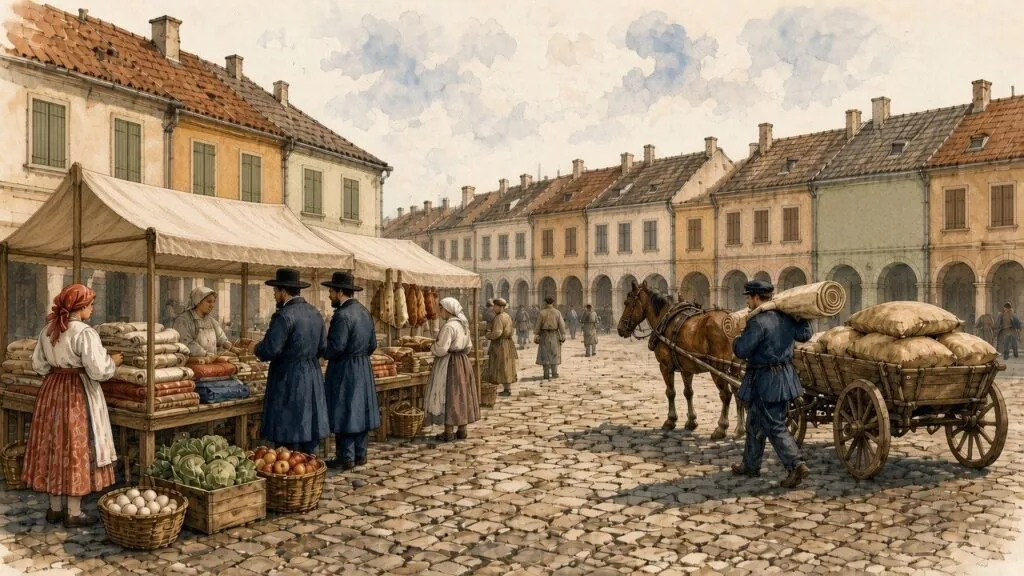
The Jewish population nevertheless grew, as Jewish merchants and craftsmen supplied the factory town with raw materials, finished goods and services. Jews dealt in wool, yarn and cloth, kept inns and shops, and worked as tailors, shoemakers, carters and porters. In the 1830s and 1840s they also began to take part in textile production, first as small producers and later as factory owners.[5][25] Samuel Salzmann, a Jewish merchant, campaigned from the 1830s for permission for Jewish weavers to live and work in the new districts, and some exceptions were granted.[6]
The community also acquired its first independent institutions in these decades. A wooden synagogue was replaced by a brick building in the old town, the old cemetery was enlarged, and a communal board was established to administer religious life, charity and the collection of the community tax.[5][6] In the 1850s new housing for Jewish families was built on the edge of Bałuty, a village north of the old town that lay outside the jurisdiction of the city and therefore outside its residence restrictions. The building plots there were developed by Jewish entrepreneurs, among them the Bławat and Birnzweig families, and Bałuty became a large suburb of Jewish and Polish workers’ housing, incorporated into the city only in 1915.[2][26]
The residence restrictions were removed in 1861–1862 as part of the reforms of Aleksander Wielopolski in the Kingdom of Poland, which granted Jews equal civil rights in most matters, including the right to live anywhere in the cities and to buy land. The decree took effect in Łódź with the abolition of the quarter, and Jewish merchants and manufacturers moved into the main streets of the city.[6][27]
5. Geyer, Scheibler and Grohman
The first of the great Łódź manufacturers was Ludwik Geyer, a cotton printer from Saxony who arrived in the 1820s and built his works at the southern end of Piotrkowska Street. His building of the 1830s, known as the White Factory, was the first large mechanised cotton mill in the town, and in 1839 it received the first steam engine in Łódź, together with a tall chimney that announced a new kind of industry.[28][24] The building now houses the Central Museum of Textiles, which preserves machines, fabrics and wooden houses of the weavers’ settlement in an open-air section.[24]
Geyer’s business suffered from the crises of the 1840s, and his place as the leading manufacturer of the town was taken by Karl Scheibler. Scheibler came from a family of cloth manufacturers in the Rhineland, arrived in the Kingdom of Poland in 1848 and established himself in Łódź in 1854. From a cotton-spinning mill on the Water Market, today Victory Square, he expanded into the largest textile concern in the Kingdom.[29][1] His main works, around the pond of Księży Młyn on the Jasień, combined spinning, weaving, finishing and the generation of power with housing for the workers, a school, a hospital, a fire station and shops. The brick spinning mill there, with its corner towers, was one of the largest industrial buildings in the Russian Empire.[12]
The Scheibler company was organised as a joint-stock company after Karl Scheibler’s death in 1881 and remained in the hands of his family and their relatives by marriage, among them the Herbst family, whose villa near Księży Młyn is now a museum of nineteenth-century interiors and art.[30][29] In 1921 the Scheibler company merged with the business of the Grohman family, and after the Second World War the combined works were nationalised as the Uniontex cotton works.[12]
The Grohman family had been in Łódź since the 1840s, when Traugott Grohman, a weaver from Saxony, set up a cotton mill there. The sources differ on the year of his arrival. His son Ludwik expanded the business into one of the leading cotton firms of the city. The family’s mill on Targowa Street, with its gateway flanked by two round towers known locally as the Grohman barrels, belongs to the same industrial landscape as Księży Młyn.[31]
The manufacturers of the second half of the nineteenth century included German, Polish and Jewish families, and some of the largest firms were joint ventures among them. Their mills drew labour from the countryside of central Poland, from the small towns of the region and from abroad. The entrepreneurs themselves often lived next to their mills, in villas and palaces that combined residence and office, and a number of these buildings survive, used today as museums, schools and public offices.[20][32]
Work in the large mills was long and hard. A working day of twelve or more hours was common before 1905, and the machines were noisy, the air full of cotton dust and the risk of injury high. Factory owners such as Scheibler and Poznański built housing, schools and hospitals for their workers, partly from paternalist conviction and partly to secure a stable labour force, and the workers’ estates of Księży Młyn are still lived in today.[12][33] Wages in the mechanised mills were higher than in domestic weaving, but the frequent crises of the cotton trade brought short-time working and dismissals, and the workers of Łódź had few means of protecting themselves before the labour movement of the 1890s.[1][34]
6. Poznański and the Jewish Industrialists
The most prominent Jewish manufacturer of Łódź was Izrael Kalmanowicz Poznański. His father, Kalman Poznański, had moved to Łódź from the Kujawy region in the 1830s and opened a shop on the Old Market. Izrael Poznański began in trade, buying and selling cotton goods, and in the 1870s built a cotton mill on Ogrodowa Street, west of the Old Town.[35][25] Over the following three decades the works grew into one of the largest textile enterprises in the Russian Empire, with spinning and weaving mills, a power station, warehouses, workers’ housing, a hospital, a school and a fire station.[36]
Next to the works Poznański built a palace, extended several times until the early twentieth century, with lavish interiors and a public front towards Ogrodowa Street. After the Second World War it became the home of the Museum of the City of Łódź, which displays its rooms together with collections on the history of the city and its notable inhabitants.[37][38] The Poznański family built several other residences in the city, one of which, on Gdańska Street, now houses the Academy of Music, and another, on Więckowskiego Street, the Muzeum Sztuki, one of the oldest museums of modern art in Europe.[35][39]
Poznański was one of a number of Jewish industrialists who rose in Łódź between the 1860s and 1914. Others included the families of Silberstein, Kon, Jarociński, Rosenblatt and Konstadt, and dozens of smaller firms producing woollen and cotton cloth, knitwear, ribbons and haberdashery.[5][2] By 1914, according to one count, there were about 175 Jewish-owned factories in the city, and Jewish firms dominated the trade in textiles from Łódź to the Russian interior.[2] Jewish bankers and merchants organised credit, purchase and sales, while agents in Moscow, Odessa and the cities of Central Asia sold Łódź goods across the empire.[7]
The Jewish manufacturers did not form a single group. Some were observant and supported traditional institutions; others adopted the German or Polish language and the manners of the industrial bourgeoisie. Poznański himself contributed to the building of the Great Synagogue, a Jewish hospital and the new cemetery, while his sons were educated in Germany and Russia and married into the wealthy families of other cities.[38][40] The relations between Jewish employers and Jewish workers were, as elsewhere, a matter of conflict. Many Jewish manufacturers preferred to employ Christian workers in their mechanised mills, citing the Sabbath and the need for continuous operation, and Jewish labour remained concentrated in smaller workshops and in handloom weaving.[2][41]
7. The Promised Land
The railway transformed the market of Łódź. In 1865 a branch line connected the city with the Warsaw–Vienna Railway at Koluszki, and the Łódź Fabryczna station opened near the Scheibler and Geyer works. A second line, to Kalisz and Warsaw, followed in 1902.[1] Coal could now be brought in cheaply, cloth could be shipped to the Russian interior, and the city’s cotton industry entered a period of very rapid growth, protected from foreign competition by the Russian tariffs of the 1870s and 1880s.[19]
The population of Łódź rose from about 40,000 in the mid-1860s to more than 310,000 in 1897 and over 400,000 before the First World War.[5][1] The growth was largely unplanned. Workers lived in wooden houses and crowded tenements, often without sewers or running water, and the city was struck repeatedly by epidemics of cholera and other diseases.[42] Bałuty, outside the city boundary, became what was often described as the largest village in Europe, with tens of thousands of inhabitants in tenements built along unpaved streets.[26]
Piotrkowska Street, the old road to Piotrków along which the first weavers had settled, became the main street of the industrial city. By 1900 it was lined with the tenement houses, banks, hotels, shops and offices of merchants and manufacturers, many of them Jewish, and in 1898 an electric tramway, among the first in the Polish lands, began to run along it, alongside horse-drawn cabs and carts.[21][22] The street is about four kilometres long and remains the main axis of the city centre.[22]
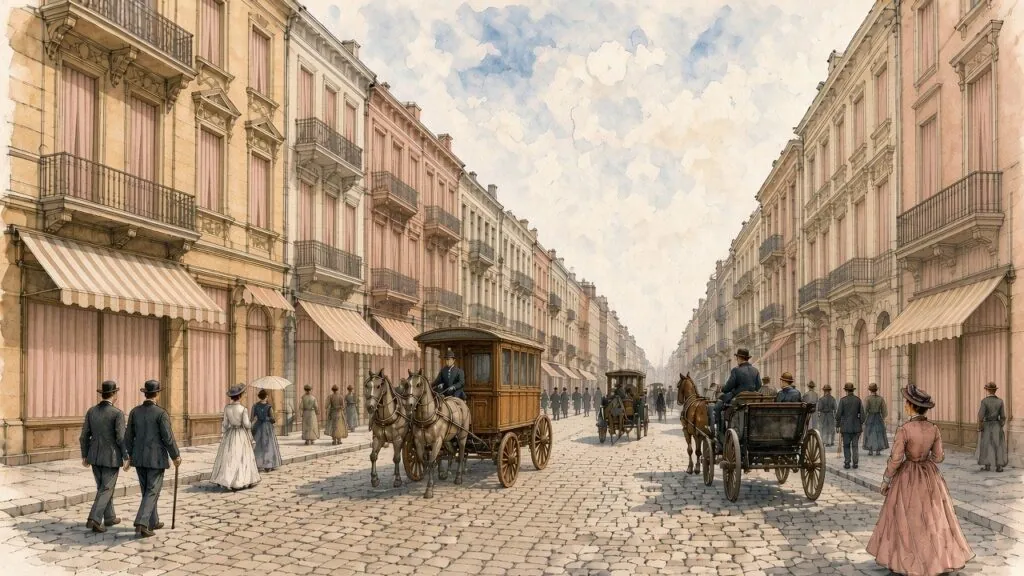
Contemporaries spoke of Łódź as the “Polish Manchester“, comparing it with the English centre of the cotton industry, and of its “smoke and chimneys” as a symbol of modern industry. Writers also saw a darker side. In his novel The Promised Land, published in 1899, Władysław Reymont described a German, a Pole and a Jew who found a cotton mill together, and their pursuit of profit in a city without traditions or solidarity.[3] The novel, later filmed by Andrzej Wajda in 1975, contains antisemitic and anti-German stereotypes and has been read both as a critique of capitalism and as a portrait of the ethnic mixture of the city.[43][44]
The mixture was real. Around 1900 the population of Łódź consisted of Poles, Jews and Germans in roughly comparable proportions, with smaller numbers of Russians, Czechs and others. Each group had its own churches or synagogues, schools, newspapers, societies and cemeteries, and to some extent its own districts, but they met daily in the mills, the market and the streets. German was the language of much of the business world, Polish of the majority of the workers and of the Catholic church, Yiddish of the Jewish majority, and Russian of the state administration.[23][2] The Lutheran, Catholic and Orthodox churches, the synagogues and the prayer houses of the city were built within a few decades of one another, and their congregations shared a city that had no long history of its own.[23][45]
The Yiddish novelist Israel Joshua Singer, who grew up partly in Łódź, gave a different portrait of the same world in The Brothers Ashkenazi, published in the 1930s, which follows two Jewish brothers through the rise of the industry, the strikes and the revolution of 1905 to the collapse of the old order after the First World War.[46][47]
8. Community and Religion
The legal emancipation of 1862 and the growth of the city changed the character of the Jewish community. From a few thousand in the middle of the century, the number of Jews rose to about 98,700 in 1897, 31.8 per cent of the population, and to more than 166,000 by 1910. Most of the newcomers came from the small towns of central Poland and from Lithuania and Belarus, the latter known in Polish as Litvaks.[5][2]
The community board, or kahal, was dominated in the late nineteenth century by wealthy manufacturers and merchants, who were elected under a restricted franchise. It administered the synagogues, the cemetery, ritual slaughter, charitable funds and a hospital. A Jewish hospital funded by Poznański and others opened around 1890, and Jewish charities supported orphanages, old people’s homes and soup kitchens.[6][48]
The rabbi of Łódź from 1873 to 1912 was Eliyahu Ḥayim Meisel, a scholar from Lithuania who was known for his charitable work among the poor and for his ability to mediate between the different groups in the community, including the manufacturers, the Hasidim and the workers.[49] After his death the rabbinate was filled by Eliezer Leib Treistman, and in the interwar period by others from among the traditional scholars.[2]
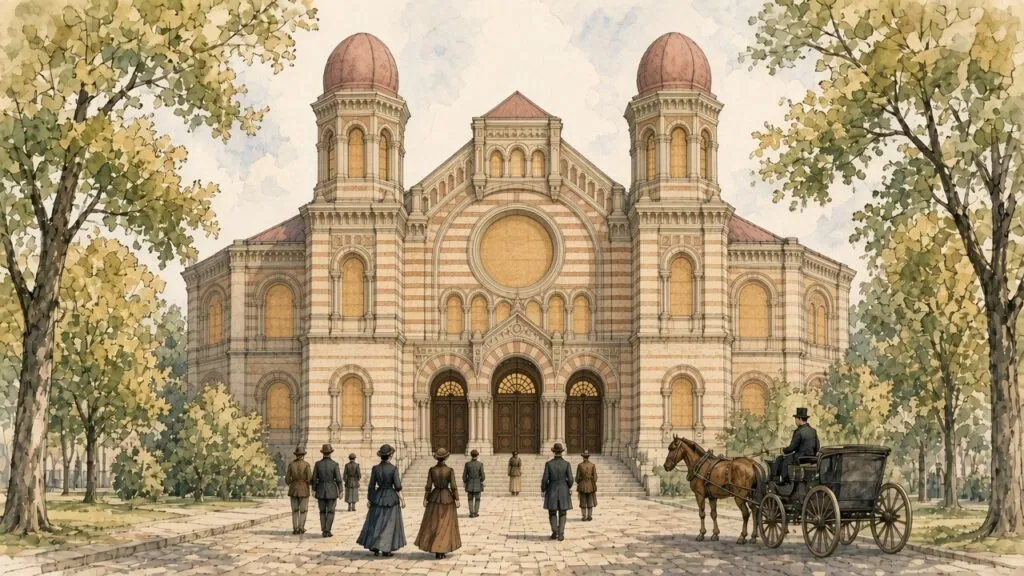
The religious life of the city was divided between several streams. The wealthy acculturated families built the Great Synagogue on Kościuszki Avenue between 1881 and 1887, a large building in a Moorish style with an organ and sermons in German and later Polish.[2][25] The Old Town synagogue on Wolborska Street, built in the 1860s, served the traditional majority, and hundreds of small prayer houses existed in tenements and courtyards across the city.[6][50] Hasidism was strong in Łódź. The largest groups followed the rebbes of Ger, near Warsaw, and of Aleksandrów, a small town near Łódź, whose court was one of the most influential in central Poland. Others followed the dynasties of Sochaczew, Radomsko and Strykow.[51][52][53]
Between these groups stood a growing number of Jews influenced by the Haskalah, the Jewish Enlightenment, and later by Jewish nationalism. Small circles of the Lovers of Zion appeared in Łódź in the 1880s, and the Zionist movement founded by Theodor Herzl in 1897 attracted merchants, teachers and young people. Many of the Lithuanian Jews who settled in the city in the 1880s and 1890s brought with them a tradition of learning, a preference for Russian culture and political radicalism, and they were often regarded with suspicion by the local Polish Jews and by the Polish press.[2][54] The tensions between Hasidim and their opponents, between the traditional and the acculturated, and between the different national and political orientations were part of daily life in the community and were fought out in the elections to the communal board.[6][55]
Of the large synagogues of Łódź, none survived the Second World War. The only historic synagogue that survives is the Reicher synagogue, a private prayer house built in the courtyard of a tenement on what is now Rewolucji 1905 roku Street, which the community uses today.[50]
9. The Bracka Street Cemetery
The old Jewish cemetery of Łódź, opened in 1811, was full by the end of the nineteenth century. In 1892 the community opened a new cemetery on Bracka Street, at the northern edge of the city, on land acquired with the help of Izrael Poznański. With an area of about 40 hectares, it is one of the largest Jewish cemeteries in Europe.[40][56]
The cemetery contains the graves of rabbis, industrialists, writers and ordinary members of the community, and its gravestones show the variety of Jewish life in the city, from traditional carved matzevot with Hebrew inscriptions to monuments in the styles of the period, with inscriptions in Polish, German and Russian.[40] The largest is the mausoleum of Izrael and Leonia Poznański, built in the early years of the twentieth century, with a dome and interior mosaics. It is often described as the largest Jewish tomb in the world, a claim that is repeated in local guides but difficult to verify.[56][38]
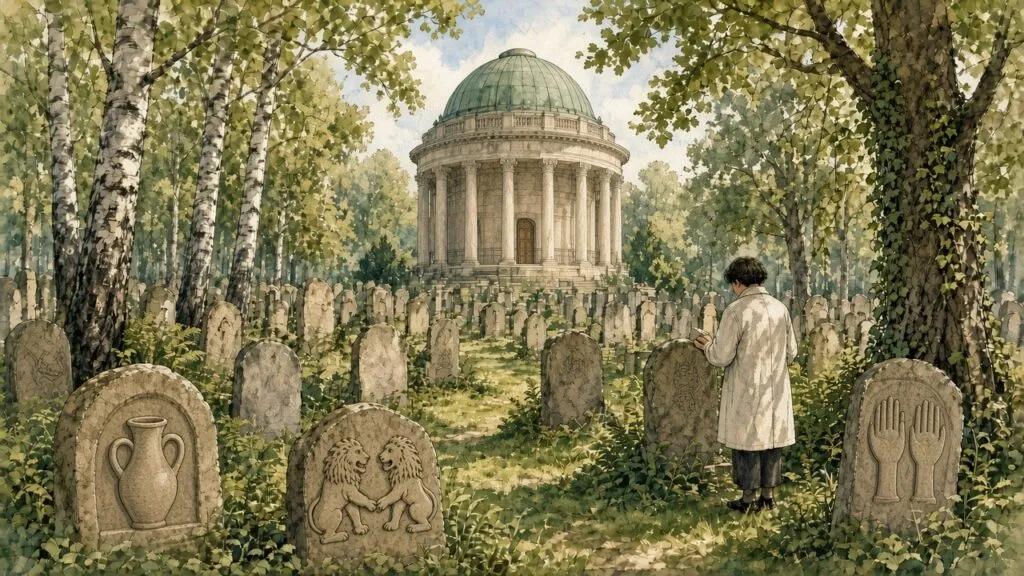
The cemetery also contains a section, known as the Ghetto Field, where tens of thousands of people who died in the ghetto between 1940 and 1944 were buried, and graves of those who were killed in the last days before liberation.[56][40] In 2015 it was declared a Monument of History by the President of Poland, and it is maintained today by a foundation and by the Jewish community of Łódź.[56][57]
The cemetery suffered from decades of neglect after the war. With most of the community gone, the graves were overgrown, some gravestones were stolen or damaged, and parts of the grounds became a wilderness. From the 1980s and especially after 1989, the Jewish community, foundations of former residents of Łódź abroad and the city authorities began restoring the cemetery, clearing vegetation, repairing the mausoleum and the funeral house, and recording the inscriptions. A memorial to the victims of the ghetto stands near the Ghetto Field, and the cemetery is now visited by descendants, schools and tourists.[40][56][57]
The Christian dead of the industrial city were buried in the Old Cemetery on Ogrodowa Street, divided into Catholic, Lutheran and Orthodox sections and containing the tombs of the Scheibler, Grohman, Geyer and Herbst families.[45][58]
10. Jewish Workers and the Labour Movement
Most Jews in Łódź were not manufacturers. The majority were workers, artisans, small traders and their families. Jewish weavers worked on handlooms in their homes or in small workshops, often for contractors who supplied the yarn and took the finished cloth. Others were tailors, cap makers, shoemakers, carters and porters, or worked in the trade in second-hand goods and food.[2][5]
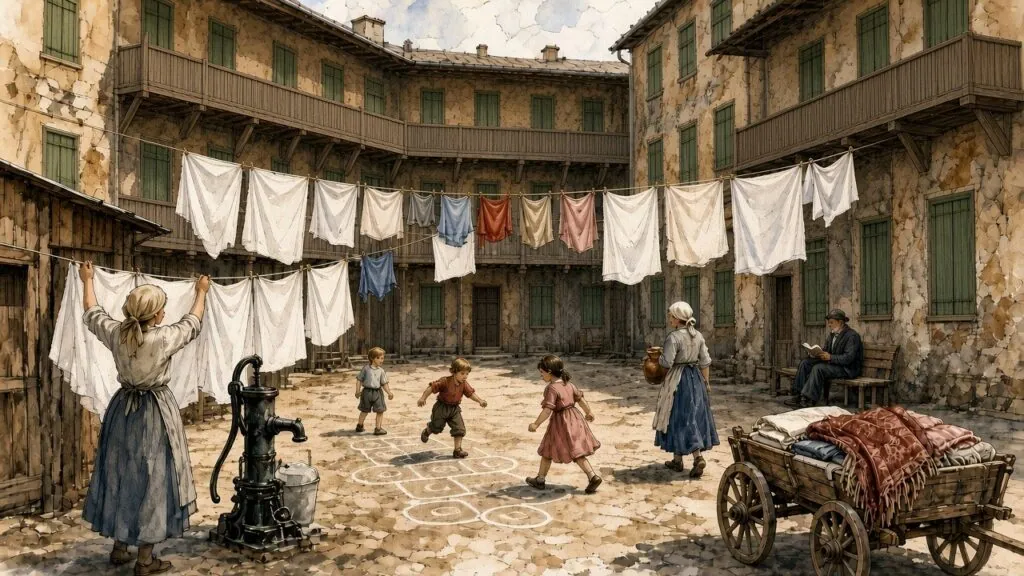
Living conditions in the Jewish districts of the Old Town and Bałuty were among the worst in the city. Overcrowding, poor sanitation and long hours of work for low pay produced high rates of tuberculosis and infant mortality.[42][26] The mechanisation of weaving put handloom weavers under constant pressure, and the exclusion of most Jewish workers from the large mechanised mills meant that they shared little of the higher wages paid in the factories.[2]
In May 1892 a strike that began in the factories of Łódź spread into a general stoppage involving tens of thousands of workers. Troops were brought into the city, and the strike turned into rioting, during which crowds attacked Jewish homes and shops, especially in Bałuty. Dozens of people were killed before the army restored order.[2][6] The event, sometimes called the Łódź revolt, showed both the strength of the new working class and the ease with which economic anger could be turned against Jews.[59]
Jewish socialist groups appeared in Łódź in the 1890s, and after the foundation of the General Jewish Labour Bund in Vilna in 1897 the Bund became active among Jewish workers in the city. In 1901 it organised a May Day demonstration in Łódź, and by 1905 it had several thousand members and supporters there.[41][60] Its rivals included the Polish Socialist Party, which also had Jewish members, and the socialist Zionist Poale Zion, which combined the class struggle with the aim of a Jewish homeland in Palestine.[59][61]
Women formed a large part of the workforce of the textile city, and Jewish women worked as seamstresses, knitters, spoolers and domestic servants, often from the age of twelve or thirteen. Their wages were lower than those of men, and their participation in strikes and in the socialist parties was noted with concern by employers and by the police.[2][60] The trade unions that were legalised after 1905 included separate Jewish unions of weavers, tailors, shop assistants and other trades, many of them under the influence of the Bund or of Poale Zion.[60][61]
11. The Revolution of 1905
The revolution that spread across the Russian Empire in 1905 reached Łódź immediately. After the shooting of demonstrators in St Petersburg in January, workers in Łódź joined a general strike, and strikes, demonstrations and clashes with the police continued through the spring.[34][62] The socialist parties, the Polish Socialist Party, the Social Democracy of the Kingdom of Poland and Lithuania and the Bund, organised meetings and funerals of victims that drew tens of thousands of people.[59][60]
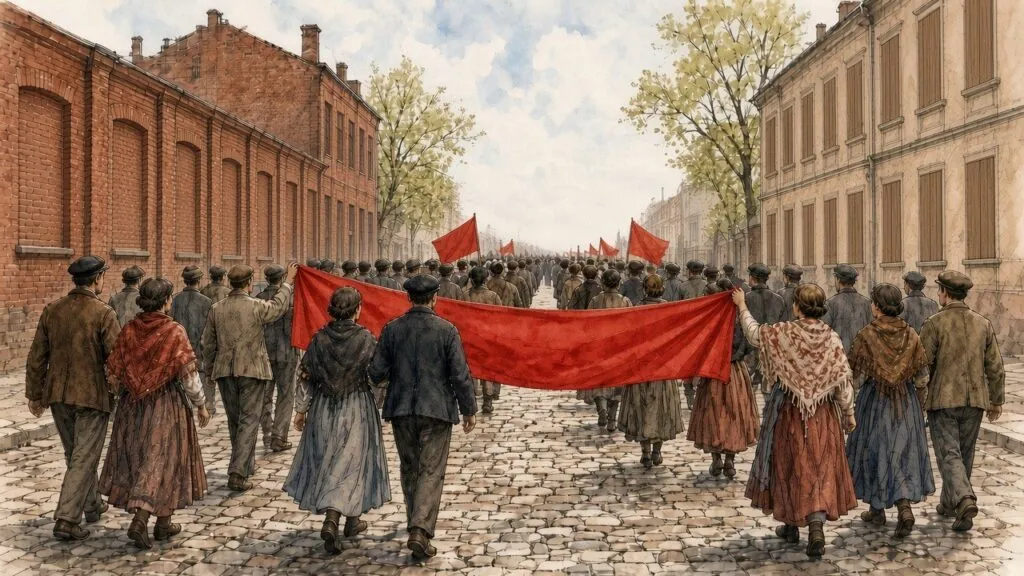
On 21 June 1905, after troops had fired on a funeral procession, workers built barricades in the streets of the city. Fighting between the barricades and the army lasted until 25 June. The official count of the dead was 151, but other estimates are higher, above two hundred, and hundreds more were wounded. Poles, Jews and Germans were among the victims.[62][2] The episode, known as the June Days or the Łódź insurrection, was one of the largest workers’ uprisings in the empire in that year.[34]
The revolutionary period in Łódź lasted until 1907. Manufacturers responded to repeated strikes with a lockout in the winter of 1906–1907 that closed many mills, and the city saw a long series of political killings among the socialist parties, the nationalist workers’ organisations and their opponents.[34] Jews took part in the revolutionary movement on all sides, as members of the Bund and the Polish parties and as targets of nationalist and conservative attacks. Some Jewish manufacturers and merchants were also attacked by revolutionary groups as employers.[2][60]
The revolution also opened space for legal Jewish organisations. After 1905 the government permitted associations, trade unions and a freer press, and the following years saw the foundation of Jewish newspapers, cultural societies, schools and sports clubs in Łódź.[2][55]
12. Press, Music and Theatre
The first Yiddish daily newspaper of Łódź, the Lodzer Tageblat, began publication in 1908, and it was followed by others, among them the Lodzer Folksblat, which became the most widely read Jewish paper of the city in the interwar years.[2][7] Jews also read the Polish, German and Russian press of the city, and Jewish journalists worked for many of these papers.[55]
Music had a strong place in Jewish Łódź. The Hazomir society, founded in 1899, organised a choir and concerts and became one of the most important Jewish musical societies in the Polish lands. The composer Joseph Rumshinsky, who later worked in the Yiddish theatre of New York, was among its early conductors.[63] The pianist Arthur Rubinstein was born in Łódź in 1887 to a Jewish family of the city and gave his first concerts there as a child.[64]
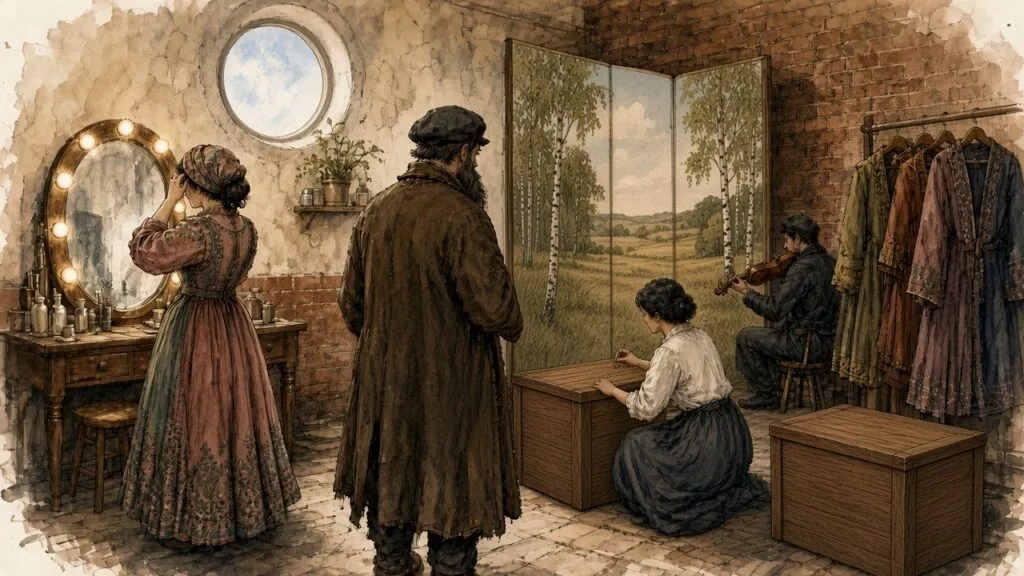
The Yiddish theatre, banned in the Russian Empire for much of the late nineteenth century, became popular in Łódź in the early twentieth, when touring companies and local troupes played melodramas, operettas and the plays of Jacob Gordin and other modern dramatists.[65][2] The Hebrew poet and educator Yitsḥak Katzenelson, who came to Łódź as a child, founded a Hebrew school there and wrote plays for children and students in Hebrew and Yiddish. He was murdered at Auschwitz in 1944, after writing a long poem on the destruction of the Jews of Warsaw.[66]
Education developed alongside the press and theatre. Traditional heders and yeshivas continued to teach the majority of Jewish boys, while modern Jewish schools, among them a Hebrew-Polish gymnasium founded by the rabbi and Zionist leader Markus Braude in 1912, taught general subjects in Polish together with Hebrew and Jewish studies.[2][55] Sports clubs, among them the Zionist Bar Kochba founded in 1912, offered football, athletics and gymnastics to young people.[67]
Łódź was also the birthplace or childhood home of writers who wrote in Polish. Julian Tuwim, born in Łódź in 1894 to an assimilated Jewish family, became one of the leading Polish poets of the twentieth century and a founder of the Skamander group. He described his native city in poems and prose and remained attached to it throughout his life.[68][69]
The cinema arrived early in Łódź, and Jewish entrepreneurs were among the first to open cinemas and to show and make films in the city. Before the First World War several picture houses opened on and around Piotrkowska Street, and in the interwar period Jewish owners ran a large share of the cinemas of the city, which showed Polish, American and Yiddish films.[70][71] The industrial city thus acquired, within two generations, the full range of the cultural institutions of a modern metropolis, though few of them received the support of the state that a capital city would have enjoyed.[7]
13. War and Independence
The First World War brought the industrial city to a standstill. In November and December 1914 the armies of Germany and Russia fought around Łódź in one of the largest battles of the Eastern Front, and the cemeteries of soldiers of both sides still lie in the surrounding countryside.[72][73] On 6 December 1914 German forces occupied the city. Russia had already lost its market, and the German occupation authorities requisitioned raw materials, machinery and transmission belts and shipped much of the industrial equipment of Łódź to Germany.[1]
Without work, the population of Łódź fell sharply, and those who remained suffered from hunger and epidemics. Jewish charities organised soup kitchens and relief committees with funds from abroad, especially from Jewish organisations in the United States.[2][5] At the same time the German occupation administration allowed a degree of political and cultural activity that had not been possible under Russian rule. Parties, newspapers, schools and theatres opened, and the first elections to the city council were held in 1917 on a franchise that gave Jewish parties a substantial representation.[19][55]
The suburb of Bałuty was incorporated into the city in 1915, adding a large Jewish and Polish working-class population to the municipality.[26] The organisations that would dominate Jewish politics in independent Poland took shape in these years. Agudat Yisrael, the political organisation of Orthodox Jewry founded in 1912, became strong among the Hasidim of Łódź with the support of the rebbe of Ger. The Zionists, divided into general, religious and socialist currents, organised among the middle classes and the young. The Bund remained the largest party among Jewish workers.[74][75][54]
In November 1918 Poland regained its independence, and Łódź became the capital of a new province and the second city of the republic. Its Jewish population in the first postwar census of 1921 was 156,155, or 34.5 per cent of the inhabitants.[19][55]
14. The Interwar City
The economy of interwar Łódź never recovered the position it had held before 1914. The loss of the Russian market left the textile industry dependent on the much smaller Polish market and on exports to other countries, and the city suffered from recurrent crises, especially during the Great Depression after 1929.[19][1] Unemployment among textile workers was high, and many Jewish workshops and small factories closed. The heavy tax burden imposed by the government of Władysław Grabski in the 1920s fell disproportionately, in the view of many Jewish contemporaries, on traders and artisans.[2]
The Jewish population nevertheless continued to grow. In the census of 1931 the city had 604,470 inhabitants, of whom 202,497, or 33.5 per cent, were Jews by religion.[55][7] Jewish life was organised in a dense network of parties, trade unions, schools, cooperatives, charities, newspapers, sports clubs and cultural societies.[7] The kehilla, now governed by a statute of independent Poland, was elected on a democratic franchise from 1924. Agudat Yisrael won the largest share in several elections, and its leader Leib Minzberg chaired the board from 1931 and sat in the Polish parliament.[2][75]
The political life of the city reflected the tensions of interwar Poland. The nationalist National Democrats were strong in Łódź, and the 1930s saw boycotts of Jewish businesses, violence against Jewish students and attacks on Jewish shops.[17][19] The National Democrats won the municipal elections of 1934, but in 1936 the Polish Socialist Party and the Bund formed a majority in the city council, a reflection of the strength of the labour movement among both Polish and Jewish workers.[2][41]
The cultural life of Jewish Łódź in this period was rich. In 1919 the poet Moyshe Broderzon and a group of artists, among them Yankl Adler and Marek Szwarc, formed Yung-yidish, a group that combined Yiddish poetry with modern art and published illustrated journals.[76][77] In 1927 Broderzon founded the Ararat, a Yiddish cabaret and puppet theatre that toured Poland.[77] The city had Jewish cinemas and film enterprises, Yiddish publishers and libraries, and a variety of leisure organisations, from workers’ sports clubs to summer camps outside the city.[70][67][78]
Jewish schools in Łódź were divided by ideology and language. The Central Yiddish School Organisation, associated with the Bund and the left Poale Zion, ran secular Yiddish schools; the Tarbut network taught in Hebrew; the religious Zionists maintained Yavneh schools; and Agudat Yisrael supported traditional schools for boys and Beys Yankev schools for girls. Many Jewish children attended Polish state schools.[2][75]
The economic and political difficulties of the period encouraged emigration. Jews from Łódź left for the United States until American immigration restrictions of the early 1920s closed that route, and then for Palestine, France, Belgium and Latin America. The Zionist youth movements prepared young people for agricultural work in Palestine, and the immigration of the 1920s and 1930s included many people from Łódź.[54][19] At the same time the city continued to attract migrants from the small towns of the region, and its Jewish population grew until 1939.[55]
The streets of the northern centre of the city, around the Old Town, Nowomiejska and Zgierska streets and the area once called Neustadt, remained the most visibly Jewish part of Łódź, with prayer houses, Hasidic courts, kosher shops and markets. Wealthier Jewish families lived along Piotrkowska Street and in the districts to the south and west, alongside Polish and German neighbours.[26][7] Jews sat on the city council for several parties, worked in the municipal administration and the professions, and owned a large part of the city’s trade, but they were excluded from most positions in the state administration and faced quotas and discrimination at Polish universities in the late 1930s.[19][17]
15. Occupation, 1939
Germany invaded Poland on 1 September 1939. The Polish Łódź Army fought in the region during the first days of the campaign but was forced to retreat, and the city was not defended in a prolonged battle.[79][80] German forces entered Łódź on 8 September. Many members of the German minority welcomed them, and some took part in the persecution of Poles and Jews that began at once.[8][81]
Jews were attacked in the streets, forced into labour, robbed of their property and excluded from economic life. Jewish bank accounts were frozen, and Jewish shops and factories were taken over by German trustees.[8][82] In the first months of the occupation tens of thousands of Jews left Łódź for Warsaw and other towns in the General Government or for the Soviet zone of occupation in the east. Estimates of the number range up to about 70,000.[83][8]
In October 1939 the German authorities appointed Mordechai Chaim Rumkowski, an insurance agent and director of a Jewish orphanage, as Elder of the Jews of Łódź. He was ordered to form a council of elders to carry out German orders.[84][85] In November most members of this council were arrested and taken to the camp at Radogoszcz, and many of them were killed. Rumkowski formed a new council, which had little influence on his decisions.[86][6]
On 9 November 1939 Łódź was annexed to the German Reich as part of the province later called the Wartheland, under the Gauleiter Arthur Greiser, whose aim was to make the region German by expelling Poles and Jews.[87][88] The sources differ on whether the annexation took effect on 7 or 9 November. In the same month the Germans burned the Great Synagogue and the other large synagogues of the city, and in December they ordered Jews to wear a yellow star.[82][83] On 11 April 1940 the city was renamed Litzmannstadt, after a German general of the First World War.[89]
The policy affected Poles as well as Jews. The Polish intelligentsia of Łódź, including teachers, priests, officials and political activists, was arrested and many were murdered, and tens of thousands of Poles were deported to the General Government in the winter of 1939–1940 to make room for German settlers from the Baltic states and eastern Europe. Polish schools, newspapers and associations were closed, and Polish street names were replaced with German ones.[87][90]
16. The Ghetto
On 8 February 1940 the German police president of Łódź issued an order establishing a residential district for Jews in the northern part of the city, in the Old Town, Bałuty and the semi-rural district of Marysin. Poles and ethnic Germans living there were ordered to leave, and Jews from other parts of the city were ordered to move in.[8][83] The resettlement was carried out under threat and violence. In early March 1940, in an action remembered in the ghetto as “Bloody Thursday“, German police shot Jews in their homes and in the streets to force the pace of the move. The sources differ on the exact day.[82][9]
The ghetto was closed on 30 April 1940 and sealed from the city on 1 May. About 160,000 people were enclosed within an area of about four square kilometres, most of it without sewers or running water.[8][91][89] Two main roads that ran through the area remained outside the ghetto and were used by the city’s traffic, so that the ghetto was divided into three parts. To connect them, the Germans built wooden footbridges over the roads, which became one of the best-known images of the ghetto.[91][92]
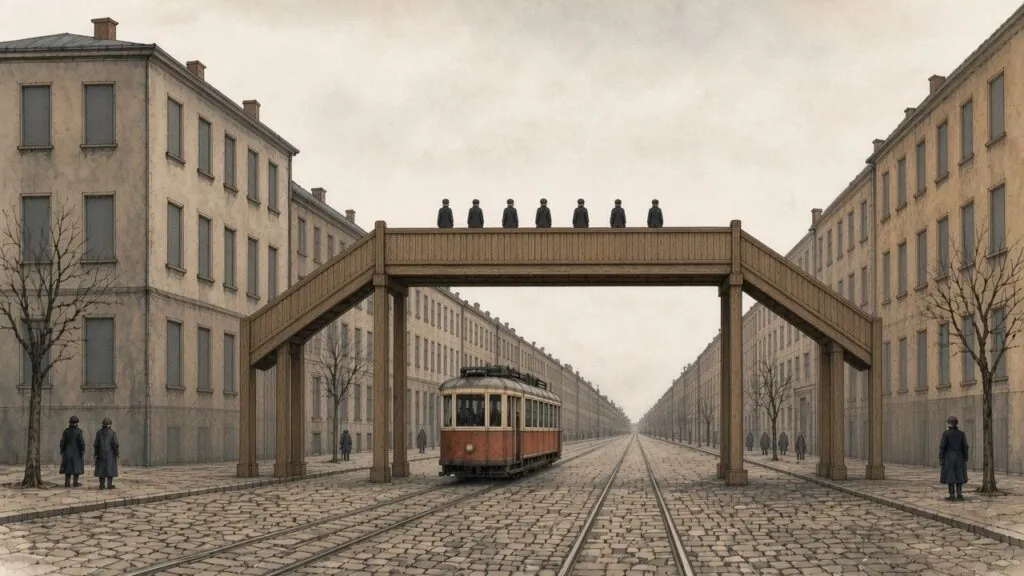
The Łódź ghetto was the first of the large ghettos to be sealed and the most strictly isolated. Unlike Warsaw, where smuggling across the walls supplied a substantial part of the population’s food, Łódź was closed by a fence patrolled by police who shot people who approached it, and very little passed through other than the deliveries arranged by the German administration.[9][93][94]
The German administration of the ghetto, the Gettoverwaltung, was headed from 1940 by Hans Biebow, a businessman from Bremen who regarded the ghetto as an economic enterprise. It controlled the supply of food and raw materials and the sale of the goods produced in the ghetto, and it collected the profits.[95][83]
Inside the ghetto, Rumkowski, as Elder of the Jews, built an extensive administration that included departments of food supply, housing, health, welfare, education, labour and statistics, a police force, courts, a prison and a post office. He issued a ghetto currency and controlled the distribution of food and work.[84][86][96] His rule has been the subject of continuing debate. Some survivors and historians have described him as an autocrat who abused his power and cooperated in the deportations; others have emphasised that he believed, in the words he often repeated, that work would make the ghetto indispensable to the Germans and allow part of the population to survive.[84][85] The ghetto did last longer than any other large ghetto in occupied Poland, but almost all of its inhabitants were murdered in the end.[8]
The district of Marysin, at the northern edge of the ghetto, had small houses, gardens and open land. Rumkowski established there orphanages, old people’s homes, schools and a summer colony for children, and allowed Zionist youth groups to cultivate plots of land in the spirit of the agricultural training they had pursued before the war. Marysin also contained the ghetto cemetery and, from 1941, the Radegast station at which transports arrived and departed.[83][97][98] The administration and the privileges of those who worked for it created sharp social differences in the ghetto, which were a constant theme of the diaries and the Chronicle.[99]
17. Work and Hunger
From the summer of 1940 Rumkowski organised the ghetto as a labour camp producing for the German economy. Workshops, known in the ghetto by the German word Ressort, made uniforms, boots, underwear, furniture, metal goods and textiles, mostly for the German army and German companies.[83][8] By 1943 there were well over a hundred enterprises, and the large majority of the adult population worked in them.[9]
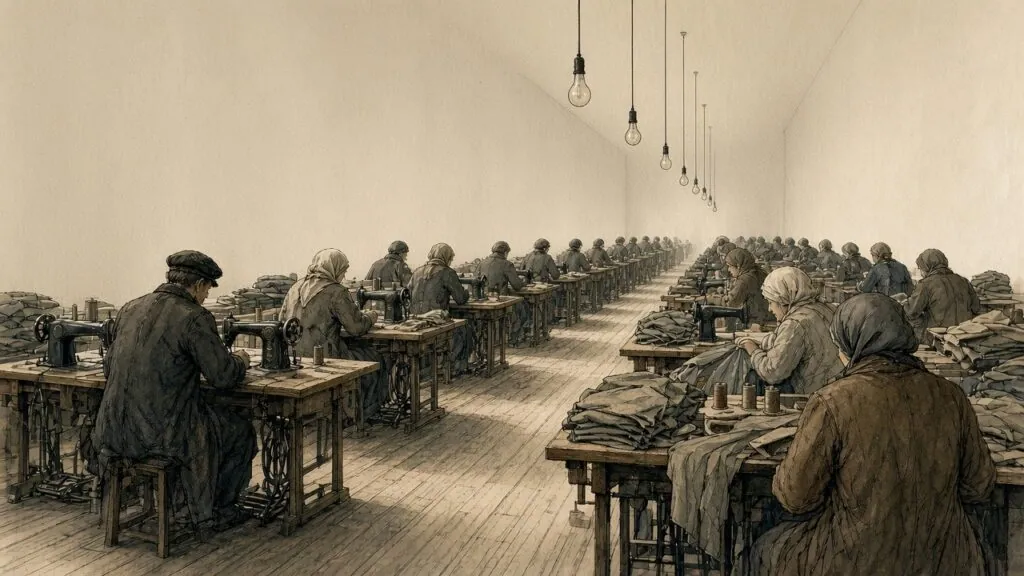
Hunger was the central fact of life in the ghetto. Food rations were set by the German authorities at a level below what was needed to survive, and the daily soup in the workshops became for many people the main meal. Typhus, tuberculosis and dysentery spread among the starving population.[100][93] About 43,000 people, according to commonly cited estimates, died in the ghetto of hunger, disease and exhaustion between 1940 and 1944.[8][9] Protests and strikes over food broke out several times in 1940 and 1941 and were suppressed by the ghetto police.[100]
The ghetto had its own money. In the summer of 1940 the German administration introduced paper notes and coins valid only in the ghetto, and all German and Polish money had to be exchanged for them. The inhabitants called the notes rumkis or chaimkis, after the Elder.[82][98] The currency allowed the administration to control trade in food and to draw the remaining savings and valuables of the population into the hands of the Germans. A black market nevertheless existed, and the price of bread, potatoes and fuel became a measure of the ghetto’s condition, recorded week by week in the Chronicle.[99][100]
Life within the ghetto did not consist only of work and hunger. Schools operated until 1941, and religious observance, concerts, theatre performances and lectures continued in difficult conditions, some of them organised by the ghetto administration and others in private homes.[8][98] The ghetto’s own archive, established in November 1940 under the direction of Henryk Neftalin, kept official records and from January 1941 compiled a daily Chronicle of events in the ghetto, written by a group that included Józef Zelkowicz, Oskar Singer and Oskar Rosenfeld.[101][99] The Chronicle recorded births and deaths, rations, the arrival of transports, deportations and the weather, in a careful and often ironic style that had to take account of the Elder’s censorship.[99]
Photographers also recorded the life of the ghetto. Mendel Grossman and Henryk Ross, who worked for the ghetto’s statistical department, took thousands of photographs, some officially and some in secret. Ross buried his negatives before the liquidation and recovered them after the war.[8][102]
In the autumn of 1941 about 20,000 Jews from Germany, Austria, Bohemia and Luxembourg were deported to the ghetto. Many of them were elderly or professional people unused to manual work, and their death rate was high.[8][83] In November 1941 about 5,000 Roma and Sinti from the Burgenland region of Austria were deported to a separate camp within the ghetto, where typhus broke out among them. Those who survived the camp were murdered at Chełmno in January 1942.[103][104]
18. Chełmno and the Gehsperre
In December 1941 the Germans began killing Jews at Chełmno, a village about seventy kilometres north-west of Łódź, using vans in which the victims were killed by exhaust gas. The killing centre was commanded initially by Herbert Lange. It was the first site in occupied Poland where poison gas was used for the mass murder of Jews.[105][106][107]
Deportations from the Łódź ghetto to Chełmno began on 16 January 1942. The ghetto administration was required to draw up lists of deportees, and it chose first those it considered unproductive or undesirable, among them people receiving welfare and people convicted by the ghetto courts. The deportees were told that they were being resettled for agricultural work.[105][108][109] Between January and May 1942 about 55,000 people were deported, including about 10,000 of the Jews who had arrived from western Europe the previous autumn.[8][83] The clothing and belongings of the victims came back to the ghetto to be sorted, which made the fate of the deportees increasingly clear to the inhabitants.[9]
The transports of 1942 were carried out mainly by train from Radegast station to a station near Chełmno, from which the victims were taken by lorry to the killing site. Very few people escaped from Chełmno, and information about the camp reached the ghetto only gradually, through the belongings of the dead and the accounts of a few escapees who reached Warsaw.[105][106][97]
In early September 1942 the Germans demanded the deportation of all children under ten, all people over sixty-five and the sick. On 4 September Rumkowski addressed a crowd in the ghetto and asked parents to give up their children, saying that it was necessary to sacrifice some in order to save the rest.[110] A curfew, known as the Gehsperre, was imposed from 5 to 12 September, during which German police and the ghetto police went from house to house. About 15,000 to 16,000 people were taken and murdered at Chełmno.[110][9][89]
The Gehsperre left a deep mark on the memory of the ghetto. Parents hid their children in cellars and cupboards, and families were separated in the streets. The Chronicle described the days of the curfew in restrained language, while diaries kept by inhabitants of the ghetto record the despair of those who lost their children and their anger at the ghetto administration.[99][110] After the action, the ghetto authorities turned the remaining children over the age of ten into workers, and children from that age worked in the workshops alongside adults until the liquidation.[9][98]
After the Gehsperre the ghetto was a labour camp with few children or elderly people. Its population stood at about 89,000 at the beginning of 1943, and it remained relatively stable for more than a year, while the other ghettos of occupied Poland were destroyed.[83][8] The survival of the ghetto in this period resulted from its economic value to the German army and to the ghetto administration, and from disagreements among German officials about whether to close it.[95][111]
19. Liquidation and Liberation
The decision to liquidate the ghetto was taken in the spring of 1944. Between 23 June and 14 July about 7,000 people were deported to Chełmno, which had been reopened for the purpose. In August the remaining population, about 67,000 people according to commonly cited figures, was deported to Auschwitz-Birkenau, where most of them were murdered on arrival.[112][111][113] Rumkowski and his family were sent to Auschwitz on one of the last transports at the end of August and were killed there.[84][86]
In early August 1944 Hans Biebow addressed the workers of the ghetto and urged them to report voluntarily for transports, which he described as relocation for work in Germany. Many people tried to avoid the transports by hiding in cellars, attics and empty workshops, but the German police and the ghetto police searched the houses street by street.[111][112] Several hundred people were selected at Auschwitz for forced labour and transferred to camps in Germany, and some of them survived the war.[114][111]
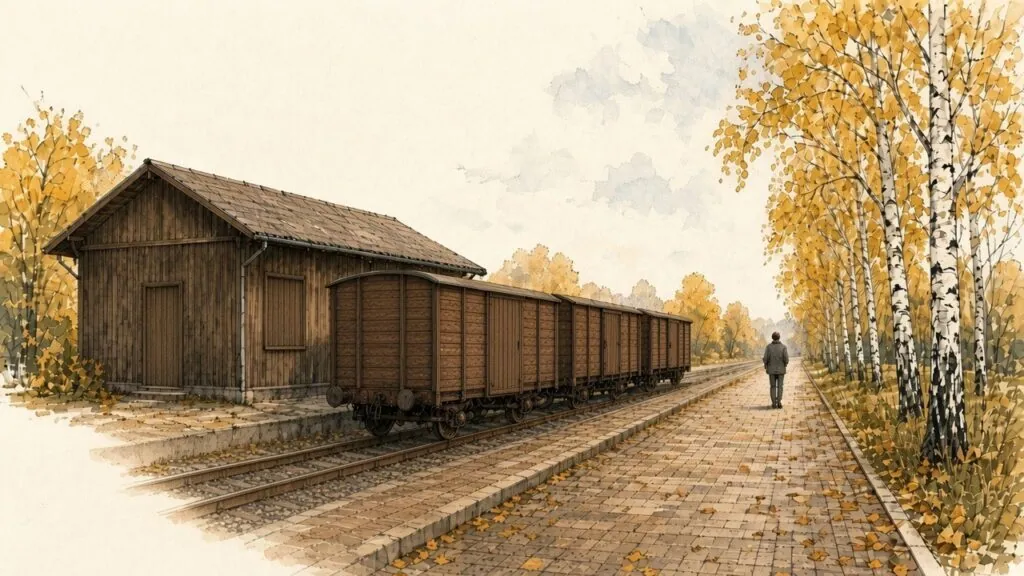
The deportations left the train from the Radegast station in Marysin, a goods station on the edge of the ghetto, through which, according to the memorial now standing there, about 145,000 people passed on their way to Chełmno, Auschwitz and other camps.[97][114] A small group of several hundred people was kept in the ghetto to clear the workshops and the houses, and some others hid in the empty buildings.[111]
In the night of 17 to 18 January 1945, as the Red Army approached, German guards set fire to the prison at Radogoszcz, where Polish prisoners were held, and shot those who tried to escape. More than a thousand people are thought to have died, though the exact number is uncertain.[115][116] On 19 January 1945 Soviet troops entered Łódź. They found in the area of the former ghetto about 870 Jewish survivors, a figure that is given in some sources as 877 and in others as about 800.[111][89]
Of the more than 200,000 people who passed through the ghetto, a few thousand survived the war in Auschwitz, in other camps or in hiding. The total number of survivors is not known precisely.[8][9] Hans Biebow was tried by a Polish court in Łódź and executed in 1947. Arthur Greiser was tried in Poznań and executed in 1946.[95][88]
20. After 1945
In the years after the war Łódź, which had suffered less physical destruction than Warsaw, became the largest centre of Jewish life in Poland. Survivors from the camps, people who had come out of hiding and, from 1946, Jews returning from the Soviet Union settled in the city, and its Jewish population was estimated at over 50,000 at its highest.[10][6] Jewish political parties, schools, theatres, newspapers and cooperatives were re-established, and the Central Jewish Historical Commission, which collected testimonies and documents about the Holocaust, worked in Łódź in its first years.[10]
For a few years after the war Łódź also served as the temporary seat of many state institutions, because Warsaw lay in ruins. Writers, artists and scholars, Polish and Jewish, settled in the city, and a Yiddish theatre company led by Ida Kamińska performed there in the late 1940s before the state Jewish theatre was moved to Warsaw. Yiddish and Polish-Jewish newspapers were published in the city, and Jewish schools and cooperatives offered work and education to survivors.[10][65]
The return was difficult. Many survivors found that their homes were occupied and that they were not welcome. The pogrom at Kielce in July 1946, in which more than forty Jews were killed, convinced many that there was no future for them in Poland, and tens of thousands left through the semi-legal emigration organisation known as Bricha for the displaced persons’ camps in Germany and Austria and then for Palestine.[117][118][119]
In November 1946 workers digging at 13 Lutomierska Street found part of the buried ghetto archive, which had been hidden before the liquidation. Another part had been recovered after liberation by Nachman Zonabend. The documents are now held in archives in Łódź, Jerusalem, New York and elsewhere.[101][120][121]
Under the communist government, independent Jewish institutions were closed or brought under state control in 1949–1950, and emigration continued in waves after the political thaw of 1956.[10][122] In 1968 the government organised a campaign against “Zionists” that led to dismissals, harassment and the departure of most of the remaining Jews of Poland, including many from Łódź.[123][10]
The city itself was reconstructed as an industrial centre of the communist state. The textile mills were nationalised and continued to work, and the national film school, founded in Łódź in 1948 in the former palace of the manufacturer Oskar Kon, trained directors who included Andrzej Wajda, Roman Polański and Krzysztof Kieślowski.[124][125][126] Several notable figures of the postwar period had their roots in the Jewish city. The writer Jurek Becker, born in Łódź in 1937, survived the ghetto as a child and later wrote the novel Jacob the Liar about life in a ghetto.[127] Marek Edelman, one of the leaders of the Warsaw ghetto uprising, settled in Łódź after the war and worked there as a cardiologist until his death in 2009.[128]
21. Deindustrialisation and Memory
The end of communist rule in 1989 and the economic reforms of the following years exposed the textile industry of Łódź to competition it could not withstand. Almost all of the large mills closed in the 1990s, and the city went through a long period of high unemployment and population loss.[129][1] Since the 2000s many of the old industrial buildings have been converted to new uses. The former Poznański works reopened in 2006 as Manufaktura, a large complex of shops, museums, restaurants and a hotel, and the former Ramisch factory on Piotrkowska Street became OFF Piotrkowska, a centre for small businesses and cafés.[36][130][131] The old Scheibler mill at Księży Młyn has been converted into apartments.[12]
The memory of the Jewish city and of the ghetto has received increasing public attention. A memorial at the former Radegast station, with the original station building, wagons and a tunnel listing the names of transports, was opened in 2004 and enlarged later.[97] Survivors’ Park, opened the same year, contains trees planted by survivors and their families, and the Marek Edelman Dialogue Center, opened in 2013 in the park, organises exhibitions, education and events on the history of the multicultural city.[132][133][134] The site of the camp for Roma within the ghetto is marked, and the Children’s Martyrdom Monument commemorates the separate German camp for Polish children that was established inside the ghetto area.[104][135]
The Jewish community of Łódź today has a few hundred members. It maintains the Reicher synagogue and a prayer house on Pomorska Street, a kosher kitchen and the Bracka Street cemetery, and it organises religious services, education and commemoration.[57][50] Each year at the end of August the city marks the anniversary of the liquidation of the ghetto, and visitors from Israel, North America and Europe come to the cemetery, the Radegast station and the streets of the former ghetto.[92][136]
The Museum of the City of Łódź, the Muzeum Sztuki, the Central Museum of Textiles, the Museum of the Factory in Manufaktura and the Herbst Palace together present the history of the industrial city, its manufacturers and its workers, and the city has been designated a UNESCO City of Film.[37][39][33][71] Murals on the walls of tenements and the restored façades of Piotrkowska Street have changed the appearance of the centre.[137]
Research and documentation continue. The State Archive in Łódź holds the records of the ghetto administration and the Elder of the Jews, and copies and parts of the ghetto collections are held by memorial institutions and archives abroad. Projects to index and publish these records, together with the Chronicle and the photographs of the ghetto, have made it possible for descendants of the Jews of Łódź to trace their families and for historians to study the ghetto in unusual detail.[120][102][48][99]
22. A Note on Sources and Numbers
The history of Łódź and its Jews is unusually well documented for the nineteenth century, through official statistics, newspapers and company records, and for the war period, through the records of the ghetto administration and the Chronicle. The records of the German administration were partly destroyed, and the figures for deportations, deaths and survivors in the ghetto are estimates that vary between sources.[120][102][99]
Several dates are also given differently in different accounts. The day of the 1423 privilege, the year of the Grohman family’s arrival, the date of the German annexation in November 1939, the day of the shootings of March 1940 and the number of survivors found in January 1945 are all disputed, and this essay has given the range rather than choosing among them.[11][89] Questions of judgement, such as the role of Rumkowski or the place of the Jewish manufacturers in the city’s industrial history, remain the subject of scholarly and public debate.[84][2]
23. Timeline
Łodzia appears in a document as a village belonging to the bishops of Kujawy (Włocławek).[1]
A privilege of King Władysław II Jagiełło, issued at Przedbórz, grants the bishops the right to found a town at Łódź under Magdeburg law.[11]
The Second Partition places Łódź in the Prussian province of South Prussia; eleven Jews are recorded in the small town.[15]
Łódź passes to the Napoleonic Duchy of Warsaw, and in 1815 to the Kingdom of Poland under the Russian tsar.[16]
The small Jewish community opens a house of prayer; a cemetery follows in 1811.[5]
The government of the Kingdom designates Łódź as a site for cloth and linen settlers; the New Town is laid out in 1821–1823.[1]
Jewish residence is restricted to a district around the Old Town, centred on Wolborska and Nadrzeczna streets.[2]
Ludwik Geyer installs the first steam engine in a Łódź mill, at the White Factory on Piotrkowska Street.[28]
Karl Scheibler, a cotton manufacturer from the Rhineland, begins building his works in Łódź.[29]
Reforms in the Kingdom of Poland remove the residence restrictions and open the city to Jewish settlement.[6]
A branch line connects Łódź to the Warsaw–Vienna Railway at Koluszki.[1]
Eliyahu Ḥayim Meisel becomes rabbi of Łódź and serves until his death in 1912.[49]
The large progressive synagogue on Kościuszki Avenue is built.[2]
A May strike becomes a general uprising suppressed by the army, accompanied by attacks on Jews.[2]
The Jewish cemetery on Bracka Street opens on land given by Izrael Poznański.[40]
The Russian census records about 99,000 Jews, almost a third of the population.[5]
Barricade fighting on 21–25 June leaves well over a hundred people dead, Poles and Jews among them.[62]
German and Russian armies fight around the city in November; Łódź is occupied by Germany in December.[72]
Łódź becomes part of the restored Polish state; its Jewish population exceeds 150,000.[19]
A group of writers and artists including Moyshe Broderzon launches a Yiddish avant-garde in Łódź.[76]
Over 200,000 Jews, a third of the population, are counted in Łódź.[55]
German forces enter Łódź on 8 September; in November the city is annexed to the Reich.[8]
On 11 April the city is renamed Litzmannstadt.[89]
On 30 April the ghetto in Bałuty and the Old Town is closed, with about 160,000 people inside.[8]
The ghetto archive begins its daily Chronicle in January 1941, after its foundation in November 1940.[101]
About 20,000 Jews from Germany, Austria, Bohemia and Luxembourg and 5,000 Roma are brought to the ghetto.[103]
Deportations to the killing centre at Chełmno begin in January; some 55,000 people are sent by May.[105]
In early September children, the elderly and the sick, about 15,000 people, are taken from the ghetto.[110]
From June to August the remaining population is deported to Chełmno and Auschwitz.[112]
Soviet troops enter Łódź on 19 January and find about 870 Jews alive in the area of the ghetto.[111]
Part of the buried ghetto archive is recovered at 13 Lutomierska Street.[101]
Over 50,000 Jews are registered in Łódź, then the largest Jewish community in Poland.[10]
The national film school opens in Łódź in the former palace of Oskar Kon.[124]
An official anti-Zionist campaign leads to the departure of most remaining Jews.[123]
The textile mills close after the end of the planned economy.[129]
A memorial is opened at the former Radegast station, and Survivors’ Park is laid out.[97]
The former Poznański works reopens as a shopping and cultural complex.[36]
The Marek Edelman Dialogue Center opens in the Park of Survivors.[133]
The Jewish cemetery is listed as a Monument of History of Poland.[56]
References
- Łódź *
- Łódź (YIVO Encyclopedia) *
- Władysław Reymont *
- In the Footsteps of The Promised Land *
- Lodz (Lodzi) *
- Lodz (Encyclopaedia Judaica) *
- Jewish Life in Interwar Łódź *
- Lodz *
- Lodz Ghetto *
- Poland: Poland since 1939 *
- Four Founding Documents of Łódź *
- Księży Młyn *
- Władysław II Jagiełło *
- Partitions of Poland *
- South Prussia *
- Duchy of Warsaw *
- History of the Jews in Poland *
- Congress Poland *
- Poland: Poland from 1795 to 1939 *
- Industrial Heritage *
- Piotrkowska Street *
- Piotrkowska Street *
- Multicultural Łódź *
- Central Museum of Textiles *
- Łódź, Poland (Virtual Jewish History Tour) *
- Neustadt *
- January Uprising *
- L. Geyer’s Industrial Empire *
- K. Scheibler’s Industrial Empire *
- Herbst Palace Museum *
- The Grohmans’ Barrels *
- Museum of Łódź *
- Museum of the Factory *
- Revolution in the Kingdom of Poland (1905 - 1907) *
- I. Poznański’s Industrial Empire *
- Manufaktura *
- Museum of the City of Łódź *
- Poznański’s Palace: Power, Posterity *
- Muzeum Sztuki in Łódź *
- New Jewish Cemetery in Łódź, Bracka Street *
- General Jewish Labour Bund *
- Cholera Epidemics in Nineteenth-Century Łódź *
- The Promised Land (1975 film) *
- Andrzej Wajda *
- The Old Cemetery on Ogrodowa Street *
- Israel Joshua Singer *
- Singer, Israel Joshua *
- Łódź KehilaLinks *
- Meisel, Eliyahu Ḥayim *
- Reicher Synagogue and the Jewish Religious Community *
- Ger Hasidic Dynasty *
- Aleksander Hasidic Dynasty *
- Hasidic Judaism *
- Zionism *
- Historical Timelines *
- The Jewish Cemetery *
- Jewish Community of Łódź *
- The Old Cemetery *
- Polish Socialist Party *
- Bund *
- Poale Zion *
- Łódź Insurrection 1905 - Night of Barricades *
- Music: Communal Music *
- Arthur Rubinstein *
- Yiddish theatre *
- Katzenelson, Yitsḥak *
- Leisure Time *
- Julian Tuwim *
- Tuwim, Julian *
- Jews and Cinema in Łódź *
- UNESCO City of Film *
- Battle of Łódź (1914) *
- Battle of Łódź 1914 Cemetery Trail *
- Agudat Yisrael *
- Agudas Yisroel *
- Yung-yidish *
- Broderzon, Moyshe *
- Artistic Colony *
- Army Łódź and the Defence of the City in 1939 *
- Invasion of Poland, Fall 1939 *
- Volksdeutsche *
- The Lodz Ghetto *
- The Lodz Ghetto - Historical Background *
- Rumkowski, Chaim Mordecai *
- Chaim Rumkowski *
- Mordechai Chaim Rumkowski *
- Reichsgau Wartheland *
- Arthur Greiser *
- Łódź Ghetto *
- The Holocaust in Poland *
- The Lodz Ghetto (animated map) *
- Litzmannstadt Ghetto *
- Ghettos *
- Warsaw Ghetto *
- Hans Biebow *
- Judenrat *
- Radegast Station *
- Lodz Ghetto: Inside a Community Under Siege *
- The Chronicle of the Lodz Ghetto, 1941 - 1944 *
- February 1941 in the Lodz Ghetto *
- Discovering the Lodz Ghetto Archive *
- Łódź Ghetto Collection *
- Genocide of European Roma (Gypsies), 1939 - 1945 *
- Romani Forge *
- Chelmno *
- Chełmno extermination camp *
- Herbert Lange *
- Chelmno Extermination Camp *
- Chelmno *
- “Give Me Your Children”: Voices from the Lodz Ghetto *
- The Final Days of the Lodz Ghetto *
- Liquidation of the Lodz Ghetto *
- Auschwitz concentration camp *
- Auschwitz *
- Museum of Independence Traditions - Radogoszcz *
- Vistula - Oder offensive *
- Kielce pogrom *
- Bricha *
- Postwar Refugee Crisis and the Establishment of the State of Israel *
- State Archive in Łódź *
- Łódź Records in the Central Archives for the History of the Jewish People *
- Polish People’s Republic *
- 1968 Polish political crisis *
- The Leon Schiller National Higher School of Film, Television and Theatre in Łódź *
- Łódź Film School *
- Łódź Film School *
- Jurek Becker *
- Marek Edelman *
- Balcerowicz Plan *
- Manufaktura *
- OFF Piotrkowska *
- Survivors’ Park *
- The Marek Edelman Dialogue Center *
- Marek Edelman Dialogue Center *
- Children’s Martyrdom Monument *
- City of Łódź *
- Murals *