Discovering Ashkenaz with YIVO
The YIVO Institute for Jewish Research has spent a century gathering the record of East European Jewish life, and for the past decade it has also been teaching that record to anyone with an internet connection. Its Shine Online Educational Series, launched in January 2016, now comprises five self-paced courses, all of them free, which draw on the Institute’s archives and library and on the scholarship of specialists in Jewish history, folklore, theatre, food and comedy.[1][2] The first of them, Discovering Ashkenaz: Jewish Life in Eastern Europe, taught by the historian Samuel Kassow, remains the foundation of the series and the most natural point of entry to it.[3][4]
This essay describes what these courses offer and why they deserve a wide audience. It considers first the institution that produced them, its scholarly work in interwar Vilna, and the series as a whole, then the design, teaching team and pedagogy of Discovering Ashkenaz, and then the course itself, module by module, setting the titles of its lessons beside the history that each module teaches. It then follows the wartime rescue of the Institute’s collections, describes the four courses that followed, and places the series within the wider landscape of Yiddish learning online. The account of the course draws on YIVO’s public pages and on the course material available to registered students; the historical context is drawn from published reference works and journalism. Where neither records a detail, that detail has been left aside rather than supplied by conjecture.
1. The institute behind the courses
YIVO was founded in 1925, as the Yiddish Scientific Institute (Yidisher visnshaftlekher institut), by scholars in Berlin and Vilna, then part of Poland and now Vilnius in Lithuania, in order to document and study Jewish life in all its aspects, with a particular focus on the Jews of Eastern Europe and on Yiddish language and culture. The founders chose Vilna, then an important centre of Jewish culture, as the seat of the new institute, which soon became known by its acronym.[5] The idea had been set out by the scholar Nokhem Shtif in a memorandum of October 1924, and on 24 March 1925 a group of more than thirty people, most of them connected with the secular Yiddish school network, met in Vilna, approved his proposal and formed a committee to realise it.[6][7] The linguist Max Weinreich became the driving force of the Institute in its early years, first in Vilna and later in New York.[6][8]
From the outset YIVO worked to the standards of modern scholarship. In its first fifteen years it published more than a hundred volumes of research in the social sciences and humanities, ran courses for teachers in Yiddish-language schools, and developed standards for Yiddish spelling and transliteration that remain in wide use.[5] Its public standing was remarkable. Albert Einstein, writing in 1929, described those gathered in the Institute as a handful of men “Chosen of Spirit” who sought to preserve and advance the spiritual and moral traditions of their people.[5] The Institute’s own account records that it was founded with the support of leading intellectuals, Einstein and Sigmund Freud among them.[1]

The most distinctive feature of prewar YIVO, however, was its relationship with ordinary Jews. Amateur zamlers, or collectors, in Poland, elsewhere in Europe and in the Americas gathered books, manuscripts, photographs, posters, fragments of folklore and other artefacts and sent them to Vilna, conscious that they were contributing to a national treasury of Jewish culture.[5] A circular of January 1926 from the Institute’s ethnographic commission urged supporters in cities and shtetls to record their heritage wherever the Yiddish language was spoken, Yiddish songs were sung and Yiddish customs survived; some of those who answered were so poor that they asked YIVO to pay their postage.[6] The contributions of the zamlers form the basis of what YIVO now describes as the world’s largest collection of materials on the history of East European Jewry.[5]
In 1929 the Institute laid the cornerstone of its headquarters on Wiwulskiego Street in Vilna.[6][9] Marc Chagall later remarked that the building, although apparently as poor as a little house in one of his paintings, was at the same time as rich as the Temple. The historian Lucy Dawidowicz, who came from America in 1938 as a research fellow, admired its vestibule and its reading room, where each seat had its own lamp, and a manuscript quoted by the historian Cecile Kuznitz recalls a map of the world over the broad staircase, with pins marking YIVO’s branches in Berlin, New York and Buenos Aires.[6] Yad Vashem’s account of interwar Vilna notes that the Institute published a scientific journal and academic works, held world conferences, and received private archives, and that writers, historians, editors and artists from Europe, the United States, Argentina and the Land of Israel attended its world congress in 1935.[9]

The Second World War ended YIVO’s existence in Europe. Early in the war the Soviets occupied Vilna and absorbed the Institute into the Institute of Lithuanian Studies; in 1941 the city was occupied by the Germans, and by the end of 1943 most of its Jews had been murdered, either in the Ponary forest or after deportation to the death camps. The Einsatzstab Reichsleiter Rosenberg plundered YIVO and other Jewish libraries for material intended for a Frankfurt institute for the study of the so-called Jewish question, and what remained was to be pulped.[10] Jews assigned by the Germans to sort the collections, who called themselves “the Paper Brigade”, risked their lives to hide rare items in the ghetto, in the homes of sympathetic non-Jews, beneath floorboards and in underground bunkers.[10] The poet Abraham Sutzkever was among them.[11] Max Weinreich, who had been outside Poland when the war began, re-established the Institute in New York, which became its headquarters in 1940.[10][1][12]
In 1947, with the help of the United States Army, YIVO recovered part of the material that had been shipped to Germany, and Sutzkever, Szmerke Kaczerginski and other survivors of the Paper Brigade smuggled further items out of Vilna.[13] In New York the Institute rebuilt its library and archives, published Uriel Weinreich’s textbook College Yiddish in 1949, trained hundreds of students in its intensive summer Yiddish programme, and in 1999 moved into the Center for Jewish History at 15 West 16th Street.[13] In 1989 it learnt that some of its prewar holdings had survived in Vilnius, hidden by Lithuanian librarians in the Lithuanian National Book Chamber; in 2015 it launched the Edward Blank YIVO Vilna Online Collections project to reunite these materials digitally with the collections recovered after the war.[13][14] Today the YIVO Archives hold some 24 million items and the Library nearly 400,000 volumes, including the largest collection of Yiddish-language books, pamphlets and newspapers in the world.[1]
2. YIVO in Vilna, sections, collectors and students
The Institute’s intellectual ancestry is older than its founding. Cecile Kuznitz, in her article on YIVO in the Institute’s own encyclopedia, traces its origins to the Wissenschaft des Judentums of nineteenth-century Germany, whose empirical methods YIVO’s founders adopted while repudiating its assimilationist goals, and to the historian Simon Dubnow, who in 1891 issued a call to save the neglected materials that documented the East European Jewish past. Dubnow developed a sociological approach to Jewish history that emphasised mass movements and the common people rather than the intellectual achievements of prominent individuals, and that emphasis was to shape the Institute’s work.[15] The more immediate precedents came on the eve of the First World War, with the writer and ethnographer S. An-ski’s expeditions to document Jewish folklore between 1912 and 1914 and with Der pinkes of 1912–13, which Kuznitz describes as the first work of modern Yiddish scholarship and the earliest to use Yiddish itself as the medium of academic discourse.[15]
Shtif’s memorandum of October 1924, entitled “Vegn a yidishn akademishn institut” (On a Yiddish Academic Institute), surveyed the state of Yiddish scholarship and proposed a central body that would coordinate research, collect material, assure scholars of employment and train future experts, and that would also have the authority to standardise Yiddish spelling, grammar and usage. Such an institute, in Kuznitz’s summary, would fill the practical functions of a national library, university and academy for a Yiddish-speaking people that had no state of its own.[15] When the Vilna group met on 24 March 1925, it proposed placing more weight on the institute’s teaching component and on work linked to the wider Jewish public, and in particular to the secular Yiddish school system.[15] The emphasis on teaching that animates the Shine Online series was therefore present at the very beginning.
The structure of the new institute was settled at a conference held in Berlin from 7 to 12 August 1925, at which nine delegates created an organisational committee, consisting of Shtif and Elias Tcherikower in Berlin and Max Weinreich and Zalmen Reyzen in Vilna, and established four academic sections. The Philological Section, for the study of language, literature and folklore, was located in Vilna under Weinreich; the Historical and the Economic-Statistical Sections, headed by Tcherikower and Jacob Lestschinsky, were to be in Berlin; and the Psychological-Pedagogical Section was intended for Warsaw.[15] The headquarters was informally transferred to Vilna in 1927, and the Institute established more than thirty branches and support groups across the region and in emigrant communities throughout the world. At its first conference, held in Vilna from 24 to 27 October 1929, its leaders officially proclaimed its founding, and thereafter its administration rested with an executive office of Weinreich, Reyzen and Zelig Kalmanovitch.[15]
Weinreich’s own career illustrates the range of the enterprise. Born in Kuldīga in Latvia, he began publishing in Yiddish at the age of thirteen and took his doctorate at Marburg in 1923 with a dissertation on the history and dialectal division of the Yiddish language; in Vilna the Institute’s offices were at first housed in his apartment.[8] His interests extended well beyond philology. He translated Freud’s Introduction to Psychoanalysis into Yiddish between 1936 and 1938, founded a Division of Youth Research in 1934, and drew on the more than 600 entries submitted to the division’s three autobiography contests for his book Der veg tsu undzer yugnt (The Way to Our Youth) of 1935.[15]
The collectors whose work is described above can be counted with some precision. A survey of 1929 found that a quarter of the zamlers had ties to Yiddish schools, while nearly a third were impoverished manual labourers, often with little formal education. By the same year the members of 163 collectors’ circles had sent more than 50,000 proverbs, folktales and folk songs to the Ethnographic Commission, although the fruits of their labour appeared in print only in 1938, as Yidisher folklor.[15] The historians worked in the same way. In 1926 Emanuel Ringelblum proposed a Historical Commission devoted to the Polish Jewish past, and in 1937 its members recruited zamlers to document nearly 300 pinkeysim, the record books of local communal organisations, the same kind of record book in which the Council of Four Lands had kept its minutes.[15][16]
The building that visitors admired was bought at a heavy price. YIVO purchased its plot at 18 Wiwulski Street in 1928, but from 1930 the Depression drastically reduced its income while construction costs exceeded the estimates. By the time it moved into its new premises in early 1933 it had cut its staff and budget nearly in half, had gone deeply into debt and had not paid salaries for more than a year.[15] The Institute nonetheless completed its original plan in 1934 with the creation of the Dr. Tsemakh Shabad Aspirantur, a graduate-level programme for aspiring scholars, and three years later it added the Borekh Kahan-Virgili Proaspirantur, a preparatory programme for students without a university education, which later concentrated on preparing teachers and social workers. Many students stayed longer than had been envisaged and sought careers outside scholarship, a fact that, in Kuznitz’s judgement, demonstrates both the programmes’ high intellectual standards and the limited professional prospects for young Jews in Poland in the late 1930s.[15]
These years were not free of controversy. A faction based in Warsaw and led by the historian Raphael Mahler urged the Institute to pursue Marxist scholarship and to affiliate openly with socialist parties, while Weinreich and Kalmanovitch argued that YIVO could serve the broadest possible public only by avoiding political stances. At the World Convention of 1935, at which Marc Chagall inaugurated the Institute’s Art Section with an exhibition of his drawings, a majority resisted the calls for politicisation while resolving to emphasise projects with a direct bearing on the pressing problems of East European Jewry.[15] The combination of scholarly independence and public service that these debates sought to secure is recognisable in the Institute’s courses today.
3. The Shine Online Educational Series
YIVO presents its online series as a response to a gap in Jewish studies education. Secondary schools and universities, it observes, offer extensive curricula in biblical literature, Israel studies and the Holocaust, but far fewer courses address the thousand years of Jewish life and culture in Eastern Europe, which it describes as an essential part of the larger Jewish story.[17] The series was conceived to bring that history to learners wherever they live, and to do so through the Institute’s own collections. The courses are flexible and interactive, allowing students to work at their own pace and to explore YIVO’s resources directly.[17]
The first course, Discovering Ashkenaz, opened on 11 January 2016. Within a week, 2,350 people from 46 countries had registered, and YIVO described the course as the flagship of the new series.[3] By the end of that year more than 3,500 people from more than fifty countries had signed up.[18][19] The work of producing the course fell to Jennifer Young, then YIVO’s Digital Learning Curator and later its Director of Education.[20] The courses are delivered on the Open edX learning platform, as the series’ own pages indicate.[21][22]
In their first years the courses carried tuition fees, with discounted bundles for those who registered for more than one; the premium tier for the first two courses included copies of Kassow’s book on the Warsaw ghetto archive and of a collection of Yiddish folktales.[19] In March 2020, as the COVID-19 pandemic closed institutions across the world, YIVO made all of its online courses free. Its executive director and chief executive, Jonathan Brent, explained that the Institute wished to help keep spirits lifted and to provide content to sustain minds and souls.[23] The courses have remained free since. According to YIVO’s current guidance, anyone may register for a Shine Online course at any time, there is no limit on the number of registrations, and a registered student may view the course indefinitely.[2]
The audience has grown accordingly. In January 2020 YIVO reported that more than 5,200 people had signed up for its online courses; in March 2024 it reported more than 26,000 registrations from all fifty American states and more than seventy countries; and its catalogue page now speaks of more than 30,000 registrations.[24][25][17] The courses can also be taken collectively. YIVO arranges private groups of ten or more for synagogues, community centres and other organisations, with a dedicated discussion board and individual accounts for each participant, and it sets up cohorts for teachers and professors who wish to use a course with their students.[26] A co-moderator of one such group in Des Moines, Jim Bunton, wrote that the arrangement allowed his group to present a lesson that would otherwise have taken hours and days of preparation.[26]
4. Discovering Ashkenaz, design, pedagogy and course team
Discovering Ashkenaz begins from a question. Despite differences of language, religious custom and geography, the Jewish people have maintained a coherent sense of themselves over the centuries; the course proposes that many of the answers to how this happened lie in the history of East European Jewry, whose legacy includes Hasidism, the Jewish Enlightenment, Yiddish literature, modern Hebrew literature and Zionism.[4] The course surveys the history and culture of the Jews of Poland, Russia and Lithuania from the Middle Ages to the Communist era. Students explore Jewish relations with the peasantry and the nobility, compare the rise of Hasidism with that of the Jewish Enlightenment, and investigate Yiddish and Hebrew modernism.[4][27] The course description published when it was first offered added revolution, spiritual resistance during the Holocaust, and the continuities of postwar Jewish life with the past.[28][29]
YIVO describes the course as an intensive, college-level survey, equivalent to two two-hour sessions a week over six weeks. Students follow the course videos, complete interactive quizzes and activities, explore the Institute’s archive and library collections, and take part in a discussion forum with fellow students and faculty; those who complete the whole course receive a YIVO certificate.[4] The demand of the course is therefore real but measured. It asks for roughly the commitment of a short university module, while allowing the student to spread that commitment over whatever period suits.
The course is the work of a small team. In the current run, Samuel D. Kassow, Charles Northam Professor of History at Trinity College, is named as course leader; Sarah Zarrow is the course facilitator; and Jennifer Young is credited as Digital Learning Curator and Curriculum Designer.[30] Zarrow is herself a historian of East European Jewish life. She is an Assistant Professor of Judaic Studies at Brooklyn College of the City University of New York, previously held the Endowed Professorship in Jewish History at Western Washington University, took her doctorate in the joint programme of the Skirball Department of Hebrew and Judaic Studies and the History Department at New York University, and is the author of Displays of Belonging: Polish Jewish Collecting and Museums, 1891–1941, published by Cornell University Press.[31][32] She has also served as a consultant to archival and museum projects at YIVO and at the POLIN Museum of the History of Polish Jews.[32] Young, as noted above, produced the course when it was first created and later became YIVO’s Director of Education.[20]
The course is divided into eight sections: an opening section, six numbered modules and a conclusion.[30] The opening section, entitled “What is Ashkenaz?”, contains a pre-course survey and an introduction. The introduction consists of a welcome letter setting out guiding questions, a video of about nine minutes in which Kassow introduces the themes of the course, and a forum in which students introduce themselves.[30] The welcome letter begins: “We are delighted that you will be joining us on this journey into the heart of Jewish eastern Europe.” Among its guiding questions are two that indicate the scope of the later modules: “How did secular, modern Yiddish culture serve as an alternative ideology of Jewish nationalism?” and “And in what ways did Jews work to create resistance movements and foundations of continuity, even within the ghettos?” The letter is signed, in a fitting combination of Yiddish and English, “Mitn rekhtn fus (Good luck!), the YIVO Course Team”.[30]

The six modules contain forty-nine lessons in all, and each module opens with a lesson plan. The plan states the learning objectives and divides the work of the week into two sessions, listing the videos to be watched with their running times and the readings to be completed.[30] The figures are modest and precise: the first lesson’s video runs for five minutes and fifty-four seconds; the video on shtetl life runs for fourteen minutes and thirty-eight seconds; a fifteen-page chapter of the course reader is assigned in one lesson and a three-page chapter in the next.[30] The planning reflects a sensible judgement about adult learners, who are more likely to sustain a course built from short, clearly defined units than one built from long lectures.
The materials are varied. Kassow’s lecture videos are accompanied by transcripts, which make the lectures accessible to readers who prefer text and to students for whom English is a second language. A course reader is available as a downloadable PDF. Each lesson includes knowledge checks and discussion questions, and each module ends with a self-assessment; further tabs provide a glossary, a set of links and answers to frequently asked questions, and the course handouts include maps.[30] The public help pages describe the same architecture: modules beginning with an introduction, lessons built from a video, a quiz, a discussion question and an end-of-lesson self-assessment, a lesson plan at the start of each module, and a course reader that can be read online or downloaded chapter by chapter.[22]
The first lesson plan asks students to “Create your own definition of ‘Ashkenaz’ – locate it on your mental map and describe its physical and cultural geography.” It also poses the questions “What makes the shtetl unique in Jewish history? What kind of communal institutions did Jews develop?”[30] These are not rhetorical prompts. They ask the student to construct a working concept, to test it against evidence and to revise it, which is the method of historical study itself. The discussion forums, in which students respond to such questions and to one another, turn a solitary activity into something closer to a seminar.
Two testimonials published by YIVO convey something of the response. One student, a New Yorker who had lived in Florida for more than forty years, valued the opportunity to learn from the YIVO faculty and from an institution with its own remarkable history. Another praised Kassow’s broad knowledge and his deceptively simple lecturing style, which covered a great deal of ground and opened the student’s eyes to history that the student wished had been learnt long before.[17] By the reckoning of the course page, more than 3,500 people from 48 states and 53 countries had signed up for Discovering Ashkenaz alone.[27]
5. Samuel Kassow as guide
It would be difficult to imagine a more fitting teacher for such a course. Samuel Kassow is the Charles H. Northam Professor of History at Trinity College, and YIVO describes him as one of the world’s leading scholars of the Holocaust and of the Jews of Poland. He was born in 1946 in a displaced persons’ camp in Stuttgart and grew up speaking Yiddish. He studied at the London School of Economics and at Princeton University, where he took his doctorate in 1976 with a study of students and professors in Tsarist Russia. He is a Fellow of the American Academy for Jewish Research.[4][27]
Kassow is best known for his book of 2007, Who Will Write Our History? Emanuel Ringelblum, the Warsaw Ghetto, and the Oyneg Shabes Archive, published by Indiana University Press.[4] Its subject, the clandestine archive that Ringelblum and his collaborators compiled in the Warsaw ghetto and buried for posterity, is itself a chapter in the history of East European Jewish self-documentation.[33] The connection is a natural one. The Oyneg Shabes project and the prewar zamlers of YIVO may both be seen as expressions of the conviction that the life of a people should be recorded by that people, and a course taught by the historian of the one, drawing on the collections of the other, carries that conviction into a new medium.
Kassow’s association with YIVO extends beyond the online course. In the spring of 2016 he was the Institute’s Jacob Kronhill Visiting Scholar in East European Jewish History, mentoring graduate students and teaching a course on the Yiddish literature of the Holocaust.[3] During the Institute’s centennial year he took part in a Yiddish-language evening celebrating its hundredth anniversary, and the centennial programme also included a mini-course, organised with the Jewish Historical Institute in Warsaw, on the historical connection between YIVO and the Oyneg Shabes Archive.[34]
6. Module 1, How Poland Became the World’s Biggest Jewish Community
The first module carries the title “How Poland Became the World’s Biggest Jewish Community”, and its eight lessons are entitled Welcome to Ashkenaz; Jewish Population Growth; At Home in Poland; Jews and Nobles; Shtetl Life; Jewish Communal Autonomy; Council of the Four Lands; and The Changing Collective.[30] The opening lesson places Eastern Europe within the long history of Jewish migration. It describes a succession of Jewish centres, from the Land of Israel to Babylon, Spain and finally Eastern Europe, and the changes in language, religion and economic position that accompanied each move, before turning to the migrations that brought Jews to the Ottoman Empire and to the Polish lands.[30]
The term Ashkenaz itself was applied by medieval Jewish scholars to the Rhineland and adjacent lands, and the Jews of those regions and their descendants came to be called Ashkenazim.[35] Their vernacular, Yiddish, emerged in the Rhineland around the tenth century and travelled east with Jewish migration; by the time YIVO was founded it was the everyday language of most Jews in the world.[36][5] The eastward movement was driven in part by persecution in Western and Central Europe, including the Black Death pogroms of 1348–49 and the expulsions from German cities and principalities that followed.[37] The Polish rulers, for their part, offered protection. Organised settlement accelerated after 1264, when Duke Bolesław the Pious issued the Statute of Kalisz, a charter that protected Jews against arbitrary seizure, trial by ordeal and the blood libel, and affirmed their right to govern their civil affairs through rabbinical courts.[37]
The lessons on population growth and on being “at home in Poland” address one of the central facts of the period. By the census of 1764–65 some 750,000 Jews lived in the Polish–Lithuanian Commonwealth, between five and seven per cent of its population, forming the largest Jewish community in the world.[37] The Commonwealth was the union of the Kingdom of Poland and the Grand Duchy of Lithuania, formalised by the Union of Lublin, which was adopted on 1 July 1569.[38][39] The course refers to this state by its Polish name, the Rzeczpospolita, and treats its union in 1569 as the setting for the growth of Polish Jewry.[30]
The lesson on Jews and nobles concerns the relation that the course description places near the centre of its account.[4] Jews in the Commonwealth frequently served the nobility as leaseholders, or arendators, of estates, mills and taverns, and as tax farmers and estate managers. These roles made Jews the visible agents of seigneurial obligation at a time of widespread peasant grievance over serfdom and heavy taxation.[40] The scale of the phenomenon is striking. According to the Jewish census of 1764–65, more than one-third of employed Jews in the Commonwealth were leaseholders of various kinds.[41] Judith Kalik’s article on leaseholding in the YIVO Encyclopedia distinguishes two main types of lease: dzierżawa, the lease of land, and arenda, the lease of monopoly rights, although the two were not always distinguished in practice. Jews entered the field through moneylending, which made them a central source of cash in an agrarian society in which cash was always scarce; and because legislation of the sixteenth century formally denied Jews rights to land, a nobleman who wished to raise money from them on real estate could do so only by leasing it to them, since in that case ownership could not change hands.[41]
The leasing of entire estates, including both the land and the owner’s monopoly rights, was increasingly widespread until the middle of the seventeenth century. It gave the Jewish leaseholder the de facto status of a noble landowner, a situation that, in Kalik’s words, “led to much tension with the peasant population and may have been one of the causes” of the rising of 1648.[41] Thereafter, as the magnates came to lease their great estates to noble clients in order to secure their political loyalty, Jews were largely excluded from such leases, and the lease of monopoly rights became more important. These covered milling, fishing, forest produce and the sale of salt and tobacco, but by far the most important was the propinacja, the estate owner’s monopoly on the production and sale of alcohol, which was the easiest and least expensive way to dispose of an estate’s agricultural surplus. Magnates often leased all their monopoly rights as a package, a “general leasehold”, to one Jew or a consortium of Jews, who sublet them piecemeal to secondary leaseholders.[41]
The tavern was the most visible result. The leasing of inns and taverns became a typical Jewish occupation, and Jews displaced the hereditary peasant leaseholders who had previously kept most of them; Kalik attributes their success to modest drinking habits, relatively advanced literacy and arithmetic, but above all to their ability to pay in advance and to bear the constant rise in the cost of leases. By the end of the eighteenth century, Jews living in villages made up almost 40 per cent of the Jewish population in certain regions of the Commonwealth. The rural inn was usually the centre of village social life, served as a shop, and extended credit to peasants against their pledges, and leasing agreements often transferred part of the serfs’ labour obligations to the leaseholder, who thus appeared to the peasants as the sole representative of their lord permanently present in the village.[41] The arrangement placed the Jewish leaseholder between lord and peasant, and it forms part of the background to the violence of 1648.
The rising began when Bohdan Khmelnytsky, a Cossack officer whose estate had been seized, fled to the Zaporozhian Sich early in 1648 and led the Cossacks, in alliance with the Crimean Tatars, to victories at Zhovti Vody on 16 May, at Korsun and at Pyliavtsi; Cossack and Tatar forces entered Kyiv on 2 January 1649. The Treaty of Zboriv of 1649 granted the Cossacks autonomy and included the expulsion of Jews from certain regions, and in 1654 the Treaty of Pereiaslav brought the Cossack Hetmanate under Muscovite protection.[40] The violence against Jews was extreme. At Nemyriv, on 10 June 1648, Cossacks overran the town and almost wholly destroyed its Jewish population; the contemporary chronicler Nathan Nata Hannover reported some 6,000 deaths, a figure that modern assessments regard as improbable given the size of the town. Massacres followed at Tulchyn, Polonne and elsewhere, and scholarly estimates place Jewish casualties at 18,000 to 20,000 in 1648 and 1649 alone, with hundreds of communities destroyed and many survivors displaced or enslaved.[40] The course, by including the nobility and the peasantry in its frame, makes it possible to understand Jewish history in Poland as part of the history of Polish society rather than apart from it.[4]
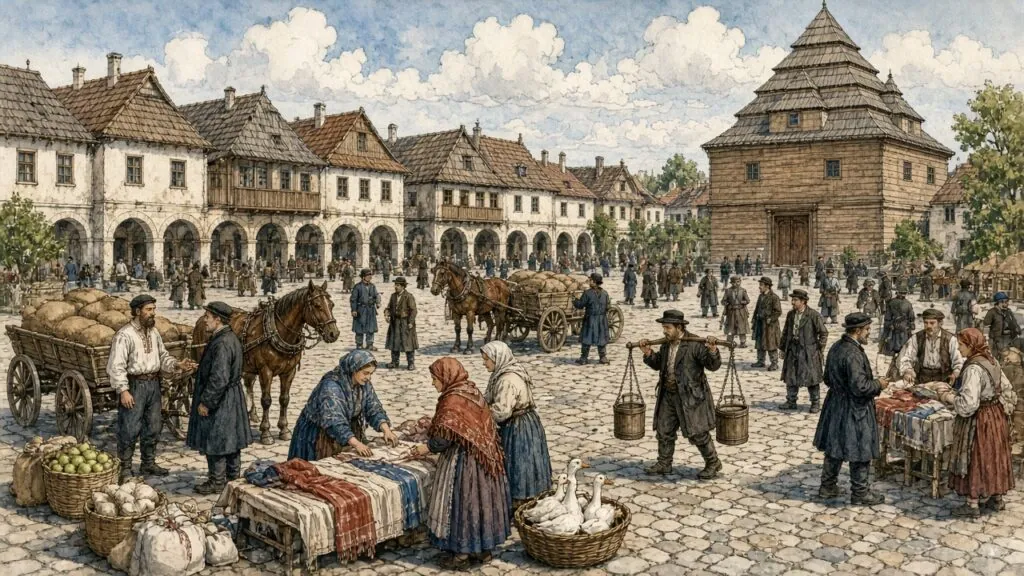
The lesson on shtetl life, with a video of more than fourteen minutes, is one of the longest in the module.[30] The shtetl was the characteristic setting of Jewish life in the region: a small market town with a large Yiddish-speaking population, whose weekly markets and annual fairs brought Jewish merchants and artisans into regular contact with the surrounding peasantry.[42] In his introduction to the course Kassow asks what made the shtetl unique in Jewish history and what communal institutions Jews developed there, and the module pursues both questions together.[30]
The answer to the second question is the subject of the lessons on Jewish communal autonomy and on the Council of the Four Lands. Each Jewish community was governed by its own council, or kahal, an autonomous body that managed taxation, education and welfare.[37] Above the communities stood the Council of Four Lands, the Va’ad Arba Aratzot, which functioned from about 1580 until 1764 as the central organ of Jewish self-government in the Polish Crown. Its name refers to Greater Poland, Little Poland, Ruthenia and Volhynia. Its delegates, most of them laymen rather than rabbis, met as a rule twice a year at the great fairs of Lublin and Jarosław; they apportioned the taxes owed by the Jews to the Crown, settled disputes between communities, issued ordinances known as takkanot, and organised relief after the catastrophe of 1648–49. Its minutes were kept in pinkasim, record books written in Hebrew and Yiddish.[16] The Convocation Sejm of 1764 decreed its abolition, citing its failure to remit collected taxes to the treasury, and the decision took effect on 2 January 1765; Jewish self-government thereafter fragmented into regional and local bodies.[16]

The final lesson, The Changing Collective, considers the transformation of these structures in the eighteenth century, as the institutions of autonomy weakened and the Commonwealth itself approached its end.[30][16] The module thus moves from the origins of the community to the eve of the partitions, and it prepares the ground for the second module, which asks what happened to that community when the state in which it had grown ceased to exist.
7. Module 2, What Happened to Polish Jews after Poland Disappeared?
The second module asks “What Happened to Polish Jews after Poland Disappeared?” Its eight lessons are entitled Polish Jews & the European Enlightenment; The Jews of Galicia; Origins of the Pale of Settlement; Russian Jews and the Challenge of Conscription; Maskilim and the Modern State; Enlightenment and its Conflicts; Alexander III and the Aftereffects of 1881; and On the Eve of Revolution, 1903-1905.[30] The question in the title is a literal one. In three partitions, in 1772, 1793 and 1795, Russia, Prussia and Austria divided the territory of the Commonwealth between them until nothing of it remained.[43][39] The largest Jewish community in the world thus became, within a generation, the subject population of three different empires, and most of it came under Russian rule.[43][37]
Austria’s share, from the first partition onwards, was the southern territory known as Galicia, centred on Lwów, which was enlarged in 1795.[43] The lesson on the Jews of Galicia concerns a community that grew rapidly under Habsburg rule: from 144,000 in 1776 to more than 800,000 by 1900.[44] Galicia was also one of the first places in which the ideas of the Jewish Enlightenment took institutional form in the East, with government-sponsored schools established in Brody and Lemberg by 1813.[45]
The Russian Empire, which had classified Jews as foreigners and barred them from its interior, now ruled the greater part of Polish Jewry.[46] Its response, as the lesson on the origins of the Pale explains, was territorial confinement. The Pale of Settlement, which originated in a decree of Catherine II in 1791, restricted most Jewish residence to the western provinces of the empire, and it was abolished only in 1917.[46] For more than a century, therefore, the great majority of the empire’s Jews lived within a single region on its western edge, and the market towns of the former Commonwealth remained the setting of much of their life.[46][42]
The lesson on conscription addresses one of the most painful episodes of the period. Under Nicholas I, a decree of 26 August 1827 extended military service to Jewish males, who had previously paid a tax in lieu of recruitment. The decree applied to Jews between the ages of twelve and twenty-five and required minors under eighteen to undergo preparatory training in special cantonist battalions and schools before beginning full terms of twenty-five years.[47] The communities were made responsible for filling quotas, and during the 1850s the burden led to the forcible seizure of boys by “khapers”, or kidnappers. An estimated 30,000 to 50,000 Jewish boys passed through the system, which subjected them to harsh discipline and to inducements and pressure to accept baptism; it was ended in 1856.[47]
The lessons on the maskilim and the modern state, and on the conflicts of the Enlightenment, introduce a theme that the third module develops at length. In Eastern Europe the Jewish Enlightenment took a more confrontational stance towards Hasidism and traditional practice than it had in Berlin, used Yiddish alongside Hebrew to reach a wider public, and became associated with government-sponsored initiatives such as the Galician schools; its adherents, the maskilim, accordingly found themselves in frequent conflict with traditionalists.[45] Isaac Baer Levinsohn of Kremenets, in his Te’udah be-Yisra’el of 1828, argued that secular knowledge strengthened rather than weakened fidelity to the Torah and recommended agricultural training as a remedy for poverty; in the 1860s and 1870s more radical figures such as the poet Yehudah Leib Gordon sharpened the movement’s criticism of rabbinic authority.[45]
The penultimate lesson turns to 1881, the year that marks a dividing line in the modern history of Russian Jewry. After the assassination of Alexander II on 13 March 1881, pogroms broke out in more than 160 localities in southern Russia and Ukraine between April and July. His successor, Alexander III, responded not by protecting the victims but by restricting them further.[48] The May Laws, the Temporary Regulations Concerning the Jews of 15 May 1882, prohibited Jews from settling outside towns and townlets within the Pale and from acquiring rural property, and although they were described as temporary they remained in force until the revolution of 1917.[49] In 1887 quotas were imposed on the admission of Jews to secondary schools and universities: ten per cent within the Pale, five per cent elsewhere, and three per cent in Moscow and St Petersburg.[48] Approximately two million Jews emigrated from the Russian Empire between 1881 and 1914.[48]
The violence spread in waves. The first pogrom broke out on 15 April 1881 in Elisavetgrad, where mobs looted and destroyed Jewish homes and businesses over two days, and the riots spread to neighbouring towns; by late April they had reached Kiev and Odessa, they continued sporadically through the summer, reached Warsaw on 25 December 1881, and ended in a final wave in the spring of 1882 that included the severe pogrom at Balta in Podolia. In all, more than 250 separate incidents occurred in more than 200 towns and villages.[50] The pogroms accelerated Jewish emigration and reshaped the demography of the Jewish world.[51]
For many of the emigrants the destination was the United States. In New York, Russian Jewish immigrants established in 1881 a Russian Emigrant Relief Committee, from which the Hebrew Immigrant Aid Society, HIAS, traces its origins; its early work consisted of legal aid, shelter and help in finding employment for Jewish arrivals at American ports.[52] The federal immigration station on Ellis Island, which opened on 1 January 1892, reached its peak in 1907, when it processed 1,004,756 immigrants, and on 17 April of that year it set a single-day record by examining 11,747 arrivals.[53] The communities formed by these emigrants were to matter a great deal to YIVO. Zamlers in the Americas sent material to Vilna, American Jews supplied the main part of the Institute’s budget between the wars, and in the 1950s the acquisition of records from organisations including HIAS made the YIVO Archives a major centre for the study of American Jewish history.[5][15]
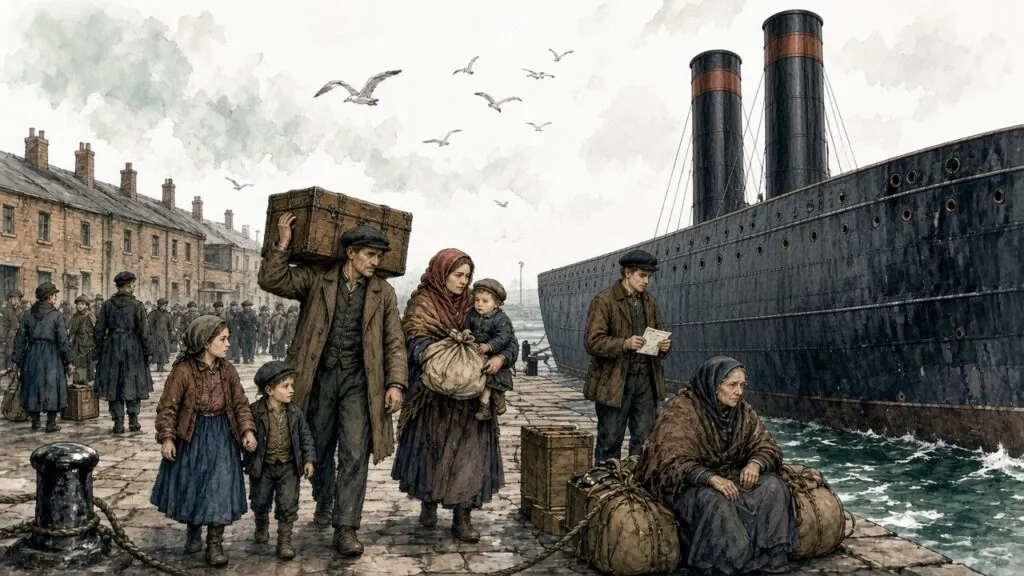
The final lesson, On the Eve of Revolution, 1903-1905, brings the module to the opening of the twentieth century.[30] On 19 and 20 April 1903 a pogrom in Kishinev, the capital of Bessarabia, killed 49 Jews and injured more than 500; it was not the deadliest pogrom in Russian history, but vivid eyewitness accounts and international reporting gave it exceptional notoriety, and it spurred emigration, self-defence organisations and Zionist activism.[54]
The pogrom had been prepared by words. The Kishinev newspaper Bessarabets, edited by Pavel Krushevan, had for years vilified Jews as ritual murderers, and in the weeks before Easter 1903 it published sensational articles promoting the blood libel. The violence began on Easter Sunday, 6 April by the Julian calendar then in use in Russia; the local police chief informed the governor, Rudolf von Raaben, of the first incidents that afternoon, but no significant preventive measures were taken, and eyewitnesses reported police watching without intervening.[54] The judicial aftermath was lenient. Two men received sentences of seven and five years’ hard labour for murder and others received short terms for lesser offences, but the majority of more than 700 detainees were ultimately released without punishment.[54] Krushevan, for his part, went on to edit the St Petersburg newspaper Znamya, in which he serialised portions of the fabricated Protocols of the Elders of Zion between 1903 and 1905.[55]
During the revolutionary upheaval of 1905 a further wave of pogroms followed, including one in Odessa in October 1905 that killed at least 400 Jews.[51] The module thus ends where the politics of the later modules begin, in a community that had lost its old institutions, had been confined by a hostile state, and was now searching for new answers to its situation.
8. Module 3, Haskalah and Hasidism, Revolution from Within
The third module, “Haskalah and Hasidism: Revolution from Within”, takes up the comparison that the course description names as one of its central exercises.[4] Its eight lessons are entitled Haskalah: The Jewish Enlightenment; The Trouble With Yiddish; Enlightenment Idealism and the New Jew; Inventory of the Jewish Past: Wissenschaft des Judentums; Moses Mendelssohn and the ‘Beckoning Other’; The Rise of Hasidism; Jewish Mysticism and the Baal Shem Tov; and The Vilna Gaon and the Misnagdim.[30] The subtitle states the thesis. Both movements, opposed as they were, transformed Jewish life from within the community rather than by external decree, and the module treats them as parallel responses to the same eighteenth-century world.
The Haskalah, the Jewish Enlightenment, was an intellectual and cultural movement among Ashkenazi Jews in Central and Eastern Europe that ran roughly from the 1770s to the 1880s. It emphasised rational inquiry, secular study and integration into European society, together with a reformed approach to Jewish tradition.[45] Its archetypal figure was Moses Mendelssohn (1729–1786), who was born into poverty in Dessau, educated himself in philosophy and rose to prominence in Berlin as a silk merchant and as the friend and collaborator of Gotthold Ephraim Lessing. His Phaedo of 1767 defended the immortality of the soul, and his Jerusalem of 1783 argued against religious coercion.[56] Lessing modelled the hero of his play Nathan der Weise, of 1779, on his friend.[56] The lesson’s title, with its reference to a “beckoning other”, points to the attraction that the surrounding culture exerted on Mendelssohn’s generation, and his own career has been read both as a demonstration that Judaism and European learning could be reconciled and, by his critics, as a step towards assimilation.[30][56]
The lesson entitled The Trouble With Yiddish concerns the language question that ran through the movement. Mendelssohn’s German translation of the Pentateuch, the Biur, printed in Hebrew characters between 1780 and 1783 with a commentary, was intended to give Yiddish-speaking Jews an alternative to the existing Yiddish translations and to equip them with High German.[56] In its Berlin phase the Haskalah urged the replacement of Yiddish by German as the means of access to European science and philosophy, and in the East its literary journals promoted a purified biblical Hebrew. Yet in Galicia and the Russian Empire the maskilim also used Yiddish, because it was the language that their intended readers spoke.[45] The movement that disdained Yiddish thus helped to lay the foundations of modern Yiddish literature.[45]
The fourth lesson turns to the Wissenschaft des Judentums, the “science of Judaism”, which the course describes as an inventory of the Jewish past.[30] Its founding impulse is traced to Leopold Zunz’s essay of 1818 on rabbinic literature, which called for objective research into Jewish writings. In 1819 Zunz, the jurist Eduard Gans and Moses Moser, among others, founded in Berlin the Verein für Kultur und Wissenschaft der Juden, the Society for the Culture and Science of the Jews; later scholars such as the historian Heinrich Graetz, author of a multi-volume history of the Jews, and the reformer Abraham Geiger extended its scope.[57] The lesson has a particular resonance in a course offered by YIVO, which may itself be seen as an heir of that tradition, transposed into Yiddish and directed towards the life of the Jewish people as a whole.
Before it reaches the Baal Shem Tov, the module invites a word on the religious crisis that preceded him, since the century before Hasidism was overshadowed by a mass messianic movement. Sabbatai Zevi (1626–1676), a kabbalist born in Smyrna in the Ottoman Empire, proclaimed himself the Messiah in his native city during Rosh Hashanah of 1665, and his claim was amplified by Nathan of Gaza, who presented himself as Zevi’s prophet and framed his mission against the background of Jewish suffering after the massacres of 1648.[58] The movement swept Jewish communities from the Ottoman Empire to Europe, with reports of thousands selling their possessions in preparation for the journey to Jerusalem. In February 1666 Zevi was arrested on his arrival in Constantinople and taken to Edirne, where, faced with a choice between execution and conversion, he became a Muslim on 16 September 1666, taking the name Aziz Mehmed Effendi.[58]
The apostasy did not end the movement. Its core followers interpreted the conversion not as defeat but as a deliberate descent into impurity in order to raise the fallen divine sparks, and persistent groups such as the Dönmeh of Salonika and Constantinople professed Islam outwardly while maintaining Jewish rites in secret and developing the antinomian theology of “redemption through sin”.[59] In the Polish lands this current found its most notorious heir in Jacob Frank (c. 1726–1791), who presented himself as the reincarnation of Sabbatai Zevi and taught that redemption required the deliberate transgression of the commandments; his followers compiled his oral teachings in The Words of the Lord.[60][61] Rituals uncovered in 1756 at Lanckoroń in Podolia led to excommunications by rabbinic courts; a disputation at Kamieniec Podolski in 1757 was followed by the burning of copies of the Talmud there, and after a larger disputation at Lwów in 1759 some 500 to 1,000 Frankists were baptised there in 1759 and 1760, outwardly professing Christianity while preserving their esoteric beliefs.[60][61]
These episodes form part of the setting in which Hasidism emerged, in the same province of Podolia and in the same decades. Whether they influenced it directly remains a matter of scholarly debate, and the links between Sabbateanism and Hasidism are contested.[59] A different line of explanation draws on economic history: as the leaseholding of taverns drew Jews into the countryside, rural innkeepers came to live far from the schools and communal religious life of the market towns, and some scholars have suggested that the roots of the Hasidic movement lay in this rural shift.[41] The student who comes to the lessons on the Baal Shem Tov with these contexts in mind will better understand why a movement of joyful prayer and accessible holiness proved so attractive, and why its opponents watched it with such suspicion.
The second half of the module concerns Hasidism. Israel ben Eliezer (c. 1700–1760), known as the Baal Shem Tov or by the acronym Besht, was a mystic and practitioner of practical Kabbalah who emerged as a religious leader in Podolia. According to the accounts collected about him, he revealed his teachings publicly around 1734 in Medzhybizh, where he gathered disciples.[62] His teaching stressed devekut, the cleaving of the soul to God, joyful prayer and the presence of holiness in everyday life, and it made mystical experience accessible to Jews who were not scholars.[62] After his death the movement spread rapidly under his successors, among them Dov Ber of Mezeritch.[62][63]
The final lesson presents the opposition. Elijah ben Solomon Zalman (1720–1797), the Vilna Gaon, was a Talmudist, halakhist and kabbalist whose learning defined the intellectual summit of traditional East European Judaism. He settled in Vilna around 1740 and declined communal office in order to devote himself to study.[64] The opponents of Hasidism, known as Misnagdim, regarded its charismatic leadership and its departures from established practice as a threat to rabbinic norms.[62][65] In 1772, during the intermediate days of Passover, the Vilna community began organised measures against the Hasidim, including the excommunication of local adherents.[65] The conflict, which pitted a movement of popular piety against the authority of learning, shaped the religious map of Eastern Europe for generations; among the Gaon’s best-known students was Hayyim of Volozhin.[65][64]
The module is a demanding one, and it is among the most rewarding. It shows the student that Jewish modernity in Eastern Europe was not simply imposed from outside, but was produced by debates among Jews themselves: between reason and tradition, between Hebrew, German and Yiddish, and between the authority of the scholar and that of the charismatic leader.
9. Module 4, What Accounts for Zionism’s Surprising Success?
The fourth module poses its question in its title: “What Accounts for Zionism’s Surprising Success?” Its seven lessons are entitled Dream Versus Reality in Eastern Europe; Leon Pinsker’s Auto-Emancipation; Herzl’s Dream; L’Affaire Dreyfus and Political Anti-Semitism in Europe; Herzl and the Failure of European Liberalism; Ahad Ha-Am’s Cultural Zionism; and Chaim Weizmann and the Synthesis of Modern Zionism.[30] The word “surprising” is well chosen. It asks the student to explain the movement’s achievement rather than to assume it, and to consider the alternatives that later modules examine in their own right.
The first of the movement’s modern theorists to be studied is Leon Pinsker (1821–1891), a Russian Jewish physician who had at first supported emancipation and integration within Russian society. The pogroms of 1881 changed his view.[66] In Auto-Emancipation, a pamphlet written in German and published in 1882, he diagnosed hatred of the Jews, which he called “Judeophobia”, not as a prejudice that education might cure but as a deep-seated aversion to a people that lived as a nation without a land. He concluded that Jews could not wait to be emancipated by others but must emancipate themselves, through organised action to secure a territory of their own, whether in Palestine or elsewhere.[50][66] Pinsker became the leader of the Hibbat Zion, or Lovers of Zion, movement, and in 1884 he chaired the Kattowitz Conference, the first international gathering of its groups.[66] The pamphlet’s influence can be traced in the first wave of Jewish immigration to Palestine, the First Aliyah of 1882 to 1903.[50]
The lessons on Herzl follow. Theodor Herzl (1860–1904) was born in Budapest into an assimilated family, studied law in Vienna and made his career as a journalist and playwright, at first in the belief that emancipation would secure the equality of the Jews.[67] The Dreyfus affair, which he covered as a correspondent in 1895, persuaded him otherwise.[67] The affair, which convulsed the French Third Republic from 1894 to 1906, arose from the false conviction for treason of Alfred Dreyfus, a Jewish captain on the General Staff, on the basis of a document, the bordereau, that was later shown to have been written by Major Ferdinand Walsin Esterhazy. At Dreyfus’s public degradation, his insignia were torn away and his sword broken amid cries of “Death to the Jews”, and he was sent to Devil’s Island.[68] The affair shattered Herzl’s belief in assimilation and led him to conclude that the Jews required a state of their own; the course’s lesson title speaks accordingly of the failure of European liberalism.[67][30]
In 1896 Herzl published Der Judenstaat, The Jewish State, a plan for Jewish self-determination through international diplomacy and organised settlement. In the following year he convened the First Zionist Congress in Basel, from 29 to 31 August 1897, which was attended by some 200 delegates from 17 countries and adopted the Basel Programme, whose stated aim was a home for the Jewish people in Palestine secured by public law.[67][69] Herzl was elected president of the newly formed Zionist Organisation, and after the congress he wrote in his diary: “At Basel I founded the Jewish State”.[67][69] He died in July 1904, at the age of forty-four.[67]
The lesson on Ahad Ha-Am introduces a different conception of the movement. Asher Ginsberg (1856–1927), who wrote under the pen name Ahad Ha’am, “one of the people”, was born into a wealthy Hasidic family in Skvira in Ukraine. He joined Hibbat Zion in Odessa in 1884, founded the B’nai Moshe society in 1889, and edited the Hebrew journal Ha-Shiloah from 1896 to 1903.[70] In his essay “Lo Zu ha-Derekh”, This Is Not the Way, of 1889, and in later essays, he argued for a gradual spiritual and cultural revival of Jewish national consciousness centred in the Land of Israel, rather than for the priority of mass immigration or of political sovereignty, and he criticised the early settlements for their neglect of Hebrew education.[70] His cultural Zionism influenced both Chaim Weizmann and the poet Hayim Nahman Bialik.[70]
The final lesson presents Chaim Weizmann (1874–1952) as the figure in whom the strands of the movement came together. Weizmann was born in Motol, near Pinsk, in the Pale of Settlement, and became a biochemist. During the First World War he developed an industrial fermentation process for the production of acetone, which was essential for British munitions, and the influence this gave him contributed to the securing of the Balfour Declaration of 1917, the British endorsement of a Jewish national home in Palestine.[71] He presided over the World Zionist Organisation from 1921 to 1931 and from 1935 to 1946, and became the first president of the State of Israel in 1949.[71] The lesson title speaks of a “synthesis of modern Zionism”, and the outline of Weizmann’s career suggests why: he was a product of the Pale, an admirer of Ahad Ha’am, and a diplomat who obtained from a great power the kind of public commitment that Herzl had sought.[30][71][70]
The module thus answers its question without simplification. It sets the dream against East European reality, follows the movement from the shock of 1881 to the diplomacy of the First World War, and shows that Zionism was not a single doctrine but a set of competing programmes, political, practical and cultural, each of which the student is asked to weigh.
10. Module 5, Varieties of Jewish Nationalism
The fifth module, “Varieties of Jewish Nationalism”, is the longest in the course, with nine lessons. The course syllabus gives it the alternative title “Was Secular Yiddish Culture An Alternative Yiddish Nation?”, and its lessons are entitled In the ‘City of Slaughter’; Marx Meets Borochov: Labor Zionism in a Time of Revolution; Origins of the Jewish Labor Bund; The Ballad of Hirsh Lekert: Organizing the Jewish Workers; ‘Fighting for Jewish Dignity’: The Bund’s Growing Jewish Nationalism; Doikeyt: The Bund in Interwar Poland; Language as Homeland; The Invention of the Yiddish Literary Canon; and I.L. Peretz and the Road to Modern Yiddish Culture.[30] Where the fourth module followed one answer to the Jewish question, the fifth sets out the others, and it takes up the guiding question from the course’s welcome letter about how modern Yiddish culture could serve as an alternative ideology of Jewish nationalism.[30]
The module begins with a poem. Hayim Nahman Bialik (1873–1934), born in Radi in Volhynia, had established his reputation with Ha-Matmid, The Talmud Student, serialised in 1898 in Ahad Ha’am’s journal Ha-Shiloah.[72] In 1903 he wrote, in Hebrew, “In the City of Slaughter” (Be’ir ha-Harega), a response to the Kishinev pogrom, which was first published in 1904 in the periodical ha-Zeman under the pseudonym “Massa Nemirov”, in order to evade the tsarist censor.[73] The poem takes the form of a prophetic tour of the aftermath of the pogrom. It depicts the carnage, the silence of God and the victims cowering in their hiding places, and it criticises with great severity the passivity of Jewish men who had failed to defend their families.[73] The poem provoked widespread debate and is regarded as among the most influential modern Hebrew poems; it contributed to the turn towards self-defence and assertive nationalism that marked Jewish politics after 1903.[73][54] By placing it at the head of the module, the course makes the shock of Kishinev the point of departure for every variety of nationalism that follows.
The second lesson concerns Ber Borochov (1881–1917), a Marxist theorist who sought to reconcile Zionism with the class struggle. In his essay The National Question and the Class Struggle, of 1905, he argued that the occupational structure of the Jews in the diaspora, concentrated in petty trade rather than productive labour, prevented them from taking a normal part in that struggle, and that the concentration of Jewish workers in Palestine would allow a socialist society to develop there.[74] In 1906 he co-founded the Poale Zion, the Workers of Zion, as a Marxist party within Russian Jewish socialism, in opposition to the anti-Zionist Bund.[74]
The next four lessons are devoted to the Bund. The General Jewish Labour Bund, the Algemeyner Yidisher Arbeter Bund, was founded clandestinely in Vilna in October 1897 by delegates of Jewish workers’ circles. It was Marxist in principle, rejected both assimilation and religious orthodoxy, and defended the Yiddish-speaking working population through strikes, mutual aid and, in the pogroms of 1903 to 1906, self-defence units.[75] The Bund was founded in the same year as the First Zionist Congress, and the coincidence is instructive: two of the largest movements in modern Jewish politics emerged within weeks of each other, offering opposite answers to the same predicament.[75][69]
The lesson on the origins of the Bund concerns a movement that grew out of the particular conditions of “Jewish Lithuania”, the north-western provinces headed by Vilna, where the Encyclopaedia Judaica places the first stirrings of the Jewish labour movement and the earliest leaders of the Bund.[76] Study circles formed in Vilna in 1886 and 1887 to promote culture and socialism among Jewish working men conducted all their activities in Russian. Between 1890 and 1895, under the leadership of Arkadii Kremer, Shmul Gozhansky, J. Mill, V. Kossovski, A. Mutnik and others, they changed course.[76] Kremer’s pamphlet On Agitation, written and published with the help of Julius Martov in 1893 and known as the “Vilna Program”, argued that activists should leave the closed study circle for mass agitation, organising the practical struggle for higher wages, shorter hours and better conditions, and it became widely influential in Russian social democratic circles as a whole.[77] To reach the Jewish masses, the activists resolved to replace Russian by Yiddish, and “jargon committees” were formed in Vilna in 1895 for the purpose; the movement thus became part of the contemporary revival of Yiddish language and literature. By the beginning of 1896 there were 32 workers’ struggle funds, the precursors of trade unions, in Vilna alone.[76]
The founding itself was modest in scale. The Bund was established at a secret convention held in Vilna from 7 to 9 October 1897, attended by thirteen delegates, eight of them working men.[76] Kremer, who had long hesitated to create a formal party, insisted on a name that implied a coalition of like-minded individuals and local organisations rather than a cohesive party, hence Bund, “federation”, and he was chosen as one of the three members of its first Central Committee.[77] A few months later he was among the principal organisers of the founding congress of the Russian Social Democratic Labour Party, held in March 1898, at which three of the nine delegates were Bundists.[77][76] Between 1903 and 1905 the Bund’s membership varied between 25,000 and 35,000.[76] Kremer himself withdrew from party politics before the First World War and spent his last years in Poland, where his death in 1935 was marked by mass marches; his wife Pati Kremer, a socialist leader and Bundist pioneer in her own right, was murdered during the liquidation of the Vilna ghetto.[77]
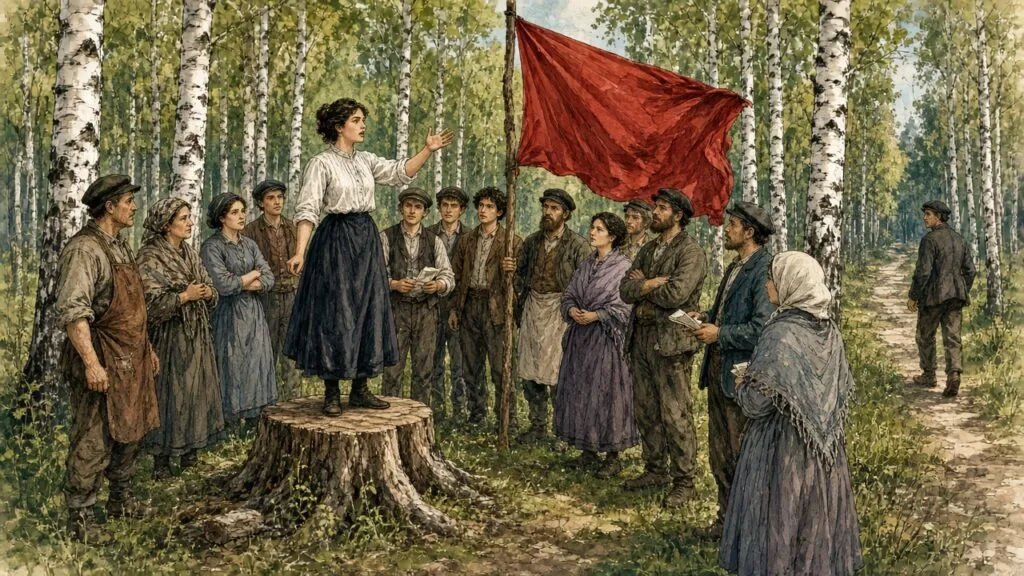
The lesson on Hirsh Lekert introduces a figure who became a legend of the Jewish labour movement. Lekert, a bootmaker born around 1879 into a poor family in the north-eastern Lithuanian town of Onuškis, had been active from his youth in workers’ groups and in the Bund in Dvinsk, Kovno, Yekaterinoslav and Vilna. After the May Day demonstration of 1902 the governor of Vilna, Victor von Wahl, ordered the flogging of 26 demonstrators, 20 of them Jews; on 18 May 1902 Lekert fired at the governor and wounded him, and he was sentenced to death by a military court and hanged on 10 June 1902.[78][79] The Vilna committee of the Bund, opposed in principle to political terror, had refused to support the attack officially, but the affair aroused terrorist tendencies within the party for a time: its fifth conference, at Berdichev in August 1902, adopted a resolution for a policy of “organized revenge”, which was later rescinded under the influence of the Bund’s committee abroad.[79] The Jewish population in general regarded the shooting “as an act in defense of Jewish honor”, and Lekert became a hero among Jewish workers, commemorated in popular songs and literary works and, in the 1920s, by a monument in Soviet Minsk.[79][78] The course’s title for the lesson, “The Ballad of Hirsh Lekert”, alludes to that afterlife in song.
The following lesson, “Fighting for Jewish Dignity”, traces the Bund’s development from a workers’ organisation into a movement with an explicitly national programme.[30] Its ideology centred on doikayt, or “hereness”, the conviction that Jews should secure their future where they lived, and on national-cultural autonomy for Jews as a minority within a socialist framework, in opposition to the territorial programme of Zionism.[75] The lesson on doikeyt in interwar Poland follows the movement into the new Polish state. The General Jewish Labour Bund in Poland was formally established in December 1917 as the independent successor to the Polish branches of the original Bund. It promoted Yiddish-language education and culture as the basis of Jewish national identity, became the largest Jewish political force in interwar Poland, dominated the Jewish labour unions in Warsaw and Łódź, and built cooperatives, cultural societies and youth movements, among them Tsukunft.[80] During the German occupation, Bundists took part in the underground and in the Warsaw ghetto uprising.[80]
The final three lessons concern the culture that the Bund and other Yiddishists regarded as the substance of Jewish nationhood. The lesson title “Language as Homeland” states the idea concisely.[30] Its most famous public expression was the conference on the Yiddish language held at Czernowitz, the principal Yiddish-speaking centre of Bukovina, from 30 August to 4 September 1908, the first international and inter-party conference to deal with the role of Yiddish in Jewish life.[81] The idea was first proposed by Nathan Birnbaum, and the original call was issued by an organising committee in New York consisting of Birnbaum, the dramatists Jacob Gordin and David Pinski, the publisher A. M. Evalenko and the philosopher Chaim Zhitlowsky.[81] The seventy delegates represented every shade of Jewish opinion, from Zionist Hebraists to militant Bundists, and included Peretz, Abraham Reisen, Sholem Asch, H. D. Nomberg, Noah Prylucki and Matthias Mieses; Mendele Moykher-Sforim and Sholem Aleichem, prevented by illness from attending, endorsed its aims.[81]
The agenda included orthography, grammar, literature, theatre, the press and the translation of the Bible into Yiddish, but above all the recognition of Yiddish as a national language of the Jewish people. The debate between those who regarded Hebrew as the only national language and those who regarded Yiddish as the living language of the people ended in a compromise. The conference proclaimed Yiddish “a national language”, rather than “the national language”, and called for its political, cultural and social equality with other languages, leaving delegates free to take whatever position on Hebrew their convictions dictated.[81] In his speech there Peretz presented Yiddish as the national language of the Jewish people.[82] The resolution also called for the creation of modern Yiddish schools.[83] The reception was mixed: Ahad Ha-Am called the gathering a Purim spectacle, while the critics S. Niger and Ba’al-Makhshoves defended it as a historic achievement. Afterwards Peretz, Asch, Reisen and Nomberg toured the Jewish communities of Galicia and Bukovina to strengthen interest in Yiddish, and the conference, in the encyclopedia’s judgement, heightened the prestige of the language and laid the ideological basis for the later founding of YIVO.[81] YIVO, founded seventeen years later, itself published a study of the conference.[9]
The lesson on the invention of the Yiddish literary canon concerns the three writers whom Yiddish readers came to call “di klasiker”, the classic authors: Mendele Moykher-Sforim, I. L. Peretz and Sholem Aleichem.[18] Mendele, the pen name of Sholem Yankev Abramovitsh (1835–1917), began by writing in Hebrew in the service of the Enlightenment and turned to Yiddish in the 1860s, and he is often called the “grandfather of Yiddish literature”.[84] Sholem Aleichem, the pen name of Solomon Rabinovich (1859–1916), created the monologues of Tevye the dairyman, which later inspired Fiddler on the Roof.[85]
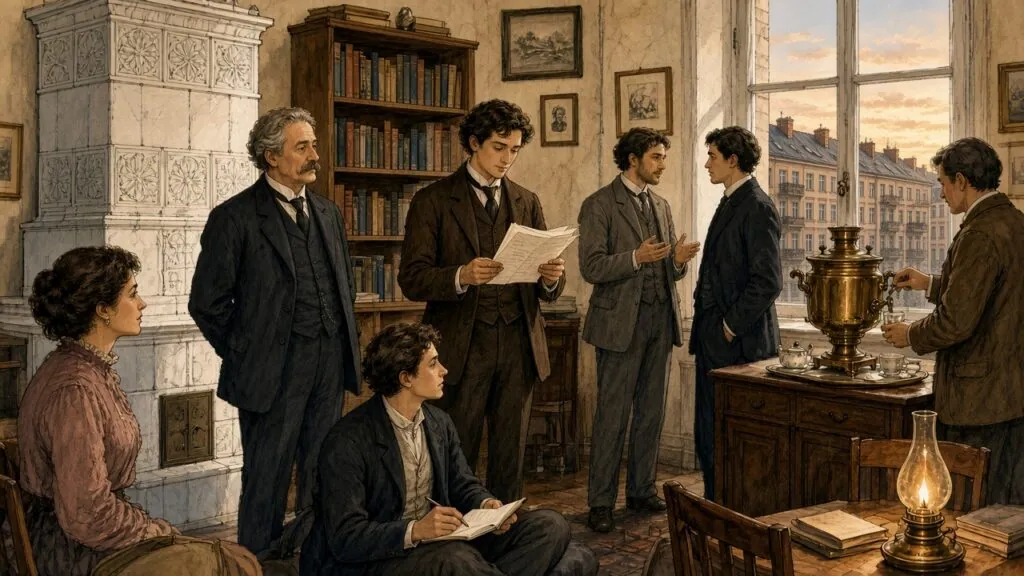
The module ends with Peretz himself. Yitskhok Leybush Peretz (1852–1915) was born in Zamość, practised law there from 1877 to 1888, and made his Yiddish debut in 1888 with the dramatic poem Monish.[82] After a denunciation forced him to abandon his practice, he moved to Warsaw, where from 1891 he worked as a clerk of the Jewish Community Council for the rest of his life. He organised libraries, choral societies and orphanages, and his home became a gathering place for young writers.[82] He favoured doikeyt over the Zionist “thereness” and became a leader of the Yiddishist movement; when he died in 1915, some 100,000 people attended his funeral.[82] The module’s final lesson title, “the road to modern Yiddish culture”, aptly describes his place in the course: he links the Enlightenment satire of the earlier modules with the secular Yiddish culture of interwar Poland, of which YIVO itself was one of the principal institutions.[30][5]
11. Module 6, Jewish Warfare, Resistance and Continuity during World War II
The sixth module, “Jewish Warfare, Resistance and Continuity during World War II”, carries the survey from the First World War to the aftermath of the Second. Its eight lessons are entitled WWI and the End of the Pale; Jews as Polish Citizens; The Politics of Exile; The Paradox of Polish Jewry; ‘No Pogroms in the Red Army’: Soviet Jewry 1917-1952; Hannah Arendt and the Question of Jewish Resistance; Understanding the Judenrat; and Spiritual Resistance.[30] It is the module closest to Kassow’s own research, and it asks the question set out in the welcome letter: in what ways Jews worked to create resistance movements and foundations of continuity, even within the ghettos.[30][4]
The opening lesson marks the end of an era. The Pale of Settlement, which had defined the lives of most Russian Jews since the reign of Catherine II, was abolished in 1917, and the May Laws of 1882 remained in force until the same revolutionary year.[46][49] At the war’s end the Polish state was re-established in 1918, after 123 years of partition, and it secured its eastern frontiers in the war with Soviet Russia of 1919 to 1921.[86]
The lessons on Jews as Polish citizens and on the paradox of Polish Jewry concern the largest Jewish community in Europe. The Jewish population of interwar Poland numbered 2,855,000 in 1921 and 3,114,000 at the census of 1931, about 9.8 per cent of the total, and reached roughly 3.3 million by 1939.[37] The political life of this community was extraordinarily varied. The Bund and the Zionist parties competed for its loyalty, alongside smaller groups such as the Folkists, and by 1938 and 1939 the Bund was winning a large majority of Jewish votes in the main cities.[37][80] At the same time Polish Jews faced growing hostility. The republic’s parliamentary period ended with Józef Piłsudski’s coup of May 1926 and the Sanation regime that followed.[86] In the 1930s the National Democratic movement promoted boycotts of Jewish shops, Jewish enrolment in universities was restricted, and from 1935 “ghetto benches” segregated Jewish students in lecture halls.[86][37] The paradox of the lesson title is apparent from these facts alone: a community of unprecedented cultural and political vitality lived in a state that increasingly treated it as alien.
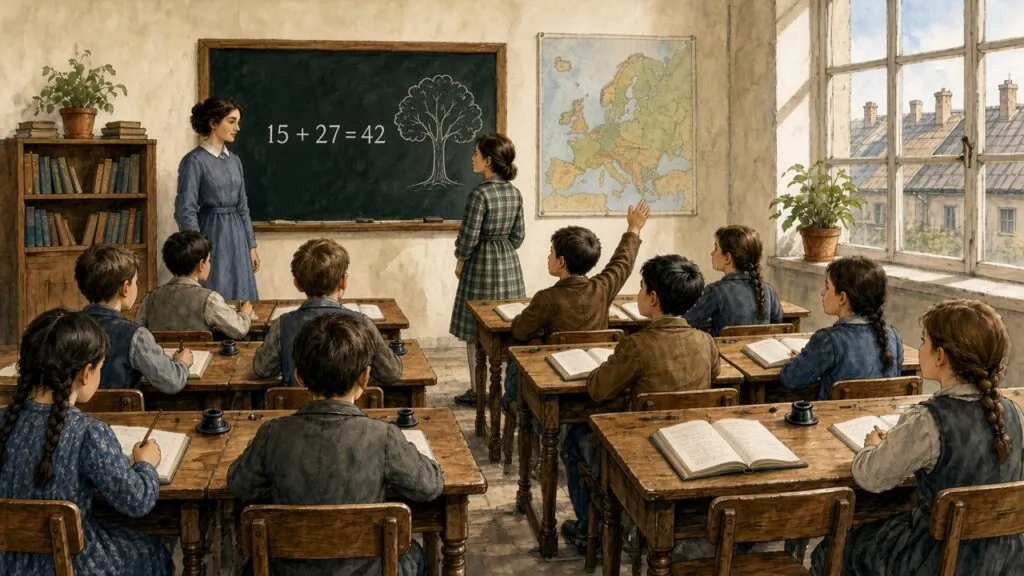
One of the clearest measures of that vitality was the networks of Jewish schools that the community built in interwar Poland. The demand for modern Yiddish schools went back before the First World War: in 1907 the first nationwide conference of teachers in modern secular Jewish schools called for Yiddish to become the language of instruction, the Czernowitz conference of 1908 called for the creation of such schools, and in 1910 the Bundist theoretician Ester Frumkin published a full-length study of the question of the Yiddish folk school.[83] The Central Yiddish School Organisation, Di Tsentrale Yidishe Shul-Organizatsye, known as TSYSHO, was established in Warsaw in June 1921, led primarily by members of the Bund and the Left Po’ale Tsiyon, with the Bundist Beynish Mikhalevitsh as its first chairman. Its curriculum combined Yiddish language and literature, Jewish history and culture, the sciences, mathematics, music, physical education and crafts, while Polish language, literature and history were taught in Polish.[83]
At its peak, in the late 1920s, TSYSHO maintained 219 institutions with 24,000 students in 100 localities, including 46 kindergartens, 114 elementary schools, 6 high schools, 52 evening schools and a pedagogical institute in Vilna. The Vilna Realgymnazye was the first high school in which Yiddish was the language of instruction, and the Vilna Teachers’ Seminary, which operated from 1921 to 1931 and counted Max Weinreich among its instructors, trained the 124 graduates who became the core of the secular Yiddish teaching profession.[83] The Depression, the decline of aid from abroad and the absence of government subsidies brought decline: in 1934–35 the network had 15,486 pupils, 9.15 per cent of the 180,681 pupils attending Jewish schools. Its schools were concentrated in the eastern provinces, where linguistic acculturation was weakest, and their share there rose from 68.5 per cent in 1926–27 to 75.5 per cent by 1934–35.[83] YIVO worked closely with these schools. In 1936 TSYSHO agreed to adopt the Institute’s orthographic rules in its classrooms, and between 1937 and 1939 the two organisations held a series of teachers’ conferences and training courses together.[15]
A second network, Tarbut, a secular Zionist system in which Hebrew was the language of instruction, took its name in Moscow in the spring of 1917, when the society of Lovers of the Hebrew Language renamed itself; in Soviet Russia Hebrew schools were closed from 1919, but in Poland the network flourished. Its first national conference met in Warsaw in December 1921 with 178 delegates, and its enrolment grew from roughly 2,500 to almost 45,000, in some 270 institutions on the eve of the Second World War: about a quarter of the 180,000 students in Jewish educational institutions and roughly 9 per cent of the half-million Jewish children of school age in Poland.[87] Its pupils learned Hebrew by the “natural method”, Ivrit be-Ivrit, without translation, and the Land of Israel occupied a central place in the curriculum; graduates who settled in Palestine spoke fluent Hebrew, and many became professional educators.[87] Orthodox Jewry built its own institutions, among them the Bais Yaakov movement for the religious education of girls, which Sarah Schenirer founded in Kraków in 1917 with about 25 girls gathered in her apartment and which, under the auspices of Agudath Israel, established hundreds of elementary, secondary and seminary institutions across Poland.[88]
The three networks corresponded to three of the principal currents in Polish Jewish life, Yiddishist socialism, Zionism and Orthodoxy, so that the competition that the fifth module traces in politics was reproduced in the classroom. The end came with the war. About 150 TSYSHO leaders fled to Vilna in 1939, where figures such as Khayim Shloyme Kazdan continued its publications and schools for a time, but the German occupation of Poland and the Soviet annexation of Lithuania in 1940 brought the system to a formal end, although many of its teachers took part in the underground education of the ghettos.[83]
The lesson on Soviet Jewry takes its title from the phrase “No Pogroms in the Red Army” and follows the very different experience of Jews under Soviet rule from 1917 to 1952.[30] The Jewish population of the Soviet Union numbered roughly 2.7 million in the mid-1920s and about 3 million by 1939. In 1922 Jews formed 5.2 per cent of the members of the Communist Party, although they made up only 1.8 per cent of the population.[89] Early Soviet policy promoted secular Yiddish culture through schools, theatres and publications, while anti-religious campaigns dismantled synagogues and yeshivas.[89] The instrument of this policy was the Yevsektsiya, the Jewish sections of the Communist Party, which operated from 1918 to 1930. It abolished the traditional community councils by decree in 1918, suppressed Zionist organisations from 1919, banned Hebrew education, and established Soviet Yiddish schools, theatres and newspapers.[90] During the Second World War the Jewish Anti-Fascist Committee, formed in 1942 and chaired by the actor Solomon Mikhoels, rallied Jewish support abroad for the Soviet war effort and documented Nazi crimes against Jews. After the war it fell under suspicion: Mikhoels was murdered in 1948, the committee was dissolved in late 1948, and in 1952 thirteen of its leaders were tried, most of them receiving death sentences, in the episode known as the Night of the Murdered Poets.[91] The closing date in the lesson’s title coincides with that trial.
The next two lessons address one of the most painful debates in the historiography of the Holocaust. The Judenräte, or Jewish councils, were imposed by the German authorities on Jewish communities in occupied Europe, under a directive issued by Reinhard Heydrich on 21 September 1939. They were charged with distributing rations, supplying forced labour, collecting taxes and maintaining order, and during the “Final Solution” they were compelled to supply quotas of Jews for deportation under threat of collective reprisals.[92] Adam Czerniaków, the chairman of the Warsaw Judenrat, took his own life on 23 July 1942, after refusing orders to deport children.[92] Hannah Arendt (1906–1975), in Eichmann in Jerusalem, published in 1963 after first appearing in The New Yorker, argued that the councils’ administrative cooperation, including the compiling of lists, had facilitated the deportations.[93][94] The argument provoked fierce controversy, particularly among Jewish intellectuals and historians.[93] Gershom Scholem publicly accused her of lacking love for the Jewish people, and the exchange ended a friendship of a quarter of a century.[94] By placing a lesson on Arendt beside one entitled “Understanding the Judenrat”, the course invites students to weigh a famous judgement against the circumstances in which the councils actually operated.[30]
The final lesson turns to spiritual resistance. The United States Holocaust Memorial Museum defines spiritual resistance as “attempts by individuals to maintain their humanity, personal integrity, dignity, and sense of civilization in the face of Nazi attempts to dehumanize and degrade them”. In the ghettos this took the form of clandestine schools, of which there were hundreds; of secret libraries, one of which in Częstochowa served more than 1,000 readers; of religious observance, with some 600 prayer groups meeting in the Warsaw ghetto in 1940; and of secret archives, which gathered evidence of the situation of the Jews and sought to reaffirm a Jewish sense of community, history and civilisation.[95] Yad Vashem’s educational materials record that a new concept arose in the ghettos and camps, the “sanctification of life”, meaning that each individual would do everything possible to foil the Nazi attempt to destroy the Jewish people as a community and as individuals.[96] The best known of the secret archives, as the museum notes, was the Oyneg Shabes archive of the Warsaw ghetto, founded by Emanuel Ringelblum, which is the subject of Kassow’s best-known book.[95][4]
The archive’s founder was himself a product of the scholarly world from which YIVO grew. Emanuel Ringelblum was born on 21 November 1900 in Buczacz, in eastern Galicia, and took his doctorate in history at the University of Warsaw in 1927.[33] With Raphael Mahler he led the group of young Warsaw-trained historians who carried much of the work of YIVO’s Historical Section, and Kuznitz observes that his leadership of the Oyneg Shabes archive was clearly inspired by that work; in 1944 YIVO in New York published his last article.[15] The archive’s codename, Oyneg Shabes, “Joy of the Sabbath”, provided a cover for clandestine meetings disguised as Sabbath gatherings. Anticipating the destruction of the ghetto, its members sealed their documents in metal milk cans and tin boxes and buried them, and portions were recovered after the war, in 1946 and 1950, yielding more than 35,000 pages that are now preserved at the Jewish Historical Institute in Warsaw.[97] Ringelblum himself, with his wife and son, was executed by the Germans in the Pawiak prison in early 1944.[33]
The course thus ends its chronological survey with the form of resistance that lies closest to YIVO’s own purpose: the determination that the life of a people should be recorded and remembered.
12. The conclusion, YIVO and the Modern Jewish Experience
The course closes with a section entitled “YIVO and the Modern Jewish Experience”. It consists of a reading, a concluding lecture in two parts, two discussion questions, a post-course survey and a self-assessment for those seeking the certificate, followed by an invitation to take another Shine Online course.[30] The placing of the Institute’s own history at the end of the course is apt. YIVO was itself one of the creations of the movements that the fifth module describes, founded in 1925 by scholars committed to the study of Jewish life in Yiddish, and its history after 1939, the plunder of its Vilna collections and its re-establishment in New York, belongs to the story that the sixth module tells.[5][10]
The course material is explicit about the scale of what it has surveyed. “The legacy of East European Jewry is enormous,” it observes, naming “Hasidism, Yiddish literature, modern Hebrew literature, Zionism, the migration to the United States and other countries.”[30] It also offers a striking figure on the linguistic transformation of the Jewish world: “In 1800, the percentage of Jews in the world who spoke either English or Hebrew was less than 1%. Today it’s well over 90%.”[30] The figure summarises in a sentence the magnitude of the change that the course has traced, from a civilisation whose everyday language was Yiddish to one that speaks principally the languages of the United States and Israel, and it explains why an institution devoted to the study of that civilisation should regard the teaching of its history as a central part of its work.[36][17]
13. The Paper Brigade and the reunited collections
The materials that students meet in the Shine Online courses have survived a history as dramatic as any that the courses recount. When the Second World War began, Vilna changed hands repeatedly. Soviet forces captured the city on 19 September 1939, arrested Zalmen Reyzen, who was later killed, and handed the city to Lithuania in October; in June 1940 the Soviets returned, in October YIVO was absorbed into the government’s Institute of Lithuanian Studies, and in January 1941 it was renamed the Institute of Jewish Culture, under the linguist Noah Prylucki, within the Lithuanian Academy of Sciences.[15] On 24 June 1941 the Germans captured Vilna.[15] On 6 September 1941 the city’s surviving Jews, about 40,000 people, were confined in two ghettos in the old Jewish quarter. Despite starvation, disease and killings, the ghetto sustained a clandestine intellectual and cultural life, including a public library at 6 Strashun Street, underground education and theatre, and in 1942 the United Partisan Organisation, the FPO, was formed under leaders including Abba Kovner.[98]
In March 1942 the Einsatzstab Rosenberg, the agency charged with looting Jewish cultural property for the Frankfurt institute for the study of the so-called Jewish question, established a sorting centre in the YIVO building.[15] The rescuers were pitted, in YIVO’s account, against Johannes Pohl, a Nazi “expert” on the Jews who had been sent to Vilna to organise the seizure of the city’s great Jewish collections; forty ghetto inmates were used as forced labourers to sort, select, pack and dispatch the materials, either to Germany or to nearby paper mills.[99] Among the labourers were Zelig Kalmanovitch, Ume Olkenitski, director of the Ester-Rokhl Kaminska Theater Museum, and the poets Abraham Sutzkever, a former student of the Proaspirantur, and Shmerke Kaczerginski.[15]
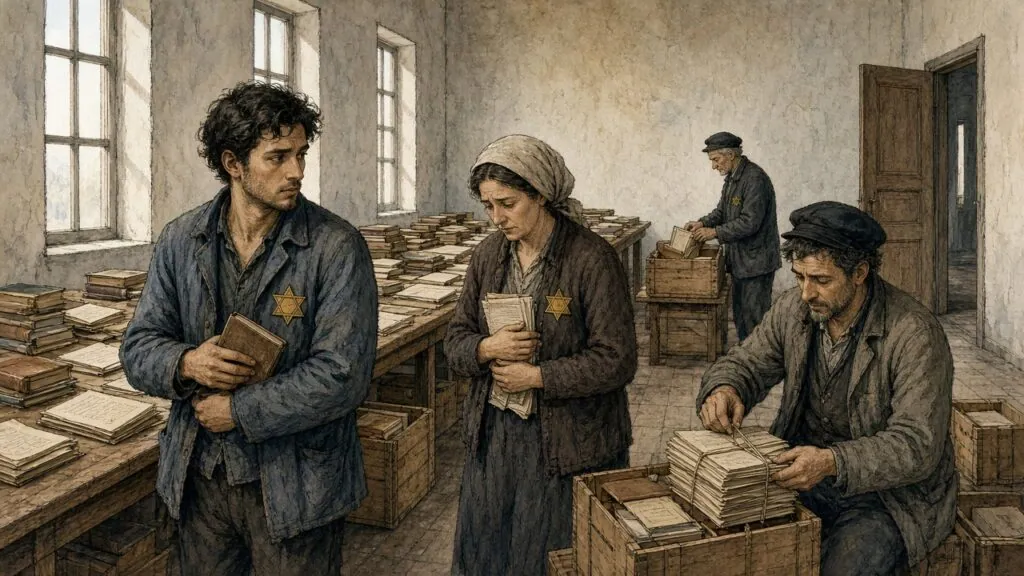
The group, nicknamed “the Paper Brigade”, risked their lives daily. They hid material in the attic of the building or carried it into the ghetto on their bodies, where they buried it or entrusted it to non-Jewish contacts for safekeeping.[15][99] Sutzkever helped to build an underground book bunker sixty feet beneath the ghetto, and capture would have meant death by firing squad at Ponar, the site of mass murder outside the city. Kaczerginski, whom YIVO describes as a garrulous, street-smart adventurer and master of deception, also used the worksite to buy weapons for the ghetto’s secret partisan organisation, and throughout this time both men wrote poetry that was recited and sung by the dwindling population of the ghetto.[99] The work continued until the liquidation of the ghetto in September 1943. Some of the hiding places went undiscovered and their contents survived, but the YIVO headquarters and everything left in it were destroyed.[15]
Liberation did not bring safety for the books. After the Soviet capture of Vilna in July 1944, Sutzkever and Kaczerginski recovered what remained of the hidden material and placed it in a Museum of Jewish Art and Culture that they established in the city, but several dozen tons of surviving YIVO documents were destroyed before they could be moved. Recognising that Jewish cultural property remained in danger under Soviet rule, the two poets began to smuggle material out of Vilna; by 1949 the museum had been closed and its collections sent to the Lithuanian National Book Chamber, where knowledge of their existence was suppressed for the next fifty years.[15] Meanwhile, by July 1947, parts of the collections that the Germans had shipped to Frankfurt had been recovered and brought to New York, together with surviving parts of Vilna’s Strashun Library and YIVO materials that Tcherikower had hidden in France during the war.[15][13]
The rediscovery came with the end of the Soviet era. Word reached New York at the end of the 1980s that much of what remained of the prewar collection had been hidden in the Book Chamber by its director, Antanas Ulpis. Independent Lithuania did not recognise YIVO’s legal ownership of the materials, but it allowed the archival portions to be brought to New York in 1995 and 1996 to be sorted and copied, with the originals returning to Vilnius.[15] The Vilna Online Collections project, described in the following chapter, completes that work digitally.[14] The historian David Fishman, who founded Project Judaica in Moscow in 1991, has told the wartime story in The Book Smugglers: Partisans, Poets, and the Race to Save Jewish Treasures from the Nazis, published by ForeEdge in 2017, which YIVO notes has been dubbed “Monuments Men for book lovers”.[15][99] In the same years in which the Paper Brigade was hiding books, YIVO in New York was the first organisation to bring word of the unfolding catastrophe to the American public, and at the end of the war it at once recruited zamlers to collect survivors’ testimonies and documents in the displaced persons camps.[15] The collecting impulse of the 1920s thus survived the destruction of the community it had served.
14. The archive in the classroom
What distinguishes YIVO’s courses from many other introductions to Jewish history is their direct use of primary sources. Each course invites students to explore YIVO’s unique archive and library collections, and the series as a whole is presented as a means of delving into the Institute’s resources.[4][17] The later courses make the point explicit: the course on the Yiddish stage offers nearly a thousand objects and documents from the YIVO Archives, while those on food and comedy each feature hundreds of archival objects.[100][101][102]
The courses are complemented by YIVO’s other free resources, which the Institute urged the public to use when it made the courses free. These include its recorded lectures, conferences and concerts, its prewar Vilna online collections and its online encyclopedia of Ashkenazi civilisation.[23] The YIVO Encyclopedia of Jews in Eastern Europe, published in two volumes with Yale University Press in 2008, became available online two years later.[13] The Vilna Online Collections project, carried out in partnership with the Lithuanian Central State Archives, the Martynas Mažvydas National Library of Lithuania and the Wroblewski Library of the Lithuanian Academy of Sciences, set out to preserve, digitise and reunite some 1.3 million original documents and 12,500 rare books, including the remnants of the Strashun Library of Vilna.[24][14]
This proximity between teaching and collection is the clearest sense in which the courses continue the work of prewar YIVO. The zamlers of the 1920s and 1930s sent their findings to Vilna so that they might be studied; the students of the Shine Online series receive a portion of those findings, and of everything gathered since, as material for their own study.
15. Folksong, Demons, and the Evil Eye
The second course in the series, Folksong, Demons, and the Evil Eye: Folklore of Ashkenaz, opened on 17 January 2017.[18] It is taught by Itzik Gottesman, Senior Lecturer in the Department of Germanic Studies and a member of the faculty of the Schusterman Center for Jewish Studies at the University of Texas at Austin, who was for thirteen years associate editor of the Yiddish Forward and who directs the blog “Yiddish Song of the Week”, which presents rare field recordings of Yiddish singers.[103]
The course explores music, folktales, rituals and superstitions. It asks why Jewish communities cast breadcrumbs into a river at Rosh Hashanah, what “Ring a Ring o’ Roses” has in common with the lullaby Rozhinkes mit mandlen, and why a glass is broken at Jewish weddings, and it follows the early Yiddish ethnographers on their expeditions through Eastern Europe, introducing dybbuks and golems, demons and spirits along the way.[103] Like Discovering Ashkenaz it is presented as an intensive, college-level survey, equivalent to two two-hour sessions a week, in this case over four weeks, with a certificate for those who complete it. Its stated aims are that students should learn songs, tales and rituals common to the Jews of Eastern Europe, understand the specifically Jewish elements of Ashkenazi folklore, follow the development of Jewish folklore studies and some of its key figures, and gain a fuller understanding of Jewish life in Eastern Europe in its richness and variety.[104] The course is presented by Edward Blank and Family.[103] Its subject returns to the very activity on which YIVO was founded: the gathering of folk culture by ethnographers and amateur collectors.
16. Oh Mama, I’m in Love! The Story of the Yiddish Stage
The third course, Oh Mama, I’m in Love! The Story of the Yiddish Stage, was launched at YIVO on 1 May 2018 with a one-day exhibition from the Institute’s theatre collections and songs performed by Miryem-Khaye Seigel and Tracy Stark.[105] Leading scholars of Yiddish theatre trace the history of Jewish performance in 25 lecture videos and discussions, presenting the Yiddish stage as a global phenomenon through images and playbills from more than twenty countries. The course introduces actors, producers, designers and playwrights, among them Molly Picon, Paul Muni and Stella Adler, many of whom went on to careers on the American stage and screen, and it considers the continuing influence of Yiddish theatre on popular entertainment.[100]
The archival offering is especially rich: nearly a thousand objects and documents, including previously unseen photographs, newly digitised audio clips, original posters and advertisements, and set and costume designs.[100] In a preview for the course, Stefanie Halpern, director of the YIVO Archives, spoke of the actor Boris Thomashefsky, whom Hadassah Magazine described as a trailblazing performer of the nineteenth-century New York Yiddish stage.[106] The history the course recounts is a long one. The first professional Yiddish troupe was formed by Abraham Goldfaden in Iași in 1876, and Thomashefsky’s staging of a Goldfaden play in Manhattan in 1881 is counted among the beginnings of Yiddish theatre in America.[107]
17. A Seat at the Table
The fourth course, A Seat at the Table: A Journey into Jewish Food, was sponsored by Edward Blank and Family, the Covenant Foundation and the Shine Trust, and its launch was set for 1 May 2020.[101][24] It explores Jewish food with an emphasis on the Ashkenazi table, combining hundreds of archival objects, lectures by scholars and demonstrations of recipes by chefs, and it asks how the essence of Jewish food has remained constant even as recipes changed with the migrations of Jews around the world.[101] Its contributors include Joan Nathan, Michael Twitty, Alice Feiring, Darra Goldstein, Leah Koenig, Adeena Sussman, Ilan Stavans and Michael Wex, together with Niki Russ Federman and Josh Russ Tupper of Russ & Daughters, Jake Dell of Katz’s Delicatessen, and Liz Alpern and Jeffrey Yoskowitz of The Gefilteria.[101]
Writing in Hadassah Magazine, Jessica Halfin described the course as having seven units, reported that it had taken two years to plan and produce, and noted that it was led by Darra Goldstein with some thirty further experts contributing discussions, videos and demonstrations. She drew attention to its visits to establishments such as the Acme smoked fish plant in Brooklyn and to its attention to Ashkenazi communities in Mexico and Argentina.[106] Although the course is free, YIVO offers optional premium registrations for residents of the United States, which add postcards of recipes from the class, magnets bearing images from the YIVO Archives and other items.[101] The course page also invites students to contribute a family recipe, with its associated stories, to the YIVO Archives, so that the course is not only a means of receiving the collection but of adding to it.[101]
18. Is Anything Okay?
The fifth and most recent course, Is Anything Okay? The History of Jews and Comedy in America, was launched on 21 March 2024, with a launch event at YIVO featuring the scholar Eddy Portnoy and the comedians Judy Gold and Alan Zweibel. It is sponsored by Edward Blank and Family, Ruth and David Levine and the Shine Trust, and it is divided into seven units, ranging from the roots of Jewish humour in traditional Ashkenazi life in Eastern Europe to the Catskills, the Borscht Belt and contemporary comedy.[25][102] The course is hosted by Eli Batalion and Jamie Elman of YidLife Crisis, and it features interviews and discussions with comedians and writers including W. Kamau Bell, Lewis Black, Marc Maron, Paul Reiser and Alan Zweibel, alongside scholars such as Jeremy Dauber of Columbia University and David Roskies of the Jewish Theological Seminary.[102][25]
The archival materials include vintage jokebooks, early comedy records, film, television and radio clips, photographs and posters.[102] The Forward reported that the course begins in Eastern Europe with the satire of the Haskalah, and quoted YIVO’s director of education, Ben Kaplan, on the way in which Jews used comedy to understand their relationship with America.[108] In an interview with the Jewish Journal, Kaplan described one of the course’s central themes as the use of comedy throughout Jewish history to process oppression, discrimination and antisemitism, to cope, and to understand the world.[109] The choice to begin an American subject in the Ashkenazi past is characteristic of the series, which returns again and again to Eastern Europe as the source from which so much of modern Jewish culture flowed.
19. YIVO’s courses among other ways of learning online
The Shine Online series is one part of a wider landscape of online learning about Yiddish and Ashkenazi culture, and that landscape grew markedly during the pandemic. The Jewish Telegraphic Agency reported in April 2021 an “explosion of interest” in Yiddish instruction: the summer classes of the Workers Circle in 2020 had 305 students from 20 countries and 32 states, a rise of 65 per cent on the previous year, while YIVO’s Uriel Weinreich Summer Program saw attendance rise by 60 per cent to 120, and five times as many students as in the previous year enrolled in its winter programme.[110]
The most widely publicised newcomer was the Yiddish course of the language-learning application Duolingo, which went live on 6 April 2021. Meena Viswanath, the daughter and granddaughter of Yiddish scholars, was the only member of its creator team from the secular, academic world of Yiddish learning, and she worked with Hasidic colleagues from Brooklyn; the result was a negotiated compromise: in Viswanath’s words, the course used mostly the spelling and grammar formalised among the secular Yiddishists, while its audio recordings used the pronunciation of the vernacular spoken in Borough Park. The first version was designed to take learners to an approximately intermediate level.[110] The agency noted that the course was geared to contemporary spoken Yiddish rather than the historical form taught at YIVO or in the Workers Circle classes, and Viswanath expressed the hope that it would show learners that Yiddish “is not just for the punchline”.[110]
The Yiddish Book Center in Amherst, Massachusetts, founded in 1980 by Aaron Lansky, has gathered about 1.5 million Yiddish books, many rescued from homes and discard piles.[111] Its educational programmes are anchored by the Sara and Simha Lainer Yiddish Language Institute, which offers courses and the textbook In eynem, and they include a seven-week Steiner Summer Yiddish Program for college students and recent graduates, online culture courses, a Yiddish Translation Fellowship, programmes in Yiddish pedagogy and an archive of recorded lectures; its digital library holds more than 11,000 titles.[112] For scholarship, In geveb: A Journal of Yiddish Studies, founded on 9 August 2015 by Eitan Kensky and Saul Noam Zaritt, publishes online in open access. Its title is taken from a 1919 collection by the poet Yehoash, and its founders explained that geveb means texture, fabric or weave and is also a word for “web”.[113]
Against this background the particular character of YIVO’s courses becomes clear. Duolingo and the language institutes teach the language; In geveb serves readers already engaged in the field; the Yiddish Book Center combines collections, translation and instruction. The Shine Online series, by contrast, teaches the history and culture of East European Jewry in English, and it does so from inside the archive that the Institute has assembled since 1925.[30][17][4] The offerings are complementary rather than competing. A student who begins with Discovering Ashkenaz may well go on to an alphabet lesson, a summer programme or a journal article, and YIVO’s own semester classes in Yiddish provide one such path within the same institution.[2]
20. Why these courses matter
YIVO offers other forms of instruction, and they help to define what the Shine Online series is. Its semester classes in Yiddish language, together with seminars and electives in English, are taught live, mostly over Zoom, with enrolment capped to keep classes small; its summer programme in Yiddish language, literature and culture has been held every summer since 1968.[2][1] The Shine Online courses complement these programmes by offering what live classes cannot: permanent, unlimited and free access, at the student’s own pace and from anywhere in the world.[2]
The merits of the series are, in the first place, those of its scholarship. Discovering Ashkenaz is taught by a historian of the first rank and is designed with the structure of a university course, combining lectures, readings, maps, assessment and discussion.[4][22] The subsequent courses enlist folklorists, theatre historians, food writers, comedians and archivists, so that the series as a whole presents East European Jewish civilisation not only through its politics and religion but through its songs, its stage, its table and its humour.[103][100][101][102]
The second merit is the direct contact with sources. Few introductions to any field place students so close to the original materials, and few institutions are so well placed to do so as one whose archives were gathered by the communities they document, rescued in part by the Paper Brigade and reassembled in part across the separations of war.[5][10][13]
The third merit is generosity. Since 2020 every course in the series has been free, and the courses may be taken individually, in community groups or as classroom resources.[23][2][26] For readers of Nekud, whose interests lie in precisely the history these courses illuminate, Discovering Ashkenaz is an obvious first step, and the remaining four courses offer an unusually complete account of the culture that East European Jews created and carried with them across the world.
21. Timeline
Duke Bolesław the Pious grants Jews protection and self-government in civil matters.[37]
The Kingdom of Poland and the Grand Duchy of Lithuania form the Commonwealth.[38]
The central body of Jewish self-government in the Polish Crown begins to function.[16]
The Cossack victory at Zhovti Vody opens a revolt in which Jews are massacred in many towns, including Nemyriv.[40]
At Rosh Hashanah in Smyrna, Sabbatai Zevi proclaims himself the Messiah.[58]
Sabbatai Zevi converts to Islam at Edirne.[58]
Israel ben Eliezer reveals his teachings in Medzhybizh.[62]
About 500 to 1,000 followers of Jacob Frank are baptised in Lwów.[60]
The Convocation Sejm decrees the abolition of the Council of Four Lands.[16]
More than one-third of employed Jews in the Commonwealth are leaseholders.[41]
The Vilna community begins organised measures against the Hasidim.[65]
Russia, Prussia and Austria divide the Commonwealth in three partitions.[43]
Moses Mendelssohn publishes Jerusalem.[56]
A decree of Catherine II begins the restriction of Jewish residence in Russia.[46]
Zunz, Gans and Moser found the Society for the Culture and Science of the Jews in Berlin.[57]
Nicholas I extends military service to Jewish males.[47]
The cantonist system for Jewish boys ends.[47]
After the assassination of Alexander II, pogroms break out in more than 160 localities.[48]
Russian Jewish immigrants form the committee from which HIAS traces its origins.[52]
New restrictions on Russian Jews; Leon Pinsker publishes Auto-Emancipation.[49]
Simon Dubnow calls for the rescue of materials documenting the East European Jewish past.[15]
Arkadii Kremer’s pamphlet sets the Vilna circles on the path of mass agitation.[77]
Committees are formed in Vilna to carry socialist agitation to workers in Yiddish.[76]
Theodor Herzl publishes The Jewish State.[67]
The First Zionist Congress adopts the Basel Programme.[69]
Thirteen delegates found the General Jewish Labour Bund at a secret convention in Vilna.[76]
Lekert is hanged in Vilna after wounding Governor von Wahl.[78]
A pogrom kills 49 Jews and injures more than 500.[54]
A record 11,747 immigrants are examined in a single day.[53]
The conference on the Yiddish language proclaims Yiddish a national language of the Jewish people.[81]
The Pale of Settlement is abolished.[46]
Sarah Schenirer opens the first Bais Yaakov school for girls in Kraków.[88]
The Polish state is re-established after 123 years of partition.[86]
The Central Yiddish School Organisation is founded in Warsaw.[83]
The first Polish national conference of the Hebrew school network meets in Warsaw.[87]
Nokhem Shtif proposes an institute for Jewish research.[6]
More than thirty people meet in Vilna, approve Shtif’s proposal and form a committee to realise it.[6]
The Yiddish Scientific Institute is founded by scholars in Berlin and Vilna, with its seat in Vilna.[5]
Nine delegates create YIVO’s organisational committee and its four sections.[15]
YIVO’s ethnographic commission calls on supporters in cities and shtetls to record their folk heritage.[6]
The cornerstone of the headquarters on Wiwulskiego Street is laid; Einstein writes his tribute the same year.[6]
YIVO opens its graduate training programme, named after Tsemakh Shabad.[15]
Writers, historians, editors and artists from several continents attend YIVO’s world congress in Vilna.[9]
Heydrich issues the directive establishing the Judenräte in occupied Poland.[92]
The Second World War forces YIVO’s relocation; New York becomes its headquarters.[1]
About 40,000 Jews are confined in two ghettos in Vilna.[98]
Under German occupation, Jewish forced labourers hide YIVO’s treasures from destruction.[10]
The Einsatzstab Rosenberg sets up a sorting centre in the YIVO building.[15]
The chairman of the Warsaw Judenrat takes his own life.[92]
Buried parts of the Oyneg Shabes archive are recovered in Warsaw.[97]
With the help of the United States Army, YIVO recovers part of its looted collections from Germany.[13]
YIVO publishes Uriel Weinreich’s textbook College Yiddish.[13]
Thirteen leaders of the Jewish Anti-Fascist Committee are tried.[91]
Hannah Arendt’s book provokes controversy over the Jewish councils.[93]
The Uriel Weinreich summer programme in Yiddish begins its unbroken annual run.[1]
YIVO learns that part of its prewar collections survived in Vilnius.[13]
Archival portions of the surviving prewar collections are brought to New York to be sorted and copied.[15]
YIVO moves to 15 West 16th Street in New York.[13]
The two-volume YIVO Encyclopedia of Jews in Eastern Europe is published with Yale University Press.[13]
YIVO launches the project to reunite its divided prewar collections digitally.[13]
The online journal of Yiddish studies is founded.[113]
YIVO’s first online course, taught by Samuel Kassow, opens.[3]
The second course, taught by Itzik Gottesman, begins.[18]
Oh Mama, I’m in Love! is launched at YIVO.[105]
All of YIVO’s online courses are made free.[23]
A Seat at the Table is scheduled to launch.[24]
A Yiddish course goes live on the language-learning app.[110]
Is Anything Okay? is launched as the fifth course.[25]
YIVO marks its hundredth anniversary.[34]
References
- “About YIVO”, YIVO Institute for Jewish Research *
- “FAQ: 2026 Fall Classes”, YIVO Institute for Jewish Research *
- “Samuel Kassow Appointed YIVO’s Jacob Kronhill Visiting Scholar for 2016”, YIVO Institute for Jewish Research, 18 January 2016 *
- “Discovering Ashkenaz: Jewish Life in Eastern Europe”, YIVO Institute for Jewish Research *
- “Early Years”, YIVO Institute for Jewish Research *
- PJ Grisar, “100 years after its founding, can a Yiddish institute serve a people who don’t speak the language?”, The Forward, 23 March 2025 *
- “YIVO” *
- “Max Weinreich” *
- “YIVO: The Yiddish Scientific Institute”, Yad Vashem *
- “YIVO During WWII”, YIVO Institute for Jewish Research *
- “Abraham Sutzkever” *
- “History of YIVO”, YIVO Institute for Jewish Research *
- “YIVO in the U.S.”, YIVO Institute for Jewish Research *
- “The Edward Blank YIVO Vilna Online Collections”, YIVO Institute for Jewish Research *
- Cecile Esther Kuznitz, “YIVO”, The YIVO Encyclopedia of Jews in Eastern Europe *
- “Council of Four Lands” *
- “YIVO’s Shine Online Educational Series”, YIVO Institute for Jewish Research *
- “YIVO’s Top 5 of 2016”, YIVO Institute for Jewish Research, 9 January 2017 *
- “YIVO’s Shine Online Educational Series: Special Rates”, YIVO Institute for Jewish Research *
- “Staff”, Yiddish Book Center *
- “The Shine Online Educational Series at YIVO”, course catalogue *
- “Help”, YIVO’s Shine Online Educational Series *
- “All YIVO online classes are now free of charge”, The Forward, 18 March 2020 *
- “YIVO’s Highlights of the Decade”, YIVO Institute for Jewish Research, 19 January 2020 *
- “YIVO’s Newest Online Course, Is Anything Okay? The History of Jews and Comedy in America, Launches March 21”, YIVO Institute for Jewish Research *
- “Take a Class as a Group”, YIVO Institute for Jewish Research *
- “Discovering Ashkenaz: Jewish Life in Eastern Europe”, YIVO’s Shine Online Educational Series *
- “Want to study? Here are two new online courses of interest”, Jewish Heritage Europe, 10 December 2015 *
- “Discovering Ashkenaz (and its folklore): online courses via YIVO”, Jewish Heritage Europe, 7 July 2017 *
- “Discovering Ashkenaz: Jewish Life in Eastern Europe” (YIVO101), YIVO Learn Online course material, 2025 run (requires registration) *
- “Sarah Ellen Zarrow: Historian of East European Jewish Life”, author’s website *
- “Sarah Ellen Zarrow”, In geveb: A Journal of Yiddish Studies *
- “Emanuel Ringelblum” *
- “YIVO Centennial”, YIVO Institute for Jewish Research *
- “Ashkenazi Jews” *
- “Yiddish” *
- “History of the Jews in Poland” *
- “Union of Lublin” *
- “Polish - Lithuanian Commonwealth” *
- “Khmelnytsky Uprising” *
- Judith Kalik, “Leaseholding”, The YIVO Encyclopedia of Jews in Eastern Europe *
- “Shtetl” *
- “Partitions of Poland” *
- “Galicia (Eastern Europe)” *
- “Haskalah” *
- “Pale of Settlement” *
- “Cantonist” *
- “Alexander III of Russia” *
- “May Laws” *
- “Auto-Emancipation” *
- “Pogroms in the Russian Empire” *
- “HIAS” *
- “Ellis Island” *
- “Kishinev pogrom” *
- “Pavel Krushevan” *
- “Moses Mendelssohn” *
- “Wissenschaft des Judentums” *
- “Sabbatai Zevi” *
- “Sabbateans” *
- “Frankism” *
- “Jacob Frank” *
- “Baal Shem Tov” *
- “Hasidic Judaism” *
- “Vilna Gaon” *
- “Misnagdim” *
- “Leon Pinsker” *
- “Theodor Herzl” *
- “Dreyfus affair” *
- “First Zionist Congress” *
- “Ahad Ha’am” *
- “Chaim Weizmann” *
- “Hayim Nahman Bialik” *
- “In the City of Slaughter” *
- “Ber Borochov” *
- “General Jewish Labour Bund” *
- “Bund”, Encyclopaedia Judaica, Jewish Virtual Library *
- Roni Gechtman, “Kremer, Arkadii”, The YIVO Encyclopedia of Jews in Eastern Europe *
- “Lekert, Hirsh”, The YIVO Encyclopedia of Jews in Eastern Europe *
- “Lekert, Hirsch”, Encyclopedia.com *
- “General Jewish Labour Bund in Poland” *
- “Czernowitz Yiddish Language Conference”, Encyclopaedia Judaica, Jewish Virtual Library *
- “I. L. Peretz” *
- Joshua D. Zimmerman, “TSYSHO”, The YIVO Encyclopedia of Jews in Eastern Europe *
- “Mendele Mocher Sforim” *
- “Sholem Aleichem” *
- “Second Polish Republic” *
- Adina Bar-El, “Tarbut”, The YIVO Encyclopedia of Jews in Eastern Europe *
- “Bais Yaakov” *
- “History of the Jews in the Soviet Union” *
- “Yevsektsiya” *
- “Jewish Anti-Fascist Committee” *
- “Judenrat” *
- “Eichmann in Jerusalem” *
- “Hannah Arendt” *
- “Spiritual Resistance in the Ghettos”, Holocaust Encyclopedia, United States Holocaust Memorial Museum *
- “Spiritual Resistance During the Holocaust”, lesson plan, Yad Vashem *
- “Ringelblum Archive” *
- “Vilna Ghetto” *
- “The Book Smugglers: Partisans, Poets, and the Race to Save Jewish Treasures from the Nazis”, YIVO Institute for Jewish Research *
- “Oh Mama, I’m in Love! The Story of the Yiddish Stage”, YIVO Institute for Jewish Research *
- “A Seat at the Table: A Journey into Jewish Food”, YIVO Institute for Jewish Research *
- “Is Anything Okay? The History of Jews and Comedy in America”, YIVO Institute for Jewish Research *
- “Folksong, Demons, and the Evil Eye: Folklore of Ashkenaz”, YIVO Institute for Jewish Research *
- “Folksong, Demons, and the Evil Eye: Folklore of Ashkenaz”, YIVO’s Shine Online Educational Series *
- “Launch Event: Oh Mama, I’m in Love! The Story of the Yiddish Stage”, YIVO Institute for Jewish Research *
- Jessica Halfin, “At YIVO Online, (Food) Class Is in Session”, Hadassah Magazine, 14 October 2020 *
- “Yiddish theatre” *
- PJ Grisar, “An online course on Jewish comedy draws big names”, The Forward, 14 March 2024 *
- Alan Zeitlin, “Just In Time for Purim, YIVO Will Launch Free Online Comedy Course”, Jewish Journal, 18 March 2024 *
- Gabe Friedman, “How Duolingo created a Yiddish course with a secular scholar and Hasidic Jews from Brooklyn”, Jewish Telegraphic Agency, 1 April 2021 *
- “Yiddish Book Center” *
- “Educational Programs”, Yiddish Book Center *
- “In geveb” *