The Yiddish Scientific Institute
There is a particular kind of institution that only appears when a people has been broken, or nearly broken, and has decided to write down what it knows about itself. The YIVO Institute for Jewish Research is one of them. It was founded in August 1925 by nine scholars who met in Berlin, it was headquartered for the better part of two decades in Vilna, and it survives today in a building on West Sixteenth Street in Manhattan with roughly four hundred thousand books and something near twenty-four million archival items in its keeping. Its name — Yidisher Visnshaftlekher Institut, the Jewish or Yiddish Scientific Institute — condenses a programme that was, in the middle twenties, genuinely radical: that the language of the Jewish masses of Eastern Europe was not a broken German, not a jargon, not a picturesque relic, but a language in its own right, deserving of dictionaries, atlases, laboratories and universities. The word yidisher, as YIVO is fond of pointing out, means both “Yiddish” and “Jewish” at once, and the abbreviation that emerged from the founders’ deliberations was YIVO, four Yiddish letters that have outlasted every ideology that produced them. [1] [2]
The institute’s history is usually told as a story of rescue, and in one sense it is: after the German army took Vilna in June 1941, a group of Jewish intellectuals smuggled books and manuscripts out of the ghetto and buried them under the city, and the records of what they saved form the largest archive of East European Jewish life anywhere in the world. [3] But the rescue was only the last and most dramatic act of a much longer programme. YIVO existed for fourteen years before the war, and in those years it did something that is hard to overstate: it invented the field of Yiddish studies, trained a generation of scholars, built a collecting network that reached into thousands of villages, and — in a series of bitter quarrels about spelling, grammar and the relationship between a language and a nation — worked out what it meant for a language to have a future. [4] [1]
This is the story of that institution: how it was conceived in a memorandum written in Berlin in 1924, why it was founded in a language rather than in a country, what it did with the two decades that separated its founding from the catastrophe, how a group of scholars in the Vilna ghetto performed the most improbable act of cultural preservation in modern history, and what the institute became when it moved to New York and spent the following eighty years trying to hold the memory of a place that no longer existed.
1. A language without a country
It is worth pausing on what Yiddish was in the early twenties, because the institute’s founding depends on understanding a situation that is now hard to reproduce. Yiddish was the everyday language of perhaps eleven to twelve million Jews across the Russian Empire, Poland, the Austro-Hungarian empire, Romania and the United States — the largest vernacular Jewish language in the world by a very wide margin, and the first language of most of those millions. It had a press running to well over three hundred newspapers and periodicals by the nineteen-twenties, a flourishing book trade, a theatre circuit, a school network, and a literary tradition that ran back to the sixteenth century. It was not, however, a language with institutions in the European sense. It had no university, no academy, no standard, no grammar, no dictionary and no map. Its speakers did not live in a state that used it, and no state had any particular reason to fund its study. [5] [6]
This absence of institutional backing was the problem that the Yiddishists of the early twentieth century spent their lives trying to solve, and the solutions they proposed clustered around two mutually exclusive poles. The first was the Hebrewist position, associated above all with the Hebrew language revival in Palestine and with the Zionist movement more broadly: the Jews of the diaspora would be redeemed by learning to speak Hebrew again, and Yiddish, whatever its merits as a vehicle of culture, was a language of exile and therefore a barrier to return. The second was the assimilationist position, held by many of the same educated Jews who had learned Russian or Polish and who looked on Yiddish as a provincial stigma, a marker of the shtetl, a thing to be outgrown. In between lay a third position, usually called Yiddishism, which held that Yiddish was neither a defect to be corrected nor a temporary condition to be transcended but the living vernacular of a people, and that the existence of that people was a fact to be organised around rather than a problem to be solved. [7] [8]
Hereness and the politics of staying
The Yiddishist position had a philosopher, and he wrote his account of it in Berlin. Nokhem Shtif (1879–1933) — linguist, critic, organiser, a man who spent his life at the hinge between the literary world of the Russian Empire and the political world of interwar Poland — characterised his own position, with characteristic sharpness, as a “realistic” Zionism. [9] The visionary Hebraists believed that the Jewish people would be restored to its own language and its own land; the assimilationists believed that the Jewish people would dissolve into the languages and the countries it happened to be living in. Shtif’s claim was that neither was realistic, and that the actual condition of the Jewish masses was neither restoration nor dissolution but a long, uncomfortable, productive life lived in a language that was not their own — the Jewish vernacular, the language of the people rather than the language of the leadership. The Yiddishists took this position as the foundation of a national culture that would be built in the present tense rather than the future one, and it gave their programme its distinctive ethical charge: the language of the poor was to be treated not as a relic to be catalogued before it disappeared but as the living medium of an actual community, whose speakers had interests of their own. [1]
What was missing, in this reading, was not enthusiasm but apparatus. Yiddish had a press and a stage and a school system, but it did not have what the European academic world called Wissenschaft: no archives, no libraries, no systematic collection, no philological method applied to the language’s history, no training pipeline for scholars who could carry the work forward, and — most conspicuously — no standard. Yiddish was, in the literal sense, a language in search of an orthography. Its speakers wrote a system that was phonetic in its Germanic elements and traditional in its Hebrew and Aramaic ones; its printers set type differently in Vilna than in Warsaw and in New York than in Vilna; and a writer in Lviv could not assume that a reader in Łódź would parse a page of his book correctly. [10]
It is a commonplace that institutions arise where a crisis meets an existing capacity, and YIVO is a unusually clean example of the formula. The crisis was the near-terminal weakness of a vernacular culture under economic pressure, mass emigration and political terror. The capacity was an extraordinary cohort of scholars who happened to be living in the same cities in the same years — Vilna, Warsaw, Berlin, Lviv, Odessa, New York — and who had between them a near-monopoly on the study of the language. What they lacked was a framework, a building, a budget and a name. The memorandum of 1924 supplied the framework; the Berlin conference supplied the name.
2. Czernowitz, 1908
The ideological ancestor of YIVO was assembled in a week in the last summer of the first decade of the twentieth century, in a city that was then a corner of the Austro-Hungarian empire and is now Chernivtsi in western Ukraine. From 30 August to 4 September 1908, a conference on the Yiddish language and its place in Jewish life met in Czernowitz in Bukovina. It was the brainchild of Nathan Birnbaum, whose own trajectory — from the pages of his youth magazine Der Yugnt to the founding of the Jüdische Rundschau — charted the movement from cultural assertion to political Zionism. The administrative work was done by a committee drawn largely from the University of Vienna’s Yiddish club Yidishe Kultur, and the call to the conference was issued in the spring of 1908, during Birnbaum’s first visit to the United States, over the signatures of Chaim Zhitlowsky and Dovid Pinski. [8] [11]
Around seventy delegates came, and their composition is itself a document. They included Zionists and Bundists, Hasidim and maskilim, men and women, literary figures and teachers and a number of scholars whose names would recur in YIVO’s own directories within two decades: I. L. Peretz, Zalmen Reisen, Sholem Asch, H. D. Nomberg, Noah Pryłucki, Matthias Mieses, Mordecai Spector. [11] The conference debated whether Yiddish was “a” national language or “the” national language of the Jewish people — a distinction that sounds like a quibble and was in fact the whole argument — and resolved it by proclaiming Yiddish a national language, and calling for parity for it in cultural, social and political life alongside the other languages of the countries in which Jews lived. The compromise was of a piece with the conference’s larger method: not a declaration of Yiddish sovereignty but a demand for a place at a table. [8]
A paper on a language
Two episodes from Czernowitz stand out in the later telling. Matthias Mieses, a young linguist from Brody who had been taught German as a child and had encountered Yiddish as an adult, submitted a paper on the structure of the Yiddish language; the paper was nearly lost, and it was saved by I. L. Peretz’s intervention, and it is regularly described as the first scientific paper on Yiddish to be presented in Yiddish. [12] It was a small thing and a large one. There had been, of course, plenty of Yiddish grammar — the standard Gramatik fun der yidisher shprakh by Zalmen Reisen would appear in Vilna in 1920 — but a grammar describes what a language is; a research paper, argued from evidence, in the language itself, asserts that the language can bear the weight of an argument about itself. [13]
Peretz’s keynote, delivered in the same week, called for the translation of Jewish cultural production into Yiddish, and it is worth registering how far this was from anything the Yiddish press was then doing. The newspaper world of the period was overwhelmingly a world of fiction, reportage, serialised melodrama and political argument; the idea that a serious scholarly paper might be read by the same audience that read the daily newspaper required an act of institutional imagination. It took a further seventeen years for that imagination to be converted into an organisation, and the conversion happened because Czernowitz had taught the movement both what it wanted and, more usefully, what a congress looked like. The first Yiddish Scientific Conference at Czernowitz laid the ideological basis for the founding of YIVO in 1925. [8]
There is a pleasing irony in the way the story of YIVO’s founding has been retold. For decades it was reported that the institute grew directly out of a “First Yiddish Scientific Conference” held in Vilna in September 1908; the confusion is easy to understand, because YIVO did eventually publish the Czernowitz proceedings — a fat volume of reports, documents and resolutions, edited by Max Weinreich and Zalmen Reisen, that appeared from the Vilna Philological Section in 1931, in Yiddish, and was one of the most admired things the institute ever printed. [14] The error has been repeated so often that it has hardened into a kind of folklore, but the correction is worth making, because the true sequence is more interesting than the myth: the argument was held in Bukovina in 1908; the proceedings were edited in Vilna in 1931; and the institution that edited them was built in the interval by people who had been present, one way or another, at both ends of it.
2. The memorandum
The document that made YIVO possible is short, and its author did not live to see what it produced. In October 1924, a talk given in New York by A. S. Zaks (Sachs) prompted Nokhem Shtif to write a memorandum on the need for a Yiddish academic institute. The memorandum circulated in February 1925 among Yiddish cultural figures in Berlin, New York and Vilna, and the response from Vilna was the most enthusiastic. [9] Shtif’s case was essentially that the institutions of Yiddish culture — the schools, the press, the theatre, the societies — had reached the point where they needed a coordinating and scholarly body of their own: something to collect the scattered material, to train the researchers, to fix a standard, and to stand between the language and the dissolution that economic hardship and emigration were bringing. The memorandum circulated under the title Organizatsye fun der yidisher visnshaft, the organisation of Yiddish scholarship; it is also referred to as Vegn a yidishn akademishn institut, on a Yiddish academic institute. [15] [16]
On 24 March 1925 the matter came to a formal decision in Vilna. A joint meeting of two local educational organisations — the Central Education Committee and the Vilna branch of the Central Yiddish School Organization — endorsed the memorandum, strengthened its provision for the training of teachers and for work serving the secular Yiddish school system, and recorded its conclusions in a document known as the “Vilna Theses on a Yiddish Scientific Institute”. [1] The meeting was held in the flat of Max Weinreich at J. Basanavičiaus Street 16 — Wielka Pohulanka 14 — on the northern edge of the old city, a few minutes’ walk from the Vilna Gaon’s synagogue, and it is generally treated as the moment of YIVO’s founding. [17] The choice of Vilna was not accident. The city had the largest Jewish population in interwar Poland, a uniquely dense concentration of schools, libraries and printing presses, and — through the figure of the Vilna Gaon and the great rabbinical libraries of the city — an intellectual prestige that no other centre of Yiddish life could claim. It was also, as events would demonstrate, a place where the work would be done and the catastrophe would happen.
It is worth noting what the memorandum did not propose. Shtif did not ask for a university. He did not propose a school of higher learning with a student body, or a national academy of the kind that France and Germany had built in the nineteenth century and that the new state of Poland was then contemplating for the several communities it contained. He asked for an institute: a body that would coordinate research, gather sources, employ scholars, train specialists and standardize the language’s written forms. [9] The distinction matters, because the difference between an academy and an institute is the difference between a permanent seat in the world of universities and a thing that depends on the goodwill of donors — and YIVO would spend the next century discovering which of the two it actually was. For the first two decades it had something of both: a Central Board and an Executive Office in the European manner, a scholarly staff of a dozen or so, and a budget that was raised annually, in small sums, from a network of Societies of Friends across three continents.
3. Berlin, August 1925
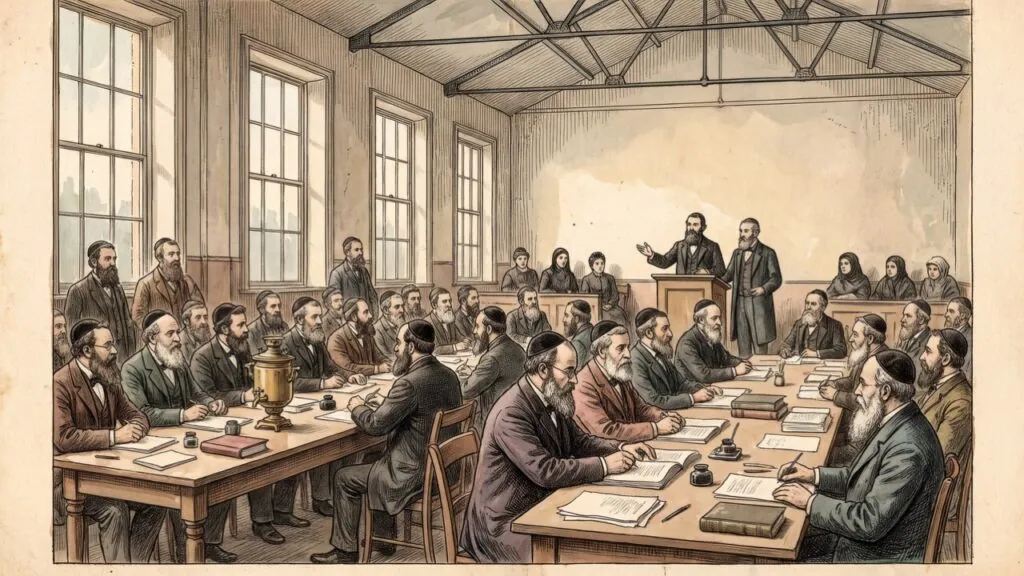
The founding conference met in Berlin between 7 and 12 August 1925. Nine delegates came, from Western and Eastern Europe, and their business was to convert a memorandum into an institution. They constituted an organising committee distributed across two cities — Shtif and Elias Tcherikover in Berlin, Weinreich and Zalmen Reyzen in Vilna — and they divided the scholarly work into four sections, each with a home city, a chairman and a projected journal. [1]
The name was settled at the same meeting, and it is worth pausing over it. The institute was to be the Yidisher Visnshaftlekher Institut — the Jewish, or Yiddish, Scientific Institute — whose initials in Yiddish letters gave YIVO. Weinreich is reported to have insisted on Institut rather than any more elevated word, on the argument that an institute was a working body and an academy was a monument; the distinction was to prove more than usually prescient. [18] The four sections were the Philological Section, covering language, literature and folklore, seated in Vilna under Weinreich; the Historical Section in Berlin under Tcherikover, the historian of the Ukrainian pogroms; the Social-Economic or Economic-Statistical Section, also in Berlin, under Yankev (Jacob) Lestschinski; and the Pedagogical, or Psychological-Pedagogical, Section in Warsaw under Leibush Lehrer, a former school inspector of unusual energy. [16] Each was to issue its own series of Shriftn fun yidishn visnshaftlekhn institut. [1]
Why Berlin, and not Vilna or Warsaw? Because the founders expected the money to come from the west. The relatively affluent Jewish communities of Western Europe and the United States were the obvious reservoir of funds for an institute that intended to employ scholars and buy collections, and Berlin offered a convenient meeting place under the Reich’s tolerant pre-war imperial constitution, with a substantial Jewish population and a rail network that made it cheap to reach from Vilna, Warsaw and Lviv. [1] Berlin was chosen as a founding venue, not a home. Within two years the centre of gravity had shifted east, to Vilna, and would not shift back until the war drove it across the Atlantic.
Who the founders were
The question of who exactly founded YIVO is one on which the sources do not perfectly agree, and the disagreement is itself a little instructive. YIVO’s own archival guide and the Encyclopaedia Judaica name five: Shtif, Weinreich, Tcherikover, Reisen and Lestschinski. The preface to the Yale reprint of Alexander Harkavy’s dictionary names a different five: Kalmanovitch, Reyzen, Shtif, Weinreich and — in place of Tcherikover — Lestschinski again. The online encyclopedia’s article on Weinreich names only four. What all accounts agree on is the organising committee of the August 1925 conference itself — Shtif, Tcherikover, Weinreich and Reyzen — and that Zelig Kalmanovitch, who joined the staff in 1928 and became the administrative spine of the Vilna years, was not present in Berlin at all. [16] [1]
The distinctions among these men are worth keeping in mind, because YIVO’s early history is not a story of a single vision but of a working coalition between people who wanted quite different things from it. Weinreich wanted a linguistics: a language mapped, described, taught and standardised. Tcherikover wanted a history: the pogroms of the Russian Civil War, the revolutions, the shtetl economies, the Jewish question as a political fact, all of it documented before the documentation disappeared. Lestschinski wanted statistics: the demography of a population that was emigrating, ageing and dying faster than it was being counted. Lehrer wanted pedagogy: a better-trained generation of Yiddish teachers, and evidence, gathered systematically, about how the schools were actually working. Shtif, the organiser, wanted an institution, because without one the other four had no vehicle. [1] [4]
And there was a fifth constituency in the room, which never appears in the scholarly literature because it did not employ scholars: the mass of Yiddish-speaking teachers, students and parents whose money and labour the whole enterprise depended on. The Societies of Friends of the Yiddish Scientific Institute that sprang up in Vilna and Warsaw, in the Baltic and in Germany, in England and in Palestine, in North and South America and in South Africa, were more than fund-raising auxiliaries. The one founded in Vilna in October 1925 soon served, in practice, as the institute’s main governing body. [1] Whatever YIVO was in its first decade, it was not an ivory tower, and the people who kept it solvent had no intention that it should be one.
4. The curatorium and the empty chair
Among the more revealing documents in the institute’s history is the list of its honorary board of trustees, the Curatorium, appointed in 1925. Simon Dubnow, the historian of Jewish law and the author of a multi-volume history of Jewish culture, chaired it. Its members included Albert Einstein, Sigmund Freud, Moses Gaster — the chief rabbi of the Anglo-Jewish Congregation, a Zionist, and the man who had translated the Talmud into English — Edward Sapir, the linguist who would go on to spend a decade studying Naskapi and Southern Athabaskan languages in Canada and to coin the word “linguistic drift”, and Chaim Zhitlowsky, the veteran Russian-Jewish publicist and Zionist ideologue. [16] [2]
There is a temptation to read this list as celebrity decoration, and it is worth resisting. Einstein’s name in particular has been used for a century as a proof of endorsement, and the honest observation is that Einstein’s engagement with Jewish communal institutions in the twenties was sporadic and largely honorary — he wrote letters, accepted honours, appeared at benefits. What the board does demonstrate is something more structural: that the founders wanted the Yiddish Scientific Institute to sit at the table of the Jewish establishment, and that the establishment, at its most distinguished, was willing to sit at the table of the Yiddish Scientific Institute. The symmetry was deliberate. A body of philologists and folklorists who were, by the standards of the Zionist and Orthodox organisations, quite marginal, had attracted the signatures of two of the most famous men of European science. It said something about the anxiety of the twenties that this mattered. [1]
It also said something about the institute’s finances, which were, for the whole of the interwar period, largely an American phenomenon. The American Jewish community provided the main part of YIVO’s budget throughout these years, through individual donors and through organisations such as the American Joint Distribution Committee. [1] This arrangement gave the institute a measure of independence that a Vilna-based body funded by the local community might not have enjoyed, and it also placed the centre of gravity of its intellectual life in New York, which is where the American branch — the Amopteyl, the “American section” — had been organised in October 1925 under the leadership of Yankev (Jacob) Shatzky. [19] The first bulletin, the Yedies fun YIVO, appeared that same year, and the first “News from YIVO” reached the Yiddish-reading public in the Warsaw journal Literarishe bleter on 9 October 1925. [1] The institute had, from the beginning, one foot in a town that no longer exists and one in a city that does.
The arithmetic of survival
The budget figures of the late twenties are humbling and instructive. YIVO was often on the verge of bankruptcy. From 1927 the institute began seeking annual subsidies from Jewish communities and municipalities in Poland, and by 1930 several dozen kehiles and city governments together were providing more than a tenth of its income — a sum that suggests how thin the whole enterprise was, and how much of it rested on the donated time of teachers who were themselves, in the deepening Depression, being asked to survive on school salaries. [1] More than thirty branches and support groups were established across Eastern Europe and the émigré communities of the world. [1]
What the money bought, given the poverty of it, is remarkable, and it is the subject of the middle chapters of this account. In the space of a dozen years the institute built a library and an archive, trained a graduate school, ran a network of volunteer collectors across the Pale of Settlement, conducted ethnographic expeditions, and produced a series of scholarly periodicals that became the reference points of the field for a generation. It did all this with a professional staff of perhaps a dozen, most of whom held academic posts elsewhere and worked for YIVO for the prestige or the principle or both. The institute’s greatness and its fragility had the same source: it was cheap to run because it was thin, and it was thin because it was never quite confident that it should be large.
5. The societies of friends
The curatorium of 1925 was the part of the founding that photographs well: Dubnow in the chair, Einstein and Freud among the members, the aura of a European academy assembled in a Berlin hotel room. It was also, in a strict sense, decorative. The institute’s real government was a network of local societies, and its real budget was a list of small subscriptions from communities that had never heard of a curatorium.
In October 1925, weeks after the Berlin conference, supporters in Vilna founded a Society of Friends of the Yiddish Scientific Institute — in the YIVO Encyclopedia’s phrase, an organisation that soon served as the de facto main governing body of the institute. [1] The same pattern was repeated across the world. In New York, the American branch, Amopteyl — Amerikaner Opteyl — was created in October 1925 under Jacob Shatzky, and published its own newsletter, Der pinkes, from 1927. [20] Over the following decade more than thirty branches and support groups were established across Eastern Europe and in the émigré communities of the West: in Poland, in the Baltic states, in Germany, France and England, in North and South America, in South Africa and in Palestine. [1] The institute was, in this sense, a federation before it was an institution — which was the only way a body funded out of donations from a dozen poor Jewish communities could have administered itself at all.
The money tells the story of the compromise. The American Jewish community provided the main part of YIVO’s budget throughout the interwar period, through individual donors and organisations such as the American Joint Distribution Committee. [1] From 1927 the institute began seeking annual subsidies from Jewish communities — kehiles — and city governments in Poland; by 1930 several dozen kehiles and municipalities together supplied more than a tenth of the budget. [1] The early finances were precarious, and the YIVO Encyclopedia’s own assessment is that the institute was often on the verge of bankruptcy. What this produced was a distinctive and slightly paradoxical financial structure: an institute devoted to the study of the most marginalised population of Europe, sustained in significant part by the most comfortable and assimilated Jews of America, and answerable to Polish municipalities who wanted a modern scholarly institute on their map. The three claims on the institution’s loyalty were visible from the start.
How it was governed
The formal structure that emerged was a three-tier one. A Central Board, chaired from the beginning by the physician and public-health leader Tsemakh Shabad, carried out the executive functions and appointed an Executive Office; from 1929 that office was Weinreich, Zelig Kalmanovitch and Zalman Reyzen. [1] [21] The scholars who ran the four sections — Weinreich in philology at Vilna, Elias Tcherikover in history and Yankev Lestschinski in economics and statistics in Berlin, Leibush Lehrer in psychology and education in Warsaw — were at once section heads, board members and the institute’s link to a world of academic politics that largely ignored them. [1] The four sections each published their own journal: Filologishe shriftn in three volumes in 1926, 1928 and 1929, the first of them a Landoy-bukh, a festschrift for the lexicographer Alfred Landau; Historishe shriftn in 1929, 1937 and 1939; Ekonomishe shriftn in 1928 and 1932; Psikhologish-pedagogishe shriftn in 1933 and 1940. [13] [22] Four journals, four languages, four audiences — and, for all the institutional awkwardness, a functioning scholarly press at a scale that nothing else in the Yiddish world could approach.
The centrepiece of the structure was the first YIVO conference, held in Vilna from 24 to 27 October 1929, at which the institute officially proclaimed its founding and laid the cornerstone of its new headquarters, and set up its governance for the decade ahead. [1] A second convention followed in 1935 — the World Convention — and it was there that the institute’s central political question was settled. The Warsaw historians around Ringelblum and Mahler pressed for the institute to be politicised, to take up the cause of the Jewish masses as a matter of policy rather than of scholarship. Weinreich and Kalmanovitch carried the majority for the opposite position, and the institute adopted the line of what the YIVO Encyclopedia calls a bastion of neutrality. [1] It was a narrow majority for a position that looks obvious only in retrospect, and it is worth being clear about what it cost: for the next decade YIVO sat out the great ideological quarrels of the Jewish world while its own members were arrested, censored, exiled and killed.
The same convention inaugurated the Art Section with an exhibition by Marc Chagall in 1935, which is a reminder of how wide the institute’s ambition was. [1] A scientific institute for a language that had no art section; a museum of the Yiddish theatre in Warsaw and a photographic archive in Vilna; a dictionary, an atlas, an economic survey and a pedagogical programme all under one roof and one budget. The societies of friends that funded it were small-town fundraising committees; what they were funding, collectively, was the idea that Jewish culture in Eastern Europe deserved to be treated as a civilisation rather than as a curiosity. It took the destruction of that civilisation to make the point for everyone else, and by then the societies of friends had already done their work.
One small detail from the same period is worth recording, because it shows the network working exactly as intended. When Chaim Zhitlowsky — a founding member of the curatorium, and a man whose political writing shaped the Bund for two decades — wanted to help, he donated the proceeds of a book to the institute. [1] His papers are now preserved in the YIVO Archives as Record Group 208. [23] The institute’s greatest asset was never the money; it was the fact that people who cared about something came and brought their papers with them.
The institute that emerged from the Berlin conference had, in its first two years, the outward signs of a foundation rather than an institution: a name, a board, a memorandum, a scattered executive, and a single room. The centre of gravity was already in Vilna, where the money was not and the work was. In the autumn of 1925 the new institute began operating from one room in Max Weinreich’s flat at J. Basanavičiaus Street 16, in the Wielka Pohulanka district just north of the old town — a fact that required a certain adjustment of the imagination, since the room in question was being used simultaneously as Weinreich’s living quarters, his study, the institute’s office, and the place where its correspondence was answered. [17] [24]
By the summer of 1926 Vilna had become the de facto centre of YIVO, as Shtif left for Kiev and Tcherikover for the Paris trial of the antisemitic newspapers; in 1927 the headquarters were informally transferred there; and in the autumn of 1927 the institute moved into the premises of the Central Education Committee at Basanavičiaus Street 20, where, from the following year, it occupied a full twelve-room flat in a building that also housed the Vilna Jewish Education Society, an ORT technical school, the Jewish Journalists’ Syndicate and the Union of Jewish Artists. [1] [16] The city was not merely a convenient address. It was a working ecology: the schools whose teachers would do the collecting, the societies whose subscriptions would pay the salaries, the printing presses whose compositors would set the periodicals, and a Jewish population of some sixty thousand whose everyday language was the thing being studied.
There were also, of course, all the other reasons for choosing Vilna, which were older and deeper. The city had been the “Jerusalem of Lithuania” for two centuries, a byword for rigorous rabbinic scholarship, and its libraries — above all the great private collections of the city’s talmidim — were among the finest in the world. The old Jewish quarter was a museum of a language before the language had been studied, and YIVO’s founders knew, without needing to be told, that they were sitting on top of something that had to be catalogued before it was scattered. [25] [26]
6. The building on Wiwulski Street
By 1928 the institute could no longer be contained in flats. The Central Archives had been established two years earlier, in 1926, with two divisions — one for the Jewish press, one for documents and manuscripts — and a photographic archive would follow in 1937. [1] The Esther-Rokhl Kaminska Theater Museum, founded in 1928, took in the papers of the great Yiddish actress and the records of the Jewish Actors’ Union in Poland, and would become the basis of the world’s largest collection of Yiddish theatrical material. The library and the archives were constituted as institutions in 1928. [16] In the same year, YIVO bought a plot of land at 18 Wiwulski Street, on the edge of the Pohulanka neighbourhood outside the old town, and on 24 October 1929 — during the first YIVO Convention, at which the institute formally proclaimed its own founding — the cornerstone of a purpose-built home was laid. [1] [17]
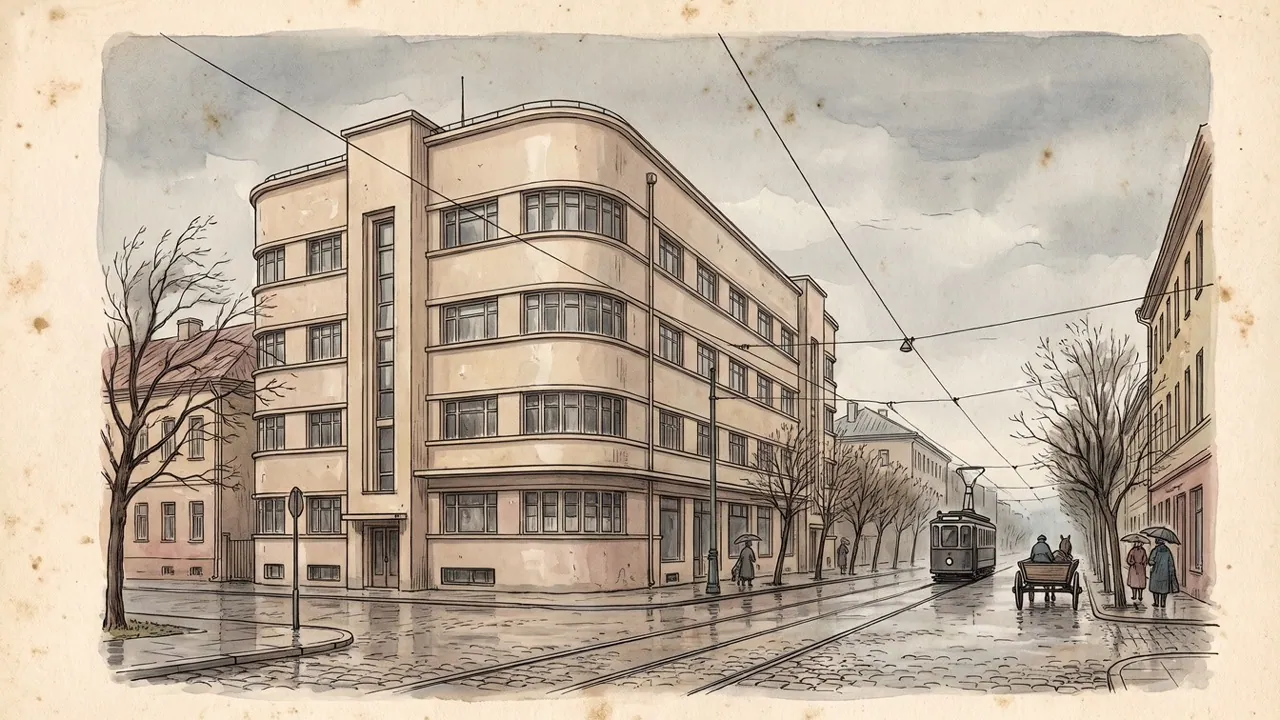
The building was commissioned in the interwar modernist idiom and completed in the early thirties; YIVO moved into it in 1933, and it remained the institute’s home until its destruction in 1944. [24] [1] Its address has been a source of confusion for decades, partly because so many later accounts attach YIVO to the Švėglicios (Shavel) Street address in the old quarter, where the Mefitse Haskala library and, later, the ghetto prison and the Jewish Museum stood. The correct sequence is the one the Vilnius municipal trail sets out: Basanavičiaus Street 16, then Basanavičiaus Street 20, then 18 A. Vivulskio Street — Wiwulski 18 — from 1933. [17] [27] A commemorative plaque was unveiled on that corner in June 2019. [28]
It is easy to read too much into a building. But the choice to commission a new one, in the interwar modernist idiom, at a moment when the Yiddish press was arguing about whether Yiddish culture was a viable thing or a dying one, was itself an argument. YIVO was saying that the study of this language was not a task of salvage. The building was a bet on the future, made by people who could not have known how badly it would be repaid — and whose library, the following spring, was going to be carried out of the building’s windows in sacks by Jewish forced labourers working for the Wehrmacht.
7. What “scientific” meant
The most consequential thing YIVO did was to pick a word. “Scientific” — visnshaftlikh — was not a decorative modifier. It was a claim about method, and it placed YIVO in a specific and adversarial position within the Jewish world. The established academic discipline of Jewish studies, founded in the nineteenth century in Germany as the Wissenschaft des Judentums, held that Jewish religion and culture had reached the end of their development with emancipation, and that what remained was a historical phenomenon fit for scholarly study. [1] YIVO’s founding manifesto stood in flat contradiction to this: it held that Jewish culture was living, creative, and national, and that it had a future requiring the same apparatus of research, documentation and training that any other living culture required. [1]
The distinction is worth pressing, because it determined what YIVO collected and who it collected from. A discipline concerned with a corpse collects monuments. A discipline concerned with a living population surveys a population. YIVO’s foundational methodological decision — made in the phrase “organised research into all aspects of Jewish history and culture”, with its four stated aims of serving as a centre of organised research, training Jewish scholars, gathering library and archival sources, and building a broad base of support in Jewish communities worldwide [16] — meant that the folklorists, the teachers, the seamstresses and the village scribes were not an adjunct to the scholarship. They were its evidence and, in a sense, its authors.
Descriptive and prescriptive at once
YIVO’s programme was explicitly two-faced, and contemporaries recognised both faces. It was descriptive, in that it documented the long history of Yiddish in order to refute the claim that the language was no more than a corrupt dialect of German. [1] And it was prescriptive, in that it standardised the language, and thereby transformed it into a suitable vehicle for a national culture. [1] The institute insisted, as a matter of pedagogy and in its own teaching materials, that Yiddish was not a dialect of German but a complete language, one of a family of Western Germanic languages alongside English, Dutch and Afrikaans. [29] Both halves of that position were controversial, and they were controversial in opposite directions. The descriptive half made YIVO the object of suspicion among those who wished the Yiddishists to abandon philology for politics; the prescriptive half made them the object of suspicion among everyone who had to read the language.
The suspicion was mutual. YIVO’s scholars spent a great deal of energy dissociating themselves from the charge that they were producing an unusable, “pedantic”, elitist Yiddish fit only for a scholarly minority, and the political left — the Bund, and the left wing of the Poale Zion — repeatedly called on the institute to declare open political allegiance and to embrace a class-conscious approach to the questions of the day. The great majority of YIVO’s leadership refused, insisting that their scholarly ideals required them to remain aloof from politics. [4] In the words of Cecile Kuznitz, whose 2014 history remains the only book-length study of the institution, the history of YIVO reads as “a battle between the champions of disinterested research and those who would degrade academic work by harnessing it to a political, particularly socialist, agenda”. [4]
Whether “disinterested research” was the right description is one of the questions the subsequent history makes unavoidable, and it is one to which the institution itself has grown more candid. Asked about the tension years later, YIVO acknowledged it directly: there was always a tension between the rhetoric of serving the folk and the reality that it was an academic institute, and the whole field of Yiddish studies had been somewhat marginalised within Jewish studies writ large. [30] It is a tension the institute did not resolve, and the argument over whether it should have tried to resolve it — whether an institute of Yiddish culture could be anything other than political, and whether a political institute of Yiddish culture could have survived — runs straight through its history, from the Culture League disputes of the late twenties to the arguments about the future of the language that were still being conducted in 2025.
8. The philological section and its journal
Of the four sections, the Philological Section was the one that set the institute’s intellectual tone, and its first publication became a model of what a pan-European Yiddish philology could look like. Filologishe shriftn appeared in three volumes, in 1926, 1928 and 1929, co-edited by Zalmen Reyzen and Max Weinreich, and the first volume was a Festschrift for Alfred Landau, the German scholar who had been compiling a comprehensive Yiddish dictionary for decades. [13] The choice of Landau as the dedicatee was a statement about alliances. [13]
Here is the thing about the intellectual isolation of interwar Eastern European Jewry, and it is the thing YIVO’s early editorial policy was built to break. The German Yiddish philologists of the Jüdische Rundschau circle and the Warsaw and Prague linguists had the training and, increasingly, the resources; the Soviet Yiddish linguists of Kiev and Minsk had the political confidence of a state; Vilna had neither. So YIVO’s journal deliberately published across these lines, including Ludwig Landau of Berlin — whose German-language work on Yiddish philology was included, in one account, as a symbolic gesture linking the Western and Yiddish academic worlds — alongside Solomon Birnbaum of Hamburg, Yisroel Tsinberg and Ayzik Zaretski of Leningrad, and the rabbi Shloyme Beilin of Irkutsk. [13] Under the pressure of the late twenties, Soviet authorities were for a time prepared to tolerate cooperation with Vilna’s institute, and the practical result was that a Yiddish philological journal printed in Vilna could contain the best Soviet Yiddish linguistics, which was among the best Yiddish linguistics there was. [13]
Zelig Kalmanovitch contributed an analysis of the dialect of Courland to these pages. [13] It is worth pausing on him, because he is the great example of the sort of figure YIVO existed to make possible: a man whose intellectual career spanned the entire political arc of his people — from Labor Zionism through Territorialism to the folkist politics of the Bund-influenced left, and eventually to Zionism again — who had taken his doctorate in Petrograd in 1919, published his first Yiddish linguistics article in 1908, and who in 1928 joined YIVO’s staff and settled into the role that would define him: administration, teaching, correspondence, and the editing of the institute’s general journal, the YIVO-bleter. [21] He handled all of this, in effect, while Max Weinreich concentrated on linguistics and pedagogy, and he was simultaneously accumulating the materials for a semantic dictionary of Yiddish that was never completed. [21]
The institute’s periodicals, taken together, form a small but remarkable publishing operation for the late twenties. The Yedies fun YIVO ran from 1925; the YIVO-bleter from 1931; the Historishe shriftn in 1929, 1937 and 1939; the Ekonomishe shriftn in 1928 and 1932; the Psikhologish-pedagogishe shriftn in 1933 and 1940; Yidishe ekonomik in 1937–39; Yidish far ale in 1938–39; Yidisher folklor in 1938; the Yunger historiker in 1926–29; and Bleter far geshikhte in 1934–38. [1] [31] It is a list that tells you exactly what the institute thought a comprehensive account of Jewish culture required: philology, history, economics, education, folklore and popular pedagogy, each with its own organ.
9. A language mapped
The central intellectual achievement of the prewar years was Max Weinreich’s dialectology, and it is worth describing in some detail because it is the clearest case in the history of the humanities of a methodological instrument producing a new field. Weinreich was born in 1894 in Goldingen, in Courland — which is to say in the Russian Empire, in a region whose Yiddish dialect would turn out to be one of the two poles of the map he drew. He was raised German-speaking, encountered Yiddish as a teenager, studied in St Petersburg and Marburg, and took his doctorate under Ferdinand Wrede in 1923 with a dissertation on the history and dialectical classification of the Yiddish language. [18] [32] That dissertation, published as Studien zur Geschichte und dialektischen Gliederung der jiddischen Sprache, is the founding statement of the method: it proceeds by gathering evidence — texts, sound records, word lists, correspondence — from an enormous number of places, and setting the resulting forms against each other so that the geography of variation emerges. [18]
What Weinreich found, and what he then spent the rest of his life defending, was a language with an interior geography of extraordinary complexity. Eastern Yiddish divides into a northern group — often called the Lithuanian, though it extends well beyond Lithuania — and a southern group, itself subdivided into a Ukrainian and a Mideastern, Polish-centred variety, the largest of the three by speakers. [6] [33] The dialects interdigitate; a single speaker may use one form of a word at home and another at work; the isoglosses run across the old political borders and ignore them entirely. To map this is to assert, with documentary force, that a language is a historical formation with its own internal structure, and not a ragged fringe of a neighbour’s tongue.
The argument was carried further in Weinreich’s four-volume Geshikhte fun der yidisher shprakh, published by YIVO between 1973 and 1980 and translated into English as History of the Yiddish Language — in 1980 in a partial version, and complete from Yale University Press in 2008. [34] Its central claim is that Yiddish is what Weinreich called a “fusion language”, whose Germanic, Slavic and Hebrew-Aramaic components were integrated phonologically, morphologically and grammatically into a single system rather than mechanically assembled from parts; that the speakers of Yiddish on the Rhine, whom the sources first meet as the Loez, spoke their own language and not a corrupted German; and that Yiddish was never formed in isolation, but in constant, productive contact with the non-Jewish populations among whom its speakers lived. [18] That last point is the sharpest challenge the school has delivered to the comfortable notion that a Jewish language was a closed and inward thing, and it is the reason Weinreich’s dialect map is not merely a reference work but an argument: the isoglosses run along lines of contact, not lines of separation.
Weinreich’s method had an immediate corollary that would dominate the politics of the institute for the next decade. If a language has a geography, it has a centre of gravity — and the centre of gravity of the Yiddish-speaking world lay not in Palestine, nor in New York, but in the triangle of Lithuania, Poland and the Ukraine that contained the densest concentration of Yiddish speakers. [6] To take Yiddish seriously as a language was, in the twenties, to take seriously the claim that the great Jewish populations of Eastern Europe were a cultural formation with a centre of its own, and to place the intellectual capital of that formation in the city where YIVO happened to be sitting. That claim was going to be tested in a way that nobody in the Berlin conference could have anticipated, and the answer it received in 1939–41 was as decisive as any vote.
“A language is a dialect with an army and navy”
The line is usually attributed to Max Weinreich, and it is a good one, but its history is instructive. It was not, strictly, his phrase. The maxim is attributed to an auditor at a Columbia University lecture in 1945, and Weinreich adopted it, quoted and credited, thereafter. [32] The choice of Columbia for the occasion is itself a small datum: the new home of Yiddish studies in America was to be lodged in the university whose English department had produced the very scholarship that Yiddish philology existed to refute. It is a measure of Weinreich’s pragmatism, and of the strange institutional shelter that American academic life offered to a language that its own students treated with a mixture of embarrassment and tenderness, that the defence of Yiddish was delivered, in the end, in the hall where the theory of American English had been developed.
There is a further irony in the maxim that YIVO’s own scholars would have appreciated better than its inventor. A language with an army and a navy is a language backed by institutions — schools, courts, bureaucracies, and eventually a state. The Yiddish of the interwar period had, in the Bundist and school networks of Poland and the Soviet Union, something approaching the institutional infrastructure the phrase demands, and it was precisely the destruction of those institutions, and of the population they served, that made the argument retrospective. What YIVO actually had, after 1945, was neither an army nor a navy but an archive and a publishing house. The claim it could make was the historical one: this language was spoken by millions, it was written in millions of books, and here is the proof, in the original.
10. The orthography wars
No controversy within YIVO was as bitter, as consequential, or as revealing of the politics of the Yiddish world as the argument about spelling. By the late twenties there were three rival systems in circulation, and the choice between them was not a trivial matter of typography; it was a declaration of what Yiddish was, and of who it belonged to. [35] [36]
The first was the Soviet code, the Sovetisher oysleyg, largely the work of Ayzik Zaretski and traceable to proposals made by Mordkhe Veynger in 1913. It was the only system with the backing of a state: a code was issued in 1928 and amended in January 1929, the five word-final consonant forms unique to the Hebrew alphabet were abolished in 1932, a conference at Kiev fixed the details in 1931, and the result was published as an orthographic dictionary in 1932. [36] Its principle was phonetic: Semitic-rooted words were to be spelled as they were pronounced. This was a deliberate act of secularisation. It stripped the Hebrew and Aramaic component of the language of its traditional, and religious, orthography, and it did so in a state for which Hebrew was, for reasons of Zionism, an ideological irritant. [10]
The second was the “Orthodox” system of Solomon Birnbaum, which rejected the klal yidish — the generally accepted, semi-standard pronunciation — in favour of a one-to-one correspondence between grapheme and phoneme, and which was guided by the principle of what is standard in German (vos vayter fun daytsh). [35] The third was YIVO’s own standard, which rested on Zalmen Reyzen’s Gramatik fun der yidisher shprakh, published in Vilna in 1920, and which retained the traditional Hebrew and Aramaic spelling. [35] The differences between these systems are, by the standards of modern linguistics, minor; what is remarkable is that they could generate a decade of polemic, and that the polemic was never really about spelling.
What would Yiddish be without Hebrew?
The polemic came to a head in the correspondence between Shtif and Weinreich, and it is the most instructive literary quarrel in the institute’s history. Shtif had embraced the Soviet orthography through his journal Di yidishe shprakh in Kiev, and in 1929 he published an essay, “The social differentiation in Yiddish: the Hebrew elements in the language”, in which he derided the Hebrew component as a reactionary relic and called for its systematic removal. [37] [10] Weinreich replied in the New York journal Di tsukunft in 1931 with a question that functioned as an argument: “What would Yiddish be without Hebrew?” Shtif answered in 1931 and 1932, in Afn shprakhfront, with a study of “Revolution and reaction in the language”. [37] The exchange was conducted with scholarly courtesy and mutual contempt, and it went to the heart of the question that divided the Yiddish world: is Yiddish a Jewish language in its own right, in which case its Hebrew and Aramaic components are the marks of its identity and must be protected; or is it a German dialect undergoing social differentiation, in which case the Semitic elements are a fossilised inheritance and must be expelled? [10]
YIVO’s own line, when it took one, was consistently on the side of preservation — and it took that line at some cost. A commission conference in 1931 approved phonetic spelling; the institute did not adopt it. When YIVO finally promulgated its orthographic rules in 1936, the Central Yiddish School Organization agreed to implement them in its classrooms, retaining the traditional treatment of the Hebrew and Aramaic elements. [1] [10] The compromise was not a victory for Weinreich. It was the decision of an institute that had to live with several incompatible publics, and it left YIVO’s own rules — set out in Weinreich’s booklet Daytshmerish toyg nit! (“Germanisms are not good!”) in 1938, and in the pages of the journal Yidish far ale, which ran from 1938 to 1939 — permanently in the position of one more opinion in a field that contained at least three. [1]
By the twenty-first century the YIVO Unified spelling had become the dominant system in secular Yiddish publication, and a sixth, greatly expanded edition of the standard appeared in 1999. [10] The rival systems now differ only in detail, and all of them are, in the helpful formulation of the YIVO Encyclopedia’s survey, “basically anti-German”. [10] It is worth noticing what this particular ending means. The Yiddish orthographic wars were fought, at the level of principle, by people who all wanted to be rid of German. The disagreement was over how to do it: whether to scrap the Semitic inheritance along with the German loanwords, or to keep it and let it do the work of making the language Jewish. YIVO’s answer, the compromise it settled on, was the second. The answer it eventually gave in practice — publishing a unified standard that wins because it is the one American and Israeli publishers use, rather than because its philological reasoning was universally accepted — is a reminder that in the marketplace of standard languages, adoption is often a fact of logistics rather than of argument.
11. The Central Archives and the photographic archive
What YIVO collected in the twenties and thirties is now so voluminous that it is easy to lose sight of how improbable its early decisions were. The Guide to the YIVO Archives lists more than nineteen hundred record groups; the library numbers in the hundreds of thousands; and the Vilna Collections alone account for dozens of record groups and hundreds of thousands of pages. [23] [38] Almost none of that was accumulated by purchase. It was made — deliberately, item by item, by people who understood that the destruction of the society they were documenting was a question of when, not whether.
The machine was assembled in a specific order. The Bibliographic Commission was the first division to begin work, and became an independent Bibliographic Center in 1927; it issued its own Bibliografishe yorbikher in 1928, a review of Yiddish printing that remains the standard bibliography of the subject. [1] The library and the archives were created at the same moment, in 1928 — a decision that matters, because it means the institute began as a collection rather than as a publishing house that acquired books, and because everything it later did was downstream of the choice to treat the whereabouts of documents as the first question. [1]
The Central Archives itself was established in 1926 with two divisions: one for the Jewish press, and one for documents and manuscripts. [1] The division was not bureaucratic. A newspaper is a different kind of object from a letter — it is serial, published, distributed, censored, sometimes illegal — and a Jewish press that had been illegal in Russian Poland and was now being suppressed in a different way in a different country required a kind of custody that a private manuscript did not. Building the press archive first, in 1926, was an act of historical imagination: the institute was already gathering the record of a freedom that was being withdrawn.
A photographic archive followed in 1937. [1] It is the least discussed of the founding decisions and it now looks like the most prescient. Photography was cheap, portable, and — this is what the decision was really about — instantly reproducible: a print could be made from a negative and distributed, so that the image did not have to be hidden in a cellar with the rest of it. Photographs of shtetl streets, of synagogues, of schoolrooms, of the interiors of houses and the faces of the people who lived in them were among the most dangerous objects in Eastern Europe in the late thirties, and YIVO began collecting them while it was still legal to do so. Other collections came in by absorption: the History Section took in the Mizrakh Yidisher Historisher Arkhiv, the Eastern Jewish Historical Archive, assembled in Ukraine between 1918 and 1920 and moved to Berlin in 1922; and in 1928 the Esther-Rokhl Kaminska Theater Museum was established, taking the papers of the great Yiddish actress and the records of the Jewish Actors Union in Poland. [1]
The institute also ran a standing series of research commissions — Ethnographic, later renamed the Folklore Commission, Terminological, Linguistic, Orthographic, and the Historical Commission on Poland — and each of them generated material before it generated conclusions. [1] The commissions were the mechanism that kept scholarship attached to collection: a commission on terminology could not proceed without knowing what the words were; a commission on orthography could not decide without knowing what people actually wrote. It is a pattern that recurs at every stage of the institute’s history, and it explains why an institution with a small budget and no university teaching obligations ended up with an archive of the first rank. The archive was not a by-product of the scholarship. The scholarship was organised so as to require the archive.
The four aims
The statute that the Vilna society endorsed in March 1925 set out four aims, and it is worth reading them as a programme rather than a list. [1] The first was to be a centre for organised research into all aspects of Jewish history and culture — which is to say, not a national literature but everything: demography, economics, folklore, religion, theatre, the professions, the life of the street. The second was to train Jewish scholars, which was the aspirantur and the summer programmes and the hundreds of young people who passed through them. The third was to gather library and archival source materials, which is the Central Archives, the Bibliographic Center, the photographic archive and the collectors’ network. The fourth was to develop a broad base of support in Jewish communities worldwide, which is the societies of friends. [1]
That fourth aim is the one that later commentators find hardest to explain, and the one that explains the most. YIVO was not a foundation; it was not a university; it was not a museum. It was an instrument for organising a constituency — the Jews of Poland, of the United States, of Palestine, of South Africa — around the scholarly study of their own history, and it happened to have discovered that the only way to do that was to build the infrastructure of a national research culture. The societies of friends were not a fundraising convenience. They were the institute’s theory of how such a thing could survive in the world it was built for.
It is a strategy that a good many later institutions would recognise, including the ones that no longer exist. The Yiddish Book Center, the National Yiddish Book Center’s descendants, the YIVO Institute in New York and the Vilna Gaon Museum all came out of the same nineteenth- and early twentieth-century conviction that a people’s culture is a researchable object and that the research has to be housed somewhere durable. The difference is that YIVO was the only one of them that was founded before the catastrophe it exists to document, and the only one that had to keep working through it.
If the philological section was the institute’s intellectual engine, the collecting network was its circulatory system, and it is the part of YIVO’s prewar history that has aged best. The method was simple and radical: rather than sending scholars out to gather material themselves, YIVO organised the people who were already there. Teachers were asked to ask their pupils. Students were asked to ask their families. Rabbis, cantors, writers and matchmakers — the people who knew everything — were asked to write it down. Each division of the institute began by surveying and gathering sources before it attempted to analyse them, and the volume that came back was astonishing. [1]
12. The collectors
These volunteers were known as zamlers, and they gathered in small local circles called zamlerkrayzn, or collectors’ circles. A 1929 survey of the network found that about a quarter of the collectors had ties to Yiddish schools and that nearly a third were impoverished manual labourers. Many of them asked, and were given, money to cover the cost of paper and postage. [1] The figures are the point. YIVO’s collecting programme was, in effect, a subscription service run by an institute in a city that could not pay its own clerks, and it reached into the kind of communities that no archive, no ministry and no university in Europe would have thought it worth a postage stamp.
By 1929, the members of 163 collectors’ circles had sent more than fifty thousand copies of proverbs, folktales and folk songs to YIVO. [1] By 1938 the folklore collections held some hundred thousand items: folk plays, song lyrics, tales, jokes, anecdotes, legends, sayings, proverbs, accounts of local religious custom, children’s rhymes and games. [1] [39] The questionnaires that went out to the villages are worth pausing over, because their contents reveal the institute’s theory of what needed preserving: Jewish legends, Purim and Passover and Lag b’Omer and Shavuot, the High Holidays, khevre kadeshah, the upshernish — the first haircut of a small child — and children’s folklore, in all its forms. [39] These are not the materials of a national epic. They are the materials of a way of life, and the distinction is the whole point.
The institutional vehicle was the Ethnographic Commission, established in 1925 as a sub-section of the Philological Section and worked in cooperation with, and partly financed by, the An-ski Jewish Historical-Ethnographic Society; it was renamed the Folklore Commission in 1930 and was chaired by Weinreich. [40] Its members included the folklorist and teacher Shloyme Bastomski, N. Weinig, Nekhama Epstein and Zalman Reisen, and it published the scholarly journal Tsaytshrift. [39] The model it followed was An-ski’s, and that model is one of the most remarkable data-collection projects of the prewar period.
An-ski’s expeditions
Shloyme Zaynvl Rapoport, better known as S. An-sky, was the great collector of the Yiddish world. Between 1912 and 1914 he led ethnographic expeditions through the Pale of Settlement, financed by a project begun in 1911 by Vladimir Gintsburg in memory of Baron Horace Gintsburg; at a preliminary meeting in St Petersburg in March 1912, An-ski declared the aim to record the oral and musical relics of the Jewish people. [41] In the second season, from June to November 1913, he and Iudovin travelled through some sixty communities in Volhynia and Podolia, joined by the folklore specialist Zusman Kiselgof and by students of the Higher Courses on Oriental Studies — Avrom Rekhtman, Yitskhok Pikangur and Shmuel Shrayer. [41] An-ski’s later reports claimed that the group investigated about seventy towns across the Pale, recording more than two thousand folktales, legends and traditions, more than fifteen hundred folk songs, and as many as a thousand instrumental and synagogue melodies and drinking songs, together with customs, ceremonies, superstitions, incantations, proverbs and parables. [41]
But the method mattered more than the totals. The expedition devised the Yidishe Etnografishe Programe — a programme in Yiddish, distributed in 1912 and 1913 — so that volunteers could work independently in the thousands of places the expedition itself would never reach. [41] It was, in effect, a distributed research protocol, published in the vernacular, in advance of the fieldwork, so that the fieldwork could be replicated by people who would never meet a scholar. That document is the true ancestor of YIVO’s zamlerkrayzn, and it is one of the more significant documents in the history of vernacular sociology: it establishes that the folk are capable of systematic inquiry about themselves, provided somebody designs the questionnaire and prints the sheets.
The parallel development came from the Pryłucki circle, which treated folklore as a branch of philology and, more ambitiously, as a resource for the study of the language itself. Around Noah Pryłucki gathered prolific collectors such as Shmuel Lehman and Pinkhes Graubard, who underwrote Bay undz yidn: Zamlbukh far folklor un filologye, published in 1923 — a landmark anthology of Yiddish master-thief tales, criminal argots, underworld folklore, children’s folklore and Purim plays. [40] The volume is a reminder that “folklore” in the Yiddish context covered both the cradle song and the confidence trick, and that the institute’s folklorists were not sentimentalists. They were comparatists, interested in what a tale’s structure did to the language it was told in.
The folklore work was given a second life in 1938, when the fruits of the zamlers’ labour were published as Yidisher folklor, a volume that owed a great deal to a visit Judah Leib Cahan made to Vilna in 1930 and which revived the collection effort that had flagged in the middle of the decade. [1] It is a good place to notice what the institute was actually building: not a folklore of the shtetl, understood as a nostalgia machine, but a field. The material in Yidisher folklor was gathered with a purpose — to be compared, to be used, to be put to work on the language — and the difference shows in the quality of the questions that were asked of it.
13. The sound archive and the singers
Sound recording changed what folklore collection could be, and YIVO was one of the few institutions in Europe to grasp this early. The Max and Frieda Weinstein Archive of YIVO Sound Recordings holds over fifteen thousand recordings — 78, 45 and 33 rpm discs, wax cylinders, open-reel and cassette tapes, piano rolls and compact discs — along with the physical artefacts of the trade: needles, styli, recorder mechanisms, and the boxes the discs came in. [42] The earliest item in the collection is a wax cylinder from 1900, which places the archive a full generation ahead of the folklorists who thought of the phonograph as a curiosity. The holdings span Yiddish and Hebrew art, folk, popular and theatre music, Holocaust songs, liturgical and Hasidic music, choral and instrumental music, children’s and holiday songs, and klezmer. [42]
The single most consequential body of material is the field collection of Ruth Rubin, preserved as RG 620 at YIVO, and it is worth describing in detail because it establishes the standard against which all later folk music collection has been measured. Rubin travelled through the towns and villages of the Bronx and the Lower East Side, and into the living rooms and kitchens and — most consequentially — the factories of the immigrants, recording lider on a portable machine, with the singers’ own commentary, and often the circumstances of the singing: who had taught it to them, where they had heard it, what it was for. [43] The resulting archive contains well over fifteen hundred Yiddish songs, and when Yiddish Folksongs from the Ruth Rubin Archive was published in 2007, edited by Mark Slobin and Chana Mlotek, it was recognised immediately as the central document of the subject. [43]
YIVO holds the field recordings of two other indispensable collectors: Benedict Stambler, whose work on the singing tradition of the Bukharan, Hasidic and other communities of the Soviet Union brought the sound of Central Asian Jewry into a recording archive for the first time, and Ben Stonehill, whose collection documents the cantorial and ritual music of the European cantorial schools. [42] It also holds more than two hundred Jewish radio programmes broadcast between 1936 and 1955 (RG 130), and forty-three oral-history interviews on the American Jewish labour movement that YIVO taped between 1964 and 1968 (RG 113). [42] [44] The sound archive was formalised in 1982, by the musicologist Henry Sapoznik, and its intellectual parent was the Yiddish Folk Arts Program — KlezKamp — founded in 1984 and run independently from 1994. [1] YIVO was, in the phrase of its own institutional history, the incubator of the klezmer revival. [1]
One of YIVO’s sound archivists deserves particular mention, because she was there from the beginning and stayed for half a century. Chana Mlotek (1922–2013) came to the institute as a young immigrant in the 1940s and became its music archivist, the compiler of its catalogues, and the keeper of its institutional memory; she was the sort of person who knew not only where a recording was filed but who had made it and why. [45] The institution she left behind in 2025 is largely the one she made. There is a particular kind of debt owed to such people, and YIVO’s centenary exhibitions in 2025 made a point of naming them: Hail to the Zamlers! YIVO’s Collections at 100, the first of three centenary shows, was dedicated to the collectors rather than to the scholars, which is the more accurate proportion. [46]
14. The library and the Vilna collection
The YIVO Library and Archives were constituted together, in 1928, and the institute’s prewar holdings were assembled with a comprehensiveness that was, for the time, startling: by 1941 the bibliography of YIVO publications had exceeded two and a half thousand items. [16] The library itself grew past forty thousand volumes, with a press archive of roughly ten thousand magazines from various countries; the Soviets, who took over the city in 1939, added some twenty thousand more volumes to it in the two years of their occupation. [24] [16] That figure is the one that stays in the mind — that at the very moment the Nazis were destroying the collection, the Soviet administration was quietly expanding it, apparently without any clear idea of what it was sitting on.
The library’s internal architecture survives in the way YIVO still describes the holdings. The Vilna Collection, the core of it, is described today as roughly fifty thousand books and periodicals, divided into rabbinica (about twenty-five thousand volumes), secular Hebrew (eight thousand), secular Yiddish (five thousand), a press section of three thousand periodical titles, and a residue of about a thousand volumes in other languages, the oldest of them reaching back to the early sixteenth century. [47] [48] The proportions are themselves an argument about what YIVO was for. A third of the collection is rabbinic. The institute was not a Yiddishist establishment in the narrow sense; it held the books of the whole Jewish world of the Pale, because it understood that the language could not be studied apart from the life that produced it.
The collection divided four ways
The physical holdings of the prewar collection are today divided between New York and Vilnius, and the division is the result of the raids, the war, the Soviet destruction and a series of hard bargains. In New York, YIVO Library holds some forty-one thousand rare rabbinical and secular Hebrew volumes from the Strashun Library, more than six thousand books in Yiddish and other languages from YIVO’s own prewar library, and three thousand periodical titles; in the YIVO Archives in New York sit sixty-one record groups of prewar archival material occupying some five hundred linear feet. In Lithuania, the Martynas Mažvydas National Library of Lithuania holds three thousand Yiddish books, some twelve hundred rare Hebrew books from the Strashun, more than a hundred Yiddish periodicals, and approximately one hundred and seventy thousand newly discovered pages; the Wroblewski Library of the Lithuanian Academy of Sciences holds between nineteen and twenty thousand documents; and roughly a hundred and fifty linear feet of YIVO archival material remain in the Lithuanian Central State Archives. [38] The two sides of this division are now being reunited, digitally, by the Edward Blank YIVO Vilna Online Collections project. [49]
YIVO’s named private collections include the Strashun, Elias Tcherikover — acquired in 1946 after he had hidden part of his pogrom archive in southern France during the war — the papers of M. Ceshinsky of Chicago, Chaim Zhitlowsky, Max Weinreich, Kalman Marmor, Shmuel Niger, Sholem Perlmutter and Chaim Grade, and the Winchevsky Collection of Jewish labour history and Yiddish literature. [50] The Grade papers were acquired jointly with the National Library of Israel in 2013. [50] It is worth noticing the shape of this list: several of the most important private libraries in the institute came to it after 1945, which means that the “YIVO collection” as it exists today is a composite whose prewar and postwar halves were assembled in different ways, under different pressures, and with different memories attached.
15. The Strashun Library
The single greatest scholarly resource of the old Vilna Jewish quarter was not YIVO’s but its neighbour’s, and the two institutions’ histories have been so often fused that they are worth separating. The Strashun Library was the bequest of Matityahu Strashun (1817–1885), the great Talmudist of the city, who left his library of some seven thousand volumes to the Jewish community of Vilna for the use of the studious poor. The library opened to scholars in 1892 and to the public in 1902, and became so central to the intellectual life of the city that it was routinely described as the most important library of Jewish learning in prewar Europe. [51] Its readers included the Vilna Gaon’s own students and successors, and the Strashun reading room functioned, in effect, as the university of a community that had no university. [25]
It was not a YIVO branch. YIVO’s library and archives were created in 1928; the Strashun was a parallel institution of the Vilna Jewish community, and its collection reached YIVO only after the war, when the remnants of the library were absorbed into the New York collections. [51] The scale of what was lost and what survived is difficult to reconcile. The library is described as having held some thirty-five thousand books before the Soviet occupation, and YIVO’s later count describes a “Strashun Collection” of some forty thousand items, broken down as twenty-five thousand volumes of Hebrew rabbinics, a thousand Yiddish rabbinics, eight thousand secular Hebrew and five thousand secular Yiddish, with roughly fifteen thousand of the books available in no other library anywhere. [31] The library was merged with YIVO’s under Soviet rule in 1940; the Nazis dismantled the YIVO library in 1941 and shipped the Strashun material largely to Frankfurt. [52]
What came home to New York in 1947 was the largest single consignment in YIVO’s history: twenty-five thousand volumes from the Strashun Collection together with fifteen thousand volumes of YIVO’s own prewar library, found in a warehouse at Offenbach near Frankfurt and shipped to New York. [52] The remnants of the Strashun library were added to UNESCO’s Memory of the World Register in June 2017. [51] Its holdings, such as they are, include the Hokhmat Shelomoh printed in Kraków around 1582, Meshal ha-Kadmoni from Venice in 1547, the first complete Yiddish Bible translation — Torah Nevi’im u-Khetuvim, Amsterdam 1679 — with the Etz Hayim of 1682, a Midrash Tehilim of 1512, Sefer Rav Mordekhai from Kraków in 1598, and the Shulhan Arukh as printed in Amsterdam in 1648. [53] Among the treasures the Paper Brigade saved was the eighteenth-century register, or pinkas, of the Vilna Gaon’s elite study group, the kloyz. [54]
The institute also absorbed, in the decade after the war, the Mizrakh Yidisher Historisher Arkhiv — the Eastern Jewish Historical Archive, assembled in Ukraine between 1918 and 1920 and moved to Berlin in 1922 — into the Historical Section. [1] And it inherited, by the accidents of war, a particular kind of responsibility: not merely to preserve Jewish culture but to establish, in a court where the matter would be argued, what had existed and what had been destroyed. That was the achievement of the Nuremberg proceedings, at which YIVO’s documentation was presented as evidence. [55] [1]
16. The aspirantur
An institute that collected but did not teach would have been an archive with a staff; YIVO’s third stated aim, the training of Jewish scholars, was the one that turned a collecting operation into a discipline. In 1934 the institute created a graduate training programme, named for its chairman, the Dr. Tsemakh Shabad Aspirantur — with a preparatory programme, the Borekh Kahan-Virgili proaspirantur, following in 1937. [1] [16] The aspirants took classes and carried out original research; many of their projects were sociological in nature, reflecting Weinreich’s own involvement, and gathered information on contemporary Jewish life in the Vilna region. [2]
The name is worth a moment. Tsemakh Shabad (1864–1935) was a physician and a leader of public health in the city, the head of the Vilna branch of the ORT, the first chairman of YIVO’s Central Board, and the chairman of the Vilna Jewish community’s executive — and the father of Regina Shabad, who married Max Weinreich. [56] [18] The institute’s first formal school was thus named for the father of the man who ran its most important section, at a moment when the most important thing the school could do was to train people to go out and find out what was actually happening in the villages. It is an institution that made a virtue of personal connections; in a field with no chairs, no journals guaranteed and no money, personal connections were the career structure.
The output of that training was not only academic. In 1934 Weinreich founded the Division of Youth Research, and the autobiography contests it ran — three of them, attracting more than six hundred entries, gathered in the same years that the YIVO-immigrant essay contest of 1942 would collect the accounts that became My Future Is in America — produced Der veg tsu undzer yugnt in 1935. [1] [2] These were the first of YIVO’s great harvests of the American immigrant voice, and they matter for a reason that is easy to miss: they gave the institute a way of being useful to the new population. If the old shtetl was being studied as a vanishing object, the new shtetl in the Bronx was being studied as a forming one, and the same methods served both. The Voices of the Great Migration, it turns out, are the voices of YIVO’s own newest project, and they were collected by the same kind of volunteer network that collected the folk tales of the Pale.
17. The schools, the seminary and the textbook war
Of the four sections YIVO created in 1925, the one that has left the smallest institutional trace is the Pedagogical or Psychological-Pedagogical Section, chaired from Warsaw by Leibush Lehrer. [1] The reason is structural rather than incidental: a section for the study of education produces research, not schools, and the schools it was meant to serve were being built and closed and built again by other people, under other auspices, in the middle of a war of ideas that was not really about pedagogy at all. It is nonetheless through this section that the institute reached the largest number of actual Yiddish speakers, and it is here that the question of what “scientific” meant became most concretely a question about children.
The setting was the network of secular Yiddish schools that had multiplied across the Polish and Soviet borderlands in the wake of the Kultur-Lige, the organisation founded in Kiev in April 1918 by Zelig Melamed and his colleagues, with sections for schools, theatre, preschool work, art, music and libraries, a Jewish People’s University, and around a hundred branches across Ukraine. [57] The Kultur-Lige was seized by the Bolsheviks in December 1920 and its press was closed in 1931, but its Polish branch, founded after the 1921 Warsaw conference, published Literarishe bleter from 1924 to 1939 before being absorbed into the Bund in 1925. [57] Vilna had had a branch of its own since 1918 or 1919, and its Yiddish public life was shaped by the competition between the Kultur-Lige’s secular programme and the orthodox institutions of the city. [57]
By the end of the twenties the educational map of Vilna was crowded. The YIVO Encyclopedia’s account of the city lists what a modern Jewish town had become: kindergartens, schools and gymnasia attached to a dozen movements, among them Tarbut for Hebrew, the Tzentraler Bildungs Komitet for Yiddish, Shul Kult, Tahkemoni for the national-religious current and Yavneh for the strictly observant. [26] These were not charity schools. They were competing instruments for the future of a population, each with its own language of instruction, its own textbooks and its own idea of what a Jewish child needed to know. What they shared was a shortage of everything except pupils, and a dependence on institutions like YIVO to tell them what the language should look like on the page.
The Yiddish side of that map was organised by TSYSHO, the Tsentrale Yidishe Shul-Organizatsye, founded in Warsaw in June 1921 by the Bund and Left Po’ale Tsiyon and administered from a central office in Warsaw with a central education committee in Vilna. [58] At its peak in the late twenties it maintained 219 institutions with 24,000 pupils across a hundred locations: forty-six kindergartens, 114 elementary schools, six high schools, fifty-two evening schools and a pedagogical institute in Vilna. [58] Its crown jewel was the Vilna Realgymnazye, the first high school in which Yiddish was the language of instruction. And the scale of this network — a quarter of a million children a year in a population of a few million — is the measure of what YIVO was working on. A language spoken at home was not yet a language taught in school; TSYSHO was building the second thing, and YIVO was to supply it with a standard.
What YIVO could offer the schools was not ideology but standardisation — and the word “standard” has to be understood in its strongest sense. The Tsentrale Yidishe Shul-Organizatsye, the central Yiddish school organisation, agreed to implement YIVO’s orthographic rules in its classrooms in 1936 while retaining the traditional treatment of Hebrew and Aramaic elements, a compromise of exactly the kind that let a scientific standard survive contact with a religious culture. [10] [59] The work behind that decision was the institute’s Terminological and Linguistic Commissions, and the work behind that was the dictionary and the corpus: a school cannot adopt a standard unless somebody has decided what the words are.
The pedagogical section’s real task was the unglamorous and decisive one of making the standard usable — reading primers, graded anthologies, classroom grammars, and above all a set of recommendations about the balance between Yiddish, Hebrew and the rest of the timetable. There was a sharper fight underneath, and it was about German. YIVO’s philologists had spent a decade establishing that Yiddish was not a broken German, and the schools were the place where that claim either became real or remained a proposition in a journal. Weinreich’s 1938 pamphlet Daytshmerish toyg nit! — “Germanisms are not good!” — was a campaign against the New High Germanisms that were flooding the language from the west. [10] [6] The tone of the title is the tone of the whole enterprise: a language defending itself, in the classrooms, one word at a time.
There was also, in this period, a quieter and more consequential educational project: the training of teachers who could do that work. YIVO did not found schools, and it did not found the Vilna Teachers’ Seminary, which ran from 1921 to 1931 and counted Max Weinreich among its instructors; the institute sat beside the seminary rather than inside it. [58] The seminary’s 124 graduates became the core members of the secular Yiddish school faculty — and a century later the mere scale is what strikes: a dozen-odd trained Yiddish teachers, each of whom taught hundreds of children, who taught their own children. The seminary closed; its graduates did not. They taught in the schools of the Pale, in the Baltic, in Poland, in the Soviet territories and later in New York, Toronto and Melbourne, and for a generation the Yiddish-speaking children of the eastern European shtetl were taught by people who had been taught, in Vilna, by Max Weinreich’s colleagues, to think of their own language as a subject with a grammar, a history and a future.
The Depression then took the whole system downhill. With the collapse of aid from abroad and the absence of government subsidies, TSYSHO’s roll fell to 15,486 pupils in 1934–35, spread across eleven kindergartens, eighty-six elementary schools, two high schools and seventy night schools — 9.15 per cent of the 180,681 school-age children attending Jewish schools. [58] It is worth sitting with that figure, because it is the institutional shape of the catastrophe to come: a language’s future was being measured in the tens of thousands, in a population that was about to be killed, in a system that had never had enough money to begin with. The schools were not rescued, and YIVO could not have rescued them. What it could do was record what they were, while they existed — which is precisely what its archive was for.
Two smaller experiments from the same decade show the institute’s method being applied to new populations. The Borekh Kahan-Virgili proaspirantur, a preparatory programme, was created in 1937 as a step towards the graduate school founded in 1934 and named after Tsemakh Shabad, Weinreich’s father-in-law. [56] And in 1934 Weinreich founded the Division of Youth Research, which ran three autobiography competitions; more than six hundred entries came back, and they became the basis of Der veg tsu undzer yugnt in 1935, a study of the paths by which young Jews had come back to their own history. [1] A competition for autobiographies is a data-gathering exercise and a public-relations exercise at once, and the second was probably the point: it found a readership for the institute’s work among people who had never read a philological journal and never would, and it asked them to write their own account of why they had come back. The Division of Youth Research was an experiment in the one thing an archive cannot do — make new people.
It is worth pausing on how thoroughly the institute’s existence was premised on children. Everything upstream of the schools was groundwork for them: the phonetic and lexical research, the dialect atlas, the orthography, the textbook corpus, the training of teachers who could teach the teachers. And everything downstream was rescue: the paper brigade, the sorting office, the New York re-establishment. Between those two things lies the institute’s entire working life, and the pedagogical section was the quiet hinge on which the whole apparatus turned. A language that is not taught to children is a language that ends. YIVO’s first great achievement was to build the machinery that could make that argument stick.
18. The dictionary that never came
The great unfinished project of YIVO’s prewar years was a Yiddish dictionary, and the story of its failure is the story of the institute’s central weakness told in miniature. A language without a standard lexicon is a language whose speakers cannot look things up; every serious teacher, journalist and writer must improvise. The Terminological and Linguistic Commissions produced standard vocabularies, and Kalmanovitch accumulated material for a semantic dictionary that was never realised. [1] In Berlin, Alfred Landau was at work for decades on a comprehensive Yiddish dictionary, and it was his achievement that the first volume of Filologishe shriftn was dedicated to him as a Festschrift when he died in 1935. [13] [1]
The project that was to succeed them was begun in 1953 as the Yiddish Dictionary Committee, and its product was the Groyser verterbukh fun der yidisher shprakh, the Great Dictionary of the Yiddish Language. Four volumes appeared between 1961 and 1980. They cover the first letter of the alphabet. [1] The editor was Yudel Mark, and the history of his relationship with the institute is one of the more instructive episodes in the whole story, because it is a story of how a scientific project came apart under the pressure of exactly the disputes it was meant to settle.
Mark and Weinreich split over the takones — the linguistic and orthographic rules — with Mark preferring his own system, and over the scale of the undertaking, with Mark arguing for a dictionary on the model of the OED and Weinreich insisting that a Yiddish dictionary could not be built on the same principles, because every word in the language needed equal rights in it. [60] The YIVO emblem was withdrawn from the volumes, and the work was, for a time at least, not officially under the institute’s auspices. [1] The dispute was dramatised in 2025 in a chamber opera by Alex Weiser and Ben Kaplan, The Great Dictionary of the Yiddish Language, premiered at YIVO’s centenary and reviewed in the New York Times under the title “The Dueling Scholars Who Bickered a Yiddish Dictionary Into Existence”. [61] [62] That the centenary year should have chosen this particular failure as the subject of its gala premiere tells you something about how the institute has come to think about its own history: the argument was the point.
The lexicon that did come out of the wartime and early postwar years was Nahum Stutchkoff’s Der Oytser fun der yidisher shprakh, a thesaurus of some ninety thousand words, edited by Max Weinreich and published by YIVO around 1950. [63] [32] Its title, “Treasury of the Yiddish Language”, is an accurate description of its bulk and an inaccurate description of its method: it was a compilation rather than a lexicographical work in the modern sense, and it was superseded within a generation. Uriel Weinreich’s Modern English-Yiddish / Yiddish-English Dictionary, published by McGraw-Hill in 1968 and reprinted by YIVO in 2012, contained some twenty thousand words and was published posthumously, its editor having died in 1967. [64] [1]
The dictionary YIVO’s own library holds in quantity is not its own. It holds more than a hundred Yiddish dictionaries in fourteen languages — Belorussian, Dutch, English, French, German, Hebrew, Hebrew and Aramaic, Japanese, Lithuanian, Polish, Russian, Spanish and Ukrainian — with subject headings running to academic terminology, etymology, proverbs, scientific terms and thesaurus. [65] The largest and most scholarly modern Yiddish dictionaries were produced outside the institute: Solon Beinfeld and Harry Bochner’s Comprehensive Yiddish-English Dictionary (Indiana University Press, 2013), and the Comprehensive English-Yiddish Dictionary based on the lexical research of Mordkhe Schaechter, edited by Gitl Schaechter-Viswanath and Paul Glasser with Chava Lapin (Indiana University Press, 2016), which runs to some eighty-three thousand words and expressions. [66] [67] Schaechter had been one of Weinreich’s circle, and his card-index terminologies had been aggregated on Joshua Fishman’s advice into the basis of that dictionary. [67] The irony is not lost on anyone who has followed the story: the greatest achievement of YIVO’s lexicographical programme was achieved by a scholar who left the institute, and the institute’s own great dictionary stopped at the letter alef.
19. Vilna’s Yiddish public life
YIVO did not exist in a vacuum. The institute’s most important local relationship was with the Vilna Jewish community itself, a self-governing body whose institutions — the schools, the teachers’ seminary, the ORT courses, the secular cultural organisations — provided YIVO with its social base, its students and its fieldwork sites. [1] [56] But the more textured relationship was with the Kultur-Lige, the organisation of Yiddish cultural life that was the great institutional phenomenon of interwar Vilna and that YIVO’s own history has been careful to characterise as a body whose members were often simultaneously YIVO’s. [57]
The Kultur-Lige was founded in Kiev in April 1918 and organised the secular Yiddish institutions of the city — with a Vilna branch from 1918 or 1919, and close to a hundred across Ukraine — schools, choirs, amateur theatres, publishing, lecture programmes, and the reading rooms that kept the Yiddish public alive as a public. Its magazine ran for years and its congresses were the model for the kind of cultural self-organisation that YIVO’s scientific rhetoric existed to dignify. [57] It is worth remembering that the Kultur-Lige was not a minor or rival body but the dominant secular force in Vilna, and that the sharpest criticism ever levelled at YIVO — that it was an academic elite divorced from the mass institutions of Yiddish life — was levelled at it by people inside that movement. The Bund and the left wing of the Poale Zion wanted YIVO to declare its politics; the Kultur-Lige wanted it to justify its separation. [4]
The philology of this relationship is instructive too. The journal Yidishe filologye began publishing in 1924 in Warsaw under the Kultur-Lige’s auspices, with the assistance of the organising committee of the Yiddish Scientific Institute, and became the field’s pioneering Yiddish philological journal. [31] [1] To say that YIVO helped to produce the Kultur-Lige’s philological journal is to say that the boundary between “science” and “culture” was drawn less sharply in the twenties than the retrospective accounts of either side now suggest — and that YIVO’s own reticence about its politics cost it, over time, an argument it might have won.
20. The Soviet rival
For most of the interwar period there was a second Yiddish Scientific Institute in the world, and it was not in Vilna. The Soviet state established a Jewish Scientific Institute in the early twenties, and by the time YIVO was constituted at the Berlin conference in 1925 the two were already producing Yiddish philology of the first rank and competing for the same small pool of trained linguists. [10] The relationship was simultaneously collaborative and venomous. YIVO’s Filologishe shriftn published the leading Soviet Yiddish linguists — Tsinberg, Zaretski, Kagaroff — and in the middle twenties Soviet authorities were prepared to tolerate the arrangement. [13] What they would not tolerate was the influence of the Hebrew component in the language, or the alignment of Yiddish scholarship with the societies and cultural organisations that the Kremlin regarded as rivals to its own Yiddish project.
The orthography split was the sharpest edge of the conflict, and it had consequences that reached well beyond spelling. The Soviet code was backed by a state that was systematically dismantling the independent Yiddish institutions of the Pale of Settlement: the dissolution of the Minsk institute in 1931, the closure of the Kiev IEPK in 1936, the liquidation of the Yiddish schools in 1938, and, a generation later, the Night of the Murdered Poets of 12 August 1952, when twenty-four Yiddish writers and scholars were shot. [68] [69] The Vilna Yiddish press was caught in the same current, and so were the reading rooms and clubs that had kept the Yiddish public alive as a public: TSYSHO’s schools were cut by two-thirds in a single decade, and the independent cultural organisations on which the shtetl’s social life had run were dismantled along with them. [58] The Soviet Yiddish project was, in the end, a project of building a national culture inside the Soviet state, and for the purposes of the language’s philology it entailed a decision, taken by politicians, about which words should survive.
YIVO’s scholars saw this clearly, and it hardened their position. The argument with Shtif — over whether to expel the Hebrew component from the orthography — was not an academic disagreement about conservatism. It was a disagreement about whether the language could be modernised by a state that was in the process of destroying the society that spoke it. [10] Weinreich’s side won inside YIVO, and YIVO’s 1936 rules retained the traditional spelling; but the institutional cost was immediate and severe. From 1927 the institute had been drawing a tenth of its budget from Polish Jewish communities and municipalities, and from the late thirties that income was under pressure from the Polish authorities, whose official attitude to Yiddish schools and organisations had turned from tolerance to active suppression. [1] The Vilna Yiddish institutions that had supplied YIVO’s students, its field sites and its subscriptions were being broken up at exactly the moment the institute needed them most.
21. Three institutes with the same name
YIVO’s most awkward rival was not in Warsaw or New York but in Minsk, and the awkwardness was partly a matter of nomenclature. The Jewish Scientific Institute of Vilna was rendered in Russian — like so many other institutions of its kind — as Yevreyskii nauchnyi institut, the Jewish Scientific Institute. So were its counterparts in Minsk and in Kiev. Three institutes in three countries, doing roughly comparable work in a language the Soviet state had declared official in one of them, carried names that were, in translation, identical. [70] The confusion was not accidental: each of them had been built on the same model, and each was an attempt to claim the same intellectual inheritance.
The Minsk institute was the first. Its Jewish department was created by decision of the Belorussian Council of People’s Commissars on 25 July 1924 and began work in March 1925, with a mandate to study the Jewish language, literature, history and archaeology. [71] [72] The umbrella body, the Institute of Belorussian Culture, was reorganised into the Byelorussian Academy of Sciences on 13 October 1928, and the Jewish sector published five volumes of Tsaytshrift between 1926 and 1931. [71] [72] In 1931 the sector was liquidated; an Institute of Jewish Proletarian Culture was created on its base and closed in 1935; and the Institute of National Minorities, which succeeded it, closed in 1936, with most of its staff repressed. [71]
There is a detail in the Belorussian records that tells you almost everything about the difference between the Soviet institutes and Vilna’s. A study of the Minsk institute’s membership for 1926 records 206 members, of whom only thirty-five — seventeen per cent — were Jewish. [71] The Soviet state was not creating an institute to study Jewish culture; it was creating an instrument to administer a national minority, and the subject and the object of study were not the same thing. In Vilna the distinction had been settled in the most argumentative way possible in 1908, when the delegates at Czernowitz had voted that Yiddish was “a national language of the Jewish people.” [8] The Minsk institute could have adopted that resolution without anyone noticing.
For a few years the Soviet Union did treat Yiddish with real seriousness, and the most famous casualty of that seriousness was the founder of this article. In 1929, out of the Ukrainian Academy’s chair of Jewish culture, came the Institute of Jewish Proletarian Culture, charged with a “struggle with bourgeois Jewish nationalist ideology and science.” [69] It had six departments, a Central Archive of the Jewish Press that received publications from Europe and the United States, a Jewish Scientific Library, a branch in Odessa, and by the middle of the thirties a staff of about a hundred. [69] Its first director was the historian Yoysef Liberberg; by the mid-thirties the directorship was held by Nokhem Shtif — the philologist who, seventeen years earlier, had written the memorandum that proposed the institute in Vilna, and who had then taken his ideas east. [69] [9] The irony is exact. Shtif, who argued all his life that Yiddish was a language with a right to a literature, a science and an institutional future, ended his career heading an institute in Moscow’s Ukraine whose formal task was to unmask “bourgeois Jewish nationalist” scholarship — including, presumably, his own.
The IEPK published the Yiddish scholarly journals Di yidishe shprakh and Visnshaft un revolutsye. [69] It was closed in early 1936, some of its staff arrested on charges of Trotskyism, and replaced by a much smaller Office for the Study of Soviet Jewish Literature, Language and Folklore under the philologist Elye Spivak. [69] That office was liquidated by decree of the Ukrainian Academy’s presidium in January 1949; its files may have been destroyed, its director Spivak was killed under interrogation, and almost all of its staff suffered repression and died in prison or in the camps. [69] Eight years later, on 12 August 1952, twenty-four Yiddish writers and scholars were executed in a single night — the Night of the Murdered Poets. [69]
Underneath all of it lay a single technical question that decided the fate of the language: the spelling. Yiddish written in the Latin alphabet with phonetic values for the Hebrew and Aramaic components was, in the Soviet Union, a mark of the correct political position — secular, anti-religious, anti-Zionist — and in the Zionist and orthodox world a mark of heresy. YIVO’s Orthographic Commission approved the Soviet-style phonetisation in 1931 and never adopted it; when YIVO promulgated its own rules in 1936 and TSYSHO implemented them in the classrooms, the traditional treatment of Hebrew and Aramaic was retained. [10] The two standards then drifted together: the Soviet version combined phonetisation with the avoidance of final letters, final letters were restored in the USSR in 1961, and Soviet spelling became, in the end, virtually identical with YIVO’s. [10] [59] The irony is again exact, and again in the opposite direction: the standard that the émigré institute imposed on the schools of the Pale ended up being the standard that the Soviet Union imposed on its own Jewish population, after the Soviet Union had destroyed the institutions that produced it.
The parallel fate of the schools is the saddest of these stories, because the schools were where the language actually lived. In Ukraine the Yiddish schools grew from 42,000 pupils in 268 institutions in 1924 to 94,800 pupils in 1,096 schools by 1931; in Belorussia they grew from 22,500 pupils in 175 schools in 1926 to 36,500 pupils in 339 by 1933. [68] Then the decade of the thirties reversed it. By 1937 Ukraine had fallen to 46,000 pupils in 312 schools and Belorussia to 26,000 pupils in 182; in Belorussia, where sixty per cent of the Jewish children of the shtetls had attended Yiddish schools as recently as 1935, the figure was down to twenty-five or thirty per cent by 1938. [68] In July 1938 Yiddish, like Polish, lost its status as an official language, and in the summer of that year all Yiddish educational institutions in Belorussia were liquidated. [68] Vilna’s Yiddish schools closed in 1949, Kaunas’s in 1950, and the last of the Soviet Yiddish schools, at Birobidzhan, in 1951. [68]
For a language with a hundred years of modern schooling behind it, this was the closest thing to extinction. Yiddish was declared an official language of the Belorussian SSR in 1924, alongside Russian, Polish and Belorussian; in the early thirties there were twenty-four Jewish soviets in the republic and ten localities with courts that conducted business in Yiddish. [73] By 1937 the Yiddish-speaking intelligentsia was being arrested: Moyshe Kulbak and Izi Kharik died in custody in that year, and Zelik Akselrod followed in 1941. [73] And YIVO, the institute that had been founded to prove that this language was a language, was watching the same evidence arrive in its own reading room from the other direction — as survivor testimony, arriving by the crateful.
22. Warsaw, the other archive
The most consequential piece of YIVO’s pre-war work was done by people who were not employed by it and worked in a city four hundred kilometres from the institute’s headquarters. In 1926 the Historical Commission on Poland was established under YIVO’s auspices and run from Warsaw by Emanuel Ringelblum and Raphael Mahler — the two historians whose sense of what a documentary record was for would turn out to matter more than anything else in this story. [1] They were not the only historians in Warsaw; they competed for the same materials with the city’s own Jewish Historical Institute, and the two institutions regarded each other with the wariness that rival archives traditionally inspire. What the commission did was to gather, systematically and with the seriousness of a scholarly project, the written traces of a society that was being destroyed: the records of the great Jewish organisations, the community’s own administrative papers, the documents of the political parties, the minute books of the courts, the correspondence of the rabbinic courts.
Ringelblum understood the commission as a preparation rather than a retrospective. The Jews of Poland were not going to be rescued by their archive; they were going to be defended by it. A people who could produce a complete record of their own lives, and of what was done to them, would have a claim on the postwar settlement that no memorial could make. This was the logic that turned a scholarly commission into a rescue operation and then into something far more dangerous: an underground archive written inside a sealed ghetto, by people who knew they were being written down.
Oneg Shabbat
Ringelblum began keeping notes on German activity against Polish Jews in October 1939, on his own, and the project grew into the group known as Oneg Shabbat — Oyneg Shabes, the customary community meeting on Sabbath — which drew in writers, teachers, social workers, journalists, a mathematician and a poet, among them Rachel Auerbach. [74] The group worked inside the Warsaw ghetto, and it collected everything a modern archivist would ask for and a good many things no archivist would think to ask for: testimonies; reports on the daily life of the ghetto; data on forced labour; the internal records of the Judenrat; ration cards; drawings; theatre posters and poems; and the posters announcing the next deportation. [74] The aim was to leave a record so complete that the crimes could not afterwards be described as individual excesses or administrative confusion.
And then the deportations came. In the summer of 1942 the great mass of the ghetto’s Jews was sent to Treblinka, and among those deported were several members of the archive itself; the work did not stop. [75] By the time the ghetto was being liquidated the group had divided its holdings into three parts, sealed them into ten metal boxes and milk cans, and buried them in three separate places — the first cache interred underground during the mass deportations, and further sections in January and April 1943. [75] [76] Some of the material was also passed to the Polish Underground, which forwarded it to the Polish Government-in-Exile in London, so that at least part of the evidence was out of German hands before the Germans reached the ghetto. [74]
Ringelblum went into hiding with his wife and their small son. In 1944 the family were denounced, captured and killed in the ruins of the ghetto. [74] [75] The first cache was found by accident after the war, in September 1946, in the ruins of the Borochov school at what was then 68 Nowolipki Street: ten metal boxes that had lain underground for nearly four years. [76] A second cache, in milk cans, was uncovered in 1950. The third has never been found. [75] What was recovered is now in the Jewish Historical Institute in Warsaw and was entered on UNESCO’s Memory of the World Register in 1999. [76]
The comparison with Vilna is the point, and the two stories are usually told as though they were the same story. They are not. The Warsaw archive was buried deliberately, in the countryside as well as in the ruins, by an organisation that had planned the recovery and left instructions; it was found, in the end, and most of it survives. The Vilna collections were buried by people who were being shot at, in a city whose sewers were being dug up by German search parties, under a German sentence of death; roughly half was recovered, and much of what was recovered was found by accident, or bought, or exhumed by the victors. [77] [78] One archive was a planned act of testimony; the other was an act of theft. Both were extraordinary. Only one of them was designed to succeed — and that difference is the difference between a testimony and a rescue.
It is worth holding the two side by side because they mark the two halves of what YIVO turned out to be. Ringelblum’s commission shows the institute at its most ambitious: a scholarly project that became a national testimony, staffed by people who were not being paid to do it. The paper brigade shows it at its most desperate: a rescue operation run on friendship, in a city where the penalty for being caught was a bullet. Between them they define what the institute actually was — not a research institute in the modern, grant-funded sense of the phrase, but a piece of social infrastructure, built by a people for itself, at the moment when it was least obvious that there would be a people left to use it.
The last two years of YIVO’s existence in Vilna are told in a handful of documents and are among the most fragmentary in the institute’s history, because the people who wrote them were being killed as they wrote. The sequence runs as follows. On 19 September 1939 the Soviet army took Vilna. The Yiddish intellectuals of the city were arrested in the first months of the occupation; Zalmen Reyzen, YIVO’s bibliographer, the editor of the 1931 Czernowitz proceedings and a member of the institute’s Executive Office, was arrested and later killed. [1] [16] The city was handed over to Lithuanian authorities in October. YIVO continued under a Soviet-appointed head, Moyshe Lerer, and the Society of Friends of the Yiddish Scientific Institute — the body that had for a decade been the institute’s effective governing board — was liquidated in August 1940. [1] [16]
In June 1940 the Soviets retook the city. In October 1940 YIVO was forcibly absorbed into the government-run Institute of Lithuanian Studies and renamed the Third Museum and Library of that institute. In January 1941 it was reconstituted as the “Institute of Jewish Culture” within the Academy of Sciences of the Lithuanian Soviet Socialist Republic, with Noah Pryłucki — YIVO’s own linguist, formerly of the Pryłucki folklore circle in Vilna — put in charge, and Kalmanovitch removed. [16] [1] The letterhead changed; the building on Wiwulski Street was still full of books, and the library was, in the grim irony of the situation, actually enlarged: the Soviet authorities added some twenty thousand new volumes to it. [16]
Meanwhile the western half of the institute had been in flight since the first days of the war. Max Weinreich was in Denmark with his elder son Uriel, on his way to a linguistics conference, when Germany invaded Poland on 1 September 1939. Both made their way to New York. His wife Regina, Shabad’s daughter, and their younger son Gabriel followed in 1940. [18] And in January 1940 the New York branch, then operating from premises on Lafayette Street in Manhattan, was formally designated the institute’s temporary headquarters, the Central Board and the Amopteyl leadership — Weinreich, Tcherikover, Lestschinski, Lehrer, Shmuel Niger, Jacob Shatzky and Naphtali Feinerman — issuing a statement that YIVO was being re-established in New York because normal communications with the institute in Vilna had been cut off. [1] [19]
23. The last winter in Vilna
What the men of YIVO did not know, and could not have known, when they declared a New York headquarters in January 1940, was that the Vilna library and archives would still be intact and still be standing when the Germans arrived seven months later. Nor could they have known that the collections would come to them twice over — once through the paper brigade that hid them under the city, and once through the Frankfurt depot where the Germans stacked what they could not ship and pulped the rest. [79]
The war itself did the first damage. Between 1939 and 1941 the institute lost its director in Vilna, its economic-statistician’s colleague Reyzen, and its independence. The Curatorium, the honorary board that had included Einstein and Freud, ceased to function. The building became a state museum with a state director. What survived was the physical fact of the collection and the small group of people who knew what it was and what it meant.
It is worth noticing, in passing, what the institute’s New York half was doing in those same months, because it was doing it in a way that would define the institution’s second century. In 1942 YIVO ran a contest for immigrant autobiographies in the Yiddish press, which produced the material eventually published as My Future Is in America — the accounts of Jewish immigrants who had come to the Lower East Side, written for a competition that the institute had designed. [2] [1] In the same years it was building the Holocaust Archive, which was established in 1945 and came to hold close to seven million pages in more than ten languages, and which YIVO describes as the largest North American repository of original Holocaust documents. [55] The institute began collecting survivor testimony from the displaced persons’ camps through a network of zamlers in 1945, at a time when most American Jewish organisations were still treating the European displaced as a relief problem rather than a historical one. [1]
It is a striking fact that the two halves of YIVO were doing complementary things in the same months: one was burying the record of a European Jewish world under the ruins of a European Jewish city, and the other was starting to collect the testimony of the people who had come out of it. Neither half could have been much use to the other. Together they would become the most important archive of East European Jewish life in the world.
24. The sorting office
The German army took Vilna on 24 June 1941, and within days the Einsatzstab Reichsleiter Rosenberg — the ERR, the Nazi task force charged with the systematic looting of European cultural property — was at work in the city. Its Judaica specialist, Dr Johannes Pohl, examined the Vilna collections and declared the city a central collection point, drawing in material from YIVO’s holdings and from private libraries in Kaunas, Šiauliai, Marijampolė, Valozhyn and elsewhere. [77] [80] The YIVO building at 18 Wiwulski Street, which stood in the Pohulanka district and therefore outside the ghetto itself, became the ERR’s principal worksite. [77] [79]
The mechanics of the looting were bureaucratic and, in that sense, almost incomprehensible. A sorting office was established to select the material judged worth keeping — for shipment to the Institut zur Erforschung der Judenfrage in Frankfurt, the “Institute for the Study of the Jewish Question”, which was intended as the scholarly foundation of a Nazi university. [81] [77] ERR orders capped the proportion of salvageable material that could be retained at thirty per cent; the remainder was to be pulped. [80] YIVO’s own account of the period is blunt: all of YIVO’s remaining books, documents and artefacts, including many extremely rare items, were to be shredded in paper mills. [79]
And so, in the spring of 1942, a group of Jewish prisoners began working in the building’s basement. The ghetto labour unit numbered about twenty inmates taken daily — YIVO’s own guide names them: Zelig Kalmanovitch, Uma Olkienicka, who directed the institute’s Theater Museum, Avrom Sutzkever, Shmerke Kaczerginski, Rokhl Pupko-Krinsky, and Daniel Feinstein. [82] [78] The ERR separately requisitioned Herman Kruk, head of the ghetto library, Kalmanovich, and Khaykl Lunski, director of the Strashun Library. [83] [80] The work of these men was nominally to sort Jewish books into categories: to be shipped, to be pulped, or to be saved. The distinction between the second and third categories was the whole of their resistance.
Thirty per cent
What was actually smuggled out of that building is not precisely known, and the figure that is usually given is between thirty and forty per cent of the YIVO archive. [80] In 1945 and 1947 the United States Army recovered hundreds of crates abandoned outside Frankfurt, and because no Jewish organisation had survived the destruction in Vilna, and because the city was in Soviet hands, restitution to YIVO in New York was decided; 465 crates arrived in New York in 1947. [77] [84] Separately, the Offenbach consignment — twenty-five thousand volumes from the Strashun Collection and fifteen thousand volumes of YIVO’s prewar library — was found in a warehouse near Frankfurt and shipped to YIVO in 1947. [52] [77]
But the survival rate of the archive as a whole tells only part of the story, because the Germans were not the only enemy. The Soviet liberation of July 1944 brought its own losses: several dozen tons of YIVO documents were destroyed before they could be transported, and the YIVO headquarters and its contents were completely destroyed. [1] The Jewish Museum that Sutzkever and Justas Paleckis opened in Vilna on 26 July 1944, with Kaczerginski — returned from the partisans — as its first director, was shut down by the Soviet authorities in 1949, and its holdings were dispersed to the Lithuanian National Book Chamber, where their existence was suppressed for the next half-century. [1] [80] Material that was smuggled out through Poland and France to YIVO in the early postwar years included some that later passed to the National Library of Israel. [80] The full accounting of what Vilna lost, and what it managed to keep, has taken seventy years and is still not final.
25. The Paper Brigade
The name is the Nazis’ — or the ghetto police’s — and it is a jest. [77] [80] The group that became known as the Paper Brigade was, in its origins, a forced labour unit of Jewish intellectuals sorting books for the Germans, and the term mocks the idea that they were doing anything so important as resistance. In fact they were doing one of the most important acts of cultural preservation in modern history, and they did it at the point of a rifle and under sentence of a labour detail.
The method had several layers, and the sophistication of the logistics is one of the remarkable things about it. Material was hidden in specialist bunkers — malinas — built inside the ghetto, the largest of them at 6 Shavel Street, descending more than eighteen metres underground, with its own ventilation system and electricity siphoned from outside the ghetto walls. [80] [83] Thousands of books were secreted in the attic and basement of the YIVO building itself. [77] And material was moved out of the ghetto, in sacks under clothing, in wagons with false bottoms, and in crates carried in cooperation with the Fareynikte Partizaner Organizatsye, the ghetto’s underground partisan organisation. [83] Sutzkever obtained a permit to carry scrap paper home to light the ghetto ovens, which gave him an unobjectionable reason to walk out of the ghetto carrying a great weight; Herman Kruk held a permit allowing him to enter and exit the ghetto unsearched. [83] There were contacts among the Jewish police, and non-Jewish helpers, including the Lithuanian librarian Ona Šimaitė. [77] [80]
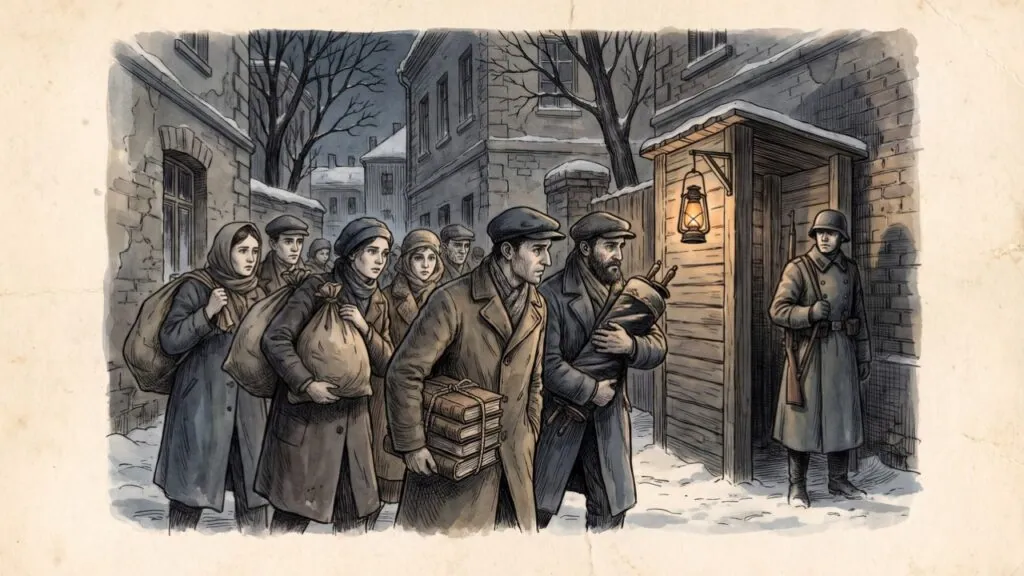
The risk was not merely theoretical. The ghetto police were a standing danger: a man caught at the gate by the Jewish or Lithuanian police might be beaten or arrested, and the ghetto had its own internal hierarchy of informers and collaborators. [77] Kaczerginski and Sutzkever, both of them members of the literary group Yung Vilne, led the sabotage. [80] The scale of what they and their companions managed to hide has never been precisely established, and the ghetto caches have been described as thousands of books and hundreds of thousands of documents. [83] A hidden collection of several thousand items was retrieved after the war and returned to YIVO in New York. [82] [1]
What happened to them
Herman Kruk had been director of the largest Jewish library in Warsaw, and had fled in 1939 after refusing a chance to emigrate to the United States, hoping to find his wife and child, trapped in Warsaw, who had perished. [85] In the Vilna ghetto he directed the library and kept the diary that is now the single most important first-person document of the ghetto’s last months. The ghetto was liquidated in September 1943. Kruk was deported to Klooga in Estonia and transferred to Lagedi on 22 August 1944. His last diary entry, on 17 September, records his hiding the diaries in a barrack at Lagedi. On 18 September 1944 he was shot and burnt on the pyre at Klooga with roughly two thousand other Jews, days before the Soviet arrival. [85] [86] The diary was edited by Benjamin Harshav and published in English in 2002 as The Last Days of the Jerusalem of Lithuania. [87]
Zelig Kalmanovitch died in the Klooga camp. [82] Shmerke Kaczerginski survived the war, founded the Vilna Jewish Museum — the first post-Holocaust Jewish museum — and then went into exile: Vilna, then Łódź, then Paris, then Argentina, where he was killed in a plane crash in 1954. [77] [78] Avrom Sutzkever joined the partisans, returned to Vilna with Paleckis in July 1944, and opened the museum on 26 July. He emigrated to Israel, and by the end of his life in 2010 was widely described as the most renowned Yiddish poet in the world. [77] [80] Rachela Krinsky survived, gave up her daughter to a Polish nanny so that the child might live outside the ghetto, and left her own account of the period. [88]
The institute has since given the collection its own name, honouring the two men who led the sabotage: the Abraham Sutzkever–Szmerke Kaczerginski Vilna Ghetto Collection, RG 223. [78] [89] It is a small but significant act of institutional memory — the first time, perhaps, that an archive has been named after the people who saved it rather than after the family who donated it.
26. The long recovery
Getting the material home was only half the operation, and the second half took longer. The Frankfurt material was recovered within a few years. The Vilna material was a different and far harder problem, because it was in Lithuanian hands, in a country whose political circumstances made an unadorned claim of ownership both unachievable and, for a long time, unthinkable. In 1990 YIVO learned that a substantial part of its prewar holdings had been hidden in the Lithuanian State Bibliographic Center — the “Book Palace” — and for five years negotiated with the General Directorate of the Lithuanian Archives. An agreement was signed in 1994 under which YIVO took photocopies of the archival material and returned the originals to Vilnius. [82] [1] Antanas Ulpis, the head of the Lithuanian Book Chamber, had hidden material for more than forty years; in 1991 some hundred and fifty thousand documents were discovered in a church. [80] In May 2017 a further hundred and seventy thousand pages of previously unknown documents surfaced in Vilnius. [49]
It is worth reflecting on how long that took. From the day the Germans started sorting books in the basement of Wiwulski Street in 1942 to the day a Lithuanian archival official and an American research institute signed a photocopying agreement in 1994 is a span of fifty-two years; and from the war’s end in 1945 to the discovery in the Book Palace in 1990 is forty-five. The materials themselves had survived, and several times over. What did not survive was the assumption, on both sides of the Atlantic and on both sides of the Baltic, that the question of what belonged to whom could be settled without a fight. It is a useful corrective to any telling of the rescue narrative in which the rescue appears to be the end of the story. The rescue was the most visible part of it.
Nor should the story be told as one of simple German barbarism against simple Jewish heroism. The ERR was a modern, literate, systematic organisation; its officers read the books they were selecting and wrote home about them, and several of them were academics. Its quartermaster argued, in writing, that the destruction of the Jewish collections was a crime against scholarship requiring documentation; the dismissal of that argument is one of the earliest recorded instances of the SS overriding its own staff. [90] On the other side, the Vilna intellectuals who went on to work with the Germans did so, in several cases, because the alternative was death, and they went on to complicate the categories of heroism and collaboration for another eighty years. The twentieth-century story of Eastern European Jewish culture is not a story of clean lines, and the one place where it comes closest to clean lines is the bunker at Shavel Street, where the material was put underground by people who expected to be killed and who were not.
27. New York, 1940
YIVO’s American address over its first half-century reads like an itinerary of the Jewish migration itself. Lafayette Street in Manhattan, where the New York branch began and was designated the temporary headquarters in January 1940; 531–535 West 123rd Street from 1942, in the former Schiff mansion; 1048 Fifth Avenue from 1955, the former Vanderbilt mansion, and the source of the nickname by which the institute was known for decades — “the Vanderbilt YIVO”; temporary offices in 1994; and 15 West 16th Street since the beginning of 1999, where YIVO is one of the founding partners of the Center for Jewish History, sharing a reading room, an auditorium and galleries with the Leo Baeck Institute, the American Jewish Historical Society, the American Sephardi Institute, Yeshiva University Museum and the Center for Jewish Education. [1] [91] [92]
The name changed too. In 1955 the English name of the institution became the YIVO Institute for Jewish Research, and Kuznitz notes that the change prompted concerns about a lessening commitment to Yiddish. [1] The concern was well founded in one direction and misplaced in another. It was well founded because the English name did shift the centre of gravity of the institution’s public identity away from the language and towards the subject matter; the library remained the largest collection of Yiddish books in the world, but the phrase “Jewish research” is broader than the phrase “Yiddish science”, and the broader phrase is easier to fund and easier to explain. It was misplaced because the acronym was kept, and because the acronym was kept for a reason that had nothing to do with sentiment: yidisher means both “Yiddish” and “Jewish” at once, and the four Yiddish letters YIVO were a compressed statement that the two were not separable — that the study of this language was the study of this people, and could not be divided without impoverishing both. [2]
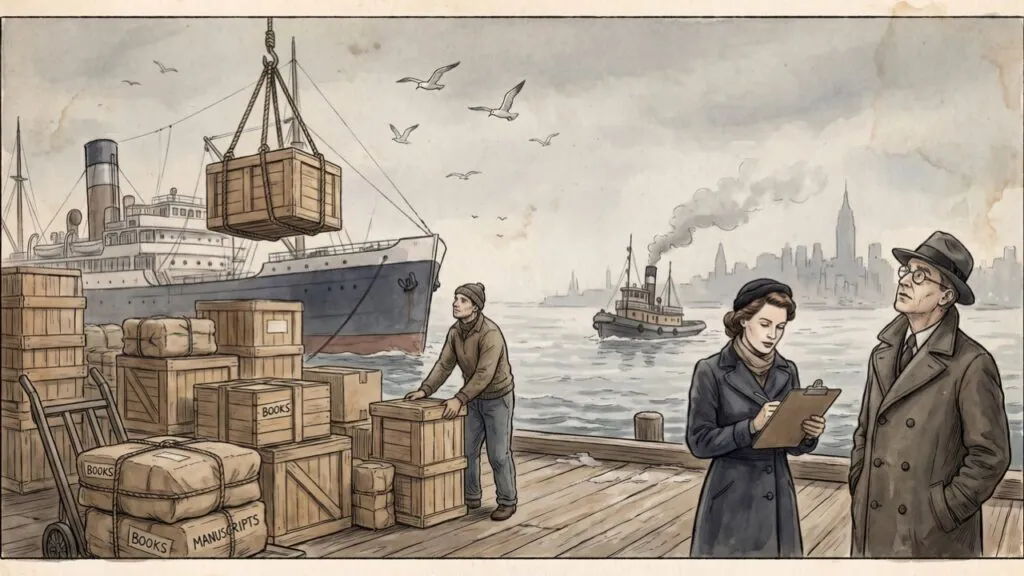
The legal form of the institution is YIVO Institute for Jewish Research, Inc., a New York non-profit corporation with tax-exempt status and a fixed identity that has outlasted every other arrangement it has had with the city. [93] Its history is therefore not only the history of an idea but the history of a particular address, and it is a history in which the address has repeatedly been the site of a negotiation: with Columbia, with the City of New York, with the State of New York, with the Vilnius municipality, with the Lithuanian national archive, and with the Central European and Israeli libraries whose holdings interlock with its own. The universality of the Yiddish Book Center, the National Library of Israel, the New York Public Library and YIVO — four institutions, four countries, one catalogue — is the institutional expression of the same proposition that yidisher means two things at once.
28. Weinreich’s American turn
Max Weinreich arrived in New York in March 1940 and remained the institute’s research director until his death in 1969. [1] [32] What he found in New York was a subject that the war had transformed. The study of East European Jewry was no longer the study of a living society; it was the study of a society that had been destroyed, and it was therefore, in the first instance, a matter of evidence. YIVO’s response to this was the founding of the Holocaust Archive in 1945, and the recruitment of zamlers to collect survivor testimony from the camps of the displaced persons. [55] [1] The institute’s documentation was presented as evidence at the Nuremberg Trials and used in war crimes trials in many countries. [1]
The second great initiative of the wartime years was the Jewish Labor and Political Archives — the Bund archives — donated to YIVO in 1992, and comprising some three and a half million pages; digitisation began in 2022 and is described by the institute as the largest archival digitisation project in its history. [94] The third was the Holocaust Bibliography, published in fifteen volumes with Yad Vashem between 1960 and 1978. [95] [1] And the fourth was the series of collections of survivor testimony — RG 104 alone holds some nineteen hundred displaced-persons’ camp testimonies, more than five hundred further individual testimonies including seventeen from Hungary and a hundred and fifty-three hand-filled Lithuanian questionnaires from the 1940s, on nineteen microfilm reels and in some twenty-seven thousand digital images. [88]
It is worth noting what was not in this list. There was no “survivor memoirs programme” and no “names project” under those titles; what exists is the archive, the collections, and the Holocaust Survivor Lists compiled in the late 1940s by the World Jewish Congress, the Jewish Agency and the American Jewish Joint Distribution Committee, whose original card indexes YIVO holds. [55] The absence of a YIVO-named scheme is characteristic. The institute’s method has always been to create the archival infrastructure and let the programmes be named by others — which is a strength when the infrastructure outlives the crisis it was built for, and a weakness when the crisis recedes and the institution has to find a new constituency.
Hitler’s professors
Among the works Weinreich produced in New York, one deserves particular notice because it is a founding document of a discipline that did not yet exist: Hitler’s Professors: The Part of Scholarship in Germany’s Crimes Against the Jewish People, published by YIVO in 1946 and reissued by Yale University Press in 1999. [96] It was a study of how German academics had enabled and justified Nazi antisemitic policy, assembled with the documentary apparatus of the institute — and it marked, in effect, the founding of Holocaust studies as a field with its own sources, its own method and its own institutional home. YIVO has been described as the pioneer of Holocaust studies avant la lettre. [1]
The book is a reminder of what YIVO’s scientific method was actually for. The point of collecting a scholar’s correspondence, a conference paper, a library’s lending register and a philological footnote is not antiquarian. It is to establish, in a form that can be exhibited in a courtroom and cited in an academic argument, that a set of claims about a people was made systematically, by identifiable people, with institutional backing, over years — and that the making of those claims was itself a part of the crime. The scholarly apparatus and the forensic one turn out to be the same apparatus. It is no accident that the institution that built the largest archive of East European Jewish life also produced the founding documentary of the field that studies the destruction of that life.
29. The salvage
By the time the Americans took Frankfurt in the spring of 1945, the German apparatus that had spent four years collecting East European Jewish material had itself become a target. The Monuments, Fine Arts and Artifacts Division — the Monuments Men — found hundreds of crates of looted books and documents abandoned outside the city, much of it destined for the Institut zur Erforschung der Judenfrage, the SS research institute where the sorted loot was to be studied. [77] Because no surviving Jewish organisation could claim the material in the field and Vilna was under Soviet occupation, the decision was made to return it to YIVO in New York: 465 crates arrived there in 1947. [77] [84] Separately, some 25,000 volumes from the Strashun Collection and 15,000 volumes of YIVO’s own pre-war library turned up in a warehouse at Offenbach, near Frankfurt, and were shipped to the institute the same year. [52]
Set against what had been taken, the yield was modest: the recovery is estimated at thirty to forty per cent of the pre-war YIVO archive. [80] Everything else had been destroyed, pulped, shipped to institutions that had themselves been bombed, or had simply rotted in the cellars of the Reich. What “restitution” actually meant in practice was a question the ERR’s Frankfurt institute had made permanently complicated: the same German inventories that identified what had been taken also identified where it had been sent, and most of those destinations had been emptied by the war itself. [82]
And the liberation brought its own losses. Around thirty tons of YIVO material were burnt by the Soviet authorities, and the Vilna Jewish Museum was closed by the KGB in 1949, its holdings dispersed among the Lithuanian Central State Archives, the Vilna Gaon Museum and the National Library. [80] Some material was carried out through Poland and France to New York; some, held by Sutzkever, later reached the National Library of Israel. [78] The pattern of the archive’s twentieth century is therefore not one of continuous accumulation but of a series of seizures and reclamations: taken by the Germans, buried by the brigade, recovered by the Americans, burnt by the Soviets, hidden by a Lithuanian bookkeeper, uncovered in a church, and finally — in a negotiation lasting five years — restituted to Vilnius in the shape of photocopies with the originals going home.
The book palace
The most extraordinary single episode in the archive’s history is the one that took longest to surface. Antanas Ulpis, head of the Lithuanian Book Chamber, had hidden material for more than forty years. In 1991, 150,000 documents were discovered in a church; and in 1990 YIVO learned that a large part of its pre-war Vilna holdings had been concealed in the Lithuanian State Bibliographic Centre — the building the ghetto Jews had called the “Book Palace”. [80] In 1995 and 1996 the archival portions were sorted and duplicated in New York, with the originals returning to Vilnius, under an agreement with the General Directorate of the Lithuanian Archives signed in 1994. [82] The discovery was still not over: in May 2017 a further 170,000 pages of previously unknown documents were found in Vilnius. [38]
Ulpis is one of the strangest figures in the story of the institute: a state librarian in a Soviet republic who spent four decades keeping alive a collection he had no legal claim to, in a country that did not want it found. His name is now attached to the humanitarian award established by the Lithuanian embassy in Washington for the institute’s centenary. [46] It is a strange thing for an institution to be commemorated by the country that took its library, and a strange thing for the library to come home — but the materials did, and the most damaged thing in the whole history was not the books. It was the belief, which the Germans had counted on, that there would be nobody left with both the knowledge and the stubbornness to look for them.
The archive was also being built in the other direction, by acquisition and by gift, and the names on the shelf list are themselves a history of the field: the Elias Tcherikower collection, acquired in 1946 after the war, which the great historian had hidden in southern France; the Chaim Grade papers, jointly acquired with the National Library of Israel in 2013; the collections of Chaim Zhitlowsky, Shmuel Niger, Kalman Marmor, Sholem Perlmutter, M. Ceshinsky and Max Weinreich himself; and the Winchevsky Collection of Jewish labour history and Yiddish literature. [50] In 1979 to 1983 the institute ran the Landsmanshaftn Project, which secured the records of over seven hundred burial societies and now accounts for some three hundred record groups — a reminder that even the paperwork of how a village buried its dead turned out to be evidence of how it had lived. [19]
And from 1945 the institute began collecting something it had never collected before: the documents of the crime rather than of the culture. YIVO’s Holocaust Archive was established that year, and YIVO’s claim to have been the first organisation to start collecting original documents on the Holocaust is a claim its own historians have been making ever since. [55] Volunteers — zamlers, the same word the folklorists used for their collectors a decade earlier — were sent into the displaced-persons camps to gather testimony; the result is close to seven million pages in more than ten languages, the largest North American repository of original Holocaust documents. [55] YIVO’s material was presented as evidence at the Nuremberg Trials and used in war-crimes proceedings in many countries. [1]
The continuity is the striking thing. The same word, zamler, describes a man in a Pale village in 1929 collecting folktales from his neighbours, and a man in a DP camp in 1946 collecting testimony from survivors. The same institution, built in 1925 to record a people’s songs and proverbs, was in 1945 recording their evidence. Whatever else YIVO was, it was an apparatus for believing that the ordinary life of a people was worth writing down — and that when the writing stopped, the record would be the only thing left to argue with.
30. The archive and the atlas
Max Weinreich’s great methodological achievement was to treat Yiddish as an object of geography. His doctoral work, published in Marburg in 1923 as Studien zur Geschichte und dialektischen Gliederung der jiddischen Sprache, did something no one had done before: it gathered the evidence of centuries of settlement — place names, surnames, the vocabulary of crafts and of agriculture, the peculiar vocabulary of a border market town — and read it as a map. [32] The result was a division of Eastern Yiddish into major dialect blocks that has remained the reference grid of the field ever since: a northern group, the north-eastern or “Lithuanian” dialect, covering roughly the old Polish-Lithuanian Commonwealth; and a southern group running into the south-eastern or “Ukrainian” dialect, with the great central-eastern or “Mideastern” dialect between them, which is the largest single block and the speech of the overwhelming majority of Yiddish speakers in the twentieth century. [33]
The point of this was not decorative. If Yiddish were simply a corrupt variety of German — the position that Max’s work was written largely to refute — then it would have no history worth mapping, because a corrupt form has no geography; it has only a centre, namely the standard language it departs from. A dialect map makes the opposite claim: that the language had a life of its own, with its own centres of innovation, its own zones of conservatism, its own history of settlement and displacement. [6] The map was the argument, and the argument was that Yiddish deserved to be studied like any other language, with the same documentary apparatus, the same cartographic conventions and the same reverence for the speech of ordinary people that a modern philology brings to bear on its material.
But a map made from printed sources can only be as good as the printed sources, and printed sources are biased towards the towns. What the twentieth century added to Max Weinreich’s method was the phonograph. From the 1920s onward — and formally through the ethnographic expeditions that YIVO’s Folklore, Ethnography and Anthropology section ran through the Pale of Settlement, the Bukovina, Bessarabia and the Black Sea towns — the institute began collecting the actual speech of the people the map was supposed to describe: singers, storytellers, craftsmen talking at their benches, the recitation of a wedding tshires or a lullaby by a grandmother. [42] [40] What emerged was the finding that the most detailed map of a language is not a map of its grammar at all but a map of its speakers — which is the argument the atlas project carried to its logical conclusion.
The Dialect Project
Between 1948 and 1949 YIVO ran what it called the Dialect Project: several hundred recorded interviews with Jews who had come to New York from Eastern and Western Europe, and with American-born speakers, conducted by Beatrice Silverman Weinreich and her colleagues. [42] The project was the first large-scale attempt to record, in a single systematic series, the range of Yiddish as it was actually spoken by the immigrant generation — and it was, in effect, the sound film of the atlas that had been Max Weinreich’s unrealised ambition. Where the elder Weinreich had worked from printed evidence and inference, the Dialect Project put microphones in front of people. The interviews, preserved in the YIVO Sound Archive, remain one of the most valuable collections in the institute for a reason that is easy to state and hard to reproduce: they are the last recordings, in many cases, of speakers who spoke a form of Yiddish that no longer has a living community anywhere.
The project also produced a small number of methodological papers that are read far outside the field. One of them, by the young Uriel Weinreich — Max’s son, born in 1926, who had already taught himself Hebrew, Yiddish, English, French and German, and who published his first textbook, College Yiddish, in 1949 in his early twenties — set out a way of describing Yiddish as a language in contact with other languages rather than as a system with fixed boundaries. [97] The argument, which he developed in Language in Contact in 1953, was that Yiddish is not one thing but a bundle of regional varieties, each shaped by a different substrate of Polish, Ukrainian, Belarusian, Lithuanian, German and Hebrew, and that the variation between them is systematic and explicable rather than sloppy. It was an argument that reframed the field’s oldest question — what kind of language is this? — as a technical question with a technical answer. [6]
Uriel Weinreich’s career was short. He held the Atran Chair of Yiddish Language, Literature and Culture at Columbia University from 1951, appointed at the age of twenty-six on the strength of his father’s advocacy, and he died of cancer in 1967. [98] His papers are preserved in the YIVO Archives as Record Group 552. [23] In the forty years between his appointment and his death he worked on the project that was the natural successor to his father’s map: the Language and Culture Atlas of Ashkenazic Jewry, begun in 1959 and eventually published in fascicles from 1992 onward, a monumental multi-volume compilation of the languages, customs and material culture of Ashkenazi Jewish communities, keyed to the villages they came from. [33] He also left unfinished, and published posthumously in 1968, the Modern English-Yiddish / Yiddish-English Dictionary, which became the standard work for English-speaking students of the language and, in a second edition in 2012, for a generation that had never met him. [64]
It would be a mistake, though, to tell the story of the atlas as a story of two men. The Dialect Project was run by Beatrice Silverman Weinreich; the expeditions that fed it were run by fieldworkers whose names are preserved in the archive guides and whose work was done, for the most part, at their own expense and at real personal risk. The Cultural and Anthropological section’s collecting network in the 1920s and 1930s reached into thousands of villages and towns of the Pale, and its records — questionnaires, interviews, songs, photographs, drawings of objects and buildings — are catalogued in the institute’s own guides. [39] When Max Weinreich died in 1969, three years after his son, what he left behind was not a building or a bequest but a method, and a body of trained people who could carry it. [1]
31. The encyclopedia
For most of its existence, YIVO’s argument was made in monographs, in periodicals and in the annual Yedies fun YIVO, and its archive was accessible principally to scholars who travelled to New York. The great institutional work of the institute’s late period was to make the accumulated knowledge of a century available to people who would never visit a reading room in Manhattan. That work began, inauspiciously, in 1998, when Ralph Carlson, then a special projects editor at Indiana University Press, approached Lisa Epstein, YIVO’s director of research, about a reference work. A contract was signed that October; Gershon D. Hundert of McGill was offered the editorship the following May; a Claims Conference grant arrived in March 2001; Hundert signed with YIVO that October; the editorial board first met at New York University in August 2002; and Yale University Press took over the project in 2002, with Jeffrey Edelstein as project director. [99]
What emerged, ten years later, was the YIVO Encyclopedia of Jews in Eastern Europe — published by Yale in cooperation with YIVO in 2008 in two volumes of roughly twenty-four hundred pages, containing more than eighteen hundred entries by some four hundred and fifty contributors from sixteen countries, submitted in ten languages, illustrated with more than a thousand images and fifty-five maps. [100] It is the kind of book that a field builds once in a generation, and the twenty years of negotiation, grant-writing and editorial labour behind it were themselves a form of institutional continuity: the encyclopedia was, in the end, the argument of the founding generation, restated in a form that could be consulted by a student in Kaunas or a historian in Kyiv who had no access to a Yiddish dictionary and no expectation of finding one.
The online edition followed on 10 June 2010, free to read, and YIVO has reported draws of more than a hundred and eighty thousand visitors a year since. [101] The entries cover the full range of the field the institute was founded to create — towns and shtetls, trades and professions, religious institutions and disputes, music and the folkways of the wedding and the funeral, literature and theatre, the labour movement and the Bund, Hasidism and its opponents, Zionism and anti-Zionism, the languages of the Pale and what became of them. The editorial board assembled around Hundert was, in itself, a statement of the field’s reach: Marion Aptroot, David Assaf, Samuel Kassow, Hillel Kieval, Barbara Kirshenblatt-Gimblett, Chava Turniansky, Leon Volovici, Mordechai Zalkin and two dozen others, working across nine or ten countries. [100]
Two of the encyclopedia’s most consulted entries are precisely the ones that document the institute’s own field from the inside: the entries on Yiddish itself, on the philological section’s journal Filologishe shriftn, on folklore and ethnographic expeditions, on the planning and standardisation of Yiddish, and on the dialect map. [13] [10] A reader who wants to know what the Vilna philologists actually believed about spelling can go to the volume and find out, with the sources named. That is the difference between an institution and a monument: an institution leaves its disagreements legible.
What YIVO did not write
One correction is worth making here, because it recurs. The monumental encyclopaedia of Jewish communities in Eastern Europe — Pinkas haKehillot, the “Book of Communities” — was published between 1969 and 2007 in eleven geographical parts by Yad Vashem, and was awarded the Israel Prize in 1973; the volume on Lithuania, edited by Dov Levin with Josef Rosin, was the fifteenth in the series. [102] [103] YIVO was not its publisher. YIVO’s role was as a supplier of sources and of trained staff: the Lithuania volume thanks “the staff of the YIVO archives in New York, headed by Marek Web and Dina Abramovitch.” [26] The relationship was close and it was collaborative, but the distinction matters: YIVO made itself indispensable as the source of record for a great many projects and the author of relatively few.
The encyclopedia has since begun to travel. A Lithuanian translation was announced in 2024. [104] That is the direction of travel for a reference work whose subject is a region whose histories are written in more than one language — and it is the same logic that produced the institute: if you want a people’s own language studied rather than merely recorded, you have to bring the scholarship to the people who need it, in their own tongue. YIVO spent a century doing that in reverse, bringing a dispersed people’s speech together into one place so that it could be studied properly. The online encyclopedia is the same movement run in the other direction.
32. The controversy of 2016
No account of YIVO’s recent history is complete without the dispute of 2016, and no account of it is complete without saying plainly what the dispute was about, because it was not what many later summaries have suggested. It was not a row about a Russian translation of the encyclopedia. It was a dispute about YIVO’s relationship with the Lithuanian state, and it began with a sign.
On 27 February 2016 the historian Dovid Katz reported on his Defending History blog that the Vilna Gaon Jewish State Museum had removed Yiddish lettering from all three of its address signs in Vilnius. [105] The museum, which occupies the building at Strashun Street that housed the Strashun Library before the war, had installed signage in Lithuanian, English and Russian; the removal of the Yiddish left a gap in the trilingual set that is visible in photographs taken before and after. Katz went on to argue, over the following months, that YIVO had effectively been captured — or “hijacked,” in his formulation — by a Lithuanian state agenda directed at softening or obscuring the Holocaust record of Lithuanian territory, and that the institution’s long-running digitisation partnership with Lithuania had made it pliable. [105]
On 9 March 2016, The Forward published an article by Britta Lokting focused on the resignation of Martin Peretz from YIVO’s board of directors; the piece also addressed the Vilna digitisation project, and therefore placed the museum’s signage and the institute’s Lithuanian relationships in a single frame. [106] Katz’s critique, which continued in Defending History and elsewhere for years afterwards, was answered from several directions — by YIVO, which co-sponsored a reporting mission to Lithuania and Poland with The Forward in 2016 under the chairmanship of board member Irene Pletka; by Lithuanian scholars; and by defenders of the museum’s right to make presentational decisions about its own signage. [107]
It should be said clearly that this dispute remains contested and has not been adjudicated by any authority. Both positions remain on the public record, and this article takes no side on the underlying question of Lithuanian responsibility for the Holocaust or of what a museum in a country with its own history should say about it. What can be said is that the disagreement was not an obscure internal quarrel, and that it exposed a real and continuing tension in the institute’s institutional position. YIVO holds the world’s largest archive of the documentary record of East European Jewish life, much of it in the territory of states whose governments have, at various times, had reasons to prefer that record less legible. A project to digitise and reunite those collections with their home institutions is, unavoidably, also a negotiation about who controls the historical record of a country. [108]
There is a further irony that the institute itself would recognise. The paper brigade smuggled books out of a ghetto because the Germans wanted them destroyed, and hid them from the Germans because the Germans intended to destroy the evidence. The salvage campaigns of the 1940s and 1980s and 1990s were all campaigns to rescue a record from people who wished it were not preserved. The 2016 dispute was not of that kind. Its fault line ran not between rescuers and destroyers but between a Holocaust survivor’s community and a state, about the terms on which a country presents its own past. YIVO found itself, as it had in 1931 and in 1990, in the position of an institution that cannot be neutral about memory and cannot stop being read as political if it tries. [105] [109]
It is worth adding one clarifying note, because the episode is often retold as though the institute had been captured by a foreign government. The Edward Blank YIVO Vilna Online Collections project, launched in 2015 after years of negotiation with the Lithuanian government, was funded largely by private donors in the United States and is run from New York; its purpose was to digitise and virtually reunite the pre-war holdings in New York and Vilnius, including parts of the Strashun Library, and to make both halves of the collection accessible to researchers in both countries. [108] Whether that project should have been pursued on the terms on which it was agreed is a legitimate question, and it was asked in public. That it was asked at all is a measure of how differently YIVO is regarded now than it was in 1990, when the same kind of arrangement with the same government would have passed without comment, because the alternative was that nothing was digitised and nothing was returned.
33. The archive today
Numbers are the easiest way to convey the scale of what the institute kept, and they are also where the accounts of YIVO most often disagree with one another. The library holds close to four hundred thousand volumes in all the European languages — by the most commonly cited figure, rather more than three hundred and eighty-five thousand of them, of which some forty thousand are in Yiddish, making it the largest Yiddish-language library in the world. [110] [2] The archival holdings are given as “some twenty-four million items” on the institute’s own pages and as “more than twenty-three million” in the Guide to the YIVO Archives, with an online encyclopedia reporting over twenty-three million. [111] [23] The discrepancy is a trivial one of date and counting method; the magnitude is not in doubt. There are more than nineteen hundred record groups. [107]
These are not numbers that grew by acquisition alone. Some of the growth is salvage. When the Americans took Frankfurt in 1945, a search of the warehouses there turned up something on the order of three hundred thousand volumes belonging to YIVO’s pre-war library, which were shipped back to the institute in 1947. [31] The paper brigade had saved perhaps a third to two-fifths of the Vilna holdings; the rest had to be found in attics, in the ruins of the book depot, in private hands. In 1990 YIVO learned that material it had believed lost had been hidden in the Lithuanian State Bibliographic Centre — the building the Vilna ghetto Jews called the “Book Palace” — and after five years of negotiation an agreement with the Lithuanian authorities allowed the archival portions to be sorted and duplicated in New York in 1995 and 1996, with the originals returning to Vilnius. [16] [80]
Not everything was saved, and the losses are as instructive as the gains. The Soviet “liberation” brought its own destruction: something in the order of thirty tons of YIVO material was burnt, and the Vilna Jewish Museum was closed by the KGB in 1949, its holdings dispersed among the Lithuanian Central State Archives, the Vilna Gaon Museum and the National Library. [83] Some material was carried out through Poland and France to New York; some of it, held by Sutzkever, later reached the National Library of Israel. [78] What the archive holds is therefore not a survival but a selection — the residue of six campaigns of recovery, each with its own losses, its own heroes and its own compromises.
Sixteen West Street
YIVO’s New York address sequence tells its own story. Lafayette Street in 1940; 531–535 West 123rd Street from 1942, in the former Schiff mansion; 1048 Fifth Avenue from 1955, the former Vanderbilt mansion, which was known as the “Vanderbilt YIVO”; temporary offices in 1994; and from the early months of 1999, 15 West Sixteenth Street. [91] [1] The last of these is the building the institute shares with the Centre for Jewish History, a consortium founded in 1990 of which YIVO is a founding partner, together with the Leo Baeck Institute, the American Jewish Historical Society, the American Sephardi Institute, the Yeshiva University Museum and the Center for Jewish Education. [92] [107] The advantage is a reading room, an auditorium, galleries and a stack that several of the world’s leading collections of Jewish history share; the cost, as every scholar who has spent a season there knows, is a booking list.

Alongside the older holdings, the archive has grown by acquisition. The Jewish Labor and Political Archives — the records of the Bund, donated in 1992 — comprise roughly three and a half million pages, and began to be digitised in 2022 in what was described at the time as the largest archival digitisation project in YIVO’s history. [94] The Holocaust Archive, established in 1945, is close to seven million pages in more than ten languages and is the largest North American repository of original Holocaust documents. [55] YIVO was, in its own account, the first organisation to begin collecting original documents on the Holocaust; it recruited zamlers — volunteer collectors — to gather testimony from the displaced-persons camps, and its material was presented as evidence at the Nuremberg Trials and used in war-crimes proceedings in many countries. [1] The eyewitness accounts catalogued as Record Group 104 run from 1939 to 1990 and include some nineteen hundred displaced-persons-camp testimonies, more than five hundred individual survivor testimonies, seventeen accounts from Hungary, a hundred and fifty-three hand-filled Lithuanian questionnaires completed in the 1940s, and twenty-seven thousand digital images. [88]
Genealogy has become the other great growth area. YIVO holds nearly a thousand yizkor books — the memorial volumes in which towns recorded their own lost communities — the most extensive such collection in the United States. [112] In 2019 JewishGen.org donated a set of seventy English translations; the New York Public Library separately digitised some seven hundred yizkor books with the Yiddish Book Center. [113] And in a project that speaks to the institute’s founding premises, YIVO participates with the Yiddish Book Center, the New York Public Library and the National Library of Israel in the Universal Yiddish Library, a shared catalogue of roughly sixty-seven thousand book records, which makes the point that a collection of Yiddish books is scattered across the world and needs a single address. [67]
All of this has been made more visible by the Edward Blank YIVO Vilna Online Collections, launched in 2015 after years of negotiation with the Lithuanian government and designed as a seven-year project to digitise and virtually reunite the pre-war holdings in New York and Vilnius, including parts of the Strashun Library. [108] By 2020 the institute reported that the library holdings were fully digitised — around a million pages — along with fifty-six per cent of the Vilna Collection. [114] [115] The project’s own pages catalogue what is held on each side of the Atlantic: in New York, tens of thousands of Strashun volumes and thousands of periodical titles; in Lithuania, the archival material recovered in 1990 and the documents of the pre-war Central State Archive. [38] [16]
34. Yiddish studies and the two chairs
YIVO is not a university. It has never granted a degree, and it is not part of Columbia University or of the City University of New York, despite the frequency with which those two institutions appear in accounts of its founders’ careers. [107] The institute’s academic life has therefore had to be organised as a network of relationships, and the most important of those relationships were built by Max Weinreich in the late nineteen-forties and fifties: the Atran Foundation, under Frank Atran and at Max’s encouragement, funded the first endowed professorship of Yiddish at Columbia University between 1951 and 1952, and appointed Uriel Weinreich to it. [98] The chair survives, in the form of the Atran Professorship of Yiddish Language, Literature and Culture, currently held by Jeremy Dauber. [116] A second endowed chair, the Dr Alice Field Cohn Chair in Yiddish Studies at Indiana University, is held by Dov-Ber Kerler. [117] Two endowed chairs for the language and culture of East European Jewry, in American universities, in a discipline a century old, is the arithmetic of a field that has succeeded in a way its founders did not dare to plan for and has not yet succeeded at anything like the scale it needs.
The training pipeline has been steadier than the chairs. The Max Weinreich Center for Advanced Jewish Studies was founded in 1968, and its seminars carry credit at students’ home universities; the Uriel Weinreich Summer Program in Yiddish, also founded in 1968, was co-sponsored with Columbia from 1968 to 2005, with New York University from 2005, and has since been run with Bard College, from 2012 — its fifty-ninth annual graduation was celebrated on 31 July 2026. [107] The YIVO–Bard Institute for East European Jewish History and Culture, founded in 2012, was described at the time as the first of its kind in the United States, and grants undergraduate credit. [107] These are modest instruments: a summer programme, a seminar series, an undergraduate institute. But they are the mechanism by which a field reproduces itself, and YIVO’s own assessment of the Max Weinreich Center in the early nineteen-seventies — credited, with the National Foundation for Jewish Culture, with training “an entire new generation of scholars in Eastern European Jewish Studies,” many of whom now head major Jewish studies programmes at institutions such as Harvard and Stanford — is the sort of thing that no archive can measure and no bibliography can show. [31]
The institute’s formal partnerships run wider than its academic ones, and they mark the same instinct: YIVO does not try to hold everything itself. It is a Smithsonian affiliate and contributes to Smithsonian Folklife; it has digitised the Chaim Grade archive with the National Library of Israel since February 2013; it works with Yad Vashem, with the Lithuanian National Library and Central State Archive, with the POLIN Museum of the History of Polish Jews since October 2012, with the Digital Public Library of America, with Judaica Europeana and with reVilna. [107] The Yiddish Book Center, which has recovered more than a million volumes, and YIVO are competitors in the collecting world and partners in the sharing one; the Yiddish Book Center’s Spielberg Digital Yiddish Library draws in part on YIVO’s material, and both institutions feed the same shared catalogue. [118]
There is a certain irony in a field with two chairs that began as an argument about whether its object of study existed. If the founding generation had won only the argument about the language and not the argument about the institution, the chairs might be more numerous and the language more threatened. What the two-chair arithmetic measures is not the failure of the field but the difficulty of the situation it addresses: a discipline whose subject is a population of perhaps six million people spread across a dozen countries, a fifth of them in a single language, most of them now living in one city. No department of Yiddish studies was ever going to have the staff of a department of English. The institute’s contribution was always to be bigger than its own staff, and to keep the books and the recordings and the dictionaries in one place so that a generation of students could be given an unusually good starting position. [1]
35. A hundred years
YIVO turned a hundred in 2025, and the commemorations were unusually well distributed across the institutions that had a claim on the story. The Seimas of Lithuania, the parliament, declared 2025 the Year of YIVO’s Centennial; the Lithuanian embassy in Washington held a commemorative event and established an Antanas Ulpis Humanitarian Award, named for the Lithuanian librarian whose 1989 discovery had made half of YIVO’s hidden holdings recoverable; the European Parliament hosted a symposium on 26 September; and Vilnius University and the Martynas Mažvydas National Library hosted “YIVO in Vilnius and Around the World” from 19 to 21 October. [46] [109] [119] [120]
The United States House of Representatives passed a resolution of its own. H.Res. 450, “Commemorating the centennial of the YIVO Institute for Jewish Research,” was introduced on 29 May 2025 and commended the institute for a century of scholarship, for the preservation of the Jewish heritage of Eastern Europe and for the rescue of the Vilna collections. [121] The two commemorations had rather different origins — one is the official act of a state that was on the wrong side of history and knows it, the other a private institution’s resolution of congratulation — and reading them side by side is an instructive way to see how much has changed in Lithuania since the museum’s signage. A plaque now marks the site of the former YIVO headquarters in Vilnius. [27]
The centrepiece was the exhibition YIVO at 100, which ran at the Center for Jewish History from 22 June to the end of December 2025 and comprised three shows: Hail to the Zamlers! YIVO’s Collections at 100, on the volunteer collectors who built the archive; The Paper Brigade: Smuggling Jewish Treasures in Nazi-Occupied Vilna; and The Strashun Library: Rare Books Rescued from the Ashes of Vilna. [122] The three subjects are, between them, the institute’s three existences: the field-work of collection, the emergency of rescue, and the library that was the point of all the collecting. There was also a centenary volume, 100 Objects from the Collections of the YIVO Institute, edited by Stefanie Halpern and published in June 2025. [123]
Two events in the autumn of 2025 were of a different kind. In September the institute saw the world premiere of a chamber opera, The Great Dictionary of the Yiddish Language, which took as its subject the un-finished dictionary that Max Weinreich and his colleagues spent a decade assembling — the oytser of Nahum Stutshkoff, edited by Weinreich and published by YIVO around 1950, and the larger project that followed it and was never completed. [61] [63] In November, a panel in Yiddish — the first such the institute is known to have staged for its centenary — brought together Samuel Kassow, Cecile Kuznitz, Zalmen Mlotek and David Roskies, four scholars of quite different generations and schools, to discuss what the study of Yiddish is for. [124] A Yiddish-language panel about Yiddish scholarship, on the centenary of the institution that made the scholarship possible, is the emblem of the thing itself: the argument conducted in the language it is about.
The centenary also marked a public campaign. YIVO’s own fundraising drive is a forty-million-dollar centennial campaign, and its 2025 gala at Tribeca 360 honoured the historian Sir Simon Schama and Ruth and David Levine. [93] The institute’s audited accounts give a sense of its scale at the end of the first century: total revenue of $13,744,682 against expenses of $7,065,266, total assets of $39,523,712 and net assets of $38,811,621, with fifty-seven employees, twenty-five volunteers and thirteen voting members of the governing body, all independent. [93] A surplus of that size on a budget of that scale is characteristic of an institution that has been given the means to do serious work slowly, which is the only pace at which this particular work can be done.
It is tempting to end a centenary story with a verdict. The honest one is that YIVO did something unusual and hard to repeat: it treated a marginal language as a first-class object of science at a moment when its speakers were being murdered and dispersed, and it did so with a method — collect everything, map it, describe it, standardise it, train people, publish — that proved durable enough to outlast the city, the country and most of the scholars who built it. [4] What is not settled is whether the field it created has grown enough to carry the work forward. The archive is enormous; the audience for it is not; the two endowed chairs are not enough; the internet, which could have been a threat to a language without a country, has turned out to be the one development in a century that might genuinely work in its favour, because for the first time a dispersed readership can be reached without a library. The Yiddish Book Center’s Steven Spielberg Digital Yiddish Library has drawn more than a million and a half downloads, and the Universal Yiddish Library puts tens of thousands of titles behind a single search. [118] [67] The language has not been saved. But it is no longer the case that a serious scholar must be in New York, or in Vilnius, or in Jerusalem, to read the books. For an institution whose founding insight was that the study of a language should not be confined to the places where it happens to be spoken, that is not a small change.
The founders of 1925 would have understood all of this immediately, because it was the argument they made before there was anything to preserve. Nokhem Shtif, Zalman Reisen, Elias Tcherikover, Max Weinreich and the others did not set out to save a culture; they set out to establish that a language deserved to be studied, and in doing so they built the institution that ended up saving a great deal more than they had promised. The names of the Vilna scholars who worked in the building on Wiwulski Street, and of the librarians in the ghetto who carried books past a guard post, and of the students who came to a summer programme on the Upper West Side and then went back to Vilnius, Lviv, Warsaw and Moscow to become professors — that is the institute’s real estate. The building in Manhattan is only the part you can photograph. [1]
36. Timeline
The First Yiddish Scientific Conference convenes in Czernowitz from 30 August to 4 September under Nathan Birnbaum, with some seventy delegates and the decisive motion of Hersh Dovid Nomberg that Yiddish be recognised as “a national language of the Jewish people.” The minutes are later reconstructed by Max Weinreich and published by YIVO in Vilna in 1931. [8] [12]
Nokhem Shtif circulates the memorandum proposing a Jewish scientific institute, with sections for philology, history, economics and statistics, and pedagogy. [9]
The founding conference meets in Berlin and elects a Curatorium chaired by Simon Dubnow, with Albert Einstein, Sigmund Freud, Moses Gaster, Edward Sapir and Chaim Zhitlowsky among its members; the Central Board is chaired by Tsemakh Shabad and the executive office comprises Max Weinreich, Zelig Kalmanovitch and Zalman Reisen. [1]
The philological section’s journal begins publication in Vilna, giving the field its first peer-reviewed vehicle in Yiddish. [13]
Max Weinreich makes his final visit to Vilna in 1939; the German army occupies the city in June 1941 and the ghetto is sealed. [82]
Some three hundred thousand volumes of YIVO’s pre-war library are located in a warehouse near Frankfurt and shipped to New York. [31]
The Atran Foundation funds the first endowed professorship of Yiddish at Columbia University and appoints Uriel Weinreich, aged twenty-six. [98]
The Max Weinreich Center for Advanced Jewish Studies and the Uriel Weinreich Summer Program in Yiddish are both founded. [107]
The encyclopedia is published online and opened to unrestricted access on 10 June 2010. [101]
- Cecile Esther Kuznitz, “YIVO”, in the YIVO Encyclopedia of Jews in Eastern Europe *
- YIVO *
- David E. Fishman, The Book Smugglers: Partisans, Poets, and the Race to Save Jewish Treasures from the Nazis (Yale University Press, 2017) *
- Cecile Esther Kuznitz, YIVO and the Making of Modern Jewish Culture: Scholarship for the Yiddish Nation (Cambridge University Press, 2014) *
- Yiddish *
- Yiddish”, in the YIVO Encyclopedia of Jews in Eastern Europe *
- Nochum Shtif *
- Joshua A. Fishman, “Czernowitz Conference”, in the YIVO Encyclopedia of Jews in Eastern Europe *
- Shtif, Nokhem”, in the YIVO Encyclopedia of Jews in Eastern Europe *
- Planning and Standardization of Yiddish”, in the YIVO Encyclopedia of Jews in Eastern Europe *
- Encyclopaedia Judaica, “Czernowitz Yiddish Language Conference *
- Joshua A. Fishman, “The Conference Per Se”, in “Tshernovits: The Yiddish Conference of 1908 *
- Filologishe Shriftn”, in the YIVO Encyclopedia of Jews in Eastern Europe *
- Yiddish Book Center, “Di ershte yidishe shprakh-konferents”, in 1000 Essential Yiddish Books *
- Center for Jewish History, “Papers of Nokhem Shtif *
- Online Guide to the YIVO Archives, “YIVO in Vilna *
- LRT, “A cultural trail through Vilnius: 12 sites that shaped Jewish intellectual history *
- Max Weinreich”, in the YIVO Encyclopedia of Jews in Eastern Europe *
- Online Guide to the YIVO Archives, “YIVO Archives in New York *
- YIVO, “History of YIVO *
- Kalmanovitch, Zelig”, in the YIVO Encyclopedia of Jews in Eastern Europe *
- Yiddish Literary Journals”, in the YIVO Encyclopedia of Jews in Eastern Europe *
- Online Guide to the YIVO Archives *
- Go Vilnius, “YIVO Quarter *
- Strashun Library *
- Vilnius”, in the YIVO Encyclopedia of Jews in Eastern Europe *
- Martynas Mažvydas National Library of Lithuania, “Commemorative Plaque to Mark Site of Former YIVO HQ in Vilnius *
- Edward Blank YIVO Vilna Online Collections, “Memorial Plaque Installed at the Site of YIVO’s Original Building *
- YIVO, “Learning Yiddish *
- YIVO, “YIVO and the Making of Modern Jewish Culture: Interview with Cecile Kuznitz *
- Yedies (YIVO’s annual), no. 190 *
- Max Weinreich *
- Dialects of Eastern Yiddish”, in the YIVO Encyclopedia of Jews in Eastern Europe *
- Max Weinreich, Geshikhte fun der yidisher shprakh, 4 vols (YIVO, 1973–1980); English translation, History of the Yiddish Language (Yale University Press, 2008) *
- Matthew Weiser, “The ‘Orthodox’ Orthography of Solomon Birnbaum” (York University) *
- Soviet Yiddish Orthography, Oxford Academic *
- YIVO Library, “What Would Yiddish Be Without Hebrew? *
- Edward Blank YIVO Vilna Online Collections, “About the Collections *
- Guide to the Records of the YIVO Ethnographic Committee, RG 1.2 *
- Folklore, Ethnography, and Anthropology”, in the YIVO Encyclopedia of Jews in Eastern Europe *
- Ethnographic Expeditions”, in the YIVO Encyclopedia of Jews in Eastern Europe *
- Edward Blank YIVO Vilna Online Collections, “Sound Archive *
- Edward Blank YIVO Vilna Online Collections, “The Jews Have Always Been a Singing People *
- Online Guide to the YIVO Archives, “Browse Collections *
- YIVO Library, “The Sound Archive at 40 *
- YIVO, “YIVO at 100 *
- YIVO, “The Vilna Collection *
- YIVO Library, “Vilna Collection *
- Edward Blank YIVO Vilna Online Collections *
- YIVO Library, “Private Libraries *
- YIVO Library, “Strashun Library Collection at YIVO *
- Yedies (YIVO’s annual), no. 194 *
- YIVO Library, “Highlights of the Strashun Library Collection *
- Jewish Review of Books, “A Book and a Sword in the Vilna Ghetto *
- YIVO, “Holocaust Archive *
- Szabad, Tsemaḥ”, in the YIVO Encyclopedia of Jews in Eastern Europe *
- Kultur-Lige *
- TSYSHO,” in the YIVO Encyclopedia of Jews in Eastern Europe *
- Yiddish orthography *
- Forward, “Opera brings to life the poignant fate of the Great Yiddish Dictionary *
- YIVO, “The Great Dictionary of the Yiddish Language” (chamber opera by Alex Weiser and Ben Kaplan) *
- New York Times, “The Dueling Scholars Who Bickered a Yiddish Dictionary Into Existence”, 17 September 2025 *
- Nahum Stutchkoff, Der Oytser fun der yidisher shprakh, ed. Max Weinreich (YIVO, 1950) *
- Uriel Weinreich, Modern English-Yiddish / Yiddish-English Dictionary (McGraw-Hill, 1968; reprinted by YIVO, 2012) *
- YIVO, “Yiddish Dictionaries *
- Yiddish Book Center, “The Maximalist’s Daughter”, interview with Gitl Schaechter-Viswanath on the Comprehensive English-Yiddish Dictionary *
- Yiddish Book Center, “Make the Universal Yiddish Library a Reality *
- Soviet Yiddish-Language Schools, in the YIVO Encyclopedia of Jews in Eastern Europe *
- Institute of Jewish Proletarian Culture,” in the YIVO Encyclopedia of Jews in Eastern Europe *
- Еврейский научный институт (YIVO)” in Vilna, 1925, Ca’IT (Lithuanian Jewish academic journal), 2011 *
- Archives of Belarus, “Documents on the History and Culture of Jews in the Archives of Belarus *
- Yad Vashem, “Minsk, Belorussia (USSR) *
- Belarus,” in the YIVO Encyclopedia of Jews in Eastern Europe *
- United States Holocaust Memorial Museum, “Metal box used to hide contents of the Oneg Shabbat archives *
- Yad Vashem, “The Oneg Shabbat Archives: ‘Let the World Read and Know’ *
- Jewish Historical Institute, “80th anniversary of the discovery of the first part of the Ringelblum Archive *
- YIVO Library, “The Paper Brigade *
- United States Holocaust Memorial Museum, “Abraham Sutzkever and Szmerke Kaczerginski Collection”, RG-223 *
- YIVO, “YIVO During WWII *
- Paper Brigade *
- Einsatzstab Reichsleiter Rosenberg *
- Online Guide to the YIVO Archives, “YIVO and the Nazi Occupation *
- Jewish Quarterly, “Paper Brigade: the incredible story of the Vilnius archive *
- Center for Jewish History, “The Paper Brigade *
- The Fortune Society, “Remembering Vilna”, podcast transcript, chapter 8, “Nazi Defeat *
- Yedies (YIVO’s annual), no. 193 *
- Benjamin Harshav, ed., The Last Days of the Jerusalem of Lithuania (Yale University Press, 2002) *
- United States Holocaust Memorial Museum, “Eyewitness accounts of the Holocaust period”, RG-104 *
- Center for Jewish History, “Herman Kruk *
- Matthew Cameron, “The Spy Who Came in from the Carrel”, Public Books *
- YIVO, “YIVO in the U.S. *
- Center for Jewish History *
- YIVO Institute for Jewish Research, Inc., Form 990, calendar year 2025 *
- YIVO, “Jewish Labor and Political Archives”, newsletter, Spring 2023 *
- Center for Jewish History, “Papers of Philip Friedman (1901–1960) *
- Max Weinreich, Hitler’s Professors: The Part of Scholarship in Germany’s Crimes Against the Jewish People (YIVO, 1946; Yale University Press, 1999) *
- Uriel Weinreich, College Yiddish: An Introduction to the Yiddish Language and to Jewish Life and Culture (YIVO, 1949) *
- Columbia University Libraries, “Yiddish at Columbia *
- YIVO Encyclopedia of Jews in Eastern Europe, “Acknowledgments *
- The YIVO Encyclopedia of Jews in Eastern Europe *
- YIVO Encyclopedia of Jews in Eastern Europe, online edition *
- JewishGen, “Pinkas Hakehillot Lita” *
- Pinkas haKehilot *
- YIVO, “Publications *
- Dovid Katz, Defending History, “YIVO manipulated?” (blog archive, 2016–2018) *
- Britta Lokting, “YIVO and Lithuania”, The Forward, 9 March 2016 *
- YIVO, “Partnerships & Affiliations *
- YIVO, “Edward Blank YIVO Vilna Online Collections *
- YIVO, “News from YIVO”, Spring 2026 *
- YIVO Library, “About the YIVO Library *
- YIVO, “Archives & Library Collections *
- YIVO, “Family History Research *
- Yedies (YIVO’s annual), no. 197 *
- YIVO, “YIVO’s 2020 Roundup *
- Edward Blank YIVO Vilna Online Collections, “Project Collections Available Online *
- Jewish studies *
- Indiana University, Germanic Studies, core faculty *
- Yiddish Book Center, “Digital Yiddish Library *
- National Library of Lithuania, “YIVO, the National Library’s Partner, Celebrates the 95th Anniversary *
- Vilnius City Municipality, “Vilnius-founded YIVO Institute Celebrates Its 100th Anniversary *
- H.Res. 450, “Commemorating the centennial of the YIVO Institute for Jewish Research” (U.S. House, 29 May 2025) *
- YIVO, “YIVO Celebrates 100 Years!”, 24 March 2025 *
- Stefanie Halpern, ed., 100 Objects from the Collections of the YIVO Institute for Jewish Research (YIVO, 2025) *
- YIVO, “A Yiddish-language centennial panel with Samuel Kassow, Cecile Kuznitz, Zalmen Mlotek and David Roskies” (November 2025) *
- YIVO, “Early Years *