The Mesha Stele and the Moabite Stone
The Mesha Stele, also known as the Moabite Stone, is a basalt monument erected around 840 BCE by Mesha, king of Moab, to commemorate his reign and his victories over the kingdom of Israel. Its thirty-four lines of text form the longest royal inscription yet recovered from the Iron Age southern Levant. The stone is significant for several reasons at once. It preserves the most extensive surviving witness to the Moabite language, it describes events that are also recounted from a different perspective in the Hebrew Scriptures, and it contains what is generally regarded as the earliest securely dated reference outside the Bible to the divine name YHWH. The monument stands today, reassembled from fragments and plaster, in the Louvre in Paris.
The history of the stele since its rediscovery is nearly as eventful as the history it records. It was seen by a European visitor in 1868, became the object of competing diplomatic and scholarly efforts to acquire it, and was shattered in 1869 before any complete copy of its text had been secured. Its survival as a readable document owes much to an impression of the inscription taken shortly before its destruction and to the patient recovery of the broken pieces afterwards. This article describes the discovery and fate of the stone, the language and script of its inscription, its relationship to the biblical narratives about Mesha, the principal scholarly debates surrounding its reading, and its continuing importance for the study of the ancient Near East and the Hebrew Scriptures.
The 1868 Discovery and the 1869 Destruction
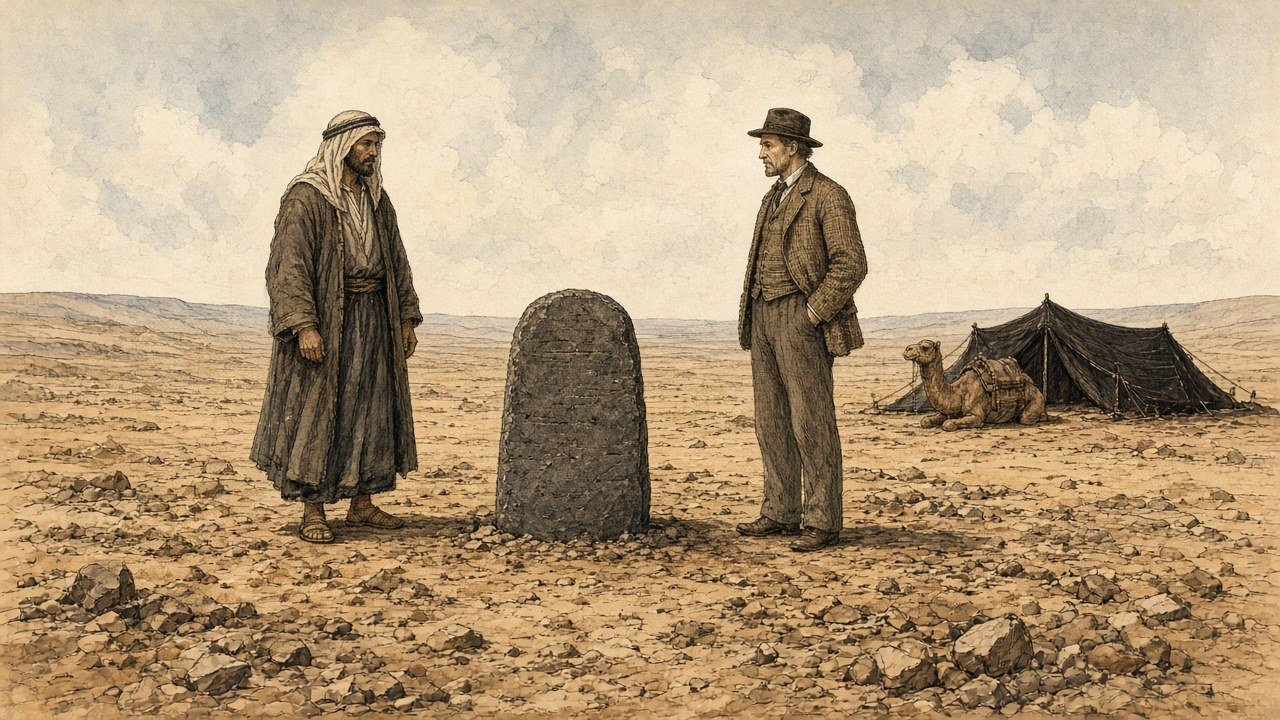
In August 1868 Frederick Augustus Klein, an Alsatian clergyman working for the Church Missionary Society, was travelling in the territory east of the Dead Sea when local guides showed him a large inscribed stone lying near the ruins of Dhiban, the site of ancient Dibon. The monument was a slab of black basalt with a rounded top, a little over a metre high and roughly sixty to seventy centimetres wide. Klein copied a few words and reported the find in Jerusalem, but he did not grasp the full extent of the text or take an impression of it.
News of the stone spread rapidly among the European consulates and learned societies in Jerusalem. The Prussian consulate sought to buy it for a museum in Berlin, while a young French scholar attached to the French consulate, Charles Clermont-Ganneau, also took a keen interest. The negotiations involved the Bani Hamida tribe who controlled the area, the Ottoman authorities, and several intermediaries, and they became entangled in local rivalries and suspicions. The repeated approaches convinced the local population that the stone was of great value, and the involvement of the Ottoman governor raised fears that it would be taken from them without compensation.
In 1869 Clermont-Ganneau sent an Arab agent, Yaqub Karavaca, to obtain a paper squeeze, an impression made by pressing damp paper onto the inscribed surface. The squeeze was taken in difficult circumstances. A dispute broke out while the paper was still wet, and the agent’s companion tore it from the stone in pieces and fled on horseback. The fragments of this squeeze, imperfect as they are, became the most important single witness to the complete text.
Shortly afterwards, in the autumn of 1869, members of the tribe heated the stone in a fire and then poured cold water over it, causing it to break apart. The fragments were distributed among families, reportedly to be kept as charms or to be placed in granaries as blessings on the harvest. Clermont-Ganneau, with the help of others including the British explorer Charles Warren, set about acquiring as many of the pieces as possible. Over the following years two large fragments and a number of smaller pieces were recovered. Altogether roughly two thirds of the original surface was retrieved.
The stone was reconstructed in Paris using the recovered fragments, with the missing portions restored in plaster on the basis of the squeeze. The result, displayed in the Louvre, is therefore a composite: the darker basalt fragments are original, while the smoother lighter areas are modern restoration. Scholars working on the text today still rely on the squeeze, on early copies, on photographs, and increasingly on digital imaging, including reflectance transformation imaging of both the stone and the squeeze, to check readings in damaged passages.
Clermont-Ganneau published his account of the discovery and his first reading of the text in 1870. His work established the inscription almost immediately as one of the major epigraphic discoveries of the nineteenth century, and it remained a model for the study of North-west Semitic inscriptions for decades.
The Moabite Language and Script
The inscription is written in Moabite, a North-west Semitic language belonging to the Canaanite group. Moabite is closely related to Hebrew, Phoenician and Ammonite, and a reader familiar with Biblical Hebrew can follow much of the text with relatively little difficulty. It is nonetheless a distinct language rather than a dialect of Hebrew, and it shows a number of features of its own.
Among the features that distinguish Moabite are the masculine plural ending in -n rather than the Hebrew -m, a feature shared with Aramaic, and the use of an infixed -t- stem of the verb that is rare in Hebrew. The inscription also uses the narrative sequence familiar from Biblical Hebrew prose, in which a series of past events is related by verbs joined with the conjunction “and”, a structure that gives the text much of its biblical flavour. Vocabulary is largely shared with Hebrew, including words for king, city, sanctuary, and the verb meaning to devote to destruction.
The script is a form of the alphabet that derives from the Phoenician alphabet and is closely related to the script used in Israel and Judah in the ninth century BCE, often called Palaeo-Hebrew. The letters are incised with care, and the scribe used small dots to separate words and short vertical strokes to mark the ends of sentences or sections. These dividers make the inscription unusually easy to segment and have helped scholars to reconstruct damaged lines. Vowels are not written except occasionally through consonants used as vowel indicators at the ends of words, a practice that the stele attests at an early stage.
Because Moabite is otherwise known from only a handful of short inscriptions, seals and fragments, the Mesha Stele provides the bulk of the evidence for its grammar. It is therefore a foundational text for the comparative study of the Canaanite languages and for understanding how Hebrew itself developed in relation to its neighbours.
Mesha and the Hebrew Bible
The inscription opens with the king’s self-presentation: “I am Mesha, son of Kemosh-yatti, king of Moab, the Dibonite.” Mesha relates that Omri, king of Israel, had oppressed Moab for many days because the Moabite god Kemosh was angry with his land, and that Omri’s son continued the oppression. Mesha then claims that Kemosh restored the land to him in his own days and that Israel “perished for ever”.
The text proceeds to recount a series of campaigns. Mesha describes taking Ataroth, where the men of Gad had lived from of old and where the king of Israel had built a city for himself, and killing its inhabitants. He describes the capture of Nebo, where he says he devoted the population to Ashtar-Kemosh and took from there the vessels of YHWH and dragged them before Kemosh. He records the expulsion of the king of Israel from Jahaz, which Israel had fortified. The latter part of the inscription turns to building works: Mesha claims to have built Qarhoh, its walls, gates, towers, palace and reservoirs, to have constructed a highway in the Arnon, and to have rebuilt several towns, including Aroer, Beth-bamoth and Bezer.
The Hebrew Scriptures speak of Mesha in 2 Kings 3. There he is described as a sheep-breeder who paid the king of Israel a heavy tribute in lambs and wool, and who rebelled after the death of Ahab. Jehoram of Israel, with Jehoshaphat of Judah and the king of Edom, marched against Moab by way of the wilderness of Edom. The biblical account describes initial success for the allied armies, followed by a siege of Kir-hareseth. In desperation Mesha offered his eldest son as a burnt offering on the wall, and “there came great wrath upon Israel”, after which the besiegers withdrew.
The two accounts are not straightforwardly the same event seen from two sides. The stele does not mention the campaign of 2 Kings 3, and the Bible does not mention Mesha’s capture of Ataroth, Nebo or Jahaz. The chronology also differs: the Bible dates Mesha’s rebellion to after Ahab’s death, whereas the stele speaks of Israelite domination during the days of Omri and “his son” and places Mesha’s liberation within a period that scholars have interpreted in various ways. The phrase “his son” may refer to Ahab or more loosely to a descendant. What the two sources share is the basic picture of Israelite control over territory north of the Arnon in the time of the Omride dynasty, followed by a successful Moabite assertion of independence under Mesha.
The stele also illuminates the religious world of the period. Its language of divine anger, divine restoration and the devoting of a captured population to a god closely parallels the language of the Hebrew Scriptures, where similar terminology describes the practice known as herem. The mention of the vessels of YHWH at Nebo indicates a sanctuary of the God of Israel in Transjordan in the ninth century BCE. The reference is the oldest known extra-biblical attestation of the name YHWH, and the context implies that the name was well known to a Moabite audience.
The geographical names in the inscription correspond closely to places mentioned in the Hebrew Scriptures, including Dibon, Medeba, Nebo, Ataroth, Jahaz, Aroer and Baal-meon. The reference to the men of Gad living in Ataroth corresponds to the biblical tradition about the tribe of Gad in Transjordan. These correspondences have made the stele a fixed point for the historical geography of the region.
Readings and Debates since the 1990s
Because roughly a third of the inscribed surface was lost, the reading of several lines depends on the squeeze and on reconstruction, and some of the most discussed questions concern these damaged passages. The most prominent debate began in 1994, when the French epigrapher André Lemaire proposed that line 31 should be read as containing the phrase “House of David”, in the form bt[d]wd. If correct, this would be a reference to the dynasty of Judah, comparable to the phrase “House of David” on the Aramaic Tel Dan Stele discovered at Tel Dan in 1993 and 1994.
Lemaire’s reading depends on restoring a letter in a damaged area, and it has been both widely accepted and strongly contested. In 2019 Israel Finkelstein, Nadav Na’aman and Thomas Römer, working from new high-resolution photographs of the squeeze, argued that the name in line 31 consisted of three letters beginning with B, and suggested that it might refer to Balak, the Moabite king of the biblical story of Balaam in Numbers 22 to 24. Other epigraphers, re-examining the same material with digital imaging, have defended the reading “House of David”. The question remains open, and it illustrates how much detailed interpretation depends on the quality of the surviving evidence.
The authenticity of the stele itself is not in serious doubt. Its discovery, its destruction and the recovery of its fragments were witnessed and documented by several independent parties in the 1860s and 1870s, and its language, script and content agree with what is known of the region from other sources. Claims that circulated in the late nineteenth century about forged Moabite artefacts concerned a separate group of pottery and figurines sold in Jerusalem in the 1870s, which Clermont-Ganneau himself helped to expose. They do not concern the stele.
Other debates concern the identity of the “son” of Omri, the location of Qarhoh, the reading of the name of Mesha’s father, and whether the stele was erected near the beginning or towards the end of Mesha’s reign. There has also been discussion of the literary character of the inscription, which some scholars read as a carefully composed royal memorial combining a victory account with a building account, comparable to other royal inscriptions from the Levant and Mesopotamia.
Continuing Significance
The Mesha Stele remains one of the most important single documents for the history of the southern Levant in the ninth century BCE. It confirms the existence and influence of the Omride dynasty, gives a Moabite perspective on relations with Israel, and shows that the kings of small Levantine states used monumental inscriptions to present their achievements in religious terms.
For students of the Hebrew Scriptures, the inscription offers a contemporary text in a closely related language and script, with a narrative style, a theological vocabulary and a geographical horizon that overlap substantially with the books of Kings and with passages in Numbers, Isaiah and Jeremiah that speak of Moab. It is frequently used to illustrate how ancient readers and writers understood the role of a national god in war and in the possession of land.
For epigraphers and linguists, the stele is the principal witness to the Moabite language and a key text for the development of the alphabet in the ninth century. It also serves as an instructive case in method, showing the value of careful documentation, the importance of squeezes and photographs, and the contribution of modern imaging technology to the reading of damaged inscriptions.
References
- Charles Clermont-Ganneau, La Stèle de Mesa, roi de Moab (Paris, 1870).
- J. Andrew Dearman (ed.), Studies in the Mesha Inscription and Moab (Atlanta: Scholars Press, 1989).
- André Lemaire, “‘House of David’ Restored in Moabite Inscription”, Biblical Archaeology Review 20:3 (1994).
- Israel Finkelstein, Nadav Na’aman and Thomas Römer, “Restoring Line 31 in the Mesha Stele”, Tel Aviv 46 (2019).
- “Mesha Stele”.
- “Mesha”.
- “Moabite language”.
- “Omri”.
- “Tel Dan Stele”.