By the Waters of Baghdad
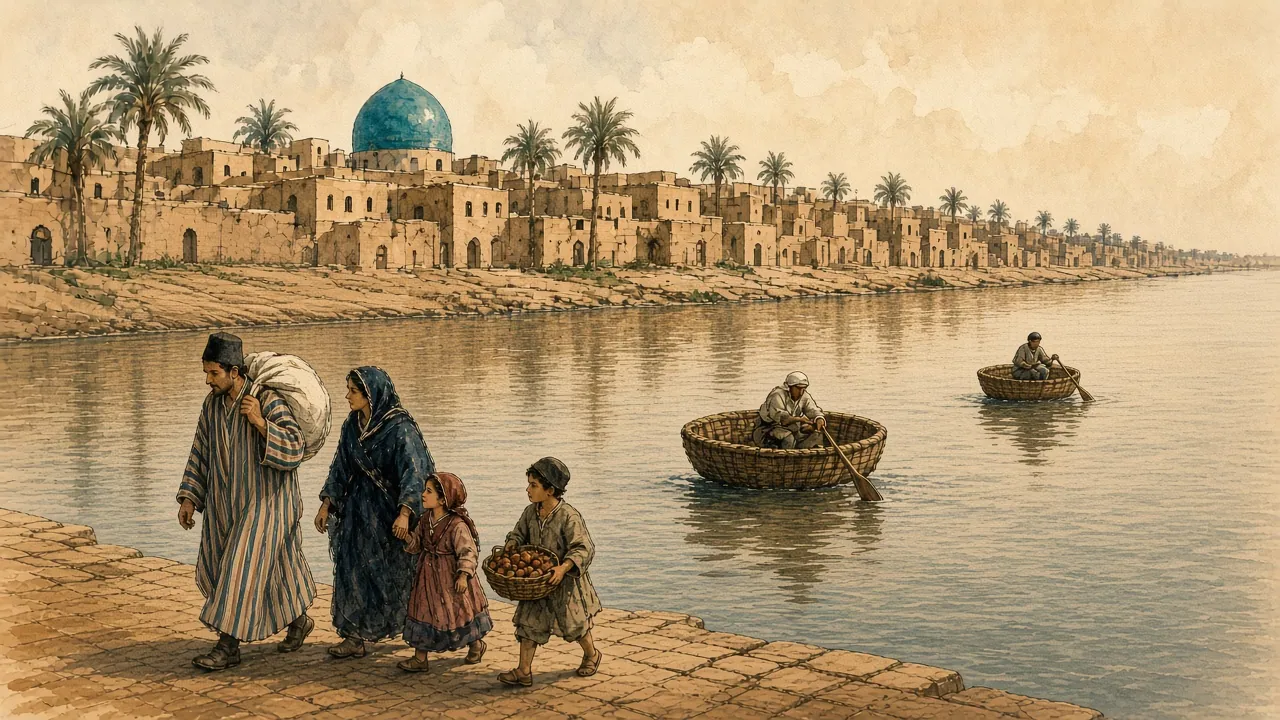
1. Babylon and Baghdad
When American soldiers searching for weapons entered the flooded basement of the intelligence headquarters in Baghdad in May 2003, they found something no one had been looking for: about 2,700 Hebrew books and tens of thousands of documents belonging to the Jewish community of the city, among them prayer books, school records, a Babylonian Talmud and fragments of Torah scrolls.[1] The papers had been seized from synagogues and communal offices by the Ba’ath state, and they recorded a community that had once made up perhaps a third of the population of the Iraqi capital. By 2003, the National Archives reported, only about fifteen Jews were still living in Baghdad.[2]
The disappearance was recent, but the community was very old. The Jews of Iraq traced their presence in the land between the Tigris and the Euphrates to the deportations carried out by the kings of Babylon in the sixth century BCE, and they remained there, under Persian, Greek, Parthian, Sasanian, Arab, Mongol, Persian again, Ottoman, British and Iraqi rulers, for about two and a half thousand years.[3] In that time Babylonia produced the Talmud that became the central text of rabbinic Judaism, and its academies, later settled in Baghdad itself, set the pattern of Jewish law and practice for communities from Spain to Yemen.[4]
The city of Baghdad is much younger than its Jewish community. It was founded by the Abbasid caliph al-Mansur in 762, at a point on the Tigris close to the old Jewish centres of Sura and Pumbedita, and Jews settled in it from the beginning.[5] For most of the next twelve centuries Baghdad was the principal Jewish city of the region, the seat of the exilarch and the geonim in the Middle Ages and the commercial centre of a trading diaspora that reached Bombay, Calcutta and Shanghai in the nineteenth century.[6]
This essay follows that history from the deportations to the departures. It begins with the evidence for the exile itself, including the cuneiform tablets that have changed the picture of how the deportees lived, and moves through the Talmudic academies, the institutions of the exilarch and the geonim, and the Jewish life of Abbasid Baghdad as described by a twelfth-century visitor from Navarre. It then traces the long contraction that followed the Mongol conquest, the Ottoman centuries, the rise of the great merchant families, and the reforms and schools of the later nineteenth century.
The final sections deal with the twentieth century, when the Jews of Baghdad became citizens of a new Iraqi state, made a large contribution to its administration, economy and culture, and then lost their place in it within a single decade. The pogrom known as the Farhud in June 1941, the measures taken against Jews after the war in Palestine in 1948, the law of 1950 that allowed them to leave on condition of giving up their nationality, and the airlift known as Operation Ezra and Nehemiah together ended the community.[7][8] Some of the causes of that ending, and in particular the series of bombings in Baghdad in 1950 and 1951, remain disputed, and the essay sets out the evidence and the main interpretations rather than choosing between them where the evidence does not allow it.
2. The deportations from Judah
The Babylonian exile is first a biblical narrative, and the narrative is unusually precise. The Second Book of Kings records that Nebuchadnezzar II besieged Jerusalem, that the young king Jehoiachin surrendered, and that the king, his household, his officials, the craftsmen and the smiths were carried to Babylon; it then describes a second siege, the destruction of the city and the Temple, and a further deportation in the eleventh year of Zedekiah.[9] The first deportation is dated to 597 BCE and the destruction to 587 or 586 BCE, with a third, smaller deportation reported for 582 BCE.[10]
Babylonian records confirm the outline. The chronicle of Nebuchadnezzar’s reign notes the capture of the “city of Judah” in 597, and ration lists from the royal palace in Babylon name “Ya’ukinu, king of the land of Yahudu” and his sons among the recipients of oil, a detail that fits the biblical statement that Jehoiachin was later released from prison and given a regular allowance at the king’s table.[11][9] The deportees were not the whole population of Judah. They were drawn mainly from the royal court, the priesthood and the skilled trades, and many of the rural poor remained in the land.[3]
The best-known expression of the exile is Psalm 137, which begins by the rivers of Babylon, where the captives sat down and wept when they remembered Zion and hung their lyres on the willows, refusing to sing the songs of the Lord in a foreign land.[12] The psalm is a lament and ends in a curse, and it fixed the image of exile as captivity and mourning for later Jewish memory.
Other biblical texts suggest a more settled existence. The prophet Jeremiah, writing from Jerusalem to the deportees, told them to build houses and live in them, to plant gardens and eat their fruit, to marry and have children, and to seek the welfare of the city to which they had been exiled, because in its welfare they would find their own.[13] The prophet Ezekiel, himself among the deportees, dated his first vision to a time when he was among the exiles by the river Chebar, one of the canals of the Babylonian plain.[14]
The question of how the exiles actually lived, as opposed to how they remembered their condition, could not be answered from the Bible alone. For most of the twentieth century the main external evidence came from the archive of the Murashu family of Nippur, a Babylonian business house of the fifth century BCE whose clients included people with Hebrew names.[10] Since the 1990s a much more direct body of evidence has come to light, in the form of cuneiform tablets written in the villages where the deportees were settled.
3. The town of Judah in Babylonia
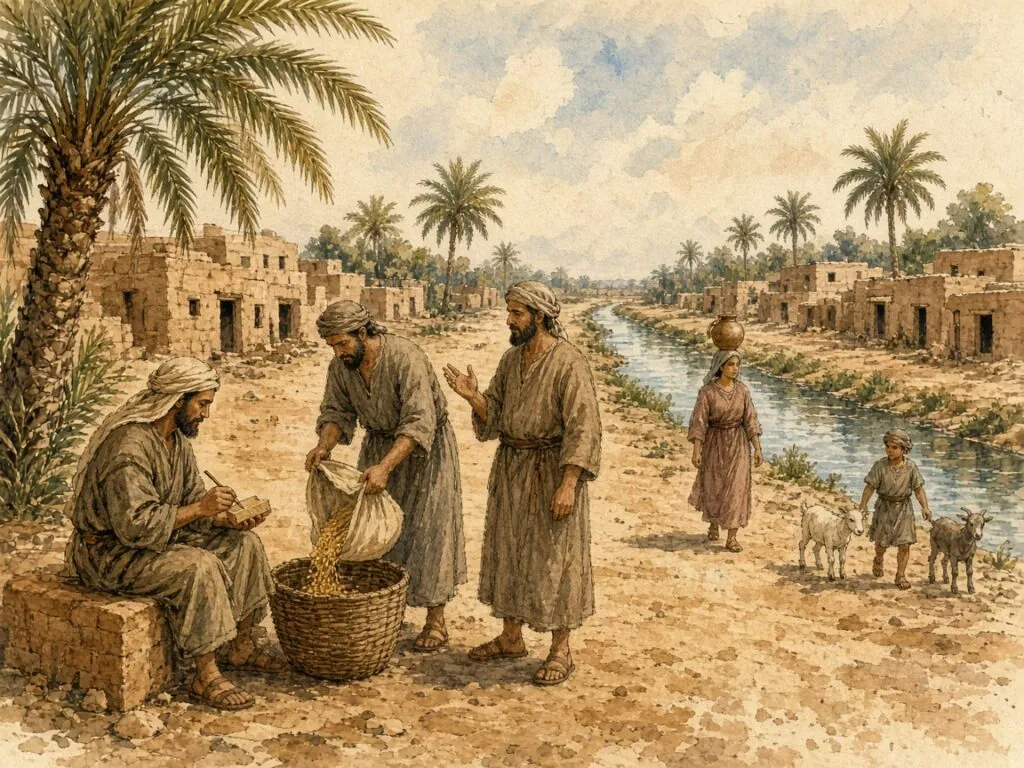
The tablets from the place the Babylonians called Al-Yahudu, “the town of Judah”, are the most important non-biblical source for the Judean exiles. They are clay documents in the Akkadian language and cuneiform script, dated between 572 and 477 BCE, and they record the affairs of a community of perhaps one or two thousand people settled in the countryside of southern Mesopotamia.[14] The earliest tablet is dated only about fifteen years after the destruction of Jerusalem, and the latest to the reign of Xerxes, so the archive covers several generations.[15]
The contents are mostly economic. There are contracts for the sale and rental of land, receipts for taxes paid in barley and dates, promissory notes, records of service owed to the state, and a few wills and a marriage contract.[14] They show that the deportees were settled as dependants of the crown on state land, which they farmed in return for taxes and labour, and that they were not slaves. Some families accumulated property, owned houses and plantations, and entered the lower ranks of the Babylonian administration.[16]
The most telling evidence is in the names. Many of the people in the tablets bear names formed with the divine element Yahu or Yama, the Babylonian rendering of the name of the God of Israel, such as Natan-Yama, the equivalent of Nathaniel.[14] A single family appears repeatedly: a man named Rapa-Yama, his son Ahiqam, and Ahiqam’s five sons, so that the archive has sometimes been described as the archive of Ahiqam.[15] Some names mix traditions, attaching the name of the Judean God to a Babylonian formula, which suggests both the retention of a distinct religious identity and a degree of adaptation to the surrounding culture.[14]
The tablets were also a reminder that the Judeans were one deported group among many. The Babylonians settled conquered peoples in villages named after their places of origin, so that there were also places called Ashkelon and Gaza in the Babylonian countryside, and the same archive includes documents of other West Semitic exiles.[14] The river Chebar named by Ezekiel appears in the tablets as an ordinary canal of the region.[14]
About two hundred tablets are known. One hundred and three of them, from the collection of David Sofer, were published by Laurie Pearce and Cornelia Wunsch in 2014 and shown the following year at the Bible Lands Museum in Jerusalem in an exhibition called “By the Rivers of Babylon”.[16] The tablets have no archaeological context: they appeared on the antiquities market in the 1990s and are widely regarded as having been looted from Iraq, which limits what can be said about the exact location of the villages and has made their display controversial.[15]
Scholars have also warned against reading the archive as a simple window on the experience of exile. The documents were produced by and for the Babylonian administration, and they record obligations and transactions rather than feelings; the “rich lives” that the exhibition attributed to the exiles are an inference from economic records.[15] What the archive does establish is that within a generation the deportees were living as settled farmers and taxpayers, keeping their names and their group identity, in the landscape where their descendants would remain for twenty-five centuries.
4. Persians, Greeks and Parthians
In 539 BCE the Persian king Cyrus II took Babylon, and the Book of Ezra opens with a proclamation in which Cyrus declares that the God of heaven has charged him to build a house in Jerusalem and invites any of his people to go up and rebuild it, with the help of those who stayed behind.[17] The Cyrus Cylinder, a Babylonian text of the king’s own propaganda, describes the return of displaced peoples and gods to their sanctuaries in general terms, though it does not mention the Judeans.[3]
Some exiles returned, in several waves and over a long period, and the biblical lists give a total of about forty-two thousand. Many more stayed. By the fifth century the descendants of the deportees had been in Babylonia for two or three generations; they had land, houses and family connections there, and the Al-Yahudu tablets show the community continuing under Persian rule long after the edict.[3][15] From this point the Jewish presence in Mesopotamia was no longer an exile awaiting its end but a permanent diaspora, linked to Judea by religion and pilgrimage and by a stream of scholars and texts in both directions.
The figures of Ezra and Nehemiah, who gave their names to the airlift of 1950, belong to this connection. Both are presented in the biblical books that bear their names as Jews of the Persian court and of the Babylonian diaspora who went to Jerusalem to restore its walls, its Temple worship and the observance of the law.[10] Their journeys from Babylon to Judea became the model of return in later Jewish thought, which is why the Israeli organisers of the departure of the Iraqi Jews chose their names twenty-four centuries later.
After Alexander’s conquest the region passed in 312 BCE to the Seleucid dynasty, and the Seleucid era, counted from that year, remained in use in Jewish contracts in the East for many centuries.[3] From the second century BCE Babylonia was ruled by the Parthian Arsacids, who left the Jews largely to govern their own affairs. Cities such as Nehardea and Nisibis became centres of Jewish life, and in the first century CE two brothers from Nehardea, Anilaeus and Asinaeus, briefly ran a semi-independent territory in the region before their downfall.[18][3]
The Parthian period also saw the conversion to Judaism of the royal house of Adiabene, a vassal kingdom in northern Mesopotamia, including Queen Helena, who later sent relief to Jerusalem in a famine.[3] The Jews of Mesopotamia supported the Parthians against the Roman invasion of Trajan in 114–117 CE. After the Roman destruction of the Second Temple in 70 CE and the suppression of the Bar Kokhba revolt in 135, Babylonia became a refuge for scholars from the Land of Israel, and the foundations were laid for the independent Babylonian tradition of learning that would flourish under the next dynasty.[3]
5. The head of the exile
The Jews of Babylonia had their own hereditary head, the exilarch, in Aramaic resh galuta, “head of the exile”. The holder of the office claimed descent in the male line from King David through Jehoiachin, the king who had been carried to Babylon in 597 BCE, and he was recognised by the Parthian and Sasanian kings, and later by the caliphs, as the representative of the Jewish community before the state.[19]
The early history of the office is obscure, and the lists of exilarchs reaching back to the exile were compiled in the Middle Ages and reflect the need of the institution to demonstrate an unbroken Davidic line.[19] The exilarchate becomes historically visible in the second century CE, when an exilarch named Huna is recorded, and from then until the Islamic period the exilarchs were a fixture of Babylonian Jewish life.[3]
The exilarch’s powers were political and judicial. He collected taxes from the Jews for the state, appointed judges and market inspectors, administered his own estates, and represented the community at court, where he ranked among the dignitaries of the realm.[19] The Babylonian Talmud records the honours due to him, including processional escorts and precedence, and it also records the frequent tension between the exilarch’s household and the rabbis, who depended on him for appointments but regarded learning, not birth, as the source of authority.[19]
This dual leadership, an aristocratic lay head with a Davidic pedigree alongside scholarly heads of academies, was the defining structure of Babylonian Jewry for a thousand years. It differed from the arrangement in the Land of Israel, where the patriarch, or nasi, combined political standing with membership of a rabbinic dynasty.[19] In Babylonia the two kinds of authority were held by different men and families, and much of the internal history of the community, down to the quarrel between Saadia Gaon and the exilarch David ben Zakkai in the tenth century, can be read as a negotiation between them.
The exilarchate survived the Arab conquest and reached a late height under the Abbasids. When Benjamin of Tudela visited Baghdad around 1170 he found the exilarch Daniel ben Hisdai riding to the caliph’s palace with an escort of horsemen, preceded by a herald calling on the crowd to make way for “our lord, the son of David”, and he reported that the exilarch’s authority extended over the Jewish communities from Mesopotamia and Persia to Yemen, Armenia and the borders of India.[20] After Daniel died without a son the office lost its importance, and claims to it survived only in scattered forms in later centuries.[5]
6. The academies and the Talmud
The Sasanian dynasty, which overthrew the Parthians in 224 CE, ruled the region until the Arab conquest four centuries later. Under the Sasanians the majority of the world’s Jews may have lived in Babylonia, concentrated in a belt of towns along the canals between the Euphrates and the Tigris, among them Nehardea, Mahoza, Sura and Pumbedita.[3] The new dynasty was closely allied with the Zoroastrian priesthood, and its policy towards Jews varied from reign to reign: Shapur II persecuted them in the fourth century, Yazdegerd I was regarded as tolerant, and Peroz in the fifth century imposed harsh restrictions, but long periods of stability allowed the institutions of Jewish learning to grow.[3]
The rabbinic schools of Babylonia have conventional foundation dates. Abba Arikha, known simply as Rav, returned from the Land of Israel to Babylonia in about 219 and established an academy at Sura; his contemporary Samuel led the school of Nehardea.[21] When Nehardea was destroyed by the forces of Palmyra in 259, its scholars moved to Pumbedita, where Judah bar Ezekiel founded the academy that, with Sura, would dominate Jewish learning for eight centuries.[22][23] Sura stood on the Euphrates in the south; Pumbedita, near modern Fallujah, lay closer to the later site of Baghdad.[24]
The scholars of these academies, the Amoraim, studied and debated the Mishnah, the code of Jewish law edited in the Land of Israel around 200 CE. Their discussions, in Jewish Babylonian Aramaic, ranged across law, ritual, ethics, medicine, folklore and biblical interpretation, and they were collected, arranged and edited over several centuries into the Babylonian Talmud.[22] Tradition attributes the main work of redaction to Rav Ashi of Sura, who died in 427, and to Ravina, who died around 500, with later anonymous editors completing the text in the sixth century.[3]
A distinctive institution of the Babylonian schools was the kallah, a gathering held in two months of the year, Adar and Elul, when scholars and laymen came to the academy to study a set tractate and hear the head of the school expound it.[25] The kallah connected the academies to the wider community and continued into the period of the geonim, when it also became the occasion on which questions sent from distant communities were read and answered.
The Babylonian Talmud was not the only Talmud. The scholars of the Land of Israel produced their own, the Jerusalem Talmud, but it was shorter, less fully edited and less widely studied. The Babylonian work became the authoritative text of rabbinic Judaism because its academies survived and its later heads, the geonim, used their authority to impose it.[4] When Jews elsewhere in the world speak simply of “the Talmud”, they mean the book compiled in the villages and towns of Babylonia, and its pages preserve many traces of their setting, from the Sasanian law of contract to the canals and markets of the Mesopotamian plain.[3]
7. The Arab conquest and the protected peoples
The Arab armies that defeated the Sasanians took the capital, Ctesiphon, in 637, and within a few years the whole of Mesopotamia was under Muslim rule.[3] For the Jews of Babylonia the conquest meant a new legal framework rather than the end of their institutions. Like Christians and Zoroastrians, they became dhimmis, “protected people”, whose lives, property and worship were guaranteed in return for the payment of a poll tax, the jizya, and acceptance of a subordinate place in the Islamic order.[26]
The conditions of that status were later gathered in a document known as the Pact of Umar, which tradition attributed to the second caliph but which in its developed form is a product of later centuries. It forbade the building of new places of worship, required non-Muslims to distinguish themselves by dress, barred them from riding horses and bearing arms, and set out a code of public deference.[27] These rules were not applied consistently. Their enforcement depended on rulers, governors and the religious climate of a given decade, and long periods of laxity alternated with sudden revivals.[26]
Within this framework the Jewish institutions of Babylonia continued. The exilarch was recognised by the new rulers as head of the Jews and remained responsible for collecting their taxes; the academies of Sura and Pumbedita resumed their work, and their heads began to be called geonim.[25] Arabic gradually replaced Aramaic as the everyday language of the Jews of Iraq, and by the tenth century Jewish scholars were writing theology, philosophy, grammar and biblical commentary in Arabic, usually in Hebrew characters, while keeping Hebrew and Aramaic for liturgy and law.[28]
The integration of Babylonia into an empire that stretched from Spain to Central Asia had important consequences for the Jewish world. It placed the Babylonian academies at the centre of a unified space of trade and communication, in which merchants, letters and books could travel from Córdoba to Basra under a single political and linguistic order.[25] The geonim used that space to extend their authority, and the Jews of North Africa and Spain came to look to Baghdad for answers to questions of law in a way that would have been impossible across the old frontier between Rome and Persia.
The early Islamic centuries also brought a challenge from within. In the eighth century a movement that rejected the authority of the rabbinic oral tradition and sought to derive law from scripture alone began to take shape in Iraq and Persia. Its adherents came to be known as Karaites, from the Hebrew word for scripture, and later tradition traced the movement to Anan ben David, a member of the exilarchic family who was passed over for the office.[29] The controversy with the Karaites would occupy the geonim for the next three centuries and would shape the work of Saadia, the most important of them.
8. The Round City and its Jews
In 762 the second Abbasid caliph, al-Mansur, began building a new capital on the west bank of the Tigris, a circular walled city with the caliph’s palace and the great mosque at its centre. The Jewish Encyclopedia notes that a place called Baghdad is already mentioned in the Babylonian Talmud, so that the caliph rebuilt and greatly enlarged an older Persian settlement rather than creating one from nothing.[5] The new city stood within a short distance of Sura and Pumbedita, and from the beginning Jews were among its inhabitants.[30]
The Jews of Baghdad lived for the most part in a quarter called Dar al-Yahud, “the abode of the Jews”, and one of the bridges over the Karkhaya canal in the western part of the city was called Qantarat al-Yahud, the Bridge of the Jews.[6] In the same quarter was a tomb that local Jews identified as that of Joshua son of Jehozadak, the high priest of the return from exile, and it was a place of prayer for many centuries.[6]
The Abbasid capital quickly became the largest city in the Islamic world and one of the largest in any part of the world, a centre of government, trade, scholarship and translation.[31] Jews took part in its commerce, its crafts and its administration, and the presence of the caliphal treasury drew Jewish bankers and financiers into the service of the state. The relationship was not free of friction. Harun al-Rashid revived the rules requiring Jews and Christians to wear distinguishing marks and forbidding them to ride horses, and the caliph al-Mutawakkil in the middle of the ninth century renewed these measures, converted synagogues and churches into mosques and imposed additional taxes on non-Muslim houses.[30]
Such episodes were followed by long periods in which the restrictions fell into disuse. Under the caliph al-Mu’tadid at the end of the ninth century many Jews were again employed in the service of the state, and the vizier ‘Ubayd Allah ibn Sulayman was remembered in Jewish sources for his kindness.[5] The pattern of tolerance interrupted by occasional repression, rather than either harmony or persecution, characterises Jewish life in Abbasid Baghdad as it does much of the medieval Islamic world.[32]
The growth of Baghdad changed the geography of Jewish Babylonia. The old Jewish towns of the canal country declined as the capital drew population, money and patronage, and the heads of the academies, the exilarch and the wealthy laymen who supported them were increasingly to be found in the city.[6] By the end of the ninth century the academies of Sura and Pumbedita, which kept their names, had moved to Baghdad, and the city that the caliphs had founded became, in Hebrew sources of the period, simply “Babylon”.[5]
9. The geonim of Baghdad
The heads of the two academies were known by the title gaon, an abbreviation of rosh yeshivat ge’on Ya’akov, “head of the academy of the pride of Jacob”. The period of their leadership, conventionally dated from the late sixth century to the death of Hai Gaon in 1038, is called the geonic age, and it falls almost entirely within the period of Islamic rule.[25]
The geonim were judges, teachers and legislators. Each academy was headed by a gaon, assisted by a chief judge, the av bet din, who often succeeded him, and by a hierarchy of scholars who sat in fixed rows during the sessions of study.[25] The academies were supported by taxes collected from districts assigned to them, by estates and by donations from abroad, which became more important as the economic base of Iraq weakened in the tenth and eleventh centuries.[25]
Their most influential activity was the writing of responsa, formal answers to questions of law and practice sent by Jewish communities throughout the Islamic world and beyond. Questions arrived from Qayrawan, Fez, Córdoba and Cairo, often collected by local leaders and carried by merchants; they were read in the academy, discussed, and answered in letters that carried the authority of the gaon and his school.[25] Through this correspondence the geonim established the Babylonian Talmud as the binding source of Jewish law and spread Babylonian practice to communities that had previously followed the traditions of the Land of Israel.[4]
The historian Robert Brody has argued that the geonim did more than preserve and transmit a tradition: they shaped medieval Jewish culture by setting the canon of authoritative texts, creating the first codes of law and prayer books, and defining the relationship between local custom and central authority.[33] The first legal compendia, the Halakhot Pesukot attributed to Yehudai Gaon in the eighth century and the Halakhot Gedolot of the ninth, and the first complete order of prayer, sent by Amram Gaon to the Jews of Spain in the ninth century, were products of the academies.[25]
The geonic academies were also institutions of prestige and patronage, and their history is full of disputes over appointments and revenues, between the two schools, between the geonim and the exilarch, and between Babylonia and the rival centre of learning in the Land of Israel.[25] The relocation of the academies to Baghdad in the late ninth century brought them closer to the caliphal court and to the wealthy Jewish families of the capital, whose support became increasingly important to them.[6]
The last great geonim, Sherira of Pumbedita and his son Hai, who led the academy until 1038, worked in Baghdad. Sherira’s letter of 987 to the community of Qayrawan, describing the transmission of the oral law from the Mishnah to his own day, remains a principal source for the history of the Talmud.[3][25] After Hai’s death the authority of the Babylonian academies declined, as the Jewish centres of Spain, North Africa and Egypt developed their own scholars and no longer needed to write to Baghdad.
10. Saadia Gaon
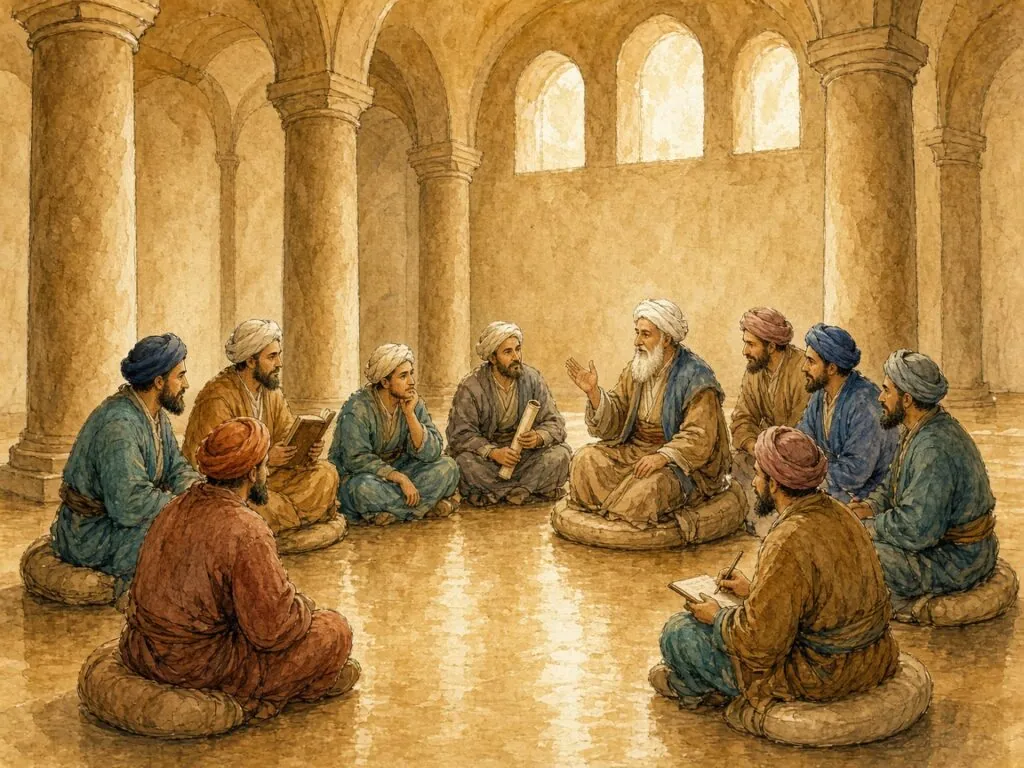
The most important of the geonim was not a Babylonian. Saadia ben Joseph was born in 882 in the Fayyum in Upper Egypt, studied in Tiberias, the centre of Masoretic scholarship on the text of the Hebrew Bible, and came to Babylonia already known as a scholar and controversialist.[28] In 928 the exilarch David ben Zakkai appointed him gaon of Sura, an unusual choice for an academy whose heads had traditionally come from a small number of Babylonian families.[28]
Saadia’s work transformed almost every field of Jewish learning. He translated the Torah into Arabic and wrote commentaries on much of the Bible; he wrote the first systematic works on Hebrew grammar and lexicography; he compiled a prayer book; and he played a leading part in a controversy over the calendar that set Babylonia against the Land of Israel in the 920s.[28] The online exhibition of the Iraqi Jewish Archive notes that the fixed calculation of the Jewish calendar was completed in the tenth century, largely through Saadia’s efforts.[34]
His Book of Beliefs and Opinions, completed around 933 and written in Arabic, was the first systematic work of Jewish philosophy in the Middle Ages. It set out to show that the teachings of revelation and the conclusions of reason agree, using the methods of the Islamic rational theology known as kalam, and it influenced later Jewish thinkers including Maimonides.[28] Saadia also wrote polemics against the Karaites, defending the rabbinic oral tradition against the claim that law could be derived from scripture alone.[29]
His tenure was turbulent. In 930 he refused to endorse a ruling of the exilarch in an inheritance case, and the dispute escalated into mutual excommunication: David ben Zakkai deposed Saadia and appointed a rival gaon, and Saadia supporters named a rival exilarch.[28] The conflict involved the wealthy Jewish families of Baghdad and their connections at the caliph’s court, and it was resolved only after several years, when Saadia and the exilarch were reconciled and Saadia returned to his office, which he held until his death in 942.[28]
The affair illustrates the structure of Baghdad Jewish life in the tenth century. The exilarch, the geonim and the great banking families were all part of a single small elite, whose quarrels were carried on in the city and sometimes in the caliph’s own court. It also shows how far the learning of the academies had come to depend on the patronage of the capital. Saadia’s career, from Egypt to Tiberias to Baghdad, followed the routes of a Jewish world that the Abbasid empire had made one, and his Arabic writings were read for centuries in every community within it.
11. Bankers at the caliph’s court
The Abbasid state needed men who could manage money, and some of the most prominent Jews of tenth-century Baghdad were bankers to the court. Two families in particular, those of Netira and Aaron, were influential at the caliph’s court and used their position on behalf of the community.[6] The Jewish Encyclopedia records that in the time of the caliph al-Mu’tadid the leaders of the community were Joseph ben Phineas and Netira, and that the Jews of the city fared well under the vizier of the day.[5]
These bankers, known in Arabic sources as court bankers or jahbadhs, advanced money to the state against the expected revenue of the provinces, and they held deposits and transferred funds for officials and merchants. Their wealth gave them a role in the affairs of the academies and the exilarchate: they paid for scholars, lent their influence in disputes over appointments, and took sides in conflicts such as that between Saadia and David ben Zakkai.[6]
Baghdad was also a centre of Jewish scholarship outside the academies. The grammarian Dunash ben Labrat spent time in the city around 950 before taking the new methods of Hebrew philology to Spain, and the commentator Abraham ibn Ezra probably visited it in the 1130s.[5] The Jewish community of the city was large enough to include Karaites and members of smaller sects, and the Jewish Encyclopedia records that a Karaite preacher of the eleventh century attacked the Rabbanites in the streets of Baghdad and was answered there by a rabbinic opponent.[5]
The prosperity of the community depended on the stability of the caliphate, and that stability ended in the tenth century, when real power passed to military commanders and then to the Buyid dynasty from western Iran, which took Baghdad in 945.[31] The caliphs remained as figureheads with a religious role, and in the eleventh century the Seljuk Turks replaced the Buyids. The economic decline of southern Iraq that accompanied these changes, as canals silted and the countryside was neglected, weakened the revenue on which the academies and the Jewish bankers had relied.[25]
The Jewish Encyclopedia observes that the condition of the Jews of the eastern caliphate was affected less by the policies of the caliphs than by the preoccupations of the military rulers, who were too occupied with other matters to trouble the Jews.[30] In the twelfth century, when the caliphs regained a measure of political independence, the Jewish community of Baghdad enjoyed a final period of medieval prosperity. The caliph al-Muktafi made Baghdad the seat of an exilarch who was once again recognised as the head of nearly all the Jews in the lands of the caliphate, and it was this community that a Jewish traveller from Navarre described around 1170.[30]
12. Benjamin of Tudela in Baghdad
Benjamin of Tudela left his home in the kingdom of Navarre around 1165 and travelled through southern Europe, Byzantium and the Near East, recording the Jewish communities he visited. His itinerary, written in Hebrew, is one of the principal sources for Jewish life in the twelfth century.[35] His account of Baghdad is the longest in the book.
Benjamin described the caliph as a pious and learned man, friendly towards the Jews, many of whose officers were Jewish, and he described the hospitals and the asylum for the insane that the caliph maintained in the city.[20] He then turned to the Jewish community. In the English translation of A. Asher, published in 1840, Baghdad contains “about one thousand Jews”; in the critical edition published by Marcus Nathan Adler in 1907, the figure is forty thousand, and a recent account by the University of Washington’s Stroum Center for Jewish Studies follows that reading.[20][32] The Jewish Encyclopedia, drawing on the same text, gives a thousand families.[5] The discrepancy, which arises from the manuscripts, is a reminder that medieval population figures are rarely reliable.
The rest of the description is less ambiguous. Benjamin counted ten academies, headed by scholars whom he names, and called the leading one the college of the Gaon Jacob, led by Samuel ben Eli.[20] He devoted most attention to the exilarch, Daniel ben Hisdai, whom Muslims called “our lord the son of David”; he described the seal of office granted by the caliph, the escort of horsemen, the herald, the embroidered silk robe and turban, and the rule that everyone should rise in the exilarch’s presence.[20] The city, he wrote, contained twenty-eight synagogues on both sides of the Tigris, and the exilarch’s synagogue had columns of coloured marble plated with gold and silver, with verses of the Psalms inscribed in gold.[20]
A few years later another traveller, Petahiah of Regensburg, gave a more modest picture, counting three synagogues in addition to one attributed to the prophet Daniel, and describing the head of the academy as a man who dressed like a king and whose servants flogged anyone who did not obey him promptly.[5] Both travellers reported that Muslims as well as Jews revered the tomb of Ezekiel outside the city, a shared veneration that continued into modern times.[32]
Benjamin’s picture of dignity and honour was not the whole truth. The Syriac historian Bar Hebraeus, writing in the thirteenth century, recorded occasions on which the Jews of Baghdad were forced to wear humiliating badges and were attacked by mobs.[32] But the twelfth-century community was real and substantial. Its last great scholar, Samuel ben Eli, who led the academy from about 1164 to 1194, raised the level of study in the city and became an opponent of Maimonides, whose code of law he regarded as a threat to the authority of the academies.[6]
13. Mongols, Ilkhans and Timur
In February 1258 a Mongol army under Hülegü, grandson of Chinggis Khan, took Baghdad after a short siege, killed the last Abbasid caliph and sacked the city. The number of the dead is unknown, and contemporary estimates in the hundreds of thousands cannot be checked, but the destruction ended the city’s role as the capital of the Islamic world.[36] The Encyclopaedia Judaica account reproduced by the Jewish Virtual Library states that the Jews were not maltreated in the conquest as the Muslims were, which reflects the general policy of the early Mongol rulers, who were not Muslims and did not favour one religion over another.[6]
Under the Ilkhans, the Mongol dynasty that ruled Iraq and Iran, a Jewish physician named Sa’d al-Dawla rose to the highest office in the state. Appointed by the Ilkhan Arghun to administer the finances of Iraq, he reorganised the revenues of Baghdad and in 1289 became chief vizier of the whole Ilkhanate.[6] He was executed in 1291, after the death of his patron, and the reaction against him was violent: the Jewish Encyclopedia records that the streets of Baghdad flowed with Jewish blood.[5] The career of Sa’d al-Dawla showed both how high a Jew could rise under a ruler who needed his skills and how quickly his community could suffer when that ruler was gone.
The conversion of the Ilkhans to Islam at the end of the thirteenth century brought back the discriminatory rules on dress and taxation that the early Mongols had abandoned.[6] In the fourteenth century the Ilkhanate disintegrated, and Iraq passed through the hands of successor dynasties. In 1393 Timur took Baghdad, and he returned in 1401 to sack it again; according to the Encyclopaedia Judaica account, many Jews fled to Kurdistan and Syria after the first conquest, leaving very few in the city until the end of the fifteenth century.[6] The Jewish Encyclopedia records that Jews who had taken refuge in Baghdad from the surrounding villages perished in the siege.[5]
The period between the Mongol conquest and the sixteenth century is the most poorly documented in the history of the Jews of Baghdad. The academies disappeared, the exilarchate faded into a title of local importance, and the community, much reduced, left few records.[5] Iraq itself had become a frontier province, impoverished by the destruction of its irrigation system and contested between Turkish, Persian and Turkmen powers.[3]
The contraction of Baghdad’s Jewish community was part of a wider shift. By the thirteenth century the centres of Jewish learning and population lay in Spain, North Africa, Egypt, Italy and the Rhineland, and the Babylonian heritage was carried forward in the Talmud and the geonic writings that those communities studied rather than in the institutions of Iraq itself.[25] When the Jewish community of Baghdad revived in the Ottoman period, it was a provincial community within a larger empire, no longer the capital of the Jewish world.
14. Between Ottomans and Safavids
In the early sixteenth century Iraq became a battleground between two new empires, the Sunni Ottomans and the Shi’i Safavids of Iran. Shah Isma’il took Baghdad in the first decade of the century, and the Ottoman sultan Süleyman captured it in 1534.[37] The Encyclopaedia Judaica account describes the first Safavid period as hard for the Jews under Isma’il’s son Tahmasp, and the first Ottoman period, which lasted until 1623, as one of improvement, in which Jewish trade with other countries increased and wealthy merchants appeared in the community.[6]
The Portuguese traveller Pedro Teixeira, who passed through Baghdad at the beginning of the seventeenth century, found a city of some twenty to thirty thousand houses, of which two to three hundred belonged to Jews living in a particular quarter around their synagogue.[5][6] The community was small, but it was growing again, and it was attached by trade to the routes running from the Persian Gulf to Aleppo and Istanbul.
In 1623 the Safavids took Baghdad again, and their rule, which lasted fifteen years, brought renewed hardship for the Jews. When the Ottoman sultan Murad IV recaptured the city in 1638, the Jews of Baghdad celebrated the day of the conquest, the sixteenth of Tevet, as a yom nes, a “day of miracle”, and they marked another such day in 1733, when a Persian attempt to retake the city failed.[6] These local festivals, modelled on Purim, preserved a memory of the Ottoman sultans as protectors against the Shi’i shahs.[3]
The Ottoman state treated the Jews of its provinces as a religious community with considerable autonomy in matters of family law, worship, education and internal taxation. In Baghdad the community was led by a lay head, called the nasi, who was often also the chief banker to the provincial governor, the sarraf bashi; the two offices were frequently held by the same man.[38] Religious authority rested with the rabbis, and from the nineteenth century the Ottoman government appointed an official chief rabbi, the hakham bashi, as the community’s representative before the state.[5]
The Ottoman centuries also saw the community’s ties with the Land of Israel renewed. Emissaries from Jerusalem, Safed and Hebron visited Baghdad regularly to collect funds, preached in its synagogues and answered questions of law, and in 1743 a rabbi from Aleppo, Tzedakah Hozin, settled in the city and reformed its educational system.[6] The Danish traveller Carsten Niebuhr, who visited Iraq in the 1760s, found a large Jewish community whose influence could be felt in the economic life of the city.[6] The foundations of the modern community, which would grow to tens of thousands in the nineteenth century, were laid in this period of Ottoman rule.
15. Bankers to the pashas
From the middle of the eighteenth century Baghdad was governed by a line of Georgian Mamluk pashas, former military slaves who ruled the province with little interference from Istanbul.[37] The Jewish bankers of the city were closely involved in their politics, lending money, managing revenues and sometimes taking sides in the rivalries between governors and the sultan.
The career of Ezekiel Gabbai illustrates both the opportunities and the risks. A member of a family that had long served the governors of Baghdad as bankers, he helped the Ottoman envoy Tal’at Effendi to suppress the rebellion of the governor Süleyman Pasha in 1811, and then moved to Istanbul, where he was honoured at court, displaced the rival Armenian bankers and used his position on behalf of his family and community.[38] His brother Ezra was nasi of the Baghdad community from 1817 to 1824. When the Armenian faction regained its influence, Ezekiel was exiled, and both brothers were later executed as a result of accusations brought against them.[38]
The last of the Mamluk governors, Da’ud Pasha, who ruled from 1817 to 1831, also tried to make himself independent of the sultan, and his government weighed heavily on the Jews of Baghdad. Many of the wealthier families left the city for Persia, India and other countries, among them David Sassoon, whose family would build one of the great commercial houses of the nineteenth century.[6][39]
The community remained large and well organised. The traveller David d’Beth Hillel, who visited Baghdad in 1828, counted six thousand Jewish families, led by a nasi whom he called “king of the Jews” and who was responsible for the community’s judicial affairs.[6] The English naval officer James Wellsted, who visited in 1831, praised the moral conduct of the Jews and their mutual responsibility, observing that there were no poor among them because anyone who lost his livelihood was supported by others.[6]
The Ottoman reconquest of Baghdad in 1831 ended Mamluk rule and brought the province under direct control from Istanbul, but the transition was violent, and the city was struck in the same years by plague and flood.[37] The Jewish Encyclopedia records later outbreaks of plague in 1876 and 1877, when the Jews were forced for a time to leave the city and camp in the desert.[5] The vulnerability of the community in such crises was a constant of Ottoman Baghdad, but so was its capacity to recover, and by the middle of the nineteenth century its commercial position in the city was stronger than it had been for six hundred years.
16. From Baghdad to Bombay and Shanghai
The families who left Baghdad in the early nineteenth century did not cut their ties with it. David Sassoon, born in 1792 into a family of Baghdad notables, settled in Bombay in the early 1830s and built a trading house, David Sassoon and Co., whose business in cotton, textiles and opium ran from India to China.[39] He sent his sons to Shanghai, Hong Kong and London, and the family became known as the “Rothschilds of the East”; in later generations its English branch produced the poet Siegfried Sassoon.[39]
Around the Sassoons and other families, among them the Kadouries, the Ezras and the Abrahams, there grew a network of Baghdadi Jewish merchants in the ports of the British empire in Asia, from Bombay and Calcutta to Rangoon, Singapore, Shanghai and Hong Kong.[40] These communities kept the liturgy and customs of Baghdad, built synagogues and schools, and recruited clerks and partners from among their relatives in Iraq. The documents recovered in 2003 include letterheads of Baghdad firms with branches in Britain, India and the Far East, showing how Iraqi commerce remained an essential part of this international network.[41]
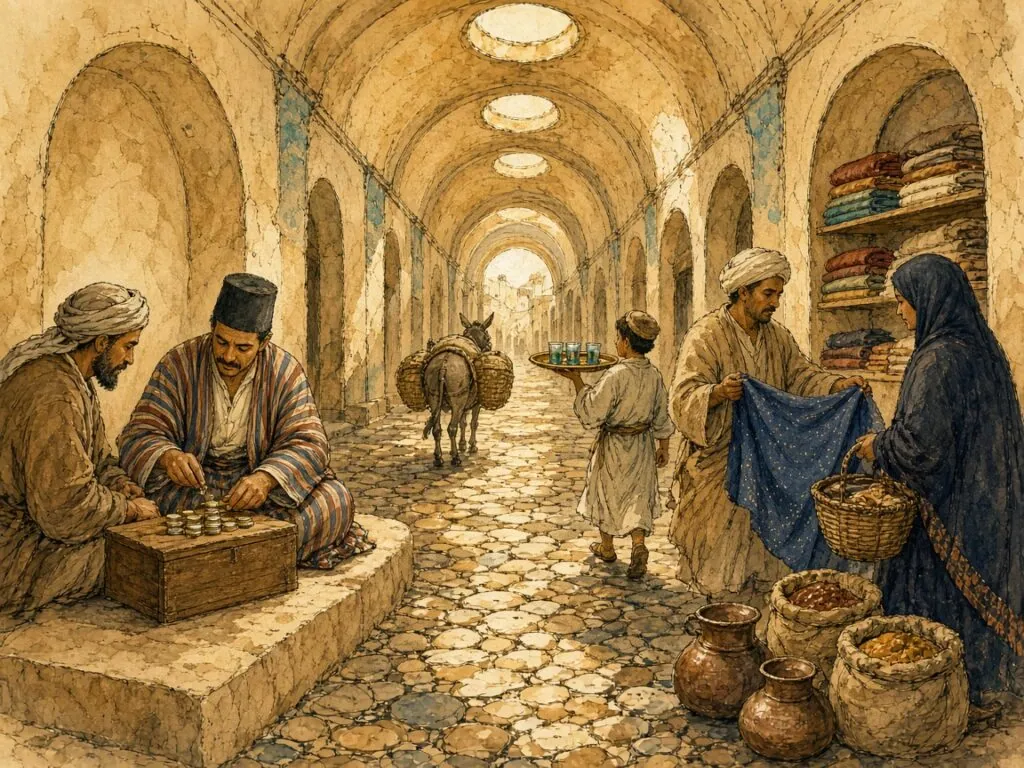
In Baghdad itself the Jews came to dominate the city’s long-distance trade. The Jewish Encyclopedia, drawing on reports of the mid-nineteenth century, states that the trade of Baghdad with India was then largely in Jewish hands, and quotes a missionary who described the Jews as the governing element of the place, with booths in every bazaar and control of banking and monopolies.[5] The same missionary estimated the Jewish population at sixteen thousand, against forty thousand Muslims and fifteen hundred Christians.[5]
The opening of the Suez Canal in 1869 shortened the route between Europe and the Gulf and brought new trade to Baghdad, and Jews from other towns moved into the city.[6] The traveller Ephraim Neumark estimated the community at thirty thousand in 1884, and the French geographer Vital Cuinet gave a figure of 52,500 Jews in the city in 1890, with fifty-two primary schools and twenty-six synagogues.[6][5] Adam Shatz notes that by the end of the Ottoman period the markets of Baghdad closed on the Jewish Sabbath rather than on the Muslim day of rest.[40]
The wealth of the great families supported the institutions of the community at home. Philanthropists such as Jacob Tzemah, Ezekiel ben Reuben Manasseh and Eliezer Kadoorie paid for schools, hospitals and religious institutions in Baghdad, and the names of donors living in Bombay or Shanghai appeared on the buildings of the city.[6] The Baghdad Jewish diaspora in Asia was in this sense an extension of Baghdad rather than a departure from it, and it gave the community an exceptional degree of connection to the commercial and imperial world of the nineteenth century.
17. Rabbis, printers and schools
The religious life of nineteenth-century Baghdad was shaped by a small number of outstanding rabbis. Abdallah Somekh, regarded by the Encyclopaedia Judaica as the greatest Iraqi rabbi of the later generations, founded the rabbinical college Beit Zilkha in 1840, and its graduates served as rabbis throughout Iraq and in the Baghdadi communities abroad.[6] His pupil Yosef Hayyim, born in 1835, became the leading sage of the community in 1859, on the death of his father, and remained so until his death in 1909.[42]
Yosef Hayyim, known from the title of his best-known work as the Ben Ish Hai, wrote on law, Kabbalah and ethics and preached weekly sermons that combined legal instruction with homiletics.[42] One of his books, Kanun al-Nisa, a guide for women to the laws, prayers and ethics of Jewish life, was written in Judeo-Arabic, Arabic in Hebrew letters, because Arabic was the everyday language of the women and most of the men of the community.[4] His writings remain authoritative for many Jews of Middle Eastern origin, and his legal rulings became the standard reference for communities that followed the customs of Baghdad.
Baghdad also became a centre of Hebrew printing. From 1862 and for more than a century its presses produced prayer books according to local custom, calendars, works of law and popular books in Judeo-Arabic; of the roughly twelve hundred religious books recovered in 2003, about a quarter had been printed in Baghdad.[4]
Alongside the traditional institutions came new schools. The Alliance Israélite Universelle, founded in Paris in 1860 to promote the education and emancipation of Jews in the Ottoman Empire and North Africa, opened a boys’ school in Baghdad in the mid-1860s, in 1864 or 1865 according to different accounts, and later a school for girls.[43][5] The Alliance schools taught French, Arabic, Turkish, English and Hebrew, arithmetic and commercial subjects, and they produced a generation of young men equipped for the international trade of the city and for posts in the administration.[44]
The Ottoman reforms of the Tanzimat, which declared non-Muslims equal before the law and abolished the poll tax, were applied unevenly in Iraq, but they opened public careers to Jews.[3] The governorship of Midhat Pasha from 1869 to 1872 brought modern administration, a newspaper, schools and urban improvements to Baghdad.[45] By the early twentieth century the Jews of Baghdad numbered about fifty thousand in a city of a little over two hundred thousand, and they formed an important part of its middle and working classes as well as its commercial elite.[41]
18. The British, the kingdom and a third of the city
British troops entered Baghdad on 11 March 1917, in the course of the campaign in Mesopotamia against the Ottoman Empire.[3] The documents found in 2003 include letters from the office of the British military governor to the chief rabbi in 1917 and 1918, dealing with the supply of matzah to Jewish prisoners at Passover and the allotment of sheep for the New Year, a small sign of how quickly the community established relations with the new administration.[34]
The Jews were then the largest single community in Baghdad. The University of Washington’s Stroum Center notes that British census figures in the 1920s showed more than a third of the city’s population to be Jewish.[32] For the Jewish notables, British rule offered security and opportunity, and they were wary of what independence might bring. In 1918 the president of the Jewish lay council and the acting chief rabbi asked for direct British rule, and a group of Jewish notables later petitioned for British citizenship, requests that the British, seeking to accommodate Arab nationalism, could not grant.[40]
The British civil commissioner Arnold Wilson reported that the Balfour Declaration of 1917 aroused no interest among the Jews of Baghdad, whose notables told him that Palestine was a poor country and that Mesopotamia, given good government, could become a national home to which the Jews of Bombay, Persia and Turkey would gladly come.[40] The historian Elie Kedourie, himself born into the Baghdad community, later concluded that the Jews of Baghdad had been defeated from the start because they did not understand the political situation in which they found themselves.[40][46]
The Kingdom of Iraq was created in 1921 under the British Mandate, with the Hashemite Faisal as king.[47] Shortly after his accession Faisal met Jewish leaders at the house of the chief rabbi and assured them that there was no meaning in the words Jews, Muslims and Christians in the language of patriotism, only a country called Iraq in which all were Iraqis.[40] Sassoon Eskell, a graduate of the Alliance school and a former member of the Ottoman parliament, served as the first minister of finance of the new kingdom in five governments from 1920 to 1925, negotiated the terms of the oil concession, and was knighted in 1923.[44]
Under the Mandate and in the first years of independence, which came in 1932, Jews entered the civil service, the professions and the universities in large numbers, and Jewish schools expanded.[47] The community’s elite was urbane, Western-educated and fluent in Arabic and European languages, and it helped to lay the administrative and commercial foundations of the new state.[40] The same association with the British and with the monarchy that served it well in the 1920s would later make it vulnerable, as Iraqi nationalism turned against the British presence and the conflict in Palestine intensified.
19. Arab Jews
The Jews of Baghdad spoke their own form of Arabic. Linguists place Baghdad Jewish Arabic among the qeltu dialects of Mesopotamia, named after their form of the verb “I said”, which preserve older features of the Arabic of the medieval city, while the Muslims of Baghdad came to speak a gilit dialect shaped by later migrations from the countryside.[48] The linguist Haim Blanc showed in the 1960s that the city’s Jews, Muslims and Christians each spoke a distinct variety, a sign of how closely the communities lived side by side while remaining separate.[48] The Jewish dialect kept words from Aramaic and Hebrew and was written, when it was written at all, in Hebrew characters.[48]
In the 1920s a generation of young Jews educated in modern schools began to write literary Arabic, not the dialect of the home, and to take part in the creation of a modern Iraqi culture. The literary scholar Reuven Snir identifies the publication on 10 April 1924 of the first issue of the journal al-Misbah, “The Lamp”, whose owner, editor and most of whose writers were Jews, as a starting point.[49] The journal’s aim was to contribute to Iraqi Arab culture rather than to serve a Jewish agenda, and the writers associated with it adopted the slogan “religion is for God, the fatherland is for everyone”.[49]
Jews wrote poetry, journalism and criticism, but they made their most significant contribution, Snir argues, in the short story.[49] Anwar Shaul, who edited al-Misbah and later al-Hasid, the most influential Iraqi literary journal of the 1930s, published one of the first collections of short stories in Iraq in 1930. In December 1929 he read an elegy for the Iraqi prime minister Abd al-Muhsin al-Sa’dun in a Baghdad mosque, a gesture that expressed his confidence that his religion was no obstacle to his place in Iraqi society.[49]
Music followed a similar course. The brothers Salih and Daud al-Kuwaiti, born in the Jewish quarter of Kuwait City to a family of Iraqi Jewish origin, settled in Iraq and became leading figures of modern Iraqi music in the 1930s and 1940s; their recordings are still played on radio stations across the region, often without any credit to their authors.[50] The World Jewish Congress notes that the creation of the State of Israel effectively ended their careers, and that in Israel their music survived among Iraqi immigrants and was revived in the twenty-first century by their grandson, the musician Dudu Tassa.[50]
The memoir of Sasson Somekh, born in Baghdad in 1933, describes a mixed neighbourhood called the Lettuce Beds, study of Arabic with a Shi’i cleric of the al-Sadr family, and a world in which Arab and Jewish writers met in the cafés of al-Rashid Street and browsed in the same bookshops.[40] In his review of the book Adam Shatz calls it an elegy for an experiment in coexistence rather than a parable of its impossibility.[40] The Arab-Jewish culture of interwar Baghdad was real, but it was also, as Snir concludes, the product of a very limited period and a very particular history.[49]
20. The darkening of the 1930s
The position of the Jews in independent Iraq deteriorated in the 1930s. Adam Shatz observes that as friends of the British the Jews were an easy target for anti-colonial anger, and that they were also identified with the Zionist project in Palestine, though most were indifferent or hostile to it.[40] Their economic prominence made them conspicuous: Shatz notes that the Jews, two per cent of the population of the country, handled three quarters of its imports.[40]
King Faisal died in 1933. His son Ghazi, who styled himself a pan-Arabist, imposed a tax on Jews leaving the country and was on good terms with the German representative in Baghdad, Fritz Grobba.[40] Grobba, who served as chargé d’affaires and later minister, used trade delegations, cultural exchanges and direct contacts to promote German influence and to encourage anti-British and antisemitic sentiment among the Iraqi elite.[51] The United States Holocaust Memorial Museum notes that Mein Kampf was translated into Arabic by Yunus al-Sab’awi and published in the Baghdad newspaper al-Alam al-Arabi in 1933 and 1934, and that Arabic-language radio broadcasts from Berlin reached a wide audience.[7]
Al-Sab’awi also led the Futuwwa, a youth movement established under government auspices in 1935 and modelled on the Hitler Youth, with drills, uniforms and oaths.[51][7] Its members began to threaten Jews in the streets of Baghdad.[40] The Palestinian Arab revolt of 1936 to 1939 sharpened the hostility. Dozens of Jewish civil servants were dismissed in 1934, some six hundred Jewish clerks were removed between 1934 and 1936, quotas limited Jewish entry to universities and public employment, attacks on Jewish targets increased, and Jewish leaders publicly dissociated themselves from Zionism and contributed to Palestinian causes in an attempt to protect their community.[8][40]
Ghazi was killed in a car accident in 1939 and was succeeded by his young son, with his pro-British uncle Abd al-Ilah as regent. In October of that year Hajj Amin al-Husseini, the mufti of Jerusalem, arrived in Baghdad as a refugee after the failure of the Palestinian revolt, and he quickly became a leading figure in anti-British circles.[7][52] He became an adviser to a group of pan-Arab army officers known as the Golden Square, who regarded Iraq as part of a wider Arab nation in which the Jews were a foreign element.[40]
On 2 April 1941 the former prime minister Rashid Ali al-Gaylani carried out a coup with the support of the Golden Square and the mufti, and the regent and Nuri al-Said fled to Transjordan.[7][53] The new government sought German and Italian support and hoped that an Axis victory would bring Iraq full independence.[7] On 19 April British forces from India landed at Basra, and in May British and Arab Legion columns advanced on Baghdad from Transjordan.[7][54] By the end of May the regime had collapsed and its leaders had fled to Iran.[7]
21. The Farhud
The British did not occupy Baghdad when the Rashid Ali regime collapsed. They wished the restored regent to appear to be returning by his own authority rather than on British bayonets, and they preferred Iraqi troops loyal to him to be the first to enter the city.[7] The ambassador, Sir Kinahan Cornwallis, kept British forces on the outskirts, although an intelligence officer warned that many people would be killed if they did not enter.[40]
The regent returned on 1 June 1941, the first day of the festival of Shavuot. Jews who had gone out to welcome him or to attend the festival services were attacked by soldiers and supporters of the defeated regime, and the violence spread across the city.[7][40] Soldiers and policemen who had supported the coup and members of the Futuwwa incited and led the riots, and they were joined by civilians and by Bedouin from the outskirts of the city who took part in the looting.[7] The violence lasted until midday on 2 June, when Iraqi troops were ordered to restore order and opened fire on the crowds.[7]
The Holocaust Memorial Museum gives the number of Jews murdered as between 150 and 180, with some 600 injured and an unknown number of women raped; about 1,500 shops and homes were looted, and community leaders estimated that 2,500 families, some fifteen per cent of the Jewish population of Baghdad, suffered directly.[7] The official commission of inquiry reported 128 Jews killed and 210 injured.[7] Other estimates are considerably higher, and the true figure is unlikely ever to be known.[51] Muslims too were killed, both among the rioters and among those who tried to protect their neighbours, and many Jewish families survived because Muslim neighbours hid them.[40][55]
The museum describes the causes of the Farhud as political and ideological. Its leaders identified the Jews with the British and with the Zionist movement, and an antisemitic ideology derived in part from Nazi propaganda helped to legitimise violence against civilians, including women and children, which was without precedent in modern Iraq and contrary to Islamic law.[7] The word farhud itself, an Arabic term usually rendered as violent dispossession or breakdown of order, entered the vocabulary of the community as the name for the worst assault on its life and property in its modern history.[7][40]
The Iraqi government paid 20,000 dinars in compensation to victims.[7] Hundreds of Jews fled to Iran, others to Beirut or, with temporary visas, to India, and a few hundred tried to reach Palestine, though most were stopped on the way.[7] Most of those who left soon returned, as the political situation stabilised and the Iraqi economy revived under British occupation for the rest of the war.[7] The emotional consequences were more lasting. Many members of the community remained in profound shock, and their confidence in their place in Iraqi society was shaken.[7]
22. Recovery and division, 1941 to 1948
The years between the Farhud and the war in Palestine were in some respects among the most prosperous in the history of the community. Sasson Somekh, quoted by Adam Shatz, insisted that the Farhud was not the beginning of the end and was soon almost erased from the collective memory of the Jews, washed away by the prosperity that the whole city enjoyed from 1941 to 1948.[40] Jews built new homes, schools and hospitals, and they took part in politics as never before; at the Bretton Woods conference of 1944 Iraq was represented by its Jewish finance minister, Ibrahim al-Kabir.[40]
The leaders of the community chose to minimise the danger. The Holocaust Memorial Museum notes that they preferred quiet personal diplomacy to open political activity, and that the Jewish members of parliament never voted against the government or publicly defended the rights of the Jewish minority.[7] The community was led from 1933 by its president and chief rabbi, Sasson Khedouri, with an elected council and committees for religious and secular affairs.[7]
Younger Jews looked elsewhere for security and meaning. Some joined the Zionist underground, which had been organised with the help of emissaries from Palestine who arrived during and after the British occupation, and which trained young people in self-defence and prepared for emigration.[40][3] Many more joined the Iraqi Communist Party, which became the most powerful opposition force of the 1940s and promoted an Iraqi civic identity that transcended sect.[40] In 1946 a group of Jewish Communists founded the League for Fighting Zionism, whose newspaper had a readership larger than the entire Zionist movement in Iraq.[40]
Jews took part in the mass demonstrations of early 1948 known as the Wathba, “the leap”, in which Iraqis of all communities protested against the Portsmouth Treaty, a revised agreement that would have preserved British influence over Iraq’s economy and foreign policy.[40] The protests forced the government to repudiate the treaty, and for a moment it seemed that a shared Iraqi politics, critical of the monarchy and the British alike, might include the Jews.[40]
That moment did not last. Shatz writes that Jewish integration was doomed by the war in Palestine, and the Holocaust Memorial Museum describes the dilemma of the Jewish intelligentsia, who had regarded themselves as partners in an Iraqi national project and found that the Arab nationalist movement and the religious right regarded them as collaborators with British colonialism.[40][7] The distinction between Jews and Zionists, which Communists and liberals had tried to maintain, collapsed in the course of 1948.
23. The war of 1948
On 15 May 1948 the State of Israel was proclaimed, the Arab armies, including an Iraqi expeditionary force, invaded, and the Iraqi government declared martial law.[40] Within a week Iraqi newspapers were calling for a boycott of Jewish shops.[40] The arrival in Iraq of several thousand Palestinian refugees in the summer of 1948 and the poor performance of the Iraqi army in Palestine increased public anger.[40]
In July 1948 Zionism was made a criminal offence under the penal code, punishable by imprisonment or death, and import and export licences held by Jewish businesses were revoked.[8][40] By October some 1,500 Jews had been dismissed from government service, among them a quarter of the staff of the port of Basra and hundreds of railway workers, and quotas restricted the entry of Jewish students to universities, especially to the scientific and medical faculties.[8] Arrests and searches of Jewish homes for evidence of Zionist or Communist activity became common.[56]
The event that shook the community most deeply was the trial and execution of Shafiq Ades, a wealthy businessman from Basra with good connections to the monarchy. Accused of selling military surplus to Israel, he was tried by a military court and hanged outside his house in Basra on 23 September 1948 in front of a large crowd.[57] Shatz describes Ades as by all accounts an apolitical man, and observes that his death taught the Jews of Iraq that if he was not safe, no one was.[40]
The chief rabbi and president of the community, Sasson Khedouri, was forced to resign in November 1949, when the Jews of Baghdad blamed him for failing to secure the release of the many young Jews who had been arrested.[6] Meanwhile thousands of Jews were leaving the country illegally, many crossing into Iran with the help of smugglers, from where they continued to Israel.[40][8]
The Israeli government and the Zionist underground in Iraq encouraged emigration. Shatz notes that the Israeli government publicised reports of persecution in Iraq, some of them exaggerated, and floated the idea of an exchange of Iraqi Jews for Palestinian refugees, an idea quietly welcomed in the British Foreign Office.[40] He concludes that if Israel was a sanctuary for the Jews of Iraq, it was also among the reasons why they needed one.[40] The Iraqi government, for its part, faced an illegal emigration it could not stop and a minority it increasingly regarded as disloyal, and in early 1950 it decided to legalise the departure of those Jews who wished to go.
24. The Denaturalisation Law
In March 1950 the Iraqi parliament passed a law permitting Jews who wished to leave the country permanently to do so, on condition that they renounced their Iraqi citizenship. Adam Shatz dates the Denaturalisation Law to 4 March, while other accounts give 9 March, the date on which it was finally enacted.[40][8] The law, valid for one year, allowed applicants to register at government offices, after which they could depart but lost the right to return; it applied only to Jews.[8]
The government expected relatively few to take up the offer. Shatz notes that the American embassy in Baghdad agreed with the prime minister, Tawfiq al-Suwaidi, that mass emigration was unlikely, and the Iraqi authorities assumed that only some seven to ten thousand people, mostly the poor and those already committed to Zionism, would register.[40][8] Critics in parliament warned of the economic consequences of losing a productive minority that made up much of the merchant class, but the bill passed with the support of nationalist deputies.[8]
At first registrations were slow. The leadership of the community remained reluctant, and the chief rabbi later asked why no one had come to speak to the Jewish leaders, who believed that Iraq was their country in good times and bad and that the trouble would pass.[40] The pace of registration then accelerated rapidly, and by the time the law expired more than a hundred thousand Jews had registered to leave.[40][8]
On 10 March 1951, a day after the law’s term ended, parliament passed Law No. 5, which froze the assets of Jews who had given up their citizenship and placed them under state administration; it was later extended by a further law in January 1952.[8] Shatz writes that the Iraqi deputies feared that neither the economy nor the state could survive the transfer of so much capital to a country that had itself expelled most of its Arab population, and that the British and Americans, though unhappy with the decision, felt unable to protest while Israel refused to compensate Palestinian refugees.[40]
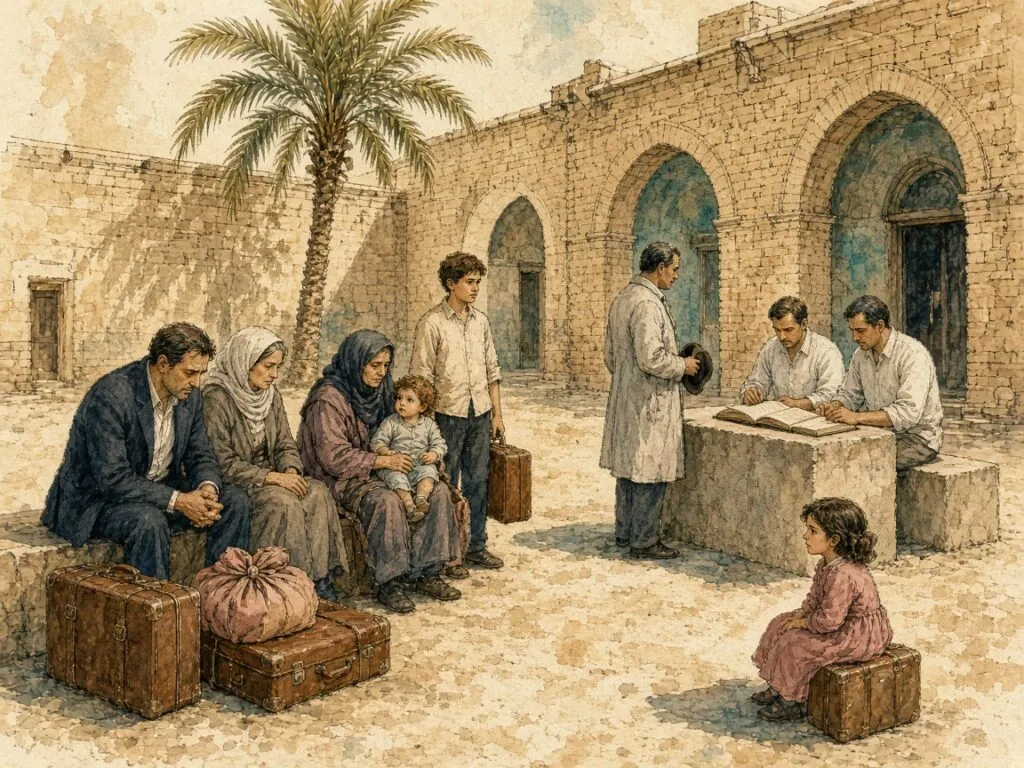
Emigrants were allowed to take only a small sum of money, given by Shatz as fifty dinars, and a limited weight of luggage, and they were forbidden to take jewellery or other valuables.[40][8] Homes, land, businesses, bank accounts and communal property were left behind.[8] A community that had been among the wealthiest in the Middle East arrived in Israel almost destitute, and the question of compensation for its property has never been settled.[56]
The law transformed the situation of every Jew in Iraq. Those who registered became stateless people waiting to leave, often having given up their jobs and sold whatever they could before their property was frozen. Those who did not register remained citizens of a state that now regarded them with suspicion, in a community that was disappearing around them.[58]
25. The bombings of 1950 and 1951
During the period of registration a series of bombs exploded at Jewish targets in Baghdad. Between April 1950 and June 1951 grenades and explosives were thrown at a café frequented by Jews, at Jewish businesses and at the Mas’uda Shemtov synagogue, where on 14 January 1951 an explosion among emigrants waiting to register killed four Jews and wounded dozens more.[59] Shatz dates the start of the series to a bombing on Abu Nuwas Street in April 1950, and notes that the attacks resumed in 1951 as the deadline for registration approached.[40]
The Iraqi police arrested members of the Zionist underground, and two of them, Yosef Basri and Shalom Salah, were convicted and hanged.[59] The question of who carried out the attacks has been disputed ever since. Many Iraqi Jews came to believe that Israeli agents had planted the bombs in order to frighten the community into leaving, and some historians have argued that this was the case for at least some of the attacks; others, including Moshe Gat and leaders of the underground such as Mordechai Ben-Porat and Shlomo Hillel, have rejected the claim and attributed the bombings to Iraqi nationalists.[59]
The historian Avi Shlaim, born in Baghdad in 1945, argued in a memoir published in 2023 that there was conclusive evidence of Israeli involvement in at least some of the bombings, citing interviews and Iraqi police reports; his conclusions have been challenged by other historians and by organisations that defend Israel’s record.[59] American embassy assessments at the time doubted the guilt of the two men who were executed, noting that the trials relied on circumstantial evidence and confessions.[59]
Adam Shatz, writing in 2008, observed that there was no proof of Israeli responsibility or of anyone else’s.[40] The timing of the registrations is part of the argument. Gat and others point out that large numbers of Jews had registered before most of the bombings, while those who attribute the bombings to Israeli agents argue that the attacks helped to persuade the hesitant majority.[59] The evidence that would settle the matter has not been made public, and the episode remains one of the most contentious in the history of the departure.[56]
What is not disputed is the effect of the bombings on the community. They spread fear among the Jews of Baghdad at a time when the departure of tens of thousands of neighbours had already undermined the sense that the community could continue.[59] By the end of the registration period, the question for most Jews was no longer whether to leave but when.
26. Operation Ezra and Nehemiah
The airlift that carried most of the Jews of Iraq to Israel was officially called Operation Ezra and Nehemiah, after the leaders of the return from Babylon in the Persian period, and was also known as Operation Ali Baba.[8][60] Its organisation was entrusted to Shlomo Hillel, an agent of the Israeli organisation for clandestine immigration who had already arranged smuggling routes from Iraq through Iran.[8] He negotiated with the Iraqi authorities under a cover identity, and Shatz records that the British Foreign Office learned of the agreement between the prime minister and “Richard Armstrong” of Near East Air Transport through its channels in Tel Aviv rather than in Baghdad.[40]
Near East Air Transport, an American company, flew the first passengers. Its pilots were not Jewish, and it used Douglas C-54 Skymaster aircraft, each carrying fifty or sixty passengers; El Al, the Israeli national airline, soon joined the operation, and the American carrier Alaska Airlines also took part.[8] The first two flights left Baghdad for Israel via Cyprus on 19 May 1950 with 175 Jews on board.[60] The early flights were routed through Cyprus, then under British rule, for refuelling and to avoid flying directly from Iraq to Israel.[8]
The American Jewish Joint Distribution Committee financed much of the operation, compiled passenger lists and supported the transit arrangements in co-operation with the Jewish Agency.[8][61] Its archives contain passenger lists and descriptions of transit camps from the airlift, part of a wider effort in the years from 1948 to 1952 in which the organisation helped some 440,000 Jews from Europe and the Muslim world to reach Israel.[61][62]
The pace of the airlift increased after the expiry of the registration period and the freezing of Jewish property in March 1951. In those months thousands of people who had registered, given up their citizenship and sold or abandoned their homes waited in Baghdad to be flown out, without citizenship and often without income.[8][40] Sasson Somekh, who left on 21 March 1951 with about two hundred others, later recalled that he saw no one kneel to kiss the ground, and that the passengers were sprayed with DDT before they were allowed to leave the aircraft.[40]
By early 1952 the operation had brought about 120,000 Iraqi Jews to Israel, almost the whole of the community.[60][58] Figures vary according to the period counted and whether those who left by other routes are included, but all accounts agree that within less than two years a community that had lived in Mesopotamia for some two and a half thousand years had been reduced to a remnant.[8][61]
27. Tents and transit camps
The immigrants from Iraq arrived in a state that had doubled its population in three years and could not house them. Most were sent to ma’abarot, transit camps of tents and later of tin and wooden huts, where about eighty thousand Iraqi Jews lived in the early 1950s, many of them for several years.[63][8] The camps were overcrowded, poorly supplied and exposed to the heat of summer and the floods of winter.[63]
Somekh described the sorting of new arrivals at a camp near Haifa and his dislike of the Hebrew word for the process, which reminded him of the Arabic word for the export of goods; he and his companions protested that they had been turned overnight from people into goods.[40] The novelist Samir Naqqash, quoted in a documentary on Iraqi Jewish writers in Israel, recalled that people who had lived in palaces were put into tents.[40]
The hardship was material, but it was also cultural. Many of the immigrants were urban, educated and commercially experienced, yet they found that their qualifications counted for little, that they were directed into manual labour, and that their Arabic language and culture were regarded with suspicion in a society whose leadership was largely of European origin.[8][40] Shatz quotes David Ben-Gurion’s remark that Israel did not want Israelis to become Arabs.[40]
Writers who had begun their careers in Arabic faced a stark choice. Snir describes how most Iraqi Jewish writers in Israel gradually stopped writing, while a few continued in Arabic and others turned to Hebrew.[49] Shimon Ballas rewrote his first novel, begun in Arabic, in Hebrew and published it in 1964 as Ha-Ma’abarah, The Transit Camp, the first Hebrew novel by an Iraqi immigrant.[49] Naqqash, who continued to write in Arabic until his death in 2004, said shortly before it that he did not exist in Israel as a writer, a citizen or a human being.[49]
Sami Michael, born in Baghdad in 1926, had joined the Communist underground as a young man and fled to Iran in 1948 to escape arrest, reaching Israel in 1949.[64] He became one of the best-known Hebrew novelists of his generation, writing about the transit camps, the Arab and Jewish neighbourhoods of Haifa and the lost world of Baghdad, and he led an Israeli civil rights organisation until his death in 2024.[64] The Iraqi immigrants and their descendants gradually established themselves in Israeli society. In 1973 Mordechai Ben-Porat, one of the organisers of the emigration, founded the Babylonian Jewry Heritage Center in Or Yehuda, near Tel Aviv, which collects oral histories, documents, photographs and objects from the communities of Iraq.[59]
28. The last Jews of Baghdad
About six thousand Jews chose to remain in Iraq after the airlift.[40] They were, for the most part, people who believed that Iraq was still their country or who could not bring themselves to abandon property and position. Their circumstances improved for a time after the revolution of July 1958, in which the monarchy was overthrown and General Abd al-Karim Qasim espoused an inclusive vision of Iraqi identity.[40]
After the Ba’ath Party took power in 1963, Jews were made to carry yellow identity cards and were subjected to new restrictions on travel and property.[40] The Jewish cemetery in Baghdad, with thousands of graves, was demolished in the same year.[8] The Arab defeat in the war of June 1967 brought a further wave of repression, in which Jews were dismissed from their posts, their bank accounts were frozen, their property was confiscated, their movements were controlled by the security services, and many were arrested.[65][3]
On 27 January 1969 nine Jews were hanged in Liberation Square in Baghdad, together with Christians and Muslims, after show trials on charges of spying for Israel; their bodies were left on the gallows before a crowd that was reportedly hundreds of thousands strong.[65] Shatz records that the radio urged listeners to come and enjoy the spectacle.[40] The hangings drew international condemnation, and in the early 1970s the regime allowed most of the remaining Jews to leave; by 1973 fewer than five hundred remained, and communal life had effectively ended.[3][65]
A small number of Jews stayed on through the rule of Saddam Hussein, most of them elderly, in Baghdad. Their numbers fell to fewer than a hundred by the mid-1990s and to about thirty-five by 2003.[3] In May 2003, after the American-led invasion, American soldiers searching the flooded basement of the intelligence headquarters in Baghdad found a room containing books, documents and scrolls taken from the Jewish community, under some four feet of water.[1] The material, which included Torah scrolls, Hebrew books printed as early as the sixteenth century, community records and school files, was taken to the United States for conservation, where it was preserved and digitised by the National Archives.[66][1]
The recovered documents are a modest remnant of a community whose libraries and synagogues were left behind in 1951. Among them are prayer books printed in Baghdad, letters of the chief rabbinate, school records and personal papers, which the online exhibition of the archive uses to reconstruct the life of a community that is now almost entirely absent from the country.[34][41]
29. A homeland by the rivers of Babylon
The history of the Jews of Baghdad is often told in terms of its beginning and its end, the exile by the rivers of Babylon and the airlift of 1950 and 1951. Between them lay some two and a half thousand years in which Mesopotamia was not a place of exile so much as one of the principal homes of the Jewish people. The Judeans settled by Nebuchadnezzar became the farmers and tenants of the al-Yahudu tablets; their descendants built the academies of Nehardea, Sura and Pumbedita and produced the Babylonian Talmud; and under the Abbasids the geonim of Baghdad answered questions of law sent to them from Córdoba, Qayrawan and Fez.[14][22][25]
The community survived the Mongol sack, the wars between Ottomans and Safavids and the plagues and floods of the Ottoman centuries. In the nineteenth century it revived as a commercial power, with branches in India and China, a rabbinic culture of great vitality and a modern school system.[39][42] In the 1920s and 1930s its members helped to build the Iraqi state, wrote modern Arabic literature and composed its music, and they regarded themselves, with good reason, as Iraqis.[49][50]
The end came quickly. The Farhud of 1941, the war in Palestine and the policies of the Iraqi government after 1948 made the position of the Jews untenable, and the Denaturalisation Law and the airlift brought almost the entire community to Israel within two years.[7][8] The causes have been debated by historians who emphasise Iraqi nationalism and antisemitism, and by those who also stress the role of the Zionist movement and the Israeli state; the evidence suggests that each of these forces played a part, and that the Jews of Baghdad themselves had little control over the events that ended their history in Iraq.[40][56]
The memory of Jewish Baghdad survives in the liturgy, music and food of Iraqi Jews in Israel, Britain and the United States, in the writings of Sami Michael, Sasson Somekh, Shimon Ballas and Samir Naqqash, and in the documents recovered from a flooded basement in 2003.[64][49][1] It survives also at the tomb of Ezekiel at al-Kifl, south of Baghdad, revered for centuries by Jews and Muslims alike, which still bears the traces of the community that tended it.[67]
The psalmist asked how the exiles could sing the Lord’s song in a strange land.[12] For most of their long history the Jews of Babylon answered that question by making the land their own. That they ceased to be able to do so in the twentieth century was the result of political forces that neither they nor their neighbours fully controlled, and the loss belongs to the history of Iraq as much as to that of the Jewish people.[3]
Timeline
Nebuchadnezzar II takes Jerusalem and deports King Jehoiachin and the Judean elite to Babylonia.
The Babylonians destroy Jerusalem and the Temple; a further deportation follows.
The earliest dated tablet from the “town of Judah” in Babylonia records Judean settlers.
The Persian king permits the exiles to return; many remain in Mesopotamia.
The academies of Sura, Nehardea and Pumbedita produce the Babylonian Talmud.
Arab armies defeat the Sasanians; the Jews of Iraq become a protected community.
The caliph al-Mansur begins building the Round City on the Tigris.
Saadia ben Joseph leads the academy of Sura and writes the Book of Beliefs and Opinions.
The traveller from Navarre describes the exilarch and the academies of Baghdad.
Hülegü sacks Baghdad and ends the Abbasid caliphate.
Süleyman the Magnificent takes the city; Safavid rule returns from 1623 to 1638.
The Alliance Israélite Universelle opens its first school in Baghdad.
British forces enter Baghdad during the Mesopotamian campaign.
Faisal becomes king; Sassoon Eskell serves as the first minister of finance.
Rioting in Baghdad over Shavuot kills between 150 and 180 Jews.
Jews are permitted to leave Iraq if they renounce their citizenship.
The first aircraft of Operation Ezra and Nehemiah leave Baghdad with 175 passengers.
Law No. 5 freezes the property of Jews who have registered to leave.
Nine Jews are among those hanged in Liberation Square in Baghdad.
American soldiers find Jewish books and documents in the flooded basement of the intelligence headquarters.
References
- “Discovery and Recovery”, Iraqi Jewish Archive: Discovery and Recovery (online exhibition) *
- “Ten years after a call for help, Iraqi Jewish documents go on display”, Pieces of History, US National Archives, 7 November 2013 *
- “History of the Jews in Iraq” *
- “Text and Heritage”, Iraqi Jewish Archive: Discovery and Recovery (online exhibition, US National Archives and partners) *
- Richard Gottheil and M. Franco, “Bagdad”, The Jewish Encyclopedia (New York: Funk and Wagnalls, 1901 - 1906) *
- “Baghdad, Iraq”, Jewish Virtual Library (from the Encyclopaedia Judaica) *
- “The Farhud”, Holocaust Encyclopedia, United States Holocaust Memorial Museum *
- “Operation Ezra and Nehemiah” *
- 2 Kings 25, Hebrew Bible, Sefaria *
- “Babylonian captivity” *
- “Jeconiah” *
- Psalm 137, Hebrew Bible, Sefaria *
- Jeremiah 29, Hebrew Bible, Sefaria *
- “The archives of some Judeans deported to Babylon”, Centre for the Study of Manuscript Cultures, University of Hamburg, 30 December 2015 *
- “Cuneiform writing and power at Yahudu and its environs”, Leiden University Scholarly Publications *
- “Tablets of Jewish Exiles”, Biblical Archaeology Society *
- Ezra 1, Hebrew Bible, Sefaria *
- “Nehardea” *
- “Exilarch” *
- Benjamin of Tudela, The Itinerary, trans. A. Asher (1840), in Bella Löwy (ed.), Medieval Hebrew (online text) *
- “Abba Arikha” *
- “Talmudic academies in Babylonia” *
- “Pumbedita” *
- “Sura (city)” *
- “Geonim” *
- “Dhimmi” *
- “Pact of Umar” *
- “Saadia Gaon” *
- “Karaite Judaism” *
- “Abbassid Califs”, The Jewish Encyclopedia (New York: Funk and Wagnalls, 1901 - 1906) *
- “Abbasid Caliphate” *
- “The Jews of medieval Iraq and Kurdistan: Surprising insights from Rabbi Benjamin of Tudela’s 12th-century geography”, Stroum Center for Jewish Studies, University of Washington *
- Review of Robert Brody, The Geonim of Babylonia and the Shaping of Medieval Jewish Culture (New Haven: Yale University Press, 1998), International Journal of Middle East Studies, Cambridge Core *
- “Iraqi Jewish Life: Constancy and Change”, Iraqi Jewish Archive: Discovery and Recovery (online exhibition) *
- “Benjamin of Tudela” *
- “Siege of Baghdad” *
- “Ottoman Iraq” *
- “Gabbai”, Jewish Virtual Library (from the Encyclopaedia Judaica) *
- “Sassoon family” *
- Adam Shatz, “Leaving Paradise”, London Review of Books 30.21 (6 November 2008) *
- “Personal and Communal Life”, Iraqi Jewish Archive: Discovery and Recovery (online exhibition) *
- “Yosef Hayyim” *
- “Alliance Israélite Universelle” *
- “Sassoon Eskell” *
- “Midhat Pasha” *
- “Elie Kedourie” *
- “Mandatory Iraq” *
- “Baghdad Jewish Arabic” *
- Reuven Snir, “‘If I Forget Thee, O Baghdad’: The Demise of Arab-Jewish Identity and Culture”, Asian and African Studies (Bratislava) *
- “Fathers of Modern Iraqi Music”, Legacy of Jews in the Middle East and North Africa, World Jewish Congress *
- “Farhud” *
- “Amin al-Husseini” *
- “Rashid Ali al-Gaylani” *
- “Anglo-Iraqi War” *
- “The Farhud and the Enduring Legacy of Iraqi Jews”, Hebrew Union College - Jewish Institute of Religion *
- “Jewish exodus from the Muslim world” *
- “Shafiq Ades” *
- “After the Millennia”, Iraqi Jewish Archive: Discovery and Recovery (online exhibition) *
- “1950 - 1951 Baghdad bombings” *
- “Airlift of Iraqi Jews Begins”, Center for Israel Education *
- “Finding Aid: Jerusalem 1944 - 1952, Subject Matter”, JDC Archives *
- “History of JDC: 1950s”, JDC Archives *
- “Ma’abarot” *
- “Sami Michael” *
- “1969 Baghdad hangings” *
- “Preserving the Iraqi Jewish Archive”, US National Archives *
- “Ezekiel’s Tomb” *
Select bibliography
- Laurie E. Pearce and Cornelia Wunsch, Documents of Judean Exiles and West Semites in Babylonia in the Collection of David Sofer (Bethesda: CDL Press, 2014).
- Robert Brody, The Geonim of Babylonia and the Shaping of Medieval Jewish Culture (New Haven: Yale University Press, 1998).
- David Solomon Sassoon, A History of the Jews in Baghdad (Letchworth: Solomon D. Sassoon, 1949).
- Elie Kedourie, “The Break between Muslims and Jews in Iraq”, in Jews among Arabs: Contacts and Boundaries, ed. Mark R. Cohen and Abraham L. Udovitch (Princeton: Darwin Press, 1989).
- Moshe Gat, The Jewish Exodus from Iraq, 1948–1951 (London: Frank Cass, 1997).
- Orit Bashkin, New Babylonians: A History of Jews in Modern Iraq (Stanford: Stanford University Press, 2012).
- Sasson Somekh, Baghdad, Yesterday: The Making of an Arab Jew (Jerusalem: Ibis Editions, 2007).
- Reuven Snir, Who Needs Arab-Jewish Identity? Interpellation, Exclusion, and Inessential Solidarities (Leiden: Brill, 2015).
- Avi Shlaim, Three Worlds: Memoirs of an Arab-Jew (London: Oneworld, 2023).
- Abbas Shiblak, Iraqi Jews: A History of Mass Exodus (London: Saqi, 2005).