The Four Castes of the Yuan and Ethnic Separation in China
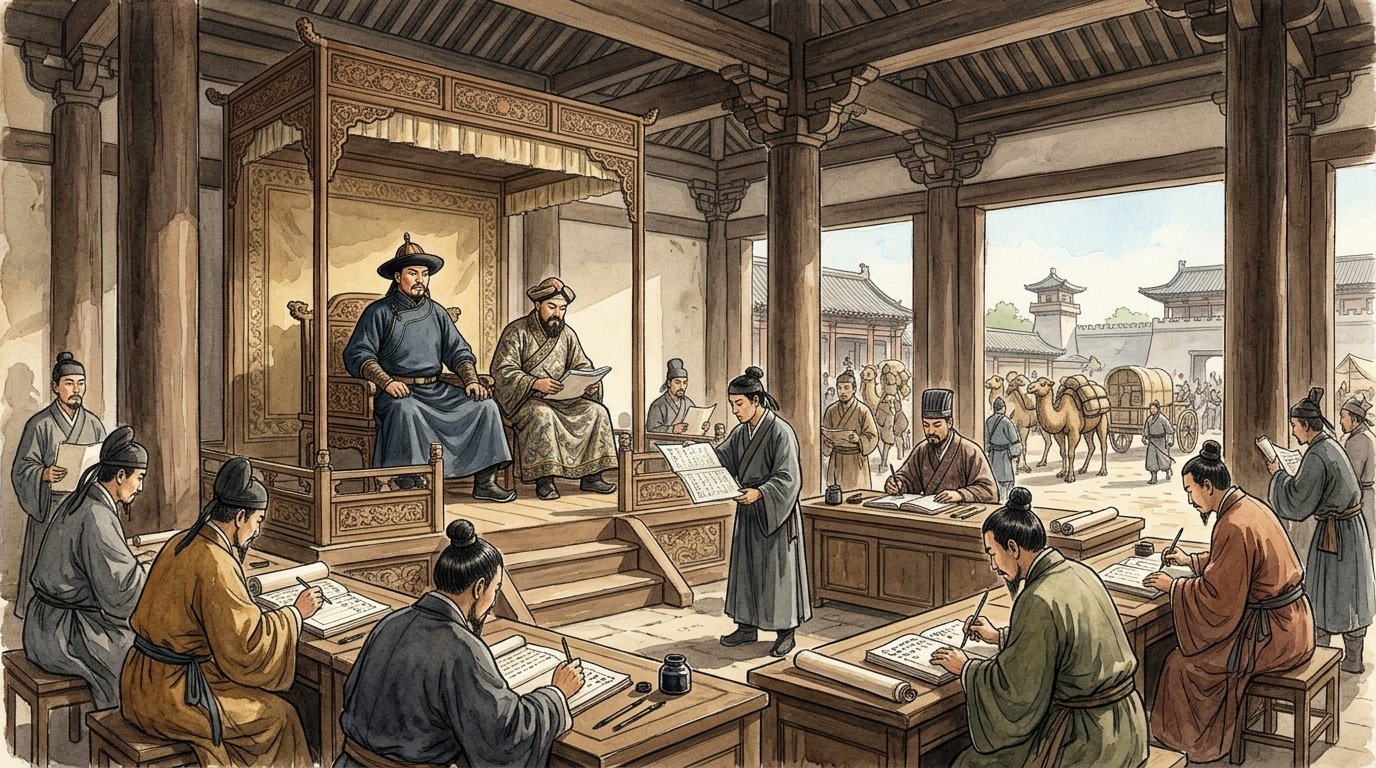
In the ninth lunar month of the first year of the Huangqing era (1312 CE), an imperial edict promulgated by the fourth Mongol sovereign of China, Emperor Renzong of Yuan (元仁宗, Ayurbarwada, r. 1311–1320 CE), arrived in the southern cultural metropolises of Hangzhou, Suzhou, and Nanjing. The decree announced the miraculous resurrection of the imperial civil service examinations (科举, Keju), which had been completely abolished for nearly four decades following the Mongol annihilation of the Southern Song in 1279 CE. To the millions of disenfranchised Han Chinese scholars who had spent a generation living as impoverished schoolteachers, fortune-tellers, and theatrical playwrights, the decree seemed at first glance like the return of civilized Confucian governance.
Yet when the scholars unrolled the fine print of the examination statutes, they were confronted by a system of staggering, state-mandated institutional discrimination. The empire was allocating exactly three hundred degrees nationwide, divided into four rigid, mathematically equal quotas of seventy-five successful candidates each for four distinct population categories:
- Mongols (蒙古人): 75 degrees allocated to a ruling population of fewer than 1.5 million people;
- Semu (色目人, Central Asians, Persians, and Europeans): 75 degrees allocated to roughly 1 million people;
- Hanren (汉人, Northern Chinese, Jurchens, and Khitans): 75 degrees allocated to roughly 10 million people;
- Nanren (南人, Southern Chinese from the former Song realm): 75 degrees allocated to over sixty-five million people.
Under this legal formula, a Mongol candidate in Beijing had roughly a one-in-twenty-thousand chance of achieving the supreme degree of Jinshi, while a southern Chinese scholar in the Yangtze delta faced odds worse than one in a million. Even more gallingly, Mongol and Semu candidates were tested on simplified, superficial questions drawn from a single classical text and were exempted from the grueling policy essays and philological tests demanded of Han and Nanren candidates. Most insulting of all, on the imperial pass-lists posted outside the palace, the names of Mongol and Semu scholars were written in the prestigious right-hand column, while Chinese scholars were relegated to the inferior left.
This rigged examination system was merely the public tip of a colossal, legal and social iceberg: the Four-Class System (四等人制, Si Deng Ren Zhi) of the Mongol Yuan Dynasty (1271–1368 CE). For nearly a century, the Mongol conquerors institutionalized the most comprehensive, rigid ethnic caste hierarchy in Chinese imperial history. Every subject within the borders of China—from the snowy forests of Manchuria to the tropical jungles of Yunnan—was legally classified from birth into one of four ethnic strata, which dictated their legal rights, taxation rates, criminal punishments, bureaucratic promotions, weapon ownership, and social status.
This monograph provides an exhaustive sociological, legal, institutional, and economic anatomy of the Yuan Dynasty’s Four-Class System. We will explore the existential demographic dilemma that drove the Mongol ruling elite to construct an apartheid-like state apparatus; analyze the precise ethnic composition and rights of each of the four castes—Mongols, Semu, Hanren, and Nanren; dissect the dual legal code that punished Chinese subjects with execution for striking a Mongol while letting Mongols off with fines for murder; examine the ubiquitous surveillance of the Darughachi (达鲁花赤) seal-keepers; trace the economic predation of Central Asian Ortogh tax-farmers; document the tragic degradation of the Chinese literati into the infamous ‘Ninth Caste’ (just above beggars); and evaluate how this century of systemic ethnic humiliation ignited the volcanic fury of the Red Turban rebellions and culminated in Zhu Yuanzhang’s historic battle-cry: ‘Drive Out the Tartars, Restore China!’
1. The Conqueror’s Terror: The Demographic Dilemma of the Steppe
To understand why the Mongol khans engineered such a brutally stratified social order, one must examine the terrifying demographic arithmetic that confronted Kublai Khan (忽必烈) and his successors. When the Mongol conquest of the Southern Song was completed in 1279 CE, the total population of the newly unified Yuan Empire was estimated by official census records at approximately fourteen million registered households, or between 75 and 85 million individuals.
Against this sea of sedentary Chinese, the total number of ethnic Mongols in China—including imperial princes, aristocratic clans, garrison soldiers, and their families—numbered at most one to one-and-a-half million people. Ethnic Mongols comprised less than two percent of the population they governed. In the densely populated southern provinces of Jiangnan, the demographic ratio was even more staggering: in many counties, a single Mongol overseer and a handful of cavalrymen were tasked with controlling hundreds of thousands of Han Chinese subjects.
The Mongol leadership was haunted by the historical ghost of previous northern conquest dynasties. The nomadic Xianbei of the Northern Wei Dynasty had conquered northern China in the fifth century, only to completely lose their language, martial skills, and tribal identity through Emperor Xiaowen’s aggressive Sinicization program. The Khitan Liao and the Jurchen Jin had similarly adopted Chinese court ceremonies, Confucian bureaucracy, and luxurious silk garments, softening their nomadic fierceness until they were easily conquered by the next wave of steppe warriors. In his seminal study The Jurchen in Twelfth-Century China, historian Jing-shen Tao noted that the rapid assimilation of the Jurchens served as a permanent, terrifying warning to the Mongols.
Kublai Khan and his chief advisors—both conservative Mongol steppe princes and Central Asian technocrats—resolved that the Mongols must never share the fate of the Jurchens. They adopted an unyielding principle of statecraft: rule China without becoming Chinese. The Mongols would exploit the immense agricultural wealth and taxation revenues of China to finance their global empire, but they would maintain an unbridgeable social, linguistic, and political gulf between the conquering steppe elite and the conquered sedentary masses. The Four-Class System was the structural fortress designed to preserve Mongol supremacy forever.
2. The Four Castes Defined: The Architecture of Apartheid
The population of the Yuan Empire was legally partitioned into four descending ethnic strata, established through conquest chronology and imperial trust:
Class 1: The Mongols (蒙古人, Menggu Ren)
Occupying the apex of the social pyramid was the Mongol ruling aristocracy and military class. This included all nomadic tribes of the Mongolian plateau that had submitted to Genghis Khan prior to 1206 CE (such as the Borjigin, Jalayir, Kereit, Naiman, and Merkit). Mongols possessed absolute monopoly over supreme political, military, and judicial power. They held vast hereditary pasturelands (Aimaq) across northern China, were exempt from agricultural taxes and forced corvée labor, and were judged exclusively by traditional nomadic steppe customary law (the Yassa of Genghis Khan) administered by Mongol judges (Jarghuchi 扎鲁火赤).
Class 2: The Semu (色目人, Semu Ren)
The term Semu (literally ‘Colored Eyes’ or ‘Various Categories’) designated a heterogeneous, multi-ethnic group of non-Chinese, non-Mongol subjects from Inner Asia, Central Asia, the Middle East, and Europe who had submitted to the Mongol Empire during its early western conquests. The Yuan administrative statutes recognized thirty-one distinct ethnic groups within the Semu caste, including:
- Turkic and Uighur Peoples: The Uighurs of Qocho, who provided the Mongol court with its written vertical alphabet, court chancellors, and scribes;
- Persians, Arabs, and Central Asian Muslims (Huihui 回回): Renowned for their mathematical, financial, astrological, and engineering skills;
- Tanguts (Mi-nyag) and Tibetans: Valued as Buddhist spiritual masters, scribes, and administrators;
- Nestorian Christians, Alan Christians, and Europeans: Including Italian merchants and diplomats like Marco Polo.
Because the Semu possessed no native roots in Chinese society, had zero political loyalty to the fallen Han dynasties, and were completely dependent on Mongol imperial patronage for their wealth and survival, the Mongol khans trusted them implicitly. The Semu served as the Empire’s primary tax-farmers, finance ministers, central bankers, astronomers, and siege engineers, acting as a ruthless bureaucratic buffer between the Mongol throne and the Chinese populace.
Class 3: The Hanren (汉人, Hanren – ‘Northern Chinese’)
Crucially, in Yuan legal terminology, the word Hanren did not mean all ethnic Chinese. It referred specifically to the inhabitants of the former Jurchen Jin Empire in northern China, which had been conquered by Genghis Khan and Ögedei Khan between 1211 and 1234 CE. This category encompassed northern Han Chinese dwelling in Hebei, Shandong, Shanxi, Henan, and Shaanxi, as well as thoroughly Sinicized northern ethnic groups including Jurchens, Khitans, and Koreans. Because northern China had been under nomadic and semi-nomadic rule for over three centuries (under the Liao and Jin), the Mongols viewed the Hanren as culturally accustomed to barbarian domination and more pliant than the fierce loyalists of the south.
Class 4: The Nanren (南人, Nanren – ‘Southern Chinese’)
At the absolute bottom of the imperial caste hierarchy were the Nanren (literally ‘Southern People’), also referred to derisively in Mongol documents as Manzi (蛮子, ‘Southern Barbarians’). These were the subjects of the former Southern Song Empire—the sixty to seventy million Han Chinese inhabiting the vast agricultural, commercial, and urban landscapes south of the Huai River and Qinling Mountains. Because the Southern Song had resisted the Mongol armies with ferocious, bloody tenacity for forty-four years (1235–1279 CE), the Mongol rulers viewed the Nanren with burning suspicion, contempt, and unyielding political paranoia. The Nanren were subjected to the most humiliating legal restrictions, the heaviest taxation burdens, and near-total exclusion from high executive office.
2B. Linguistic Apartheid and the Phags-pa Script (八思巴文)
The institutional separation of the four castes was reinforced by a profound linguistic chasm. Unlike the Khitan and Jurchen rulers who gradually became fluent in spoken and written Chinese, the vast majority of Mongol emperors, grand princes, and garrison commanders never bothered to learn Chinese. Official imperial audiences in Dadu were conducted entirely in middle Mongolian, requiring a specialized corps of multilingual Uighur and Persian interpreters (Tongshi 通事) to translate memorials back and forth. Chinese ministers prostrated themselves before a throne whose occupant could neither read their classical poetry nor comprehend their administrative petitions.
To eliminate reliance on Chinese ideographs, Kublai Khan commissioned his Tibetan spiritual preceptor, Phags-pa Lama (八思巴, 1235–1280 CE) of the Sakya sect, to invent a universal phonetic script. Promulgated in 1269 CE as the ‘New Mongol Script’ (蒙古新字) or Phags-pa Script (八思巴文), this forty-one-letter square alphabet was derived from the Tibetan writing system. Phags-pa was designed to phonetically transcribe all the major languages of the empire—Mongolian, Chinese, Turkic, Tibetan, and Persian—using a single standard alphabet. By imperial decree, all official seals, coinage, imperial patents (Paiza 牌子), and high-level diplomatic documents were mandated to be inscribed in Phags-pa.
For the Chinese literati, being forced to write Chinese phonetically using an alphabet designed by a Tibetan monk was the ultimate civilizational humiliation. In regional offices, a bizarre administrative hybrid language emerged known to linguists as Yuan Baihua (元代白话公文). Imperial edicts were drafted in literal, word-for-word grammatical translations of Mongolian syntax into colloquial Chinese (following the Subject-Object-Verb order of Altaic tongues rather than traditional Chinese Subject-Verb-Object). These decrees began with clunky, unnatural formulas such as: ‘Under the power of the Eternal Blue Sky, under the splendor of the Great Khan’s fortune, our imperial word to the troops and commoners…’ (长生天气力里,大福荫护助里,皇帝圣旨……). To classical scholars accustomed to the refined elegance of Tang-Song prose, reading official Yuan documents was an agonizing aesthetic torment.
2C. Cultural Segregation, Sumptuary Codes, and Name Masquerades
To preserve ethnic boundaries, the Yuan state instituted strict sumptuary codes regulating clothing, hairstyles, and personal names. Mongols were forbidden from adopting Chinese silk scholar robes, wide sleeves, or Confucian headwear, while Chinese subjects were forbidden from wearing the Mongolian peaked felt hat (Guguan 姑姑冠), fur coats lined with sable, or jade belt buckles reserved for the nomadic aristocracy.
In the mid-Yuan period, a bizarre sociological phenomenon developed: ambitious Chinese clerks and military officers began falsifying their ethnic identities by adopting Mongolian or Semu personal names (such as Temür, Bayan, or Mahmud) and wearing nomadic boots to evade administrative discrimination and secure government promotions. The practice became so rampant that the Yuan court under the ultra-conservative Chancellor Bayan of the Merkit (蔑儿乞·伯颜, not to be confused with the conqueror of Song) issued a furious imperial edict in 1335 CE:
「禁汉人、南人不得效蒙古、色目人起名,已有者限期勒令改正;禁汉人、南人不得习学蒙古、色目文字!」
— Imperial Rescript of Chancellor Bayan, recorded in Yuan Shi (元史·顺帝纪)
‘It is strictly prohibited for Hanren and Nanren to imitate Mongols and Semu by taking their personal names; those who have already adopted such names are ordered to rectify them within a strict time limit!
It is strictly prohibited for Hanren and Nanren to learn or study the Mongolian and Semu languages and scripts!’
Chancellor Bayan went so far as to propose to the last Yuan emperor, Toghun Temür, that the state should execute a wholesale genocide of the five most common Chinese surnames—Zhang (张), Wang (王), Liu (刘), Li (李), and Zhao (赵)—arguing that exterminating ninety percent of the Han populace would permanently eliminate the danger of rebellion. Fortunately, the Emperor was horrified by the proposal and dismissed Bayan before the massacre could be launched, but the incident reveals the terrifying depths of ethnic paranoia festering within the Mongol high command.
3. The Dual Justice System: Blood Money versus Slow Slicing
The most shocking manifestation of the Four-Class System was the institutionalization of an openly unequal, racially partitioned penal code. Under the Tang and Song dynasties, the Chinese legal system had operated under the foundational principle of Confucian legalism: while status differences existed between officials and commoners, the criminal law was applied uniformly based on family relationships and statutory definitions of homicide. The Yuan Dynasty dismantled this universal jurisprudence, replacing it with a dual-track justice system based entirely on the ethnic caste of the perpetrator and the victim.
The official legal compilations of the Yuan—most notably the Da Yuan Tongzhi (大元通制, Comprehensive Statutes of the Great Yuan) and the Yuan Dianzhang (元典章, Statutes and Rescripts of the Yuan)—codify this grotesque disparity in chilling detail:
- A Mongol Kills a Chinese: If a Mongol killed a Hanren or Nanren in a drunken brawl or violent dispute, the Mongol was never sentenced to death. The law mandated that the Mongol perpetrator merely pay a fine of ‘Burial Silver’ (烧埋银, Shaomai Yin)—typically fifty taels of silver—to the victim’s family, and was sentenced to an administrative beating or reassigned to military garrison duty on the distant frontier. If the Mongol was an aristocrat, he was completely immune from punishment.
- A Chinese Kills a Mongol: If a Hanren or Nanren struck, wounded, or killed a Mongol—even in legitimate self-defense—the law showed zero mercy. The Chinese perpetrator was immediately condemned to public execution: either by decapitation or the agonizing torment of Death by a Thousand Cuts (凌迟, Lingchi, slow slicing). Furthermore, the law applied collective family guilt: the perpetrator’s wife and daughters were confiscated and sold into hereditary slavery, and his entire family property was forfeited to the Mongol victim’s household.
- The Right of Physical Retaliation: The Yuan penal code explicitly stripped Chinese subjects of the right of self-defense. The statute proclaimed: ‘If a Mongol beats a Hanren, the Hanren is forbidden from striking back; he may only appeal to the local authorities’ (诸蒙古人因争及乘醉殴死汉人者,断罚出征,并全征烧埋银。蒙古人殴打汉人,汉人不得还手,只许申诉). In practice, because the local magistrate was bound to protect Mongol privilege, appealing to the authorities resulted only in the Han complainant being flogged for insolence.
Even in the administration of judicial torture, the caste system was rigidly maintained. While Chinese suspects in criminal trials were subjected to savage floggings, thumb-screws, and bone-crushing presses to extract confessions, ethnic Mongols and Semu were legally exempt from judicial torture in provincial courts, requiring a special imperial patent from the central court in Dadu before an iron could touch their skin.
The dark folk memory of this ethnic subjugation gave rise to one of the most persistent, controversial legends in southern Chinese folklore: the alleged Mongol ‘Right of the First Night’ (初夜权, Chuye Quan). According to widely circulated folklore in the lower Yangtze and Guangdong, the resident Mongol overseer in each village claimed the right to deflower every Han bride on the eve of her wedding. To prevent the birth of Mongol half-blood offspring, folklore claimed that southern families instituted the grim ritual of ‘Drowning the Firstborn’ (摔头胎)—killing the first child born to a newly married bride. While rigorous modern archival research in the Yuan Dianzhang demonstrates that no such statutory law ever officially existed in the Yuan legal code, the widespread prevalence of the myth among Ming-Qing lineage genealogies testifies to the terrifying, unchecked sexual license and physical predation exercised by foreign garrison troops over vulnerable Chinese villages.
Furthermore, millions of Han Chinese were dragged into hereditary chattel slavery. During the early Mongol campaigns across Hebei and Henan, captured Chinese civilians were branded like cattle, classified as Qumin (驱民, ‘Driven Captives’), and parcelled out among Mongol imperial princes, imperial consorts, and military generals. Over three million Chinese captives were stripped of all civil personhood, forced to clear wilderness estates on military agricultural colonies (Tuntian 屯田), or sold across slave markets spanning Central Asia and the Black Sea. Under Yuan law, a Mongol master possessed the absolute legal right to beat his Qumin slaves to death without facing criminal prosecution, reducing a significant portion of the agrarian population to the status of domestic livestock.
4. The Disarmed Masses: The Ban on Weapons, Iron, and Light
Terrified that the overwhelming numerical superiority of the southern Chinese population would erupt into armed rebellion, the Yuan court instituted a regime of absolute, permanent domestic demilitarization. Beginning in the reign of Kublai Khan and reaching its apex under Emperor Chengzong and Emperor Wuzong, the state issued draconian decrees disarming the civilian populace:
- The Total Prohibition of Weapons: Hanren and Nanren were legally forbidden from manufacturing, possessing, carrying, or trading any martial weapon. The ban encompassed not only swords, spears, bows, arrows, and crossbows, but even decorative daggers, iron-tipped staves, hunting falconry nets, and ceremonial theater props. An imperial edict of 1285 CE ordered imperial troops to execute house-to-house searches across Jiangnan; anyone caught concealing an iron arrowhead was summarily beheaded.
- The Banning of Horses and Martial Arts: Chinese subjects were forbidden from owning or riding warhorses. Horse ownership was restricted exclusively to Mongol and Semu military units. Chinese citizens who had practiced archery or traditional martial arts were outlawed; martial arts academies were demolished, and public boxing competitions were banned.
- The Legend of the Ten-Household Kitchen Knife: Popular Chinese folklore from the late Yuan recorded the harrowing memory of the ‘Single Kitchen Knife’ policy. According to persistent historical tradition across Jiangsu and Zhejiang, every ten Chinese households were forcibly grouped together and placed under the surveillance of a resident Mongol soldier. The ten families were permitted to possess only a single kitchen knife for chopping vegetables, which was chained to the stone hearth of the village head’s cottage. While modern historians debate whether this extreme measure was enforced nationwide or represented a localized wartime atrocity, its presence in folklore reflects the suffocating reality of total disarmament.
- The Curfew and Assembly Bans: Chinese subjects were forbidden from gathering in public after dark. The beating of drums, theatrical performances, lantern festivals, and traditional village temple fairs (Miaohui) were banned. Night curfews were enforced by armed Mongol patrols who were legally authorized to shoot anyone found walking the streets after sundown without an imperial pass.
5. The Eye of the Khan: The Darughachi and Administrative Segregation
In the administrative sphere, the Yuan Dynasty constructed an institutional architecture that barred the Chinese majority from exercising sovereign command. The central executive bureaus—the Secretariat (中书省, Zhongshu Sheng), which directed civil administration, the Bureau of Military Affairs (枢密院, Shumi Yuan), which controlled the armed forces, and the Censorate (御史台, Yushi Tai), which exercised surveillance over the bureaucracy—were reserved strictly for Mongols and trusted Semu. No Chinese official, no matter how brilliant, was ever permitted to serve as Grand Councilor (宰相) or Commissioner of Military Affairs.
To enforce imperial control over regional and grassroots government, the Mongols institutionalized the office of the Darughachi (达鲁花赤, ‘The Seal-Keeper’ or ‘Overseer’). In every single administrative unit in the empire—each of the eleven Branch Secretariats (行省, Xingsheng), each Route (路), Prefecture (府), Sub-prefecture (州), and County (县)—real executive power resided not with the nominal Chinese magistrate, but with the resident Darughachi.
By imperial statute, the office of Darughachi was restricted strictly to Mongols; in regions where Mongols were scarce, high-ranking Semu were permitted to fill the vacancy. Hanren and Nanren were legally barred from ever holding the title of Darughachi. The Darughachi held the official government seal (印信) in his private possession; no official decree, tax assessment, judicial verdict, or military movement could be enacted without his personal chop. The Chinese civil magistrate was reduced to a powerless administrative clerk, responsible for the grueling labor of tax collection and canal dredging, while the illiterate Mongol Darughachi reclined upon carpets, drank mare’s milk wine (Airag), and collected bribes.
6. Economic Predation: The Ortogh Tax-Farmers and the Squeeze of the South
The economic burden of the Yuan Empire was distributed with monstrous inequality. While northern China had been devastated by fifty years of continuous warfare—leaving its cities ruined, its irrigation canals silted, and vast tracts of farmland turned into weed-choked pastures for Mongol ponies—the southern provinces of Jiangnan had surrendered relatively intact. Consequently, the Southern Chinese (Nanren) bore over eighty percent of the entire fiscal tax burden of the Yuan Empire.
To extract this colossal wealth without building a large civil bureaucracy, the Mongol khans partnered with a powerful class of Central Asian and Middle Eastern merchant-financiers organized into corporate partnerships known as the Ortogh (斡脱, Wotuo). The Ortogh were Muslim and Uighur trading consortiums who received immense capital investments directly from the Mongol imperial clan and royal princes. The Ortogh operated with terrifying commercial immunity:
- Tax-Farming (包税制): The Yuan court auctioned off the right to collect provincial salt monopolies, tea taxes, transit tolls, and commercial customs to the highest Ortogh bidder. Having paid a lump sum of silver to the Mongol court in Dadu, the Muslim tax-farmer dispatched armed mercenaries into southern towns, ruthlessly squeezing merchants and peasants to extract double or triple the official tax rate to maximize private profits.
- Usurious Lending (‘Lamb’s Interest’): The Ortogh operated state-backed moneylending networks known as Yanglin Qian (羊羔息, ‘Lamb’s Growth Interest’). Peasant farmers and small shopkeepers who fell into arrears were forced to borrow paper currency (Chao 钞) at compounding monthly interest rates of one hundred percent per annum. If a debtor defaulted, the Ortogh agents seized his land, sold his oxen, and enslaved his children with the full backing of the Mongol garrison.
- The Catastrophe of Unbacked Paper Currency: Under finance ministers like the infamous Central Asian Muslim chancellor Ahmad Fanakati (阿合马), the Yuan state printed trillions of strings of unbacked paper fiat currency (Zhongtong Chao 中统钞 and Zhiyuan Chao 至元钞) to pay for imperial wars, lavish palace construction in Dadu, and luxury gifts to Mongol princes. Because the paper money was unbacked by silver or silk, runaway hyperinflation devastated the commercial markets of Jiangnan, wiping out the accumulated savings of the Chinese middle classes.
7. The Dispossessed Mind: The Tragedy of the ‘Ninth Caste’ Literati
For more than a thousand years, the social contract of Chinese civilization had rested upon the prestige of the scholar-official elite (Shi 士). A poor peasant boy who spent decades mastering the classical brush could pass the imperial examinations and rise to become Chancellor, governing the realm with moral authority. The Mongol conquest shattered this civilizational reality overnight.
For thirty-six unbroken years—from the fall of Xiangyang in 1273 until the reforms of 1313 CE—the Mongol court completely suspended the imperial examinations. Generations of Chinese intellectuals who had devoted their youths to classical literature found their knowledge rendered utterly worthless. They were treated by the illiterate steppe conquerors as useless parasites who neither herded sheep nor fought with lances.
The bitter social degradation of the literati was immortalized in a famous contemporary saying recorded by late Song loyalist writer Xie Fangde (谢枋得), who described the ‘Ten Social Castes of the Yuan’ (元代十等人):
「一官、二吏、三僧、四道、五医、六工、七猎、八娼、九儒、十丐。」
— Popular satirical saying of the late thirteenth century, recorded in Dieshan Ji (叠山集)
‘First: The Imperial Officials;
Second: The Bureaucratic Clerks;
Third: The Buddhist Monks;
Fourth: The Daoist Priests;
Fifth: The Medical Physicians;
Sixth: The Skilled Artisans;
Seventh: The Wilderness Hunters;
Eighth: The Public Courtesans and Prostitutes;
Ninth: The Confucian Scholars (儒);
Tenth: The Street Beggars (丐).’
In this biting sociological satire, the Confucian scholar was ranked ninth—directly above street beggars, and below common prostitutes! While Buddhist lamas from Tibet were showered with gold and rode through the streets of Dadu in imperial carriages, Chinese classical scholars lived in freezing garrets, hawking calligraphy on street corners, working as village fortune-tellers, or serving as domestic servants for illiterate Mongol garrison officers.
Yet this tragic dispossession yielded an astonishing, unintended cultural renaissance. Denied an outlet in civil administration, the creative genius of the Chinese literati channeled itself into alternative artistic media. Scholars who previously looked down upon vernacular popular entertainment joined commercial acting troupes in the pleasure quarters (Wazi 瓦子) of Dadu and Hangzhou, giving birth to the golden age of Yuan Zaju Theater (元杂剧). Playwrights like Guan Hanqing (关汉卿), Ma Zhiyuan, and Bai Pu used dramatic opera to veil subversive political attacks against corrupt Mongol magistrates and Semu moneylenders. Similarly, the Four Masters of the Yuan (元四家)—Huang Gongwang, Ni Zan, Wu Zhen, and Wang Meng—revolutionized Chinese landscape painting, rejecting the bright colors of the court academy in favor of austere, dry-brush monochrome landscapes that expressed the profound spiritual loneliness and political hermitism of the conquered Chinese soul.
The visual art of the era became a silent language of subversive political protest. The Southern Song loyalist painter Zheng Sixiao (郑思肖, 1241–1318 CE) became famous for painting delicate ink-wash orchids without any soil, earth, or roots. When curious art collectors asked him why his orchids floated in empty white space without soil to nourish them, Zheng Sixiao coldly replied: ‘The earth was stolen by the barbarians; do you not know that there is no longer any Chinese soil left to plant them in?’ (土为番人所夺,汝尚不知耶?). Zheng Sixiao lived in seclusion in Suzhou, never sitting or lying facing north toward Dadu, and upon his death requested that his grave be inscribed with the words: ‘A Solitary Subject of the Great Song.’
7B. The Salt Gabelle and the Armed Smuggler Networks
While the scholar-gentry resisted through brush and ink, the rural masses along the eastern seaboard resisted through armed economic subversion. Under the Yuan state monopoly on salt (盐法, Yanfa), salt was manufactured in massive coastal evaporation pans along the Jiangsu and Zhejiang coastlines. The Mongol court and its Semu Ortogh tax-farmers raised the official price of salt to astronomical heights to plug fiscal deficits, while debasing the quality with dirt and sand.
Because salt was a biological necessity for preserving food and human physical labor, an immense underground black market exploded across the Yangtze delta. Powerful armed illicit smuggling syndicates—known as Salt Bands (盐帮, Yanbang) or Salt Braves (盐徒, Yantu)—navigated the labyrinthine canals and coastal shoals on armored barges. Armed with illegal sabers, crossbows, and fire-lances, these salt smugglers developed disciplined combat units and built vast networks of popular support among impoverished fishermen and coastal peasants who despised the Mongol tax police.
When the Yuan dynasty began to fracture in the 1350s, it was these illegal salt networks that provided the military leadership and maritime muscle for the anti-Mongol rebellion. The warlord Zhang Shicheng (张士诚)—who seized Suzhou, crowned himself King of Wu, and ruled the richest agricultural region in China—was an illiterate coastal salt boatman who launched his uprising with eighteen fellow salt smugglers. Similarly, Fang Guozhen (方国珍), who commanded the piratical rebel fleets controlling the Zhejiang coast, was a maritime salt merchant. The economic oppression of the Mongol caste state had inadvertently trained and financed the very insurgent armies that would destroy it.
8. The Gathering Storm: Red Turbans and the Anti-Mongol Explosion
The fatal flaw of the Four-Class System was that it institutionalized a state of permanent, simmering ethnic cold war. By deliberately alienating ninety-eight percent of the population, barring the Chinese elite from political participation, and extracting the empire’s wealth for a narrow parasitic aristocracy, the Yuan Dynasty ensured that it had zero societal resilience when crisis struck.
In the 1340s and 1350s, a catastrophic convergence of ecological and economic crises shattered the Mongol state. The Little Ice Age brought brutal droughts and unseasonable blizzards across northern China; plagues decimated urban populations; and the Yellow River burst its dykes in massive, apocalyptic floods that displaced millions of starving peasants across Henan, Shandong, and Anhui. To repair the dykes, the tyrannical Mongol chancellor Toghto (脱脱) forcibly conscripted one hundred and fifty thousand starving Chinese peasants, forcing them to work knee-deep in freezing mud under the whips of Mongol cavalry.
In 1351 CE, underground millenarian secret societies—most notably the White Lotus Society (白莲教) and the Maitreya Cult—ignited the explosive Red Turban Rebellion (红巾起义). Rebel leaders unearthed a stone statue of a one-eyed man in the riverbed bearing the prophetic inscription: ‘The stone man has one eye; when he stirs the Yellow River, all under Heaven shall rise in rebellion!’ (莫道石人一只眼,挑动黄河天下反!). Across the Central Plains and the Yangtze valley, millions of Chinese peasants tied red cloths around their heads, armed themselves with scythes and captured lances, and launched a merciless war of ethnic vengeance against their Mongol and Semu overlords.
Out of the bloody chaos of the Red Turbans arose an impoverished peasant, former Buddhist novice, and military genius: Zhu Yuanzhang (朱元璋, 1328–1398 CE). Zhu Yuanzhang unified the southern rebel factions, established his capital at Nanjing, and forged an invincible Han Chinese military machine. In 1367 CE, as his grand armies prepared to march north to storm Beijing, Zhu Yuanzhang issued his historic revolutionary proclamation to the entire Chinese nation, written by his chief scholar Song Lian:
「自古帝王临御天下,皆中国居内以制夷狄,夷狄居外以奉中国,未闻以夷狄居中国而制天下也!……驱除胡虏,恢复中华,立纲陈纪,救济斯民!」
— Zhu Yuanzhang (Ming Taizu), Proclamation of the Northern Expedition (谕中原檄), 1367 CE
‘Since antiquity, whenever Sage Emperors have governed all under Heaven, China has resided in the center to govern the barbarian tribes, while the barbarians resided outside to pay tribute to China; never was it heard that barbarians should reside in China to rule all under Heaven!…
Drive out the Tartar Barbarians! Restore the Chinese Nation! Re-establish our laws and moral order, and rescue our suffering people!’
In August 1368 CE, the Ming vanguard under General Xu Da breached the ramparts of Dadu. The last Mongol emperor, Toghun Temür (Emperor Shundi, 元顺帝), fled in panic through the northern gates with his concubines, galloping back into the barren steppes of Mongolia. The ninety-seven-year nightmare of the Four-Class System collapsed in an instant; the Ming Dynasty was proclaimed; and Chinese sovereignty was restored.
9. Historiographical Deconstruction: The Myth and Reality of the Four Castes
For centuries following the fall of the Yuan, Chinese historians viewed the Four-Class System as an absolute, monolithic apartheid code explicitly drafted by Kublai Khan to crush the Han race. Modern twentieth-century historiography, pioneered by the Chinese historian Meng Siming (蒙思明) in his classic 1938 study Social Classes of the Yuan Dynasty (元代社会阶级制度), codified the Four-Class model into standard modern textbooks.
In recent decades, however, revisionist scholarship by international Yuan specialists—including David Morgan, Morris Rossabi, Elizabeth Endicott-West, and Taiwanese historian Xiao Qiqing (萧启庆)—has illuminated a far more complex, nuanced picture:
- No Single ‘Apartheid Code’: Modern archival research demonstrates that the Yuan Dynasty never promulgated a single, centralized document officially titled ‘The Four-Class Law’ (四等人令). Rather, the caste hierarchy was an emergent, cumulative administrative reality—a collection of hundreds of separate imperial rescripts, judicial precedents, tax schedules, and examination quotas issued over fifty years that consistently privileged Mongols and Semu while subordinating Hanren and Nanren.
- Class over Ethnicity: The social reality was often cross-cut by socio-economic class. A wealthy southern Chinese landlord in Suzhou who collaborated with the Mongol authorities, paid his taxes, and entertained Mongol officials lived in lavish, aristocratic luxury, while an ordinary, illiterate Mongol soldier stationed in a dusty Henan garrison was often impoverished, suffering from malaria, and forced to pawn his weapons to Semu moneylenders.
- The Pragmatic Accommodation: Despite the official ideology of segregation, the Mongol state could not function without Chinese expertise. Tens of thousands of Chinese scholars served as clerks (Li 吏), accountants, translators, and technical specialists, exercising quiet, immense bureaucratic power behind the scenes.
Yet even with these historical nuances, the fundamental reality remains undeniable: the Yuan Dynasty was an empire founded upon institutionalized ethnic privilege. By elevating ethnicity above merit, justice, and human decency, the Mongol rulers constructed a fragile imperial edifice that alienated the vast majority of its subjects, ensuring that when the steppe gale subsided, the dynasty collapsed with breathtaking, cataclysmic speed.
The memory of the Four-Class System left an indelible scar upon Chinese political culture. It permanently altered the historical trajectory of Han Chinese identity, transforming the cosmopolitan, open universalism of the Tang Dynasty into the defensive, vigilant cultural nationalism of the Ming. When Zhu Yuanzhang established his new imperial capital at Nanjing in 1368, his first acts included the complete purification of court vestments, the restoration of traditional Han hairstyles, the banning of Mongolian names and colloquial administrative jargon, and the re-establishment of the civil service examinations grounded in Zhu Xi’s Neo-Confucian commentaries—a conscious, systemic attempt to heal a century of civilizational humiliation and restore the sacred moral order of the Central Plains.
10. Chronology of the Yuan Ethnic Caste System (1260–1368 CE)
| Year (CE) | Historical Event | Key Historical Figures | Significance & Sociological Impact |
|---|---|---|---|
| 1260 | Ascension of Kublai Khan | Kublai Khan, Ahmad Fanakati | Kublai declares era Zhongtong; begins integrating Semu financiers into core governance |
| 1271 | Proclamation of the Great Yuan | Kublai Khan, Liu Bingzhong | Adopts dynastic title ‘Da Yuan’; establishes capital at Dadu (Beijing) |
| 1273 | The Complete Suspension of Keju | Kublai Khan | Abolishes civil service exams; Chinese literati stripped of bureaucratic advancement path |
| 1279 | Fall of Southern Song at Yamen | Lu Xiufu, Zhang Hongfan | Complete unification of China; 65 million Southern Song subjects classified as Nanren |
| 1282 | Assassination of Chancellor Ahmad | Ahmad Fanakati, Wang Zhu | Corrupt Muslim finance minister assassinated in Dadu; triggers deep anti-Semu backlash |
| 1285 | The Great Weapons Confiscation | Kublai Khan, Bayan | Decree commands total disarmament of Han and Nanren; bows, spears, and iron banned |
| 1289 | Promulgation of the Darughachi Statute | Kublai Khan | Mandates that all local Darughachi must be Mongols; Hanren legally barred from office |
| 1313 | Restoration of the Keju (Rigged Quotas) | Emperor Renzong (Ayurbarwada) | Exams restored with 25% equal quotas for all 4 castes; Mongols tested on easier papers |
| 1320s | Golden Age of Yuan Zaju Theater | Guan Hanqing, Ma Zhiyuan | Dispossessed literati write masterpieces in pleasure quarters mocking corrupt rulers |
| 1351 | The Red Turban Rebellion Explodes | Han Shantong, Liu Futong | 150,000 Yellow River dyke conscripts rebel under White Lotus banner; war begins |
| 1367 | Zhu Yuanzhang’s Anti-Mongol Manifesto | Zhu Yuanzhang, Song Lian | Issues proclamation: ‘Drive out the Tartars, Restore China!’ to unify Han population |
| 1368 (Aug) | Fall of Dadu; Flight of Toghun Temür | General Xu Da, Emperor Shundi | Ming army captures Beijing; Mongols flee to steppe; Four-Class System dissolved |
11. Scholarly Bibliography and Primary Historical Sources
To substantiate the sociological classifications, legal codes, and economic records presented in this study, the following primary sources and academic monographs are recommended for further study:
- Song Lian (宋濂) et al. (comp. 1370 CE), History of Yuan (元史, Yuan Shi): The essential primary dynastic history, containing the Treatise on Criminal Law (刑法志, Vols. 102–105), the Treatise on Elections/Examinations (选举志, Vols. 81–84), and the Biographies of Treacherous Ministers (Ahmad, Sanga, Vol. 205).
- Unknown Compilers (comp. c. 1320 CE), Statutes and Rescripts of the Yuan Dynasty (元典章, Yuan Dianzhang): Monumental 60-volume legal archive preserving the vernacular, everyday legal cases, penal judgments, and ethnic statutes of regional Yuan courts.
- Meng Siming (蒙思明, 1938), Social Classes of the Yuan Dynasty (元代社会阶级制度), Yenching University Press: The pioneering, foundational modern academic monograph that first systematically documented and codified the Four-Class System.
- Xiao Qiqing (萧启庆, 2008), Studies on the Ethnic Policies and Social History of the Yuan Dynasty (元代的族群政策与社会变迁), National Taiwan University Press: The definitive contemporary East Asian scholarship re-evaluating ethnic interaction, military organization, and the nuances of the caste hierarchy.
- Rossabi, Morris, ed. (2014), Eurasian Influences on the Yuan Dynasty, Institute of Southeast Asian Studies: Essential collection of essays exploring the roles of Semu Muslim merchants, Uighur scribes, and Persian astronomers in the Yuan administration.
- Endicott-West, Elizabeth (1989), Mongolian Rule in China: Local Administration in the Yuan Dynasty, Harvard University Asia Center: The definitive English-language monograph on the institution of the Darughachi and local bureaucratic surveillance.
- Allsen, Thomas T. (1989), “Mongolian Princes and Their Merchant Partners, 1200–1260,” Asia Major: Masterful economic analysis of the Ortogh merchant consortiums and early Mongol commercial financial networks.
- Dardess, John W. (1973), Conquerors and Confucians: Aspects of Political Change in Late Yüan China, Columbia University Press: Rigorous examination of late Yuan court factionalism, the reign of Toghun Temür, and the institutional breakdown leading to the Red Turban revolt.
- Mote, Frederick W. (1999), Imperial China 900–1800, Harvard University Press: Comprehensive, authoritative chapters on the Mongol conquest, the administrative structures of Dadu, and the four-class social hierarchy.
- Morgan, David (2007), The Mongols, 2nd ed., Wiley-Blackwell: The classic, authoritative global survey of Mongol imperial governance, military expansion, and relations with conquered sedentary civilizations.