The Six-Year Siege of Xiangyang
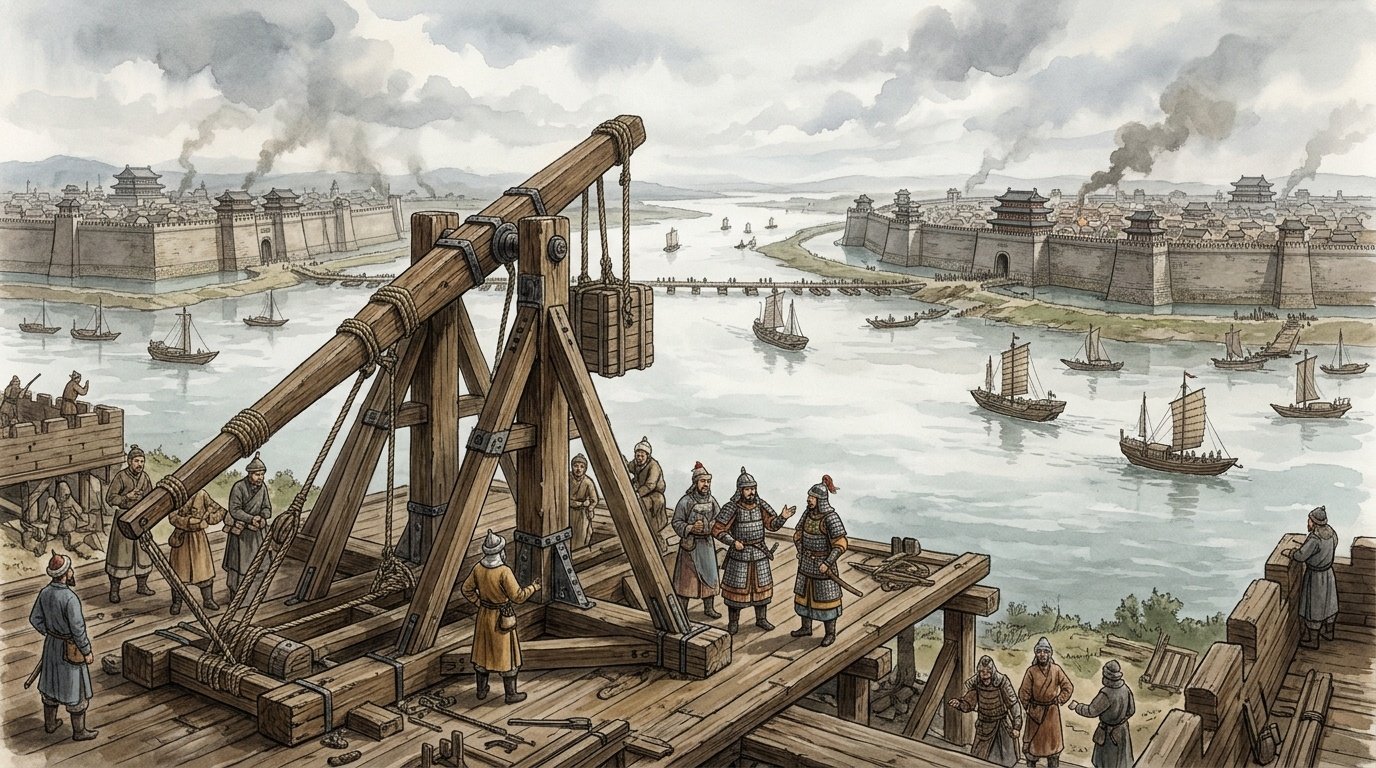
In the first lunar month of the tenth year of the Zhiyuan era (February 1273 CE), an eerie, unnatural shriek echoed across the freezing waters of the Han River (汉江) in central China. Deep within the fortified siege camps of the Mongol Yuan army, an enormous wooden siege engine reared against the grey winter sky. It was not the traditional Chinese traction trebuchet operated by dozens of straining men pulling hemp ropes. It was a terrifying new engine of global war: a massive, counter-weighted catapult with a pivoted beam thirty paces long, counterbalanced by tons of earth, scrap iron, and stones in an elevated wooden box. Engineered by Muslim masters summoned across thousands of miles from the Ilkhanate of Persia, this machine was known to Chinese history as the Huihui Pao (回回炮, ‘The Muslim Trebuchet’).
With a thunderous groan of seasoned timber and the snap of heavy iron chains, the counterweight dropped. A carved limestone projectile weighing over one hundred and fifty catties (approx. 90 kg) arced gracefully through the clouds, whistling with apocalyptic momentum before slamming directly into the main watchtower of Xiangyang (襄阳). The explosion was deafening: stone masonry shattered like dried pottery, the three-story wooden pavilion collapsed into a cloud of splintered dust, and the impact drove a crater several feet deep into the frozen earth. As the chroniclers of the History of Yuan recorded with awe and dread: ‘The sound was like a crack of thunder from a clear sky; the trembling shook the mountains and valleys; and all who looked upon it lost their courage.’
That single stone marked the beginning of the end for the longest, most brutally contested siege in the history of East Asian warfare: the Siege of Xiangyang (襄阳之战, 1267–1273 CE). For six grueling years, through searing summer heat, freezing river blizzards, plague, and starvation, the twin fortress-cities of Xiangyang and Fancheng (樊城) had held the line against the full might of the Mongol Empire under Kublai Khan (忽必烈). Guarding the vital confluence where the Han River opened into the middle Yangtze, Xiangyang was the iron lock securing southern China. As long as Xiangyang stood, the southern empire of the Song Dynasty (南宋) was impregnable; if Xiangyang fell, the grand waterway of the Yangtze lay wide open, allowing Mongol flotillas to sail downstream directly into the imperial capital of Lin’an (Hangzhou).
The fall of Xiangyang was far more than a localized military defeat; it was the geopolitical turning point that broke the back of the Southern Song and completed the total Mongol conquest of China—the first time in four millennia of recorded history that the entirety of the Central Plains, the southern river basins, and the maritime coasts fell under foreign nomadic rule. Yet it was also a watershed in global military history: a titanic, multi-ethnic collision that fused Song naval architecture, Chinese gunpowder technology, Mongol cavalry encirclement, and Middle Eastern mechanical engineering into a lethal crucible of early modern warfare.
This monograph provides an exhaustive military, institutional, and geopolitical reconstruction of the Six-Year Siege of Xiangyang. We will analyze the strategic geography of the Han River basin and the twin-citadel architecture of Xiangyang and Fancheng; trace the radical strategic pivot executed by Kublai Khan and the Chinese defector-admiral Liu Zheng; examine the five-year investment, naval blockade, and circumvallation lines constructed by General Aju; chronicle the harrowing, heroic relief expedition of the ‘Two Zhangs’ (Zhang Shun and Zhang Gui) in 1272 CE; dissect the mechanical physics and ballistic revolution of the counterweight trebuchets brought by the Persian engineers Ismail and Ala al-Din; recount the apocalyptic storming and slaughter of Fancheng; unpack the agonizing surrender of Commander Lü Wenhuan; and trace the lightning naval campaign down the Yangtze that culminated in the tragic death of the Song Dynasty in the waves of Yamen.
1. The Throat of Jiangnan: The Twin Citadels of Xiangyang and Fancheng
To grasp why Kublai Khan was willing to commit the financial, technological, and manpower resources of his vast Eurasian empire to reduce a single city, one must understand the absolute strategic centrality of Xiangyang in traditional Chinese military geography. Throughout imperial history, China was fundamentally divided by the rugged Qinling Mountains and the barrier of the Yangtze River. An invader from the northern steppe had only three potential invasion corridors to strike into southern China:
- The Upper Yangtze (Sichuan Basin): Striking south through the Hanzhong valley and down the Yangtze Gorges. Yet here, the Song had constructed an interlocking network of mountain citadels perched on sheer cliffs—most famously Diaoyucheng (钓鱼城, Fishing Castle) in Hechuan, where the fourth Great Khan, Möngke Khan (蒙哥汗), was mortally wounded in 1259 CE by Song catapult fire, shattering the first Mongol blitzkrieg.
- The Lower Yangtze (Huai River / Nanjing corridor): Striking across the flat plains of the Huai River toward Yangzhou and Jiankang. Yet this region was choked by a labyrinth of marshes, tidal lakes, deep canals, and rice paddies, where the Song riverine navy possessed absolute superiority and nomadic cavalry was helpless.
- The Middle Yangtze (The Han River Gateway): Striking south from the Central Plains down the Nanyang basin along the Han River (汉水). The Han River is the largest and most navigable tributary of the Yangtze. If an invading army could capture the middle Han, it could assemble an armada, sail down into the main trunk of the Yangtze at Wuchang (modern Wuhan), and sweep east with the river current directly into the heart of Jiangnan, severing the food supply lines of the Song capital.
And sitting directly across the Han River like an iron padlock were the Twin Citadels: Xiangyang on the south bank and Fancheng on the north bank. Xiangyang was nature’s fortress: flanked on the south and west by the rugged peaks of Mount Xian and Mount Liang, and washed on the north and east by the deep, broad currents of the Han River. Its massive brick-faced ramparts, over thirty feet high and forty feet thick at the base, were encircled by an astonishing moat: at its widest points, the moat was over 150 paces (approx. 200 meters) wide, making it impossible to undermine with subterranean sapping or bridge with standard siege ladders.
Directly across the river stood Fancheng, serving as Xiangyang’s northern shield. The two cities were physically bonded into a single, symbiotic defensive complex by a floating pontoon bridge (浮桥, Fu Qiao) spanning the Han River, anchored by massive iron chains and guarded by wooden watchtowers and river stockades. If the Mongols attacked Fancheng, Xiangyang poured fresh troops, arrows, and grain across the bridge to reinforce its northern ramparts; if the Mongols threatened Xiangyang from the landward hills, Fancheng launched naval flotillas to strike the enemy flank. Defended by a veteran garrison of over fifty thousand elite troops, commanded by the prestigious military clan of Lü Wenhuan (吕文焕), and packed with granaries holding years of rice, Xiangyang was hailed as the ‘Iron Citadel of All under Heaven’ (天下铁打襄阳).
2. The Strategic Pivot: Liu Zheng, Kublai Khan, and the Birth of the Mongol Navy
For three decades following the outbreak of the Mongol-Song wars in 1235 CE, the Mongol khans had repeatedly smashed against the southern frontier with brute force, only to be bloodied by Song fortresses and repulsed by Song river armadas. The traditional steppe doctrine of lightning cavalry maneuvers was completely useless in the waterlogged terrain of the south. The Mongols possessed no navy; whenever they reached the banks of the Han or the Yangtze, they were forced to halt while Song warships rained incendiary gunpowder bombs and heavy crossbow bolts upon their horsemen.
The strategic breakthrough came not from a Mongol general, but from a bitter, vengeful Chinese defector: Liu Zheng (刘整, 1213–1275 CE). Liu Zheng was one of the most brilliant field commanders in the Southern Song, having distinguished himself in Sichuan by capturing twelve enemy forts. Yet because he was a northerner serving in the southern military, he was subjected to vicious jealousy and political persecution by the corrupt Southern Song Chancellor Jia Sidao (贾似道) and the Southern Song imperial court. Facing imminent court-martial and execution on trumped-up charges, Liu Zheng defected to Kublai Khan in 1261 CE, surrendering the vital strategic city of Luzhou in Sichuan along with 300,000 households.
Summoned to Kublai’s imperial tent in Shangdu, Liu Zheng delivered a masterclass geopolitical briefing that fundamentally transformed Mongol strategic grand vision:
「宋所恃者,襄阳也。襄阳若下,江南之门辟矣!且兵法攻其所必救,襄阳受围,宋必倾国来援,可设伏以歼之。
— Liu Zheng (刘整), memorial to Kublai Khan, recorded in Yuan Shi (元史·刘整传)
臣愿奉诏督造舟师,习练水战。无水军而欲灭宋,如徒步而逐飞鸟也!」
‘What the Song Dynasty relies upon for its very survival is Xiangyang. If Xiangyang falls, the gateway to Jiangnan swings wide open!
Moreover, military strategy dictates that one must attack what the enemy is compelled to rescue. If Xiangyang is besieged, the Song will exhaust their entire empire to relieve it, allowing us to ambush and annihilate their armies in the field.
I beg Your Majesty to order the construction of a grand fleet and train troops in naval warfare. To seek the destruction of the Song without a navy is like attempting to chase flying birds on foot!’
Kublai Khan immediately recognized the genius of the plan. Abandoning the bloody mountain war in Sichuan and the muddy swamps of the Huai, Kublai resolved to concentrate the entire military weight of the empire upon Xiangyang. Even more crucially, Kublai authorized Liu Zheng to build a massive, state-of-the-art naval shipyard along the Baihe and Han rivers. Within three years, Liu Zheng constructed five thousand war junks, paddle-wheel assault ships, and ramming vessels, and trained seventy thousand northern soldiers and defectors in naval combat, river boarding, and aquatic maneuvering. For the first time in history, the steppe nomad possessed a riverine navy capable of challenging the Southern Song on its own waters.
3. The Iron Ring: Circumvallation and the Five-Year Siege (1267–1271 CE)
In the autumn of 1267 CE, the Mongol grand offensive commenced. Kublai appointed two supreme commanders to direct the siege: the veteran Mongol general Aju (阿术, 1227–1287 CE), grandson of Genghis Khan’s legendary commander Subutai, and the Chinese admiral Liu Zheng. They commanded an initial force of over one hundred thousand troops, which would eventually swell to over two hundred thousand as the siege dragged on.
Aju and Liu Zheng knew that Xiangyang’s walls were too high and its moat too wide to take by direct assault. Instead, they executed a strategy of relentless, suffocating circumvallation (围困). The Mongols systematically established a chain of fortified earthworks, ramparts, and stone redoubts circling both Xiangyang and Fancheng. Across a perimeter of over fifty li (approx. 25 km), the Mongols constructed an unbroken wall studded with watchtowers, palisades, and deep defensive moats facing outward against Song relief armies:
- Securing the Han River: South of Xiangyang, at the strategic river junction of Lutan (鹿门山) and Baihuashan (白虎山), the Mongols constructed massive stone bastions directly overlooking the water, mounting heavy crossbows and traction trebuchets to rake any passing ships.
- The Han River Boom: To prevent Song relief convoys from sailing up the Han River from the Yangtze, Liu Zheng stretched enormous wrought-iron chains (铁索) across the river surface, supported by floating timber booms and submerged wooden stakes (木桩). Armed Mongol patrol boats maintained twenty-four-hour patrols across the waters.
- Isolating the Twin Cities: On the north bank, the Mongols completely encircled Fancheng, digging trenches to cut off all overland communication with the northern countryside.
Inside the cities, Commander Lü Wenhuan organized an iron-willed defense. The Song soldiers mounted heavy multi-bolt crossbows (床子弩) and catapults upon the ramparts, beating back every tentative Mongol probing attack with heavy casualties. But as the months turned into years—1268, 1269, 1270—the psychological toll mounted. Cut off from all trade and contact, the citizens and soldiers were trapped in a claustrophobic prison. Salt, cloth, medicine, and arrows began to run perilously low. While the grain reserves in the state granaries were vast enough to sustain bread and porridge for several years, life without salt left the defenders physically weakened and prone to scurvy.
Meanwhile, in the imperial capital of Lin’an, Chancellor Jia Sidao deliberately concealed the true gravity of the siege from the young Emperor Duzong (宋度宗). Obsessed with his private cricket fights, sensual pleasures, and maintaining his political monopoly, Jia Sidao executed imperial messengers who brought alarming frontline dispatches, reassuring the court that Xiangyang was fully capable of holding indefinitely. A few sporadic relief fleets dispatched by provincial commanders were ambushed and annihilated by Liu Zheng’s river fleet. Xiangyang was being left to die alone.
4. The Epic of the Two Zhangs: The Relief Flotilla of 1272 CE
By the spring of 1272 CE, Xiangyang had been completely besieged for nearly five years. The garrison was on the brink of total physical collapse: uniforms had rotted into rags, bowstrings had snapped from humidity, and the lack of salt had left the defenders’ limbs swollen and lethargic. Knowing that without an immediate infusion of salt and arrows the citadel would surrender, two obscure, heroic civilian militia captains in Yingzhou (modern Zhongxiang, Hubei) stepped forward: Zhang Shun (张顺) and Zhang Gui (张贵), popularly known to their men as ‘The Black Pig’ (乌猪) and ‘The White Pig’ (白猪).
Gathering three thousand fearless volunteer boatmen and water-braves from the Han River marshes, the Two Zhangs assembled a fleet of one hundred light, armored paddle-wheel warships. They packed the hulls of the ships to the gunwales with the two things the defenders desperately needed: hundreds of barrels of salt, thousands of bolts of woven cloth, and several million iron-tipped crossbow arrows. The ships were draped with soaked ox hides to extinguish fiery arrows, fitted with revolving paddle-wheels, and armed with heavy halberds and fire-lances.
In the fifth lunar month of 1272 CE, waiting for the Han River to swell in a torrential summer flood, the relief fleet set sail. Under cover of a midnight thunderstorm, the Two Zhangs formed their hundred ships into a razor-sharp wedge formation and charged directly down the Han River toward the Mongol naval blockade:
「顺与贵乘水暴涨,引舟顺流急下。元军万舰蔽江,以铁索断水道。顺拔斧砍断铁索,发神机箭,雷奔电突,转战百余里……」
— Record of the Battle of the Han River, Song Shi (宋史·张顺传)
‘Taking advantage of the sudden violent flood, Zhang Shun and Zhang Gui guided their ships rushing downstream with the raging current. The Yuan warships blanketed the river in their thousands, severing the waterways with iron chains. Zhang Shun drew his great axe, severed the iron chains, and unleashed divine rocket-arrows, bursting through like thunder and lightning, fighting continuous running battles across more than a hundred li…’
The night battle was a spectacle of primeval fury. Song rocket-arrows (火药箭) and ceramic gunpowder bombs (霹雳火球) detonated across the water, setting dozens of Mongol warships ablaze in roaring firestorms. Wielding iron boarding axes, the Chinese boatmen hacked through the floating iron chains and timber booms. Hearing the roar of artillery and cheering from the river, Lü Wenhuan threw open the water gates of Xiangyang and fired catapults from the ramparts to illuminate the water.
Just before dawn, the relief fleet smashed through the final Mongol cordon and docked safely inside the water gates of Xiangyang. The garrison wept with hysterical joy as tons of salt, cloth, and arrows were unloaded onto the wharves. Yet amidst the celebration, an agonizing tragedy was discovered: Captain Zhang Shun was missing. Several days later, a floating corpse was caught in the river nets: it was Zhang Shun, clad in armor, his body pierced by four heavy lance wounds and dozens of iron arrows, his face frozen in a ferocious snarl, his hand still gripping his bloody broadsword. Lü Wenhuan buried the fallen hero with the full honors of a supreme general, his spirit worshipped by the citizens as the guardian deity of the Han River.
Months later, in the ninth lunar month of 1272 CE, Captain Zhang Gui attempted to lead a breakout force back down the river to link up with an approaching Song imperial relief army. Yet a Song traitor defected to the Mongols and revealed the precise operational timing and light signals of the breakout. Trapped at the Longwei Delta by hundreds of Mongol warships under Liu Zheng and Aju, Zhang Gui fought for two days until his body was covered in dozens of wounds. Captured alive, Zhang Gui refused to kneel before the Mongol commanders, spitting blood into their faces and cursing them until he was executed. The Mongols severed his head and paraded it on a pike before the walls of Xiangyang. The final thread of human hope connecting Xiangyang to the outside world was severed forever.
5. The Persian Revolution: Ismail, Ala al-Din, and the Counterweight Trebuchet
By late 1272 CE, the siege had entered its sixth year. In Beijing (Dadu), Kublai Khan was growing increasingly impatient. Millions of strings of silver had been expended, and tens of thousands of Mongol, Chinese, and Jurchen soldiers had died of disease along the humid banks of the Han River, yet Xiangyang’s colossal stone ramparts remained unbroken. Traditional traction trebuchets—which relied on teams of fifty to one hundred men pulling ropes—could only throw stones weighing 30 to 50 pounds, which bounced harmlessly off Xiangyang’s twenty-foot-thick stone masonry.
In his quest for an engineering solution, Kublai mobilized the unrivaled transcontinental connectivity of the Pax Mongolica. In 1271 CE, Kublai dispatched an urgent imperial courier across the Silk Road to his nephew, Abaqa Khan (阿八哈), the ruler of the Ilkhanate in Persia. Kublai demanded the dispatch of the greatest hydraulic and mechanical siege engineers in the Islamic world—masters of the revolutionary counterweight trebuchet (Manjaniq), which had been perfected in the Crusader wars of the Levant.
In response, Abaqa selected two peerless master military engineers: Ismail (亦思马因), a native of Hira, and Ala al-Din (阿老瓦丁) from Homs (modern Syria). Traveling for months across the mountain passes of Central Asia and the Tarim Basin with their families and technical blueprints, the two Persian masters arrived at the Mongol siege works outside Xiangyang in the winter of 1272 CE.
Ismail and Ala al-Din immediately transformed the operational physics of the siege:
- The Counterweight Advantage: Unlike Chinese traction trebuchets that relied upon human muscle (which tired quickly and varied in pull strength), the Persian counterweight trebuchet utilized gravitational potential energy. An enormous wooden counterweight box—filled with ten to twenty thousand pounds of river gravel, pig iron, and lead—was hoisted into the air via geared windlasses. When released, the gravitational drop snapped the long throwing beam upward with mathematical, repeatable velocity.
- Colossal Projectile Mass: The Huihui Pao could launch monolithic limestone boulders weighing 150 to 300 catties (approx. 90 to 180 kg) across distances exceeding four hundred paces (over 300 meters)—far beyond the maximum range of Song wall-mounted crossbows.
- Extreme Ballistic Accuracy: Because the counterweight mass, beam length, and sling release angle were fixed mechanical constants, Ismail and Ala al-Din could calibrate their aim with terrifying mathematical precision, striking the exact same section of brickwork repeatedly until the masonry disintegrated.
- Explosive Projectiles: Alongside massive stone balls, the Persian trebuchets were loaded with large ceramic and iron hollow bombs packed with low-nitrate gunpowder, toxic sulfur, and petroleum bitumen, turning target zones into raging infernos.
Ismail inspected the terrain around Fancheng, selected a high alluvial terrace outside the southeastern ramparts, and directed local Chinese carpenters to fell massive hardwood timbers in the nearby hills to assemble the monstrous engines. The doom of the Southern Song was loaded into the sling.
6. The Annihilation of Fancheng: The Fall of the Shield (January 1273 CE)
General Aju and Liu Zheng realized that before they could bring the Persian trebuchets to bear against the main citadel of Xiangyang, they had to destroy its northern twin and shield: Fancheng. Fancheng was garrisoned by several thousand die-hard troops commanded by Generals Fan Tianchun and Niu Fu. But its true strength lay in its connection to Xiangyang via the floating pontoon bridge.
On the eleventh day of the first lunar month in 1273 CE, the Mongol assault began with a brilliant amphibious operation to sever the pontoon bridge once and for all. Under cover of a dense Han River fog, General Aju dispatched specialized aquatic sappers equipped with underwater breathing tubes and heavy iron cross-saws. Swimming beneath the pontoon bridge, the sappers cut the underwater mooring ropes and sawed through the heavy wooden pontoon timbers. Concurrently, Mongol river barges equipped with massive iron rams smashed into the bridge, while fire-rafts loaded with pitch and oil drifted down the current, setting the wooden structures ablaze. With an agonizing roar of twisting iron and crackling timber, the floating pontoon bridge snapped and drifted down the river in flames. Fancheng was cut off from Xiangyang; the two twins were severed forever.
Ismail and Ala al-Din then ordered the Huihui Pao batteries to open fire upon Fancheng’s southeastern battlements. The bombardment was an apocalyptic revelation. The massive stone projectiles battered the brick parapets into rubble, smashed the wooden guardhouses, and breached the outer curtain wall within hours. On January 29, 1273 CE, General Aju ordered a general assault from all sides. Mongol, Jurchen, and Han-defector infantry surged through the breaches over scaling ladders, while naval brigades stormed the water gates.
What followed inside Fancheng was one of the bloodiest street battles in Chinese history. Led by General Niu Fu (牛富), the Song defenders refused to surrender, fighting street by street, house by house, and alley by alley with broadswords, spears, and kitchen knives. When the Mongol troops set the houses on fire, Niu Fu rallied his surviving hundred men around the ancestral shrine, fighting until his body was scorched and pierced by arrows. Crying out ‘A true subject dies for his country!’, Niu Fu threw himself into the roaring flames of a burning temple. The garrison fought to the last man. Infuriated by five years of frustration and casualties, General Aju ordered the wholesale slaughter of Fancheng’s remaining population: over ten thousand corpses were stacked into colossal pyramidal mounds outside the city walls, visible from across the river to the terrified sentries atop Xiangyang’s ramparts.
7. The Fall of the Iron Citadel: Lü Wenhuan’s Agony and Surrender (March 1273 CE)
Across the river in Xiangyang, Commander Lü Wenhuan stood atop the southern watchtowers in absolute, soul-crushing despair. Through the smoke, he could see the smoking ruins of Fancheng, the heaps of slaughtered comrades, and the severed heads of his officers on Mongol pikes. Fancheng had fallen in barely two weeks after the arrival of the Persian trebuchets; Xiangyang stood completely alone, surrounded by a ring of two hundred thousand enemies, with not a single Song relief soldier on the horizon.
In February 1273 CE, Ismail dismantled the Huihui Pao from Fancheng, ferried the timber beams and counterweights across the river, and reassembled the colossal battery on the south bank facing the southeastern gate of Xiangyang. Ismail personally sighted the machine, pulled the trip-lever, and launched a test boulder weighing over 150 catties. The projectile struck the main drum tower with pinpoint precision, shattering the three-story wooden structure into matchwood. The psychological shock among the starving defenders was catastrophic: soldiers abandoned their posts, weeping that the weapons were not made by mortal men, but possessed by heavenly demons.
Modern forensic ballistics and archaeological discoveries at the Xiangyang museum confirm the devastating physical mechanics of the Persian siege machines. Excavations along the ancient ramparts of Xiangyang and Fancheng have unearthed dozens of spherical, hand-chiseled limestone boulders measuring between thirty and fifty centimeters in diameter, weighing up to 130 kilograms. Contemporary Song counter-artillery, consisting primarily of lightweight traction catapults firing small twenty-pound stones, could neither match the range of the counterweight trebuchets nor penetrate the heavy timber mantlets protecting the Mongol gunners. The technological gap between the two sides was unbridgeable; what had taken years of laborious sapping and failed infantry charges was accomplished by gravitational mathematics and kinetic physics in days.
Yet Kublai Khan, exhibiting the sublime political statecraft that distinguished him from his grandfather Genghis Khan, recognized that a butchered Xiangyang was of no use to him. He needed Xiangyang intact as a naval staging ground, and he desperately needed the prestige and military talents of Commander Lü Wenhuan to convince other southern garrisons along the Yangtze to lay down their arms without resistance. General Aju rode to the edge of the moat alone, without weapons, shouting up to the battlements:
「汝守孤城,历年已深,天命可知。今樊城已破,若速降,君臣皆保富贵,妻子完聚;若待攻破,玉石俱焚!」
— General Aju, parley dialogue before the walls of Xiangyang, 1273 CE
‘You have held this solitary citadel for many deep years; the Mandate of Heaven is now manifest! Today Fancheng is already broken. If you surrender swiftly, your sovereign rank and noble wealth will be preserved, and your wives and children will remain whole and united.
If you wait until our engines break your walls, jade and stone alike shall burn together!’
Lü Wenhuan had held the fortress for six years. He had watched his soldiers die of starvation and disease; his brothers and nephews were dead; Chancellor Jia Sidao had abandoned him to the wolves; and further resistance meant the total, merciless slaughter of sixty thousand innocent civilians inside the city. Lü Wenhuan climbed to the highest pavilion of Xiangyang, knelt facing south toward the imperial capital of Lin’an, bowed his head to the stone floor three times, and wept bitter tears of historical guilt.
On the twenty-seventh day of the second lunar month in 1273 CE (March 14), Lü Wenhuan ordered the massive water gates of Xiangyang to be thrown open. Clad in plain white mourning robes, Lü Wenhuan walked across the wooden drawbridge and surrendered the city keys and imperial seals to General Aju. Kublai Khan kept his word: not a single civilian was harmed; Xiangyang was spared from plunder; and Lü Wenhuan was appointed a senior Grand General in the Yuan military and Grand Coordinator of Jiangnan. The iron lock of southern China had opened.
8. The Floodgates Burst: Bayan’s Lightning March Down the Yangtze (1274–1276 CE)
The fall of Xiangyang shattered the strategic defensive architecture of the Southern Song in an instant. Just as Liu Zheng had predicted to Kublai Khan twelve years earlier, once Xiangyang was lost, the entire middle and lower Yangtze valley was completely defenseless. In 1274 CE, Kublai appointed the brilliant Mongol general Bayan of the Baarin (伯颜, 1236–1295 CE) as Grand Marshal to lead the final conquest of the south.
Bayan mobilized an enormous amphibious armada of over two hundred thousand troops and thousands of war junks assembled at Xiangyang. Crucially, Bayan placed the defected Lü Wenhuan at the head of the vanguard fleet. As the armada sailed down the Han River into the Yangtze, fortress after fortress along the river—Ezhou (Wuhan), Huangzhou, Jiujiang, and Anqing—garrisoned by former subordinates and relatives of the Lü clan, surrendered without firing an arrow upon seeing Lü Wenhuan standing on the flagship bow. Lü Wenhuan shouted to the garrison commanders: ‘Even Xiangyang could not hold for seven years! What hope do your small towns have? Surrender, and your lives are saved!’
In the spring of 1275 CE, Chancellor Jia Sidao was finally forced to leave the imperial palace to personally lead the main Song imperial army of 130,000 veteran troops and 2,500 warships to make a final stand at Dingjiazhou (丁家洲, modern Tongling, Anhui). The battle was a disgraceful rout. Bayan concentrated heavy naval catapults and horse-archers on both riverbanks, cross-raking the Song fleet. Seeing the Mongol ships charge, Jia Sidao was gripped by cowardice and fled the flagship in a small pleasure boat. The Song fleet dissolved in chaotic panic; over two thousand warships were captured, and tens of thousands of Song soldiers drowned in the river. Jia Sidao was stripped of office and assassinated on his way to southern exile by an indignant county bailiff named Zheng Hucheng, who drowned the corrupt chancellor in a wooden latrine pit.
In the first lunar month of 1276 CE, Bayan’s armies arrived outside the walls of the Southern Song capital of Lin’an (Hangzhou). The five-year-old child monarch, Emperor Gong of Song (宋恭帝), and his grandmother, Grand Empress Dowager Xie, surrendered the imperial jade seal and submitted to the Yuan. The 316-year-old Zhao imperial dynasty had lost its capital.
9. The Final Stand in the Sea: Lu Xiufu and the Tragedy of Yamen (1279 CE)
Even after the fall of Lin’an, a die-hard band of Song loyalists refused to yield to the Mongol conquest. Led by the towering scholar-statesman Wen Tianxiang (文天祥, 1236–1283 CE), Grand Councilor Lu Xiufu (陆秀夫, 1236–1279 CE), and Admiral Zhang Shijie (张世杰, d. 1279 CE), the loyalists rallied surviving soldiers, court maidens, and citizens, crowned the seven-year-old imperial prince Zhao Shi as Emperor Duanzong, and fled southward through Fujian and Guangdong toward the South China Sea.
By late 1278 CE, after Emperor Duanzong died of illness falling into the sea, the loyalists crowned his eight-year-old brother, Zhao Bing (赵昺). They assembled their final refuge upon the rocky cliffs and tidal waters of Yamen (崖山, modern Xinhui, Guangdong). Here, on the edge of the known Chinese world, over two hundred thousand Song loyalists, court officials, scholars, and soldiers gathered aboard a massive floating city of one thousand large warships, lashed together by heavy cables and encircled by floating palisades.
On March 19, 1279 CE (the sixth day of the second lunar month), the Yuan general Zhang Hongfan (张弘范) launched a devastating multi-directional naval assault on the Yamen fleet during a violent sea fog and shifting tidal current. Yuan fireships and boarding parties breached the Song perimeter; the lashed Song warships caught fire, turning the bay into an inferno. Trapped on the flagship with the eight-year-old Emperor Zhao Bing, Grand Councilor Lu Xiufu realized that all hope was extinguished.
Refusing to allow the Son of Heaven to endure the public humiliations inflicted upon Huizong and Qinzong at the hands of barbarians, Lu Xiufu put on his formal imperial court robes. He took the child emperor in his arms, tied the boy to his chest with silk cords, walked to the gunwale of the flagship, and leaped into the crashing waves of the South China Sea. Over one hundred thousand Song loyalists, palace concubines, ministers, and soldiers followed their emperor, throwing themselves into the ocean to drown rather than submit to the Mongol yoke. When the sea subsided several days later, tens of thousands of floating corpses covered the waters for miles. The Song Dynasty was extinguished. China, for the first time in its four-thousand-year history, was completely conquered by an empire of the northern steppe.
10. Global Crucible: Historiographical Significance of the Siege
The Six-Year Siege of Xiangyang stands as one of the most consequential military engagements in global history, marking the structural transition from medieval to early modern warfare:
- The Climax of the Pax Mongolica’s Technology Transfer: Xiangyang proved that the Mongol Empire was not merely an army of nomadic horse archers, but the world’s first global military-industrial superpower. Kublai Khan mobilized Chinese shipwrights, Jurchen cavalry, Korean sailors, Central Asian logistics managers, and Syrian/Persian mechanical engineers to solve a single tactical operational problem in central China. The siege was a triumph of transcontinental technological integration.
- The Birth of Heavy Counterweight Artillery in East Asia: The arrival of the Huihui Pao permanently revolutionized Chinese siege warfare. The technology rapidly spread across East Asia, rendering traditional thin-walled earthen and brick fortifications obsolete and spurring the development of the massive, sloped, stone-faced city walls that characterized the later Ming and Qing dynasties.
- The Historiographical Tragedy of Lü Wenhuan: In traditional Confucian moral historiography, Lü Wenhuan was condemned alongside Qin Hui as a traitor who surrendered his sovereign’s realm to barbarians. Yet modern military historians recognize Lü Wenhuan’s agonizing reality: he defended a solitary outpost for six years without relief, endured horrors that few commanders in human history have survived, and surrendered only when his walls were shattered and his imperial government had completely abandoned him. His defense was heroic; his surrender was tragic realism.
- The Cultural Fracture of 1279: The fall of Xiangyang and the subsequent catastrophe of Yamen created a profound civilizational trauma in East Asia. In Japan, Korea, and Vietnam, scholars mourned that ‘After the Fall of Song, there is No Real China’ (崖山之后无华夏)—fostering the conviction that the sacred classical Confucian cultural heritage had to be preserved outside the borders of a Mongol-ruled mainland.
11. Chronology of the Siege of Xiangyang and Fall of Southern Song (1259–1279 CE)
| Year (CE) / Date | Historical Event | Key Historical Figures | Significance & Battlefield Impact |
|---|---|---|---|
| 1259 | Death of Möngke Khan at Diaoyu Castle | Möngke Khan, Kublai Khan | First Mongol invasion halted; Kublai ascends as Khagan; shifts strategy to Middle Han |
| 1261 | Defection of General Liu Zheng | Liu Zheng, Kublai Khan | Song admiral defects with Sichuan fleet; convinces Kublai to build navy and target Xiangyang |
| 1267 (Autumn) | The Siege of Xiangyang Commences | Aju, Liu Zheng, Lü Wenhuan | Mongol army invests twin cities; begins constructing 50-li circumvallation network |
| 1268–1270 | Circumvallation & River Blockade | Aju, Liu Zheng, Lü Wenhuan | Mongols build forts at Lutan; stretch iron chains across Han River; Xiangyang isolated |
| 1271 | Kublai Summons Persian Siege Engineers | Kublai Khan, Abaqa Khan | Imperial courier dispatched to Ilkhanate requesting master counterweight trebuchet engineers |
| 1272 (May) | The Heroic Battle of the Two Zhangs | Zhang Shun, Zhang Gui, Lü Wenhuan | 100 paddle-wheel ships run river blockade delivering salt and arrows; Zhang Shun dies hero |
| 1272 (Sep) | Defeat and Martyrdom of Zhang Gui | Zhang Gui, Liu Zheng | Song breakout force ambushed at Longwei; Zhang Gui captured and executed; hopes shattered |
| 1272 (Winter) | Arrival of Ismail and Ala al-Din | Ismail, Ala al-Din | Persian masters arrive at Xiangyang; begin felling timber and building Huihui Pao |
| 1273 (Jan 11) | The Severing of the Pontoon Bridge | Aju, Song Sappers | Mongol sappers cut mooring chains; fire-rafts burn floating bridge; Fancheng isolated |
| 1273 (Jan 29) | Fall and Slaughter of Fancheng | General Niu Fu, Aju, Ismail | Huihui Pao breaches walls; Niu Fu leaps into flames; 10,000 citizens slaughtered |
| 1273 (Feb) | Bombardment of Xiangyang Watchtower | Ismail, Lü Wenhuan | 150-catty stone collapses drum tower; earth trembles; garrison paralyzed with terror |
| 1273 (Mar 14) | Surrender of Xiangyang | Lü Wenhuan, Aju, Kublai Khan | Lü Wenhuan opens gates in mourning robes; city spared; six-year siege ends |
| 1274 | Bayan’s Grand Armada Assembled | Bayan of the Baarin, Lü Wenhuan | 200,000 troops sail down Yangtze; Lü Wenhuan leads vanguard; cities surrender |
| 1275 (Spring) | Battle of Dingjiazhou; Fall of Jia Sidao | Bayan, Jia Sidao | Song fleet of 2,500 ships routed; Jia Sidao flees; murdered in exile; Song army destroyed |
| 1276 (Jan) | Surrender of Lin’an (Hangzhou) | Emperor Gong, Bayan | Child Emperor surrenders imperial jade seal; capital occupied by Yuan forces |
| 1279 (Mar 19) | The Battle of Yamen; End of Song | Lu Xiufu, Zhao Bing, Wen Tianxiang | Yuan fleet crushes Song armada; Lu Xiufu leaps into sea with child emperor; 100,000 drown |
12. Scholarly Bibliography and Primary Historical Sources
To substantiate the military operations, ballistics data, and historical narratives presented in this study, the following primary sources and academic monographs are recommended for further study:
- Song Lian (宋濂) et al. (comp. 1370 CE), History of Yuan (元史, Yuan Shi): The foundational dynastic history compiled by Ming scholars. Crucial chapters include the Annals of Shizu (Kublai Khan, Vols. 4–11), the Biography of Bayan (Vol. 127), the Biography of Aju (Vol. 128), the Biography of Liu Zheng (Vol. 161), and the Biographies of Ismail and Ala al-Din (Vol. 203: ‘Artisans and Engineers’).
- Tuo Tuo (脱脱) et al. (comp. 1345 CE), History of Song (宋史, Song Shi): Essential chapters include the Annals of Duzong and Gongdi (Vols. 46–47), the Biography of Lü Wenhuan (Vol. 474), the Biography of Zhang Shun and Zhang Gui (Vol. 450: ‘Loyal and Righteous’), and the Biography of Jia Sidao (Vol. 474).
- Needham, Joseph, and Robin D. S. Yates (1994), Science and Civilisation in China, Volume 5: Chemistry and Chemical Technology, Part 6: Military Technology: Missiles and Sieges, Cambridge University Press: The definitive technical study of the physics, counterweight mechanics, ballistics, and historical transmission of the Huihui Pao between the Islamic world and China.
- Rossabi, Morris (1988), Khubilai Khan: His Life and Times, University of California Press: Masterful biography detailing Kublai Khan’s strategic pivot to the south, his administration of defected Han elites, and the integration of Muslim technocrats into the Yuan state.
- Franke, Herbert, and Denis Twitchett, eds. (1994), The Cambridge History of China, Volume 6: Alien Regimes and Border States, 907–1368, Cambridge University Press: In-depth chapters on the military campaigns of the Mongol conquest of Southern Song, the siege works at Xiangyang, and the battle of Yamen.
- Lorge, Peter (2005), War, Politics and Society in Early Modern China, 900–1795, Routledge: Rigorous analysis of the tactical interaction between gunpowder weapons, riverine flotillas, and Mongol siegecraft during the late thirteenth century.
- Chevedden, Paul E. (2000), “The Invention of the Counterweight Trebuchet: A Study in Cultural Diffusion,” Dumbarton Oaks Papers: Authoritative academic investigation into the global transmission of counterweight artillery from Byzantium and the Levant to China.
- Allsen, Thomas T. (2001), Culture and Conquest in Mongol Eurasia, Cambridge University Press: Pioneering monograph on the transmission of specialists, siege engineers, astronomers, and physicians across the Mongol Eurasian empire.
- Davis, Richard L. (1996), Wind Against the Mountain: The Crisis of Politics and Culture in Thirteenth-Century China, Harvard University Asia Center: Illuminating political study examining factional infighting in the Southern Song court, the dictatorship of Jia Sidao, and the fall of Lin’an.
- Graff, David A., and Robin Higham, eds. (2002), A Military History of China, Westview Press: Contains expert military analyses of Chinese riverine warfare and the tactical coordination of the Han River defenses.