Zhu Xi, the White Deer Grotto and Imperial Orthodoxy
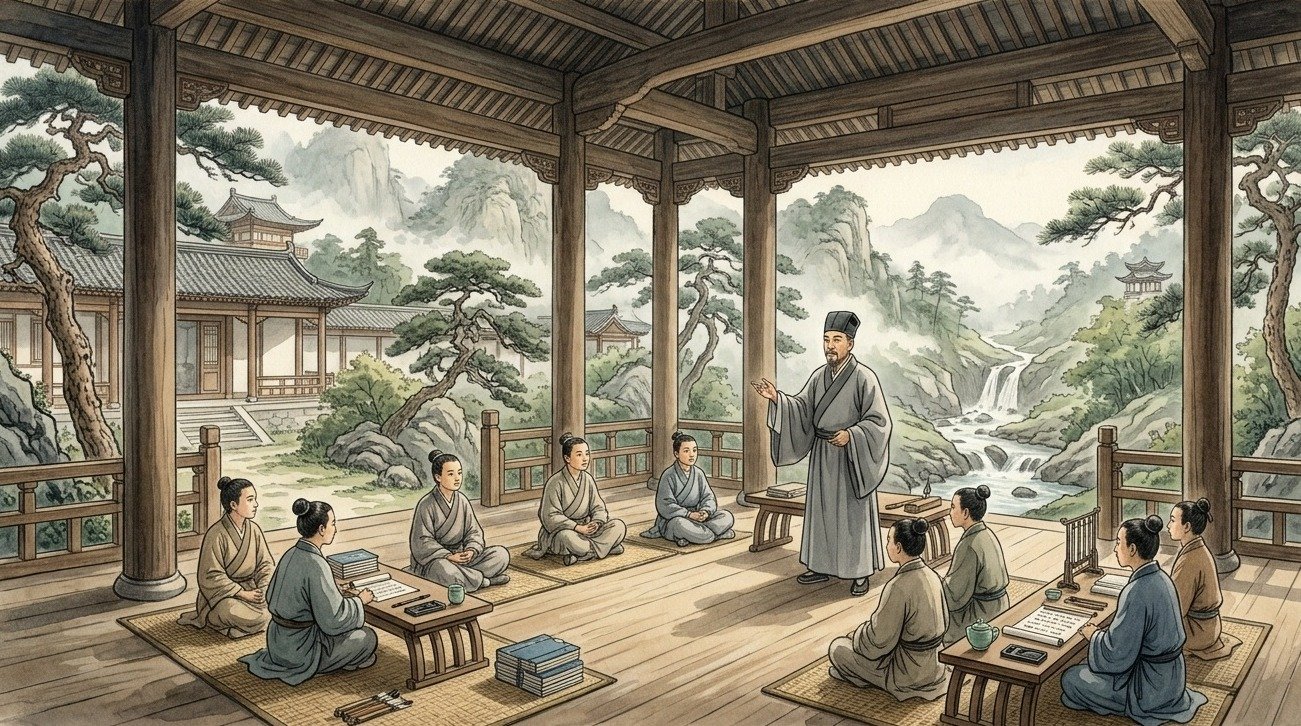
In the third lunar month of the sixth year of the Chunxi era (1179 CE), a fifty-year-old scholar-official arrived in Nankang Military Prefecture (modern Xingzi County, Jiangxi), nestled along the northern shores of Lake Poyang in the misty shadow of Mount Lu (庐山). While inspecting the regional waterways and granaries, he rode his horse into a quiet, overgrown mountain valley shrouded in towering pines and murmuring streams. Pushing aside thorny brambles and tangled vines, he uncovered the moss-covered stone foundations and collapsed eaves of an ancient academy founded four centuries earlier during the Tang Dynasty by the poet Li Bo. His eyes shone with spiritual resolve. Summoning local masons and carpenters, he rebuilt the lecture halls, gathered hundreds of classical texts, and hung a wooden plaque over the gate: The White Deer Grotto Academy (白鹿洞书院, Bailudong Shuyuan).
Upon the whitewashed walls of the central hall, the master inscribed five concise, revolutionary pedagogical rules known as the Articles of the White Deer Grotto Academy (白鹿洞书院揭示). In these rules, he declared that the true purpose of learning was not to pass state civil service examinations, flatter emperors, or amass wealth and aristocratic titles, but to achieve moral self-perfection, master cosmic principles, and illuminate human relations. The scholar standing in that mountain grove was Zhu Xi (朱熹, 1130–1200 CE, courtesy name Yuanhui 元晦, known to posterity as Master Huian 晦庵先生)—the most influential philosopher in Chinese civilization since Confucius and Mencius.
To the modern world, Zhu Xi is often remembered as the rigid intellectual architect of imperial orthodoxy—the philosopher whose system was adopted as the mandatory state dogma of the civil service examinations from 1313 CE until 1905 CE, binding the intellectual imagination of imperial China, Joseon Korea, Tokugawa Japan, and pre-modern Vietnam for six centuries. Yet in his own lifetime, Zhu Xi was a dangerous philosophical radical, a relentless political critic who defied corrupt imperial chancellors, and a visionary intellectual reformer. In his twilight years, his teachings were condemned by the Southern Song imperial court as subversive ‘False Learning’ (伪学, Wei Xue); his books were burned; his disciples were banned from public office; and Zhu Xi died in political disgrace, attended by only a handful of loyal disciples who risked arrest to bury him.
Zhu Xi’s monumental historical achievement was nothing less than the total metaphysical, ethical, and canonical resurrection of Confucianism—a philosophical synthesis known as Daoxue (道学, ‘The Learning of the Way’) or Neo-Confucianism. For eight centuries following the fall of the Han Dynasty, Confucianism had been eclipsed by the cosmic depth of Mahayana Buddhism and the mystical allure of religious Daoism. Traditional Confucianism had decayed into dry, ritualistic pedantry and imperial examination trivia. Zhu Xi synthesized the scattered cosmological insights of eleventh-century Northern Song masters—Zhou Dunyi, Zhang Zai, and the Cheng brothers (Cheng Hao and Cheng Yi)—into an all-encompassing, architectonic philosophical system. He grounded moral ethics in cosmic metaphysics through the dualism of Principle (理, Li) and Material Force (气, Qi); pioneered the scientific-philosophical epistemology of ‘Investigating Things’ (格物致知, Gewu Zhizhi); and executed a canonical revolution by elevating the Four Books (四书, Si Shu) into the supreme spiritual foundation of Chinese civilization.
This comprehensive monograph reconstructs the life, thought, political trials, and global legacy of Zhu Xi. We will examine the spiritual and political crisis of the Southern Song in the aftermath of the Jingkang catastrophe; trace Zhu Xi’s intellectual journey from early Buddhist infatuation to orthodox Confucian awakening under Li Tong; unpack the metaphysical architecture of Li and Qi and the famous cosmic metaphor of ‘the moon reflected in ten thousand rivers’; dissect the ethics of ‘Preserving the Principle of Heaven and Extinguishing Human Desire’ (存天理,灭人欲); reconstruct the legendary philosophical duel at Goose Lake Temple (鹅湖之会) between Zhu Xi and Lu Jiuyuan; trace the composition of the monumental Collected Commentaries on the Four Books (四书章句集注); examine the political persecution of the Qingyuan era; document his miraculous posthumous elevation to state orthodoxy under the Mongol Yuan Dynasty; and evaluate his enduring resonance across East Asian modernity.
1. The Crisis of Meaning: The Intellectual Vacuum of Twelfth-Century China
To comprehend why Zhu Xi’s intellectual synthesis possessed such explosive, transformative power, one must understand the profound spiritual and civilizational crisis gripping China in the twelfth century. In 1127 CE, the Northern Song collapsed in the apocalyptic trauma of the Jingkang Incident. The ancient Yellow River heartland—the cradle of Confucius, the Duke of Zhou, and the Han-Tang dynasties—was conquered and occupied by the Jurchen Jin barbarians. The Song court was exiled south of the Yangtze, establishing a precarious capital in the humid luxury of Lin’an (Hangzhou).
For the Chinese scholar-official elite (Shi 士), the catastrophe was not merely military or political; it was an existential, spiritual shock. Why had Heaven permitted barbarian horsemen to conquer the Central Plains and violate the imperial tombs? Traditional Han Dynasty Confucianism—which had focused on the literal philological annotation of the ancient Five Classics (五经) and omen-based cosmic teleology—offered no satisfying answers to the problem of human suffering, historical tragedy, or the inner nature of human evil.
Consequently, for over eight hundred years, the most brilliant, sensitive minds of China had fled into the metaphysical embrace of Chan Buddhism (禅宗) and Daoism (道教). Buddhism offered an intoxicating, sophisticated psychological analysis of consciousness, karmic cause-and-effect, and transcendent liberation from the illusion of the material world through the realization of Emptiness (空, Śūnyatā). Daoism offered an organic, mystical communion with the boundless transformations of nature (Ziran 自然). In comparison, official Confucianism appeared as little more than an arid, cynical manual for passing civil service exams, memorizing rhymed prose, and enforcing social etiquette.
Yet Buddhism and Daoism suffered from a fatal civic flaw in the eyes of patriotic literati: their ultimate spiritual orientation was world-denying and socially escapist. The Buddhist monk shaved his head, abandoned his ancestral graves, severed his filiality to his parents, and retreated into monastic celibacy. The Daoist hermit fled to the mountains to brew alchemical elixirs. Neither offered a coherent moral philosophy for governing human society, managing state finance, resisting barbarian invasions, or ordering family lineages in the real, physical world. China was desperately in need of a philosophical reformation: a system that could match Buddhism’s cosmic depth and psychological introspection while fiercely reaffirming the sacred, moral reality of family, society, and state. That reformation was Daoxue, and its supreme master was Zhu Xi.
2. The Making of a Sage: From Buddhist Infatuation to Confucian Awakening
Zhu Xi was born on the fifteenth day of the ninth lunar month in 1130 CE in Youxi County, Huizhou (modern Fujian Province). His father, Zhu Song (朱松), was an incorruptible scholar-official who had been banished to the southern mountains for courageously opposing Qin Hui’s policy of appeasement toward the Jurchens. Even as a small boy, Zhu Xi displayed an extraordinary, obsessive cosmic curiosity. Legend records that at the age of four, pointing up at the sky, he asked his father: ‘What lies beyond Heaven?’ When his father replied, ‘Heaven has no boundary,’ the child fell into deep, troubled silence, staring at the clouds for hours.
His father died when Zhu Xi was only fourteen, leaving him under the guardianship of three local Buddhist and Daoist scholars in Mount Wuyi (武夷山). Possessing an astonishing intellect, Zhu Xi passed the highest imperial examination (Jinshi 进士) in 1148 CE at the miraculous age of nineteen. During his late teens and twenties, Zhu Xi was completely infatuated with Chan Buddhism and philosophical Daoism. He studied under Chan master Daoqian, carried Buddhist sutras in his travel bags, practiced seated meditation, and explored the non-dual metaphysics of the Lotus Sutra.
The turning point of his life occurred in 1153 CE, when the twenty-four-year-old Zhu Xi traveled to Yanping to meet the reclusive scholar Li Tong (李侗, 1093–1163 CE, Master Yanping). Li Tong was the direct third-generation intellectual heir of the great Northern Song Neo-Confucian master Cheng Yi (程颐). When Zhu Xi attempted to dazzle the old master with his subtle, brilliant Chan Buddhist dialectics on emptiness and illusion, Li Tong listened in calm silence. Li Tong then gently brought Zhu Xi down to earth, asking him how these ethereal Buddhist abstractions helped a son serve his father, a minister serve his sovereign, or a magistrate distribute grain to starving peasants.
Li Tong instructed Zhu Xi in the austere Confucian practice of ‘Quiet-Sitting to Experience the State Before Joy and Anger Arise’ (静坐体会喜怒哀乐未发之中). Over years of rigorous reflection, Zhu Xi experienced an intellectual and spiritual awakening. He realized that Buddhism, for all its psychological brilliance, was fundamentally selfish and nihilistic: by treating human relationships and the physical world as mere illusions (Māyā), it severed man from his moral duties. Confucianism, by contrast, recognized that the everyday world—eating, sleeping, loving one’s parents, serving the state—was the sacred arena where the cosmic Order of Heaven was made manifest. Turning his back permanently on Buddhism, Zhu Xi dedicated the remaining forty-five years of his life to resurrecting the pure, unadulterated lineage of the Confucian Way (道统, Daotong).
3. The Architecture of the Cosmos: Principle (Li) and Material Force (Qi)
The bedrock of Zhu Xi’s philosophical system is his grand metaphysical cosmology, articulated through the dialectic between two foundational cosmic concepts: Principle (理, Li) and Material Force or Vital Energy (气, Qi).
To Zhu Xi, the universe is not an accidental void, nor is it the creation of an anthropomorphic deity. It is a self-generating, rational, and morally coherent organism governed by eternal natural and ethical laws:
- Principle (理, Li): Li is the incorporeal, metaphysical order of the universe—the eternal blueprint, structural logic, and moral reality behind all existing things. Before a physical horse exists, the ‘Principle of the Horse’ (马之理) exists eternally in Heaven. Before a physical ruler or father exists, the Principle of Benevolence (仁) and Filial Piety (孝) exists. Principle is perfectly moral, orderly, and unchanging. The totality of all Principles combined in the cosmos is the Supreme Ultimate (太极, Taiji).
- Material Force (气, Qi): Qi is the physical, material, dynamic substance of the universe—the psychophysical energy, vapor, and condensing matter that gives tangible shape, weight, color, and texture to physical reality. When Qi condenses (聚), a physical object or human being is born; when Qi disperses (散), the object disintegrates or dies.
Zhu Xi summarized the intricate metaphysical relationship between Li and Qi in four famous Chinese characters: ‘Neither Separate nor Confused’ (不离不杂, Bu Li Bu Za):
「天下未有无理之气,亦未有无气之理……有是理便有是气,但理是本。」
— Zhu Xi (朱熹), Classified Conversations of Master Zhu (朱子语类, Zhuzi Yulei)
‘Under Heaven, there has never been Material Force without Principle, nor has there ever been Principle without Material Force… Where there is this Principle, there is this Material Force; yet Principle is fundamentally the root!’
Principle cannot physically act, speak, or build a table; it requires Qi as its physical vehicle. Conversely, Qi without Li would be chaotic, blind, turbulent energy. To illustrate how a single, indivisible cosmic Principle can exist simultaneously within millions of distinct physical entities, Zhu Xi employed one of the most famous metaphors in world philosophy: ‘The Moon Reflected in Ten Thousand Rivers’ (月印万川, Yue Yin Wan Chuan):
「本只是一太极,而万物各有禀受,又自各全具一太极尔。如月在天,只一而已;及散在江湖,则随处可见,不可谓月已分也。」
— Zhu Xi (朱熹), Zhuzi Yulei (朱子语类)
‘Fundamentally, there is only one Supreme Ultimate, yet each of the ten thousand things receives it, and each individually possesses the Supreme Ultimate in its entirety.
It is like the single moon suspended in the heavens: there is only one moon;
Yet when its light is scattered upon the rivers and lakes, it can be seen everywhere across the waters—
Yet one cannot say that the moon in the sky has been divided!’
Through this magnificent synthesis, Zhu Xi achieved what traditional Confucianism had never accomplished: he established that human moral duties—filial piety, loyalty, righteousness, empathy—are not arbitrary social conventions invented by human rulers. They are the direct, structural reflections of the eternal metaphysical laws of the universe itself.
4. Human Nature and Ethics: ‘Preserve the Principle of Heaven, Eliminate Human Desire’
Having established his cosmological foundation, Zhu Xi resolved the ancient, fierce debate regarding human nature that had divided Chinese philosophy since Mencius (who argued nature is good) and Xunzi (who argued nature is evil). Zhu Xi bridged the gap by dividing human nature into two distinct dimensions:
- 1. The Original Nature of Heaven and Earth (天地之性, Tiandi zhi Xing): This is the innate Principle (Li) endowed by Heaven within every human soul at the moment of conception. It consists of the four cardinal virtues: Humaneness (仁), Righteousness (义), Propriety (礼), and Wisdom (智). This original nature is universally, purely, and pristinely good in every human being, without exception.
- 2. The Physical / Psycho-physical Nature (气质之性, Qizhi zhi Xing): When a human being is physically formed, this pure Principle is encased within a specific allotment of Material Force (Qi). In some individuals, their endowed Qi is clear, bright, and pure (清明)—producing sages, virtuous scholars, and naturally compassionate people. In other individuals, their endowed Qi is turbid, heavy, and muddy (浊昏)—producing people prone to greed, selfishness, violent passions, and moral blindness.
From this dualism emerged Zhu Xi’s most famous, and most controversial, ethical maxim: ‘Preserve the Principle of Heaven, Extinguish Human Desire’ (存天理,灭人欲, Cun Tianli, Mie Renyu).
In modern times, especially during the May Fourth Movement of 1919, this slogan was bitterly attacked by radical intellectuals (such as Lu Xun and Hu Shih) as a monstrous, ascetic instrument of imperial oppression that ‘ate people’ (吃人的礼教), demanding the total suppression of natural human emotions. Yet in Zhu Xi’s original twelfth-century teaching, ‘Human Desire’ did not mean natural biological needs. When asked by his students whether eating food when hungry was a ‘human desire,’ Zhu Xi laughed and clarified:
「饮食者,天理也;要求美味,人欲也。」
— Zhu Xi (朱熹), Zhuzi Yulei (朱子语类)
‘Eating and drinking to sustain life is the Principle of Heaven;
Demanding lavish, gluttonous delicacies purely for sensory indulgence—that is human desire!’
To Zhu Xi, ‘Human Desire’ (人欲) referred specifically to selfish, grasping, antisocial egoism that severed man from moral empathy with others. To ‘extinguish human desire’ was not to become an unfeeling stone or a celibate monk; it was to cleanse the muddy psychological turbidities of the ego through rigorous moral discipline, allowing the radiant, original Principle of Heaven to shine forth unimpeded.
4B. Grassroots Social Engineering: Community Granaries and Family Rituals
Zhu Xi was far more than an ivory-tower metaphysician gazing at mountain clouds; he was an energetic, practical social reformer who sought to insulate local communities from both state bureaucratic extortion and commercial exploitation. Recognizing that the failure of Wang Anshi’s Green Sprouts Law had stemmed from coercive state mandarins extracting profits, Zhu Xi pioneered a bottom-up, community-managed agrarian welfare institution: the Community Granary System (社仓, Shecang).
First established in 1171 CE in his home village of Chong’an (Fujian) following a devastating famine, the Shecang was funded through charitable donations of seed grain from wealthy local gentry and managed entirely by local village elders rather than government clerks. During the lean spring planting season, peasant households borrowed grain from the community granary at a modest interest rate of ten percent (half the state rate under the New Policies), payable in autumn. In years of minor drought, interest was completely waived; in catastrophic famine years, the principal loan itself was forgiven. The grain surpluses generated in bumper years were stored permanently in stone granaries, creating an autonomous local buffer against famine. Zhu Xi’s community granary model was so successful that it spread across southern China, praised even by conservative court officials as the gold standard of rural micro-insurance.
Simultaneously, Zhu Xi sought to standardize the social fabric of the family lineage through his monumental handbook, the Family Rituals of Master Zhu (朱子家礼, Zhuzi Jiali). Observing that traditional Han-Tang aristocratic rituals were too complex and expensive for commoners, while popular Buddhist and Daoist funeral customs involved un-Confucian cremation and superstitious chants, Zhu Xi drafted simplified, accessible liturgical manuals for the four cardinal family rites of passage: Capping/Pinning (coming of age), Weddings, Funerals, and Ancestral Sacrifices. He mandated the construction of a domestic Ancestral Shrine (祠堂, Citang) in every home, housing the spirit tablets of four generations of ancestors. By anchoring lineage solidarity around domestic Confucian ritual rather than Buddhist monasteries, the Zhuzi Jiali became the sociological blueprint that structured Chinese and Korean lineage society for the next seven centuries.
4C. The Great Debate on Utilitarianism: Zhu Xi versus Chen Liang
Alongside his duel with Lu Jiuyuan, Zhu Xi engaged in another momentous intellectual debate that defined the boundaries of East Asian political ethics: his intense correspondence with the brilliant Zhejiang utilitarian philosopher Chen Liang (陈亮, 1143–1194 CE, Master Longchuan). The dispute centered around the fundamental dichotomy of Righteousness versus Profit (义利之辨, Yi-Li zhi Bian) and The Kingly Way versus The Hegemonic Way (王霸之辩, Wang-Ba zhi Bian).
Chen Liang was a passionate, pragmatic patriot who argued that the supreme priority of the Southern Song was military reconquest of the northern plains and national survival. Chen Liang defended the historical achievements of the Han and Tang dynasties—such as Han Gaozu and Tang Taizong—who, despite personal moral flaws, had successfully created rich, powerful empires, built massive armies, defeated foreign barbarians, and brought peace to millions. Chen Liang argued that political morality could not be divorced from practical, utilitarian results: ‘He who succeeds in establishing enduring public achievement possesses the Way; he who fails and loses his country has no Way!’
Zhu Xi mounted an unyielding, absolutist defense of moral deontological ethics. In Zhu Xi’s view, the rulers of Han and Tang were not true Sage Kings, but cynical, manipulative hegemonists (Ba 霸) driven by selfish ambition, vanity, and the lust for territory. Their empires had been built upon deceit and brute force, temporarily achieving superficial stability while leaving the moral Principle of Heaven unilluminated. Zhu Xi insisted that an action is morally righteous only if it springs from a pure, uncorrupted moral motive, regardless of pragmatic success or failure:
「正其谊不谋其利,明其道不计其功。」
— Classical maxim championed by Zhu Xi against Chen Liang’s utilitarianism
‘Rectify righteousness without scheming for personal profit;
Illuminate the Way without calculating practical success!’
To Zhu Xi, if the Song dynasty merely imitated the ruthless militarism of the Jurchens in order to recapture Kaifeng, it would have saved its territory only to destroy its civilizational soul. The purpose of the state was not raw wealth and power (Fuguo Qiangbing), but the realization of humaneness (Ren) and moral order. This debate permanently established the high moral idealism that characterized late imperial Chinese political rhetoric.
5. The Epistemology of Enlightenment: The ‘Investigation of Things’ (Gewu Zhizhi)
How does an ordinary human being cleanse their turbid Qi and achieve moral sagehood? Zhu Xi rejected both the sudden, mystical enlightenment of Chan Buddhism and the purely interior, emotional intuitionism of rival schools. Instead, he formulated a rigorous, lifelong epistemological methodology based on four characters from the ancient text The Great Learning: ‘Investigating Things and Extending Knowledge’ (格物致知, Gewu Zhizhi).
To Zhu Xi, Ge (格) meant ‘to arrive at’ or ‘to exhaustively probe’; Wu (物) meant ‘things’—encompassing physical natural phenomena, historical events, classical texts, and human ethical relationships. Because the same cosmic Principle resides within all things, the seeker of truth must investigate the external world systematically:
「所谓致知在格物者,言欲致吾之知,在即物而穷其理也。盖人心之灵莫不有知,而天下之物莫不有理……至于用力之久,而一旦豁然贯通焉,则众物之表里精粗无不到,而吾心之全提大用无不明矣!」
— Zhu Xi (朱熹), Supplementary Commentary on the Fifth Chapter of The Great Learning (大学章句补传)
‘What is meant by “the extension of knowledge lies in the investigation of things” is this: If we wish to extend our knowledge to the utmost, we must investigate the Principle inherent in every thing we encounter.
For the intelligence of the human mind is never without the capacity to know, and the things of the world are never without Principle…
When one has exerted effort for a long time, suddenly, in a single dawn, a breakthrough penetration occurs (豁然贯通)!
Then the external and internal, the subtle and gross dimensions of all things will be reached, and the entire substance and vast functioning of our mind will be completely illuminated!’
Zhu Xi’s epistemological program was astonishingly empirical. He urged his students to study botany, geology, astronomy, hydrology, and historical institutions. When Zhu Xi observed fossilized sea shells embedded in the high limestone cliffs of Mount Lu, he deduced with breathtaking scientific accuracy that those mountain peaks had once been the floor of an ancient ocean, elevated over geological epochs by the churning of the earth—anticipating modern geological plate tectonics by seven centuries! To Zhu Xi, reading a classical text, observing a blade of grass, and reforming a village tax system were all interconnected acts of investigating cosmic Principle.
6. The Great Philosophical Duel: The Debate at Goose Lake Temple (1175 CE)
In the intercalary fourth lunar month of the second year of the Chunxi era (June 1175 CE), one of the most famous intellectual summits in world history convened at Goose Lake Temple (鹅湖寺, Ehu Si) in Qianshan, Jiangxi. Organized by the scholar Lü Zuqian, the summit was arranged to reconcile the growing philosophical divide between the two intellectual titans of the age: forty-six-year-old Zhu Xi and thirty-seven-year-old Lu Jiuyuan (陆九渊, Lu Xiangshan, 1139–1193 CE).
The debate pitted Zhu Xi’s gradualist, empirical intellectualism against Lu Jiuyuan’s radical, subjective intuitionism:
- Zhu Xi’s Stance: ‘Following the Path of Inquiry and Study’ (道问学, Dao Wen Xue): Zhu Xi argued that moral cultivation required exhaustive study, textual philology, broad reading of history, and the external investigation of things (格物). Without grounded book learning, an individual’s subjective mind was prone to delusion, intellectual arrogance, and falling into the heretical traps of Chan Buddhism.
- Lu Jiuyuan’s Stance: ‘Exalting the Moral Nature’ (尊德性, Zun De Xing): Lu Jiuyuan countered with an explosive subjective idealism that anticipated the German philosopher Immanuel Kant by six centuries. Lu Jiuyuan declared: ‘The Universe is My Mind; My Mind is the Universe’ (宇宙便是吾心,吾心便是宇宙), and ‘The Mind Is Principle’ (心即理, Xin Ji Li). In Lu’s view, all moral truths were already fully complete and innate within the human heart. To spend years memorizing ancient texts and investigating blades of grass was fragmented, pedantic, and spiritually crippling—what Lu mocked as ‘drifting along broken fragments’ (支离).
Lu Jiuyuan and his elder brother Lu Jiuling penned a teasing poem on the temple walls, taunting Zhu Xi’s method: ‘The work of unearthing weeds is easy and simple; the effort of piecing fragments together is endlessly wide and drifting’ (简易工夫终久大,支离事业竟浮沉). Zhu Xi turned pale with anger, retorting that Lu’s method was nothing more than wild Chan Buddhist antinomianism masquerading as Confucianism. For three days, the philosophers argued passionately amidst the mountain mists. They parted without reaching agreement, establishing the foundational dualism that would divide Chinese intellectual history for the next half-millennium: the School of Principle (理学, Lixue) led by Zhu Xi versus the School of Mind (心学, Xinxue) later brought to its zenith by Wang Yangming (王阳明) in the Ming Dynasty.
7. The Canonical Revolution: The Elevation of the Four Books (Si Shu)
For more than a thousand years, the official curriculum of Chinese education had centered around the Five Classics (五经, Wu Jing): the Classic of Odes (诗经), the Classic of Documents (尚书), the Classic of Rites (礼记), the Classic of Changes (易经), and the Spring and Autumn Annals (春秋). These texts were ancient, massive, archaic, and difficult to comprehend, encouraging rote memorization of grammatical arcana rather than moral transformation.
In a stroke of pedagogical genius, Zhu Xi executed a radical canonical revolution: he dethroned the Five Classics from their primary instructional position, elevating in their place four concise, philosophically accessible texts that he grouped together as the Four Books (四书, Si Shu):
- 1. The Great Learning (大学, Da Xue): Originally Chapter 42 of the Classic of Rites, elevated by Zhu Xi as the foundational introductory primer, outlining the sequential eight steps of self-cultivation leading to global peace: investigating things, extending knowledge, rectifying thoughts, cultivating the person, regulating the family, ordering the state, and bringing peace to all under Heaven.
- 2. The Analects of Confucius (论语, Lun Yu): The core record of the Master’s living dialogues on humaneness (Ren) and moral practice.
- 3. The Mencius (孟子, Meng Zi): Elevated to canonical status, providing philosophical depth regarding the innate goodness of human nature, righteous governance, and the Mandate of Heaven.
- 4. The Doctrine of the Mean (中庸, Zhong Yong): Originally Chapter 31 of the Classic of Rites, providing the soaring metaphysical capstone connecting human psychology to cosmic harmony.
Zhu Xi spent forty continuous years drafting, refining, and polishing his definitive commentaries: the Collected Commentaries on the Four Books (四书章句集注, Si Shu Zhangju Jizhu). He treated every single Chinese character with monastic reverence, weighing alternative readings for months before committing brush to paper. In March 1200 CE, lying upon his deathbed, frail, blind in one eye, and coughing blood, Zhu Xi summoned his disciple Fan Nianling. Propped up on his pillows, the dying master spent his final conscious hours revising his commentary on the ‘Sincerity of the Will’ (诚意) chapter of The Great Learning, putting down his brush only three days before breathing his last.
8. The Dark Valley: The Qingyuan Persecution of ‘False Learning’ (1195–1202 CE)
While Zhu Xi’s intellectual stature grew across southern China, he became a terrifying figure to the corrupt power brokers in the capital of Lin’an. In 1194 CE, the sixty-four-year-old Zhu Xi was summoned to court by the newly enthroned Emperor Ningzong (宋宁宗) to serve as Imperial Lecturer (待制侍讲), delivering daily classical lectures to the young sovereign.
Zhu Xi refused to flatter the palace. In forty-six explosive days at court, Zhu Xi used his lectures to fiercely rebuke the emperor for personal moral laxity, nepotism, and allowing his maternal uncle, the corrupt and bellicose Grand Councilor Han Tuozhou (韩侂胄), to seize autocratic control of state administration. Han Tuozhou was enraged by the austere, unbending philosopher who treated him with open disdain. Han Tuozhou whispered poison into Ningzong’s ear, having Zhu Xi dismissed from court after barely six weeks.
What followed between 1195 and 1202 CE was one of the most vicious ideological purges in Chinese history: the Qingyuan Persecution of False Learning (庆元党禁, Qingyuan Dangjin). Han Tuozhou launched a nationwide campaign to eradicate Zhu Xi’s Daoxue movement:
- Daoxue was formally denounced by imperial decree as ‘Spurious Learning’ (伪学, Wei Xue), a treasonous, hypocritical cult designed to deceive the populace and usurp imperial authority.
- A blacklist of fifty-nine prominent scholars and ministers was compiled, with Zhu Xi named at the very head of the register.
- Zhu Xi was stripped of all official ranks, honors, and imperial pensions. Sycophantic censors submitted memorials demanding that Zhu Xi be executed by decapitation to appease Heaven.
- The Four Books with Collected Commentaries were banned; printing blocks were smashed; and imperial examination candidates were required to sign written oaths swearing they had never studied under Zhu Xi.
During these dark years, many of Zhu Xi’s former disciples burned their notes, changed their clothes, and publicly renounced their master to save their government careers. Yet Zhu Xi met the storm with serene, Olympian tranquility. Refusing to flee into hiding, he gathered the handful of faithful students who remained, smiling and remarking: ‘If Heaven intends to preserve this Culture of Ours (斯文), what can Han Tuozhou do to me?’
On April 23, 1200 CE (the ninth day of the third lunar month), Zhu Xi passed away peacefully at his mountain retreat in Kaoting, Jianyang, at the age of seventy. In Lin’an, Han Tuozhou issued a decree banning scholars from attending the funeral on pain of imprisonment. Yet on the day of the burial, more than one thousand courageous scholars, students, and common peasants, dressed in white mourning robes, marched through the mountain paths to carry Master Zhu’s coffin to his grave at Mount Tianhu.
9. From Heresy to Imperial Dogma: The Mongol Yuan Canonization (1313 CE)
The triumph of Zhu Xi’s philosophy was achieved with astonishing historical irony: the system that had been banned as subversive heresy was transformed into the supreme, unshakeable state dogma of imperial China by a foreign conquering dynasty—the Mongols.
Shortly after Zhu Xi’s death, Han Tuozhou launched an ill-prepared, reckless military invasion of the Jurchen Jin Empire in 1206 CE, seeking personal military glory. The Southern Song armies were routed with catastrophic casualties. Humiliated and desperate, the Song court assassinated Han Tuozhou, cut off his head, pickled it in a wooden box, and delivered it to the Jurchen court to purchase peace. To restore moral legitimacy to the shattered dynasty, Emperor Ningzong enacted an immediate, complete rehabilitation of Zhu Xi in 1209 CE, granting him the posthumous title Duke of Wen (文公, Wen Gong). In 1241 CE, Emperor Lizong personally carried Zhu Xi’s ancestral spirit tablet into the Imperial Confucian Temple in Hangzhou, formally sanctifying him among the Twelve Sages of the Confucian tradition.
The decisive turning point in world intellectual history occurred in 1313 CE under the fourth emperor of the Mongol Yuan Dynasty, Ayurbarwada (Emperor Renzong of Yuan, 元仁宗). Seeking to consolidate administrative rule over ninety million Han Chinese subjects, the Mongol emperor resurrected the imperial civil service examinations (Keju) after a hiatus of nearly four decades. By imperial decree:
Zhu Xi’s Collected Commentaries on the Four Books (四书章句集注) was designated as the sole mandatory, authoritative text and standard for all civil service examinations throughout the Yuan Empire.
— Imperial Edict of Yuan Emperor Renzong, 1313 CE
This momentous decree was maintained by the succeeding Ming Dynasty (1368–1644 CE) and Qing Dynasty (1644–1911 CE). For nearly six hundred unbroken years, every single individual who aspired to achieve political office, administrative power, or literary prestige in the Chinese empire was required to memorize every character of Zhu Xi’s commentaries. A philosophy forged in the quiet mountain groves of Fujian had become the cosmic operating system of the world’s largest bureaucratic state.
10. The East Asian Crucible: Korea, Japan, and Vietnam
Zhu Xi’s intellectual empire did not end at the borders of China; it expanded to become the common moral and philosophical currency of pre-modern East Asia:
- Joseon Korea (1392–1910 CE): Nowhere did Zhu Xi’s teachings achieve a more absolute, religious orthodoxy than in Korea. Founding the Joseon Dynasty on anti-Buddhist principles, Korean scholar-officials transformed the kingdom into a hyper-orthodox Zhu Xi state. Korean intellectual titans—most notably Yi Hwang (Toegye, 退溪 李滉, 1501–1570 CE) and Yi I (Yulgok, 栗谷 李珥, 1536–1584 CE)—engaged in the profound ‘Four-Seven Debate’ (四端七情论争), pushing the metaphysical analysis of Li and Qi to levels of psychological subtlety that astonished Chinese scholars. Zhu Xi’s ritual codes (Zhuzi Jiali 朱子家礼) thoroughly restructured Korean family lineages, ancestral rites, and funerary customs.
- Tokugawa Japan (1603–1867 CE): In early seventeenth-century Japan, the Tokugawa Shogunate sought an ideological foundation to transition from centuries of Sengoku civil war to permanent bureaucratic peace. Shogunal adviser Hayashi Razan (林罗山) established Zhu Xi’s Neo-Confucianism (known in Japan as Shushigaku 朱子学) as the official moral orthodoxy of the samurai class, utilizing Zhu Xi’s emphasis on cosmic order, loyalty, and social duty to legitimize the shogunal hierarchy. Later thinkers, such as Yamazaki Ansai, synthesized Zhu Xi’s Li with Shinto theology.
- Vietnam (Later Le and Nguyen Dynasties): Following the expulsion of the Ming occupation in 1428 CE, Emperor Le Loi established Neo-Confucianism as the state ideology of Vietnam, organizing the national Temple of Literature in Hanoi (Van Mieu) around the Four Books and Zhu Xi’s commentaries.
11. A Millennial Assessment: Humanist Synthesis or Intellectual Cage?
Across the twentieth and twenty-first centuries, the historical verdict on Zhu Xi has swung across violent extremes. To the radical modernizers of the May Fourth Movement, Zhu Xi was the supreme scapegoat for China’s historical backwardness—the moralistic despot whose elevation of female chastity (‘Starving to death is a small matter, losing one’s chastity is a great matter’ 饿死事小,失节事大) justified foot-binding, female oppression, and imperial servility.
Yet contemporary modern scholars—including Qian Mu, Fung Yu-lan, Tu Wei-ming, and Wing-tsit Chan—have restored a far more balanced, nuanced appreciation of Zhu Xi’s genius. Zhu Xi was not an apologist for imperial autocracy; he was a courageous moral philosopher who spent his life challenging emperors and chancellors. His doctrine of Li (Principle) asserted that there existed an objective moral standard higher than the emperor’s arbitrary will, to which even the Son of Heaven was accountable. His elevation of the ‘Investigation of Things’ fostered an insatiable spirit of intellectual inquiry, textual criticism, and natural observation that laid the groundwork for pre-modern Chinese scientific thought.
Zhu Xi accomplished for East Asia what Thomas Aquinas accomplished for Western Christendom: a titanic, majestic intellectual cathedral that synthesized cosmology, psychology, ethics, and political theory into a coherent, beautiful whole. In the quiet words inscribed upon the stone stele at the White Deer Grotto, Zhu Xi left behind an immortal humanist testament: ‘To study is to learn how to be truly human’.
12. Chronology of Zhu Xi and the Rise of Neo-Confucianism (1130–1313 CE)
| Year (CE) | Historical Event | Key Historical Figures | Philosophical & Cultural Significance |
|---|---|---|---|
| 1130 (Sep 15) | Birth of Zhu Xi in Youxi, Fujian | Zhu Xi, Zhu Song | Born into scholar family; demonstrates precocious cosmic curiosity about Heaven |
| 1148 | Attains Jinshi Degree at Age 19 | Zhu Xi | Passes metropolitan imperial examination; studies Chan Buddhism and Daoism |
| 1153–1160 | Apprenticeship under Li Tong | Zhu Xi, Li Tong (Master Yanping) | Abandons Buddhism; learns ‘quiet-sitting’ and orthodox Cheng-school Confucianism |
| 1175 (Jun) | The Debate at Goose Lake Temple | Zhu Xi, Lu Jiuyuan, Lü Zuqian | Epic duel between Zhu Xi’s ‘Dao Wen Xue’ and Lu Jiuyuan’s ‘Mind is Principle’ |
| 1179 | Rebuilding of White Deer Grotto Academy | Zhu Xi | Reconstructs historic academy on Mount Lu; pens five foundational educational rules |
| 1189 | Completion of Commentaries on Four Books | Zhu Xi | Publishes Si Shu Zhangju Jizhu; elevates Four Books above the Five Classics |
| 1194 | Imperial Lecturer in Lin’an (46 Days) | Zhu Xi, Emperor Ningzong, Han Tuozhou | Lectures emperor on moral reform; clashes with Han Tuozhou; dismissed from court |
| 1195–1200 | Qingyuan Persecution of ‘False Learning’ | Han Tuozhou, Zhu Xi | Daoxue banned as heresy; Zhu Xi blacklisted and stripped of all official honors |
| 1200 (Apr 23) | Death of Zhu Xi in Kaoting, Fujian | Zhu Xi, Disciples | Dies at age 70 revising Great Learning; buried by 1,000 defying government ban |
| 1207 | Fall and Execution of Han Tuozhou | Han Tuozhou, Song Court | Han’s failed northern war ends in disaster; head pickled in box sent to Jin; ban lifted |
| 1209 | Posthumous Rehabilitation as Duke of Wen | Emperor Ningzong, Zhu Xi | Zhu Xi cleared of heresy; bestowed posthumous title Wen Gong (文公) |
| 1241 | Canonization in Imperial Confucian Temple | Emperor Lizong, Zhu Xi | Tablet placed in Confucian Temple alongside Mencius; Daoxue becomes state philosophy |
| 1313 | The Mongol Yuan Examination Decree | Emperor Renzong (Ayurbarwada) | Zhu Xi’s commentaries made mandatory standard for Keju; imperial orthodoxy established |
13. Scholarly Bibliography and Primary Historical Sources
To substantiate the philosophical treatises, institutional records, and historical accounts presented in this study, the following primary sources and academic monographs are recommended for further study:
- Zhu Xi (朱熹, 1130–1200 CE), Collected Commentaries on the Four Books (四书章句集注, Si Shu Zhangju Jizhu): Zhu Xi’s supreme canonical masterpiece, containing his detailed philosophical notes on the Great Learning, Doctrine of the Mean, Analects, and Mencius.
- Li Jingde (黎靖德, comp. 1270 CE), Classified Conversations of Master Zhu (朱子语类, Zhuzi Yulei), 140 vols: The monumental compilation of verbatim dialogues between Zhu Xi and his disciples, covering cosmology, metaphysics, literature, and educational pedagogy.
- Tuo Tuo (脱脱) et al. (comp. 1345 CE), History of Song (宋史, Song Shi): Essential chapters include the Annals of Ningzong (Vols. 37–40), the Biographies of Daoxue Scholars (道学传, Vol. 429: Biography of Zhu Xi), and the Biography of Han Tuozhou (Vol. 474).
- Chan, Wing-tsit (1987), Chu Hsi: Life and Thought, St. Martin’s Press: The definitive English-language biography and philosophical analysis by the foremost twentieth-century authority on Neo-Confucianism.
- Chan, Wing-tsit (1989), Chu Hsi: New Studies, University of Hawai’i Press: Comprehensive monograph exploring Zhu Xi’s religious life, Academy governance, astronomical observations, and relations with disciples.
- Bol, Peter K. (2008), Neo-Confucianism in History, Harvard University Asia Center: Masterful examination of the social, institutional, and political transformation wrought by Daoxue from the Song through the Ming-Qing eras.
- de Bary, Wm. Theodore (1981), Neo-Confucian Orthodoxy and the Learning of the Mind-and-Heart, Columbia University Press: Seminal study of the transmission of Zhu Xi’s thought to the Yuan court and its elevation into civil service examination dogma in 1313.
- Tillman, Hoyt Cleveland (1992), Confucian Discourse and Chu Hsi’s Ascendancy, University of Hawai’i Press: Groundbreaking intellectual history deconstructing the diverse intellectual landscape of the Southern Song and how Zhu Xi’s school achieved ideological supremacy over rivals.
- Tu, Wei-ming (1985), Confucian Thought: Selfhood as Creative Transformation, State University of New York Press: Philosophical investigation into the spiritual psychology of ‘Investigation of Things’ and moral self-cultivation.
- Chaffee, John W. (1995), The Thorny Gates of Learning in Sung China: A Social History of Examinations, State University of New York Press: Essential social history of how the examination system interacted with Neo-Confucian academy culture.