Guan Hanqing and the Golden Age of Yuan Zaju
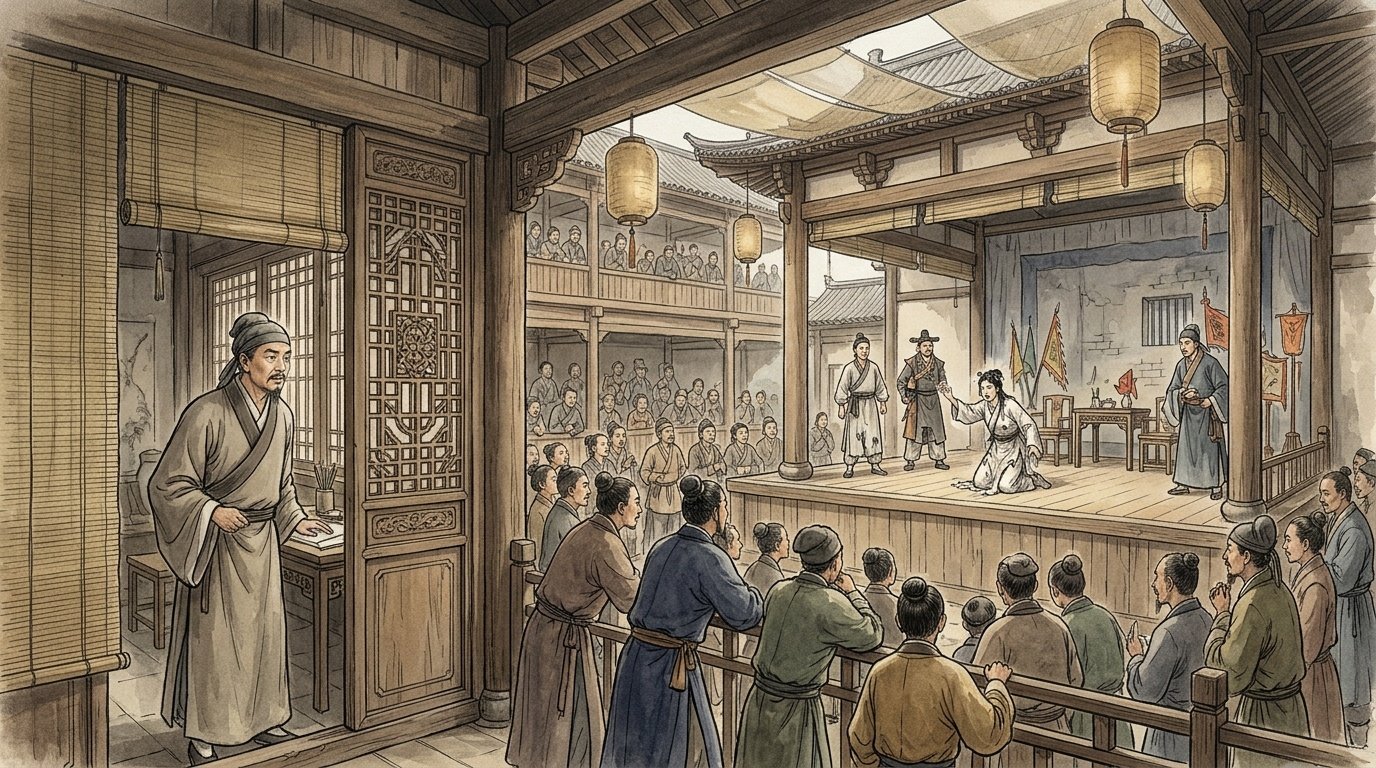
Under the blinding, scorching sun of the sixth lunar month—the dead of midsummer, when the humid plains of northern China baked under relentless heat—a young woman of twenty years knelt upon the packed dirt of the municipal execution ground in Chuzhou (modern Anhui). Her hair was disheveled, her delicate wrists were chafed raw by heavy iron chains, and her back was bruised black and blue from judicial bamboo beatings. Her name was Dou E (窦娥), a virtuous young widow falsely accused of poisoning her father-in-law. Standing beside her on the wooden scaffold was the executioner, his broad-bladed execution sword glinting in the sweltering glare, while behind a shaded desk sat the corrupt magistrate, Prefect Tao Wu (梼杌)—a venal bureaucrat whose very name signified an ‘ignorant monster.’ Before the executioner’s blade could fall, Dou E turned her face toward the shimmering heavens and uttered three impossible, prophetic vows:
「我窦娥向天发下三桩誓愿:第一桩,要丈二白练挂在旗枪上,若是我窦娥委实的冤枉,刀过头落,一腔热血休滴在地下,都飞在丈二白练上;
— Guan Hanqing (关汉卿), The Injustice to Dou E (感天动地窦娥冤), Act III
第二桩,现如今三伏天道,若是窦娥委实冤枉,身死之后,天降三尺瑞雪,遮掩了窦娥尸首;
第三桩,我窦娥死后,要这楚州大旱三年!」
‘I, Dou E, swear three vows before High Heaven!
First: Let a twelve-foot white silk banner be hung from the spear-point of the flagpole. If I, Dou E, am truly wronged, when the blade severs my neck, let not a single drop of my hot blood spill upon the filthy earth, but let it all fly upward to stain the white silk banner!
Second: Though it is now the sweltering heat of midsummer, if I am truly wronged, when my breath ceases, let Heaven send down three feet of pure snow to cover Dou E’s corpse!
Third: After I die, let this land of Chuzhou suffer three years of bone-dry drought!’
The magistrate laughed in mocking derision at her superstitious ravings, shouting for the blade to strike. Yet the instant the steel severed her neck, nature defied the laws of the universe. In an uncanny suspension of gravity, not a single drop of her crimson blood touched the dust; a geyser of scarlet surged ten feet straight into the air, splashing across the white silk banner. Minutes later, the summer sky darkened to bruised violet, a bone-chilling wind swept through the marketplace, and heavy, thick white snowflakes began falling from the clouds, piling three feet deep across the sweltering earth to shroud her innocent corpse. And for three continuous years thereafter, not a single drop of rain fell upon Chuzhou, withering crops and drying up rivers until an imperial inspector arrived to overturn the verdict.
This harrowing climax from The Injustice to Dou E (窦娥冤, Dou E Yuan, full title: The Injustice That Moved Heaven and Earth 感天动地窦娥冤) is the supreme masterpiece of Chinese dramatic tragedy. Its author was Guan Hanqing (关汉卿, c. 1240–c. 1320 CE), widely revered as the ‘Shakespeare of China’—the undisputed king of Yuan Zaju (元杂剧) opera. Through the tears of a poor, powerless child-bride, Guan Hanqing crafted an immortal indictment of social injustice, judicial corruption, and the cruelty of patriarchal society that has shaken the hearts of audiences for over seven centuries.
Yet Dou E’s tragedy was also the artistic reflection of a profound civilizational trauma: the catastrophic disenfranchisement of the Chinese intellectual class under the Mongol Yuan Dynasty. Following the Mongol destruction of the Song, the imperial civil service examinations were completely abolished for decades, and the proud Confucian scholar-gentry (Shi 士) were degraded to the bottom of the social hierarchy—ranked as the ‘Ninth Caste,’ directly above beggars and below prostitutes. Barred from imperial governance, an entire generation of brilliant literati walked away from the corridors of power and descended into the noisy, smoke-filled commercial theaters (勾栏瓦舍, Goulan Wazi) of Dadu and Hangzhou. Partnering with courtesans, acrobats, and street performers, these dispossessed scholars transformed popular vernacular song-drama into the glorious golden age of Chinese dramatic literature.
This comprehensive monograph explores the life, works, dramatic revolution, and historical world of Guan Hanqing and Yuan Zaju. We will trace the historical catastrophe that drove the Chinese literati into the commercial pleasure quarters; examine Guan Hanqing’s rebellious, bohemian persona as the self-proclaimed ‘unpoppable copper pea’ (响当当一粒铜豌豆); analyze the structural mechanics, musical modes, and performance conventions of the four-act Zaju genre; conduct an exhaustive textual dissection of The Injustice to Dou E; explore the other towering masterpieces of the Yuan dramatic canon—including Ma Zhiyuan’s Autumn in the Han Palace, Bai Pu’s Rain on the Paulownia Tree, and Ji Junxiang’s The Orphan of Zhao; examine Zaju as a veiled medium of subversive political resistance against Mongol despotism; celebrate Guan Hanqing’s progressive championship of oppressed women; and trace the enduring global journey of Yuan drama from the tea-houses of Dadu to Voltaire’s Enlightenment stage.
1. The Dispossessed Literati: From Imperial Court to Commercial Stage
For more than half a millennium, from the Sui and Tang through the Northern and Southern Song, the traditional career path of the Chinese intellectual was unshakeable: an educated man studied the Confucian classics, perfected his brush calligraphy, sat for the competitive imperial civil service examinations (科举, Keju), and entered the civil bureaucracy to govern the realm. Literary prestige belonged exclusively to high classical poetry: the regulated verse (Shi 诗) of Du Fu and Li Bai, or the elegant lyric songs (Ci 词) of Su Shi and Li Qingzhao. Dramatic performance, storytelling, and vernacular theater were despised by orthodox Confucians as vulgar street entertainment (俗戏), fit only for illiterate commoners and loose women.
The Mongol conquest of China shattered this institutional ecosystem with atomic force. When Kublai Khan conquered the north and completed the annihilation of the Southern Song in 1279 CE, the Mongol court made the deliberate decision to abolish the imperial examinations entirely. For nearly forty years—from 1274 until 1313 CE—not a single examination was held. The social ladder that had elevated talent from the villages to the imperial cabinet was kicked away.
Under the rigid, ethnically stratified Four-Class System (四等人制), Chinese scholars found themselves stripped of political dignity and social standing. The famous satirical saying of the era captured their catastrophic demotion into the ‘Ninth Caste’ (九儒)—ranked beneath officials, clerks, Buddhist monks, Daoist priests, physicians, artisans, hunters, and courtesans, resting just one rung above street beggars. Impoverished scholars who had spent thirty years mastering classical prose found themselves unable to feed their families.
Faced with existential irrelevance, Chinese intellectuals underwent a radical sociological migration: they abandoned high classical literature and entered the commercial marketplace. In the roaring, cosmopolitan metropolises of Dadu (Beijing), Pingyang (Shanxi), and Hangzhou, urban commerce was booming. Vast commercial entertainment quarters—known as Wazi (瓦子, ‘Tile Markets’) or Goulan (勾栏, ‘Fenced Theaters’)—attracted thousands of merchants, artisans, boatmen, soldiers, and courtesans every single night. The theaters charged admission, sold snacks and tea, and competed fiercely for sensational new scripts.
Seeing an opportunity to earn a living while giving voice to their personal grief and social indignation, dispossessed scholars formed professional literary writing guilds known as Shuhui (书会, ‘Book Societies’). Partnering directly with commercial acting troupes, these highly educated literati began writing scripts for public performance. They brought to the vernacular stage an unprecedented literary sophistication: encyclopedic knowledge of history, dazzling poetic rhymes, razor-sharp psychological depth, and complex philosophical themes. In the crucible of the commercial entertainment quarters, Yuan Zaju (元杂剧) was born—the supreme literary synthesis of popular vernacular song and high classical poetry.
2. The Copper Pea of Dadu: Guan Hanqing, the Bohemian Rebel
The undisputed titan and pioneer of this theatrical explosion was Guan Hanqing (关汉卿, courtesy name Yizhai 已斋). Born in the Mongol northern capital of Dadu (or possibly nearby Qizhou) around 1240 CE, Guan was originally trained in medicine, holding a low-ranking post in the Imperial Academy of Medicine (太医院). Yet Guan possessed a wild, uninhibited temperament that was utterly allergic to stuffy bureaucratic decorum. Resigning his medical post, he threw himself headlong into the bohemian demimonde of Dadu’s theater districts.
Contemporary accounts—such as Zhong Sicheng’s Register of Ghostly Talents (录鬼簿)—describe Guan Hanqing as a charismatic, versatile genius: a master of singing, zither playing, dancing, chess, football (蹴鞠, Cuju), and comedic improvisational acting. He lived openly among courtesans, singing girls, and itinerant actors, writing scripts specifically tailored to the vocal ranges and emotional personalities of famous female stars like Zhu Liansxiu (珠帘秀). Guan did not merely write plays from an ivory tower; he physically stepped onto the wooden stage, applying theatrical greasepaint to his face, performing comedic clown roles (Chou 丑) and romantic leads, and personally directing acting troupes across the country.
The relationship between Guan Hanqing and the celebrated Dadu courtesan-actress Zhu Liansxiu (珠帘秀, ‘Pearl Curtain Elegance’) was one of the most famous romantic and artistic partnerships in Chinese cultural history. Zhu Liansxiu was a superstar of the northern stage: gifted with a crystalline singing voice that could carry across the largest theater grounds, exquisite physical grace, and deep literary intelligence. Because traditional high-born women were bound by strict family seclusion, the actresses of the Yuan stage were recruited almost entirely from the ranks of hereditary theatrical courtesans (乐户, Yuehu). Despite being legally classified as base-born outcasts by the Mongol state, these female stars achieved immense wealth and celebrity in urban centers.
Guan Hanqing composed dozens of intimate lyric songs and play scripts specifically for Zhu Liansxiu. In his famous sanqu poem to the tune of Chen Zui Dong Feng (沉醉东风), Guan compared her physical beauty and vocal brilliance to a gossamer curtain of translucent pearls, praising her sharp intellect and artistic autonomy. Zhu Liansxiu responded in kind, penning witty, metrically complex verses that astonished contemporary male mandarins. This mutual respect between playwright and actress fostered a unique theatrical environment where female stage characters were portrayed not as decorative props, but as complex, intelligent human beings endowed with their own distinct moral agency.
This creative explosion occurred in the teeth of severe state surveillance. As the popularity of Yuan Zaju skyrocketed, the Mongol imperial court became deeply alarmed by the subversive potential of the theater. The Da Yuan Tongzhi (大元通制) and Yuan Dianzhang preserve multiple imperial decrees issued between 1271 and 1320 CE strictly banning actors from portraying reigning Mongol khans, dressing in imperial yellow dragon robes, performing scenes of armed peasant rebellions, or singing melodies that mocked official decrees. Violators were threatened with floggings, the confiscation of troupe costumes, and lifelong exile to the northern frontiers. Yet Guan Hanqing and his fellow playwrights outmaneuvered the censors with brilliant cunning: by setting their stories in the ancient Han, Tang, or Song dynasties—or disguising social critiques within domestic murder mysteries like Dou E Yuan—they slipped their radical social indictments past illiterate Mongol inspectors, speaking directly to the hearts of their cheering audiences.
Guan Hanqing’s fearless, rebellious soul was immortalized in his legendary autobiographical song-suite, One Not Yielding to Old Age (南吕·一枝花·不伏老, Bu Fu Lao). In verses of dazzling linguistic vitality and swaggering defiance, Guan mocked the conservative moralists and imperial authorities who looked down upon him as a degenerate:
「我是个蒸不烂、煮不熟、捶不匾、炒不爆,响当当一粒铜豌豆!
— Guan Hanqing (关汉卿), Bu Fu Lao (不伏老)
恁子弟每谁教你钻入他引逗?我将你钻入他锦窠牢,缠上他锦套头……
我也会围棋、会蹴鞠、会打围、会插科,会歌舞、会吹弹、会咽作、会吟诗、会双陆。
你便是落了我牙,歪了我嘴,瘸了我腿,折了我手,天赐与我这几般儿歹症候,尚兀自不肯休!
子除是阎王亲自唤,神鬼自来勾,三魂归地府,七魄丧冥幽,天哪!那其间才不向烟花路上走!」
‘I am a copper pea that cannot be steamed soft, boiled through, hammered flat, or popped in a frying pan—a ringing, clattering, indestructible copper pea!
Who told you young rakes to fall into my enticing snare? I shall trap you in my brocade cage and tangle you in my silken noose!
I know how to play chess, kick the football, hunt with hounds, crack bawdy stage jokes, sing, dance, play the flute and zither, swallow swords, compose classical poetry, and gamble at dice!
Even if you knock out my teeth, twist my mouth, cripple my legs, and break my arms—afflicting me with every miserable infirmity Heaven can bestow—I still will never yield!
Unless King Yama of the Underworld summons me in person, and demonic ghosts drag me away in chains, until my three spiritual souls return to the yellow springs and my seven earthly souls perish in the nether gloom—O Heaven! Only then will I cease walking along the flowery paths of the pleasure quarters!’
In the character of the ‘indestructible copper pea’ (铜豌豆), Guan Hanqing forged an immortal metaphor for the resilient spirit of the Chinese literati under foreign occupation. The Mongol conquerors could strip them of their official ranks, ban their books, and disarm their weapons, but they could not crush their creative genius, their wit, or their defiant laughter. Guan Hanqing was prolific beyond belief: he authored over sixty-seven complete plays, of which eighteen survive today—spanning harrowing legal tragedies, rollicking romantic comedies, historical war epics, and social satires.
3. The Architecture of Drama: Mechanics of the Yuan Zaju Form
To appreciate Guan Hanqing’s dramatic genius, one must understand the rigorous, highly structured artistic conventions that defined Yuan Zaju (元杂剧). Unlike modern free-form theater, Zaju was a strictly codified musical drama governed by mathematical prosody and theatrical economy:
- The Four-Act Structure (四折, Si Zhe): Every standard Zaju play was composed of exactly four sequential acts (折, Zhe). Act I established the exposition and moral conflict; Act II developed the rising action and tension; Act III delivered the dramatic climax and emotional crisis; Act IV provided the resolution, divine intervention, or judicial retribution. Playwrights were permitted to insert an optional short scene—known as a Wedge (楔子, Xiezi)—at the beginning or between acts to introduce background exposition.
- The Monopolistic Singing Lead: In a radical departure from Western opera or later Peking Opera, only one single actor in the entire cast was permitted to sing throughout all four acts. If the play was a female tragedy (such as Dou E Yuan), the lead female role—the Zhengdan (正旦)—sang every aria in the production; if it was a heroic drama, the lead male role—the Zhengmo (正末)—sang. All other characters—villains (Jing 净), clowns (Chou 丑), and supporting elders (Wai 外)—were restricted entirely to spoken dialogue (白, Bai) and stage business (科, Ke). This put a colossal vocal and emotional burden upon the lead performer.
- Modal and Rhythmic Unity: Each act of a Zaju play was composed within a single musical mode (宫调, Gongdiao). A suite of ten to twenty individual songs (曲, Qu) had to be sung sequentially in that exact mode, maintaining a uniform rhythmic key and utilizing the same continuous rhyme scheme across every single verse in the act. The modal progression mirrored the emotional psychology of the drama: Act I often used the dignified Xianlü mode; Act II shifted to the expansive Zhengong; Act III escalated to the mournful, weeping Zhonglü; and Act IV resolved in the triumphant Shuangdiao.
- The Fusion of Poetry and Street Vernacular: Zaju obliterated the boundary between elite classical literature and colloquial street slang. In a single aria, Guan Hanqing could seamlessly blend sublime Tang poetic imagery with earthy Beijing street argot, bawdy sexual puns, and vivid dialect expressions.
4. Anatomy of an Immortal Tragedy: The Textual World of Dou E Yuan
Among Guan Hanqing’s surviving plays, none matches the emotional power and structural perfection of The Injustice to Dou E (窦娥冤). The play is an excruciating, four-act psychological journey through human cruelty, filial sacrifice, and cosmic retribution.
Act I: The Sacrifice of the Child-Bride
The play opens with an agonizing economic transaction. An impoverished scholar named Dou Tianzhang (窦天章) owes an unpayable debt of twenty taels of silver to an elderly moneylender, Widow Cai (蔡婆婆). To clear his debt and secure travel funds to sit for the imperial examinations in the capital, Dou Tianzhang surrenders his motherless seven-year-old daughter, Dou Duanxiang (later renamed Dou E), to Widow Cai to be raised as a child-bride (童养媳) for Cai’s sickly son. Ten years later, Dou E marries Cai’s son, only for the young husband to die of illness within two years. At nineteen, Dou E is left a virtuous, chaste widow, living with her aging mother-in-law in frugal domesticity.
Disaster strikes when Widow Cai goes to the outskirts of town to collect a debt from a shady herbalist, Sai Luoyi (赛卢医, ‘Dr. Better-Than-Lu-Yi’). To evade his debt, Sai Luoyi lures the old widow into an isolated garden and attempts to strangle her with hemp rope. She is rescued by two rogue ruffians, Donkey Zhang (张驴儿) and his lecherous father, Old Zhang. Yet the rescue is merely extortion: Donkey Zhang forces his way into Widow Cai’s home, demanding that the old widow marry his father, and that Dou E marry him. Dou E fiercely rejects Donkey Zhang’s proposal, singing passionate arias affirming her unyielding chastity and filial devotion to her deceased husband.
Act II: The Poisoned Mutton Soup
Enraged by Dou E’s moral resistance, Donkey Zhang resolves to murder Widow Cai so that Dou E will be left without a protector. He blackmails Dr. Sai Luoyi into providing a packet of lethal poison. When Widow Cai falls ill and asks for a bowl of hot mutton broth (羊肚汤), Donkey Zhang secretly dumps the poison into the soup. Yet in a stroke of tragic irony, Widow Cai feels nauseous and cannot drink; Donkey Zhang’s foolish old father eagerly grabs the bowl and gulps it down. Within minutes, the old man collapses, foaming at the mouth, and dies on the floor. Donkey Zhang seizes the opportunity to frame Dou E: he threatens to accuse her of murdering his father unless she immediately agrees to sleep with him and become his wife. Dou E refuses with supreme dignity: ‘A true woman never marries two husbands; I am innocent, and I am not afraid to face the magistrate!’
Act III: The Torture and the Three Vows
Act III is the dramatic heart of the play. Dou E is dragged before the Chuzhou county court. The presiding judge, Prefect Tao Wu, is a caricature of venal incompetence, greeting the court with a comic monologue: ‘When commoners sue, I squeeze their money; when cases are brought, I take bribes from both sides!’ (我做官人胜别人,告状来的要金银;若是两家一般要,打得官司快又明). Tao Wu orders Dou E to be subjected to brutal judicial torture. She is beaten with wooden rods until her flesh is shredded and she faints three times, yet she maintains her total innocence.
Seeing that Dou E’s will is unbreakable, Tao Wu threatens to subject her frail, sixty-year-old mother-in-law to the same bloody torture. Dou E cannot bear to see the mother of her deceased husband beaten to death. In an act of supreme filial self-sacrifice, Dou E falsely confesses to the murder, taking the death penalty upon herself to save the old woman. Sentenced to immediate decapitation, Dou E is paraded through the streets to the execution ground. As she marches past her mother-in-law’s house, she asks the guards to take the rear alley, weeping that she does not want her mother-in-law to see her bound in chains and suffer a broken heart. She then sings her immortal, furious aria condemning Heaven and Earth for being blind to human suffering:
「地也,你不分好歹何为地!天也,你错勘贤愚枉做天!
— Dou E (窦娥), Act III aria to the tune of Gun Xiu Qiu (滚绣球)
哎,只落得两泪涟涟!」
‘Earth! When you fail to distinguish good from evil, how can you be called Earth!
Heaven! When you confound the virtuous and the corrupt, in vain do you claim the name of Heaven!
Alas, I am left with nothing but endless streaming tears!’
She then utters her three miraculous vows—her blood flying to the white banner, snow falling three feet in midsummer, and three years of drought—all of which instantly manifest, sealing her martyrdom in cosmic fire.
To grasp the emotional devastation of Act III, one must examine the precise lyrical sequence of Dou E’s farewell songs as she is marched to the execution ground. In the aria to the tune of Dao Dao Ling (叨叨令), Dou E gazes at the weeping crowd and laments the monstrous injustice that has stolen her youth:
「没由的犯王法,不提防遭刑宪,叫声屈动地惊天!顷刻间游魂先赴森罗殿,怎不将天地也生埋怨。
— Dou E (窦娥), Act III aria to the tune of Dao Dao Ling (叨叨令)
有日月朝暮悬,有鬼神掌着生死权。天地也!只合把清浊辨,可怎生糊突了盗跖、颜渊?
为善的受贫穷更命短,造恶的享富贵又寿延。天地也!做得个怕硬欺软,却原来也这般顺水推船!」
‘Without any cause I am accused of breaking the royal laws; without warning I suffer the extreme penalty!
My cry of injustice shakes the earth and startles High Heaven!
In a brief instant, my wandering soul must journey to the Hall of Yama;
How could I not harbor bitter resentment against Heaven and Earth!
The sun and moon hang in the sky morning and night; the ghosts and gods hold the power of life and death.
O Heaven and Earth! You ought to distinguish the pure from the turbid—
Yet how could you confound the robber Robber Zhi with the virtuous Yan Yuan?
The virtuous suffer bitter poverty and cut-short lives, while those who commit evil enjoy lavish wealth and long years!
O Heaven and Earth! You too fear the strong and bully the weak—
It turns out that you too merely follow the current and push the boat downstream!’
This aria represents the absolute peak of existential revolt in traditional Chinese literature. Traditional Confucian poetry preached passive acceptance of Heaven’s Will (知天命). Guan Hanqing shattered this comforting piety: through Dou E, he accused Heaven itself of cowardice—fearing the tyrannical and bullying the weak (怕硬欺软). In thirteenth-century China, where Mongol cavalry rode down commoners with impunity while corrupt officials flourished in luxury, Dou E’s cry was the collective scream of an enslaved civilization.
4B. Heroic Defiance: Guan Hanqing’s The Single Sword Feast (单刀会)
While The Injustice to Dou E stands as the supreme monument of social tragedy, Guan Hanqing proved equally peerless in the genre of heroic martial drama (历史剧). His crowning historical play is Lord Guan Goes to the Feast with a Single Sword (关大王单刀会, Dan Dao Hui), based on the legendary Three Kingdoms episode where General Guan Yu (关羽) crosses the Yangtze River to attend a perilous diplomatic banquet hosted by Eastern Wu commander Lu Su.
In Guan Hanqing’s dramatic treatment, the historical episode is transformed into a towering, magnificent hymn of Han Chinese cultural majesty and martial defiance. In Act IV, as Lord Guan stands upon his war junk crossing the churning waters of the Yangtze, wearing green dragon robes and leaning upon his legendary Green Dragon Crescent Blade (青龙偃月刀), he looks down at the river currents where the Battle of Red Cliffs was fought a millennium earlier. In an aria of volcanic poetic grandeur to the tune of Gun Xiu Qiu (滚绣球), Guan Yu sings an elegy to the sacred soil of the Central Plains:
「大江东去浪千叠,引着这数十人驾着这只小扁舟,又不比驾着大龙舟。索是风急天高,浪滚澎湃……
— Lord Guan (关羽), Act IV aria in Guan Hanqing’s Dan Dao Hui (单刀会)
这不是江水,二十年流不尽英雄血!」
‘The great river flows endlessly to the east in a thousand folding waves;
Leading these few dozen men aboard this tiny wooden skiff, so unlike an imperial dragon barge.
The wind is fierce, the sky is soaring, the billows crash in thunderous tumult…
This is no ordinary river water—
This is the unquenched blood of twenty years of fallen heroes!’
To the Chinese audiences packed into the commercial theaters of Mongol-ruled Dadu, Lord Guan’s soaring aria was electrifying. When the actor proclaimed that the river was not water, but the blood of fallen heroes fighting for their homeland, the audience wept openly. Guan Hanqing was using the ancient spirit of Guan Yu to remind his conquered compatriots that their civilization had weathered a thousand storms, and that the blood of heroes running through their veins would outlast the foreign conquerors of the steppe.
Act IV: The Ghostly Retribution
Three years later, Dou E’s biological father, Dou Tianzhang, has passed the highest imperial examinations and risen to become the supreme Imperial Inspector of the Huai River region (两淮提刑肃政廉访使). Arriving in Chuzhou to investigate why the region has suffered three years of catastrophic drought, he reviews legal dockets by candlelight in his lodge. Suddenly, the oil lamp flickers dim, a cold draft blows through the shutters, and the weeping ghost of Dou E appears before her father.
In a deeply emotional reunion, the ghost reveals the truth of the poisoned soup, the corrupt magistrate, and her filial sacrifice. Dou Tianzhang reopens the trial: Donkey Zhang is arrested, tried, and sentenced to public execution by Slow Slicing (凌迟, Lingchi); the corrupt magistrate Tao Wu is dismissed from office, stripped of rank, and sentenced to one hundred heavy cane strokes and permanent exile; Dr. Sai Luoyi is dispatched to frontier penal servitude; and Dou E’s name is permanently cleared, her spirit receiving an imperial sacrifice. Justice is restored, and torrential rain pours upon the parched earth of Chuzhou.
5. The Great Four of Yuan Drama: Masterpieces of an Era
While Guan Hanqing stood as the undisputed monarch of the stage, he was surrounded by a constellation of brilliant playwrights. Ming dynasty scholars identified the ‘Four Great Dramatists of the Yuan’ (元曲四大家): Guan Hanqing, Bai Pu (白朴, 1226–1306 CE), Ma Zhiyuan (马致远, c. 1250–c. 1321 CE), and Zheng Guangzu (郑光祖). Together with Ji Junxiang, they created a golden age of dramatic literature that rivaled the Elizabethan theater of England.
Four towering tragedies defined this golden age:
- 1. The Injustice to Dou E (窦娥冤) by Guan Hanqing: The supreme social tragedy, dissecting judicial corruption, the vulnerability of women, and cosmic moral justice.
- 2. Autumn in the Han Palace (汉宫秋, Han Gong Qiu) by Ma Zhiyuan: Re-imagining the ancient story of the Han imperial concubine Wang Zhaojun (王昭君), who was surrendered by the cowardly Emperor Yuan of Han to the Xiongnu nomadic Chanyu to purchase peace. To Chinese audiences living under Mongol rule, the play was a devastating, agonizing allegory of dynastic impotence: an empire whose male rulers could not protect their own women and were forced to surrender their princesses to barbarian horsemen. When Zhaojun leaps into the freezing waters of the Amur River to drown rather than marry the barbarian khan, her sacrifice indicted the cowardice of Chinese men.
- 3. Rain on the Paulownia Tree (梧桐雨, Wutong Yu) by Bai Pu: A psychological tragedy exploring the fall of the High Tang during the An Lushan Rebellion. The play focuses on the aging Emperor Xuanzong and his doomed love for Consort Yang Guifei. In the final act, after Yang Guifei has been strangled at Mawei Station, Xuanzong sits alone in his damp, deserted palace in Chang’an, listening to the monotonous, sorrowful patter of autumn rain beating upon the broad leaves of the paulownia trees, reflecting upon the ashes of imperial glory.
- 4. The Orphan of Zhao (赵氏孤儿, Zhao Shi Gu’er) by Ji Junxiang: An epic revenge tragedy set in the ancient Spring and Autumn period. When the ruthless general Tu’an Gu massacres all three hundred members of the noble Zhao clan, an obscure physician named Cheng Ying and an elderly loyalist Gongsun Chujiu execute an astonishing conspiracy of sacrifice: Cheng Ying surrenders his own biological infant son to be slaughtered in place of the Zhao orphan. Decades later, the grown orphan uncovers the truth, slays the tyrant, and restores his family lineage. The Orphan of Zhao achieved global immortality when French Jesuit missionary Joseph de Prémare translated it in 1731 CE; the play was adapted by Voltaire in 1755 as L’Orphelin de la Chine and performed in Paris, introducing Chinese dramatic literature to Enlightenment Europe.
6. Subversive Allegory: Theater as Political Weapon under Mongol Rule
Why did Yuan Zaju focus so obsessively upon corrupt judges, unjust executions, and barbarian conquests? In the totalitarian environment of the Mongol Empire—where Han Chinese were disarmed, forbidden from assembling, and subjected to harsh penal laws—open political criticism of the Yuan court meant immediate execution. Theater became the sole public arena where veiled political protest was possible.
Playwrights like Guan Hanqing and Ma Zhiyuan utilized a brilliant technique known as ‘Borrowing the Past to Mock the Present’ (借古讽今, Jie Gu Feng Jin):
- The Corrupt Magistrate as Mongol Proxy: In dozens of Zaju plays, court scenes feature bumbling, illiterate, and vicious magistrates who demand bribes and torture innocent citizens. To the Chinese audience in the theater pit, everyone understood who Tao Wu really was: he was the resident Mongol Darughachi or the Central Asian Semu tax-collector who could not read Chinese law and ruled through brute intimidation.
- The Cry for a Pure Official (Qingguan 清官): The immense popularity of plays featuring the legendary Northern Song incorruptible judge Bao Zheng (包拯, Judge Bao)—such as Guan Hanqing’s The Butterfly Dream (蝴蝶梦) and Rescuing a Sister (救风尘)—was an expression of collective public despair. Because real justice was non-existent in Yuan courts, audiences wept and cheered in the theater as the fictional Judge Bao executed corrupt princes and aristocrats with his dragon-head guillotine.
- Cosmic Reversal of Human Hierarchy: When Dou E cried that ‘Heaven and Earth confound the wise and the corrupt’, she was questioning the moral legitimacy of the Mongol dynasty itself. If the Mongol khans ruled through violence, robbery, and racial subjugation, then the universe was morally broken. The miraculous snow in midsummer was a cosmic warning that Heaven’s patience had expired.
7. Champion of the Voiceless: Guan Hanqing’s Radical Feminism
Perhaps the most extraordinary aspect of Guan Hanqing’s dramatic oeuvre is his revolutionary, deeply empathetic portrayal of women. In traditional Confucian literature, women were largely passive, silent background figures—virtuous daughters who obeyed their fathers, chaste wives who served their in-laws, or dangerous temptresses whose physical beauty toppled empires. Guan Hanqing turned this tradition upside down.
In Guan Hanqing’s plays, women are the active moral protagonists, intellectual leaders, and strategic architects of the drama:
- The Courage of the Courtesan: Zhao Pan’er in Rescuing a Courtesan (救风尘): In this brilliant social comedy, a naive young courtesan named Song Yinzhang marries a vicious, abusive merchant named Zhou She, who beats her and locks her in a cellar. Her sister courtesan, the clever and experienced Zhao Pan’er (赵盼儿), does not wait for male officials to help. Disguising herself in lavish silks, Zhao Pan’er travels to Zhou She’s mansion, flirts with him, makes him fall madly in love with her, and tricks him into signing a divorce certificate releasing Song Yinzhang before mocking his stupidity. A low-class prostitute outwits a wealthy male predator using her own sharp intellect.
- The Unbending Integrity of Dou E: Dou E is not merely a passive victim; she makes a conscious, moral decision to sacrifice her own life to spare her aging mother-in-law. Her courage on the scaffold is towering: she does not beg for mercy, but indicts the magistrate, the legal system, and cosmic order itself.
- The Dignity of Working Women: In plays like The Riverside Pavilion (望江亭), Tan Ji’er outwits an arrogant imperial official to protect her marriage. Guan Hanqing portrayed working-class women—singing girls, tea-sellers, widows, and maidservants—with profound psychological dignity, validating their moral worth in a world dominated by aristocratic men.
8. Global Resonance: From Dadu’s Theaters to Enlightenment Paris
Following the fall of the Yuan Dynasty in 1368 CE, the dramatic energy of Chinese theater shifted southward into the longer, gentler operatic forms of the Ming Dynasty—the Chuanqi (传奇) and Kunqu (昆曲) operas, culminating in Tang Xianzu’s The Peony Pavilion (牡丹亭). Yet Yuan Zaju remained the foundational bedrock upon which all subsequent Chinese dramatic literature was built, directly giving birth to modern Peking Opera (京剧).
Yuan drama was also the first Chinese literary genre to cross the Eurasian continent and transform European Enlightenment culture. In 1731 CE, Father Joseph de Prémare published a French translation of Ji Junxiang’s The Orphan of Zhao in Jean-Baptiste Du Halde’s monumental Description de la Chine. The play captured the imagination of Europe’s greatest intellectual, Voltaire. In 1755, Voltaire adapted the play into his five-act classical tragedy, L’Orphelin de la Chine, staging it at the Comédie-Française in Paris to ecstatic reviews. Voltaire used the Chinese play to argue for the universal moral superiority of Confucian humanism over European aristocratic tyranny:
‘This play is a painting of human nature, such as it is in every age and every country… The Chinese have brought the dramatic art to perfection, demonstrating that virtue and moral sacrifice are the true laws of Heaven.’
— Voltaire, Preface to L’Orphelin de la Chine (1755)
In 1958, the World Peace Council formally recognized Guan Hanqing as one of the world’s greatest cultural giants, celebrating the 700th anniversary of his dramatic career alongside William Shakespeare and Molière. Across seven centuries, Guan Hanqing’s ‘copper pea’ has never ceased to ring. In every performance of The Injustice to Dou E—as the summer snow begins to fall and the white banner turns scarlet—audiences across the globe are reminded that though tyranny may rule for an era, the cry of human justice is eternal.
Throughout the twentieth and twenty-first centuries, The Injustice to Dou E experienced a vibrant modern resurrection. In the 1950s, the celebrated modern Chinese playwright Tian Han (田汉) adapted Guan Hanqing’s life and play into a major historical drama, portraying Guan as a courageous public intellectual who risked imprisonment to comfort the oppressed. Dou E’s tragic three vows—especially her blood flying to the silk banner and the unnatural summer snow—have entered the common vocabulary of modern Chinese culture as the definitive idiom for unredressed judicial grievance (Yuanqing 冤情). From avant-garde theater productions in Hong Kong and Taipei to international adaptations across Europe, Dou E’s voice continues to challenge corrupt authority, demonstrating the timeless power of theatrical truth against the silence of tyranny.
9. Chronology of Guan Hanqing and the Golden Age of Yuan Zaju (1234–1368 CE)
| Year (CE) | Historical & Cultural Event | Key Literary Figures | Significance in Theatrical History |
|---|---|---|---|
| 1234 | Fall of Jurchen Jin; Northern Literati Dispersed | Early Northern Scholars | Mongols conquer North China; scholars lose bureaucratic paths; migrate to Dadu |
| c. 1240 | Birth of Guan Hanqing in Dadu | Guan Hanqing | Born in capital; trains in medicine; embraces the bohemian pleasure quarters (Wazi) |
| 1274–1279 | Fall of Southern Song; Keju Abolished | Kublai Khan, Southern Literati | Total conquest of China; civil service exams suspended; scholars demoted to ‘Ninth Caste’ |
| c. 1280s | Composition of The Injustice to Dou E | Guan Hanqing, Actresses of Dadu | Guan writes Dou E Yuan; premieres in Dadu commercial theaters to explosive acclaim |
| c. 1290s | Flourishing of the ‘Four Great Dramatists’ | Guan Hanqing, Bai Pu, Ma Zhiyuan | Zaju achieves artistic zenith; Bai Pu pens Wutong Yu; Ma Zhiyuan writes Han Gong Qiu |
| c. 1300 | Composition of Bu Fu Lao (‘Copper Pea’) | Guan Hanqing | Guan pens autobiographical song-suite declaring his defiance against age and tyranny |
| c. 1320 | Death of Guan Hanqing | Guan Hanqing | Passes away leaving behind 67 plays, having revolutionized Chinese vernacular theater |
| 1330 | Compilation of the Register of Ghostly Talents | Zhong Sicheng (钟嗣成) | First comprehensive biographical encyclopedia of Yuan playwrights and actors compiled |
| 1368 | Fall of Yuan; Rise of Ming Drama | Zhu Yuanzhang, Ming Playwrights | Mongols expelled; theatrical center shifts south to Jiangnan; emergence of Kunqu |
| 1731 | First Translation of The Orphan of Zhao | Father Joseph de Prémare | Jesuit father translates Ji Junxiang’s play; introduces Chinese drama to Western world |
| 1755 | Voltaire Stages L’Orphelin de la Chine | Voltaire, French Actors | Voltaire adapts play in Paris; sparks European Enlightenment fascination with China |
| 1958 | World Peace Council Honors Guan Hanqing | International Scholars | Guan celebrated globally as one of humanity’s supreme dramatic masters |
10. Scholarly Bibliography and Primary Historical Sources
To substantiate the textual analyses, theatrical structures, and historical records presented in this study, the following primary sources and academic monographs are recommended for further study:
- Zhong Sicheng (钟嗣成, comp. 1330 CE), Register of Ghostly Talents (录鬼簿, Lu Gui Bu): The foundational contemporary biographical encyclopedia recording the lives, social status, and play titles of over one hundred Yuan dynasty dramatists, including the earliest account of Guan Hanqing.
- Zang Maoxun (臧懋循, comp. 1616 CE), Anthology of Yuan Plays (元曲选, Yuanqu Xuan), 100 vols: The monumental Ming dynasty compilation preserving the complete performance scripts of one hundred classic Yuan Zaju plays, including The Injustice to Dou E.
- Wang Guowei (王国维, 1912), History of Song and Yuan Drama (宋元戏曲史, Song Yuan Xiqu Shi): The seminal modern masterpiece of Chinese dramatic criticism that first established Yuan Zaju as the literary equal of Tang poetry and Song lyrics.
- West, Stephen H., and Wilt L. Idema (1991), The Injustice to Dou E (Tou Ngo Yüan), in Selected Plays of Kuan Han-ch’ing, Oxford University Press: The definitive English translation, philological commentary, and dramatic analysis of Guan Hanqing’s masterpiece.
- Idema, Wilt L. (1984), Chinese Theater in the Days of Kublai Khan, University of Arizona Press: Groundbreaking social and institutional history examining the commercial pleasure quarters (Wazi), acting troupes, and theatrical economics of the Yuan Dynasty.
- Crump, J. I. (1980), Chinese Theater in the Days of Kublai Khan, University of Michigan Press: In-depth study of the performance mechanics, role types, and musical modal structures of Yuan Zaju.
- Johnson, Dale R. (1980), Yuarn Music Dramas: Studies in Prosody and Structure and a Complete Catalogue of Northern Arias, Center for Chinese Studies, University of Michigan: The definitive technical study of the modal and metrical rules governing Northern Qu poetry.
- Shih, Chung-wen (1976), The Golden Age of Chinese Drama: Yüan Tsa-chü, Princeton University Press: Comprehensive critical survey of the dramatic conventions, characterization, and thematic concerns of Yuan playwrights.
- Rossabi, Morris (1988), Khubilai Khan: His Life and Times, University of California Press: Provides the broad geopolitical and administrative background of the disenfranchisement of the Chinese literati under Mongol rule.
- Mote, Frederick W. (1960), “Confucian Eremitism in the Yüan Period,” in The Confucian Persuasion, ed. Arthur F. Wright, Stanford University Press: Foundational essay analyzing how Chinese intellectuals channeled political resistance into literature and painting during foreign occupation.