The Sherborne Turing Project
There is a particular kind of irony that only English school histories produce. The school that taught Alan Turing the beginnings of modern computing has spent the last hundred years being the sort of establishment that produced ministers, bishops andquite a lot of people with strong views about the correct amount of Latin. In the centenary year of its most famous alumnus, it has now announced that it intends to train the country in artificial intelligence, that it intends to build a three-storey technology centre in the centre of its home town, and that it intends to have an AI tutor running inside its own classrooms within a few years. The Sherborne Turing Project is not a history of Alan Turing. It is an attempt, made in the name of Alan Turing, to work out what a school should be doing in a world where the thing he invented has become the most consequential technology on the planet, and it is worth taking seriously for three reasons: because it is a real and well-funded attempt rather than a press release, because it says something sharp about the current state of the argument over AI in schools, and because the town it is happening in is small enough that the bet is legible. You can see what is at stake in Sherborne in a way that you cannot in a city.
The project itself has three overlapping parts, and it helps to separate them at the outset because they are frequently run together in the coverage and they carry very different weight. There is a piece of ceremonial commemoration: a centenary bike ride, a conference, an exhibition, a concert in the abbey. There is a piece of institutional change inside the schools: a new platform called Sherbot, a pilot called Turing Tutor, a computer science department that now claims to be a centre for AI development. And there is a piece of town planning: a charity called the Sherborne Turing Foundation and a company called the Turing Centre Project Sherborne Limited, which intend to build a permanent Alan Turing Centre in Sherborne by 2030, with teaching space, incubator space and a visitor attraction under one roof. The first is mostly symbolism, the second is the most interesting and the least documented, and the third is the most ambitious and the least certain. All three are being sold, with some skill, as one thing.
This essay is an attempt to take that claim apart. It is partly a profile of a particular project in a particular year, and partly an argument about a question that has been strangely under-discussed in the British press: what is actually happening in schools when generative AI arrives, and who is actually deciding? The official position is set out in Department for Education guidance updated in August 2025, which is committed, in its own words, to supporting the government’s AI Opportunities Action Plan and to making AI “support with the delivery of the Plan for Change”. The research published by the same department in June 2025 is more equivocal but more useful, and its title is the most quotable sentence in the entire policy debate: the biggest risk is doing nothing. That is a remarkable position for a government to take in public, and it is the context in which a school in Dorset has decided to build a centre.
Before going further it is worth being clear about the sort of piece this is. It is not an advertorial for the project, and it is not an attack on it either. The Turing Project has been unusually well documented for something at this stage: it has a public website that states its intentions in plain English, it has a named leadership, it has a company registered at Companies House and a charity registered with the Charity Commission, and its organisers have put their senior figures on the record about what they want to build and why. That is a better position from which to assess a claim than most. What follows therefore takes the project’s own stated aims seriously enough to test them, and asks the question that the promotional material mostly avoids, which is what happens if a three-floor building full of AI does not arrive on schedule, or arrives and is not what anybody imagined.
A Boy on a Bicycle
Alan Mathison Turing was born on 23 June 1912 in Maida Vale, north-west London. His father, Julius Mathison Turing, was an officer in the Indian Civil Service, and his mother, Ethel Sara, was the daughter of a chief engineer in the Madras railways who had invented a system of railway carriage design that was still in use. The boy spent much of his childhood separated from both parents, which is the ordinary condition of a colonial administrative childhood and which does not appear to have diminished his self-reliance. The family settled in Dinard in north-west France in 1922, and he attended a preparatory school at Frant in Sussex from January 1922 until the spring of 1926. When he was thirteen years old, in the spring of 1926, he was sent to Sherborne.
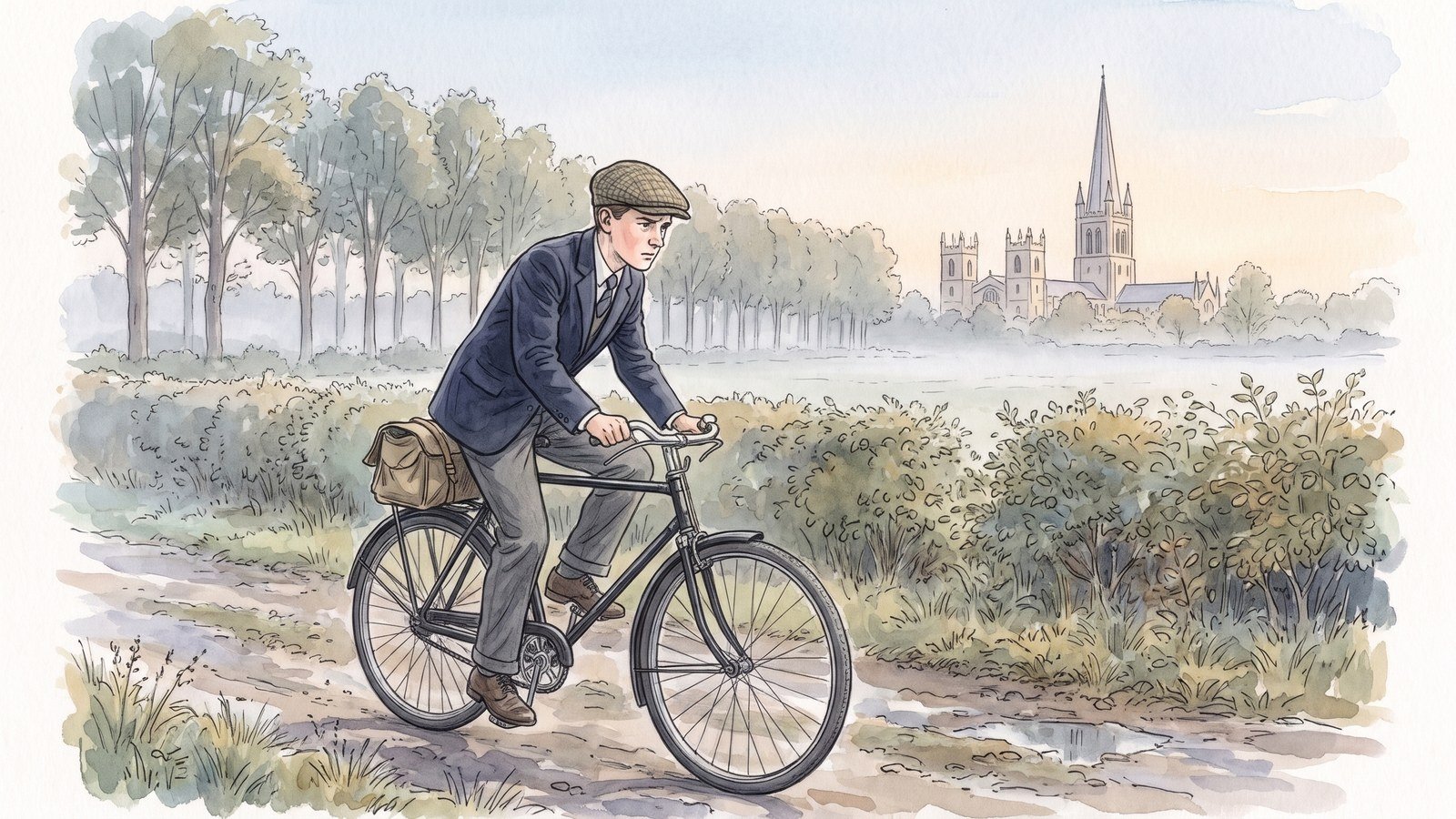
The first day of the spring term was 4 May 1926, and the General Strike had begun that morning, which meant that the trains from Southampton were not running. Turing had crossed the Channel by ferry and arrived in Southampton the previous day, and he found himself stuck. What he did instead has become the most quoted anecdote in the history of the school: he bought a bicycle and cycled the better part of sixty miles through the Hampshire and Dorset countryside, stopping overnight in a hotel at Blandford Forum, and arrived at Sherborne a day late, having telegraphed his housemaster to explain the delay. The distance is reported variously as sixty miles, sixty-three miles, sixty-five miles or a hundred kilometres, and the variation is probably a function of which road he took rather than of any difference of memory. In 2026, the centenary year, the Sherborne Schools Group re-enacted the ride on Tuesday 5 May, the exact date of his arrival, with pupils and staff cycling from Southampton station along the same route, roughly a hundred kilometres, arriving in Sherborne at about six in the evening and finishing with a parade down Cheap Street lined by pupils, staff and the Mayor of the town.
What is remarkable is not the ride. A determined thirteen-year-old with a bicycle and a map could do a great deal with a fortnight of unexpected freedom. What is remarkable is what the school made of him afterwards, which was mostly to misunderstand him. The report cards are still quoted in the school’s history and they are not flattering. From the Michaelmas term of 1927, the physics master, Henry Shorland Gervis, wrote: “He shows considerable promise, but he must learn to express himself adequately.” That is a report on a boy who would be doing the foundational work of theoretical computer science within a decade. From 1930: “He has done some excellent work, mostly strict training for his scholarship examinations. I can only hope Cambridge will think as well of him as I do.” A mathematics master’s comment, preserved from the same period, is the more revealing one: “In one sense he was difficult to teach, as he preferred his own independent methods.” The same report goes on: “All that I can claim is that my deliberate policy of leaving him largely to his own devices and standing by to assist when necessary, allowed his natural mathematical genius to progress uninhibited.”
That is the whole story of the failure of English schools at their best and worst in a single paragraph. The policy of leaving him alone was, in the end, the correct policy, and it was arrived at by a teacher who was frankly getting on with other things. The report that said he must learn to express himself adequately was simply wrong, and was written by a man of considerable ability judging a thirteen-year-old by the standards of the time. The school took Turing’s mathematics seriously enough to make him the winner of the Digby Prize in 1930 and 1931, the Christopher Morcom Prize for Natural Science in 1930 and 1931, and of the King’s Medal for Mathematics in 1931, and it gave him a leaving scholarship to Cambridge. But the school was also, at the time, a rigidly hierarchical establishment in which the curriculum ran through Latin and Greek, and the fact that Turing was teaching himself Einstein and working through the foundations of quantum mechanics while still at school is remarkable.
Some of the detail survives because the school kept it. Turing borrowed three books from the school library on 4 November 1930: Lewis Carroll’s The Game of Logic, The Universe Understood, and Symbolic Logic. The school library held somewhere between eight and ten thousand volumes by then. The mathematics master at the time was Dr Edwin Davis, and a full-time mathematics specialist, Donald Eperson, taught at Sherborne from 1927, and it was Eperson who introduced the school to Lewis Carroll. The most consequential relationship of Turing’s schooldays was with another boy. Christopher Morcom shared his taste for science and mathematics and died suddenly in February 1930, and the loss appears to have redirected Turing’s thinking towards questions about mind, matter and consciousness that run through everything he did afterwards. There is a theory, widely held and not proven, that the Morcom friendship was the origin of his lifelong interest in whether a machine could think. It is at least certain that he did not walk into Cambridge in 1931 with no ideas of his own.
Turing came back. On 9 March 1953 he returned to Sherborne to give a paper on “The Electronic Brain” to the Alchemists’ society, which was a considerable visit for a man then working at the National Physical Laboratory on the design of the ACE machine, the project this journal has described separately in its account of the laboratory that measured time. In 1966 the school’s new science building was named the Alan Turing Laboratories, apparently the first building anywhere named after him, an honour arranged after Sir Ben Lockspeiser, the first president of CERN, wrote to Turing’s mother. In August 2023 a group of Turing’s school papers was returned to Sherborne from King’s College Cambridge in a ceremony that the school and the university both treated as a repatriation: school reports, the School Mathematics Medal for 1931, the OBE awarded for war service in the Foreign Office and at Bletchley Park, the official photograph of his election as a Fellow of the Royal Society in 1951, and eighty-six letters he had written to his parents and others between 1924 and 1954.
And in the centenary year, a temporary exhibition of those school years opened in the town. The Sherborne, a local charitable trust, has staged Turing Before Bletchley at its Art Room premises, running from October 2026 into January 2027, with free entry. It is reported to include a replica Enigma machine, facsimiles of the Turing-Morcom correspondence, school reports and photographs, and an interactive area, Play Like Turing, in which visitors try the kind of puzzle that the fourteen-year-old would have tried. It is a well-judged exhibition, and it is doing something the old blue plaque never managed, which is to put a boy’s actual work in front of the public rather than a summary of his adult achievements. As the project’s own website puts it, with a candour that is unusual in institutional self-promotion: “few traces of Turing’s formative years here remain in public view”. A small blue plaque, a bust, a school building and a mural in Old Market Yard. That is the inventory, and it is thin.
It is worth noticing what the centenary made visible. The story that emerged was not that a great man came from this school. It was that a school did not know what it had. For seven years Turing was assessed as a promising mathematician who expressed himself badly, and the mathematics that mattered to him was not on the timetable at all; his most important teacher in that period was a book he borrowed from the library. No school is a good detector of genius. That is not a complaint about Sherborne, which was reasonably good by the standards of the time, but it is a general fact about institutions, and it is the fact the Turing Project is built on. The school has concluded that the thing it failed to do for Turing was to teach him the mathematics of the machine, and it has concluded that the mathematics of the machine has now become the mathematics everyone needs. A century of institutional memory has been converted, quite deliberately, into an institutional mission.
The Centenary and the Plan
The centenary itself was used as a lever. The plan for the Turing Centre was announced into a news cycle that had already been made for it by the centenary, and the announcement came with a number attached: a multi-million-pound centre for digital education and entrepreneurship in the heart of Sherborne. The framing was careful and it was deliberate. The Turing Project is not presented as a museum project, or as a monument. It is presented, in the project’s own words, as “a charity start-up combining expertise in education, communications, fundraising and defence brought together by a shared belief in Turing’s legacy”, building “a democratic, welcoming destination for curious thinkers and emerging scientific talent, in the town where his story began”. The vision statement is unusually direct for a fundraising document: “The Turing Project is not about preserving history, it’s about building the future.”
The project is one strand of a wider local initiative. The Turing Centre Project is described as one part of Future Sherborne, launched by Sir Christopher Coville, and the distinction matters because it locates the project in a civic rather than a purely institutional frame. Coville is a former RAF fast-jet pilot and senior commander, a former chairman of Westland Helicopters and of the European aerospace companies’ rotorcraft group, and until 2016 the senior defence and security adviser at Dell EMC, where he built a public reputation for arguing that cyber security was a commercial opportunity rather than merely a defensive one. He is a visiting professor at King’s College London. He chairs the project. Nick Burton, a trustee and the fundraising lead, spent his career in retail technology and hardware and is a director of Screwfix; he studied computer science at what was then UMIST in Manchester. The trustee group also includes Jason Dobson, a serial entrepreneur, and the project’s marketing and communications focus group is led by Annette Cremin, who has worked at Ketchum, Edelman, Selfridges and Fenwick. There is also a Sherborne town councillor among the trustees, James Griffen, which tells you something about how carefully the town has been knitted into the governance.
The public figures attached to the project are not decorative. The supporters list includes Sir Dermot Turing, Alan’s nephew, a trustee of the Turing Trust and a visiting fellow at Kellogg College, Oxford; the former Cabinet Secretary and head of the civil service, Lord Sedwill of Sherborne, who is honorary president of the foundation; Lieutenant General Sir Robert Fry, a former commandant general of the Royal Marines; Kate Adie, the former BBC chief news correspondent and president of Dorset CPRE; and Sol Rogers, global director of innovation at Magnopus and chairman of BAFTA’s immersive entertainment advisory group. One line on the supporters page does more work than the names do. It reads: “Alan Turing didn’t just break codes. He broke assumptions about what machines, and minds, could achieve. Every AI system running today stands on foundations he laid. Sherborne shaped him before Bletchley defined him. This Centre both honours that origin story and points ahead. The question it poses to the next generation is simple: what assumptions will you break?”
Structurally, the project is a charity and a company. The Sherborne Turing Foundation is a registered charity, number 1218206. The Turing Centre Project Sherborne Limited is a separate vehicle, company number 16677352, incorporated on 28 August 2025 as a private company limited by guarantee without share capital, with its registered office in Bradford Road, Sherborne, and classified under the general business support services heading. That is an unglamorous detail and a revealing one. A company limited by guarantee without share capital is the standard vehicle for a social enterprise or a charitable trading subsidiary: it can contract, employ, raise money and sign leases, but it has no shareholders to satisfy. The separation of the charitable foundation from the delivery company is the structure you would expect from a project that wants to be both a public-interest body and a developer, and it is a sign that somebody has thought about the governance. The directors of the company and the trustees of the charity are the same small group of people, which is simpler but also means that the group’s own judgement is the only real oversight there is going to be.
The delivery plan is set out in three phases and the phasing is the most revealing part of the whole document, because it shows the organisers already know that the centre itself is a long way off. Phase one, October 2026, is the conference and festival marking a century since Turing joined the school, bringing together young people, industry leaders and the wider community, and it has already happened. Phase two, 2027 and 2028, is an interim educational hub delivering hands-on digital technology and AI programmes for schools and colleges, explicitly described as building momentum ahead of the centre’s opening. Phase three, 2030, is the purpose-built Alan Turing Centre opening in the heart of Sherborne. Read in order, that is a four-year sequence in which the visible thing happens in 2026, the teaching happens in temporary premises in 2027, and the building arrives in 2030. Any organisation that announces a building before it has secured planning permission, a site, or a full funding package is making a promise about a future it does not control, and the organisers have been clear enough about the sequence to let the reader see it.
The timing has been chosen as carefully as the phasing. The project’s own news commentary, written by Louise Troup in July 2026, notes that the announcement “chiming as it does with the government’s new Plan for Change to develop the UK as an AI superpower; news of billions of US investment in critical AI infrastructure, and Dorset’s own Economic Growth Strategy, focusing on the use of technology to drive our energy, defence and food and drink industries”. The Department for Education’s own guidance on generative AI in education, updated in August 2025, commits the department to supporting the AI Opportunities Action Plan and states that AI “will support with the delivery of the Plan for Change and our opportunity mission”. Whether the Turing Project would exist without that national weather is a fair question, and one the organisers have effectively answered by putting the timing in writing. A project that has a vision, a company, a charity, a name, a board, a phased plan, an interim delivery vehicle and a national policy tailwind is a serious undertaking. It is not, however, yet a funded building.
The town is the other half of the proposition, and it deserves more attention than it usually gets. Sherborne is a small Dorset market town whose economic life has been shaped for a thousand years by two institutions: an abbey that was once one of the wealthiest religious houses in England, and a school that is, on the traditional reckoning of its own foundation, the oldest in the world, with a documented history running back to the seventh century and a royal re-foundation in the sixteenth. The modern Sherborne Schools Group comprises Sherborne Boys, Sherborne Girls and Sherborne Prep, the last of which opened in 2017 and brought the three under one brand. The town has roughly six thousand residents and a school group that is a genuinely significant local employer, and the relationship between the two has traditionally been extractive in the sense that the school has always been a route out: the thing Sherborne produces is well-educated people who then leave for London, Cambridge and the professions elsewhere.
That is the problem the Turing Project is trying to invert, and the inversion is the only reason the project has a town dimension at all. A school can teach computer science without a town plan. What it cannot easily do is change the distribution of opportunity in a small town, because the schools that educate the children of a place like Sherborne draw their teachers from a much wider circle and their pupils towards a much wider set of universities, and the region outside the handful of southern cities has very little high-wage technical industry to hold on to them. The project’s own framing makes the point with unusual bluntness: one of its stated aims is raising the aspirations and ambitions of all the young people of the town, and not only of its own pupils, and the sponsors include the town council and the town’s own business community rather than the schools alone.
The centenary year was used to assemble that coalition in a way that is easy to under-rate. Between May and October 2026 the town staged, in sequence, a centenary cycle ride from Southampton, a run of summer exhibitions, an abbey concert, a two-day conference with a school festival attached, and the formal launch of the project. Each event was small on its own. Together they constituted a communications strategy, executed with real skill, whose object was to make a plausible idea seem locally inevitable before the fundraising for the building began. Whether that is civic imagination or civic engineering is a question worth keeping open, but it is worth noticing that most town-scale technology projects never get as far as a coherent public calendar of this kind.
It is worth being precise about the gap between the two, because the gap is where the interesting decisions are. What is actually secured, on the evidence available, is the phase one event and the phase two interim hub. What is being aimed at is a multi-million-pound building with three floors, a lecture theatre, incubator and hot-desking space, creative labs, an outdoor space, a cafe, a gift shop, gardens, an immersive visitor experience and a digital twin of the centre available online to a worldwide audience. The site’s own renderings are labelled as conceptual artwork inspired by Sherborne, with the final design subject to change. The planning and design phase was, according to trustee Nick Burton, in its fundraising stage as of the centenary year. A town of roughly six thousand people, in one of the most attractive and least industrial parts of the country, is attempting a three-floor national-attention technology centre. That is either the most interesting thing happening in British education, or it is a school and a local authority betting their credibility on a building. The interesting thing is that both readings are true at once, and the essay has to keep both in view.
The Turing Centre
The centre itself is the part of the proposition that cannot be assessed until it exists, and the organisers have been unusually clear about that. The published concept is a three-storey building in the centre of Sherborne, and the project site is careful to label its renderings as conceptual artwork inspired by Sherborne rather than as a design. What is described is a programme of floors rather than a set of plans. On the education side: immersive interactive learning days for school groups, a Young Entrepreneurs’ Innovation Hub with an Invention Room, a Tech Entrepreneur in Residence, an annual Turing Award for talented young people, and a spread of residential courses, holiday clubs and a digital technology scheme. On the enterprise side: rentable office units and incubator space, meeting rooms and open-plan hot-desking, regular technology-focused events, and a possible link with a regional university to establish a satellite faculty in digital technology and artificial intelligence. On the visitor side: an immersive visitor experience, a lecture theatre, a cafe, a gift shop, gardens, and a digital twin of the centre itself that would exist online, worldwide, whether or not the building ever did.
That digital twin is the most interesting single item in the whole proposal, and it is worth dwelling on, because it is the one piece of the project that can be built before the building. A digital twin is a live data model of a physical thing: a factory, a city, a hospital, a building, maintained so that its virtual counterpart can be used to simulate changes before they are made. The project lists its intended applications as education, construction, smart cities and infrastructure, medical research, drug design, vaccine discovery and entertainment, with space exploration as the headline example, and the day-two conference put the technology in front of four hundred school pupils through exactly this route. If the centre’s most advanced proposition is that it can model itself before it exists, there is a pleasing circularity there. It is also a defensible way to build credibility for a capital project: a digital twin that people can walk into and operate is a demonstration that the people behind it can deliver, and it costs a fraction of a building.
The rest of the proposal is a mixture of the conventional and the genuinely new. A lecture theatre, a cafe, a gift shop and gardens are what every visitor attraction since the Crystal Palace contains, and the honest reading is that they are there to make the centre pay for itself through footfall and hospitality rather than through grants alone. A university satellite faculty is more interesting, because it is the one element that would genuinely change what the town is. A permanent academic presence in a town of about six thousand people, teaching digital technology and AI, would be a serious act of place-making; it would also be a serious act of institutional risk-taking, because university provision follows funding and research success, and neither is guaranteed by the presence of a nice building. The Tech Entrepreneur in Residence and the annual Turing Award for talented young people are, by contrast, inexpensive and immediately legible, and the fact that they appear in the same document as the three-storey centre says something about how the programme will actually be judged by the people who attend it.
On the question of money, the public material is careful in a way that reveals the stage the project has reached. The centre is described as a multi-million-pound project. The delivery vehicle, the Turing Centre Project Sherborne Limited, was incorporated in August 2025 as a company limited by guarantee without share capital, and the charitable foundation that will hold the public-interest side of the work is separately registered with the Charity Commission. Neither vehicle has, on the public record, an announced total cost, a secured site, a planning submission, or a funding package. As of the centenary year the planning and design phase was, according to the project’s own trustee, in its fundraising stage. And the three-phase delivery plan makes the shape of the risk explicit: the conference happened in October 2026, the teaching begins in temporary premises in 2027 and 2028, and the building is scheduled for 2030. Four years of interim operation sit between the launch and the thing that is actually being promised.
It is also worth setting the proposal against the international competition for AI capability, because that competition is the thing the project is really entering. Governments from the United States to the Gulf states have concluded that a small number of cities will absorb the world’s AI research capacity, and they are competing to make those cities the places where the talent goes. The American model has been to put a federal laboratory next to a university; other states and cities have built dedicated districts; the British approach has so far been to designate a scatter of clusters and hope that private investment follows the designation. What none of them has done is try to establish such a centre in a town of six thousand people in the English countryside. If it worked, it would be a genuinely new model, and the model is the interesting part: the argument is that a small town has what a large one no longer has, which is land, room, affordable space for a workshop or a studio, and the absence of a competing use for the site.
The financial engineering is also less conventional than the promotional material lets on. A charity that owns the public-interest work and a company limited by guarantee that owns the commercial work is a sensible division, and it is the structure the project has used. But a company limited by guarantee has no shareholders, which means it has no equity to sell and no dividend to pay, and it therefore has to be financed by grants, donations, contracts and trading income. That makes it patient in a way a venture-backed model is not, and correspondingly slow: the centre’s delivery vehicle has been registered since August 2025 and has, on the public record, barely begun to spend money. Whether a charitable vehicle can deliver a multi-million-pound building on the timeline the project has published is the single biggest open question, and it is a question of balance sheets rather than of vision.
One small thing deserves flagging, because it is the kind of detail that costs nothing to fix now and is awkward to fix later. The project’s education strand includes an annual Turing Award for talented young people. The name is already the most famous award in computing, the A. M. Turing Award conferred by the Association for Computing Machinery, and it is administered by a foundation whose trustees include members of the Turing family. A school prize with the same name will be read by every journalist who covers it as a dilution of the real thing, and the project’s own supporters include a member of that family, which makes the conversation one that is better had before the branding is fixed. It is a small thing, and it is exactly the kind of thing a centenary is the right moment to get right.
There is a familiar failure mode here, and it is worth naming it because the people involved are well aware of it. A capital project that is announced in advance of its funding, designed before its business case is settled, and located in a town with a small population and a correspondingly small donor base can end in one of two ways. Either the building is scaled down to what the money actually supports, which is usually a good outcome and is never described as such, or the money is found and the building is built, which is usually a good outcome too. The bad outcome is the one where the press release has run, the pledges have been made, and the building never arrives, and the organisation that made the promises has to spend the next decade explaining the gap. The Turing Project’s own phasing is the best available answer to that failure mode, because it puts a working educational programme in the gap. If the centre opens in 2030, the interim hub will look like prudent staging. If the centre never opens, the interim hub will still be there, teaching, and the project will have been worth doing anyway. That is the structural difference between a civic project and an announcement, and the organisers appear to have designed for it deliberately.
There is also a question about what a centre for AI is actually for, which the project’s materials answer more openly than one might expect. The stated ambition is to create “a multi-million-pound centre for digital education and entrepreneurship”, and the vision language is about building rather than preserving: “The Turing Project is not about preserving history, it’s about building the future.” The four strands are education, enterprise, community and visitor experience, and the site is explicit that the centre is intended to bring jobs, investment and tourism to the town, and to give young people access to skills, mentors and opportunities that shape real careers. The argument for the project is therefore not primarily commemorative. It is that a town that produced one of the great figures of the twentieth century has spent a century exporting its most capable young people, and that the most logical corrective is to build the thing that would make them stay.
The Conference
The two-day event that opened the project in October 2026 is the most concrete thing it has yet produced, and it is the part of the story that best illustrates the gap between the project’s ambitions and the reality of what a school can do with artificial intelligence. The official programme was published in full, and it is worth taking it apart, because an agenda is a curriculum statement whether or not it is meant as one.
Day one, Thursday 15 October, was held at the Gryphon School’s Innovation Hub, and its audience was schoolchildren. The morning session was a demonstration of AI-driven robotics with Thales UK, bringing together thirty-five pupils from The Gryphon School with ten from other schools, and welcomed by Joe Miles and Alastair Poulain. The afternoon session was a talk on reinforcement learning, the branch of machine learning in which an artificial agent learns behaviour from experience rather than from a set of hand-written rules, given by Professor Ozgur Simsek, who directs the Centre for Artificial Intelligence at the University of Bath, and introduced by Jim Gower. The stated target audience was Years 11, 12 and 13, which in England means pupils from about fifteen to eighteen. The evening was a concert in Sherborne Abbey, with the Rector welcoming the audience, Sir Christopher Coville introducing the evening, the school choir, readings by Sherborne Boys’ pupils on Turing’s time at Sherborne, an interval, readings by pupils from The Gryphon School and Sherborne Girls on the Enigma story, the town band, and closing remarks from Coville. A concert in a medieval abbey, on the centenary of the birth of a computer scientist, is an entirely coherent thing to do, and it was also, in its way, the most honest part of the project: it was an evening about a boy who lived a hundred years ago, and it asked nothing of anybody’s understanding of machine learning.
Day two, Friday 16 October, was held at the Merritt Centre at Sherborne Girls and was aimed at a larger and older audience: more than four hundred pupils drawn from the local schools, with sixth-formers from Yeovil College, The Gryphon School and Leweston among them. Dr Ruth Sullivan, head of Sherborne Girls, opened it, and the first substantive session was an expert panel on the future of AI, facilitated by Ben Keene, the director of entrepreneurship at Sherborne Boys. The three questions put to the panel are printed on the programme, and they are the right three questions, which is more than can be said for most. What will your generation decide? What controls should apply to the application of AI? What impact will it have on the job market? The panel was James Cary, the screenwriter and broadcaster; Professor Ozgur Simsek; Sol Rogers, global director of innovation at Magnopus and chairman of BAFTA’s immersive entertainment advisory group; Suki Fuller, who advises on technology and geopolitics for the BBC; and Professor Alison Honour, vice-chancellor of Bournemouth University. After the break, Rogers gave a demonstration of digital twin technology, and the day closed with further remarks from Coville. From half past twelve the hall became a technology festival, with exhibits on drones and medical research among the stands, running into the afternoon.
Separately, and on the same week, Sherborne Prep opened the conference as a whole with a day for six local primary schools: around three hundred children from Hanford Prep, Sherborne Abbey Church of England Primary, Bradford Abbas Church of England Primary, Thornford Church of England Primary, Sherborne Primary and Bishops Caundle Church of England Primary. They were given workshops in coding and cryptography, robotics and artificial intelligence, art and creative design, adventure and resilience, and STEM challenges in the science laboratory, with an entrepreneurship session led by Ben Keene. The project describes the conference week as intended to bring together some six hundred young people. Whether it was exactly six hundred is not the point. The point is that a town of six thousand people put four hundred and thirty-odd of its children in front of a panel of AI specialists on a Friday morning in term time, and that is a serious commitment of staff time and timetable.
Read as a whole, the agenda tells you a great deal. It is a curriculum, and it is the actual curriculum of the moment. There is no arithmetic of large numbers, no essay on the nature of consciousness, and no history of computation, and that is defensible given the occasion. Robotics, reinforcement learning, digital twins and the future of work: these are the things that people in this field actually think are going to matter, and for once a school conference is showing pupils the real thing rather than a simplified substitute. The panel’s questions are notably adult questions. The controls question is a governance question, and it is a strange and rather good thing for fifteen-year-olds to be asked what regulation should look like. The job-market question is the one the school’s own project is really about, since the school’s stated aim for its AI work is to give its pupils the skills to do the jobs that will exist rather than the ones that did.
It is equally worth noticing who is not on the stage. There is no teacher, no union representative, no critic, no parent and no regulator on either day. The voices the project assembles are the voices of people who believe the thing is worth doing, and the questions are their questions. In a project with an explicit public-interest mission and a document that runs to several pages of mission language about a democratic and welcoming destination, the absence of a critical voice on the programme is a small but revealing omission. It does not mean the organisers are not open to criticism, and the published vision page is candid enough about the risk that the centre might not happen. But an audience of schoolchildren encountering a debate about the future of artificial intelligence should probably meet at least one person whose job is to be sceptical about it.
There is one more structural point, which is that this was not simply a conference. It was the launch event for a fundraising project, and the agenda was designed to do two jobs at once: to be a genuine educational event and to be a demonstration of capability to funders, press and, not least, to prospective staff. The parts that serve the first job are the robotics demonstration, the Bath lecture, the primary school workshops and the pupil readings. The parts that serve the second are the panel, the digital twin presentation, the technology festival and the fact that the founder of a specialist immersive technology company was brought in to talk to four hundred schoolchildren about space exploration. Both jobs were done well. But the reader should be clear about which is which, because the evidence that the first job is being done well is that it happened, and the evidence that the second job is being done well is a photograph of a full hall.
And there is a final irony that the organisers, to their credit, put in the Abbey programme. The conference was held to mark the centenary of Turing’s arrival at Sherborne, and the evening concert took place in the abbey of a town whose medieval foundations and religious buildings are among the most significant in the country. It was a celebration of a mathematician who spent his school years running numbers in his head and teaching himself relativity from books in the library, and whose single most consequential decision was to stop and think about a machine. Four hundred years after the first mechanical calculators appeared in the cathedrals of medieval Europe, and eighty years after the first electronic ones, the question that Turing asked at Sherborne is the question the school is now putting to its pupils: what can a machine do, and what should we do with it. The conference’s three questions are that question, asked properly. The interesting thing is that a project built on nostalgia seems to have understood that the inheritance worth passing on is not an answer but a method.
AI in the Classroom
The most consequential part of the Turing Project is the least photographed, because it happens inside classrooms and does not lend itself to a concept rendering. This is the school’s own work: the computer science department that Alan Turing’s example inspired, a platform called Sherbot that the school has built for itself, and a pilot called Turing Tutor, an AI-powered individual learning system that the school describes as the next phase of its work. The pitch is straightforward and, in the context of everything else, quietly bold. Turing Tutor is intended to identify and close individual learning gaps; to support neuro-diverse pupils who can soar in some areas and struggle in others; and to give teachers a richer picture of each child’s progress by bringing assessment and performance data together in one place. The head of computer science and director of AI development at Sherborne School, David Wild, is the man credited with building the department in the first place, inspired by the school’s own most famous former pupil, and his stated position on the technology is notable for what it refuses to claim. The school’s headmaster put it plainly in the Spectator: “No AI engine, though, will ever replicate the human side of education, nor do away with the importance of a good teacher.”
That refusal is worth pausing on, because it is the single thing that distinguishes this project from most of the writing on AI in schools. The standard argument, in both directions, is about substitution. One side says AI will replace teachers who are failing their pupils; the other says AI will liberate teachers to teach. Both are framed as questions of how much of the teacher the machine can do. The Turing Project’s formulation is not a claim about what AI will replace but a claim about what it can add, and the addition is specific: individual pacing, diagnostic feedback, and a consolidated view of a pupil’s progress that a teacher with eighty charges and a hundred and twenty pupils cannot otherwise hold in their head. If it works, it is a triage instrument. If it fails, it is an expensive dashboard that tells a teacher what they already knew.
The school is not the only one doing this, and it is worth being clear that it is neither the first nor the most advanced. Caterham School has piloted an AI tutor of its own, RileyBot, which won an innovation award at the Gatwick Business Diamond Awards. What distinguishes Sherborne’s version is the ambition of its scope, because it is tied to a building, a conference, a charity and a town strategy rather than to a single product. That ambition is also the source of the risk. A platform pilot can be run, evaluated and quietly discontinued. A platform pilot that is the pedagogical engine of a national attention centre is very hard to stop, because by the time anyone evaluates it the building will have been paid for.
The national policy context is genuinely unusual, and it explains part of the confidence. The Department for Education’s guidance on generative AI in education, last updated in August 2025, commits the department to supporting the government’s AI Opportunities Action Plan and states that AI “will support with the delivery of the Plan for Change and our opportunity mission”. It adds that “AI has the power to transform education by helping teachers focus on what they do best: teaching”, while acknowledging that evidence on the benefits and risks is still emerging. A companion publication, Using AI in education: support for school and college leaders, published in June 2025 and updated in May 2026, is a practical document for headteachers covering the opportunities, the safety requirements, how to conduct an audit of existing AI use, what to consider when planning to use AI, and how to embed it in a digital strategy. It carries an appropriate caution: any use of AI needs to be carefully planned, and what is appropriate in one setting may not be in another.
Then there is the research the department published in June 2025 on early adopters of AI in schools and colleges, whose title is its own conclusion: the biggest risk is doing nothing. It reports how institutions that have moved early describe the benefits they have found, in a document that is essentially a government argument for action. Alongside it sits research published in August 2024 on public attitudes to the use of AI in education, which matters for a different reason: a system that requires the consent of parents and the professional trust of teachers is not built by announcement, and the politics of who is consulted are part of what determines whether it survives.
Against that, the structural fact is that England has no national curriculum in artificial intelligence. What there is instead is a GCSE in computer science, which the government announced in January 2015 as part of its final specification for more rigorous arts-based GCSEs and A levels, following the consultation on subjects for September 2016, and which was first examined in 2016 with the A level following it in 2017. That is a fine qualification for a rapidly changing technical field, and it has produced a generation of schools that can teach programming, algorithms, data structures and networks, and that have no agreed way to teach a machine learning system or a large language model at all. The gap has been filled in practice by extracurricular provision: coding clubs, the Raspberry Pi Foundation’s network of clubs, and a long tradition of schools teaching the BBC Micro and its descendants to children who were never going to become software engineers. The Turing Project’s interest in AI is, in this light, less a novelty than a response to a specific hole in the curriculum, and the response is the right shape: teach it early, teach it to everybody, and do it in a building that also serves the town.
It is worth being concrete about what an AI tutor is, because the phrase covers several quite different technical claims with very different prospects. The weakest version is a chatbot that answers questions, and there is no evidence that pupils learn better from one. The strongest version is a mastery model that keeps a running estimate, for each child, of which specific concepts have been securely grasped and which have not, and then reallocates practice accordingly. Systems of that second kind have a respectable academic pedigree, in the tradition of mastery learning and of the intelligent tutoring systems developed from the 1970s onwards, and the underlying idea is not new at all. What is new is the cost. A diagnostic model that can read a child’s work and decide what they should do next used to require a human tutor and a room; if a large language model can approximate the judgement of a skilled teacher at near-zero marginal cost, the arithmetic of what schools can afford changes completely.
The neuro-diverse claim is the most interesting application and the one most in need of an evidence base. A pupil who can soar in one area and struggle in another is badly served by a classroom built around the pace of the middle, and the traditional remedy has been to set them a separate worksheet at the back, which teaches them that they are the problem. A system that silently adjusts difficulty, pacing and format for the individual does something a teacher cannot easily do for thirty simultaneous learners, because a teacher has to guess, and the guess has to be made quickly and in public. The technical claim is not that the machine is more intelligent than the teacher. It is that the machine can hold a finer-grained model of one child than any one adult can hold while also managing thirty others. That is a real and defensible claim.
It is also a claim with a failure mode that is specific and serious. A model that infers a child’s ability from their responses will, if the model is wrong, be confidently wrong, and it will be wrong in a way that is invisible to everyone except the child, because the system presents the pupil with a smooth and plausible explanation of why they are being given this exercise. Human teachers make errors too, but they make them in the open and they can be questioned. The design question the Turing Project has not yet published an answer to is therefore not whether the tutor works but where the human stays in the loop: who reviews the inferences, who can override them, who tells a parent that the system believes their child has a ceiling in mathematics, and what happens when a family does not believe it. Every one of those questions has an answer. None of them is answered by a platform.
It is fair to say that the project has not yet answered the hard questions, and the questions it has not answered are the ones that will decide whether it works. The first is data. A system that aggregates assessment and performance data for individual pupils, and that profiles pupils against a model of what they should be learning, is handling a category of information that has to be protected with unusual care, and the DfE’s own guidance is careful to insist that AI use must be planned rather than improvised. The second is evaluation. The school says Turing Tutor will plug learning gaps and help neuro-diverse pupils, and these are testable claims, but no published evaluation framework, no baseline, no comparison group and no external evaluator has been announced. The third is voice. The conference programme contains no teacher, no union representative and no regulator, and a system that gathers pupil data and reshapes teaching deserves at least a teacher at the table who is responsible for the consequences. None of this means the project is wrong. It means that the parts of it which are hardest to photograph are the parts that are hardest to verify, which is the normal condition of institutions in their first year of doing something new.
The Bet on Sherborne
Take the project seriously and the case for it becomes reasonably strong, for reasons that are not entirely sentimental. The first is that a school is one of the few institutions in Britain that can make a five-year intervention on a person at the age at which careers are decided, and that it does so at scale and for free. That is a more powerful instrument for changing the distribution of opportunity than any technology company, and it is the instrument most obviously available to a place like Sherborne, whose whole historical function has been to take boys from small towns and send them somewhere else. The second is the argument the project itself makes about concentration. Almost all the AI wealth, talent and research in Britain is concentrated in a handful of places, and almost none of it in the southwest of England outside Bristol and Exeter. A town of six thousand people building a centre for digital technology and AI is, among other things, an attempt to break a geographical pattern that has been getting worse for fifty years. The third is the argument about timing. If the 2026 policy environment really does treat AI as a national infrastructure priority, then a town that builds capability early gets a decade of head start on the towns that wait for a central initiative to arrive. Projects like this are rarely started because the conditions are perfect. They are started because somebody moves before the conditions are perfect, and the whole point of the person who moves early is that they thought it was worth moving before the conditions were perfect.
Now take the case against it, which is also reasonably strong. The first worry is that a capital project announced by a small group of men with defence-industry, technology and fundraising backgrounds can become a monument to the organisers. This is not a slur; it is the standard failure mode of civic vanity projects, and the markers are visible: the emphasis on the building rather than the programme, the emphasis on the visitor experience rather than the pupils, the tendency to describe everything in the language of national strategy, and the tendency to answer a question about teaching with a fact about construction. The second worry is the donor problem. A multi-million-pound building in a small town requires either a very large grant, a very large local donor base, or a mixture, and the project has a charity and a company but no announced package, which means that between now and 2030 the founders will have to keep the interest of people whose principal alternative use for a large sum of money is something else. The third worry is the one that matters most for the pupils: that the project is answering a question that does not need answering. Does a school need a three-storey centre to teach artificial intelligence? The evidence from Turing’s own career says no. A boy who wanted to think about computable numbers did it in a school library, with a bicycle, and with a mathematics master who had the good sense to leave him alone. What the project actually needs is teachers who know the subject, pupils with time and tools, and a curriculum slot. All three are expensive. None of them requires a building.
There is one more strand to the project that has not been discussed much in the public material and that belongs in any honest assessment: defence and security. The project describes itself as combining expertise in education, communications, fundraising and defence, and it is chaired by a former fast-jet pilot and senior commander who was the senior defence and security adviser at one of the world’s largest technology companies. The conference programme included representatives from GCHQ and from BAE Systems at its technology festival. A town of six thousand people becoming a centre for artificial intelligence, with a cyber security and defence industry at the heart of its funding and its curriculum, is not a neutral proposition, and it deserves to be noticed rather than noticed past.
The attraction of this framing to a funder is easy to see. Defence and national security budgets are large, persistent, and unusually willing to fund things in places that have no obvious commercial case for them. The attraction of it to a school is also easy to see: the pipeline from a small regional school into GCHQ, BAE Systems and the defence technology sector is a real thing, it is well paid, and it is exactly the sort of destination that keeps ambitious young people in a region that does not otherwise offer much. Set against that, the objections are not primarily about secrecy or military recruitment. They are about framing. The Turing Project’s own language is about a democratic, welcoming destination for scientific talent of every kind, and about education that serves a democratic society. A curriculum whose most enthusiastic sponsors are defence contractors and intelligence agencies will teach pupils something about the purposes of technology that is not the same lesson, and the claim that artificial intelligence should be a force for good becomes harder to make convincingly if the people saying it are, in another part of the same programme, demonstrating drones.
None of this is a reason to oppose the project, and the conference’s own composition suggests that the organisers understand it as a tension rather than a contradiction: the panel included a broadcaster, an academic, an industrialist and a university vice-chancellor, and the questions put to them were about regulation and the labour market rather than about defence. But a project of this scale, in a country where the state is one of the largest employers in the very technology it is teaching, ought to be explicit about what it is for. The schools will not be able to leave that question unasked for long.
And there is a question the project has not answered publicly, which is what success looks like. Every serious project needs a measure it is willing to be judged against, and the Turing Project’s published measures are all inputs rather than outputs. How many young people from the town, and particularly from its state schools, will be in AI and technology careers in ten years? How many local businesses will have adopted AI in a way that changes what they can do? What will a pupil with ADHD or dyslexia actually experience differently in a Turing Tutor classroom, and how will anyone know? And if the building does not happen, does the interim hub survive, and does it matter? A project with the honesty to publish its own failure metrics would be taken more seriously by the people who might fund it than one that has only milestones to announce. There is nothing in the published material yet that says which of these questions the founders consider themselves accountable for.
The comparison with Turing himself is the sharpest test, and it cuts both ways. The project gets right that Turing’s formation mattered and that a school is a place where a mind can be caught. But the specific thing that happened to Turing at Sherborne was not a building or a centre. It was a library of eight or nine thousand books, a mathematics master with the insight to leave him to his own devices, a friend who died, and a question he was not yet ready to ask. The lesson of the centenary, if there is one, is that a school can do extraordinary things with a child who is left alone in a room with the right books. If the Turing Project’s four hundred schoolchildren are to get something analogous, the centre will be the least important part of it. If they are to get tours, a digital twin and a well-branded conference instead, then the project will have produced a good afternoon and a building, and the question Turing asked will still be waiting.
What is genuinely remarkable is the speed and the seriousness with which this has been attempted. A town has taken the memory of a great scientist, refused to make it a museum, and used it as a warrant to argue for the teaching of a new subject in a new way to a wider public than any school has managed in a long time. The conference put four hundred children in front of a panel and asked them what controls should apply to artificial intelligence, which is a better question than most adults in Britain have been asked. The interim hub means that if the centre fails, the teaching continues. And the refusal to claim that a machine can do a teacher’s job is the single most sensible thing the project has said, because it is the thing that the entire ed-tech industry has been getting wrong for a decade.
Turing cycled sixty miles to arrive a day late for his first day of school, and then spent seven years being assessed as a promising mathematician who expressed himself badly, in a school that had no idea what it was teaching him. A century later, the same school is proposing to teach the subject that would have made him famous, in a town of six thousand people, funded by the memory of him. Whether the building arrives in 2030 is a question of money, planning and the national weather. Whether it deserves to is a question about the relationship between a school and the ideas of its most consequential former pupil, and on that question the project has made a strong case for taking the question seriously, even where it has not yet made the case for itself.
References
- The Vision - The Turing Project
- The Turing Project - The Turing Project
- The Team - The Turing Project
- Turing Legacy - The Turing Project
- Our Supporters - The Turing Project
- Festival and Conference - The Turing Project
- Festival and Conference Full Schedule - The Turing Project
- The Sherborne Turing Project: Where Innovation Meets Legacy - The Turing Project, July 2026
- The Turing Centre Project Sherborne Limited, company number 16677352 - Companies House
- Turing project launched in Sherborne in centenary year of codebreaker’s death - BBC News, October 2026
- Building the future grounded in the past - The Spectator, September 2026
- Sherborne Schools host inaugural Turing Conference - Best Boarding Schools, October 2026
- Sherborne Prep opens Sherborne Schools Group’s inaugural Turing Conference week - Dorset Echo, October 2026
- Sherborne Prep opened inaugural Turing Conference - Dorset Echo, October 2026
- How schools are staying ahead of the AI curve - The Week, October 2026
- News and notices - Sherborne Town Council
- The life and work of Alan Turing - BBC Teach
- Generative artificial intelligence (AI) in education - Department for Education, updated August 2025
- Using AI in education: support for school and college leaders - Department for Education, updated May 2026
- The biggest risk is doing nothing: insights from early adopters of artificial intelligence in schools and further education colleges - Department for Education, June 2025
- Research on public attitudes towards the use of AI in education - Department for Science, Innovation and Technology and Department for Education, August 2024
- Education Secretary announces final content for more rigorous and demanding arts GCSEs and A levels, and GCSE computer science - Department for Education, January 2015
- GCSEs, AS and A level reform: subjects for September 2016 - Department for Education, 2013
- RileyBot wins innovation award at Gatwick Business Diamond Awards - Caterham School
- Alan Turing - Bletchley Park
- Alan Turing - Wikipedia
- Turing test - Wikipedia
- Bombe - Wikipedia
- On Computable Numbers, with an Application to the Entscheidungsproblem - Wikipedia
- Sherborne School - Wikipedia
- Raspberry Pi Foundation - Wikipedia
- Computer science - Wikipedia
- GCHQ - Wikipedia
- BAE Systems - Wikipedia