The Discovery of the Electron
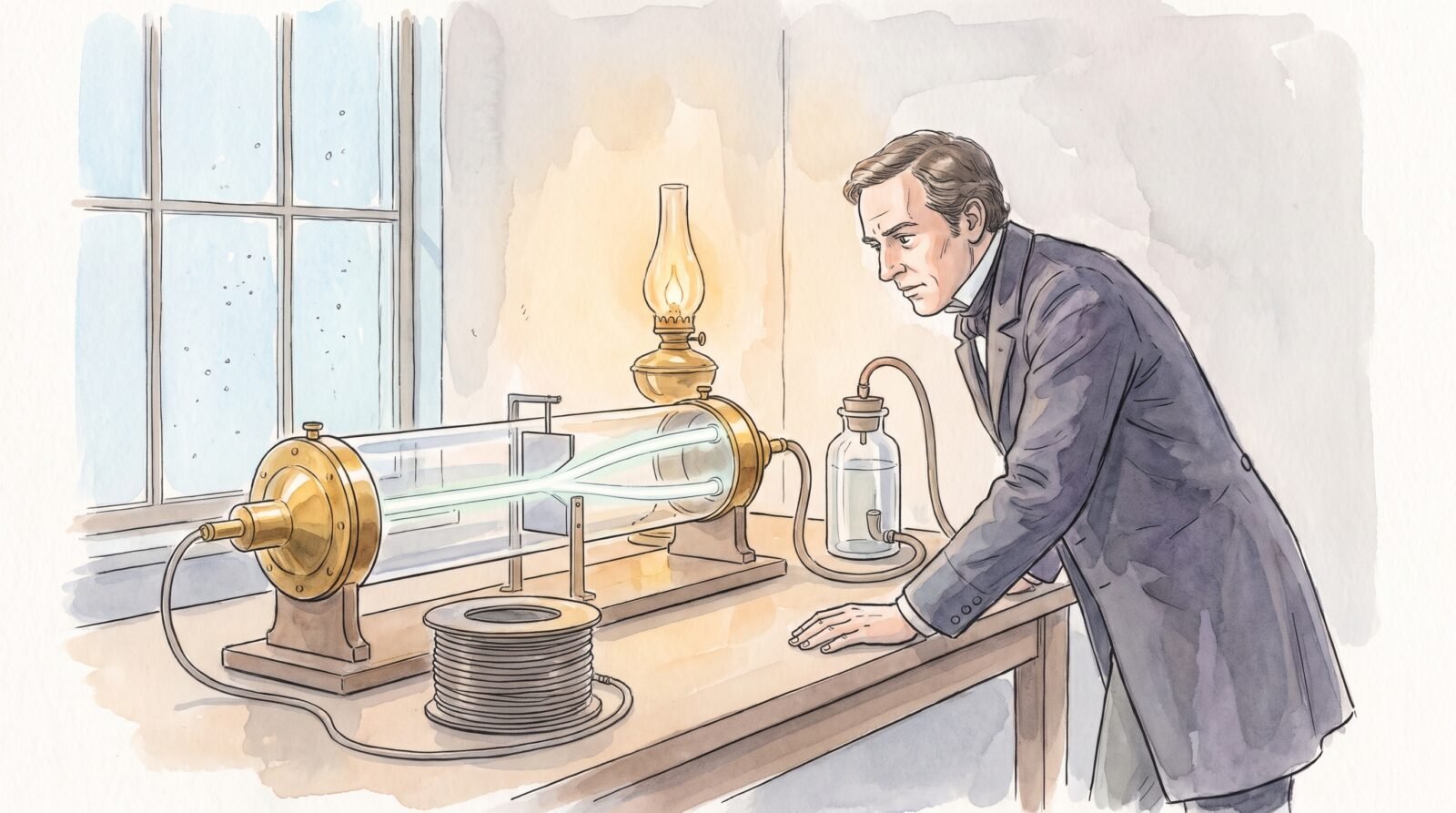
On the evening of 30 September 1897, in a lecture theatre at the Royal Institution in London, a thin beam of light inside a glass tube was bent sideways by a small electric field, and the man who did it announced that he had found the atom. Joseph John Thomson, Cavendish Professor of Physics at Cambridge for thirteen years, had taken a discharge tube, evacuated it to a pressure a million million times lower than the atmosphere, and put an electric charge across it. The glow at the far end of the tube, which every schoolchild of the time had seen in the windows of instrument makers and had been taught to call radiant matter, turned out to be a stream of particles. Not a wave, not a glow of excited gas, and emphatically not a puff of material thrown off by the cathode. Particles, each carrying a definite charge, each with a mass far smaller than that of the hydrogen atom, and moving fast enough to turn in a magnetic field. He called them corpuscles. The name electron had already been proposed for the unit of electric charge, and it stuck. This is the story of how the first subatomic particle was found, how its charge was measured, how it was discovered to be spinning, and how the discovery of its opposite number changed the meaning of the word matter.
The Glow in the Tube
No nineteenth century laboratory was stranger than the ones that produced the discharge tube. William Crookes, a chemist who became the leading British authority on the new physics, spent the 1870s building increasingly evacuated tubes of glass with elaborate and often beautiful shapes, and he fitted them with phosphorescent coatings so that the beam inside would light up the whole apparatus. He was convinced that what he saw was radiant matter, a sort of cathodic smoke torn off the metal plate and flying across the vacuum to strike the far wall. The alternative view, which his German contemporaries held, was that the discharge was a vibration of the ether, a wave rolling through the tube, and that the light was the visible symptom of some luminous disturbance.
The apparatus made the question unavoidable. The tube had to be sealed and pumped, and pumping to a hard vacuum was itself a technical achievement of the period, driven by the improved mercury and mechanical pumps of the 1860s and by the techniques of the glassblower. The harder the vacuum, the more striking the behaviour. In a good vacuum the luminous column narrows into a distinct beam that crosses the tube and strikes the glass at a sharply defined spot. There is a dark space near the cathode, the Crookes dark space, and beyond it the glowing beam. Put an obstacle in the path and it casts a shadow, which no ether wave should do. Put a piece of platinum foil in the beam and it glows red at the point of impact, which is exactly what a stream of particles should do.
The quality of the vacuum mattered more than anything else, and it was the one part of the apparatus that was genuinely difficult. Pumping was done with mercury pumps, of which the best known was the design of Hermann Sprengel and its later improvements, and the pressure in a good tube was of the order of a few hundredths of a millimetre of mercury, roughly ten thousand times lower than the pressure a modern laboratory vacuum pump reaches. The residual gas was not a nuisance but the active ingredient. A cathode ray was a beam of electrons knocked out of the cathode by the energetic collisions to which the cathode itself was being subjected, and the glow was the light given off by the gas molecules that those electrons excited on the way. The darker the vacuum, the fewer gas molecules there were to glow, and the more the beam behaved like a beam of particles rather than like a luminous gas. Every improvement in pumping made the physics cleaner and the argument harder for the wave camp.
The arguments of the 1880s and 1890s were really arguments about the nature of the cathode ray and its relation to the canal ray. Eugen Goldstein, working in Berlin, found that if the cathode were made of a ring or of a perforated plate, the beam continued past it in narrow streamers, and he named these canal rays, the Strahlen that ran down the channels. Unlike the cathode ray, which he found could be bent by a magnet, the canal rays bent the other way, suggesting that they carried positive charge. Heinrich Hertz had shown a few years earlier that the cathode ray was deflected by a magnetic field, and Philipp Lenard had shown in 1892 that the same rays could be led out of the tube through a thin aluminium window and were still deflectable outside the glass. Lenard and his mentor Hermann von Helmholtz, who had been one of the sturdiest sceptics of the material view, were persuaded by that result to concede that the rays were particles after all, though they continued to think of them as some sort of etherial matter rather than as anything with a familiar mass.
The question was live because the stakes were large. If the cathode ray was a stream of charged particles, then the atom was not the last word in matter, and the foundations of physics were about to change. If it was a wave, then the classical picture was safe. The debate was conducted partly in Germany and partly in Britain, with the sharpest polemics between the two traditions, and it was settled in Britain, in Cambridge, by a man who was prepared to measure things that his opponents had been arguing about for a decade.
The tool that made the measurement possible was the phosphorescent screen and the microscope. A wire gauze cathode could be made with a small hole in it, and the beam could be made to pass through a narrow slit so that whatever came through could be observed as a luminous spot on a screen. Behind the slit, Thomson placed a pair of parallel plates that could be given opposite charges, and he watched the spot. It moved. It moved in the direction that said the particles were negatively charged, which was the opposite of what the German physicists had expected of the beam, and it moved by an amount he could measure against a scale.
The Summer of 1897
Thomson published his results in the Philosophical Magazine in November 1897, in a paper simply titled Cathode Rays. The method was to combine two measurements. He applied an electric field between the plates and measured how far the beam was pushed sideways, which gave the ratio of charge to mass, since the electric force on a particle depends on its charge and the acceleration depends on its mass. Then he applied a magnetic field, which bends the beam into a curve, and the radius of that curve gave the speed. Combining the two separated the charge from the mass. The answer was extraordinary: the ratio of charge to mass for whatever was coming out of the tube was about 1.76 times ten to the eleventh coulombs per kilogram, and the hydrogen ion, which had been the standard of comparison for two decades, was about 1.03 times ten to the eleventh. Whatever the particles were, they were carrying a great deal of charge for very little mass. If the beam were made of hydrogen atoms stripped of their electrons, their mass would have been sixteen thousand times greater than this. The particles must be far smaller than the atom, and there could be many of them in one atom.
Thomson had found what is now called the electron, although he used the word corpuscle and referred to the particles as negatively charged corpuscles. The measurements themselves were undignified in the best sense. Thomson used a pear-shaped bulb with a narrow capillary in the neck, so that the beam formed a fine pencil that could be steered past a slit and onto a fluorescent screen where its position could be read against a calibrated scale. The electric deflection came from charging two parallel plates, and the magnetic deflection from a large electromagnet, and it was the magnetic curvature, which depends on the velocity, that allowed the speed to be separated from the ratio of charge to mass. Nothing about this could have been done with the apparatus of Crookes or Lenard. It needed a good vacuum, a good magnet, a good microscope and a physicist with the patience to spend months on a number nobody had asked for. The circumstances of the discovery were equally unheroic. Thomson was not looking for the electron. He was trying to settle an argument about the cathode ray, and the electron fell out of the measurement.
Two other laboratories were close behind, and the priority question was narrow. Emil Wiechert, working in Aachen, had measured the charge-to-mass ratio of the cathode ray and published a value of the same order early in 1897, several months before Thomson’s paper appeared, but he did not draw the same inference from it. Walter Kaufmann, who had been a student in Thomson’s own laboratory at the Cavendish, pushed on to the question of whether the particle had a fixed mass, and it was his experiments on fast rays in 1902 that started the electromagnetic mass debate. The particle itself was in the air by 1897. What took until the end of that year was the idea of what it was.
The name electron was older. George Stoney had used it in 1891 for the elementary unit of electric charge, as a name for a quantity of electricity rather than for a particle, and the name came to be attached to the particle as well. He had a reason for choosing it. The word electron had been in use since the time of the ancient Greek for amber, the material that takes a static charge when rubbed, and Stoney wanted to mark the connection. The usage that survived is slightly muddled, since the electron names both the particle and the charge, and physicists still say “the charge on the electron” when they mean one and “the electron volt” when they mean the other.
Having found a particle, Thomson immediately had to say what it was inside the atom, and in 1904 he produced the most famous model in the history of physics. He imagined the atom as a sphere of positively charged matter with the negative corpuscles embedded in it, and asked what would happen to the negative particles if the positive charge were suddenly removed. They would fly out of the sphere, and, if the sphere were sufficiently small, they would all move at about the same speed, so the atom would give off light of a single colour. Since every element gives off a characteristic spectrum of colours, and since the size of the sphere determines the speed and therefore the colour, Thomson argued that each element had its own size of atom, which produced its own line spectrum. The model is universally known by the schoolroom image of a pudding with a hundred or so raisins or plums in it. He had, in effect, invented the electron and put it inside the atom in the same decade, and both discoveries were to prove awkward for his successors.
Thomson’s model had an immediate problem, which was that it did not survive contact with the work on the magnetic properties of atoms. The negative electrons in a pudding model, if they were at rest, would have no magnetic moment of their own. Yet an atom in a magnetic field does respond, and Otto Stern and Walther Gerlach showed in 1922 that a beam of silver atoms passing through a strongly non-uniform magnetic field splits into two separate beams. Since the model has no way to produce a magnetic moment, either the model is wrong or the electron has a property it was not supposed to have. That thread runs straight through the next decade of physics and it ends with the discovery of electron spin.
There was a second problem, in the direction of mass. If the electron were a genuine particle with a fixed rest mass, its mass ought to be constant. But in 1902 Walter Kaufmann, working with fast cathode rays, found that the effective mass of the electron increased as its speed approached the speed of light, and he took this as confirmation of the electromagnetic mass theory, in which all of the electron’s mass is supposed to come from its charge and the energy of the field around it. Einstein’s paper of 1905 on the electrodynamics of moving bodies, which introduced relativity, used exactly this formula for the mass of a charged body, and the question of whether the electron was entirely electromagnetic was one of the sharpest problems in the subject for a decade. Bucherer, and then Bucherer and Ewald in 1908, performed more careful experiments, and the general conclusion that emerged was that the electron behaves as though it has a rest mass and that its inertia increases with speed, in the way relativity requires, rather than as though all its mass were the mass of its own field. The electromagnetic mass idea did not die, but it stopped being the obvious explanation, and the resolution of the whole business waited for the better theories of the 1920s.
The Charge and the Controversy
A particle with an enormous charge-to-mass ratio is a strange thing to have measured only indirectly. The obvious next question was what its charge actually was, and that question was answered by Robert Millikan, who arrived at it from an improbable direction. Millikan was an oil-drop man by accident. He had been interested in the charge carried by the electron on and off for most of a decade, and in 1909 he set out to measure it by observing the motion of charged droplets of water suspended in an electric field. Water evaporates, so he changed to oil, which does not. The apparatus was the standard one: a fine spray of oil droplets above a horizontal capacitor plate, illuminated from the side so that the droplets could be watched through a telescope, with an electric field applied between the plates to hold them up.
The method is a balance. A droplet in the field rises or falls depending on whether the electrical force on its charge exceeds or falls short of its effective weight, and the terminal velocity of the fall gives the size of the droplet and hence its mass, while the field strength and the velocity give the charge. Millikan found droplets that hovered, or that turned very slowly, and for these the charge divided by the mass was always the same. Every droplet that behaved well gave the same answer, whatever its size, and that consistency was the evidence that the charge was quantised. The result, worked out in 1909 and refined through a decade of measurement, was a value that has stood essentially unchanged since the redefinition of the SI base units in 2019 made it exact by definition: 1.602176634 times ten to the minus nineteen coulombs.
It was an extraordinary piece of work and it was recognised as such. Millikan received the Nobel Prize in Physics in 1923, and with it a considerable measure of the credit for establishing that electric charge comes in integer multiples of a single basic unit, which is one of the quiet structural facts on which the whole of modern physics rests. Every chemical bond, every electrolysis, every photograph of a lightning flash, every transistor, every one of the accelerators that have since been built on five continents, is downstream of that number.
It is also the most famous scientific controversy of the kind that popular history likes, and it deserves to be stated carefully rather than in the usual compressed form. The claim usually made is that Millikan discarded inconvenient droplets and published only the ones that agreed with him. What can be established is this: there was a dispute in the years immediately after the experiment, beginning with a 1912 paper by S. Kuzava questioning whether Millikan’s data were mutually consistent, and continuing through a sharp exchange in the Journal of the American Chemical Society in 1913. Millikan defended his conclusions, and the value he published was not seriously wrong. The story of the discarded drops was reconstructed much later, from Millikan’s own laboratory notebooks, by historians of science working from the archival record, most influentially in work published from the 1990s onward, and what they found was a man who did discard some data, but who also, in the published paper, explained in print the criterion he had used for rejecting a drop and why, which is not what a fraud looks like. The consensus now is that the controversy is more interesting as a question about how the practice of measurement works than as a question about misconduct. The data filtering was not a conspiracy to deceive, it was a judgement about which droplets had reached terminal velocity, and it was a judgement that turned out to be right.
It is worth being clear about what Millikan had actually established, because the popular version compresses two different things into one. He had not shown that charge is quantised in the sense that the electron carries a whole number of basic charges. He had shown that the charge on the oil droplets he measured was always an exact multiple of a smallest common value, and that this value was consistent with the ratio already measured for the corpuscle. The quantisation of charge is a statement about the universe; what Millikan had shown was that the droplets he had measured were all carrying the same basic unit, or a whole number of them, and that the basic unit was the same one that divided the charge-mass ratio of the beam. The identification of that unit with the electron followed from the work of the previous decade, and the two facts together give the picture that we still hold.
The electron’s second career, in chemistry and in metals, began in the same decade and ran on parallel lines. Gilbert Newton Lewis proposed in 1902 that the atom was a cube with a quantum of charge at each corner, and he then made the decisive move of treating a chemical bond as a pair of electrons shared between atoms. It was a model built directly on Thomson’s electron, and it is the ancestor of the bonding diagrams still drawn on a chemical whiteboard. The other line ran through physics. Paul Drude and then Hendrik Lorentz applied the free electron to metals in 1900 and 1904, and the model accounted at once for the extraordinary conductivity of metals, for the way a current-carrying wire responds to a magnetic field, and for the anomalous resistance of certain metals at low temperature that the electron theory then had to explain away. The same particle Millikan had caught in a droplet of oil was now the reason a copper wire conducts, and the reason a piece of germanium could be made to switch.
The Nobel Prize recognised a second body of work as well. Millikan spent the years after 1912 verifying Einstein’s prediction that the energy of a photoelectron should depend on the frequency of the light and not on its intensity, a test Einstein had been unable to carry out himself because the effect was too small to measure with the equipment of 1905. Millikan did it, and did it accurately enough to earn what was at the time the most prestigious prize in physics for a measurement that many physicists had doubted could be made at all. The electron was the link in that chain too, since it was the photoelectron whose energy was being measured, and it was the energy of that particle that had forced the quantum theory of light into existence.
The Spin and the Wave
The spin of the electron was not found by anyone looking for it. It was proposed by two young Dutch graduate students, George Uhlenbeck and Samuel Goudsmit, who were at Leiden in 1925 and who wanted to make sense of two puzzles at once. The first was the anomalous Zeeman effect, in which the spectral lines of certain atoms split in a way that the existing quantum theory could not explain. The second was the Stern-Gerlach experiment, in which a beam of silver atoms had been shown to split into two, which meant that silver atoms carried a magnetic moment whose only possible source was the electron.
Uhlenbeck and Goudsmit’s proposal was that the electron possesses an intrinsic angular momentum of one half unit of quantum mechanical angular momentum, together with an associated magnetic moment, and that this was a property of the electron itself rather than something arising from its motion in orbit. The idea was immediately greeted with an obstacle of exactly the kind that makes physics history worth reading. In a hydrogen atom, the angular momentum of the electron in its orbit had to be an integer multiple of the basic unit, so a spin of half a unit seemed impossible. There was a theorem, associated with Uhlenbeck and Goudsmit’s colleagues Ehrenfest, that appeared to forbid it. The two young men were considering abandoning the idea, and the story goes that Niels Bohr, told of the proposal on a visit to Leiden, responded with a kind of blessing that has become famous in the telling: if one is crazy enough, one can be right. The suggestion that Uhlenbeck and Goudsmit should at least publish before they destroyed themselves was also given at the time.
They published, and they were right. The classical analogue of electron spin is rotation, but the electron is not a little spinning ball, and the modern description is that the spin is an intrinsic property, a quantum number that can take the value one half, with a magnetic moment twice what a classical rotating charge of the same mass and charge would produce. Ralph Kronig had proposed an alternative in 1925, in which the electron was a charged shell that actually rotated, and the alternative failed to produce the observed spectrum and was abandoned. The intrinsic description won. The spin of the electron is the reason that the periodic table has the shape it has, that the noble gases are inert, that chemistry has anything to do with valence, and that the Pauli exclusion principle exists at all.
The consequences of the spin ran through the whole of atomic physics. The idea that no two electrons in an atom can occupy the same state was stated by Wolfgang Pauli in 1925, in a form that made the periodicity of the chemical elements a consequence of electron statistics rather than a coincidence, and Mendeleev’s table, published a little over half a century earlier, became an explained thing rather than a lucky pattern. James Franck and Gustav Hertz had already shown, by firing electrons through mercury vapour in 1914, that an atom absorbs energy in discrete lumps, which had been Bohr’s central claim about the atom and which the discovery of spin then explained in detail. And the magnetic moment of the electron turned out to be very slightly larger than the value a naive rotating charge would give, a factor of 2.0023, which is now measured to a precision of many digits and remains one of the sharpest tests of the theory of the electron.
Electron spin also sits at the centre of the most beautiful experimental confirmation in the history of physics. In 1927, at Bell Telephone Laboratories, Clinton Davisson and Lester Germer directed a beam of electrons at a nickel target and found that the scattered electrons were not distributed smoothly but formed a set of diffraction peaks, the signature of interference, which meant that electrons had a wavelength and behaved as waves. Louis de Broglie had predicted in 1924 that particles should, and the experiment confirmed it for the first time. Within months, George Paget Thomson, the son of J. J. Thomson, produced the same effect independently, sending electrons through a thin polycrystalline film and photographing the concentric rings that the electrons made on the screen. The grandfather and the grandson, the man who had discovered the particle and the man who demonstrated its wave nature, had between them turned the electron into the founding object of quantum mechanics. It is a pleasing irony that the wave was confirmed by the same kind of interference pattern that had been used two centuries earlier by Thomas Young to show that light is a wave, and that the electron turned out to be not a little charged bullet but something that cannot be described as either.
The Positive One
The last turn in this story came from a cloud chamber photograph. In 1932, in Pasadena, Carl Anderson was examining tracks left by cosmic ray particles in a magnetic field, photographing them one at a time in a device where a supercooled vapour condensed along the path of an ionising particle and made the track visible. Most of the tracks went up or down and curved as expected for particles with the charge of the electron. One track did not fit. It went through the chamber, curved in the direction that indicated a positive charge, and the curvature was consistent with a mass equal to that of the electron. Anderson published the photograph with a note on it describing the particle as a positively charged electron, a positron, and he did not claim to have invented the idea. He had been told to look for it, and when it turned up in his cloud chamber the first time, he recorded that he was not entirely sure he was not being tricked by a particle going into the chamber from below.
It was the discovery of antimatter. Dirac had produced the positron out of pure mathematics in 1928, from a relativistic equation that demanded a solution symmetric to the electron, and Anderson supplied the experimental half of the argument four years later. Anderson received the Nobel Prize in Physics in 1936 for the discovery of the positron. The particle’s significance was immediately and permanently larger than the experiment that found it, because the same logic that required a positively charged electron also required a neutral one. Wolfgang Pauli proposed the neutrino in 1930 as a way of making the energy conservation of beta decay work, and it was eventually confirmed experimentally by Clyde Cowan and Frederick Reines in 1956, decades of careful work at the risk of a reactor accident. Anderson and Seth Neddermeyer found a heavier intermediate particle, the muon, in 1936, and the meson picture of the nuclear force followed from it.
Set beside the discovery of the electron, these results amount to a change of extraordinary scope. In 1897 the electron was a negatively charged speck, smaller than the atom, whose only remarkable property was its ratio of charge to mass. Within forty years it had acquired a spin, a magnetic moment, a wave nature, a relativistic mass, and a positive counterpart, and it had become the central object of quantum mechanics and the carrier of the electromagnetic force. The theory of the atom, the theory of chemistry, the theory of the chemical bond and the theory of the semiconductor all begin with it.
The second half of the electron’s career is technological, and it began almost immediately. George Paget Thomson was not the only one who noticed what an electron beam could do. The oscilloscope, the electron microscope, the mass spectrometer, the cathode ray tube that carried television for half a century, the synchrotron that produced the X-ray beams used in radiotherapy and in the great physics experiments of the twentieth century, and the positron emission tomography scanner, which works by producing a positron, annihilating it with an electron, and detecting the two 511 keV photons that fly off in opposite directions: all of these are the electron and its opposite, put to work. The development of the transistor in 1947 was a story about what happens when electrons are confined to a solid and made to respond to a field, and it opened the sequence of devices that produced the modern world. The electron is not a historical curiosity that was superseded. It is the working substance of the twentieth and twenty-first centuries.
The electron microscope was the first of the new instruments and the most immediately surprising, because it worked by exactly the mechanism that the wave story had predicted and that the particle story had seemed to forbid. A beam of electrons through a column of lenses can be focused to a much finer spot than a beam of light, because the de Broglie wavelength of an electron accelerated through tens of thousands of volts is thousands of times shorter than the wavelength of visible light. Ernst Ruska and Max Knoll built the first working instrument in 1931, and within a decade electron microscopes were in daily use in metallurgy, in biology and in the inspection of everything from transistors to integrated circuits. The limitation is a reminder that the instrument does not contradict the particle picture but refines it, since what is being focused is a quantum wave, and the resolution of an electron microscope is set by the wavelength of the particles in it.
And in one respect the story is still open. No experiment has resolved any finite size for the electron, and the standard model treats it as a point particle with no internal structure. That is an empirical statement about the limit of current measurement rather than a theorem, and it is the kind of statement that has a habit of being overturned. The instrument that found the electron was a glass tube with a hole in the cathode and a fluorescent screen. It took a century, and the resources of several new disciplines, to get to the point where the same question can be asked in an accelerator rather than a laboratory, and to the point where the answer might still surprise us.
References
- Cathode ray - the discharge tube, the Crookes tube, radiant matter, the canal rays and the Crookes dark space
- Geissler tube - the earlier evacuated tubes and the development of the vacuum technique
- J. J. Thomson - the Cavendish Laboratory, the 1897 measurements of the charge to mass ratio and the 1904 model of the atom
- Plum pudding model - Thomson’s description of the atom as a positively charged sphere with corpuscles embedded in it
- George Stoney - the coinage of the word electron in 1891 for the elementary unit of electric charge
- Millikan oil drop experiment - the measurement of the elementary charge and the observation of quantised droplet charges
- The Nobel Prize in Physics 1923 - Robert Millikan, for his work on the elementary charge of electricity and on the photoelectric effect
- Photoelectric effect - Einstein’s prediction of the frequency dependence of the photoelectron energy and Millikan’s verification
- Stern-Gerlach experiment - the 1922 splitting of the silver beam and the magnetic moment of the atom
- The Nobel Prize in Physics 1922 - Otto Stern and Walther Gerlach, for their experimental work on the magnetic moment of atoms
- Spin (physics) - intrinsic angular momentum, the Uhlenbeck and Goudsmit proposal and the Dirac equation
- Davisson-Germer experiment - the 1927 electron diffraction from nickel and the wave nature of the electron
- Electron microscope - Ruska and Knoll, the de Broglie wavelength and the electron as the working substance of modern instruments
- Positron - Anderson’s cloud chamber photograph of 1932, the Dirac prediction and the origin of antimatter
- The Nobel Prize in Physics 1936 - Carl D. Anderson, for the discovery of the positron
- Neutrino - Pauli’s proposal, the muon and the experimental confirmation of the neutrino