The Steam Engine
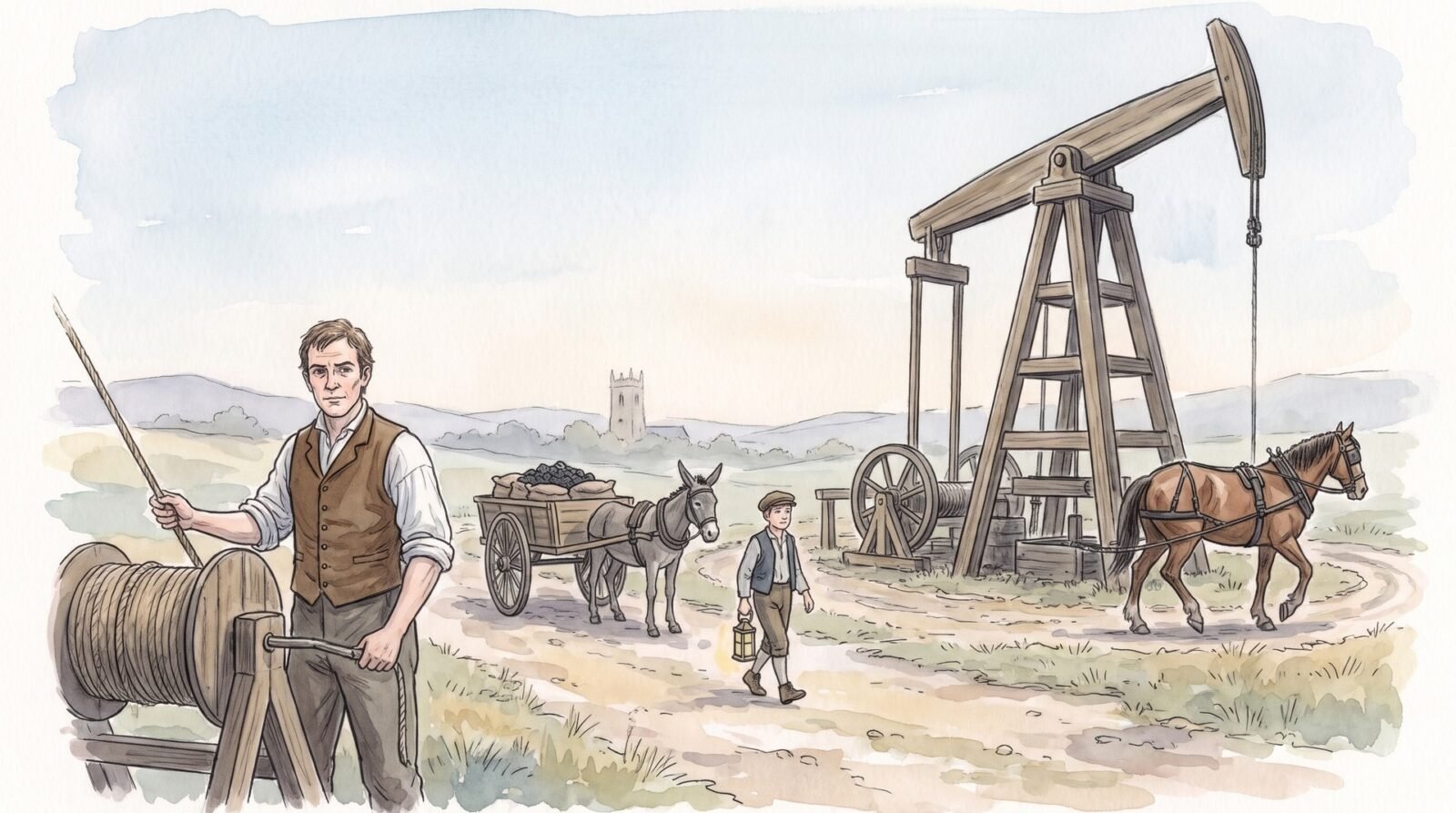
In the summer of 1712, in a brick engine house beside the coalfield at Tipton, a machine rather smaller than a ship’s capstan began to lift water out of a flooded mine. It burned coal at a rate that scandalised its owners, it wasted almost all the heat it made, and it worked. Everything that followed for the next two and a quarter centuries – the separate condenser, the rotative beam, the locomotive, the turbine, the power station – is in one way or another an attempt to make that waste smaller.
The Mine That Would Not Stop Flooding
The Black Country coalfield runs through southern Staffordshire and Warwickshire, and for most of the seventeenth century it was worked by people who went down with a pick and a bucket. The seams were shallow and near the surface, which was convenient, but it also meant that every pit was a sump. Water from the surface, water from the springs, water from the neighbouring hills found the workings and gathered in them, and the deeper a colliery pushed, the more water it had to lift every hour of every day. A horse walking in circles on a gin above the shaft could raise a remarkable amount of water. It was also slow, hungry and available only while the horse was willing. By the end of the century a number of the shallower pits had simply been abandoned, because the water beat the horses.
The machine that broke the deadlock was built by Thomas Newcomen, an ironmonger and lay Baptist preacher of Dartmouth in Devon, working with John Calley. The first successful engine was erected in 1712 at the Conygree coalworks at Tipton, close to Dudley Castle, and a second followed about a mile and a half east of Wolverhampton. Exactly where the first engine stood is still argued over, since contemporary notices and later retellings disagree about whether it was at Conygree or at the castle itself. The engine was small, with a cylinder of roughly twenty-one inches in diameter, and is reported to have made about twelve strokes a minute, lifting around ten imperial gallons on each stroke from a depth of some 150 feet.
It is worth stopping over the mechanism, because almost everything else in this story is a variation on it. The boiler sat directly beneath the cylinder, of the kind now called a haystack boiler: a squat shell of riveted plate on a brick setting, fed by a stoker and belched with its own smoke. From it, steam rose into a vertical cylinder that was open at the top. The piston was not screwed to the piston rod. It hung from it by a chain, and the chain hung from the arch head at the end of a great timber beam that rocked on its centre. The pump rods at the other end of that beam were chained in turn to the pump at the bottom of the shaft. In the larger engine houses the beam’s centre pivot was carried on two great cross beams running the length of the building, which the trade called the mother beams; the cylinder was seated on them, and they carried the pounding of the machine as well as its weight.
Here is the trick, and it is a beautiful one. At the start of the working stroke the beam is out of the house, engine side up. The heavy pump gear at the far end outweighs the piston, so the beam rests with its weight over the shaft. As that weight pulls the beam down, the piston is drawn up out of the cylinder and steam from the boiler rushes in behind it to fill the space. A jet of cold water is then injected into the cylinder and strikes the hot steam, condensing it. Condensation collapses the volume, the pressure under the piston falls away, and the atmosphere above the open top of the cylinder – which is simply the weight of the whole sky pressing down – drives the piston back down with a force of about fourteen pounds on every square inch of piston area. The beam swings into the house, the pump rods rise, and a stroke of water comes up the shaft. Then the water in the cylinder is pumped out by a small auxiliary engine, the steam returns, the beam is dragged back by the pump gear, and the whole thing begins again.
Nothing here is a push. The engine is worked by the weight of the atmosphere and the weight of its own pump rods, and the only thing the coal does is to make the steam and heat the injection water. That is why the design looks so strange to modern eyes. The piston cannot push, so the chain has to hang, so the beam must be balanced, so the pump gear must be heavier than the piston side. Every part of the arrangement stands downstream of that asymmetry.
Two problems had to be solved before the engine could run without a human mind in the loop. The first was the valves. The steam inlet and the injection cock had to be opened and closed at exactly the right moments, twelve times a minute. In the earliest engines a man did this, standing in the cold with a bar in his hand, turning the cocks. The story, which may be embroidered, is that around 1713 a boy named Humphrey Potter, employed to tend the valves, tied cords and catches to the beam so that the machine worked its own gear. By 1718 Henry Beighton, a mining engineer, had tidied the arrangement into what the trade called a plug tree: a rod hung from the beam carrying pegs that tripped levers and opened the valves at the correct points in the stroke. The engine had become self-acting, and that was what turned it from a curiosity into a machine.
The second problem was the seal. Early engines used a leather cup around the piston, then a rope seal held down by metal weights, in both cases with a film of water on top of the piston to keep the gap tight. No machine tool of the day could bore a cylinder to the accuracy a piston wanted, so a good deal of the steam escaped past it.
The cost of all this was coal, and the coal bill was ferocious. The engine burned coal not merely to make the steam it needed, but to heat a cold cylinder back up to working temperature on every single stroke, and then threw most of that heat away down the condenser. Its thermal efficiency is usually put at well under one per cent, with about half a cent the figure most commonly quoted, and it is not hard to believe figures that low. This is where it is important not to call Newcomen a failure. The engine did precisely what it was built to do, at a scale and a fuel cost that beat the horse gin, and it did so without any theory of heat to guide it. Joseph Black’s work on latent heat was still a decade away in 1720. Until somebody knew that steam had to surrender a hidden quantity of heat in order to become water, there was no way to see that the cylinder was being wasted, and therefore no way to see that the cylinder could be kept hot by moving the heat somewhere else. The waste was not a design error. It was the edge of the science.
The other thing that changed quickly was the material of the cylinder. The agreement for the first engine in Warwickshire, drawn up in 1714 for the colliery at Griff near Nuneaton, describes the machine with startling plainness: “A copper boiler a brass steam barren and Piston two pitt barrels of pott metall.” The engine’s proprietors there, Richard Parrott and George Sparrow, were already experimenting, and by 1717 Parrott was testing iron plates from the salt pans to replace the copper in the boiler. Cast iron was the material the industrial North of England could supply cheaply and in quantity, and a cast iron cylinder was both tougher and far cheaper than a brass one. The first iron cylinder is generally said to have been used at Hawarden in Flintshire in 1714 or 1715, and by the 1740s cast iron cylinders were ordinary, with Desaguliers advising them in print in 1743. The direction of travel is plain in the machine that survives as the memorial to Newcomen: a 22-inch bore engine bought second-hand in 1821 by the Coventry Canal Company for a water supply at Hawkesbury Junction in Warwickshire, very like the 1712 Dudley engine but, in the words of the American Society of Mechanical Engineers, “made of iron and not brass”. It was given to the Newcomen Society in 1963, moved to Dartmouth and re-erected there as the Newcomen Memorial Engine.
Meanwhile, on the other side of the country, the same problem of pumping was being solved for a different customer. The New River Company had been incorporated in 1619 to carry water from the Hertfordshire springs to London, and by the middle of the eighteenth century it needed more power than the windmill it had built in 1709 could give it. The windmill was followed in 1720 by a horse mill, which is itself a comment on the limits of pre-steam power. In 1766 the company turned to John Smeaton, and in 1768 Smeaton’s first steam engine was at work at New River Head, raising water from the Round Pond to the Upper Pond. The engine house he built there, a tall buttressed slab of brick, still stands. The company kept meticulous accounts, including notes and reports on the coal consumption of the engine and its effect on the water service, and those records are one reason we know so much about how these machines actually performed rather than how their makers said they did. For a water company buying coal by the cartload, the coal bill was the scoreboard, and the scoreboard was unforgiving.
The New River’s engine house is worth returning to, because its history is the whole argument of this essay in miniature. Smeaton’s engine was followed in 1785 by a Boulton and Watt engine with a 32-inch cylinder and an eight-foot stroke, working by parallel rather than rotative motion, at work by the end of 1786; it was about three times as efficient as Smeaton’s, which by 1792 had been written off. In 1811 and 1816 the two were replaced by single-acting parallel-motion engines with 48-inch cylinders and cast-iron beams, and in the 1840s those were altered to work expansively with cylindrical boilers, each delivering 150 horsepower. Steam power was finally replaced by electricity in 1950, and the engines and the chimney went with it. What the sequence shows is not a series of inventions but a series of measurements, each one answering the question the last measurement had posed: what did the coal cost, and how much less of it could the next engine need?
Measuring the Machine
John Smeaton was a Leeds law clerk who built instruments. He was the engineer who redesigned the third Eddystone lighthouse, and the method he used there is why he is the hinge of this story. He built the lighthouse in scale models, tested them in a trough of water, and measured how they behaved. He noticed that a small model would only behave like the full-sized thing if certain ratios were kept the same, above all the ratio of the model’s size to the wavelength of the waves it met. He generalised the idea into what is now called dynamic similarity, and it became the foundation of experimental method in engineering: you may study a large machine in a small model, provided you keep the right proportions and change everything else accordingly.
He turned the same method to the fire engine. The company engineers had been sending him the engine problem, and he built a series of models, tested them on a measured bench, and compared their duty: the weight of water raised a foot for each foot of coal burned, or in his own units, the millions of pounds of water raised one foot high per horsepower per day. His results, published in 1769 as “A Narrative of the Construction and Effects of the New Fire-Engine for the Raising of Water” in the Philosophical Transactions of the Royal Society, were startling in two ways. First, the best small beam engine on his bench raised more water for each bushel of coal than the full-sized engines the company was running in London. Second, the fault was not size but design: the way the cylinder was heated and cooled, the arrangement of the valves, the shape of the beam and the placement of the cylinder relative to its fulcrum. Smeaton’s models were not toys. They were a measuring instrument.
He then built the full-sized engine at New River Head. He had promised the company an engine that would more than double the pumping power of the horse works and cost less to run. The engine was erected in 1768 and working by early 1769, with an asymmetrically pivoted beam of laminated timber and an eighteen-inch cylinder with a nine-foot stroke. It was, in the dry phrase of the Survey of London, “one of trial and failure”: by 1774 it was clear that it did not work anything like as efficiently as had been hoped, and by 1792 the company had come to deem it wholly useless. But the setback did something more valuable than a success would have done. It sent Smeaton back to his models, and the experiments that followed, on the jet, on steam, on the latent heat of steam, informed the innovations of a young instrument maker in Glasgow whose name was James Watt.
In 1763 Watt was asked to repair a small Newcomen engine belonging to the University of Glasgow, and he found that the model consumed an enormous quantity of steam to heat the cylinder again after each stroke. His diagnosis was the same as Newcomen’s unspoken one: the heat was going into the cylinder rather than into the work. His answer, conceived in 1765 and patented in January 1769, was to put the condenser in a separate vessel and connect it to the cylinder by a pipe, so that the steam could be condensed without cooling the cylinder itself. The cylinder could then stay hot, and the steam used per stroke fell dramatically. The patent of 1769 covered the separate condenser for the single-acting engine; in 1775 it was extended to twenty-five years and widened to cover the double-acting engine, in which steam pushes the piston from both ends, together with other improvements. Watt had the idea of double acting at the same time as the separate condenser, and the two together would produce the machine that still carries his name.
Watt needed money. In 1765 he went into partnership with John Roebuck, a Leeds manufacturer whose interests in coal and iron were exactly what the work required and whose own finances were not. The partnership broke up in 1769, the patent was taken out in the names of Boulton and Watt, and Matthew Boulton, a Birmingham manufacturer who had made his fortune in buttons and silverware and then in engineering, bought Roebuck’s share in 1773. From 1775 Boulton and Watt manufactured engines at Soho near Birmingham. In 1795 they opened the Soho Foundry, with its own rolling mill and pattern shop, and from 1800 they supplied complete engines of their own manufacture rather than drawings for engines to be built elsewhere by other people. That foundry was where the business of selling performance rather than machines really began.
But a pumping engine in a coalfield has a narrow use. To change what the steam engine could do, Watt had to turn its reciprocating motion into rotation. The rotative engine of 1781 used a gear called the sun and planet: a wheel the diameter of the crank wheel, with teeth cut on its face, meshing with a smaller planet wheel on the crank pin. On the dead centre of the stroke the two gears meshed in opposite directions, giving a drive that did not vary in speed and did not need the heavy flywheel that a crank alone would have required. The arrangement was put to serious work at the Albion Mills in London, which was grinding flour by steam from the mid-1780s. Then came the problem of the connecting rod, which had to drive a piston moving in a straight line while the beam swung. Watt’s parallel motion, patented in 1784, copied the arc of the beam with a linkage of rods, so that the cylinder could sit at the end of the beam and still work through a long stroke, which in turn allowed a single cylinder to do the work of two. And in 1788 Watt added the centrifugal governor, a pair of weighted arms on the shaft that flew outward as the speed rose and closed a throttle on the steam valve, so that the engine held its speed whatever the load. The governor was the difference between an engine that had to be stopped every time the mill needed changing and an engine that could be left in charge of a textile mill or a rolling mill.
How, then, did the customer know what to pay? Here is where the engine becomes a business. Boulton and Watt did not sell engines at a fixed price. They offered to make the customer a saving and to take a share of it: the customer paid them one third of the money saved by using a Watt engine instead of a Newcomen engine, the saving being measured in coal. The company kept the account, took the measurements, and sent a remittance when it was owed. It was an arrangement that aligned the engine maker with the engine owner’s running cost, and it gave Boulton and Watt a motive to measure with a rigour nobody had applied before. It also gave them a motive to keep quiet. Their business depended on an engine that only they could draw well, and the archives are full of evidence that they guarded their customers’ drawings, their dimensions and their customers’ identities. The records of the firm are the celebrated Boulton and Watt Collection, MS 3147, now held in the Birmingham City Council Archives; the careful reconstruction of that collection by H. W. Dickinson and others is what has made it possible to follow engine by engine what the partners were doing and why.
The measurement idea travelled. In the Cornish tin and copper mines, where coal had to be imported at great expense, duty became the local currency, and engine keepers recorded it month by month so that owners could see whether they were getting their money’s worth. The Cornish single-cylinder beam engine, which ran its steam into the cylinder in one direction and used the weight of the pump rods to drive it back, was built around that arithmetic, and its makers competed on it. The museum at Kew Bridge still holds a row of them: the Boulton and Watt engine of 1820 that came from Chelsea Pumping Station and was later converted to high-pressure working, a Maudslay engine of 1838 converted to the Cornish cycle in 1848, a ninety-inch Grand Junction engine of 1846 that is the only Cornish engine over eighty inches bore still in operation, and a hundred-inch engine of 1869, one of the four largest such machines left in the world. Between 1820 and 1869 the cylinder diameter of the Cornish engine grew from sixty-five inches to a hundred, and the driving force was not new physics but competition measured in millions of pounds of water per hundredweight of coal.
From the Pit to the Road and the Rail
Everything so far has been a low-pressure machine, a machine that works by making a vacuum. Its weakness is that it needs a foundation, a boiler and a condenser with cooling water, and it is at its best pumping a heavy rod up and down a shaft. The way out was to use steam above atmospheric pressure, so that the piston is driven from above as well as pulled from below. Richard Trevithick, a Cornish engineer working in a corner of Wales, was the first to get a high-pressure engine to work properly. In 1802 he drove a road locomotive on the public roads, hauling a wagon with passengers and a barrel of water, and a version of the same machine went to Paris the following year. A larger engine of 1803, the Colossus, hauled a loaded wagon along the Cambrian roads and was christened with a challenge that became its name: Catch me who can. In 1804 a Trevithick locomotive worked the Penydarren tramroad in Glamorgan, using a boiler of cast iron bars and a steam blast in the chimney to draw the fire. For a few years in the early 1800s the steam locomotive was a fact rather than a fantasy.
And then it stopped. The high-pressure boiler was the weak point. Trevithick’s cylinders were brittle and his boilers leaked, and sometimes they burst, and the whole scheme ran aground not on principle but on metallurgy. Cylinders had to be bored accurately and to a depth that no foundry could yet achieve; the wrought iron plate of the time could not be trusted with the pressures a locomotive needed. For roughly sixty years the steam engine in general, and the locomotive in particular, were held back less by any lack of theory than by the quality of the iron and the skill of the machinists. It took the foundrymen of the north-east, the puddlers of the Midlands and the boiler makers of the Clyde to catch up.
And the iron industry needed steam as badly as the mine did, which is the point where the story closes back on itself. Puddling, the process of converting pig iron into malleable wrought iron, was a brutal business of heat, hammer and puddler’s sweat, and the first large-scale use of steam in the iron trade was to drive the hammers that did the work and then the rolls that replaced them. The blast furnace, which had been blown by water for a century, was gradually taken over by steam-driven blowing engines. Coal and iron were needed to build those engines; engines were needed to drain the coal and to work the iron. Engines were built with iron, iron was made with engines, coal was burned to run the engines that drained the coal. The feedback loop is the industrial revolution in a single sentence.
Meanwhile the locomotive had been waiting for the iron to catch up. George Stephenson, the son of a Northumberland colliery fireman, built his first locomotive in 1815 to haul coal from the Killingworth pit to a wagonway on the Tyne, and by the time the Liverpool and Manchester Railway was promoted in 1826 he was its chief engineer, with the ballast and the rails bought in bulk from foundries that had learned to make iron in quantity. When the line opened on 15 September 1830 it ran scheduled passenger services between Liverpool and Manchester with no horses and no fixed power stations anywhere on the route, an arrangement that other companies copied with remarkable speed. The first inter-city railway in the world was decided, in effect, by a competition to see which machine could pull the heaviest load fastest, and the competition was settled in public, in front of a crowd, on a measured mile of track.
Out of that loop came the railway, and the railway brought with it the first great public trial of the steam engine, the Rainhill Trials of October 1829. The Liverpool and Manchester Railway had offered a prize of five hundred pounds for the best locomotive, and required any entrant to draw three times the weight of its own train on level track and then four times, at a minimum average speed of ten miles an hour, over a measured mile at Rainhill. Five engines were entered. The first day of the trials, 6 October, was largely a parade of failures: Novelty could not get started, Persevere cracked its boiler, and Cycloped was withdrawn. Rocket, built by Robert Stephenson with the Liverpool and Manchester treasurer Henry Booth, arrived late, on a wagon, and went straight out on the first day and ran badly. On its own trial day, 8 October, it ran properly. Its boiler was a horizontal multitube design, a large return flue and some two dozen small tubes connecting the firebox to the chimney, an arrangement for which the credit belongs to Booth, who had heard of the idea from a Northumbrian millwright and pressed it on Stephenson. The two inclined cylinders acted directly on the driving wheels with no intervening gear, and the exhaust steam was blown up the chimney to raise the draught. The other two entrants, Novelty and Sans Pareil, had both adopted vertical cylinders, and a vertical cylinder cannot drive a wheel directly without return cranks; that choice was exactly what Rocket avoided. Rocket pulled its own train of nearly thirteen tons over twelve miles of running at an average of about thirteen and a half miles an hour, and on its measured runs averaged 13.4 and then 14.2 miles an hour. It was the only engine to finish the whole trial. It won the prize, Stephenson was given the contract for the railway’s locomotives, and the trials ran to 13 October. The set of trials at Rainhill is the oldest known instance of a formal performance test settling a competition between rival machines, and it is the ancestor of every engine test bench since.
There was a human cost to all of this too, and it came packaged with the coal. Railway construction in the 1820s and 1830s was dangerous work that killed men in their hundreds through accidents, blasting and the collapse of cutting faces, and the men who then ran the trains worked long hours in the heat of the boiler room. The locomotive was by a wide margin the most dangerous machine the Victorians owned, and the railwaymen’s own unions spent much of the second half of the nineteenth century arguing with the companies over hours, over pay and over the interlocking of signals that would have saved lives. The machine that won the trial at Rainhill was a triumph of the metallurgy of its boiler tubes as much as of its cylinders, and it brought with it a set of hazards that Britain spent the rest of the century learning to manage.
The railway changed the steam engine as much as the steam engine changed the railway. It created a vast new market for iron and coal, and it did so in the most self-reinforcing way imaginable: the same coal that powered the engines at the pit was now carried away from the pit on the engines’ own railway, and the rails and the locomotives were themselves made of the coal and iron that the system produced. The railway also made a national market in a way that coal and iron had never been. British coal output, which had been a few million tons a year in the middle of the eighteenth century, was around fifty million tons by 1850 and approaching three hundred million tons by 1913, and the steam engine was the machine that burned it. The railway opened in September 1830, and the steam age arrived faster than anyone watching had any reason to expect. In the fifty years before the trials the engine had been a machine that pumped water out of holes in the ground. Within thirty years of Rainhill it was hauling the food of the industrial towns.
The Cycle and the Turbine
To understand what happened next you need one more instrument, and it is the most important tool in the whole history. The indicator was a small piston, connected by a lever to a pencil, allowed to move up and down with the pressure inside the cylinder while the engine turned. The pencil traced a closed loop on a card: a picture of what the steam actually did. Its use was pioneered by Watt and then by John Southern, and from the 1780s it became routine to draw the diagram of every engine. It turned an engine from a lump of iron into an argument that could be read on paper, and it is the direct ancestor of the cylinder pressure trace that every modern engine test still records. Watt used it to see the effect of expanding the steam in the back of the cylinder, which is how his expansive working of 1782 and the compound engines that followed were designed.
For a century after Watt the steam engine was improved by measurement but not yet by theory. The theory came from Scotland. William John Macquorn Rankine, an engineer and physicist who had worked on the molecular theory of heat with William Thomson, began in the 1850s to treat the steam engine as a thermodynamic system rather than an assembly of parts. His paper “On the Mechanical Theory of Heat” appeared in the Transactions of the Royal Society of Edinburgh in 1854, and in 1857 he set out the cycle that now carries his name: the working fluid is heated at constant pressure in the boiler, expanded adiabatically in the cylinder, condensed at constant pressure in the condenser, and then pumped back to the boiler against a small pressure difference. He also introduced the word transformer for the device that carries the heat from the boiler to the working cylinder, which is the entire heat engine in a single term. Rankine gave engineers a way to calculate what an engine ought to achieve before it was built, and he gave the profession its steam tables.
There is a wrinkle worth stating plainly, because it is usually glossed over. The Rankine cycle was never actually built. No engine was ever made to follow the ideal cycle exactly; the separate condenser, the wetness losses in the turbine and the pump work in the condenser all push real machines away from it. The Rankine cycle is the ideal against which every real steam engine is measured, a construction of the textbooks rather than a machine you can visit. That is not a criticism of Rankine. The purpose of an ideal cycle is to tell you how much better you could do and where the gap lies, and the gap is exactly what engineers spent the rest of the century closing.
The ladder is steep at the bottom and flat at the top. The Newcomen engine converted well under one per cent of the energy in its coal into work, the figure usually given being about half a cent. Watt’s improved engines, on the evidence of Smeaton’s duty figures and the Cornish records, were several times better, of the order of two to three per cent, which sounds negligible and was revolutionary, since it meant a given amount of coal would now do three times the pumping. A good compound engine, in which steam is expanded in two or three cylinders of increasing size, reached the high twenties per cent by the end of the nineteenth century, and the triple-expansion marine engine that did so much for steamship range sat in the same region. A modern combined-cycle plant, in which a gas turbine drives an electricity generator and its hot exhaust is used to make more steam for a steam turbine, reaches well over sixty per cent, with the best installations in the low sixties. The precise figures vary with the fuel, the load and the ambient temperature, and the literature disagrees about some of them, but the shape of the curve is not in doubt. The first improvement was enormous, and nearly all of it came from measurement and metallurgy; the last century and a half has been a long grind of a few percentage points at a time.
The triple-expansion engine is the climax of the piston engine. The idea, worked out by John Elder and Ebenezer Birnie of Glasgow, was to admit steam at high pressure into a small high-pressure cylinder, let it expand into a larger intermediate cylinder and then into a larger low-pressure cylinder, so that the work is shared among three pistors instead of one and the expansion is spread over three volumes. The first ship to use it was the SS Adriatic of 1881, built by Robert Napier and Sons, and within a decade it was standard. It is the direct descendant of Watt’s expansive working and of the compound engine that Jonathan Hornblower had argued for, painfully and successfully, in the 1780s and 1790s, and against which Boulton and Watt had fought him in the courts.
But there is a limit to how big a cylinder you can bore, how long a stroke you can crank, and how many times a minute a reciprocating mass can be driven without the machine shaking itself to pieces. The way past that limit was to abandon the piston. Charles Algernon Parsons had been an apprentice at William Armstrong’s Elswick works, then at Kitson’s in Leeds, and in 1884, at Clarke, Chapman and Co on the Tyne, he built the first turbine-driven generator in the world: a machine with a series of rotating wheels on a shaft turning at 18,000 revolutions a minute, driving a dynamo at that speed so that electricity could be generated directly, without a slower intermediate shaft to gear up from. It was a very small machine and an extraordinarily inefficient one by later standards, but by 1888 some two hundred of Parsons’s turbines were in service, mostly lighting ships. He left Clarke, Chapman and Co, and in 1889 founded C. A. Parsons and Company at the Heaton Works in Newcastle; in 1890 his Newcastle and District Electric Lighting Company opened Forth Banks power station in the city, the first in the world to generate electricity with turbo-generators. The engineering insight behind it was that the whole pressure of the steam should be given up as flow rather than as push, and that a turbine could be built with enough stages to take that pressure down in small steps, keeping the velocity of the steam low enough not to cut the blades.
The demonstration was a spectacle, and it was meant to be. In 1894 Parsons patented turbine propulsion and formed the Marine Steam Turbine Company; in June 1897 his experimental steam yacht Turbinia was put through the Diamond Jubilee Fleet Review at Spithead, sailing through the assembled squadrons at a speed of around thirty-four knots while the navy’s fastest battleships, with all the boiler power the Admiralty could give them, could not manage about twenty. The fleet had been told to ignore her. By the time the ships turned to give chase, she was gone. Within a few years turbine-driven warships were the standard, and HMS Dreadnought of 1906, with Parsons turbines driving turbines in turn, was built around the fact that speed had become the decisive variable in naval design. Parsons’s own turbine engine was presented to the Science Museum in London in 1928.
It is worth being clear about what the turbine did and did not replace. The reciprocating engine was not swept away. It remained the best machine for the slow, heavy, long-stroke work of driving a mill or a ship’s winch, and it remained in ships for years as the auxiliary engine, running the pumps and the dynamos. What the turbine replaced was the piston in the two places where the piston had run out of room: high-speed rotation, and power of a size that no single cylinder could be made to deliver. And what the turbine did not replace, at least on the road, was the whole steam engine, because the internal combustion engine was already taking that job. The steam locomotive was driven by the piston engine for its entire working life, with a turbine replacing the piston only in the last decades, and then only in some classes of engine. The steam turbine’s real descendants are not steam engines at all. They are the electrical generators of the twentieth century, which is to say that the machine that began as a way of draining a coal mine ended as a way of making electricity.
What the Steam Age Cost
Start with the fuel. The steam engine’s appetite for coal was the condition of everything else it did, and the scale of it is difficult to hold in the mind. British coal output grew from a few million tons a year in the middle of the eighteenth century to roughly fifty million tons by 1850 and to something approaching three hundred million tons by 1913, and essentially all of that coal was burned to make steam that turned a piston or a turbine. Two centuries of the world’s industrial economy have run on this one fuel, and the reason it was chosen was not that it was good but that Britain had it, in quantities no other country could match, close to the iron and the water that the rest of the system needed.
The people who paid for the coal were the people who dug it, and they were not the people who profited from it. Children went underground in large numbers through the eighteenth century and into the nineteenth, hauling tubs and working the ventilation doors, because they were small and cheap and could get into places adults could not. Parliament’s first attempt at restriction, the Coal Mines Act of 1862, raised the minimum age for underground work to ten, with exceptions for the boys who tramped the cylinders of ventilation doors; the Act of 1872 tightened things further, the Mines Act of 1889 raised the general minimum age to twelve, and the Mines (Coal) Act of 1908 finally set it at fourteen. Each step followed a disaster or an inquiry. The death toll in the nineteenth-century British coal industry ran at many hundreds a year by the later decades and into the thousands in the worst years, and the injuries, far more numerous than the deaths, ended careers at every age. The steam engine freed the mine from the horse and made deep mining possible at all; it also built the traffic that killed and maimed the men who went down with it.
The inspection that followed was slow and contested. A Royal Commission on Mines reported in 1872, and the Mines Act of 1872 made inspection a matter for the state, paid for out of public funds rather than by the coal owners, which the owners had resisted. The commissioners described conditions in which children worked in water and darkness, where the ventilation was so poor that a horse could not stand, and where nothing resembling a rescue organisation existed when a pit flooded. The recommendations on rescue and on the training of underground men took far longer to put into effect than the recommendations on inspection, and the gap between the two was paid for in lives.
The other cost was the boiler. The high-pressure boiler was the most dangerous mass of iron in the nineteenth-century world, and the record is bad. There were years in the middle of the century when boiler explosions killed hundreds of people, and the campaigns against them were led by engineers and insurers rather than by the state. The Manchester Steam Users’ Association, formed in 1855, began inspecting boilers and insuring them against explosion, and by the 1860s the argument for statutory inspection was being made in terms of the dead. The Boiler Explosions Act of 1882 finally required boilers to be registered and to be examined at intervals by a person appointed as competent for the purpose, and a further Act in 1890 tightened the requirements and extended them. The safety laws were not a gift from above. They were the price of the engine, written down in the aftermath of the explosions the engine made possible.
And then the carbon, which is the bill that has not come due. Burning coal releases carbon dioxide, and burning the coal that the steam engine consumed added more carbon dioxide to the atmosphere than anything else humanity had done up to that point. It is worth being precise about the engine’s contribution, because the usual shorthand is too simple. The steam engine was not the source of the carbon problem. It was the mechanism that made the carbon problem affordable, by turning a fuel that was of no use at all into the most useful energy carrier ever devised. It is also true that the engine has been getting steadily less carbon-intensive for two centuries, and the efficiency figures in this essay describe an improvement of something like two orders of magnitude in the carbon emitted per unit of work delivered. The problem is that the amount of work demanded grew faster than the efficiency improved, so the total emission rose anyway, and the concentration of carbon dioxide in the atmosphere is now roughly half again what it was before the industrial revolution and still climbing. The engine did not create the problem. It made the problem possible, and then it made it unavoidable, and it did both in the same generation.
The coal did not stay inside the engine house either. Every horsepower the steam age added put more smoke over the towns that the same horsepower was feeding, and for a century the British industrial city breathed its own fuel. Sulphur from the coal, soot from the boilers and the damp air that the coal helped to load with pollution produced the recurring smogs of the early twentieth century, the worst of them in London in December 1952, when an inversion held the smoke of the city down and several thousand people died in a few days. It took a statute aimed at smoke, and then a slow conversion away from coal, before the air of the industrial city improved at all. The engine’s exhaust was not a side effect of the steam age. It was the steam age, hanging over the houses of the people who worked it.
It is only fair to say what the engine bought in return. Coal that was cheaper to move made salt, glass, iron and pottery cheaper to make; a railway that replaced the wagon made flour and fuel cheap in the cities that had no local coal; and a mechanised textile industry put cotton cloth within reach of people who had worn wool or linen. None of this was a gift from the engine alone, and the gains came unevenly and late. But the engine was the machine that made cheap energy the general condition of industrial life, and the long rise in real wages that followed the middle of the nineteenth century is not explicable without it, however uneven that rise was and however much of the profit of the first industrial revolution was captured rather than shared. The engine made a century richer and a century dirtier, and it did both at once, at the same speed.
Which brings the story back to where it can be measured. The steam engine is not a museum piece. It is running in coal-fired power stations around the world, and it is the reference point against which every other heat engine is still judged, because it is the machine that taught the world what efficiency means. The Carnot limit, the theoretical ceiling on any heat engine working between a boiler at roughly six hundred degrees Celsius and a condenser at roughly thirty, is somewhere around sixty-five per cent, and every steam plant ever built lives under that ceiling. That is why the combined cycle, a gas turbine burning gas and a steam turbine burning the gas turbine’s waste heat, is the standard modern answer: two engines in series beat one, and beat it by enough to have changed the economics of electricity. The argument that the steam engine made, that a machine’s performance can be measured, that the measurement can be improved, and that the improvement can be sold, is the argument we are still using about carbon. The engineers who built these machines in brick engine houses with soot on the ceiling could not have imagined where it would end. But they did the thing that made the ending possible. They turned the machine into a number, and then they made the number go up.
References
- Newcomen atmospheric engine - Science Museum Group Collection, object number co50900, London
- Newcomen Engine, Historic Mechanical Engineering Landmark No. 70 - American Society of Mechanical Engineers with the Institution of Mechanical Engineers, designated 17 September 1981, Dartmouth, Devon
- Men and Mining in Warwickshire - A. W. A. White, Warwickshire Industrial Archaeology Society and Warwickshire County Council
- Records of the New River Company - The London Archives, series ACC/2558/NR, and ACC/2558/MW/C/15/041, notes and reports on the coal consumption of Smeaton’s fire engine and its impact on the water service, 1766-1792
- Survey of London: New River Head - H. P. L. Finberg ed., Survey of London, volume 47, London County Council, 1975
- The Steam Engine of Thomas Newcomen - L. T. C. Rolt and J. S. Allen, Moorland Publishing, Hartington, 1977
- Rotative Steam Engine by Boulton and Watt, 1788 - Science Museum Group Collection, object number 1861-46, London
- Boulton and Watt Rotative Steam Engine, Historic Mechanical Engineering Landmark No. 111 - American Society of Mechanical Engineers, designated April 1986, Power House Museum, Sydney
- Archives of Soho: the Boulton and Watt Collection - Birmingham City Council Archives, MS 3147
- Archive overview - Institution of Mechanical Engineers, London
- James Watt and the Steam Engine - H. W. Dickinson and Rhys Jenkins, Clarendon Press, Oxford, 1927, reprinted 1981
- The State and the Steam-Boiler in Nineteenth-Century Britain - Roger Hahn, The Cambridge Historical Journal, volume 25, 1963
- Liverpool Manchester Railway and Site of Rainhill Trials, Historic Mechanical Engineering Landmark No. 263 - American Society of Mechanical Engineers with the Institution of Civil Engineers, the Institution of Mechanical Engineers and the American Society of Civil Engineers, designated 14 September 2016
- Kew Bridge Cornish Beam Engines, Historic Mechanical Engineering Landmark No. 194 - American Society of Mechanical Engineers with the Institution of Mechanical Engineers, designated 10 July 1997, Kew Bridge Steam Museum, Brentford
- Turbinia, Historic Mechanical Engineering Landmark No. 73 - American Society of Mechanical Engineers, Discovery Museum, Newcastle upon Tyne
- Boiler Explosions Act 1882 - legislation.gov.uk, 45 and 46 Vict. c. 22, amended by the Boiler Explosions Act 1890, 53 and 54 Vict. c. 35