The Antikythera Mechanism
In the National Archaeological Museum in Athens, in a dimly lit case, lie the corroded remains of a bronze instrument that was lifted from the sea floor off the small Greek island of Antikythera in 1901. The largest fragment is about the size of a hand. Its surface is green and crusted, and at first sight it resembles a lump of weathered rock; looked at more closely, it shows the edge of a toothed wheel, and then another, and the fine lines of inscribed Greek letters. The object, now known as the Antikythera mechanism, was a geared calculating device that modelled the movements of the Sun, the Moon and probably the planets, predicted eclipses, and kept track of calendars and the cycle of the Panhellenic games. It was made in the Greek world in the second or early first century BC. Nothing of comparable mechanical complexity survives from anywhere in the world for more than a thousand years after it. This article describes the shipwreck in which it was found, the long effort, spread over more than a century, to understand what it was, and what it reveals about Greek astronomy and engineering.
The Wreck off Antikythera
Antikythera is a rocky island of about twenty square kilometres lying between Kythera and the western tip of Crete, on the sea route between the Aegean and the central Mediterranean. In the spring of 1900 a party of sponge divers from the island of Symi in the Dodecanese, under their captain Dimitrios Kontos, sheltered from a storm in the lee of the island on their way home from the fishing grounds off North Africa. When the weather cleared they dived off Point Glyphadia and one of them, Elias Stadiatis, came up from a depth of some forty-five metres with a story of a heap of dead men and horses on the sea floor. Kontos went down himself and returned with the bronze arm of a statue. The sponge divers had found the wreck of a large ancient merchant ship, and the “dead men and horses” were bronze and marble statues lying among the remains of her cargo.
Kontos reported the find to the Greek authorities, and in November 1900 the government, with the help of the Greek navy, began what is often described as the first major underwater archaeological excavation. The divers worked in heavy standard diving dress at the limit of what was possible, in strong currents and cold water, and the work was dangerous: one diver died of decompression sickness and two others were paralysed. Over the following ten months, until September 1901, they recovered a remarkable cargo: bronze statues, among them the figure now known as the Antikythera Youth; dozens of marble statues, badly eroded on the sides that had been exposed to the sea; glassware, pottery, amphorae, furniture fittings and coins. The coins, from Pergamon and Ephesus, and the style of the pottery and other finds date the sinking to about 70 to 60 BC. The ship seems to have been sailing westwards from the eastern Aegean, perhaps carrying luxury goods to wealthy buyers in Italy, when she went down. The site and its finds are summarised in the Grokipedia entry on the Antikythera wreck.
The finds were brought to the National Archaeological Museum in Athens, where the staff concentrated at first on the statues. Among the lesser material was a heavily corroded mass of bronze and wood that had been stored in the open air. As the wood dried and shrank, the lump split apart into several pieces. In May 1902 the archaeologist Valerios Stais noticed that one of the fragments had a gear wheel embedded in it and that there were inscriptions in Greek on others. Stais suggested that the object was an astronomical instrument, perhaps an astrolabe. Many scholars doubted that such a complex mechanism could be ancient, and some suggested that it had come from a later wreck on the same site. The inscriptions, however, were in a Greek script consistent with the first century BC, and the fragments had been recovered from the same deposit as the rest of the cargo.
First Interpretations
For the first half of the twentieth century the mechanism was studied by a succession of scholars who could see only what was visible on the surfaces of the fragments. The German philologist Albert Rehm, who examined it from 1905 onward, recognised that it was a calculating device rather than an observational instrument like the astrolabe and suggested, correctly as it turned out, that it involved astronomical periods such as the 19-year cycle of the Moon. The Greek numismatist Ioannis Svoronos published photographs and a description in 1903, and the naval officer Jean Theophanidis made an early attempt at a reconstruction in the 1930s. Rehm’s notes were never published in his lifetime, and the work as a whole made only limited progress, because the essential structure of the device was hidden inside the corroded fragments.
The first systematic attempt to understand the gearing was made by the British physicist and historian of science Derek de Solla Price, who began to study the fragments in 1951. In 1959 he published an article in Scientific American under the title “An Ancient Greek Computer,” arguing that the mechanism was a geared calendar computer that displayed the positions of the Sun and Moon. In 1971 Price worked with the Greek radiographer Charalampos Karakalos of the Greek Atomic Energy Commission, who took gamma-ray and X-ray images of the fragments that showed for the first time the gear trains inside them. Price counted the teeth of the gears as best he could from these images and published his reconstruction in 1974 in a monograph entitled Gears from the Greeks. He proposed that the mechanism had a differential gear, which would have been an astonishing early instance of a device not otherwise known until the modern era. Price’s counts and some of his interpretations were later shown to be wrong, but his work established beyond doubt that the mechanism was a sophisticated geared calculator and placed it at the centre of discussions of ancient technology.
The next decisive steps were taken by Michael Wright, a curator of mechanical engineering at the Science Museum in London, who began to study the mechanism in the 1980s, at first with the Australian computer scientist Allan Bromley. Using a technique called linear tomography, which produces X-ray images of thin slices through an object, Wright made new and much clearer images of the gear trains. He showed that Price’s differential gear did not exist, and he identified a remarkable arrangement of two gears mounted on a rotating platform, one driving the other through a pin on one gear engaging a slot in the other. The two gears turned on slightly offset axes, so that the motion transmitted through the pin and slot was not uniform but sped up and slowed down in the course of each turn. Wright recognised that this pin-and-slot device modelled the variable speed of the Moon across the sky, the phenomenon that astronomers call the lunar anomaly. He also argued that the front of the mechanism had displayed the positions of the planets, and he built a working model on that basis.
The Research Project
In 2005 an international team, the Antikythera Mechanism Research Project, combined new imaging technologies to study the fragments in detail. The project brought together the astronomer Mike Edmunds and the mathematician and film-maker Tony Freeth from Cardiff University, the astronomers John Seiradakis and Xenophon Moussas from the universities of Thessaloniki and Athens, and the National Archaeological Museum, with support from the Hewlett-Packard laboratories and the X-ray company X-Tek Systems. X-Tek brought to Athens a specially built microfocus computed tomography machine, weighing about eight tonnes, which produced three-dimensional X-ray images of the interiors of the fragments with a resolution far beyond anything previously available. A team from Hewlett-Packard led by Tom Malzbender used a technique called polynomial texture mapping, which photographs a surface under light from many directions and allows it to be viewed afterwards under any lighting, to bring out inscriptions on the surfaces of the fragments that were invisible to the naked eye.
The results, published in the journal Nature in November 2006 in a paper led by Freeth, transformed understanding of the mechanism (Freeth and others, 2006). The computed tomography revealed hidden gears, made it possible to count the teeth on many of them with much greater confidence, and showed thousands of new characters of inscription, many on the inside surfaces of the fragments that had never been seen. In all, eighty-two fragments are now catalogued, and some thirty gears survive, the largest about thirteen centimetres across. In 2008 the project published a second paper in Nature that identified the names of the months on the calendar dial and the names of the games on a subsidiary dial. Later work, including a careful edition of the inscriptions published in 2016, has raised the count of readable characters to about 3,500, a substantial text that describes the mechanism, how it was used, and what it showed.
How the Mechanism Worked
As now reconstructed, the mechanism was housed in a wooden case about thirty-four centimetres high, eighteen wide and nine deep, roughly the size of a large book or a shoebox, with dials on its front and back faces and a handle or knob on its side. Turning the knob drove a large four-spoked gear wheel near the front, which represented one year, and through it a network of gears inside the case. The user set the device to a chosen date by turning the knob, and the dials then showed the corresponding astronomical and calendrical information. The mechanism was in this sense an analogue computer: it did not observe anything, but calculated by the ratios of its gear teeth the positions and cycles that astronomers had derived from long observation.
The front face carried two concentric scales. The outer one was a ring marked with the 365 days of the Egyptian calendar, which had twelve months of thirty days and five additional days; because the true year is about a quarter of a day longer, the ring could be moved by a quarter-day each year to keep it in step, and holes for a pin survive along its edge. The inner scale was marked with the twelve signs of the zodiac, divided into degrees. Pointers moving over these scales showed the position of the Sun and the Moon in the zodiac, and a small ball on the lunar pointer, half dark and half light, turned to show the phase of the Moon. Through the pin-and-slot gearing identified by Wright, the lunar pointer moved faster and slower in the course of each month in the way the real Moon does, following a model of lunar motion associated with the astronomer Hipparchus, who worked at Rhodes in the second century BC.
The back face carried two large spiral dials, one above the other, with smaller subsidiary dials within them. The upper spiral had five turns divided into 235 cells, one for each lunar month in the Metonic cycle, the period of nineteen years after which the phases of the Moon recur on the same days of the solar year. The cells were labelled with the names of months, and the 2008 study showed that these were the months of a calendar of Corinthian type, of the kind used in Corinth’s colonies in north-western Greece, in Illyria and Epirus, and in Syracuse in Sicily. A pointer with a pin running in the spiral groove moved outward as it turned, so that it could follow the five turns of the dial. Within the upper spiral a small dial divided into four sectors showed the four-year cycle of the Panhellenic games. The sectors were labelled with the names of the games held each year, including the Isthmian, the Pythian at Delphi, the Nemean, the Naa held at Dodona, and the Olympic Games, which gave the device a name in modern accounts as an “Olympiad calculator.”
The lower spiral was the eclipse dial. It had four turns divided into 223 cells, one for each lunar month in the eclipse cycle known as the Saros, a period of about eighteen years and eleven days after which eclipses of the Sun and Moon recur in a similar sequence. Certain cells were marked with glyphs indicating that an eclipse was expected in that month, whether of the Sun or of the Moon, and with abbreviated information about the hour of the day or night at which it would occur and, in some cases, its colour or size. Because the Saros is not a whole number of days, each successive cycle begins about eight hours later than the previous one, so that eclipses predicted for one cycle would occur a third of a day later in the next. A subsidiary dial within the lower spiral, divided into three sectors, kept track of this triple cycle, called the exeligmos, so that the times shown could be corrected. One of the largest surviving gears in the train that drove the eclipse dial has 223 teeth, matching the number of months in the cycle.
The Planets and the Cosmos
Whether the mechanism also showed the positions of the five planets known in antiquity, Mercury, Venus, Mars, Jupiter and Saturn, has been one of the most debated questions in its study. The gearing for the planets does not survive, but there is strong indirect evidence. The main four-spoked wheel has fittings that seem to have carried additional gear trains, and the inscriptions on the back cover plate, which served as a user’s manual, refer to the planets by name and to their stationary points and retrograde motions. Wright built a model with planetary gearing in the early 2000s, and in 2021 a team at University College London led by Tony Freeth published in Scientific Reports a full reconstruction of the planetary display on the front face (Freeth and others, 2021).
The UCL team used inscriptions on the front cover plate, which give the synodic periods of the planets as numbers of years, to infer the cycles built into the mechanism. They identified a period of 462 years for Venus and one of 442 years for Saturn, cycles that are very accurate and seem to have been derived by a mathematical method attributed to the philosopher Parmenides. Using these cycles they designed compact gear trains that would fit in the available space and that used, where possible, gears that shared teeth with the surviving ones. In their model the front face showed the Moon, Mercury, Venus, the Sun, Mars, Jupiter and Saturn as small coloured spheres or markers on concentric rings, in the order of their supposed distance from the Earth, with their varying motions produced by epicyclic gearing in the manner of Greek planetary theory. The reconstruction remains a hypothesis, since the planetary gears are lost, but it fits the inscriptions and the surviving mechanical evidence remarkably well.
Who Made It, and When
The date and origin of the mechanism are uncertain, and different lines of evidence point in somewhat different directions. The style of the letters in the inscriptions suggests a date in the second half of the second century or the early first century BC. The Corinthian month names suggest a link with Corinth’s colonies, perhaps Syracuse or the cities of Epirus. Some scholars have linked the device to the tradition of mechanical astronomy associated with Archimedes of Syracuse, who died in 212 BC. The Roman orator Cicero wrote in On the Republic that the general Marcellus had carried off from the sack of Syracuse a bronze sphere made by Archimedes that showed the motions of the Sun, the Moon and the planets, and in another work he mentioned a similar device made by his own teacher, the philosopher Posidonius, at Rhodes. The workshop of Posidonius and the astronomy of Hipparchus have both been proposed as possible sources for the mechanism.
Astronomical arguments based on the eclipse dial have given more specific results. In 2014 Christián Carman and James Evans, analysing the pattern of predicted eclipses, argued that the starting point of the eclipse cycle corresponded to a date in 205 BC, which would place the design of the mechanism earlier than the date suggested by the inscriptions; others have proposed starting dates around 178 BC. A starting point in the cycle does not necessarily give the date at which the mechanism was built, since the designer could have used an earlier epoch, and the mechanism may have been many years old when the ship sank. What seems clear is that the mechanism belonged to a tradition of instrument-making that had been developing for some time, since its design is too refined to have been a first attempt. No other device like it has survived, but references in ancient literature to geared models of the heavens suggest that it was not unique in its own time.
The Craft of the Gears
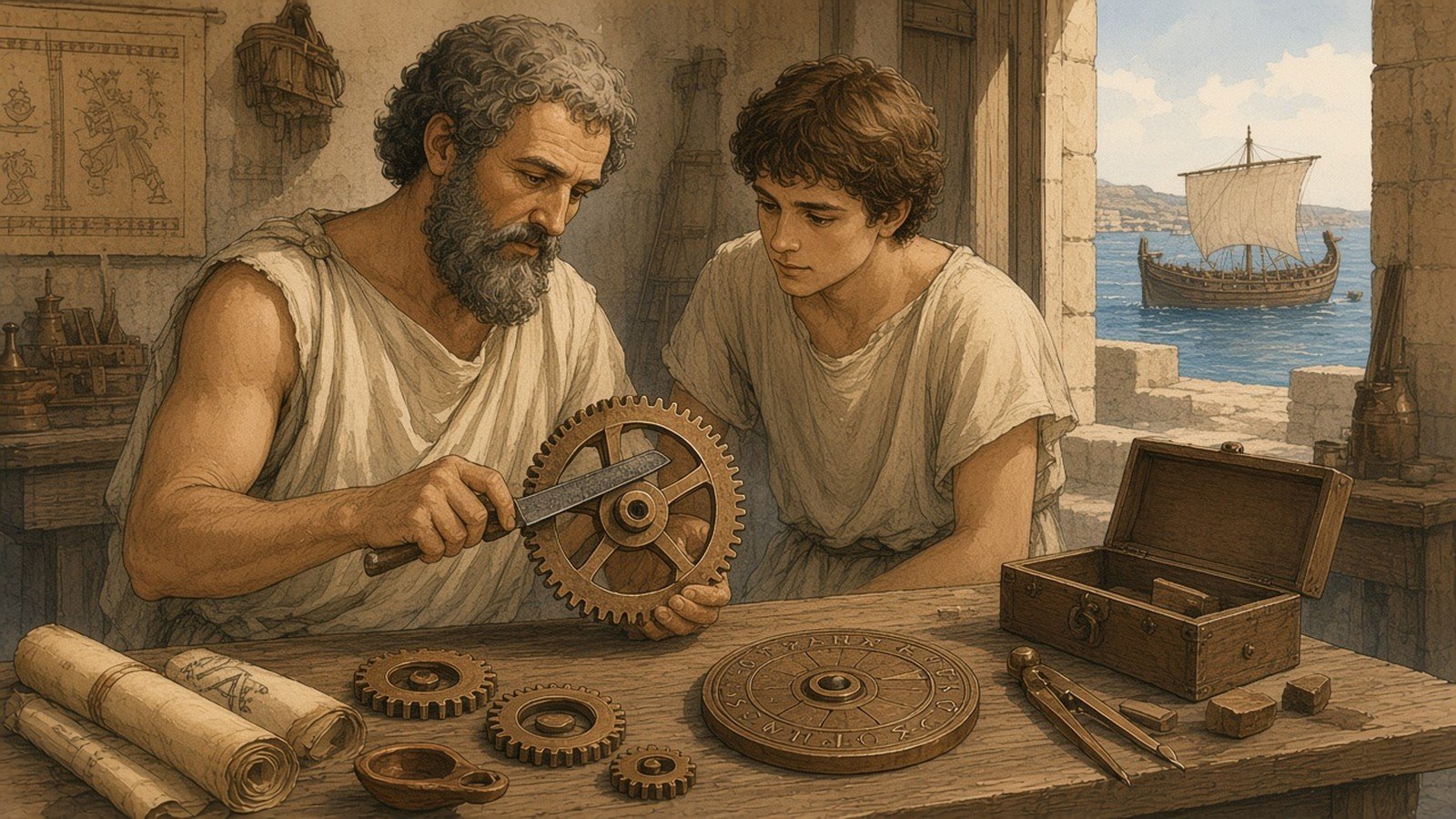
The gears of the mechanism were cut from a sheet of bronze about one and a half to two millimetres thick. Their teeth are triangular in profile rather than the curved shapes used in modern gearing, and they seem to have been cut by hand with files, after the positions of the teeth had been marked out by eye or by simple dividing methods. The teeth are small, about one and a half millimetres apart on many of the wheels, and the computed tomography images show that their spacing is irregular, which would have caused some play and imprecision in the motion. The gears were mounted on arbors and pins and held by bearings in plates, and the whole was enclosed in a wooden case with bronze dial plates, cover plates engraved with inscriptions, and pointers of bronze.
The design shows a sophisticated understanding of gear ratios. The designer had to represent astronomical periods such as the Metonic cycle of 235 lunar months in nineteen years, or the Saros of 223 months, by gear trains whose numbers of teeth multiplied together to give the correct ratios. Since it was not practicable to cut gears with several hundred teeth for every ratio, he combined several pairs of gears in series, and chose tooth numbers with prime factors that could be divided among the gears of a train. The number of teeth on the gear that drove the lunar pointer, for example, was chosen so that the combination of trains produced the ratio of 254 sidereal months to nineteen years, and the prime number 127, half of 254, appears in the tooth counts. The epicyclic arrangement of the pin-and-slot gears on a rotating platform, which produced the lunar anomaly while the platform itself turned with the slow rotation of the Moon’s orbit, is the most ingenious single feature and has no known parallel before the late medieval period.
Analogues to the mechanism’s gearing appear in the medieval Islamic world, where the astronomer al-Biruni described in the eleventh century a geared calendar device showing the phases of the Moon, and an astrolabe with a geared calendar made in Isfahan in the thirteenth century survives in the Museum of the History of Science in Oxford. In Europe, the astronomical clocks of the fourteenth century, such as those built by Richard of Wallingford at St Albans and Giovanni de’ Dondi at Padua, combined gear trains with displays of the Sun, Moon and planets. None of these devices approaches the antiquity of the Antikythera mechanism, and its discovery overturned the assumption that Greek technology was largely confined to simple machines and that sophisticated gearing was an invention of the Middle Ages.
Returning to the Wreck
The wreck site off Antikythera has been revisited several times since 1901. In 1953 and again in 1976 the French oceanographer Jacques-Yves Cousteau dived on it, and in 1976 his team, working with Greek archaeologists, recovered further finds including coins, jewellery and pottery, as well as human bones from the crew or passengers. A new campaign by the Greek Ephorate of Underwater Antiquities, in collaboration with the Woods Hole Oceanographic Institution and later the Swiss Return to Antikythera project, began in 2012. Using modern diving equipment and mapping techniques, divers have recovered more finds, including a bronze arm from a statue, a disc-shaped bronze object briefly suspected to be part of another mechanism, and in 2016 a partial human skeleton, from which researchers hoped to recover DNA. The excavations have shown that the ship was very large for its time, perhaps forty metres long, and that more of her cargo remains buried in the sediment.
No other fragments of the mechanism have been found, and it is possible that pieces of it remain in the sea or in the museum’s storerooms. The surviving fragments are displayed in the museum in Athens, together with reconstructions and models, and the research project maintains a public website describing its work.
The Astronomy Behind the Gears
The cycles built into the mechanism had a long history before any Greek craftsman cut a gear to represent them. For centuries the scribes of Babylon had kept nightly records of the heavens, the so-called astronomical diaries, which noted the positions of the Moon and planets, the weather, the level of the river and the price of barley. From these records, accumulated over generations, Babylonian astronomers derived the periods after which celestial phenomena recur. They knew that 235 lunar months correspond very closely to nineteen solar years, and they used this relation to regulate the intercalation of extra months in their calendar from about the fifth century BC. They knew that eclipses of the Moon recur in a pattern after 223 months, and they used that period, together with records of earlier eclipses, to predict when an eclipse was possible. They also developed sophisticated arithmetical methods for calculating the positions of the Moon and planets, based not on geometrical models but on numerical sequences that rose and fell in regular patterns.
Greek astronomers took over these periods and combined them with their own geometrical approach. In Athens in 432 BC the astronomer Meton proposed a nineteen-year calendar cycle, which is why the relation now bears his name, although its Babylonian use was earlier. In the fourth century BC Eudoxus of Cnidus devised a model of nested rotating spheres to account for the movements of the planets, and Callippus refined the Metonic cycle by combining four cycles into a period of seventy-six years. In the third century BC Apollonius of Perga developed the geometrical devices of the eccentric circle and the epicycle, a small circle carried on a larger one, which allowed astronomers to represent the non-uniform motions of the Sun, Moon and planets by combinations of uniform circular motions. Hipparchus, in the second century BC, applied these devices quantitatively, using Babylonian eclipse records and his own observations to derive the parameters of the Moon’s motion, and he discovered the slow drift of the equinoxes known as precession.
The pin-and-slot gearing of the mechanism is a mechanical realisation of exactly this kind of geometrical model. A Moon carried on an epicycle, or moving on an eccentric circle, appears from the Earth to speed up and slow down in a regular way; the pin-and-slot arrangement produces the same variation in the motion of the pointer. Moreover, because the platform carrying the pin-and-slot gears itself rotates slowly, the point of fastest motion moves gradually around the zodiac, completing a turn in about nine years, which corresponds to the real slow rotation of the Moon’s elliptical orbit. That the maker could translate an abstract geometrical theory into a working arrangement of gears, and could include so subtle a refinement, shows how closely the astronomy of the period and the craft of instrument-making were connected.
The eclipse predictions on the back dial reveal the same blend of traditions. The use of the Saros cycle and the sequence of eclipse possibilities within it follow Babylonian practice, while the hour times and the corrections for the exeligmos suggest Greek calculation. Studies of the glyphs have shown that the sequence of predicted eclipses is consistent with an astronomical scheme rather than with records of observed eclipses, which implies that the maker or his source calculated the pattern by a theory. The mechanism therefore did not merely record what had been seen; it computed what would be seen, from rules and models that encoded centuries of accumulated observation.
What the Mechanism Tells Us
The Antikythera mechanism is a witness to a world of Greek science and craft that has otherwise left very little physical trace. Greek astronomy is known mainly from texts, above all the Almagest of Ptolemy, written in Alexandria in the second century AD, which summarised and built on the work of Hipparchus and his predecessors. The mechanism shows that the astronomical theories described in these texts were embodied in physical models, that the periods and cycles used by astronomers were known and used by instrument makers, and that the craftsmen of the Hellenistic world were capable of a precision in metalwork and an ingenuity in design that historians had not suspected. It also shows a blending of traditions. The eclipse cycles and the period relations on which the mechanism depended were derived ultimately from Babylonian astronomy, which had recorded eclipses and planetary positions for centuries, while the geometrical models of lunar and planetary motion were Greek, and the calendars and games were those of the Greek cities.
For the history of computing, the mechanism is a reminder that calculation by machine is much older than the electronic computer. Its gears performed, by mechanical means, the same kind of operation that later analogue computers performed with shafts, cams and differentials, and that digital computers such as the ENIAC later performed with electronic circuits. It modelled the heavens for people who wished to understand them and to use their regularities for practical purposes, such as the keeping of calendars and the prediction of eclipses. In that respect it stands at the beginning of a line of instruments that leads through the astronomical clocks of medieval Europe, the orreries of the eighteenth century and the marine chronometers described in Harrison’s Marine Chronometer and the Longitude Problem, to the space telescopes, such as the Hubble Telescope, that now measure the cosmos with a precision the Greeks could not have imagined.
The study of the mechanism has also been a lesson in the history of science itself. For decades its fragments lay in a museum, admired and puzzled over but largely misunderstood, until new techniques of imaging, developed for quite different purposes in medicine and industry, made it possible to see inside them. Each generation of investigators, from Stais and Rehm to Price, Wright and the research project, built on and corrected the work of its predecessors, and many questions about the device remain open. The mechanism has become, in a sense, an object that teaches as much about the methods of modern science as about the achievements of the ancient world.
Legacy and Interpretation
Since the publication of the 2006 results the mechanism has attracted wide public interest, and a number of working reconstructions have been built, in bronze, wood and plastic, by museums, universities and individual makers. Some follow Wright’s design, others the research project’s; some include the planetary gearing proposed in 2021, others confine themselves to the surviving parts. Each reconstruction is a test of a hypothesis, since only by making a working model can one see whether a proposed gear train would fit and function as intended. The mechanism has also been the subject of numerous popular books and documentaries, and its image as an “ancient computer” has sometimes been exaggerated into claims that it represents lost or impossible knowledge. The scholarly view is more measured and in some ways more remarkable: the mechanism was made by skilled people using known techniques and known astronomy, and it demonstrates how much those techniques and that astronomy could achieve.
The mechanism also challenges the common narrative that the ancient Greeks were theorists who disdained practical technology. Writers such as Plutarch, in his life of Marcellus, presented Archimedes as a man who regarded his famous machines as mere diversions from geometry, and this portrayal encouraged a view of Greek science as abstract and uninterested in application. The Antikythera mechanism, and the references to similar devices in Cicero and other authors, suggest that mechanical modelling of the heavens was a recognised craft, practised by skilled makers and valued by educated patrons. It may have served for teaching, for display, for calendar regulation or for astrology; the inscriptions on the back plate suggest an intended user who wished to understand as well as to calculate. Whatever its purpose, it embodied in bronze the intellectual achievement of Hellenistic astronomy, and it remains the oldest known geared machine in the world.
The story of the mechanism thus runs from the sponge divers of Symi, sheltering from a storm in the spring of 1900, through more than a century of patient investigation, to the high-resolution scans and computer models of the present day. It is a story in which the sea preserved what the land destroyed, and in which modern technology recovered the achievements of an ancient one. The green and broken fragments in Athens, once taken for lumps of corroded metal, have become one of the most closely studied objects of the ancient world, and their study is not yet finished.