Tycho Brahe and the Observatory at Uraniborg
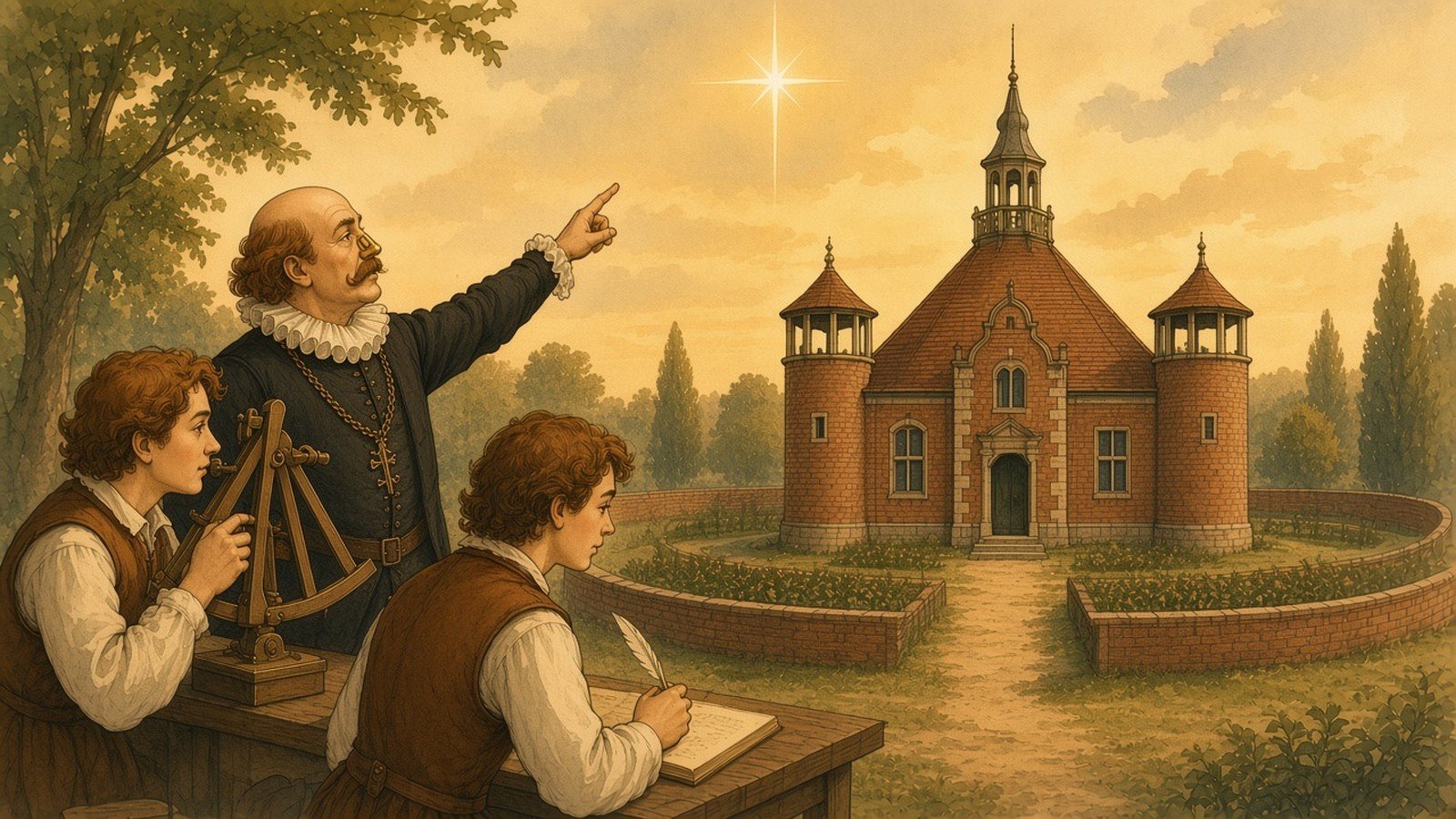
On the evening of 11 November 1572, walking back from his alchemical laboratory at Herrevad Abbey in Scania, then part of the kingdom of Denmark, the young Danish nobleman Tycho Brahe looked up and saw a star in the constellation Cassiopeia where none had been before. It was brighter than Venus. He was so astonished that he called his servants and some passing peasants to confirm that they could see it too. Over the following months he measured its position with great care and found that it did not move against the other stars, as a comet or any object in the Earth’s atmosphere would have done. The new star, he concluded, lay in the heavens beyond the Moon, in the region that the philosophy of Aristotle held to be perfect and unchanging. The observation made his name, and within four years it had brought him the patronage of the Danish king and an island in the Øresund on which to build an observatory. At Uraniborg, the castle of the heavens that he built on the island of Hven, Tycho and his assistants made, over twenty years, the most accurate and comprehensive astronomical observations of the age before the telescope. Those observations, passed after his death to Johannes Kepler, became the foundation of the laws of planetary motion. This article follows Tycho from his youth to Uraniborg, describes the observatory and its instruments, and traces the fate of his work in Prague and after.
A Danish Nobleman
Tyge Ottesen Brahe, who later latinised his name as Tycho, was born on 14 December 1546 at Knutstorp Castle in Scania, the southern province of the Scandinavian peninsula that then belonged to Denmark and is now part of Sweden. His father, Otte Brahe, was a member of one of the most powerful noble families of the kingdom and later a member of the king’s council and governor of Helsingborg Castle; his mother, Beate Bille, came from another great family. As a young child Tycho was taken, apparently by agreement or at least with the later acquiescence of his parents, into the household of his childless uncle, Jørgen Brahe, a vice-admiral, and his wife, Inger Oxe, who brought him up as their own son.
Tycho was sent to the University of Copenhagen in 1559, at the age of twelve, to study law and the subjects suitable for a nobleman destined for the service of the state. On 21 August 1560 he observed a partial eclipse of the Sun, and he was struck, according to his own later account, by the fact that astronomers could predict such events. He bought a copy of the astronomical tables of the time and a Latin edition of the works of Ptolemy, and began to study astronomy in his spare time. In 1562 his uncle sent him with a tutor, Anders Sørensen Vedel, to the University of Leipzig to study law. Tycho continued to study astronomy secretly, at night, while his tutor slept. In August 1563 he observed a conjunction of Jupiter and Saturn and found that the tables then in use were seriously wrong about its date: the Alfonsine Tables, based on Ptolemy, were in error by a month, and the newer Prutenic Tables, based on Copernicus, by several days. He resolved that astronomy could only be reformed by long and accurate observation.
After the death of his uncle in 1565, who caught a fever after rescuing King Frederick II from the water when the king fell from a bridge, Tycho travelled through Germany and Switzerland, studying at Wittenberg, Rostock, Basel and Augsburg. At Rostock, on 29 December 1566, he fought a duel in the dark with a fellow Danish nobleman, his third cousin Manderup Parsberg, apparently after a quarrel over a point of mathematics, and lost part of his nose. For the rest of his life he wore a prosthetic nose, said to have been made of gold and silver, held on with paste or glue; when his tomb in Prague was opened in 1901, a green stain on the skull suggested copper, and analysis after a second exhumation in 2010 found traces of brass, suggesting that he wore a lighter brass nose for everyday use. In Augsburg in 1569 he designed and had built a great wooden quadrant with a radius of about five and a half metres, which was set up in a garden outside the city and was so large that it took twenty men to erect it. It was the first of the large, precise instruments that became the hallmark of his work.
The New Star of 1572
Tycho returned to Denmark in 1570, shortly before his father’s death, and settled at Herrevad Abbey, which belonged to his maternal uncle, Steen Bille, who encouraged his interest in alchemy and the natural sciences. It was there that he saw the new star. He measured its distance from the stars of Cassiopeia with a new sextant of his own design, made of walnut wood with bronze fittings, and found that its position did not change over many months, either during the night as the sky turned or from night to night. If the star had been close to the Earth, like a meteor, or even as close as the Moon, its position against the background stars would have shifted noticeably as the Earth rotated and as observers in different places viewed it, the effect called parallax. Since Tycho could detect no parallax at all, the star must be much further away than the Moon. The star faded slowly over the following months and disappeared from view in March 1574.
In 1573 Tycho published his observations in a short book, De nova stella, “On the New Star,” printed in Copenhagen. He hesitated at first to publish, since it was considered unsuitable for a nobleman to write books, but he was persuaded by his friends. The book argued that the new star was a genuine star located in the sphere of the fixed stars, and that the heavens were therefore capable of change. This was a direct challenge to the Aristotelian doctrine, then accepted in the universities, that the heavens beyond the Moon were made of an incorruptible fifth element and that change occurred only in the sublunary world of earth, water, air and fire. Other astronomers in Europe also observed the star and some reached similar conclusions, but Tycho’s measurements were the most precise and his arguments the most persuasive. The object, now called SN 1572 or Tycho’s Supernova, is known today to have been the explosion of a white dwarf star in our galaxy, about eight to ten thousand light-years away; its remnant has been studied by modern X-ray and radio telescopes.
The Island of Hven
The new star made Tycho famous. In 1574–75 he lectured on astronomy at the University of Copenhagen at the king’s request, and in 1575 he travelled again in Germany and Italy, visiting the Landgrave Wilhelm IV of Hesse-Kassel, himself a keen astronomer who had built an observatory at Kassel. Tycho was considering settling in Basel, and King Frederick II, learning of this and perhaps prompted by the Landgrave, resolved to keep him in Denmark. In February 1576 the king offered Tycho the island of Hven in the Øresund, the strait between Zealand and Scania, together with funds to build a house and an observatory, and a royal letter of 23 May 1576 granted him the island for life. Tycho received the rents and services of the island’s peasants, a substantial income from the crown and, later, the revenues of various fiefs and church benefices in Denmark and Norway.
Hven, now the Swedish island of Ven, is a small island, about four and a half kilometres long and two and a half wide, rising steeply from the sea to a fertile plateau. Tycho chose a site near the middle of the island for his house. The foundation stone of Uraniborg was laid on 8 August 1576, at sunrise, with a ceremony at which the French ambassador Charles de Dançay and other friends poured wine on the stone. Tycho chose the time so that Jupiter and the Moon were rising together in a favourable configuration, in keeping with the astrological ideas that he shared with most astronomers of his day.
The Castle of the Heavens
Uraniborg, named after Urania, the Muse of astronomy, was a building unlike any other in Europe. It was designed by Tycho himself, perhaps with the help of the Flemish architect Hans van Steenwinckel, in an Italianate Renaissance style, and it stood at the centre of a square walled garden whose corners pointed to the cardinal directions. The main building, of red brick with sandstone decoration, was square in plan with semicircular towers on its northern and southern sides, and was crowned by a central cupola and a spire bearing a weathervane in the form of Pegasus. The towers had conical roofs that could be opened in sections to allow observations of the sky, and on balconies around them stood some of Tycho’s instruments. The whole design was governed by geometrical proportions intended to express the harmony of the cosmos.
The house contained living quarters for Tycho, his family and his assistants, a library, a dining hall, guest rooms, and rooms for instruments. In the basement was an alchemical laboratory with sixteen furnaces, where Tycho prepared medicines and conducted chemical experiments, and the house had running water, pumped from a well, which was a great novelty. In the library stood a great celestial globe, about a metre and a half in diameter, made in Augsburg of wood covered with brass, on which over many years the positions of the stars that Tycho measured were engraved. The surrounding garden was laid out with flower beds, fruit trees and herbs, and at the corners of the walls were small buildings housing a printing press and servants’ quarters. On the island Tycho also built a paper mill, driven by water from a series of fish ponds, so that he could print his own books.
The towers of Uraniborg proved to be unsatisfactory for precise work, since the instruments mounted on them were exposed to the wind and their foundations were not completely stable. In 1584, therefore, Tycho built a second observatory a short distance to the south, called Stellaeburgum or Stjerneborg, the castle of the stars. Its instruments were placed in crypts sunk into the ground, with only their domed roofs, which could be opened or rotated, above the surface, so that they were sheltered from the wind and mounted on solid foundations. Stjerneborg contained the largest of his armillary spheres, several quadrants and sextants, and a room in which portraits of famous astronomers, from Hipparchus and Ptolemy to Copernicus and Tycho himself, were displayed with inscriptions.
The Instruments
Tycho’s instruments were the most precise of the age before the telescope, and his description of them, in Astronomiae instauratae mechanica, “Instruments for the Restored Astronomy,” printed in 1598, became a model for later instrument makers. They included quadrants, which measured altitude above the horizon; sextants, which measured angular distances between celestial bodies; armillary spheres, which modelled the circles of the celestial sphere and measured positions in coordinates related to the equator or the ecliptic; and a variety of smaller and portable devices. Many were made in his own workshops on Hven by craftsmen in his employ.
The most famous was the great mural quadrant, a quarter-circle of brass with a radius of about two metres, fixed to a wall that ran exactly north and south in one of the rooms of Uraniborg. An observer looked through sights on a movable arm at a small opening in the opposite wall, through which a star crossing the meridian could be seen, and read off its altitude on the graduated scale, while an assistant noted the exact time from clocks and a second assistant wrote down the result. The space inside the arc of the quadrant was decorated with a large painted mural showing Tycho, seated with his dog at his feet, pointing towards the opening in the wall, with views of the library, the laboratory and the observation rooms of Uraniborg behind him. The painting, made by several artists, is known from a woodcut in the Mechanica, and it is the best image we have of the interior of the observatory.
Tycho’s instruments achieved their precision by several means. They were large, so that the graduations on their scales could be widely spaced; they were rigidly built and firmly mounted; and their sights were carefully designed so that the observer could align them with a star precisely. To read the scales to a fraction of a degree, Tycho used transversal points, a system of diagonal rows of dots across the graduated scale, which allowed an arc to be subdivided into small parts. He paid close attention to the sources of error in his instruments, testing them against one another and measuring the same object repeatedly with different instruments to estimate their accuracy. He also recognised and allowed for the refraction of light by the Earth’s atmosphere, which raises the apparent position of objects near the horizon, and made the first systematic tables of its effect. By such methods his best observations were accurate to about one minute of arc, a thirtieth of the apparent diameter of the full Moon, which was several times better than the work of any previous astronomer and close to the limit of what the unaided eye can achieve.
Life and Work at Uraniborg
Uraniborg was not only an observatory but a research institute, perhaps the first in Europe. Tycho employed a staff of assistants, students and craftsmen, sometimes numbering more than twenty, who lived on the island, made observations under his direction, kept records and performed calculations. Many of them went on to careers as scholars, teachers and churchmen, and some, such as Christen Sørensen Longomontanus, became distinguished astronomers in their own right. Observations were made systematically, night after night, of the Sun, the Moon, the planets and the stars, and the results were entered in observation logs that, in the course of twenty years, filled many volumes. The work was organised so that observations of the same object were made repeatedly and checked against one another, a practice that distinguished Tycho’s programme from the occasional observations of most earlier astronomers.
Visitors came to Hven from all over Europe, including scholars, noblemen and royalty. King James VI of Scotland, the future James I of England, visited the island in March 1590 when he came to Denmark to marry Anne, the daughter of Frederick II, and he wrote verses in Tycho’s honour. Tycho’s sister Sophie Brahe, a gifted scholar in her own right, assisted him with observations, worked on horoscopes and alchemy, and spent long periods on the island. Tycho himself lived in some style. He had married, in about 1573, a commoner named Kirsten Jørgensdatter, whose low birth meant that their marriage was recognised under Danish law only as a form of common-law union, so that their children could not inherit his noble status or his estates; they had eight children, of whom six survived infancy. At Uraniborg he kept a dwarf named Jepp as a jester and, according to later stories, a tame elk that died after drinking too much beer at a neighbouring castle.
The Comet of 1577 and the Tychonic System
In November 1577 a great comet appeared in the western sky, with a long, curving tail, and Tycho observed it with his instruments until it faded in January 1578. As with the new star, he found that it showed no measurable daily parallax and must therefore lie beyond the Moon, far out among the planets. This was another blow to the Aristotelian cosmos, in which comets were regarded as fiery exhalations in the upper atmosphere. Tycho also argued that the comet’s path must cross the regions of the planets, which implied that the planets could not be carried on solid crystalline spheres, as most astronomers and philosophers believed, since the comet would have to pass through them. His analysis of the Great Comet of 1577 was published in 1588 in a book entitled De mundi aetherei recentioribus phaenomenis, “On the More Recent Phenomena of the Aethereal World,” printed on his own press at Uraniborg.
In the same book Tycho presented his own model of the cosmos, now called the Tychonic system. He admired Copernicus, whose De revolutionibus of 1543 had placed the Sun at the centre of the universe with the Earth and the planets moving around it, for the mathematical elegance of his system, but he could not accept that the Earth moved. He argued that if the Earth moved round the Sun, the fixed stars should show an annual parallax as the Earth moved from one side of its orbit to the other, and his own precise observations showed none; to avoid detection, the stars would have to be unimaginably far away and, if their apparent sizes were real, unimaginably large. He also thought that the motion of a body as heavy and sluggish as the Earth was contrary to physics, and that it conflicted with passages of Scripture. In the Tychonic system the Earth was at rest at the centre of the universe, the Moon and the Sun revolved around the Earth, and the five planets revolved around the Sun. Geometrically, this system was equivalent to the Copernican for the purposes of calculating the planets’ apparent positions, but it kept the Earth stationary. Because the orbit of Mars around the Sun intersected the orbit of the Sun around the Earth, the system was only possible if there were no solid spheres, which Tycho’s study of the comet had already shown. For the next half-century the Tychonic system was widely adopted by astronomers, especially in Catholic countries after the condemnation of Copernicanism in 1616, as a compromise between the old cosmos and the new.
The Stars, the Sun and the Moon
Alongside the dramatic phenomena of the new star and the comet, the everyday work of Uraniborg was the patient measurement of the ordinary heavens. A central task was the compilation of a new catalogue of the fixed stars. The only comprehensive catalogue available in the sixteenth century was that of Ptolemy, compiled in the second century AD and probably based in part on the earlier work of Hipparchus, which listed just over a thousand stars with positions given to the nearest sixth of a degree or so. Over the centuries copying errors had crept into it, and the slow shift of the equinoxes had made its coordinates obsolete. Tycho set out to measure the positions of the brighter stars afresh. He first established the positions of a small number of reference stars with the greatest possible care, linking them to the Sun by way of Venus and the Moon, which could be seen in daylight or twilight, and then measured the other stars relative to these. By 1592 he had completed accurate positions for 777 stars, which were later printed in his Astronomiae instauratae progymnasmata, and by 1598 he had extended the list to a thousand in a manuscript catalogue presented to patrons. The positions of the brighter stars in his catalogue were accurate to a minute or two of arc, a precision several times greater than that of Ptolemy.
Tycho also made a long series of observations of the Sun. By measuring its altitude at noon every day with the mural quadrant and other instruments, he determined the length of the year, the obliquity of the ecliptic, the tilt of the Sun’s apparent path to the celestial equator, and the eccentricity of the Sun’s orbit, with a precision far beyond that of earlier astronomers. His solar tables, which predicted the Sun’s position to within a fraction of a minute of arc, were the best yet made. Accurate solar positions were essential to everything else, since the positions of the Moon and planets were reckoned in coordinates tied to the Sun’s path, and errors in the solar theory propagated into every other calculation.
The Moon was a still greater challenge, since its motion is the most complicated of all the bodies visible to the naked eye. Ptolemy had recognised two irregularities in the Moon’s motion: the first, now called the equation of centre, which arises from the elliptical shape of its orbit, and the second, the evection, which depends on the Moon’s position relative to the Sun. By careful observation of the Moon at many points in its orbit, and not just at the new and full Moons when eclipses could occur, Tycho discovered a third irregularity, now called the variation, which causes the Moon to run ahead or behind its predicted position by up to about forty minutes of arc at the quarters between new and full Moon. He also found a further small inequality depending on the time of year, the annual equation, and detected the oscillation in the tilt of the Moon’s orbit to the ecliptic. These discoveries, which later found their explanation in Newton’s theory of gravitation as effects of the Sun’s pull on the Moon, were among the first genuinely new findings about the Moon’s motion since antiquity.
All of this work depended on the recognition that observations were subject to error and that error could be measured and controlled. Tycho compared his instruments against each other, repeated observations, recorded the conditions under which they were made, and drew up tables of atmospheric refraction to correct for the bending of starlight near the horizon. He did not possess the statistical methods that later astronomers used to combine observations, but he understood the principle that many careful measurements, made with well-tested instruments, were more trustworthy than a single observation, however careful. In this he anticipated the methods by which physical science came to judge the reliability of its data.
Departure from Hven
Tycho’s position on Hven depended on royal favour. Frederick II died in April 1588, and since his son Christian IV was only eleven years old, the kingdom was governed by a regency council, which continued Tycho’s support. When Christian came of age and was crowned in 1596, however, relations deteriorated. Tycho had treated the peasants of Hven harshly, demanding heavy labour services, and he had neglected the upkeep of a royal chapel in Roskilde that was one of his benefices. The young king and his ministers were less inclined than his father to fund astronomy, and Tycho’s arrogance made him enemies at court. His revenues were reduced, and in 1597 he left Hven, taking with him his family, his assistants, his portable instruments, his printing press and his observation logs. He stayed for a time in Copenhagen and then at the castle of Wandsbek near Hamburg as the guest of the nobleman Heinrich Rantzau, where in 1598 he printed the Mechanica and prepared a manuscript catalogue of a thousand stars.
In 1599 Tycho accepted an invitation from the Emperor Rudolf II to become imperial mathematician and settled in Bohemia, first at the castle of Benátky nad Jizerou, north-east of Prague, and then in Prague itself. Rudolf, an enthusiastic patron of the arts and sciences, offered him a large salary and the promise of an estate. Tycho had his large instruments brought from Hven and set about establishing a new observatory. To help him reduce and interpret his observations, he invited a young German mathematician, Johannes Kepler, who had written to him and sent him a copy of his first book, Mysterium cosmographicum, published in 1596, in which Kepler had defended the Copernican system and argued that the spacing of the planets reflected the five regular solids of geometry.
Tycho and Kepler
Kepler arrived at Benátky in February 1600. The relationship between the two men was difficult. Tycho was a proud and secretive aristocrat, unwilling to share his precious observations; Kepler was a poor, sensitive and touchy scholar, desperate to obtain the data he needed to test his ideas. After a series of quarrels and reconciliations, Tycho set Kepler to work on the orbit of Mars, which had proved particularly difficult to model. Tycho hoped that Kepler would use his observations to demonstrate the Tychonic system.
In October 1601, according to Kepler’s account, Tycho attended a banquet in Prague at which, from a sense of etiquette, he did not leave the table to relieve himself. He fell ill with a painful inability to urinate and died eleven days later, on 24 October 1601, at the age of fifty-four. On his deathbed he is said to have repeated the words, “Let me not seem to have lived in vain.” Speculation that he was poisoned with mercury persisted for many years, but analyses of his hair and bones after the 2010 exhumation found no toxic levels of mercury, and the most likely cause of death remains a bladder or kidney disorder. He was buried with great ceremony in the Týn Church in Prague, where his tomb, with a red marble effigy showing him in armour, can still be seen.
After Tycho’s death Kepler was appointed his successor as imperial mathematician and gained access to the observations, though their ownership was disputed with Tycho’s heirs for some years. Kepler’s long struggle with the orbit of Mars, recorded in his Astronomia nova of 1609, depended on the accuracy of Tycho’s data. At one stage Kepler found a model of the orbit, based on circles, that agreed with the observations to within eight minutes of arc, an error that earlier astronomers would have accepted as negligible; but because he trusted Tycho’s observations to be accurate to a few minutes, he rejected the model and continued his search. “Since the divine goodness has given to us in Tycho Brahe a most diligent observer,” he wrote, “it is fitting that we should with gratitude recognise and make use of this gift.” His persistence led him to the first two laws of planetary motion: that the planets move in ellipses with the Sun at one focus, and that a line from the Sun to a planet sweeps out equal areas in equal times. The third law, relating the periods of the planets to their distances from the Sun, followed in 1619.
In 1627 Kepler published the Rudolphine Tables, named after Rudolf II, which were based on Tycho’s observations and Kepler’s laws and included a catalogue of 1,005 stars derived from Tycho’s work. The tables were far more accurate than any previous planetary tables, and their success did much to persuade astronomers of the truth of Kepler’s heliocentric astronomy. It was a historical irony that Tycho’s observations, collected in part to establish the Tychonic system, became the foundation of a system that Tycho had rejected.
The Fate of Uraniborg
After Tycho left Hven, Uraniborg fell into decay. The island was given to another nobleman, and the buildings were gradually dismantled, their stones taken for other buildings. In 1658, by the Treaty of Roskilde, Denmark ceded Scania and the island to Sweden. By the end of the seventeenth century hardly anything was left of Uraniborg above ground, and the great instruments, which had been taken to Prague, were lost during the Thirty Years’ War; the great celestial globe was destroyed by fire in Copenhagen in 1728. In the twentieth century the foundations of Uraniborg and Stjerneborg were excavated, and the garden has been reconstructed according to Tycho’s plan. Stjerneborg has been partly restored, and a museum on the island commemorates his work; the Tycho Brahe Museum is now part of the town of Landskrona, which administers the site.
Tycho’s Place in Astronomy
Tycho Brahe was the last great astronomer before the telescope, and his career stands at the point where observational astronomy changed from an occasional activity to a systematic science. He demonstrated that the heavens change, by showing that the new star and the comet lay beyond the Moon; he dismantled the crystalline spheres of medieval cosmology; he set new standards of accuracy in measurement and a new understanding of the importance of error; and he built and organised an institution devoted to the collection of precise data over long periods. His observations made possible the laws of Kepler, which in turn provided the basis for Isaac Newton’s theory of universal gravitation in 1687. The idea that astronomy must rest on large bodies of accurate, repeated measurement, gathered by teams of observers using instruments of the highest precision, is his most lasting legacy. It runs from Uraniborg through the national observatories of the seventeenth and eighteenth centuries to the great telescopes and space observatories of the present day, such as the Hubble Telescope, whose observations are also collected systematically and shared with astronomers around the world. The problem of accurate positional astronomy and timekeeping that Tycho pursued also lay at the root of the long search for a method of finding longitude at sea, described in Harrison’s Marine Chronometer and the Longitude Problem.
Tycho’s personality was as remarkable as his work. He was proud, quarrelsome and extravagant, generous to his friends and harsh to his tenants, fascinated by alchemy and astrology as well as by astronomy, and conscious of his rank and his fame. He lived at a time when the boundaries between astronomy, astrology, natural philosophy and theology were still fluid, and his work drew on all of them. But in the work for which he is remembered he was guided by a single conviction: that the heavens could be understood only through observation, and that observation must be as accurate as human ingenuity could make it. His island observatory, the first of its kind, was built to serve that conviction, and in the twenty years of its existence it transformed the science of the heavens.