Gutenberg and the Printing Press with Movable Type
Some time around 1454 or 1455, in a workshop in the Rhineland city of Mainz, a team of craftsmen working under the direction of Johannes Gutenberg completed the printing of a Latin Bible in two large folio volumes. Each page carried two columns of text in a dense, dark Gothic letter, mostly forty-two lines to the column, so even and regular that it rivalled the work of the finest scribes. Perhaps 180 copies were produced, some on paper and some on vellum, and they were sold before the printing was finished. The book, known today as the Gutenberg Bible or the 42-line Bible, was the first substantial book printed in Europe with movable metal type. The method by which it was made, a system combining cast type, oil-based ink and a screw press, spread across Europe within a generation and remained the basis of printing for nearly four hundred years. This article describes Gutenberg’s life and the evidence for his work, explains the technical system he devised, sets it against the earlier history of printing in East Asia, and follows the spread of the press and its consequences.
Books Before Printing
In the first half of the fifteenth century books in Europe were copied by hand. In the early Middle Ages most copying had been done in monasteries, but by the fifteenth century much of it was the work of professional scribes in the cities, who served the universities, the clergy, the nobility and a growing lay readership of merchants and officials. Paper, which had reached Europe from the Islamic world through Spain and Italy in the twelfth and thirteenth centuries, had become cheap enough by 1400 to be used widely for books, though the finest volumes were still written on vellum, prepared calfskin. Demand for books was rising: the universities needed textbooks, the Church needed service books, and educated laymen wanted devotional works, chronicles and romances. A skilled scribe could copy perhaps a few pages a day, and a large book such as a Bible might take a year or more to complete. Every copy differed from every other, and errors accumulated as texts were copied and recopied.
There were already methods of producing images and short texts in multiple copies. From about 1400 woodcuts, pictures carved in relief on blocks of wood, were printed on paper by rubbing or pressing and sold as devotional images and playing cards. Some woodcuts included short texts, and in the middle of the fifteenth century so-called blockbooks were produced in which whole pages of text and pictures were carved on single blocks. Carving every page by hand was laborious, the blocks wore out, and the method was unsuited to long texts. Metal punches were used by goldsmiths to stamp letters and ornaments on metal objects, and coin makers struck coins with engraved dies. Each of these techniques contained part of what would be needed, but none of them provided a way to produce long texts quickly and accurately in many identical copies.
Gutenberg’s Early Life
Little is known of Gutenberg’s life, and almost everything that is known comes from legal and financial records rather than from his own words. He was born in Mainz around 1400, the son of a patrician merchant, Friele Gensfleisch zur Laden, and his second wife, Else Wyrich. The family took the name Gutenberg from the house, the Hof zum Gutenberg, in which they lived. Mainz was the seat of an archbishop who was one of the seven prince-electors of the Holy Roman Empire, and its patrician families were often in conflict with the craft guilds. The Gensfleisch family appears to have had connections with the archbishop’s mint, and it is possible that the young Gutenberg learned something of metalworking there. In the 1420s, during one of the periodic struggles between the patricians and the guilds, the family left Mainz, and Gutenberg may have studied for a time at the University of Erfurt, where a “Johannes de Altavilla” (Altavilla being a Latin form of Eltville, where the family had property) is recorded as enrolling in 1418.
By 1434 Gutenberg was living in Strasbourg, then a free city of the Empire on the Rhine. Records from there show that he was involved in a dispute over a debt with the city of Mainz, that he was sued for breach of promise by a woman named Ennelin zu der Iserin Türe, and that he taught a number of citizens various crafts, including the polishing of gemstones. In about 1438 he entered into a partnership with three Strasbourg men, Andreas Dritzehn, Hans Riffe and Andreas Heilmann, to make metal mirrors for sale to pilgrims at the great pilgrimage to Aachen, where the relics were displayed every seven years. Pilgrims believed that a mirror held up to the relics would capture something of their holy radiance. When the pilgrimage was postponed to 1440, the partners agreed to fund another secret enterprise of Gutenberg’s.
Andreas Dritzehn died at the end of 1438, and his brothers sued Gutenberg to be admitted to the partnership in his place. The record of the lawsuit, heard in 1439, is the earliest evidence of Gutenberg’s work on printing. The witnesses spoke of a press built by a carpenter, Konrad Saspach, of the purchase of lead and other metals, of “forms” that were to be taken apart so that no one could see what they were, and of a goldsmith, Hans Dünne, who said he had been paid a hundred guilders for work connected with “trucken,” printing. The record does not say exactly what Gutenberg was printing or how, but it shows that by 1439 he had begun to work with a press, metal and forms, and that the enterprise was being kept secret. The court found in Gutenberg’s favour. Little more is known of his activities in Strasbourg, and by 1448 he had returned to Mainz.
The Mainz Workshop
In Mainz, Gutenberg borrowed money to set up a printing workshop. In 1448 he took a loan from a relative, Arnold Gelthus. In about 1450 he received a loan of 800 guilders from Johann Fust, a wealthy Mainz merchant and money-lender, secured on the equipment he would make with it, and in 1452 Fust advanced a further 800 guilders on condition that he became a partner in the “work of the books.” These were very large sums, enough to buy several substantial houses in Mainz, and they show how costly it was to set up a press, cast type and buy paper and vellum in the quantities required for a major book.
The workshop produced a variety of smaller items before and alongside the Bible. Among the earliest surviving pieces printed with movable type in Europe are fragments of Latin grammar books based on the Ars minor of the fourth-century grammarian Donatus, a standard school text, and a fragment of a German poem on the Last Judgement, the so-called Weltgericht or Sibyllenbuch fragment, which may date from the late 1440s. In 1454 and 1455 the workshop printed letters of indulgence, single-sheet forms issued by the Church in return for contributions to the defence of Cyprus against the Turks, with blank spaces in which the name of the purchaser and the date were written by hand. These indulgences, printed in two versions with thirty-one and thirty lines of text, are the earliest European printed documents bearing a date. A calendar for the year 1455 urging war against the Turks, the so-called Türkenkalender, was also printed in this period.
The great project of the workshop was the Bible. It was printed in Latin, in the text of the Vulgate, the translation made by Jerome in the late fourth century, and laid out on 1,282 pages in two volumes. The first few pages were set with forty lines to the column, then forty-one, and from page ten onwards forty-two, apparently to economise on paper. The type, a textura or Gothic book hand modelled on the script used for Bibles and liturgical books, consisted of some 290 different characters, including variant forms of letters, abbreviations and ligatures, which allowed the compositors to imitate the subtle variations of a scribe’s hand and to justify the lines evenly. The pages were printed in black; spaces were left for the initial letters and headings, which were added by hand in red and blue by illuminators engaged by the purchasers, so that each surviving copy is decorated differently.
Work on the Bible probably began around 1452 and was finished by 1455. The earliest reference to it comes from a letter written in March 1455 by Enea Silvio Piccolomini, later Pope Pius II, to Cardinal Juan de Carvajal. Piccolomini reported that at the imperial diet in Frankfurt in the previous October he had seen quires of a Bible, printed by “a marvellous man,” so clean and correct that they could be read without spectacles, and that all the copies had been sold before completion. Scholars estimate that about 180 copies were printed, perhaps 135 to 150 on paper and 30 to 45 on vellum. Forty-nine copies survive, about twenty of them complete, in libraries in Europe, the United States and Japan, and they are among the most valuable books in the world.
The System of Printing
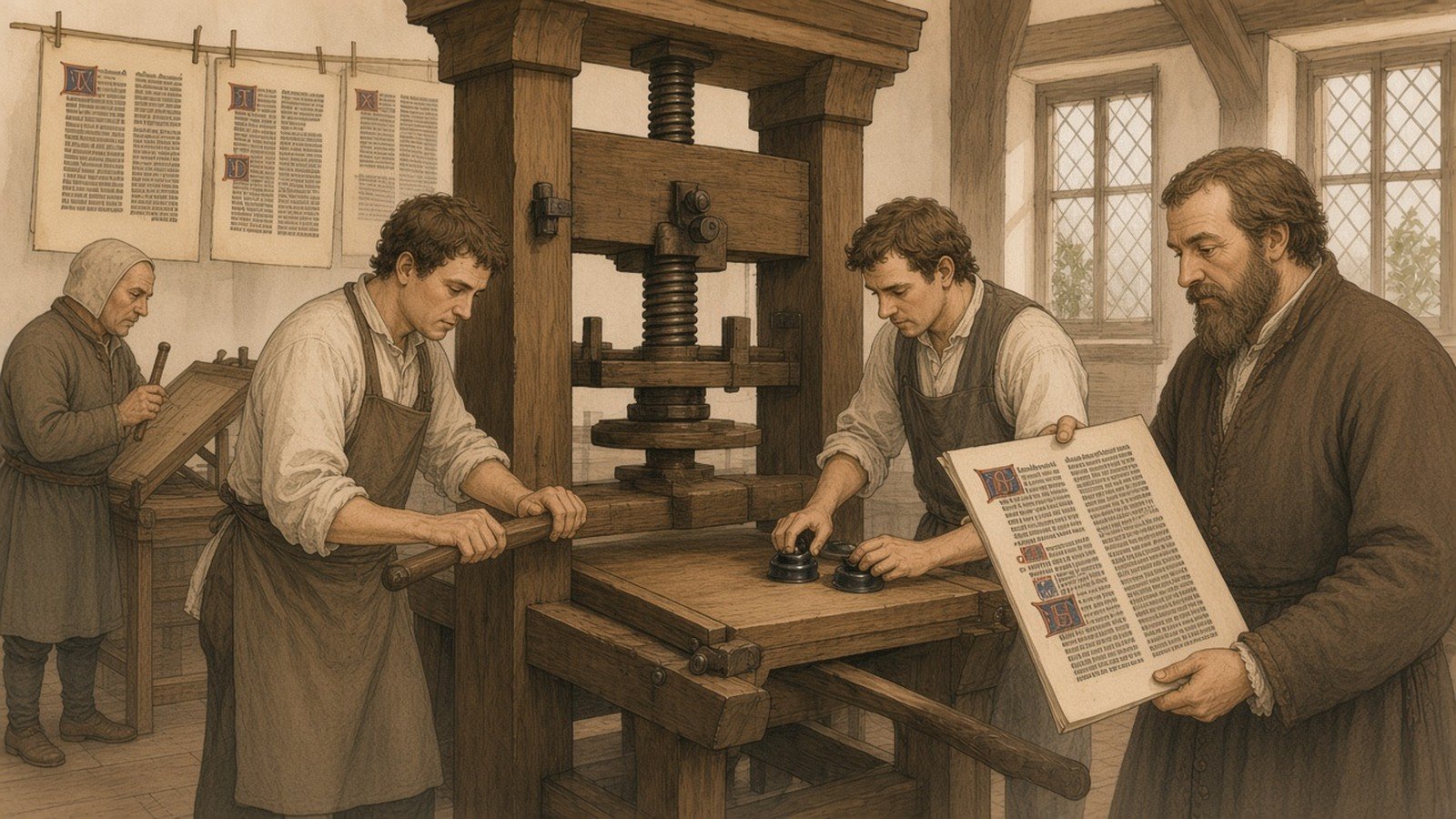
The achievement of Gutenberg was not a single invention but a system of interlocking techniques, each of which had to work reliably for the whole to succeed. The first and most important was a method of producing large quantities of identical, interchangeable metal type. For each character, a punch was cut: a steel rod on the end of which the letter was engraved in relief, reversed, by a skilled punch-cutter. The punch was struck into a bar of softer metal, usually copper, to make a matrix, an impression of the letter sunk into the metal. The matrix was then fitted into an adjustable hand mould, a device of two interlocking parts that formed a cavity for the body of the type with the matrix at one end. Molten metal was poured into the mould, and when it cooled the two halves were separated and a piece of type was released, with the letter in relief at one end. The mould could be adjusted to cast type of different widths, for narrow letters such as i and wide letters such as m, while keeping the height and the depth of the body constant, so that all the pieces of type would stand at exactly the same height and fit together into lines. This hand mould, which allowed a skilled caster to produce thousands of pieces of type a day, was the heart of Gutenberg’s system.
The second element was the type metal itself. Gutenberg needed an alloy that would melt at a low temperature, flow readily into the fine detail of the matrix, cool without shrinking, and be hard enough to withstand the pressure of the press. The alloy that came to be used was based on lead, with tin and antimony; antimony has the unusual property of expanding slightly as it solidifies, which helps the metal fill the matrix completely. Analyses of early type have shown that the composition of type metal varied, and that the proportions used by Gutenberg may have differed from those of later printers, but the essential solution, a lead-tin-antimony alloy, remained in use for centuries.
The third element was an ink that would adhere to metal type. The water-based inks used by scribes and the inks used for woodcuts did not take well on metal and smudged. Gutenberg developed an oil-based ink, related to the varnishes used by Flemish painters, made from lampblack or soot combined with linseed oil and other ingredients. Analysis of the ink of the 42-line Bible has shown that it contained significant amounts of copper, lead and titanium compounds, which give it its remarkable glossy blackness and durability. The ink was applied to the type with leather-covered ink balls stuffed with wool or horsehair.
The fourth element was the press. Gutenberg adapted the screw presses used in the Rhineland for pressing grapes and olives and for flattening paper and linen. In his press a flat platen was pressed down by a large wooden screw onto a sheet of paper or vellum laid over the inked type, which was locked in an iron frame called a forme on a flat bed. The bed could be rolled in and out under the platen, and a hinged frame, the tympan, held the paper in position, while a second frame, the frisket, protected the margins from smudges. The paper was dampened before printing so that it would take the ink evenly, and the pressure of the platen produced a clean, sharp impression. With a team of two men, one inking and one pulling, an early press could print several hundred sheets on one side in a day.
The fifth element was composition. The compositor set the type by hand, picking pieces from a case divided into compartments for each character and placing them, upside down and from left to right, in a composing stick, a small adjustable tray that held a line of type. Lines were assembled into pages and pages into formes, which were locked up, inked and printed. After printing, the type was cleaned and distributed back into the case for reuse. The ability to reuse type was what distinguished movable type from blockbooks, and it made printing economical for long texts. The workshop of the 42-line Bible seems to have used six compositors working simultaneously on different sections of the text and perhaps six presses.
Paper, Vellum and the Making of a Copy
The materials of the Bible were as demanding as its type. The paper copies were printed on a heavy, high-quality rag paper made from linen, imported from northern Italy; watermarks in the surviving copies, among them a bull’s head, a bunch of grapes and a walking ox, have been traced to paper mills in Piedmont and have been used to reconstruct the order in which batches of paper were used in the workshop. Each paper copy of the Bible required about 320 large sheets, each folded once to make two leaves and printed on both sides, so that an edition of 150 paper copies consumed some fifty thousand sheets. The vellum copies were still more costly: a single vellum copy of the 42-line Bible needed the skins of perhaps 170 calves, and an edition of thirty or more vellum copies required several thousand skins, a quantity that could only be gathered over many months from the tanners and parchment makers of the region.
Printing such a book was a long operation. Each sheet was printed twice, once on each side, and since the paper had to be dampened and the ink allowed to dry, the work proceeded in a rhythm of wetting, printing, drying, turning and printing again. Careful study of the surviving copies has shown that early in the production the workshop experimented with printing the headings in red ink on the press, in a second pass through the machine, before abandoning the practice as too slow and leaving the rubrics to be written by hand. Some pages exist in two different settings, which suggests that the size of the edition was increased after printing had begun, so that the first pages had to be set and printed again to complete the additional copies. Such details, recovered by bibliographers comparing the copies letter by letter, show a workshop learning its craft as it went, adapting its methods in the middle of a project of unprecedented scale.
The finished sheets were sold unbound and undecorated. The purchaser, often a monastery, a cathedral chapter or a wealthy individual, then commissioned a rubricator to add the red headings and chapter numbers, an illuminator to paint the initial letters and borders, and a binder to sew the quires and bind them between wooden boards covered with leather. Because each copy was finished in this way by different hands in different places, the surviving copies vary greatly in appearance. Some have only simple red and blue initials; others, such as the copy in the Göttingen State and University Library have elaborate painted borders with foliage, birds and animals. A few copies contain notes by their rubricators recording the date on which the work was completed, and one copy now in the Bibliothèque nationale de France carries a note by the rubricator Heinrich Cremer, vicar of the collegiate church of St Stephen in Mainz, stating that he completed the rubrication and binding of the two volumes in August 1456. That note provides a firm date by which the printing must have been finished.
The price of a copy is not recorded precisely, but a complete paper copy is commonly estimated to have sold for about thirty florins, a sum equal to perhaps three years’ wages for a clerk, yet considerably less than the cost of a manuscript Bible of comparable size and quality. Gutenberg’s workshop thus did not produce cheap books in the modern sense; it produced fine books more quickly and more cheaply than the scribes could, and in a uniformity no scribe could match. The great reduction in the price of books came later, as competition among printers increased, editions grew larger, and the press turned from monumental folios to smaller formats aimed at students and lay readers.
Partners and Quarrels
By 1455 the partnership between Gutenberg and Fust had broken down. In November of that year Fust sued Gutenberg for the repayment of his loans with interest, a total of 2,026 guilders. The court’s decision is recorded in a notarial document known as the Helmasperger Instrument, after the notary Ulrich Helmasperger, dated 6 November 1455. The document records that Gutenberg was required to account for the money and to pay what was owed, and it seems that Fust took possession of much of the equipment, including, probably, the type and presses used for the Bible. Among the witnesses to the document was Peter Schöffer, a former scribe from Gernsheim who had studied in Paris and had worked in Gutenberg’s shop; Schöffer later married Fust’s daughter Christina.
Fust and Schöffer continued printing in Mainz. In August 1457 they produced the Mainz Psalter, a magnificent liturgical book with large initial letters printed in red and blue from separately inked metal blocks. Its colophon, the first in a printed book, named Fust and Schöffer as its makers and gave the date, and it described the book as made “by an ingenious invention of printing and stamping, without any writing with a pen.” The Psalter was probably prepared in part while Gutenberg was still involved, but his name does not appear in it. Fust and Schöffer went on to print many other books, including a Bible in 1462, and Schöffer’s firm became one of the leading printing houses of Germany.
Gutenberg seems to have continued printing on his own after 1455, probably with another set of type. Books attributed to him or to his circle include a 36-line Bible printed in Bamberg around 1458–60 with an earlier version of the Bible type, and the Catholicon, a large Latin dictionary and grammar by Johannes Balbus of Genoa, printed in Mainz in 1460 in a smaller type; the colophon of the Catholicon praises the city of Mainz for having been chosen by God for the gift of printing, but it does not name the printer, and its attribution to Gutenberg remains uncertain. No book printed in his lifetime bears his name.
The Sack of Mainz and the Spread of the Press
In 1462 Mainz was captured and sacked by the forces of Adolf II of Nassau, who was contesting the archbishopric with Diether von Isenburg. Many citizens were expelled, and printers who had learned their craft in the Mainz workshops scattered to other cities. Whether or not the sack itself was the cause, the years that followed saw printing spread rapidly through Germany and beyond. In January 1465 Adolf, now established as archbishop, granted Gutenberg the title of courtier with an annual allowance of clothing, corn and wine, and freedom from taxes, in recognition of his services. Gutenberg died in Mainz on 3 February 1468 and was buried in the Franciscan church, which was later demolished; his grave is lost.
Printing spread with remarkable speed. By 1470 there were presses in some fourteen towns in Germany, Italy, Switzerland and France; by 1480 in more than a hundred; and by 1500 in about 250, from Portugal to Poland and from Sweden to Sicily. In Italy two German clerics, Konrad Sweynheym and Arnold Pannartz, set up a press in the Benedictine monastery of Subiaco near Rome in 1465 and moved to Rome two years later. Johannes of Speyer began printing in Venice in 1469, and within a few years Venice became the greatest printing centre of Europe, with dozens of presses. In Paris three German printers were invited by the Sorbonne to set up a press in 1470. In Bruges the English merchant William Caxton, who had learned printing in Cologne, printed the first book in English, his own translation of a French romance of Troy, around 1473–74, and in 1476 he set up a press at Westminster, where he printed Chaucer’s Canterbury Tales and Malory’s Morte d’Arthur.
Books printed before 1501 are called incunabula, from the Latin for “swaddling clothes” or “cradle,” reflecting the idea that printing was then in its infancy. About 28,000 to 30,000 editions of incunabula are known, and they were printed in many millions of copies; estimates of the total number vary widely, from about eight million to twenty million. Most were in Latin, but a growing proportion were in the vernacular languages, and their subjects ranged from theology, law and medicine to classical literature, grammar, popular devotion and almanacs. The printers soon developed new forms and styles. In Venice Nicolas Jenson cut a roman type, based on the humanist script of Italian scholars, that became the model for later roman types, and at the end of the century Aldus Manutius began publishing Greek texts and small, portable editions of the Latin classics, set in an italic type cut by Francesco Griffo.
Printing in East Asia
Gutenberg was not the first to print with movable type. In China, printing from carved wooden blocks was practised from at least the seventh century, and the oldest surviving dated printed book, a copy of the Buddhist Diamond Sutra found at Dunhuang, bears a date corresponding to 868. In the eleventh century, according to the scholar and official Shen Kuo in his Dream Pool Essays, a commoner named Bi Sheng made movable type of baked clay, setting the characters in an iron frame on a plate coated with a mixture of resin, wax and paper ash, which was heated to fix them and reheated to release them after printing. Later Chinese printers made type of wood, notably the official Wang Zhen, who described around 1313 a system of wooden type arranged on revolving tables, and of metal, including bronze. Movable type was used in China for some books, but woodblock printing remained dominant, largely because the Chinese script, with its thousands of different characters, made the composition and storage of movable type cumbersome, while a skilled carver could cut a woodblock quickly and the blocks could be stored and reprinted as needed.
In Korea, metal movable type was developed in the thirteenth century, and the oldest surviving book printed with metal type is the Jikji, an anthology of Buddhist teachings printed at the Heungdeok temple in Cheongju in 1377, a copy of which is preserved in the Bibliothèque nationale de France in Paris. In 1403 the Korean government established a type foundry, and royal printing offices produced many books in metal type. In the 1440s King Sejong introduced the Korean alphabet, hangul, whose small number of letters was well suited to movable type, though most official printing continued in Chinese characters.
There is no evidence that Gutenberg knew of the East Asian methods, and the techniques he used were different in important respects. Korean type was cast by a sand-moulding method, using impressions of carved wooden characters, rather than in a reusable metal hand mould from punched matrices, and Korean printing was done by rubbing the paper with a brush or a pad rather than with a press, using water-based inks. The European system, by contrast, was designed for an alphabetic script with a small number of characters and for mechanical presswork, and its combination of punch, matrix, mould, alloy, ink and press made printing fast, cheap and capable of producing large editions. The question of whether knowledge of East Asian printing reached Europe by way of trade or travellers has been discussed for more than a century, but no direct link has been established.
The Consequences of Printing
The consequences of printing have been the subject of an enormous literature, and historians have debated how far the press was a cause and how far a vehicle of the changes associated with it. Some effects are clear. Printing made books far cheaper and more numerous, so that by 1500 more books had been produced in Europe in fifty years than in the previous thousand. It made it possible to produce many identical copies of a text, so that scholars in different cities could refer to the same page and line, and errors could be identified and corrected in later editions rather than multiplied by copying. It encouraged the standardisation of spelling, grammar and vocabulary in the vernacular languages, and it created a market for books in those languages among readers who knew no Latin. It made possible new kinds of reference works, such as dictionaries, indexes and tables, whose usefulness depended on accuracy and on the fixed arrangement of the printed page.
The press was quickly put to use in religious and political controversy. In the early sixteenth century Martin Luther’s writings were printed in hundreds of thousands of copies, and the Protestant Reformation spread across Germany and northern Europe through pamphlets, broadsheets and vernacular Bibles. The Catholic Church in turn used the press for its own propaganda and tried to control it through licensing and the Index of Prohibited Books. Governments learned to use print for proclamations, laws and news, and by the seventeenth century regular newspapers had appeared in many European cities.
For science, printing was of fundamental importance. Before the press, the diagrams, tables and illustrations on which much of science depended were corrupted by every copying, and observations made in one place were known elsewhere only slowly and imperfectly. Printed books allowed astronomers to share tables of planetary positions, anatomists to circulate exact illustrations, and naturalists to compare descriptions of plants and animals. When Andreas Vesalius published his anatomy in 1543, its woodcuts were printed in Basel from blocks cut in Venice, and copies reached every university in Europe; when Tycho Brahe built his observatory on the island of Hven in the 1570s, he set up his own printing press there to publish his observations. The communication of science through print, by books and later by journals, created a community of readers who could check and build on one another’s work, and this was one of the conditions for the rise of modern science.
The press itself changed remarkably little for centuries after Gutenberg. Wooden hand presses of essentially his design were used until the early nineteenth century, when iron hand presses such as the Stanhope press of about 1800 and the steam-powered cylinder press of Friedrich Koenig, first used to print The Times of London in 1814, greatly increased the speed of printing. The rotary press, the Linotype machine of Ottmar Mergenthaler in the 1880s, which cast whole lines of type from molten metal, and the Monotype machine, which cast individual letters, mechanised composition. In the twentieth century photocomposition and then computer typesetting replaced metal type altogether, and the electronic computer, from machines such as the ENIAC onward, eventually transformed the production and distribution of text as fundamentally as Gutenberg’s press had done five centuries earlier.
Remembering Gutenberg
Gutenberg’s reputation grew slowly after his death. In the late fifteenth and sixteenth centuries his role was sometimes disputed, by partisans of Fust and Schöffer and by claims on behalf of other inventors, notably Laurens Janszoon Coster of Haarlem, whom Dutch writers credited with the invention of printing. Careful study of the documents and the surviving books, beginning in the eighteenth century, established Gutenberg’s priority in Europe, and by the nineteenth century he had become a national hero in Germany. A statue by Bertel Thorvaldsen was unveiled in Mainz in 1837, and the Gutenberg Museum was founded in the city in 1900, on the five-hundredth anniversary of his supposed birth. The museum holds two copies of the 42-line Bible and a reconstruction of his workshop. Other copies are held by libraries such as the Harry Ransom Center at the University of Texas at Austin, whose online presentation allows readers to examine every page.
No portrait of Gutenberg made in his lifetime survives. The familiar image of a bearded man in a fur hat derives from an engraving published in 1584 by André Thevet, nearly 120 years after his death, and it is probably imaginary; a beard was then fashionable but was unusual among Mainz patricians in Gutenberg’s day. In the end Gutenberg is known not by his face but by his work: by the even columns of black type on the pages of the 42-line Bible, which still look as fresh and sharp as when they were printed, and by the printing press that carried his invention to every corner of the world.