The Hubble Telescope
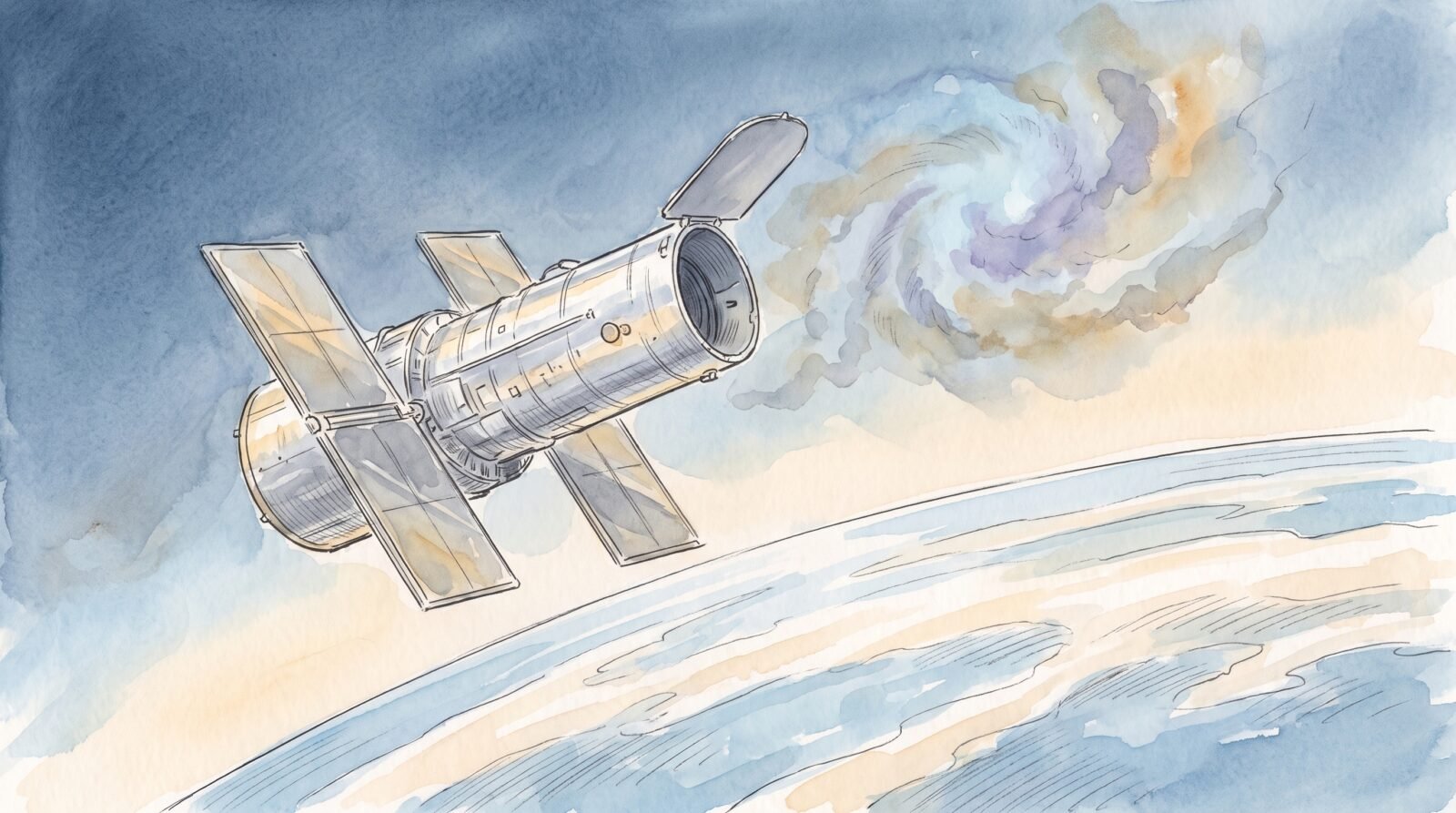
The Hubble Space Telescope was deployed into low Earth orbit on 24 April 1990 by the crew of Space Shuttle mission STS-31 on board the Space Shuttle Discovery. The astronomical community and the wider public were expecting, after two decades of planning, an observatory that could resolve features of distant galaxies at ten times the resolution of the best ground-based telescopes. What they got, instead, was a telescope whose images were only marginally better than the best ground-based images, with light smeared across an unfocused spot rather than concentrated at a single point. The cause turned out to be a small but devastating manufacturing error in the telescope’s 94.5-inch (2.4 metre) primary mirror, which had been ground to the wrong shape. The error was caused by a calibration mistake in the device (a reflective null corrector) used at Perkin-Elmer Corporation in Danbury, Connecticut, to verify the mirror’s curvature during polishing. The path from the launch to the discovery of the error, from the error to the corrective service mission in December 1993, and from the December 1993 mission to the long programme of deep-field imaging and cosmological discovery that followed, is the central story of the Hubble program. The story is told, in its elements, through official NASA documentation and through the historical literature of the program, with the principal historic work being Robert W. Smith’s “The Space Telescope: A Study of NASA, Science, Technology, and Politics” published by Cambridge University Press in 1989 with a revised paperback edition in 1994.
The intellectual prehistory of the Hubble Space Telescope is long. The case for an orbiting astronomical observatory was first laid out by the Princeton astrophysicist Lyman Spitzer in 1946, in a report he prepared for Project RAND titled “Astronomical advantages of an extra-terrestrial observatory”, which was reprinted in 1990 in the journal Astronomy Quarterly and again in the NASA publication “Exploring the Unknown: Selected Documents in the History of the U.S. Civil Space Program, Volume V”. Spitzer’s paper laid out, in language still consulted by the designers of orbital observatories, the case for placing a large telescope above the distorting and partially opaque lower atmosphere. He identified two principal advantages: the much greater angular resolution achievable above the atmosphere; and access to portions of the electromagnetic spectrum (in particular the ultraviolet and the infrared) that the Earth’s atmosphere either strongly absorbs or blocks altogether. The proposal was endorsed by the National Academy of Sciences in 1962, in a study panel chaired by the Berkeley astronomer Lyman Spitzer himself. The Space Studies Board reconvened the proposal in 1969 and worked out the basic parameters of what would eventually become the Hubble Space Telescope. The project was first named the Large Space Telescope and was conceived with a 3-metre mirror; in 1975 the European Space Agency joined the project as a partner and the mirror diameter was reduced to 2.4 metres to keep the program within budget. The mirror was reduced for budget reasons and the wavelength range, the partnership, the orbit, and the schedule for the launch were all fixed in the 1975 final design. The name was changed from Large Space Telescope to Hubble Space Telescope in 1983, in honour of the American astronomer Edwin P. Hubble who in the 1920s had established the expansion of the universe and the existence of extragalactic nebulae.
The mirror was ordered from the Perkin-Elmer Corporation in 1977 and was completed in 1981. The specifications were exacting: the figure of the mirror, the precise curvature of its surface, was to be polished to an accuracy of one twentieth of the wavelength of visible light, or about 30 nanometres across the mirror’s 2.4 metre span. The mirror was fabricated from ultra-low expansion glass, with the polishing taking place in the Perkin-Elmer plant in Danbury, Connecticut, between 1979 and 1981. The verification of the figure, during the polishing process, was done with a system of reflective null correctors — specially-made optical elements that convert the concave primary mirror, for testing purposes, into an apparently flat mirror. Perkin-Elmer’s reflective null corrector was the principal instrument used to verify the figure. The error in the figure of the mirror, as later analysed, was that the primary mirror had been ground approximately 2.2 micrometres too flat at its periphery, the equivalent of about one fiftieth of the width of a human hair. The discrepancy was caused by an error of 1.3 millimetres in the spacing of the components of the reflective null corrector — a small positional error in a measuring instrument that was, in the polishing programme, treated as the source of truth for the figure. The error in the mirror was not caught during ground verification. The same null corrector was used for the final acceptance test. The mirror was disassembled and reassembled into the spacecraft, with the error undetected. The mirror was later used by the Eastman Kodak Company of Rochester, New York, to construct a backup mirror by conventional polishing techniques; the Eastman Kodak mirror came out within the original specification, while the Perkin-Elmer mirror came out two micrometres too flat at the outer edge. The difference between the two mirrors’ measurements, in independent tests, became one of the diagnostic clues for the later investigation.
The Hubble Space Telescope was deployed from the Space Shuttle Discovery on 24 April 1990. The first images returned in May and June 1990 were examined by the Space Telescope Science Institute, by NASA, and by groups at the Jet Propulsion Laboratory and the University of California. The two principal diagnostic groups were those of Christopher Burrows and the WFPC team, and of Jon Holtzman and Sandy Faber. They worked independently and arrived at the same conclusion: the telescope was suffering from the simplest possible optical aberration, spherical aberration. The two analyses, by Burrows and Holtzman-Faber respectively, agreed on the magnitude of the aberration as well as the nature. The result was published in late 1990 and early 1991. NASA established the Hubble Space Telescope Optical Systems Board of Investigation on 2 July 1990, chaired by Lew Allen, at the time Director of the Jet Propulsion Laboratory. The Board’s report, often called the Allen Report, was published in late 1990 and remains the principal document of the investigation. The Allen Report placed the principal cause of the error in the wrong spacing of the reflective null corrector at the Perkin-Elmer plant in Danbury; the secondary cause was the inadequate quality-assurance procedures at Perkin-Elmer, with the Perkin-Elmer Optical Operations division functioning as “a closed shop” that withheld its internal processes from the parent corporation and from NASA. The total cost of the mirror correction (the corrective instruments and the shuttle servicing mission) was around 470 million dollars in 1990 prices, against the cost of the entire Hubble project of around 2.5 billion dollars in 1990 prices.
The corrective optics took three years to design and build. The program was called COSTAR, the Corrective Optics Space Telescope Axial Replacement. COSTAR was a bench of small mirrors, about the size of a telephone booth, designed to be inserted into the axial section of the spacecraft. The mirrors, designed by a team at Ball Aerospace in Boulder, Colorado, took the aberrated beam from the Hubble primary mirror, applied a corrective curvature equal and opposite to the aberration, and presented the corrected beam to three of the remaining first-generation instruments: the Faint Object Camera, the Faint Object Spectrograph, and the Goddard High Resolution Spectrograph. The high-speed photometer, the principal optical instrument not in the FOC/FOS/GHRS cluster, was removed and not replaced — that instrument’s space aboard the spacecraft was taken by COSTAR. A second corrective approach was taken with the new wide-field camera: the Wide Field Planetary Camera 2, designed and built at the Jet Propulsion Laboratory, had internal corrective mirrors figured to compensate exactly for the optical aberration; the WFPC2 thus did not need COSTAR to operate correctly. The two correction systems — the COSTAR bench and the internal correction in WFPC2 — were designed and built in parallel between 1990 and 1993.
The first Hubble servicing mission, designated SM1, was flown on Space Shuttle Endeavour in December 1993 as mission STS-61. The mission included five spacewalks over eleven days, with the crew of seven including Commander Richard Covey, Pilot Kenneth Bowersox, and Mission Specialists Story Musgrave, Claude Nicollier, Gregory Harbaugh, Tom Akers, and Kathryn Thornton. The EVAs were conducted by Story Musgrave, Tom Akers, Kathryn Thornton, Gregory Harbaugh, and Claude Nicollier in various pairings. The mission installed the corrective instruments: the High Speed Photometer was removed and COSTAR was installed in its place; the original Wide Field Planetary Camera was removed and WFPC2 installed in its place. The mission also replaced the Goddard High Resolution Spectrograph electronics, refurbished the Faint Object Camera, replaced the spacecraft’s solar arrays, and replaced the spacecraft’s gyroscopes. The total cost of the SM1 mission, including its orbital operations and the preparation of the seven astronauts, was around 600 million dollars. The first images after the SM1 installation were released by NASA on 13 January 1994 at a press conference hosted by the NASA Administrator Daniel Goldin, who described the refurbished telescope as “better than new”. The key image in the press release was an unusually sharp view of the centre of a galaxy; the image showed, for the first time, the dense concentration of stars at the core of a typical large spiral galaxy, with stars fully resolved across a field of view that had not previously been achieved from a ground-based observatory.
The Hubble Space Telescope was designed from the beginning to be serviced in orbit. The spacecraft includes a series of handholds that astronauts can use to grip the body of the telescope; the science instruments are arranged as modular carriers in the rear of the spacecraft; the solar arrays and the gyroscopes are designed to be replaced. The design was prescient: the SM1 mission demonstrated that the spacecraft could be substantially upgraded and its instruments substantially overhauled, with the astronauts working at the telescope for the equivalent of several typical eight-hour EVAs across the eleven-day mission. There were four further servicing missions over the next sixteen years. Servicing Mission 2, flown as STS-82 on Space Shuttle Discovery in February 1997, replaced the Goddard High Resolution Spectrograph with the Space Telescope Imaging Spectrograph (STIS) and replaced the Faint Object Spectrograph with the Near Infrared Camera and Multi-Object Spectrometer (NICMOS). Servicing Mission 3A, flown as STS-103 on Space Shuttle Discovery in December 1999, replaced the six Rate Sensing Units containing the spacecraft’s gyroscopes after a fourth gyro had failed; the mission, originally scheduled for later in 2000, had been moved forward because by the time of a fourth gyro failure the spacecraft could not stabilise itself to take science data, and the Hubble programme feared that the spacecraft could drift into safe mode and remain there. Servicing Mission 3B, flown as STS-109 on Space Shuttle Columbia in March 2002, replaced the original solar arrays with the more efficient SA3 array and installed the Advanced Camera for Surveys, which replaced the Faint Object Camera as the principal imaging instrument on the spacecraft. The SM3B mission also attempted, for the first time, an on-orbit instrument repair: the cooling system of NICMOS had run out of cryogen in early 1999 and had been placed in standby, and the SM3B mission restored the instrument to operation with a new cryogenic cooler. Servicing Mission 4, flown as STS-125 on Space Shuttle Atlantis in May 2009, replaced the WFPC2 with the Wide Field Camera 3, removed COSTAR and installed the Cosmic Origins Spectrograph (COS) in its place, replaced all six Rate Sensing Units containing all the spacecraft’s gyroscopes, replaced all six batteries, replaced one Fine Guidance Sensor, replaced the Science Instrument Command and Data Handling unit, and conducted the first on-orbit repairs of two instruments (the STIS and the Advanced Camera for Surveys). The mission marked the last scheduled servicing visit, with the Space Shuttle fleet retired in 2011, and the spacecraft has been operating without servicing since. The mission was commanded by Scott Altman, with Gregory Johnson as pilot; the mission specialists were Andrew Feustel, Michael Good, John Grunsfeld, Michael Massimino, and K. Megan McArthur.
The principal science that the telescope has produced is the second half of the Hubble story. The early science from the period 1994-1999 included the long-duration monitoring of the Shoemaker-Levy 9 comet impacts on Jupiter in July 1994, which was the first observational signature of a major impact in modern times; the imaging of dense star clusters in many nearby galaxies, which established the high end of the stellar-luminosity function; and the first direct imaging of protoplanetary disks around stars in nearby star-forming regions. The principal cosmological work began with the Hubble Deep Field in December 1995, a ten-day exposure of a small patch of sky near the Big Dipper, which produced an image containing roughly 3,000 galaxies of various distances and morphologies. The deep field image became the visual emblem of the Hubble programme in the next decade and is one of the most-cited photographs in the history of observational cosmology. The success of the original deep field was followed by the Hubble Deep Field South in 1998, the Hubble Ultra Deep Field in 2003-2004, and the Hubble eXtreme Deep Field in 2012. The deep field series confirmed the existence and the morphology of galaxies in the early universe (within roughly 500 million years of the Big Bang), and it established the population of galaxies as one of the principal data sets of observational cosmology.
The single most consequential Hubble result is the measurement of the rate of cosmic expansion. The combination of the Hubble Space Telescope’s Cepheid-distance-scale observations, the Hubble Space Telescope’s Type Ia supernovae observations, and a series of long-duration survey programmes that began in the late 1990s and ran through the 2010s produced a set of measurements of the present rate of cosmic expansion, the Hubble constant (H0). The local distance ladder measurement, led by Adam Riess of Johns Hopkins University and the Space Telescope Science Institute, gives a value of approximately 73 kilometres per second per megaparsec, with progressively small systematic uncertainties over each release. The cosmic microwave background measurement, primarily from the Planck satellite, gives a value of approximately 67.4 kilometres per second per megaparsec, with similarly small systematic uncertainties. The two values disagree by more than five standard deviations in the most recent round of measurements from the SH0ES team. The disagreement was first clearly identified in 2015 and has been progressively sharpened with every new round of Cepheid measurements and every new Planck data release; the latest results in 2022 reported by the SH0ES team gave H0 = 73.04 ± 1.04 km/s/Mpc, in a 5-sigma tension with the Planck value of 67.4 ± 0.5 km/s/Mpc. The discovery of the accelerating expansion of the universe — for which the Hubble and supernova observations provided the principal observational evidence — was awarded the 2011 Nobel Prize in Physics to Saul Perlmutter, Brian P. Schmidt, and Adam G. Riess. The Nobel committee cited the supernova teams rather than the Hubble Space Telescope directly, but the telescope’s precision on the Cepheid distance scale was a load-bearing piece of the argument. The continuing disagreement between the local-distance-ladder Hubble constant and the early-universe Hubble constant has been the most consequential unsolved cosmological problem of the last decade.
The infrared half of the electromagnetic spectrum is the single largest gap in the Hubble Space Telescope’s coverage. The Hubble mirror is at a temperature of about 21 degrees Celsius, which is too warm to support the imaging of distant faint sources at wavelengths beyond about 2,500 nanometres (near-infrared) without the thermal noise of the telescope dominating the signal. The James Webb Space Telescope, launched on an Ariane 5 rocket from Europe’s Spaceport at the Guiana Space Centre in Kourou, French Guiana, on 25 December 2021, was designed specifically to address this gap. The Webb mission is a joint project of NASA, the European Space Agency, and the Canadian Space Agency. The Webb mirror is 6.5 metres in diameter, with 18 hexagonal segments, each coated in a thin layer of gold for infrared reflectivity. The spacecraft operates at about 50 kelvin (-223 degrees Celsius) by being placed at the second Sun-Earth Lagrange point, roughly 1.5 million kilometres from Earth, with a multi-layer sunshield to keep the mirror in deep shadow. Webb covers the wavelength range from about 600 nanometres (visible red) to about 28,000 nanometres (mid-infrared), with the principal missions being the imaging of the first galaxies, the spectroscopic characterisation of exoplanet atmospheres, and the imaging through interstellar dust of star-forming regions in the Milky Way. The first round of joint Hubble and Webb observations, in 2022 and 2023, produced the most thoroughly multi-wavelength surveys of galaxies in the early universe that any scientific programme has produced.
The successor telescopes that will eventually complement the Hubble programme are the Nancy Grace Roman Space Telescope, the Euclid space telescope of the European Space Agency, and the Vera C. Rubin Observatory in Chile. The Nancy Grace Roman Space Telescope is a wide-field infrared survey telescope scheduled for launch by NASA in 2027 (the launch date has slipped during development). The telescope will have a 2.4-metre primary mirror, identical in size to the Hubble primary, and a field of view roughly 200 times larger, optimised for cosmology-relevant sky-area measurements of gravitational lensing, supernovae, and large-scale structure. The Euclid space telescope, a European Space Agency medium-class mission launched on a SpaceX Falcon 9 rocket from Cape Canaveral Space Force Station in Florida on 1 July 2023, observes from the second Sun-Earth Lagrange point and covers roughly 14,000 square degrees of sky in a wide optical and near-infrared band, producing a three-dimensional view of large-scale structure back to redshift 2. The Vera C. Rubin Observatory, under construction on Cerro Pachón in north-central Chile and expected to begin science operations in late 2025, is an 8.4-metre ground-based optical telescope with a 3.2 gigapixel LSST camera; the Rubin Observatory will conduct a ten-year wide-fast-deep survey of the southern sky called the Legacy Survey of Space and Time.
The Hubble Space Telescope’s long-term future is constrained by the gradual decay of the orbit and the limited fuel aboard the spacecraft for orbit re-boosts. The orbit has been decaying slowly since the last servicing visit in 2009, with the rate of decay driven by atmospheric drag at the spacecraft’s altitude of about 540 kilometres. The telescope’s remaining gyroscopes, of which three have failed since the SM4 mission and three remain, are sufficient for science but with no margin for further failures. The spacecraft’s batteries are at the end of their design life. The NASA strategic plan, articulated in the 2006 Astrophysics Decadal Survey and reaffirmed in the 2021 senior review, is to keep the telescope operating through the late 2020s with progressively more limited capability, and to bring the telescope down in a controlled deorbit into a remote ocean patch at the end of operations. NASA’s 2024-2025 strategic discussions have considered a private-mission re-boost of the telescope by a commercial spacecraft such as the SpaceX Dragon, which would extend operations by several years. The final decision on a re-boost mission has not been made. The expected lifetime of the telescope, before atmospheric re-entry, is around the mid-2030s. The end of the Hubble programme will leave the James Webb Space Telescope, the Nancy Grace Roman Space Telescope, and the Euclid space telescope as the principal large space-based observatories in operation.
The Hubble Space Telescope is the principal flagship of the institutional model of large orbital astronomy that emerged from the late 1970s and matured through the 1990s. The institutional model has several components. The first is the procurement model, in which a single large observatory is procured by a national space agency and is operated under a single project structure for decades. The second is the international partnership model, in which the European Space Agency provides one of the major scientific instruments and a fraction of the observing time in return for partnership. The third is the operating-organisation model, in which the science support is delegated to a dedicated scientific institute (the Space Telescope Science Institute) that does the scheduling, the data calibration, and the science operations. The fourth is the peer-review-competition model, in which observing time is allocated to the most scientifically compelling proposals from the international community. The fifth is the public-engagement model, in which the observatory’s operations, instruments, and images are actively promoted to the general public. Each of these models is now being inherited by every subsequent observatory of comparable scale: the Webb, Roman, and Euclid programmes all work in roughly the same institutional structure; the ground-based Rubin programme also works in roughly the same structure. The Hubble will not have been the only flagship of its kind, but it was the first flagship of its kind, and its operational and institutional legacies are the long-term inheritance of the Hubble programme.
The Space Telescope Science Institute and the Hubble Heritage
The Space Telescope Science Institute, founded in 1981 as a non-profit corporation operated under NASA contract, is the operational support centre that runs the science programme of the Hubble Space Telescope and, since 2002, of the upcoming James Webb Space Telescope as well. The institute is located on the Johns Hopkins University Homewood campus in Baltimore, Maryland, and is staffed by a mix of university employees, contractor staff, and visiting astronomers. The institute’s responsibilities include the annual cycle of telescope-time allocation from observing proposals submitted by the international community, the daily mission planning for the spacecraft’s science observations, the long-term archiving of Hubble and Webb data products for use by future astronomers, and a public-outreach programme that produces the Hubble and Webb image releases for the press. The institute’s director is the principal scientific and operational head of the Hubble programme and is the institutional interface between NASA and the international astronomical community. The institute’s location at Johns Hopkins is a feature of its institutional design — the university’s strong astronomy and astrophysics departments were a key reason the institute was placed in Baltimore — and the institute’s status as a non-profit independent of NASA has been one of the design features that has made the Hubble programme distinctive.
The Hubble Heritage programme, run from the Space Telescope Science Institute, has been one of the principal points of public engagement with the telescope’s science. The Heritage programme, which began in the late 1990s, selects, with senior programme review, a small number of the best Hubble images each year for release to the press and to the wider public. The Heritage images are typically made available in a format suitable for the photographic and electronic press, with clear identification of the instrument that produced the image, the wavelength band of the observation, the principal investigators of the observation programme, and a short scientific summary. The Heritage images have been widely reproduced in textbooks, in popular science magazines, in public exhibitions, and in the news media. The Hubble Deep Field, the Eagle Nebula, the Whirlpool Galaxy, the Sombrero Galaxy, the Hubble Ultra Deep Field, and the Arp 142 pair are among the most-cited and most-reproduced images in the entire photographic record of modern astronomy. The images have been exhibited at the Smithsonian Air and Space Museum, at the American Museum of Natural History, at the National Geographic Society, and at science centres and museums around the world.
The Hubble’s working-archive data is one of the principal long-term assets of the programme. The Mikulski Archive for Space Telescopes (MAST), which is run by the Space Telescope Science Institute, holds the calibrated scientific data from Hubble and the other NASA space telescopes (including the James Webb Space Telescope, the Kepler Space Telescope, the TESS mission, the GALEX ultraviolet mission, and the IUE ultraviolet mission), and is one of the largest scientific archives in the world. The Hubble data products are used in two principal ways. First, by the original observers and their collaborators, who retain proprietary rights to their data for an initial period of typically 12 months; second, by the wider astronomical community, who can request the data products through the MAST archive for analysis, additional research, and re-analysis with updated calibration. The Hubble’s calibrated archive is particularly important because the telescope has been operating for over three decades and the calibration of the older data has been progressively improved; re-reduction of older Hubble data with the latest calibration pipelines continues to produce new scientific results. The multi-decade time baselines of Hubble observations are also a one-of-a-kind resource — they allow the construction of light curves of variable stars and active galaxies that no other telescope can produce.
The Hubble programme’s place in the long history of large-scale science is mixed. The telescope was the most expensive civilian scientific instrument that the United States had ever built when it was launched. The mirror’s error was a public disaster for NASA. The first images were an embarrassing disappointment. The corrective program was the most visible single piece of satellite repair that the Space Shuttle ever flew. The post-correction science was the most-cited single body of work in observational cosmology in the last three decades. The Smithsonian’s National Air and Space Museum has a Kennedy-era X-ray spectrometer, a moon-rock display, and several historic spacecraft on display in its halls; the Hubble Space Telescope’s corrective-optics hardware, the COSTAR unit, is one of the centrepieces of the museum’s collection of space hardware. The Hubble’s history is a single connected case study of engineering failure, salvage, and recovery, and the case study has become one of the standard pieces of the engineering curriculum in the United States and abroad. The Hubble’s case is also a case study of the role of high-precision metrology in large-scale optical engineering, and of the institutional rules that govern the use of metrology in industrial fabrication. The Allen Report’s recommendations about quality assurance at the Perkin-Elmer optical division and about the role of independent verification testing became the standard recommendations for large optical projects of comparable cost. The Hubble’s cases of bad science and good recovery, treated as a single connected case study, are one of the principal pieces of the modern history of large-scale engineering.
The Hubble is also a piece of modern science history. The principal scientific work for which the Hubble programme is cited — the high-precision measurement of the Hubble constant, the direct imaging of protoplanetary disks, the imaging of the surface of Pluto, the spectroscopic characterisation of exoplanet atmospheres, the imaging of galaxies in the early universe — is the work that the telescope was designed to do. The Hubble has not been the principal driver of any one of the most-cited discoveries of the last three decades. The accelerating expansion of the universe was discovered by the Supernova Cosmology Project and the High-Z Supernova Search Team, with the Hubble providing the precision distance calibration. The imaging of the surface of Pluto was done by Hubble, although the principal post-2015 imaging of Pluto has been done by the New Horizons spacecraft. The detection of the first known exoplanet was done by ground-based observation. The mass of the universe’s dark matter has been principally determined by large-scale-structure observations from observatories other than Hubble. The Hubble’s place in the larger history of observational cosmology is that of a precision-instrument that has provided the high-quality supporting observations of the major discoveries of the last three decades, rather than the principal driver of those discoveries. The characterisation is not a criticism. The Hubble has been the workhorse of observational cosmology in a way that no other instrument has been since the 200-inch telescope at Palomar in the mid-twentieth century. The characterisation is the principal measure of the Hubble programme’s actual scientific role.
The Hubble’s science programme is also a model of institutional collaborations. The Hubble’s observing time, since the SM1 servicing mission in December 1993, has been allocated by a peer-reviewed process in which astronomers submit observing proposals to the Space Telescope Science Institute, where panels of senior astronomers rank the proposals by scientific merit, and a Time Allocation Committee assigns observing time based on the rankings. The total annual observing time available on the Hubble, in active science operations, is roughly 5,000-6,000 hours per year, allocated by the committee among the top-ranked proposals. The proposals are typically small in size (a few orbits, where one orbit is approximately 96 minutes of usable observing time at a given target), and the successful proposals can be in the several-hundred range per year. The observing cycle is competitive, and the acceptance rate is typically below 30 percent. The competition is the principal mechanism by which the Hubble’s observing time is distributed, and it is one of the most-cited features of the Hubble programme’s institutional design. The success of the model is one of the institutional legacies that is being inherited by the James Webb Space Telescope, the Nancy Grace Roman Space Telescope, and other large orbital programmes.
References
- Hubble Space Telescope official mission page - NASA Goddard Space Flight Center, accessed 2026.
- Hubble’s Mirror Flaw - Optics - NASA Science / Goddard Space Flight Center.
- Astronaut Missions to Hubble - NASA Science / Hubble Servicing Missions overview.
- Hubble Astronaut Missions - NASA Science.
- HubbleSite - Space Telescope Science Institute public outreach - STScI, Baltimore, MD.
- Lyman Spitzer - NASA biographical sketch.
- A Small Error: The Origin of Spherical Aberration - IOP Publishing.
- Panel on Space Telescope Cites Flaws in Management - John Noble Wilford, New York Times, 28 November 1990.
- Robert W. Smith, The Space Telescope: A Study of NASA, Science, Technology, and Politics - Cambridge University Press, 1989 (revised paperback 1994).
- David DeVorkin and Robert W. Smith, The Hubble Space Telescope: Imaging the Universe - National Geographic / Smithsonian, 2004.
- The 2011 Nobel Prize in Physics - Royal Swedish Academy of Sciences.
- NASA’s Webb Telescope Launches - NASA, 25 December 2021.
- Euclid mission page - European Space Agency.
- Nancy Grace Roman Space Telescope mission page - NASA.
- LSST Camera Arrives at Rubin Observatory in Chile - Vera C. Rubin Observatory / NSF-DOE.
- The Hubble Tension - Springer / Oxford Academic book chapter, 2024.
References
- Hubble Space Telescope official mission page — NASA Goddard Space Flight Center, accessed 2026.
- Hubble’s Mirror Flaw — Optics — NASA Science / Goddard Space Flight Center.
- Astronaut Missions to Hubble — NASA Science / Hubble Servicing Missions overview.
- Hubble Astronaut Missions — NASA Science.
- HubbleSite — Space Telescope Science Institute public outreach — STScI, Baltimore, MD.
- Lyman Spitzer — NASA biographical sketch, including a reprint of “Astronomical advantages of an extra-terrestrial observatory” (RAND, 1946).
- A Small Error: The Origin of Spherical Aberration — book chapter summarising the Allen and Moore Reports. IOP Publishing.
- Panel on Space Telescope Cites Flaws in Management — John Noble Wilford, New York Times, 28 November 1990.
- Robert W. Smith, The Space Telescope: A Study of NASA, Science, Technology, and Politics — Cambridge University Press, 1989 (revised paperback edition 1994).
- David DeVorkin and Robert W. Smith, The Hubble Space Telescope: Imaging the Universe — National Geographic Society / Smithsonian Institution, 2004.
- The 2011 Nobel Prize in Physics — Royal Swedish Academy of Sciences, press release, 2011.
- NASA’s Webb Telescope Launches to See First Galaxies, Distant Worlds — NASA Science, 25 December 2021.
- Euclid: Exploring the dark universe — European Space Agency / Euclid mission page.
- Nancy Grace Roman Space Telescope mission page — NASA Goddard Space Flight Center.
- The Hubble Telescope — Fast Facts — NASA.
- The Hubble Tension — book chapter in “The Hubble Constant Tension” (Springer / Oxford Academic), 2024. Includes discussion of the SH0ES 73.04 ± 1.04 measurement.
- LSST Camera Arrives at Rubin Observatory in Chile — Vera C. Rubin Observatory project / NOIRLab.