Triangles in the Void – The LISA Mission
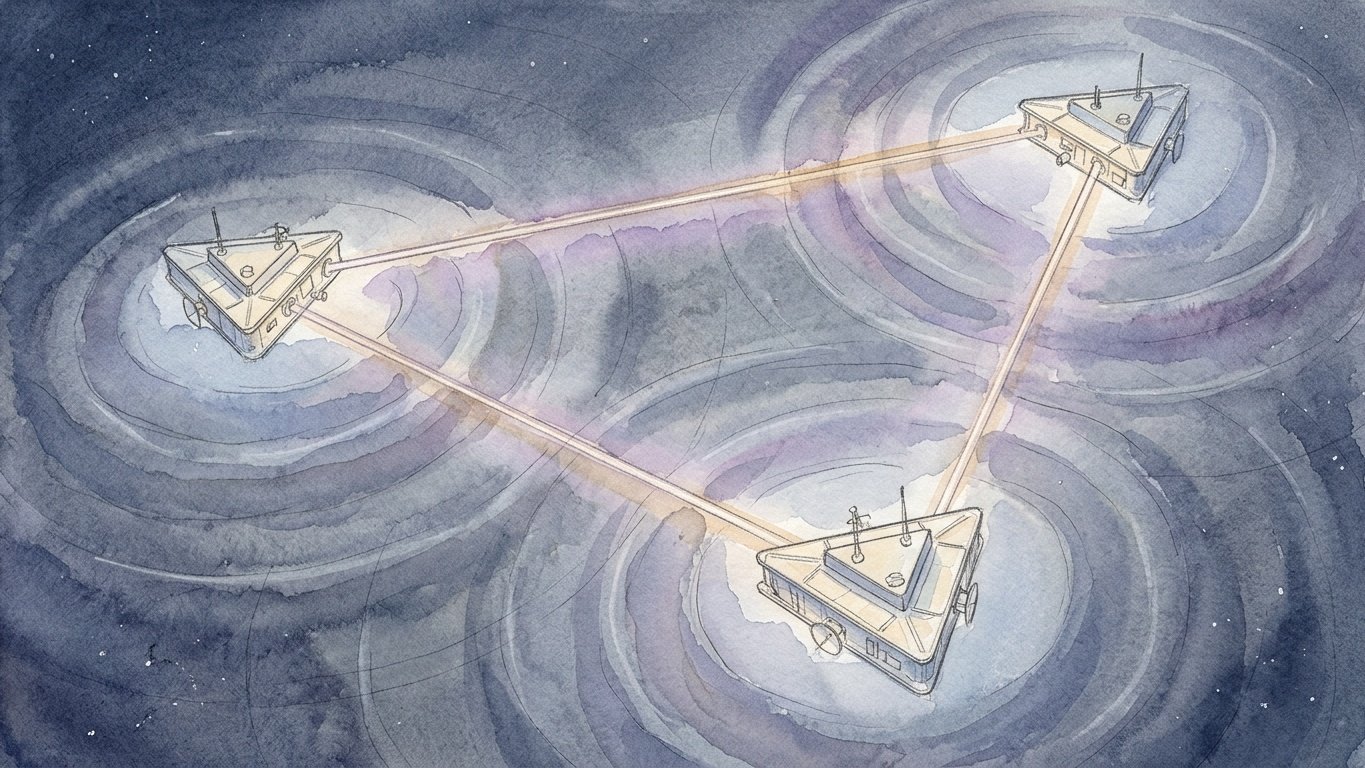
In September 2015, a century after Albert Einstein formulated the general theory of relativity, humanity opened a radical new sensory channel into the cosmos when the ground-based Advanced LIGO interferometers detected the gravitational ripples of two colliding stellar-mass black holes. Yet, astonishing as the terrestrial gravitational wave discoveries have been, ground-based detectors such as LIGO, Virgo, and KAGRA are fundamentally blind to the grandest gravitational symphonies of the universe. Bound to the vibrating crust of the Earth, terrestrial interferometers are permanently blocked below 10 Hertz by a brick wall of seismic tremors, atmospheric infrasound, and ambient gravitational gradient fluctuations known as Newtonian noise. To hear the deep, low-frequency rumble of the cosmos—the cataclysmic mergers of supermassive black holes millions of times the mass of the Sun, the spiraling dance of stellar corpses plunging into galactic centers, and the primordial whispers of the Big Bang—humanity must escape the planet entirely. Operating in the pristine silence of deep space, the Laser Interferometer Space Antenna (LISA), led by the European Space Agency in partnership with NASA, represents one of the most audacious scientific endeavors ever conceived. Comprising three identical spacecraft flying in an equilateral triangular formation spanning 2.5 million kilometers in a trailing heliocentric orbit, LISA will bounce precision infrared lasers between free-floating gold-platinum test masses across millions of kilometers of interplanetary vacuum. By measuring infinitesimal variations in spacetime geometry smaller than the diameter of a single atom, LISA will inaugurate the era of space-based gravitational wave astronomy, mapping the Kerr metric of spinning black holes, testing Einsteinian gravity to unprecedented precision, and unlocking the low-frequency gravitational universe.
1. The Earthbound Wall – The Seismic and Newtonian Noise Limits of LIGO
To understand why space-based gravitational wave observatories are an absolute physical necessity, one must examine the fundamental physical noise sources that constrain terrestrial interferometers. Terrestrial detectors—such as the twin Advanced LIGO facilities in Hanford, Washington, and Livingston, Louisiana—utilize kilometer-scale L-shaped vacuum arms with 40-kilogram fused silica test-mass mirrors suspended by multi-stage pendulums. These instruments measure the differential strain of spacetime induced by a passing gravitational wave.
For a four-kilometer arm length (L = 4 km), this requires measuring a displacement delta L of approximately $10⁻¹⁸ meters—less than one-thousandth the diameter of a proton. While terrestrial detectors have achieved historic success in the high-frequency band between 10 Hertz and 1,000 Hertz, their sensitivity collapses completely below 10 Hz due to three insurmountable terrestrial noise barriers:
- Seismic Noise: The Earth’s crust is in continuous, violent oscillation. Ocean waves pounding on continental shores generate microseismic peaks around 0.1 to 0.3 Hz that reverberate globally. Human activity, seismic faults, wind buffeting surface buildings, and industrial machinery shake the ground continuously. While LIGO utilizes state-of-the-art quadruple pendulum suspension systems and active hydraulic isolation platforms, the transmission of mechanical vibration scales inversely with the fourth power of frequency (f⁻⁴). Below 10 Hz, seismic vibration overwhelms the tiny gravitational wave strain signal by trillions of times.
- Newtonian Noise (Gravity Gradient Fluctuations): Even if one could construct an infinitely rigid mechanical suspension that isolates a mirror from physical ground contact, a far more insidious terrestrial noise source remains: direct gravitational coupling. When seismic Rayleigh waves traverse the ground beneath an interferometer, they compress and rarefy the rock density. Similarly, turbulent atmospheric temperature and pressure fluctuations create moving pockets of varying air density overhead. These fluctuating mass distributions generate fluctuating Newtonian gravitational forces that pull directly on the suspended mirrors. Because gravity cannot be shielded, Newtonian noise creates an impenetrable terrestrial sensitivity wall between 0.1 Hz and 10 Hz.
- Thermal Suspension and Coating Noise: Thermal excitation (Brownian motion) of atoms within the dielectric optical coatings and fused silica suspension fibers causes microscopic surface vibrations that obscure sub-10 Hz signals, despite ongoing cryogenic upgrades in detectors like KAGRA and the future Einstein Telescope.
Consequently, the vast, rich cosmic spectrum of gravitational radiation below 1 Hz is completely inaccessible from the surface of the Earth. To access this low-frequency realm, astronomy must leave the planet.
2. The Low-Frequency Gravitational Universe – The Millihertz Symphony
In gravitational wave astrophysics, the frequency of a gravitational wave is inversely proportional to the total mass of the emitting binary system. When two compact objects of masses m_1 and m_2 spiral toward each other, the gravitational wave frequency f_GW at the innermost stable circular orbit (ISCO) is determined by the Schwarzschild or Kerr radius of the final merged object.
For stellar-mass black holes of ten to sixty solar masses (totaling twenty to one hundred times the mass of the Sun), the coalescence frequency f_ISCO lands in the 50 Hz to 500 Hz range—the exact sweet spot of terrestrial LIGO and Virgo detectors. However, for Supermassive Black Holes (SMBHs) with masses ranging from $10⁵ to 100 million solar masses residing at the centers of colliding galaxies, the merger frequency drops into the millihertz regime (0.1 millihertz to 10⁻¹ Hz)!
The millihertz frequency band targeted by space-based gravitational wave observatories represents the richest, most densely populated gravitational domain in the universe:
- Supermassive Black Hole Mergers: When massive galaxies collide in the distant universe, their central supermassive black holes sink to the galactic center through dynamical friction, forming a bound binary. Their final inspiral and coalescence radiate gravitational waves with signal-to-noise ratios (SNR) exceeding several thousand! LISA will detect supermassive black hole mergers out to cosmological redshifts of z > 20, observing the birth of the earliest supermassive black holes in the epoch of cosmic reionization.
- Extreme Mass Ratio Inspirals (EMRIs): An EMRI occurs when a stellar-mass compact object (a 10-solar-mass black hole or neutron star) is captured into an eccentric, relativistic orbit around a million-solar-mass supermassive black hole. The small black hole orbits hundreds of thousands of times within the deep, highly curved gravitational well of the giant, tracing out complex geodesic orbits that map the spacetime metric of the central black hole with sub-percent precision, providing an uncompromising test of the Kerr metric and the general relativistic No-Hair Theorem.
- Ultra-Compact Galactic Binaries: Within our own Milky Way galaxy, LISA will continuously detect tens of thousands of compact binary systems composed of orbiting white dwarfs, neutron stars, and stellar black holes with orbital periods ranging from minutes to hours. Several dozen known ‘verification binaries’ will produce continuous, unyielding gravitational signals from the very instant LISA opens its eyes, serving as immediate calibration standards.
- Cosmological Stochastic Background: Beyond astrophysical binaries, LISA will search for the stochastic gravitational wave background produced by phase transitions in the early universe, including electroweak symmetry breaking, cosmic strings, and primordial inflation occurring fractions of a second after the Big Bang.
3. The Architecture of LISA – The Giant 2.5-Million-Kilometer Triangle
To detect gravitational waves in the millihertz frequency band (0.1 millihertz to 1 hertz), the detector must possess interferometer arms millions of kilometers in length. The Laser Interferometer Space Antenna architecture achieves this through an unprecedented formation of three identical, autonomous spacecraft.
LISA will not orbit the Earth. To escape Earth’s gravitational gradient perturbations and magnetic field fluctuations, the three spacecraft will be inserted into a heliocentric Earth-trailing orbit, trailing the Earth at an interplanetary distance of approximately 50 to 65 million kilometers (roughly 0.3 to 0.4 Astronomical Units). The three spacecraft will fly in an equilateral triangular constellation with arm lengths of exactly 2.5 million kilometers ($2.5 × 10⁹ meters).
The plane of the triangular constellation is tilted at an angle of 60 degrees relative to the ecliptic plane of the Solar System. As the entire constellation orbits the Sun over a 365-day year, celestial orbital mechanics naturally cause the triangle to cartwheel smoothly through space. This continuous orbital rolling provides an all-sky survey capability: the antenna sensitivity pattern sweeps across the entire celestial sphere, allowing scientists to triangulate the sky locations of gravitational wave sources across cosmic history.
However, celestial orbital mechanics also introduce a formidable engineering reality: Arm Breathing. Because the three spacecraft are on slightly elliptical, inclined Keplerian orbits around the Sun, the 2.5-million-kilometer distance between any two spacecraft is not perfectly constant. Over the course of a year, the arm lengths expand and contract by approximately ± 1% (tens of thousands of kilometers), while the relative line-of-sight velocities between spacecraft vary by up to ± 10 meters per second. This breathing geometry makes traditional Michelson interferometer arm-locking impossible, necessitating revolutionary laser metrology solutions.
4. Drag-Free Satellites and the Gravitational Reference Sensor
The foundational principle of gravitational wave detection is that the test masses must follow pure, unperturbed spacetime geodesics—falling freely under gravity alone, completely isolated from all non-gravitational physical forces. In deep space, however, an unprotected spacecraft is continuously battered by external physical perturbations: solar photon radiation pressure, the fluctuating solar wind of energetic protons, cosmic rays, and micrometeoroids.
To overcome this, LISA utilizes the revolutionary concept of Drag-Free Satellite Control. Inside the core of each LISA spacecraft sit two ultra-precise Gravitational Reference Sensors (GRS). At the heart of each GRS is a pristine, polished cube: the Free-Floating Test Mass.
The Test Mass – The Purest Free Fall in Human History
The LISA test mass is a solid, 46-millimeter cube weighing exactly 1.928 kilograms. It is fabricated from an ultra-pure, non-magnetic mono-block alloy composed of 73% Gold and 27% Platinum. This specific metallurgical stoichiometry was formulated to achieve a magnetic susceptibility of near absolute zero (chi approximately 10⁻⁵), completely eliminating magnetic dipole coupling to interplanetary magnetic fields.
The gold-platinum cube floats completely freely inside an evacuated titanium housing, separated from surrounding electrode walls by a microscopic vacuum gap of just 4 millimeters. There is zero mechanical contact, zero tether, and zero wiring connected to the cube. A multi-channel capacitive sensing system monitors the cube’s position relative to the housing with sub-nanometer precision.
When external solar radiation pressure pushes against the spacecraft’s exterior thermal shielding, the spacecraft moves slightly relative to the floating cube. The capacitive sensors detect this micro-displacement, and the spacecraft’s autonomous attitude and orbit control system (AOCS) immediately fires microscopic Cold Gas or Colloidal Micronewton Thrusters. The thrusters apply tiny micro-Newton puffs of thrust to push the outer spacecraft back into alignment, keeping the satellite centered around the floating cube without ever touching it. In essence, the spacecraft acts as an active, flying shield that flies around the test mass, allowing the gold-platinum cube inside to drift through the universe in the purest, most undisturbed gravitational free-fall ever achieved by civilization.
5. The LISA Pathfinder Triumph – Proving Free Fall in the Void
Because the drag-free technology required for LISA was so radical, the global scientific community demanded physical verification before committing billions of dollars to the full multi-satellite mission. In December 2015, the European Space Agency launched LISA Pathfinder into orbit around the Earth-Sun L1 Lagrange point.
LISA Pathfinder took one arm of the LISA observatory and compressed it inside a single spacecraft: two identical gold-platinum test masses floating inside vacuum chambers separated by a distance of only 38 centimeters. A laser interferometer measured the differential acceleration noise between the two free-falling cubes.
The mission requirements mandated that LISA Pathfinder demonstrate a differential acceleration noise no greater than.
In 2016, the LISA Pathfinder team published their experimental results in Physical Review Letters, sending shockwaves through the astrophysical world. The mission did not merely meet its stringent target; it crushed the requirement by more than a factor of five! Across the entire millihertz band, the residual acceleration noise dropped below $1.7 × 10⁻¹⁵ m/s^2/square root of Hz. The cubes were falling through space with an acceleration noise lower than one hundred-quadrillionth the acceleration of Earth’s gravity, proving that drag-free test mass isolation was fully capable of supporting the full 2.5-million-kilometer LISA mission.
6. Interplanetary Laser Metrology – Bouncing Photons Across 2.5 Million Kilometers
While LISA Pathfinder verified drag-free free fall across 38 centimeters, the full LISA mission requires measuring the distance between test masses across 2.5 million kilometers of vacuum. This demands an interplanetary laser metrology system that pushes the frontiers of quantum optics and phase measurement.
Each of the three LISA spacecraft houses two ultrastable Nd:YAG non-planar ring oscillator (NPRO) solid-state lasers operating at an infrared wavelength of lambda = 1,064 nanometers with an optical power of approximately 2 watts. The laser beam is expanded through a 30-centimeter off-axis Ritchey-Chrétien telescope and transmitted across the 2.5-million-kilometer arm toward the distant receiving spacecraft.
Over a distance of 2.5 million kilometers, diffraction causes the laser beam to expand into a massive footprint roughly 20 kilometers in diameter by the time it reaches the distant satellite. Consequently, of the $10¹⁹ photons transmitted every second, the receiving telescope’s 30-centimeter aperture captures only about 300 to 500 picowatts of optical power—a few hundred million photons per second! This tiny trickle of photons cannot be directly reflected back across space. Instead, LISA implements Heterodyne Transponder Laser Phase Locking:
- The incoming 500-picowatt beam is mixed with a fraction of the receiving spacecraft’s high-power local laser on an ultra-stable optical bench made of Zerodur glass-ceramic.
- The resulting optical beat-note is detected by high-bandwidth quadrant photodiodes.
- A digital phase-locked loop (DPLL) locks the receiving spacecraft’s local 2-watt laser to the exact phase of the weak incoming beam, and transponds this freshly boosted optical signal back toward the original spacecraft.
- Ultra-fast phasemeters record the phase fluctuations with a timing resolution of a few femtoseconds, enabling LISA to measure picometer-scale variations in arm length (delta L about 10⁻¹² meters) across the 2.5-million-kilometer baseline.
7. Time-Delay Interferometry – Cancelling Laser Phase Noise in Unequal Arms
In a classical ground-based Michelson interferometer like LIGO, laser frequency noise is eliminated because the two orthogonal arms are constructed with equal lengths (L_1 approximately L_2). When laser light splits at the beam splitter, travels down both arms, and recombines, any phase jitter in the master laser affects both beams identically and cancels out via common-mode rejection.
In LISA, however, celestial mechanics dictates that the three 2.5-million-kilometer arms are inherently unequal and continuously changing (delta L about 10⁴ km). Because the light travel time down Arm 1 (tau_1 approximately 8.3 seconds) differs from Arm 2 (tau_2), laser frequency noise delta ν(t) does not cancel! The raw laser frequency noise of the best space-qualified Nd:YAG laser is approximately $10^2 Hz/square root of Hz—which is eight orders of magnitude (100 million times) larger than the infinitesimal gravitational wave signal!
To overcome this fatal noise wall, theoretical physicists Michele Tinto, John Armstrong, and Massimo Tinto invented Time-Delay Interferometry (TDI) in 1999. TDI is an extraordinary post-processing algorithm executed in software on the ground.
Instead of relying on hardware optical interference, each LISA spacecraft continuously records phase beat-notes stamped with ultra-precise atomic clock time. On Earth, supercomputers combine the recorded phase data streams, introducing synthetic mathematical time delays corresponding to the exact light transit times around the triangular constellation. By synthesizing virtual closed optical loops (such as the standard TDI X, Y, and Z combinations).
the synthetic interferometer reconstructs symmetric optical round-trips where the laser light experiences identical cumulative time delays. As a result, laser phase noise cancels to zero by more than eight orders of magnitude, extracting the pristine gravitational wave signal from what appeared to be an overwhelming sea of laser noise.
8. Testing General Relativity and the Kerr Metric
When LISA launches, it will perform the most rigorous and uncompromising tests of Einstein’s general theory of relativity ever conducted. In general relativity, the exterior spacetime geometry of any stationary, uncharged, rotating black hole is described uniquely by the celebrated Kerr Metric, discovered by New Zealand mathematician Roy Kerr in 1963. The Kerr metric depends upon only two macroscopic physical parameters: the total mass M and the spin angular momentum J = a M c. All other higher multipole moments of the gravitational field (M_l, S_l) are strictly determined by mass and spin according to the No-Hair Theorem:
For decades, physicists have wondered whether the black holes observed in the universe are truly the idealized Kerr solutions of pure general relativity, or whether they harbor quantum hair, scalar field charges, or deviations predicted by string theory and modified gravity theories (such as Chern-Simons gravity or f(R) theories).
LISA will test the no-hair theorem directly through Extreme Mass Ratio Inspirals (EMRIs). As a 10-solar-mass black hole executes millions of relativistic orbits within a few gravitational radii of a spinning million-solar-mass black hole, its orbital precession and radiation reaction map out the spacetime metric with exquisite precision. Any minute deviation from the Kerr metric will alter the gravitational wave phase evolution over months of observation, allowing LISA to test the no-hair theorem with a fractional accuracy of better than one part in ten thousand, definitively testing Einstein’s classical black hole paradigm.
9. Standard Sirens and Cosmological Expansion
LISA will also revolutionize observational cosmology by serving as an independent, clean cosmic distance ladder using Gravitational Wave Standard Sirens. In traditional astronomy, measuring the expansion rate of the universe (the Hubble constant H_0) requires calibrating distance ladders through Cepheid variable stars, Type Ia supernovae, and cosmological redshift surveys—a methodology currently embroiled in the contentious ‘Hubble Tension’ between early-universe CMB measurements (H_0 approximately 67.4 km/s/Mpc) and late-universe supernova measurements (H_0 approximately 73.0 km/s/Mpc).
When two supermassive black holes merge, general relativity predicts the exact absolute intrinsic gravitational wave luminosity from the observed waveform’s chirp rate df_GW/dt.
By measuring the chirp mass M and the observed strain amplitude h, the detector calculates the absolute luminosity distance d_L directly from first principles, with zero astronomical distance calibration ladders and zero cosmic dust extinction! When combined with electromagnetic identification of the host galaxy from future space telescopes (such as the Roman Space Telescope or the Vera C. Rubin Observatory), standard sirens will measure cosmological expansion rates out to the edge of the observable universe, resolving fundamental questions regarding dark energy and cosmic evolution.
10. The Mission Roadmap – From Formal Adoption to the Launch in 2035
The road to space-based gravitational wave astronomy has spanned over three decades of scientific advocacy, international negotiations, and engineering refinement. In January 2024, the Science Programme Committee of the European Space Agency officially granted LISA Mission Adoption, formally approving the construction of the flight hardware.
Under the industrial leadership of prime contractors including Airbus Defence and Space and Thales Alenia Space, and with NASA delivering major mission-critical subsystems (including the flight lasers, telescopes, and ultra-stable phase-measurement hardware), construction is proceeding toward a targeted launch date in 2035 aboard an Ariane 64 heavy-lift launch vehicle from the Guiana Space Centre in Kourou.
Following launch, the three spacecraft will execute a sixteen-month cruise phase into their heliocentric trajectory, deploy their 30-centimeter optical telescopes, release their gold-platinum test masses into drag-free levitation, and commence an initial four-year nominal science mission with planned extensions to ten years. When operational, LISA will monitor thousands of gravitational sources simultaneously across cosmic time.
12. Galactic White Dwarf Binaries and the Confusion Noise Foreground
While LISA’s most dramatic targets are the violent collisions of supermassive black holes in distant galaxies, the observatory’s data stream will be completely dominated by our own home galaxy, the Milky Way. Within the Milky Way’s disk, bulge, and halo reside an estimated 100 million ultra-compact binary systems composed of pairs of orbiting white dwarfs, neutron stars, and stellar-mass black holes.
For binaries with orbital periods shorter than a few hours, the emitted gravitational waves fall squarely within the 0.1 mHz to 10 mHz frequency window. This astronomical reality presents both an unprecedented treasure trove and a formidable signal-processing challenge:
- The Resolved Binaries: LISA will individually detect and resolve approximately 25,000 to 50,000 distinct galactic white dwarf binaries. These systems radiate continuously at nearly monochromatic frequencies, allowing their orbital periods, orbital inclinations, sky coordinates, and chirp masses to be measured with exquisite accuracy. Because white dwarfs are the degenerate remnants of over 95% of all stars, mapping this population will trace the formation history, spatial structure, and chemical evolution of the Milky Way with unprecedented fidelity.
- The Galactic Confusion Foreground: Beyond the tens of thousands of individually resolvable systems lie tens of millions of fainter, unresolvable binaries whose signals overlap in frequency. Because the frequency spacing between adjacent binaries becomes narrower than the Fourier frequency resolution bin of a multi-year observation (delta f approximately 1/T_obs), their millions of overlapping signals coalesce into an irreducible, continuous sea of astrophysical noise: the Galactic Confusion Foreground. Between 0.5 mHz and 3 mHz, this confusion noise actually exceeds the instrumental noise floor of the spacecraft, forming the true physical sensitivity limit of the detector in that frequency band.
- Verification Binaries: Astronomers have already identified dozens of ultracompact binaries via electromagnetic observations (optical and X-ray eclipses), such as HM Cancri (RX J0806.3+1527), a pair of white dwarfs with an astonishing orbital period of just 5.4 minutes! These known systems will produce unmistakable gravitational signals within hours of LISA’s first operational turn-on, serving as celestial calibration benchmarks for the instrument.
13. Thermal and Structural Engineering – Zerodur and Picometer Stability
To detect gravitational wave strains of h about 10⁻²¹ across a 2.5-million-kilometer baseline, the internal optical and mechanical components of each LISA spacecraft must achieve a level of dimensional stability unprecedented in aerospace engineering: the optical path lengths within the satellite must not fluctuate by more than one picometer ($10⁻¹² meters, or one-hundredth the radius of a hydrogen atom) per square root Hertz across the millihertz measurement band!
In deep space, achieving picometer stability requires conquering the physics of thermal expansion. Even in a quiet heliocentric orbit, fluctuations in solar irradiance, changes in spacecraft attitude, and power dissipation within internal electronics generate micro-Kelvin temperature oscillations:
- Zerodur Glass-Ceramic Optical Benches: All critical optical components—beam splitters, polarizing prisms, quadrant photodiodes, and fiber collimators—are mounted onto an ultra-dense optical bench fabricated from Zerodur, a specialized lithium aluminosilicate glass-ceramic developed by Schott. Zerodur is engineered with a near-zero coefficient of thermal expansion: |α| < 10⁻⁸ K⁻¹ around 20 degrees Celsius. The optical elements are bonded to the Zerodur bench using hydroxide-catalysis bonding (silicate bonding), forming seamless molecular crystal linkages that eliminate mechanical creep and thermal stress.
- Multi-Stage Radiative Thermal Shielding: The optical bench and gravitational reference sensors are housed inside a nested succession of four concentric thermal shields. The outermost solar array shields the spacecraft body from direct sunlight; inside, multiple layers of gold-coated Kapton insulation and thermally isolated structural bays act as thermal low-pass filters, damping high-frequency external temperature swings and ensuring that internal temperature variations at the optical bench remain below 10 micro-Kelvin per square root Hertz.
- Carbon-Fiber Reinforced Polymer (CFRP) Telescopes: The 30-centimeter off-axis Ritchey-Chrétien telescopes are constructed from ultra-stiff CFRP struts and mirrors polished from Zerodur or silicon carbide (SiC), guaranteeing that the primary-to-secondary mirror separation does not drift under thermal cycling, preserving wavefront flatness to within lambda / 30.
14. Inter-Spacecraft Clock Synchronization and Optical Ranging
A critical microelectronic challenge that differentiates LISA from terrestrial interferometers is clock synchronization. In ground-based LIGO, all photodetectors and digitizers share a single, common ultra-precise master clock distributed over local fiber optic cables. In LISA, however, the three spacecraft are separated by 2.5 million kilometers of void; each spacecraft carries its own independent ultra-stable oscillator (USO) and atomic clock.
Because the independent clocks on the three satellites experience natural timing drift and phase jitter, this clock noise would easily corrupt the phase measurements required for Time-Delay Interferometry. To eliminate this error, LISA implements an integrated Inter-Spacecraft Clock Transfer System:
- Gigahertz Sideband Modulation: Each spacecraft modulates its outgoing 2-watt laser carrier beam with ultra-high-frequency radiofrequency sidebands (typically 2.4 GHz) derived directly from its local atomic clock.
- Inter-Spacecraft Laser Ranging (ISLR): When the weak laser beam arrives at the distant spacecraft, the sidebands are demodulated alongside the optical carrier. By measuring the phase differences between local and received sidebands, the onboard computers continuously monitor the relative clock drift between the two spacecraft with sub-picosecond accuracy.
- Absolute Distance Determination: The sidebands also carry a pseudo-random noise (PRN) code modulation, functioning identically to interplanetary GPS. This provides continuous real-time measurement of the absolute arm length L(t) between spacecraft with an accuracy of better than one meter across the 2.5-million-kilometer distance—information essential for feeding the time-delay parameters into the ground-based TDI data pipeline.
15. Waveform Modeling – Post-Newtonian Expansions and Self-Force Theory
Detecting and interpreting gravitational waves requires solving Einstein’s non-linear field equations with extreme mathematical fidelity. In LISA data analysis, a gravitational wave signal from an Extreme Mass Ratio Inspiral (EMRI) or supermassive black hole merger will persist in the data stream for months or even years, comprising hundreds of thousands of individual wave cycles. If theoretical waveform templates lose phase alignment with the true physical signal by even a fraction of a cycle over those millions of oscillations, the signal-to-noise ratio collapses, preventing detection.
To construct these templates, relativistic astrophysicists employ three cutting-edge mathematical frameworks:
- Post-Newtonian (PN) Theory: For widely separated binaries in the early inspiral phase where orbital velocities are much lower than the speed of light (v/c ll 1), Einstein’s equations are solved as a perturbation series in powers of (v/c)². Modern theorists have computed waveforms up to 4.5PN and 5PN orders, incorporating intricate spin-orbit, spin-spin, and tail-effect gravitational radiation interactions.
- Numerical Relativity: As two supermassive black holes approach their final plunge and merger, orbital velocities approach the speed of light, and spacetime curvature becomes intensely non-linear. Perturbation theory breaks down completely. Supercomputers numerically discretize Einstein’s four-dimensional tensor equations on adaptive mesh refinement grids, solving the full non-linear field equations to simulate the final violent collision and the subsequent black hole ‘ringdown’ (quasinormal modes).
- Gravitational Self-Force Theory: For EMRIs, where the mass ratio is extreme (mass ratio between the orbiting body and the primary black hole about 10⁻⁵ to $10⁻⁶), numerical relativity is computationally impossible because the spatial resolution required to resolve the tiny 10-solar-mass black hole inside the vast curved background of the million-solar-mass giant would require centuries of supercomputer time. Instead, theorists use Black Hole Perturbation Theory: the small black hole is treated as a point mass perturbing the Kerr spacetime metric. The small mass’s own gravitational field scatters off the curved background and exerts a back-reaction force onto itself—the Gravitational Self-Force. First-order and second-order self-force calculations track the secular orbital decay and precession of the EMRI over a hundred thousand orbits, producing the high-precision templates needed for LISA science.
16. Primordial Gravitational Waves and Cosmic Inflation
Beyond astrophysical black holes and white dwarfs, space-based gravitational wave observatories offer the tantalizing possibility of detecting Primordial Gravitational Waves produced in the earliest moments of cosmic creation.
In standard Big Bang cosmology, the universe was completely opaque to electromagnetic radiation during its first 380,000 years; photons were trapped in an opaque plasma of ionized electrons and protons until the epoch of recombination formed neutral hydrogen, releasing the Cosmic Microwave Background (CMB). Consequently, optical and radio telescopes can never peer directly beyond the CMB redshift surface (z approximately 1100).
Gravitational waves, however, interact so weakly with matter that they decoupled from the primordial cosmic soup at the Planck Epoch—a mere 10⁻⁴³ seconds after the singularity! A passing gravitational wave can travel across the entire visible universe for 13.8 billion years without absorption or scattering. LISA will search for stochastic gravitational wave backgrounds generated by:
- First-Order Cosmological Phase Transitions: If the electroweak phase transition (at T about 100 GeV) or other high-energy symmetry breakings in the early universe were strongly first-order, they proceeded via the nucleation and violent collision of expanding vacuum bubbles, generating an intense stochastic background of gravitational waves peaking in LISA’s millihertz frequency band.
- Cosmic Strings: One-dimensional topological defects formed during cosmological symmetry breaking in grand unified theories (GUTs). Vibrating cosmic string loops and snapping cusps emit powerful bursts and continuous stochastic backgrounds of gravitational waves.
- Primordial Black Hole Formation: Ultra-dense primordial density fluctuations re-entering the cosmic horizon during radiation domination could collapse directly into primordial black holes (PBHs)—a leading candidate for dark matter—generating distinctive scalar-induced secondary gravitational wave spectra.
17. The Global Flotilla – Taiji, TianQin, and Big Bang Observer
While LISA is the pioneering flagship mission, it is not the only space-based gravitational wave observatory planned for the twenty-first century. The global scientific community is actively developing complementary and successor architectures:
| Mission Name | Lead Agency / Nation | Orbit Type | Arm Length | Target Frequency Band |
|---|---|---|---|---|
| LISA | ESA / NASA | Heliocentric Earth-trailing | 2.5 Million km | 0.1 mHz – 100 mHz |
| Taiji | Chinese Academy of Sciences | Heliocentric Earth-leading | 3.0 Million km | 0.1 mHz – 100 mHz |
| TianQin | Sun Yat-sen University (China) | High Geocentric (Earth orbit) | 170,000 km | 10 mHz – 1 Hz |
| DECIGO / BBO | JAXA / NASA (Concepts) | Heliocentric multiple triangles | 1,000 – 50,000 km | 0.1 Hz – 10 Hz |
The prospect of flying LISA and Taiji simultaneously in the 2030s has ignited tremendous enthusiasm. Because LISA is in an Earth-trailing orbit and Taiji is planned for an Earth-leading orbit, the two triangular constellations would form an interplanetary baseline spanning over 100 million kilometers. Operating in coordinated coincidence, the LISA-Taiji network would dramatically improve sky localization of gravitational wave sources from degrees down to arcminutes, enabling immediate pinpointing of host galaxies by ground and space-based electromagnetic observatories.
18. Multimessenger Astronomy in the 2030s – The Unified Cosmic Lens
The operational debut of LISA in the mid-2030s will coincide with the golden era of twenty-first-century observational astronomy. For the first time, humanity will possess observatories covering the entire electromagnetic spectrum, cosmic neutrinos, and gravitational radiation simultaneously.
When two supermassive black holes spiral toward coalescence, LISA will detect the system weeks or months before the final merger. As the inspiral progresses, the orbital frequency chirp and sky position will be continuously updated in real time, alerting the international astronomical community. The European Space Agency’s Athena X-ray Observatory, the Vera C. Rubin Observatory (Legacy Survey of Space and Time), the Square Kilometre Array (SKA) radio telescope, and NASA’s Nancy Grace Roman Space Telescope will slew their instruments to monitor the target galactic nucleus in advance of the crash.
Astronomers will witness the pre-merger truncation of accretion disks, the relativistic shockwaves produced as the two event horizons fuse into one, the ejection of relativistic jets, and the post-merger accretion flare across optical, X-ray, and radio bands. By uniting gravitational spacetime metrology with electromagnetic photon imaging and neutrino detection, space-based gravitational wave astronomy will unlock a completely unified, multimodal understanding of the most violent, energetic events in the universe.
20. Big Data in the Void – The LISA Data Challenge and Global Pipelines
Unlike ground-based gravitational wave observatories, which detect transient signals lasting from fractions of a second to a few minutes against an otherwise quiet background, LISA presents an unprecedented computational and data-analysis paradigm: the detector is permanently illuminated by thousands of overlapping, continuous gravitational signals simultaneously!
At any given second of observation, the LISA data stream contains the superposition of tens of thousands of galactic white dwarf binaries, several ongoing extreme mass ratio inspirals (EMRIs), the distant background hum of merging supermassive black holes, and the underlying stochastic cosmic background. Analyzing this data is equivalent to standing in the center of a crowded stadium with ten thousand people speaking at once and attempting to reconstruct the exact transcript of every individual conversation simultaneously.
To solve this monumental problem, the international LISA Consortium established the LISA Data Challenges (LDCs). Data scientists and astrophysicists worldwide develop advanced global Bayesian inference algorithms, Markov Chain Monte Carlo (MCMC) samplers, and machine-learning deep neural networks that perform simultaneous multi-source parameter estimation. The algorithms iteratively identify the brightest galactic binaries, subtract their exact deterministic waveforms from the time-delay interferometry data streams, and progressively drill down to expose fainter signals beneath—a process known as iterative source peeling. The development of these high-performance computing pipelines ensures that when the flight hardware begins beaming data back from heliocentric orbit, scientists will extract astrophysical catalogs with minimal latency.
21. Celestial Orbit Dynamics and Precision Propulsion Micro-Thrusters
Maintaining the 2.5-million-kilometer triangular formation across a decade of mission operations requires an extraordinary convergence of orbital mechanics and aerospace micro-propulsion. The three LISA spacecraft do not utilize active propulsion to force the formation into a rigid, artificial triangle; doing so would consume prohibitive quantities of propellant and introduce unacceptable mechanical vibration noise.
Instead, the constellation relies entirely on Celestial Orbit Optimization. In 1996, orbital mechanics specialists discovered that by choosing Keplerian orbital elements with specific, slight inclinations (i approximately 0.96^°) and eccentricities (e approximately 0.0096) relative to the ecliptic plane, the natural gravitational pull of the Sun causes the three free-falling spacecraft to maintain an approximately equilateral formation with minimal arm length breathing over decade-long baselines.
The only active propulsion aboard the spacecraft is dedicated to drag-free compensation. LISA utilizes two cutting-edge micro-thruster technologies:
- Cold Gas Micro-Thrusters: Utilizing pressurized high-purity nitrogen gas expanded through micro-machined convergent-divergent nozzles, these thrusters deliver continuous, ultra-fine thrust with a resolution of less than 0.1 micro-Newton (0.1 micronewtons) and a response bandwidth exceeding 10 Hz.
- Colloidal Micro-Thrusters (FEEP / Electrospray): In this advanced technology, an electric field extracts charged droplets or ions from an ionic liquid propellant (such as 1-ethyl-3-methylimidazolium bis(trifluoromethylsulfonyl)imide) through arrays of microscopic emitter tips. The ions are accelerated to high exhaust velocities (> 10 km/s), providing ultra-high specific impulse and continuous micro-Newton thrust adjustments with virtually zero mechanical jitter, guaranteeing that the spacecraft flies effortlessly around the free-floating gold-platinum test masses for over ten years without propellant depletion.
22. Spacetime Memory Effects and Asymptotic Symmetries
One of the most profound theoretical frontiers that LISA is uniquely positioned to observe is the Gravitational Wave Memory Effect. When a traditional gravitational wave passes through an interferometer, it causes the test masses to oscillate sinusoidally before returning to their original equilibrium separations once the wave packet has passed.
In 1974, Soviet physicists Ya. B. Zel’dovich and A. G. Polnarev discovered that gravitational radiation also produces a linear memory effect; in 1991, Demetrios Christodoulou proved the existence of the far more subtle Non-Linear Christodoulou Memory Effect. Christodoulou showed that because gravitational waves carry energy and momentum, and because gravity gravitates in non-linear general relativity, the radiated gravitational waves themselves act as an effective stress-energy source that permanently warps the background metric.
Consequently, when a violent merger of two supermassive black holes radiates thousands of solar masses of pure energy into spacetime, the passage of the gravitational wave leaves behind an irreversible, permanent physical displacement in the relative separation of the test masses ! Because this permanent strain offset manifests as a step-function shift, its power spectral density rises inversely at low frequencies (f to 0). Ground-based detectors like LIGO cannot detect this permanent DC displacement because seismic isolation filters violently reject sub-Hertz frequencies. LISA, operating in the pristine millihertz and microhertz bands, will directly measure this permanent warping of spacetime, providing empirical verification of the Bondi-Metzner-Sachs (BMS) supertranslation symmetries of asymptotic null infinity and linking gravitational wave astronomy to the quantum structure of spacetime.
By connecting classical gravitational radiation to asymptotic symmetries and infrared quantum gravity theorems, the detection of spacetime memory will open an unprecedented bridge between general relativity and quantum field theory, solidifying space-based interferometry as one of humanity’s supreme scientific endeavors.
23. Conclusion – Listening to the Dark Universe
For thousands of years, astronomy was an exclusively visual science: humanity looked at the universe through electromagnetic photons, from the visible starlight seen by ancient Babylonians to the radio waves, X-rays, and gamma-rays captured by modern orbital observatories. Yet more than 95% of the cosmos is completely dark, composed of non-luminous dark matter, dark energy, and black holes that emit no light.
The Laser Interferometer Space Antenna represents the ultimate fulfillment of gravitational wave astronomy: breaking free from the seismic shackles of our home planet and spreading a golden triangle of coherent laser light across millions of kilometers of deep interplanetary vacuum. By capturing the millihertz rumbles of colliding supermassive giants and the spacetime ripples of the newborn cosmos, LISA will do what no telescope has ever done: it will allow humanity to listen to the dark, invisible architecture of the universe.