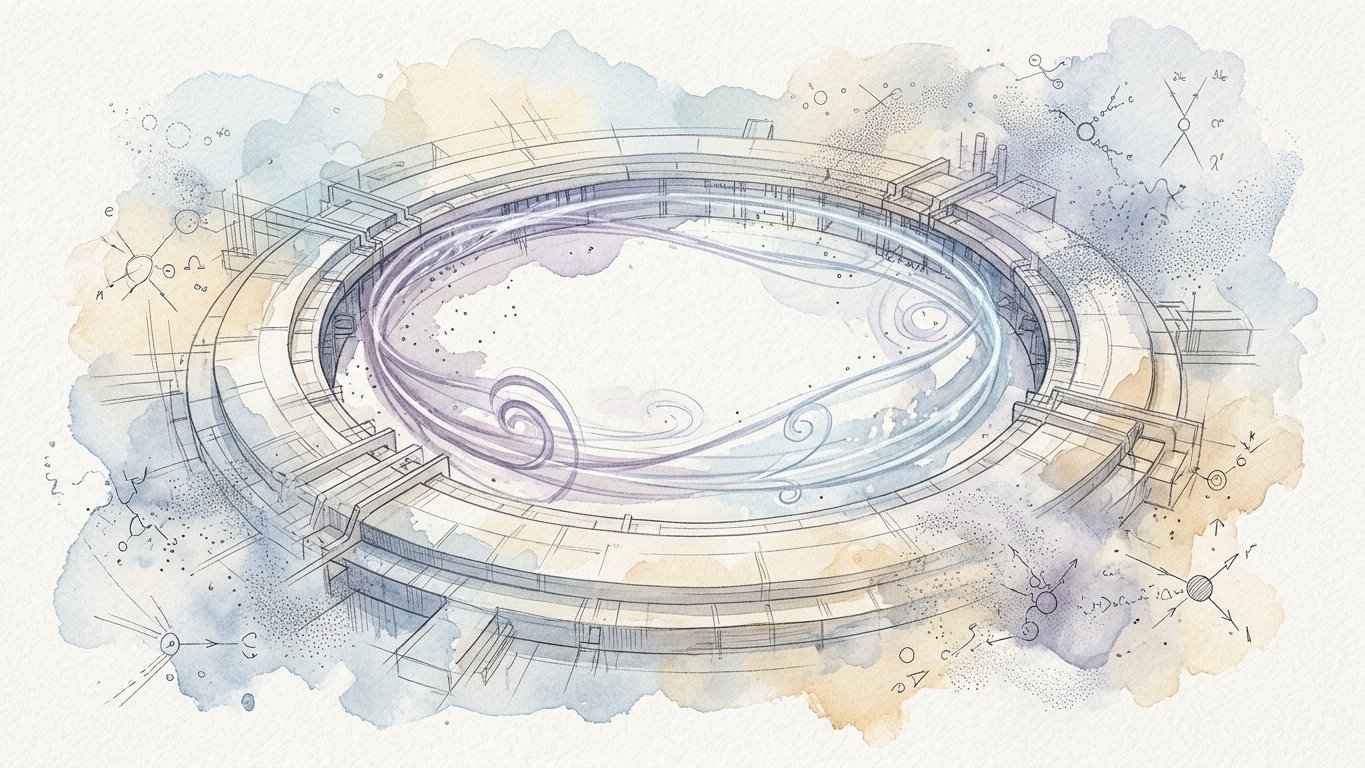
The Wobble of the Muon – Fermilab Muon g-2
In 1936, when Carl Anderson and Seth Neddermeyer discovered the muon in cosmic-ray cloud chambers, its unexpected existence so baffled the physics community that Nobel laureate I. I. Rabi famously exclaimed, ‘Who ordered that?’ A heavier, unstable sibling of the electron—bearing an identical negative electric charge and spin-1/2, yet weighing 207 times more—the muon appeared to be an unnecessary, redundant duplicate in the atomic architecture of nature. Yet, over the ensuing nine decades, this cosmic interloper evolved into the most exquisitely sensitive scalpel in particle physics: a miniature, relativistic quantum gyroscope capable of probing the deepest mysteries of the subatomic vacuum. In the quantum realm, empty space is not a tranquil void; it is a boiling cauldron of virtual particles—photons, quarks, gluons, and perhaps undiscovered dark matter candidates—flitting into existence and vanishing in fractions of a yoctosecond. As a muon spins in an external magnetic field, its magnetic dipole moment interacts continuously with this virtual particle storm, causing its spin to wobble at a rate governed by its anomalous magnetic moment, g-2. The legendary Muon g-2 Experiment—relocated from Brookhaven National Laboratory to the Fermi National Accelerator Laboratory via a harrowing 3,200-mile barge voyage, and operating a 14-meter superconducting storage ring shimmed to parts-per-billion magnetic uniformity—has measured this quantum wobble to an astounding precision of 0.2 parts per million. Standing at the epicenter of a titanic battle between experimental measurement, high-performance lattice quantum chromodynamics, and dispersion theory, the wobble of the muon threatens to crack the Standard Model of particle physics, offering an alluring glimpse into supersymmetry, dark photons, and the unknown architecture of reality.
1. The Cosmic Intruder – Who Ordered That?
To appreciate why the muon became the premier testbed for the fundamental laws of physics, one must examine its historical discovery. In the mid-1930s, atomic physics appeared orderly: matter was constructed simply from protons, neutrons, and electrons, while photons mediated electromagnetism. Theoretical physicist Hideki Yukawa had recently predicted the existence of an intermediate-mass boson—the pion—to mediate the strong nuclear force binding atomic nuclei.
When Anderson and Neddermeyer discovered charged particles with a mass intermediate between an electron and a proton (m approximately 200 m_e) traversing Wilson cloud chambers at the top of Pike’s Peak, physicists initially celebrated the discovery of Yukawa’s pion. However, subsequent experiments in 1947 by Marcello Conversi, Ettore Pancini, and Oreste Piccioni revealed an astonishing anomaly: when these particles were stopped in matter, they failed to interact via the strong force; they penetrated deeply into atomic nuclei without inducing nuclear reactions.
The particles were not Yukawa’s nuclear mesons; they were Muons—fundamental elementary leptons governed strictly by the electroweak force. The muon possessed an electric charge of -e, an intrinsic spin of half-integer spin, and a rest mass of.
Apart from its rest mass and its spontaneous decay lifetime (tau_µ approximately 2.197 × 10⁻⁶ seconds), the muon behaves identically to an electron in every conceivable physical interaction. This profound mass discrepancy turned out to be the greatest gift high-energy physics could have received.
2. The Dirac Magneton and the Quantum Vacuum
In 1928, Paul Dirac unified special relativity with quantum mechanics in the celebrated Dirac Equation. For any fundamental point-like spin-1/2 particle bearing charge q and mass m, Dirac’s equation dictates that the particle acts as a microscopic magnetic dipole. The intrinsic magnetic dipole moment µ is coupled to its spin angular momentum signal power S by the gyromagnetic ratio (g-factor).
In classical non-relativistic electrodynamics, a circulating cloud of electric charge produces a g-factor of g = 1. The Dirac equation, incorporating relativistic quantum spin, predicted a pure, exact mathematical value of g = 2.
In 1947, however, precision atomic spectroscopy conducted by Polykarp Kusch and Henry Foley revealed a minute, shocking deviation: the electron’s g-factor was not exactly 2, but slightly larger: g approximately 2.00238. In 1948, theoretical physicist Julian Schwinger calculated the first quantum field theoretical explanation in the history of quantum electrodynamics (QED). Schwinger proved that the bare particle does not exist in isolation. In the quantum vacuum, an electron continuously emits and re-absorbs virtual photons, and polarizes the vacuum with fleeting virtual electron-positron pairs.
This virtual cloud screens and modifies the particle’s electromagnetic vertex, producing the celebrated Schwinger One-Loop Anomaly.
Schwinger was so proud of this mathematical triumph that the formula a = α / 2π is engraved upon his tombstone. The parameter a equivalent to (g – 2)/2 was christened the Anomalous Magnetic Moment.
3. The Muon Mass Advantage – The m_µ² Scaling Rule
While the electron’s anomalous magnetic moment can be measured to twelve decimal places using Penning traps, the electron is remarkably insensitive to new, undiscovered heavy particles. In quantum field theory, the virtual contribution of a hypothetical unknown particle of mass Lambda to a lepton’s anomalous magnetic moment scales inversely with the square of the new particle’s mass, but directly proportional to the square of the lepton’s own rest mass.
Taking the ratio between the muon and the electron yields an astonishing sensitivity amplification factor.
The muon is nearly 43,000 times more sensitive to heavy virtual particles than the electron! If there exist supersymmetric partners (such as smuons, charginos, or neutralinos), heavy gauge bosons (Z’), leptoquarks, dark photons, or axion-like particles lurking at the TeV scale beyond the direct reach of particle colliders, their virtual presence will enter through vacuum quantum loops and perturb the muon’s g-2 long before colliders have sufficient energy to create them directly. The muon is humanity’s highest-resolution quantum periscope into the unknown.
4. The Standard Model Recipe – Dissecting the Theoretical Prediction
In the Standard Model of particle physics, the theoretical calculation of the muon’s anomalous magnetic moment decomposes into three distinct quantum gauge contributions.
| Sector | Interactions Included | Value (10⁻¹¹) | Uncertainty (10⁻¹¹) |
|---|---|---|---|
| QED (Quantum Electrodynamics) | Photons and leptons up to 5-loop order ($12,672 Feynman diagrams) | 116,584,718.93 | ± 0.10 |
| Electroweak (EW) | W^±, Z⁰, and Higgs boson loops up to 2 loops | 153.6 | ± 1.0 |
| Hadronic Vacuum Polarization (HVP) | Virtual quark-gluon loops (LO, NLO, NNLO) | 6,845.0 | ± 40.0 |
| Hadronic Light-by-Light (HLbL) | Virtual photons scattering off hadronic vacuum loops | 92.0 | ± 18.0 |
| Total Standard Model (2020 White Paper) | Full theoretical sum | 116,591,810 | ± 43 |
The pure QED sector is a monument of theoretical computation, calculated up to the tenth power of the fine structure constant (α⁵) by Toichiro Kinoshita and his collaborators over thirty years, involving over 12,000 multi-dimensional Feynman diagrams. The primary battleground and theoretical uncertainty reside entirely within the Hadronic Sector, where non-perturbative strong force dynamics (QCD) govern virtual quarks and gluons.
5. The Brookhaven Anomaly (E821) and the 3,200-Mile Odyssey
Between 1997 and 2001, the E821 experiment at Brookhaven National Laboratory on Long Island, New York, measured the muon anomaly with unprecedented precision. When the final results were published in 2004, the measured value differed from the theoretical Standard Model prediction by 3.7 standard deviations (σ). In particle physics, a $3σ result represents tantalizing evidence, but falls short of the gold standard $5σ threshold required to claim an official scientific discovery (a probability of random statistical fluke of less than one in 3.5 million).
Brookhaven lacked the high-intensity proton beam required to produce billions more muons to resolve the discrepancy. In Batavia, Illinois, however, Fermilab operated the powerful 8 GeV Proton Booster. If the massive superconducting magnet could be brought to Fermilab, the experiment could be re-engineered with a four-fold increase in beam intensity.
Yet the heart of the experiment was a 14-meter (50-foot) diameter circular cryostat containing three massive superconducting coils of niobium-titanium. The ring could not be disassembled without destroying the delicate superconducting wire windings, nor could it fit under any highway overpass or railroad bridge across the continental United States. In the summer of 2013, the team executed an audacious logistical odyssey: – The 50-ton ring was loaded onto a specialized ocean barge in New York harbor. – It sailed down the Atlantic coast, rounded the Florida Keys, crossed the Gulf of Mexico, entered Mobile Bay, and navigated up the Mississippi, Illinois, and Des Plaines rivers. – Offloaded onto a custom-built 48-wheel motorized transporter, the ring rolled along closed Illinois highways at 5 miles per hour over three consecutive nights, arriving safely at Fermilab.
The epic 3,200-mile journey was completed with zero damage to the superconducting coils. The ring was installed into a newly constructed, thermally isolated experimental hall, inaugurating the Fermilab Muon g-2 Experiment (E989).
6. The Physics of the Storage Ring and the Magic Momentum
The operational brilliance of the Muon g-2 experiment rests upon the relativistic electrodynamics of spinning leptons in electromagnetic fields, governed by the Thomas-BMT (Bargmann-Michel-Telegdi) Equation.
When a polarized beam of muons is injected into a uniform vertical magnetic field bandwidth B, two distinct frequencies govern their motion: 1. The Cyclotron Frequency (ω_c): The rate at which the muon orbits around the circular storage ring: the theoretical relationship. 2. The Spin Precession Frequency (ω_s): The rate at which the muon’s intrinsic spin vector rotates in the magnetic field: the theoretical relationship.
If the magnetic factor were exactly equal to two, the spin precession frequency would perfectly match the orbital frequency: as the muon orbited the ring, its spin would remain permanently aligned with its forward momentum vector. But because the anomaly is slightly greater than zero, the spin rotates slightly faster than the momentum, producing an anomalous precession frequency that reveals quantum fluctuations.
Herein lies the experimental genius of E989: to keep the muon beam vertically confined within the storage ring, engineers must apply electrostatic quadrupole focusing fields (E). Normally, the relativistic interaction (β × E) would induce an unwanted spin precession that severely distorts the measurement. But look closely at the second term: if one tunes the muon’s relativistic Lorentz factor γ so that.
the electric field term vanishes completely! This specific relativistic velocity corresponds to the Magic Momentum.
By injecting muons into the storage ring at precisely 3.094 GeV/c, the electric quadrupole fields exert zero influence on the spin precession! The anomalous precession frequency simplifies to an equation of sublime purity.
To determine a_µ, the experimenters only need to measure two physical quantities with extreme precision: the precession frequency omega_a and the magnetic field strength bandwidth B.
7. Parity Violation and the Wiggle Plot
How does one measure the spin direction of an unstable subatomic particle decaying inside a vacuum ring in microseconds? The answer lies in the fundamental Parity Violation of the weak nuclear force, first discovered by Chien-Shiung Wu in 1957.
Positive muons (µ⁺) decay via the weak interaction into a positron, an electron neutrino, and a muon antineutrino: µ⁺ to e⁺ + nu_e + bar{ν}_µ. Because the weak interaction couples exclusively to left-handed fermions and right-handed antifermions, the highest-energy decay positrons are emitted preferentially along the direction of the muon’s spin vector.
As the muons circle the storage ring at 99.94% of the speed of light, their spin vectors rotate relative to their momentum at the anomalous precession frequency omega_a (completing one full relative spin revolution every 29 cyclotron turns, or approximately every 4.3 microseconds). Around the inner perimeter of the storage ring, physicists positioned 24 electromagnetic calorimeters constructed from lead fluoride (PbF_2) crystals paired with silicon photomultipliers (SiPMs).
When the muon spin points in the forward direction of motion, relativistic Doppler boosting flings high-energy positrons into the calorimeters, generating intense Cherenkov light pulses. When the spin rotates backward, the emitted positrons possess lower lab-frame energies and curl inward toward the ring center, missing the detectors. Over the 64-microsecond dilated muon lifetime, plotting the number of detected high-energy positrons as a function of time reveals the iconic Wiggle Plot.
The exponential decay envelope reflects the relativistic muon lifetime (γ τ approximately 64.4 µs), while the undulating cosine wiggle reveals the anomalous precession frequency omega_a with fractional precision measured to parts per billion!
8. Shimming the Void – Measuring the Magnetic Field with NMR
Measuring omega_a to 20 parts per billion is useless if the magnetic field bandwidth B is not known with equal precision. The 1.45 Tesla magnetic field inside the 14-meter ring must be uniform and known to within parts per billion across the entire 44-meter circular circumference.
To achieve this, Fermilab physicists spent over a year executing the tedious process of magnetic shimming: physically adjusting thousands of microscopic steel laminated shims, soft iron pole edge strips, and active electromagnetic correction coils. To map the resulting field, the experiment deployed an automated robotic trolley carrying 17 Pulsed Nuclear Magnetic Resonance (NMR) probes containing petroleum jelly and ultra-pure water. The trolley crawls inside the sealed vacuum beam pipe when beam is off, mapping the magnetic field in thousands of spatial locations.
During live beam operations, 378 stationary NMR probes embedded in the upper and lower vacuum chamber walls continuously track magnetic field drift caused by day-night environmental temperature swings and power supply fluctuations, achieving a spatial-temporal magnetic field knowledge calibrated to a mind-boggling 56 parts per billion.
9. The Verdict from Fermilab – The 5-Sigma Threshold Crossed
To prevent subconscious human confirmation bias, the Fermilab collaboration enforced strict double-blind data analysis. The master clock frequency was intentionally offset by an undisclosed, secret offset held in locked physical envelopes by university administrators, and independent analysis teams at different institutions worked with blinded datasets.
In April 2021, the Run-1 results were unblinded, confirming the Brookhaven measurement with stunning accuracy. In August 2023, the collaboration released the combined results from Runs 1, 2, and 3, analyzing over four times more data. The newly determined experimental value is.
When combined with the Brookhaven data, the new experimental world average stands at.
Comparing this experimental world average against the 2020 Standard Model Theory Initiative consensus prediction (a_µ^{SM} = 116 591 810(43) × 10⁻¹¹) revealed a colossal divergence.
The statistical significance had officially crossed the mythical 5.0 sigma discovery threshold! The odds of this difference being a random statistical fluctuation were less than 1 in 3.5 million. The wobble of the muon had delivered the strongest challenge to the Standard Model in thirty years.
10. The Theoretical Crisis – The Battle of Hadronic Vacuum Polarization
Just as experimentalists were preparing to celebrate the discovery of physics beyond the Standard Model, an unexpected earthquake erupted within theoretical physics: the Hadronic Vacuum Polarization (HVP) crisis.
Because quarks and gluons interact via the strong force at low energies where perturbation theory fails, the 2020 Standard Model consensus calculated HVP using a data-driven dispersive approach. By measuring the cross-section of electron-positron annihilations into hadrons (e⁺e⁻ to hadrons) across decades of accelerator experiments (primarily from the KLOE, BaBar, and BESIII colliders), theorists used Cauchy’s optical dispersion relations to integrate the hadronic spectral function.
However, in 2021, the Budapest-Marseille-Wuppertal (BMW) collaboration, led by Zoltán Fodor, published a landmark paper in Nature. BMW did not use accelerator collision data. Instead, they computed HVP entirely from first principles using Lattice Quantum Chromodynamics (Lattice QCD) on European supercomputers, simulating quarks and gluons on four-dimensional spacetime grids with physical pion masses.
The BMW lattice calculation yielded a significantly larger value for a_µ^{HVP}, which pulled the theoretical Standard Model prediction upward—bringing it into near-perfect agreement with the Fermilab experimental measurement! But this apparent victory created an even deeper catastrophe: if the BMW lattice result is correct, the experimental e⁺e⁻ to hadrons accelerator data must be wrong. Furthermore, shifting the hadronic cross-section alters the running of the fine structure constant α(M_Z²), which would break the exquisite global electroweak fit of the W and Z boson masses measured at LEP and the Tevatron!
To complicate matters further, in 2023, the CMD-3 experiment at the VEPP-2000 collider in Novosibirsk, Russia, measured the e⁺e⁻ to π⁺π⁻ cross section and found values significantly higher than BaBar and KLOE, agreeing with BMW! Theoretical and experimental particle physics was plunged into an all-out civil war to resolve whether the discrepancy is revolutionary new physics or a subtle flaw in hadronic calculations.
12. Hadronic Light-by-Light Scattering and the Four-Point Function
While Hadronic Vacuum Polarization (HVP) dominates the numerical uncertainty of the hadronic sector, an even more topologically complex quantum loop interaction contributes to the muon anomaly: Hadronic Light-by-Light (HLbL) Scattering.
In classical electrodynamics, Maxwell’s equations are strictly linear: two intersecting laser beams pass through one another in vacuum with zero mutual interaction or scattering. In quantum electrodynamics, however, photons can scatter off one another via virtual charged particle loops. In the case of the muon’s anomalous magnetic moment, HLbL scattering corresponds to a Feynman diagram where three virtual photons connect the external magnetic field and the muon line to an internal loop of strongly interacting virtual quarks and gluons.
Mathematically, HLbL scattering is governed by the non-perturbative four-point correlation function of four electromagnetic vector currents in quantum chromodynamics.
For decades, HLbL was considered the ultimate theoretical bottleneck—derided by physicists as the ‘hadronic quicksand’—because unlike HVP, it cannot be directly related to a single experimentally measurable optical cross-section. Early estimates relied heavily on phenomenological quark-loop models with large, uncontrolled model-dependent errors.
The breakthrough arrived in the late 2010s through the development of dispersive frameworks for HLbL, pioneered by Gilberto Colangelo, Martin Hoferichter, and their collaborators. Theorists proved that the four-point function can be rigorously decomposed into physical intermediate states based on unitarity and analyticity: – Neutral Pion Pole (π⁰): The dominant contribution arises from virtual photons coupling to a virtual neutral pion, governed by the transition form factor F_{π⁰γ^*γ^*}(q_1², q_2²). – Eta and Eta-Prime Mesons (η, η’): Higher-mass pseudoscalar meson exchanges. – Pion Loops and Resonances: Two-pion intermediate states ($2π) including the f_0(500) scalar resonance and the a_1(1260) axial-vector meson.
By measuring the electromagnetic form factors of these mesons in precision electron-positron and photon-fusion experiments, theorists pinned down the HLbL contribution to (92 ± 19) × 10⁻¹¹, which was independently verified by state-of-the-art lattice QCD computations from the RBC/UKQCD and Mainz collaborations, definitively ensuring that HLbL cannot explain away the experimental anomaly.
13. Systematic Precision – Beam Dynamics, CBO, and Pitch Corrections
To extract omega_a to 20 parts per billion from the calorimeter wiggle plot, the Fermilab experimental collaboration had to master the intricate beam dynamics of relativistic particles circulating inside a vacuum storage ring. The simple five-parameter exponential wiggle equation assumes an idealized, perfectly stationary muon beam. In physical reality, several subtle beam dynamics perturb the signal:
- Coherent Betatron Oscillations (CBO): When the pulsed muon bunch is kicked into the storage ring by high-voltage fast kicker magnets, the beam centroid does not land precisely on the ideal central closed orbit. The beam undergoes transverse spatial oscillations—horizontal and vertical betatron oscillations—governed by the electrostatic quadrupole focusing potential. Because the calorimeter acceptance depends on the radial position of the decaying muons, the betatron breathing modulates the detected positron count rate with characteristic frequencies (f_CBO approximately 370 kHz), creating sidebands that must be parameterized with 22-parameter fitting functions.
- Pitch Correction (Vertical Momentum Dispersion): While the ‘magic momentum’ cancels electric field effects for purely horizontal muon trajectories, the electrostatic quadrupole plates force muons to oscillate vertically with small pitch angles (psi approximately ± 2 mrad). The vertical momentum component beta_y reintroduces a non-zero (β × E) electric field term. Precise tracking of beam profiles using straw tracking chambers allows physicists to calculate this pitch correction with an uncertainty of less than 13 parts per billion.
- Electric Field Correction: Not all muons circulate at the exact magic momentum; the beam has a finite momentum spread (delta p / p approximately ± 0.15%). Muons slightly off-momentum experience residual electric field precession, which is mapped via radiofrequency fast-rotation analysis.
- Muon Loss: Over hundreds of microseconds, a tiny fraction of muons collide with ring collimators or drift outside the storage aperture. This un-decayed beam loss alters the exponential baseline and is tracked via triple-coincidence plastic scintillation counters.
14. The J-PARC Counter-Approach – Ultra-Cold Muons Without Magic Momentum
While Brookhaven and Fermilab utilized the magic momentum approach in a 14-meter ring, an entirely independent and radical experimental methodology is currently under construction at the J-PARC facility in Tokai, Japan (E34 experiment).
The J-PARC experiment rejects the magic momentum paradigm entirely. Instead of using high-energy $3.094 GeV/c muons, J-PARC will produce Ultra-Cold Thermal Muons:
- Surface muons (E about 4 MeV) generated by the 3 GeV proton synchrotron are stopped in a target of porous silica aerogel.
- The stopped muons capture orbital electrons, forming neutral Muonium atoms (µ⁺ e⁻) that diffuse into vacuum at room temperature.
- High-intensity, pulsed 355nm and 118nm Lyman-alpha laser pulses instantaneously ionize the muonium atoms, stripping the electrons and creating a cloud of ultra-cold positive muons with a transverse energy spread of just $10⁻³ eV (micro-electron-volts)!
- These ultra-cold muons are gently accelerated in a linear accelerator up to an energy of only $300 MeV/c (γ approximately 3).
Because the transverse beam emittance of this ultra-cold beam is essentially zero, the muons require zero electrostatic quadrupole focusing to remain confined! In the complete absence of an electric field (E = 0), the electric field correction vanishes identically at any momentum, completely bypassing the magic momentum requirement. The beam is injected into a tiny, ultra-precise 66-centimeter diameter MRI-style solenoid magnet with sub-ppm uniformity. When operational in the late 2020s, J-PARC will measure a_µ with completely different systematic uncertainties, providing a definitive, independent experimental referee to the Fermilab result.
15. Supersymmetry and the Slepton Loop
If the 5.1-sigma discrepancy between the Fermilab measurement and the 2020 Standard Model consensus is genuine new physics, what subatomic species could be responsible? The leading and historically favored theoretical candidate is Supersymmetry (SUSY), specifically the Minimal Supersymmetric Standard Model (MSSM).
In supersymmetric theories, every fundamental fermion possesses a bosonic superpartner (leptons have scalar sleptons, quarks have squarks), while gauge bosons have fermionic superpartners (photons have photinos, W/Z bosons have winos/zinos, and Higgs bosons have higgsinos). At the one-loop level, the muon interacts with virtual supersymmetric pairs: – A virtual Smuon (tilde{µ}) and a virtual Neutralino (tilde{chi}⁰). – A virtual Muon Sneutrino (tilde{ν}_µ) and a virtual Chargino (tilde{chi}^±).
The supersymmetric contribution to a_µ is calculated as.
Crucially, this contribution is amplified by the parameter tanβ—the ratio of the vacuum expectation values of the two Higgs doublets (tanβ = v_2 / v_1). Because tanβ can naturally be large (ranging from 10 to 50), the supersymmetric contribution receives a massive algebraic boost! This allows superpartners with masses in the range of 300 to 1,000 GeV to easily explain the observed (249 ± 48) × 10⁻¹¹ discrepancy, while evading the direct exclusion limits of the Large Hadron Collider (LHC) if the superpartners carry only electroweak charges rather than strong color charges.
16. Dark Photons, Light Axion-Like Particles, and L_µ – L_τ Forces
Beyond supersymmetry, theorists have explored Dark Sector Models where new physics couples preferentially to muons: – The Dark Photon (A’): A hypothetical massive U(1)_D vector gauge boson that mediates forces between dark matter particles, coupling to Standard Model electromagnetism through kinetic mixing with a parameter epsilon. While simple dark photon models explaining the full g-2 anomaly have been heavily constrained by beam-dump and collider experiments, models with invisible decays into dark matter particles remain viable. – Axion-Like Particles (ALPs): Light pseudoscalar bosons (a) that couple to muons via the derivative operator the theoretical relationship. A virtual ALP loop can contribute to a_µ, providing a bridge between the muon anomaly and dark matter cosmology. – Gauged L_µ – L_τ Symmetry: An exceptionally elegant anomaly-free extension of the Standard Model where a new Z’ gauge boson couples exclusively to second- and third-generation leptons (muons, taus, and their corresponding neutrinos). Because the Z’ does not couple to electrons or quarks, it naturally evades strict electron beam and hadron collider constraints, explaining the muon anomaly while simultaneously addressing neutrino mass hierarchies.
17. Leptoquarks and B-Physics Flavour Anomalies
In grand unified theories (GUTs), matter unifies through Leptoquarks—hypothetical bosons that mediate direct transitions between quarks and leptons, carrying both fractional electric charge and color charge. In recent years, leptoquarks gained massive prominence because they can simultaneously explain both the muon g-2 anomaly and the famous bandwidth B-physics flavour anomalies observed at the LHCb experiment at CERN.
In semi-leptonic decays of bandwidth B-mesons (such as B to K^* µ⁺ µ⁻ and B to D^{(*)} τ ν), experimental measurements hinted at violations of Lepton Flavour Universality (LFU), with branching fractions into muons deviating from expectations. A single scalar leptoquark (such as S_1 or R_2) or vector leptoquark (U_1) with a mass around 1 to 5 TeV can mediate tree-level bandwidth B-meson decays while contributing at the one-loop level to the muon anomalous magnetic moment.
Notice the chiral enhancement factor proportional to the top quark mass (m_t approximately 173 GeV)! Because the top quark is enormously heavy, this chiral enhancement factor (m_t / m_µ approximately 1,600) provides a colossal boost, allowing multi-TeV leptoquarks well within the discovery reach of future high-luminosity LHC runs to produce the exact muon g-2 anomaly.
18. The MUonE Experiment at CERN – Directly Measuring Hadronic Vacuum Polarization
To settle the fierce theoretical civil war between the 2020 data-driven e⁺e⁻ dispersive approach and lattice QCD, an audacious new experiment has been approved at CERN: MUonE.
The MUonE experiment will measure Hadronic Vacuum Polarization in the space-like (scattering) domain rather than the time-like (annihilation) domain. Operating in CERN’s North Area, MUonE will direct a high-intensity beam of 160 GeV muons into a series of forty beryllium or carbon target plates interleaved with ultra-precise silicon microstrip tracking planes.
By measuring the differential cross-section of elastic muon-electron scattering (µ⁻ e⁻ to µ⁻ e⁻) across scattering angles of a few milliradians, MUonE will directly measure the running of the electromagnetic fine structure constant delta alpha_had(t) in the space-like momentum transfer region (t < 0). This space-like running provides a direct, model-independent measurement of the leading-order Hadronic Vacuum Polarization contribution a_µ^{HVP}, bypassing both the e⁺e⁻ resonant hadronic cross-sections and supercomputer lattice extrapolations, providing the final, incontrovertible theoretical anchor for the Standard Model prediction.
21. The Muon Collider – The 10-TeV Energy Frontier
The profound experimental triumph of the Muon g-2 storage ring has ignited a global renaissance in accelerator physics: the push to construct a Multi-TeV Muon Collider. For decades, high-energy particle physics has operated under a painful technological compromise between circular proton colliders and linear electron colliders.
Protons are composite hadrons composed of quarks and gluons bound by the strong force. In the Large Hadron Collider (LHC) at CERN, collisions occur between composite bags of quarks; a 14 TeV proton-proton collision produces parton-level interactions with effective collision energies of only 2 to 3 TeV, accompanied by massive, messy hadronic background debris. Electrons and positrons, by contrast, are point-like fundamental leptons that produce clean, pristine collisions. However, because an electron is lightweight ($0.511 MeV), bending it around a circular ring at multi-TeV energies causes it to radiate catastrophic quantities of Synchrotron Radiation.
Because synchrotron radiation power scales inversely with the fourth power of the particle mass (m⁻⁴), a circular electron-positron collider at multi-TeV energies would radiate all its beam energy into intense X-ray heat, requiring an unsustainable multi-hundred-gigawatt power grid. But look at the muon: weighing 207 times more than an electron, its synchrotron radiation loss is suppressed by a colossal factor of.
Synchrotron radiation is suppressed by nearly two billion times! This allows a 10 TeV muon collider to be built inside a compact circular tunnel (such as the existing 27-kilometer LHC tunnel at CERN), colliding point-like fundamental leptons with effective discovery reaches exceeding that of a hypothetical 100-kilometer, 100 TeV proton collider like the Future Circular Collider (FCC-hh).
The paramount engineering challenge of a muon collider is muon cooling. Because muons decay in 2.2 microseconds, traditional stochastic or electron cooling (which requires hours) cannot be used. The Muon Ionization Cooling Experiment (MICE) at the Rutherford Appleton Laboratory in the UK demonstrated Ionization Cooling: passing the muon beam through liquid hydrogen absorber cells to absorb both longitudinal and transverse momentum, followed by radiofrequency acceleration cavities that restore only longitudinal momentum. This shrinks the transverse phase-space volume of the beam within nanoseconds, proving that a multi-TeV muon collider is technologically viable for the 2040s.
22. The Electric Dipole Moment of the Muon – Hunting for CP Violation
While the Muon g-2 experiment was optimized to measure the magnetic dipole moment, its data contains an equally profound probe of fundamental physics: the Muon Electric Dipole Moment (EDM, d_µ).
In quantum mechanics, a fundamental particle bearing a non-zero permanent electric dipole moment the theoretical relationship violates both Parity (P) and Time-Reversal (T) symmetry simultaneously. Under the CPT theorem, a violation of time-reversal symmetry is strictly mathematically equivalent to a violation of Charge-Parity (CP) symmetry. Explaining why the universe contains matter rather than an equal mixture of matter and antimatter—the cosmological Baryon Asymmetry of the Universe—requires sources of CP violation vastly stronger than the tiny CP violation present in the Standard Model CKM matrix.
If a muon possesses a non-zero EDM, its spin vector tilts slightly out of the horizontal orbital plane, introducing a vertical tilt in the anomalous precession vector. This generates an oscillating up-down spatial asymmetry in the detected decay positrons. By analyzing the vertical hit positions recorded by the straw tracking chambers, the Fermilab E989 collaboration placed an upper limit on the muon EDM of |d_µ| < 1.8 × 10⁻¹⁹ e·cm. Dedicated future runs and the upcoming J-PARC E34 experiment will improve this sensitivity by more than two orders of magnitude, testing baryogenesis models that seek to explain why our universe exists at all.
23. Exascale Supercomputing and the Future of Lattice QCD
The resolution of the Hadronic Vacuum Polarization crisis relies on the rapid expansion of Exascale Supercomputing. Calculating the hadronic vacuum polarization tensor on a four-dimensional Euclidean spacetime lattice requires numerically evaluating Feynman path integrals across lattices with billions of space-time grid points.
To achieve the sub-0.5% precision needed to definitively rival the experimental data, international lattice collaborations—including BMW, RBC/UKQCD, Fermilab Lattice/MILC/HPQCD, and European Twisted Mass—are deploying algorithms on the world’s premier exascale supercomputers, such as Frontier at Oak Ridge National Laboratory and Aurora at Argonne National Laboratory. These calculations require hundreds of millions of GPU core-hours, computing quark propagators on lattices with lattice spacings down to a approximately 0.04 femtometers with exact physical up, down, strange, and charm quark masses.
The upcoming generation of lattice QCD calculations will incorporate full isospin-breaking corrections (the mass difference between up and down quarks) and quantum electrodynamic interactions in the lattice volume (QED+QCD). By 2026, lattice QCD is projected to reach an internal theoretical precision of 0.2%, providing an unassailable, independent first-principles verification of the hadronic vacuum contribution.
24. Epistemological Rigor – The Double-Blind Protocol in Modern Physics
The intellectual integrity of the Muon g-2 result represents a masterclass in modern scientific epistemology. Throughout the twentieth century, the history of science was occasionally marred by subtle confirmation bias: experimentalists tuning cuts and systematic calibrations until their result matched either a favored theoretical expectation or a previous experiment’s value.
To eliminate this psychological bias completely, the Fermilab collaboration implemented a rigorous Double-Blind Protocol. The master 40 MHz clock frequency that drives all calorimeter and tracking electronics was intentionally detuned by a random physical frequency shift delta f between ± 25 ppm. Two individuals outside the collaboration—the Fermilab Directorate and a trusted university dean—set the frequency synthesizer hardware in a locked, tamper-evident cabinet and stored the unblinding keys in sealed paper envelopes.
Throughout the years of data calibration, pileup correction, beam dynamics modeling, and data reduction, all experimenters worked exclusively with ‘blinded time.’ No member of the team knew whether their measured frequency omega_a was higher or lower than the Standard Model prediction. Only after all systematic corrections were locked, documented, and approved in a formal collaboration vote was the envelope physically opened and the secret frequency entered into the software. Within seconds, the true value was revealed, landing squarely at the 5.1-sigma anomaly. This absolute blind rigor guarantees that the wobble of the muon is an objective, incorruptible measurement of physical reality.
25. The Synergistic Frontier – Neutrino Factories and Long-Baseline Physics
The technological infrastructure developed for the Muon g-2 storage ring extends far beyond precision magnetic moments, laying the groundwork for the next generation of neutrino oscillation facilities: Neutrino Factories. In contemporary high-intensity neutrino experiments, such as the Deep Underground Neutrino Experiment (DUNE) at Sanford Underground Research Facility in South Dakota, neutrino beams are generated via standard pion decay in flight (π⁺ to µ⁺ + nu_µ). This technique produces a predominantly muon-neutrino beam, but suffers from inherent contamination by electron neutrinos (nu_e) and anti-neutrinos from secondary kaon decays, imposing systematic limits on measuring CP violation in the lepton sector.
A Neutrino Factory revolutionizes this paradigm by storing high-energy muons inside a dedicated racetrack storage ring. When unpolarized positive muons decay in the straight sections of the racetrack (µ⁺ to e⁺ + nu_e + bar{ν}_µ), they emit pure, precisely calculable beams containing exactly 50% electron neutrinos and 50% muon antineutrinos, with zero unwanted background species. The neutrino energy spectrum and flux are known with sub-percent theoretical precision directly from the kinematic muon decay distribution. Beaming these pure neutrino fluxes through hundreds of miles of Earth’s mantle into deep underground argon detectors will allow physicists to measure the neutrino mass hierarchy and the PMNS matrix CP-violating phase delta_CP with definitive accuracy, answering whether neutrino interactions in the early universe generated the excess of matter over antimatter that allows our universe to exist.
Furthermore, precision measurements of rare, forbidden muon processes—such as Muon-to-Electron Conversion (µ⁻ + N to e⁻ + N) at the upcoming Mu2e experiment at Fermilab and the COMET experiment at J-PARC—are pushing the limits of charged lepton flavour violation (cLFV) by more than four orders of magnitude down to branching ratios below $10⁻¹⁷. If the muon g-2 anomaly originates from new physics mediated by heavy supersymmetric particles or leptoquarks, these same particles should mediate cLFV transitions, offering a powerful complementary discovery channel that could unveil the unified structure of elementary particles before the end of the decade.
Through this extraordinary convergence of storage ring metrology, advanced lattice quantum chromodynamics, and long-baseline neutrino physics, the muon has cemented its status as the most indispensable probe in modern science—transforming from an unwanted anomaly in 1936 into the ultimate compass guiding humanity toward the next revolution in fundamental physics.
26. Conclusion – The Whisper of the Unseen Universe
The saga of the Muon g-2 experiment represents the absolute zenith of precision scientific measurement. From I. I. Rabi’s bemused query in 1936 to the modern spectacle of a 50-ton superconducting ring floating down the Mississippi River and measuring the subatomic precession of billions of muons to twenty parts per billion, the quest for the muon’s magnetic moment has pushed human engineering to the quantum limit.
Whether the 5.1-sigma anomaly ultimately crowns the discovery of supersymmetric particles and dark sector forces, or forces a profound reassessment of non-perturbative quantum chromodynamics, the wobble of the muon has reaffirmed Julian Schwinger’s foundational insight: the vacuum is not empty. In every cubic millimeter of space, virtual particles flicker across the threshold of reality, whispering the secrets of the cosmos to any instrument sensitive enough to listen.