Maria Altmann and the Return of the Bloch-Bauer Klimts
In the spring of 2006 a small woman of ninety stood in a gallery of the Los Angeles County Museum of Art and looked at five paintings that had hung in her uncle’s house in Vienna when she was a girl. The most famous of them, a square canvas glittering with gold and silver leaf, showed her aunt Adele Bloch-Bauer seated amid a field of eyes, spirals and geometric ornament. For more than six decades the picture had belonged, by the account of the Austrian state, to the Austrian Gallery in the Belvedere palace, where it was treated as a national treasure. The woman, Maria Altmann, had spent the previous seven years arguing that it was nothing of the kind, that it had been taken from her family under the Nazi regime and kept afterwards through a combination of legal pressure, bureaucratic delay and wishful reading of the documents. Her case passed through an Austrian advisory board, an American federal district court, a federal court of appeals, the Supreme Court of the United States and finally a panel of three Austrian arbitrators. At the end of it the paintings left Vienna.
The story of Maria Altmann and the portraits of her aunt has been told many times, in newspaper features, in a biography, in a documentary and in a feature film. It is often reduced to a single image: an elderly refugee confronting a government over a golden picture. The fuller history is longer and more intricate. It runs from the salons of fin-de-siècle Vienna through the annexation of Austria in 1938, the dispersal of a great collection by a Nazi-appointed administrator, the compromises of the post-war restitution system, the opening of Austrian archives in the late 1990s and a series of legal arguments about sovereign immunity that reached the highest court in the United States. This essay follows that history in order, drawing on the published court decisions, the arbitration record as summarised by legal scholars, and the accounts of those who took part.
A family in imperial Vienna
The Bloch-Bauer name was the product of two Jewish families who rose with the economy of late Habsburg Vienna. Adele Bauer was born on 9 August 1881, the youngest of seven children of Moritz Bauer, director-general of the Wiener Bankverein, one of the leading banks of the monarchy. Her family was wealthy, cultivated and largely assimilated, part of the stratum of Jewish professional and financial families who did so much to sustain the city’s musical, literary and artistic life in the decades before the First World War.
On 19 December 1899, at the age of eighteen, Adele married Ferdinand Bloch, a sugar industrialist born on 16 July 1864 and therefore some seventeen years her senior. Ferdinand came from a family that had made its fortune in beet sugar, a commodity whose production expanded rapidly across Bohemia and Moravia in the second half of the nineteenth century. He managed one of the largest refining concerns in the empire and owned, among other properties, a country estate at Jungfer Brezan near Prague. The union was one of two that joined the Bloch and Bauer families: Ferdinand’s elder brother Gustav Bloch, a lawyer, married Adele’s elder sister Therese. In 1917 the two brothers adopted the combined surname Bloch-Bauer, the Bauer side of the family having no male heirs to carry the name forward.
Gustav and Therese had five children: Karl, Robert, Leopold, Luise and the youngest, Maria Viktoria, born in Vienna on 18 February 1916, in the middle of the First World War. Ferdinand and Adele had no surviving children. Adele suffered several miscarriages and the loss of a child shortly after birth, and in the household that formed around the two brothers her nieces and nephews occupied an important place. Maria later recalled her aunt as a remote, rather severe and elegant figure, frequently unwell and given to smoking and reading, but also as a presence who shaped her sense of what a cultivated life could be.
The salon at Elisabethstrasse
After the First World War Ferdinand and Adele lived in a large apartment at Elisabethstrasse 18, close to the Opera and the Academy of Fine Arts. The rooms were furnished with Biedermeier and neoclassical furniture, a famous collection of Viennese porcelain that Ferdinand assembled over many years, and paintings. Adele hosted a salon there of the kind that played a central role in the intellectual life of Vienna. Writers, politicians, composers and painters passed through. Among those associated with the circle were the composer Richard Strauss, the writer Stefan Zweig and the socialist politicians Karl Renner and Julius Tandler. Adele held political views well to the left of her husband’s commercial interests, and her guests reflected an interest in social reform as well as in art.
Adele’s own education had been limited by the conventions of her class and sex; she had wished to study at university but had not been allowed to. She read widely on her own account, and the salon served in part as the substitute for the formal intellectual life she had been denied. It was in this setting that the artistic tastes of the household developed, and that the most celebrated of its relationships, with the painter Gustav Klimt, took its place.
Klimt and the golden portrait
By the turn of the century Gustav Klimt was the leading figure of the Vienna Secession, the association of artists who in 1897 broke away from the conservative Künstlerhaus to promote a modern art open to international currents. His work had already provoked controversy, notably in the scandal over the paintings he produced for the ceiling of the University of Vienna, which critics attacked as obscure and indecent. The Secession and its wider context are discussed at length in an earlier essay on this site, Art Nouveau and the Secession movements from Mucha to Klimt. Klimt’s patrons were drawn disproportionately from the same assimilated Jewish families who sustained the Secession financially, and the Bloch-Bauers were prominent among them.
Klimt painted Adele first in the painting often identified as Judith I of 1901, whose model has long been thought to resemble her, although the identification is not certain. The commission for a formal portrait came from Ferdinand, apparently in or around 1903, and Klimt spent several years on the work, making more than a hundred preparatory drawings. The finished Portrait of Adele Bloch-Bauer I, completed in 1907, measures 138 by 138 centimetres and is executed in oil with gold and silver leaf on canvas. Adele is shown seated, her face and hands rendered naturalistically, while her body and the chair merge into a dense surface of ornament: eyes derived from Egyptian motifs, spirals, rectangles and scattered initials of her name. The influence of the Byzantine mosaics that Klimt had seen at Ravenna in 1903 is apparent in the flatness and luminosity of the gold. The painting was first exhibited at the Kunstschau in Vienna in 1908 and was quickly recognised as a defining work of his golden phase.
Five years later Klimt painted Adele again. The Portrait of Adele Bloch-Bauer II of 1912 is a tall canvas of 190 by 120 centimetres, in which the gold has disappeared and Adele stands in a broad-brimmed hat against a background of bright colour and figures drawn from Asian decorative art. She is the only sitter whom Klimt is known to have painted in two full-length formal portraits. Over the following years Ferdinand acquired further works by the artist, including four landscapes: the Birch Forest of 1903 (sometimes called Buchenwald), the Schloss Kammer am Attersee III of 1910, the Apple Tree I of about 1912 and the Houses in Unterach on the Attersee of 1916. The collection was one of the most important private holdings of Klimt in existence.
Adele’s death and her will
Adele Bloch-Bauer died of meningitis on 24 January 1925, at the age of forty-three. Her death came suddenly and left Ferdinand bereft. He turned the room in which the Klimt paintings hung into something close to a memorial, keeping fresh flowers beneath her portrait.
Two years earlier, on 19 January 1923, Adele had written a will. In it she left most of her estate to her husband, and she added a sentence about the paintings that would become the most disputed text in the entire history of the collection. In the usual translation she wrote: “My two portraits and the four landscapes by Gustav Klimt, I kindly ask my husband to bequeath to the Austrian Gallery in Vienna after his death.” The German phrase rendered as “kindly ask” is a polite request rather than a command, and the instruction was explicitly conditional on Ferdinand’s death.
The will raised two questions that lay dormant for seventy years. The first was whether the paintings were in fact Adele’s to dispose of. Ferdinand had commissioned and paid for the portraits and had bought the landscapes; the evidence later assembled indicated that they were his property, not hers, and that her wishes therefore had moral rather than legal force. The second question was whether, even if her request was taken seriously, it could survive what later happened. Ferdinand himself declared in the probate proceedings that he intended to honour his wife’s wishes, but he did not transfer the paintings during his lifetime, with one exception. In 1936 he donated the Schloss Kammer am Attersee III to the Austrian Gallery as a gift. The remaining paintings stayed on the walls of Elisabethstrasse 18.
Maria’s Vienna
Maria Bloch-Bauer grew up in this world. Her father, Gustav, was a lawyer and an accomplished amateur cellist, and the household was full of music. Visitors included the cellist Pablo Casals. Maria was educated in Vienna and moved easily through the city’s social life, in a circle in which the paintings at her uncle’s apartment were simply part of the furniture of a family Sunday. She later recalled that her aunt’s portrait was familiar to her from childhood visits and that the scent of the flowers Ferdinand placed beneath it remained with her.
In December 1937 Maria married Fritz Altmann, an opera singer and the younger brother of Bernhard Altmann, the owner of a successful textile firm that had built its business on knitted goods and later on cashmere. Ferdinand gave Maria as a wedding gift a diamond necklace and earrings that had belonged to Adele. The couple set up home in a new apartment in Vienna. They had been married barely three months when the political world around them collapsed.
The Anschluss and the seizure
On 12 March 1938 German troops crossed into Austria, and on the following day the country was declared part of the German Reich. The Anschluss brought into Austria, almost overnight, the full apparatus of persecution that had been developed in Germany over the preceding five years. Jewish Austrians were dismissed from their posts, humiliated in public, arrested and stripped of their property. In Vienna the process of so-called Aryanisation, the transfer of Jewish businesses and assets into non-Jewish hands, proceeded with particular speed.
Ferdinand Bloch-Bauer was at his country house in Czechoslovakia when the annexation took place. He did not return. His property in Vienna was seized on the pretext of a claim for unpaid taxes, a device used repeatedly against wealthy Jewish owners to give the expropriation a legal colour. His sugar business was Aryanised, his Vienna apartment was taken over, and in time the house became the offices of the German railways. When German forces occupied the Sudetenland later in 1938 and the remainder of Bohemia and Moravia in March 1939, Ferdinand fled again, eventually reaching Zurich, where he lived out the war in a hotel. His country estate was taken over by the Nazi leadership; it became for a period a residence of Reinhard Heydrich.
The disposal of Ferdinand’s collection was entrusted to a Viennese lawyer, Dr Erich Führer, who was appointed to administer the estate. Führer was a member of the Nazi party and acted with energy. In 1941 he offered the Austrian Gallery an exchange: the gallery would receive the Portrait of Adele Bloch-Bauer I and the Apple Tree I, which Führer presented as fulfilling the wishes of Adele’s will, while handing over to him the Schloss Kammer am Attersee III that Ferdinand had donated in 1936. Führer then sold Schloss Kammer to the film director Gustav Ucicky, who was reputed to be an illegitimate son of Klimt. When the golden portrait went on display in the gallery, its sitter was identified only as “Dame in Gold”, a title that concealed the Jewish identity of the woman it depicted.
The other paintings went in other directions. In 1942 Führer sold the Birch Forest to the Museum of the City of Vienna. In 1943 he sold the Portrait of Adele Bloch-Bauer II to the Austrian Gallery. He kept the Houses in Unterach on the Attersee for himself. Ferdinand’s porcelain collection was dispersed through sales and transfers, and his other paintings and furniture were distributed among museums, dealers and senior figures of the regime. A large part of the porcelain was later found to have been sold at auction.
Dachau and escape
The family’s personal fate was harsher still. Shortly after the Anschluss, the Gestapo came to Maria and Fritz’s apartment, took Maria’s jewellery, including the necklace that had been Adele’s, and confined the couple to a single room. Fritz was arrested and sent to the Dachau concentration camp near Munich. His detention was intended as leverage against his brother Bernhard, who had already left Austria and was trying to rebuild his business abroad. The authorities demanded that Bernhard transfer to them the proceeds of his foreign sales. Bernhard complied, and Fritz was released.
Maria’s father died in Vienna in July 1938, of natural causes. She later said that she would never have left him while he lived. After his death she and Fritz began to plan their escape, with Bernhard organising the arrangements from abroad. The couple were still under watch. On 21 October 1938 Maria persuaded their guards that Fritz needed to see a dentist, and the two left the apartment and went instead to the airport, where they boarded a flight that took them by way of Munich to Cologne. From there they travelled to a farmhouse near Aachen, close to the Dutch border, where a guide led them across the frontier at night under barbed wire into the Netherlands. They reached Amsterdam the next day.
The Dutch authorities were at that time returning many refugees to Germany, and Bernhard Altmann chartered a plane to bring the couple to Britain. They settled in Liverpool, where Bernhard was building a new textile works with the support of the city’s officials. When war broke out in 1939, Fritz faced internment as an enemy alien. A sponsor in the United States provided the affidavit of support required for immigration, and in May 1940 Maria and Fritz sailed for America. She was six months pregnant. They lived for a time near Boston before moving west.
In Los Angeles Fritz found work at the Lockheed aircraft plant. Maria began selling cashmere sweaters sent by her brother-in-law, who had established himself in business in the United States, and the trade grew into a clothing business in Beverly Hills that she ran for many years. She became an American citizen in 1945. She and Fritz had three sons and a daughter. Fritz died in 1994.
The other members of the family were scattered. Maria’s brother Robert reached Canada, and her sister Luise, who had married into the Gutmann family of Zagreb, survived the war in Yugoslavia. Ferdinand Bloch-Bauer died in Zurich on 13 November 1945, impoverished and alone, a few months after the end of the war. In his last will, made in October 1945, he left his estate to his nephew Robert and his nieces Luise and Maria. He made no mention of any donation of the Klimt paintings to the Austrian Gallery.
Restitution after the war
When the war ended, Austria was re-established as an independent republic under Allied occupation. The post-war state adopted an official position, later summarised in the phrase “first victim”, that Austria had been the first country to fall to Nazi aggression and was therefore not responsible for the crimes committed on its territory between 1938 and 1945. The position had a basis in the Moscow Declaration of 1943, in which the Allies had described Austria as the first free country to fall victim to Hitlerite aggression, but it also served to limit the obligations that the new state was willing to accept towards those who had been persecuted.
In 1946 Austria passed a Nullity Act declaring void the legal transactions carried out during the German occupation for the purpose of depriving persons of their property on racial or political grounds. A series of restitution laws followed. In principle they offered a means of recovering looted property; in practice they were narrowly drawn, slow and expensive to use, and they were administered against the background of an export law that prohibited the removal from the country of objects considered of national artistic importance.
The Bloch-Bauer heirs engaged a Viennese lawyer, Gustav Rinesch, to recover what he could of Ferdinand’s property. Rinesch succeeded in recovering a number of objects, including the Houses in Unterach, which had been in Führer’s possession. In 1948, however, he entered into an arrangement with the Austrian Gallery and the federal monuments office that would shape everything that followed. In order to obtain export permits for other works of art that the family wished to remove from the country, Rinesch acknowledged on the heirs’ behalf that Adele’s will had expressed a wish that the Klimt paintings go to the gallery, and he declared that the heirs would respect it. The gallery asserted that the paintings were bequeathed to it, and on the basis of this acknowledgement the state treated them as its own, with the Houses in Unterach, too, eventually passing into the gallery’s collection.
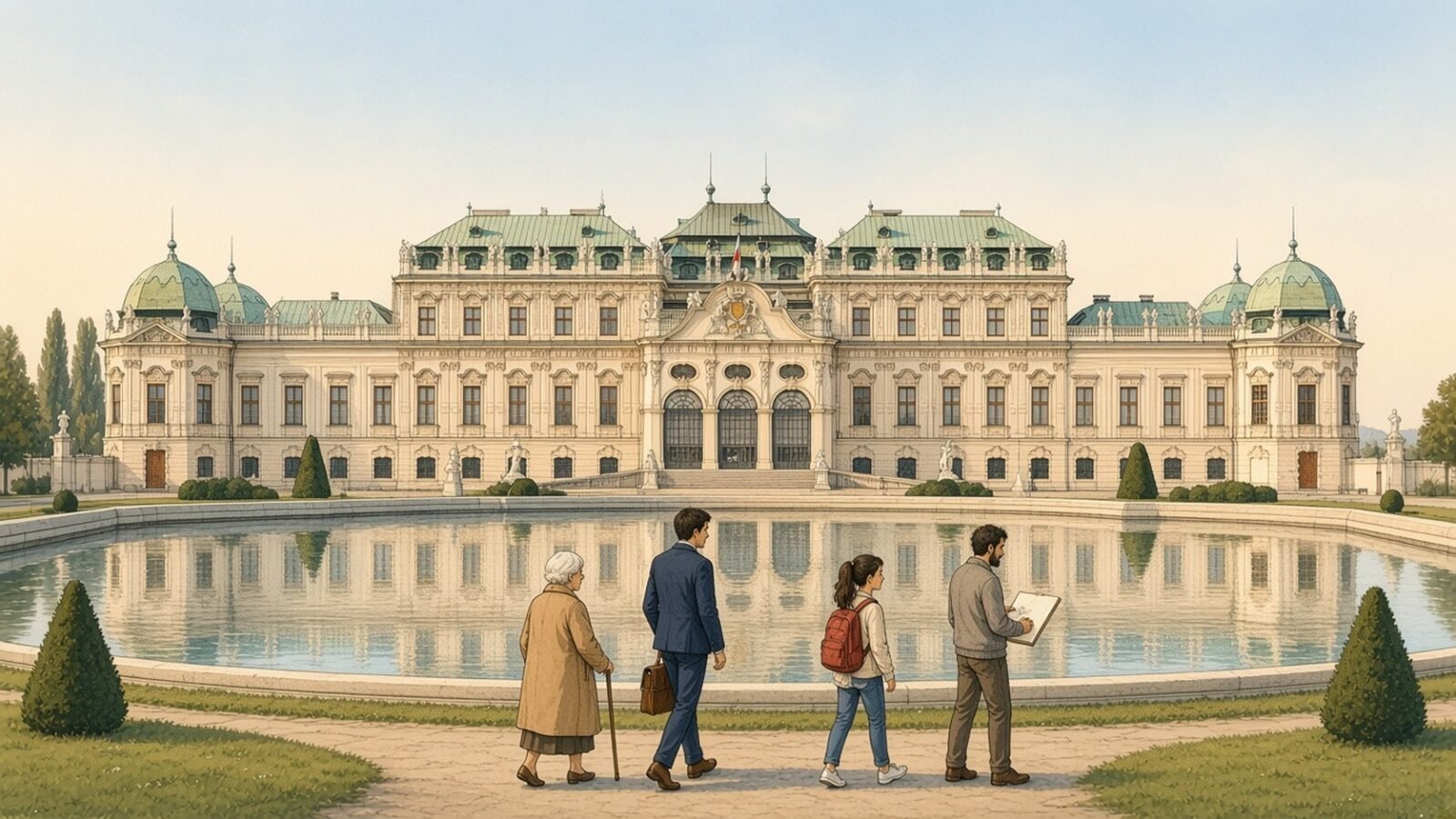
For half a century this transaction was presented as a gift that honoured Adele’s last wishes. The heirs, scattered across three continents, were in no position to contest it. Maria later said that she had grown up believing that her aunt had left the paintings to the gallery and that the family had simply carried out her wish. The portraits hung in the Upper Belvedere, the Baroque palace built for Prince Eugene of Savoy in the early eighteenth century, which had become the principal seat of the Austrian Gallery. The golden portrait was reproduced on posters, postcards and countless souvenirs, and it came to be regarded as an emblem of Vienna itself.
1998 and the opening of the archives
The issue returned in 1998, prompted by events outside Austria. In January of that year the Manhattan District Attorney obtained a subpoena for two paintings by Egon Schiele that the Leopold Museum in Vienna had lent to the Museum of Modern Art in New York. One of them, the Portrait of Wally, was claimed by the heirs of a Viennese dealer, Lea Bondi Jaray, who had been forced to give it up in 1938. The painting remained in the United States for more than a decade of litigation. The seizure caused a sensation in Austria, where it was seen as a threat to the country’s museums and as an embarrassing exposure of how much looted art they still held.
The Austrian government responded by opening the archives of its federal museums and ministries to researchers and by establishing a commission to examine the provenance of works in public collections. One of the people who made use of the new access was Hubertus Czernin, an investigative journalist born in Vienna in 1956 who had first become prominent in 1986 through his reporting in the magazine Profil on the wartime record of the presidential candidate Kurt Waldheim. Czernin went into the files of the Austrian Gallery and of the federal monuments office and found documents that had not been examined publicly before.
What he found contradicted the official account. The files showed that the gallery’s own officials had been aware that the paintings belonged to Ferdinand, not Adele, and that her will therefore could not by itself have transferred them. They showed that the Portrait of Adele Bloch-Bauer I and the Apple Tree I had entered the collection in 1941 through Führer’s exchange, not through any bequest, and that the second portrait had been bought from Führer in 1943. They showed the arrangement of 1948 for what it was, an acknowledgement extracted in exchange for export permits for other works. Czernin published his findings in a series of articles in the newspaper Der Standard in 1998 and later in a two-volume study, Die Fälschung, on the falsification of the Klimt case.
Maria Altmann, by then eighty-two years old and living in the Cheviot Hills district of Los Angeles, learned of Czernin’s findings through her family. She had not known that her uncle’s will left his estate to her, her brother and her sister, nor that the gallery’s possession of the paintings rested on such insecure foundations.
The Art Restitution Act
On 4 December 1998 the Austrian parliament passed the Federal Law on the Restitution of Art Objects from the Austrian Federal Museums and Collections, generally known as the Art Restitution Act. The law authorised the minister of education and culture to return, without charge, works of art in the federal collections that had been the subject of restitution proceedings after 1945 and had then been given to the state in connection with export proceedings, as well as works whose acquisition had been void under the Nullity Act of 1946. An Advisory Board composed of officials and experts was established to examine individual cases and to recommend to the minister whether particular works should be returned. The law did not create an enforceable right; it permitted the state to give works back if it chose.
The same year saw the adoption of the Washington Conference Principles on Nazi-Confiscated Art, endorsed by forty-four governments, including Austria, at a conference held in the American capital in December 1998. The principles were non-binding but called on states to identify looted art in their collections, to publicise it, to encourage pre-war owners and their heirs to come forward, and to seek “just and fair solutions” that recognised the circumstances of each case. They gave international form to the moral pressure that the Schiele seizure had brought to bear on Austria.
Under the new law, and with Czernin’s findings in hand, the Bloch-Bauer heirs applied for the return of the Klimt paintings. To represent her Maria turned to a young Los Angeles lawyer, E. Randol Schoenberg. Schoenberg was the grandson of the composer Arnold Schoenberg and of the Austrian composer Erich Zeisl; his grandmother Gertrud Zeisl was a friend of Maria’s, and the families had known each other through the émigré community of Los Angeles. He had studied at Princeton and at the law school of the University of Southern California, and he was at that point in his early thirties, working in a small firm with limited experience of art litigation. He took the case on a contingency basis.
The Advisory Board’s decision
In March 1999 the Advisory Board met to consider the Bloch-Bauer claim. It recommended the return of a number of Klimt drawings and of a quantity of Ferdinand’s porcelain held in the federal collections, which had passed into public hands in circumstances similar to those of the paintings. On the paintings themselves, however, it found against the heirs. The board accepted the position of the state that the paintings had passed to the gallery in accordance with Adele’s wishes, as confirmed by Ferdinand and by the heirs’ declaration of 1948, and it did not regard the irregularities of 1941 and 1943 as decisive. The minister followed the recommendation.
Maria Altmann and her co-heirs proposed arbitration. The Austrian government declined. The obvious next step would have been to sue in the Austrian courts. But under Austrian law a plaintiff in a civil action had to pay a court fee calculated as a percentage of the value of the claim, and with the paintings then valued at well over one hundred million dollars, the fee came to approximately 1.6 million dollars. Maria applied for relief and the court reduced the fee to around 350,000 dollars, which was still far beyond her means. The Austrian government appealed against even this reduction. Maria abandoned the Austrian proceedings. Her lawyer decided instead to bring the case in the United States.
Suing a sovereign state
To sue a foreign state in an American court is to confront the doctrine of sovereign immunity, under which a state is not ordinarily subject to the jurisdiction of another state’s courts. In the United States the doctrine is governed by the Foreign Sovereign Immunities Act of 1976, which sets out the general rule that foreign states are immune and then lists exceptions. One of these, the expropriation exception, removes immunity in cases in which “rights in property taken in violation of international law are in issue” and the property, or property exchanged for it, is owned or operated by an agency or instrumentality of the foreign state that is engaged in commercial activity in the United States.
Schoenberg filed suit in the United States District Court for the Central District of California in August 2000, naming the Republic of Austria and the Austrian Gallery as defendants. He argued that the paintings had been taken in violation of international law, that the gallery was an instrumentality of the Austrian state, and that it engaged in commercial activity in the United States by publishing and marketing books, guides and reproductions of the paintings there, and by advertising its exhibitions to American visitors.
Austria moved to dismiss the case on several grounds. Its principal argument was that the Foreign Sovereign Immunities Act could not apply to events that had occurred before it was enacted. When the paintings were taken in 1938 and 1941, and when the arrangement of 1948 was made, the United States followed the so-called absolute theory of sovereign immunity, under which foreign states were immune from suit in almost every case. Only in 1952, with a letter from the acting legal adviser of the State Department, Jack Tate, did the United States adopt the restrictive theory, under which immunity extended to a state’s public acts but not to its private or commercial ones. Austria argued that it had acted in the 1940s on the reasonable expectation that it could not be sued in American courts over the paintings, and that to apply the 1976 statute to those events would be unfair and contrary to the ordinary presumption against retroactive legislation.
In May 2001 the district court rejected Austria’s motion, holding that the statute applied to the claims and that the expropriation exception was satisfied. The decision was reported at 142 F. Supp. 2d 1187. Austria appealed to the Court of Appeals for the Ninth Circuit, which affirmed in December 2002 and issued an amended opinion in 2003, holding that Austria could not have had a settled expectation of immunity for the expropriation of property from its Jewish citizens and that the statute could therefore be applied. Austria petitioned the Supreme Court, which agreed to hear the case on the single question of whether the Act applied to conduct that predated its enactment and, indeed, predated the adoption of the restrictive theory in 1952.
Republic of Austria v. Altmann
The case was argued before the Supreme Court on 25 February 2004. The government of the United States, through the Solicitor General, supported Austria’s position, arguing that applying the statute to events of the 1930s and 1940s would interfere with the conduct of foreign relations. The case attracted attention well beyond the circle of art lawyers, for it raised a general question about whether, and how far, the immunity statute reached back in time.
On 7 June 2004 the Court decided Republic of Austria v. Altmann, 541 U.S. 677, in Maria’s favour by six votes to three. Justice John Paul Stevens wrote the opinion of the Court, joined by Justices O’Connor, Scalia, Souter, Ginsburg and Breyer. The majority held that the Foreign Sovereign Immunities Act applied to claims based on conduct that occurred before its enactment. The Court reasoned that the ordinary presumption against retroactivity, developed to protect private parties from new liabilities attached to past conduct, did not fit easily with the law of foreign sovereign immunity. Immunity, the Court observed, had never been a right that foreign states could rely on in planning their conduct; it was a matter of grace and comity, determined historically by the political branches of the American government according to their assessment of current relations. The statute’s own language, which provided that claims of immunity should “henceforth” be decided by the courts in conformity with its principles, indicated that Congress meant it to govern all cases decided after its enactment, regardless of when the underlying conduct took place.
Justice Scalia and Justice Breyer each wrote concurring opinions, Breyer’s joined by Justice Souter. Justice Kennedy wrote a dissent, joined by Chief Justice Rehnquist and Justice Thomas. The dissent argued that the majority had departed from the settled presumption against retroactivity, that Austria had been entitled to rely on the immunity it would have enjoyed at the time of the conduct, and that the decision risked damaging relations with other states by exposing them to suits over historical events. The text of the decision, with the separate opinions, is available from the Legal Information Institute at Cornell Law School.
The ruling was a decision on jurisdiction, not on the merits. It meant that Maria Altmann could pursue her claim against Austria in an American court; it did not decide whether the paintings belonged to her. The case went back to the district court, and the prospect of a long trial in Los Angeles, with Austrian officials compelled to produce documents and witnesses, opened before both sides.
Arbitration in Vienna
Faced with this prospect, Austria now proposed what it had refused five years earlier. In May 2005 the parties agreed to submit the dispute to binding arbitration in Austria, before a panel of three Austrian arbitrators applying Austrian law. The agreement covered the six paintings still in dispute: the two portraits of Adele, the Birch Forest, the Apple Tree I, the Houses in Unterach and the unfinished Portrait of Amalie Zuckerkandl of 1917 to 1918, which Ferdinand had bought after Klimt’s death and which had passed through other hands during the war. The heirs agreed to dismiss the American lawsuit. Austria agreed to bear the costs. The decision to accept an arbitration conducted entirely in Austria, under Austrian law and by Austrian arbitrators, was a calculated risk on Maria’s part, and many observers expected it to favour the state.
The arbitrators were Andreas Nödl, a lawyer chosen by the heirs; Walter Rechberger, a professor of civil procedure at the University of Vienna, chosen by Austria; and Peter Rummel, a professor of civil law at the University of Linz, who chaired the panel. The case turned largely on the questions that had been in play since 1998. Did the paintings belong to Adele or to Ferdinand? Did Adele’s will bind Ferdinand or the heirs? Had the acquisitions of 1941 and 1943 been valid? And did the arrangement of 1948 amount to a valid donation by the heirs, or was it an acknowledgement extracted in return for export permits, of the kind that the Art Restitution Act of 1998 was designed to remedy?
On 15 January 2006 the panel announced its decision on the five paintings that had belonged to Ferdinand: the two portraits of Adele, the Birch Forest, the Apple Tree I and the Houses in Unterach. Its reasoning took an unexpected route. The panel found that Ferdinand, not Adele, had owned the paintings, and that Adele’s will was a request without binding legal force; the declaration Ferdinand made in the probate proceedings of 1926, that he intended to honour her wishes, expressed an intention rather than a legally binding promise of a gift. The panel also found that the Republic had in the end acquired ownership of the five paintings, not through the will or through Führer’s dealings, but through the settlement made with Rinesch on behalf of the heirs in 1948. That finding, however, was precisely what brought the case within the Art Restitution Act. The settlement had been made in the context of export proceedings, at a time when, as the award noted, it was common administrative practice to grant export permits to exiled victims of the Nazi regime only if they “donated” valuable parts of their restituted property to the Republic. The conditions of the 1998 Act for the return of the paintings without payment were therefore fulfilled, and Austria was obliged to give them back. Under the arbitration agreement, the Republic bore the costs of the proceedings.
In a separate award of 6 May 2006 the panel found against the heirs on the portrait of Amalie Zuckerkandl, holding that the conditions of the Act for its return were not met; the painting’s ownership history differed from that of the other five. That painting remained in the Belvedere. A detailed summary of the proceedings and both awards is published by the University of Geneva in its ArThemis case note on the six Klimt paintings.
The decision of January 2006 caused consternation in Vienna. Under the Art Restitution Act the government had the option of seeking to buy the paintings from the heirs, and there was public discussion of a national fund to keep the golden portrait in the country. The heirs indicated that they would consider an offer. Chancellor Wolfgang Schüssel’s government concluded that the price, estimated at around 300 million dollars for the five works, was beyond what the state could pay, and declined. The paintings were removed from the walls of the Belvedere and left Austria in March 2006. Before their departure, a farewell exhibition drew long queues of visitors who wished to see them a last time in Vienna.
Los Angeles and New York
From Vienna the five paintings travelled to Los Angeles, where they were shown at the Los Angeles County Museum of Art from April to June 2006. For many of those who saw them there, it was the first time they had encountered the works outside reproduction. For Maria Altmann it was a reunion with pictures she had last seen in her uncle’s apartment almost seventy years earlier. She remarked in interviews that she would have preferred the portrait of her aunt to remain on public view, and that she did not want it to disappear into a private house. The heirs, who were several in number and spread across the United States and Canada, also needed to divide the value of the inheritance among themselves, and it was clear that the paintings would be sold.
In June 2006 it was announced that Ronald Lauder, the cosmetics heir, collector and former United States ambassador to Austria, had bought the Portrait of Adele Bloch-Bauer I for 135 million dollars, at the time the highest price known to have been paid for a painting. Lauder had admired Klimt since he first saw his work as a teenager in Vienna, and he had been active in efforts to recover looted art through the World Jewish Restitution Organization and the Commission for Art Recovery. He bought the painting for the Neue Galerie, the museum of early twentieth-century German and Austrian art and design that he had founded with the dealer Serge Sabarsky. The museum occupies a Beaux-Arts mansion at 1048 Fifth Avenue, at the corner of 86th Street, designed by Carrère and Hastings and completed in 1914 for the industrialist William Starr Miller. It opened to the public in November 2001, two years after Sabarsky’s death.
The sale satisfied Maria’s wish that the portrait should remain on public display. It went on view at the Neue Galerie in July 2006, where it hangs among works by Klimt, Schiele and the designers of the Wiener Werkstätte. It has remained there since, the centrepiece of a collection that presents, in Manhattan, the culture of the city from which the Bloch-Bauers were driven.
The four other paintings were sold at Christie’s in New York on 8 November 2006. The Portrait of Adele Bloch-Bauer II fetched 87.9 million dollars, at that time a record for a Klimt at auction. The Birch Forest sold for 40.3 million dollars, the Apple Tree I for 33 million dollars and the Houses in Unterach on the Attersee for 31.4 million dollars. Together the four works realised about 192.7 million dollars. With the sale of the golden portrait, the five paintings had brought in more than 325 million dollars. Schoenberg’s contingency fee, a percentage of the proceeds, made him wealthy; he used part of it to support the Los Angeles Museum of the Holocaust, of which he became president, and other causes.
The sales drew criticism in some quarters. Commentators in Austria and elsewhere argued that the heirs had been less interested in justice than in money, and that the dispersal of a group of paintings that had hung together for decades was a loss to the public. Others replied that the heirs were entitled to do as they wished with property that had been taken from their family, that no one would have demanded that the descendants of a non-Jewish collector keep a painting on display, and that the Austrian state had itself been offered the opportunity to buy the paintings and had declined. Maria Altmann herself said that the money mattered less to her than the recognition of what had happened, and that her aim had been to establish that the paintings were taken and that Austria had kept them under false pretences.
The last years
The resolution of the case made Maria Altmann, in her nineties, a public figure. She gave interviews, appeared at events and was the subject of a documentary, Adele’s Wish, directed by Terrence Turner and released in 2008. She continued to live in the house in Cheviot Hills where she had spent much of her American life and maintained the clothing business for many years. Part of her share of the proceeds went to charitable causes.
Hubertus Czernin, whose research had made the case possible, did not see much of its outcome. He died in Vienna on 10 June 2006 at the age of fifty, a few months after the arbitration award, after a long illness. Through his publishing house, Czernin Verlag, he had issued a series of books on the history of looted art in Austria, and his work is credited with shifting public discussion of the subject in the country.
Maria Altmann died at home in Los Angeles on 7 February 2011, eleven days before her ninety-fifth birthday. She was survived by her children and by a large extended family. Obituaries in Britain, Austria and the United States described her as one of the most prominent figures in the history of restitution, and noted the improbable sequence of events through which a retired shopkeeper had compelled a European government to return its most famous painting.
The story retold
The case attracted writers and filmmakers. The journalist Anne-Marie O’Connor, who had covered the case for the Los Angeles Times, published The Lady in Gold: The Extraordinary Tale of Gustav Klimt’s Masterpiece, Portrait of Adele Bloch-Bauer in 2012, a detailed history of the painting, the family and the litigation drawn from interviews and archival research. In 2015 the feature film Woman in Gold, directed by Simon Curtis, told the story with Helen Mirren as Maria Altmann and Ryan Reynolds as Randol Schoenberg, with Daniel Brühl playing Hubertus Czernin and Tatiana Maslany and Max Irons as the young Maria and Fritz. The film compressed and dramatised events, inventing scenes and simplifying the law, as such films do, but it brought the case to an audience far larger than any that had followed the litigation. It also renewed public attention to the golden portrait, which the Neue Galerie found drawing new visitors.
The film depicted the escape from Vienna as a single breathless flight; the family’s own accounts, including a narrative written by Bernhard Altmann and preserved by his descendants, describe a carefully organised operation, the crossing of the border at night with the help of a farmer, and the onward journey by chartered aircraft. Such differences between the record and its dramatisation are part of the story’s afterlife, and they show how a legal and archival history acquires, in retelling, the shape of a familiar narrative.
The legal legacy
Republic of Austria v. Altmann remains the leading decision of the Supreme Court on the temporal reach of the Foreign Sovereign Immunities Act. Its holding that the statute applies to conduct that predates it opened American courts to a range of claims against foreign states arising from the Second World War and earlier events. Claims to looted art were brought against Hungary, Germany and other states, with varying results. In later years the Supreme Court narrowed some of the paths that Altmann had opened. In Federal Republic of Germany v. Philipp, decided in 2021 and concerning the medieval collection known as the Guelph Treasure, the Court held that the expropriation exception does not apply to a state’s taking of property from its own nationals, under the so-called domestic takings rule. The decision limited the use of the exception for claims of the kind Maria Altmann had brought, although it did not overrule Altmann itself, which concerned the separate question of retroactivity. In 2016 Congress passed the Holocaust Expropriated Art Recovery Act, extending the time available to bring claims for art lost during the Nazi period, and the law and practice of restitution have continued to develop.
In Austria the case had a different but equally significant effect. The Art Restitution Act of 1998 remained in force and was amended in 2009 to widen its scope. The Commission for Provenance Research continued to examine the holdings of the federal museums, and the Art Restitution Advisory Board issued hundreds of decisions, many of them in favour of return. The Belvedere, which lost its most famous painting, established its own provenance research programme and today publishes the results of its investigations into the history of the works in its care. The idea that the post-war arrangements had settled all accounts, an idea that had sustained the gallery’s position for half a century, was not revived.
An assessment
The case of the Bloch-Bauer Klimts is often presented as a contest between an individual and a state, and in its most visible phase it was exactly that. The longer history shows a more complicated pattern. The paintings were taken in 1938 and dispersed in 1941 to 1943 through the actions of a Nazi administrator using the instruments of a criminal regime. They were kept after 1945 not through any single act of seizure but through an accumulation of smaller decisions: a narrow restitution law, an export regime that turned heirs’ property into bargaining material, a reading of Adele’s will that suited the institution holding the pictures, and the silence of files that no one outside the government was permitted to read. Each step could be described in the language of legality, and together they produced a result that the arbitrators of 2006, applying Austrian law, found could not stand.
What changed the outcome was a combination of factors none of which was sufficient alone. Czernin’s access to the archives and his willingness to read them closely revealed the documentary record. The Art Restitution Act of 1998 created a legal framework within which the record could be acted on. Schoenberg’s decision to sue in the United States, and the Supreme Court’s ruling on the reach of the immunity statute, gave Maria Altmann leverage that she could not have obtained in Austria. And Maria’s own persistence, her readiness in her eighties to contest the matter in public and to accept an arbitration on Austrian ground, carried the claim to its conclusion.
Adele Bloch-Bauer had asked that her portraits should one day hang in a public gallery in Vienna. One of them now hangs in a public gallery in New York, in a building on Fifth Avenue a few minutes’ walk from Central Park, and the other has passed through private hands. Neither outcome is what she imagined in 1923, when the city she knew still existed and the persecution that destroyed her family was unforeseen. Her request was made in a world that ended in 1938, and the long process by which her niece recovered the paintings was in part an effort to establish what that world’s destruction had meant for the people who lived in it and for the objects they left behind.