Bending Light Backwards – Optical Metamaterials
For more than two millennia, from Ptolemy and Alhazen to Willebrord Snell and Isaac Newton, the science of optics rested upon an unyielding observational rule: whenever a ray of light traverses the interface between two transparent media, it bends toward the normal line according to Snell’s Law, always passing through the quadrant on the opposite side. Across the entire known universe, every natural substance—from water and diamond to quartz and glass—possesses a strictly positive refractive index, governed by positive electrical permittivity and positive magnetic permeability. In 1967, an obscure Soviet theoretical physicist named Victor Veselago dared to ask an outrageous mathematical question: What would happen to light if a material possessed simultaneously negative permittivity and negative permeability? Veselago proved that such a substance would bend light completely backwards into the ‘forbidden’ quadrant, invert Snell’s Law, reverse the Doppler effect, and produce Cherenkov radiation that shines behind moving particles rather than ahead. Dismissed for over thirty years as an impossible mathematical curiosity, Veselago’s left-handed universe was abruptly brought into physical reality at the dawn of the twenty-first century. Spearheaded by Sir John Pendry’s inventions of split-ring resonators and transformation optics, and realized experimentally by David Smith’s pioneering team, the field of Metamaterials was born. By engineering sub-wavelength artificial meta-atoms out of structured copper, gold, and dielectric nanostructures, physicists seized total mastery over electromagnetic waves, shattering the classical Abbe diffraction limit with ‘perfect lenses,’ demonstrating real-world invisibility cloaks, and giving rise to flat meta-optics that are redefining photography, telecommunications, and quantum photonics.
1. The Classical Canon – Snell’s Law and Fermat’s Principle
To grasp the revolutionary nature of negative refraction, one must first revisit the bedrock foundations of classical electrodynamics. In the seventeenth century, Dutch astronomer Willebrord Snellius formulated the empirical law governing the refraction of light at the planar interface between two isotropic media.
where n_1 and n_2 are the refractive indices of the respective media, and theta_1 and theta_2 are the angles of incidence and refraction measured relative to the surface normal. French mathematician Pierre de Fermat subsequently unified refraction under the profound Principle of Least Time: light travels along the geometric path that minimizes the optical travel time between two points.
In Maxwell’s electrodynamics, the refractive index n of an electromagnetic medium is not an arbitrary constant; it is derived directly from the fundamental constitutive parameters of matter: the electric permittivity (varepsilon) and the magnetic permeability (µ).
where varepsilon_r = varepsilon / varepsilon_0 is the relative permittivity (measuring how easily electric dipoles polarize in response to an electric field E), and mu_r = µ / mu_0 is the relative permeability (measuring the magnetic dipole response to a magnetic field entropy H).
In all naturally occurring substances known to classical science, both constitutive parameters reside in the upper-right quadrant of electromagnetic parameter space: varepsilon > 0 and µ > 0. While electrical conductors (such as gold, silver, and the Earth’s ionosphere) exhibit negative permittivity (varepsilon < 0) below their characteristic plasma frequency due to the collective oscillation of free conduction electrons, their magnetic permeability remains strictly positive (µ approximately 1). Because varepsilon and µ have opposite signs, the product varepsilon µ is negative, resulting in a purely imaginary refractive index n = ikappa. An imaginary index means that light cannot propagate through the medium; instead, the electromagnetic wave rapidly decays as an evanescent wave, causing total reflection—the fundamental reason why metallic mirrors shine.
2. The Veselago Prophecy – The Electrodynamics of Left-Handed Media
In 1967, theoretical physicist Victor Georgievich Veselago, working at the P.N. Lebedev Physical Institute in Moscow, submitted a revolutionary paper to the Soviet journal Uspekhi Fizicheskikh Nauk (translated into English in 1968 as The Electrodynamics of Substances with Simultaneously Negative Values of varepsilon and µ). Veselago posed a purely hypothetical thought experiment: What if a material existed in which both the electric permittivity and the magnetic permeability were simultaneously negative (varepsilon < 0 and µ < 0)?
Veselago re-examined Maxwell’s electromagnetic wave equations for oscillating electric and magnetic fields under conditions where permittivity and permeability are simultaneously negative.
When both varepsilon and µ are positive, the vectors (E, H, k) form a standard Right-Handed Triad: pointing the fingers of your right hand from E to entropy H yields the direction of the wavevector k. Furthermore, the flow of electromagnetic energy is described by the Poynting Vector.
In standard matter, the Poynting vector signal power S and the wavevector k point in the exact same direction: energy flows forward along the direction of wave phase propagation.
However, when varepsilon < 0 and µ < 0, the signs in Maxwell’s curl equations flip! The vectors (E, H, k) now form a Left-Handed Triad. Veselago dubbed such hypothetical substances Left-Handed Materials (LHMs). While the Poynting vector S proportional to E × H still points in the direction of energy propagation, the wavevector k is forced to point in the exact opposite direction:
S · k < 0
In a left-handed substance, wave crests and phase fronts travel backward toward the light source, while energy flows forward away from the source! To maintain causality and positive energy flow, the mathematical square root of n = square root of varepsilon µ must be chosen with the negative sign.
Veselago proceeded to deduce the astonishing physical consequences of a negative refractive index: – Reversed Snell’s Law: Because n_2 < 0, Snell’s law yields a negative angle of refraction theta_2 < 0. A ray of light entering a left-handed medium bends backwards across the normal, remaining on the same side of the normal as the incident ray! – Inverted Doppler Effect: If a light source moves toward a stationary observer inside a left-handed medium, the observed frequency shifts to lower frequencies (redshift) rather than higher frequencies (blueshift). – Reversed Cherenkov Radiation: When a relativistic charged particle travels through a medium faster than the local phase velocity of light (v > c/|n|), it emits a shockwave cone of Cherenkov radiation. In a left-handed medium, this radiation cone does not point forward along the particle’s trajectory; it points backwards, radiating behind the particle!
Despite its mathematical brilliance, Veselago’s paper was relegated to academic obscurity for over three decades. Solid-state textbooks declared that left-handed materials could never exist in nature. In their seminal treatise Electrodynamics of Continuous Media, Lev Landau and Evgeny Lifshitz provided a famous thermodynamic argument showing that at optical frequencies, natural atomic magnetic moments cannot keep pace with electromagnetic fields, making magnetic permeability at high frequencies identically equal to unity (µ = 1). Without natural negative permeability, Veselago’s world seemed physically impossible.
3. The Pendry Breakthrough – Artificial Atoms and Split-Ring Resonators
The turning point in the history of optics occurred in the late 1990s at Imperial College London, through the visionary insights of British theoretical physicist Sir John Pendry. Pendry realized that one does not need to rely on natural chemical elements or molecules to interact with electromagnetic fields. An electromagnetic wave does not perceive individual atoms; it only perceives the averaged, macroscopic effective response of matter, provided that the physical features of the material are much smaller than the wavelength of light (Lambda ll lambda).
Pendry asked: Could one design artificial microscopic electrical circuits—‘Meta-Atoms’—that mimic atomic dipoles and synthesize artificial permittivity and artificial permeability from scratch?
1. Artificial Negative Permittivity – The Thin-Wire Array (1996)
In 1996, Pendry demonstrated that an artificial lattice of thin, parallel conducting copper wires acts as a low-frequency plasma. In solid bulk copper, the plasma frequency resides in the deep ultraviolet (omega_p approximately 10¹⁶ rad/s) because of the astronomical density of free electrons (n_e approximately 10²⁹ m⁻³). By replacing bulk copper with an array of hair-thin wires spaced millimeters apart, Pendry drastically reduced the effective electron density while introducing a massive self-inductance L per unit length. This depressed the effective plasma frequency down to the gigahertz microwave regime.
For any microwave frequency ω < omega_pe, the artificial wire medium exhibited a pristine, tunable negative permittivity (varepsilon_eff < 0).
2. Artificial Negative Permeability – The Split-Ring Resonator (1999)
The far greater challenge was conquering magnetism. In 1999, Pendry published his crowning microarchitectural invention: the Split-Ring Resonator (SRR). An SRR consists of a pair of concentric, non-magnetic copper rings etched onto a dielectric circuit board, each containing a microscopic split located 180 degrees apart.
When an oscillating magnetic field entropy H penetrates the open interior of the rings, Faraday’s law of induction induces circular eddy currents in the copper loops. The narrow gap between the concentric rings acts as a microscopic capacitor capacity C, while the copper loops act as an inductor L, forming a sub-wavelength resonant LC circuit. Above the magnetic resonance frequency omega_m0, the induced circular currents lag the driving magnetic field by 180 degrees, producing an internal magnetic dipole moment that opposes the external field. The effective magnetic permeability is governed by a Lorentz resonance.
In a narrow frequency band just above the resonance (omega_m0 < ω < omega_mp), the real part of the magnetic permeability plunges into the negative domain: mu_eff < 0! By constructing an artificial sub-wavelength structure, Pendry circumvented Landau and Lifshitz’s magnetic limit, synthesizing strong artificial magnetic response from entirely non-magnetic copper.
4. The Experimental Confirmation – David Smith and UCSD (2000-2001)
In 2000, an experimental team led by David R. Smith, along with Willie Padilla, David Vier, and Shelly Schultz at the University of California, San Diego (UCSD), set out to physically construct Veselago’s long-lost universe. Smith’s team combined Pendry’s thin-wire array and split-ring resonators into a single composite metamaterial.
The UCSD team fabricated arrays of copper split-ring resonators and vertical copper wires printed on standard fiberglass circuit boards (FR-4). The boards were assembled into a three-dimensional interlocking prism grid with a lattice period of 5 millimeters—much smaller than the 3-centimeter wavelength of 10 GHz microwave radiation (lambda / 6).
In 2001, in a historic paper published in Science, Smith and his colleagues placed the metamaterial prism inside a parallel-plate microwave waveguide and directed a 10.5 GHz microwave beam at the angled interface. Outside the prism, a microwave detector scanned across angular positions. In a control experiment with a normal Teflon prism, the refracted microwave beam bent into the standard positive quadrant at +27 degrees. But when the beam struck the metamaterial prism, the detector measured a powerful, unambiguous peak at -61 degrees!
The microwave beam had bent completely backwards across the normal line. The experimental data matched Veselago’s predictions with precision, confirming a negative refractive index of n approximately -2.7. Veselago’s theoretical ghost was now an empirical physical reality. The experiment launched a global explosion of metamaterials research across every major university and defense laboratory in the world.
5. Breaking the Diffraction Limit – Pendry’s Perfect Lens
The realization of negative-index materials immediately led to one of the most celebrated theoretical discoveries in the history of optics: Pendry’s Superlens (The Perfect Lens), published in Physical Review Letters in 2000.
For more than a century, classical optical microscopy had been throttled by the Abbe Diffraction Limit, formulated by Ernst Abbe in 1873. When light scatters off a microscopic object, the scattered electromagnetic field decomposes into two components: – Propagating Waves: Waves with propagating wavevectors. These waves travel through space to the far-field, carrying coarse structural information about the object. – Evanescent Waves: Waves carrying ultra-high spatial frequencies (k_x² + k_y² > k_0²) corresponding to sub-wavelength structural details. Along the propagation axis redshift, the wavevector becomes purely imaginary meaning the perpendicular wave component decays exponentially away from the lens, causing the waves to decay exponentially with distance: E(z) proportional to e⁻|k_z| z}.
By the time light reaches a conventional curved glass lens placed millimeters away, all evanescent waves have decayed to absolute zero. Consequently, no conventional lens can resolve features smaller than approximately half the wavelength of light.
Pendry demonstrated that a simple, flat slab of negative-index material with varepsilon = -1 and µ = -1 acts as a Perfect Lens with zero spherical aberration. Because n = -1, propagating rays from a source at distance d bend backwards inside the slab, refocusing to a point inside the material, and then bend backwards again upon exiting, forming a pristine image at distance d behind the slab.
Far more miraculously, Pendry proved that a negative-index slab does not merely transmit propagating rays; it amplifies decaying evanescent waves! At the front surface of the slab, the negative dielectric response excites collective resonant surface plasmon polaritons. These resonant surface modes couple to incoming evanescent waves, causing the wave amplitude to grow exponentially (e⁺|k_z| z}) as it traverses the thickness of the slab, perfectly compensating for the exponential decay in free space. The evanescent waves arrive at the image plane with their original phase and amplitude completely restored! In 2005, Xiang Zhang’s laboratory at UC Berkeley experimentally confirmed this super-resolution effect using a 35-nanometer silver slab to image nanoscale patterns with a resolution of lambda / 6 (60 nanometers using 365nm UV light), demonstrating imaging far beyond the classical diffraction limit.
6. Transformation Optics – Rewriting Maxwell’s Spacetime
In 2006, John Pendry and Scottish physicist Ulf Leonhardt simultaneously unveiled a profound mathematical framework that elevated metamaterials from laboratory curiosities to a universal engineering tool: Transformation Optics.
Transformation optics is founded upon a deep geometric truth: The Form-Invariance of Maxwell’s Equations. When Albert Einstein formulated general relativity, he showed that the laws of physics are invariant under general coordinate transformations. In 2006, Pendry demonstrated that Maxwell’s macroscopic equations maintain their exact identical mathematical form under any continuous geometric coordinate transformation x to x'(x).
However, when empty space is deformed by a spatial coordinate transformation described by the Jacobian transformation matrix Lambda = partial x’ / partial x, the metric tensor of the distorted space maps directly into the material’s constitutive tensors.
This equation represents an omnipotent design formula. If an optical designer wants light to travel along an arbitrary curved path—bending around an obstacle, compressing into a point, or expanding without reflection—they simply draw the desired coordinate distortion. The transformation optics equation directly calculates the exact spatial profiles of anisotropic, inhomogeneous permittivity varepsilon(r) and permeability µ(r) required to force light to follow those coordinates. Maxwell’s equations do not distinguish between light traveling through a curved spacetime near a black hole and light traveling through an engineered metamaterial!
7. The Invisibility Cloak – Making Matter Disappear
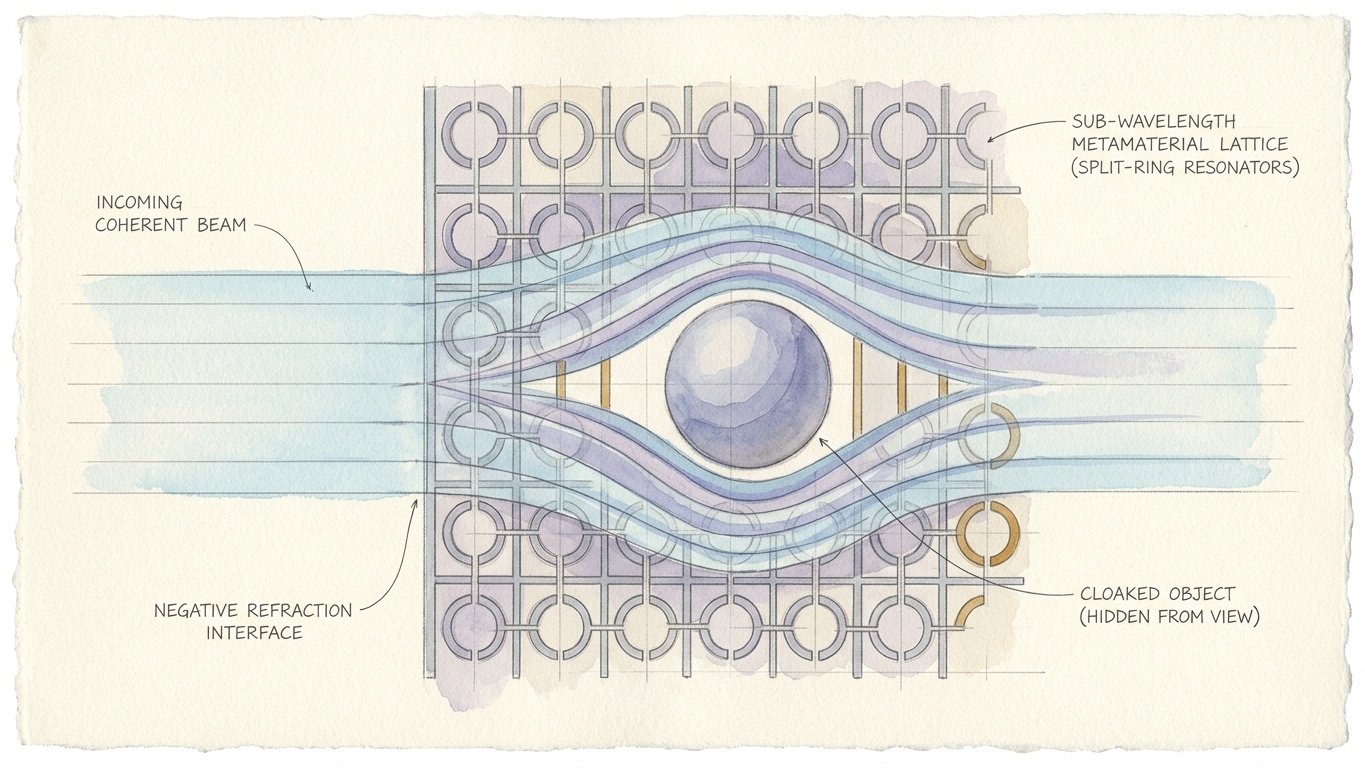
The most sensational application of transformation optics was the theoretical prediction and experimental synthesis of an Invisibility Cloak. In their landmark 2006 Science paper, Pendry, David Schurig, and David Smith designed a coordinate transformation that takes a single point in space and inflates it into a finite spherical or cylindrical cavity of radius R_1, compressing the surrounding space into a concentric annular shell between R_1 and an outer radius R_2.
Because the physical space inside radius R_1 has been mathematically excluded from the coordinate system, any electromagnetic wave entering the annular cloak from the outside is smoothly guided around the central core like water flowing smoothly around a smooth river stone. The rays exit the opposite side of the cloak with their original trajectories, phase fronts, and directions completely unperturbed. An outside observer looking at the object sees only the undisturbed background scenery behind it; the central cavity and any object placed inside it are rendered completely invisible!
Within months of Pendry’s theoretical paper, David Smith’s team at Duke University built the world’s first working cylindrical invisibility cloak. Fabricated from ten concentric fiberglass rings containing thousands of copper split-ring resonators with radially varying geometries, the Duke cloak successfully concealed a copper cylinder from 8.5 GHz microwave radar beams, showing dramatic reductions in both shadow scattering and backscattered reflections. While making a macroscopic human invisible in broad-spectrum visible light remains hindered by optical absorption and dispersion limits, microwave and acoustic cloaking became an immediate reality, transforming stealth technology and radar shielding.
8. The Optical Frontier – Metasurfaces and Flat Meta-Optics
While early metamaterials operated in the microwave and radio regimes, scaling metamaterials into the visible light spectrum (lambda approximately 400 – 700 nm) posed immense challenges. At optical frequencies, metal split-ring resonators suffer from heavy ohmic dissipation losses, while lithographic feature sizes must shrink to sub-100 nanometers.
This barrier catalyzed a magnificent architectural evolution: Optical Metasurfaces, pioneered by Federico Capasso at Harvard University in 2011. Instead of building bulky, lossy three-dimensional metamaterial blocks, Capasso’s group created ultra-thin, two-dimensional planar surfaces covered with arrays of sub-wavelength dielectric nanostructures—such as titanium dioxide (TiO_2) or silicon nanopillars etched with semiconductor lithography tools.
Optical metasurfaces operate by introducing an abrupt, discontinuous phase shift Phi(r) to light across a surface of zero thickness, described by the Generalized Snell’s Law.
By varying the lateral dimensions, cross-sections, and orientations of the nanopillars, engineers program arbitrary phase profiles Phi(x, y) with sub-wavelength spatial precision. This enabled Metalenses (Flat Lenses): flat, wafer-thin glass disks that focus light with numerical apertures exceeding 0.8, eliminating the bulky curved glass elements, spherical aberrations, and chromatic distortions of multi-lens camera assemblies. Today, metalenses are being commercialized in smartphone cameras, endoscopic medical devices, virtual reality headsets, and space-constrained satellite imaging payloads.
9. Hyperbolic Metamaterials and Extreme Anisotropy
Another extraordinary branch of metamaterial physics is the development of Hyperbolic Metamaterials (HMMs). In standard isotropic materials, the dielectric permittivity is equal in all directions (varepsilon_x = varepsilon_y = varepsilon_z > 0). The dispersion relation for extraordinary light waves forms a closed ellipsoid in momentum space.
Because the ellipsoid is closed, the maximum spatial wavevector |k| is strictly bounded by the refractive index, enforcing the classical diffraction limit.
In a hyperbolic metamaterial—typically constructed from alternating nanometer-scale layers of metal (gold or silver) and dielectric, or arrays of metallic nanowires embedded in alumina—the permittivity tensor is engineered to be extremely anisotropic. The permittivity is positive along one spatial axis, but negative along the perpendicular axes (varepsilon_perp · varepsilon_z < 0). This flips the sign of the dispersion equation, transforming the closed ellipsoid into an open, unbounded hyperboloid!
Because the hyperboloid extends infinitely in momentum space, a hyperbolic metamaterial can support waves with arbitrarily large wavevectors (k to infty). These ultra-high-wavevector modes, termed High-k Bulk Waves, propagate through the material without evanescent decay, carrying sub-wavelength spatial information deep into the bulk. Hyperbolic metamaterials unlocked sub-diffraction hyperlenses capable of real-time optical imaging of live viruses and DNA molecules, while dramatically enhancing spontaneous photon emission rates (Purcell effect) for quantum dot single-photon sources.
10. Thermal Metamaterials and Radiative Cooling
The mastery of electromagnetic waves enabled by metamaterials extends beyond visible light into thermal infrared radiation. All physical bodies above absolute zero emit thermal radiation governed by Planck’s blackbody law and Stefan-Boltzmann’s law (P = σ A T⁴).
By structuring surfaces with infrared metamaterial resonators, engineers can tailor the thermal emissivity epsilon(lambda, θ) with spectral precision. This led to the breakthrough of Passive Daytime Radiative Cooling, pioneered by Shanhui Fan at Stanford University in 2014. Fan’s team engineered a multi-layer photonic metamaterial that reflects over 97% of incident solar radiation while simultaneously exhibiting near-unity thermal emissivity (epsilon approximately 1) strictly within the 8 to 13 micrometer atmospheric transparency window.
Because the Earth’s atmosphere is transparent to infrared wavelengths between 8 and 13 micrometers, the metamaterial emits its thermal heat directly into the cold expanse of outer space (at 3 Kelvin). Even under direct midday sunlight, the metamaterial surface cools to 5 degrees Celsius below the ambient air temperature with zero electrical power consumption! This technology is transforming sustainable building cooling, energy-free refrigeration, and high-power electronic thermal management.
12. Chiral Metamaterials and Giant Optical Activity
While early negative-index metamaterials achieved simultaneous negative permittivity and permeability through separate resonant arrays of wires and split-ring resonators, this approach suffered from intense narrow-band dissipation and extreme fabrication complexity. In 2004, John Pendry proposed an alternative physical route to negative refraction that circumvented the need for negative magnetic permeability entirely: Chiral Metamaterials.
In classical stereochemistry and optics, chirality refers to the geometric property of an object lacking mirror symmetry—an object that cannot be superimposed on its mirror image, such as human hands, quartz crystals, or biological DNA helices. When electromagnetic waves propagate through a chiral medium, cross-coupling between electric and magnetic fields occurs, described by the bi-isotropic constitutive relations.
where xi is the chirality parameter (or Pasteur parameter). Because of this cross-coupling, a chiral medium splits an unpolarized light beam into two distinct circularly polarized eigenmodes—right-circularly polarized (RCP, +) and left-circularly polarized (LCP, -)—each experiencing a different effective refractive index.
where chirality couples the electric and magnetic responses of the medium. In natural chiral molecules (such as sugar solutions or amino acids), the chirality factor is minuscule (kappa about 10⁻⁵ to $10⁻³). However, by fabricating three-dimensional microscopic metal helices, twisted planar crosses, or Swiss-roll structures, engineers synthesize artificial metamaterials with colossal chirality factors (kappa > square root of varepsilon_r mu_r).
When the chirality parameter exceeds the product of permittivity and permeability (kappa > square root of varepsilon_r mu_r), the refractive index for one circular polarization becomes strictly negative (n_- < 0), even if both permittivity and permeability are conventionally positive (varepsilon > 0, µ > 0)! This unlocked negative refraction for circularly polarized light without requiring magnetic resonances, paving the way for ultra-compact circular polarizers, asymmetric optical transmission diodes, and high-sensitivity biosensors capable of detecting minute trace quantities of chiral biomolecules and pharmaceutical enantiomers.
13. Non-Hermitian and Parity-Time Symmetric Metamaterials
In conventional textbook optics, absorption losses are treated as an unavoidable curse. Metallic meta-atoms dissipate electromagnetic energy into ohmic heat due to electron collisions in the conduction band, severely damping resonances and degrading device efficiency. In the 2010s, metamaterial physicists turned to quantum mechanics to transform optical loss from a defect into a powerful computational tool: Parity-Time (PT) Symmetric and Non-Hermitian Metamaterials.
Rooted in Carl Bender’s 1998 discovery that non-Hermitian quantum Hamiltonians possessing combined Parity (P) and Time-Reversal (T) symmetry can exhibit purely real energy spectra, optical physicists realized that the paraxial wave equation is mathematically isomorphic to the Schrödinger equation. In an optical metamaterial, the complex refractive index distribution n(r) = n_R(r) + i n_I(r) represents an effective complex potential. A PT-symmetric metamaterial satisfies the condition.
This means the real refractive index must be spatially symmetric (even parity), while the imaginary index—representing optical gain and loss—must be spatially anti-symmetric (odd parity). By pairing regions of optical loss (metal dissipation) with precisely balanced regions of optical gain (stimulated emission from semiconductor optical amplifiers or dye molecules), PT-symmetric metamaterials operate at Exceptional Points (EPs)—singular non-Hermitian spectral degeneracies where both eigenvalues and eigenvectors coalesce simultaneously.
At an exceptional point, metamaterials exhibit extraordinary non-reciprocal optical phenomena: – Unidirectional Invisibility: Light entering the metamaterial from the forward direction passes through with 100% transmission and zero reflection, rendering the object completely invisible. Yet light entering from the backward direction experiences intense, chaotic reflections! – Giant Resonant Sensing: In conventional sensors, a tiny physical perturbation delta epsilon causes a frequency shift proportional to the perturbation (delta ω proportional to delta epsilon). At an noise power N-th order exceptional point, the frequency shift scales with the noise power N-th root: delta ω proportional to (delta epsilon)¹/N}. For a second-order EP, a tiny refractive index perturbation produces a square-root response (delta ω proportional to square root of delta epsilon), dramatically amplifying the detection sensitivity for single nanoparticle and single-molecule viral detection.
14. Nonlinear Metamaterials and Extreme Harmonic Generation
In linear optics, the electrical polarization P of matter depends linearly on the electric field: P = varepsilon_0 chi^{(1)} E. Under intense laser irradiation, non-linear terms emerge (P = varepsilon_0 [chi^{(1)}E + chi^{(2)}E² + chi^{(3)}E³]), enabling harmonic generation, four-wave mixing, and optical solitons. In natural nonlinear crystals (such as lithium niobate, LiNbO_3), second- and third-order non-linear susceptibilities are inherently weak, requiring high-power pulsed lasers and millimeter-scale crystal lengths to achieve efficient frequency conversion.
Nonlinear Metamaterials dismantle this limitation by concentrating electromagnetic energy into ultra-dense sub-wavelength volumes: – Colossal Local Field Enhancement: Inside the nanometer-scale gaps of plasmonic split-ring resonators or metallic bowtie nanoantennas, localized surface plasmon resonances compress optical fields by factors of hundreds (|E_local / E_0| > 100). Because nonlinear optical processes scale with high powers of the electric field (second-harmonic generation scales with |E|⁴, third-harmonic with |E|⁶), this local field enhancement amplifies the effective non-linear optical response by six to ten orders of magnitude! – Relaxed Phase Matching: In bulk crystals, generating second harmonics (ω to 2ω) requires strict phase-matching conditions (k_2ω} = 2k_ω) across macroscopic propagation distances. In ultra-thin optical metasurfaces measuring only tens of nanometers in thickness, the interaction length is sub-wavelength, completely eliminating phase-matching constraints. Engineers can generate second- and third-harmonic ultraviolet and extreme-UV light from sub-micron films at room temperature.
15. Acoustic and Seismic Metamaterials – Guiding Earthquakes and Sound
Because the mathematics of transformation optics and effective medium theory apply to all mechanical wave equations, metamaterial engineering has expanded from light into acoustics and mechanical elastodynamics, establishing the fields of Acoustic and Seismic Metamaterials.
In classical fluid acoustics, sound wave propagation is governed by two constitutive parameters: the mass density (ρ) and the bulk modulus (bandwidth B), with acoustic refractive index the acoustic refractive index is determined by the ratio of density to bulk modulus.. In 2000, Zhengyou Liu and his colleagues demonstrated Locally Resonant Sonic Materials—arrays of high-density lead balls coated with elastic silicone rubber and embedded in an epoxy matrix. At frequencies far below the acoustic Bragg scattering limit, the lead cores undergo sub-wavelength dipolar oscillations, producing an effective negative dynamic mass density (rho_eff < 0)!
By coupling negative-density resonators with Helmholtz acoustic cavities exhibiting negative bulk modulus (B_eff < 0), acousticians constructed Acoustic Double-Negative Metamaterials, demonstrating acoustic negative refraction and acoustic superlenses capable of sub-wavelength ultrasonic medical imaging.
Even more awe-inspiring is the application of transformation elastodynamics to Seismic Metamaterials. When an earthquake strikes, destructive energy propagates primarily through surface Rayleigh waves—coherent mechanical vibrations rolling through the Earth’s crust within the top few tens of meters. In civil engineering experiments conducted in France and the United States, researchers drilled periodic two-dimensional arrays of cylindrical borehole pits (measuring 5 meters in diameter and 30 meters deep) into the soil surrounding vulnerable industrial facilities. These sub-surface seismic metamaterial grids act as macroscopic phononic crystals, scattering and redirecting seismic Rayleigh wave energy completely around the protected foundation, demonstrating real-world earthquake cloaking for critical infrastructure.
16. Nanoscale Manufacturing Gauntlet – EBL, FIB, and Nanoimprint Lithography
The transition of optical metamaterials from theoretical blueprints into functional commercial hardware required mastering the extreme physical limits of nanofabrication. To interact with visible light (lambda approximately 400 – 700 nm), meta-atoms must have physical dimensions between 30 and 150 nanometers, spaced with sub-10-nanometer positional tolerances.
Fabricating these structures relies on three primary nanolithography paradigms:
- Electron-Beam Lithography (EBL): Using finely focused electron beams with spot sizes below 2 nanometers, EBL writes arbitrary meta-atom geometries directly into polymer resists (such as PMMA or ZEP520A). While EBL provides pristine atomic resolution and flexibility for prototyping, writing a square centimeter of metasurface containing billions of individual nanopillars takes days of continuous electron exposure, rendering it commercially unviable for volume production.
- Focused Ion Beam (FIB) Milling: Utilizing heavy gallium or helium ions accelerated at tens of kilovolts to physically sputter away gold, silver, or silicon at the nanoscale. Like EBL, FIB is a serial writing tool reserved for specialized prototyping and cross-sectional diagnostic inspection.
- Deep Ultraviolet (DUV) Immersion and Nanoimprint Lithography (NIL): The true commercial breakthrough for flat meta-optics occurred when researchers integrated metasurface fabrication into standard 300 mm CMOS semiconductor foundries. By utilizing 193-nanometer immersion photolithography steppers and industrial atomic layer deposition (ALD) tools, companies now manufacture full-wafer metasurfaces—etching millions of high-aspect-ratio titanium dioxide (TiO_2) or silicon nitride (Si₃N₄) nanopillars onto 12-inch fused silica glass wafers in seconds. In parallel, Nanoimprint Lithography (NIL) stamps nanoscale meta-atom patterns into liquid UV-curable polymers using high-precision silicon master molds, driving the manufacturing cost of advanced flat lenses down to fractions of a dollar per unit.
17. Telecommunications and Reconfigurable Intelligent Surfaces (RIS) in 6G
As telecommunications engineering advances from 5G into sixth-generation (6G) networks operating at sub-terahertz frequencies (100 GHz to 1 THz), wireless signals encounter severe propagation degradation: millimeter and terahertz waves suffer severe free-space path loss and are easily blocked by concrete walls, human bodies, and rain.
To overcome this wireless propagation wall, telecom engineers are deploying Reconfigurable Intelligent Surfaces (RIS)—also known as Programmable Metasurfaces. An RIS is a planar array of thousands of sub-wavelength metamaterial cells, where each cell integrates a dynamic electronic tuning element, such as a varactor diode, a PIN diode, or a graphene electrostatic gate.
By adjusting the bias voltage delivered to each meta-atom via high-speed FPGA controllers, the electromagnetic phase, amplitude, and polarization reflected by the surface can be reprogrammed dynamically in real time. Instead of functioning as passive, reflective building facades, walls coated with RIS panels actively manipulate wireless waves: – Dynamic Beam Steering: An RIS senses the location of a moving user and dynamically focuses incoming ambient cell-tower signals into a concentrated, high-gain pencil beam steered directly at the user’s mobile device. – Circumventing Physical Blockages: If a concrete building obstructs line-of-sight communication, an RIS mounted on an adjacent skyscraper redirects signals around the obstruction with zero active RF amplification, consuming mere milliwatts of control power. Reconfigurable metasurfaces are transforming urban environments into intelligent, software-programmable electromagnetic propagation channels for future 6G networks.
18. Quantum Metamaterials and Entangled Photon Control
The frontier of metamaterial science is actively converging with quantum electrodynamics in the emerging domain of Quantum Metasurfaces. In traditional quantum optics, generating, manipulating, and characterizing entangled photon pairs requires sprawling optical tables covered with beam splitters, nonlinear bulk crystals, waveplates, and cryogenic single-photon avalanche detectors.
Quantum metasurfaces compress this entire experimental optical setup onto a single planar microchip: – Flat Entangled Photon Sources: By patterning dielectric metasurfaces on non-centrosymmetric materials (such as lithium niobate or gallium arsenide), spontaneous parametric down-conversion (SPDC) can be engineered with sub-wavelength phase control. A single pump laser striking the metasurface directly emits multiphoton quantum states entangled simultaneously across spatial path, polarization, and orbital angular momentum (OAM) degrees of freedom. – Single-Photon State Tomography: Specially structured metasurfaces can split a single incoming photon beam into multiple polarization and spatial projections simultaneously, allowing complete quantum state tomography to be executed on a single shot without rotating mechanical waveplates. – Vacuum Fluctuation Engineering: By altering the local photonic density of states (ρ(ω)) near the surface of hyperbolic metamaterials, physicists can tailor the quantum vacuum itself, controlling Casimir forces, suppressing or accelerating spontaneous atomic emission, and engineering strong-coupling regimes between single quantum emitters and trapped optical modes.
20. Time-Varying Metamaterials and Photonic Time Crystals
For more than two decades, metamaterial engineering focused exclusively on spatial modulation: structuring permittivity and permeability as a function of position, varepsilon(r) and µ(r). In the 2020s, a profound frontier emerged that revolutionized the field by introducing modulation across time: Time-Varying Metamaterials and Photonic Time Crystals (PTCs).
In a standard spatial photonic crystal, spatial periodicity introduces constructive and destructive interference, creating photonic energy bandgaps where light of specific frequencies cannot propagate. A Photonic Time Crystal inverts this physics by modulating the refractive index periodically in time, varepsilon(t) = varepsilon(t + T), uniformly across space. Because the temporal variation breaks continuous time-translation symmetry while preserving spatial translation symmetry, crystal momentum k is strictly conserved, but energy (frequency ω) is broken!
This temporal inversion produces unprecedented physical phenomena:
- Momentum Bandgaps: Instead of frequency bandgaps where wavevectors are forbidden, a Photonic Time Crystal exhibits momentum bandgaps. Inside a momentum gap, light waves possess purely imaginary frequencies (ω = omega_R + iα). Rather than decaying exponentially in space, light traveling through a PTC experiences exponential amplification in time (e⁺α t})! The metamaterial directly extracts mechanical or optical pump energy from the temporal modulation, acting as a distributed parametric amplifier without spatial boundaries.
- Temporal Snell’s Law and Time Interfaces: When the refractive index of a metamaterial is abruptly switched in time—from n_1 to n_2 across the entire volume within a fraction of an optical cycle—light undergoes a Temporal Interface. The wavevector k remains completely unchanged, but the light wave splits into two new modes: a forward-propagating wave with shifted frequency omega_2 = omega_1 (n_1 / n_2), and a time-reversed backwards wave that retraces the historical path of the incoming light pulse!
- Extreme Non-Reciprocity: By pairing rapid temporal phase modulation with spatial gradients (space-time metasurfaces), engineers break Lorentz Reciprocity without requiring magnetic fields. Light traveling forward through a space-time modulated metasurface experiences frequency up-conversion, while light traveling backward experiences down-conversion and total destructive interference. This enables magnet-free optical isolators and circulators directly integrated onto silicon photonic chips.
21. Holographic Metasurfaces and Advanced Volumetric Displays
The phase and amplitude precision of dielectric metasurfaces has also conquered one of the oldest holy grails of optical engineering: Full-Color Volumetric Holography. Traditional optical holograms recorded on photographic film or spatial light modulators (SLMs) suffer from severe limitations: pixel pitches are typically larger than 3 to 8 micrometers, restricting the holographic field of view to narrow angles and generating pervasive twin-image noise and high-order diffraction artifacts.
Dielectric metasurface holograms operate with sub-wavelength pixel pitches below 300 nanometers—an order of magnitude smaller than commercial SLMs. By interleaving titanium dioxide nanopillars of varying cross-sections and orientations, engineers independently control the phase, amplitude, and polarization of three primary color laser beams (Red, Green, Blue) across a single flat chip. When illuminated by coherent light, the metasurface reconstructs ultra-sharp, high-resolution three-dimensional holographic images floating in free space with a viewing angle exceeding 120 degrees, completely free of speckle noise and chromatic blur.
Furthermore, in biological neuroscience, these holographic metasurfaces are deployed as Endoscopic Neural Probes. Mounted on the tips of ultra-thin flexible optical fibers, metasurfaces project intricate, multi-focal light patterns deep into living brain tissue, optically stimulating individual neurons via channelrhodopsin optogenetics with single-cell spatial precision, unlocking new horizons in sensory restoration and neurodegenerative disease research.
Taxonomy of Metamaterial Classes and Physical Characteristics
| Metamaterial Class | Constitutive Properties | Primary Physical Phenomena | Key Applications |
|---|---|---|---|
| Double-Negative (DNG / LHM) | Re(varepsilon) < 0 and Re(µ) < 0 | Negative refraction (n < 0), reverse Doppler, backwards Cherenkov | Superlenses, perfect imaging, compact microwave antennas |
| Epsilon-Near-Zero (ENZ) | Re(varepsilon) approximately 0, µ > 0 | Infinite phase velocity (v_p to infty), zero spatial phase variation | Waveguide geometry squeezing, giant optical nonlinearity |
| Hyperbolic Metamaterials (HMM) | varepsilon_perp · varepsilon_z < 0 (extreme tensor anisotropy) | Open unbounded momentum hyperboloid, high-k propagating waves | Hyperlenses, single-photon emission enhancement (Purcell effect) |
| Dielectric Metasurfaces | Planar sub-wavelength array of high-index dielectric nanopillars | Discontinuous spatial phase jumps (nabla Phi), generalized Snell’s law | Flat metalenses, camera objectives, polarization optics, holograms |
| Photonic Time Crystals (PTC) | varepsilon(t) = varepsilon(t + T) (periodic temporal modulation) | Momentum bandgaps, exponential wave amplification in time | Distributed parametric amplifiers, magnet-free optical circulators |
The taxonomic classification above demonstrates how metamaterial engineering evolved from an initial quest for negative refraction into an all-encompassing paradigm of wave control. By manipulating the tensor values, spatial gradients, and temporal rates of change of permittivity and permeability, physicists can synthesize materials that exist nowhere in nature. The implications for defense, medicine, information technology, and renewable energy are vast: an aircraft skin engineered with radar metasurfaces can absorb or deflect microwave tracking pulses across broad spectral angles; an industrial rooftop coated with daytime radiative cooling metamaterials sheds heat without electricity; and consumer optics are shedding bulky, heavy glass elements in favor of single-layer, lithographically etched silicon flat lenses.
Furthermore, in the domain of high-power laser systems and inertial confinement fusion research, metasurface optics provide unprecedented resistance to laser-induced damage thresholds (LIDT). Conventional multi-layer dielectric mirrors degrade rapidly when subjected to petawatt-scale femtosecond laser pulses due to thermal runaway in high-refractive-index layers. High-contrast grating metasurfaces, engineered from single-crystal silicon or wide-bandgap diamond nanostructures, distribute the peak electromagnetic field outside the physical dielectric material into the surrounding air or vacuum, dramatically elevating damage thresholds and enabling next-generation ultra-intense laser facilities to push the frontiers of relativistic plasma physics and particle acceleration.
22. Conclusion – The Mastery of the Wave
The journey of metamaterials—from Victor Veselago’s lonely mathematical thought experiment in 1967 to John Pendry’s split rings, David Smith’s microwave prisms, and Federico Capasso’s flat metalenses—represents one of the most stunning triumphs of physics in the modern era. It demolished the ancient doctrine that optics is forever constrained by the natural properties of chemical elements, proving that by structuring matter on the sub-wavelength scale, humanity can dictate how electromagnetic waves propagate with complete, unrestricted freedom.
By bending light backwards, amplifying vanishing evanescent waves, and steering photons around cloaked matter, metamaterials transformed the impossible into the practical. As flat meta-optics replace bulky lenses and hyperbolic nanostructures harness quantum light, the legacy of transformation optics continues to expand, reminding us that the physical universe is not bounded by the materials we find in nature, but by the bounds of human imagination and mathematical daring.