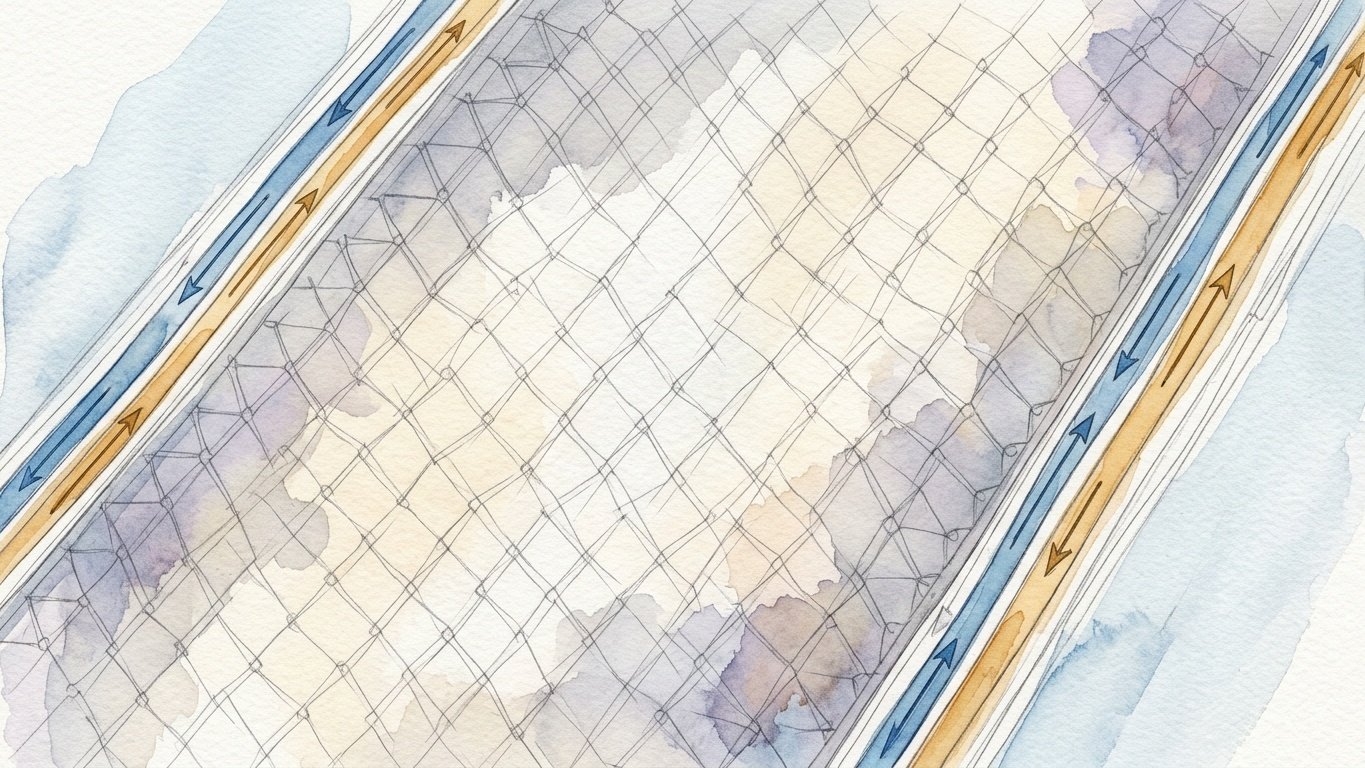
Dissipationless Highways – Topological Insulators
For more than a century, condensed matter physics rested upon a foundational classification dogma established by Lev Landau: the paradigm of spontaneous symmetry breaking. Under Landau’s brilliant framework, every phase of matter—from the crystalline lattice of a diamond to the ferromagnetic alignment of iron and the zero-resistance state of a superconductor—could be rigorously categorized by the underlying symmetries that the system broke as it cooled. Yet, in the closing decades of the twentieth century, physicists encountered an entirely new realm of quantum matter that defied Landau’s century-old canon: states of matter distinguished not by broken symmetries, but by the subtle, unyielding mathematics of global topology. At the forefront of this modern quantum revolution stands the discovery of Topological Insulators and the Quantum Spin Hall Effect. These extraordinary materials perform a physical impossibility within classical electrodynamics: their interior bulk acts as a pristine, non-conducting electrical insulator, while their surfaces and edges host indestructible, gapless metallic super-highways of current. Protected from backscattering and physical defects by fundamental time-reversal symmetry and relativistic spin-orbit coupling, these dissipationless quantum channels lock an electron’s momentum directly to its quantum spin. From the theoretical predictions of Charles Kane, Eugene Mele, and Shoucheng Zhang to the laboratory synthesis of bismuth selenide crystals and the search for non-Abelian Majorana zero modes, topological insulators have shattered textbook solid-state physics, offering an audacious blueprint for dissipationless spintronics, fault-tolerant topological quantum computing, and a profound unification of pure mathematics and physical reality.
1. Beyond Landau – The Mathematical Genesis of Topological Order
To appreciate the intellectual earthquake unleashed by topological insulators, one must examine the classical theory of phase transitions formulated by Lev Landau in 1937. In Landau’s theory, transitions between phases of matter correspond to the reduction of symmetry. A liquid possesses continuous spatial translational and rotational symmetry; as it freezes into a solid crystal, that continuous symmetry spontaneously breaks into a discrete lattice symmetry. A paramagnet possesses rotational symmetry among its atomic magnetic moments; upon cooling below the Curie temperature, spontaneous magnetic alignment breaks this rotational symmetry, yielding a non-zero ferromagnetic order parameter.
For fifty years, physicists believed that every physical state of matter could be fully indexed by local order parameters and symmetry groups. This absolute conviction was shattered in 1980 by Klaus von Klitzing’s experimental discovery of the Integer Quantum Hall Effect (IQHE). When a two-dimensional electron gas (2DEG) at the interface of a GaAs/AlGaAs semiconductor heterostructure is subjected to liquid-helium cryogenic temperatures and immense perpendicular magnetic fields (exceeding 10 Tesla), the transverse Hall conductance (sigma_xy) does not vary smoothly with magnetic field. Instead, it forms plateaus quantized with astonishing, part-per-billion precision.
where e is the elementary charge, h is Planck’s constant, and ν is an exact integer ($1, 2, 3,…). What astounded theorists was that this quantization remained utterly unaffected by random chemical impurities, macroscopic sample geometry, or crystal lattice strain. Yet, the quantum Hall state exhibited no broken spatial symmetries and possessed no classical Landau order parameter.
The mathematical resolution arrived in 1982 in a landmark paper by David Thouless, Mahito Kohmoto, M. Peter Nightingale, and Marcel den Nijs (known as the TKNN formulation). Thouless and his colleagues demonstrated that the Hall conductance integer ν was not an ordinary thermodynamic variable, but a fundamental topological invariant: the first Chern number. In differential geometry, topology studies properties of geometric shapes that remain invariant under continuous deformations (stretching, twisting, or bending) without tearing or gluing—such as the number of holes (genus) that distinguishes a sphere (g=0) from a donut (g=1).
TKNN proved that in a quantum Hall system, the electronic wavefunctions in the crystalline momentum space (the Brillouin zone) define a complex geometric manifold. Integrating the Berry curvature—the geometric phase acquired by an electron wavefunction traversing closed loops in momentum space—over the closed two-dimensional torus of the first Brillouin zone yields an invariant that is strictly, mathematically constrained to be an integer.
where F_xy(k) = nabla_k × A(k) is the Berry curvature derived from the Berry connection A(k) = -i . Just as a porcelain coffee mug cannot be continuously transformed into a sphere without punching a hole or tearing the surface, an electronic band structure with a non-zero Chern number cannot be continuously transitioned into an ordinary atomic insulator without closing the bulk energy bandgap. The era of topological physics had begun.
2. The Quantum Spin Hall Leap – Topology Without Magnetic Fields
Despite its mathematical beauty, the Integer Quantum Hall Effect suffered from an inescapable practical limitation: it required immense, multi-Tesla external magnetic fields produced by bulky liquid-helium superconducting magnets. A magnetic field is inherently time-reversal asymmetric—it breaks Time-Reversal Symmetry (T), pointing an arrow of direction along the magnetic field vector. For more than two decades, physicists assumed that non-trivial topological invariants could only exist when time-reversal symmetry was forcefully obliterated by magnetic fields.
In 2005, theoretical physicists Charles Kane and Eugene Mele at the University of Pennsylvania shattered this assumption in a revolutionary pair of papers. Kane and Mele asked an audacious question: Could a material exhibit topological quantum Hall-like behavior without any external magnetic field, preserving time-reversal symmetry intact?
Their theoretical breakthrough hinged on a fundamental relativistic quantum mechanical interaction: Spin-Orbit Coupling (SOC). When an electron orbits a heavy atomic nucleus at relativistic velocities, the nucleus’s static electrostatic electric field E appears in the electron’s moving rest frame as a powerful effective magnetic field B_eff proportional to v × E. This relativistic magnetic field couples directly to the electron’s intrinsic magnetic spin signal power S, governed by the Dirac Hamiltonian term.
Kane and Mele demonstrated that in graphene—a single layer of carbon atoms arranged in a honeycomb lattice—intrinsic spin-orbit coupling acts like an effective, internal, spin-dependent magnetic field. Crucially, this internal field points upward for spin-up electrons, but points downward for spin-down electrons! The system can be envisioned as two decoupled copies of the quantum Hall effect superimposed in the same crystal: – Spin-up electrons experience an effective positive magnetic field and circulate clockwise along the boundary. – Spin-down electrons experience an effective negative magnetic field and circulate counter-clockwise along the boundary.
Because the effective magnetic field reverses direction whenever spin is flipped, the entire system remains perfectly invariant under time reversal! The net transverse charge Hall current cancels to zero, but a pure transverse quantum spin current flows without resistance. This unprecedented state of matter was christened the Quantum Spin Hall (QSH) Effect, or the two-dimensional topological insulator.
3. The integers_2 Topological Invariant and Kramers’ Degeneracy
Because the Quantum Spin Hall effect preserves time-reversal symmetry, the classical TKNN Chern number is identically zero (nu_uparrow + nu_downarrow = 1 – 1 = 0). How, then, could mathematicians and physicists classify this state as topologically distinct from a piece of ordinary vacuum, wood, or glass?
Kane and Mele uncovered a profoundly new topological classification: the integers_2 topological invariant (ν in {0, 1}). Unlike the integer quantum Hall effect, which is indexed by the infinite set of integers ℤ = {…, -2, -1, 0, 1, 2,…}, time-reversal-invariant insulators are characterized by a binary classification. An insulator is either topologically trivial (ν = 0, like ordinary glass, silicon, or vacuum) or topologically non-trivial (ν = 1, a true topological insulator).
The mathematical guardian of this integers_2 invariant is Kramers’ Theorem, an inescapable consequence of quantum mechanics for half-integer spin particles (fermions). The time-reversal operator T acting on a spin-1/2 electron satisfies the mathematical condition:
Because electrons are fermions with half-integer spin, applying the quantum time-reversal operation twice in succession introduces a fundamental minus sign. Under time-reversal symmetry, this geometric phase shift guarantees that every electronic state is matched with an exact time-reversed partner—a phenomenon known as Kramers’ degeneracy.
Kramers’ theorem dictates that in any time-reversal-symmetric fermionic system, every single electronic energy eigenstate |psi> must be degenerate with its time-reversed partner T|psi>. In the momentum space of a crystalline lattice, there exist special high-symmetry points known as Time-Reversal Invariant Momenta (TRIM)—points Gamma_i in the Brillouin zone where the momentum satisfies at time-reversal-invariant momentum points (where G is a reciprocal lattice vector). At these precise TRIM points, an electron and its time-reversed partner share the identical crystal momentum. Therefore, Kramers’ theorem forces the energy bands to touch in pairs at every TRIM point, creating an un-splittable degenerate crossing called a Kramers degeneracy point.
In a trivial insulator (ν = 0), the surface states connecting the bulk valence band to the bulk conduction band cross the Fermi level an even number of times (or zero times). A small perturbation or atomic surface oxidation can easily push these states out of the bandgap, rendering the surface insulating. But in a topological insulator (ν = 1), the surface bands cross the Fermi energy an odd number of times. Kramers’ theorem strictly prohibits any time-reversal-symmetric perturbation from opening a gap at the Kramers point! The crossing is topologically protected: as long as time-reversal symmetry is unbroken and the bulk energy gap remains open, the surface metallic states cannot be eliminated by any amount of disorder, surface contamination, or lattice strain.
4. The Experimental Breakthrough – Molenkamp, Zhang, and HgTe Quantum Wells
While Kane and Mele’s 2005 theory was a triumph of mathematical elegance, its application to real materials faced a sobering reality: in carbon graphene, the atomic number of carbon is a lightweight Z = 6. Because spin-orbit coupling scales with the fourth power of the atomic number (H_SOC proportional to Z⁴), the spin-orbit bandgap in pristine graphene is ridiculously tiny—a microscopic fraction of a micro-electron-volt (~10⁻⁶ eV), requiring temperatures below $0.001 Kelvin to observe, far beyond practical experimental limits.
The quest for a real-world topological insulator shifted into overdrive. In 2006, theoretical physicist Shoucheng Zhang and his collaborators Andrei Bernevig and Taylor Hughes at Stanford University identified the ideal physical platform: Mercury Telluride / Cadmium Telluride (HgTe/CdTe) quantum wells. Mercury (Z = 80) and Tellurium (Z = 52) are heavy elements possessing colossal relativistic spin-orbit coupling.
In ordinary semiconductor crystals (such as CdTe or GaAs), the conduction band is formed from atomic s-orbitals (Gamma_6 symmetry), while the valence band is formed from atomic p-orbitals (Gamma_8 symmetry). The s-orbital conduction band sits higher in energy than the p-orbital valence band, creating a normal, trivial energy bandgap. In Mercury Telluride, however, the immense relativistic speed of electrons orbiting the heavy mercury nucleus lowers the energy of the s-orbitals while pushing the p-orbitals upward. This produces a dramatic physical phenomenon: Band Inversion. In bulk HgTe, the valence and conduction bands are flipped upside down!
Bernevig, Hughes, and Zhang (BHZ) formulated a precise mathematical model showing that by sandwiching an ultra-thin layer of HgTe between barrier layers of CdTe using molecular beam epitaxy (MBE), the thickness d of the HgTe quantum well acts as a physical tuning knob:
- When d < 6.3 nm (sub-critical thickness), quantum confinement dominates, and the band structure is topologically normal (ν = 0).
- When d > 6.3 nm (critical thickness d_c approximately 6.3 nm), relativistic band inversion occurs! The Gamma_6 and Gamma_8 bands cross and invert, driving a quantum topological phase transition into the non-trivial Quantum Spin Hall regime (ν = 1).
In 2007, an experimental team led by Laurens Molenkamp at the University of Würzburg in Germany fabricated pristine HgTe/CdTe quantum wells with sub-nanometer thickness control. Molenkamp cooled the devices to millikelvin temperatures and measured their longitudinal electrical resistance. For thin quantum wells (d < 6.3 nm), the resistance skyrocketed to giga-ohms as the Fermi level entered the insulating bandgap. But for inverted quantum wells (d = 7.3 nm), when the bulk Fermi level was tuned into the bandgap, the resistance plateaued precisely at the fundamental quantum value.
This quantized resistance corresponded exactly to two dissipationless edge channels—one spin-up channel flowing forward and one spin-down channel flowing backward! The Quantum Spin Hall Effect was real.
5. Helical Edge States and the Suppression of Backscattering
The defining physical marvel of the Quantum Spin Hall effect resides in its one-dimensional boundary channels, termed Helical Edge States. To understand why these states represent true dissipationless highways, consider an ordinary metallic copper wire carrying an electrical current.
In a classical copper wire, electrons collide continuously with vibrating lattice atoms (phonons), missing atoms (vacancies), and chemical impurities. These collisions cause elastic backscattering: an electron moving forward with momentum +k bounces off an impurity and scatters backward with momentum -k, dissipating its kinetic energy into heat according to Joule’s law (P = I² R). This electrical dissipation is the fundamental reason computers overheat and power transmission lines lose gigawatts of energy.
In a Quantum Spin Hall helical edge state, however, electron momentum and electron spin are fundamentally locked together by relativity: – An electron traveling forward with momentum +k has its spin pointing strictly Up (|+k, uparrow>). – An electron traveling backward with momentum -k has its spin pointing strictly Down (|-k, downarrow>).
Now consider what happens when a forward-moving electron (|+k, uparrow>) encounters a non-magnetic impurity (such as a lattice vacancy, a step edge, or an electrostatic defect). To backscatter into the counter-propagating state (|-k, downarrow>), the electron must not only reverse its momentum; it must simultaneously flip its quantum spin! Because a non-magnetic electrostatic potential V(r) cannot exert a magnetic torque, it cannot flip an electron’s spin directly.
Even more profound is the quantum mechanical interference of the scattering pathways. Because an electron is a spin-1/2 fermion, rotating its spin by 360 degrees ($2π radians) introduces a fundamental quantum phase shift of minus one (e^{iπ} = -1). When calculating the total quantum scattering amplitude for an electron to scatter around the left side versus the right side of an impurity, the two time-reversed scattering paths interfere destructively:
Because electrons possess half-integer spin, their wavefunctions acquire a phase shift of 180 degrees upon completing a full circular rotation. When an electron attempts to backscatter along a topological edge channel, the clockwise and counter-clockwise scattering pathways interfere with opposite quantum phases, producing complete destructive interference. Backscattering is physically forbidden, allowing current to flow without resistive heat dissipation.
The backscattering probability vanishes identically! As long as time-reversal symmetry is preserved (i.e., no external magnetic fields or localized magnetic impurities are present), the electron literally cannot bounce backward. It glides effortlessly around physical obstacles, macroscopic defects, and micro-cracks without generating electrical resistance or Joule heat. It is a dissipationless quantum super-highway.
6. Entering the Third Dimension – 3D Topological Insulators
While HgTe quantum wells confirmed the reality of 2D topological insulators, their practical engineering utility was constrained by the extreme delicacy of molecular beam epitaxy quantum well fabrication and cryogenic operating requirements. In 2007, Liang Fu, Charles Kane, and Eugene Mele extended the integers_2 classification from two dimensions into three dimensions, proving that three-dimensional bulk crystals could also host topologically protected surface states.
In 3D, the topological classification expands to four distinct integers_2 invariants: (nu_0; nu_1, nu_2, nu_3). If the primary invariant nu_0 = 1, the crystal is a Strong Topological Insulator (STI). A strong topological insulator possesses surface states on all crystal faces, regardless of how the crystal is cleaved or oriented.
In 2008 and 2009, theoretical predictions by Haijun Zhang, Shoucheng Zhang, and experimental verifications by teams led by M. Zahid Hasan at Princeton University and Robert Cava identified the archetypal family of stoichiometric 3D topological insulators: – Bismuth Selenide (Bi_2Se_3) – Bismuth Telluride (Bi_2Te_3) – Antimony Telluride (Sb_2Te_3)
Among these, Bi_2Se_3 emerged as the hydrogen atom of topological physics. It possesses a crystal structure composed of stacked rhombohedral layers called quintuple layers (Se-Bi-Se-Bi-Se), bound together along the vertical c-axis by weak van der Waals forces. Crucially, Bi_2Se_3 features a massive bulk energy bandgap of approximately 0.3 electron-volts (300 meV)—vastly larger than room-temperature thermal energy (k_B T approximately 26 meV). For the first time in history, physicists held in their hands a macroscopic, stoichiometric crystal that acted as a topological insulator at room temperature!
7. The Dirac Cone and Spin-Momentum Locking
The electronic surface of a three-dimensional topological insulator represents a truly exotic two-dimensional state of matter. Unlike a conventional two-dimensional electron gas where electrons obey the parabolic Schrödinger dispersion relation (E = ħ² k² / 2m^*), electrons traversing the surface of a 3D topological insulator behave as massless relativistic Dirac fermions, described by the two-dimensional Dirac Hamiltonian.
where v_F approximately 5 × 10⁵ m/s is the Fermi velocity, k = (k_x, k_y) is the two-dimensional surface wavevector, and σ = (sigma_x, sigma_y) are the Pauli spin matrices. Plotting energy E as a function of momentum (k_x, k_y) reveals a pristine, linear, double-cone geometry: The Dirac Cone. The upper and lower halves of the cone touch at a single point of zero energy: the Dirac Point, which is pinned directly to a time-reversal-invariant Kramers degeneracy point.
The defining microarchitectural signature of the Dirac cone is Spin-Momentum Locking. Because the Hamiltonian explicitly couples the Pauli spin matrices to the momentum components (sigma_x proportional to k_y and sigma_y proportional to -k_x), an electron’s spin vector is strictly constrained to be perpendicular to its momentum vector. In momentum space, the spin vectors form a helical vortex wrapping tangentially around the circular Fermi surface: – An electron moving with wavevector +k_x has its spin pointing along +y. – An electron moving with wavevector -k_x has its spin pointing along -y. – An electron moving with wavevector +k_y has its spin pointing along -x.
To directly observe this relativistic band structure, Hasan’s Princeton group and researchers worldwide utilized Angle-Resolved Photoemission Spectroscopy (ARPES) and Spin-Resolved ARPES. By shining high-energy synchrotron ultraviolet photons onto cleaved Bi_2Se_3 surfaces, electrons were ejected into vacuum through the photoelectric effect. Measuring the kinetic energy and emission angles of the photoelectrons yielded spectacular, direct visual images of the gapless Dirac cone bridging the bulk bandgap, while spin detectors confirmed that the electron spins wrapped in helical circles around the Dirac cone, providing undeniable spectroscopic confirmation of topological order.
8. The Quantum Anomalous Hall Effect – The Holy Grail Realized
Having established the existence of 2D and 3D topological insulators preserving time-reversal symmetry, physicists pursued a tantalizing theoretical dream first formulated by F. Duncan M. Haldane in 1988: Could one create a quantized Hall effect at absolute zero magnetic field by introducing internal spontaneous ferromagnetism into a topological insulator? This elusive phenomenon was termed the Quantum Anomalous Hall (QAH) Effect.
In a standard topological insulator, time-reversal symmetry protects the Dirac point, forcing the surface states to remain gapless. If one intentionally breaks time-reversal symmetry by introducing ferromagnetism—aligning a uniform magnetic exchange field perpendicular to the surface—the magnetic exchange energy opens a massive energy gap at the Dirac point. In 2008, Shoucheng Zhang and his colleagues calculated that if a thin film of a 3D topological insulator was doped with ferromagnetic transition metal atoms, the resulting 2D insulator would possess a non-zero Chern number (C = 1), producing an exact quantized Hall conductance sigma_xy = e²/h with zero external magnetic field!
Synthesizing a material that combined topological band inversion, uniform long-range ferromagnetic order, and a pristine insulating bulk proved to be an experimental nightmare that stymied global research groups for five years. The triumph was achieved in 2013 by a Chinese collaboration led by Qi-Kun Xue at Tsinghua University and the Institute of Physics of the Chinese Academy of Sciences.
Xue’s team utilized molecular beam epitaxy to synthesize atomically flat, five-nanometer-thick films of Chromium-doped Bismuth Antimony Telluride, Cr_0.15}(Bi_0.1}Sb_0.9})_1.85}Te_3, grown on high-resistivity sapphire substrates. When cooled below 30 millikelvin, the spontaneous ferromagnetism of the Chromium dopants broke time-reversal symmetry, opening a mass gap in the Dirac surface states. In the absence of any applied magnetic field, the Hall resistance quantized with breathtaking precision at the exact von Klitzing constant.
while the longitudinal resistance plunged to zero (R_xx to 0). The Quantum Anomalous Hall effect had been conquered, proving that chiral dissipationless edge channels could circulate around a macroscopic chip purely through internal quantum topology.
9. Topological Superconductivity and Majorana Bound States
Perhaps the most profound and revolutionary frontier born from topological insulators is their convergence with superconductivity. In 1937, Italian theoretical physicist Ettore Majorana deduced that the relativistic Dirac equation permitted solutions representing fermions that are their own antiparticles: γ^dagger = γ. For decades, high-energy particle physicists searched in vain for fundamental Majorana particles in cosmic rays and neutrino oscillations.
In 2008, Liang Fu and Charles Kane proposed a breathtaking conceptual breakthrough: Majorana fermions could be physically engineered as emergent quasiparticles in solid-state condensed matter! Fu and Kane showed that by placing an ordinary, conventional s-wave superconductor (such as niobium or aluminum) in direct contact with the surface of a 3D topological insulator, the proximity effect induces superconducting pair correlations into the helical Dirac fermions.
Because the topological surface states are already spin-momentum locked, the superconducting pairing effectively mimics an exotic, spinless p-wave superconductor (p_x + i p_y). When a magnetic vortex or a physical semiconductor nanowire junction is introduced onto this surface, the core of the vortex traps an isolated, zero-energy quantum bound state: a Majorana Zero Mode (MZM).
Majorana zero modes are not ordinary fermions or bosons; they obey Non-Abelian Anyon Exchange Statistics. When two Majorana modes residing at spatial positions r_1 and r_2 are physically braided (exchanged in two-dimensional space), the quantum state of the system does not merely acquire a trivial phase factor (± 1). Instead, the braiding operation performs a unitary matrix rotation within a degenerate, topologically protected multi-dimensional ground state Hilbert space.
This property constitutes the foundation of Topological Quantum Computation, pioneered theoretically by Alexei Kitaev and Michael Freedman. Because a single logical qubit is encoded non-locally across two spatially separated Majorana modes, local environmental thermal noise, stray electromagnetic fields, and material impurities cannot perturb the stored quantum information. Quantum logic gates are executed by physically braiding Majorana channels around each other. The computation is protected by global topology, promising an architecture for quantum computers that are fundamentally immune to environmental decoherence.
10. Spintronics and Post-CMOS Dissipationless Interconnects
Beyond quantum computing, topological insulators are poised to revolutionize classical microelectronics and spintronics. For six decades, modern microprocessors have computed by shuttling electric charges through semiconductor channels, dissipating substantial heat. Spintronics seeks to replace charge currents with electron spin currents, dramatically slashing power consumption.
Topological insulators are the ultimate spintronic engine because of their 100% efficient spin-momentum locking. In a standard ferromagnetic metal (such as iron or permalloy), passing a charge current generates a spin polarization of at most 30% to 50%. On the surface of a 3D topological insulator, however, passing a charge current creates a 100% spin-polarized transverse surface current! This produces an exceptionally high Spin-Hall Angle (theta_SH) and unprecedented Spin-Orbit Torque (SOT) efficiency.
In spintronic magnetic random-access memory (SOT-MRAM), passing a tiny electrical current through a thin topological insulator underlayer generates a massive spin torque capable of switching the magnetization of an adjacent ferromagnetic storage bit in picoseconds, consuming orders of magnitude less energy than conventional spin-transfer torque (STT) mechanisms. Furthermore, researchers are engineering topological insulator ribbons as dissipationless quantum interconnects to replace resistive copper wiring in future ultra-dense microprocessors, circumventing the thermal dissipation ceiling that threatens the future of Moore’s Law.
11. Axion Electrodynamics and Topological Magnetoelectric Effects
The profound intersection between topological insulators and fundamental theoretical physics reaches its zenith in Axion Electrodynamics. In 1987, particle physicist Frank Wilczek showed that extending Maxwell’s equations with an additional topological interaction term yields exotic electrodynamic phenomena.
where α = e² / ħ c approximately 1/137 is the fine-structure constant, and θ is the axion field angle. In vacuum and ordinary matter, time-reversal symmetry restricts the parameter θ to zero. In a three-dimensional topological insulator, however, the bulk topological invariant dictates that the axion parameter is quantized to exactly.
This non-zero axion term produces the Topological Magnetoelectric Effect (TME): applying a static electric field E to a topological insulator induces a magnetic polarization M proportional to E inside the material, while applying an external magnetic field bandwidth B induces an electrical polarization P proportional to B! A single electric charge placed near the surface of a topological insulator induces a magnetic monopole image charge beneath the surface, physically realizing electrodynamic phenomena that theorists once believed could only exist in the exotic conditions of the early universe.
12. Higher-Order Topological Insulators and Corner States
In recent years, the mathematical taxonomy of topological matter has expanded into Higher-Order Topological Insulators (HOTIs), pioneered by Taylor Hughes, Andrei Bernevig, and Frank Schindler. In traditional d-dimensional topological insulators (first-order), a d-dimensional crystal hosts gapless metallic states on its (d-1)-dimensional boundaries (for instance, a 3D bulk hosts 2D surface states, and a 2D bulk hosts 1D edge states).
Higher-order topological insulators generalized this principle in a stunning manner: an n-th order topological insulator in d dimensions hosts protected gapless states on its (d-n)-dimensional boundaries! Specifically: – A Second-Order 2D Topological Insulator possesses an insulating 2D bulk and insulating 1D edge boundaries, but hosts topologically protected, fractional zero-energy states localized strictly at its zero-dimensional physical corners! – A Second-Order 3D Topological Insulator (such as elemental crystalline Bismuth, discovered experimentally in 2018) possesses an insulating bulk and insulating surface facets, but hosts gapless helical 1D conduction channels running strictly along the physical one-dimensional hinges connecting adjacent crystal facets!
These hinge and corner states are protected by spatial crystal symmetries—such as four-fold rotational inversion (C_4 T) or mirror symmetries—combined with time-reversal symmetry. The discovery of HOTIs demonstrated that topology in solids is far richer than initially imagined, enabling the creation of sub-nanometer quantum wires embedded directly into the structural facets of macroscopic 3D crystals.
13. Weyl and Dirac Semimetals – The Topological State of Metals
While the initial topological revolution focused on insulators, physicists soon realized that the mathematics of Berry curvature and topological invariants could be applied directly to gapless metals. This led to the discovery of Topological Semimetals, specifically Dirac Semimetals (such as Cd_3As_2 and sodium_3Bi) and Weyl Semimetals (such as Tantalum Arsenide, TaAs, and Niobium Phosphide, NbP).
In a Weyl semimetal, bulk conduction and valence bands do not form a bandgap, nor do they overlap randomly. Instead, they touch at isolated, discrete zero-dimensional points in momentum space called Weyl Nodes. These Weyl nodes act as literal monopoles of Berry curvature in momentum space—acting as sources (C = +1) and sinks (C = -1) of the Berry flux field. Because a magnetic monopole in momentum space cannot be eliminated by any local perturbation, Weyl nodes are topologically indestructible; they can only be annihilated if two nodes of opposite chirality are brought together and merged in momentum space.
Weyl semimetals exhibit extraordinary physical manifestations: – Fermi Arc Surface States: On the physical surface of a Weyl semimetal, the Fermi surface does not form a closed loop (as required by textbook solid-state physics for all normal metals). Instead, it forms disconnected, open curves called Fermi Arcs that terminate abruptly at the surface projections of the bulk Weyl nodes! – The Chiral Anomaly: When parallel electric and magnetic fields in parallel are applied to a Weyl semimetal, quantum mechanics breaks the conservation of chiral charge. Electrons pump continuously from Weyl nodes of left-handed chirality to nodes of right-handed chirality, producing a massive, negative longitudinal magnetoresistance where electrical resistance plunges dramatically as the magnetic field increases.
14. Engineering Quantum Matter – Epitaxy, Cleaving, and Nano-Fabrication
Synthesizing topological crystals of sufficient purity to harness their dissipationless surface states requires the pinnacle of modern materials science. A major obstacle that hindered early commercial applications was bulk native defect conduction. In stoichiometric Bi_2Se_3, natural selenium vacancies act as n-type electron donors, pushing the Fermi level out of the bulk bandgap and into the conduction band. As a result, early samples conducted significant electrical current through their bulk, masking the delicate topological surface channels.
To suppress bulk conduction, materials scientists developed quaternary solid-solution crystals: Bi_2-x}Sb_xTe_3-y}Se_y (BSTS). By carefully adjusting the stoichiometry of bismuth, antimony, tellurium, and selenium, the intrinsic donor vacancies and acceptor defects compensate each other with atomic precision. In optimized BSTS single crystals grown via the modified Bridgman method, bulk resistivity skyrockets to over $10⁵ Ω·cm at cryogenic temperatures, ensuring that more than 99% of electrical transport flows strictly through the topologically protected surface Dirac channels.
Simultaneously, thin-film heterostructures are fabricated using Molecular Beam Epitaxy (MBE) in ultra-high vacuum chambers (P < 10⁻¹⁰ Torr). By depositing quintuple layers one by one onto lattice-matched substrates (such as SrTiO_3 or aluminum_2O₃), engineers construct artificial topological superlattices, interfacing topological insulators with ferromagnets, conventional superconductors, and 2D materials like graphene and transition metal dichalcogenides (TMDs). These atomically engineered interfaces serve as the testbeds for next-generation spintronic switches and topological quantum gates.
16. Multi-Terminal Quantum Transport and Landauer-Buttiker Formalism
To rigorously prove that helical edge states conduct current without dissipation, condensed matter physicists rely on the Landauer-Buttiker Formalism for multi-probe ballistic quantum transport. In a macroscopic classical conductor, electrical current obeys Ohm’s law and Kirchoff’s rules, where resistance scales linearly with channel length (R proportional to L / A). In a mesoscopic quantum device where the mean free path of electrons exceeds the physical dimensions of the sample, transport becomes ballistic, and resistance originates entirely at the interfaces between the microscopic quantum channel and the macroscopic contact reservoirs.
Consider a six-terminal Hall bar device fabricated from an inverted HgTe/CdTe quantum well. Current is injected through source contacts while intermediate voltage probes draw zero net current. In an ordinary semiconductor, electrons scatter in all directions, producing non-zero longitudinal resistance voltages.
In an ordinary conductor or trivial semiconductor, backscattering allows electrons to scatter into all available leads, producing non-zero resistance voltages along the edges. In a topological insulator, however, backscattering is completely suppressed by quantum symmetry.
In a Quantum Spin Hall helical edge state, however, time-reversal symmetry enforces strict directional transmission: – Spin-up electrons travel clockwise with transmission probability T_p to p+1} = 1, and T_p to q} = 0 for all other contacts. – Spin-down electrons travel counter-clockwise with transmission probability T_p to p-1} = 1, and T_p to q} = 0 for all other contacts.
Under these topological conditions, the longitudinal voltage drop between adjacent probes along the edge is strictly zero, while the two-terminal conductance is quantized to the exact fundamental quantum conductance value. – When measuring non-local voltages—injecting current across contacts 1 and 2 while measuring voltage across distant contacts 3 and 4—a large, quantized non-local resistance is detected. In conventional classical conductors, non-local signals decay exponentially with distance (e⁻L/lambda}). In a topological insulator, because the helical edge channels circulate continuously around the entire perimeter of the chip, the non-local signal propagates across macroscopic millimeter distances with zero exponential decay. This non-local transport signature provided conclusive, definitive proof of topological edge conduction.
17. Topological Photonics and Acoustic Metamaterials
The mathematical elegance of topological band theory is fundamentally a property of wave equations. As theorists recognized that Berry phase physics applies to any linear wave equation, the concepts of topological insulators exploded beyond solid-state electronic crystals into classical optics, photonics, and acoustics, giving birth to Topological Photonics.
In 2008, Marin Soljacic and his collaborators at MIT predicted that the photonic band structure of a two-dimensional photonic crystal—an array of dielectric cylinders embedded in a magnetic ferrite matrix—could possess non-zero photonic Chern numbers. When irradiated with microwaves in the presence of an external magnetic field, the photonic crystal demonstrated Chiral Photonic Edge States: beams of light that travel strictly in one direction along the edge of the crystal. If a physical defect, an opaque metal barrier, or a sharp 90-degree corner is placed directly in the optical path, the light beam does not reflect, scatter, or undergo diffraction; it glides smoothly around the obstacle and continues forward with 100% transmission efficiency.
Soon after, researchers engineered Photonic Topological Insulators preserving time-reversal symmetry using helical optical waveguides etched into silica glass via femtosecond lasers (Alexander Szameit and Mordechai Segev), or using arrays of ring resonators exhibiting synthetic spin-orbit coupling (Mohammad Hafezi). In these optical chips, light of one circular polarization circulates clockwise, while the opposite polarization circulates counter-clockwise. These topological waveguides enable backscatter-immune optical delay lines, high-power topological laser cavities that maintain single-mode emission despite localized semiconductor defects, and robust optical interconnects for on-chip photonic computing.
Similarly, in mechanical engineering and acoustics, researchers have synthesized Topological Acoustic Metamaterials—lattices of miniature acoustic resonators, pendulums, or spinning gyroscopic rods that guide sound waves and mechanical vibrations along surface boundaries without echo or back-reflection. These acoustic topological channels offer revolutionary applications in seismic vibration shielding, ultra-sensitive ultrasonic medical imaging, and vibration-isolated acoustic delay lines for radiofrequency signal processing.
18. Scanning Tunneling Spectroscopy and Direct Nanoscale Imaging
While Angle-Resolved Photoemission Spectroscopy (ARPES) maps electronic states in reciprocal momentum space, understanding the real-space atomic behavior of topological surfaces required Low-Temperature Scanning Tunneling Microscopy (STM) and Scanning Tunneling Spectroscopy (STS), pioneered by Ali Yazdani at Princeton University and J.C. Seamus Davis at Cornell.
An STM scans an atomically sharp metallic tungsten or platinum-iridium tip across the cleaved surface of a Bi_2Se_3 or Bi_2Te_3 crystal at liquid-helium temperatures (4.2 K or below). By applying a bias voltage V and measuring the quantum tunneling current I, the differential conductance dI/dV maps the local density of electronic states (LDOS) with sub-angstrom spatial resolution and millivolt energy resolution.
STS revealed the profound microscopic reality of the Dirac cone: – V-Shaped Local Density of States: As the tip scanned across defect-free surface terraces, the differential conductance exhibited a characteristic linear, V-shaped profile, bottoming out at zero conductance at the exact energy of the Dirac point, confirming the conical dispersion E(k) = ħ v_F |k|. – Quasiparticle Interference (QPI) and Fourier-Transform STM: When isolated non-magnetic surface defects (such as missing selenium atoms or step edges) are present, scattered electrons interfere, creating standing wave patterns in the local density of states. Taking the two-dimensional spatial Fourier transform of these interference patterns (FT-LDOS) maps out allowed scattering wavevectors momentum transfer vector. In conventional metals, backscattering with wavevector q = 2k_F produces intense, bright circular rings in Fourier space. On topological insulator surfaces, however, the $2k_F backscattering peak is completely extinguished! The destructive quantum interference enforced by spin-momentum locking leaves a dark hole at the backscattering wavevector, providing direct, real-space visual proof that Dirac electrons are physically incapable of bouncing backward off non-magnetic obstacles.
Theoretical Case Study – The Quantum Spin Hall Effect in 2D Transition Metal Dichalcogenides
Beyond HgTe quantum wells, condensed matter theorists identified monolayer transition metal dichalcogenides (TMDs) in the distorted 1T’ crystal phase—specifically monolayer tungsten ditelluride (1T’-WTe₂) and molybdenum ditelluride (1T’-MoTe₂)—as prime candidates for high-temperature 2D topological insulators. In 2014, Liang Fu and his colleagues at MIT predicted that the atomic distortion in the 1T’ phase induces an inverted band structure around the Brillouin zone center, accompanied by a robust fundamental spin-orbit bandgap exceeding 45 to 55 millielectron-volts.
In 2018, experimental groups led by Sanfeng Wu and Pablo Jarillo-Herrero at Princeton and MIT successfully exfoliated single-layer flakes of 1T’-WTe₂ inside inert argon gloveboxes, encapsulating the monolayers between protective hexagonal boron nitride (hBN) sheets. Transport measurements demonstrated quantized helical edge conductance persisting up to an astounding 100 Kelvin! Unlike fragile MBE heterostructures that collapse above liquid-helium temperatures (4 K), 1T’-WTe₂ opened the real-world possibility of integrating dissipationless quantum spin channels into liquid-nitrogen-cooled (77 K) microelectronic circuits and topological field-effect transistors, bridging the gap between exotic laboratory physics and scalable semiconductor manufacturing.
19. Conclusion – The Architectural Legacy of Quantum Topology
The odyssey of topological insulators—from the abstract mathematics of fiber bundles and Chern invariants to the synthesis of bismuth selenide crystals, the observation of helical Dirac cones, and the braiding of Majorana modes—stands as one of the supreme intellectual achievements of modern physics. It shattered the century-old assumption that materials can only be understood through broken symmetries and local atomic order, revealing that nature encodes fundamental physical laws in the global, indestructible topology of quantum wavefunctions.
By transforming fragile electronic states into dissipationless quantum highways protected by the bedrock symmetries of spacetime, topological insulators have bridged the deepest realms of pure mathematics and practical engineering. Whether through ultra-low-power spintronic memory, room-temperature dissipationless interconnects, or decoherence-immune topological quantum processors, the legacy of topological physics has redefined humanity’s mastery over the quantum realm, illuminating a future where mathematics and matter are truly one.