Sima Qian, the Castration of Truth, and the Architecture of the Shiji
In 99 BCE, in the subterranean darkness of the “Silkworm Chamber” (Canshi) beneath the imperial palace of Chang’an, a forty-eight-year-old scholar lay shivering in agony on a blood-soaked mat. His genitals had been hacked away with an embalmer’s knife, his flesh cauterized with boiling oil, his name forever stained with the ultimate social disgrace permitted under Han law: the punishment of castration (Gongxing). In traditional Chinese aristocratic culture, a gentleman subjected to such grotesque bodily mutilation had only one honorable recourse: immediate ritual suicide. Yet Sima Qian (司馬遷)—the Grand Astrologer-Historian of the Han Empire—refused to die. Swallowing his vomit and enduring the mocking snickers of court eunuchs, Sima Qian chose to live in dishonor for a single, incandescent obsession: to complete the monumental historical architecture begun by his dying father. That work—the Shiji (史記, Records of the Grand Historian)—spanned one hundred and thirty chapters and over five hundred and twenty thousand Chinese characters, surveying three thousand years of human civilization from the mythical Yellow Emperor down to the reign of his tormentor, Emperor Wu. Written not with imperial sycophancy, but with a searing, unflinching commitment to moral truth, Sima Qian created not merely the foundational blueprint of East Asian historiography, but the supreme testament of the human spirit conquering imperial despotism through the written brush.
1. The Lineage of the Sky-Watchers: Sima Tan’s Dying Oath (110 BCE)
To understand why Sima Qian was willing to endure the most excruciating physical and social degradation known to the ancient world, one must first grasp the sacred, ancestral burden laid upon his shoulders. The Sima lineage did not view history as a secular academic profession; they viewed the recording of time as a cosmic, hereditary priesthood. For generations dating back to the legendary monarchs of the Western Zhou, ancestors of the Sima family had served as Taishi (太史)—traditionally translated as Grand Astrologer, Grand Scribe, or Grand Historian—officials responsible for observing the movements of the stars, harmonizing the astronomical calendar, recording royal omens, and documenting the words and deeds of kings.
Sima Qian’s father, Sima Tan (司馬談), was one of the intellectual giants of the early Han dynasty. A master philosopher who had studied astronomy under Tang Du, the I Ching under Yang He, and Daoist metaphysics under Master Huang, Sima Tan was appointed Grand Astrologer by Emperor Wu in 140 BCE. In his famous treatise, “On the Essential Essentials of the Six Schools” (Lun Liujia Yaozhi), Sima Tan produced the first systematic intellectual classification of Chinese philosophy, evaluating Confucianism, Mohism, Legalism, School of Names, Naturalists, and Daoism, identifying Huang-Lao Daoism as the supreme synthesis of administrative statecraft.
For decades, Sima Tan quietly gathered ancestral archives, bamboo chronicles, and imperial decrees, dreaming of composing a universal history that would encompass the entire human narrative. But in 110 BCE, as Emperor Wu prepared to perform the sacred, grandiose Fengshan Sacrifices (封禪) upon the summit of Mount Tai to announce his cosmic supremacy to Heaven, tragedy struck. Sima Tan was seized with violent illness and stranded in the transit city of Luoyang, barred by disease from accompanying the imperial procession to the mountain crest. Knowing that his life was slipping away and that his lifelong dream remained unfulfilled, Sima Tan awaited the arrival of his son.
Sima Qian arrived at his father’s deathbed, fresh from a diplomatic expedition to the southwestern barbarian frontiers of Yunnan. In Chapter 130 of the Shiji, Sima Qian recorded their final, shattering confrontation—a deathbed scene that burns with tragic filial intensity:
“My father grasped my hand, weeping with tears streaming down his face, and said: ‘Our ancestors were grand historians for the house of Zhou… Now the Han has arisen, all within the four seas is united, and the enlightened sovereign has mounted Mount Tai to perform the Fengshan rites; yet I am unable to follow him! This is my tragic destiny! After I die, you must become Grand Astrologer; and once you are Grand Astrologer, you must not forget that which I desired to write!… When Confucius compiled the Spring and Autumn Annals, the tyrants and treacherous ministers trembled with fear. It has been four hundred years since the capture of the unicorn; the feudal states have been swallowed up, the historical records dispersed and broken. Now the Han has flourished, yet the annals of virtuous rulers, loyal ministers, and valiant heroes have not been set in order! I am terrified that the history of the world will be extinguished from the earth! You must remember this!'”
— Sima Tan’s Dying Charge, Shiji, Chapter 130: “The Grand Scribe’s Postface”
Sima Qian bowed his head to the dirt, wept bitterly, and swore the sacred oath that would dictate the remainder of his life: “Your humble son is simple and dull, but he shall strive to gather all the ancient traditions transmitted by our ancestors; I dare not let a single word be lost!” Three years later, in 108 BCE, having observed the formal mourning period, Sima Qian was appointed to his father’s vacant seat as Grand Astrologer, gaining full, unrestricted access to the secret imperial archives, stone chambers, and bamboo libraries of the Western Han court.
2. The Grand Wanderer: Field Archaeology and Topographical Memory
What distinguishes Sima Qian from every other imperial bureaucrat of his age was his extraordinary experiential methodology. Sima Qian was not a desk-bound scholar who compiled history from secondhand manuscripts; he was the ancient world’s greatest historical traveler, a pioneer of field anthropology, oral history, and topographical archaeology.
Born around 145 BCE in Longmen (modern Hancheng, Shaanxi) near the Yellow River, Sima Qian was sent by his father at the age of twenty on an epic, multi-year expedition across the length and breadth of the Chinese sub-continent. Armed with bamboo scrolls, a horse, and minimal funds, the young scholar journeyed across thousands of miles of rugged wilderness. He traveled south across the Yangtze and Huai rivers, ascending Mount Kuaiji in Zhejiang to explore the legendary cavern where the Great Yu was said to have assembled the tribal chiefs; he sailed across the misty waters of Lake Dongting, visiting the banks of the Miluo River where Qu Yuan had drowned himself, weeping openly as he interviewed local fishermen; he journeyed to the ancient capital of Chu at Ying, examining the charred ruins left by Bai Qi’s legions.
He pushed north through the heartland of Qi and Lu, visiting the birthplace of Confucius at Qufu, observing the ancient bronze chariots, ritual robes, and musical bells preserved by the sage’s descendants, marveling that while countless kings and dukes had vanished into dust, the humble teacher’s schoolhouse still resonated with students chanting the Rites. He traveled to the battlefield of Julu, kicking through the loess to unearth rusted bronze arrowheads and fractured chariot hubs; he visited Pengcheng, where Xiang Yu had slaughtered hundreds of thousands; and he spent weeks in Pei County, sitting in village taverns with eighty-year-old peasants who had personally known Liu Bang in his youth, recording their vivid, unvarnished memories of the First Emperor’s drunkenness, debts, and vulgar jokes.
This immense geographic odyssey transformed Sima Qian’s historical consciousness. He realized that geography, climate, and local folklore were living, inseparable components of human history. When he described a battle in the Shiji, he knew the exact gradient of the ravine, the mud along the riverbank, and the psychological temperament of the local people. He listened to the oral tales of old women, interviewed veteran border soldiers, inspected stone inscriptions on mountain summits, and cross-referenced every folk rumor against the imperial bamboo archives. He did not merely write history; he walked through the living ruins of time.
3. The Court of Emperor Wu: Megalomania and the Taichu Calendar
Upon assuming the office of Grand Astrologer in 108 BCE, Sima Qian entered the inner orbit of the most terrifying, grandiose monarch in Chinese history: Emperor Wu of Han (Han Wudi, r. 141–87 BCE). Under Emperor Wu, the Han dynasty had abandoned forty years of Huang-Lao peaceful restraint. Emperor Wu transformed the empire into an aggressive, militarized continental superpower: his armies marched thousands of miles across Central Asia to conquer the Ferghana valley for the “Heavenly Horses” (Tian Ma); he incorporated modern Korea (Gojoseon), modern Vietnam (Nanyue), and the southwestern tribal kingdoms into the imperial commandery grid; and he established state monopolies on salt, iron, and liquor to finance his gargantuan military budgets.
Emperor Wu was an autocrat obsessed with cosmic immortality, alchemy, and divine omens. He surrounded himself with fangshi magicians, Daoist alchemists, and sycophantic courtiers who flattered his vanity by claiming that the emperor was a living immortal who would mount a flying dragon to the stars like the Yellow Emperor. Sima Qian served in this court with quiet, professional dignity. In 104 BCE, Sima Qian achieved one of the great scientific triumphs of ancient astronomy: together with the astronomers Tang Du and Luoxia Hong, he designed and instituted the celebrated Taichu Calendar (太初曆)—the most precise astronomical calendar of the ancient world, which fixed the solar year at 365.25 days, established the beginning of the civil year in the first month of spring, and remained the structural basis of the traditional Chinese calendar for two millennia.
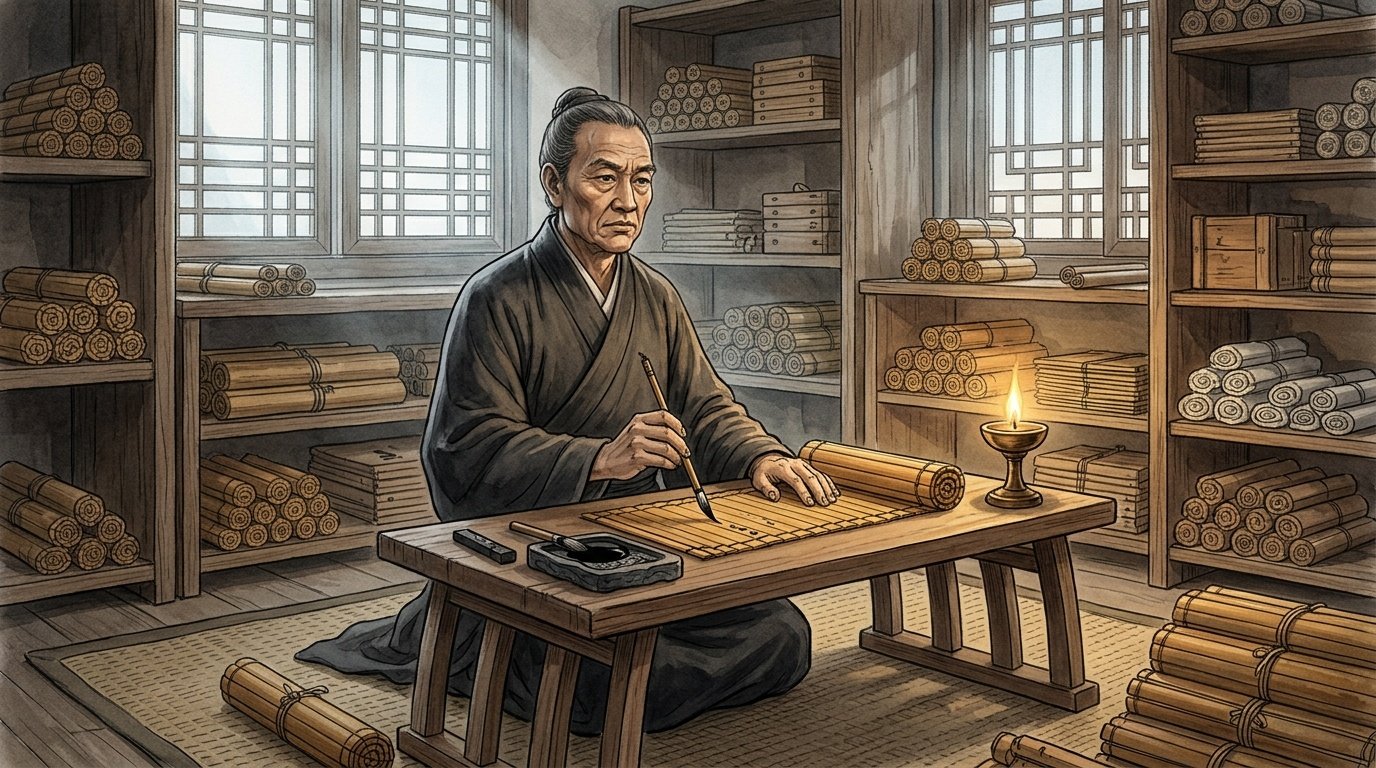
With the calendar completed, Sima Qian devoted his nights to his true life’s work: drafting the chapters of his universal history. In his study in Chang’an, illuminated by flickering oil lamps, surrounded by thousands of bundles of inscribed bamboo and wooden slips, the Grand Astrologer was steadily assembling the annals of dynasties. He was forty-seven years old, held in high honor by the court, blessed with a loving family, and poised to leave an unblemished career to posterity. Then arrived the year 99 BCE.
4. The Disaster at Mount Junji: General Li Ling (99 BCE)
In the autumn of 99 BCE, Emperor Wu ordered a colossal military offensive against the northern steppe empire of the Xiongnu. The supreme command of the main strike force—numbering over thirty thousand cavalry—was granted to the emperor’s brother-in-law, General Li Guangli (the Marquis of Ershi), a man of meager military talent whose high rank was owed entirely to the emperor’s infatuation with his sister, the beautiful Consort Li.
Serving under Li Guangli was a brilliant, dashing young cavalry officer named Li Ling (李陵)—the grandson of the celebrated “Flying General” Li Guang, whose peerless archery had terrorized the Xiongnu for decades. Emperor Wu initially commanded Li Ling to serve as a rear supply officer, hauling baggage for Li Guangli. Li Ling, burning with ancestral pride, bowed before the emperor and begged to be allowed to launch an independent strike force, declaring: “Your servant desires to lead five thousand infantry from Jingzhou to march deep into the northern grasslands, diverting the Chanyu’s armies so that the Marquis of Ershi may strike unhindered!” Delighted by his bravery, Emperor Wu approved the expedition.
Li Ling marched his five thousand foot soldiers past the Great Wall, advancing over a thousand li into the hostile heart of Mongolia. At Mount Junji (浚稽山), Li Ling’s tiny force was suddenly surrounded by the entire nomadic strike force of the Xiongnu: eighty thousand elite mounted archers commanded in person by the Chanyu.
What followed was an epic of military courage that stunned the ancient world. Outnumbered sixteen to one, without cavalry support, Li Ling arrayed his five thousand men in a disciplined defensive circle of heavy wooden supply wagons, forming a mobile fortress. Behind the wagons, Han halberdiers braced against charges while elite crossbowmen fired synchronized volleys of heavy bronze bolts into the steppe swarms. In eight days of continuous, running combat as he retreated toward the Han border, Li Ling’s tiny army killed over ten thousand Xiongnu warriors, forcing the Chanyu to contemplate breaking off the engagement in terror.
Then arrived the fatal betrayal. A Han military scribe named Guan Gan, having been flogged by Li Ling for an infraction, deserted in the night to the Xiongnu camp. Guan Gan revealed to the Chanyu that Li Ling’s soldiers were out of water, had exhausted their five hundred thousand crossbow bolts, and were receiving zero reinforcements from the main Han army. Knowing the enemy was helpless, the Xiongnu launched an overwhelming, all-out assault. Li Ling’s men fought with bare hands, wagon poles, and short daggers in the rocky defiles. Seeing that total slaughter was seconds away, Li Ling sighed toward Heaven: “I have no face to report to His Majesty!” To save the lives of his surviving wounded soldiers, Li Ling surrendered to the Xiongnu in the ninth month of 99 BCE. Only four hundred battered Han soldiers managed to crawl back across the Great Wall alive.
5. The Solitary Voice: Sima Qian’s Defense of the Defeated
When the news of Li Ling’s surrender reached the imperial palace of Chang’an, Emperor Wu flew into an uncontrollable, murderous fury. The emperor felt personally insulted: his beloved brother-in-law Li Guangli had achieved nothing on the battlefield, while Li Ling, who had won glory before surrendering, had disgraced the imperial arms by surviving in barbarian captivity.
The entire Han court immediately executed a sickening display of moral cowardice. High chancellors, ministers, and military commanders—many of whom had toasted Li Ling’s bravery a few weeks earlier—rushed forward to denounce the general as a traitor, demanding the execution of his entire family. Sima Qian watched this sycophancy with burning disgust. When Emperor Wu turned to his Grand Astrologer and asked for his formal evaluation of the campaign, Sima Qian took a step forward and spoke the unvarnished truth.
In his celebrated letter to his friend Ren An, Sima Qian recalled that fateful audience:
“I observed that Li Ling was filial to his parents, faithful to his friends, honest in seeking wealth, and deferential in matters of honor. He constantly strove to sacrifice his life for the state… He marched five thousand foot soldiers into the heart of the enemy’s lair, confronting eighty thousand horsemen! He fought for a thousand li until his arrows were exhausted and the road barred; yet his men still turned their faces to the enemy, fighting with empty hands and bare blades! Even the famous generals of antiquity could not have surpassed him! Although he fell into defeat, his intention was clearly to preserve his life so that he might find an opportunity to repay the Han! To accuse him of treason while ministers who sit safely at home do nothing is to insult the valor of our fallen warriors!”
— Sima Qian, “Letter to Ren An” (Bao Ren An Shu), preserved in Hanshu, Chapter 62
Sima Qian’s speech was an act of sublime moral integrity, but a fatal political catastrophe. Emperor Wu interpreted Sima Qian’s defense of Li Ling as a direct, insolent insult aimed at his favorite, General Li Guangli (implying that Li Guangli had been a coward who failed to relieve his comrade). Enraged that a mere astrologer dared to lecture him on military justice, Emperor Wu ordered Sima Qian seized by imperial guards, stripped of his court robes, and cast into the deepest dungeon of Chang’an to face trial for the capital offense of “Deceiving the Sovereign” (Wu Wang, 誣罔).
6. The Cell and the Knife: The Humiliation of Castration
The judicial tribunal returned the predictable, state-mandated verdict: Sima Qian was sentenced to Execution by Beheading (Zhan). Under Han law, a convicted official of high rank possessed only two legal avenues to escape the executioner’s axe:
1. Cash Redemption (Shu Zui): The payment of a colossal imperial fine of fifty thousand copper cash (or its equivalent in grain and horses) directly into the royal treasury.
2. Commutation to Castration (Gongxing): Submitting to the total surgical removal of his genitals, permanently stepping down from the status of an honorable gentleman (shi) to become an untouchable, mutilated palace eunuch.
Sima Qian desperately sought the funds to buy his life. But his family had spent generations in honest scholarly poverty, possessing no vast landed estates or commercial monopolies. Sima Qian appealed to his former colleagues, friends, and high ministers at court—men who had dined in his home and praised his scholarship. In his hour of mortal terror, not a single human being stepped forward to lend him a single copper coin. As he later recorded with bitter, weeping clarity: “My family was poor, possessing no wealth to redeem my crime; my friends and colleagues did not save me; not a single person among the emperor’s advisors spoke a solitary word on my behalf!”
In classical Chinese society, castration was viewed as a fate infinitely more horrifying than death. Death was clean; death preserved one’s ancestral honor; death allowed a gentleman to meet his ancestors in the underworld with his body intact. Castration was the ultimate, living death: it was a physical mutilation that severed a man from his ancestral line, rendered him biologically incapable of filial duty, and relegated him to the social status of an effeminate, polluted slave. Roman and Greek historians might have understood physical exile, but to the Han gentleman, castration was an ontological annihilation.
In the cold autumn of 98 BCE, Sima Qian was marched down into the Canshi (蠶室)—the “Silkworm Chamber.” This was a dark, windowless subterranean room kept artificially hot and draft-free with charcoal stoves, named after silkworm nurseries because patients who underwent castration had to be shielded from wind and cold to prevent fatal tetanus infections. Stripped naked and tied down to a wooden bench, Sima Qian was subjected to the butcher’s knife. His testicles and penis were completely excised. An earthen quill was inserted into his urethra to prevent it from closing as the wound healed, and he was left in the dark for weeks, swimming in his own blood and excrement, listening to the agonizing screams of other mutilated convicts.
7. The Choice: The Letter to Ren An and the Will to Bear Dishonor
When Sima Qian finally emerged from the Silkworm Chamber, pale, emaciated, his beard falling out and his voice cracking into an unnatural high pitch, the entire bureaucratic world expected him to commit suicide. Why did he not take a cup of poisoned wine or draw a dagger across his throat to erase his shame?
The answer to that question forms one of the greatest documents in world intellectual history: the celebrated Letter to Ren An (Bao Ren An Shu, 報任安書), written in roughly 91 BCE. Ren An, an old friend who had been convicted of treason in the twilight purges of Emperor Wu’s reign and was awaiting execution, had written to Sima Qian urging him to use his position to promote worthy men. Sima Qian’s reply was a raw, agonizing, magnificent explosion of literary defiance:
“A man has only one death: that death may be heavier than Mount Tai, or it may be lighter than a swan’s feather; it all depends upon how he uses it!… If I had yielded to the law and suffered execution, to the multitude it would have been no different from the death of a single solitary ant falling into a furnace! Why? Because the world would have concluded that my crimes were real and my wisdom exhausted, seeing in my death only the common fate of an outcast.”
— Sima Qian, “Letter to Ren An”, Hanshu, Chapter 62
Sima Qian revealed the solitary, sacred fire that kept his heart beating in the dark: his universal history remained unfinished. If he died, three thousand years of human memory would be swallowed by the void; the oath he had sworn to his weeping father on the banks of the Luo River would be broken; and the voices of China’s heroes, rebels, and martyrs would be silenced forever:
“In the past, King Wen was imprisoned and expanded the Book of Changes; Confucius was in distress and composed the Spring and Autumn Annals; Qu Yuan was banished and wrote the Li Sao; Zuo Qiu became blind and compiled the Guoyu; Sunzi had his kneecaps severed and expounded the Art of War; Lü Buwei was exiled to Shu and the world transmitted his Chunqiu; Han Feizi was imprisoned in Qin and penned the Shuinan and Gufen!… All these ancient masters were men whose hearts were choked with bitter sorrow, unable to enact their Way in their own age. Therefore, they recounted past affairs, leaving their words so that generations to come might know their minds!”
— Sima Qian, “Letter to Ren An”, Hanshu, Chapter 62
Sima Qian concluded with an extraordinary declaration of artistic immortality: “I dared not love my poor life, but chose to live in filth and shame because my book was not yet complete! When I have completed this book, I shall hide it away in the Famous Mountain, to be transmitted to men who understand it in ages to come. When that is done, though I should suffer ten thousand executions, what regret could I ever feel?!” Sima Qian had conquered the emperor’s knife: he had transformed the ultimate physical humiliation into the ultimate literary monument.
8. The Architecture of the Shiji: A Five-Dimensional Cosmos
Having chosen to live, Sima Qian returned to his study with a feverish, almost superhuman intensity. In 96 BCE, Emperor Wu—displaying a bizarre mix of imperial guilt, administrative pragmatism, and psychological cruelty—appointed the castrated Sima Qian to the powerful post of Palace Secretary (Zhongshuling), an office normally held by trusted eunuchs that controlled the flow of imperial memorials, secret decrees, and policy documents directly to the throne. Sima Qian used his high administrative access to quietly complete the grand architecture of the Shiji, working deep into the night while fulfilling his daytime court secretarial duties.
The Shiji is not a dry, chronological diary like the older Spring and Autumn Annals or the court records of Lu; it is a monumental, Five-Dimensional Architectural Symphony comprising 130 fascicles and over 526,500 Chinese characters. Sima Qian invented an entirely original historiographical framework—the Jizhuan Ti (紀傳體, Annals-Biography Form)—which broke forever with linear chronicle and became the mandatory structural template for all subsequent twenty-four official dynastic histories of imperial China across two thousand years.
The structural anatomy of this five-part masterpiece reveals Sima Qian’s philosophical genius:
| Structural Section | Fascicle Count | Historical Scope & Content | Philosophical Function |
|---|---|---|---|
| 1. Basic Annals (Benji, 本紀) |
12 Chapters | Chronological accounts of supreme dynastic sovereigns: Yellow Emperor, Xia, Shang, Zhou, Qin, First Emperor, Xiang Yu, Gaozu, Empress Lü, Wen, Jing, Wu. | The central temporal spine of the empire; charts the rise, moral degeneration, and cosmic transfer of the Mandate of Heaven across ages. |
| 2. Chronological Tables (Biao, 表) |
10 Chapters | Synchronized graphic matrices of political events across decades and centuries, coordinating feudal states, aristocratic successions, and bureaucratic appointments. | Visualizes the complex, multi-polar political chessboard; allows the reader to track simultaneous events across competing kingdoms without losing temporal cohesion. |
| 3. Treatises / Monographic Books (Shu, 書) |
8 Chapters | Deep systemic essays on institutional and scientific infrastructure: Rites, Music, Pitch-Pipes, Astronomy/Calendar, Fengshan Sacrifices, Rivers/Canals, and the Economy (Pingzhun). | Provides structural, materialist explanations for state capacity, technology, hydrology, and financial policy beyond individual biographical will. |
| 4. Hereditary Houses (Shijia, 世家) |
30 Chapters | Histories of the major feudal states (Lu, Qi, Jin, Chu, etc.), noble lineages, and exceptional figures who shaped civilization (Confucius and Chen Sheng). | Examines the intermediate echelons of power; recognizes regional autonomy and ideological founders who held no imperial crowns. |
| 5. Ranked Biographies (Liezhuan, 列傳) |
70 Chapters | Portraits of individual human beings: generals, philosophers, diplomats, assassins, merchants, jesters, wandering knights, corrupt officials, and foreign border peoples (Xiongnu, Dayuan, Chaoxian). | The vibrant, beating heart of the book; captures the moral agency, eccentric genius, and individual tragedies of human beings across every social class. |
The interlocking, multi-layered nature of this structure is breathtaking. A single historical event—such as the Battle of Muye, the Legalist reforms of Shang Yang, or the Feast at Hongmen—is viewed through multiple perspectives across the Annals, the Tables, and the individual Biographies. Sima Qian does not force history into a simplistic, monolithic moral narrative; he provides multiple lenses, allowing the contradictory voices, private motivations, and human flaws of historical actors to resonate across the text.
Every single chapter in the work concludes with Sima Qian’s personal authorial signature: the celebrated “The Grand Astrologer Remarks” (Taishi Gong Yue, 太史公曰). In these concluding appraisals, Sima Qian steps out from behind the historical curtain to deliver his personal, philosophical judgment on the figures he has just chronicled. These remarks are not dry academic summaries; they are masterpieces of moral passion, ironic wit, and profound human pathos. In them, Sima Qian weeps for Qu Yuan on the banks of the Miluo, laughs at the vanity of itinerant persuaders, admires the unbending courage of assassins, and questions whether the cosmos possesses any genuine moral justice when good men are mutilated while wicked tyrants die comfortably in their beds.
9. The Revolutionary Eye: Elevating the Marginalized and Defying the Crown
The true glory of the Shiji—and the proof of Sima Qian’s moral triumph over his physical mutilation—lies in his revolutionary authorial perspective. Where court historians before and after him wrote history exclusively from the perspective of the imperial palace, celebrating the victorious, glorifying the reigning dynasty, and condemning the defeated as illegitimate traitors, Sima Qian wrote history with deep, boundless empathy for the marginalized, the tragic, and the rebellious.
Sima Qian committed profound historiographical heresies that terrified and scandalized conservative Confucian scholars. He included Chen Sheng—the penniless peasant conscript who had raised the banner of revolt in the marshes of Dazexiang—in the Hereditary Houses (Shijia), a section strictly reserved for ancient feudal dukes and blood royalty, placing a landless peasant on equal structural footing with the Duke of Zhou and the King of Qi! Sima Qian argued that although Chen Sheng died in defeat, it was his peasant courage that had shattered Qin’s tyranny and initiated the historical wave that brought the Han to power: “Although Chen She died, the feudal lords and kings whom he raised eventually extinguished the Qin. The Han dynasty arose because Chen She took the initiative; how could his house not be ranked among the hereditary lords?!”
Similarly, he placed Confucius in the Hereditary Houses, acknowledging the landless itinerant teacher as an “Uncrowned King” (Su Wang) whose moral legacy exceeded that of all earthly monarchs. In his Ranked Biographies, Sima Qian devoted entire chapters to social groups that polite court society disdained as vulgar, lawless, or parasitic. Chapter 86 celebrates the Assassins (Cike Liezhuan), praising men like Cao Mo, Zhuan Zhu, Yu Rang, Nie Zheng, and Jing Ke, who sacrificed their lives to fulfill private oaths of personal honor: “A gentleman dies for one who understands him, as a woman adorns herself for one who delights in her” (士為知己者死,女為悅己者容).
Chapter 124 celebrates the Wandering Knights (Youxia Liezhuan), praising lawless vigilantes whose word was absolute bond in an age of corrupt magistrates: “Although their deeds may not conform to the established rites, their promises are faithful, their words true, their actions resolute; they do not spare their own bodies to rescue others from calamity!” Chapter 126 celebrates the Court Jesters and Satirists (Huaji Liezhuan), showing how men like Chunyu Kun and Dongfang Shuo used ironic parables and razor-sharp humor to dissuade tyrannical kings when high ministers were paralyzed with fear. And Chapter 129 celebrates the Money-Makers and Merchants (Huozhi Liezhuan), delivering a brilliant, early capitalist defense of free trade, commercial enterprise, and wealth accumulation, arguing that the desire for wealth is an innate human instinct that the state must accommodate rather than violently suppress.
Most daring of all was his treatment of his tormentor, Emperor Wu. In Chapter 12 (the Basic Annals of Filial Wu) and Chapter 28 (the Treatise on the Fengshan Sacrifices), Sima Qian paints a devastating, thinly veiled portrait of the emperor’s megalomania: his pathetic credulity toward fraudulent alchemists, his paranoia, his expensive military vanities, and his relentless exactions that bled the empire dry. While Sima Qian praised Emperor Wu’s expansion of the realm, he refused to erase the terrible human cost of that glory. Sima Qian wrote what the Han court called a “True Record” (Shi Lu, 實錄)—an unvarnished mirror that recorded virtues without exaggeration and crimes without concealment.
In his treatment of the founding emperor, Liu Bang (Emperor Gaozu), Sima Qian displayed the same uncompromising biographical honesty. While later imperial historians depicted Gaozu as a semi-divine dragon born of miraculous omens, Sima Qian depicted Liu Bang in all his raw, earthy human reality: his drunken debts in Pei County, his cowardice at Pengcheng where he kicked his own children out of his carriage to lighten the load for escape, his habit of urinating into the official hats of Confucian scholars to show his contempt for ritual, and his jealousy of his own generals. Yet Sima Qian also captured Liu Bang’s sublime capacity for listening to advice, his magnanimity at Bashang, and his tearful song at Pei County. Sima Qian did not create mythological idols; he created living, breathing, flawed human beings whose virtues and vices were laid open to the judgment of time.
10. The Secret Transmission: Hiding the Book in the Famous Mountain
Sima Qian knew with absolute certainty that if Emperor Wu or his conservative successors discovered the full contents of the Shiji, the bamboo scrolls would be cast into the fire and his entire clan exterminated for high treason. According to the Book of Han, when Emperor Wu once examined a draft chapter concerning his own reign, the emperor flew into an imperial rage, drew a brush, and physically scraped the ink off the bamboo slips with a knife.
To ensure the survival of his masterpiece, Sima Qian executed a clandestine transmission strategy. He prepared two complete master sets of the one hundred and thirty chapters, inscribed on thousands of bundles of polished bamboo and wooden slips tied with silk cords. One copy he deposited in the imperial government archives in Chang’an, knowing that parts of it might be sanitized or lost. The second, complete master copy he entrusted to his beloved daughter, Sima Ying, commanding her to execute the prophecy he had spoken to Ren An: “To Hide It Away in the Famous Mountain” (Cang Zhi Mingshan, 藏之名山)—depositing the sacred manuscripts in a hidden mountain sanctuary in the rugged gorges of Shaanxi.
Sima Qian died in obscurity around 86 BCE, roughly the same time Emperor Wu passed away. For more than three decades, the master text remained hidden in the darkness of the mountain rocks, silent and waiting. The text was finally brought into the daylight during the reign of Emperor Xuan of Han (r. 74–48 BCE) by Sima Qian’s brilliant grandson, the prominent scholar and statesman Yang Yun (楊惲). Yang Yun petitioned Emperor Xuan, formally revealing the existence of the universal history and distributing copies across the scholarly community of China. The book that an emperor had tried to murder through castration emerged into the sunlight, dazzling the empire with its peerless prose and breathtaking historical sweep.
11. Historiographical and Literary Impact: The Father of History
The impact of Sima Qian on East Asian civilization is immeasurable. In Western civilization, Herodotus is universally revered as the “Father of History”; but while Herodotus created a brilliant, episodic narrative of the Persian Wars that had few direct structural imitators, Sima Qian created an all-encompassing historiographical architecture that governed the historical writing of China, Korea, Vietnam, and Japan for more than twenty centuries. The Twenty-Four Dynastic Histories (Ershisi Shi)—stretching from the Han to the fall of the Qing—all adopted Sima Qian’s Annals-Biography form, ensuring that the continuous biographical memory of Chinese civilization was preserved with unbroken institutional fidelity.
Beyond historiography, Sima Qian is universally celebrated as the supreme master of Classical Chinese Prose. The literary giant Lu Xun, in his famous historical assessment in An Outline of the History of Han Literature, captured Sima Qian’s dual achievement in an immortal eight-character couplet:
“The Supreme Masterpiece of Historians;
— Lu Xun, An Outline of the History of Han Literature (1926)
The Li Sao Without Rhyme!”
(史家之絕唱,無韻之離騷!)
Lu Xun recognized that Sima Qian was not a detached, cold recorder of dates, but a tragic poet of human existence. The dramatic tension of the Shiji—the flickering torches of the Hongmen Banquet, the thunderous cavalry charges of Julu, the weeping of Xiang Yu at Gaixia, the lonely dialogue of Qu Yuan and the fisherman—possesses a vivid, narrative energy that redefined the aesthetic possibilities of the Chinese language. The Tang dynasty literary masters Han Yu and Liu Zongyuan, when launching the “Classical Prose Movement” (Guwen Yundong) to sweep away empty ornamental rhetoric, took Sima Qian’s prose as their supreme stylistic model.
In modern world literature, Sima Qian stands alongside Thucydides, Tacitus, and Edward Gibbon as a supreme cartographer of the human condition. Yet in many respects, Sima Qian’s achievement was more profound and comprehensive than his Mediterranean counterparts. Where Thucydides chronicled a single, localized twenty-seven-year war, and Tacitus documented the dark palace intrigue of a single imperial dynasty, Sima Qian synthesized the entire civilizational arc of an entire continent across three millennia—integrating astronomy, hydrology, economic theory, poetry, philosophy, and military strategy into a single organic masterpiece. He accomplished this monumental task with neither state funding nor university endowments, working in solitary, mutilated disgrace, sustained solely by his sacred filial oath and his indomitable artistic will.
Sima Qian reminds us that earthly power is fleeting and ephemeral: the grand palaces of Emperor Wu have long since vanished beneath the wheat fields of modern Shaanxi, his bronze towers toppled, his vast treasures looted and dispersed. But the book written by the mutilated scholar in the darkness of the Silkworm Chamber remains immortal, read and studied today by millions across the globe. The knife of the emperor severed Sima Qian’s flesh, but Sima Qian’s brush captured the emperor’s soul and held it before the judgment of eternity.
Modern philological and historical scholarship, from the pioneering textual reconstructions of Wang Guowei (王国维) to contemporary archaeological discoveries of Han bamboo slips at Juyan and Xuanquan, has continually validated the astonishing empirical fidelity of Sima Qian’s narrative. Sima Qian traveled extensively throughout the empire, interviewing eyewitnesses, examining battlefield terrain, and verifying local epigraphic inscriptions with rigorous scholarly detachment. By enduring castration and completing his masterpiece, Sima Qian established a moral benchmark for intellectual integrity that has inspired Chinese writers, philosophers, and historians for over two millennia.
12. Classical Chapters, Dunhuang Manuscripts, and Scholarly Bibliography
Primary Classical Texts:
Sima Qian (司馬遷). (c. 94 BCE). Shiji (史記, Records of the Grand Historian). 130 Chapters. Critical punctuated edition with commentaries by Pei Yin (Jijie), Sima Zhen (Suoyin), and Zhang Shoujie (Zhengyi). Beijing: Zhonghua Book Company, 10 vols., 1959; revised edition 2013.
Ban Gu (班固). (c. 111 CE). Hanshu (漢書, Book of Han). Chapter 62: “Sima Qian Zhuan” (Biography of Sima Qian, containing the complete text of the “Letter to Ren An”). Beijing: Zhonghua Book Company, 1962.
Complete English Translations:
Watson, Burton. (1958). Ssu-ma Ch’ien: Grand Historian of China. New York: Columbia University Press. The foundational intellectual biography and stylistic analysis of the Shiji.
Watson, Burton. (1961/1993). Records of the Grand Historian. 3 vols. New York: Columbia University Press. ISBN: 978-0231081658
Nienhauser, William H., Jr. (ed.). (1994–present). The Grand Scribe’s Records. 9 vols. Bloomington: Indiana University Press. The definitive, fully annotated scholarly translation of the complete Shiji corpus.
Archaeological and Manuscript Discoveries:
Dunhuang Shiji Manuscripts (敦煌史記殘卷). Discovered in Cave 17 of the Mogao Grottoes, Dunhuang. Six Tang dynasty manuscript fragments preserved at the Bibliothèque Nationale de France (Pelliot chinois 2548, 3013) and British Library, confirming the stability and textual transmission of the Shiji across the Silk Road.
Modern Scholarly Studies:
Durrant, Stephen W. (1995). The Cloudy Mirror: Tension and Conflict in the Writings of Sima Qian. Albany: State University of New York Press. doi:10.1353/book.4795
Durrant, Stephen, Li, Wai-yee, Nylan, Michael, & Schaberg, David. (2016). The Letter to Ren An and Sima Qian’s Legacy. Seattle: University of Washington Press.
Hardy, Grant. (1999). Worlds of Bronze and Bamboo: Sima Qian’s Conquest of History. New York: Columbia University Press.
Pines, Yuri. (2009). Envisioning Eternal Empire: Chinese Political Thought of the Warring States Era. Honolulu: University of Hawaiʻi Press.
Qian, Mu. (1985). Zhongguo Shixue Mingzhu (中國史學名著, Masterpieces of Chinese Historiography). Taipei: Sanmin Book Company.