The Rule of Wen and Jing and Huang-Lao Governance in the Early Han
When the founding emperor of the Han dynasty, Liu Bang, rode through the devastated ruins of China in 202 BCE, the continent was an economic and demographic graveyard. Centuries of relentless Warring States carnage, followed by the totalitarian exactions of the Qin and the apocalyptic devastation of the Chu-Han Contention, had reduced agricultural productivity to near zero. The imperial court was so impoverished that royal stables could not assemble four carriage horses of matching coat colors, while prime ministers were compelled to ride in humble ox carts. Forty years later, during the celebrated reigns of Emperor Wen (r. 180–157 BCE) and his son Emperor Jing (r. 157–141 BCE)—historically revered as the Rule of Wen and Jing (Wen-Jing Zhi Zhi, 文景之治)—China had undergone the most spectacular economic resurrection in pre-modern history. Granaries across the empire were so overwhelmed with surplus millet that grain spilled out into the courtyards and rotted in the sun, while strings of copper cash in imperial vaults rotted through from decades of disuse. This miracle was achieved not through aggressive state intervention, but through its radical opposite: the philosophical doctrine of Huang-Lao (黃老)—governing through “Non-Action” (Wu Wei), radical tax reductions to one-thirtieth of crop yields, the abolition of mutilating penal tortures, and obsessive imperial frugality. The Rule of Wen and Jing stood as the golden age of classical Chinese economic libertarianism, providing the accumulated wealth that would finance Emperor Wu’s subsequent imperial expansions.
1. The Post-Apocalyptic Baseline: China in 202 BCE
To measure the economic magnitude of the Rule of Wen and Jing, one must first confront the terrifying demographic and material baseline of China at the close of the third century BCE. Between the outbreak of the Chen Sheng rebellion in 209 BCE and Liu Bang’s final victory at Gaixia in 202 BCE, seven continuous years of unrestricted civil war had pulverized the urban centers and agricultural basins of the Central Plains. Cities such as Daliang, Xinzheng, and Handan were depopulated ghost towns; irrigation dykes had collapsed, transforming thousands of square miles of prime farmland into stagnant malarial swamps; and agricultural labor had been obliterated as successive waves of warlords conscripted every able-bodied peasant.
The contemporary historical accounts preserved in Ban Gu’s Book of Han (Hanshu) paint a harrowing portrait of civilian survival. Famine was so widespread across the middle Yellow and Yangtze river basins that the price of an individual bushel (dan) of rice skyrocketed to five thousand copper cash, forcing destitute peasant families to sell their own children into chattel slavery to buy food, while chronicles matter-of-factly record that “the common people starved along the roadsides, and men ate each other’s flesh” (民大饑,人相食). Sima Qian estimates that in the core economic regions of Henan and Shandong, more than half of the total civilian population had perished from sword, famine, or pestilence.
The newly established Han imperial state was virtually bankrupt. Under the Qin dynasty, the central government had maintained vast metallic currency reserves, full armories, and millions of bushels of grain in state silos. In 202 BCE, all of it was gone. The economic embarrassment of the imperial court was recorded with vivid historical honesty: when Emperor Gaozu (Liu Bang) traveled outside the capital, the Master of the Royal Stables could not find four carriage horses of identical color to pull the imperial chariot, and high ministers, chancellors, and generals were reduced to traveling in common wooden ox-drawn carts (niu che). Metallic copper was so scarce that private citizens minted paper-thin, clipped copper coins known as “elm-seed cash” (yujia qian), which were so light they floated upon water, triggering catastrophic hyperinflation and paralyzing commercial trade.
Compounding this domestic ruin was a mortal external peril. Along the northern steppe frontier, the Xiongnu nomadic confederation had unified under the iron leadership of Modu Chanyu (冒頓單于). Commanding an estimated three hundred thousand mounted horse archers, the Xiongnu looked south upon the devastated Han empire with hungry contempt. When Emperor Gaozu attempted to confront Modu militarily in 200 BCE, his green infantry army was encircled for seven days on the freezing heights of Mount Baideng near modern Datong. Gaozu escaped annihilation only through secret bribes to the Chanyu’s consort, forcing the infant Han dynasty to submit to the humiliating Heqin (和親) appeasement system: sending annual tribute payments of fine silk, grain, fermented wine, and royal princesses to the steppe to buy an uneasy peace. The Han dynasty began not as a triumphant superpower, but as a traumatized, impoverished state fighting for its day-to-day survival.
2. The Ideological Pivot: The Rise of Huang-Lao Daoism
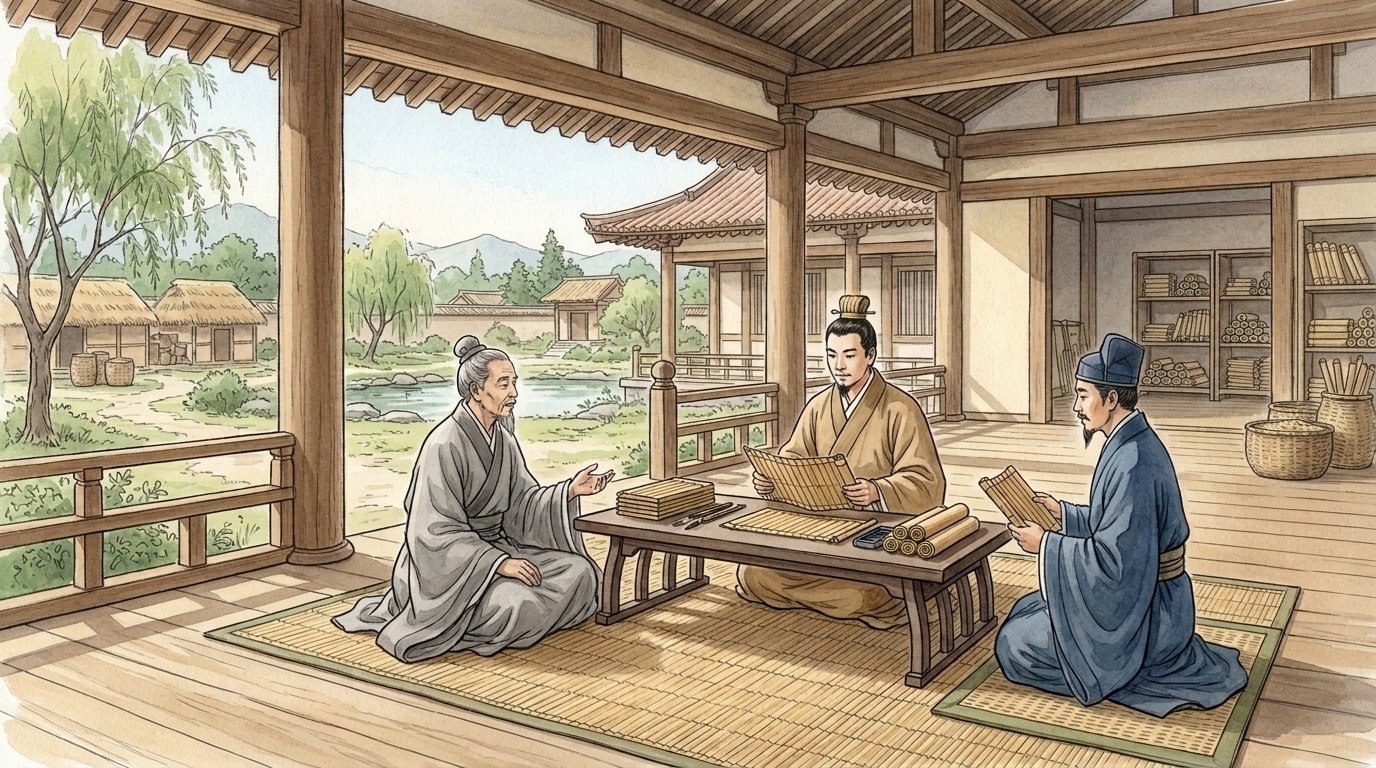
Faced with an exhausted civilization on the brink of total collapse, the founding leaders of the Han made an intellectual pivot that departed radically from both the totalitarian Legalism of the Qin and the dogmatic moralism of the Confucians. They embraced the school of political philosophy known as Huang-Lao (黃老之學)—so named because it synthesized the ancient cosmic wisdom attributed to the Yellow Emperor (Huangdi) with the naturalistic, non-interventionist metaphysics of Laozi.
Huang-Lao was not an ivory-tower philosophy of mystical quietism; it was an intensely pragmatic, hard-headed doctrine of Administrative Restraint and Social Regeneration. The core tenet of Huang-Lao statecraft was the concept of Wu Wei Er Zhi (無為而治)—”Governing Through Non-Action.” In the Huang-Lao understanding, society, like the human body or an agricultural ecosystem, possessed an innate, self-healing capacity. If the state continuously poked, taxed, mobilized, regulated, and punished the populace—as the Qin had done with tragic obsessiveness—the social organism would wither and die. But if the ruler remained tranquil, emptied his mind of grand personal ambitions, minimized laws, drastically lowered taxes, and allowed the people to follow their natural economic instincts, society would naturally regenerate its own wealth, population, and order.
“The Way of Heaven is to accomplish without acting, to enrich without demanding… When the ruler cherishes tranquility, the people naturally become upright; when the ruler loves stillness, the people naturally become prosperous; when the ruler engages in non-action, the world naturally flourishes.”
— Huainanzi (Master of Huainan), Chapter 1: “Searching the Dao”
The institutional pioneer who brought Huang-Lao from philosophical theory into daily administrative practice was Chancellor Cao Shen (曹參). Following the death of Xiao He in 193 BCE, Cao Shen became Prime Minister of the Han. Rather than issuing a flurry of new decrees or revamping the administration, Cao Shen did something that scandalized the court: he retained every single statute, regulation, and personnel appointment enacted by Xiao He, spending his afternoons drinking wine and feasting his subordinates in the chancellery. When young, ambitious officials arrived at his office eager to propose aggressive new legal reforms, Cao Shen offered them flagons of fine wine, kept them drinking until they were intoxicated, and sent them home without permitting them to utter a single word about policy.
When the young Emperor Hui (Liu Bang’s son) summoned Cao Shen to court and angrily demanded why the Prime Minister spent his days drinking rather than governing, Cao Shen asked the emperor two simple questions: “Does Your Majesty consider yourself superior in wisdom and virtue to the founding Emperor Gaozu?” Emperor Hui replied: “How could I dare compare myself to my father?” Cao Shen asked: “Does Your Majesty consider me superior in administrative capacity to Chancellor Xiao He?” Emperor Hui smiled: “You do not seem to equal him.” Cao Shen bowed low: “Your Majesty has spoken with absolute truth. Since Emperor Gaozu and Chancellor Xiao He pacified the realm and laid down clear laws, all that is required of Your Majesty is to maintain his robes in tranquility, and all that is required of your servant is to adhere strictly to the established rules without deviation. Is this not sufficient?!” Emperor Hui nodded in silent enlightenment. This policy of deliberate administrative stability gave birth to the celebrated idiom “Xiao Formulated the Rules, Cao Followed Them” (Xiao Gui Cao Sui, 蕭規曹隨)—establishing the foundational principle that the greatest virtue of early Han governance was administrative non-interference.
3. The Matriarch of Stillness: Empress Dowager Dou
The philosophical continuity of Huang-Lao across four decades of early Han history was anchored by one of the most formidable women in Chinese history: Empress Dowager Dou (竇太后, c. 205–135 BCE). Originally a humble palace maid from a poor family in Hebei, she was assigned to the court of Prince Liu Heng of Dai (the future Emperor Wen). Endowed with quiet dignity and profound intelligence, she became his primary consort and, upon his ascension to the imperial throne in 180 BCE, Empress of the Han Dynasty.
In her middle years, Empress Dou suffered a catastrophic illness that left her completely blind. Deprived of physical sight, she turned her formidable intellect inward, becoming a passionate, fanatical devotee of the texts of Laozi, the Daodejing, and the Huang-Lao masters. She insisted that her sons—Emperor Jing and Prince Liu Wu of Liang—and all royal grandchildren memorize and recite the chapters of the Daodejing before they were permitted to discuss politics.
Empress Dowager Dou held absolute, veto-wielding authority within the inner palace. She was violently suspicious of the rising school of Confucian scholars, viewing their complicated ritual etiquette, expensive mourning ceremonies, and moral preachiness as hypocritical vanity that would bankrupt the state and burden the peasantry. When a prominent Confucian scholar named Yuan Gu ventured to criticize the Daodejing in her presence, dismissing it as “merely the common talk of servants,” Empress Dou flew into a fury: “Is this book so inferior to your Confucian books of forced ritual?!” She ordered Yuan Gu stripped of his court robes and cast into the royal pigsty, commanding him to fight a ferocious wild boar with a tiny dagger (the scholar survived only because Emperor Jing secretly slipped him a razor-sharp iron spear).
For more than forty years, through the reigns of Emperor Wen, Emperor Jing, and the early years of Emperor Wu, Empress Dowager Dou acted as the ideological guardian of the state. She ruthlessly crushed any minister who attempted to introduce expensive imperial foreign wars, elaborate palace construction, or increased taxation. Her blind eyes remained fixed on a single, unwavering goal: keeping the imperial hands off the throats and purses of the Chinese peasantry.
4. The Accession of Emperor Wen: The Reluctant Sovereign (180 BCE)
The true architectural golden age of early Han governance began in 180 BCE with the dramatic ascension of Emperor Wen (漢文帝, Liu Heng). Following the death of Emperor Gaozu in 195 BCE, the supreme power of the empire had been hijacked by Gaozu’s ruthless widow, Empress Dowager Lü (Lü Zhi). For fifteen years, Empress Lü ruled as de facto sovereign, poisoning royal Liu princes, executing rival concubines with unimaginable cruelty (such as the torture of Consort Qi), and packing the high ministries and military commands with her own Lü clan relatives.
When Empress Lü died in 180 BCE, the veteran ministers and generals of the founding generation—led by the Grand Commandant Zhou Bo and Chancellor Chen Ping—launched a bloody, coordinated counter-coup in the capital of Chang’an: the Elimination of the Lü Clan (Zhu Lü). Every member of the Lü family was executed, and the ministers faced the urgent task of selecting a new emperor from among the surviving sons of Liu Bang.
The ministers deliberately passed over the wealthy, aggressive princes of Qi and Huainan, fearing they would bring overbearing maternal clans to court. Instead, their eyes turned to the remote, impoverished northern border kingdom of Dai (modern northern Shanxi and Hebei), governed by Liu Bang’s fourth son, the twenty-three-year-old Liu Heng. Liu Heng’s mother, Consort Bo, was famous for her quiet modesty, possessing no powerful family connections, while Liu Heng had spent a decade on the harsh northern frontier, living simply among his soldiers, defending the borders against Xiongnu horse raids, and earning the deep devotion of his subjects.
When the imperial couriers arrived at the prince’s palace in Jinyang carrying the Imperial Seal and inviting Liu Heng to ascend the throne of China, the young prince’s first reaction was not joy, but profound skepticism. Suspecting that the bloody veterans in Chang’an were laying an elaborate trap to lure him to the capital to be executed, Liu Heng consulted his mother and his advisors. Following the ancient divination of the tortoise shell, he dispatched his trusted uncle Song Chang to scout Chang’an; only when Zhou Bo knelt before his carriage at the Bridge of the Wei River, formally handing over the military tallies of the northern and southern imperial armies, did Liu Heng step into the imperial carriage.
Emperor Wen entered the capital not as a proud, conquering autocrat, but as a sober, deeply humble custodian of the realm. His first acts upon ascending the throne established the moral tone of his entire twenty-three-year reign: he issued a general amnesty for all minor criminals; distributed grain, silk, and wine to widows, orphans, and the elderly across the empire; and rescinded the ancient, tyrannical Qin law of Guilt by Association (Shouzuo), decreeing that the innocent parents, wives, and children of convicted criminals should never again be executed or enslaved for crimes they did not commit.
5. The Tax Revolution: One-Thirtieth and the Twelve-Year Exemption
At the center of Emperor Wen’s governance was an economic revolution that remains unmatched in the fiscal history of the world: the systematic, radical dismantling of the imperial tax burden. Under the Warring States and the Qin dynasty, the agricultural land tax (tianfu) had absorbed between one-tenth and one-third of a peasant’s total grain yield, supplemented by crushing monthly labor corvée duties and universal military service. Peasant families worked three hundred days a year simply to feed the imperial army and fill the royal granaries.
When Liu Bang founded the Han, he had reduced the agricultural tax to one-fifteenth of the harvest. In 178 BCE, Emperor Wen took a step that stunned his treasury officials: he promulgated a decree slashing the agricultural tax by half, establishing the permanent rate at One-Thirtieth of the Crop Yield (San Shi Shui Yi, 三十稅一)—an effective tax rate of merely 3.33 percent. For the first time in memory, the Chinese peasant retained more than ninety-six percent of the grain he harvested with his own hands.
Then, in 167 BCE, following a series of bumper harvests and careful treasury management, Emperor Wen executed an even more astonishing policy: he promulgated an imperial edict granting a Complete, Universal Exemption from All Agricultural Land Taxes (Quan Mian Tianfu) across the entire Chinese empire. For twelve consecutive years, from 167 BCE until the second year of Emperor Jing’s reign in 156 BCE, the central government of China collected zero grain taxes from the peasantry. The state operated purely on modest customs tolls, excise profits from state salt and iron mines, and minimal poll taxes on adult males (suifu), which were themselves reduced from 120 cash to 40 cash per year.
“Agriculture is the foundation of the world; there is no labor greater than this. Yet the people are burdened with taxes, and their yields are insufficient to sustain their lives. We hereby decree that the agricultural land tax of the empire shall be entirely abolished!”
— Emperor Wen’s Imperial Edict, Hanshu (Book of Han), Chapter 4: “Annals of Emperor Wen”
When Emperor Jing ascended the throne in 157 BCE, he formally re-instituted the agricultural land tax, but fixed the rate permanently at one-thirtieth. This 3.33 percent tax rate remained the official constitutional benchmark of Chinese agrarian taxation for centuries. The economic consequences of this prolonged fiscal holiday were profound: peasant families, freed from the fear that surplus grain would be confiscated by greedy tax magistrates, expanded their fields, invested in iron plows, bred draft oxen, cleared hillsides, and dug local drainage channels. Capital accumulated directly in the hands of the primary producers, laying the foundation for a massive, organic demographic and commercial explosion.
6. Dismantling the Penal Terror: Tiying’s Petition and the Abolition of Mutilation
Parallel to his fiscal revolution was Emperor Wen’s systematic dismantling of the terrifying Legalist penal apparatus inherited from the Qin. Despite the fall of the First Empire, the early Han had retained the majority of Qin’s ancient mutilating corporeal punishments (rouxing, 肉刑): tattooing the face with indelible ink (mo), slicing off the nose (yi), chopping off one or both feet at the ankle (yue or fei), and castration (gong). Tens of thousands of citizens across the empire lived as permanently disfigured, crippled outcasts, unable to perform manual labor and forever marked by the shame of state violence.
The event that shattered this ancient barbarism occurred in 167 BCE, initiated by the extraordinary courage of a young teenage girl named Chunyu Tiying (淳于緹縈). Tiying’s father was Chunyu Yi, a celebrated physician and former magistrate of Qi. When a wealthy patient died despite his treatment, Chunyu Yi was falsely accused of medical malpractice and official corruption, convicted under the ancient laws, and sentenced to be escorted in chains to Chang’an to suffer mutilation.
Chunyu Yi had no sons, only five daughters. As he was being placed in the convict cart, he cursed his weeping daughters: “Giving birth to children without bearing sons; in the hour of emergency, you are of no use whatsoever!” Deeply wounded, his youngest daughter, the fifteen-year-old Tiying, stepped forward and announced that she would walk beside her father’s cart all the way to the capital. Arriving in Chang’an, Tiying submitted a memorial directly to the palace gates of Emperor Wen—an act of breathtaking bravery that carried the penalty of execution if deemed insolent:
“Your handmaid’s father was an official in Qi; the people praised his integrity, but now he is entangled in the law and faces mutilation. Your handmaid grieves that once a dead man is executed, he cannot be restored to life; once a mutilated limb is severed, it cannot be rejoined! Even if a man desires to reform his conduct and begin anew, the path is forever closed to him. Your handmaid offers herself to become a state bond-servant in the imperial palace, so that she may redeem her father’s punishment and permit him to live with his body whole!”
— Tiying’s Petition to Emperor Wen, Shiji, Chapter 105: “Biographies of Bian Que and Chunyu Yi”
Emperor Wen read the teenage girl’s petition and was moved to tears by her extraordinary filial piety and the profound moral logic of her argument. He recognized that mutilating punishments were an archaic savagery that destroyed human beings rather than reforming them. In the fifth month of 167 BCE, Emperor Wen promulgated one of the most famous humanistic decrees in world legal history:
“We have heard that in antiquity, when the sage Shun governed, he merely painted marks upon their garments and colored their shoes to distinguish criminals, and the people did not violate the laws. How brilliant was that order! Today, our laws possess three forms of mutilation, yet crimes do not cease. Where does the fault lie? It lies in Our own lack of virtue and Our failure to instruct… When a man is severed of his nose or has his feet chopped off, his flesh is destroyed for the remainder of his days. How cruel is such punishment! Let the mutilating corporeal punishments be completely abolished from the laws of the Han!”
— Emperor Wen’s Decree Abolishing Corporeal Punishment, Shiji, Chapter 10: “Basic Annals of Emperor Wen”
Emperor Wen pardoned Tiying’s father and ordered the judicial ministry to replace mutilation with prison terms, hard labor (such as wall-building and grain-pounding), and measured caning with bamboo rods (chi). When the initial caning statutes proved too severe under corrupt jailers, Emperor Jing subsequently promulgated further reforms in 144 BCE, standardizing the thickness of the cane, reducing the maximum number of blows from five hundred to one hundred, and strictly prohibiting jailers from striking a prisoner’s vital organs. Through Tiying’s courageous letter and Emperor Wen’s moral conscience, Chinese criminal jurisprudence made an irreversible leap toward humanistic civilization.
7. Frugality as Grand Strategy: The Straw Sandals and the Dew Terrace
In the history of global monarchies, imperial power is almost universally expressed through architectural extravagance, gold regalia, opulent banquets, and monumental tombs designed to terrorize subjects with awe. Emperor Wen engineered the absolute opposite: he transformed Extreme Imperial Frugality (Jiejian, 節儉) into a conscious instrument of statecraft and moral authority.
For the entire twenty-three years of his reign, Emperor Wen refused to construct a single new palace, pleasure garden, or imperial pavilion. In his audience chambers, he wore robes made of coarse, un-dyed black silk (yidun), which he wore until they were frayed, ordering his attendants to patch the fabric rather than tailoring new garments. His favorite imperial consort, Lady Shen, was strictly forbidden from wearing silk robes that trailed upon the palace floor, and the curtains in his bedchamber were made of plain linen without embroidered patterns or gold hems.
Sima Qian records a famous incident that perfectly captures Emperor Wen’s fiscal mindset. The emperor desired to build an open-air observation platform on the heights of the southern mountain outside Chang’an, known as the Dew Terrace (Lutai, 露臺). He summoned master carpenters and architects to survey the site and calculate the construction budget. The chief architect reported that the project would cost one hundred ounces of gold (bai jin). Emperor Wen paused, calculated the figure, and immediately ordered the blueprints burned, stating:
“One hundred ounces of gold is equivalent to the entire collective property of ten middle-class peasant households! I inherited the palaces and halls of my ancestors, and I am perpetually terrified that I disgrace their memory by my unworthiness. Why should I construct an observation platform at the cost of the livelihood of ten families?!”
— Emperor Wen Halting the Dew Terrace, Shiji, Chapter 10
When foreign kings sent rare gifts to the capital, Emperor Wen returned them or gave them away. When the King of Southern Yue (Zhao Tuo) sent exotic tropical birds and rare pearls, Emperor Wen received the envoy with warm diplomatic courtesy, but bestowed gifts of iron farming tools and silk fabric upon the southern peasantry. When a local magistrate presented a magnificent stallion capable of running a thousand li in a single day (a qianli ma), Emperor Wen issued an imperial decree rebuking the official: “When the Son of Heaven travels, heralds precede him and armored guards flank his carriage; he travels fifty li a day. If I ride a horse that runs a thousand li in a day, where would I go ahead of my army?!” He ordered the horse returned to its owner and reimbursed the travel expenses from his own purse.
This frugality reached its ultimate expression in his final testamentary edict (Yizhao) composed before his death in 157 BCE. Terrified that his funeral would disrupt the economic life of the peasantry, Emperor Wen strictly forbade the lavish mourning practices of antiquity:
“We have heard that of all things produced between Heaven and Earth that receive life, none escapes death… Why should death be lamented with such excessive sorrow? Let all people across the empire mourn for merely three days, and then put off their mourning clothes! Do not prohibit weddings, do not suspend sacrificial offerings, do not forbid the drinking of wine and the eating of meat! Let my tomb at Baling be constructed using only ordinary earth and clay; do not decorate it with gold, silver, bronze, or jade! Let the natural mountain remain as it is; do not alter its slopes or disturb the nesting birds!”
— Emperor Wen’s Final Testamentary Edict, Shiji, Chapter 10
Emperor Wen rejected the monumental earthen tumuli of the Qin and Han emperors. His tomb, Baling (霸陵)—recently verified by modern satellite archaeology and excavations on the southern plateau of Xi’an—was excavated directly into the natural limestone cliffs of Mount Ba, requiring no massive pyramid of rammed earth. In December 2021, archaeological excavations confirmed that unlike the opulent tombs of other Han monarchs, Emperor Wen’s subterranean chambers contained thousands of modest pottery figurines and bronze seals, but zero precious jades or gold vessels, confirming down to the final archaeological layer the profound historical authenticity of his legendary frugality.
8. Emperor Jing and the Rebellion of the Seven States (154 BCE)
When Emperor Wen died in 157 BCE, his son Liu Qi ascended the throne as Emperor Jing (漢景帝, r. 157–141 BCE). While Emperor Jing rigorously maintained his father’s low-tax and Huang-Lao economic policies, he confronted a dangerous, simmering institutional crisis that threatened to tear the Han dynasty apart: the Feudal Kingdom Problem (Zhuhou Wang Wenti).
When Liu Bang founded the Han in 202 BCE, he had been forced to adopt a dual administrative structure: the Junxian and Fengjian Hybrid (Jun-Guo Zhi). While the central court directly governed fifteen commanderies around the capital using salaried bureaucrats, the remaining two-thirds of the empire in the east and south was partitioned among regional kings (Zhuhou Wang) of the imperial Liu clan. Over fifty years of peace, these regional kingdoms—such as the massive State of Wu (spanning Jiangsu and Zhejiang) and the State of Chu—had grown into colossal, semi-independent fiefdoms. The King of Wu, Liu Pi (Emperor Gaozu’s nephew), minted his own bronze currency from Mount Tongguan, boiled seawater to monopolize the maritime salt trade, paid no taxes to Chang’an, and maintained a private standing army of two hundred thousand men.
Emperor Jing’s brilliant, uncompromising Grand Counselor, Chao Cuo (晁錯), submitted his famous memorial: “On Reducing the Feudal Territories” (Xuefan Ce). Chao Cuo warned the emperor with chilling clarity: “If you trim their lands today, they will rebel; if you do not trim their lands, they will rebel tomorrow! If you trim their lands now, their rebellion will come early while their strength is small and the calamity minor; if you wait, their rebellion will come late when their strength is colossal and the catastrophe will swallow the empire!”
Emperor Jing approved the policy, stripping territories from the kingdoms of Chu, Zhao, and Jiaoxi. In 154 BCE, the storm broke. Led by the elderly King of Wu, seven regional kingdoms formed an allied league and launched a colossal insurrection of five hundred thousand men: the Rebellion of the Seven States (Qiguo Zhi Luan, 七國之亂). Marching westward under the hypocritical slogan of “Executing Chao Cuo to Cleanse the Imperial Court” (Zhu Chao Cuo, Qing Jun Ce), the rebel armies threatened to drown the central government.
In a moment of political panic, Emperor Jing made the tragic, shameful mistake of sacrificing Chao Cuo, ordering his loyal counselor executed in the marketplace in full court robes in a futile attempt to appease the rebels. But when the rebel kings predictably refused to lay down their arms, Emperor Jing awoke to strategic reality. He appointed the legendary veteran general Zhou Yafu (the son of Zhou Bo) as Supreme Commander. Zhou Yafu executed a brilliant operational campaign: refusing to engage the furious frontal assault of the Wu and Chu armies, Zhou Yafu fortified the strategic granary depot of Changyi, severed the rebels’ logistical supply lines with light cavalry, and allowed the rebel host to exhaust its provisions. Within three short months, the allied rebel army disintegrated into mass starvation; the King of Wu was assassinated by tribal allies in Donghai; and the remaining rebel kings committed suicide.
The suppression of the Rebellion of the Seven States in 154 BCE was the decisive constitutional watershed of the Western Han dynasty. Emperor Jing stripped the regional kingdoms of all independent administrative, fiscal, and military powers. Regional kings were demoted to wealthy figureheads who lived off palace stipends, while their lands were reorganized into imperial commanderies governed by bureaucrats appointed directly by Chang’an. The threat of feudal fragmentation was permanently eradicated; China had finally become an indivisible, centralized bureaucratic empire.
9. The Granary Miracle: Rotting Strings and Overflowing Grain
By the final years of Emperor Jing’s reign in the early 140s BCE, forty years of uninterrupted Huang-Lao economic governance, agrarian tax holidays, and administrative peace had generated a material transformation that astounded contemporary observers. In Chapter 30 of the Shiji—the celebrated “Treatise on the Balanced Standard” (Pingzhun Shu)—Sima Qian composed the definitive, breathless economic audit of the high point of the Rule of Wen and Jing:
“The state granaries of the capital and the commanderies were filled to overflowing; the new grain was piled atop the old until it spilled outside the storehouses, exposed to the elements, until it rotted and became unfit to eat. The copper cash collected in the imperial treasury reached millions upon millions; the leather strings that bound the coins together rotted away from decades of disuse, so that the cash could no longer be counted, lying in mountainous heaps in the vaults.”
— Sima Qian, Shiji (Records of the Grand Historian), Chapter 30: “Treatise on the Balanced Standard”
The prosperity was not confined to imperial vaults; it transformed daily civilian existence across the towns and hamlets of the realm. Sima Qian writes that in the countryside, even ordinary peasant households possessed riding horses in their stables, and it was considered a mark of disgraceful poverty to ride an ordinary mare instead of a fine stallion. Peasants ate meat and drank filtered wine at village festivals, while communal elders were greeted with universal deference. The population had more than doubled, recovering completely from the apocalyptic demographic losses of the post-Qin collapse.
Social mores had undergone a profound moral stabilization. Because the state laws were few, predictable, and rarely enforced through violence, the common people developed a natural, organic sense of civic shame and mutual restraint. Official corruption was exceptionally rare, because magistrates were well-paid and held their offices for decades, enjoying deep familiarity with local communities. Sima Qian observes that across the thirty-six commanderies, the prisons were frequently empty, and in some years, the total number of capital executions across the entire continental empire numbered fewer than four hundred individuals—an astonishing statistic for an empire of over thirty million people.
10. The Bitter Frontier: Heqin and Strategic Pacifism
There was, however, one dark, humiliating shadow that hung perpetually over the golden peace of Wen and Jing: the northern frontier. Despite their domestic economic brilliance, Emperor Wen and Emperor Jing remained strictly committed to a foreign policy of Strategic Pacifism toward the formidable steppe empire of the Xiongnu.
Every single year, the Han court dispatched long wagon trains laden with thousands of bolts of fine silk, thousands of bushels of millet, hundreds of jars of royal wine, and astronomical quantities of gold and bronze to the nomadic capital of the Chanyu. Every few years, an imperial princess (or an adopted daughter of the royal clan) was sent across the Great Wall to marry the barbarian ruler in the humiliating ritual of Heqin. Yet despite these lavish bribes, the Xiongnu regularly broke the peace treaties. In 166 BCE, the Xiongnu Laoshang Chanyu launched a sudden, devastating invasion with one hundred and forty thousand horse archers, breaking through the Chaona pass, burning the imperial summer palace at Huizhong, and sending raiding cavalry within sight of the beacon towers of Chang’an itself, filling the capital with smoke and terror.
Many fiery young officers and patriotic courtiers begged Emperor Wen to mobilize the grand armies of the Han and launch a punitive expedition into the northern grasslands. Emperor Wen refused. He possessed the supreme strategic discipline to recognize that the Han dynasty was not yet ready for a continental war of attrition against mobile nomadic horsemen. The Han infantry had no extensive cavalry divisions; their horses were few; and marching hundreds of thousands of men across the waterless Gobi Desert would consume forty years of accumulated grain in a single season.
Instead, Emperor Wen swallowed his imperial pride. He dispatched more silk, renewed the peace treaties, and quietly initiated a long-term, multi-decade Equine Breeding Program. Along the northern and northwestern frontier commanderies, Emperor Wen established thirty-six vast state stud farms, hiring nomadic horse breeders, importing fine Central Asian broodmares, and incentivizing peasant households with tax exemptions to rear war horses. For forty years, the Han endured diplomatic humiliation in silence, using the peace of Huang-Lao to construct the immense cavalry reserves that would allow Emperor Wen’s grandson—the legendary Emperor Wu of Han (Han Wudi)—to finally unleash Generals Wei Qing and Huo Qubing across the Gobi to smash the Xiongnu empire forty years later.
11. The Shadow Side: Usury, Land Consolidation, and Merchant Tycoons
While traditional historiography universally venerates the Rule of Wen and Jing as an unblemished agrarian paradise, modern economic historians have identified the deep structural contradictions and social costs of pure Huang-Lao laissez-faire governance.
When the state withdraws entirely from economic regulation, wealth naturally and inexorably concentrates in the hands of those who already possess capital. While the abolition of agricultural land taxes benefited all farmers, poor peasant households remained vulnerable to localized droughts, hail storms, family illnesses, and funeral expenses. Possessing no state credit mechanisms (such as the Green Sprouts loans later attempted by the Song dynasty), a destitute farmer who suffered a bad harvest was forced to borrow grain from wealthy local gentry or merchant usurers at extortionate interest rates—frequently exceeding one hundred percent annually.
When the peasant was unable to service the debt, the usurer foreclosed on the land. The brilliant scholar Chao Cuo warned Emperor Wen in his famous memorial “On the Value of Grain” (Lun Gui Su Shu) that beneath the veneer of national abundance, a dangerous process of Rural Land Consolidation (Tudi Jianbing, 土地兼併) was quietly accelerating:
“Now the laws despise merchants, yet merchants have become wealthy and noble; the laws honor farmers, yet farmers have become poor and degraded… A merchant family does not till a single mu of land, nor do their women rear silkworms, yet they dress in fine embroidered silks and eat fat meat; they travel in grand carriages and hoard grain in times of famine, extracting a hundredfold profit! Thus are our peasants driven from their ancestral fields, selling their land and their sons to become the slaves of the wealthy!”
— Chao Cuo, Hanshu, Chapter 24: “Treatise on Food and Money”
Furthermore, by permitting private citizens to smelt iron and boil sea salt without state monopolies, the early Han permitted the emergence of gargantuan private oligarchies. Industrial tycoons, such as the Zhuo family of Shu and the Cheng family of Yuan, commanded thousands of private slave-miners, controlled continental supply chains, and amassed personal fortunes that rivaled the imperial treasury. These oligarchs bought up vast agricultural estates, reducing once-free yeoman farmers to landless tenants who surrendered fifty percent of their crops to private landlords—rendering the state’s 3.33 percent tax rate completely meaningless for the bottom half of society. The extreme libertarianism of Huang-Lao had enriched the civilization, but it had planted the seeds of the eternal agrarian dilemma that would haunt every subsequent imperial dynasty.
12. Historiographical Legacy: The Model of Benevolent Restraint
In the grand philosophical tapestry of Chinese historiography, the Rule of Wen and Jing occupies a sacred, luminous position. For two thousand years, whenever an imperial dynasty became exhausted by foreign wars, crushed beneath mountains of bureaucratic corruption, or threatened by peasant rebellion, reforming scholars—from Su Shi in the Song dynasty to Huang Zongxi in the Ming—invariably pointed back to Emperor Wen and Emperor Jing as the supreme, ideal models of monarchic stewardship.
What made their rule so historically unique was the profound, sublime rarity of Self-Imposed Executive Restraint. In human history, it is common for weak rulers to govern lightly because they lack the physical capacity to project power; it is common for strong rulers to govern tyrannically because power naturally craves its own expansion. Emperor Wen and Emperor Jing possessed absolute, unquestioned imperial autocracy—they commanded millions of subjects, commanded victorious armies, and controlled bottomless wealth. Yet they consciously chose to stay their own hands. They understood that the highest manifestation of political wisdom is not the frantic display of sovereign will, but the quiet, dignified creation of a space where ordinary human beings can live, farm, love, and prosper in peace.
When Emperor Jing died in 141 BCE, he passed to his sixteen-year-old son, Emperor Wu, an empire that was bursting at the seams with economic energy, overflowing granaries, and societal confidence. Emperor Wu would spend that accumulated treasure in decades of glorious, colossal foreign campaigns—pushing the borders of China into Central Asia, Korea, and Vietnam, opening the Silk Road, and establishing the imperial state monopolies. But every single mile conquered by Emperor Wu, every cavalry charge led by Wei Qing and Huo Qubing across the sands of the Gobi, was paid for by the copper cash and the millet grain quietly husbanded by the straw-sandaled emperor who had refused to spend one hundred ounces of gold to build his Dew Terrace upon the mountain.
13. Primary Texts, Bamboo Archaeological Discoveries, and Scholarly Bibliography
Primary Classical Sources:
Sima Qian (司馬遷). (c. 94 BCE). Shiji (史記, Records of the Grand Historian). Chapter 10: “Xiaowen Benji” (Basic Annals of Emperor Xiaowen); Chapter 11: “Xiaojing Benji” (Basic Annals of Emperor Xiaojing); Chapter 30: “Pingzhun Shu” (Treatise on the Balanced Standard); Chapter 105: “Bian Que Cang Gong Liezhuan” (Biographies of Bian Que and Chunyu Yi / Tiying). Translated by Burton Watson (1961), Records of the Grand Historian: Han Dynasty I, New York: Columbia University Press.
Ban Gu (班固). (c. 111 CE). Hanshu (漢書, Book of Han). Chapter 4: “Wendi Ji” (Annals of Emperor Wen); Chapter 5: “Jingdi Ji” (Annals of Emperor Jing); Chapter 24: “Shihuo Zhi” (Treatise on Food and Money); Chapter 49: “Yuan Ang Chao Cuo Zhuan” (Biographies of Yuan Ang and Chao Cuo). Beijing: Zhonghua Book Company, 1962.
Huainanzi (淮南子). Compiled under the patronage of Liu An, King of Huainan (c. 139 BCE). Standard translation and commentary by John S. Major, Sarah A. Queen, Andrew Seth Meyer, and Harold D. Roth (2010), The Huainanzi: A Guide to the Theory and Practice of Government in Early Han China, New York: Columbia University Press. doi:10.7312/majo14962
Archaeological Excavations and Epigraphy:
Mawangdui Silk Manuscripts (馬王堆漢墓帛書). Discovered at Changsha, Hunan, 1973. Tomes 1 and 2: Contains the complete lost four-treatise corpus of the Huangdi Sijing (Yellow Emperor’s Four Canons) coupled with the Laozi, providing revolutionary epigraphical confirmation of the precise ideological content of Early Han Huang-Lao Daoism. Edited by the Mawangdui Han Tombs Silk Manuscripts Group (1980), Beijing: Cultural Relics Publishing House.
Shaanxi Provincial Institute of Archaeology. (2021). “Archaeological Identification and Verification of the Jiangling Mausoleum (Baling) of Emperor Wen of Han in Baqiao District, Xi’an,” Wenwu (Cultural Relics), No. 12, pp. 4–28. Confirmed that Emperor Wen’s tomb was cut into natural rock without gold or jade suits, vindicating the historical account in the Shiji.
Modern Scholarly Studies:
Csikszentmihalyi, Mark. (2006). Material Virtue: Ethics and the Body in Early China. Leiden: E. J. Brill.
Loewe, Michael. (1986). “The Former Han Dynasty,” in Denis Twitchett and Michael Loewe (eds.), The Cambridge History of China, Volume 1: The Ch’in and Han Empires, 221 B.C.–A.D. 220, Cambridge: Cambridge University Press, pp. 103–197.
Pines, Yuri. (2009). Envisioning Eternal Empire: Chinese Political Thought of the Warring States Era. Honolulu: University of Hawaiʻi Press.
Roth, Harold D. (1999). Original Tao: Inward Training (Nei-yeh) and the Foundations of Taoist Mysticism. New York: Columbia University Press.
Wang, Zhongshu. (1982). Han Civilization. Translated by K. C. Chang. New Haven: Yale University Press.
Yü, Ying-shih. (1967). Trade and Expansion in Han China: A Study in the Structure of Sino-Barbarian Economic Relations. Berkeley: University of California Press.