Ban Chao and the Desert Bastions of the Western Regions
In 73 CE, in the imperial government archives of Luoyang, a forty-one-year-old copyist grew weary of copying official bamboo scrolls for a few copper coins a day. Flinging his writing brush onto the wooden desk, he stood up before his startled colleagues and shouted: “A real man, having no other plan, should emulate Zhang Qian and Fu Jiezi in winning titles of nobility in foreign realms! How can one spend his entire life wasting his days between brush and inkstone?!” That copyist was Ban Chao (班超)—the younger son of China’s most distinguished literary family. Stepping into the trackless, furnace-like sands of the Taklamakan Desert accompanied by only thirty-six mounted companions, Ban Chao executed the most astonishing, asymmetric diplomatic-military campaign in world history. Over thirty-one continuous years in Central Asia (73–102 CE), without a single regular imperial army from the capital, relying entirely on psychological terror, audacity, local tribal coalitions, and the legendary maxim “How can one catch the tiger’s cubs without entering the tiger’s lair?!”, Ban Chao subdued more than fifty sovereign oasis kingdoms across the Tarim Basin. He reopened the Silk Road, brought the Pamir Mountains and the borders of Parthia into tributary submission to the Eastern Han, and dispatched an envoy to the shores of the Persian Gulf in search of the Roman Empire (Da Qin). Ban Chao stood as the supreme master of frontier statecraft, proving that a lone man armed with iron will, psychological brilliance, and imperial bluff could project the authority of a continent across four thousand miles of sand.
1. The literary dynasty, The Ban family of Anling
It was one of the greatest ironies of ancient Chinese history that the man who became the most ruthless, swashbuckling frontier general of the imperial era was born into the most refined, scholarly family in the empire. The Ban clan of Anling (modern Xianyang, Shaanxi) was an intellectual dynasty whose literary and historical achievements defined the culture of the Eastern Han dynasty (25–220 CE).
Ban Chao’s father, Ban Biao (班彪, 3–54 CE), was a revered Confucian philosopher and historian who, seeing that Sima Qian’s Shiji had concluded during the reign of Emperor Wu, spent his later years compiling the Hou Zhuan (Later Traditions), gathering documents to continue the dynastic chronicle of the Western Han. Ban Chao’s elder twin brother, Ban Gu (班固, 32–92 CE), was the supreme literary scholar of the age, the principal author of the monumental Hanshu (漢書, Book of Han)—the world’s first dynastic history focused exclusively on a single imperial house, which set the standard for all subsequent Chinese official historiography. Ban Chao’s younger sister, Ban Zhao (班昭, 45–116 CE), was China’s first female historian, who completed the unfinished chapters of the Hanshu after Ban Gu’s death and authored the celebrated Lessons for Women (Nü Jie), serving as imperial tutor to the Empress Deng Sui.
Born in 32 CE, Ban Chao grew up in this household of books, brushes, and classical scrolls. While he mastered the Confucian classics, the Spring and Autumn Annals, and the ancient military treatises, Ban Chao possessed a restless, volcanic energy that could not be contained within the quiet halls of an academy. He was physically robust, endowed with an expansive chest, thick shoulders, and an intense, piercing gaze. A famous physiognomist who observed the young Ban Chao in the capital remarked with astonishment: “This man has the brow of a leopard and the throat of a swallow; he travels across flying sands for ten thousand li! His destiny is to be enfeoffed as a marquis a thousand miles beyond the western frontier!”
Following Ban Biao’s death in 54 CE, the family fell into severe poverty. Ban Gu was appointed an assistant editor in the imperial archives at Luoyang, and Ban Chao accompanied his mother and brother to the eastern capital. To support his aging mother, Ban Chao took a humble, exhausting job as an official copyist (Chanshu) for the municipal government, spending fourteen hours a day copying tax ledgers, population registers, and administrative decrees on bamboo and wooden slips for a meager daily wage of a few grains of rice and copper cash. For nearly a decade, the future conqueror of Central Asia was trapped in bureaucratic drudgery, watching the dust motes dance in the dark corridors of the government scribe-rooms.
2. Throwing Down the brush, the Scribe’s leap into War (73 CE)
The moment of historical liberation arrived in 73 CE. Overcome with boredom, frustration, and burning ambition, Ban Chao abruptly threw his writing brush across the scribe’s hall, uttered his immortal oath to emulate the ancient frontier explorers, and marched out of the imperial chancellery. His fellow clerks laughed at his delusions, mocking him as an impoverished eccentric who dreamed of impossibilities. Ban Chao glared at them with cold disdain: “How could vulgar scribes and petty clerks ever understand the ambitions of a hero?!”
The geopolitical moment was uniquely ripe for Ban Chao’s ambition. For nearly sixty years following the fall of the Western Han and the chaotic reign of Wang Mang, China had completely abandoned its presence in the Western Regions (Xiyu, 西域). The frontier fortress gates of Yumen Guan and Yang Guan had been barred shut; imperial garrisons had been withdrawn; and the lucrative trans-continental trade of the Silk Road had been strangled. Into this strategic power vacuum stepped the Northern Xiongnu (北匈奴). The nomadic horse lords had re-established their brutal hegemony over the Tarim Basin, installing nomadic overseers (the Tongpu Duwei), extracting crushing tribute in gold, jade, silk, and grain from the oasis cities, and using the wealth of Central Asia to launch devastating seasonal raids across the northern borders of the newly established Eastern Han.
In 73 CE, the second emperor of the Eastern Han, Emperor Ming (Han Mingdi, r. 57–75 CE), resolved to break this nomadic stranglehold. Reviving Emperor Wu’s ancient grand strategy of “cutting off the right arm of the Xiongnu” (duan Xiongnu youbi), Emperor Ming dispatched General Dou Gu (竇固) at the head of a major expeditionary army into the eastern Tien Shan mountains. Dou Gu, recognizing Ban Chao’s formidable intelligence and physical courage, appointed the former copyist to the post of Acting Major (Jiasima), putting him in command of an independent detachment.
Ban Chao’s first military engagement was an explosion of tactical violence. Operating in the desert wastes near Lake Barkol (modern Xinjiang), Ban Chao encountered an elite Northern Xiongnu cavalry force. Rather than waiting for Dou Gu’s main army, Ban Chao launched an aggressive frontal assault, single-handedly decapitating dozens of enemy warriors, pursuing the fleeing nomads into the mountains, and capturing hundreds of prisoners. Stunned by the copyist’s terrifying combat instinct and cool tactical judgment, Dou Gu recognized that Ban Chao was too valuable to remain an ordinary battalion officer. Dou Gu assigned Ban Chao the most perilous, impossible assignment of the imperial era: to take an embassy deep into the unexplored, hostile heart of the Tarim Basin to persuade the sovereign oasis kingdoms to break with the Xiongnu and submit to the Han. Ban Chao’s total command: thirty-six mounted companions.
3. The geopolitical Labyrinth of the Tarim Basin
To understand the terrifying audacity of Ban Chao’s mission, one must visualize the geography of the Western Regions. The Tarim Basin occupies modern Xinjiang—an immense, hyper-arid depression covering more than four hundred thousand square miles, bounded by the soaring, snow-capped ranges of the Tien Shan to the north, the Pamir Mountains to the west, and the Kunlun Mountains to the south. At the center of this depression lay the Taklamakan Desert—the “Sea of Death”—a waterless expanse of shifting sand dunes where, in ancient nomadic parlance, “you go in, but you never come out.”
Civilization in the Tarim existed exclusively along the edges of the desert, clinging to isolated oases fed by glacial meltwater rivers flowing down from the mountains. These oases were organized into approximately fifty independent city-state kingdoms (Xiyu Wushi Guo). These kingdoms were ethnically, linguistically, and culturally distinct from China: they spoke Indo-European Tocharian and Saka languages, practiced Buddhism, Zoroastrianism, and animism, and were ruled by sovereign kings who inhabited walled, mud-brick citadels. Among the most powerful of these kingdoms were Shanshan (Loulan) at the southeastern gateway, Yutian (Khotan) along the southern jade river route, Shule (Kashgar) in the western Pamir bottleneck, and Qiuci (Kucha) and Yanqi (Karashahr) guarding the northern route beneath the Tien Shan.
These city-states were caught in an agonizing, permanent geopolitical vice between two imperial titans: the agrarian Han Empire four thousand miles to the east, and the mobile nomadic Northern Xiongnu empire roaming the grasslands directly to the north. The kings of the Tarim were terrified of the Xiongnu: the nomadic horse archers could appear outside their mud walls within days, burn their crops, slaughter their citizens, and take their crown princes hostage. For sixty years, the Xiongnu had ruled the Tarim through terror. When Ban Chao rode through the Jade Gate in 73 CE with thirty-six men, he was entering an ocean of sand where every oasis was garrisoned by Xiongnu intelligence agents, and where a single false step meant torture and decapitation.
4. The raid at Shanshan, entering the tiger’s lair (73 CE)
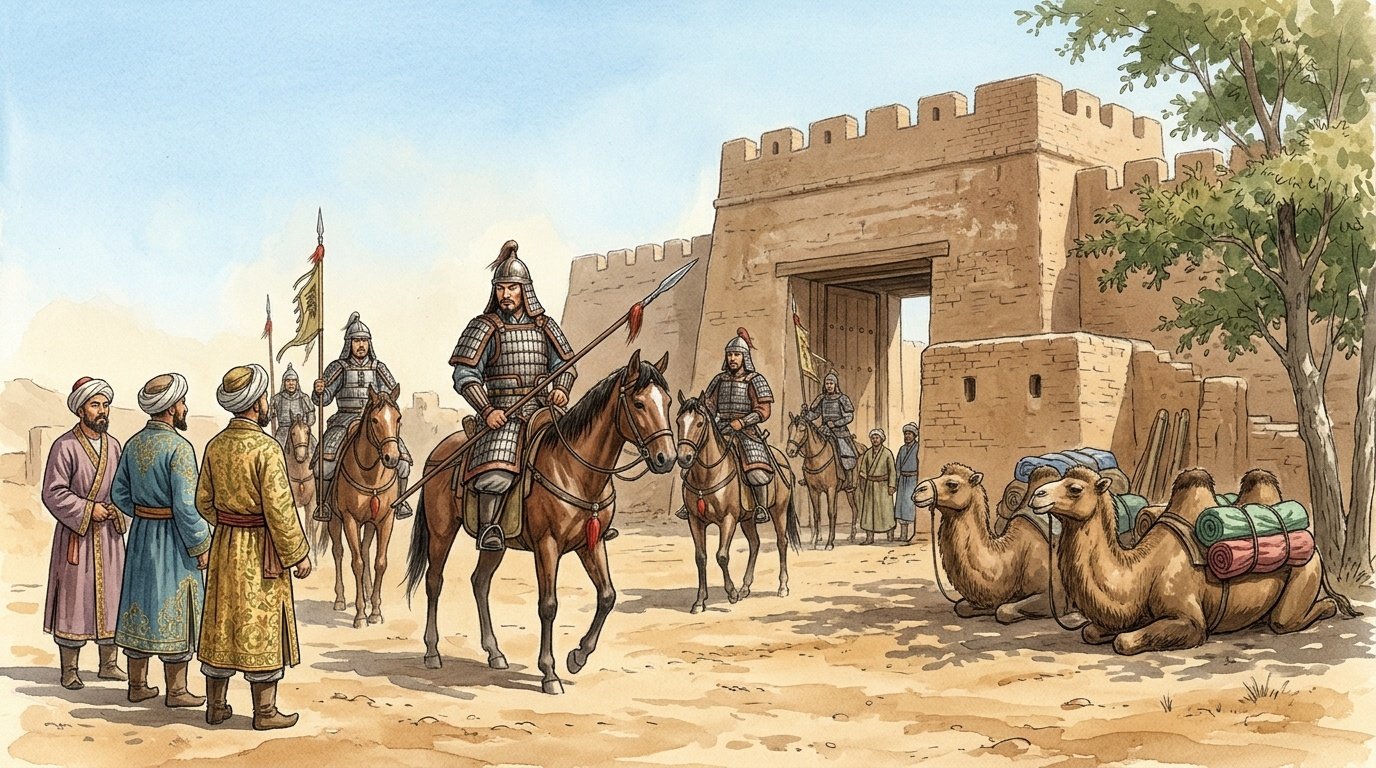
Ban Chao’s first destination was the kingdom of Shanshan (formerly known as Loulan), situated on the western shore of the desiccated salt flats of Lop Nor. As the first major oasis on the Silk Road west of Dunhuang, Shanshan was the strategic choke-point of all trans-Eurasian transit. When Ban Chao and his thirty-six horsemen arrived at the mud-brick citadel, King Guang of Shanshan received the Han embassy with lavish royal hospitality, bowing before Ban Chao, providing banquets of roast mutton and wine, and treating the imperial envoys with exquisite deference.
A few days later, the atmosphere transformed into icy terror. The King of Shanshan suddenly grew cold, distant, and evasive; palace audiences were canceled; food rations delivered to the Han quarters were halved; and armed guards were stationed outside the embassy. Ban Chao did not panic; he applied the deep psychological tradecraft he had studied in the ancient chronicles. Ban Chao gathered his thirty-six men and said: “Have you observed how the King of Shanshan’s demeanor has turned from warmth to neglect? This cannot be an accident. An embassy from the Northern Xiongnu must have arrived, and the king is hesitating, uncertain which party to slaughter!”
Ban Chao executed a brilliant piece of psychological intelligence extraction. He summoned the local Shanshan servant assigned to wait on the Han embassy. Staring into the servant’s eyes with cold, terrifying intensity, Ban Chao feigned absolute omniscient knowledge, snapping: “The Xiongnu envoys arrived several days ago; where are they quartered at this moment?!” The servant, terrified by Ban Chao’s piercing gaze and assuming the Han already knew everything, collapsed to his knees and confessed: the Xiongnu embassy, comprising thirty elite diplomats and a heavily armed cavalry escort of over one hundred warriors, was quartered at an inn merely thirty li outside the city walls. Ban Chao immediately locked the servant in a back chamber to prevent leaks.
That evening, Ban Chao summoned his thirty-six companions to his tent, poured them jars of wine, and got them thoroughly intoxicated. In the middle of the night, as the men were singing and celebrating, Ban Chao laid before them the stark, terrifying truth:
“You and I are stationed here in the remote wilderness, seeking to win great glory for our state! Now the Xiongnu envoys have arrived merely days ago, and the king has already turned his back upon us. If the king seizes us and hands us over to the Xiongnu, our bones will rot in the desert wastes without burial! What shall we do?!”
— Ban Chao to his Thirty-Six Companions, Hou Hanshu (Book of the Later Han), Chapter 47
The thirty-six men, pale with shock, replied: “We are in the jaws of death; our lives belong to the Major! We will follow you wherever you command!” Ban Chao uttered the eight-character maxim that entered the permanent philosophical lexicon of world strategy:
“How can one catch the tiger’s cubs without entering the tiger’s lair?!” (不入虎穴,不得虎子!)
— Ban Chao, Hou Hanshu, Chapter 47
“Our only recourse tonight is to use the cover of darkness to launch a surprise arson assault upon the Xiongnu camp! They have more than a hundred men, but they are completely off guard; if we set fire to their tents, they will panic, having no idea of our numbers! If we exterminate the Xiongnu embassy to the last man, the King of Shanshan will have his liver broken with terror, and will submit to the Han!”
That night, a ferocious desert gale arose, howling across the dunes. Ban Chao led his thirty-six men through the pitch-black darkness to the Xiongnu compound. Ban Chao assigned ten men to hide behind the rear of the compound armed with drums and crossbows, with strict orders: the moment flames arose, they were to beat their drums with deafening fury and shout battle cries. Ban Chao led the remaining twenty-six men to the windward gate, carrying torches and bundles of dry desert brush.
Ban Chao ignited the brushwood and hurled the torches into the thatched huts. The howling desert wind transformed the compound into a colossal roaring inferno. The drums thundered like an earthquake; battle cries echoed through the night. The Xiongnu warriors, awakened from drunken sleep by smoke and flames, stumbled out of their tents in blind panic. Ban Chao personally stood in the flaming gateway, cutting down three Xiongnu commanders with his broadsword, while his thirty-six men fired volleys of crossbow bolts into the burning compound. Over thirty Xiongnu officers were decapitated on the spot; the remaining seventy warriors were incinerated in the fire or butchered in the dark. Not a single Xiongnu survived.
At dawn, Ban Chao strolled back into the citadel of Shanshan carrying the severed head of the Xiongnu ambassador in his left hand. He requested an audience with King Guang. When the severed head of the terrifying nomadic envoy was tossed onto the palace floor at the king’s feet, Sima Qian’s successor Fan Ye records that King Guang’s legs turned to water: the monarch began shaking with such violent terror that his royal crown clattered against the throne. King Guang immediately prostrated himself, renounced all allegiance to the Northern Xiongnu, swore an eternal covenant of loyalty to the Eastern Han, and handed over his own royal prince as a hostage to accompany Ban Chao back to the Jade Gate. In a single night, with thirty-six men and thirty torches, Ban Chao had conquered the eastern portal of the Silk Road.
5. The Taming of the Jade kingdom, Khotan (74 CE)
Ban Chao returned to Dou Gu’s camp at Dunhuang. When Emperor Ming received the report, he was stunned by the audacity of the copyist. Emperor Ming promoted Ban Chao to full Military Major (Sima) and offered him a regular army of several thousand infantry to garrison the west. Ban Chao declined with astonishing strategic confidence: “The distances are vast, and foreign peoples are suspicious; to lead a large army will merely provoke panic, exhaust our logistical grain wagons, and achieve nothing. Thirty-six companions are entirely sufficient for my needs!”
In 74 CE, Ban Chao rode west along the southern Silk Road toward the wealthy kingdom of Yutian (Khotan). Situated on the northern slopes of the Kunlun Mountains along the Yurungkash (White Jade) River, Khotan was the undisputed cultural and economic superpower of the southern Tarim Basin. Its king, Guang De, had recently conquered all the neighboring oasis kingdoms, fielding tens of thousands of armored troops. Furthermore, Khotan was under the absolute thumb of a resident Northern Xiongnu overseer, who commanded Guang De’s foreign policy.
When Ban Chao arrived with his thirty-six men, King Guang De treated the Han embassy with haughty, cold condescension. To humiliate the Chinese envoys, the kingdom’s supreme high priest and shaman (Wushi) announced to the court that the ancestral gods were furious that foreign Han envoys had entered the realm. The shaman announced that the gods demanded a divine sacrificial offering: the Han ambassador must immediately surrender his magnificent, prized horse—the very warhorse ridden by Ban Chao’s chief lieutenant—to be slaughtered on the altar.
King Guang De dispatched an official to Ban Chao’s tent to demand the horse. Ban Chao smiled with tranquil courtesy: “Certainly. The gods must be respected. But the horse is sacred; let the high shaman come in person to my camp to receive the beast from my own hands.” A few hours later, the high shaman arrived at the Han encampment, dressed in ritual feathers and amulets, accompanied by his acolytes, haughtily demanding the steed. The moment the shaman stepped inside the tent, Ban Chao’s smile vanished. Drawing his sword in a flash of bronze, Ban Chao severed the shaman’s head with a single blow.
Ban Chao placed the dripping head of the sacred priest in a box, walked directly into the royal palace of Khotan, and presented it to King Guang De. Glaring at the monarch, Ban Chao rebuked him with thunderous fury for daring to conspire with barbarians against the Son of Heaven. Terrified by the fate of Shanshan and paralyzed by the sudden execution of his untouchable high priest, King Guang De broke down in tears of terror. He ordered the immediate execution of the resident Xiongnu overseer, surrendered all nomadic treaties, sent his crown prince as a hostage to Luoyang, and dispatched five thousand Khotanese cavalry to serve under Ban Chao’s command. The entire southern Silk Road had flipped to Han allegiance without China firing a single imperial crossbow.
6. The Pamir gateway, Kashgar and the Dethroning of the usurper
Ban Chao immediately exploited his momentum, marching eight hundred miles northwest to the extreme western bottleneck of the Tarim Basin: Shule (modern Kashgar), situated directly at the foot of the soaring Pamir Mountains. Kashgar was the strategic hinge of Eurasia: it was the crossroad where the northern and southern Silk Road tracks converged, and the sole gateway leading over the high mountain passes into Ferghana, Bactria, and the Kushan Empire.
A few months prior to Ban Chao’s arrival, the powerful northern kingdom of Qiuci (Kucha), operating as a loyal client of the Northern Xiongnu, had invaded Kashgar. The King of Kucha had murdered the legitimate King of Kashgar and placed his own puppet—a tyrannical general named Douti—upon the throne of Shule. Douti ruled through savage military repression, backed by a large foreign garrison.
Arriving at the outskirts of Kashgar with his thirty-six men and a detachment of Khotanese allies, Ban Chao encamped ninety li from the capital. He did not launch a bloody siege. Instead, he summoned his most trusted, iron-willed lieutenant, Tian Lv. Ban Chao commanded Tian Lv to ride into the royal palace of Kashgar accompanied by only three horsemen, posing as a diplomatic herald delivering a minor imperial greeting. Ban Chao whispered his instructions: “Douti is an outsider and a usurper; the common people of Kashgar despise him. He will assume that an embassy of three men poses no danger. When he sits upon his throne to receive your scroll, seize his arms and bind him in chains!”
Tian Lv rode into the palace hall. Douti sat on his throne surrounded by armed bodyguards. As Tian Lv unrolled the imperial silk scroll, he lunged forward, grabbed Douti by the collar, pinned the king to his throne, and pressed a razor-sharp dagger against his throat. Tian Lv roared to the stunned palace guards: “The Han Major has arrived! Whoever moves an inch shall see their king decapitated!” Paralyzed with shock, the guards threw down their weapons.
Tian Lv escorted the bound king out of the palace and brought him directly to Ban Chao’s camp. Ban Chao entered the capital of Kashgar without shedding a single drop of blood. He summoned the elders, clan chiefs, and nobility of Kashgar to the public square. Ban Chao located the nephew of the murdered legitimate monarch, a prince named Zhong, and placed the royal crown upon his head, declaring him the rightful King of Shule. The populace of Kashgar wept tears of joy, prostrating themselves before Ban Chao. In an act of sublime strategic clemency, Ban Chao did not execute the usurper Douti; he stripped him of his rank, gave him provisions, and released him to return safely to Kucha, demonstrating that the Han empire operated with supreme moral justice. At the age of forty-two, Ban Chao had conquered the westernmost threshold of the known Chinese world.
7. The great withdrawal of 75 CE, tears at the edge of the world
In 75 CE, just as Ban Chao had unified the southern and western Tarim Basin, a catastrophic imperial crisis erupted in China. Emperor Ming died suddenly in Luoyang. In the northern frontier commanderies of Yanqi and Jushi, the Northern Xiongnu launched an apocalyptic counter-offensive, ambushing and killing the Han Protector-General Chen Mu and besieging the isolated Han garrison under Geng Gong at the fortress of Shule in the Tien Shan.
In Luoyang, the newly ascended nineteen-year-old Emperor Zhang (Han Zhangdi, r. 75–88 CE) and his conservative court counselors panicked. Believing that the Western Regions were an expensive, untenable imperial vanity, the court decided to abandon Central Asia permanently. Emperor Zhang issued an absolute imperial edict ordering all Han personnel, ambassadors, and garrisons to immediately evacuate the Tarim Basin and retreat behind the safety of the Jade Gate.
When the imperial recall order reached Ban Chao in Kashgar, the general was shattered. He had spent three years of blood and sand constructing a network of loyal kingdoms; to retreat now meant abandoning millions of friendly allies to the horrific vengeance of the Northern Xiongnu. Yet as a disciplined imperial officer, Ban Chao packed his scrolls, saddled his horses, and led his thirty-six men east toward the Jade Gate.
What followed was an extraordinary, heart-wrenching historical scene recorded by Fan Ye in the Hou Hanshu. When the people of Kashgar saw that Ban Chao was departing, mass panic broke out across the oasis. The city gates were blocked by weeping crowds; thousands of citizens threw themselves in front of Ban Chao’s warhorse, clutching the animal’s hooves, crying aloud: “The Han Major is our father! If the Han Major abandons us, we will become the meat and fish of Kucha and the Xiongnu before the week is out! We would rather die beneath your horse’s feet than watch you leave!” King Zhong of Kashgar drew his sword and declared that if Ban Chao left, he would slit his own throat on the spot.
Ban Chao managed to ride east to Khotan, but there the scene was even more agonizing. King Guang De and all his royal ministers threw themselves in the dust, weeping tears of blood. The Khotanese elders surrounded Ban Chao’s horse, holding his stirrups, while hundreds of women and children cried out to the desert winds. Ban Chao looked upon the weeping multitude, looked back toward the four thousand miles of desert leading to China, and made the defining, heroic command decision of his life. He drew his sword, wheeled his horse around, and shouted: “I will not return!”
Ban Chao formally defied the imperial recall order. He rode back to Kashgar, restored order, and submitted a celebrated memorial across the desert tracks to Emperor Zhang in Luoyang—the famous “Memorial Requesting Military Assistance for the Western Regions” (Qing Bing Xiyu Shu). In this masterwork of strategic analysis, Ban Chao explained the profound economic and military value of the Silk Road, demonstrating that China could control all of Central Asia without draining a single bushel of grain from the imperial treasury through the brilliant doctrine of “Using Barbarians to Subdue Barbarians” (Yi Yi Zhi Yi, 以夷制夷). Persuaded by the sheer brilliance of the report, Emperor Zhang revoked the withdrawal, confirming Ban Chao as supreme imperial commissioner with plenary authority to govern the Western Regions as he saw fit.
8. Yi Yi Zhi Yi, Asymmetrical Guerrilla statecraft
For the next two decades, isolated in the heart of Central Asia, cut off from imperial military reinforcement, Ban Chao executed the doctrine of Yi Yi Zhi Yi with peerless operational artistry. He did not seek to impose Chinese cultural institutions, tax collectors, or Legalist magistrates upon the Tarim city-states. Instead, he governed through an informal, flexible Imperial Umbrella: recognizing local royal dynasties, respecting indigenous Buddhist and Saka customs, and demanding only two non-negotiable conditions: total severance of ties with the Northern Xiongnu, and absolute obedience to his personal military commands.
Whenever a recalcitrant kingdom rebelled, Ban Chao did not petition the court for Han soldiers; he assembled allied armies from the compliant kingdoms. When the kingdom of Gumo rebelled, Ban Chao marched twenty-five thousand Khotanese and Kashgarian cavalry to suppress it. When Sulei revolted, he mobilized the forces of Shanshan. He paid his allied armies not with imperial bullion, but with the captured cattle, horses, and silks of the defeated pro-Xiongnu aristocrats, creating a self-financing military organism where victory generated its own operational budget.
Ban Chao’s operational methodology was a masterclass in psychological warfare. He was a master of speed, misdirection, and sudden shock strikes. At the siege of Wushi, he feigned a retreat for three days, drew the enemy garrison out into the open desert, and ambushed them from behind sand dunes with his thirty-six veterans. He understood the private jealousies of tribal monarchs: whenever an enemy coalition formed against him, Ban Chao secretly sent gifts of silk and jade to the second-in-command, creating instant suspicion between the allied kings until their coalition dissolved into internal fratricide. Foreign kings began viewing Ban Chao not as a mortal general, but as a semi-divine sorcerer who possessed the ability to read the secret thoughts of men across hundreds of miles of sand.
9. The clash with Kushan, Slaying the viceroy of the Pamirs (90 CE)
Ban Chao’s greatest, most perilous international crisis occurred in 90 CE, when the expanding Chinese sphere of influence collided with another colossal world superpower: the Kushan Empire (known in Chinese chronicles as the Da Yuezhi, 大月氏). Originating as nomadic pastoralists driven from the Gansu corridor centuries earlier, the Kushans had established a wealthy, Hellenistic-Buddhist continental empire spanning northern India, Pakistan, Afghanistan, and Central Asia.
In 87 CE, the Kushan monarch had dispatched an embassy to Ban Chao requesting a royal marriage alliance with a Chinese imperial princess. Viewing the nomadic Kushans as uncultivated barbarians who had not performed tributary submission, Ban Chao haughtily rejected the proposal and expelled the envoys. Infuriated by this diplomatic insult, the King of Kushan dispatched his supreme viceroy, General Xie (謝), at the head of a massive invasion army of seventy thousand elite armored cavalrymen across the towering, icy passes of the Pamir Mountains into the Tarim Basin to destroy Ban Chao.
When the news arrived that seventy thousand Kushan warriors were descending into Kashgar, Ban Chao’s allied kingdoms panicked. Ban Chao’s own garrison numbered fewer than a few thousand men. His commanders urged him to retreat into the mountains or construct emergency ramparts. Ban Chao smiled and delivered a brilliant hydrodynamic and logistical assessment of the campaign:
“The Yuezhi army is indeed numerous, but they have marched several thousand li across the freezing snows of the Pamir passes! They have no deep supply corridors; their food is carried on their saddles. This is what the military manuals call ‘an army that cannot sustain itself.’ All that is required of us is to execute a scorched-earth defense: burn the crops, strip the fields, shelter the populace inside the citadels, and wait! Within weeks, their horses will starve, their men will hunger, and they will be completely helpless!”
— Ban Chao’s Operational Analysis, Hou Hanshu, Chapter 47
Ban Chao ordered every blade of grain within a hundred miles of Kashgar harvested or burned, and every water well poisoned or covered with sand. When General Xie arrived with his seventy thousand cavalrymen, he found an empty, silent wasteland. For weeks, the Kushan army attacked fortified mud-brick outposts, suffering heavy casualties without securing a single bushel of grain. As winter approached, the Kushan horses began dying of starvation by the thousands.
In desperation, General Xie dispatched a convoy of cavalry carrying carts of gold to the neighboring northern kingdom of Qiuci (Kucha), begging to purchase grain supplies. Ban Chao, who had anticipated this exact maneuver, laid a trap: he stationed his veteran officer Tian Lv with an elite ambush force in the narrow desert canyon through which the Kushan convoy had to pass. The Kushan supply convoy was completely annihilated; the gold was captured; and the severed heads of the Kushan couriers were brought back to the front.
Ban Chao sent the heads directly to General Xie’s command tent. Seeing that his supply lines were severed and his men starving, General Xie broke down in total despair. The Kushan viceroy requested permission to surrender his weapons and retreat. In an act of magnificent imperial statesmanship, Ban Chao permitted the battered Kushan army to limp back across the Pamir Mountains without further slaughter. The King of Kushan was so overwhelmed by Ban Chao’s strategic genius and mercy that he signed an eternal treaty of peace, dispatching annual tributary missions of gemstones and lions to the Han court. The western flank of the empire was secured forever.
10. The reaching for Rome, Gan Ying and the Persian Gulf (97 CE)
By 94 CE, Ban Chao had accomplished the complete pacification of Central Asia. Following a final, brilliant campaign that crushed the northern kingdoms of Yanqi and Qiuci, all fifty sovereign states of the Tarim Basin had submitted to the Han. In 95 CE, the Han court promulgated an imperial decree appointing Ban Chao to the supreme office of Protector-General of the Western Regions (Xiyu Duhu, 西域都護) and enfeoffing him with the hereditary noble title of Marquis of Dingyuan (定遠侯)—”The Marquis Who Stabilized the Far Borders”—fulfilling down to the final letter the prophecy uttered by the physiognomist forty years earlier in the streets of Luoyang.
Having brought the Pax Sinica to the Pamir Mountains, Ban Chao looked west toward the setting sun. In the bazaars of Kashgar and Samarkand, Persian merchants spoke of a magnificent, civilized empire that lay beyond the western oceans: an empire of stone roads, marble temples, and red robes, known to Chinese historical memory as Da Qin (大秦)—the “Great Qin,” the Roman Empire.
In 97 CE, Ban Chao dispatched his brilliant assistant, Gan Ying (甘英), on an unprecedented diplomatic mission: to travel west across Eurasia to establish direct, sovereign diplomatic and commercial contact with Rome. Gan Ying was the first official Chinese envoy to venture deep into the Middle East. He crossed the Pamir Mountains, traversed Parthia (Anxi), and journeyed through modern Iran and Iraq, arriving at the shores of the Tiaozhi (條支) sea—modern historical scholarship identifies this location as the northern tip of the Persian Gulf or the headwaters of the Euphrates River.
At the port, Gan Ying prepared to board a merchant ship to sail around the Arabian Peninsula toward Roman Egypt. But the local Parthian mariners and merchants, terrified that direct diplomatic and commercial contact between Han China and Imperial Rome would eliminate their lucrative monopoly as middlemen in the trans-Eurasian silk trade, deliberately sabotaged the mission. The Parthian sailors told Gan Ying terrifying tales of the western sea:
“The sea is vast and boundless; those who sail upon it can cross in three months with favorable winds, but if winds are contrary, it may require two years. Therefore, all who embark must carry three years of rations. In the middle of the sea, there is a mysterious longing that seizes the heart; men frequently become homesick and die of sorrow!”
— Parthian Sailors’ Warning to Gan Ying, Hou Hanshu, Chapter 88: “Treatise on the Western Regions”
Unaccustomed to oceanic navigation and fearing that he would perish without completing his report, Gan Ying decided to turn back. Although he did not reach Rome itself, Gan Ying returned to Ban Chao’s headquarters with the world’s first accurate, systematic geographical and ethnographic accounts of Mesopotamia, Parthia, and the Roman Empire, which were incorporated into Chapter 88 of the Hou Hanshu. For a fleeting historical moment in the twilight of the first century CE, the two greatest civilizations on Earth had reached out their hands across the sands of the Middle East, brushed fingertips, and retreated.
11. The white Gate memorial, the old tiger Begs for death at home (100 CE)
By the turn of the second century CE, Ban Chao was an old, battered man. He had spent thirty-one continuous years in the desert wastes. His hair and beard were white as snow; his body was racked with chronic malaria and arthritis contracted in damp riverbeds; his hands trembled so violently that he could barely hold his sword. In 100 CE, at the age of sixty-eight, sensing that death was approaching, the conqueror of the Western Regions composed his final, heartbreaking memorial to Emperor He of Han:
“Your servant dares not harbor the wild ambition to enter the wine-feasts of the capital; he desires only that his living eyes may look once more upon the Jade Gate!… In antiquity, Lian Po was an old general, yet he still ate a bushel of rice and ten pounds of meat to show his fitness; today your servant is emaciated and teeth-broken, his body decayed. I am like a dying hound that can no longer pursue the hare… If I should die in this distant wilderness, my soul will become a wandering ghost in the sands, forever barred from the ancestral shrines of China! I beg Your Imperial Majesty to take pity on an old soldier, and grant me permission to drag my bones home to die within the passes!”
— Ban Chao’s Memorial Requesting Return, Hou Hanshu, Chapter 47
At the court in Luoyang, his sister, the great historian Ban Zhao, submitted a parallel memorial to the emperor, begging on her knees for her brother’s return, reminding the court of the unpayable civilizational debt China owed to the man who had pacified fifty kingdoms. Deeply moved, Emperor He granted the petition.
In the eighth month of 102 CE, an old, withered man riding in a simple cart crossed the threshold of Yumen Guan (the Jade Gate). Thirty-one years after he had thrown down his writing brush, Ban Chao returned to China. The crowds of Dunhuang lined the roads in reverent silence, looking upon the living legend whose thirty-six companions had expanded the borders of civilization to the Pamir Mountains. Ban Chao arrived in Luoyang in the ninth month; one month later, having embraced his sister and visited the ancestral tombs of his father, the Marquis of Dingyuan closed his eyes forever. He was seventy years of age.
12. Historiographical and strategic legacy, the architect of frontier grand strategy
The historical and strategic legacy of Ban Chao is one of the most enduring monuments of Chinese civilization. In the long narrative of Chinese frontier policy, Ban Chao created the foundational doctrinal playbook for what modern political scientists term Asymmetric Force Projection and Suzerainty Management.
When Ban Chao departed the Western Regions, his successor, the aristocrat Duan Xi, attempted to govern through conventional bureaucratic arrogance and military heavy-handedness. Within a few short years, the Tarim kingdoms rebelled, the Silk Road was severed again, and the Han court was forced once more to abandon the west. Ban Chao’s wisdom was verified by its absence: he had demonstrated that empire along the Asian frontier was never a matter of building massive stone fortresses or stationing hundreds of thousands of expensive troops, but an art of psychological diplomacy, deep respect for local autonomy, and lightning-fast decisive justice.
In modern Chinese language and popular culture, Ban Chao remains an incandescent cultural hero. The idiom “Throwing Down the Writing Brush to Join the Army” (Tou Bi Cong Rong, 投筆從戎) is invoked by every generation of Chinese scholars, students, and intellectuals who choose to abandon the safety of academic libraries to serve their nation in times of existential crisis—from the May Fourth Movement to the War of Resistance against Japan. Ban Chao proved that the intellect of the scholar and the courage of the warrior are not mutually exclusive opposites, but two halves of the complete human spirit. He took the ink of his father’s study, carried it across four thousand miles of desert sand, and wrote the name of the Han dynasty across the threshold of the Western world.
13. Classical chapters, Silk Road Archaeology, and scholarly bibliography
Primary Classical Sources:
Fan Ye (范曄). (c. 445 CE). Hou Hanshu (後漢書, Book of the Later Han). Chapter 47: “Ban Liang Liezhuan” (Biographies of Ban Chao and Liang Tong); Chapter 88: “Xiyu Zhuan” (Treatise on the Western Regions). Critical punctuated edition by Zhonghua Book Company, Beijing, 12 vols., 1965.
Ban Gu (班固) and Ban Zhao (班昭). (c. 111 CE). Hanshu (漢書, Book of Han). Chapter 96: “Xiyu Zhuan” (Treatise on the Western Regions). Beijing: Zhonghua Book Company, 1962.
Silk Road Archaeological Discoveries and Epigraphy:
Xuanquanzhi Han Bamboo Slips (懸泉置漢簡). Excavated at Dunhuang, Gansu, 1990–1992. Over 35,000 Han dynasty administrative and postal slips recovered from an ancient Silk Road relay station, detailing imperial diplomatic hospitality, horse allocations, and courier registers that directly confirm the operational mechanics of Ban Chao’s Western Regions missions. Cataloged by Gansu Provincial Institute of Cultural Relics and Archaeology (2019), Beijing: Cultural Relics Publishing House.
Niya and Loulan Wooden Documents (尼雅與樓蘭木簡). Kharosthi and Han administrative slips excavated in the Tarim Basin by Aurel Stein and modern Sino-Japanese archaeological expeditions, illustrating the bilingual administrative culture of Shanshan and Khotan during the Eastern Han.
Modern Scholarly Studies:
Bielenstein, Hans. (1986). “Wang Mang, the Restoration of the Han Dynasty, and Later Han,” in Denis Twitchett and Michael Loewe (eds.), The Cambridge History of China, Volume 1: The Ch’in and Han Empires, Cambridge: Cambridge University Press, pp. 223–290. doi:10.1017/CHOL9780521243278[1]
de Crespigny, Rafe. (2007). A Biographical Dictionary of Later Han to the Three Kingdoms (23–220 AD). Leiden: E. J. Brill. Authoritative biographical entries on Ban Chao, Ban Gu, and Dou Gu, pp. 4–7. doi:10.1163/ej.9789004156050.i-1311[2]
Hansen, Valerie. (2012). The Silk Road: A New History. Oxford: Oxford University Press.
Hill, John E. (2009). Through the Jade Gate to Rome: A Study of the Silk Routes during the Later Han Dynasty, 1st to 2nd Centuries CE. Charleston: BookSurge Publishing. Detailed annotated translation of Hou Hanshu Chapter 88.
Leslie, Donald D., & Gardiner, K. H. J. (1996). The Roman Empire in Chinese Sources. Rome: Bardi Editore.
Yü, Ying-shih. (1986). “Han Foreign Relations,” in The Cambridge History of China, Vol. 1, pp. 377–462.