Linnaeus and the System of Binomial Nomenclature
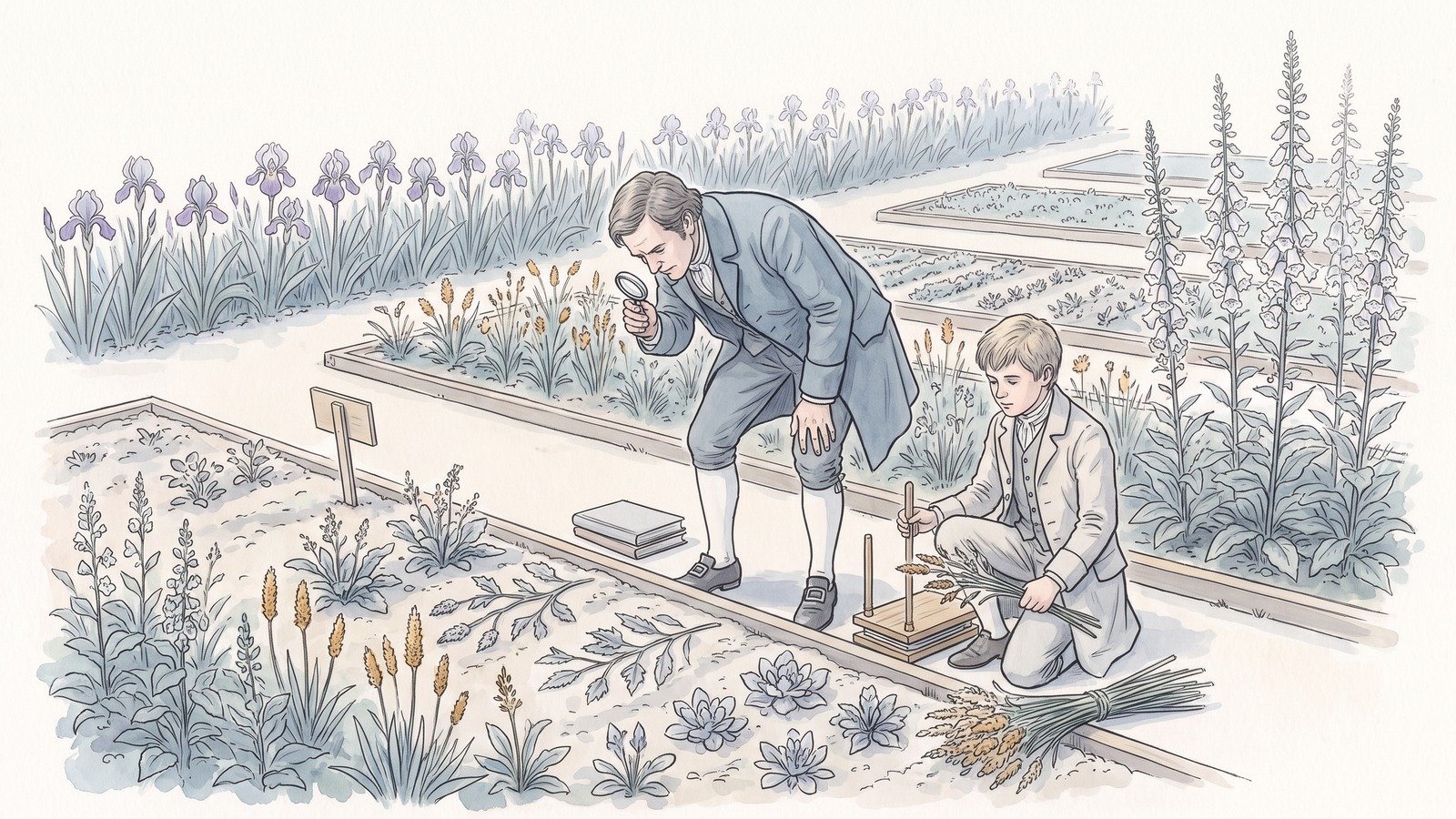
Every described organism carries a scientific name made of two words: a genus followed by a species epithet, such as Quercus robur or Mycobacterium tuberculosis. The system is so familiar that it is easy to forget it had a beginning. It was put into consistent use by the Swedish naturalist Carl Linnaeus in the middle of the eighteenth century, first for plants in Species Plantarum in 1753 and then for animals in the tenth edition of Systema Naturae in 1758. Those two books remain the formal starting points for the naming of plants and animals, and the rules that grew up around them now govern the names of more than two million species. This article describes its predecessors and origins, the ranks, types and codes on which it rests, the fate of Linnaeus’s collections, the challenges posed by modern biology, and the system’s practical uses.
Naming Before Linnaeus
As plants arrived in Europe from Asia, Africa and the Americas in the sixteenth and seventeenth centuries, the printed herbals multiplied, and each author tended to name plants in his own way. The names themselves were not names in the modern sense but short descriptions. A plant was identified by a phrase in Latin, called a polynomial or phrase name, which listed the features that distinguished it from its relatives. As more species became known, the phrases had to grow longer to keep them apart. A common example, often cited in histories of botany, is the briar rose, which in the early eighteenth century might appear as Rosa sylvestris inodora seu canina, the wild scentless or dog rose, and in other works under a different phrase altogether. A phrase name served as both label and diagnosis, and every new discovery threatened to make the existing phrases inadequate. The result was a literature in which cross-referencing the names of different authors, known as synonymy, became a major scholarly labour in its own right.
Caspar Bauhin
The most important single effort to cut through the confusion of names was made by the Swiss botanist Caspar Bauhin (1560–1624), professor of anatomy and botany at Basel. His Pinax Theatri Botanici, published in 1623 after some forty years of work, listed about six thousand plants and gave, for each, the names under which it had appeared in the works of earlier authors. The Pinax was in effect an index of synonyms, and it allowed a reader to see that the plant called one thing by Fuchs and another by Mattioli was the same species. Bauhin also distinguished clearly between the genus, a group of similar plants sharing a common name, and the species, the particular kind within it. Many of his names consisted in practice of a generic noun followed by a single descriptive word, and in this he anticipated the binomial form. But he did not apply the practice consistently, and he did not treat the two-word form as the name proper. The Pinax nevertheless remained the standard reference for plant synonymy for more than a century, and Linnaeus cited it constantly.
John Ray
The English naturalist John Ray (1627–1705) contributed something of equal importance: a clear idea of what a species is. In his Historia Plantarum, the first volume of which appeared in 1686, Ray proposed that the surest sign of a species was that plants raised from its seed would reproduce its form, so that variations of colour or size which did not persist through seed did not justify a new species. This was the first explicit biological definition of the species, and it made the species a natural unit rather than a convenient category. Ray also drew the distinction, still used in botany, between flowering plants whose seedlings bear one seed leaf and those that bear two, the monocotyledons and dicotyledons. With his colleague Francis Willughby he extended the same careful methods to birds and fishes. Ray’s systems of classification were based on many characters taken together, and in this respect they were more natural than the system Linnaeus later adopted, but their names remained phrase names, and his classifications were revised in successive works in a way that made them hard to use as a stable reference.
Joseph Pitton de Tournefort
The French botanist Joseph Pitton de Tournefort (1656–1708), professor at the Jardin du Roi in Paris, made the genus into a rigorously defined rank. In his Éléments de botanique of 1694, expanded in Latin as Institutiones Rei Herbariae in 1700, he described some seven hundred genera, each with a precise account of its flower and fruit and an engraved illustration of the characteristic parts. Before Tournefort a genus was often a loose collection of plants sharing a traditional name; after him it was a group defined by stated characters. Linnaeus adopted many of Tournefort’s genera and much of his method of defining them, and the modern practice by which each genus is founded on a published description of its distinguishing features owes a great deal to the Institutiones. Tournefort’s classification of genera into larger groups was based mainly on the form of the corolla, and it was this part of his work that Linnaeus replaced.
Linnaeus and the Making of a System
Carl Linnaeus was born on 23 May 1707 at Råshult in the province of Småland in southern Sweden, the son of a country curate and keen gardener. He studied medicine at Lund and then at Uppsala, where medicine and botany were taught together because most medicines were prepared from plants. As a student he was given charge of demonstrations in the university’s botanic garden and became absorbed in the question of how plants should be arranged. In 1732 the Royal Society of Sciences in Uppsala sent him on an expedition to Lapland, from which he returned with descriptions of many northern plants and with experience in the systematic recording of observations in the field.
In 1735 he travelled to the Netherlands, where it was then common for Swedish students to complete their medical degrees. He took his doctorate at the small university of Harderwijk within a few weeks and moved on to Leiden, then the leading centre of botany and medicine in Europe, where he met the physician Herman Boerhaave and the botanist Johan Frederik Gronovius. Gronovius was so impressed by a manuscript Linnaeus showed him that he arranged and paid for its publication. This was the first edition of Systema Naturae, which appeared in Leiden in 1735 as a set of large folio sheets, scarcely more than a dozen pages in all, setting out a classification of the three kingdoms of nature, animal, vegetable and mineral, in the form of tables.
For plants the 1735 Systema introduced what became known as the sexual system. Linnaeus divided flowering plants into twenty-four classes according to the number, relative length and arrangement of their stamens, the male organs of the flower, and subdivided the classes into orders according to the number of styles or pistils, the female organs. The twenty-fourth class, the Cryptogamia, contained plants such as mosses, ferns, algae and fungi whose reproductive organs were not visible. The system was openly artificial: Linnaeus himself acknowledged that it brought together plants with nothing in common but the number of their stamens and separated others that were obviously related. Its great merit was that it was easy to use. Anyone with a hand lens could count stamens and pistils and place an unknown plant in its class and order, and from there find its genus. The system’s use of sexual language caused some offence in its day, but it spread rapidly because it made identification possible for students and travellers who had no access to great libraries.
Linnaeus spent three years in the Netherlands and visited England and France. For much of the time he was employed by George Clifford, a wealthy director of the Dutch East India Company, as physician and curator of the garden and hothouses at Clifford’s estate, the Hartekamp, near Haarlem. There he had access to living plants from every continent, and he described them in Hortus Cliffortianus (1737). In the same period he published a series of short books which laid down the principles of his method: Fundamenta Botanica (1736), a set of 365 aphorisms on botanical practice; Bibliotheca Botanica (1736); Critica Botanica (1737), devoted to the rules for forming names of genera; and Genera Plantarum (1737), which defined every genus of plants then known. These rules were later collected and expanded in Philosophia Botanica (1751). Many of the principles they contain, such as that generic names should be single Latin or Latinised words, that the same generic name should not be used for two different groups, and that names should not be altered without good cause, passed almost unchanged into the modern codes.
Linnaeus returned to Sweden in 1738, practised medicine in Stockholm, and was a founding member of the Royal Swedish Academy of Sciences in 1739. In 1741 he was appointed to a professorship at Uppsala, and the following year he exchanged chairs so as to take charge of botany, natural history and the university’s botanic garden. He restored and replanted the garden, which had fallen into neglect, arranged its beds according to his sexual system, and lived in the professor’s house at its edge. The garden, now restored as the Linnaean Garden and managed by Uppsala University’s botanical gardens, was his working laboratory for the rest of his career. He was ennobled as Carl von Linné in 1761 and died at Uppsala on 10 January 1778. He was an exceptionally popular teacher, and his botanical excursions around Uppsala attracted large crowds of students.
Species Plantarum and the Binomial
Species Plantarum, published in Stockholm in two volumes in 1753, was an attempt to list and describe every species of plant known in the world, arranged by the sexual system. It contained about 5,900 species in more than 1,000 genera. For each species Linnaeus gave a phrase name in the traditional manner, consisting of the genus followed by a diagnostic phrase of up to twelve words, which he regarded as the true scientific name. He followed this with a list of synonyms from earlier authors, notes on the plant’s habitat and distribution, and, in the margin, a single word, which he called the trivial name (nomen triviale).
The trivial name was intended as a convenience. Linnaeus had begun to use such short names in student exercises and in indexes in the late 1740s, notably in his account of the plants used in Swedish pharmacy, because the phrase names were too unwieldy for everyday use. In Species Plantarum he applied them systematically to every species. The genus name and the trivial name together made a two-word label: the common daisy was Bellis perennis, the cultivated pea Pisum sativum, the potato Solanum tuberosum. The trivial name could be descriptive, as in sativum, cultivated; geographical, as in virginiana; or commemorative, honouring a person. It did not have to be unique across the whole of botany, only within its genus, and it did not need to describe the plant at all.
The decisive point was that the trivial name was separated from the description. A phrase name had to change whenever a new species was found that it failed to exclude, but a trivial name was simply an arbitrary label attached to a species, and it could remain the same however many relatives were discovered. Linnaeus did not at first think of the trivial name as the scientific name proper, but his contemporaries quickly found the binomial combination so convenient that it displaced the phrase names within a generation. The pattern had been anticipated by Bauhin and by others, including the German botanist Augustus Rivinus, but it was Linnaeus who applied it consistently to every known species in a single comprehensive work. For that reason the publication of Species Plantarum, conventionally dated 1 May 1753, is treated as the beginning of botanical nomenclature, and names published earlier have no standing under the modern rules. The book is freely available in digitised form through the Biodiversity Heritage Library (doi:10.5962/bhl.title.669).
Systema Naturae, Tenth Edition, 1758
Linnaeus revised Systema Naturae repeatedly through his life, and the work grew from a pamphlet into a multi-volume treatise. The tenth edition, the first volume of which was published in Stockholm in 1758, dealt with the animal kingdom and was the first in which he applied binomial names consistently to animals. It described some 4,400 species, arranged in six classes: Mammalia, Aves, Amphibia, Pisces, Insecta and Vermes. The term Mammalia, referring to the mammary glands, was introduced in this edition, and in it Linnaeus placed whales among the mammals rather than the fishes and grouped human beings with the apes in the order Primates under the name Homo sapiens. The classification of the invertebrates into only two classes, insects and worms, was crude even by the standards of the time, and was transformed by Lamarck and Cuvier half a century later, but the names Linnaeus gave remain the foundation of zoological nomenclature.
The zoological code treats the tenth edition as having been published on 1 January 1758, and that date is the starting point for the names of animals. A single exception is made for Carl Clerck’s Svenska Spindlar, a work on Swedish spiders published in 1757, whose names are treated as if published on the same date. The tenth edition is likewise available through the Biodiversity Heritage Library (doi:10.5962/bhl.title.542). Linnaeus produced a twelfth edition in 1766–1767, the last revised by him; later editions under his name, such as the thirteenth edited by Johann Friedrich Gmelin in 1788–1793, were the work of others.
The Hierarchy of Ranks
The binomial is only one half of the Linnaean system. The other is the arrangement of organisms in a nested hierarchy of ranks, in which each group is contained within a larger one. Linnaeus used five principal ranks below the kingdom: class, order, genus, species and variety. A species belonged to exactly one genus, each genus to one order, each order to one class and each class to one of the three kingdoms. The hierarchy made it possible to locate any organism quickly and to state its relationships in a compact form.
Later naturalists added further ranks as the number of known species grew and the need for intermediate groupings became apparent. The family, a rank between order and genus, was used informally by the French botanist Pierre Magnol at the end of the seventeenth century and became standard in botany through the work of Antoine-Laurent de Jussieu, whose Genera Plantarum of 1789 arranged plants into natural families on the basis of many characters together. The phylum was introduced by the German zoologist Ernst Haeckel in 1866, and the botanical equivalent, the division, is still permitted in plant nomenclature. The modern sequence of principal ranks is therefore domain, kingdom, phylum or division, class, order, family, genus and species, and the codes allow secondary ranks such as tribe and section and any number of prefixed ranks such as subfamily or superorder.
The codes also fix the form of names at many ranks. In botany the names of families end in -aceae, as in Rosaceae, and those of orders in -ales; in zoology family names end in -idae, as in Felidae, and subfamily names in -inae. A reader can therefore tell the rank of a group from its name alone. Names above the rank of species are single words, names of species are binomials, and names below species, such as subspecies and varieties, are trinomials or are formed with a connecting term such as var. or subsp. Zoology recognises only one rank below the species, the subspecies, while botany recognises several, including variety and form. The three-part name for a subspecies, such as Panthera tigris altaica for the Amur tiger, came into common use in zoology in the nineteenth century.
Type Specimens
A name is useful only if it is clear which organisms it refers to. In the eighteenth century a name was tied to a species by its description, but descriptions are always incomplete, and when a group that had been treated as a single species was later found to contain several, it was often impossible to tell to which of them the original name belonged. The solution adopted in the nineteenth century, and formalised in the codes in the twentieth, was the type method. Every name of a species or subspecies is permanently attached to a particular specimen, the name-bearing type, and the name applies to whatever species that specimen belongs to, however the boundaries of the species may later be drawn. Names of genera are attached to a type species, and names of families to a type genus, so that the whole hierarchy of names is anchored at its base in physical specimens.
The codes distinguish several kinds of type. A holotype is the single specimen designated by the author who first described the species. Where the author did not designate one, a later worker may select a lectotype from the material the original author studied. A neotype may be designated if all the original material has been lost and a type is needed to settle a question of identity. Duplicates of a holotype, collected from the same plant at the same time and distributed to other herbaria, are known in botany as isotypes, and other specimens cited in the original description are paratypes. Botany also permits an epitype, a specimen chosen to supplement a type that is ambiguous, for example a fungus or alga whose type cannot be identified with certainty without characters that the original specimen does not show. Type specimens are kept in herbaria and natural history museums, and their safekeeping is one of the main reasons those institutions exist.
Linnaeus himself did not designate types, and many of his names were based on a mixture of his own specimens, illustrations in earlier books and descriptions by other authors. Fixing the application of his names has therefore required a great deal of later scholarship. From 1981 the Natural History Museum in London ran the Linnaean Plant Name Typification Project, which examined the original material for each of the roughly nine thousand plant names Linnaeus published and selected lectotypes where none had been chosen. Its results were published by Charlie Jarvis in Order out of Chaos (2007). A celebrated example from zoology concerns Homo sapiens, for which Linnaeus himself was designated the lectotype by the botanist William Stearn in 1959, on the ground that Linnaeus’s own self-knowledge formed part of the basis of his description.
The Codes of Nomenclature
For a century after Linnaeus there were no formal rules, only conventions, and naturalists disagreed about which names should be used when more than one had been published for the same species. The first widely adopted set of rules for zoology was drawn up by a committee of the British Association for the Advancement of Science led by Hugh Strickland and published in 1842; it is known as the Strickland Code. For botany the first comparable statement was the Lois de la nomenclature botanique, prepared by Alphonse de Candolle and adopted by an international botanical congress in Paris in 1867. Both established the principle that the earliest available name should normally prevail. Formal international codes followed at the beginning of the twentieth century: the International Rules of Botanical Nomenclature were adopted by the International Botanical Congress at Vienna in 1905, and the Règles internationales de la nomenclature zoologique were published in the same year following the work of a commission set up by the International Zoological Congress in 1895.
The botanical code is now the International Code of Nomenclature for algae, fungi, and plants (ICN), a title adopted at the Melbourne congress in 2011 in recognition of the fact that it governs groups which are no longer regarded as plants. It is revised at each International Botanical Congress, held every six years, and its text is published by the International Association for Plant Taxonomy, which maintains an online edition. The zoological code is the International Code of Zoological Nomenclature (ICZN), whose fourth edition came into force on 1 January 2000 and has been amended since. It is administered by the International Commission on Zoological Nomenclature, and its text is available on the Commission’s website. Separate codes govern the names of bacteria and archaea, viruses and cultivated plants, the last of which deals with cultivar names such as those of garden roses and apple varieties.
The two main codes share their basic principles. Each regulates only names, not classification: a taxonomist is free to decide, on scientific grounds, that a species belongs in one genus or another, or that two populations form one species or two, and the code then determines what the correct name of the group so defined must be. Each requires that a name be effectively published in a work that is publicly available, that it be accompanied by a description or a reference to one, and that it be in the correct form. Each applies the principle of priority and the type method, and each provides a means by which strict application of the rules can be set aside where it would cause confusion.
Differences Between the Botanical and Zoological Codes
The codes developed independently, however, and differ in several respects. The starting points are different, as described above: 1 May 1753 for most groups of plants and 1 January 1758 for animals, with later starting points for some groups of fungi and algae under the botanical code. The botanical code forbids tautonyms, names in which the species epithet exactly repeats the generic name, so that a plant may not be called Linaria linaria; the zoological code permits them, and names such as Bufo bufo for the common toad and Gorilla gorilla for the western gorilla are entirely correct. Because the codes are independent, the same generic name may be used for a plant and an animal: Prunella is both a genus of plants, the self-heals, and a genus of birds, the accentors.
The citation of authors also differs. In botany the name of the author who published a name is often appended to it in an abbreviated standard form, and when a species is moved to a new genus the original author is cited in parentheses followed by the author who made the transfer; Linnaeus is abbreviated simply to L., so that the potato is Solanum tuberosum L. In zoology the author is usually cited with the year, as in Homo sapiens Linnaeus, 1758, and parentheses indicate only that the species is now placed in a different genus from the one in which it was originally described. The requirements for valid publication have also diverged. The botanical code required every new name of a plant to be accompanied by a description or diagnosis in Latin until the end of 2011, and since 2012 has permitted English as an alternative, a change discussed in the nekud article on why science speaks English. Both codes now allow publication in electronic journals under defined conditions, and the zoological code requires that electronically published names be registered in ZooBank, the Commission’s online register. The mechanisms for setting aside the rules differ as well. Botany maintains lists of conserved and rejected names, which are voted on by the nomenclature section of each congress, while in zoology the Commission exercises plenary powers to rule on individual cases.
Priority, Synonyms and Stability
The central rule of both codes is the principle of priority: of two or more names applied to the same taxon, the correct name is normally the earliest one that was validly published. Later names for the same taxon are synonyms. Botanists distinguish homotypic synonyms, which share the same type, as when a species is moved from one genus to another, from heterotypic synonyms, which are based on different types that a taxonomist has concluded belong to the same species. Zoologists speak of senior and junior synonyms, the senior being the older and normally valid name. A homonym, by contrast, is the same name applied to two different taxa, and the later homonym is unavailable and must be replaced.
Priority was adopted because it offered an objective rule which did not depend on the preferences of individual authorities. Its drawback is that the discovery of an overlooked older name may require a familiar name to be replaced. The best-known example in popular culture is the dinosaur Brontosaurus, described by Othniel Marsh in 1879 and later judged to be the same genus as Apatosaurus, which Marsh had named in 1877; for most of the twentieth century Brontosaurus was treated as a junior synonym, although a study in 2015 argued that the two were distinct after all. In applied fields such changes can cause real difficulty, because names appear in legislation, product labels and medical literature. Both codes therefore temper priority with provisions for stability. The botanical code allows names of families, genera and species of economic importance to be conserved against earlier competitors, and the zoological code allows a junior synonym that has been in prevailing use for many decades to be maintained if the senior synonym has not been used as a valid name since 1899. The aim is not to preserve every name unchanged, which would be incompatible with the advance of knowledge, but to ensure that changes are made only for scientific reasons.
The Linnean Society and the Collections in London
On his death Linnaeus’s herbarium, library, manuscripts and natural history collections passed to his son, Carl Linnaeus the Younger, who succeeded him as professor at Uppsala. When the younger Linnaeus died without heirs in 1783, the collections reverted to his mother, Sara Lisa, who offered them for sale. They were bought in 1784 for one thousand guineas by James Edward Smith, a twenty-four-year-old English medical student, on the advice of Joseph Banks, who had declined to buy them himself. The collections were shipped to London later that year. A popular story holds that the Swedish king, returning from abroad, sent a ship in pursuit, but there is no reliable evidence for it.
In 1788 Smith and a small group of naturalists founded the Linnean Society of London, the oldest society in the world devoted to natural history that is still active, with Smith as its first president. After Smith’s death in 1828 the Society bought the collections from his widow in 1829. They have remained in its possession ever since, and are now kept in a purpose-built strongroom beneath the Society’s rooms at Burlington House, Piccadilly. They include some fourteen thousand plant specimens, several thousand insects, more than fifteen hundred shells, about 170 fish, Linnaeus’s library of some sixteen hundred books and many thousands of letters and manuscripts. Because so many of the specimens are the types or original material of Linnaean names, the collections are consulted constantly by taxonomists, and much of the herbarium has been photographed and made available online. The Society, whose activities are described on its website, publishes scientific journals and awards the Linnean Medal.
Evolution, Phylogenetics and Cladistics
After Darwin, classification was expected to reflect genealogy, and naturalists such as Ernst Haeckel drew trees of descent that linked the Linnaean groups in a single history of life. For the following century, however, there was no agreed method for inferring relationships, and classifications were based on overall resemblance combined with the judgement of experienced specialists. In 1950 the German entomologist Willi Hennig published a theory of what he called phylogenetic systematics, which became widely known after an English translation appeared in 1966. Hennig argued that relationships should be inferred only from shared derived characters, features inherited from a common ancestor in which they first appeared, and that only groups consisting of an ancestor and all its descendants, now called clades or monophyletic groups, should be formally recognised. The method, known as cladistics, became the dominant approach to classification by the 1980s.
Cladistics had consequences for many traditional groups. The class Reptilia, as Linnaeus’s successors defined it, excludes birds, but birds are descended from within the reptiles and are more closely related to crocodiles than crocodiles are to lizards. Reptiles in the traditional sense are therefore a paraphyletic group, and a strictly cladistic classification must either include birds among the reptiles or abandon the group. Similar problems affected the fishes, the traditional invertebrates and many groups of plants. In botany the Angiosperm Phylogeny Group, a collaboration of systematists, published from 1998 onwards a classification of the flowering plants into orders and families based mainly on DNA sequences, now in its fourth version of 2016, which substantially reorganised the families recognised in earlier systems.
The development of DNA sequencing made molecular evidence the main basis of phylogenetics. The methods rest on the discoveries described in the nekud articles on the structure of DNA and the Human Genome Project, and the heritable variation they measure was first described in quantitative form by Gregor Mendel. The most dramatic result came at the very top of the hierarchy. In 1977 the American microbiologist Carl Woese and his colleagues showed, by comparing ribosomal RNA, that the prokaryotes comprise two fundamentally different groups, and in 1990 Woese, Otto Kandler and Mark Wheelis proposed a new rank above the kingdom, the domain, with three domains named Bacteria, Archaea and Eucarya (doi:10.1073/pnas.87.12.4576). The two kingdoms of living things recognised by Linnaeus, plants and animals, thus became two small branches of one of three domains.
The PhyloCode Debate
Some systematists concluded that the ranks themselves were the problem. The ranks of the Linnaean hierarchy are not comparable across groups: a genus of beetles and a genus of orchids have no common property beyond the fact that specialists chose to call them genera, and there is no biological sense in which all families are equivalent. Moreover, because the form of a name depends on its rank, a change of rank requires a change of name, even when nothing is learned about the organisms. In 1992 Kevin de Queiroz and Jacques Gauthier proposed a system of phylogenetic nomenclature in which names would be defined by reference to clades rather than by ranks and types, for example as the least inclusive clade containing two specified species (doi:10.1146/annurev.es.23.110192.002313). The proposal was developed into the PhyloCode, a draft of which was made public in 2000. After two decades of discussion the code came into effect in 2020, together with a companion volume, Phylonyms, containing the first set of formally defined clade names, administered by the International Society for Phylogenetic Nomenclature.
The PhyloCode has attracted strong criticism as well as support. Its opponents argue that the ranked system, whatever its theoretical weaknesses, provides information which users value, that the binomial conveys a species’ genus at a glance, and that two parallel systems of names would cause confusion. Its supporters reply that the PhyloCode is intended to coexist with the traditional codes rather than replace them, and that it does not, at present, govern the names of species. In practice the Linnaean codes remain overwhelmingly dominant, and most biologists use cladistic methods to determine relationships while continuing to name the resulting groups under the traditional rules, accepting that ranks are a convention of convenience rather than a statement about nature.
DNA Barcoding
A different challenge arose from the sheer scale of undescribed diversity. Fewer than two million species have been named, while estimates of the total range far higher, and specialists capable of identifying most groups are few. In 2003 Paul Hebert and colleagues at the University of Guelph proposed that a short standard sequence of DNA could be used to identify species, in the way a barcode identifies a product (doi:10.1098/rspb.2002.2218). For animals they chose a region of the mitochondrial gene cytochrome c oxidase subunit I, known as COI; for plants a combination of two chloroplast genes, rbcL and matK, was recommended in 2009, and for fungi the nuclear ribosomal ITS region. DNA barcoding made it possible for non-specialists to identify specimens, including larvae, fragments and processed products, by comparison with a reference library, and the Barcode of Life Data System now holds many millions of sequences. Barcoding does not replace the Linnaean system but depends on it, since a sequence is useful only when it is linked to a correctly named voucher specimen. It has also revealed many cryptic species, groups of organisms which look identical but are genetically distinct, and has thereby added to the number of species awaiting formal names.
The Practical Value of the System
The importance of the Linnaean system lies less in its intellectual elegance than in its everyday utility. A scientific name is a key which gives access to everything that has been recorded about a species, in any language and in any period. Common names are unreliable for this purpose: the bird called a robin in Britain, Erithacus rubecula, is a different species in a different family from the American robin, Turdus migratorius, and many plants have dozens of local names in a single country. A binomial, by contrast, has a single correct form for a given classification and is traceable through its type to a particular specimen.
In medicine the precise naming of organisms is a matter of safety. Pathogens are identified and reported by their scientific names, as with Plasmodium falciparum, the most dangerous agent of malaria, and the control of disease depends on distinguishing among closely related vectors, such as the several species of the Anopheles gambiae complex, which differ in their behaviour and their capacity to transmit malaria. Many drugs come from plants, and the correct identification of medicinal plants is essential. In the early 1990s patients at a clinic in Belgium suffered severe kidney damage after a slimming preparation intended to contain the root of Stephania tetrandra was made with Aristolochia fangchi, a plant sold under a similar Chinese name; the poisoning, caused by aristolochic acid, has been cited ever since as an example of the dangers of identification by common names.
In conservation, the unit of protection is usually the named species. The Red List of Threatened Species maintained by the International Union for Conservation of Nature assesses the risk of extinction of taxa identified by their scientific names, and the Convention on International Trade in Endangered Species of Wild Fauna and Flora regulates trade by reference to lists of species and higher taxa. National laws protecting wildlife do the same. A change in taxonomy, such as the recognition that a widespread species in fact consists of several, can therefore change the legal status of a population overnight, and the stability that the codes try to provide has direct consequences for policy.
Finally, scientific names are the organising principle of the large databases that have made biodiversity information available worldwide. The Global Biodiversity Information Facility (GBIF), established in 2001 by an agreement among governments, aggregates more than two billion records of the occurrence of species from museums, herbaria, surveys and citizen observations, all indexed by scientific name. The International Plant Names Index (IPNI), produced by the Royal Botanic Gardens, Kew, the Harvard University Herbaria and the Australian National Herbarium, records the publication details of the names of seed plants, ferns and lycophytes, and descends from the Index Kewensis, begun in the 1880s with funds left by Charles Darwin. The Catalogue of Life attempts to provide a single authoritative checklist of all known species, and the NCBI Taxonomy database links names to the genetic sequences held in the world’s public archives. The world’s herbaria, which together hold several hundred million specimens, are being digitised so that their labels and images can be searched by the same names. None of these resources would function without a system of names which is unique, universal and governed by agreed rules.
Conclusion
The binomial name was not invented by Linnaeus out of nothing. It drew on the synonymy of Bauhin, the species concept of Ray and the defined genera of Tournefort, and it began as a marginal convenience in a book whose author regarded the long phrase names as the true scientific ones. What Linnaeus contributed was consistency and comprehensiveness: he applied a short, stable name to every species known to him, in two books that covered the plant and animal kingdoms, and he set out rules for forming names that his successors adopted. Over the following two and a half centuries the system acquired formal codes, type specimens and international institutions, and it absorbed the theory of evolution, the methods of cladistics and the evidence of DNA without losing its basic form. Its ranks remain under debate, and the PhyloCode offers an alternative for naming clades, but the two-word name that Linnaeus printed in the margins of Species Plantarum remains the means by which biologists, physicians, farmers, conservationists and databases refer to living things, and the specimens on which many of those names rest are still kept, and consulted, in London and Uppsala.