Kepler and the Laws of Planetary Motion
In the first two decades of the seventeenth century the German mathematician Johannes Kepler set out three statements about the motion of the planets that have remained, in substance, unchanged ever since. The planets move in ellipses with the Sun at one focus; a line joining a planet to the Sun sweeps out equal areas in equal times; and the square of the time a planet takes to complete its orbit is proportional to the cube of its mean distance from the Sun. These laws replaced a tradition, two thousand years old, that had built the heavens out of circles, and they supplied the pattern that Isaac Newton later explained by universal gravitation. They were not the product of a single insight. They emerged from years of laborious calculation upon the observations of the Danish astronomer Tycho Brahe, from a series of hypotheses that Kepler adopted, tested and abandoned, and from a conviction, unusual in its day, that the motions of the planets had physical causes that could be found. This article follows Kepler from his education in Württemberg to his work in Prague and Linz, explains each of the three laws and the route by which he reached it, and describes how the laws were received and later absorbed into Newtonian mechanics.
An Education in Württemberg
Johannes Kepler was born on 27 December 1571 in Weil der Stadt, a small free imperial city on the edge of the Black Forest in south-western Germany. His family had once been of some standing, but by the time of his birth its fortunes had declined. His father, Heinrich, was a soldier of fortune who spent long periods away and eventually disappeared from the family altogether; his mother, Katharina, was the daughter of an innkeeper. Kepler was a sickly child, and an attack of smallpox in early childhood left him with weakened eyesight, a circumstance that has often been noted in view of the fact that his greatest work depended on observations made by another man.
Two experiences of his childhood remained in his memory. At the age of six he was taken by his mother to a hill to see the Great Comet of 1577, the same comet that Tycho Brahe was measuring at the time from his island observatory. In 1580 his father showed him the Moon, darkened and reddened, during a lunar eclipse. Kepler recorded both events in later life as early encounters with the sky.
Württemberg was a Lutheran duchy, and its dukes maintained a system of schools designed to train capable boys of modest means for the ministry. Kepler passed through the Latin school at Leonberg and the seminaries at Adelberg and Maulbronn, and in 1589 he entered the University of Tübingen as a scholarship student at the Tübinger Stift, the theological seminary. He intended to become a Lutheran minister. At Tübingen, however, he studied mathematics and astronomy under Michael Maestlin, one of the few teachers in Europe who understood and privately favoured the heliocentric system that Nicolaus Copernicus had published in 1543 in his book De revolutionibus orbium coelestium. In public lectures Maestlin taught the traditional Earth-centred astronomy of Ptolemy, but he introduced his abler students to Copernicus, and Kepler became a convinced Copernican while still a student. He defended the heliocentric arrangement in student disputations, arguing not only that it was mathematically convenient but that it was physically true.
In 1594, before he had completed his theological studies, the authorities at Tübingen recommended him for a post as teacher of mathematics at the Protestant school in Graz, the capital of the Austrian province of Styria. Kepler accepted with some reluctance, since it meant abandoning the career for which he had been trained. Among the duties of the post was the preparation of an annual calendar with astrological predictions, an exercise in which he enjoyed some early success when his forecasts of a cold winter and a Turkish incursion proved correct.
The Cosmographic Mystery
In Graz, on 19 July 1595 according to his own account, Kepler conceived an idea that he believed revealed the plan on which God had constructed the universe. Copernicus had placed six planets around the Sun: Mercury, Venus, Earth, Mars, Jupiter and Saturn. Kepler asked why there should be six rather than some other number, and why their distances from the Sun should be as they are. His answer drew on the five regular solids of Greek geometry, the polyhedra whose faces are all identical regular polygons: the cube, the tetrahedron, the dodecahedron, the icosahedron and the octahedron. Euclid had proved that there are exactly five such solids. If the spheres of the six planets were nested so that one regular solid fitted between each pair, inscribed within the outer sphere and circumscribing the inner one, then five solids would account for exactly six planets. With the solids arranged in a particular order, the ratios of the spheres came out close to the ratios of the planetary distances that Copernicus had derived.
Kepler published this scheme in 1596 in a book usually known by its short title Mysterium Cosmographicum, the Cosmographic Mystery. The central idea is now regarded as mistaken, since the number of planets is not six and the agreement between the nested solids and the observed distances was imperfect even with the data available to Kepler. Yet the book contains several features that foreshadow his later achievements. It treated the Copernican system as a physical reality in need of explanation. It asked why planets farther from the Sun move more slowly, and it suggested that a force emanating from the Sun drives the planets in their courses and weakens with distance. It also contained Kepler’s admission that the fit between theory and data was not exact, and his recognition that better observations would be needed to decide the matter. Those observations existed, in the possession of Tycho Brahe.
Kepler sent copies of his book to several leading astronomers, among them Tycho and Galileo Galilei. Tycho, who did not accept the Copernican system, replied with interest and encouragement and suggested that Kepler might apply his ingenuity to Tycho’s own observations.
Tycho Brahe and the Move to Prague
By the late 1590s the circumstances of both men had changed. In Graz the Catholic Archduke Ferdinand, who later became Holy Roman Emperor, was enforcing the Counter-Reformation in his territories, and in 1598 the Protestant school was closed and its teachers ordered to leave. Kepler was granted a temporary exemption, but his position was insecure. Tycho, meanwhile, had left his observatory at Uraniborg on the island of Hven in 1597 after falling out with the young Danish king, Christian IV, and in 1599 he entered the service of the Emperor Rudolf II in Prague as imperial mathematician. The history of that observatory and its instruments is described in the article on Tycho Brahe and the Observatory at Uraniborg.
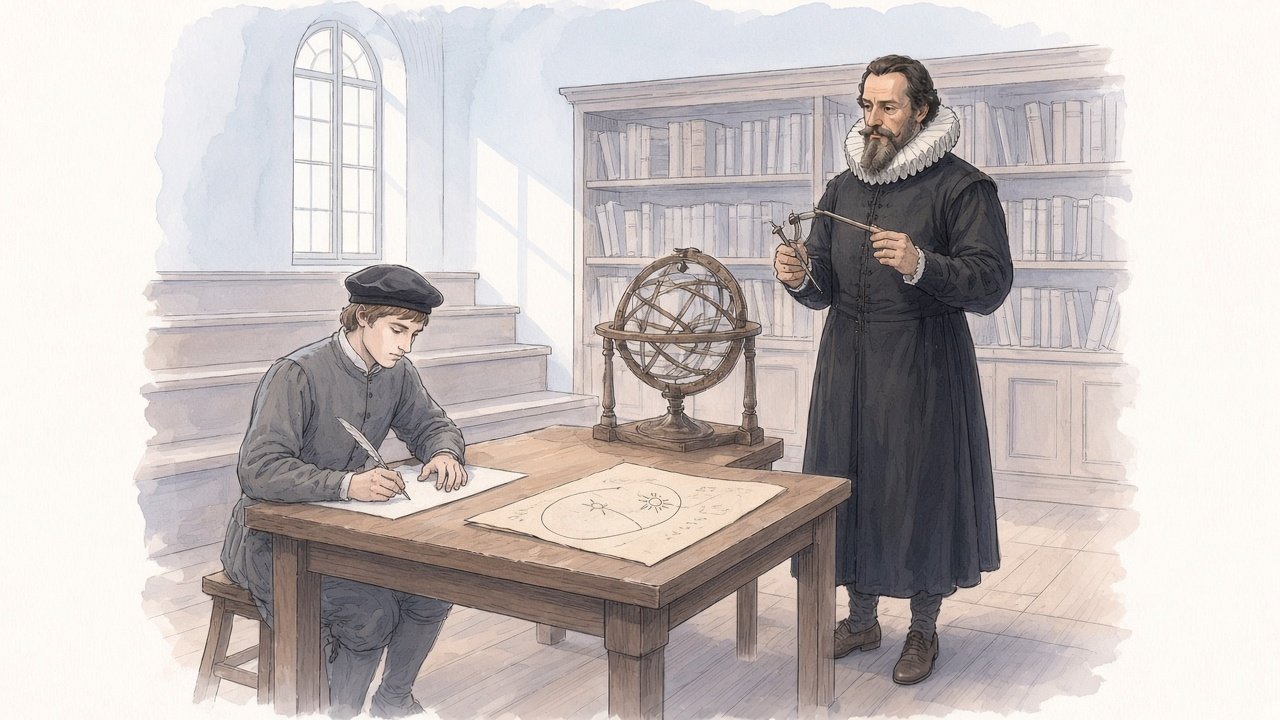
Kepler travelled to Prague early in 1600 and joined Tycho at the castle of Benátky nad Jizerou, north-east of the city, where Tycho was setting up his instruments. The meeting brought together two men of very different temperaments and positions. Tycho was a wealthy nobleman, proud and guarded with his data, which represented two decades of work and which he hoped would be used to establish his own system of the world. In the Tychonic system the Sun and Moon circled the motionless Earth while the other planets circled the Sun. Kepler was poor, intense and in need of employment, and he wished to use the observations to confirm his own Copernican scheme. Their relations were at times difficult. Tycho released his data to Kepler only gradually, and Kepler at one point left in anger before returning with an apology.
Tycho assigned Kepler the problem of the orbit of Mars. Mars was the most troublesome of the planets for astronomers, because its orbit departs more from a circle than that of any planet then known except Mercury, which was hard to observe. Tycho’s assistant Christen Sørensen Longomontanus had been working on it without success. Kepler reportedly expected to solve it within eight days. It took him the better part of six years.
Tycho died suddenly in Prague on 24 October 1601. Two days later Kepler was appointed to succeed him as imperial mathematician, with responsibility for completing the astronomical tables that Tycho had promised the emperor, which were to be called the Rudolphine Tables. The observations themselves passed into the control of Tycho’s heirs, who regarded them as valuable property, and Kepler’s continued use of them required negotiation with Tycho’s son-in-law, Frans Gansneb Tengnagel. In practice Kepler kept working with the records, and his later publications were issued under conditions agreed with the family.
The Quality of Tycho’s Observations
The importance of Tycho’s data to Kepler’s work can hardly be overstated. Before the telescope, positions of the planets were measured with large instruments fitted with sights, such as quadrants, sextants and armillary spheres. Tycho had built instruments of unprecedented size and stability, had calibrated them against one another, and had developed methods to reduce the errors introduced by the instruments and by the refraction of light in the atmosphere. His best measurements were accurate to within about one or two minutes of arc, roughly one thirtieth of the apparent diameter of the full Moon. Earlier observers had commonly worked to an accuracy of about ten minutes of arc. Tycho had also, unlike most of his predecessors, observed the planets systematically at many points around their orbits rather than only at certain significant positions, so that his records offered a dense and continuous series of observations of Mars over many years.
This precision made a decisive difference. A theory of planetary motion that agreed with the observations to within ten minutes of arc might have been acceptable to any earlier astronomer. Kepler, knowing that Tycho’s measurements were better than that, could not accept such a discrepancy, and it was precisely a discrepancy of this size that eventually forced him to give up the circle.
The War on Mars
Kepler described his struggle with the orbit of Mars as a war, and he published its history, including his errors, in the book Astronomia nova, the New Astronomy, which appeared in Prague in 1609. Its full title announced that it was an astronomy founded on causes, or a celestial physics, derived from investigations of the motions of Mars. The book is unusual among scientific works of its period in recounting at length the false paths its author had followed, and historians have studied it closely as a record of how a major scientific result was actually reached.
Kepler began with the tools of traditional astronomy. Astronomers since antiquity had represented the motion of a planet by a circle whose centre was displaced from the Earth, or in the Copernican scheme from the Sun, and by a second point, the equant, about which the planet appeared to move at a uniform angular rate. Ptolemy had introduced the equant to account for the fact that planets do not move at uniform speed. Copernicus had rejected the equant on philosophical grounds and replaced it with additional small circles. Kepler reinstated a version of it. He also made a change of considerable consequence: he referred the motions of the planets to the true position of the Sun rather than, as Copernicus had done, to the centre of the Earth’s orbit, a point near the Sun but not at it. For Kepler, who believed the Sun was the physical source of the planets’ motion, it was natural that the Sun itself should be the reference point.
Using four observations of Mars at opposition, the moments when Mars stands directly opposite the Sun in the sky, Kepler constructed by a long process of iterative calculation a circular orbit with an equant that reproduced the longitudes of Mars, its positions along the zodiac, to within about two minutes of arc at the oppositions that Tycho had recorded. This model, which he called the vicarious hypothesis, was a considerable achievement in itself. But when he tested it against other observations, especially those of the planet’s latitude, its distance north or south of the ecliptic, and against positions observed away from opposition, he found that it failed. At certain points of the orbit the predicted positions differed from Tycho’s by about eight minutes of arc.
Kepler drew a famous conclusion from this result. Since divine goodness had given astronomers in Tycho an observer so exact, he wrote, it was proper to acknowledge the gift, and the eight minutes, which could not be ignored, had pointed the way to a complete reformation of astronomy. A lesser discrepancy might have been dismissed as observational error. Kepler was confident that Tycho’s instruments did not err by so much, and he therefore concluded that the circular model itself must be wrong.
The Orbit of the Earth
Before he could determine the true shape of the orbit of Mars, Kepler needed to know the orbit of the Earth precisely, because all observations of Mars were made from the moving Earth. An error in the assumed motion of the observer would contaminate every inference about the motion of the planet observed. Kepler devised an ingenious method to determine the Earth’s orbit using Mars itself as a fixed marker. Mars returns to the same point of its orbit after one Martian year of about 687 days. During that time the Earth completes nearly two orbits and arrives at a different place. By selecting observations of Mars separated by exact multiples of the Martian period, Kepler could treat the position of Mars as fixed and use it, together with the Sun, to triangulate the position of the Earth at several different points of its own orbit.
This analysis showed that the Earth, too, moved non-uniformly, faster when nearer the Sun and slower when farther away, and that its orbit was best described with the Sun displaced from the centre of the circle and with an equant, in a manner consistent with the treatment of the other planets. Copernicus had treated the Earth’s motion as uniform about the centre of its orbit, and Kepler’s correction removed an anomaly that had distinguished the Earth from the other planets.
The Second Law
It was in studying the speed of the Earth that Kepler arrived at the principle now called his second law, although he found it before the first. He observed that the speed of the Earth at the points of its orbit nearest to and farthest from the Sun was inversely proportional to its distance from the Sun. Kepler interpreted this physically. He supposed that the Sun, rotating on its axis, emitted a kind of moving force, which he likened to the spokes of a turning wheel or to rays of light, and which pushed the planets around in their orbits. The force, he argued, weakened in proportion to distance, so that a planet twice as far from the Sun would be driven at half the speed.
He extended this distance rule to all points of the orbit and needed a way to calculate how long a planet took to traverse any given arc. In principle this required summing the distances from the Sun to every point along the arc, a calculation that was impractical without the integral calculus, which had not yet been invented. Kepler replaced the sum of distances by the area enclosed between the arc and the lines drawn to it from the Sun. This substitution was not strictly equivalent to the distance rule except at particular points, a fact that Kepler partly recognised, but it was convenient to calculate and it agreed with the observations. The result was the area law: the line from the Sun to a planet sweeps out equal areas in equal intervals of time. A planet therefore moves fastest when it is closest to the Sun, at the point called perihelion, and slowest at its greatest distance, aphelion.
Later physics showed that the area law is correct and that Kepler’s reasoning towards it was not. In Newtonian mechanics the area law follows from the conservation of angular momentum for any body moving under a force directed towards a fixed centre, whatever the dependence of that force on distance. The speed of a planet perpendicular to the line from the Sun is inversely proportional to its distance, which is the rule Kepler had found at the extreme points of the orbit, but the total speed is not. Kepler arrived at a true law by an argument that contained compensating errors, a circumstance that historians have often discussed without diminishing the value of the result.
The First Law
Having established the area law and an improved orbit for the Earth, Kepler returned to Mars. He calculated the distances of Mars from the Sun at many points in its orbit and found that they were consistently less than those predicted by a circle at the sides of the orbit, midway between perihelion and aphelion. The orbit was therefore some kind of oval, narrower than a circle. Kepler tried several oval curves and for a time favoured an egg-shaped figure derived from a physical model, which was difficult to calculate with and did not fit the observations satisfactorily. He also used an ellipse as a mathematical approximation to the egg-shaped orbit without at first recognising that the ellipse itself might be the true curve.
The decisive step came, according to Kepler’s own account in the Astronomia nova, through a numerical coincidence. He noticed that the maximum width of the crescent-shaped region between the circle and the observed orbit, as a fraction of the radius, was about 0.00429, and that this number was equal to the amount by which the secant of the largest angle between the Sun and the centre of the orbit, as seen from the planet, exceeded one. The angle in question, called the optical equation, was about five degrees and eighteen minutes for Mars. Pursuing this relation, he found a rule that gave the distance of the planet from the Sun at any point in terms of its position in the orbit. After further confusion, in which he applied the rule incorrectly and obtained a curve that he rejected, he realised that the correct application of the rule produced an ellipse with the Sun at one focus. In his words, he had been led by a way that he did not understand to the conclusion that the orbit was an ellipse.
An ellipse is the curve traced by a point whose distances from two fixed points, the foci, add up to a constant. A circle is the special case in which the two foci coincide. The degree to which an ellipse departs from a circle is measured by its eccentricity, a number between zero, for a circle, and one. The eccentricity of the orbit of Mars is about 0.093, and that of the Earth about 0.017. Such ellipses are only slightly flattened, and drawn to scale they look almost circular. What betrays their elliptical shape most clearly is the displacement of the Sun from the centre. In the case of Mars the difference between the elliptical orbit and the best-fitting circle amounted, in angular position seen from the Earth, to the eight minutes of arc that Kepler had refused to ignore.
The first law therefore states that each planet moves in an ellipse with the Sun at one focus. The other focus is an empty point with no physical significance. Combined with the area law, which governs how fast the planet moves along the ellipse, the first law allowed Kepler to calculate the position of a planet at any time with an accuracy that matched Tycho’s observations.
Kepler’s Equation
Using the two laws in practice required the solution of a particular mathematical problem. Given the time elapsed since a planet passed perihelion, one wishes to find its position on the ellipse. The area law gives the area swept out, which is proportional to the elapsed time, and one must then find the angle corresponding to that area. The relation can be written in modern notation as M = E − e sin E, where M, the mean anomaly, is proportional to the time, e is the eccentricity, and E, the eccentric anomaly, is an angle from which the position on the ellipse is readily found. This relation is known as Kepler’s equation. It cannot be solved for E in terms of elementary functions, and Kepler himself expressed doubt that a direct geometrical solution existed. It is solved by successive approximation, and it has occupied mathematicians ever since; methods for its solution were studied by Newton, Lagrange, Bessel and many others, and the equation remains in daily use in the calculation of orbits of planets, comets and artificial satellites.
Publishing the New Astronomy
Kepler had essentially completed the Astronomia nova by 1605, but its publication was delayed by disputes with Tycho’s heirs and by the cost of printing. It appeared in 1609, the same year in which Galileo began to observe the heavens with a telescope. The book contained the first and second laws, though not in the numbered form in which they are now taught. The ordering of the laws as first, second and third was introduced by later writers, and Kepler himself did not single them out as his principal achievements in the way that modern textbooks do.
The Astronomia nova was a difficult book, filled with long calculations and frank accounts of failed hypotheses, and its readership was small. Its argument that the planets moved under the influence of physical forces originating in the Sun was not widely accepted. Many astronomers who used Kepler’s results treated them as calculating devices rather than as statements about the physical world, as astronomers had long treated the circles of Ptolemy and Copernicus. Kepler’s own conception of the solar force was also partly mistaken. He believed that the Sun’s force pushed the planets along their orbits tangentially, and he supposed that a magnetic interaction between the Sun and the planets, which he compared to the magnetism of the Earth described by William Gilbert in 1600, varied the distance of each planet from the Sun so as to produce the ellipse. Newton later showed that a force directed towards the Sun, without any tangential push, accounts for the motion.
Optics and the Telescope
Kepler’s work in Prague was not confined to Mars. In 1604 he published a treatise on optics, Astronomiae pars optica, in which he gave the first essentially correct account of how the eye forms an image. He showed that light entering the eye is refracted by the lens to form an inverted image on the retina, and he treated the problem of how pinhole images form, which had a direct bearing on astronomical measurement, since the apparent size of the Sun and Moon observed through pinholes was affected by the size of the aperture. In the same year he observed a new star, a supernova, in the constellation Ophiuchus, and published a book on it in 1606. That supernova of 1604 is still known as Kepler’s supernova.
When Galileo announced his telescopic discoveries in 1610, Kepler responded quickly and publicly in support, publishing a pamphlet in the form of a letter, the Dissertatio cum Nuncio Sidereo, and later confirming the existence of the moons of Jupiter with a telescope borrowed from a nobleman. In 1611 he published Dioptrice, a theoretical account of the passage of light through lenses, in which he described a telescope with two convex lenses. This design, which gives an inverted image but a wider field of view than Galileo’s arrangement of a convex and a concave lens, became the standard form of the astronomical refracting telescope and is still called the Keplerian telescope. The story of Galileo’s own instruments is told in the article on Galileo and the Telescope of 1609.
Upheaval and the Move to Linz
The year 1611 brought disaster to Kepler’s household. His wife, Barbara, fell ill and died, and his young son Friedrich died of smallpox. Prague was disturbed by the struggle between the Emperor Rudolf and his brother Matthias, who forced Rudolf to abdicate the Bohemian crown. Rudolf died early in 1612. Kepler retained his title of imperial mathematician under Matthias but moved to Linz in Upper Austria, where he took up the post of district mathematician, with duties that included teaching and the preparation of a map of the province. In 1613 he married Susanna Reuttinger, with whom he had several children.
The years in Linz were troubled by religious conflict. Kepler, a Lutheran, refused to sign the Formula of Concord, the confession of faith that the Lutheran authorities in Württemberg required of their ministers and officials, because he disagreed with part of its teaching on the Eucharist, and he was excluded from communion by the Lutheran pastor at Linz. He thus found himself at odds both with the Catholic authorities of the Habsburg lands and with his own church. From 1615 to 1621 he was also preoccupied with the trial of his mother, Katharina, who had been accused of witchcraft in Württemberg. Kepler devoted much time and effort to her defence, travelled to Württemberg to take charge of it, and composed legal arguments on her behalf. She was imprisoned for over a year and threatened with torture but was released in 1621. She died the following year.
The Harmony of the World and the Third Law
In the midst of these difficulties Kepler completed the work he regarded as his greatest, Harmonices Mundi, the Harmony of the World, published in Linz in 1619. The book was an extended inquiry into the harmonic relations that Kepler believed underlay the structure of the cosmos. It treated the geometry of regular polygons and their constructibility, the ratios of musical consonances, the influence of the configurations of the planets on terrestrial affairs, and finally the harmonies of the planetary motions themselves. Kepler compared the extreme angular speeds of each planet, as they would be seen from the Sun, and found that the ratios between them approximated the ratios of musical intervals. Each planet, in his interpretation, sang a range of notes, and together they produced a harmony that only God could hear.
Within this speculative framework appeared the result now known as the third law. In the fifth book of the Harmonices Mundi Kepler stated that the ratio between the periods of any two planets is precisely the ratio of the three-halves power of their mean distances from the Sun. Equivalently, the square of the period is proportional to the cube of the mean distance. Kepler recorded that the relation had first occurred to him on 8 March 1618, that he had rejected it after an error in calculation, and that it returned to him on 15 May and was confirmed.
The law can be tested with simple figures. If distances are measured in astronomical units, the mean distance of the Earth from the Sun, and periods in years, then the cube of the distance equals the square of the period for every planet. Jupiter lies at about 5.2 astronomical units; the cube of 5.2 is about 140.6, and its square root is about 11.86, close to Jupiter’s period of 11.86 years. Saturn, at about 9.54 astronomical units, has a period of about 29.5 years. Mars, at about 1.52 astronomical units, has a period of about 1.88 years. The relation holds for each planet known to Kepler with high accuracy.
The third law differed in character from the first two. The first and second laws describe the motion of a single planet. The third law relates the motions of different planets to one another and therefore implies that a single cause governs the whole system. Kepler understood it in these terms, seeing it as evidence of the unity of the Sun’s governing force, and it later provided Newton with a crucial clue to the form of the force of gravity.
The Epitome and the Rudolphine Tables
Between 1617 and 1621 Kepler published in three parts the Epitome Astronomiae Copernicanae, a textbook of Copernican astronomy in the form of questions and answers. In it he extended the elliptical orbits and the area law, which he had established for Mars, to all the planets, and also to the Moon and the four moons of Jupiter discovered by Galileo. He showed that the third law applied to the satellites of Jupiter as well as to the planets. The Epitome was the most widely read of Kepler’s astronomical works and became the means by which his system reached a larger audience. The Catholic Church placed it on the Index of Prohibited Books in 1619, together with other Copernican writings.
Kepler’s remaining major task was the completion of the Rudolphine Tables, the tables of planetary positions based on Tycho’s observations that he had been commissioned to complete in 1601. Their computation was greatly aided by logarithms, which the Scottish mathematician John Napier had published in 1614. Kepler studied Napier’s work, wrote his own treatise on logarithms in 1624, and used them in the tables. The Thirty Years’ War, which had begun in 1618, made the work of printing hazardous. In 1626 Linz was besieged during a peasant rebellion, and the printing house was burned. Kepler moved to Ulm, where the tables were finally printed in 1627.
The Rudolphine Tables were far more accurate than any earlier tables. The Prutenic Tables of 1551, based on the Copernican models, and the Alfonsine Tables of the thirteenth century, based on the Ptolemaic, could err in the position of Mars by several degrees. The Rudolphine Tables reduced the typical error by a large factor. Their accuracy was strikingly demonstrated when Kepler used them to predict transits of Mercury and Venus across the face of the Sun in 1631. Kepler did not live to see the event, but the French astronomer Pierre Gassendi observed the transit of Mercury in Paris on 7 November 1631, close to the predicted time. The transit of Venus of December 1631 was not visible in Europe, but Jeremiah Horrocks, using improved calculations, predicted and observed the transit of Venus of 1639 from Lancashire. The success of the tables did more than any argument to persuade astronomers of the practical value of Kepler’s laws.
Last Years
After the publication of the tables Kepler entered the service of Albrecht von Wallenstein, the imperial general, and moved in 1628 to Sagan in Silesia, where Wallenstein held lands. His duties included the preparation of horoscopes for his patron. Kepler’s salary as imperial mathematician was heavily in arrears. In 1630 he travelled to Regensburg, where the imperial diet was meeting, in the hope of collecting money owed to him. He fell ill shortly after his arrival and died there on 15 November 1630. He was buried in the Protestant cemetery of the city, but the cemetery was destroyed during the Thirty Years’ War, and the site of his grave is lost.
Among the works he left unpublished at his death was the Somnium, a fictional narrative of a journey to the Moon, which describes how the Earth and the heavens would appear to an observer on the lunar surface. Kepler had written the original version as a student exercise and expanded it with extensive notes in later life. His son Ludwig published it in 1634. It has been described as an early work of science fiction, but its principal purpose was to illustrate the Copernican system by showing that motion of the Earth would appear to lunar inhabitants exactly as the motion of the Moon appears to us.
Reception of the Laws
Kepler’s laws did not win immediate acceptance. Galileo, the most famous Copernican of the period, never adopted elliptical orbits, and in his Dialogue Concerning the Two Chief World Systems of 1632 he continued to discuss circular motion. Many astronomers in the decades after Kepler’s death accepted the ellipse but sought to replace the area law, which was difficult to apply because of the transcendental character of Kepler’s equation, with simpler approximations. The French astronomer Ismaël Boulliau, for example, proposed in 1645 a model in which the planet moved uniformly about the empty focus of the ellipse, and the English astronomer Seth Ward proposed a similar scheme. Such approximations were adequate for planets with small eccentricities and reflected a continuing preference for uniform motion.
Boulliau made one contribution of lasting importance. Arguing against Kepler’s physical theory, he suggested that if a force did emanate from the Sun it ought to weaken in proportion to the square of the distance, as light does, rather than in simple proportion to distance. He did not himself believe in such a force, but the suggestion entered the discussions that led to the theory of gravitation.
By the middle of the seventeenth century the practical superiority of the Rudolphine Tables had made Keplerian astronomy the working standard among European astronomers. Jeremiah Horrocks, who died young in 1641, had applied Kepler’s laws to the Moon and argued for their physical reality. Through the 1660s and 1670s the members of the Royal Society in London, among them Christopher Wren, Robert Hooke and Edmond Halley, discussed the possibility that an attraction towards the Sun, decreasing as the inverse square of the distance, might account for the planetary motions. It was known that the third law, combined with the mathematics of circular motion published by Christiaan Huygens in 1673, implied such an inverse-square force for circular orbits. The open question was whether the same force would produce Kepler’s ellipses.
Newton and the Explanation of the Laws
The question was answered by Isaac Newton. In 1684 Halley visited Newton in Cambridge and asked him what curve a planet would describe if it were attracted to the Sun by a force varying inversely as the square of the distance. Newton replied that it would be an ellipse and that he had calculated it. He was unable to find his calculation at the time but sent Halley a short treatise, De motu corporum in gyrum, later that year. Expanded over the following two years, this work became the Philosophiae Naturalis Principia Mathematica, published in 1687.
In the Principia Newton showed that Kepler’s laws follow from his three laws of motion and the law of universal gravitation. The area law, he demonstrated, holds for any body moving under a force directed towards a fixed point, so that it reveals the direction of the force but not its law of variation. An elliptical orbit with the force directed towards a focus requires that the force vary inversely as the square of the distance. The third law, in turn, follows if the same inverse-square force, with a strength proportional to the mass of the Sun, acts on all the planets. Kepler’s three laws, found empirically from Tycho’s observations, thus became consequences of a single physical principle.
Newton also showed that Kepler’s laws are not exactly true. Because the Sun is itself attracted by the planets, the two bodies move around their common centre of mass, and the third law must be corrected by a factor involving the sum of the masses of the Sun and the planet. Because the planets attract one another, their orbits are perturbed and are not exact ellipses. The departures are small for the planets because the Sun is so much more massive than any of them, but they are measurable, and the study of planetary perturbations became one of the principal tasks of celestial mechanics in the eighteenth and nineteenth centuries. It was through the analysis of such perturbations in the orbit of Uranus that Urbain Le Verrier and John Couch Adams predicted the existence and position of Neptune, which was found in 1846. Later still, a small residual in the motion of Mercury’s perihelion that Newtonian theory could not explain was accounted for by Einstein’s general theory of relativity, which is discussed in the article on Einstein’s Annus Mirabilis and the Theory of Special Relativity.
The Laws Today
Kepler’s laws remain fundamental to astronomy and to spaceflight. The orbits of artificial satellites and space probes are calculated in the first instance as Keplerian ellipses, with perturbations added. The six quantities that specify an orbit, among them the semi-major axis, the eccentricity and the inclination, are still called Keplerian elements. Engineers planning a transfer between two planetary orbits commonly begin with a half-ellipse that touches both, the Hohmann transfer orbit, whose duration follows directly from the third law.
The third law, in its Newtonian form, is one of the main tools by which astronomers measure mass. The masses of planets are determined from the orbits of their moons; the masses of stars in binary systems from their mutual orbits; and the mass of the black hole at the centre of the Milky Way from the orbits of stars that move around it, which have been followed by observers for more than two decades. When the motions of stars and gas in the outer parts of spiral galaxies were found not to decline with distance from the centre in the way that the visible matter would imply, the inference that galaxies contain large amounts of unseen matter rested on the same reasoning, as described in the article on Vera Rubin and the Discovery of Dark Matter.
Kepler’s laws have also served in the discovery of planets around other stars. When a planet orbits a star, the star moves in a small ellipse about the common centre of mass, and its velocity towards and away from the observer varies periodically. The shape of the velocity curve reveals the eccentricity of the orbit, and the third law, combined with an estimate of the star’s mass, gives the planet’s distance from the star. When a planet passes in front of its star, the periodic dimming of the star gives the orbital period directly, and the third law again yields the size of the orbit. The NASA Kepler space telescope, launched in 2009 and named after the astronomer, used this transit method to identify thousands of planets beyond the solar system.
Assessment
Historians have often remarked on the contrast between the speculative and mystical aspects of Kepler’s thought and the rigour of his treatment of observations. He believed in a cosmos built on geometrical archetypes, sought musical harmonies in the planetary motions and practised astrology, though he was critical of much of its conventional apparatus. Yet he was also unwilling to accept a theory that disagreed with good observations by more than their known error, and he was prepared to abandon cherished assumptions, including the circularity of planetary orbits, when the evidence required it. His conviction that the planets were moved by physical causes, and that astronomy should be a physics of the heavens rather than a geometry of convenient circles, led him to the questions whose answers he found.
The three laws stand at a point of transition in the history of science. They were derived from the most accurate observations made before the telescope, they were among the first quantitative laws of nature expressed in a form that could be tested to high precision, and they became the bridge between the observational astronomy of Tycho and the mechanics of Newton. Their discovery shows the value of a long and carefully maintained series of observations, the importance of the precision of measurement in deciding between theories, and the role of persistent calculation in turning data into understanding.
Further Reading
The principal sources for this article include the Grokipedia entries linked in the text and the following: the entry on Johannes Kepler in the Stanford Encyclopedia of Philosophy; the account of Kepler’s work provided by the Kepler Museum in Weil der Stadt; and the NASA overview of orbits and Kepler’s laws. Readers interested in the observations on which the laws were based will find their history in the article on Tycho Brahe and the Observatory at Uraniborg.