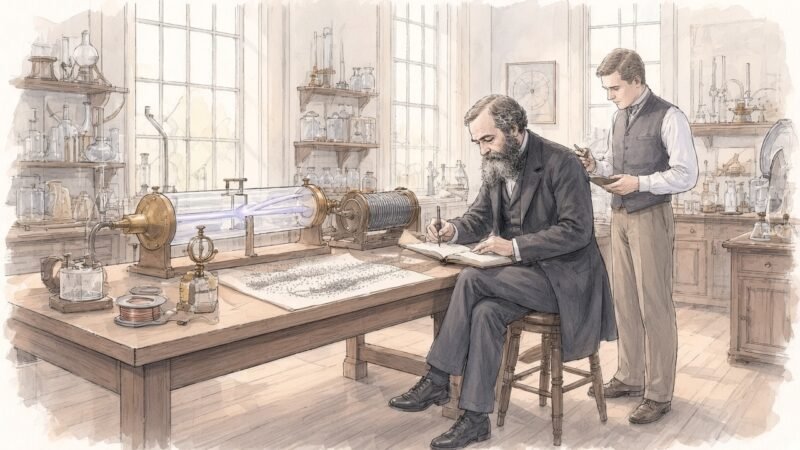
Carnot, Clausius and the Laws of Thermodynamics
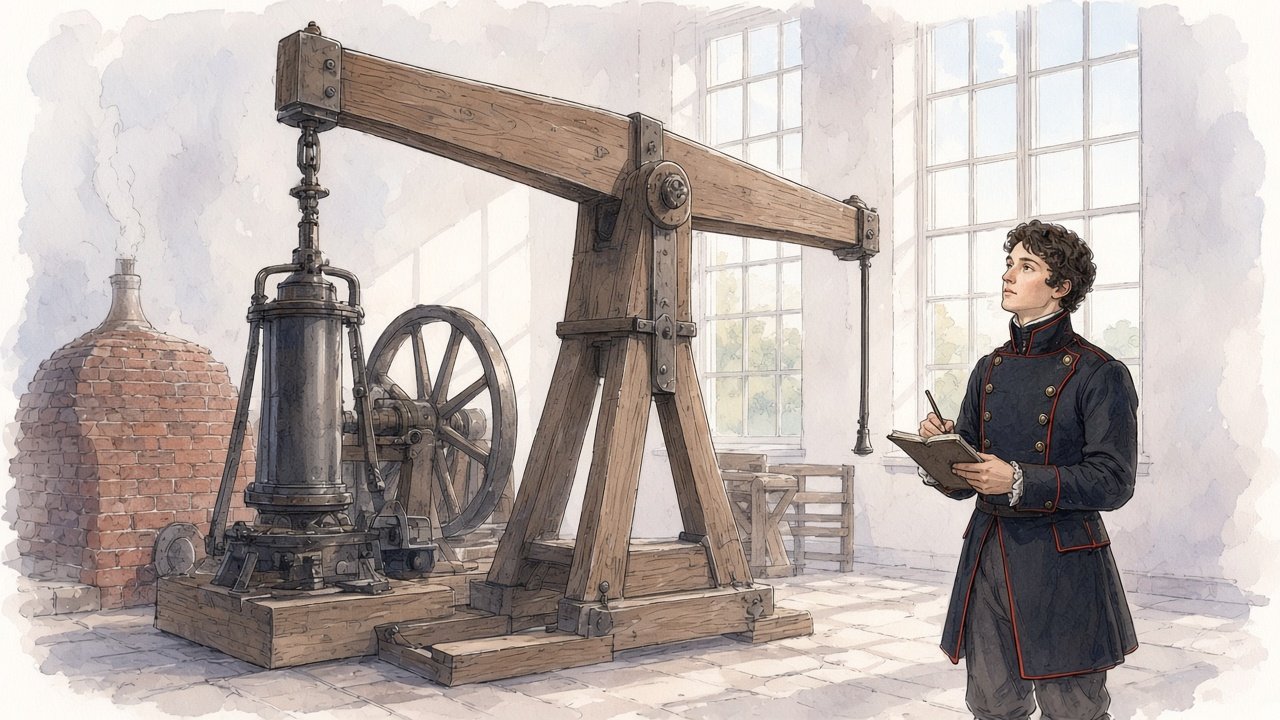
In June 1824 a young French military engineer named Sadi Carnot published at his own expense a short book entitled Réflexions sur la puissance motrice du feu, Reflections on the Motive Power of Fire. In it he asked a question that the builders of steam engines had never posed in general form: is there a limit to the work that can be obtained from a given quantity of heat, and if so, what determines it? His answer, that the efficiency of an ideal engine depends only on the temperatures between which it operates, was largely ignored for a quarter of a century. Taken up and reinterpreted in the 1850s by Rudolf Clausius in Germany and William Thomson in Scotland, it became the foundation of thermodynamics, the science of heat and energy, and led to two of the most general laws in physics: the conservation of energy and the law that the entropy of an isolated system never decreases. This article describes the industrial and scientific background of Carnot’s work, the content of his argument, the establishment of the first law through the work of Mayer, Joule and Helmholtz, the reformulation of thermodynamics by Clausius and Thomson, the introduction of entropy, and the later interpretation of the second law in statistical terms.
Steam and the Question of Efficiency
By the early nineteenth century the steam engine had transformed mining, manufacturing and transport in Britain. The development of the engine from the atmospheric engine of Thomas Newcomen in 1712 to the separate condenser of James Watt patented in 1769 and the high-pressure engines of Richard Trevithick and Arthur Woolf in the first years of the nineteenth century is described in the article on The Steam Engine. Each improvement had reduced the coal consumed for a given amount of work. Engineers measured performance by the duty of an engine, the weight of water raised one foot by the burning of a bushel of coal, and the duty of the best Cornish pumping engines rose several times over in the first decades of the century.
Despite these improvements there was no theory of why one engine was more economical than another, or of how far improvement could go. Engineers argued about whether steam was the best working substance, whether air or alcohol vapour would do better, and whether high pressure was itself the source of economy. France, which had fallen behind Britain in industrial development, took a particular interest in these questions, and it was in this context that Carnot wrote.
Sadi Carnot
Nicolas Léonard Sadi Carnot was born in Paris on 1 June 1796. His father, Lazare Carnot, was a mathematician and engineer who had been a member of the Committee of Public Safety during the Revolution and had organised the armies of the Republic, and who had written on the theory of machines. Sadi was named after the Persian poet Saadi of Shiraz. He entered the École Polytechnique in 1812 and then the school of military engineering at Metz, and served as an officer of engineers. After the fall of Napoleon, his father went into exile, and Sadi’s military career stalled. In 1819 he obtained a post on the general staff in Paris and was able to spend much of his time in study, attending lectures at the Collège de France and the Conservatoire des Arts et Métiers and visiting factories and workshops.
The Réflexions was his only published work. It was printed in an edition of six hundred copies and received a favourable notice in a scientific journal but attracted little further attention. Carnot continued to work on the theory of heat, and his surviving notes show that by the late 1820s he had come to doubt the caloric theory on which his book was based and to believe that heat was a form of motion. He died of cholera in Paris on 24 August 1832 at the age of thirty-six. In accordance with the practice in cases of cholera, most of his belongings, including his papers, were burned, though some notes survived and were published by his brother Hippolyte in 1878.
The Argument of the Réflexions
Carnot’s book is written without equations in the main text and was addressed to a general educated audience. He began by observing that heat could produce motion and that the steam engine had already changed the world, but that its theory was little understood. To understand it, he argued, one must consider heat engines in general, independently of any particular mechanism or working substance.
His central observation was that the production of work in a heat engine always accompanied the passage of heat from a hot body to a cold body. In a steam engine, heat passed from the furnace to the boiler, was carried by the steam to the cylinder, and passed to the cold water of the condenser. Carnot compared this to the fall of water in a water wheel. Just as the work obtained from a waterfall depended on the quantity of water and the height of the fall, so the motive power of heat depended on the quantity of heat, which he called caloric, and the difference in temperature between the hot and cold bodies. In accordance with the caloric theory then generally accepted, he assumed that heat was a conserved substance, so that the same quantity of caloric that entered the engine at the high temperature left it at the low temperature.
Carnot then described an idealised engine operating in a cycle, now called the Carnot cycle. A working substance, such as a gas in a cylinder with a piston, is first placed in contact with a hot body and allowed to expand at constant temperature, absorbing heat. It is then insulated and allowed to expand further, cooling until it reaches the temperature of the cold body. It is then placed in contact with the cold body and compressed at constant temperature, giving up heat. Finally it is insulated and compressed further until it returns to the temperature of the hot body and to its initial state. In the course of the cycle the gas does more work in expanding than is done on it in compression, and the difference is the net work produced.
The important feature of this cycle is that it is reversible. Every step proceeds through states of equilibrium, with no contact between bodies at different temperatures and no friction, so that the cycle can be run backwards, using work to carry heat from the cold body to the hot one. Carnot then argued that no engine operating between the same two temperatures could produce more work than a reversible engine. If such an engine existed, it could be used to drive a reversible engine backwards, returning all the heat to the hot body and leaving a surplus of work, so that work would be produced without any net consumption of caloric or any change in other bodies. This, he said, would be a perpetual motion, which was contrary to the accepted laws of mechanics and of sound physics.
From this argument Carnot drew his principal conclusion: the maximum motive power of heat is independent of the agents employed to realise it, and is fixed solely by the temperatures of the bodies between which the transfer of caloric takes place. All reversible engines operating between the same temperatures have the same efficiency, whether they use steam, air or any other substance. He also concluded that greater efficiency could be obtained by increasing the difference in temperature, which explained the advantage of high-pressure engines, since water boils at a higher temperature under pressure, and he suggested that engines using air heated to high temperatures might be superior to steam engines, an idea later realised in the internal combustion engine.
Clapeyron and the Indicator Diagram
The Réflexions might have been forgotten entirely but for Émile Clapeyron, an engineer of the École des Mines who published a paper in 1834 restating Carnot’s argument in mathematical form. Clapeyron represented the Carnot cycle on a diagram of pressure against volume, like the indicator diagram that Watt’s assistant John Southern had devised for recording the pressure in the cylinder of a steam engine, and showed that the work done in the cycle was equal to the area enclosed by the curve. He also derived a relation between the pressure at which a liquid boils, the temperature, and the latent heat of evaporation, now known in its later form as the Clausius–Clapeyron equation. It was through Clapeyron’s paper, translated into English and German, that Carnot’s ideas became known to the next generation.
The Mechanical Equivalent of Heat
Meanwhile the caloric theory was being undermined. In 1798 Benjamin Thompson, Count Rumford, had reported that the boring of cannon at the arsenal in Munich produced apparently inexhaustible quantities of heat from friction, which seemed difficult to reconcile with the idea of heat as a conserved substance. In the 1840s several investigators independently proposed that heat and work were interconvertible and that a fixed quantity of work always produced a fixed quantity of heat.
The German physician Julius Robert Mayer published in 1842 a short paper arguing that force, by which he meant what is now called energy, was indestructible, and calculated a value for the mechanical equivalent of heat from the difference between the specific heats of air at constant pressure and constant volume. His work was at first ignored. In Manchester, James Prescott Joule, the son of a brewer, carried out from 1843 onwards a long series of experiments measuring the heat produced by electric currents, by the compression of gases and, most famously, by the stirring of water with a paddle wheel driven by falling weights. His result, published in its most precise form in 1850, was that the work done by a weight of 772 pounds falling through one foot would raise the temperature of a pound of water by one degree Fahrenheit, which is within one per cent of the modern value. The unit of energy is now named the joule in his honour.
In 1847 the German physiologist and physicist Hermann von Helmholtz published a memoir, Über die Erhaltung der Kraft, On the Conservation of Force, in which he gave a general mathematical formulation of the conservation of energy and applied it to mechanics, heat, electricity, magnetism and physiology. The principle of conservation of energy, which these three men did most to establish, became the first law of thermodynamics. Its relation to the symmetry of physical laws under translation in time was later established by Emmy Noether, as described in the article on Emmy Noether and the Theorem Linking Symmetry and Conservation.
The Conflict between Carnot and Joule
The new view of heat created an apparent conflict with Carnot’s theory. Carnot had assumed that heat was conserved in the engine, the same quantity passing from the hot body to the cold. If heat was converted into work, then less heat must reach the cold body than left the hot one. It seemed that one of the two theories must be abandoned.
The young Scottish physicist William Thomson, later Lord Kelvin, had read Clapeyron’s paper and in 1848 used Carnot’s theory to define an absolute scale of temperature, independent of the properties of any particular substance. He met Joule at the meeting of the British Association in Oxford in 1847 and was impressed by his experiments, but in a paper of 1849 he set out the difficulty of reconciling them with Carnot’s principle, which he believed to be correct. The resolution came from Germany.
Rudolf Clausius
Rudolf Julius Emanuel Clausius was born on 2 January 1822 in Köslin in Pomerania, now Koszalin in Poland, the son of a Lutheran pastor and school inspector. He studied mathematics and physics at the University of Berlin and received his doctorate from the University of Halle in 1847 for a dissertation on the optical effects of the atmosphere, in which he explained the blue colour of the sky and the red colours of sunrise and sunset, though his explanation was later superseded.
In 1850, while teaching at the Royal Artillery and Engineering School in Berlin, Clausius published a paper entitled Über die bewegende Kraft der Wärme, On the Moving Force of Heat. He showed that Carnot’s essential result could be preserved if his assumption that heat was conserved was abandoned. In a heat engine, part of the heat taken from the hot body is converted into work, and the remainder passes to the cold body. The conservation of energy requires that the heat absorbed equal the work done plus the heat rejected. Carnot’s principle, that the efficiency of a reversible engine depends only on the temperatures, could be derived from a different postulate: that heat cannot of itself pass from a colder to a hotter body. With these two principles, the first and second laws of thermodynamics, Clausius reconstructed the theory of heat engines on a consistent basis.
Thomson reached similar conclusions independently and published them in 1851 in a paper on the dynamical theory of heat. He stated the second law in a different form: that it is impossible, by means of inanimate material agency, to derive mechanical effect from any portion of matter by cooling it below the temperature of the coldest of the surrounding objects. In other words, no engine can operate in a cycle by drawing heat from a single reservoir and converting it entirely into work. The statements of Clausius and Thomson are equivalent, since a violation of either can be used to construct a violation of the other.
Thomson drew a further conclusion in 1852 in a short paper on a universal tendency in nature to the dissipation of mechanical energy. Whenever heat flows from hot to cold bodies without producing work, or work is turned into heat by friction, the capacity of the energy to do useful work is lost, though the energy itself is conserved. He concluded that within a finite period of time the Earth would become unfit for human habitation, and he later speculated about the eventual heat death of the universe.
Absolute Temperature
Carnot’s theorem implied that the efficiency of a reversible engine was a universal function of the two temperatures, and Thomson used this to define temperature in a way that did not depend on any thermometric substance. On the absolute scale he proposed in 1854, the ratio of the heat absorbed at the high temperature to the heat rejected at the low temperature in a reversible cycle is equal to the ratio of the absolute temperatures. The efficiency of a reversible engine, the fraction of the heat absorbed that is converted into work, is then one minus the ratio of the low temperature to the high temperature.
The scale has an absolute zero, the temperature at which a reversible engine would convert all the heat absorbed into work, and which cannot be reached. It coincides with the scale defined by an ideal gas thermometer, and its zero lies at about minus 273 degrees Celsius. The unit of temperature in the International System of Units, the kelvin, is named after Thomson, and since 2019 it has been defined by fixing the value of the Boltzmann constant, as part of the redefinition of the base units described in the article on The Kilogram That Was a Cylinder.
The formula for the Carnot efficiency shows why engineers seek high working temperatures. A steam engine with a boiler at 150 degrees Celsius and a condenser at 40 degrees, corresponding to absolute temperatures of about 423 and 313 kelvin, has a maximum possible efficiency of about 26 per cent. Real engines fall well below this limit because of friction, heat losses and departures from reversibility. Modern power stations, using steam at more than 600 degrees Celsius, achieve efficiencies above 40 per cent, and combined cycle stations, in which a gas turbine operating at still higher temperatures is followed by a steam turbine, exceed 60 per cent.
Entropy
Clausius continued to refine the second law throughout the 1850s and 1860s. In 1854 he showed that for any reversible cycle the sum of the quantities of heat absorbed, each divided by the absolute temperature at which it was absorbed, is zero, while for an irreversible cycle this sum is negative. This implied the existence of a quantity that depends only on the state of a system, whose change between two states is equal to the heat absorbed in a reversible process divided by the temperature.
In a paper of 1865, Clausius gave this quantity the name entropy, from the Greek word for transformation, choosing a word deliberately similar to energy because he regarded the two quantities as closely related in their physical significance. He showed that in any process occurring in an isolated system the entropy either increases or, in the limiting case of reversible processes, remains constant. He concluded the paper with a summary of the two laws applied to the universe as a whole: the energy of the universe is constant, and the entropy of the universe tends towards a maximum.
The entropy formulation made the second law a quantitative tool. It allowed the direction of spontaneous processes to be predicted, the conditions of equilibrium to be determined, and the maximum work obtainable from any process to be calculated. In the 1870s the American physicist Josiah Willard Gibbs extended the theory to chemical reactions and to mixtures of substances in his long memoir On the Equilibrium of Heterogeneous Substances, published between 1875 and 1878, which introduced the chemical potential and the free energy and laid the foundations of chemical thermodynamics.
The Kinetic Theory of Gases
Clausius also made fundamental contributions to the kinetic theory of gases, which explained the properties of gases in terms of the motion of their molecules. In a paper of 1857, Über die Art der Bewegung, welche wir Wärme nennen, On the Kind of Motion that We Call Heat, he derived the pressure of a gas from the impacts of its molecules on the walls of the container and related the temperature to the average kinetic energy of the molecules. In 1858, in response to the objection that molecules moving at the speeds he calculated would make gases mix almost instantly, he introduced the concept of the mean free path, the average distance a molecule travels between collisions, and showed that the slow diffusion of gases could be explained by frequent collisions.
Clausius’s work was taken up by James Clerk Maxwell, who in 1860 derived the distribution of molecular velocities in a gas at equilibrium, as described in the article on Maxwell and the Equations of Electromagnetism. Maxwell also pointed out in 1867, in a letter to Peter Guthrie Tait, that the second law might be violated by a being able to observe individual molecules and sort the fast from the slow, opening and closing a door between two compartments without doing work. This thought experiment, later called Maxwell’s demon, showed that the second law was a statistical rather than an absolute law. The demon has been discussed ever since, and its resolution is now generally held to involve the thermodynamic cost of acquiring and erasing information.
Boltzmann and the Statistical Interpretation
The statistical meaning of entropy was developed by the Austrian physicist Ludwig Boltzmann. In 1872 he derived an equation for the evolution of the distribution of molecular velocities in a gas and showed that a certain quantity, related to entropy, always decreased until the distribution reached Maxwell’s equilibrium form. This result, the H-theorem, was attacked on the ground that the laws of mechanics are reversible in time, so that for every motion leading to an increase in entropy there is a reversed motion leading to a decrease. In response, Boltzmann argued in 1877 that the entropy of a state is a measure of the number of microscopic arrangements of the molecules that correspond to it, and that the increase of entropy reflects the overwhelming probability of passing from less probable to more probable states, not a strict necessity.
The relation between entropy and the number of microscopic states, expressed by the formula S equals k log W, is engraved on Boltzmann’s tombstone in the Zentralfriedhof in Vienna, though the formula in that form was written down by Max Planck. The constant k, the Boltzmann constant, connects the microscopic and macroscopic descriptions and was used by Planck in his work on black-body radiation in 1900, which began the quantum theory described in the article on The Discovery of Quantum Mechanics and Superposition.
Heat Engines Beyond Steam
Carnot’s suggestion that air heated to high temperatures might serve as a better working substance than steam was pursued throughout the nineteenth century. In 1816 the Scottish clergyman Robert Stirling patented a hot-air engine in which a fixed quantity of air was alternately heated and cooled, passing through a regenerator that stored heat from one part of the cycle and returned it in the next. The ideal Stirling cycle, like the Carnot cycle, can in principle reach the maximum efficiency permitted between two temperatures. Stirling engines were used for small pumping duties but could not compete with steam for large powers.
The decisive development was the internal combustion engine, in which the fuel is burned inside the cylinder rather than in a separate furnace, so that the working gas reaches much higher temperatures. In 1876 Nicolaus Otto built in Germany the first successful four-stroke engine, burning a mixture of gas and air compressed before ignition. In 1892 and 1893 Rudolf Diesel patented and described an engine in which air was compressed so strongly that its temperature rose high enough to ignite the fuel injected into it. Diesel had studied thermodynamics at the Technical University of Munich under Carl von Linde and set out explicitly to build an engine approaching the Carnot efficiency. His engine did not achieve the near-isothermal combustion he first proposed, but it became the most efficient of internal combustion engines and is still used in ships, locomotives, lorries and generators.
The steam turbine, patented by Charles Parsons in 1884, replaced the reciprocating steam engine in power stations and large ships. Gas turbines, developed for aircraft jet engines in the 1930s and 1940s by Frank Whittle in Britain and Hans von Ohain in Germany, were later adapted for power generation. In every case the designers’ aim of raising the temperature at which heat is supplied, and lowering the temperature at which it is rejected, follows directly from Carnot’s analysis.
Carnot’s analysis applies equally to these later machines because it concerns only the temperatures between which heat is taken in and given out, not the mechanism. The thermal efficiencies of the best large marine diesel engines now exceed fifty per cent, the highest of any single-stage combustion engine, which reflects the very high temperatures and pressures reached in their cylinders. Even so, they remain below the Carnot limit for the same temperatures, because combustion, heat transfer across finite temperature differences and friction are all irreversible processes that generate entropy.
Refrigeration and the Heat Pump
A reversible heat engine run backwards uses work to move heat from a cold body to a hot one, and the second law determines the minimum work required. Thomson described the principle of the heat pump in 1852, proposing that a machine driven by an engine could warm a building by drawing heat from the colder outside air, delivering more heat than the work consumed. Practical refrigeration machines using the compression and evaporation of volatile liquids were built in the 1850s and 1860s, by James Harrison in Australia and Ferdinand Carré in France among others. In 1873 and 1876 Carl von Linde designed refrigerators using ammonia that were adopted by breweries, and in 1895 he devised a process for liquefying air on an industrial scale by repeated expansion and cooling.
The performance of a refrigerator or heat pump is measured by its coefficient of performance, the ratio of the heat moved to the work supplied. For an ideal reversible machine this depends, like the Carnot efficiency, only on the two absolute temperatures, and it is largest when the temperatures are close together. A heat pump warming a house to 20 degrees Celsius from outside air at 0 degrees could in principle deliver nearly fifteen units of heat for each unit of work; real machines deliver typically three or four, which still makes them several times more economical than burning fuel or using electric resistance heating directly.
The Age of the Sun and the Earth
The new science of energy was soon applied to questions far from engineering. In the 1850s and 1860s Thomson and Helmholtz asked what source of energy could keep the Sun shining. Chemical burning could sustain it for only a few thousand years. They proposed instead that the Sun was slowly contracting under its own gravity, converting gravitational energy into heat, and calculated that this could supply its output for some tens of millions of years. Thomson also estimated the age of the Earth from the rate at which heat flows out through its crust, arriving at figures between twenty and four hundred million years, later narrowed to about twenty to forty million.
These estimates conflicted with the much longer periods required by geologists and by Charles Darwin’s theory of evolution by natural selection, and the dispute continued for decades. It was resolved only after the discovery of radioactivity in 1896, which revealed a source of heat within the Earth that Thomson’s calculation had omitted, and after the recognition in the twentieth century that the Sun is powered by nuclear fusion. The age of the Earth is now estimated at about 4.5 billion years from radiometric dating. The episode illustrates both the power of thermodynamic reasoning and its dependence on knowing all the relevant sources of energy.
The Third Law
A further law was added in the early twentieth century. In 1906 the German chemist Walther Nernst proposed, on the basis of measurements of chemical reactions at low temperatures, that the entropy changes in reactions between pure crystalline substances approach zero as the temperature approaches absolute zero. This heat theorem, later formulated by Planck as the statement that the entropy of a perfect crystal at absolute zero is zero, is known as the third law of thermodynamics. One of its consequences is that absolute zero cannot be reached in any finite number of steps. Nernst received the Nobel Prize in Chemistry in 1920 for this work. The principle that two systems each in thermal equilibrium with a third are in equilibrium with each other, which underlies the concept of temperature itself, was later named the zeroth law, a name usually credited to Ralph Fowler in the 1930s.
Later Life of Clausius
Clausius held professorships at the Federal Polytechnic in Zurich from 1855, at Würzburg from 1867 and at Bonn from 1869 until his death. During the Franco-Prussian War of 1870 to 1871 he organised a volunteer ambulance corps of students from Bonn and was wounded in the leg, an injury that troubled him for the rest of his life. His wife Adelheid died in 1875 in childbirth, leaving him with six children. In his later years he worked on electrodynamics and took part in controversies over priority, notably with the Scottish physicist Peter Guthrie Tait, who championed the claims of British scientists. He received the Copley Medal of the Royal Society in 1879. He died in Bonn on 24 August 1888, on the same day of the year as Carnot.
Reception of Carnot’s Work
Carnot’s reputation rose as the importance of his ideas was recognised. Thomson, who had searched for a copy of the Réflexions for years, wrote of it with admiration, and the publication of Carnot’s surviving notes in 1878 showed that he had anticipated the mechanical theory of heat and estimated a value for the mechanical equivalent. The Réflexions was reprinted by the École Normale Supérieure in 1872 and has been translated into many languages. Carnot is now regarded as the founder of thermodynamics, and the Carnot efficiency remains the reference against which the performance of every heat engine, refrigerator and heat pump is measured.
Significance
Thermodynamics emerged from the practical problem of improving the steam engine, and its laws were formulated in terms of engines, heat reservoirs and cycles. Its principles proved to be among the most general in science, applying to chemical reactions, the behaviour of materials, the functioning of living cells, the stars and the universe as a whole. The first law asserts that energy is conserved in all transformations. The second law asserts that in all real processes some capacity for useful work is irretrievably lost, and it gives a direction to natural processes that the laws of mechanics alone do not provide. The work of Carnot, Clausius and their contemporaries thus connected the engineering of the industrial age with questions about the nature of time, probability and information that remain subjects of research.
Further Reading
The principal sources for this article include the Grokipedia entries linked in the text and the following: the entry on Philosophy of Statistical Mechanics in the Stanford Encyclopedia of Philosophy; the MacTutor biography of Sadi Carnot and the MacTutor biography of Rudolf Clausius at the University of St Andrews. The earlier history of the steam engine is described in the article on The Steam Engine.