Galileo and the Telescope of 1609
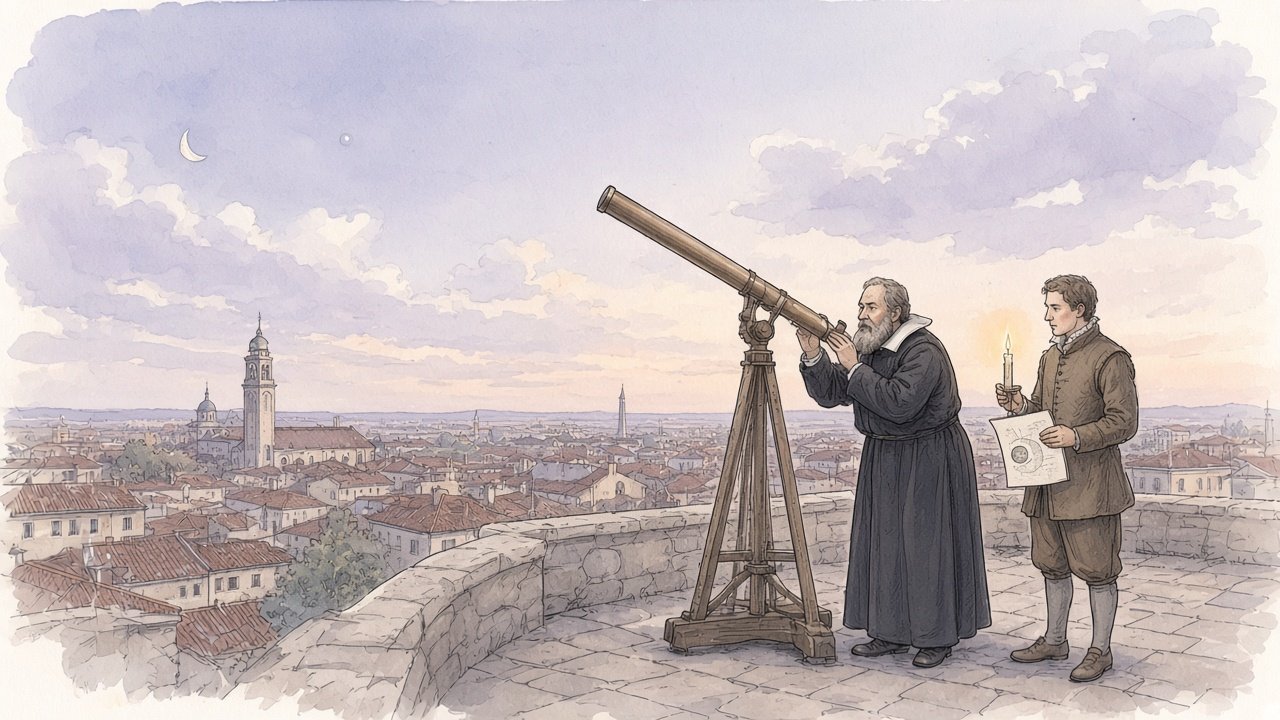
In the summer of 1609 Galileo Galilei, professor of mathematics at the University of Padua, heard that a device had been made in the Netherlands which caused distant objects to appear near. Within weeks he had built one himself, and within months he had improved it to a magnifying power that no one else could match. Late in 1609 and early in 1610 he turned it towards the sky and saw things that no one had seen before: mountains and valleys on the Moon, multitudes of stars invisible to the naked eye, and four small bodies moving around the planet Jupiter. He published these observations in March 1610 in a short book, the Sidereus Nuncius, or Starry Messenger, and it made him famous across Europe. Later in 1610 he observed the phases of Venus, which provided strong evidence that Venus circles the Sun. This article describes the origins of the telescope, the instruments Galileo built and how they worked, the observations he made with them and the manner in which he reported them, and the debates that followed, which led eventually to his trial in Rome in 1633.
Galileo before the Telescope
Galileo was born in Pisa on 15 February 1564, the eldest son of Vincenzo Galilei, a musician and writer on musical theory who had conducted experiments on the relation between the tension of strings and the pitch they produce. The family moved to Florence in the early 1570s. Galileo entered the University of Pisa in 1581 to study medicine, but he became absorbed in mathematics, which he studied privately with Ostilio Ricci, a mathematician associated with the Tuscan court, and he left the university without a degree in 1585.
Over the next few years he taught mathematics privately in Florence and Siena, wrote on the hydrostatic balance and on the centres of gravity of solids, and gained the patronage of influential figures, among them the Marquis Guidobaldo del Monte. In 1589 he was appointed to the chair of mathematics at Pisa, and in 1592 he moved to the more prestigious and better paid chair of mathematics at the University of Padua, in the territory of the Republic of Venice. He remained in Padua for eighteen years, which he later described as the happiest of his life.
At Padua Galileo lectured on Euclid, on the sphere and on the astronomy of Ptolemy, as the curriculum required. Privately he carried out his studies of motion, investigating the fall of bodies, the motion of pendulums and the paths of projectiles. He also ran a workshop in his house where an instrument maker, Marcantonio Mazzoleni, built devices for sale, including a calculating instrument known as the geometric and military compass, for which Galileo wrote a manual in 1606. The workshop and its craftsman would be important when the telescope arrived.
Galileo’s commitment to the heliocentric system of Copernicus before 1609 is attested chiefly in private letters. In 1597 he wrote to Johannes Kepler, who had sent him his Mysterium Cosmographicum, that he had for many years accepted the Copernican view but had not dared to publish his reasons for fear of ridicule. In 1604, when a new star appeared in the constellation Ophiuchus, Galileo gave public lectures arguing that its absence of parallax placed it far beyond the Moon, contrary to the Aristotelian doctrine that the heavens were unchangeable. These were the extent of his public engagements with cosmology before the telescope.
The Dutch Spyglass
Spectacle lenses had been made in Europe since the late thirteenth century, convex lenses for the farsighted and later concave lenses for the nearsighted. Why no one combined them into a telescope before the early seventeenth century has been much discussed. Part of the answer lies in the quality of the glass and the grinding: an effective telescope requires an objective lens of long focal length and good optical figure, and an eyepiece of short focal length, and the lenses made for spectacles were not suited to the purpose without deliberate selection or modification.
The first documented record of a telescope is a patent application submitted on 2 October 1608 to the States General of the Netherlands in The Hague by Hans Lipperhey, a spectacle maker of Middelburg in Zeeland. Lipperhey described an instrument for seeing things far away as if they were nearby. Within weeks, other claimants appeared, among them Jacob Metius of Alkmaar, and the States General declined to grant a patent on the ground that the device was already known to others and easily copied. They did, however, pay Lipperhey to make several instruments for the government, including binocular versions. A diplomatic newsletter describing the demonstration of the device at The Hague, in the presence of the Dutch military leader Prince Maurice of Nassau and envoys of the King of Siam, circulated in Europe in late 1608, and by the spring of 1609 small spyglasses were being sold in Paris, and soon in Italy and elsewhere.
These early instruments combined a convex objective lens with a concave eyepiece, an arrangement that gives an upright image. They typically magnified about three times. They were valued as curiosities and as aids to military and naval observation, since a commander who could see an approaching fleet or army sooner than an enemy could see his own gained an advantage.
Galileo Builds a Telescope
Galileo’s own account, given in the Sidereus Nuncius, states that about ten months before the book’s publication, which places the event in May or June 1609, a report reached him that a certain Dutchman had made a spyglass. Shortly afterwards he received confirmation of the report from Jacques Badovere, a former pupil in Paris. Galileo set himself to work out the principle of the instrument and arrived, he wrote, through the theory of refraction, at a design using a convex and a concave lens in a lead tube. His first instrument magnified about three times. He then made a second of about eight or nine times.
In August 1609 Galileo travelled to Venice and demonstrated his eightfold telescope to the members of the Venetian Senate. Senators climbed the bell tower of St Mark’s to look at ships approaching the harbour, which they could see two hours or more before they could be seen with the naked eye. Galileo presented the instrument to the Doge, and the Senate responded by confirming him in his professorship for life with a substantial increase of salary. The episode was later the source of some resentment when it became clear that telescopes were neither as rare nor as difficult to make as the Senate may have been led to believe, and the terms of the salary increase were less generous in their details than Galileo had expected.
Galileo continued to improve his instruments. The magnifying power of a telescope of the Dutch type is the ratio of the focal length of the objective to the focal length of the eyepiece. To raise the magnification he needed objective lenses of longer focal length, ground with a shallow curvature to a precise figure, and eyepieces of shorter focal length. He ground his own lenses, selected glass of good quality, and discarded a large proportion of the lenses he made. By the end of 1609 he had an instrument that magnified about twenty times. In the Sidereus Nuncius he reported that he had made an instrument which magnified almost a thousand times in area, or more than thirty times in linear dimension, and two of his surviving telescopes, now held at the Museo Galileo in Florence, magnify about fourteen and twenty-one times.
How Galileo’s Telescope Worked
The optical arrangement that Galileo used, now known as the Galilean telescope, consists of a convex objective lens and a concave eyepiece placed before the objective’s focus. Light from a distant object, refracted by the objective, converges towards an image. Before it reaches that image it is intercepted by the concave eyepiece, which diverges it again so that it leaves the eyepiece in parallel bundles that the relaxed eye can bring to a focus. The image is upright, which is convenient for terrestrial viewing, and the tube is shorter than the focal length of the objective by the focal length of the eyepiece.
The Galilean design has a significant limitation. Its field of view is narrow, and it narrows further as the magnification increases, because the bundles of light from objects away from the centre of the field diverge after the eyepiece and miss the pupil of the eye. With his twentyfold telescope Galileo could see only about a quarter of the Moon’s disc at one time. The objective lenses also suffered from aberrations. Spherical aberration, which arises because a spherical surface does not bring all rays to the same focus, and chromatic aberration, which arises because glass refracts light of different colours by different amounts, blurred the image and fringed bright objects with colour. Galileo reduced these effects by placing a cardboard aperture stop over the objective, reducing its effective diameter. This improved the image but reduced the amount of light gathered.
In 1611 Kepler described a different arrangement with two convex lenses, which gives an inverted image but a much wider field of view and allows the inclusion of crosshairs and measuring scales at the internal focus. This design, discussed in the article on Kepler and the Laws of Planetary Motion, displaced the Galilean form for astronomy by the middle of the seventeenth century.
The Face of the Moon
Galileo began systematic observation of the Moon in late November or early December 1609. Others had looked at the Moon with telescopes before him. The English mathematician Thomas Harriot made a drawing of the Moon with a sixfold telescope on 26 July 1609, several months before Galileo, and he made further drawings in later years. Harriot did not publish his observations, and his first drawing shows the boundary between light and dark without interpreting its irregularities.
Galileo, who had been trained in drawing and in the representation of light and shadow, interpreted what he saw in physical terms. He observed that the boundary between the illuminated and dark parts of the Moon, the terminator, was not a smooth curve but an irregular, jagged line. Bright points appeared in the dark region beyond the terminator and grew and merged with the illuminated part as the Moon’s phase advanced, exactly as the peaks of mountains on Earth are lit by the rising Sun before the valleys below them. Dark spots within the bright region had their shadowed sides towards the Sun and their bright sides away from it, as hollows on Earth have at sunrise. He concluded that the surface of the Moon was not smooth and perfectly spherical, as the Aristotelian philosophy taught, but rough and uneven, covered with mountains and depressions like the surface of the Earth.
Galileo went further and estimated the height of the lunar mountains. Measuring the distance of an illuminated peak from the terminator as a fraction of the Moon’s diameter, and using simple geometry with the Moon’s radius, he calculated that some lunar mountains rose to a height of about four Italian miles, roughly six or seven kilometres. Modern measurements show that the highest relief on the Moon is of that order.
He also explained the faint glow visible on the dark part of the crescent Moon, called earthshine or the ashen light. Earlier explanations had attributed it to the Moon’s own light or to light passing through it from the Sun. Galileo argued that it was sunlight reflected from the Earth onto the Moon, and that it was brightest when the Moon was a thin crescent because at that time the Earth, as seen from the Moon, was nearly full. Leonardo da Vinci had given the same explanation in his notebooks a century earlier, but his notes were unpublished. The explanation implied that the Earth shines in the sky of the Moon as the Moon shines in the sky of the Earth, a point that Galileo used to argue that the Earth was a celestial body like the others.
The wash drawings of the Moon that Galileo made, six of which survive in a manuscript in the National Central Library in Florence, and the engravings based on them in the Sidereus Nuncius, are among the first representations of a celestial body as a physical landscape. The engravings exaggerate the size of one large crater near the terminator, a feature that has been discussed by historians as an attempt to illustrate the phenomenon of shadowing clearly rather than to map the Moon precisely.
Innumerable Stars
When Galileo turned his telescope to the fixed stars, he found that it revealed vast numbers of stars too faint to be seen without it. In the belt and sword of Orion, where the naked eye sees a handful of stars, he counted more than eighty and drew them in the Sidereus Nuncius. In the Pleiades, where the naked eye typically sees six or seven, he drew thirty-six. He reported that the Milky Way, whose nature had been debated since antiquity, was nothing but a mass of innumerable stars gathered together in clusters, and that certain nebulous patches in the sky resolved likewise into groups of small stars.
He also noted a difference between the appearance of the planets and the fixed stars in the telescope. The planets appeared as small round discs, like little moons, whereas the fixed stars were not much magnified and continued to appear as sparkling points. He drew from this the inference that the stars were at an immense distance compared with the planets. It is now known that the stars appear as points because their angular sizes are far below the resolving power of any telescope of the period; the small discs that early observers sometimes reported around bright stars were an optical effect of the instrument and the atmosphere.
The Moons of Jupiter
The discovery that made the greatest impression came on 7 January 1610, when Galileo observed Jupiter and noticed three small bright stars close to the planet, two to the east and one to the west, lying in a straight line parallel to the ecliptic. The following night all three were to the west of Jupiter. He first supposed that Jupiter had moved relative to the stars, but this would have required the planet to be moving in the opposite direction to that predicted by the astronomical tables. On 10 January only two of the small stars were visible, both to the east. Observing night after night, Galileo found that the small stars changed position relative to Jupiter in a way that could only be explained if they were moving around it, and on 13 January he saw a fourth. He concluded that four bodies orbited Jupiter as the Moon orbits the Earth.
He recorded the positions of the four satellites on every clear night through January, February and the first days of March 1610, and published these observations in the Sidereus Nuncius as a series of small diagrams, each showing Jupiter and its companions on a given night. From the records he inferred that the satellites moved in orbits of different sizes, the innermost moving fastest, and he estimated some of their periods.
Galileo was at this time seeking a position at the court of Tuscany, whose young Grand Duke, Cosimo II de’ Medici, had been his pupil. He named the four satellites the Medicean Stars, the Medicea Sidera, in honour of Cosimo and his three brothers, and dedicated the Sidereus Nuncius to the Grand Duke. The names by which the satellites are now known, Io, Europa, Ganymede and Callisto, were proposed by the German astronomer Simon Marius, who claimed to have observed them independently at about the same time, and they came into general use in the twentieth century. The four are collectively called the Galilean moons.
The significance of the discovery for the Copernican debate was considerable. One of the objections to the heliocentric system was that the Moon would be left behind if the Earth moved around the Sun; another was that the Earth, in the Copernican system, was a unique body with a satellite of its own, unlike any other planet. Jupiter, which all parties agreed was moving, whether around the Earth or the Sun, was now seen to carry four satellites with it. The discovery did not prove the Copernican system, since the same phenomenon could be accommodated within the system of Tycho Brahe, but it removed an objection and demonstrated that the Earth was not the only centre of motion in the universe.
The Sidereus Nuncius
Galileo wrote the Sidereus Nuncius rapidly. The last observation of Jupiter it reports was made on 2 March 1610, and the book was printed in Venice by Tommaso Baglioni and published on 13 March, in an edition of 550 copies. It was written in Latin, the language of European learning, and was short, about sixty pages, with illustrations of the Moon and the star fields and the diagrams of Jupiter’s satellites. Its title page announced great and marvellous sights, observed with a spyglass lately devised by Galileo. The phrase was ambiguous enough to suggest that Galileo had invented the instrument, although in the text he acknowledged that it had first been made in the Netherlands.
The book sold out within a week, and news of it spread across Europe in months. The English ambassador in Venice, Sir Henry Wotton, sent a copy to King James I on the day of publication with a letter describing its contents. Galileo sent telescopes to princes and patrons so that they could see the satellites for themselves. In the summer of 1610 he obtained the position he sought, being appointed chief mathematician of the University of Pisa, without obligation to teach, and philosopher and mathematician to the Grand Duke of Tuscany. He left Padua and moved to Florence in September 1610.
Doubts and Confirmation
The claims of the Sidereus Nuncius were not at once accepted. Many who looked through the telescopes of the period saw little, because the instruments were difficult to use, their fields of view were narrow, and inexperienced observers did not know what they were looking for. Some scholars refused to look through the instrument at all. Others questioned whether the telescope could be trusted to show what was really in the heavens rather than illusions produced by the lenses. In April 1610 Galileo demonstrated his telescope at Bologna to a group of scholars, several of whom reported that they could not see the satellites, and a young Bohemian assistant of the astronomer Giovanni Antonio Magini, Martin Horky, published a pamphlet attacking the discovery.
Galileo’s most important early supporter was Kepler, who as imperial mathematician in Prague held a position of great authority. Without having yet seen the satellites, Kepler published in April 1610 his Dissertatio cum Nuncio Sidereo, a conversation with the Starry Messenger, endorsing Galileo’s claims on the basis of his trust in Galileo and the coherence of the observations. In August and September 1610 he observed the satellites himself with a telescope that Galileo had sent to the Elector of Cologne, and he published a report confirming them in 1611.
The most consequential confirmation came from the Jesuit astronomers of the Collegio Romano in Rome, led by Christopher Clavius, the principal author of the Gregorian calendar reform of 1582. After initial scepticism, the Jesuit astronomers obtained telescopes good enough to see the satellites late in 1610, and in the spring of 1611, when Galileo visited Rome, they formally confirmed to Cardinal Robert Bellarmine that Jupiter had four satellites, that the Moon appeared rough and uneven, and that Venus showed phases, though they expressed reservations about Galileo’s interpretation of the lunar surface. During the same visit Galileo was admitted to the Accademia dei Lincei, a scientific academy founded by Prince Federico Cesi. It was at a banquet held by the academy in Galileo’s honour in April 1611 that the word telescope, from the Greek for far-seeing, was proposed as a name for the instrument.
The Phases of Venus
In the autumn of 1610, after his move to Florence, Galileo began observing Venus as it emerged from behind the Sun into the evening sky. He found that its appearance in the telescope changed over the following months. At first it appeared as a small, nearly round disc. As it moved farther from the Sun in the sky and then began to approach it again, it became larger and took on the shape of a half-disc and then a thin crescent, like the Moon in its phases. Galileo announced the discovery to Kepler in December 1610 in the form of a Latin anagram, a common device of the period that allowed a discoverer to establish priority without revealing the discovery before he had confirmed it. The solution, sent in January 1611, read in translation that the mother of loves imitates the shapes of Cynthia, meaning that Venus shows the phases of the Moon.
The observation was of great importance. In the Ptolemaic system Venus moved on a small circle, its epicycle, whose centre always lay on the line between the Earth and the Sun, with Venus always between the Earth and the Sun. In that arrangement Venus could show only crescent phases and never appear full or nearly full. The observed full range of phases, together with the change in apparent size, in which Venus appeared largest when it was a crescent and smallest when it was nearly full, showed that Venus moved around the Sun, passing behind it at some times and in front of it at others. The Ptolemaic arrangement of Venus could not survive this evidence. It remained compatible, however, with the Tychonic system, in which Venus orbits the Sun while the Sun orbits the Earth, and the observation thus narrowed rather than settled the debate between the Copernican and Tychonic systems.
Saturn and the Sunspots
In July 1610 Galileo observed that Saturn did not appear as a single round disc but as a central body with two smaller bodies attached on either side. He announced the observation in another anagram, meaning that he had observed the highest planet to be triple. In 1612 the side bodies disappeared, to his considerable puzzlement, and later reappeared. The explanation, that Saturn is surrounded by a thin flat ring which is seen edge-on at certain times, was given by Christiaan Huygens in 1659 with the aid of a better telescope.
Galileo also observed dark spots on the face of the Sun, by projecting its image through the telescope onto a sheet of paper, a method developed by his pupil Benedetto Castelli that avoided looking at the Sun directly. Sunspots had been seen occasionally with the naked eye for centuries, and in 1611 several observers, among them Thomas Harriot, Johannes Fabricius and the Jesuit Christoph Scheiner, were observing them with telescopes. Scheiner argued that the spots were small bodies orbiting close to the Sun, which preserved the perfection of the Sun itself. Galileo, in his Letters on Sunspots published by the Lincean Academy in 1613, argued that the spots were on or very near the surface of the Sun, that they changed in shape and size and appeared and disappeared, and that their movement across the disc showed that the Sun rotated on its axis. The dispute with Scheiner over priority and interpretation was bitter and contributed to the hostility that Galileo later encountered among some Jesuits. In the Letters on Sunspots Galileo for the first time declared his support for the Copernican system in print.
The Copernican Controversy
The telescope had transformed the debate over the structure of the cosmos. By 1613 Galileo was openly advocating the Copernican system, and his advocacy brought him into conflict with those who held that it contradicted passages of scripture which speak of the motion of the Sun and the stability of the Earth. In a letter of 1613 to his former pupil Benedetto Castelli, and in an expanded version addressed in 1615 to the Grand Duchess Christina of Lorraine, the mother of Cosimo II, Galileo argued that scripture was not intended to teach natural philosophy, that it spoke in the language of ordinary appearance, and that where demonstrated knowledge of nature appeared to conflict with the literal meaning of a scriptural passage, the passage should be interpreted in a manner consistent with that knowledge.
In February 1616 a commission of theologians advising the Holy Office in Rome declared the proposition that the Sun stands still at the centre of the world to be foolish and absurd in philosophy and formally heretical, and the proposition that the Earth moves to be at least erroneous in faith. On 26 February Cardinal Bellarmine, acting on the instructions of Pope Paul V, informed Galileo that he must abandon the opinion. On 5 March the Congregation of the Index suspended Copernicus’s De revolutionibus until corrected and prohibited other books that taught the motion of the Earth as true. Galileo himself was not named in the decree.
For several years Galileo avoided the subject in public. In 1623 a cardinal who had shown interest in his work, Maffeo Barberini, was elected pope as Urban VIII, and Galileo, encouraged by the change, began writing a book comparing the Ptolemaic and Copernican systems. The Dialogue Concerning the Two Chief World Systems, written in Italian in the form of a conversation over four days between three characters, was published in Florence in 1632 after receiving licences from the ecclesiastical censors. In it Galileo drew on his telescopic discoveries, his work on motion and an argument from the tides, which he believed demonstrated the Earth’s motion but which was incorrect.
The Dialogue was received in Rome as a defence of the Copernican system rather than the hypothetical discussion that Galileo had been permitted to write. A record was found in the files of the Holy Office of an injunction of 1616 forbidding Galileo to hold, teach or defend the Copernican opinion in any way, a document whose exact terms and status have been much debated by historians. Galileo was summoned to Rome, tried by the Holy Office in 1633, found vehemently suspect of heresy and required to abjure the Copernican opinion. He was sentenced to imprisonment, which was commuted to house arrest, and spent the rest of his life at his villa at Arcetri near Florence. There he completed the Discourses and Mathematical Demonstrations Relating to Two New Sciences, his work on the strength of materials and the motion of falling bodies and projectiles, published in Leiden in 1638. He became blind in 1638 and died at Arcetri on 8 January 1642.
Later Telescopes and Galileo’s Legacy
The telescopes of the seventeenth century grew rapidly in size and power after Galileo’s time. Astronomers found that chromatic and spherical aberration could be reduced by making objective lenses with very long focal lengths, and by the 1660s observers such as Johannes Hevelius in Danzig and Christiaan Huygens in The Hague were using refractors many metres long. Isaac Newton built a reflecting telescope with a curved metal mirror in 1668, avoiding chromatic aberration altogether. Achromatic lenses, combining two kinds of glass, were developed in England in the 1730s and 1750s. Each step extended the range of observation, and the history of the instrument from Galileo’s tube to orbiting observatories is traced in part in the articles on The Hubble Telescope and The James Webb Space Telescope.
The Galilean moons themselves continued to serve science. Because their eclipses by Jupiter could be predicted and observed from anywhere on Earth, Galileo proposed in 1612 that they could serve as a universal clock for finding longitude at sea, and he spent years trying to persuade the Spanish and Dutch governments to adopt the method. It proved impractical on a moving ship, but it was used successfully on land in the later seventeenth century to improve maps. The eventual solution to the longitude problem at sea is discussed in the article on Harrison’s Marine Chronometer and the Longitude Problem. In 1676 the Danish astronomer Ole Rømer, working at the Paris Observatory, noticed that the eclipses of Io occurred earlier than predicted when the Earth was approaching Jupiter and later when it was receding, and he explained the discrepancy by the finite speed of light, making the first estimate of that speed.
In the twentieth century spacecraft visited the Galilean moons. The Voyager probes, described in the article on The Voyager Probes, photographed active volcanoes on Io in 1979, and the Galileo spacecraft, named after the astronomer, orbited Jupiter from 1995 to 2003 and gathered evidence that Europa, Ganymede and Callisto may possess liquid water oceans beneath their surfaces.
In 1992, following the work of a commission established by Pope John Paul II in 1981, the pope addressed the Pontifical Academy of Sciences and acknowledged that the theologians who condemned Galileo had erred in their understanding of the relation between scripture and natural knowledge.
Assessment
Galileo did not invent the telescope, and he was not the only person in 1609 and 1610 to point one at the sky. His achievement lay in a combination of qualities. He improved the instrument by his own craftsmanship to a level that others could not at first match, he observed systematically and recorded what he saw with care, he interpreted his observations in physical terms with a draughtsman’s understanding of light and shadow, and he published them quickly and persuasively in a form that reached the whole learned world. The discoveries of 1609 and 1610 did not by themselves prove that the Earth moves. They showed, however, that the heavens were not as the traditional philosophy described them, that the Moon was a world with mountains, that the Milky Way was made of stars, that Jupiter carried moons, and that Venus circled the Sun. They established the telescope as the principal instrument of astronomy, a position it has held ever since.
Further Reading
The principal sources for this article include the Grokipedia entries linked in the text and the following: the entry on Galileo Galilei in the Stanford Encyclopedia of Philosophy; the collections and online catalogue of the Museo Galileo in Florence, which holds two of Galileo’s telescopes; and the Library of Congress digital exhibition material on Galileo and the telescope. The work of Galileo’s contemporary and correspondent is described in the article on Kepler and the Laws of Planetary Motion.