IG Farben, the Rise and Dissolution of the German Chemical Combine
On 2 December 1925 the Badische Anilin- und Soda-Fabrik in Ludwigshafen changed its name to I.G. Farbenindustrie Aktiengesellschaft and absorbed five of the largest chemical manufacturers in Germany, with a sixth group of firms following as subsidiaries. The new company was for two decades the largest chemical enterprise in Europe and one of the largest industrial corporations in the world. It made dyes, fertiliser, synthetic fuel, synthetic rubber, plastics, photographic film and medicines, and it employed several Nobel laureates. Under National Socialism it became a central supplier to the German war economy, built a factory at Auschwitz worked by concentration camp prisoners, and held a share in the firm that sold Zyklon B. After 1945 the Allies seized it and broke it up, its directors were tried at Nuremberg, and the successor companies became the modern BASF, Bayer and Hoechst. The shell of the original company remained in liquidation until 2012. This is an account of that history from the dye works of the 1860s to the final deletion of the company from the commercial register[1, 3, 4].
Key findings
- IG Farben was formed in December 1925 from BASF, Bayer, Hoechst, Agfa, Griesheim-Elektron and Weiler-ter-Meer, with Cassella and Kalle as majority-owned subsidiaries. It followed two earlier profit-sharing associations of 1904 and the wider community of interest of 1916[1, 3].
- The company’s research produced the industrial synthesis of ammonia, high-pressure hydrogenation of coal to petrol, Buna synthetic rubber, polystyrene and polyurethane, Agfacolor film, magnetic recording tape and the sulphonamide drug Prontosil. Carl Bosch and Friedrich Bergius shared the 1931 Nobel Prize in Chemistry and Gerhard Domagk was awarded the 1939 prize in medicine[10, 12, 15, 16].
- From 1941 the company built a synthetic rubber and fuel plant at Auschwitz. Prisoners from the main camp and from the company’s own camp at Monowitz, opened in October 1942, were used as labour. Estimates of the number who died range from about 10,000 to 25,000 or more, and the plant never produced synthetic rubber[18, 19].
- IG Farben owned 42.5 per cent of Degesch, the firm that held the rights to the pesticide Zyklon B. The SS used the product to murder people in the gas chambers of Auschwitz-Birkenau and other camps[21, 22].
- In the Nuremberg IG Farben trial of 1947 and 1948, 23 executives were tried. Thirteen were convicted, on counts of plunder or slavery and mass murder, and received sentences of between eighteen months and eight years. All were released by early 1951[23, 24].
- The Allies ordered the company’s seizure in 1945 and divided its western assets in the early 1950s, chiefly between BASF, Bayer and Hoechst. The residual company, IG Farbenindustrie AG in Abwicklung, survived as a listed shell, entered insolvency in 2003 and was removed from the commercial register in 2012[1, 7].
Coal tar and colour
The industry from which IG Farben grew began with a chemical accident in London. In 1856 William Henry Perkin, an eighteen-year-old student of August Wilhelm Hofmann at the Royal College of Chemistry, was trying to synthesise quinine from coal-tar derivatives. He obtained instead a dark residue which, dissolved in alcohol, gave a strong purple colour that dyed silk well and did not fade quickly in light. Perkin patented the substance, which came to be called mauveine, and with his father and brother set up a factory at Greenford to make it. Within a few years other chemists had found further dyes in the same family of compounds, among them fuchsine, aniline blue and the first of the aniline blacks[31].
Coal tar was in plentiful supply. It was the thick black by-product of making town gas, and the gasworks of the mid-nineteenth century had more of it than they could sell. Distillation separated it into fractions containing benzene, toluene, naphthalene, anthracene and phenol, and these could be nitrated, reduced, sulphonated and coupled into an almost unlimited range of coloured molecules. The work called for a new kind of chemist, trained in the structural theory being developed in the 1850s and 1860s by Kekulé, Couper and others, and it called for laboratories where many related compounds could be made and compared[4].
Britain and France led at first, but within twenty years the centre of the industry had moved to Germany. Several reasons have been given for this. The German universities and technical colleges were turning out large numbers of research chemists, many of whom had studied under Liebig, Hofmann, Kekulé or Baeyer. Hofmann himself returned from London to Berlin in 1865. The German states had no unified patent law until 1877, which allowed firms to copy foreign processes freely during the early years, and when the imperial patent law came, it protected processes rather than products, which encouraged firms to invent their own routes to known dyes. The firms themselves were founded by men who were prepared to employ salaried chemists in large numbers and to spend money on research whose returns were uncertain. By the 1880s the major German dye works had research laboratories on a scale that no other industry in the world could match[3, 4].
The products also changed. The first aniline dyes were bright but not always fast to light and washing, and the natural dyestuffs still dominated many markets. The decisive commercial step was the synthesis of the natural colours themselves. In 1868 Carl Graebe and Carl Liebermann, working in Berlin, determined the structure of alizarin, the red colouring matter of the madder root, and found a route to it from anthracene. Heinrich Caro of the Badische Anilin- und Soda-Fabrik worked out a practical process at almost the same time as Perkin in England, and the patents were filed within a day of each other in June 1869. Synthetic alizarin displaced madder cultivation in southern France and the Netherlands within about a decade. Indigo took longer. Adolf von Baeyer described its structure and a laboratory synthesis between 1878 and 1883, but it took BASF seventeen years and a very large sum of money before it brought synthetic indigo to market in 1897, using a route from naphthalene devised by Karl Heumann and improved in its works. Synthetic indigo, in turn, displaced most of the indigo grown in British India[3, 5].
By 1900 German firms made something like four-fifths of the world’s synthetic dyestuffs. A handful of companies accounted for most of that share, and six of them, together with two smaller firms, later formed IG Farben.
The founding firms
The largest and oldest of the eventual partners was the Badische Anilin- und Soda-Fabrik, known as BASF. It was founded in Mannheim in April 1865 by Friedrich Engelhorn, a jeweller and businessman who had already been making coal gas and tar dyes, and it moved almost at once across the Rhine to Ludwigshafen in the Bavarian Palatinate, where land was cheaper and the authorities more accommodating. As its name suggests, it was intended to make the inorganic chemicals the dye works needed, soda and acids, as well as the dyes themselves. Under Heinrich Caro, its first director of research, it developed alizarin, methylene blue and a series of azo dyes, and under Heinrich von Brunck and Rudolf Knietsch it industrialised the contact process for sulphuric acid and the synthesis of indigo. In the early twentieth century it was the company that took up Fritz Haber’s ammonia synthesis and, under Carl Bosch, turned it into an industrial process[5, 10, 33].
The second was Friedr. Bayer et comp., founded in Barmen in the Wupper valley in August 1863 by Friedrich Bayer, a dye merchant, and Johann Friedrich Weskott, a master dyer. The firm moved to Elberfeld in 1866 and in the 1890s began to build a new works on the Rhine at Wiesdorf, the site that became Leverkusen. Its rise in the late nineteenth century was associated with Carl Duisberg, a chemist who joined in 1884, developed a series of profitable dyes, and became in effect its chief executive. Duisberg reorganised the firm’s research into a central laboratory with a defined method, and he laid out the Leverkusen works as a planned industrial town. Bayer also moved early into medicines. In the 1890s it marketed phenacetin, the sedative sulphonal and, from 1898, diacetylmorphine under the trade name Heroin as a cough remedy. In 1899 it registered the name Aspirin for acetylsalicylic acid, prepared in a pure and stable form in its laboratories in 1897 and sold first as a powder and then as tablets. The name became one of the best known trade marks in the world[6, 32].
The third was the firm founded at Höchst am Main, west of Frankfurt, in January 1863 by Carl Friedrich Wilhelm Meister, Eugen Lucius and Ludwig August Müller, joined shortly afterwards by the chemist Adolf Brüning. Trading as Meister, Lucius & Brüning, it was known by the name of its town as the Farbwerke Hoechst. It made aniline dyes and alizarin, and from the 1880s it became the most important of the dye firms in pharmaceuticals. It produced the antipyretic antipyrine in 1884, the diphtheria antitoxin developed by Emil von Behring in the 1890s, the local anaesthetic procaine, sold as Novocain, in 1905, and in 1910 Salvarsan, the arsenical compound against syphilis discovered by Paul Ehrlich and Sahachiro Hata. Hoechst’s relationship with Ehrlich’s institute in Frankfurt was an early model of collaboration between a company and a research institution[7].
The fourth was the Actien-Gesellschaft für Anilin-Fabrikation, Agfa, of Berlin. It grew from a dye works founded in 1867 at Rummelsburg near Berlin by Paul Mendelssohn Bartholdy, a son of the composer, and the chemist Carl Alexander von Martius, and it became a joint-stock company in 1873. In the late 1880s Agfa began to make photographic chemicals, among them the developer Rodinal, introduced in 1891, and it moved on to dry plates, roll film and, in the twentieth century, cinema film made at its large works at Wolfen near Bitterfeld. Photography became its distinctive business[8].
The fifth and sixth members of the 1925 merger were firms whose main lines lay outside dyes. Chemische Fabrik Griesheim-Elektron, near Frankfurt, had grown from a chemical works founded in 1856 and was a pioneer of the electrolytic production of chlorine and caustic soda in the 1890s. It also developed the light magnesium alloys sold under the name Elektron, and its works at Bitterfeld in Saxony, built to use the cheap local brown coal for electricity, became one of the centres of German electrochemistry. Chemische Fabriken vorm. Weiler-ter Meer of Uerdingen, near Krefeld, had been founded in 1877 by Julius Weiler and Edmund ter Meer and made dyes and intermediates. Edmund ter Meer’s son Fritz ter Meer joined its board and later became one of the most senior technical directors of IG Farben[1, 3].
Two further firms were associated with Hoechst and became subsidiaries rather than full members. Leopold Cassella & Co., whose dye works at Fechenheim near Frankfurt dated from 1870, was the offshoot of a Frankfurt dyestuff trading house and was controlled by the families of Leo Gans and Arthur von Weinberg. Kalle & Co. of Biebrich, near Wiesbaden, founded in 1863, made dyes and later cellulose film products, including the Cellophane-type packaging film it sold as Cellophan and, from the 1920s, the copying papers sold under the name Ozalid[9].
Interessengemeinschaft
By the turn of the century the German dye industry was highly profitable but also highly competitive. Firms duplicated each other’s research, fought expensive patent actions, and cut prices in export markets. In 1903 Carl Duisberg travelled to the United States and saw at first hand the trusts formed by Standard Oil and the large industrial combinations then being built in American steel and other industries. On his return he wrote a memorandum proposing a merger of the leading German dye firms into a single company. The proposal was not accepted in that form, but it led to two looser associations in 1904[3, 6].
The first, often called the Dreibund, joined BASF, Bayer and Agfa in an Interessengemeinschaft, a community of interest. The members remained separate companies, but they agreed to pool profits according to a fixed ratio, to exchange information, and to coordinate sales and research. The second, the Dreiverband, joined Hoechst and Cassella through an exchange of shares, and Kalle joined it in 1907. These arrangements reduced competition among the members and allowed some rationalisation, but they stopped short of common ownership[1, 3].
The First World War changed the position. Germany’s dye exports were cut off by blockade, and the dye works turned to munitions, explosives and other war materials. Nitric acid for explosives was the most urgent need. The country’s supplies of Chilean nitrate were cut off, and the industrial ammonia synthesis that BASF had started at Oppau in 1913 was rapidly extended so that the ammonia could be oxidised to nitric acid. In 1916 and 1917 BASF built a second and much larger plant at Leuna, near Merseburg in Prussian Saxony, away from the French border. The dye firms also produced poison gases. Chlorine, released from cylinders at Ypres in April 1915 under the direction of Fritz Haber, came largely from the electrolytic plants of BASF, Bayer and Griesheim-Elektron, and phosgene and mustard gas followed[10, 11, 35].
In August 1916 the two associations and the two firms outside them, Griesheim-Elektron and Weiler-ter Meer, joined in a single larger community of interest, the Interessengemeinschaft der deutschen Teerfarbenfabriken. It had eight members, a common council, and a profit-pooling arrangement intended to last until 1999. The members kept their own boards, works and trade names. The wartime arrangement was meant in part to prepare for peace, since the firms expected to face renewed competition from British, French, Swiss and American dye industries that had grown during the war[1, 3].
Defeat, inflation and the road to merger
The peace was difficult for the German chemical firms. Under the Treaty of Versailles they lost their foreign subsidiaries and many foreign patents and trade marks. In the United States, the Alien Property Custodian sold the confiscated German chemical patents in 1919 to a newly formed body, the Chemical Foundation, which licensed them to American firms. Bayer lost the rights to its name and its cross trade mark in the United States and in several other countries, and the American aspirin business passed to Sterling Products. The Allies demanded reparations deliveries of dyes and pharmaceuticals, and in 1923 French and Belgian troops occupied the Ruhr and the Rhineland bridgeheads, interrupting work at Ludwigshafen and Leverkusen. In 1921 a large explosion of ammonium sulphate nitrate fertiliser at Oppau destroyed much of the works and killed more than five hundred people[6, 11].
At the same time the competitive position had shifted. The war had created domestic dye industries in Britain, the United States, France and Japan, protected by tariffs and licensing schemes. German exports recovered in the 1920s but did not regain their pre-war share. The German firms had also invested heavily during the war in nitrogen fixation, which promised large future revenues but needed further capital. Duisberg and Bosch, the two most influential figures in the community of interest, disagreed on the best structure. Duisberg favoured a holding company that would preserve the individual firms. Bosch wanted a full merger that would allow the combined enterprise to finance large new projects, in particular his plans for the hydrogenation of coal to motor fuel. Bosch’s view prevailed, though the outcome was a compromise in its details[1, 3, 10].
The merger was carried out in the autumn of 1925. Legally it took the form of an absorption. BASF, the largest of the firms, increased its capital, renamed itself I.G. Farbenindustrie Aktiengesellschaft and moved its registered office to Frankfurt am Main. Bayer, Hoechst, Agfa, Griesheim-Elektron and Weiler-ter Meer transferred their assets to it in exchange for shares. Cassella and Kalle remained separate companies but under IG Farben’s majority control, and several other firms, including the explosives maker Dynamit AG, were closely associated with it. The merger was entered in the commercial register on 2 December 1925 and dated retrospectively from the start of that year. The new company had a share capital of about 1.1 billion Reichsmarks after a further increase in 1926, and it employed more than 80,000 people[1, 3].
The leadership reflected the balance between the founders. Carl Bosch became chairman of the managing board, the Vorstand, and Carl Duisberg chairman of the supervisory board, the Aufsichtsrat. Beneath them sat a large and at first unwieldy managing board of more than eighty members drawn from the old firms, and a smaller working committee, the Arbeitsausschuss, through which business was actually conducted. Over the following years the company was divided into three main operating divisions, Sparten. Sparte I, under Bosch’s associates at Ludwigshafen and later under Carl Krauch, was responsible for nitrogen, fuel and high-pressure chemistry. Sparte II, under Fritz ter Meer, covered dyes, organic intermediates, pharmaceuticals, solvents and plastics. Sparte III, based in Berlin, handled photography and artificial fibres. Alongside the divisions there were regional works groups, Betriebsgemeinschaften, centred on the Upper Rhine, the Lower Rhine, the Main, Central Germany and Berlin, and central sales organisations for dyes, chemicals, pharmaceuticals and nitrogen[1, 2, 3].
Dyes and the high-pressure inheritance
Dyestuffs remained the commercial base of the company for most of its existence, even when they no longer provided most of its growth. IG Farben inherited from its founders a catalogue of several thousand colours and a technical service network that advised textile mills around the world on their use. Among the most valuable lines were the vat dyes of the Indanthren range, developed at BASF from 1901 onwards, which were exceptionally fast to light and washing and were promoted to consumers with a trade mark guaranteeing colourfastness. The company also made the large intermediates on which the dye business depended, among them aniline, naphthalene derivatives, phthalic anhydride and the acids and alkalis needed in quantity for every stage[1, 4].
The largest single legacy, however, came from Ludwigshafen. The Haber-Bosch synthesis of ammonia, industrialised by BASF between 1909 and 1913, gave IG Farben the dominant position in German nitrogen fertiliser. Oppau and Leuna together made most of the country’s synthetic ammonia, which was converted into ammonium sulphate, sodium nitrate, calcium nitrate and urea for farmers and into nitric acid for explosives. The same engineering skills, the design of steel reactors able to withstand hydrogen at high pressures and temperatures, the production of pure synthesis gas, and the use of promoted catalysts found by systematic testing, became the basis of a family of further processes. In 1923 BASF began the high-pressure synthesis of methanol from carbon monoxide and hydrogen, and later in the decade it made higher alcohols by related routes. The catalyst research that underlay these processes was led for many years by Alwin Mittasch, who had tested thousands of compositions in the search for the ammonia catalyst before the First World War and who directed a large catalysis laboratory at Oppau in the 1920s. His group’s method, the systematic preparation and testing of large numbers of mixed oxides and metals under realistic conditions, was applied in turn to methanol, to the purification of synthesis gas, and to the hydrogenation catalysts described below. The engineering side was equally important. The high-pressure works at Oppau and Leuna had their own foundries, forges and workshops for reactors, compressors and valves, and the company trained its own specialists in the metallurgy of steels that would resist hydrogen at high temperature. Much of the later chemical engineering of the century, in Germany and elsewhere, drew on this experience.
The dangers of large-scale chemistry were also part of the inheritance. On 21 September 1921 a silo containing about 4,500 tonnes of a mixture of ammonium sulphate and ammonium nitrate exploded at Oppau when workers used small explosive charges to loosen the caked fertiliser, as had been done many times before without incident. The explosion killed 561 people, destroyed most of the works and much of the village, and left a crater about 125 metres long. The works were rebuilt within months, and the accident led to changes in the handling and composition of mixed fertilisers[10, 11].
Petrol from coal
The most ambitious of these processes was the hydrogenation of coal. Friedrich Bergius, a chemist working first in Hanover and then in Mannheim-Rheinau, had shown between 1910 and 1913 that coal dust mixed with heavy oil could be made to absorb hydrogen under pressure at around 400 to 500 °C, producing liquid hydrocarbons. He had patents but not the capital or the engineering resources to make the method work at scale. BASF acquired rights to the Bergius patents in 1925, shortly before the merger, and Bosch committed the new company to a large programme to produce motor fuel by this route at Leuna. The decision rested on a widely shared belief at the time that world petroleum reserves were limited and that oil prices would rise[10, 12].
The Leuna hydrogenation plant began production in 1927. The work was technically difficult. Matthias Pier and his colleagues at Ludwigshafen found that sulphur-resistant catalysts, chiefly based on molybdenum and tungsten compounds, were needed, and that the process worked best in two stages, a liquid phase in which the coal paste was hydrogenated and a vapour phase in which the middle oils were further converted into petrol. By 1931 Leuna had a capacity of about 100,000 tonnes of fuel a year. In the same year Bosch and Bergius shared the Nobel Prize in Chemistry for their contributions to the invention and development of chemical high-pressure methods[12, 14, 15].
The commercial calculation went wrong. Large discoveries of oil in Texas and elsewhere in the late 1920s caused prices to fall sharply, and the onset of the world depression made the position worse. Synthetic petrol from Leuna cost several times as much to make as imported fuel. For some years the management board debated whether to abandon the project. That it was continued owed something to Bosch’s personal commitment and something to the possibility that the state would protect the product[3, 12].
IG Farben also sought partners abroad. From 1927 it negotiated with Standard Oil of New Jersey, which was interested in hydrogenation as a way of upgrading heavy oils. Agreements signed in 1927, 1928 and 1929 gave Standard Oil the rights to the hydrogenation process outside Germany, in exchange for a share of Standard stock and a division of fields in which Standard undertook to stay out of chemicals and IG Farben out of oil. A jointly owned company, the Standard-IG Company, was formed to hold the patents, and in 1930 a second joint enterprise, the Joint American Study Company, known as Jasco, was set up to develop new processes, among them synthetic rubber. These arrangements later became the subject of investigations and litigation in the United States during the Second World War, when the patent exchanges were examined by Senate committees and the Justice Department[3, 34].
Cartels and the international market
The Standard Oil agreements were part of a wider pattern. Between the wars the international chemical industry was organised to a large extent through cartels and market-sharing agreements, which were lawful in most European countries and were regarded by many governments as a means of stabilising prices and employment. IG Farben was the most important participant in many of them. In 1927 it concluded an agreement with the French dye makers, and in 1929 the two were joined by the Swiss firms of Basel, which had themselves formed a community of interest, to create a continental dye cartel. Imperial Chemical Industries, formed in Britain in 1926, joined in 1932, making it in effect a four-party agreement that allotted export quotas in most of the world’s markets[3, 4].
Nitrogen was organised in a similar way. The collapse of fertiliser prices at the end of the 1920s, when new synthetic ammonia plants had come into production in Britain, France, Italy, Belgium, the Netherlands, Norway and the United States, led to the formation of an international nitrogen cartel in 1930, with the German producers, ICI and the Chilean nitrate industry as its principal members. The agreements fixed quotas and prices and were renewed with modifications through the 1930s. In magnesium, light metals, hydrogenation and several other fields, IG Farben exchanged patents and licences with British, American and other firms, among them ICI, DuPont, Dow and the aluminium producer Alcoa[3, 34].
These agreements served commercial purposes, but they also gave IG Farben a detailed view of the technology and capacity of its foreign competitors, and they later attracted the attention of governments. In the United States the Department of Justice brought antitrust actions in 1941 and 1942 against several American firms over their arrangements with the German company, and the Senate committee on national defence, chaired by Harry S. Truman, held hearings on the Standard Oil patent exchanges and their effect on the American synthetic rubber programme. After the war the cartel arrangements were described in the reports of American investigators and in the prosecution case at Nuremberg[3, 23, 34].
The company itself was organised on a scale that few European enterprises of the time approached. Its central administration in Frankfurt and Berlin supervised dozens of works, each with its own laboratories, and its research budget was among the largest of any private firm in the world. The company maintained the tradition of the founding firms by which chemists were hired in large numbers, assigned to defined problems, and expected to file patents in the company’s name. It ran its own technical schools, housing estates, sports clubs and works libraries, and at Leverkusen and Ludwigshafen the works dominated the towns that had grown up around them. Employment rose again after 1933 with rearmament and the autarky programmes, and continued to grow through the war years, when it included the foreign and forced labourers described below[1, 3].
Rubber, plastics and fibres
The company’s research covered a much wider field than fuel. Synthetic rubber had first been made in Germany during the First World War, when Bayer produced a few thousand tonnes of methyl rubber from dimethylbutadiene. The product was inferior and expensive and was abandoned after the war. In the late 1920s chemists at Leverkusen and Ludwigshafen returned to the problem using butadiene, which could be polymerised with sodium as a catalyst. The name Buna was formed from butadiene and Na, the chemical symbol of sodium. In 1929 Walter Bock and Eduard Tschunkur of IG Farben patented a copolymer of butadiene and styrene made by emulsion polymerisation, later sold as Buna S, and in the early 1930s Erich Konrad and Tschunkur produced a copolymer of butadiene and acrylonitrile, Buna N, which resisted oil and petrol. Buna S became the model for the styrene-butadiene rubbers that are still the most widely produced synthetic rubbers in the world[13].
Plastics came out of the same polymer chemistry. IG Farben began production of polystyrene at Ludwigshafen in 1930, and in the following years it developed plasticised polyvinyl chloride, sold under trade names including Igelit, polyvinyl acetate, polyacrylates and polyisobutylene, which was marketed as Oppanol. At Leverkusen in 1937 Otto Bayer and his colleagues discovered the polyaddition of diisocyanates to polyols, the basis of the polyurethanes, which later became one of the main classes of foam, coating and elastomer. In fibres, Paul Schlack at the Agfa works in Berlin-Lichtenberg found in January 1938 that caprolactam could be polymerised to a polyamide fibre comparable to the nylon that Wallace Carothers had developed at DuPont. The German product was sold as Perlon[4].
The photographic division produced another lasting innovation. In 1936 Agfa introduced Agfacolor Neu, a colour reversal film in which the colour couplers were incorporated in the emulsion layers, so that a single development process produced all three dye images. It was one of the first practical colour films of its kind and became the basis of a family of colour negative and print materials. In collaboration with the electrical company AEG, IG Farben’s Ludwigshafen works also made the first magnetic recording tape for the Magnetophon tape recorder, shown at the Berlin radio exhibition of 1935. The tape was first coated with carbonyl iron and then with iron oxide on a cellulose acetate base[4, 5].
Film and photography
Photographic materials formed a smaller but technically distinguished part of the combine. Agfa brought into IG Farben its film and paper works at Wolfen near Bitterfeld and its camera factory in Munich, and the photographic business was organised as a separate sales combine within the group. Wolfen became one of the largest film factories in Europe, producing cinema film, roll film, X-ray film and photographic papers. In 1936 Agfa introduced Agfacolor Neu, a colour reversal film in which the colour couplers were incorporated in the emulsion layers themselves, so that the film could be developed in a single process rather than requiring the dye couplers to be added during development. The principle, developed by the Agfa chemists Wilhelm Schneider and Gustav Wilmanns, became the basis of most later colour negative and colour print materials. From 1939 Wolfen also produced Agfacolor negative and positive film for the cinema, and the first German colour feature films were made on it in the early 1940s[1, 8].
After the war the division of Germany separated the business. The Wolfen works lay in the Soviet zone and continued as a state enterprise, which from 1964 sold its products under the name ORWO, while the western Agfa company was re-established at Leverkusen and Munich and later merged with the Belgian firm Gevaert in 1964 to form Agfa-Gevaert. The Agfacolor patents, seized as enemy property, were made available to Allied manufacturers and influenced colour film production in several countries[1, 8].
Medicines
The pharmaceutical research of IG Farben was concentrated at Elberfeld, in the former Bayer laboratories, and at Hoechst. Among its first important products were synthetic antimalarial drugs, developed because Germany depended on imported quinine. Plasmochin, also called pamaquine, was introduced in 1926, and atebrin, the drug known in Britain and the United States as mepacrine or quinacrine, followed in 1932. In 1934 Hans Andersag at Elberfeld synthesised a compound named Resochin, which was judged too toxic at first and was set aside. It was re-examined in the United States during the Second World War and became chloroquine, for decades the most widely used antimalarial in the world[4].
The best known discovery of the Elberfeld laboratories was the first of the sulphonamide drugs. Gerhard Domagk, who directed experimental pathology there, tested a series of azo dyes made by the chemists Fritz Mietzsch and Josef Klarer against bacterial infections in mice. In December 1932 he found that one of them, a red dye containing a sulphonamide group, protected mice against lethal streptococcal infection. It was patented and marketed as Prontosil, and Domagk published the results in 1935. Workers at the Pasteur Institute in Paris soon showed that the active substance was sulphanilamide, released from the dye in the body, a compound that was not patentable because it had been described in 1908. The sulphonamides were the first broadly effective antibacterial drugs and were widely used before penicillin became available. Domagk was awarded the Nobel Prize in Physiology or Medicine for 1939, but the German government had forbidden its citizens to accept Nobel prizes after the award of the 1935 Peace Prize to Carl von Ossietzky, and he was compelled to decline it. He received the diploma and medal in 1947[16, 17].
The building in Frankfurt
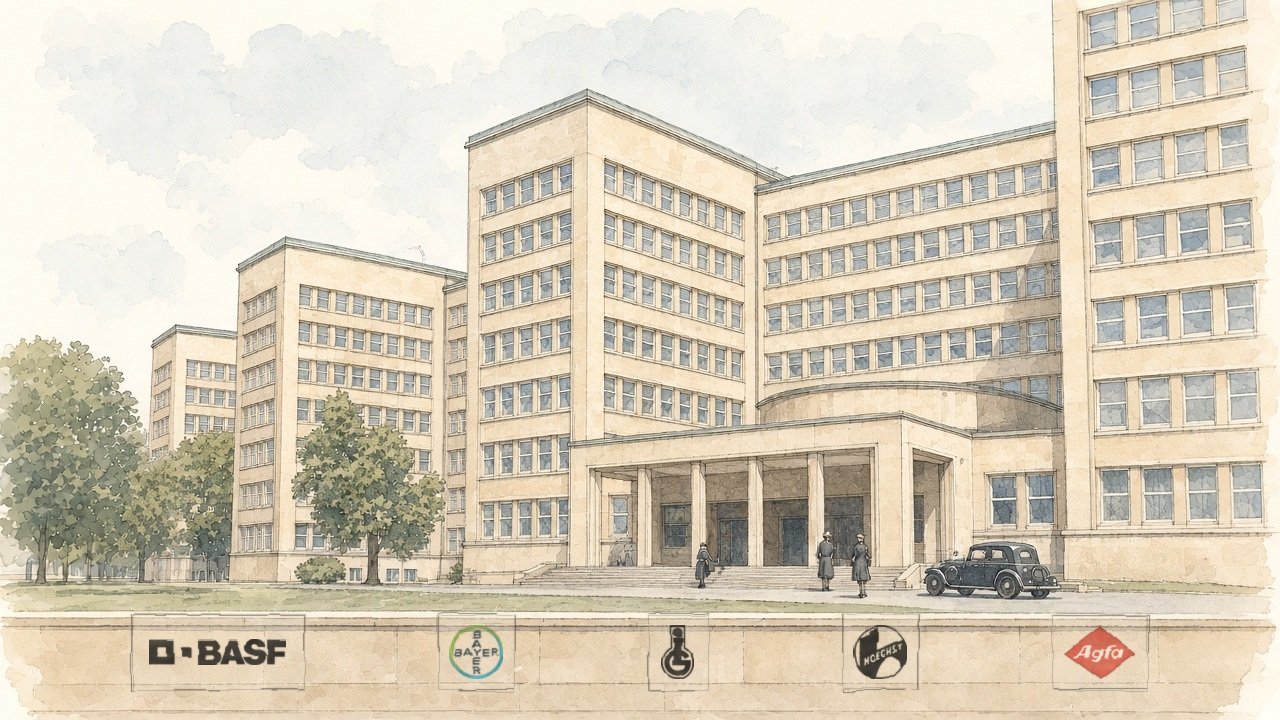
The company’s administrative centre was built in Frankfurt between 1928 and 1930 to designs by the architect Hans Poelzig. It stood on the site of a former estate in the Westend district and was, when completed, the largest office building in Europe. The structure, a steel frame clad in pale travertine, consists of six wings radiating from a long, gently curved central spine, with a columned entrance portico at the centre of the curve. The interior had paternoster lifts and a large open stairwell, and the grounds included a casino building and gardens. The building expressed the scale and self-confidence of the enterprise, and its sober, regular facades were admired by architectural critics at the time[26].
Depression and the political turn
The world depression hit IG Farben hard. Sales fell from about 1.4 billion Reichsmarks in 1929 to under 900 million in 1932, the workforce fell from more than 110,000 to around 70,000, and the hydrogenation programme continued to lose money. The company was not, during the Weimar years, closely associated with any one political party. Its directors held a range of views, several of them supported the liberal parties of the centre, and the National Socialists had attacked the company in their press as an example of international finance. Some of its senior figures were Jewish, or of Jewish descent, among them the brothers Arthur and Carl von Weinberg of Cassella and Otto von Mendelssohn Bartholdy of the Agfa founding family, all members of its supervisory board. Historians who have studied the company’s records, notably Peter Hayes, have described its relationship with the National Socialist movement before 1933 as cautious and divided rather than one of early support[2, 3].
In 1932 two IG Farben representatives, Heinrich Bütefisch and Heinrich Gattineau, met Adolf Hitler to discuss whether a National Socialist government would support synthetic fuel. They reported that it would. After Hitler became chancellor in January 1933, the company contributed 400,000 Reichsmarks to the fund raised from industrialists at a meeting with Hitler and Hermann Göring in Berlin on 20 February 1933, ahead of the March election. In December 1933 IG Farben and the Reich signed the so-called Benzinvertrag, the fuel agreement, under which the state guaranteed a price and a market for Leuna petrol for ten years in return for an expansion of capacity. The agreement secured the future of the hydrogenation project and tied the company more closely to the government’s economic and rearmament plans[2, 3].
The new regime’s racial laws reached into the company. Jewish members of its supervisory and managing boards, and Jewish employees in its offices and laboratories, were removed or forced out over the following years, a process completed by 1938. Carl Bosch, who had protested in person to Hitler in 1933 against the dismissal of Jewish scientists, lost influence with the government. When Duisberg died in March 1935, Bosch moved to the chairmanship of the supervisory board, and Hermann Schmitz, the company’s financial director, became chairman of the managing board. Bosch died in April 1940[2, 10].
The Four Year Plan
In 1936 Hitler issued a memorandum calling for the German army to be ready for war and the German economy to be capable of waging it within four years. The Four Year Plan that followed, placed under Hermann Göring, set out to make the country self-sufficient in fuel, rubber, textiles, fats and metals. IG Farben’s products and processes were central to it. Carl Krauch, head of Sparte I, joined Göring’s planning office, first as head of research and development and from 1938 as Göring’s plenipotentiary for special questions of chemical production. Krauch’s office, staffed in part by people seconded from IG Farben, drew up the programmes for fuel, explosives, synthetic rubber and chemical warfare agents, and much of the investment under those programmes went to IG Farben plants or to plants it designed and operated[2, 27].
The chemical expansion was very large. Hydrogenation plants were built at Pölitz, Scholven, Gelsenkirchen, Böhlen, Magdeburg, Lützkendorf and Brüx, several of them by mining and fuel companies under IG Farben licence. A first Buna plant at Schkopau, near Merseburg, came into operation in 1937, and a second was built at Hüls, near Marl in the Ruhr, from 1938. Plants for explosives and their intermediates were built and run through subsidiaries such as Anorgana and Luranil on terms that made the state the owner and the company the operator. By 1939 IG Farben had become the largest single private supplier of chemical materials to the German armed forces[2, 13, 14].
Military research also entered the company’s laboratories. In December 1936 Gerhard Schrader, working on organophosphorus insecticides at Leverkusen, synthesised a compound of extreme toxicity, later named tabun. Under a regulation then in force, the discovery was reported to the army, and Schrader went on to make sarin in 1938. A production plant for tabun was built at Dyhernfurth in Silesia from 1940 and operated by Anorgana. Several thousand tonnes of tabun were made and loaded into munitions during the war, but none was used in combat[28, 29].
Expansion with the Reich
As the German state expanded its territory from 1938 onwards, IG Farben acquired chemical businesses in the annexed and occupied countries. After the annexation of Austria in March 1938 it took control of the Skodawerke Wetzler at Moosbierbaum and other Austrian chemical firms. After the occupation of the Sudetenland and then of Bohemia and Moravia, it took over the dye and chemical works of the Verein für chemische und metallurgische Produktion at Aussig and Falkenau. In occupied Poland in 1939 and 1940 it took over the management, and later the ownership, of the three largest Polish dye works, Boruta, Wola and Winnica. In France it obtained a majority of a new company, Francolor, formed in 1941 from the dye plants of the leading French producers under an agreement negotiated with the Vichy authorities. In Norway it took a share in plans to expand Norsk Hydro’s production of light metals. These acquisitions were the main basis of the charge of plunder and spoliation brought against the company’s directors after the war[1, 2, 23].
During the war the company’s sales rose to about three billion Reichsmarks a year. Its works produced almost all of Germany’s synthetic rubber, methanol, lubricating oil and nickel, most of its synthetic fuel, nitrogen and plastics, and very large quantities of explosives intermediates. Like the rest of German industry, it came to depend on foreign labour as German workers were conscripted. Civilian workers recruited or compelled from occupied countries, prisoners of war, and later concentration camp prisoners were employed across its works. By 1944 a substantial share of its workforce consisted of foreign or forced labourers[1, 2].
Auschwitz
The best documented and most consequential of IG Farben’s wartime projects was the factory it built near the town of Oświęcim, called Auschwitz in German, in the part of Polish Upper Silesia annexed to the Reich in 1939. In late 1940 the company was under pressure from the Reich to build a fourth Buna plant, in addition to Schkopau, Hüls and a planned plant at Ludwigshafen, and it wanted a site in the east, out of range of British bombers, with coal, water, lime and salt nearby. Otto Ambros, the director in charge of Buna and of chemical warfare production, led the search. A site at Dwory, close to Oświęcim and near the confluence of the Vistula and the Soła, was chosen in early 1941. The availability of prisoner labour from the concentration camp that the SS had established at Auschwitz in 1940 was one of the factors considered. The decision was approved by the company’s managing board in February 1941, and at a meeting with Göring’s office it was agreed that the SS would provide prisoners for construction[2, 18, 25].
The new works, the IG Auschwitz, was planned to make 30,000 tonnes of Buna S a year and, from coal, a range of other products including methanol, isooctane for aviation fuel and other intermediates. It was a very large investment, eventually more than 600 million Reichsmarks, and the largest single project of the company’s history. Construction began in April 1941. From that month prisoners from the Auschwitz main camp, the Stammlager, were marched about seven kilometres to the site each day, and later taken by train. Walter Dürrfeld was the works director on site, and Heinrich Bütefisch was responsible for the fuel side of the project[18, 19, 23].
The arrangement with the SS was commercial. The company paid the SS a daily rate for each prisoner, initially three to four Reichsmarks depending on skill, while the SS fed, housed and guarded them. The prisoners were not paid. The daily march, the poor food and the physical demands of construction led to very high rates of exhaustion and death, and in 1942 the company and the SS agreed to build a camp next to the site so that prisoners would not have to make the journey. This camp, built by IG Farben and run by the SS, opened at the end of October 1942 on the site of the village of Monowice, from which it took its German name, Monowitz. It was at first a subcamp of Auschwitz. In November 1943 it became the headquarters of the third of the three main camps of the Auschwitz complex, Auschwitz III, which administered several dozen further subcamps serving mines and factories in the region[18, 19].
The number of prisoners in Monowitz rose to about 11,000 in 1944. Most were Jews deported from across Europe, and others were Polish, Soviet and other political prisoners. Prisoners who could no longer work were sent to the camp hospital and, in many cases, selected by SS doctors for death in the gas chambers at Birkenau. The total number who passed through the camp, and the number who died there or after selection, have been estimated in different ways. Recent estimates by the Auschwitz-Birkenau State Museum and by historians working with surviving SS and company records place the total number of prisoners at about 35,000 and the number of deaths in the range of roughly 10,000 to 25,000, with some estimates higher. Alongside the prisoners, the IG Auschwitz site employed many thousands of civilian foreign workers, German staff and British prisoners of war, the last held in a separate camp nearby[18, 19, 20].
Several accounts by survivors of Monowitz became important testimonies of the camp system. The Italian chemist Primo Levi, deported in February 1944, was assigned to a laboratory at the Buna works in the last months of the war and described his imprisonment in the book later published in English as If This Is a Man. Norbert Wollheim, a prisoner at Monowitz, became after the war the plaintiff in the first civil suit brought by a former forced labourer against a German company[1, 18].
Despite the scale of the project, the Buna plant at Auschwitz never produced synthetic rubber. The methanol plant began operating in October 1943 and produced several tens of thousands of tonnes before the end of the war. Allied aircraft attacked the site in August, September and December 1944. In January 1945, as the Red Army approached, the SS evacuated the camps. The prisoners of Monowitz were marched west on 18 January, and many died on the march or in the camps to which they were taken. Soviet troops reached the site on 27 January 1945[18, 19].
Zyklon B and Degesch
Zyklon B was a commercial pesticide based on hydrogen cyanide absorbed in a porous carrier such as diatomaceous earth, packed in sealed tins, and used to fumigate ships, mills, warehouses and clothing. It was developed in the early 1920s at the Deutsche Gesellschaft für Schädlingsbekämpfung, known as Degesch, a Frankfurt company formed in 1919 to commercialise the gassing methods developed for pest control during the First World War. Degesch held the patents and trade marks and licensed production to the Dessauer Werke für Zucker und chemische Industrie at Dessau and to the Kaliwerke at Kolín in Bohemia. Two firms, Heerdt-Lingler and Tesch & Stabenow, known as Testa, distributed it in different parts of Germany and occupied Europe[21, 22].
In 1930 and 1931 the ownership of Degesch was reorganised. Degussa, the Frankfurt precious metals and chemical firm that had founded it, kept 42.5 per cent, IG Farben acquired 42.5 per cent, and Th. Goldschmidt AG of Essen took the remaining 15 per cent. Degussa provided the management, while IG Farben was represented on the company’s administrative committee by senior directors, among them Wilhelm R. Mann, head of the pharmaceutical sales organisation and a member of the IG managing board[22].
From September 1941 the SS used Zyklon B to murder people. The first experiments were carried out on Soviet prisoners of war and sick prisoners in the basement of Block 11 at the Auschwitz main camp. It was then used in gas chambers in the main camp and, from 1942, in the much larger installations at Birkenau, where most of the approximately one million Jews murdered at Auschwitz were killed. It was also used in gas chambers at Majdanek and in several camps in the Reich. Deliveries to Auschwitz were made through Testa, and they rose from 1942 well beyond the quantities needed for delousing[20, 21].
After the war, Bruno Tesch, the owner of Testa, and his deputy Karl Weinbacher were tried by a British military court in Hamburg in March 1946, convicted of supplying the gas with knowledge of its use to kill people, and executed. Gerhard Peters, the managing director of Degesch from 1940, was tried in Frankfurt in several proceedings between 1949 and 1955 and finally acquitted. The question of what IG Farben’s representatives on the Degesch committee knew of the use of the product was examined at the Nuremberg trial of the company’s directors. The tribunal found that the evidence did not establish that those defendants had known of it[21, 22, 24].
Experiments and other wartime activities
IG Farben’s pharmaceutical division supplied experimental drugs that were tested on concentration camp prisoners. The SS doctor Helmuth Vetter, who had previously worked for the Bayer pharmaceutical sales organisation, tested sulphonamides, an anti-typhus preparation and other products from the company on prisoners at Auschwitz, Dachau and Mauthausen, and the company paid for the work and received reports. Other doctors carried out experiments with IG products at Buchenwald. The extent of the directors’ knowledge and responsibility for these tests was argued at the Nuremberg trial, where the tribunal did not convict any defendant on that ground[23, 24].
The company also continued its normal commercial activity during the war, including sales in neutral countries and a considerable export trade with south-eastern Europe. Its foreign subsidiaries in neutral and enemy countries were seized or placed under custodianship. In the United States, General Aniline and Film, a firm in which IG Farben held a controlling but concealed interest, was taken over by the Alien Property Custodian in 1942 and remained in American government ownership until 1965[1, 34].
The collapse
From 1944 the Allied bombing campaign against German oil and chemical production struck IG Farben’s plants repeatedly. Leuna was attacked more than twenty times between May 1944 and April 1945 and production fell to a fraction of capacity. Ludwigshafen, Oppau, Leverkusen and Hoechst were all bombed. By the spring of 1945 most of the company’s works had stopped. The eastern plants were overrun by the Red Army. Ludwigshafen and Oppau were occupied by American and then French forces, Leverkusen and Hüls by the British and Americans, Hoechst and the Frankfurt headquarters by the Americans, and Leuna, Schkopau, Bitterfeld and Wolfen, first occupied by American troops, were handed over to the Soviet forces in July 1945 under the agreed boundaries of the zones[1, 14].
The Poelzig building in Frankfurt survived the war almost undamaged and was requisitioned by the United States Army. It became the headquarters of the Supreme Headquarters Allied Expeditionary Force and then of the American military government in Germany, and for decades afterwards it housed the headquarters of the United States Army in Europe[26].
Seizure and Control Council Law No. 9
The Allied governments had already decided during the war that IG Farben should not survive in its existing form. American investigators, who saw the company as a central part of the German war economy and as the heart of an international cartel system, collected its records from the Frankfurt headquarters and from works across the western zones. On 5 July 1945 General Dwight D. Eisenhower ordered the seizure of all IG Farben plants and assets in the American zone. On 30 November 1945 the Allied Control Council for Germany issued Law No. 9, providing for the seizure of all property owned or controlled by IG Farbenindustrie AG, its transfer to Allied control, and its eventual dispersal. The law declared that the purpose was to ensure that Germany would never again threaten its neighbours or the peace of the world and to break up the concentration of economic power the company represented[1].
In practice each occupying power administered the works in its zone. The American and British authorities appointed controllers. In the French zone, which included Ludwigshafen and Oppau, the plants were placed under French sequestration and run by a French administration. In the Soviet zone, some plants were dismantled and their equipment shipped to the Soviet Union as reparations, and others, including Leuna and Schkopau, were turned into Soviet joint-stock companies and later transferred to the East German state as nationally owned enterprises. The Wolfen film works became the basis of the East German film manufacturer that later traded as ORWO. The plants in the eastern territories, including the Auschwitz works, passed to Poland and became part of the Polish chemical industry, and the former Buna site at Dwory continued in operation as a chemical works[1, 14].
The trial
The trial of the company’s leading executives was the sixth of the twelve trials held by American military tribunals at Nuremberg under Control Council Law No. 10, after the main trial of the major war criminals before the International Military Tribunal. Its formal title was The United States of America against Carl Krauch et al. The indictment was filed on 3 May 1947 against twenty-four defendants, all present or former members of the managing board or senior executives. One, Max Brüggemann, was severed from the case because of ill health, and twenty-three were tried. The proceedings began on 27 August 1947 before Military Tribunal VI, with Judge Curtis Grover Shake of Indiana presiding, and the judgement was delivered on 29 and 30 July 1948. The record ran to more than 15,000 pages of transcript and several thousand documents, and was later published in summary in volumes VII and VIII of the series Trials of War Criminals before the Nuernberg Military Tribunals[23, 24].
The indictment contained five counts. The first charged the defendants with planning and preparing aggressive war, and the fifth with conspiracy to do so. The second charged plunder and spoliation in occupied territories, the third slavery and mass murder through the use of forced labour and the supply of poison gas, and the fourth membership of the SS, a criminal organisation, against three defendants. The prosecution, led by Josiah DuBois, argued that the company had been an essential partner in the preparation and conduct of the war. The defence argued that the directors had acted as businessmen and technicians under the compulsion of a totalitarian state and without knowledge of its aims or crimes[23].
The tribunal acquitted all the defendants on the counts of aggressive war and conspiracy, finding that the evidence did not show that they had known of or participated in the planning of aggression. It acquitted the three defendants charged with SS membership. It convicted several defendants of plunder and spoliation, in connection with the acquisitions in Poland, Norway, Alsace-Lorraine and France. On the count of slavery and mass murder it convicted five defendants of responsibility for the use of forced labour at Auschwitz, namely Otto Ambros, Heinrich Bütefisch, Walter Dürrfeld, Fritz ter Meer and Carl Krauch. It found the evidence insufficient to convict any defendant in connection with the supply of Zyklon B or the medical experiments. In all, thirteen defendants were convicted on one or more counts and ten were acquitted[23, 24].
The sentences were as follows. Ambros and Dürrfeld received eight years’ imprisonment, ter Meer seven years, Krauch and Bütefisch six years, Georg von Schnitzler five years, Hermann Schmitz four years, Max Ilgner three years, Paul Häfliger and Heinrich Oster two years, Heinrich Bürgin two years, and Friedrich Jähne and Hans Kugler one and a half years. Time spent in custody since 1945 was taken into account. One member of the tribunal, Judge Paul M. Hebert, wrote a separate opinion dissenting from the acquittals on the slave labour count, arguing that the defendants as a group had shared responsibility for the use of forced labour. The sentences were widely considered lenient at the time, both in Allied countries and among some members of the prosecution staff[23, 24].
All of the convicted defendants had been released by early 1951, several of them after the general review of sentences carried out by the American High Commissioner John J. McCloy. A number of them resumed senior positions in German industry. Fritz ter Meer became chairman of the supervisory board of Bayer in 1956. Otto Ambros held seats on the boards of several companies and advised chemical firms in Germany and abroad. Heinrich Bütefisch was appointed to the supervisory board of the mining group Ruhrchemie, and was awarded the Federal Cross of Merit in 1964, an award that was withdrawn within days after public criticism of his past[23, 25].
The division of the western assets
The question of how to divide the company in the western zones took several years to settle. The American authorities at first considered breaking it into many small firms. The British and French were more inclined to preserve units large enough to compete, and German officials and the company’s own former managers argued strongly for keeping the large integrated works intact. A tripartite group, the Tripartite IG Farben Control Group, and later the Allied High Commission oversaw the process, and its German counterpart was a liquidation committee, the Farben-Liquidations-Kommission, chaired at different times by German appointees. The outcome was decided in principle in 1950 and carried out in stages between 1951 and 1953[1, 3].
Three large successor companies were formed. The Badische Anilin- und Soda-Fabrik was re-established in Ludwigshafen in January 1952 with the Ludwigshafen and Oppau works. Farbenfabriken Bayer was refounded in Leverkusen in December 1951 with the Leverkusen, Elberfeld, Uerdingen and Dormagen works and with Agfa’s western photographic business, which was placed in a Bayer subsidiary in Leverkusen. Farbwerke Hoechst, vormals Meister Lucius & Brüning, was re-established in Frankfurt-Höchst in December 1951, and later took over Cassella, Kalle and other businesses. In addition, smaller companies were formed or released, among them Chemische Werke Hüls, the Buna works at Marl, and the nitrogen and fuel companies in which IG Farben had held stakes. The shareholders of the old company received shares in the successors in exchange for their old IG shares. Each of the three new firms was smaller than the old IG Farben, but each was a large enterprise in its own right, and each rebuilt its foreign business, research and product lines during the 1950s. The Wirtschaftswunder, the rapid growth of the West German economy in that decade, carried them with it[1, 5, 6, 7].
The successors
BASF remained concentrated at Ludwigshafen, which became one of the largest integrated chemical sites in the world, and developed what it called the Verbund, the close integration of production units so that the by-products of one served as feedstocks for another. It expanded into plastics, fertilisers, oil and gas, and later agricultural chemicals, coatings and catalysts, and by the early twenty-first century it was the largest chemical company in the world by sales. It acquired Wintershall, the oil and gas company, in 1969 and later merged Wintershall’s business with DEA. In 2001 it sold its pharmaceutical business, Knoll, to Abbott[5, 33].
Bayer became one of the leading pharmaceutical and agricultural chemical companies in the world. Its photographic business was combined with the Belgian Gevaert company in 1964 to form Agfa-Gevaert, owned equally at first by the two parents and later fully by Bayer. Agfa-Gevaert was floated on the stock market in 1999. Its consumer photography business was sold in 2004 and went bankrupt in 2005, while Agfa-Gevaert continued in medical imaging and printing. Bayer recovered the rights to its name and cross in the United States in stages, buying back the North American consumer business from Sterling in 1994. It sold its plastics business, Covestro, in stages between 2015 and 2018 and in 2018 acquired the American agricultural company Monsanto[6, 8].
Hoechst took a different course. In the 1980s and 1990s it acquired the American chemicals company Celanese, and then the pharmaceutical firms Roussel Uclaf and Marion Merrell Dow, and under the chairman Jürgen Dormann it set out to become a life sciences company. It spun off its specialty chemicals into Clariant and its basic chemicals into Celanese AG, and in December 1999 it merged its life sciences business with the French group Rhône-Poulenc to form Aventis, with headquarters in Strasbourg. In 2004 Aventis was acquired by Sanofi-Synthélabo in a hostile bid, and the combined company took the name Sanofi-Aventis, shortened to Sanofi in 2011. Hoechst AG survived for a time as a holding company within the Sanofi group, and its last minority shareholders were bought out in 2005. The Höchst site became an industrial park shared by many companies[7, 30].
Cassella was merged into Hoechst and its name later disappeared from the market. Kalle became a separate manufacturer of food casings. Griesheim-Elektron’s former works at Griesheim passed to Hoechst. The names of the predecessor companies thus survived unevenly. BASF and Bayer remained household names; Hoechst became part of a French group; Agfa survived in Belgium; and the others became works, brands or historical names[1, 7, 9].
IG Farbenindustrie AG in Abwicklung
The dispersal of the assets did not end the legal existence of the original company. In 1952 the residual company was renamed IG Farbenindustrie AG in Abwicklung, IG Farben in liquidation. Its purpose was to wind up its remaining affairs, including claims against it, the realisation of minor assets and the pursuit of claims for property it had lost in the eastern territories. Its shares, known as liquidation share certificates, continued to be traded on German stock exchanges and attracted speculative interest whenever it seemed that East German or Polish property might be recovered[1].
The liquidators faced claims by former forced labourers. In 1951 Norbert Wollheim, a survivor of Monowitz, sued IG Farben in liquidation in the Frankfurt regional court for unpaid wages and damages. The court found in his favour in 1953. The company appealed, and in 1957 it reached a settlement with the Conference on Jewish Material Claims against Germany, under which it paid 30 million Deutsche Mark, most of it into a fund for Jewish former prisoners who had worked for it administered through the Claims Conference and a smaller part reserved for non-Jewish claimants. Payments were made to about 6,000 people. The settlement was conditional on the waiver of further claims[1, 18].
After German reunification in 1990, the company in liquidation argued that it should recover property in the former East Germany, and the possibility kept its shares in the news. In the late 1990s, as the German government and industry established the foundation Remembrance, Responsibility and Future to compensate former forced labourers, the company’s continued existence attracted protests at its annual meetings. Its offer to set up a small foundation of its own was criticised as inadequate. In November 2003 the company filed for insolvency after the failure of property transactions. The insolvency proceedings ran for several years. In 2012 the company was removed from the commercial register, ending the legal existence of the enterprise formed in 1925[1].
Legacy
The Poelzig building in Frankfurt was returned to the German government in 1995 when the United States Army moved out. It was bought by the state of Hesse and became the main building of the Westend campus of the Goethe University Frankfurt, which moved in from 2001. A permanent exhibition and a memorial to the victims of Monowitz were installed in the building and its grounds, and the square in front of it was renamed after Norbert Wollheim[1, 26].
The history of IG Farben has been the subject of a large literature. Early accounts written soon after the war, some by members of the prosecution staff, emphasised the company’s role in the preparation of war. Later historians working with the company archives, among them Peter Hayes in Industry and Ideology, published in 1987, and the contributors to the volume on the German chemical industry edited by John Lesch in 2000, examined in detail the relationship between the company’s commercial strategies, its technical commitments and the policies of the state, and the decisions that led to its involvement at Auschwitz. Werner Abelshauser and his co-authors’ history of BASF, published in English in 2003, traced the continuities from the nineteenth-century dye works through IG Farben to the modern company[2, 3, 4].
The technical inheritance is large. The industrial synthesis of ammonia, high-pressure catalysis, the styrene-butadiene rubbers, the polyurethanes, polystyrene, and a series of medicines from the sulphonamides to chloroquine came out of laboratories that belonged to IG Farben or its predecessors. The successor firms remain among the largest chemical and pharmaceutical companies in the world. The company’s history also includes the construction of a factory at Auschwitz with the labour of concentration camp prisoners, the share in the firm that held the rights to Zyklon B, and the conviction of its leading executives at Nuremberg. Both parts of the record are documented in its own files and in the trial record, and both are part of the history of the industrial chemistry of the twentieth century[1, 2, 23].
References
- Grokipedia, “IG Farben”. grokipedia.com
- Stokes, R. G. (1988). “Chemistry at War”, review of P. Hayes, Industry and Ideology. IG Farben in the Nazi Era (Cambridge University Press, 1987). Science 240, 1052. doi.org
- Abelshauser, W., von Hippel, W., Johnson, J. A. and Stokes, R. G. (2003). German Industry and Global Enterprise. BASF, the History of a Company. Cambridge University Press. doi.org
- Lesch, J. E. (ed.) (2000). The German Chemical Industry in the Twentieth Century. Dordrecht, Kluwer Academic Publishers. link.springer.com
- Grokipedia, “BASF”. grokipedia.com
- Grokipedia, “Bayer”. grokipedia.com
- Grokipedia, “Hoechst AG”. grokipedia.com
- Grokipedia, “Agfa-Gevaert”. grokipedia.com
- Grokipedia, “Cassella”. grokipedia.com
- Grokipedia, “Carl Bosch”. grokipedia.com
- Grokipedia, “Haber process”. grokipedia.com
- Grokipedia, “Bergius process”. grokipedia.com
- Grokipedia, “Styrene-butadiene”. grokipedia.com
- Grokipedia, “Leuna works”. grokipedia.com
- Nobel Foundation, “The Nobel Prize in Chemistry 1931”. nobelprize.org
- Nobel Foundation, “Gerhard Domagk - Facts”, Nobel Prize in Physiology or Medicine 1939. nobelprize.org
- Grokipedia, “Prontosil”. grokipedia.com
- Grokipedia, “Monowitz concentration camp”. grokipedia.com
- Auschwitz-Birkenau State Museum, “Monowitz”. auschwitz.org
- United States Holocaust Memorial Museum, Holocaust Encyclopedia, “Auschwitz”. encyclopedia.ushmm.org
- Grokipedia, “Zyklon B”. grokipedia.com
- Grokipedia, “Degesch”. grokipedia.com
- Trials of War Criminals before the Nuernberg Military Tribunals under Control Council Law No. 10, vol. VII, Case 6, United States v. Krauch et al. Washington, US Government Printing Office, 1952. Internet Archive. archive.org
- Trials of War Criminals before the Nuernberg Military Tribunals under Control Council Law No. 10, vol. VIII, Case 6 (continued), including the judgement. Washington, US Government Printing Office, 1952. Internet Archive. archive.org
- Grokipedia, “Otto Ambros”. grokipedia.com
- Grokipedia, “IG Farben Building”. grokipedia.com
- Grokipedia, “Four Year Plan”. grokipedia.com
- Grokipedia, “Tabun (nerve agent)”. grokipedia.com
- Grokipedia, “Gerhard Schrader”. grokipedia.com
- Grokipedia, “Sanofi”. grokipedia.com
- Grokipedia, “Mauveine”. grokipedia.com
- Grokipedia, “Aspirin”. grokipedia.com
- BASF, “History”. basf.com
- Grokipedia, “Standard Oil”. grokipedia.com
- Grokipedia, “Fritz Haber”. grokipedia.com