Haber, Bosch and the Feeding of the World
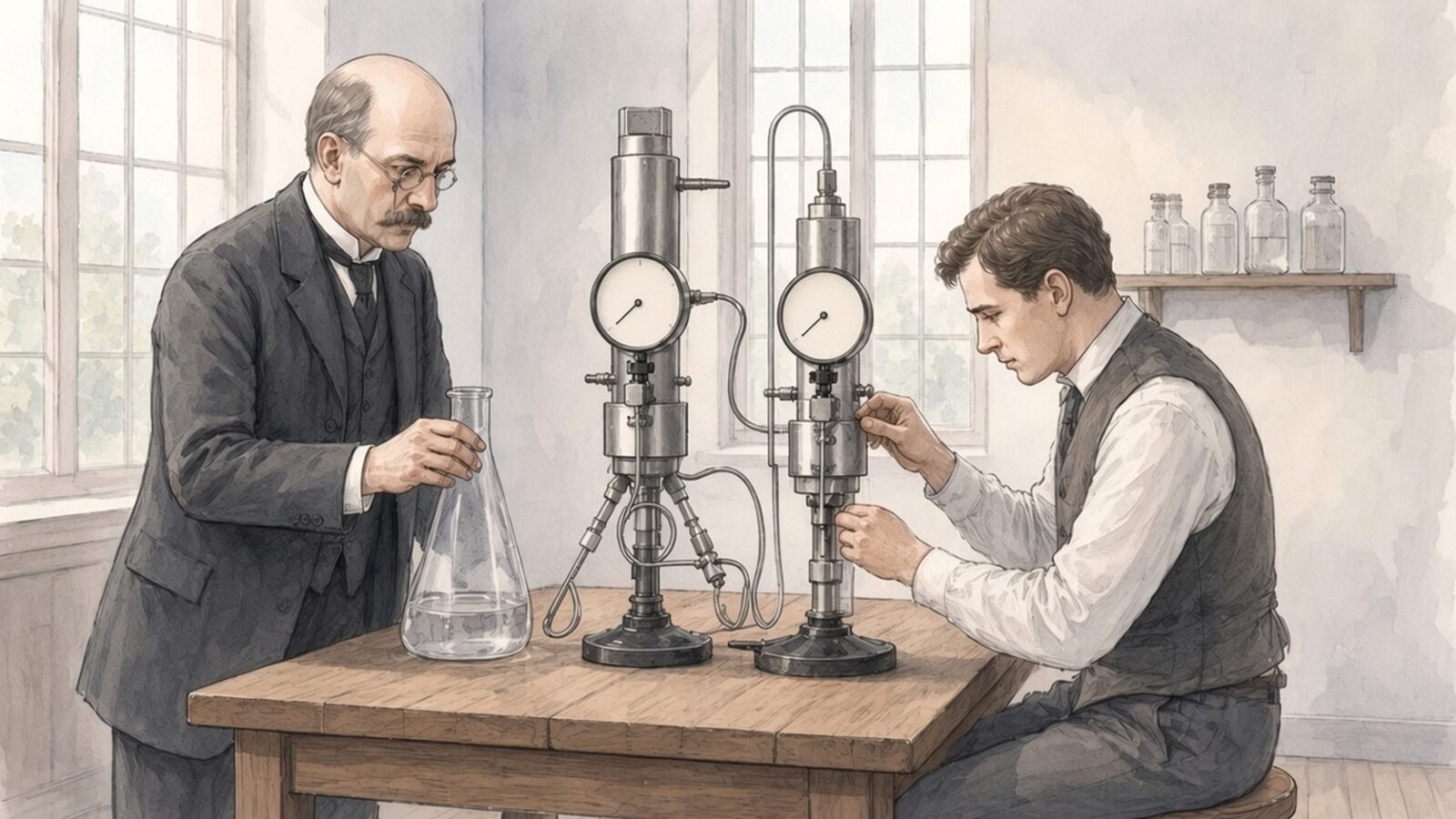
In the summer of 1909 a small steel apparatus on a laboratory bench in Karlsruhe produced a steady trickle of liquid ammonia from the nitrogen of the air and a stream of hydrogen. Within four years the same chemistry was running in a factory at Oppau on the Rhine, and within a century the fertiliser made by that route had become one of the foundations of the world’s food supply. This is an account of how the process was found, how it was made to work at industrial scale, what it was used for in war and in peace, and how its product came to support a human population larger than any that had existed before, together with the costs in energy and in the wider nitrogen cycle that came with it[1, 2].
Key findings
- Sir William Crookes warned the British Association in 1898 that the world’s supply of wheat would fall short within a generation unless chemists found a way to fix atmospheric nitrogen, and he named the problem as one for the laboratory[3, 4].
- Fritz Haber and Robert Le Rossignol demonstrated continuous ammonia synthesis to BASF on 2 July 1909, using an osmium catalyst at about 175 to 200 atmospheres and around 500 to 600 °C[5, 8].
- Carl Bosch solved the problem of hydrogen attacking steel at high temperature and pressure, and Alwin Mittasch’s systematic testing of some 2,500 compositions produced the promoted iron catalyst still used in modified form today[5, 7, 10].
- The first industrial plant began operating at Oppau on 9 September 1913 with a capacity of about 30 tonnes of ammonia a day. Haber received the Nobel Prize in Chemistry for 1918, and Bosch shared the prize for 1931 with Friedrich Bergius[5, 11, 12].
- Vaclav Smil has estimated that without synthetic nitrogen fertiliser roughly two fifths to one half of the world’s people could not be fed at current diets, and Erisman and colleagues estimated that about 48 per cent of the world’s population in 2008 was supported by it[1, 2].
- Ammonia production today accounts for around 2 per cent of global final energy use and about 1.3 per cent of carbon dioxide emissions from the energy system, while losses of reactive nitrogen affect water, air and climate[19, 21].
The Element That Plants Cannot Take from the Air
Nitrogen is the most abundant gas in the atmosphere. It makes up about 78 per cent of dry air by volume, and every square metre of the Earth’s surface lies beneath roughly eight tonnes of it. It is also an indispensable element of living matter. Every amino acid contains nitrogen, and so therefore does every protein; the bases of DNA and RNA are nitrogenous compounds; chlorophyll, the molecule through which plants capture sunlight, is built around a ring of four nitrogen atoms. A plant that cannot obtain enough nitrogen grows slowly, yellows, and sets little seed. For most of the history of agriculture, nitrogen has been the nutrient that most often limits the yield of a field.
The difficulty lies in the form in which the element is present in the air. Atmospheric nitrogen consists of molecules of two atoms joined by a triple bond, one of the strongest chemical bonds known. Breaking it requires a large input of energy, and very few natural processes are able to supply it. Plants cannot use the gas directly. They take up nitrogen from the soil as nitrate or ammonium ions, and these “fixed” forms of nitrogen are scarce relative to the enormous reservoir overhead[37].
In nature, nitrogen is fixed chiefly by bacteria. Some live freely in soil and water; the most important for agriculture live in nodules on the roots of leguminous plants such as clover, beans, peas, lentils and alfalfa, where they convert atmospheric nitrogen into ammonia with the help of an enzyme, nitrogenase, and receive sugars from the plant in return. Lightning also fixes a smaller quantity of nitrogen by forcing it to combine with oxygen in the intense heat of the discharge, and the resulting oxides reach the ground dissolved in rain[37].
Traditional farming systems grew up around these sources. Farmers returned to their fields whatever fixed nitrogen they could recover: animal manure, human waste, straw, crop residues, ashes, and composted vegetable matter. They planted legumes in rotation with cereals, a practice known in the ancient Mediterranean and refined in the agricultural changes of eighteenth-century England, where the four-course rotation of wheat, turnips, barley and clover became widespread. In the rice-growing regions of East and South Asia, the recycling of organic matter reached a high degree of intensity, and the nitrogen-fixing fern Azolla, which harbours a cyanobacterium, was cultivated in paddy fields as a green manure.
These methods could sustain substantial populations, but they set an upper limit on how much food a given area of land could produce. Recycling cannot add nitrogen to a farming system; it can only slow its loss. Every harvest that left the farm for a town carried nitrogen with it, and much of that nitrogen ended in rivers and the sea rather than back on the fields. Leguminous crops add new nitrogen, but a field growing clover is not growing wheat in that season. As long as fixed nitrogen came only from biological sources and lightning, the yields of the staple grains remained modest by modern standards, typically around one tonne of wheat per hectare in much of Europe during the nineteenth century.
The scientific understanding of this constraint developed through the nineteenth century. The German chemist Justus von Liebig, in works published from 1840 onwards, argued that plants draw their mineral nutrients from the soil and that these could be supplied in chemical form, and he popularised the idea that growth is governed by whichever essential nutrient is in shortest supply[36]. Liebig initially underestimated the importance of nitrogen fertiliser, believing that plants could obtain sufficient nitrogen from ammonia in the air. Field experiments, above all those begun by John Bennet Lawes and Joseph Henry Gilbert at Rothamsted in Hertfordshire in 1843, showed that cereal yields responded strongly to applied nitrogen. By the second half of the century, agricultural chemists broadly agreed that additional fixed nitrogen would raise crop production, and the question became where such nitrogen might be found.
Guano and Chilean Nitrate
The first answer came from deposits accumulated over very long periods on the dry coasts of western South America. On the rainless islands off Peru, notably the Chincha Islands, colonies of seabirds feeding on the anchovy shoals of the Humboldt Current had left layers of droppings many metres deep. In the absence of rain the nitrogen and phosphorus in the excrement had not been leached away, and the resulting material, known by its Quechua-derived name guano, was an exceptionally concentrated fertiliser[14].
Guano had long been used by Andean farmers. Its systematic export to Europe began in the early 1840s, and for several decades it was one of the most valuable commodities in world trade. Britain imported large quantities, and the Peruvian state derived a large share of its revenue from the trade. The deposits were mined by hand under harsh conditions, with labour drawn in substantial part from indentured workers brought from southern China. The supply, however, was finite. The richest deposits were largely exhausted by the 1870s, and the guano age passed within roughly forty years[14].
As guano declined, attention shifted to a mineral source on the mainland. In the Atacama Desert, in a region then divided between Peru and Bolivia and later incorporated into Chile, lay extensive beds of caliche, a cemented mixture of salts rich in sodium nitrate. The origin of these deposits has been debated, but their preservation is again owed to extreme aridity. Refined by dissolving the caliche in hot water and crystallising the nitrate, the product became known in trade as Chilean saltpetre or Chile nitrate[15].
Control of the nitrate fields was one of the principal issues in the War of the Pacific of 1879 to 1884, in which Chile fought Peru and Bolivia and at the end of which Chile held the nitrate provinces of Tarapacá and Antofagasta. Bolivia lost its coastline. For the following decades, nitrate exports provided a large part of the revenue of the Chilean state, and the oficinas, the processing works scattered across the desert, employed tens of thousands of workers[15].
Chilean nitrate was used both as fertiliser and as a raw material for explosives. Nitric acid, made from sodium nitrate and sulphuric acid, was needed to manufacture nitroglycerine, guncotton, smokeless powders and, later, high explosives such as trinitrotoluene. The same compound that raised the yield of a field of wheat was therefore also essential to the armaments industries of the industrial powers. By the early twentieth century Chile supplied the great majority of the world’s traded nitrate, and Germany was among the largest importers.
Two features of this situation concerned observers in Europe and North America. The first was that the deposits, though large, were not unlimited, and estimates of their remaining life varied widely. The second was that the supply depended on a long sea route from the Pacific coast of South America, around Cape Horn or later through the Panama Canal, which any naval power able to control the Atlantic could interrupt. A third source of fixed nitrogen, ammonium sulphate recovered as a by-product from coke ovens and gasworks, grew in importance from the late nineteenth century, but its output was tied to the production of coke and coal gas and could not easily be expanded on its own account.
Crookes and the Wheat Problem
On 7 September 1898, the physicist and chemist Sir William Crookes delivered his presidential address to the British Association for the Advancement of Science at its meeting in Bristol. Crookes was known for his work on cathode rays, on the element thallium, which he discovered, and on spectroscopy. He chose as the principal theme of his address the future supply of wheat, and he presented it as a problem that chemistry would have to solve[3].
Crookes’s argument rested on a simple comparison. The populations of the wheat-eating nations, which he took to include Britain, Western Europe, the United States and the British dominions, were growing quickly, and the land suitable for wheat that had not yet been brought under cultivation was, in his estimate, running out. The great expansions of the nineteenth century, on the prairies of North America, in Argentina, and in Australia, could not be repeated indefinitely. Unless yields per acre could be raised substantially, the demand for bread would outrun the supply. He placed the point of difficulty at around 1931, roughly a generation ahead[3, 4].
The obvious means of raising yields was more nitrogen fertiliser, and Crookes reviewed the available sources. Manure and other organic wastes were already being used. Ammonium sulphate from coal was limited by the coal industry. Chilean nitrate was the largest source, but on the estimates available to him it would be exhausted within a few decades if consumption increased as fast as it would need to. In a passage that was widely quoted afterwards, he stated that England and all civilised nations stood in deadly peril of not having enough to eat, and that the solution lay with the chemist[3].
He then pointed to the atmosphere. The fixation of atmospheric nitrogen, he said, was one of the great discoveries awaiting the ingenuity of chemists. He described experiments in which nitrogen had been made to combine with oxygen in an electric arc, and he suggested that if cheap electrical power, for example from waterfalls such as Niagara, could be applied to the task, the production of nitrate from the air might become practicable. The address was published in Science in October 1898 and later expanded into a book, The Wheat Problem, which appeared in successive editions, the later ones with supplementary chapters[3, 4].
Not all of Crookes’s figures proved correct. His estimates of the remaining wheat lands were too low, and the reserves of Chilean nitrate lasted far longer than he expected. Historians have also noted that his framing of the question in terms of the “wheat-eating” nations reflected the assumptions of his time. The central point of his address, however, was sound. The growth of food production was constrained by fixed nitrogen, the existing sources could not be expanded without limit, and the atmosphere contained an inexhaustible supply if a means of tapping it could be found. In the years after 1898 several groups of chemists and engineers set out to provide one.
Early Attempts to Fix the Air
The first method to reach industrial operation followed the route Crookes had described. In an electric arc, nitrogen and oxygen combine to form nitric oxide, which can be converted with further oxygen and water into nitric acid. The yield is small, because the reaction is reversible and nitric oxide decomposes again unless the hot gas is cooled very quickly, and the process consumes a great deal of electricity. In Norway, where hydroelectric power was abundant and cheap, the physicist Kristian Birkeland and the engineer Sam Eyde developed an arc furnace in which a magnetic field spread the arc into a broad disc of flame. Their process went into commercial operation in the first decade of the twentieth century and formed the basis of the company Norsk Hydro, founded in 1905[16].
The Birkeland-Eyde process worked, but its energy requirement was very high, and it was only competitive where electricity was exceptionally cheap. It was later displaced entirely by ammonia synthesis[16].
A second method went into production at about the same time. The German chemists Adolph Frank and Nikodem Caro, working from the 1890s, found that calcium carbide, made by heating lime and coke in an electric furnace, would absorb nitrogen at around 1,000 °C to form calcium cyanamide. Calcium cyanamide could be applied directly to soil, where it breaks down to release ammonia, or treated with steam to produce ammonia itself. The cyanamide process also depended on large amounts of electricity for the carbide furnaces, but it required less energy per unit of nitrogen than the arc process, and plants were built in Germany, Italy, Norway, Canada, the United States and elsewhere. During the First World War it was expanded considerably in several countries as a source of nitrogen for explosives[17].
The third route, the direct combination of nitrogen and hydrogen to form ammonia, had long been recognised as attractive in principle but had appeared impossible in practice. Ammonia contains one atom of nitrogen and three of hydrogen, and the reaction of the two elements releases heat. Yet when chemists heated mixtures of nitrogen and hydrogen with various metals, they obtained at best minute traces of ammonia. The reason, as the developing science of chemical thermodynamics made clear, was that the equilibrium between the elements and ammonia lies heavily on the side of the elements at the high temperatures needed for the reaction to proceed at a useful rate. At lower temperatures the equilibrium is more favourable, but the reaction becomes too slow to be useful. The problem was thus a conflict between thermodynamics and kinetics, and resolving it required both a better understanding of the equilibrium and the right means of accelerating the reaction.
A further consideration followed from the principle formulated by the French chemist Henri Le Chatelier in 1884. When nitrogen and hydrogen combine, four volumes of gas, one of nitrogen and three of hydrogen, become two volumes of ammonia. Raising the pressure therefore shifts the equilibrium towards ammonia[35]. Le Chatelier himself attempted the synthesis at high pressure around 1901, but an explosion in his apparatus, caused by air contaminating the gas mixture, ended the experiments. He later regretted having abandoned them.
Fritz Haber at Karlsruhe
Fritz Haber was born in Breslau, then in Prussian Silesia and now Wrocław in Poland, on 9 December 1868, into a family of Jewish merchants. His father dealt in dyes, pigments and pharmaceuticals. Haber studied chemistry at Berlin, Heidelberg and the Technische Hochschule in Charlottenburg, worked for a period in industry and in his father’s business, and in 1894 took a position as an assistant at the Technische Hochschule in Karlsruhe, where he remained for seventeen years and rose to a full professorship of physical chemistry and electrochemistry in 1906. During this period he wrote on the thermodynamics of technical gas reactions, a subject that prepared him well for the problem of ammonia[6, 29].
Haber’s first serious work on ammonia began in 1904, at the request of an Austrian chemical firm, and was carried out with his assistant Gabriel van Oordt. Working at atmospheric pressure and at around 1,000 °C with an iron catalyst, they measured the equilibrium concentration of ammonia and found it to be very small, of the order of a hundredth of one per cent. Haber concluded at that time that the direct synthesis offered little prospect of industrial use[5, 9].
The matter was reopened by a dispute with Walther Nernst, the leading physical chemist in Berlin. Nernst had developed a new theorem on heat and chemical equilibrium, from which equilibrium constants could be calculated, and his calculations for ammonia, supported by measurements made at elevated pressure, gave values lower than Haber’s. At a meeting of the Bunsen Society in 1907 Nernst criticised Haber’s figures publicly. Haber undertook more careful measurements, now at higher pressures, and confirmed that his own values were broadly correct. In the course of this work he became convinced that a practical synthesis might after all be possible, provided that the reaction were carried out at high pressure, at a moderate temperature, and with an effective catalyst, and provided that the gas were recirculated so that the unreacted nitrogen and hydrogen could be passed repeatedly over the catalyst[5, 9].
The recirculation principle was one of Haber’s essential contributions. Because the equilibrium allows only a limited fraction of the gas to be converted in a single pass, a once-through process would waste most of its compressed feed. Haber proposed instead a closed loop in which the gas, after passing through the catalyst, would be cooled so that the ammonia condensed out as a liquid, and the remaining gas, topped up with fresh nitrogen and hydrogen, would be returned to the reactor still at high pressure. The heat released by the reaction could be used, through a heat exchanger, to warm the incoming gas. In this arrangement the fraction converted per pass mattered less than the rate at which ammonia could be produced in a given volume of catalyst, which Haber described as the space-time yield[9].
Robert Le Rossignol and the High-Pressure Apparatus
The construction of an apparatus able to work at the pressures Haber had in mind was largely the work of his assistant Robert Le Rossignol. Le Rossignol was born in 1884 in Saint Helier, Jersey, to a family of French descent, studied chemistry at University College London under William Ramsay, and came to Karlsruhe in 1907 to work with Haber. He was an unusually capable experimentalist and a skilled designer of apparatus, and in Karlsruhe he worked closely with the laboratory’s mechanic, Friedrich Kirchenbauer[8].
Between 1907 and 1909 Haber and Le Rossignol built a series of high-pressure apparatus in which the gas mixture could be compressed, passed over a heated catalyst, cooled to separate the ammonia, and recirculated. The design required valves, seals and joints that would remain tight at pressures of around 200 atmospheres while parts of the apparatus were heated to several hundred degrees. Le Rossignol designed a needle valve suited to these conditions, and the converter itself was a small steel tube, a few centimetres across, heated electrically from inside so that the outer wall, which carried the pressure, remained comparatively cool[8].
The work was supported by the Badische Anilin- und Soda-Fabrik, BASF, of Ludwigshafen, then one of the largest chemical companies in the world. An agreement concluded in 1908 gave the company the rights to Haber’s results in return for funding and a share of future profits. BASF had itself spent several years working on nitrogen fixation by the arc process and had joined with Norwegian interests in that field, and its directors were initially sceptical about high-pressure synthesis[5, 8].
The decisive change came with the catalyst. Haber and Le Rossignol tested many metals and found that finely divided osmium, a rare and expensive member of the platinum group, gave a markedly better performance than the materials they had tried before. At about 175 atmospheres and around 550 to 600 °C, the gas leaving the converter contained some 6 to 8 per cent of ammonia by volume. Uranium also proved active. In March 1909 the apparatus produced liquid ammonia continuously, and Haber wrote to BASF to report the result[5, 8].
On 2 July 1909 two representatives of BASF, Alwin Mittasch and Julius Kranz, came to Karlsruhe to see the apparatus in operation. Carl Bosch had been expected as well but did not attend. During the visit a bolt in the apparatus failed and had to be repaired, delaying the demonstration for several hours, but by the end of the day the converter was producing liquid ammonia at a steady rate. Mittasch reported to the company that the process worked, and the account of the visit is regarded as the point at which BASF committed itself to the development of ammonia synthesis. Haber’s patents, the first of which had been filed in October 1908, now formed the legal basis of the project[5, 8].
Haber described the work in his Nobel lecture of 1920 with emphasis on the scientific reasoning that had led to it, and he acknowledged Le Rossignol’s part in the development of the apparatus. Le Rossignol received a share of the royalties from the process under the terms of the agreement with BASF. He remained in Berlin during the First World War, working for the Auergesellschaft, returned to Britain after it, was later employed in the research laboratories of the General Electric Company in Britain, and in later life gave substantial sums to charitable causes, including medical research[8, 9].
Carl Bosch and the Problem of Scale
The man charged with turning a tabletop apparatus into a factory was Carl Bosch. He was born in Cologne on 27 August 1874, a nephew of Robert Bosch, the founder of the electrical engineering firm. Before studying chemistry at Leipzig he had trained as a metalworker and studied metallurgy and mechanical engineering at Charlottenburg, and he joined BASF in 1899. This combination of chemistry with practical engineering made him an unusual figure among the company’s chemists. He had already been involved in BASF’s work on nitrogen fixation through the production of cyanides and nitrides, and he was placed in charge of the ammonia project in 1909[7, 10].
The difficulties were formidable. The pressures involved, around 200 atmospheres, had never been used in continuous industrial chemistry. The largest high-pressure equipment then in use was found in steam engineering, where boilers worked at a small fraction of that pressure, and in the manufacture of guns. Bosch needed compressors that could deliver large volumes of gas at these pressures day and night, reactor vessels able to contain hot, compressed hydrogen, pipework, valves and gauges, and methods of producing pure hydrogen and nitrogen in great quantity. Each of these had to be developed largely from the beginning[10].
The first converters built at Ludwigshafen were made of carbon steel and were heated from outside. After some eighty hours of operation they burst. Examination of the failed tubes showed that the steel had become brittle on its inner surface. Bosch, who had his own metallurgical laboratory set up for the investigation, found that hydrogen at high temperature and pressure was diffusing into the steel and reacting with the carbon in it to form methane. The removal of carbon weakened the metal, and the methane formed within it created fissures, a form of damage that came to be known as hydrogen attack or decarburisation and that is now treated as a variety of hydrogen embrittlement[10, 34].
Bosch’s solution was a double-walled reactor. The inner tube, in contact with the hot hydrogen, was made of soft iron with a very low carbon content, which the hydrogen could not decarburise. This lining was not strong enough to carry the pressure, so it was fitted closely inside a thick outer jacket of ordinary steel, which bore the load. Hydrogen that diffused through the soft iron liner would still have attacked the outer steel, so Bosch had small holes drilled through the outer wall to allow the gas to escape before it could accumulate and do harm. The hydrogen leaking through these holes was negligible in quantity, and the outer steel, kept cooler than the inner tube, remained sound. He described this arrangement in his Nobel lecture of 1932 as the key to the safe operation of the high-pressure plant[10].
Further changes followed. External heating of the reactor was abandoned in favour of an arrangement in which the incoming gas was preheated in a heat exchanger by the gas leaving the catalyst, and the heat of the reaction itself kept the catalyst at its working temperature once the process had started. Compressors were redesigned for continuous high-pressure operation. Gas purification had to remove carbon monoxide, oxygen, water vapour and sulphur compounds, all of which poison the catalyst. The hydrogen was produced from coke by the water-gas reaction, in which steam passed over red-hot coke yields hydrogen and carbon monoxide, followed by a further reaction in which the carbon monoxide reacted with steam over an iron oxide catalyst to produce more hydrogen and carbon dioxide. Nitrogen was introduced by burning a controlled quantity of air in the gas producers, so that the oxygen was consumed and the nitrogen remained in the mixture in the right proportion[10].
Mittasch and the Search for a Catalyst
Osmium was unsuitable for industrial use. The world’s entire stock of the metal amounted to only around a hundred kilograms, and BASF moved to secure most of what was available while the search for an alternative went on. Uranium was also costly and was easily poisoned. BASF therefore needed a catalyst that was cheap, abundant, active and durable, and the search was entrusted to Alwin Mittasch.
Mittasch, born in 1869, had been a schoolteacher before taking a doctorate in physical chemistry under Wilhelm Ostwald at Leipzig, and he had joined BASF in 1904. Beginning in 1909 he organised a systematic programme in which a large number of small test reactors, operated in parallel, were used to compare candidate catalysts under identical conditions. Between 1909 and 1911 his group tested some 2,500 different compositions, and the programme continued in later years until the number of experiments ran to many thousands[5, 10].
The most important result came from a sample of magnetite, a natural iron oxide, from the Gällivare mine in Swedish Lapland, which proved unexpectedly active. Analysis suggested that small amounts of other substances present in the ore were responsible. Mittasch’s group then established that iron becomes a far better catalyst when it contains small additions of certain other oxides, which became known as promoters. Aluminium oxide helps to preserve the high surface area of the iron by preventing the small crystals from growing together, and potassium oxide enhances the activity of the iron surface itself. Calcium oxide and other oxides also proved beneficial. The resulting catalyst, made by fusing iron oxide with small proportions of these promoters and then reducing it in the hydrogen-nitrogen mixture, was robust, inexpensive and highly active[5, 10].
The promoted iron catalyst of 1910 to 1911 has proved remarkably durable. Many improvements have been made to it in the century since, and catalysts based on other metals, notably ruthenium, have come into use in some plants, but the great majority of the world’s ammonia is still made over catalysts that are recognisably descendants of Mittasch’s. The detailed mechanism of the reaction on the iron surface, in which nitrogen molecules are adsorbed and split into atoms which then combine step by step with hydrogen, was established much later by surface science, most completely in the work of Gerhard Ertl, who received the Nobel Prize in Chemistry for 2007 for his studies of chemical processes on solid surfaces[26].
Oppau, 1913
Construction of the first industrial ammonia plant began in 1912 at Oppau, on the Rhine immediately north of the main BASF works at Ludwigshafen. The site was chosen because it offered room for a new plant, access to the river for water and transport, and proximity to the company’s existing services. The plant began operating on 9 September 1913. Its initial capacity was about 30 tonnes of ammonia a day, and within its first year of operation it was producing some 40 tonnes a day after modifications to the reactors and the operating procedures[5].
The ammonia produced at Oppau was not, at first, intended chiefly for direct use. BASF converted most of it into ammonium sulphate, a solid salt that could be handled, stored and spread with existing equipment and for which there was an established agricultural market. The process was therefore designed as a fertiliser enterprise. The investment had been large, and the commercial case rested on the expectation that synthetic ammonia could compete with Chilean nitrate and by-product ammonium sulphate in the fertiliser trade.
That expectation was overtaken within a year by the outbreak of war. In August 1914, when the First World War began, the Oppau plant had been in operation for less than twelve months, and synthetic ammonia was a new and comparatively small contributor to Germany’s supply of fixed nitrogen.
The First World War
When war began in August 1914, Germany depended heavily on imported Chilean nitrate for both its fertiliser and its explosives. The British naval blockade, established in the first months of the war, cut the sea route from South America, and by the end of 1914 the German army and the War Ministry faced the prospect of a serious shortage of nitric acid for munitions. Stocks of nitrate captured in Antwerp in October 1914 eased the position for a time, but a lasting source was needed[5, 6].
Ammonia could meet that need only if it could be converted into nitric acid. The oxidation of ammonia to nitric oxide over a platinum catalyst had been developed by Wilhelm Ostwald in the first years of the century, and the nitric oxide could then be absorbed in water to give nitric acid[18]. BASF developed its own version of the oxidation step, using an iron oxide and bismuth catalyst, and in the spring of 1915 the company agreed with the government to build plant to turn Oppau’s ammonia into nitrate. This arrangement, sometimes called the “saltpetre promise”, committed the company to supplying the war effort and the state to supporting the expansion[5].
Capacity at Oppau was enlarged during the war, and in 1916 BASF began building a second, much larger plant at Leuna, near Merseburg in central Germany. The site was chosen in part because it lay further from the western front and beyond the range of Allied aircraft, and because it was close to deposits of brown coal and to supplies of gypsum and water. The Leuna works began producing ammonia in April 1917, with an initial output of some 36,000 tonnes a year, and expanded rapidly thereafter[6]. By the end of the war, synthetic ammonia from Oppau and Leuna supplied a large part of Germany’s fixed nitrogen, alongside calcium cyanamide, whose production had also been greatly increased[5, 17].
Historians have generally concluded that without ammonia synthesis Germany would have faced an acute shortage of explosives by 1915 or 1916, and that the process therefore enabled the German war effort to continue for longer than it otherwise could have done. The same capacity also supplied fertiliser, although during the war a large part of the fixed nitrogen available was directed to munitions, and German agricultural production fell substantially as a result of the blockade, the shortage of labour and draught animals, and the diversion of nitrogen[1, 5].
Haber’s own wartime work took a different direction. As director of the Kaiser Wilhelm Institute for Physical Chemistry and Electrochemistry in Berlin-Dahlem, which had opened in 1911, he placed the institute at the service of the War Ministry. He became head of the chemical section of the ministry and directed the German programme of chemical weapons. The first large-scale use of chlorine gas took place under his supervision at the Second Battle of Ypres on 22 April 1915, when chlorine was released from cylinders along a stretch of the front, and thousands of Allied soldiers were killed or injured. Both sides subsequently developed and used chemical weapons on a large scale[6, 31].
Haber’s wife, Clara Immerwahr, herself a chemist and the first woman to receive a doctorate in chemistry from the University of Breslau, took her own life with his service pistol in the early hours of 2 May 1915, shortly after his return from Ypres. Her reasons have been the subject of much discussion. Contemporary evidence is limited, and accounts that attribute her death primarily to opposition to his work on chemical weapons rest in part on later testimony; historians have also pointed to the strains of the marriage and to the restrictions placed on her own scientific career[32].
The Nobel Prizes
The Royal Swedish Academy of Sciences awarded the Nobel Prize in Chemistry for 1918 to Fritz Haber “for the synthesis of ammonia from its elements”. The award was announced in November 1919, together with other prizes held over from the war years, and it was presented at a ceremony in Stockholm in June 1920, at which Haber gave his Nobel lecture[9, 11].
The award was controversial. Several scientists from the countries that had fought against Germany objected to the honouring of a man who had led the German chemical weapons programme. The academy’s citation referred only to the synthesis of ammonia, and its presentation speech emphasised the significance of the discovery for agriculture and for the supply of food[6, 11].
In his lecture Haber reviewed the history of the problem from the work of the nineteenth century to Crookes’s address and the arc and cyanamide processes, and he set out the thermodynamic reasoning that had led him to high pressures and gas recirculation. He described the synthesis as a contribution to the means of producing bread from the air, and he took care to credit those who had worked with him, including Le Rossignol, and the engineers of BASF who had carried the process to industrial scale[9].
The second Nobel Prize connected with the process came in 1931, when the Prize in Chemistry was shared by Carl Bosch and Friedrich Bergius “in recognition of their contributions to the invention and development of chemical high pressure methods”. Bergius had applied high-pressure hydrogenation to the conversion of coal into liquid fuels. The citation recognised that the techniques Bosch and his colleagues had developed for ammonia had opened a new field of industrial chemistry, which included the high-pressure synthesis of methanol from 1923 and the hydrogenation of coal at Leuna from the late 1920s[10, 12]. Bosch’s lecture, given in May 1932, is a detailed account of the engineering of the ammonia plant, including the problem of hydrogen attack on steel and the design of the reactors[10].
Oppau and Leuna After the War
The Treaty of Versailles of 1919 required Germany to surrender or destroy much of its war industry, and Allied commissions inspected the chemical works of the Rhineland, which was placed under Allied occupation. The ammonia plants survived, since they could be used for fertiliser, and in the years after the war BASF, in common with the other German chemical companies, turned their output back towards agriculture. Germany’s own demand for nitrogen fertiliser was considerable, as its farms had been depleted during the war, and the country could no longer rely on imported nitrate[5].
At the Oppau works, part of the ammonia was converted into a mixed fertiliser consisting of ammonium sulphate and ammonium nitrate, known as ammonium sulphate nitrate. This material tended to cake into a hard mass during storage, and it was customary to loosen it with small charges of explosive. The practice had been carried out many thousands of times without incident, and tests had indicated that a mixture with no more than about half ammonium nitrate would not detonate. On the morning of 21 September 1921 a charge set off in a silo containing some 4,500 tonnes of the mixture caused a detonation of about 450 tonnes of it. The explosion destroyed much of the plant and a large part of the village of Oppau, left a crater about 20 metres deep, and killed 561 people, with almost 2,000 injured. Later investigation found that a change in the manufacturing process had altered the composition and moisture of the material and that parts of the store contained a higher proportion of ammonium nitrate than intended[13].
The plant was rebuilt in a remarkably short time, and production resumed within a few months. The Oppau explosion remained one of the most serious industrial accidents in the history of the chemical industry and became a standard case in the study of the hazards of ammonium nitrate, a subject that has recurred at intervals ever since[13].
In 1925 BASF merged with the other leading German chemical firms, including Bayer and Hoechst, to form IG Farbenindustrie AG, with Bosch as chairman of the management board. Leuna, which had been organised under a separate company during the war, became one of the principal production sites of the new concern. Bosch later became chairman of the supervisory board. He was critical of aspects of the National Socialist government’s policies, including its treatment of Jewish scientists, and he lost influence after 1933. He died in Heidelberg on 26 April 1940[7, 30].
Haber’s position in Germany ended abruptly in 1933. Under the law for the restoration of the professional civil service, adopted in April of that year, the institute was required to dismiss its Jewish staff. Haber, who had converted to Christianity in 1892 and as a war veteran was initially exempt, resigned as director rather than carry out the dismissals. He left Germany, spent some months in Cambridge at the invitation of colleagues there, and accepted an invitation to work at the Daniel Sieff Research Institute in Rehovot. He died of heart failure in Basel on 29 January 1934, while travelling[6, 29].
The Spread of Synthetic Ammonia Between the Wars
The German success prompted other countries to develop ammonia synthesis of their own. The Haber-Bosch patents were confiscated or licensed in several countries after the war, but the detailed engineering knowledge of BASF was not easy to reproduce, and much of the early work elsewhere involved independent development. In Britain, Brunner Mond built a plant at Billingham on Teesside, which began producing ammonia in the mid-1920s and later became part of Imperial Chemical Industries. In France, a plant was built at Toulouse, and the Claude process, developed by Georges Claude, operated at very high pressures of around 1,000 atmospheres. In Italy, Luigi Casale and Giacomo Fauser developed processes that were licensed widely. In the United States, the government’s Fixed Nitrogen Research Laboratory, established in 1919, undertook research on the process, and companies including Du Pont and Allied Chemical built plants. Japan and the Soviet Union also established their own ammonia industries[5].
World production of synthetic nitrogen grew rapidly in the 1920s. Within a decade of the war it had overtaken Chilean nitrate, whose share of world fixed nitrogen supply declined steeply. The fall in demand for Chilean nitrate, followed by the Great Depression, produced a severe crisis in the Chilean nitrate industry, and many of the oficinas closed. Chile continues to produce natural nitrate, but it has long since ceased to be the dominant source of fixed nitrogen[15].
The arc process was abandoned. Norsk Hydro converted to ammonia synthesis in the late 1920s, using hydrogen produced by the electrolysis of water with its hydroelectric power, and the cyanamide process gradually declined in importance, although calcium cyanamide remained in use as a specialised fertiliser[16, 17].
Despite the growth of production, synthetic fertiliser remained a modest factor in world agriculture before the Second World War. Its use was concentrated in Western Europe, Japan and parts of North America, and in much of the world farming continued to depend on manure, legumes and the recycling of organic matter. In 1913 the total fixed nitrogen applied to crops worldwide from all industrial sources was well under one million tonnes, and by the late 1930s it had grown to a few million tonnes a year[1, 2].
After 1945
The great expansion of synthetic nitrogen came after the Second World War. Several developments made it possible. The first was a change of feedstock. The early plants made their hydrogen from coke, and in some countries from coal or by the electrolysis of water. From the 1930s onwards, and on a large scale after 1945, natural gas and other light hydrocarbons became the principal source. In steam reforming, methane and steam react over a nickel catalyst at high temperature to produce hydrogen and carbon monoxide, and in a secondary reformer air is introduced so that the oxygen is consumed in combustion and the nitrogen enters the gas in the proportion needed for synthesis. The carbon monoxide is then converted with more steam to hydrogen and carbon dioxide, and the carbon dioxide is removed. Natural gas was cheaper and cleaner to process than coke, and it allowed considerable savings in energy and in capital cost[33].
The second development was in the scale of individual plants. In the 1960s engineers in the United States, notably at the M. W. Kellogg Company, introduced single-train plants in which a centrifugal compressor driven by a steam turbine replaced the banks of reciprocating compressors used previously, and the waste heat of the reforming and synthesis steps was used to raise the high-pressure steam that drove the turbine. Plants of this kind could produce around 1,000 tonnes of ammonia a day in a single line, and they greatly reduced the cost of production. Single trains of several thousand tonnes a day now exist[5].
The third was the growth of nitrogen products suited to different farming systems. In North America, anhydrous ammonia came to be injected directly into the soil as a liquid under pressure. Ammonium nitrate became widespread in Europe. Above all, urea, made by reacting ammonia with the carbon dioxide produced in the hydrogen plant, became the most widely used nitrogen fertiliser in the world, because of its high nitrogen content, its stability, and its suitability for the rice fields of Asia. The industrial production of urea from ammonia and carbon dioxide had been developed at BASF in the early 1920s.
The fourth was the arrival of the process in the developing countries. From the 1960s, governments and international agencies financed the construction of ammonia and urea plants in India, Pakistan, Indonesia, Egypt, Mexico and many other countries. China, which had begun building small plants in the 1950s and many more in the 1960s and 1970s, bought thirteen large modern plants from Western companies in 1973, and it is today by a wide margin the largest producer and consumer of nitrogen fertiliser, with much of its ammonia made from coal rather than natural gas[21].
As a result of these changes, the world’s consumption of nitrogen fertiliser rose from roughly 4 million tonnes of nitrogen a year around 1950 to more than 80 million tonnes by the end of the century, and to a little over 100 million tonnes a year in recent years. The world now produces around 185 million tonnes of ammonia annually, of which about 70 per cent is used to make fertilisers; the remainder serves the chemical industry, the production of explosives for mining and construction, the manufacture of fibres and plastics, and other purposes[2, 21, 28].
The Green Revolution
The rise in fertiliser use was closely linked to changes in the crops themselves. Traditional varieties of wheat and rice responded poorly to large applications of nitrogen. They grew tall and leafy, and their heavy heads of grain caused the stems to bend and collapse, a condition known as lodging, which reduced the harvest. In the mid-twentieth century plant breeders developed semi-dwarf varieties with short, stiff stems that could carry heavier heads of grain without falling over, and that directed more of the plant’s growth into grain rather than straw.
The wheat programme in Mexico, supported by the Rockefeller Foundation and the Mexican government from 1943, was led for many years by the American agronomist Norman Borlaug. Borlaug and his colleagues crossed Mexican wheats with semi-dwarf varieties descended from the Japanese variety Norin 10, and from the late 1950s they produced high-yielding, disease-resistant semi-dwarf wheats adapted to a wide range of latitudes. In the mid-1960s these varieties were introduced on a large scale in India and Pakistan, at a time of serious concern about food supplies in South Asia[23, 24].
At the International Rice Research Institute in the Philippines, founded in 1960, breeders crossed a tall Indonesian variety, Peta, with a semi-dwarf Chinese variety, Dee-geo-woo-gen, to produce IR8, released in 1966. With adequate water and nitrogen fertiliser, IR8 could yield several times as much as many traditional varieties, and it was followed by a series of improved rice varieties with better grain quality and resistance to pests and diseases[25].
The term “Green Revolution” was coined in 1968 by William Gaud of the United States Agency for International Development to describe the rapid increase in grain production that followed. The new varieties, irrigation, pesticides and synthetic nitrogen fertiliser were adopted together, and their effects cannot be cleanly separated, but the high yields of the new varieties depended on nitrogen supplied at rates that only industrial fixation could provide. Wheat production in India roughly doubled between the mid-1960s and the early 1970s, and comparable gains followed in rice across much of Asia[23].
Borlaug received the Nobel Peace Prize in 1970. The Norwegian Nobel Committee recognised his work on the development of high-yielding grain varieties and their contribution to the supply of food in the developing world[24]. The Green Revolution has since been the subject of extensive study and debate, concerning its effects on income distribution among farmers, on soils and water, on the diversity of crop varieties, and on regions, notably much of sub-Saharan Africa, where it had less effect. These questions lie beyond the scope of this account, but its dependence on synthetic nitrogen is not disputed[23].
How Many People Depend on It
Assessing how many people are fed by synthetic nitrogen requires a comparison between the world as it is and a world that does not exist, and the estimates rest on assumptions about diets, about the alternative sources of nitrogen that might have been used, and about how efficiently nitrogen passes from fertiliser to crops and from crops to people. The best-known estimates come from the Czech-Canadian scientist Vaclav Smil, who studied the global nitrogen cycle and the history of the process in detail.
In a short essay published in Nature in 1999, Smil argued that the synthesis of ammonia was the most important technical invention of the twentieth century, more significant in its effects than the aeroplane, nuclear energy, space flight or television, because without it the world’s population could not have grown as it did. He calculated that by the end of the century about 40 per cent of the nitrogen in the protein eaten by humanity came, through crops and the animals fed on them, from the Haber-Bosch process, and that roughly two of every five people alive owed their existence to it[1]. In later work he extended this estimate, concluding that at the diets of the early twenty-first century roughly half of the world’s population depends on synthetic nitrogen fertiliser.
An independent calculation by Jan Willem Erisman and colleagues, published in Nature Geoscience in 2008 to mark the centenary of Haber’s work, reached a similar conclusion. They estimated that in 2008 about 48 per cent of the world’s population was fed by it. They also emphasised that the share is growing, as more of the additional food produced each year depends on additional fertiliser[2].
These figures can be set against the growth of the population itself. When the Oppau plant began operating, the world’s population was about 1.8 billion. It reached 2.5 billion around 1950, 6 billion around 1999, and, according to the United Nations, 8 billion on 15 November 2022[27]. Over the same period, average cereal yields worldwide rose from roughly 1.4 tonnes per hectare in the early 1960s to around 4 tonnes per hectare in recent years, and total cereal production rose from under 900 million tonnes a year to roughly 2.8 to 3 billion tonnes a year, while the area under cereals grew only modestly[28]. Several factors contributed, including plant breeding, irrigation, mechanisation and crop protection, but the yields achieved by modern varieties depend on applied nitrogen, and the estimates of Smil and Erisman indicate that synthetic fertiliser supplies roughly half of all the nitrogen taken up by the world’s crops.
The estimates should be read with care. Some of the synthetic nitrogen used in agriculture goes to feed for livestock, so that the numbers depend heavily on the share of animal products in the diet, and a world without synthetic nitrogen would have developed other means of supplying the element, such as more extensive cultivation of legumes, over a larger area. Nonetheless, the estimates are robust in their order of magnitude. Billions of people now alive are fed by nitrogen that was fixed from the air by the process Haber and Bosch developed[1, 2].
Energy
Ammonia synthesis is one of the largest consumers of energy in the chemical industry. Energy is needed to produce the hydrogen, which in the conventional process means breaking down natural gas or coal, to compress the gas to synthesis pressure, and to drive the circulation and refrigeration of the synthesis loop. Part of the natural gas is used as feedstock, its hydrogen ending in the ammonia, and part as fuel.
The efficiency of the process has improved greatly since 1913. The early coke-based plants used far more energy per tonne of ammonia than modern ones, and the transition to natural gas, large single-train plants and integrated heat recovery reduced consumption several-fold. The best modern natural gas plants use around 28 gigajoules of energy per tonne of ammonia, which is not far from the theoretical minimum of a little over 20 gigajoules for this route; coal-based plants use considerably more[21].
The International Energy Agency estimated in its Ammonia Technology Roadmap of 2021 that ammonia production accounts for around 2 per cent of total final energy consumption in the world and emits about 450 million tonnes of carbon dioxide a year, about 1.3 per cent of the carbon dioxide emissions of the global energy system. The carbon dioxide arises both from the combustion of fuel and from the feedstock, since the carbon in the natural gas or coal is released when the hydrogen is separated from it. Some of this carbon dioxide is captured and used to make urea, but it is released again when the urea breaks down in the soil[21].
The choice of operating conditions in a modern plant reflects the same balance that Haber identified in 1908. Higher pressures favour the equilibrium and increase the fraction of the gas converted in each pass, but they require more energy for compression and heavier, more costly equipment. Lower temperatures also favour the equilibrium but slow the reaction, so that more catalyst is needed. Designers therefore choose a combination of pressure, temperature, catalyst volume and recycle rate that minimises the total cost of production, and the trend in recent decades has been towards somewhat lower synthesis pressures made possible by more active catalysts and more efficient compressors[5, 21].
Considered against the food it helps to produce, the energy cost is modest in relation to the rest of the food system; the energy embodied in a kilogram of fertiliser nitrogen is returned many times over in the energy content of the additional grain it allows to be grown. In absolute terms, however, the quantity is large, and it is one of the reasons why ammonia production has been a focus of efforts to reduce industrial emissions.
Effects on the Nitrogen Cycle
Before the twentieth century, the quantity of nitrogen fixed by human activity was small compared with natural fixation. Today it is larger. Galloway and colleagues, writing in Science in 2008, estimated that human activity created about 187 million tonnes of reactive nitrogen in 2005, of which about 121 million tonnes came from the Haber-Bosch process, about 40 million tonnes from the cultivation of legumes and other crops that fix nitrogen, and about 25 million tonnes from the combustion of fossil fuels, which fixes nitrogen in engines and furnaces as an unintended by-product. For comparison, natural biological fixation on land is generally estimated at around 100 million tonnes a year or more. Human activity has thus roughly doubled the rate at which nitrogen is converted from the inert gas of the atmosphere into forms that living organisms can use[19].
A substantial part of the nitrogen applied to fields is not taken up by crops. On average, less than half of the nitrogen in fertiliser ends in the harvested crop, although the proportion varies widely between countries and farming systems. The remainder may be stored in the soil, washed out of it as nitrate, released to the atmosphere as ammonia, or converted by soil bacteria into nitrogen gas and nitrous oxide. Nitrogen in animal manures follows similar pathways[2, 19].
Nitrate that enters rivers and lakes acts as a fertiliser for algae. In coastal waters, especially where large rivers drain agricultural regions, the resulting growth of phytoplankton can lead, when the algae die and decompose, to the depletion of dissolved oxygen in the deeper water. Diaz and Rosenberg, writing in Science in 2008, counted more than 400 coastal systems affected by such hypoxic zones, covering a total area of about 245,000 square kilometres, among them the northern Gulf of Mexico, the Baltic Sea and parts of the East China Sea. Phosphorus and sewage also contribute, and the relative importance of the different sources varies from place to place[20, 38]. Nitrate in drinking water is regulated in many countries, and in some agricultural regions groundwater concentrations exceed the limits set.
Ammonia released from fertilisers and manure combines in the atmosphere with sulphur and nitrogen oxides to form fine particles, which contribute to air pollution over farming regions, and the deposition of nitrogen compounds on land can alter the composition of natural plant communities that are adapted to low-nitrogen conditions[19].
Nitrous oxide, produced by bacteria in fertilised soils, is a long-lived greenhouse gas. The Sixth Assessment Report of the Intergovernmental Panel on Climate Change gives its global warming potential over a century as about 273 times that of carbon dioxide, and agriculture is the largest human source of it. Nitrous oxide also contributes to the depletion of stratospheric ozone[19, 39].
These effects are well documented, and their scale is a direct consequence of the scale at which synthetic nitrogen is used. Agricultural scientists and policy-makers have responded with measures to improve nitrogen use efficiency, such as matching the timing and quantity of applications to the needs of the crop, the use of slow-release fertilisers and nitrification inhibitors, and improvements in the handling of manure[2, 19].
Ammonia Today
More than a century after Oppau, the Haber-Bosch process remains the only means by which nitrogen is fixed industrially on a large scale. Its essential elements are those established between 1909 and 1913: a promoted iron catalyst, temperatures of around 400 to 500 °C, pressures in most plants of about 100 to 250 atmospheres, and a synthesis loop in which the ammonia is condensed and the unconverted gas recirculated. What has changed is the source of the hydrogen, the scale of the plants, the efficiency with which energy is recovered, and the materials from which the equipment is built[5, 21].
Current research is directed chiefly at the hydrogen. Hydrogen produced by the electrolysis of water using renewable electricity, an approach with antecedents in the Norwegian plants of the 1920s, would make it possible to produce ammonia without the carbon dioxide associated with natural gas or coal. Another approach captures and stores the carbon dioxide from conventional plants. The Royal Society’s report on green ammonia, published in 2020, also considered the use of ammonia as a carrier of energy and as a fuel, for example for shipping, in addition to its established role in agriculture[22]. Researchers are also investigating electrochemical and other routes for fixing nitrogen at lower temperatures and pressures, and the development of cereal crops that could form nitrogen-fixing associations with bacteria in the manner of legumes, although none of these has yet reached widespread use.
A Process That Feeds Half the World
The history of ammonia synthesis brings together several distinct achievements. The scientific contribution of Haber and Le Rossignol lay in understanding the equilibrium of the reaction and in designing a laboratory process that worked at high pressure with recirculation of the gas. The engineering contribution of Bosch and his colleagues at BASF lay in solving the problems of materials, compression, gas purification and catalyst manufacture that stood between a laboratory apparatus and a factory, and in creating in the process the field of industrial high-pressure chemistry. The catalytic contribution of Mittasch lay in finding, by systematic experiment, a cheap and robust catalyst that has served for more than a century.
Its uses have been divided from the beginning. The process was conceived as a solution to the problem of food that Crookes had described, and it was brought into production in 1913 as a fertiliser enterprise. Within two years its output was supplying explosives to an army in the field, and its principal inventor was directing the use of poison gas. After the war it returned to agriculture, and its expansion after 1945, together with the new crop varieties of the Green Revolution, contributed to an increase in food production that has allowed the world’s population to grow more than fourfold since the first plant began operating.
The consequences of this growth are visible in the composition of the human body itself. On the estimates discussed above, roughly half of the nitrogen in the proteins of people now living has passed, at some stage, through a Haber-Bosch reactor before reaching a field, a crop and a meal[1, 2]. The same process also accounts for a significant share of the world’s energy use and has substantially altered the global nitrogen cycle. Both outcomes follow from the scale at which ammonia is now produced, and both are part of the legacy of the apparatus that produced its first steady flow of liquid ammonia on a laboratory bench in Karlsruhe in July 1909.
References
- Smil, V. (1999). “Detonator of the population explosion”. Nature 400, 415. doi.org
- Erisman, J. W., Sutton, M. A., Galloway, J., Klimont, Z. and Winiwarter, W. (2008). “How a century of ammonia synthesis changed the world”. Nature Geoscience 1, 636 - 639. doi.org
- Crookes, W. (1898). “Address of the President before the British Association for the Advancement of Science, Bristol, 1898”. Science 8 (200), 561 - 575. doi.org
- Crookes, W. (1899). The Wheat Problem. London, John Murray. Internet Archive. archive.org
- Grokipedia, “Haber process”. grokipedia.com
- Grokipedia, “Fritz Haber”. grokipedia.com
- Grokipedia, “Carl Bosch”. grokipedia.com
- Sheppard, D. (2017). “Robert Le Rossignol, 1884 - 1976. Engineer of the ‘Haber’ process”. Notes and Records of the Royal Society 71 (3), 263 - 296. doi.org
- Haber, F. (1920). “The synthesis of ammonia from its elements”. Nobel Lecture, 2 June 1920. Nobel Foundation. nobelprize.org
- Bosch, C. (1932). “The development of the chemical high pressure method during the establishment of the new ammonia industry”. Nobel Lecture, 21 May 1932. Nobel Foundation. nobelprize.org
- Nobel Foundation, “The Nobel Prize in Chemistry 1918”. nobelprize.org
- Nobel Foundation, “The Nobel Prize in Chemistry 1931”. nobelprize.org
- Grokipedia, “Oppau explosion”. grokipedia.com
- Grokipedia, “Guano”. grokipedia.com
- Grokipedia, “Sodium nitrate”. grokipedia.com
- Grokipedia, “Birkeland - Eyde process”. grokipedia.com
- Grokipedia, “Frank - Caro process”. grokipedia.com
- Grokipedia, “Ostwald process”. grokipedia.com
- Galloway, J. N. et al. (2008). “Transformation of the Nitrogen Cycle. Recent Trends, Questions, and Potential Solutions”. Science 320, 889 - 892. doi.org
- Diaz, R. J. and Rosenberg, R. (2008). “Spreading Dead Zones and Consequences for Marine Ecosystems”. Science 321, 926 - 929. doi.org
- International Energy Agency (2021). Ammonia Technology Roadmap. Paris, IEA. iea.org
- The Royal Society (2020). Ammonia. Zero-carbon fertiliser, fuel and energy store. royalsociety.org
- Grokipedia, “Green Revolution”. grokipedia.com
- Nobel Foundation, “Norman Borlaug - Facts”, Nobel Peace Prize 1970. nobelprize.org
- Grokipedia, “IR8”. grokipedia.com
- Nobel Foundation, “The Nobel Prize in Chemistry 2007”. nobelprize.org
- United Nations, “Day of Eight Billion, 15 November 2022”. un.org
- Food and Agriculture Organization of the United Nations, FAOSTAT database (fertilisers by nutrient; crops and livestock products). fao.org
- Science History Institute, “Fritz Haber”. sciencehistory.org
- BASF, “History”. basf.com
- Grokipedia, “Second Battle of Ypres”. grokipedia.com
- Grokipedia, “Clara Immerwahr”. grokipedia.com
- Grokipedia, “Steam reforming”. grokipedia.com
- Grokipedia, “Hydrogen embrittlement”. grokipedia.com
- Grokipedia, “Le Chatelier’s principle”. grokipedia.com
- Grokipedia, “Justus von Liebig”. grokipedia.com
- Grokipedia, “Nitrogen fixation”. grokipedia.com
- Grokipedia, “Dead zone (ecology)”. grokipedia.com
- Intergovernmental Panel on Climate Change (2021). Climate Change 2021. The Physical Science Basis, Working Group I contribution to the Sixth Assessment Report, chapter 7. ipcc.ch