Imperial Chemical Industries, from Brunner Mond to AkzoNobel
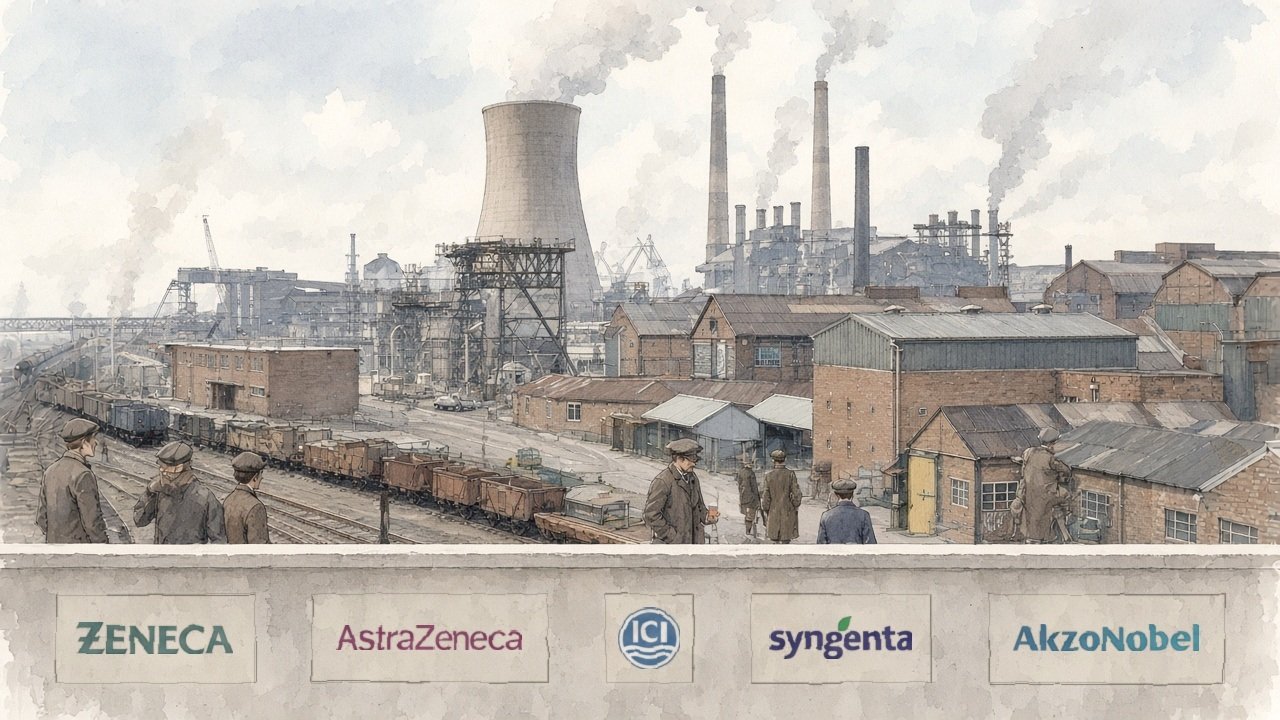
Imperial Chemical Industries was registered in London on 7 December 1926 from the merger of four companies, Brunner, Mond and Company, Nobel Industries, the United Alkali Company and the British Dyestuffs Corporation. Its founders, Sir Alfred Mond and Sir Harry McGowan, intended it to be a British counterpart to IG Farben and to the American chemical corporations, large enough to compete in world markets and to carry the cost of modern research. For most of the twentieth century it was the largest manufacturer in Britain. Its laboratories discovered polyethylene, developed Perspex, brought polyester fibre to industrial scale, and produced the beta-blocker propranolol and the breast cancer drug tamoxifen. In 1993 it divided itself in two, separating its pharmaceutical and agricultural businesses into Zeneca, which became part of AstraZeneca and Syngenta. The remaining company was bought by the Dutch group AkzoNobel in 2008. This is an account of the company from its Victorian predecessors to its absorption, and of what remains of it[1, 2, 3].
Key findings
- ICI was formed in 1926 from Brunner Mond, the leading British maker of soda by the Solvay process; Nobel Industries, the explosives group descended from Alfred Nobel’s Scottish dynamite company; the United Alkali Company, the 1890 combination of Leblanc soda works; and the British Dyestuffs Corporation, formed in 1919 with government support[1, 27, 28, 29, 30].
- The merger was negotiated by Sir Alfred Mond of Brunner Mond and Sir Harry McGowan of Nobel Industries in the autumn of 1926, in response to the formation of IG Farben in Germany the year before. Mond became the first chairman and McGowan succeeded him in 1930[1, 4, 31].
- At Billingham on Teesside the company operated one of the largest synthetic ammonia and fertiliser works in Europe and, from 1935, a plant making petrol from coal by high-pressure hydrogenation[5, 2].
- Polyethylene was first made in a reproducible form at ICI’s Winnington laboratory on 27 March 1933 by Eric Fawcett and Reginald Gibson. ICI also developed Perspex acrylic sheet and brought Terylene polyester fibre to industrial production[6, 7, 8, 24].
- ICI Pharmaceuticals introduced the anaesthetic halothane, the beta-blocker propranolol and the anti-oestrogen tamoxifen. James Black, who led the propranolol work at ICI, shared the 1988 Nobel Prize in Physiology or Medicine[9, 10, 11, 16, 36].
- In 1993 ICI demerged its bioscience businesses as Zeneca. Zeneca merged with Astra in 1999 to form AstraZeneca, and its agrochemical business combined with that of Novartis in 2000 to form Syngenta. The remaining ICI was acquired by AkzoNobel in January 2008[12, 13, 14, 15, 37].
Soda and the chemical industry of Victorian Britain
Britain had the largest chemical industry in the world for most of the nineteenth century, and its core was alkali. Soda, sodium carbonate, was needed in large quantities for glass, soap, textiles and paper. Until the early nineteenth century it came from the ashes of plants, kelp and barilla. The Leblanc process, devised in France in the 1790s, made soda from common salt, sulphuric acid, limestone and coal, and from the 1820s it was adopted on a large scale in Britain, above all on the Mersey at Widnes and St Helens, on the Tyne, and around Glasgow. The process was heavy and dirty. It released hydrochloric acid gas, which damaged crops and buildings until the Alkali Act of 1863 required its capture, and it left mountains of calcium sulphide waste. The recovery of the acid and its conversion into bleaching powder became a significant business in itself[1, 19].
In the 1860s the Belgian chemist Ernest Solvay developed a different route. In the ammonia-soda process, brine saturated with ammonia is treated with carbon dioxide, so that sodium bicarbonate precipitates and can be heated to give soda, while the ammonia is recovered with lime and used again. The process needed careful engineering, but once it worked it was cleaner and cheaper than Leblanc. Solvay began production at Couillet in Belgium in 1865 and licensed the process abroad[19].
Brunner, Mond and Company
The Solvay process came to Britain through two men who met at the Hutchinson alkali works in Widnes. John Brunner was the son of a Swiss schoolmaster who had settled in Liverpool and was a clerk and later manager at Hutchinson’s. Ludwig Mond was a German chemist from Kassel, who had studied under Kolbe and Bunsen and had come to England in 1862 with a process for recovering sulphur from Leblanc waste. In 1872 Mond obtained a licence from Solvay, and in 1873 he and Brunner set up a partnership to make ammonia soda on the Winnington Hall estate near Northwich in Cheshire, where the salt beds lay close to the River Weaver. The first months were very difficult, the plant repeatedly failed, and Mond lived in part of the hall while he worked on it. By the end of the decade the works was profitable, and in 1881 the partnership became a limited company, Brunner, Mond and Company[17, 27, 32].
Brunner Mond grew to be the largest alkali maker in Britain. It built further works at Lostock and Middlewich and acquired salt and lime interests. It was known as a demanding but progressive employer. It introduced an eight-hour shift in 1889, paid holidays, a pension scheme and housing, and Brunner, who became a Liberal member of parliament, paid for schools, libraries and village halls in the district. Mond devoted much of his fortune to science. He founded the Davy Faraday Research Laboratory at the Royal Institution, and he developed the Mond gas process for producing cheap fuel gas from coal and, with Carl Langer, the carbonyl process for refining nickel, which became the basis of the Mond Nickel Company, a separate enterprise with works at Clydach in South Wales[17, 27, 32].
Ludwig Mond died in 1909 and Brunner in 1919. Ludwig’s son Alfred Mond had joined the board of Brunner Mond and became a Liberal politician, serving in Lloyd George’s coalition government as First Commissioner of Works and later as Minister of Health. During the First World War Brunner Mond supplied ammonium nitrate for explosives and purified TNT, and in January 1917 an explosion at the government TNT purification plant it operated at Silvertown in east London killed 73 people. After the war the company bought the electrolytic alkali maker Castner-Kellner of Runcorn and, in 1920, took over the government’s incomplete project to build a synthetic ammonia plant at Billingham on the Tees[4, 27].
Nobel’s company
The second predecessor began with dynamite. Alfred Nobel, the Swedish chemist and industrialist who had patented dynamite in 1867, needed a factory in Britain. The use of nitroglycerine explosives was restricted under British law, and the first company, the British Dynamite Company, formed in Glasgow in 1871, built its works on the sand dunes at Ardeer on the Ayrshire coast. It was reconstituted as Nobel’s Explosives Company in 1877. Ardeer grew into one of the largest explosives factories in the world. The company was part of an international group of Nobel companies linked through a trust formed in 1886, the Nobel-Dynamite Trust, which held the British and German Nobel firms until it was dissolved at the outbreak of the First World War[1, 28].
Harry McGowan, the son of a Glasgow brassworker, joined Nobel’s Explosives as an office boy in 1889 and rose through its sales organisation. He was a skilled negotiator and an energetic builder of combinations. In 1909 he created a merger of Canadian explosives firms that became Canadian Explosives, and he played a central part in the agreements between Nobel and the American firm of DuPont that divided world markets for explosives. In 1918, after the wartime expansion of the explosives industry, the principal British explosives makers combined under his leadership as Explosives Trades Limited, which was renamed Nobel Industries in 1920 with McGowan as chairman. Nobel Industries diversified into metals, ammunition, leathercloth and paints, and in the early 1920s, with DuPont, it bought a substantial shareholding in the American car maker General Motors[28, 31].
The United Alkali Company
The third predecessor represented the older industry. As the Solvay process took over the market, the Leblanc producers found their profits shrinking. In 1890 forty-eight alkali works, most of them Leblanc plants in Lancashire, on Tyneside and in Scotland, together with salt, copper and other works, merged into the United Alkali Company, with its headquarters in Liverpool. It was at the time one of the largest chemical companies in the world by capital. Its strategy was to close the least efficient works, concentrate production, and develop the by-products, chlorine, bleaching powder, sulphuric acid and caustic soda, in which the Leblanc system still had an advantage. It set up a central research laboratory at Widnes in 1892, one of the first in British industry. Its position nevertheless declined, and by the 1920s it had become the weakest of the companies that would form ICI[1, 29].
British dyes
The fourth predecessor was the result of a wartime emergency. Synthetic dyes had been invented in Britain, but by 1914 about four-fifths of the dyestuffs used in British mills came from Germany, and much of the rest from Switzerland. The outbreak of war cut off the supply and threatened the textile industry, as well as the production of khaki for uniforms. In 1915 the government sponsored the formation of British Dyes Limited, which took over the works of Read Holliday at Huddersfield, with a government loan and shareholding. Levinstein Limited of Blackley in Manchester, the largest independent British dye maker, acquired the British factory of Hoechst at Ellesmere Port, which had been seized as enemy property, and with it the process for indigo. In 1919 the two companies merged as the British Dyestuffs Corporation, again with government participation and the protection of the Dyestuffs (Import Regulation) Act of 1920. The corporation struggled to compete with German producers, and it was in financial difficulty when it joined ICI[1, 30].
The merger of 1926
The formation of IG Farben in December 1925 changed the outlook for British chemical firms. Brunner Mond and Nobel Industries were both large and profitable, but the German combine was several times larger, had a long lead in research and patents, and was seeking agreements with American firms. Alfred Mond had at first explored the possibility of an arrangement between Brunner Mond and IG Farben. In the summer of 1926 McGowan was in the United States negotiating with DuPont and General Motors, while Mond was in New York in discussions with the Allied Chemical and Dye Corporation. When the talks with the Germans and Americans failed to produce a satisfactory arrangement, McGowan and Mond agreed to merge their own companies and to bring in United Alkali and British Dyestuffs. The outline of the merger was settled during the return voyage on the liner Aquitania in late September and early October 1926, a story that later became part of the company’s tradition[1, 3, 4].
The agreement was announced in October 1926 and Imperial Chemical Industries Limited was registered on 7 December 1926. The shareholders of the four constituent companies received ICI shares in exchange. The new company had an authorised capital of £65 million, of which some £56.8 million was issued, and about 33,000 employees. Mond became chairman and McGowan president, effectively his deputy. Mond’s proposal for the name reflected his political view that the company should serve the economic unity of the British Empire, and the word Imperial in the title was intended to signal that it would develop markets in the Dominions and India. The merger was one of the largest in British business history up to that time[1, 2, 3].
The company quickly built a headquarters on Millbank, beside the Thames in Westminster. Imperial Chemical House, designed by Sir Frank Baines and completed in 1928, was a large steel-framed building faced in Portland stone, with bronze doors and sculptural figures of science and industry. Across the street stood Thames House, built at the same time, and the two buildings formed a monumental pair at the end of Lambeth Bridge. The company’s emblem, a circle containing the letters ICI over wavy lines, was introduced in the early years and remained, in successive versions, its mark until 2008[1, 3].
The two founders
The two men who created ICI had very different backgrounds and temperaments. Alfred Mond, born in 1868 in Farnworth near Widnes, was educated at Cheltenham, Cambridge and Edinburgh and trained as a barrister before joining his father’s company. He was a politician as much as an industrialist. He sat in the House of Commons as a Liberal from 1906, held ministerial office under Lloyd George, and joined the Conservative Party in 1926, shortly before the merger. He wrote and spoke widely on economic questions, advocating industrial rationalisation, the cooperation of employers and trade unions, and economic union within the British Empire. He was also a prominent supporter of the Zionist movement and a collector of Italian Renaissance paintings, part of which he bequeathed to the National Gallery[4].
Harry McGowan, born in Glasgow in 1874, left school at fifteen and spent his whole working life in the explosives industry. He had none of Mond’s intellectual or political interests. His abilities were in negotiation, finance and the management of large organisations, and he was known for his confidence and his strong personal control of the company. He was made a baronet in 1927 and a peer, as Baron McGowan, in 1937. In the late 1930s his authority within ICI was challenged by other directors, who objected to his concentration of power and to losses on some of his personal investments, and for a period the board considered removing him. He remained chairman until 1950 and died in 1961[31].
The partnership between them lasted only four years, but it set the pattern of the company. Mond provided the vision of a large, research-based, imperial enterprise that would cooperate with labour and with government. McGowan provided the commercial structure, the international agreements and the system of central control. Their successors inherited both the size and the expectations, and much of the later history of ICI can be read as a series of attempts to reconcile the scale that Mond and McGowan had created with the changing markets in which the company had to operate[2, 3, 4, 31].
The merger itself was not universally welcomed. Some shareholders of Brunner Mond, the most profitable of the four companies, considered that the terms favoured the weaker partners, and the inclusion of United Alkali and British Dyestuffs brought with it plants that had to be closed or modernised at considerable cost. Within the first years ICI closed a number of the remaining Leblanc works and concentrated alkali production in Cheshire and electrolytic chlorine production at Runcorn and Widnes. The dyestuffs business required continued investment to compete with German and Swiss producers, which ICI justified as a matter of national interest, since the war had shown the dangers of dependence on imported dyes and organic chemicals[2, 29, 30].
For contemporaries, the creation of ICI was a sign that British industry was adopting the methods of its American and German rivals. Newspapers compared it with IG Farben and with DuPont, and it was presented as a demonstration that a British company could operate on the same scale. The company soon became the largest industrial enterprise in Britain by market value, a position it held for decades, and its shares were among the most widely held on the London Stock Exchange[1, 2, 41].
Organisation and the first years
The merger brought together businesses of very different character, from the profitable alkali works of Cheshire to the declining Leblanc plants of Widnes and the loss-making dye factories of Huddersfield and Blackley. Mond and McGowan imposed a centralised structure. Policy, finance and research were directed from Millbank, while manufacturing was organised into groups, which became the divisions that would define the company for half a century. By the 1930s these included the Alkali Division at Northwich, the General Chemicals Division at Widnes and Runcorn, the Dyestuffs Division at Blackley, the Explosives Division at Ardeer, the Metals Division at Witton in Birmingham, the Lime Division at Buxton, the Fertilizer and Synthetic Products Division at Billingham, and later a Plastics Division and a Paints and Lacquers Division. Each division had its own works, laboratories and management, and many kept a strong sense of the identity of their predecessor companies for decades[1, 2, 33].
The company inherited the paternalist labour policies of Brunner Mond and extended them. It introduced works councils in 1929, a profit-related share scheme for employees, staff grades for long-serving manual workers, and, in 1929, a pension fund. These arrangements were partly a response to the industrial conflict of the 1920s, including the General Strike of 1926, and partly a reflection of Mond’s interest in industrial cooperation, which he pursued in the talks with trade union leaders that became known as the Mond-Turner conversations of 1928[2, 4].
Alfred Mond was raised to the peerage as Baron Melchett in 1928. He died in December 1930, and McGowan became chairman, a post he held until 1950. Under McGowan the company became more cautious. The depression of the early 1930s hit ICI hard, especially in fertilisers, and McGowan concentrated on cost reduction and on agreements with competitors to stabilise markets[2, 3, 31].
International agreements
ICI was formed in an era of cartels, and international agreements were a central part of its strategy. Its most important relationship was with DuPont. The patents and processes agreement of 1929 provided for the exchange of technical information and patent licences between the two companies and, in effect, divided markets between them, with ICI taking the British Empire, except Canada, where they had joint companies, and DuPont the Americas. The agreement was renewed in 1939 and remained in force until the United States government brought an antitrust action against it, which resulted in a court judgement in 1952 requiring its termination[2, 3].
With IG Farben ICI negotiated a series of agreements on nitrogen, dyestuffs and hydrogenation. In 1929 it joined the convention that regulated the international nitrogen market, and in 1932 it entered the international dyestuffs cartel with the German, French and Swiss producers. In hydrogenation it joined Standard Oil of New Jersey, Royal Dutch Shell and IG Farben in the International Hydrogenation Patents Company, formed in 1931 to pool patents on the conversion of coal and oil into motor fuel. In the alkali trade, the old relations between Brunner Mond and Solvay continued, with Solvay holding a significant shareholding in ICI. These arrangements gave ICI security in its home and imperial markets, but they also limited its ambitions in the United States and continental Europe[2, 3, 41].
The empire was the company’s principal overseas field. It formed or acquired companies in Australia and New Zealand, where Imperial Chemical Industries of Australia and New Zealand was established in 1928 from the local Nobel and other interests; in Canada, with DuPont, as Canadian Industries Limited; in South Africa, with De Beers, as African Explosives and Chemical Industries; and in India, as ICI (India). These companies later became independent groups, the Australian one under the name Orica[1, 26].
Billingham
The works at Billingham was the largest of ICI’s new investments in the interwar years and the one that most closely linked it to the German industry. The site, north of the Tees near Stockton, had been chosen by the Ministry of Munitions in 1917 for a synthetic ammonia plant to make nitrates for explosives, but the plant had not been built by the end of the war. Brunner Mond bought it in 1920 and formed Synthetic Ammonia and Nitrates Limited to develop it. There was no British experience with high-pressure synthesis, and the engineers had to reconstruct the Haber-Bosch method from published information, patents and the findings of the Allied missions that had visited the BASF works at Oppau after the war. Ammonia was first produced at Billingham at the end of 1923, and by 1924 the plant was in regular production[5, 42].
Under ICI Billingham was expanded rapidly in the late 1920s. The company expected a large world demand for nitrogen fertilisers, and it built capacity to make ammonium sulphate, using anhydrite mined beneath the site, and later the compound fertiliser marketed as Nitro-Chalk and concentrated complete fertilisers. By 1929 Billingham was one of the largest chemical works in the world. The expectation proved wrong. The world market collapsed in the depression, the international nitrogen cartel restricted output, and for several years the plant ran well below capacity. ICI’s reorganisation of 1931 involved heavy write-downs on the fertiliser investment[2, 5].
The company turned part of Billingham’s capacity to the hydrogenation of coal. Using the patents of Friedrich Bergius, which it obtained through the international hydrogenation arrangements, and its own research, ICI built a plant to convert coal and creosote into petrol. The government supported the project with a guaranteed preference on the duty on home-produced fuel, under the British Hydrocarbon Oils Production Act of 1934, partly to provide employment in the depressed North East and partly to establish a domestic source of motor and aviation fuel. The plant was opened in October 1935 and had a capacity of about 150,000 tonnes of petrol a year. During the Second World War it produced aviation spirit and iso-octane. The plant was costly in peacetime, and after the war it was converted to the processing of creosote and later of petroleum feedstocks[2, 5].
Billingham also produced the industrial gases, methanol and other products of high-pressure chemistry. A large research department grew up there, and it was the base for much of ICI’s later work on catalysts and process engineering. After 1945 the company developed a second major Teesside site at Wilton, on the south bank of the river, for petrochemicals and fibres, and the two sites together formed one of the largest concentrations of chemical industry in Europe[1, 5].
Research and the discovery of polyethylene
The founders had promised that ICI would match the research effort of the German industry. The company established research laboratories in each division and, in the late 1920s, began a programme of fundamental research. The most important result came from work at the Alkali Division’s laboratory at Winnington, which had been investigating chemical reactions at very high pressures under the direction of a research committee that included academic advisers.
On 27 March 1933 Eric Fawcett and Reginald Gibson were studying the reaction of ethylene and benzaldehyde at a pressure of about 1,400 atmospheres and a temperature of about 170 degrees Celsius. When they opened the vessel they found a small amount of white waxy solid coating its walls. It was a polymer of ethylene. The result could not at first be reliably repeated, because the reaction sometimes ran away and decomposed the ethylene explosively, and work was suspended. In December 1935 a team under Michael Perrin returned to the problem with improved equipment and found that the reaction depended on the presence of a small trace of oxygen, which acted as an initiator. With that understanding the process could be controlled[6, 18].
ICI filed the first patent on polyethylene in 1936, and the first production plant, with a capacity of about 100 tonnes a year, began operation at Wallerscote near Northwich on 1 September 1939, the day German forces entered Poland. The new material, a tough, flexible plastic with excellent electrical insulating properties, proved to be essential for the insulation of high-frequency cables, and it was used in radar equipment throughout the war. After the war it became one of the most widely used plastics in the world, in films, packaging, containers and pipes, although the low-pressure processes developed in the 1950s by Karl Ziegler and by Phillips Petroleum later supplemented the ICI high-pressure process[6, 18].
Perspex and the plastics business
At the same time ICI was developing acrylic plastics. Polymethyl methacrylate had been studied in Germany, where Röhm and Haas made a cast sheet under the name Plexiglas. At ICI’s Dyestuffs Division, Rowland Hill investigated polymers of methacrylic esters, and John Crawford found a commercially practical route to the monomer methyl methacrylate from acetone, hydrogen cyanide and sulphuric acid, by way of acetone cyanohydrin. ICI produced the clear, rigid acrylic sheet from 1934 and registered the trade name Perspex. Its first large market was the aircraft industry, where its lightness, transparency and resistance to shattering made it the standard material for cockpit canopies, gun turrets and windows, including those of the Spitfire and the Hurricane. After the war Perspex was used in signs, lighting, baths, display stands and medical devices[7].
The company formed a Plastics Division in 1944, based at Welwyn Garden City, which took responsibility for polyethylene, Perspex, polyvinyl chloride and other plastics. Its products were sold under trade names that became widely known, such as Alkathene for polyethylene and Welvic for PVC[1, 7].
Paints
ICI also entered the consumer market through paint. Nobel Industries had acquired a nitrocellulose lacquer business at Slough, and in 1926 the merged company had a small paint interest. Through its agreement with DuPont ICI obtained the formulations for alkyd resin paints, which DuPont sold under the name Dulux. ICI began to produce Dulux paints in Britain in 1931, at first for industrial and motor vehicle finishes and later for houses. The ICI paint business expanded with the purchase of established firms, and after the war Dulux became the leading brand of household paint in Britain and in many Commonwealth countries. From the early 1960s its advertising used an Old English Sheepdog, which became one of the best-known images in British advertising[23].
Dyestuffs under ICI
The British Dyestuffs Corporation became the Dyestuffs Division of ICI, with its main works at Blackley in north Manchester and further plants at Huddersfield, Grangemouth and Ellesmere Port. The division was the least profitable of the founding businesses for many years, but it held the company’s largest concentration of organic chemists. In 1928 ICI acquired Scottish Dyes Limited of Grangemouth, a firm founded during the war by James Morton, which had specialised in vat dyes for cotton. Chemists at Grangemouth had observed in 1928 that a blue impurity formed during the manufacture of phthalimide in an iron vessel. The compound was studied with academic chemists, notably Reginald Patrick Linstead at Imperial College, who determined the structure of the phthalocyanines. ICI introduced copper phthalocyanine in 1935 under the name Monastral Blue. It was an intensely coloured, very stable pigment that became one of the most widely used blues in printing inks, paints and plastics[1, 2].
The division’s chemists made a second important contribution in the 1950s. In 1954 Ian Rattee and William Stephen, working at Blackley, found that dyes containing a dichlorotriazine group would react chemically with the hydroxyl groups of cellulose under mild alkaline conditions, forming a covalent bond between dye and fibre. The resulting fibre-reactive dyes, launched in 1956 under the name Procion, gave bright colours with very good fastness to washing and were simple to apply. Reactive dyes became the most important class of dyes for cotton. The Dyestuffs Division was also the starting point for ICI’s medical chemicals and, later, for its pharmaceutical division, since the techniques of dye synthesis were applicable to drug discovery[1, 3].
Explosives, metals and the older divisions
The Nobel inheritance remained a major part of ICI for decades. The Explosives Division at Ardeer supplied commercial explosives to mines and quarries throughout the empire, as well as military explosives and propellants. In 1927 ICI acquired a controlling interest in the Kynoch ammunition business at Witton, which had already been part of Nobel Industries, and the Metals Division grew there into a large producer of copper, brass, zinc and later titanium and other non-ferrous metals. The Metals Division was separated from ICI as Imperial Metal Industries, which was partly floated in 1962 and became fully independent as IMI plc in 1978[1, 28].
The Alkali Division, the direct descendant of Brunner Mond, continued to make soda ash and sodium bicarbonate at Winnington and Lostock, and salt from the Cheshire brine fields. The General Chemicals Division, which included the former United Alkali works and Castner-Kellner at Runcorn, made chlorine, caustic soda, solvents and the fluorine chemicals that later led to halothane and to refrigerants. The Lime Division quarried limestone in the Peak District around Buxton. In 1964 the Alkali and General Chemicals divisions were merged as the Mond Division, a name that recalled the company’s founder, with its headquarters at Runcorn[1, 2, 3].
Rearmament and the Second World War
From the mid-1930s ICI was drawn into British rearmament. The government relied on the company for explosives, ammunition and chemicals, and in 1937 it asked ICI to design, build and manage a series of new explosives factories on its behalf. These agency factories, which were owned by the state but run by the company, were built at sites chosen for their distance from likely bombing, among them Dumfries, Drungans, Bishopton in Renfrewshire, Wigtown and Irvine, as well as in Wales and the north of England. By the height of the war ICI was operating some twenty-five agency factories in addition to its own plants, and the number of people working under its management, including those in the government factories, rose to well over one hundred thousand[2, 3].
The company’s wartime production covered most of the materials of modern warfare. Ardeer and the agency factories made cordite, TNT, RDX and other high explosives. The Metals Division produced cartridge cases, ammunition and non-ferrous metals. Billingham made aviation fuel and ammonia, and the Alkali and General Chemicals divisions supplied the basic chemicals on which other industries relied. ICI also made poison gas for the government’s stockpile, although gas was not used. Polyethylene for radar cables and Perspex for aircraft gave the company’s new plastics a strategic importance that had not been foreseen when they were discovered[2, 6, 7].
In 1940 the Ardeer works was one of the places where ICI scientists were consulted about the possible military applications of nuclear fission. After the report of the MAUD Committee in 1941 concluded that an atomic bomb was feasible, the government set up a secret project under the cover name Tube Alloys within the Department of Scientific and Industrial Research. Its director was Wallace Akers, the research director of ICI, who was seconded from the company, and Michael Perrin, who had led the work on polyethylene, became his assistant. ICI scientists and engineers carried out work on the separation of uranium isotopes by gaseous diffusion, on the production of uranium metal and on the design of plant. The company had expected that the post-war atomic industry might be run commercially, and its role created some suspicion on the American side. When the British programme was merged with the American Manhattan Project under the Quebec Agreement of 1943, British scientists moved to the United States and the industrial work in Britain was largely suspended[21].
Nationalisation debates and post-war expansion
The Labour government elected in 1945 nationalised coal, steel, electricity, gas and the railways, but not the chemical industry. ICI was nevertheless the subject of public discussion as a near monopoly in many products, and in the late 1940s the Labour Party considered including it in its nationalisation programme. The company responded with a public relations effort that emphasised its research and its contribution to exports. McGowan retired as chairman in 1950, and his successors were managers with technical training, such as John Rogers and Alexander Fleck, who had been a chemist at Billingham[2, 3, 33].
The post-war period brought very rapid growth. Demand for plastics, fibres, fertilisers, paints and agricultural chemicals rose year after year, and the company invested heavily to meet it. It built the Wilton site from 1946 as an integrated petrochemical complex based on oil rather than coal, with cracking plants supplying ethylene and other feedstocks to its plastics and fibres plants. Wilton was officially opened in 1949 and grew into one of the largest chemical complexes in Europe. ICI also expanded abroad, particularly in continental Europe after Britain’s first application to join the European Economic Community, and in the United States, where the termination of the DuPont agreement in the early 1950s left it free to compete[1, 2].
Terylene and fibres
The most important new product of the post-war decades was polyester fibre. Polyethylene terephthalate had been discovered in 1941 by John Rex Whinfield and James Tennant Dickson at the Calico Printers’ Association in Manchester, which had no capacity to develop it. During the war the invention was kept secret, and in 1947 ICI acquired the rights to it outside the United States, where DuPont took the rights and sold the fibre as Dacron. ICI named its fibre Terylene, built a pilot plant at Hillhouse in Lancashire and began full-scale production at Wilton in 1955. Terylene was strong, quick-drying and resistant to creasing, and it was used in shirts, suits, sails and industrial fabrics, often blended with wool or cotton. The polyester film made from the same polymer was sold as Melinex[8].
In 1959 ICI introduced Crimplene, a bulked textured polyester yarn developed with a Lancashire textile firm and named after the Crimple Valley near Harrogate, where ICI Fibres had its headquarters. Crimplene fabrics were heavy, uncreasable and easy to wash, and they were widely used in women’s dresses and suits in the 1960s and early 1970s. ICI was also a major producer of nylon, through British Nylon Spinners, a company it owned jointly with Courtaulds from 1940, and which ICI took over completely in 1964[24, 25].
The fibres business drew ICI into a contest with Courtaulds, the largest British maker of rayon. In December 1961 ICI made a takeover bid for Courtaulds, which was then the largest bid in British corporate history. Courtaulds’ management resisted strongly, and in March 1962 the bid failed when ICI obtained only a minority of the shares. ICI retained a substantial shareholding for some years and later sold it. The episode was one of the first great contested takeovers on the London stock market[25].
Pharmaceuticals
ICI’s entry into pharmaceuticals began during the Second World War. The Dyestuffs Division had experience in organic synthesis, and in 1942 the company set up a medical chemicals section, which produced sulphonamides and, in 1944, the antimalarial drug proguanil, known as Paludrine. In 1957 the pharmaceutical work became a separate division, ICI Pharmaceuticals, with headquarters and laboratories at Alderley Park, an estate in Cheshire that the company had bought in 1950. It became one of the most productive centres of drug research in Britain[1, 12].
The first of the major products came from the General Chemicals Division’s work on fluorine chemistry. In 1951 Charles Suckling synthesised halothane, a fluorinated hydrocarbon that proved to be a potent, non-flammable inhalational anaesthetic. After clinical trials by Michael Johnstone in Manchester, it was introduced in 1956 under the name Fluothane. It replaced ether and cyclopropane in many hospitals because it did not explode and allowed a smoother induction and recovery, and it became one of the most widely used anaesthetics in the world for several decades[9].
The second was propranolol. James Black, a Scottish pharmacologist, joined ICI Pharmaceuticals in 1958 with the idea that the pain of angina pectoris might be relieved by reducing the heart’s demand for oxygen rather than by increasing its supply. He proposed blocking the beta-adrenergic receptors through which adrenaline stimulates the heart. The team first produced pronethalol, which was withdrawn after it caused tumours in mice, and then propranolol, which was introduced in 1964 under the name Inderal. Propranolol was the first clinically successful beta-blocker. It was used for angina, high blood pressure, irregular heartbeat and, later, for the prevention of further heart attacks, and it became one of the most prescribed drugs in the world. Black left ICI in 1964 and later developed the H2 receptor antagonist cimetidine at Smith, Kline and French. He shared the Nobel Prize in Physiology or Medicine in 1988 with Gertrude Elion and George Hitchings for discoveries of important principles for drug treatment[10, 16, 36].
The third was tamoxifen. In 1962 the chemist Dora Richardson synthesised a series of triphenylethylene compounds in a programme led by Arthur Walpole that was looking for a contraceptive. One of them, the trans isomer known as ICI 46,474, was found to block the action of oestrogen. It failed as a contraceptive but showed activity against hormone-dependent breast cancers in early clinical trials in Manchester. It was introduced in Britain in 1973 as Nolvadex, and it became the standard hormonal treatment for breast cancer for several decades and was later used to reduce the risk of the disease in women at high risk[11].
Later ICI products included the beta-blocker atenolol, sold as Tenormin from 1976, which became the company’s largest selling drug, the cancer drug goserelin, sold as Zoladex, and the ACE inhibitor lisinopril, sold under licence as Zestril. By the 1980s pharmaceuticals were the most profitable part of ICI, although they accounted for a minority of its sales[1, 12, 35].
Agriculture
ICI’s interest in agriculture grew out of its fertiliser business. In 1928 it bought Jealott’s Hill, a farm near Bracknell in Berkshire, and established an agricultural research station there to test fertilisers and develop crop treatments. During the Second World War the station worked on plant growth regulators and developed the selective herbicide MCPA, one of the first chemicals that could kill broad-leaved weeds in cereal crops without harming the crop[1, 20].
The best-known Jealott’s Hill product was paraquat. The herbicidal properties of the compound, which had been known as a chemical since the nineteenth century, were discovered at ICI in 1955, and it was introduced in 1962 under the name Gramoxone. Paraquat killed green plant tissue on contact and was quickly inactivated in soil, so that it could be used to clear weeds before planting and made possible the method of farming with reduced tillage. It became one of the most widely used herbicides in the world. It is also highly toxic to humans if swallowed, and accidental and intentional poisonings led to restrictions on its sale and, eventually, to its prohibition in many countries, including the countries of the European Union from 2007[20].
Other agrochemical products included the herbicide diquat, the fungicide ethirimol and, later, the strobilurin fungicide azoxystrobin, which was discovered at Jealott’s Hill, launched in 1996 under the name Amistar and became one of the best-selling fungicides in the world. By the time of the demerger the agrochemicals business was among the largest in the world[12, 14].
Single-cell protein and the limits of diversification
Not every large research project succeeded. In the late 1960s ICI’s Agricultural Division at Billingham began to investigate the production of protein for animal feed by growing bacteria on methanol, which the division made in large quantities from natural gas. The bacterium Methylophilus methylotrophus was cultivated in a continuous fermenter, and the dried cells, containing about seventy per cent protein, were sold as Pruteen. ICI built a production plant at Billingham, which opened in 1980 and contained one of the largest continuous fermentation vessels ever built, an air-lift fermenter some sixty metres tall. The technology worked, but by the time the plant was finished the price of soya meal had fallen and the price of energy had risen, and Pruteen could not compete. The plant was closed in the late 1980s. Part of the knowledge gained in fermentation was later used in the development of the fungal protein Quorn, which ICI produced in a joint venture with the food company Rank Hovis McDougall[1, 5].
The same period saw ICI expand its production of nitrogen fertilisers with a new generation of large single-stream ammonia plants at Billingham and Severnside, based on steam reforming of natural gas and naphtha. These plants, built in the 1960s and 1970s, were developed with the company’s own catalysts and engineering, and the ICI steam reforming and ammonia process was licensed to plants throughout the world. ICI Katalco, the catalyst business, became an international supplier, and the low-pressure methanol process developed at Billingham in the 1960s became the dominant method of making methanol worldwide[1, 5, 42].
The company and its people after the war
At its post-war peak ICI was one of the largest employers in Britain, and in towns such as Northwich, Runcorn, Widnes, Billingham, Stevenston and Blackley it dominated local life. The company maintained sports clubs, social centres, housing, apprenticeship schemes and long-service awards, and many families worked for it over several generations. It recruited large numbers of science and engineering graduates each year and was the principal industrial employer of chemists in the country. Its research laboratories maintained close ties with universities, and it funded ICI research fellowships at British universities from 1944, which supported many scientists early in their careers[2, 3, 33].
ICI was also a significant voice in national industrial policy. Its chairmen sat on government committees, it was a founding member of the Confederation of British Industry, and it was frequently used by governments and commentators as a measure of the health of British manufacturing. Its share price was regarded for decades as a barometer of the British economy, and commentators spoke of the company as a bellwether of the stock market[2, 3, 22].
International expansion
From the 1960s ICI sought to reduce its reliance on the British market. Britain’s applications to join the European Economic Community, the second of which succeeded in 1973, encouraged investment on the continent, and ICI built a large petrochemicals and plastics complex at Rozenburg near Rotterdam and plants in Germany, France and Belgium. In the United States, where the end of the DuPont agreement had removed the old restrictions, the company bought the Atlas Chemical Industries of Wilmington, Delaware, in 1971, and formed ICI Americas as the base of its American business. It later bought further American businesses in specialty chemicals, paints and seeds, and by the mid-1980s more than half of its sales were made outside the United Kingdom[1, 3].
The overseas affiliates in the Commonwealth followed their own course. ICI Australia, which had grown into one of the largest industrial companies in Australia, was partly floated on the local stock exchange and later became fully independent, taking the name Orica in 1998 when ICI sold its remaining shares. Canadian Industries Limited, separated from DuPont after the American antitrust judgement, became ICI Canada. In India ICI’s interests were gradually reduced as the Indian government restricted foreign ownership, and the Indian company later became part of AkzoNobel India. In South Africa AECI, the former joint venture with De Beers, became an independent listed company[1, 26].
Environment and regulation
Like all large chemical manufacturers, ICI faced growing environmental regulation from the 1960s onward. Its older sites had accumulated waste over a century of production. In Cheshire the lime beds left by the Solvay process covered large areas near Northwich, and the Leblanc waste heaps around Widnes and St Helens were a legacy of the United Alkali works. The chlor-alkali plants at Runcorn used mercury cells, and the discharge of mercury into the Mersey estuary became the subject of regulation and of long programmes of reduction. The Teesside sites were subject to controls on emissions to air and water as the regulatory framework developed under successive pollution control laws[1, 5].
ICI was one of the leading producers of chlorofluorocarbons, which it sold under the trade name Arcton as refrigerants and aerosol propellants. When the role of chlorofluorocarbons in the depletion of stratospheric ozone was established and the Montreal Protocol of 1987 provided for their phase-out, ICI was among the first companies to develop replacements. It built the first large-scale plant for the hydrofluorocarbon HFC-134a, which it sold as Klea, at Runcorn in the early 1990s, and HFC-134a became the standard refrigerant for car air conditioning and domestic refrigerators for the following decades[1].
The pesticide paraquat brought the company into lengthy controversy over the safety of its products in developing countries, where poisonings were frequent. Zeneca and Syngenta, which inherited the product, added an emetic, a stenching agent and a blue colour to formulations in an effort to reduce accidental ingestion. The product remained in use in many countries after its prohibition in the European Union[20].
Imperial Chemical House
The headquarters on Millbank remained the company’s centre for most of its history. Imperial Chemical House housed the board, the central departments and the company’s archives, and its boardroom and entrance hall, decorated with bronze reliefs and panelling, were used for formal occasions. The building was part of the image that ICI presented to the public, a solid, monumental institution at the centre of London. In the decades after the demerger the reduced company had less need for so large an office, and the headquarters was moved to smaller premises. The Millbank building passed to other owners and was converted for other uses, while Thames House across the road became the headquarters of the Security Service[1, 33].
Explosives after 1945
The explosives business that ICI had inherited from Nobel Industries changed in character after the Second World War. The agency factories built for the government were returned to state control or closed, and the demand for military explosives fell sharply. The commercial market, by contrast, grew with the post-war expansion of mining, quarrying and civil engineering. The Ardeer factory remained the centre of the business and its research, and the division supplied blasting explosives, detonators and safety fuses to mines in Britain and to the large mining industries of the Commonwealth, where the affiliated companies in Australia, Canada and South Africa operated their own explosives plants[1, 3, 28].
The technology of commercial blasting also changed. From the 1950s mining companies increasingly used mixtures of ammonium nitrate and fuel oil, which were cheap and much safer to handle than nitroglycerine dynamite, and later water-based slurry and emulsion explosives that could be pumped directly into boreholes. ICI and its affiliates developed and manufactured these products, and the business became less a matter of factory-made cartridges and more one of supplying bulk materials, initiating systems and technical services at the mine. The Explosives Division at Ardeer gradually reduced its manufacture of traditional dynamite, and much of the site’s chemical production was closed in the later decades of the century[1, 26].
By the 1990s ICI Explosives was one of the largest commercial explosives businesses in the world, with operations on several continents. It was a natural fit for the Australian affiliate, which had built a strong mining explosives business of its own. In 1997 ICI sold its remaining shareholding in ICI Australia, which took the name Orica in 1998, and in the same period Orica acquired the ICI Explosives business worldwide. The transaction completed the separation of the Nobel inheritance from ICI, seventy years after the merger of 1926, and Orica became the largest supplier of commercial explosives in the world[1, 26, 28].
Histories of the company
ICI attracted more historical and analytical study than most British companies. In the 1960s the company commissioned the historian W. J. Reader to write its official history with full access to its archives. The first volume, published in 1970, covered the predecessor companies from 1870 to 1926, and the second, published in 1975, the first quarter-century of ICI itself, from the merger to 1952. A popular account of the company, ICI. The Company That Changed Our Lives, was published by the journalist Carol Kennedy in 1986. Reader’s volumes remain the principal sources for the formation of the company, the negotiations of 1926 and the international agreements of the interwar years[2, 3].
The later history was studied mainly by management scholars. Andrew Pettigrew’s study of strategic change in ICI, published in 1985, drew on interviews with directors and managers across the company over many years, and it became a standard text on organisational change in large corporations. The demerger of 1993 was analysed at the time in business and scientific journals, which discussed its logic, its effect on research, and the precedent it set for other large conglomerates. These studies, together with the company histories of the successor firms, form the main body of literature on ICI[34, 35, 37, 39].
The large company in a changing market
By the late 1960s ICI was one of the largest chemical companies in the world, with more than 190,000 employees worldwide and a range of products that ran from soda ash and chlorine to dyes, paints, fibres, plastics, explosives, fertilisers, drugs and pesticides. Its scale was also a source of difficulty. Many of its bulk businesses, such as alkali, chlorine, fertilisers and petrochemicals, were mature, cyclical and exposed to competition from new producers in Europe, the Middle East and Asia. The company had built a large fibres business in the 1950s and 1960s just as the market for synthetic fibres was becoming saturated, and its plants at Wilton and in Northern Ireland were affected by low prices and overcapacity in the 1970s[1, 3, 39].
The organisation also reflected its history. The divisions were large, semi-autonomous bodies with their own traditions, and the board in London had to balance their claims for investment. In the 1960s and 1970s the company made several attempts at reorganisation, merging divisions, introducing product groups and strengthening the role of the main board. The sociologist Andrew Pettigrew, who studied ICI over many years, described the period as one in which the company struggled to change a culture built around engineering and manufacturing into one focused on markets and profitability[39].
The oil crises of 1973 and 1979 raised the cost of feedstocks and energy, and the recession of 1980 to 1981 hit British manufacturing severely. In 1980 ICI reported a loss in the third quarter, the first in its history, and it cut its dividend for the first time. It closed plants, reduced its British workforce substantially and began to shift investment toward higher-value products and toward markets outside the United Kingdom[1, 22].
Harvey-Jones and the 1980s
Sir John Harvey-Jones, a former naval officer who had joined ICI in 1956 and had worked in the petrochemicals division, became chairman in 1982. He reduced the size of the main board, gave the businesses more responsibility for their own results, and pressed for a more international and commercially minded company. He also sought to reduce ICI’s dependence on bulk chemicals, and the company bought businesses in specialty chemicals and seeds in the United States and Europe, including the Glidden paint business in 1986. In 1984 ICI became the first British manufacturing company to report a pre-tax profit of more than one billion pounds. Harvey-Jones became a well-known public figure, and after his retirement in 1987 he presented the television series Troubleshooter, in which he advised struggling businesses[22].
His successor, Sir Denys Henderson, faced a further downturn at the end of the decade. The chemical cycle turned down in 1990 and 1991, the profits of the bulk businesses fell sharply, and the market value of ICI declined to a level that made it vulnerable to a takeover[1, 22].
Hanson and the decision to divide
In May 1991 the conglomerate Hanson plc, which was known for buying underperforming companies and selling parts of them, announced that it had acquired a stake of about 2.8 per cent in ICI. The move was widely interpreted as a prelude to a bid. ICI responded with a public campaign against Hanson, questioning its accounting and its record of investment, and the stake was sold in 1992 without a bid being made. The episode nonetheless had a decisive effect on ICI’s strategy. The board concluded that the market valued the company below the sum of its parts, because the high-growth, research-intensive bioscience businesses were weighed down by the mature industrial chemicals[1, 34].
In July 1992 ICI announced that it would divide itself into two separate companies. The pharmaceuticals, agrochemicals and seeds, and specialty businesses were to be transferred to a new company, while ICI would retain the industrial chemicals, paints, materials and explosives. The plan was carried out by means of a demerger, in which ICI shareholders received shares in the new company in proportion to their holdings, together with a rights issue that raised £1.3 billion for the new company. The new company was given the name Zeneca, a word chosen because it had no existing meaning and could be registered as a trade mark in many countries. The demerger was completed on 1 June 1993, when Zeneca Group plc was listed on the London Stock Exchange[12, 34].
Analyses of the demerger at the time noted that it was one of the largest corporate separations in Europe. It gave Zeneca about a third of the former group’s sales but a much larger share of its profits and research, and it left ICI with a large but slower-growing industrial business. Commentary in scientific journals noted that much of ICI’s central research capacity, including Alderley Park and Jealott’s Hill, had gone to Zeneca, and that the remaining ICI would have to rely more on the research of its individual businesses[34, 35].
Zeneca, AstraZeneca and Syngenta
Zeneca was led by Sir Denys Henderson as chairman and David Barnes as chief executive. It had three businesses, Zeneca Pharmaceuticals, Zeneca Agrochemicals and Zeneca Specialties, and its principal products included Tenormin, Zestril, Nolvadex and Zoladex, together with the herbicide and fungicide lines developed at Jealott’s Hill. The company performed strongly in its first years, and it launched new medicines, among them the breast cancer drug anastrozole, sold as Arimidex, and the antipsychotic quetiapine, sold as Seroquel[12, 13].
In December 1998 Zeneca and the Swedish pharmaceutical company Astra AB announced a merger of equals. The combination was completed on 6 April 1999, creating AstraZeneca plc, with its corporate headquarters in London and major research centres in Sweden, the United Kingdom and the United States. At the time it was one of the largest pharmaceutical companies in the world. AstraZeneca moved its global headquarters to the Cambridge Biomedical Campus in the following decades, and it remains one of the two largest companies on the London Stock Exchange by market value[13, 37].
The agrochemical business followed a different route. In December 1999 AstraZeneca and the Swiss group Novartis announced that they would combine their agribusiness divisions in a new company. Syngenta was formed in November 2000, with headquarters in Basel, as the first global company devoted entirely to agribusiness, with leading positions in crop protection and a substantial seeds business. Jealott’s Hill became one of its main research centres. In 2017 Syngenta was acquired by the state-owned China National Chemical Corporation, known as ChemChina, for about 43 billion dollars, and it later became part of the Syngenta Group[14].
Zeneca Specialties was sold in 1999 to a group of private equity investors led by Cinven and Investcorp and renamed Avecia. It was later divided and its parts sold to other companies[12, 13].
The new ICI
The ICI that remained after 1993 was still a large company, with sales of about eight billion pounds, but most of its businesses were in commodity chemicals and materials. Its management, under the chairman Sir Ronald Hampel and the chief executive Charles Miller Smith, who was recruited from Unilever in 1994, concluded that the company should become a specialty chemicals and consumer products business, less exposed to the chemical cycle[1, 40].
The central step was taken in 1997, when ICI bought four specialty chemicals businesses from Unilever, National Starch and Chemical, Quest International, Unichema and Crosfield, for about 4.9 billion pounds, equivalent to about 8 billion dollars. National Starch made adhesives, specialty starches and electronic materials, and Quest made flavours and fragrances. The acquisition was financed largely with debt, which ICI intended to repay by selling its bulk chemical businesses[1, 40].
The disposals took longer than expected and raised less than planned, because chemical markets weakened after the Asian financial crisis of 1997. In 1999 ICI sold its polyurethanes, titanium dioxide pigments under the Tioxide name, aromatics and petrochemicals businesses to the American company Huntsman. The acrylics business, including Perspex, was sold to Ineos in the same year. The explosives business went to ICI’s former Australian affiliate, which had been renamed Orica in 1998. The chlor-alkali and fluorochemical businesses were sold or transferred in the following years, and Crosfield was sold to Ineos. Earlier, in 1991, ICI had sold its soda ash business, the original business of Brunner Mond, to a management buyout that revived the name Brunner Mond. By the early 2000s almost all of ICI’s founding industries had left the company[1, 26].
The debt from the Unilever purchase remained a heavy burden. In 2003, after a profit warning, ICI’s share price fell sharply and it lost its place in the FTSE 100 index for a period. Under the chief executive John McAdam, who took over in 2003, the company reduced its debt, sold Uniqema, formed from Unichema, to Croda in 2006, and sold Quest to the Swiss flavours company Givaudan in 2007. What remained was a company of two main businesses, the paints group, with brands such as Dulux and Glidden, and National Starch[1, 15].
AkzoNobel
In June 2007 the Dutch paints and chemicals company Akzo Nobel made an approach to ICI. After rejecting two lower proposals, the ICI board agreed in August 2007 to recommend an offer of 670 pence per share, which valued the company at about eight billion pounds. As part of the arrangement Akzo Nobel agreed to sell National Starch’s adhesives and electronic materials businesses to the German company Henkel for about 2.7 billion pounds, while retaining the specialty starch and other activities. The acquisition was completed on 2 January 2008, and ICI was delisted from the London Stock Exchange. The former ICI paints business became part of AkzoNobel’s decorative paints division, which made AkzoNobel the largest paint and coatings company in the world at the time[15, 38].
There was a historical connection in the name of the acquirer. Akzo Nobel had been formed in 1994 by the merger of the Dutch chemical group Akzo with the Swedish company Nobel Industries, which traced its origins to the explosives business of Alfred Nobel in Sweden, the same inventor whose British company had been one of the four founders of ICI[15, 28].
Legacy
The industrial sites that ICI created remain in use in various forms. Billingham and Wilton on Teesside are still chemical sites, divided among a number of companies, although employment there is a small fraction of what it was at the peak. The Winnington works, where Brunner and Mond began production in 1873 and where polyethylene was discovered, continued to make soda ash under Brunner Mond and its later owner Tata Chemicals Europe until production there ended in 2014. Ardeer, the site of Nobel’s dynamite factory, was largely closed. Alderley Park, the former pharmaceuticals laboratory, was sold by AstraZeneca and became a science park, and Jealott’s Hill remains a research centre of Syngenta[5, 13, 14, 27].
The communities that grew around the works also carry the company’s history. In Northwich, Runcorn, Widnes and Billingham, housing estates, sports grounds, social clubs and memorials built by Brunner Mond and ICI remain, and local museums and heritage groups have collected the records, photographs and recollections of former employees. The Lion Salt Works and the Weaver Hall Museum in Cheshire, and local history collections on Teesside, document the salt, alkali and chemical industries in which generations of families worked. Former ICI scientists and engineers formed pensioner associations that kept contact for decades after the company ceased to exist, and the ICI pension fund, one of the largest in Britain, continued to pay pensions to former employees after the AkzoNobel acquisition. For many of these communities the end of ICI was less a single event than the gradual conclusion of a long industrial era that had begun with the opening of the Winnington works in 1873[1, 5, 27].
The products that came out of ICI laboratories are still in widespread use. Polyethylene is the most produced plastic in the world. Polyester, which ICI made as Terylene, is the most used synthetic fibre. Acrylic sheet is still sold under the Perspex name by later owners. Propranolol and tamoxifen remain on the World Health Organization’s list of essential medicines, and the paint business that ICI built still sells Dulux in many countries[6, 8, 10, 11, 23].
In business history ICI is often studied as the outstanding example of a British attempt to build an integrated national champion in a science-based industry. It was formed by the same pressures that produced IG Farben in Germany and the large American chemical companies, and for half a century it was the largest British manufacturer and a major employer of scientists. Its history has been documented in the official history by W. J. Reader, published in two volumes in 1970 and 1975, and in studies of its strategy and organisation by management scholars. Its end came not through a single failure but through a sequence of decisions, the demerger of 1993, the Unilever purchase and the disposals that followed, which separated its research-based businesses from its industrial ones and left the remaining company small enough to be acquired[2, 3, 34, 39].
The two companies that grew out of the demerger are much larger today than the ICI from which they came. AstraZeneca is one of the leading pharmaceutical companies in the world, and Syngenta one of the leading agricultural companies. The name Imperial Chemical Industries no longer appears on any company, but much of what it built continues under the names of its successors[13, 14].
References
- Grokipedia, “Imperial Chemical Industries”. grokipedia.com
- Reader, W. J. (1970). Imperial Chemical Industries. A History, vol. 1, The Forerunners, 1870 - 1926. London, Oxford University Press. Internet Archive. archive.org
- Reader, W. J. (1975). Imperial Chemical Industries. A History, vol. 2, The First Quarter-Century, 1926 - 1952. London, Oxford University Press. Internet Archive. archive.org
- Grokipedia, “Alfred Mond, 1st Baron Melchett”. grokipedia.com
- Grokipedia, “Billingham”. grokipedia.com
- Grokipedia, “Polyethylene”. grokipedia.com
- Grokipedia, “Poly(methyl methacrylate)”. grokipedia.com
- Grokipedia, “Polyethylene terephthalate”. grokipedia.com
- Grokipedia, “Halothane”. grokipedia.com
- Grokipedia, “Propranolol”. grokipedia.com
- Grokipedia, “Tamoxifen”. grokipedia.com
- Grokipedia, “Zeneca”. grokipedia.com
- Grokipedia, “AstraZeneca”. grokipedia.com
- Grokipedia, “Syngenta”. grokipedia.com
- Grokipedia, “AkzoNobel”. grokipedia.com
- Grokipedia, “James Black (pharmacologist)”. grokipedia.com
- Grokipedia, “John Brunner”. grokipedia.com
- Grokipedia, “Eric Fawcett”. grokipedia.com
- Grokipedia, “Solvay process”. grokipedia.com
- Grokipedia, “Paraquat”. grokipedia.com
- Grokipedia, “Tube Alloys”. grokipedia.com
- Grokipedia, “John Harvey-Jones”. grokipedia.com
- Grokipedia, “Dulux”. grokipedia.com
- Grokipedia, “Crimplene”. grokipedia.com
- Grokipedia, “Courtaulds”. grokipedia.com
- Grokipedia, “Orica”. grokipedia.com
- Grace’s Guide to British Industrial History, “Brunner, Mond and Co”. gracesguide.co.uk
- Grace’s Guide to British Industrial History, “Nobel Industries”. gracesguide.co.uk
- Grace’s Guide to British Industrial History, “United Alkali Co”. gracesguide.co.uk
- Grace’s Guide to British Industrial History, “British Dyestuffs Corporation”. gracesguide.co.uk
- Grace’s Guide to British Industrial History, “Harry Duncan McGowan”. gracesguide.co.uk
- Grace’s Guide to British Industrial History, “Ludwig Mond”. gracesguide.co.uk
- Grace’s Guide to British Industrial History, “Imperial Chemical Industries”. gracesguide.co.uk
- Kennedy, C. (1993). “The ICI demerger”. Long Range Planning 26 (3). doi.org
- Dickson, D. (1993). Report on the transfer of ICI research to Zeneca. Nature 362, 3. doi.org
- Nobel Foundation, “Sir James W. Black - Facts”, Nobel Prize in Physiology or Medicine 1988. nobelprize.org
- AstraZeneca, “Our history”. astrazeneca.com
- AkzoNobel, “Our history”. akzonobel.com
- Review of A. M. Pettigrew, The Awakening Giant. Continuity and Change in Imperial Chemical Industries (Oxford, Blackwell, 1985). JSTOR. doi.org
- Grokipedia, “Unilever”. grokipedia.com
- Grokipedia, “IG Farben”. grokipedia.com
- Grokipedia, “Haber process”. grokipedia.com