Why Uranium Is So Fissile
A block of uranium metal the size of a fist[1] can kill everyone in a city; a block a hundred times larger will sit inert on a table. The difference is one neutron, and why it exists took physics fifty years to answer: why one isotope breaks when a slow neutron touches it and its neighbour refuses. This is the physics of nuclear fission — the binding energy curve making heavy nuclei fragile, the barrier a heavy nucleus must tunnel through, the odd-even pairing that decides whether the tunnel opens, and the rarity of the isotope that opens it. It is also the story of how a curiosity about the uranium found in Canadian pitchblende became a weapon, a power industry, and an unfinished problem.
Key findings
- Fission is not a rare accident. Every heavy nucleus sits past the peak of the binding energy curve, and the electrostatic repulsion of its own protons is slowly pulling it apart[2, 3].
- A uranium nucleus must tunnel through a barrier of roughly 5 to 8 MeV to split, and quantum tunnelling is what makes the process fast enough to matter[4, 5].
- Uranium-235 splits under slow neutrons; uranium-238 does not, because it needs a neutron of at least about a megaelectronvolt. The distinction between fissile and fissionable is the hinge of the whole subject[6, 7].
- The odds were against us. Uranium-235 was roughly 3.7 per cent of the natural uranium when the Earth formed and is about 0.72 per cent today; every large fission event in human history has run on that dwindling residue[8, 9].
- Nature got there first. The Oklo natural reactors in Gabon[9] ran for hundreds of thousands of years on a uranium seam, and their spent fuel is what gave geologists the clock for the age of the Earth[9, 10].
- The energy arithmetic is still remarkable: about 200 MeV per fission, a million times more than burning the same weight of coal, and roughly 2.5 free neutrons that make the chain reaction possible[1, 11].
The Drop That Would Not Hold
Start with the thing everyone is shown at school: a curve of binding energy per nucleon against mass number. It rises steeply from the lightest nuclei, flattens through the iron group, and then falls again for everything heavier. The peak sits near iron-56[11] at about 8.8 MeV per nucleon[2]; lead-208 is close behind at roughly 7.87 MeV per nucleon[12]. Every atom heavier than iron is a nucleus that is losing energy by existing, and the reason is written in one term of a single equation.
That equation is the semi-empirical mass formula, first written down in a form close to its present one by Carl Friedrich von Weizs[3]äcker in 1935, and refined by Niels Bohr and Yakov Frenkel the following year into the liquid drop model that became the foundation of nuclear fission theory. It treats a nucleus as a drop of incompressible nuclear fluid bound by the surface tension of the strong nuclear force, and it sums a handful of terms: a large positive volume term that rewards the number of nucleons; a negative surface term that penalises having a surface at all, and so penalises small nuclei; a negative Coulomb term that penalises having many protons crowding together and repelling one another; an asymmetry term that punishes an unequal mix of protons and neutrons; and a small pairing term that rewards even numbers of both.
The Coulomb term is the villain of the piece, and it is worth pausing on its size. The electrostatic repulsion between two protons is about 1.6 times 10-14 newtons at nuclear distances, and although the strong force is roughly a hundred times stronger at close range[11], it does not act on the repulsive part of the interaction. Multiply the weak repulsive force across a nucleus containing 92 protons and you get a substantial fraction of the total binding. For a small nucleus the surface term dominates and the drop is stable. For a large one the Coulomb term grows roughly with the square of the proton number, while the volume term grows only linearly, and past a certain point the drop cannot hold itself together at its natural radius.
Here is the first subtlety[8], and it is the one that makes uranium special rather than merely heavy. A nucleus being unstable is not the same as a nucleus being fissile. The binding energy curve shows that plutonium-239, uranium-233 and uranium-235 all sit at about 7.56 to 7.6 MeV per nucleon, while uranium-238 sits at about 7.57 MeV per nucleon. These are nearly identical numbers, and if the curve were the whole story they would behave alike. They do not. Something else decides the matter, and that something else is the shape of the barrier between the nucleus and its fragments.
The Coulomb term also tells us why the elements beyond uranium exist at all. In the r-process — the rapid neutron capture process that builds the heaviest nuclei in supernovae and neutron star collisions — a nucleus under a flood of neutrons has no choice but to capture them, even when doing so moves it further from stability. Capture a neutron and the nucleus becomes isotopes of the same element with more neutrons; beta decay then converts a neutron into a proton, and the cycle repeats. Because neutrons are far more abundant than protons in the extreme neutron densities of these events, and because neutron capture is far more likely than proton capture, the process produces nuclides with more neutrons than protons, dragging the periodic table up into territory the big bang left empty. Uranium and plutonium are, in this sense, cosmic accidents: the debris of neutron-rich events.
The pairing term is the third actor, and it is the most underappreciated. Nucleons of the same kind pair up, and a nucleus with an even number of protons and an even number of neutrons is measurably more stable than one with unpaired nucleons — in the language of the shell model, it sits at a filled configuration with no partially occupied level left over. Uranium-238 has 92 protons and 146 neutrons, both even, both paired. Uranium-235 has 92 protons and 143 neutrons: one neutron short of a closed shell, with a single unpaired nucleon hanging at the top of the distribution. That lone unpaired neutron is what a slow neutron finds when it arrives.
The Barrier Between
If the Coulomb term is pushing the heavy nucleus apart, why does it not simply fly apart? Because a nucleus is quantised. It cannot deform smoothly and continuously into a dumbbell and then snap; it sits in a quantum state described by a wave function, and the deformation that leads to fission has to be paid for in energy before it can proceed. That energy is the fission barrier, and it is the single most important number in the subject.
The classical picture, worked out by Bohr and Wheeler in 1939 and refined by many hands since, describes the nucleus as a sphere that must first deform into an elongated shape, then into a peanut, and only then into two separate droplets. As it elongates, the surface area grows and the surface term costs energy; but as it elongates, the two ends separate and the Coulomb repulsion between them falls, which pays energy back. The competition between those two effects traces a curve, and the height of that curve is the barrier. For a nucleus near iron the curve never rises much and fission is easy; for a very heavy nucleus the Coulomb term is large enough that the barrier is lower and fission is easier still. But for uranium the barrier is high: roughly 5 to 6 MeV for uranium-235 and about 6 to 7 MeV for uranium-238, with shell corrections from the shell model shifting the numbers either way and, in the actinides, producing the famous double-humped barrier with a shallow pocket in between[4, 5].
Six MeV is an enormous amount of energy to find from outside. A thermal neutron carries about 0.025 eV. Even a fast fission neutron carries about a couple of MeV. Yet fission happens readily, which can only be because of the phenomenon that Bohr and Wheeler named in the same year: quantum tunnelling. A classical particle approaching a barrier it does not have the energy to cross simply turns around. A quantum particle has a non-zero probability of appearing on the far side even when it lacks the energy to get there classically, and that probability falls off with the square root of the barrier height and with the square of the distance. The Gamow factor, the name given to the resulting exponential suppression, is the reason nuclear reactions that are energetically forbidden still occur at a measurable rate, and the reason the barrier in uranium is a wall rather than a moat[1].
This also explains a thing that surprises people: slow neutrons are better at causing fission in uranium-235 than fast ones are, even though they carry less energy. The tunnelling probability depends on the height of the barrier and the energy available above it. A slow neutron is absorbed by the nucleus, raising its internal energy by the mass defect of the capture reaction, which is about 6.5 MeV for uranium-235[5]. That puts the compound nucleus above the barrier even though the neutron itself was feeble. A fast neutron carries its energy into the nucleus directly, but it also adds angular momentum, and the higher spin states available to a fast neutron tend to push the system towards a higher barrier.
The barrier is also why, in practice, the fission that matters is induced fission rather than spontaneous fission. Uranium-235 does spontaneously fission, but with a half-life of about 1017 years for that single channel, which is why a block of it can be left on a desk for a human lifetime without doing anything. The neutron is not needed to supply energy; it is needed to supply the angular momentum and parity that let the system reach the ground-state barrier rather than the higher barriers available to it.
This last point deserves emphasis, because it is the answer to the question the essay is really asking. Uranium-235 is odd in neutrons, and therefore has a lower fission barrier available to a slow, spin-zero neutron. Uranium-238 is even in neutrons, so the slow neutron it captures produces an odd-odd nucleus, uranium-239, whose fission barrier is higher — and crucially, whose shape is still a compact, well-grounded configuration rather than the elongated, easily-split one. In technical language the even-even nucleus has a well-defined ground state, and the barrier measured from that ground state is the full barrier. The odd-odd nucleus formed by capture has its neutron in a different state, and the barrier it must cross is not the same shape. It is a difference of a fraction of a MeV, and it is the difference between a material that can sustain a chain reaction with slow neutrons and one that cannot.
A Neutron Is All It Takes
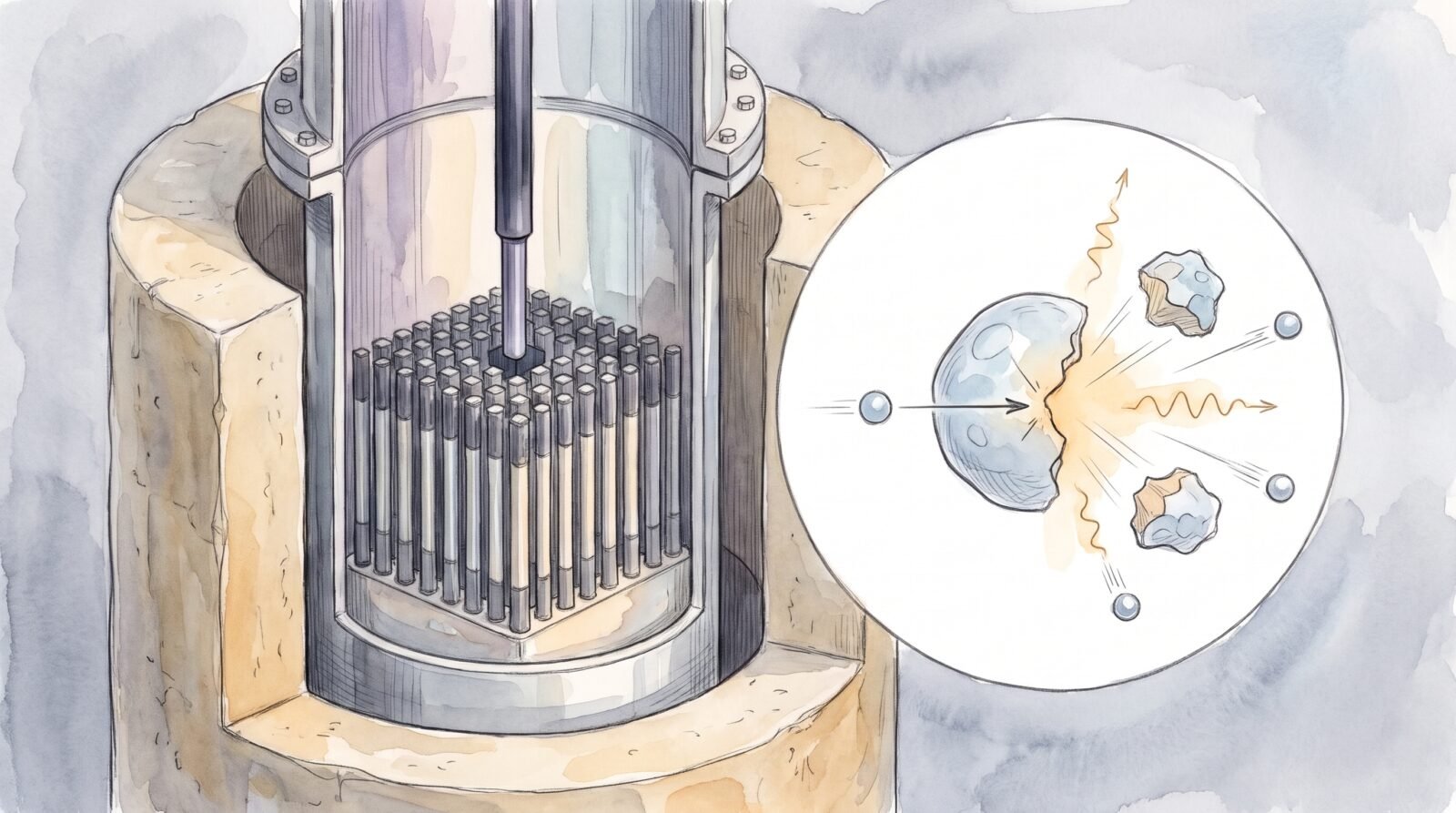
The mechanism of induced fission was worked out in 1939 and has been refined ever since. A slow neutron wanders into the nucleus of a uranium-235 atom[13] and is absorbed. The result is not a uranium-235 atom any more but a compound nucleus, uranium-236, in a highly excited state — a state with about 6.5 MeV more energy than the ground state of the same nucleus. It is not yet a uranium-236 atom in any ordinary sense, because its energy is distributed across all its nucleons rather than sitting in a particular shell. It lives for about 10-15 seconds, which is roughly the time it takes a nucleus to vibrate through one cycle of its shape.
At that point the compound nucleus does one of three things. Most of the time it evaporates a gamma quantum and settles back into a stable uranium-236, which is what happens when a neutron is absorbed by uranium-238 and why that reaction is the basis of neutron capture detectors and of the production of plutonium-239. Sometimes it evaporates a neutron or two and becomes a lighter uranium isotope. And sometimes, if it has enough excitation energy and the right shape, it splits. When it splits, the pieces are two medium-sized nuclei[14], and the energy released goes into the rapid motion of those two fragments, into prompt gamma rays, and into two or three free neutrons.
Those free neutrons are the whole commercial and military point of the reaction. Each fission event releases on average about 2.5 neutrons, and those neutrons go on to be absorbed by other uranium-235 nuclei, which release about 2.5 more each. If the average number of neutrons per fission exceeds one, and if enough of them are captured by f fissile nuclei rather than escaping, the process is self-sustaining. That is the definition of a chain reaction[15], and it was formulated by Leo Szilárd and Enrico Fermi in 1934, years before anyone knew what the reaction would be.
The cross section for the reaction, measured in barns, tells you how likely a given neutron is to cause a given outcome. One barn is 10-28 square metres, roughly the area of a large atom’s cross-section. For thermal neutrons, uranium-235 has a fission cross section of about 585 barns[16]. The same neutron hitting uranium-238 has a fission cross section of about 0.1 barns, but a capture cross section of roughly 2.9 barns, which means the overwhelmingly likely outcome is capture, not splitting. Those numbers, a factor of several thousand apart, are the formal statement of the difference between the two isotopes.
There is one more subtlety that matters for the energy arithmetic and for how reactors are built. The 2.5 neutrons per fission are not all released at the same instant. About one to two percent of them[1], the delayed neutrons, come from the decay of short-lived fission products and arrive seconds to minutes after the event. The rest, the prompt neutrons, appear within billionths of a second. The distinction is not academic: a reactor is only critical when, on average, exactly one neutron from each fission causes another fission. The delayed neutrons are what make a reactor controllable, because they stretch the response time of the chain reaction from a fraction of a microsecond to several minutes, and therefore give the control rods time to move. A reactor operating only on prompt neutrons would be impossible to govern. This is why the RBMK design used at Chernobyl — a graphite-moderated, water-cooled, boiling water reactor of a type used elsewhere only in the Soviet Union[17] — was unusually sensitive to control rod design, and why the positive void coefficient built into its cooling water made a particular accident sequence possible.
Two Isotopes, Two Fates
The contrast between the two isotopes of uranium is the cleanest demonstration in nuclear physics of how a single number can decide whether a material is a fuel or a dead end. Uranium-238, which makes up 99.27 per cent of natural uranium, has 92 protons and 146 neutrons. Uranium-235 has 92 protons and 143 neutrons. The elements are identical; the mass differs by three neutrons. The behaviour differs by a factor of several thousand.
The reason is the neutron-to-proton ratio[18]. Every nucleus wants roughly as many neutrons as protons, because the strong force is charge-independent but the electromagnetic force is not: protons repel one another and need neutrons to compensate with the attractive strong force that does not care about charge. For light nuclei, one to one is about right. For heavy nuclei, more neutrons are needed, and the most stable heavy nuclei have neutron-to-proton ratios well above one. Uranium-238, with 146 neutrons to 92 protons, sits close to the valley of stability. Uranium-235 sits three neutrons down the same valley, in a place that happens to be just unstable enough to be interesting.
That “just unstable enough” is doing all the work. Uranium-235 is not on the valley of stability; it would energetically prefer to be uranium-236 with 144 neutrons, and it is only prevented from decaying that way because it happens to be in a stable spin state. Its slight instability is why it is found in the Earth’s crust at all, in quantities a few parts per million, alongside uranium-238 and the very much rarer uranium-234. All three are decay products of primordial plutonium, and their relative abundances are a direct measurement of geological time. That is a separate reason to care about uranium-235: it is a clock.
The technical vocabulary distinguishes fissile from fissionable. A fissile material is one that will fission with thermal neutrons, that is, with neutrons at or near room temperature, and that does so with a large cross section. A fissionable material is one that can be split by neutrons of higher energy, or by other means, but will not sustain a chain reaction on slow neutrons. Uranium-235 is fissile. Uranium-238 is fissionable but not fissile. The distinction is not a matter of degree but of kind, and it is the reason the United States Regulatory Commission defines the two terms separately in its glossary rather than treating fissionable as a weaker form of fissile[7].
The reason uranium-238 will not sustain a slow-neutron chain reaction[1] is quantitative and worth spelling out. A thermal neutron captured by uranium-238 produces uranium-239, which is an odd-odd nucleus in which the odd neutron occupies a state well above the ground-state configuration of the nucleus. The barrier that this nucleus must cross to fission is correspondingly higher, and tunnelling through it is correspondingly less likely. The fission cross section for thermal neutrons in uranium-238 is around 0.1 barn. Multiply that by the enormous number of neutrons bouncing around a large lump of uranium-238 and you still do not get a self-sustaining chain reaction. But raise the neutron energy to about a megaelectronvolt or above, and the barrier is surmountable by an ordinary collision rather than by tunnelling; the fast fission cross section for uranium-238 rises by roughly an order of magnitude, and above the fission threshold[5] of around 1 MeV the reaction becomes usable. This is the principle behind the fast breeder reactor, and it is also why a nuclear weapon made of highly enriched uranium-235 works with a gun-type assembly of plain, unmoderated material.
The same neutron economy, read the other way round, is what makes a reflector matter. If neutrons escaping from the fissile mass are turned back into it by a surrounding layer of material, the effective multiplication improves and less fissile material is needed. This is the entire basis of the famous “size of a fist” descriptions of critical mass. The number of neutrons produced per absorption, the fraction of neutrons lost by leakage, and the fraction lost in captures that do not result in fission are the three quantities that set the size of the smallest possible self-sustaining system, and all three are measured in barns and in metres of geometry.
The Rarest Isotope in the Room
Which raises the question of why uranium-235 exists at all in useful quantity, and the answer is one of the strangest in science. Uranium is not made in any ordinary process on Earth. The heaviest elements are manufactured in cosmic events, and the events that produce them are rare and violent. When a massive star collapses and explodes, or when two neutron stars merge, the debris is briefly flooded with free neutrons at densities that no laboratory can approach. Nuclei capture those neutrons faster than they can beta-decay, building up nuclides that are far more neutron-rich than anything stable, and the chain of captures and decays produces a characteristic distribution of heavy nuclei known as the r-process.
The r-process has one dominant statistical feature that matters here. Neutron capture is far more likely than proton capture in these conditions, and beta decay converts neutrons into protons one at a time, slowly. The result is that nuclei with odd numbers of neutrons are produced at only half the rate of their even-even neighbours, because a nucleus with an unpaired neutron is more likely to capture another one and become even. In a plot of nuclide abundance against mass number, the r-process therefore produces a characteristic sawtooth, with sharp peaks at even mass numbers. Almost all of the world’s uranium-238[19] sits on one of those peaks, at mass 238.
Uranium-235 sits at mass 235, one below that peak. Because it is odd in neutrons, the r-process makes it less abundant than its even neighbours would be — and then, over the following billions of years, the passage of time makes it still rarer. Uranium-235 has a half-life of 7.04[20] × 108 years; uranium-238 has one of 4.47 × 10⁹ years. Both are decaying all the time, but the shorter-lived one is decaying more than six times faster. The consequence is arithmetic: uranium-235 was about 3.7 per cent of natural uranium when the Earth formed about 4.5 billion years ago, and it is about 0.72 per cent today. It was, in other words, roughly five times more abundant when the planet formed than it is now, and it is still declining. In a few billion more years the ratio will be closer to one part in a hundred, and then natural reactors become harder and harder to ignite — which is precisely the direction in which the Oklo natural reactors were travelling.
Natural fission reactors on Earth are not a hypothesis but a documented fact. In 1956, French physicists investigating uranium ore in the Oklo region of Gabon, in what was then French Equatorial Africa, measured uranium-235 abundances[10] roughly 0.7 per cent below the value expected for the age of the deposit. An isotope does not simply disappear; if uranium-235 was being consumed by fission, there would be fission products, and the searchers found anomalous quantities of xenon, neodymium and, decisively, of the element with no business being there at all in a uranium deposit. Neodymium-142, a product of the alpha decay of neodymium-143, which is in turn a fission product, was present in the ore in exactly the ratio the reaction required. The site was a natural reactor, and it had been running for a very long time[9, 10].
What the Oklo deposits show is that a uranium seam, saturated with water, sitting in a geologically stable pocket of rock, will assemble the conditions for a self-sustaining natural chain reaction. Water serves the role water serves in a reactor: it moderates the neutrons down into the energy range where uranium-235 is fissile. The deposit is compacted enough to keep the neutrons in; the geometry is wrong by human standards but right by geological ones. The heat drives the water out, the water slows the reaction, the reaction restarts: a cycle of perhaps thirty minutes to a few hours on and off, which is how the classic geological signature of Oklo was recognised as a series of stacked, cyclically deposited layers rather than one continuous burn.
The International Atomic Energy Agency’s own account of the phenomenon, prepared by Roger Naudet in the 1970s, identifies several natural reactors across the Oklo deposit and gives estimates of their operating power, their total operating periods and the total quantity of uranium they consumed. The figures are large enough to be startling: the natural reactors are estimated to have consumed on the order of hundreds of tonnes of uranium[9], at power levels comparable to small power reactors, over periods of hundreds of thousands of years. The most important conclusion, though, is the one about time: Oklo ran because the Earth was younger, and uranium-235 was more abundant, than it is now. The natural reactor is a phenomenon of the deep past, one that is closing rather than opening. If natural reactors were to be found in the future, they would be in a different kind of deposit with a different balance of properties; the era in which the Earth itself could host them is ending[9, 10].
That is a nice place to be careful, because the popular version of the story — that Oklo shows nuclear reactors are natural and therefore safe — is a misuse of the evidence. What Oklo demonstrates is that the physics of fission does not require human engineering. It does not demonstrate that the engineering is easy. The difference between a natural reactor and a power plant is the difference between a fire that starts by itself in a dry forest and a fire that somebody has to keep fed, controlled and put out.
Making More Fuel Than You Start With
There is a second respect in which uranium is unusual, and it is the opposite of scarcity. Uranium-238 is not merely inert; it is fertile. A fast neutron that lands on uranium-238 usually does not split it, but it is captured, and the capture product decays in a chain: uranium-238 plus a neutron becomes uranium-239, which beta-decays with a half-life of about 23 minutes[11] to neptunium-239, which beta-decays with a half-life of about 2 days to plutonium-239. Plutonium-239 is fissile, with a thermal fission cross section comparable to uranium-235 and a far higher one for fast neutrons. A single neutron absorbed by uranium-238 without causing fission therefore leaves behind, after a couple of days, a new fissile nucleus. In a reactor with a fast neutron spectrum, where more neutrons are produced per fission than are needed to sustain the chain reaction, those extra neutrons can convert non-fissile material into fissile material faster than the fuel is consumed.
That is the breeder reactor, and the arithmetic is startling. A thermal reactor using uranium fuel converts only a small fraction of the fuel it burns into new fissile material, because most of the neutrons are slowed down and absorbed uselessly. A fast breeder uses plutonium-239 fuel and a fast neutron spectrum in which some neutrons are absorbed by uranium-238 in the breeding blanket[21], producing new plutonium-239, with a breeding ratio potentially above one. It would in principle extract far more energy from a given quantity of uranium than any thermal reactor, because it uses the 99.3 per cent that is uranium-238 as well as the 0.7 per cent that is uranium-235. The catch is that fast neutrons are hard on materials, that the sodium or lead coolant required is unpleasant to work with, and that the technology has spent seventy years failing to become commercial.
The fast spectrum is not a preference; it is required. In a thermal reactor, uranium-238 has a large capture cross section at low neutron energy, which is exactly where a thermal reactor operates. The captured neutron is lost from the chain reaction. In a fast spectrum the capture cross section of uranium-238 falls sharply, so the neutron is more likely to cause a fission in plutonium-239 instead. The price is that the critical mass in a fast reactor is large, because fast neutrons have low fission cross sections, and that the doubling time[21] — the time to double the fissile inventory — is long and unforgiving. A breeder is a business that must run continuously.
The thorium cycle is the other way of manufacturing[22] fissile material, and it is the one that interests people who dislike the association of nuclear power with bombs. Thorium-232 is fertile in exactly the same way as uranium-238, and it has two significant advantages over it. It is roughly three times as abundant in the Earth’s crust, and it can breed a fissile isotope that is less useful for weapons. Thorium-232 captures a neutron to become thorium-233, which beta-decays to protactinium-233, which beta-decays to uranium-233, which is fissile. The drawbacks are equally well known. The chain runs through protactinium-234, whose half-life of about 27 minutes is long enough to allow significant neutron loss in any reactor with a fuel cycle of practical length, so the protactinium has to be removed and stored separately, which is a real complication. And every thorium cycle that has ever been operated has been contaminated with uranium-232, which is produced by a side reaction and is a gamma emitter strong enough to make the spent fuel a handling problem. Thorium is not a free-energy proposition but a different set of engineering trade-offs[22].
It is worth being clear about what “breeding” does and does not mean, because it is routinely misunderstood. Breeding does not create energy. The energy comes from the same mass defect either way, whether the nucleus that splits is a uranium-235 atom made four billion years ago or a plutonium-239 atom manufactured on Tuesday. What breeding does is change the fuel: it converts a material that cannot sustain a chain reaction into one that can, which is the difference between a furnace that burns the kindling it finds and one that manufactures its own. The promise of the breeder and the thorium cycle is that the supply of usable fuel becomes effectively unlimited, because the thorium and the uranium-238 are not scarce. The reason this has not changed the world is that the engineering is difficult, not that the physics is wrong.
The Long Half-Lives
Everything in this essay that happens quickly, happens in a nucleus. Everything that happens slowly, happens in the ground. The two natural uranium isotopes are the parents of the three classical[20] decay series, the chains of radioactive daughter products that end in stable lead. Uranium-238, with a half-life of 4.47 billion years, decays through thorium-234 and protactinium-234 into uranium-234, then through a chain of alpha and beta decays to thorium-230 and radium-226 and radon-222, ending at lead-206. Uranium-235, with its half-life of 704 million years, takes a different route through actinium and francium to lead-207. A third chain, beginning with thorium-232 and its 14 billion year half-life[23], runs through radium-228 and actinium-228 to lead-208, and because it is so long-lived it accounts for most of the natural radioactivity in ordinary rock, in ordinary soil, in the human body.
The important thing about these chains is that they are not linear and instantaneous. Each link has its own half-life, and several of the intermediate products decay in months or days rather than millennia, so the daughter of a uranium atom in the ground is very likely to be a thorium or radium or radon atom, and only rarely to be an atom of the next element in the same chain. The practical consequence is that a sample of uranium ore is radioactive in a way that a sample of pure uranium metal is not: the metal, freshly refined, contains only the uranium and its immediate daughter, whereas the ore contains the whole chain in equilibrium, including the radon, which is a gas and therefore escapes readily. Removing the radon from an old sample by heating it leaves the daughters in disequilibrium, and the sample then measures differently depending on how long it has been allowed to re-establish equilibrium. This is why the radiometric dating of uranium minerals requires an elaborate protocol involving the alphas and betas produced by the daughter products, and why the famous early measurements of the age of the Earth were revised several times as the daughter chains were understood.
The same chains produce a quantity that is easy to underestimate. The heat generated by the decay of uranium and thorium in ordinary crustal rock is substantial. Radiogenic heat production in the continental crust runs at roughly 40 to 50 milliwatts per cubic metre, and in the mantle at about 0.1 to 0.3 milliwatts per cubic metre over a volume that makes the total a very large fraction of the heat the Earth loses. The Earth’s internal heat budget has three components: the primordial heat left over from formation, the heat of core crystallisation, and the decay of the radioactive elements. On most estimates the radiogenic component is the largest of the three, which is one reason the standard estimate of the Earth’s internal heat flux has been revised upwards over the past two decades.
This is where the physics of fission brushes against a theory that has been argued over for more than half a century. If the Earth had an appreciable amount of uranium-235 when it formed — and it did, about 3.7 per cent of its natural uranium, as we have seen — then the early Earth was, for a while, a more fissile planet than it is now. And if the mantle contained concentrations of uranium and thorium high enough, and water sufficient to moderate the neutrons, and geological conditions stable enough to keep the reaction going, then the mantle itself might have hosted natural reactors. The hypothesis is known as the georeactor, and it has been advanced, disputed and revived for decades. Its most striking implication is that the heat driving plate tectonics would not be the residual heat of a cooling planet but the steady burning of uranium and thorium in the mantle, and that the great dyke swarms and layered intrusions of the early Proterozoic, which are conventionally explained as the product of a large and sudden burst of mantle melting, might instead be the record of a reactor that was running for a hundred million years and then stopped.
The georeactor remains unproven and is not accepted as the explanation for plate tectonics, which has its own well-developed and largely independent account in the thermal convection of a cooling mantle. But the argument that produced it is worth following, because it shows the reach of the subject. The same three conditions that made Oklo work — fissile material, a moderator, and containment — are the three conditions a reactor needs anywhere. Change the scale and the timescale and you have a planetary heat engine. The obstacles are the same ones that have always stood in the way of nuclear power: finding out where the fissile material[6] actually is, in what concentration, and in what geometry, and then keeping the conditions stable for long enough to matter. The Earth has had four and a half billion years to solve the containment problem. We have had seventy.
It is worth adding one closing observation about the scale of time involved, because it reframes the entire subject. The half-life of uranium-235 is 704 million years. The half-life of uranium-238 is 4.47 billion years, which is close to the age of the Earth. The half-life of thorium-232 is 14 billion years, longer than the current age of the universe. These are the clocks that made the discovery of fission possible in the first place, because pitchblende is a uranium ore and the radioactivity of uranium is what a curious physicist in Paris was measuring when he noticed that the radiation came from the ore itself and not from the pitchblende[8]. The material that made the bomb and the material that made the reactors is the material that keeps time for the planet. It has been decaying, patiently and invisibly, since the Earth was made, and the chain reaction in the middle of it is a footnote in a much longer sentence.
Enrichment and the Arithmetic of Scarcity
Everything discussed so far assumes you have a fissile material in hand. In practice you have ore, and the fissile material has to be manufactured from it, which is a problem of chemistry and probability rather than physics. Natural uranium contains about 99.27 per cent uranium-238, about 0.72 per cent uranium-235 and about 0.005 per cent uranium-234. A power reactor does not need weapons-grade material; it needs around 3 to 5 per cent of uranium-235, and even that is more than most designs want, with many reactors running on fuel enriched to just under 4 per cent. A weapon needs something like 90 per cent, and the jump from 0.72 to 90 per cent is the enrichment problem, and it is the single most consequential industrial process in the whole subject.
Enrichment works on the tiny difference in mass between the two isotopes, and it does so by exploiting the fact that a gas molecule containing uranium-235 is very slightly lighter than one containing uranium-238. The chemical compound used is uranium hexafluoride, a solid at room temperature that is sublime and poisonous, and it is converted to a gas before being fed into the machines. The workhorse for more than half a century was the gas centrifuge[24], a tall cylinder spinning at tens of thousands of revolutions per minute in which the heavier molecules are thrown outward more strongly than the lighter ones, so that the gas at the wall is depleted and the gas near the axis is enriched. A cascade of centrifuges, each stage feeding the next, raises the concentration a little at a time, and the entire process is measured in separative work units, a unit of physical effort that can be computed exactly but is never quite the same in practice, because real machines leak, lose and are operated by imperfectly trained people.
Before the centrifuge there was the calutron, the electromagnetic isotope separator built at Oak Ridge during the Second World War, in which a beam of uranium ions was bent by magnets and the heavy and light isotopes were collected in separate collectors. It was fantastically expensive, it consumed an enormous amount of electrical power, and it was used to produce the material for the first atomic weapons. It is also the reason that the United States had to build a very large electric power system in Tennessee during the war, because the electricity for Oak Ridge was a strategic resource in its own right. The whole history of enrichment[25] is a story of trying to do the same separation more cheaply, from the electromagnetic method through to the calutron[24]‘s descendant, the Zippe-type centrifuge[26], which is a beautifully simple piece of engineering: a tube of maraging steel with a conical rotor, spinning in a vacuum, with a complex gas mixture to control the wall and axial flows that makes the separation stable over decades.
The arithmetic of scale is where the subject becomes uncomfortable. Enriching a kilogram of natural uranium to 3.5 per cent costs a small number of separative work units; enriching enough for a weapon requires a plant, a cascade, and a supply of uranium hexafluoride — and a country with no domestic uranium supply must also buy the ore, which means finding a supplier, which means a market in which the material is traceable. Every enrichment programme is also a potential weapons programme, because the same cascade that makes 4 per cent fuel makes 90 per cent material if it is run with the right feed and enough centrifuges. The difference between a civilian and a weapons enrichment capability is not a qualitative difference but a quantitative one, and this is the fact that makes non-proliferation so much harder than it sounds[27].
It is worth remembering why the 3 to 5 per cent figure exists at all, because it is a consequence of the physics rather than an engineering preference. In a thermal reactor, uranium-238 absorbs neutrons without fission, and the more uranium-238 in the fuel, the more neutrons are wasted in that way. Push the enrichment up and more of the neutrons do useful work, so less fuel is needed and the reactor’s economics and its burnup improve. But the fuel gets more expensive, because enrichment is a real cost per kilogram, and beyond a point the additional enrichment buys less than the fuel it saves. The optimum sits around 3 to 5 per cent for most designs, and the pressure to push it higher — for higher burnup, for a once-through fuel cycle, or for a weapons purpose — is visible in the design history of every reactor programme.
One further detail about the physics of enrichment deserves a mention because it is counter-intuitive and because it reappears in weapons discussions. The difference in mass between a uranium-238 atom and a uranium-235 atom is about 0.9 per cent, and it is this small difference that the centrifuge exploits. It is also the reason that enriching by chemical means — by reacting the uranium with a volatile compound and distilling it — cannot work at all: chemical reactions do not distinguish between isotopes to any useful degree. Every enrichment technology ever invented has been a physical method that separates by mass, and the whole history of the subject is the history of finding cheaper and cleverer ways to exploit that one per cent.
Critical Mass and the Moderator
A reactor is a machine for arranging that the number of neutrons produced equals the number consumed. The measure is the multiplication factor, k, and the reactor is critical when k equals one. Below one it dies out; above one it runs away. Every design decision in nuclear engineering is an attempt to control k while keeping it as close to one as possible, and the practicalities of that are why critical masses are measured in tens of kilograms rather than grams.
The reason a critical mass is needed at all is leakage. In an infinite mass of pure uranium-235, every neutron released stays in the system and the multiplication factor would be enormous. In a real lump, neutrons produced near the surface escape into the air, and the fraction that escapes grows with the surface-to-volume ratio of the sample. A small sphere therefore loses a large fraction of its neutrons and cannot be critical; a large one loses a smaller fraction and can. This is the same geometry that makes a small fire go out and a large one spread, and it is the reason the critical mass of a bare uranium-235 sphere in water is around 52 kilograms[28], falling to something in the low twenties of kilograms in a reflector that traps and returns escaping neutrons.
Density matters as much as mass. A critical mass of uranium metal[29], at about 19 grams per cubic centimetre, occupies roughly 2.7 litres, a sphere about 17 centimetres across[6]. A critical mass of plutonium-239, denser and with a lower critical mass, is smaller still. Both figures assume the presence of a moderator, usually water, around the fissile material. Remove the moderator and the mass needed goes up sharply, because the neutrons must stay fast enough to keep the chain reaction going on their own. This is the entire design logic of the two families of nuclear weapon: a gun-type device fires one sub-critical piece of highly enriched uranium into another to make a fast, supercritical mass with no moderator anywhere; an implosion device compresses a sphere of material to much higher density by detonating conventional explosives around it, which raises the effective density, allows a lower enrichment to work, and adds a layer of neutron reflector around the fissile core.
The moderator itself is one of the beautiful pieces of physics in the story. Neutrons are born fast, with energies in the megaelectronvolt range, and uranium-235’s fission cross section is small at those energies and enormous at low energy. A moderator exploits the fact that a light nucleus can absorb a large fraction of a neutron’s kinetic energy in an elastic collision. Ordinary water does this well, because the hydrogen nucleus has almost exactly the mass of a neutron[11] and can take essentially all of its energy in a single head-on collision. Heavy water, with deuterium, does it slightly more slowly but absorbs far fewer neutrons in the process, which is the trade-off that makes CANDU reactors possible. Graphite works too, and was the moderator of the Chicago Pile-1[30], the first reactor to go critical[30] in December 1942. A neutron that has been slowed this way has a much greater chance of being absorbed by a uranium-235 nucleus and causing a fission, which is why a reactor is filled with a substance that has no fissioning role whatsoever.
The final subtlety in the control of k is the one that decides how a reactor is built. If the chain reaction were governed entirely by prompt neutrons, then a slight increase in reactivity would cause an immediate and explosive increase in power, and no control system could keep up. The delayed neutrons, as noted earlier, stretch the response time of the chain reaction to seconds and minutes, which is the timescale on which humans operate. The distinction between prompt critical and delayed critical is therefore a safety distinction before it is a technical one. A reactor operating below prompt critical can be throttled by inserting control rods; a reactor driven above prompt critical is, in the strict sense, beyond the reach of its own control system. The catastrophic failure at Chernobyl in April 1986 was a route to that state, reached through a design with a positive void coefficient and a control rod geometry that could displace cooling water rather than insert itself cleanly into the active zone, combined with the violation of operating rules and the failure of the safety systems. The physics that made Chernobyl possible is the same physics that makes a large reactor work at all.
Two Hundred Megajoules
Now the arithmetic that makes the whole subject matter. When a uranium-235 nucleus splits, the mass of the products is about 0.2 atomic mass units[31] less than the mass of the reactants[32]. That small fraction, converted through mc2, is about 200 MeV of energy[11], and it is the entire basis of nuclear power and of nuclear weapons. The typical fission of uranium-235 into barium-141 and krypton-92 releases about 200.7 MeV, of which roughly 165 MeV appears as the kinetic energy of the two fragments, about 5 MeV as prompt gamma rays, a few MeV as the kinetic energy of the neutrinos and the beta decays of the unstable fragments, and the remainder as delayed gamma radiation from the fission products afterwards.
Compare that with combustion. Burning one kilogram of coal releases about 29 megajoules. Splitting one kilogram of uranium-235 releases about 8.2 × 10¹³ joules, which is roughly 2.8 million times as much[33]. The reason is not that nuclear reactions are intrinsically more productive but that the mass defect per reaction is much larger: burning carbon releases energy by rearranging chemical bonds, and the mass equivalent of those bonds is a vanishing fraction of an atomic mass unit, whereas fission converts about one mass unit in two hundred into pure energy[11]. This is why a kilogram of uranium fuel can run a large power station for years while a coal station consumes tonnes of fuel a day.
The practical figures are worth stating plainly, because they are the ones that make people uneasy. The bomb dropped on Hiroshima used about 60 kilograms of uranium-235, of which perhaps 2 kilograms actually fissioned, delivering an energy release of around 15 kilotons of TNT equivalent[30]. Two years later the Trinity test used a plutonium core of similar size and similar yield. By contrast, a large power reactor fissions about 3 kilograms of uranium-235 per day[34], in a continuous release of heat that is converted into steam and then into electricity at an efficiency of roughly a third. The energy is the same; the difference is whether it arrives as an explosion or as a working fluid.
The products are the other side of the ledger. Every fission produces two medium-mass nuclei, and because a nucleus absorbs neutrons without limit, the fragments are a mixture of many different elements, most of them radioactive. These fission products include isotopes with half-lives from seconds to tens of thousands of years: strontium-90 with a half-life[35] of about 29 years, caesium-137 with a half-life of about 30 years, iodine-131 with about 8 days, technetium-99 with about 212,000 years. None of this is unique to reactors — the same products, in smaller quantities, are in a nuclear weapon’s fallout, and the fallout of a weapons test is the reason atmospheric testing was stopped. But it is the reason that the waste problem[36] is a permanent engineering problem rather than a solvable one. The spent fuel from a power reactor is not dangerous in the way a reactor is dangerous; it is simply a concentrated, thermally hot, long-lived material that has to be kept dry and isolated for centuries, and the world has built a great many repositories for coal and almost none for this.
There is also a second category of material that deserves separate mention: the transuranics. Some of the neutrons produced in a fission are captured by uranium-238 rather than causing another fission, and as described earlier this makes new plutonium-239. In a reactor operating on a once-through fuel cycle, a fraction of the plutonium is bred but is burnt or discarded with the spent fuel, and the rest accumulates. Plutonium-239 has a half-life of 24,100 years[37] and is, in the strict sense, a nuclear material. The fraction of it in any given fuel assembly is small, and the material is in a form — ceramic oxide beads, embedded in a matrix of fission products — that is extraordinarily difficult to extract. The technical difficulty is real; so is the fact that the same chemistry that makes it hard to extract is what makes it hazardous if it is ever extracted. Both statements are true and neither cancels the other.
What the Barrier Still Cannot Explain
Everything so far has been the liquid drop model[4] and its refinements, and the liquid drop model is spectacularly good at predicting that fission should happen and roughly how much energy it releases. It is considerably less good at predicting which nuclei actually fission, how the barrier is shaped, and what the fragments will be. A complete account of the barrier remains one of the outstanding problems in nuclear structure theory, and the reason is worth stating plainly: it requires a three-dimensional, time-dependent, quantum mechanical description of a many-body system the size of a nucleus, which is exactly the regime where the standard tools stop working.
The failures are specific. The liquid drop model with no shell correction predicts a single-humped barrier, and the actinides in fact have a double-humped barrier with a shallow pocket in the middle, corresponding to a deformed, moderately collective shape between the ground state and the scission point. The pocket exists because of shell effects: the doubly magic, very stiff, spherical nucleus caesium-141 is an unusually stable configuration, and the deformed actinide nuclei sit in a state that is nearly but not quite as bound. It was this pocket that made the spontaneous fission half-lives of the actinides so wildly different from one another, and it was the pocket that is the reason some isotopes are so prone to spontaneous fission and others are not.
The modern theoretical position, as set out in the extensive 2022 review by Nicolas Schunck and David Regnier, is that the barrier can now be computed with remarkable accuracy for the ground states and first barrier of the actinides, using density functional theory[38] with modern pairing functionals and corrected for the influence of the odd nucleon in the odd-odd and even-odd systems. What remains open is the second barrier, the pocket, and the shape of the scission configuration, which is where the dynamics of the actual separation live. The fission fragment distributions, the distribution of prompt neutron multiplicities, and the detailed emission spectra are observables that probe exactly the region where the models are least reliable, and they are the reason that fission theory remains an active field rather than a closed subject[38, 5].
There is one further twist worth mentioning, because it bears directly on why uranium is special. In the last decade it has become clear that fission is not a single process but a competition between several, distinguished by the angular momentum and parity of the collective states involved: a parity-violating pathway that leads to the lowest barrier and dominates in the heavier actinides, a parity-conserving pathway at slightly higher energy, and a third route associated with an isomeric state of the deformed parent that produces fragments with a different mass distribution. The practical consequences include a measurable component of delayed fission gamma rays in the prompt neutron spectrum, and a sensitivity of the fission yield distribution to the temperature of the fuel. A reactor fuel pellet at the centre of a core and one at the edge do not, quite precisely, fission the same way.
So where does this leave the original question? Uranium is not fissile because it is heavy, and it is not fissile because it is radioactive, and it is certainly not fissile because it is dangerous. Uranium-235 is fissile because a slow neutron it captures supplies just enough excitation energy to put the nucleus above a barrier that its odd neutron count has left unusually low, and because the resulting fragment pair is lighter per nucleon than the parent, releasing about 200 MeV in the process. Uranium-238, being even in neutrons, has a barrier roughly a megaelectronvolt higher, which a slow neutron cannot quite overcome. That difference of about a MeV, and the odd-even pairing that produces it, is the whole of the matter[11]. Everything else — the chain reaction, the power stations, the weapons, the waste, the breeders, the thorium cycle, the natural reactors of Gabon, the profound good fortune that the Earth’s uranium-235 reservoir was large enough to last until somebody worked out what to do with it — follows from it.
And it is worth ending with the fact that this is a subject still in its infancy. The physics of fission was understood in outline within a year of its discovery, in 1939, by a small group of physicists working in hiding and in exile. The engineering took longer than the physics by a factor of several. The theory of the barrier is still being worked out. And the question of what to do with the material, which is the only part of the subject that has ever really mattered, has been argued about for longer than the whole of nuclear physics has existed, without reaching a conclusion. The atom split. The rest is politics and engineering, which have proved considerably harder.
The Fuel Cycle and Its Residues
A reactor is only the middle of the story, and the ends of the story are where the politics live. The fuel cycle begins with ore. A typical reactor of 1,000 megawatts electric consumes on the order of 170 to 200 tonnes of uranium fuel per year[39], of which only a small fraction is the fissile material that actually burns; the rest is fertile material that is being converted. When the fuel comes out of the reactor it is called spent fuel, and it is hot, radioactive, and chemically complex. A large fleet of reactors produces, in total, something in the order of a thousand tonnes of spent fuel and a correspondingly modest volume of high-level waste every year — a quantity that is sometimes described as a teaspoon per person per year, and which is also sometimes pointed at as evidence that the waste problem is exaggerated. Both framings miss the point. The tonnage is small; the problem is that the material is hot, long-lived, and must be kept apart from the biosphere for a period longer than any civilisation has yet existed.
The back end of the cycle has two possible directions. The first is reprocessing, in which the spent fuel is dissolved and its components are chemically separated: the uranium, the plutonium, the fission products and the minor actinides. The classic industrial method is PUREX, a solvent extraction process developed at Savannah River in the 1950s that separates plutonium from spent fuel, and which was used on an industrial scale at Sellafield in Britain and at La Hague in France. Reprocessing does not eliminate waste. It reduces the volume of high-level waste by moving most of the mass into lower-level forms that can be stored more easily, and it recovers the plutonium for reuse as MOX fuel[40] in reactors designed to burn it. It also, unavoidably, separates a stream of weapons-usable plutonium from a stream of civilian material, in a plant whose technical characteristics are not fundamentally different from those of a weapons facility. That is the objection that has kept the United States, which has never built a commercial reprocessing plant, from pursuing the route, and it is the reason the proliferation argument about the fuel cycle is not a debating point but the central fact of the international regime.
The second direction is the once-through cycle: dispose of the spent fuel directly. If the material is put into a deep geological repository[40] — a tunnel gallery several hundred metres underground in stable rock such as granite, with the fuel in sealed metal canisters and bentonite clay around them, designed to keep water away from the fuel and to last for a hundred thousand years or more — then the safety argument rests on containment rather than on processing. The engineering of this is genuinely difficult, and the political problem is worse than the engineering. Sweden, Finland and France have made serious progress on repository siting. The United States has spent three decades and billions of dollars on the Yucca Mountain project in Nevada and has no repository, which means its spent fuel stays in pools and dry casks at the reactor sites, which is safe for decades but is not a solution.
There is a third option that sits between the two and deserves mention because it is the one that most appeals to engineers: partitioning and transmutation. The idea is to take the long-lived actinides out of the waste stream and destroy them in a reactor or accelerator, converting them into shorter-lived products, while immobilising the fission products that remain in a stable matrix. It is elegant, it is well understood in physics, and it is enormously expensive, and it does not remove the requirement for a repository — it shrinks and shortens the inventory that has to go into it. Whether that is worth the money depends on a comparison between the cost of a repository and the cost of a transmutation facility, which is a comparison that different countries have answered differently.
What is certain is that the fuel cycle is where the fission physics meets everything else that is not physics: the economics of a kilowatt-hour, the politics of a border, the fifty-year argument about what to do with a material that will be dangerous to handle for longer than the argument itself will last. The physics of the chain reaction is settled. The physics of the fuel cycle is settled. The unresolved questions are all human, and they are the reason that the number of operating reactors in the world has grown far more slowly than the number of people who understand the physics.
References
- Encyclopaedia Britannica, “Nuclear fission”. britannica.com, accessed 2 November 2026
- Encyclopaedia Britannica, “Binding energy”. britannica.com, accessed 2 November 2026
- Encyclopaedia Britannica, “Liquid-drop model”. britannica.com, accessed 2 November 2026
- Bohr, N. and Wheeler, J. A. (1939). “The Mechanism of Nuclear Fission”. Physical Review 56 (5), 426 - 450. journals.aps.org
- Denschlag, J. O. (2011). “Nuclear Fission”, in Handbook of Nuclear Chemistry, Springer, pp. 223 - 280. link.springer.com
- United States Nuclear Regulatory Commission, “Fissile material”, glossary entry. nrc.gov, accessed 2 November 2026
- United States Nuclear Regulatory Commission, “Full Text Glossary”, entries for fissile material and fissionable material. nrc.gov, accessed 2 November 2026
- Encyclopaedia Britannica, “Uranium”. britannica.com, accessed 2 November 2026
- Naudet, R. (1975). The Oklo Phenomenon, IAEA STI/PUB/405. iaea.org
- “Oklo reactors and implications for nuclear science, energy, and weapons” (2022). arXiv preprint arXiv:1404.4948. arxiv.org, accessed 2 November 2026
- International Atomic Energy Agency (2004). The Physics of Fission, IAEA-TECDOC-1501. iaea.org
- National Institute of Standards and Technology, “Atomic Spectra Database” and atomic mass data. nist.gov, accessed 2 November 2026
- Encyclopaedia Britannica, “Neutron”. britannica.com, accessed 2 November 2026
- Frisch, O. R. (1939). “Physical evidence for the division of heavy nuclei under neutron bombardment”. Nature 143, 276. nature.com
- Encyclopaedia Britannica, “Nuclear chain reaction”. britannica.com, accessed 2 November 2026
- OECD Nuclear Energy Agency, “Nuclear data: fission and product physics”. oecd-nea.org, accessed 2 November 2026
- International Atomic Energy Agency (2006). “Chernobyl’s Living Legacy”. IAEA Bulletin 47/2. iaea.org
- Encyclopaedia Britannica, “Isotope”. britannica.com, accessed 2 November 2026
- International Atomic Energy Agency, Nuclear Data Section, “Publications”. www-nds.iaea.org, accessed 2 November 2026
- Encyclopaedia Britannica, “Half-life”. britannica.com, accessed 2 November 2026
- OECD Nuclear Energy Agency (2015). Introduction of Thorium in the Nuclear Fuel Cycle, NEA No. 7224. oecd.org
- International Atomic Energy Agency (2005). Thorium fuel cycle - Potential benefits and challenges, IAEA-TECDOC-1450. iaea.org
- Encyclopaedia Britannica, “Thorium”. britannica.com, accessed 2 November 2026
- International Atomic Energy Agency, “Enrichment of nuclear fuel”. iaea.org, accessed 2 November 2026
- United States Department of Energy, “History of nuclear energy”. energy.gov, accessed 2 November 2026
- World Nuclear Association, “Thorium fuel”. world-nuclear.org, accessed 2 November 2026
- International Atomic Energy Agency, “Fission and fusion”. iaea.org, accessed 2 November 2026
- United States Nuclear Regulatory Commission, “Nuclear Criticality Safety”. nrc.gov, accessed 2 November 2026
- Encyclopaedia Britannica, “Nuclear reactor”. britannica.com, accessed 2 November 2026
- United States Department of Energy, Office of Scientific and Technical Information, “The First Reactor”, Manhattan Project history. osti.gov, accessed 2 November 2026
- International Atomic Energy Agency, Atomic Mass Data Center, “Atomic Mass Evaluation”. www-nds.iaea.org, accessed 2 November 2026
- Meitner, L. and Frisch, O. R. (1939). “Disintegration of uranium by neutrons: a new type of nuclear reaction”. Nature 143, 239 - 241. nature.com
- Encyclopaedia Britannica, “Nuclear power”. britannica.com, accessed 2 November 2026
- International Atomic Energy Agency, “Nuclear power”. iaea.org, accessed 2 November 2026
- Encyclopaedia Britannica, “Gamma ray”. britannica.com, accessed 2 November 2026
- Encyclopaedia Britannica, “Nuclear waste”. britannica.com, accessed 2 November 2026
- Encyclopaedia Britannica, “Plutonium”. britannica.com, accessed 2 November 2026
- Schunck, N. and Regnier, D. (2022). “Theory of nuclear fission”. Progress in Particle and Nuclear Physics 125, 103963. arxiv.org
- International Atomic Energy Agency, “Spent fuel”. iaea.org, accessed 2 November 2026
- International Atomic Energy Agency, “Radioactive waste”. iaea.org, accessed 2 November 2026