The Discovery of the Neutron
In 1920 Ernest Rutherford told the Royal Society that the nucleus of the atom must contain a particle nobody had ever seen: a neutral body with roughly the mass of a hydrogen atom. It took twelve years to find it, and when James Chadwick finally did so in the spring of 1932 the decisive step was not a new instrument but an argument — photons have no mass, so they cannot knock protons loose[1]. This is the story of that argument, of the quarrel over beryllium that preceded it, and of the nuclear structure that made the rest of the twentieth century possible.
Key findings
- Rutherford proposed the neutral nuclear particle in his Bakerian Lecture of 1920, and the Cavendish Laboratory went on searching for it for more than ten years without success[2, 3].
- The decisive obstacle was arithmetic rather than instrumental. A gamma ray has no rest mass, so it cannot transfer enough energy to eject a proton at the speeds actually observed[4].
- Chadwick turned the speeds of the recoiling protons into a mass. The result, usually quoted as a ratio of about 1.15 to the proton mass, made the new particle slightly heavier than the proton[1, 5].
- The short announcement appeared in Nature on 27 February 1932; the full paper, “The Existence of a Neutron”, was submitted in May and published in the Proceedings of the Royal Society in June of that year[6, 1].
- A neutron absorbed by uranium-235 splits it and liberates roughly two and a half more neutrons, which is what makes a chain reaction, a power reactor and a weapon possible[7, 8].
A Particle No One Could Find
In November 1920, in his Bakerian Lecture to the Royal Society, Rutherford set out a problem that atomic physics had reached and could not get past. The atom had a nucleus. Rutherford had demonstrated that in the years before the war, and by 1920 the evidence was overwhelming: a tiny, dense, positively charged core carrying almost the whole mass of the atom, with a swarm of electrons around it. But a nucleus made of nothing but protons would be roughly twice too heavy, and a nucleus made of protons with electrons bound to them would be far too light. Neither arrangement fitted the observed isotopes. Something was missing, and Rutherford was able to say with precision what the missing thing had to do: it had to carry mass and no charge[2].
The solution he proposed was ingenious and, as it turned out, wrong in its details. A neutral particle of roughly the mass of the hydrogen atom could be built, Rutherford argued, from a proton with an electron bound to it. Since the electron is very light, such a pair would be slightly lighter than a hydrogen atom and electrically neutral, and it could sit inside the nucleus alongside the ordinary protons, providing mass without charge. Rutherford gave the thing a name. The word “neutron” appears in his writing from 1920 onwards, and in the Nature summary of the same proposal he set out the case for it in language aimed at a much wider readership[2].
The problem with the model was that it made the neutron a complicated object, and the more Rutherford looked at it the more complicated it became. His pictures of the nuclear contents grew stranger as the years went by. At one point he suggested that an alpha particle might be a nucleus made of two proton-electron pairs plus two free electrons, and elsewhere he explored the idea that the nuclear constituents were, in his own phrase, four neutrons actually, polyneutrons. The Cavendish Laboratory, meanwhile, spent more than ten years trying to produce the thing Rutherford had described, and did not succeed[3].
It is worth being clear about how strange the puzzle was, because the strangeness is what makes the resolution impressive. The nuclear model of the 1920s accounted for most of what was observed. It explained the scattering of alpha particles off gold foil, the smallness of the nucleus, the positive charge of it. It could not explain three things at once. The atomic mass was much larger than the atomic number, so the nucleus had to contain mass-bearing particles that carried no charge. The existence of isotopes, atoms of the same element with different weights and chemically identical behaviour, demanded a second kind of nuclear constituent, or some way of binding the same constituents differently. And the measured charge of the nucleus demanded that these extra mass-bearing constituents be electrically neutral.
Three requirements, one conclusion: the nucleus must contain something with mass and without charge. That conclusion was, in retrospect, forced on nuclear physics by the evidence. The difficulty lay entirely in the phrase “without charge”. A neutral object gives a physicist almost nothing to grip. It is not deflected in a magnetic field, so it cannot be steered into a detector. It leaves no track in a cloud chamber. It does not ionise the air around it, so it cannot be registered by the counters of the day. Every technique that had worked for the electron, the proton and the alpha particle depended on the particle having a charge, and the neutron had none of it. A decade of searching produced nothing at all, which is why the story of the neutron is a story about an argument rather than about an apparatus[3, 1].
It helps to hold the shape of the whole story in mind at this point, because it is not the shape the familiar retelling suggests. There was no moment in 1920 when a prophet announced a particle and a technician went out and found it. There was a deduction, which was right about the properties of the missing particle and wrong about its composition, and then a decade in which the deduction could not be cashed. The searchers of the 1920s were working in vacuum chambers with the best detectors available, and what defeated them was not the apparatus but the assumption that a particle worth looking for would leave a trace, or a charge, or an ionisation. It would not. The discovery that finally came did not come from a better detector. It came from a re-reading of somebody else’s data in the light of a physics argument that everybody else had chosen not to make.
The Beryllium Problem
The thing that broke the deadlock came out of a laboratory in Berlin. Herbert Becker and Walter Bothe were studying the scattering of alpha particles, and in 1930 and 1931 they fired alpha particles at a target of beryllium and detected, behind the target, a radiation of considerable penetrating power. It went through several centimetres of matter, and it was not stopped by the ordinary absorbing screens that stop alpha particles. Their natural assumption was that it was a gamma ray: a high-energy photon produced in the collision inside the beryllium[5].
Frédéric Joliot and Irène Joliot-Curie in Paris then did something that made the question urgent. In January 1932 they reported that this penetrating radiation, when it fell on paraffin wax, ejected protons at high speed. Not alpha particles, not electrons: hydrogen nuclei coming out of the wax at velocities high enough to be measured. Their interpretation was that the radiation was still gamma radiation, and that the gamma photons were transferring their energy to the hydrogen nuclei by the Compton effect. That was a reasonable reading, and the standard one, and it was given a physical mechanism that was already well understood. Gamma rays knock electrons out of matter by the Compton effect, the energy of a photon goes as its frequency, and a sufficiently energetic photon could in principle transfer a great deal of momentum to a light nucleus[9].
Chadwick saw at once that the arithmetic would not work, and the obstruction was fundamental rather than a matter of detail. A photon has no rest mass. When a photon collides with a massive particle the energy it can transfer is limited, and the limit is reached only for a photon of infinite energy. But there is a second and tighter restriction, and it is the one that matters here. For a photon to knock loose a particle as heavy as a proton, it must be able to hand over enough momentum, and the momentum of a photon is set directly by its energy. There is a limit to how much energy a photon can give to a massive particle in a single collision, and that limit is the reason the Compton effect ejects electrons so efficiently and protons so poorly. The protons were coming out with speeds that a gamma ray of the available energy simply could not produce. The photons that alpha particles make inside beryllium are nowhere near energetic enough, and the assumption that they were was simply wrong[4, 5].
The practical objection was almost as strong. Even in principle, a gamma ray of the required energy is absorbed so efficiently by matter that it cannot travel through the apparatus in useful quantity, whereas a neutral particle simply passes through and interacts only when it happens to strike a nucleus. The observed radiation was both more penetrating and, in paraffin, more effective at producing fast protons than any photon could have been. Both anomalies pointed the same way: whatever it was, it was not light.
The naming of the thing is a small episode that is often garbled, and the record is clear about it. The Joliot-Curies and Chadwick were working on the same problem at the same time, and the Joliot-Curies did use the word neutron for the corpuscular radiation in their papers. Their full account, published in French in 1933, is titled Preuves expérimentales de l’existence du neutron. But Chadwick’s own short announcement, which appeared in Nature on 27 February 1932, already carried the name and explicitly credited the Joliot-Curies with the observation that had started it all. Nobody stole the word. What Chadwick did was to take the name the others had begun to use and attach it, for the first time, to a measured mass[6, 9].
The temperature of the laboratory deserves a mention too, because it explains why the beryllium result sat on the table for two years: only the Paris half of the result made the question worth an argument. The Berlin measurement had a limited reach. What it showed was that some radiation came out of beryllium and penetrated matter. It did not show what that radiation was, and it did not show what the radiation did when it hit something. The Paris measurement supplied the second half: the radiation threw protons out of paraffin. Only when the two were put together — a penetrating, corpuscular radiation that ejects fast protons — did the question become sharp enough for the arithmetic of the photon hypothesis to be run, and found wanting. The discovery was not made in one laboratory or by one person. It was made by a disagreement between three of them.
It is also worth noting what the participants thought they were looking for. The Joliot-Curies were interested in artificial radioactivity, and the paraffin experiment was for them a curiosity: a way of seeing what the penetrating radiation did when it stopped in matter. They expected gamma rays and they expected them to do what gamma rays do. Chadwick was interested in the composition of the nucleus, because that was where the neutron was supposed to be hiding, and he went to the paraffin experiment with a prior commitment to finding a particle. It was, in other words, an argument about what an uncharged thing could be, conducted across four laboratories in three countries, and the winning move was to notice that the standard explanation broke a conservation law rather than to build a better detector[4, 10].
There is a further reason the disagreement took the form it did, and it concerns what a gamma ray actually is. A photon has no rest mass, which means that a photon cannot be assigned a weight, and therefore cannot be weighed by any of the ordinary means — including the balance and the globe that physicists had used since the eighteenth century to settle questions about gases. The moment the beryllium radiation was proposed to be a corpuscular particle of definite mass, it became something that a laboratory could in principle weigh. The Joliot-Curies had shown that the radiation ejected protons; what they had not done was ask what that implied about its mass. That was the question Chadwick asked, and the question was answerable with the equipment already on the bench.
Weighing Something You Cannot See
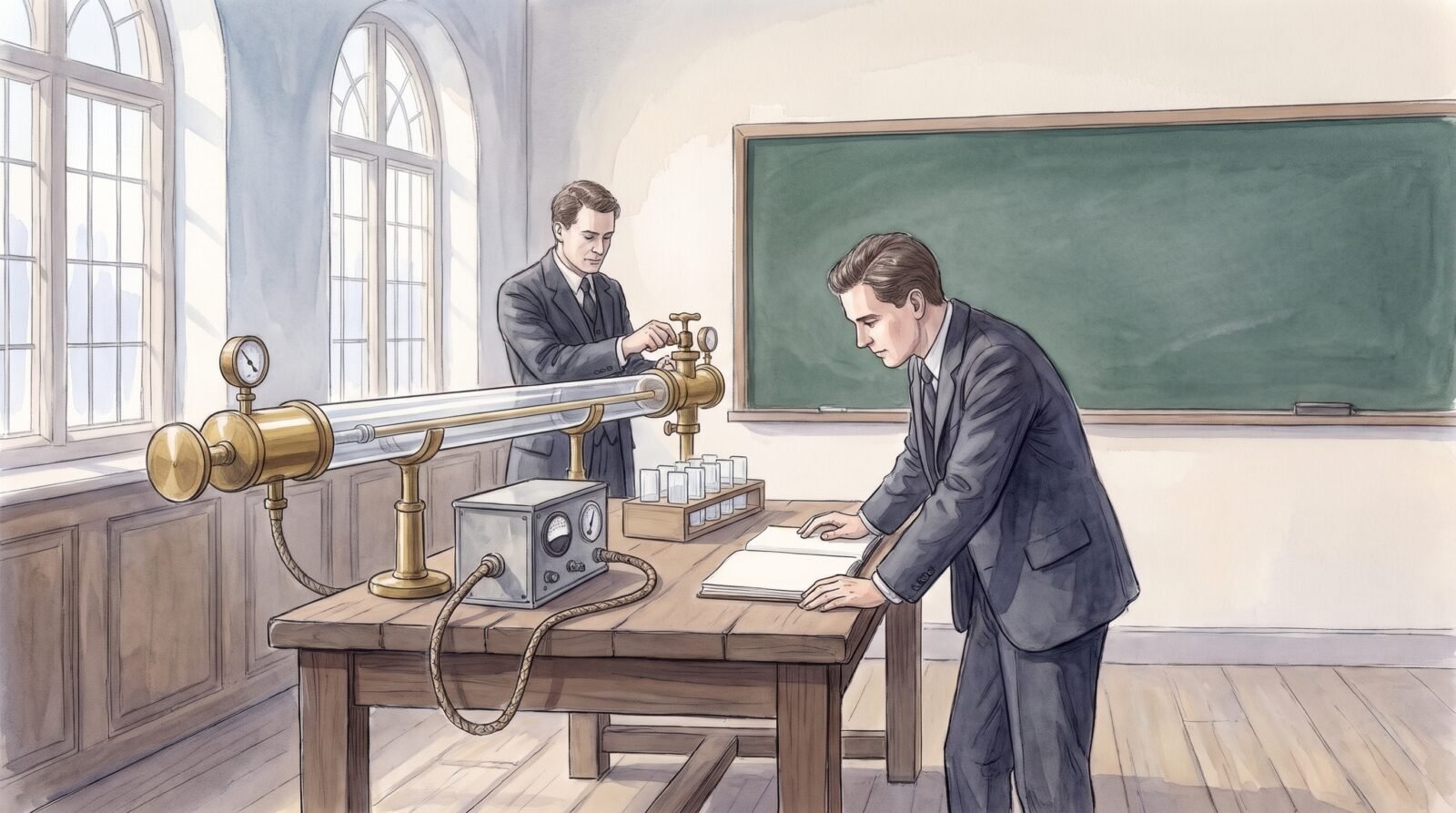
So Chadwick set out to measure the mass of the radiation, and the method he chose is the elegant heart of the whole story. The instrument was not new. It was a piece of apparatus that J. J. Thomson had used in his own work on positive rays: a cloud chamber in which the path of a charged particle could be photographed, together with magnets that bent charged particles into curves from which their speeds could be calculated. The technique was old. The particle being measured was new. The whole of Chadwick’s achievement lay in applying an old measurement to a new thing, and in refusing to let the standard explanation stand in the way of doing it[11, 12].
The apparatus had three parts. An alpha source bombarded a beryllium target. The radiation produced by the beryllium was allowed to fall on a slab of paraffin wax, which is rich in hydrogen. And the fast hydrogen nuclei knocked out of that paraffin were detected and their speeds measured, in the cloud chamber and by magnetic deflection. The paraffin was the pivot of the whole arrangement: it was the detector, but it was also the reason the mass could be extracted, because a proton is one of the easiest particles in physics to identify once it is flying. The alpha source was, by the convention of the period, very likely a polonium preparation, though the published accounts describe the set-up simply as an alpha source[4].
The reasoning runs as follows. Treat the unknown radiation as a corpuscular particle. Assume that when it strikes the hydrogen in the paraffin, the two undergo a two-body elastic collision, so that momentum and energy are conserved between the incoming particle and the recoiling proton. Measure the speed of the recoiling proton. The mass of the incoming particle then follows, because for a collision between a projectile of mass m and a stationary target of mass M, the recoil speed of the target is fixed by the two masses alone, together with the energy the projectile had to begin with. If the incoming particle were a photon there would be no mass m to solve for, and the physics would have to be done in the centre of mass of the collision rather than in the laboratory frame, which is precisely why the gamma-ray hypothesis could not survive this step: it produced a number with no consistent answer. The beryllium radiation produced a consistent one, and the number it produced was a mass very close to that of the proton[1].
The recoil calculation is the whole trick, and it is worth spelling out a little further. The proton comes off with a speed that can be measured; the maximum possible speed it could have if the collision were head-on is known; and the ratio between the two is a direct function of the mass ratio of the two particles involved. Chadwick did not need to catch the incoming particle, photograph its path, or measure its energy. He needed only to catch what it did to the hydrogen. That is the peculiar generosity of the arrangement: the unmeasurable quantity makes itself known through its effect on something that is very measurable, provided the effect is treated as a collision rather than as an absorption[1, 11].
It is worth noting what did not have to be built. There was no new accelerator, no new detector, no new piece of glasswork. The cloud chamber that produced the tracks was the standard instrument of the decade, and the magnets that bent the protons were the same ones used to measure alpha particles. The laboratory at Manchester had been studying the passage of fast particles through matter for a decade, and the technique for turning a track into a speed was settled and well tested. This is why the experimental part of the work could be done in about a fortnight, while the interpretive part — deciding what the radiation was — took the better part of a year and the collective scepticism of several laboratories.
Consistency across targets was the keystone of the argument, and Chadwick was careful to build it. If the incoming particle has a definite mass, then that mass must come out the same whether the radiation strikes hydrogen, helium, nitrogen or lithium. Each of these gives a different recoil speed and a different pair of numbers to work with, and each is a separate check on the same hypothesis. If the radiation were gamma rays, the answers would not agree; if it were a stream of particles of some fixed mass, they would. The fact that they agreed, to the precision the cloud chamber photographs allowed, was what turned a possibility into a measurement. The mass that emerged was slightly greater than the proton’s, a ratio usually quoted at about 1.15, which is to say a particle very slightly heavier than the proton and very nearly equal in mass to the hydrogen atom[1, 5].
That figure deserves a small caveat, because it has been quoted for a very long time without most of its readers being in a position to check it. The paper itself has been behind a paywall for most of the last century, and the ratio of about 1.15 comes from summaries of it rather than from the text. Later and better measurements, including those of the Joliot-Curies, who returned to the question of the neutron mass in 1934, narrowed the value to something only very slightly above the proton’s mass. But the sense of the original result was never in doubt. Chadwick was not measuring an electron, which is nearly two thousand times lighter than the proton, and he was not measuring a proton itself. He was measuring something in between: something that behaved in mass like a hydrogen atom and in every other respect like nothing that had been known before[13, 5].
It is easy to underestimate how much work sits behind a result that looks, in retrospect, like a single stroke of logic. The recoil protons had to be identified on cloud chamber photographs and their ranges measured, which meant comparing them with calibration tracks from particles of known energy. The ranges then had to be converted into velocities through the method Thomson and Barkla had used for alpha particles, which involves knowing precisely how a fast proton loses energy as it passes through matter. Every one of those steps was a potential source of error, and each had to be got right for the mass to come out the same from four different targets. The experiment was over in about two weeks. The argument that came out of it took considerably longer to be accepted, and it took longer still to be understood by the people who had supplied the data in the first place[4, 1].
The Existence of a Neutron
The formal presentation came in two stages, and the sequence is worth knowing because it is often reported wrongly. The short note, “Possible Existence of a Neutron”, appeared in Nature on 27 February 1932, as a single page in volume 129. Its title has no leading article, as published, and several later accounts have garbled it into forms it never took. The full paper, “The Existence of a Neutron”, was submitted in May and published in volume 136 of the Proceedings of the Royal Society in June 1932. It was the longer paper that carried the measurements and the reasoning, and it is the one the Nobel citation would eventually point to[6, 1].
What the paper established, beyond the mass, was that the beryllium radiation was a particle and not a photon, and that its mass was that of the proton. From that the consequences ran out in every direction at once. The nucleus of the atom, which had been a mystery mass, was now a place where protons and nucleons lived, and the old Rutherford model acquired a second constituent. The atomic number gave the number of protons and therefore the element; the mass number gave protons plus neutrons and therefore the isotope. The isotopes stopped being a puzzle and became an arithmetic consequence of the model. A nucleus was a dense collection of nucleons held together by a nuclear force that did not depend on the charge of the nucleons, and the same force could be probed with a neutral particle because a neutron feels it without feeling the electrical repulsion that keeps alpha particles out[14].
That last point is worth dwelling on, because it turned the neutron from a constituent into an instrument. A charged projectile approaching a nucleus is repelled by the electrostatic force long before it gets close, and this barrier has made the study of nuclear forces very difficult. A neutral projectile feels nothing until it is practically inside the nucleus, where the strong interaction takes hold in full. The neutron is therefore almost the only particle that can be fired at a nucleus and made to interact with it without the interaction being distorted by the electrostatic barrier. Much of what was subsequently learned about nuclear structure was learned with neutrons, for this reason alone[14, 8].
The recognition came quickly. Within months of the June paper the Royal Society itself was publishing a note under the heading “Nobel Prize for Physics: Prof. J. Chadwick”, and the Nobel Foundation’s citation for 1935 reads, in the standard wording, “for the discovery of the neutron”. It is worth being precise about the shape of that prize, because it is commonly misdescribed. The 1935 Physics prize went to Chadwick alone, with a share of one of one. It was not shared with Rutherford, who had died in 1937 and could not have shared anything, nor with the Joliot-Curies, who received the Chemistry prize that same year for their work on artificial radioactivity. Chadwick was at the University of Manchester when the discovery was made and at the University of Liverpool when the prize was awarded[15, 5, 16].
His own account, given in the Nobel lecture later that year, is notably modest in tone. He described how the experiment had been forced on him by the failure of the others to explain the paraffin result, and how the decisive step had been the refusal to accept the gamma-ray explanation, which he treated as a hypothesis that could be tested and had failed the test. The lecture is a useful corrective to the popular version, in which the discovery looks like a flash of inspiration rather than a calculation. It was a calculation. Chadwick took a measurement that other people had made, applied to it a piece of physics that other people had already worked out, and was willing to discard an explanation that everyone else was still using[11].
The Royal Society’s presentation speech for the 1935 prize makes the same point in a different register, remarking on how short a road separates the experiment from the discovery once it was finally walked. That is the nature of the case, and it is the reason the paper reads as an argument rather than as a report. Chadwick was not announcing a new object. He was showing that an existing body of measurement, correctly interpreted, could not be anything but a particle, and that the particle’s properties were those of Rutherford’s missing neutron. The experimental part was short; the inference was the work[11, 17].
It is also clear, in hindsight, that the discovery reshaped more than nuclear physics. The nucleus had been a puzzle about mass; it became a structure. Once it was understood that the nucleus held two kinds of particle, the questions that followed were of an entirely new kind, and the first of them was the beta decay that turned a neutron into a proton and moved an element along the periodic table: why does one isotope of an element differ from another only in neutron count, why are some stable and some not, what holds them together, and what happens to a nucleus that is driven to shed too many neutrons. Radioactive decay stopped being a property of the atom and became a property of the nucleus, with its own half-lives and its own chains. The periodic table acquired a second axis. None of this was in the paper of June 1932. All of it depended on it[14].
What the Neutron Unlocked
The scientific consequences of the neutron were immediate and the practical consequences were not, and the interval between them is one of the sharpest illustrations in the subject of how long it takes for a piece of physics to become a piece of engineering. Within a year the same Cavendish Laboratory that had failed to find the neutron for a decade was using neutrons to bombard heavy nuclei, and in 1939 Otto Hahn and Fritz Strassmann working in Berlin, with Lise Meitner and Otto Frisch working out in Stockholm what it meant, established that uranium and other heavy nuclei could be split by neutron bombardment, a step that led directly to the Manhattan Project and to the atomic bomb. The mechanism was elegant: a slow neutron is absorbed by a fissile nucleus, the resulting compound nucleus is too large and too charged to be stable, and it divides into two medium-sized nuclei, releasing energy and two or three more neutrons[7, 14].
The neutron is both the trigger and the multiplier in that process, and it is worth being clear about why. A fission releases, on average, about two and a half neutrons. If each of those goes on to split a further nucleus, and if each of those releases two and a half again, the number of events multiplies without limit. The whole question of a chain reaction reduces to whether the average number of neutrons produced per fission exceeds one, which is the whole of nuclear power and the whole of the reactor, and whether enough of them are captured by fissile nuclei rather than escaping into the surroundings. Because the neutron carries no charge, it is not repelled by the nuclei it approaches, and a slow neutron can be absorbed by a fissile nucleus with a large probability. The neutron’s mass sets the energy that comes out, because that mass is converted into the motion of the fragments in exactly the way the mass-energy relation describes[7, 14].
Then, in the 1940s, the neutron became a measuring instrument rather than a projectile. A beam of neutrons scattered by a material carries the same diffraction information that X-rays carry, and neutron scattering became a technique of the first rank, because a neutron has a wavelength set by its momentum through the same relation, and the structure of a crystal appears in the angles at which the scattered neutrons peak. But where X-rays probe the electron cloud and therefore say most about the heavy atoms, neutrons interact with nuclei, and a neutron of the right wavelength is sensitive to the arrangement of the nuclei themselves. Hydrogen, which is nearly invisible to X-ray diffraction because it has only one electron, is by contrast among the most visible things to a neutron. The NIST Center for Neutron Research is one of the large facilities built on this fact, and neutron diffraction is now a routine technique in chemistry, in materials science and in the study of biological molecules[8].
And then there is the endpoint of the story, which is the most dramatic of all. When a massive star exhausts its fuel, its core collapses, and the collapse does not stop when the pressure of radiation can no longer hold it up. It stops when the matter is pressed against a limit set by the degeneracy of the neutrons themselves, because at that density the neutrons, which cannot be squeezed out of existence, make up essentially the whole of the matter. The result is a neutron star: a body with the mass of a star compressed into a sphere some twenty kilometres across, denser than an atomic nucleus, and signalling so copiously in radio waves and X-rays that it can be detected across the galaxy[18].
So the sequence runs like this. Rutherford predicted a neutral particle in 1920 and could not find it. Bothe and Becker found radiation that did not behave, and the Joliot-Curies showed that it threw protons out of paraffin. Chadwick noticed that the standard explanation could not pay the energy bill, measured the speed of the recoiling protons, and found a mass slightly greater than the proton’s. From that mass came the nuclear model, and from the nuclear model came isotopes, the nuclear force, nuclear fission, the chain reaction, the reactor, the bomb, neutron scattering and neutron diffraction, and the neutron star. Nothing in that list was in Chadwick’s mind in February 1932, and none of it was in Rutherford’s in 1920. The neutron was not so much a discovery as a new category of thing, and the twentieth century spent the rest of its time finding out what could be done with it[15].
References
- Chadwick, J. (1932). “The Existence of a Neutron”. Proceedings of the Royal Society of London A 136 (830), 692 - 708; announced in Nature 136, 824. nature.com
- Rutherford, E. (1920). “Nuclear Constitution of Atoms”. Nature 105, 500 - 501; Bakerian Lecture, Proceedings of the Royal Society of London A 97 (686), 374 - 400. nature.com
- American Institute of Physics, “Rutherford’s Nuclear World - Atop the Physics Wave”, history exhibit. history.aip.org
- American Physical Society (2007). “May 1932: Chadwick reports the discovery of the neutron”. APS News. aps.org
- Nobel Foundation, “James Chadwick - Facts”. nobelprize.org
- Chadwick, J. (1932). “Possible Existence of a Neutron”. Nature 129 (3252), 312. nature.com
- American Heritage of the Nuclear Age, “James Chadwick”. nuclearmuseum.org
- National Institute of Standards and Technology, “Center for Neutron Research”. nist.gov, accessed 2 November 2026
- American Heritage of the Nuclear Age, “Irene Joliot-Curie”. nuclearmuseum.org
- De Gregorio, A. (2005). “Neutron physics in the early 1930s”. arXiv physics/0510044. arxiv.org
- Chadwick, J. (1935). “The Neutron”. Nobel Lecture, Nobel Foundation. nobelprize.org
- Weiner, C. (1972). “1932 - Moving into the new physics”. Physics Today, May 1972. physicstoday.aip.org
- Curie, I. and Joliot, F. (1934). “Mass of the Neutron”. Nature 133 (3367), 721. nature.com
- American Institute of Physics, “Nuclear physics in the 1930s”, history exhibit. history.aip.org
- Nobel Foundation, “The Nobel Prize in Physics 1935”. nobelprize.org
- Nobel Foundation, “The Nobel Prize in Chemistry 1935”. nobelprize.org
- Nobel Foundation, “Nobel Prize in Physics 1935 - Presentation Speech”. nobelprize.org
- National Aeronautics and Space Administration, “Neutron Stars”. nasa.gov, accessed 2 November 2026