The Davisson Germer Experiment
In 1927, at Bell Telephone Laboratories in New York, a beam of electrons was fired at a plate of nickel and the scattered electrons were counted at different angles. The experiment was designed to answer a question about metals, and it did answer one — but only after a liquid-air bottle exploded and a cooling failure turned the polycrystalline target into a few large single crystals, and after a summer spent in Oxford where Louis de Broglie’s hypothesis was explained to an audience that included the experimenter. This is the story of a wrong question, an accidental change of specimen, and an idea that arrived too late to be useful and exactly in time to be decisive[1].
Key findings
- The experiment was designed to probe the atomic structure of metals with slow electrons. Its decisive feature was an accident: in 1925 a liquid-air bottle exploded, the heat recrystallised the nickel target into a few large single crystals, and the angular distribution of the scattered electrons changed completely[2, 3].
- The standard figures are a peak at an accelerating voltage of 54 volts and a scattering angle of about 50 degrees, giving a nickel lattice spacing of roughly 0.092 nanometres. They come from a tertiary compilation rather than from the paper itself[4].
- After Oxford, Davisson and Germer searched deliberately for interference maxima and found 30. Twenty-nine were accounted for by diffraction; one was not, and eight peaks they expected never appeared at all[3].
- The short announcement appeared in Nature in 1927, months before the full paper in Physical Review 30, 705–740, published on 1 December[5, 1].
- The Nobel Prize in Physics was awarded in 1937, jointly to Clinton Davisson and George Paget Thomson, share one half each. The work had been done a decade earlier, and the year is often misremembered[6, 7].
The Wrong Question
The laboratory was the Bell Telephone Laboratories, and the men were Clinton Joseph Davisson and his colleague Lester Germer, working in room 7B of the West Village site in Manhattan. The apparatus belonged to Western Electric, the manufacturing arm of the Bell system, and the programme it belonged to was an industrial one: to understand the behaviour of electrons as they struck metal surfaces, because every piece of vacuum equipment in the telephone system depended on that behaviour and nobody had a satisfactory account of it. The question was not about waves. The question was about engineering[8, 2].
The programme was not chosen for its own sake. Vacuum tubes and electron tubes were at that moment the basis of long-distance telephony, of broadcasting and of the whole of the electronics industry, and the reliability of such a device depended on what happened to the electrons that bounced around inside it. Metallic surfaces were everywhere: the cathode, the anode, the grid. A beam of electrons hitting a metal and scattering in a complicated way was a daily engineering nuisance, and the angular distribution curve was the sort of thing an industrial laboratory wanted explained because a good explanation would make the devices better. Nothing in that brief pointed towards a foundational discovery, and that is exactly why the discovery was available to be made[8, 2]
The first results came out between 1919 and 1923, from work with C. H. Kunsman. When a metal target was bombarded with electrons of a given energy, the secondary electrons coming off it were found to have a distribution in angle with two maxima, and the pattern was found again with platinum and with magnesium. The result was published in 1923 and it was, in the phrase used afterwards, a loose thread. The two maxima were real, they were reproducible, and they had no explanation. Two maxima is not smooth. Two maxima is a signature, and the secondaries in question carried the same energy as the primaries that had produced them, which is to say that they were being reflected rather than knocked loose. An electron that has been scattered inside a metal should have lost energy on the way out. These had not, and that was what made the result so hard to wave away. The ordinary expectation was that the secondary electrons should come off in a smooth distribution, more or less according to how the incident electron happened to be scattered in the material[9, 2].
The mechanism is worth describing because it explains why the effect was so dramatic. A polycrystalline metal surface is a mosaic: millions of small crystals, each with its own lattice orientation, so that a beam passing through many of them meets a great many different diffraction conditions, and the individual patterns blur together into a smooth average. Annealing a metal slowly produces large grains, and large grains with a single orientation preserve the diffraction pattern instead of averaging it away. The liquid-air bottle had done exactly that. In one accident the target was converted from an averaging device into a resolving device, and an experiment that had been running for six years acquired, without anyone intending it, the specimen it needed[2, 3]
Something was offered in explanation, and it was offered early. In 1924 and 1925 the physicist Walter Elsasser suggested that the two maxima should be read not as a scattering effect at all but as diffraction, that is, as the interference pattern produced when a beam of particles behaved like a wave, in accordance with the hypothesis Louis de Broglie had put forward in his doctoral thesis in 1924. Davisson knew of the suggestion. He did not find it persuasive, and the usual explanation is that he regarded de Broglie’s hypothesis as too strange to be worth building an experiment around, and perhaps also that it did not seem to connect obviously to the particular effect under study. Either way, the suggestion was set aside, and it stayed set aside for a year[3, 2].
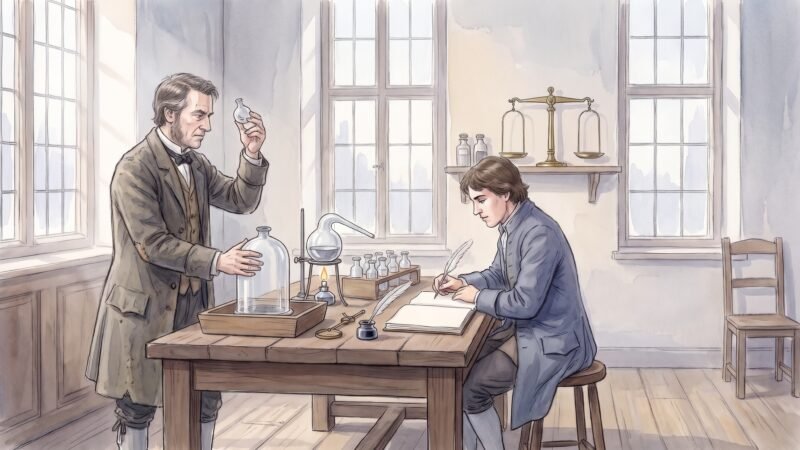
Then, in 1925, the apparatus was damaged. A bottle of liquid air, part of the cooling system that kept the target at a low enough temperature to stay clean, exploded. The heat of the explosion and the failure of the cooling that followed exposed the nickel target to temperatures it was not designed to withstand, and the nickel, which had been a surface of many small crystals, recrystallised into a new crystal structure. The change was permanent and it was enormous. Where there had been a jumble of crystallites in every orientation, there were now a few large single crystals, each with its own well-defined lattice direction and its own lattice planes, and the angular distribution of the scattered electrons, which had been smooth and featureless, developed sharp structure that depended strongly on where in the crystal the beam happened to strike. The accident had turned a piece of metal into a grating[2, 3].
It is worth being precise, too, about how nearly the whole thing was missed. The peaks had been in the data from 1925. The apparatus that produced them had been in use since 1919. The physicist who had the data and the apparatus and the training to interpret them had, in the accepted account, walked past the peaks for a year because he was looking for a scattering effect and not a diffraction effect. Nothing about the discovery required a new instrument, a new laboratory or a new idea about nature. It required an accident, a conversation at a meeting, and the willingness to look at a familiar curve and ask whether the bumps in it meant something[2, 3]
It is worth being precise about what the accident did and did not do, because the popular version usually inflates it. The explosion did not produce diffraction. It produced a specimen capable of showing diffraction, which is a different and much more modest claim, and one that depended on the fact that the experiment was already looking at the angular dependence of scattered electrons with an instrument sensitive enough to see a narrow peak. If the original polycrystalline target had been capable of showing a sharp pattern, the accident would have been unnecessary. What the accident did was remove the averaging that had been hiding the structure. Davisson and Germer went back to work with the recrystallised target, and the peaks they found in it were the peaks they should have been finding all along[3].
The paper of 1927 makes the point almost in passing, in the discussion of why the earlier results did not show the same structure. The experiment had been done, and it had been done well; what it had lacked was a specimen with a regular lattice rather than a soup of them. Between the accident of 1925 and the recognition of what the data meant in 1926 lay the most consequential summer in the history of the subject, and it was spent not in New York but in Oxford[1].
The Apparatus
The experiment is best understood as a single curve. Everything the apparatus produced came down to one measurement: the current collected by a detector, plotted against the angle at which that detector was placed, for a given accelerating voltage. The apparatus existed to make that plot accurately, and it is worth describing because the constraints it imposed shaped what could be concluded from it[4, 1].
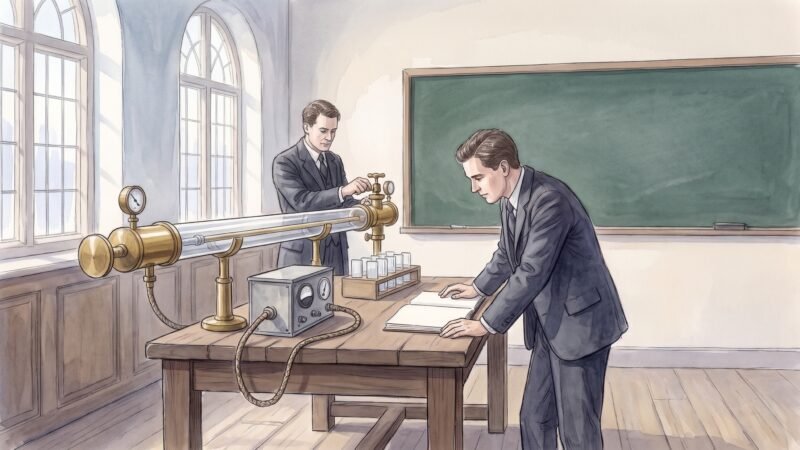
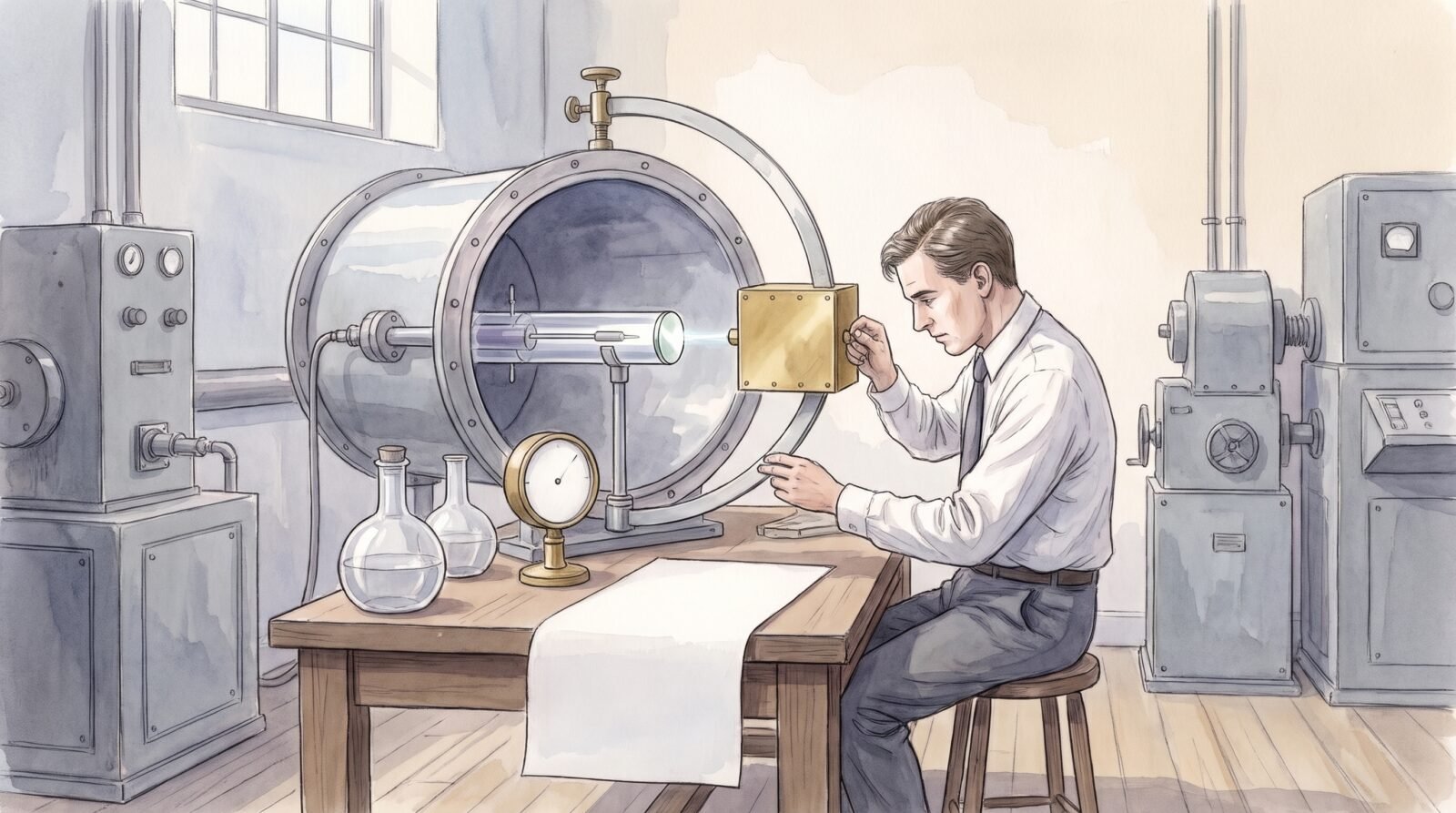
The source was an electron gun: a filament heated to release electrons, which were then accelerated through a known voltage — typically of the order of tens of volts, so that the electrons were slow by the standards of the nuclear physicists but fast enough to have a wavelength short enough to be comparable with the spacing of atoms in a crystal. They struck a target of nickel, which could be rotated so that the beam hit it at different angles and at different points on the crystal face. The vacuum was essential rather than decorative: a residual gas molecule in the path would scatter electrons in all directions and wash out the very structure the experiment was looking for[8, 4].
The detector was a Faraday box: a small collector, shaped rather like a deep cup, which could be swung around the target on an arc so that it could be placed at any scattering angle. Electrons entering the box deposited their charge on it, and the resulting current was measured with a galvanometer. The method was a nineteenth-century one, and it was chosen because it was sensitive and because it was not selective: unlike a photographic plate or a screen, the box responded to electrons coming from anywhere within its acceptance, so the plot it produced was a genuine intensity distribution rather than an image. The scattering angle, the accelerating voltage and the collector current were the three numbers that came off the bench for each setting[4, 1].
The shape of the collector was not incidental. A plain flat plate facing the target would have measured the current arriving at one angle but would also have been shadowed and biased by its own edges. The deep cup solved this: it admitted electrons over a wide range of directions while presenting almost none of its own surface to the incident beam, so that what it collected was very nearly the whole flux arriving within its acceptance. The measurement was therefore an integral of the angular distribution rather than a sample of it, and the curve it produced could be compared directly with a theory of the distribution rather than needing a correction for the shape of the detector. The same cup design was used for half a century afterwards[4, 1]
The result of any one setting was a single point on the curve. What made the experiment decisive was that the whole curve could be taken at several voltages, and that the Bragg condition could then be tested against it. If the scattered electrons were being diffracted by the crystal lattice, then peaks should appear at angles that satisfied a specific geometrical relation involving the spacing of the lattice planes and the wavelength of the electrons, and the wavelength should itself change with the accelerating voltage in a known way. The measurement was therefore over-determined: a single peak could be fitted to almost anything, but a family of peaks taken at several voltages could not[4, 1].
The figures usually quoted are these. At an accelerating voltage of 54 volts a definite peak appears at a scattering angle of about 50 degrees, and the corresponding Bragg angle of roughly 65 degrees gives a lattice spacing for nickel of about 0.092 nanometres, which is of the right order for the atomic spacing of the metal. The measured values of the square root of the accelerating voltage, 7.36, 14.7 and 22, fall in proportion to the wavelengths predicted by the de Broglie relation, and this proportionality is the part of the evidence that is decisive. A small caveat should be recorded: these numbers come from a standard tertiary compilation of the experiment rather than from the paper itself, which has for decades been difficult to consult in full, and they should be treated as the accepted summary of the result rather than as a fresh reading of the measurements[4].
That last point matters, because the argument was not made in terms of a single number. The de Broglie relation says that a particle of mass m moving with speed v has a matter wave whose wavelength is given by dividing the Planck constant by its momentum, so that increasing the accelerating voltage increases the electron’s speed and shortens its wavelength. What the experiment showed was that the positions of the peaks moved with the voltage in exactly the way that relation required, and that the geometry of the crystal lattice was consistent with the same relation read the other way round. The electrons were behaving like waves of a calculable length, and the crystal was the ruler against which the length was measured[1, 3].
Oxford, 1926: The Man Who Heard the Idea
The British Association met at Oxford in the summer of 1926, and Davisson was there with his data and without an explanation for them. He discussed the electron-scattering results with Max Born, with James Franck and with others in the audience, and for the first time in any detail he heard Louis de Broglie’s hypothesis, that a particle of velocity v has a wavelength given by dividing the Planck constant by its mass times its velocity. De Broglie’s thesis of 1924 had made the argument from the symmetry of the electromagnetic wave equations, and it had been regarded as one of the more speculative pieces of physics of its decade. It was, in effect, a wager: if matter waves existed, they would be undetectable in any ordinary circumstance, and only a very precise scattering experiment could show them[3, 2].
The hypothesis Davisson heard was, in its own terms, extremely bold. De Broglie had noticed that the wave equation for light and the equations of mechanics for matter could be written in a formally similar way, and that if the symmetry were real then a particle of matter must be associated with a wave whose wavelength was fixed by its momentum, through the ordinary constant that relates the energy of a photon to its frequency. The argument was so general that it also predicted that matter waves would be extremely short and therefore almost impossible to observe. De Broglie was explicit about this: the waves existed, but no existing means could show them. A hypothesis that announces its own untestability is not the kind of thing a laboratory in New Jersey is likely to be built around[3, 1]
Davisson did not announce a conversion on the spot. What he did was go back to New York and look at his own curves again with the idea in hand, and this time he was not looking for a scattering effect but for interference. He and Germer began a deliberate search for maxima, sweeping the collector through the angles at which a diffraction pattern predicted peaks, and they found thirty of them. Twenty-nine of the thirty could be accounted for by the diffraction geometry. One could not. And eight peaks that the geometry predicted never appeared at all. The modern assessment of the experiment rests on that balance, and it is a much better assessment than the story usually told: the experiment was not a perfect demonstration, and the imperfections are part of why it reads as an experiment rather than a proof[3].
The publication itself tells you something about the reception. The note in Nature was short, and it announced the confirmation of a hypothesis rather than the discovery of a new effect, which is why it could be written quickly and why it did not need the full apparatus description. The full Physical Review paper came later in the same year, with the curves and the analysis and the caveats, including the awkward ones: the peak that could not be explained and the peaks that failed to appear. Publishing the awkward ones alongside the convincing ones is what distinguishes a mature result from a lucky one, and it is part of the reason the experiment was still being cited and taught forty years later[5, 1]
The second half of the story is the one that is often garbled, so it is worth stating exactly. The same idea was being tested at the same time, in a different laboratory, by a different route, and by a different generation. In Aberdeen, George Paget Thomson, the son of J. J. Thomson, was sending cathode rays through thin films and photographing the diffraction rings they produced. His collaborator at Aberdeen was Alexander Reid, and the two of them published “Diffraction of Cathode Rays by a Thin Film” in Nature in 1927, some weeks after Davisson and Germer’s own note. Thomson followed it with a second paper on thin films of platinum, and the fuller accounts of the Aberdeen work appeared in the Proceedings of the Royal Society in 1928, including Reid’s own paper on the diffraction of cathode rays by thin celluloid films. There was no single discoverer here: two groups, on opposite sides of the Atlantic, using a crystal and a film, arrived at the same conclusion within months of each other[5, 10].
The search that followed was systematic and unglamorous. For a given voltage they swung the collector through a range of angles and noted where the current rose; they did it again at a different voltage, and again at a third, and they compared the positions of the peaks with what the diffraction geometry predicted for the unit cell of the nickel lattice. Thirty peaks were found in this way. The remarkable thing about the count is not that there were thirty, but that twenty-nine of them fitted the predicted pattern and that the twenty-nine fitted at three different voltages. A peak that moved with the voltage in the right way could hardly be an artefact of the apparatus, and the one that did not fit was a reminder that the apparatus was real[3, 1]
The interpretation was straightforward once it was seen. The recrystallised nickel behaved as a three-dimensional grating, and the atoms of the crystal acted as the ruling, scattering the electrons in the directions that the Bragg law required. The peaks were not a curiosity of the apparatus. They were the diffraction of a wave, and the wave was the electron. What de Broglie had proposed as a formal symmetry argument about the wave equations of light and matter had been made visible in a laboratory in a single stroke, and it turned quantum mechanics from a theory of atomic spectra into a theory of the whole of matter. The electron had been shown to be a wave in a laboratory, with an apparatus that cost very little[1, 3].
The publication sequence shows how quickly the thing was taken up. The short note announcing the result appeared in Nature in 1927, ahead of the full paper, which was published in Physical Review in the same year in volume 30, page 705, on 1 December. The full paper carried the apparatus description, the curves and the analysis. Both were out within months of each other, and the Aberdeen papers came in between and after. The period from the accident of 1925 to the last of the papers is under three years, and it is one of the shortest intervals between a question being asked and the question being answered in the whole history of the subject[5, 1].
The 1937 Nobel Prize and What the Theory Did With It
The prize was awarded in 1937, not in 1929, and it was shared equally between Clinton Joseph Davisson and George Paget Thomson, for their experimental discovery of the diffraction of electrons by crystals. Davisson was at Bell Telephone Laboratories in New York and Thomson at the University of Aberdeen. The ten-year gap between the work and the award is the sort of thing that happens in physics, where the committee for a prize is often waiting for the consequences to make sense of the discovery, and where a result that began as an industrial curiosity about vacuum equipment took a decade to be recognised as the demonstration of a foundational idea[6, 7, 11].
Davisson’s own Nobel lecture of 1937 is the natural place to look for the story from the man himself, and the ten-year delay before the award was not a sign of neglect. It was the ordinary pace at which the significance of a result like this was absorbed, and it is worth remembering that by 1937 the electron microscope had been in use for a decade, which is to say that the instrument had made the discovery useful a long time before the prize had caught up with it[7, 12]
What the prize was for was the experiment; what the experiment did was settle a question that nobody had known how to ask properly. De Broglie’s hypothesis had made a single, checkable claim: that material particles have a wavelength, and that this wavelength can be calculated from the particle’s momentum. It was not a theory of matter in the sense that quantum mechanics later became. It was a pointer, and the pointer had been pointing at an instrument nobody had thought to build. The Davisson and Germer curves were the first object in which the pointer could be seen, and once they had been seen, the whole of wave–particle duality became an experimental fact rather than a mathematical symmetry[3, 1].
The consequences were worked out in a flurry of papers in 1928 and after. Davisson and Germer published two further papers in the Proceedings of the National Academy of Sciences, one on the reflection of electrons by a crystal of nickel and one on the reflection and refraction of electrons by the same crystal, both freely available. Davisson wrote a review of the whole business for the Journal of the Franklin Institute under the title “Are electrons waves?”, which is a fair indication of how strange the question still seemed. The physical picture that emerged was that the electron could be treated as a wave when it was spread through a crystal and as a particle when it was counted, and that neither description was a distortion of the other[13, 14]
Davisson’s own career is a reminder of how narrow the gap between a fundamental discovery and an instrument was. He went on to contribute directly to the development of the electron microscope, in which the same diffracting beam of electrons is used not to measure a crystal but to form an image of a specimen at a resolution no light microscope could reach. He retired from Bell Laboratories in 1946 and spent the later part of his career at the University of Virginia. The apparatus that had been built to settle a question about atomic structure turned, almost immediately, into a way of looking at things[15, 7].
There is also a detail in the physical account that is easy to miss and that matters for what followed. The diffraction was elastic: the electrons came off the crystal with the same energy they went in with, and all the information about the lattice was carried in the angles. That is precisely the condition under which a crystal can be used as a ruler for a wave, and it is why the same arrangement, with X-rays instead of electrons, had been the standard technique of crystallography for two decades. The Davisson and Germer apparatus was a diffractometer. What was new was what was being diffracted[1, 3].
The Instrument Age
The direct line of descent from a scattering experiment to a working instrument runs through the Nobel Prizes of 1986, and the award was again divided three ways. Half went to Ernst Ruska for his fundamental work in electron optics and for the design of the first electron microscope. The other half was shared between Gerd Binnig and Heinrich Rohrer for the design of the scanning tunnelling microscope, which works not by diffracting a beam but by bringing a sharp tip to within a fraction of a nanometre of a surface and measuring the tunnelling current between them as the tip is moved across it. The tunnelling is the same quantum tunnelling that governs the alpha decay of a nucleus, and the sensitivity that it gives is what allows a single atom of a surface to be imaged[16, 17, 18].
The two halves of the 1986 prize are less closely related than the single award suggests, and the shared thread is the electron rather than the technique. Ruska’s electron microscope and the scanning tunnelling microscope use entirely different physics: one forms an image with a focused beam of electrons, the other maps a surface with a current flowing across a gap far too small for a classical particle to cross, which is the quantum tunnelling that governs alpha decay as well. What they share is a purpose. Both are instruments for resolving structure that no light could resolve, and both are built on quantum effects that could be understood because of the experiment of 1927. The distinction between them is the distinction between a wave and a tunnel, and both belong to the quantum theory that de Broglie’s wavelength set in motion[16, 18, 17]
The connection is not merely chronological. A beam of electrons diffracting off a crystal was, in the first place, a way of measuring a wavelength. The moment the wavelength of an electron had been measured, it could be set deliberately — by choosing the accelerating voltage — and then a beam with the right wavelength could be used to do something other than measure. It could be focused, and it could be made to form an image. The electron microscope is the direct application of the fact that an electron has a wavelength, and the fact that it has a wavelength was established by the experiment of 1927. Ruska’s first working electron microscope came only a few years later, in the early 1930s, and it worked because of it[17, 3].
The same is true of the scattering of neutrons, which is the closest of all the descendants. A neutron has a wavelength set by its momentum in exactly the way an electron’s is, because the relation is the same and it does not depend on the charge. A beam of neutrons scattered by a material therefore produces diffraction patterns in the same way, and since the neutron interacts with nuclei rather than with electron clouds, the pattern contains information about where the nuclei are rather than where the electrons are. The NIST Center for Neutron Research and its equivalents elsewhere are large facilities built on this principle, and the same technique has become a routine probe of wherever the positions of nuclei matter. The instrument that made the discovery was a diffractometer, and the discovery turned the diffractometer into the most powerful structural tool in the physical sciences. The crystal lattice that served as a ruler for the electron in 1927 serves the same function for the neutron, and neutron diffraction is now a routine technique in chemistry, in materials science and in the study of biological structures[19].
There is a pleasing symmetry in the closing of the story. The crystal lattice that had been used since the nineteenth century to measure atomic weights and densities, and that had been the setting for Rutherford’s discovery of the atomic nucleus, became in 1927 the ruler that measured the wavelength of a particle of matter. From that measurement followed the electron microscope, the tunnelling microscope, neutron diffraction and the whole apparatus of modern structural science. The apparatus did not change much. What changed was the idea inside it. A lattice of atoms, scattering a beam of electrons, went from being a curiosity of the laboratory to being the founding experiment of quantum mechanics, because a physicist who had been measuring the wrong thing was finally given the right idea by somebody else[3].
There is a broader point hiding in the story, and it bears on how much of science is decided by accidents of attention rather than by accidents of nature. Nothing about the experiment was obscure: the apparatus was modest, the technique was old and the data were ordinary. What was unusual was that the physicist who owned the data was present at a meeting where somebody else explained the idea that made the data legible, and that he was willing to go back and look again. The liquid-air bottle had made the experiment possible; the idea made it mean something. Those are very different kinds of contribution[3, 15]
References
- Davisson, C. and Germer, L. H. (1927). “Diffraction of Electrons by a Crystal of Nickel”. Physical Review 30, 705 - 740. doi.org
- “Davisson, Clinton Joseph”, Complete Dictionary of Scientific Biography. encyclopedia.com, accessed 2 November 2026
- Charles, H. (2025). “Quantum Milestones, 1927: Electrons Act Like Waves”. Physics 18, 23. physics.aps.org
- Georgia State University, “Davisson-Germer Experiment”. HyperPhysics. hyperphysics.gsu.edu, accessed 2 November 2026
- Davisson, C. and Germer, L. H. (1927). “The Scattering of Electrons by a Single Crystal of Nickel”. Nature 119, 558 - 560. nature.com
- Nobel Foundation, “The Nobel Prize in Physics 1937”. nobelprize.org
- Nobel Foundation, “Clinton Davisson - Facts”. nobelprize.org
- American Physical Society, “Bell Laboratories Building”, Historic Sites plaque, May 2011. aps.org
- Davisson, C. J. and Kunsman, C. H. (1923). “Scattering of low Speed Electrons by Platinum and Magnesium”. Physical Review 22, 242 - 258. doi.org
- Thomson, G. P. and Reid, A. (1927). “Diffraction of Cathode Rays by a Thin Film”. Nature 119, 890. nature.com
- Nobel Foundation, “George Paget Thomson - Facts”. nobelprize.org
- Nobel Foundation, “Clinton Davisson - Nobel Lecture”, 1937. nobelprize.org
- Davisson, C. and Germer, L. H. (1928). “Reflection of Electrons by a Crystal of Nickel”, PNAS 14, 317 - 322. pmc.ncbi.nlm.nih.gov
- Davisson, C. J. (1928). “Are electrons waves?”. Journal of the Franklin Institute 205 (5), 597 - 623. doi.org
- Gehrenbeck, R. K. (1978). “Electron diffraction: fifty years ago”. Physics Today, January 1978. physicstoday.aip.org
- Nobel Foundation, “The Nobel Prize in Physics 1986”. nobelprize.org
- Nobel Foundation, “Ernst Ruska - Facts”. nobelprize.org
- Nobel Foundation, “Gerd Binnig - Facts” and “Heinrich Rohrer - Facts”. nobelprize.org
- National Institute of Standards and Technology, “Center for Neutron Research”. nist.gov, accessed 2 November 2026