How the Royal Society Was Born
The Royal Society was founded in a lecture room in the City of London on 28 November 1660, by twelve men who had been meeting irregularly for years. It is the oldest scientific academy in continuous existence, and its journal, Philosophical Transactions, is the oldest scientific journal still being published. This is the story of how a group of natural philosophers with no building, no money and no legal status turned a weekly evening meeting into an institution, why Charles II gave them a royal charter, how the Society nearly destroyed itself over money in the eighteenth century, what it did for British science in the nineteenth, and what it has become.
Key findings
- The Society began as a conversation after a lecture. Twelve men met at Gresham College on 28 November 1660, after Christopher Wren had lectured on astronomy, and agreed to form “a Colledge for the promoting of Physico-Mathematicall Experimentall Learning”[1].
- Royal patronage was the price of its survival. The first charter of 15 July 1662 and the second of 22 April 1663 made the body corporate, gave it a president, treasurer, secretaries and council, and allowed it to bear the word “Royal”[2, 3].
- It was, and remains, a private voluntary body rather than a government department. The 1911 Encyclopaedia Britannica put it plainly: the Society “has always remained a voluntary organization, independent of the British state”[2].
- Philosophical Transactions, first issued on 6 March 1665 and edited by Henry Oldenburg at his own expense, is the oldest scientific journal in continuous publication, and it established the referee system that every journal since has copied[4, 5].
- The eighteenth century nearly finished it. Arrears in subscriptions reached almost £2,000 by 1673 and the Society was running a deficit of £240 by 1740; the journal had to be taken off the hands of its private editor in 1752; and the dissensions of 1783 and 1784 came close to splitting the Society in two, ending in a vote of 119 to 42 in favour of Sir Joseph Banks[1, 2].
- It is still the UK’s national academy of science, and it is still small. There are approximately 1,900 Fellows, about 85 of them Nobel laureates, and up to 109 are elected each year from about 800 candidates, by a confidential ballot in which two-thirds of the votes cast must agree[6, 7].
The Society Before It Existed
No institution appears fully formed. The Royal Society had been sketched, argued over and nearly abandoned twice before the day it was founded, and the shape it took on 28 November 1660 was the residue of a decade of argument that began in the middle of the English Civil War. The men who gathered at Gresham College were the survivors of a dispersed group of natural philosophers who had been corresponding since the 1640s, when experimental science in England was an activity conducted out of private rooms with the new name “natural philosophy” attached to it.
The first of these circles gathered around Samuel Hartlib and around the letters that Robert Boyle wrote from Ireland between 1646 and 1648. Boyle proposed a college of experimental philosophers who would work together, pool results and report them to a wider public, and in a letter of 22 October 1646 he called his correspondents “our invisible college”. Two years later he reported that “the corner-stones of the invisible or (as they term themselves) the ‘philosophical college'” did him the honour of their company. The phrase stuck. Boyle’s New Experiments Physico-Mechanical, which described the air pump and the experiments he had performed with it, was printed by Hartlib in 1660, the year the Society was founded[1].
Whether Boyle’s “invisible college” ever met in a room at all is now contested. The identification of his correspondence circle with the Gresham group is questioned by historians who argue that the two were separate bodies, and the claim that Theodore Haak, Hartlib’s Dutch-born associate in London, was the founder of a physical meeting place has been challenged. What is not in dispute is that the idea of a small, disciplined group that met regularly, tested claims by demonstration and published the results circulated widely among the scientifically minded in the 1640s and 1650s, and that the men at Gresham were part of that circulation[1].
A second circle formed at Oxford. John Wilkins, who had been chaplain to Charles I before the war and was now a young Oxford don, gathered around him a group that met weekly in rooms at Wadham College. When the Civil War came to Oxford they scattered, some to Parliamentarian causes and some into exile with the king. The Restoration brought them back to the same city, and by 1659 a group of Oxford men including Wilkins, Wren and William Petty were back in London and in contact with Boyle in Ireland, whose letters describe an experiment “on the weight of the air” as the most promising of the lot. There was a third ingredient, and it was political. The Restoration of Charles II in 1660 brought back to London a network of royalists, soldiers and diplomats who had spent the previous decade in exile and who were looking for useful work to justify royal patronage. One of them was Robert Moray, a Scottish soldier and courtier who had been the king’s channel during the exile, who knew the Oxford group from the Commonwealth years, and who now made it his business to introduce natural philosophers to the king. The famous first meeting was the visible result of three years of work by men who needed the Crown and needed each other at the same time.
The place was Gresham College, founded under a will of 1597 by Sir Thomas Gresham, which provided for seven public professors of divinity, astronomy, music, geometry, civil law, physic and rhetoric to lecture to Londoners for nothing. Two of the earliest holders of chairs there, in astronomy and geometry, were to be the two most important founders of the Society. A college designed for free public lectures turned out to be an ideal meeting place for a private band of gentlemen who also wanted to meet on Wednesday afternoons and to try instruments together.
They had already tried, and failed, once. Meetings at Gresham had begun in the 1650s, and they stopped in 1658 when the college was quartered by soldiers. Sprat’s history of the Society recalled the moment with a classical analogy: “till they were scattered by the miserable distractions of that fatal year”, and then quoted the fate of Archimedes to make the point. “[t]he place of their Meeting was made a Quarter for Soldiers.” The parallel was pointed. A society of scholars who put their trust in demonstration rather than authority could be destroyed by a quartering of soldiers, and the lesson of 1658 was in the mind of everyone who gathered again in 1660[8].
Twelve Men in a Lecture Room
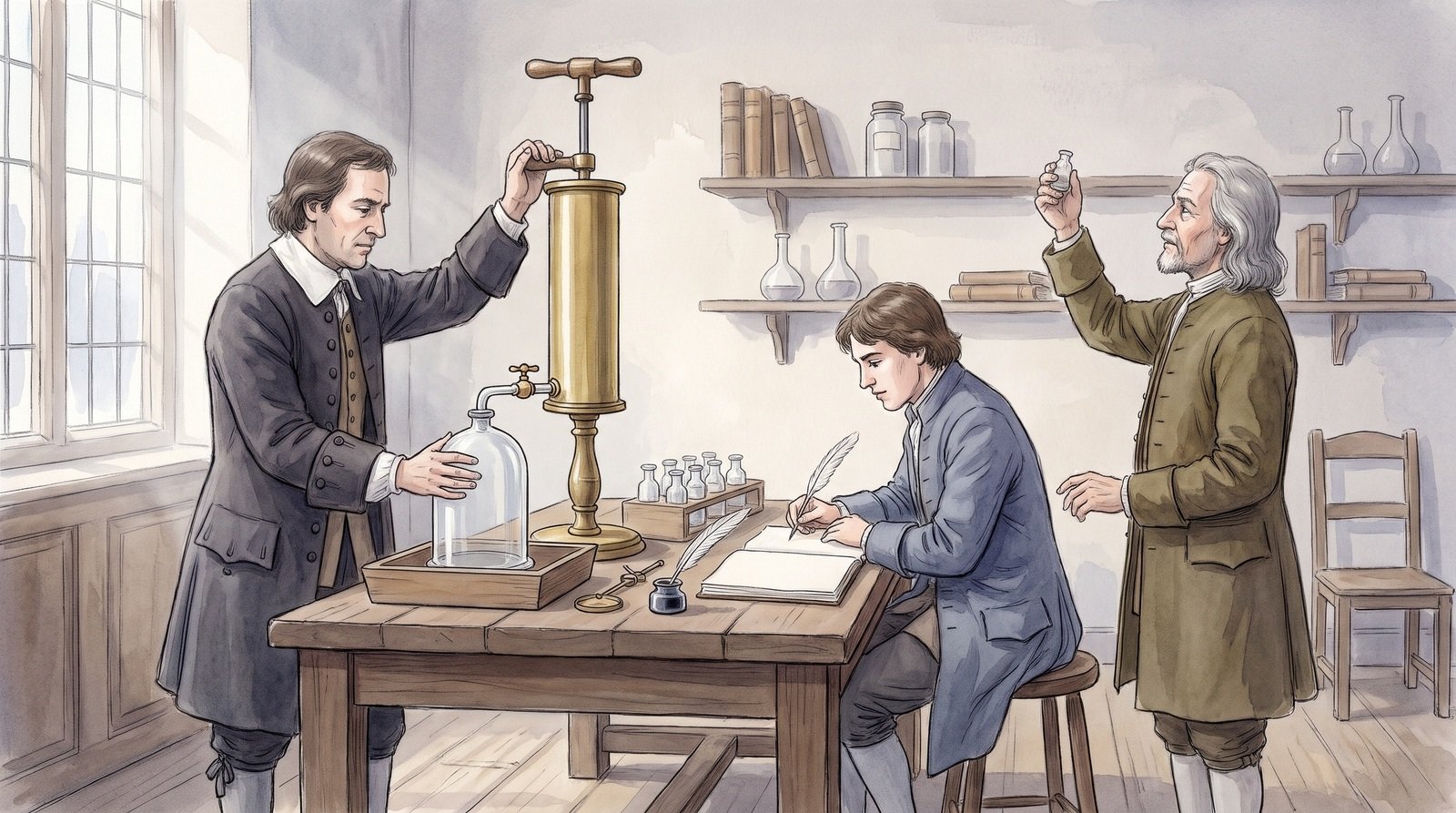
Christopher Wren, the Gresham professor of astronomy, gave a lecture at Gresham College on the evening of 28 November 1660. Afterwards a group of men who had been talking with him stayed on, and out of that conversation came a resolution. The Society’s own Journal Book records that “something was offered about a designe of founding a Colledge for the promoting of Physico-Mathematicall Experimentall Learning”. The name is cumbersome, provisional and entirely characteristic: these were men who wanted experiments rather than learning, and who had not yet decided whether they were a college, a society or something else. The name “Royal Society” first appeared in print the following year, in a dedicatory epistle by John Evelyn prefixing his translation of a French manual on libraries, and Evelyn’s diary for 3 December 1661 records the Society thanking him for “the honourable mention I made of them by the name of Royal Society”[9, 2].
The twelve who gathered were Wren, Boyle, Wilkins, Brouncker, Petty, Moray, Lawrence Rooke, Abraham Hill, Paul Neile, Alexander Bruce, Jonathan Goddard and William Ball. Between them they had the law, the church, the army, the court, medicine, astronomy and mathematics, and they included the three men who would run the Society for the next thirty years: William Brouncker as the first president, John Wilkins as the first secretary, and Henry Oldenburg, a German-born physician and linguist who was not yet among the founders but who would take over the correspondence within a few months and, in effect, run the Society’s scientific programme for the rest of his life[1, 2].
The meeting itself settled the practical arrangements in a way that sounds startlingly casual. The Society would meet on Wednesdays at three o’clock. Admission cost ten shillings and the weekly subscription a shilling. Wilkins would chair, Ball would keep the money and Croone the register. A list of forty-one candidates was drawn up on the spot. Two weeks later, on 5 December 1660, Moray brought word that the king approved of the design, a pendulum experiment was assigned to Wren as the Society’s first scheduled demonstration, and a form of Obligation was signed by the twelve named in the memorandum and by seventy-three others. On 12 December the Society fixed its own size at fifty-five, with barons, Fellows of the College of Physicians and the public professors of mathematics, physics and natural philosophy at both universities admitted as supernumeraries. Elections were by ballot, with two-thirds consent required and a quorum of twenty-one for elections and nine for other business[1, 2].
It is worth noticing what the twelve did not do. They did not claim to discover anything, they did not issue rules for research, and they did not try to teach the public. They met on Wednesday afternoons, paid a shilling each for candles and porter, and discussed whatever any member or visiting stranger brought. The first year of the Journal Book is mostly a list of experiments: the weight of the air, the freezing of water, the colours produced by prisms, the shape of raindrops, the behaviour of loaded and unloaded pendulums. Nothing was published for the first five years. The Society’s rule was that its meetings were enough, and that its members would learn from each other in person. That habit, of the discussion rather than the paper, is the part of the founding that survived everything that followed.
The Charter, the Mace and the Motto
The first royal charter, sealed on 15 July 1662 and read before the Society on 13 August, turned a voluntary association into a corporate body with a president, treasurer, secretaries and council, and with the right to hold meetings, make statutes, elect fellows and acquire property[2, 10]. The second charter, which passed the Great Seal on 22 April 1663, is the one that made the name and the privilege permanent. It named Charles II as founder and patron, gave the Society the name “The Royal Society of London for Improving Natural Knowledge”, authorised the use of a common seal, and provided for a council of twenty-one, ten of them retiring each St Andrew’s Day. It also created the office of Curator of Experiments, with power to appoint two of them, and it reserved the right to “demand and receive the bodies of executed criminals, and to anatomize them, as the College of Physicians and the Company of Surgeons of London use or enjoy”[1, 2, 3].
The second charter’s date is one of those details that appear settled and are not. The Royal Society’s own archive catalogue and picture library give 22 April 1663 for the Great Seal, and the 1911 Britannica agrees; MacTutor gives 23 April, and a widely repeated modern date is 23 April, possibly the date of the royal signature rather than of the seal. The Society’s name also varies between sources, with “for Improving Natural Knowledge”, “for the Improvement of Natural Knowledge” and “for Promoting Natural Knowledge” all in circulation. Small discrepancies of this kind are worth noting rather than smoothing over, because they are a useful reminder that institutional histories are written by people who were not all in the room[3, 10, 11].
A royal warrant of 23 May 1663 delivered the Society its mace, a piece of silver gilt weighing 150 ounces troy, its head bearing the rose, the harp, the thistle and the fleur-de-lis, and its inscription crediting the king as founder and patron. The mace is not decoration. It is the visible proof that the Society was under royal protection, and it is still carried at the Admissions Day on which new Fellows sign the Charter Book and take the Obligation, in a ceremony that still quotes the words the first subscribers signed in December 1660[1, 12].
The motto is Nullius in verba, “on the word of no one”, taken from Horace’s Epistles: nullius addictus iurare in verba magistri, “sworn to swear on the word of no master”. It appears on the arms granted by Sir Edward Walker, Garter King of Arms, which carry three lions passant guardant for England, an eagle as crest and two white hounds as supporters. It states the founding principle of the institution in six syllables: take nothing on anyone’s authority, including the authority of a member of the Society. Thomas Sprat, the Society’s own historian at the time, understood the motto as a rejection of the authority of the universities and the churches, which is why his History of the Royal Society of 1667 was written as propaganda as much as narrative. He offered the king a flattering version of the same story in his dedicatory epistle: “F all the Kings of Europe, Your Majesty was the first, who confirm’d this noble Design of Experiments, by Your own Example”[13, 9].
The Society’s seal told a more interesting version of the same idea. Where the charter’s arms were a field of flames, the seal shows a hand holding a burning torch above the motto Ignitas Naturae, “nature kindled”: an image of a light passed from hand to hand, and the reason a body with no premises, no salary list and no significant income lasted where far richer schemes failed. The charters conferred public status in name only. None of them included any actual funding, and the cost of the work fell on the fellows themselves. In 1664 Samuel Pepys recorded the king laughing “mightily” at them for “spending time only in weighing of ayre”; by 1668 he was reported to call the fellows “his fools”. The Society’s answer was to be so useful that the Crown could not afford to lose it, and that answer would take a hundred years to be proven[1, 8].
| Instrument | Date | What it granted | Consequence |
|---|---|---|---|
| First Royal Charter | 15 July 1662, read 13 August | Corporate status; president, treasurer, secretaries and council; power to elect fellows, make statutes, hold property and use a common seal | A voluntary band of gentlemen became a legal person that could own land, be sued and sue. Henry Oldenburg became secretary |
| Second Royal Charter | 22 April 1663, read 13 May | The name “The Royal Society of London for Improving Natural Knowledge”; Charles II as founder and patron; a council of twenty-one; two curators of experiments; the bodies of executed criminals for dissection | Royal patronage became permanent, and the Society gained its first salaried scientific officer: Robert Hooke, elected curator on 11 January 1664-65 at £30 a year |
| Royal warrant for the mace | 23 May 1663 | A silver gilt mace of 150 ounces troy, inscribed with the king as founder and patron | Gave the Society a public symbol of its status, still carried at Admissions Day |
| Third Royal Charter | 8 April 1669, read 19 May | Vesting of the Chelsea College estate, nearly thirty acres granted by the king in 1667 | Gave the Society an endowment independent of subscriptions; the Chelsea land was later sold back to the Crown for £1,300 in 1681 |
For all the grandeur of the mace and the motto, the Society was not well funded. It relied on the weekly shilling subscription, on the profits of the Chelsea land, and on the cost of printing falling partly on the authors themselves. That anxiety never entirely left. It returned in the 1730s, when arrears left the Society unable to pay its printer, and it reached a crisis in the 1760s, when a hostile press treated the Society as a target and the fellows who paid their dues were mocked for doing so. The first fifty years were spent proving that a private group of gentlemen with nothing but a charter could do serious work. The next two hundred and fifty were spent working out what kind of institution it wanted to be.
How the Society Actually Worked
The Society’s machinery was simple enough to describe in a paragraph and complicated enough to run for three centuries. It met, it demonstrated, it corresponded, it wrote it down, and it printed what was worth printing. On Wednesday afternoons at three o’clock the members met at Gresham College, paid a shilling each into the box, and heard whatever had been brought. Experiments were performed in front of the company rather than described afterwards, and the results were debated on the spot. When the Council first met on 13 May 1663 it resolved two things about the admission of new members: that the debate on candidates should be secret, and that fellows should continue to pay a shilling a week to defray expenses[1, 2].
Underneath the meetings sat a second activity, and it was the more important one. The Society maintained an active correspondence with continental philosophers, and the 1911 Britannica made the point that “at this early stage of its history the ‘correspondence’ which was actively maintained with continental philosophers formed an important part of the society’s labours”. Selections from it furnished the beginnings of the Philosophical Transactions, and at first “the publication of the Transactions was entirely ‘the act of the respective secretaries'”[2]. Henry Oldenburg, the first secretary and the man who ran this half of the operation, was a German-born physician who had come to England to serve the Cromwellian regime, had stayed on when the regime collapsed, and had turned his network of contacts into the Society’s instrument for reaching every serious scientific mind in Europe. He set the journal’s method, and the method is still the method: a paper is read to the Society, it is referred to two or three members who are not its authors, and the Council licenses it for publication.
The third pillar was paid. The 1663 charter allowed the Society to appoint two “curators of experiments”, and the first holder was Robert Hooke, elected on 11 January 1664-65 at a salary of £30 a year and later a secretary of the Society. Hooke’s job was the job the Society had invented: to perform the experiments the fellows could not perform themselves, to maintain the instruments and the collection, and to be the source of the Society’s technical memory. He was also the Society’s publisher in practice, reviewing the papers that went into the Transactions and inserting the notes and experiments that made each number more than a collection of separate reports[1, 2].
Philosophical Transactions and the Machinery of Priority
The journal was the Society’s central invention, and the competition to be first was not a distant concern. The Journal des Sçavans began publication in Paris on 5 January 1665, two months before the first number of the Philosophical Transactions appeared, and the two journals would spend the next century in competition for the same authors[2, 14]. The Transactions went out on Monday 6 March 1665. It was sixteen quarto pages, printed by John Martyn and James Allestry, who styled themselves “Printers to the Royal-Society”, and it carried the long title that is still the journal’s title: Philosophical Transactions: giving some Accompt of the present undertakings, studies and labours of the Ingenious in many considerable parts of the world. It was dedicated to the Royal Society and signed by Oldenburg[2, 5].
Five days before publication, on 1 March 1665, the Council resolved “that the tract be licensed by the Council of the Society, being first reviewed by some of the members of the same”[2]. That sentence is the origin of peer review, and it is worth reading twice. The paper is not published because the Society liked it or because the secretary approved it, but because a small number of fellows who were not the authors have read it and reported on it. The condition is not that the paper must be true, which nobody could guarantee in 1665, but that it must not be the private property of its author, and that it must survive a reading by people competent to object. Everything that has happened in scientific publishing since, including the anonymous review reports of today’s journals, is an elaboration of that one Council order.
The journal then ran into the century’s disasters, and the way it survived them is a fair summary of the Society’s condition. Meetings stopped after 28 June 1665 “for more than eight months”, and the fifth number, dated 3 July 1665, ended with a notice that “by reason of the present Contagion in London … the Printing of these Philosophical Transactions may possibly for a while be intermitted”[1, 5]. Publication resumed with the sixth number on 6 November 1665, and numbers six to eight were printed at the Sheldonian Theatre in Oxford by Lichfield and W. Hall, because London was no longer safe. The Society’s own meetings resumed on 14 March 1666. Then, on the night of 2 September 1666, the Great Fire destroyed four fifths of the City, and the Gresham College apartments were required for the use of the city authorities[1, 2].
Oldenburg’s achievement was to keep the journal monthly through all of this. On the eve of the Fire the Society had resolved to spend £100 on “the collection of rarities formerly belonging to Mr Hubbard”, which became the nucleus of its museum, and Oldenburg had been to Holland and Paris to recruit correspondents. When the plague stopped the meetings he kept the journal running by correspondence, and when the Fire stopped the printing he moved part of it to Oxford. The numbers that survive from that year are among the most famous documents in the history of science, because they carry the earliest work on Hooke’s microscope and on Boyle’s air pump, and because the plague notice and the Oxford imprint record, in the journal itself, the two events that would otherwise have swallowed it[1, 5].
Oldenburg died in 1677, by which time he had issued 136 numbers, and publication stopped for five years. It resumed in January 1683 with the 143rd number under Robert Plot, and the editorship then passed through Edmond Halley and on to Richard Waller in 1692 or 1693, assisted by Halley and Hans Sloane, with Sloane taking it over entirely in 1696[15, 11]. The scheme of binding the monthly parts into an annual volume was Oldenburg’s, and it is the scheme still in use. By 1750, when the Society finally took the journal onto its own finances, 496 numbers had appeared in 46 volumes[2].
The priority problem was there from the beginning, and the journal was the Society’s answer to it. In 1667, while Oldenburg was in the Tower, a rival produced what purported to be the next number of the journal, a pirate issue that the historians have numbered 27. The Society’s response to such theft was the same as its response to all disputes about credit: a committee, a report, a printed finding. By the end of the century the machinery was in place for the most famous priority dispute in the history of science, and the machinery was what made the settlement possible at all.
The Pump, the Microscope and the City Rebuilt
Two instruments carry the Society’s early reputation, and both are now recognisable as the founding objects of modern laboratory science. The first is the air pump. Boyle’s improved version, worked on by Hooke, was the most discussed experimental device in Europe for a decade, and Boyle’s New Experiments Physico-Mechanical, published by Hartlib in 1660, set out what it could be made to demonstrate. Air could be pumped out of a sealed vessel, and the consequences were startling: a candle goes out, a bird suffocates, water boils at a lower temperature, and the weight of the atmosphere turns out to be a measurable force pressing on everything. Boyle’s law, that the pressure and volume of a gas are inversely related, is still taught as a piece of school physics, and it was found by pumping air out of a cylinder in a room in London[1, 16].
The second is the microscope. Hooke’s Micrographia, published by the Society in 1665 with its arms on the title page, described in obsessive and beautiful detail what a lens could bring into focus: the edge of a razor, the surface of a leaf, the compound eye of a fly, the mould that grew on a slice of cork. It is the book that made the microscope a scientific instrument rather than a toy, and it did so by insisting on the discipline of drawing exactly what was seen, at a known magnification, with the observer’s method stated so that others could repeat it. The Society had made a decision here that it has never reversed. It is a body that publishes what was observed, in a form that can be checked.
The third great project of the founding generation was civic rather than scientific, and it is easy to forget that the same men did it. After the Fire, Christopher Wren was appointed Surveyor of the King’s Works and produced a plan for rebuilding the City on a regular street pattern; he then spent the remaining thirty years of his life building St Paul’s Cathedral, consecrated in 1710. Hooke worked on the new foundations and on the survey of the damage. The Society’s members were the same network of gentlemen who rebuilt London, and the Surveyor’s work was itself an exercise in measurement, with practical problems of construction, drainage, surveying and water supply that the new science of the seventeenth century had to solve[17].
What the Fire also did was put the Society’s institutional independence to the test. The Gresham College rooms were requisitioned by the city authorities, and the Society spent the next seven years as the guest of Henry Howard of Norfolk at Arundel House in the Strand. Howard also gave them the library assembled by his grandfather, Thomas Earl of Arundel, which became the foundation of a scientific library that the Society still says exceeds 60,000 volumes. It got a home of its own in 1667, when the king granted it the freehold of Chelsea College, nearly thirty acres on the north bank of the river, vested in the Society by the third charter of 1669. The land was a genuine endowment and an expense as well, and it was sold back to the Crown in 1681 for £1,300 after a proposal by Sir Stephen Fox[1, 2].
Hooke, Newton and the Price of a Book
No episode in the Society’s history illustrates its machinery better than the publication of Newton’s Principia. The manuscript was shown to the Society in 1686, and the Society’s licence to print it carries a piece of the institution’s own machinery in its imprint: Imprimatur: S. Pepys, Reg. Soc. Praeses. Julii 5, 1686. Samuel Pepys was then president, and the Society was acting as publisher, referee and guarantor of the book that would set out the laws of motion and universal gravitation[2]. The Society’s own archive still holds the original manuscript, with Newton’s autograph corrections, from which the first edition was printed. Today those pages are published in full on the Society’s open “Science in the Making” platform, where more than 40,000 manuscripts are available to anyone[2, 18].
The path to publication had not been smooth. In 1684 Edmond Halley, then a young astronomer working at the Society, asked Newton a question about the path of a planet under an inverse-square force, and received an answer that turned into the central argument of the Principia. Newton showed the manuscript to the Society in 1686, and Hooke and Halley both raised the priority question: Hooke claimed he had reached the inverse-square law first and said as much to Newton, and Halley asked who had got there first. Newton’s response was to withhold the book for a year. The settlement was financial. Halley offered to pay for the printing out of his own pocket, the book appeared in July 1687, and the Society then bought 300 copies to distribute among members and universities[19].
Newton himself was elected a Fellow on 11 January 1671-72, on the proposal of the bishop of Salisbury, and became president in 1703, holding the office until his death in 1727[2]. He presided over a Society that was at that moment moving house: the first meeting in the new quarters at Crane Court in Fleet Street was held on 8 November 1710, and in the same year the Society was appointed visitors and directors of the Royal Observatory at Greenwich, a function it performed for more than two centuries[2]. The connection between the Society and the Observatory is the clearest early example of the pattern that would define its later history: the Society as adviser and guarantor, the national institution as operator, and the two locked together by a shared board.
| Years | Home | What happened there |
|---|---|---|
| 1660 to 1666 | Gresham College, City of London | The founding meetings, the first charter, the first experiments and the first numbers of the Transactions. Rooms requisitioned by the city authorities after the Great Fire |
| 1666 to 1673 | Arundel House, the Strand | Given to the Society by Henry Howard of Norfolk, who also presented the Arundel library that founded its collection |
| 1673 to 1710 | Gresham College, City of London | Return to the old rooms; the collection of rarities bought for £100 in 1666 grows into a museum |
| 1710 to 1780 | Crane Court, Fleet Street | The first meeting in the new quarters on 8 November 1710, under Newton’s presidency; the Society made visitors and directors of the Royal Observatory in the same year |
| 1780 to 1857 | Somerset House, the Strand | The museum is handed to the trustees of the British Museum on the move; the Society’s own collections stay in its hands |
| 1857 to 1967 | Burlington House, Piccadilly | Shared with the Linnean, Geological and Chemical societies, which grew out of the same Fellowship |
| 1967 to the present | 6 to 9 Carlton House Terrace, St James’s | The Society’s own building, paid for by subscription and by the Wolfson Foundation, and still the centre of its library and collections |
The Eighteenth Century: Splendour and Arithmetic
For thirty years the Society was presided over by the most famous man in Europe, and it has never been quite the same institution since. Isaac Newton was elected president in 1703 and held the chair until his death in 1727, and the reputation of the Society rose with him. The style of that rise is worth pausing on. Newton’s own fortune came from the Mint, where he was Warden from 1696 and Master from 1699, and he brought the habits of a man who reorganised a coinage to an institution that had been running on subscriptions of one shilling a week. He gave the Society money of his own, including £100 in December 1710 “towards the easing of the Debt of ye Society for ye House” in Crane Court, and he used its machinery to settle his own quarrels[20, 2].
The most famous instance was the calculus war. When Gottfried Leibniz claimed independent invention of the calculus, the Society appointed a committee of its own body to examine the priority dispute. The committee reported on 24 April 1712, and the Commercium Epistolicum was printed the same year by the Society, on the title page “by order of the Royal Society”. It was, in effect, a party document: the committee was packed with Newton’s friends, and Newton wrote the report himself. The verdict was, in the judgment of historians, right on the mathematics and wrong on the ethics. The episode established two things at once. It proved that the Society could adjudicate a priority dispute, which no one before it had been able to do; and it showed that the Society could not be trusted to do so impartially when one of the parties was the president of the chair. Every priority committee the Society has appointed since has been read with that history in mind[21, 20].
Newton’s quarrel with the Society’s other great officer, Hans Sloane, was less about mathematics than about money and control. Sloane took the secretaryship in 1713 and resigned it in the same year, and as the Society’s chief officer he was responsible for the journal, which was still in law and in practice the private property of whoever held the post. In 1727, the year Newton died, Sloane became president and held the chair until 1741. The two men got on uneasily, and the strain surfaced in 1712, when the Society was told by Whitehall that the Queen had directed her ministers and governors abroad to correspond with the President and Fellows and to procure satisfactory answers to enquiries. The Society returned thanks, and Bolingbroke replied that Her Majesty intended “to countenance and encourage the studies of the Society”[22, 21].
The Arithmetic of a Broken Institution
Underneath the genius, the accounts were a mess. The Society’s debts and arrears were a running theme of the first century. The arrears reached almost £2,000 by 1673; when the Council bought the two houses in Crane Court on 26 October 1710, the purchase was funded by borrowing. Newton gave £100 towards the debt. By 1740 the Society had a deficit of £240, and in 1741 the treasurer began proceeding harshly against Fellows who had not paid their subscriptions, which is the point at which a club becomes a business[20, 2].
The journal was the other emergency. For eighty-seven years it had been the private property of successive secretaries, and its editorial quality, its print run and its solvency depended on one man’s energy and one man’s pocket. By 1723 it was nearly sixty years old and had passed through eight editors, and by the middle of the century the attacks of a hostile critic named John Hill had made the position untenable. In 1752 the Society took it over, to be published “for the sole use and benefit of this Society”, carried by the members’ subscriptions and edited by a Committee of Papers drawn from the Council. By 1773 the transfer was complete, the right to publish no longer sat with the secretaryship, and any paper read before the Society was automatically considered by the Committee. The journal had been rescued from its founder and handed to the institution, and the modern Philosophical Transactions dates from that handover rather than from 1665[22, 23, 4].
The middle of the century belonged to the “Hardwicke Circle”, a group of Whig-leaning figures around Lord Hardwicke, including Daniel Wray and Thomas Birch, who held the Society’s main offices through the 1750s and 1760s and saw the presidency pass from Martin Folkes to the Earl of Macclesfield, then to Lord Morton in 1764 and to Sir John Pringle in 1772. The circle fragmented in the 1780s as the Whig party itself fractured under George III. Meanwhile the Society was becoming, in practice, an adviser to the Crown. It was consulted on the change of the calendar in 1752 and on the protection of buildings and ships from lightning. It sent Fellows to the transits of Venus in 1761 and 1769, the second of them commanded by Captain Cook, and it sat as visitors and directors of the Royal Observatory at Greenwich. It was also a client of the government rather than only a servant of it: the Longitude Act of 1714, which set the tiered rewards of £10,000, £15,000 and £20,000 for a method of finding longitude at sea, was passed in a country where the Society’s fellows included most of the people who would try to win them[20, 2].
Banks and the Dissensions
On 30 November 1778 the Society elected Joseph Banks president, and he held the office until 19 June 1820, a tenure of forty-two years that remains the longest in the Society’s history and still shapes its finances and its membership. Banks had been Cook’s patron on the Endeavour voyage, he was a botanist of enormous standing, and he was a formidable administrator. Under him the Society became a closed and dignified body whose Fellowship was, in the words of a contemporary defence, to be made harder of attainment than it had been. The opposition did not accept this quietly. In 1783 and 1784 the Society came close to splitting in two, with Banks and his Council on one side and an opposition led by William Horsley, Nevil Maskelyne, Johann Heinrich Maseres, the Earl of Powis, John Glenie and Paul Henry Maty on the other. Maty published the pamphlet that gave the episode its name, An Authentic Narrative of the Dissentions and Debates in the Royal Society, and the opposition charged that Banks had turned the Society into “a cabinet of trifling curiosities”, “a virtuoso’s closet decorated with plants and shells”. In the late-evening vote the motion carried 119 to 42 in favour of Banks. Maty resigned the secretaryship, Charles Blagden took it with Banks’s blessing, and the Society survived with its constitution intact and its reputation damaged[20, 2].
The institutional cost of the eighteenth century was also physical. The Society moved to Somerset House in 1780, into rooms the government put at its disposal, and immediately found that they did not fit. The library store was too small, the accommodation was insufficient, and there was nowhere to put the museum at all. In 1781 the natural history collections were handed over to the British Museum, and the cabinet of curiosities that had been the Society’s pride since 1666 became an empty room. A committee reporting in the 1730s had already noted that “The Instruments and Models of Engines are generally so broke in pieces that few of them are worth preserving”. The instruments that matter to us now are largely the ones that survived by being moved and looked after[20, 24].
What the eighteenth century did produce was the pattern of specialisation that still defines British science. In 1788 the Linnean Society was founded by Sir James Edward Smith, named for Linnaeus, and it was the first instance of a distinct scientific association arising under Royal Society auspices. Within two decades the Geological Society of London met at the Freemasons’ Tavern in 1807 with thirteen founders including Humphry Davy and George Bellas Greenough; the Royal Astronomical Society was founded in 1820; the Institution of Civil Engineers held its inaugural meeting at the Kendal Coffee House in 1818; the Royal Geographical Society followed in 1830, the Chemical Society in 1841, the Meteorological Society in 1850 and the Physical Society in 1874. The parent had spawned a federation. The 1911 Britannica noticed the significance at the time: the Linnean Society was “the first instance of the establishment of a distinct scientific association under royal charter”[2, 25, 26].
Babbage’s Audit of a Sleeping Body
The nineteenth century opened with the Society in a state that a member of it eventually described, accurately, as a sleep. The Fellowship had grown to a little over six hundred members, and of the 662 Fellows in 1830 only 104 had contributed a paper to the Philosophical Transactions. The Society had a Royal Observatory it visited, a Government grant of a thousand pounds a year it administered, a museum it had given away, and a journal it had only just taken control of. Its presidents were respectable noblemen and its ordinary work was a formality. In 1830 Charles Babbage published Reflections on the Decline of Science in England, and on Some of Its Causes, and the polite version of events is that he woke the Society up. The less polite version, which is closer to the truth, is that he wrote the book out of pique, with the aim of ousting Davies Gilbert from the presidency, and that it worked because the criticisms happened to be fair[27, 2].
The most famous response to Babbage was not written by the man it was meant to defend. Michael Faraday, who by then was the most famous experimental scientist in the world, had a reply drafted for him by the Dutch physician and instrument-maker Gerrit Moll, published in 1831 as On the Alleged Decline of Science in England. Its argument was that Britain’s strength lay not in the pure mathematics it neglected but in the mixed mathematics and experimental work it did well, and it cited the Society’s own record to prove the point. It is worth noting in passing that Faraday, one of the greatest of the Society’s Fellows, was never its president: the chair in his generation belonged to the Earl of Rosse, to Wrottesley, to Brodie and to Edward Sabine. The Society’s presidency has never been the highest honour it can bestow on a scientist, because it has always been an office of administration as much as of science[20, 2].
The change came in the middle of the century, and it came through the statutes rather than through a charter, which is a point worth making because the reform charter of 1845 is a common invention. A Committee of Council was appointed in 1846 to consider the mode of election of Fellows, and in 1847 new Statutes were enacted “regulating the Election of fifteen Fellows annually”. Election was to take place on a single day of the year, the candidates were to be selected on the basis of scientific achievement, and the number of new Fellows was capped at fifteen a year. The cap was raised to seventeen in 1930 and to twenty in 1937, and in a different sense it is still in force today, because the modern ballot still runs to a shortlist and a secret vote[2, 7].
The same statutes quietly re-priced the Society. The annual contribution rose from a shilling a week to a pound a quarter, the admission fee from five guineas to ten pounds and the composition fee from twenty-six guineas to forty pounds. The reform was as much a solvency measure as a meritocratic one, and it worked. The character of the Fellowship changed with it: the Society’s own history page says that “The nature of the Fellowship itself was modified towards more professional practitioners, as a result of rule changes enacted in 1847”, and the politics largely went out of it. Within a generation the Fellowship was, as one account put it, almost entirely scientific, with few political Fellows or patrons[24, 2].
The journal followed the Society into the new century. The referral of papers to individual referees, the mechanism behind the 1665 Council order, appeared in the record as early as 25 October 1780, when a paper by Mr Ludlow was sent to Cavendish and Hutton; it was used again on 21 March 1831 for a paper by Davy sent to Faraday; and by 1832 the practice was common enough to be unremarkable. By the middle of the century the process was systematic, and the Committee of Papers, which had controlled the journal since 1752, was the formal machinery of a system that had been in informal use for a century. In 1832 the Society began printing an annual abstract of papers in the Transactions, which grew into the Proceedings of the Royal Society. The journal itself split in two in 1887, into series A for the physical sciences and series B for the biological, a division it has kept ever since. The great Royal Catalogue of Scientific Papers ran to twelve quarto volumes covering 1800 to 1883, an index of the literature by author that was, in its way, as useful as anything the Society has published[2, 23, 4].
The Government Turns to the Society
The change in the Society’s finances was driven from outside. In 1849 Lord John Russell proposed that at the close of each year the president and council should point out to the First Lord of the Treasury a limited number of persons to whom a reward or a sum to defray the cost of experiments might be of essential service. The sum was £1,000 a year, and the Society took it on. The exact handover date is given variously as 1850 and 1851, and it is a good illustration of how institutions record their own beginnings: the Society’s own history page says the grant was endorsed in 1851, and other accounts say the Society accepted the responsibility in 1850[28, 24]. What matters is the principle. A body that had existed on one shilling a week from gentlemen who paid their own expenses had become the channel through which the state paid individual scientists to do research. The grant grew into a Government Fund of £4,000 a year in the financial year 1876 or 1877, and the two were combined as a single grant of £4,000 under new regulations in 1881. From 1896 Parliament added a further £1,000 a year to aid scientific publications by other bodies as well as the Society’s own[2, 20].
The national laboratories followed the same logic. The Devonshire Commission, appointed in May 1870 under the Duke of Devonshire and reporting in eight volumes between 1871 and 1875, asked what the state should do to advance science, and William Thomson told it that five organs of public science were needed near London. The National Physical Laboratory was founded at Teddington in 1900 “for standardising and verifying instruments, for testing materials, and for the determination of physical constants”, in response to representations from the Society, which retains a controlling interest in its Board. The Society also ran the Meteorological Office between 1865 and 1905 and Kew Observatory between 1871 and 1899, held the standard copies of the imperial standard yard and pound, and appointed seven of the board of visitors of the Royal Observatory at Greenwich[2, 29, 30].
The list of national tasks the Society was handed in the later nineteenth century is long enough to be impressive and specific enough to show how the relationship worked. It organised expeditions to observe the transits of Venus in 1761, 1769, 1877 and 1882. It backed the Antarctic voyages of Cook in 1772 and of James Clark Ross in 1839, the latter carrying the botanist Joseph Dalton Hooker, and the Arctic expeditions of 1817, 1819, 1827, 1845 and 1874. It advised on the Challenger expedition of 1872, on the 1884 international conference that fixed the Greenwich meridian, on the investigation of colour blindness in 1890, and in 1897 on the relation between the metric and the imperial units. Few of these were the Society’s own projects. All of them were cases of the Society being the body that the government could ask, because it contained the people who knew and because it had no institutional interest in the answer[2].
Two episodes in the 1850s show how entangled the Society was with the state and with its own rivals. The Great Exhibition of 1851 was organised by the Society for the Encouragement of Arts, Manufactures and Commerce under Prince Albert, not by the Royal Society, and it is a common error to give the credit to the wrong body; the Royal Society’s own role was smaller, though Faraday assisted with the planning and the judging of exhibits. And Burlington House, the building the Society occupied for a century, was bought by the government for £140,000 in 1854, originally for demolition to make way for the University of London. The Royal Society moved in temporarily in 1857, shared the house with the Linnean and Chemical Societies, and in 1873 took the East Wing for good. The building was never quite big enough, and in 1872 the Council resolved “to dispose of superfluous books from the collection of works in miscellaneous literature” and sold off a large part of the library. What was kept and locked away in a dust-proof case tells you what the Society thought it was: the Caxton Chaucer of 1484, the Second Folio Shakespeare, the Liber Sextus Decadalium of 1465 on vellum, the 1482 editio princeps of Euclid and the 1493 Nuremberg Chronicle[31, 2, 20].
The century’s Presidents read like a history of British science told in one list. Humphry Davy held the chair from 1820 to 1827, having been made a baronet in 1818, the first such honour conferred in Britain on a man of science. The Earl of Rosse, who built the giant telescope at Birr Castle, followed in 1848. Edward Sabine, the geophysicist and Arctic veteran, served from 1861 to 1871; George Biddell Airy, Astronomer Royal, from 1871 to 1873; Joseph Dalton Hooker, the botanist and Darwin’s ally, from 1873 to 1878; Thomas Henry Huxley, from 1883 to 1885; George Stokes, from 1885 to 1890; Lord Kelvin from 1890 to 1895; Joseph Lister from 1895 to 1900, the year after he published his antiseptic surgery. By the end of the century the Society’s chair had passed to men whose work was in every case known outside it, and the Fellowship had grown to around seven hundred and fifty members, having been little more than a hundred at the start of the eighteenth[2, 20].
War, Enlargement and the End of the Old Fellowship
The Society’s two centuries of quiet decline were not a single failure but a series of small ones: under-subscribed meetings, a journal that had to be rescued from its own back catalogue, a Fellowship diluted by patronage, and a building that never quite fitted the work. The two wars of the twentieth century supplied the pressure that broke the old shape open. In November 1914 the Council appointed a War Committee, and in June 1915 it constituted itself formally as the Royal Society (War) Committee, with sectional committees for physics, chemistry, engineering and physiology[32]. Its most visible piece of work was the Food (War) Committee, which advised the Ministry of Food between 1915 and 1919 on the British potato supply and on a controversy that became famous for the vehemence with which it was conducted. The “great plantain debate” of 1917 pitted the Committee’s own scientific judgement against the commercial and imperial assumptions of the Ministry, and the Society’s insistence that the question be settled by evidence rather than by administrative convenience is a fair summary of the institution’s whole method[33, 34].
The war also gave the Society the international role it has never given up. In 1919 it became a member of the body now the International Science Council, which still records its membership “since 1919”[35]. The pattern of the Society’s modern life was set in these years: a domestic body with a small and highly selective Fellowship, which spends its influence on the things a government will not do for itself.
One reform came out of the war, and it is the one most often misremembered. The Society’s statutes had barred women from election, and in 1944 the first statute was amended so that “Nothing herein contained shall render women ineligible as candidates”. On 22 March 1945 Marjory Stephenson and Kathleen Lonsdale were elected the first female Fellows, on a postal ballot of 336 votes in favour and 37 against[36, 37]. The date is regularly given as 1925, which appears to confuse the election with the year the Society acknowledged the Sex Disqualification (Removal) Act 1919. The Society’s own pages are unambiguous: 1945. Mary Cartwright, the first female Fellow mathematician and the first woman on the Council, followed in 1947, and Dorothy Hodgkin, elected the same year, would become the first woman to hold the presidency, from 1970 to 1975[20, 36].
Carlton House Terrace and a New Kind of Academy
The tercentenary of 1960 found the Society still working in a handful of rooms at Burlington House, rented rather than owned, with a staff of about seventy people, and it gave the institution a decade in which to decide what it was for. The answer that emerged was not the one its founders would have recognised. The Society stopped thinking of itself as a metropolitan club of gentlemen and started thinking of itself as a national academy: an adviser to government, a grant-maker in its own right, an international convener, and the body that certifies excellence in British science. Jon Agar’s study of the period describes the shift as one from an inward-facing metropolitan posture to an outward-looking one, with the expansion of state-funded science policy as both the backdrop and the occasion[37].
The visible symbol of that change was a building. In November 1963 the Society concluded an agreement with the Crown Estate for numbers 6 to 9 Carlton House Terrace, a terrace of handsome houses on the edge of St James’s that had most recently housed the German Embassy. The cost of the conversion was anticipated at around £850,000, and the Society looked to donors to help cover it; the Wolfson Foundation put £50,000 towards the new library rooms on the first floor of number 6[38]. The Society moved in 1967, and it has been at Carlton House Terrace ever since. The terrace is now a Grade I listed building, and the collections, the library, the archives and the public rooms are all there, in one place, for the first time in the Society’s history[18].
The Grant-maker
The most consequential thing the Society ever did for British science was not an experiment but an account. From 1850 it administered the government’s grant-in-aid for scientific research, initially £1,000 a year, which became an annual grant of £4,000 in 1876 and 1877 and was administered under new regulations as a single fund from 1881. The money was small, but the principle was not: the Society, which had spent its first century demonstrating results by exhibition, became the body through which the state paid individual scientists to do research. The same pattern produced the National Physical Laboratory in 1899, established in response to representations from the Society, and the custody of the standard yard and pound that British industry and science both relied on[2, 29].
That principle has scaled, though not always in the way the Society would have chosen. Today the Society administers a grant portfolio that has become the largest part of what it does. In the financial year 2025 to 2026 it recorded total income of £162.9 million and total expenditure of £190.8 million, drew £122.2 million from the Department for Science, Innovation and Technology, of which £113.1 million was core grant, held an investment portfolio worth £599.5 million at 31 March 2026 after a 15.2 per cent return, and awarded £154.2 million of new grants supporting more than 1,800 researchers. Of those, 706 held research fellowships, from University Research Fellowships at £63.4 million to the Dorothy Hodgkin Fellowships at £12.0 million and the Newton International Fellowships at £10.2 million[39].
Two changes in that portfolio tell the story of the modern Society. The first is the 2011 merger of the Society’s biomedical postdoctoral fellowships with the Wellcome Trust’s, which created the Sir Henry Dale Fellowships: up to eight years of support for a researcher moving from a doctorate to independence, with the first awards made in June 2012[40]. The second is the arrival, in March 2024, of £250.0 million from the Department for Science, Innovation and Technology to establish the Faraday Discovery Fellowships over twenty years[39]. The Society that in 1663 had a charter, a mace and a weekly shilling from each of its fellows now disburses more money for British research in a year than it spent in the whole of the eighteenth century. What has not changed is the unit of account. The Society still funds people, not projects, and it still makes its decisions by the method it used in 1665: a proposal is read, it is referred to people who are not the proposers, and the Council licenses it.
The Society Today
It is worth stating plainly what the Society is now, because it is frequently misdescribed. It is not a research institute and it does not run laboratories. It is not a government department, and it is not a learned society in the older, narrower sense of a club for the learned. The Society describes itself as “the independent scientific academy of the UK, dedicated to promoting excellence in science for the benefit of humanity”, and it is a registered charity, number 207043, with the Council as its trustees[41, 42].
Its Fellowship is small and deliberately so. There are approximately 1,900 Fellows, including around 85 Nobel laureates, and each year up to 109 Fellows are elected, of whom as many as 24 come through the Foreign Membership route, from a pool of roughly 800 candidates[6]. The process is the one written into the statutes and the standing orders: a candidate must be recommended in writing by six or more Fellows, at least three of whom know the candidate personally; the Council selects a shortlist; and the Fellowship votes by secret ballot, with two-thirds of the votes cast required for election. There is no appeals process, no annual report to the membership, and no route in except a ballot of the people who are already there. The 2026 election produced more than ninety new Fellows, 26 per cent of them women, drawn from twenty UK institutions and from Kenya, Japan and Mexico[43, 7].
The public face of the institution is its awards, and it runs thirty of them[44]. The oldest is the Copley Medal, which came from a bequest of £100 made by Sir Godfrey Copley, who died in 1709, and is awarded, in the terms of the original trust, to the living author of such philosophical research “as may appear to the council to be deserving of that honour”, with no restriction on nationality. The Rumford Medal began with Count Rumford’s gift in 1796 of £1,000 in consols for the most important discoveries in heat or light made in the preceding two years. The Royal Medals were instituted by George IV; the Davy Medal came from John Davy’s will, in memory of his brother Humphry, for the most important discovery in chemistry made in Europe or Anglo-America; the Darwin Medal, the Buchanan Medal, the Mullard Award and the Africa Prize sit alongside a family of named lectures, of which the Bakerian is the senior[2].
The Society also runs the Summer Science Exhibition, the annual free exhibition that has drawn millions of visitors since the nineteenth century, and it traces the practice back to the “conversaziones” that Joseph Banks began as president in 1778, with the Society itself becoming responsible for the annual exhibitions by the 1870s[45]. One popular belief has to be corrected here, because it is repeated constantly and it is wrong: the Christmas Lectures are not a Royal Society institution. They were founded by Michael Faraday at the Royal Institution in 1825 and they still belong to the Royal Institution[46]. The Society’s own public programme is the Summer Exhibition, the schools engagement that reached 170,000 students in 2025 to 2026, the UK Young Academy, and a growing international programme that includes the G-Science Academies, the annual meeting of the world’s national science academies, begun in 2005 under the Society’s convening[39, 47].
Behind all of it is the collection, which is the quiet reason the Society matters. Its library holds more than 78,000 volumes with about 6,000 photographs, 1,300 engravings, 265 medals, 215 paintings and 80 sculptures; it keeps 57 original scientific instruments and timepieces, among them the telescope with which William Herschel discovered Uranus, and it has placed more than 40,000 manuscripts on its open “Science in the Making” platform, where the original manuscript of the Principia, with Newton’s own corrections, can be read page by page. The instruments are not museum pieces. Some of them are still used[48].
The Society’s present strategy is set out in the Strategic Plan 2022 to 2027, built on five areas of work: the Fellowship, Foreign Membership and beyond; influencing in the UK and globally; the research system and culture; science and society; and corporate and governance, with four cross-cutting considerations, the first of which is the independence of the Society, intellectually and financially. That word independence is the thread running from the charter of 1663, in which the Society was given the right to choose its own fellows and to do its own work without interference, to the Supplemental Charter of 2012, the first new charter since the seventeenth century and the first to be drafted in English, which fixed the Council at between twenty and twenty-four Fellows and confirmed the character of the institution as a self-governing body of elected scientists. The Society’s present President is Sir Paul Nurse, who took office on 1 December 2025, and it has been run since 2011 by Dame Julie Maxton as Executive Director[49, 50, 51].
What Endures
Strip away the charters, the mace and the medals and six things are left, and they are all still running. The meeting: the Society still meets, and it still meets on a Thursday, as it did in the days when the weekly subscription bought candles and porter. The journal: Philosophical Transactions is still the oldest scientific periodical in continuous publication, and a paper read to the Society is still considered for publication by people who are not its authors. The election: the Fellowship is still chosen by secret ballot, and a candidate still needs six Fellows to recommend him, three of whom must know him personally. The archive: the Journal Book has been kept since 28 November 1660, and the papers that the Society took in to adjudicate the calculus dispute are the reason we can still argue about them. The medals: thirty of them, from the Copley to the Africa Prize, awarded on the same principle as the first. And the motto, which is still the best one-line description of the method: nullius in verba, on the word of no one[24, 4, 7, 52, 44, 3].
Everything else has changed, and the changes are not cosmetic. The Society that met in a borrowed lecture room to hear a man talk about a pump is now a charity with £623.3 million of funds, a portfolio worth £599.5 million, an annual income of £162.9 million, a staff of about three hundred people, and a grant programme that supports more than 1,800 researchers. The twelve men who signed the Obligation in December 1660 have become roughly 1,900 Fellows. The single paid curator of experiments has become a permanent staff of curators, publishers, policy officers and grant administrators. The Society’s income now comes almost entirely from the state, which means the independence it has guarded since 1663 is an administrative achievement rather than an automatic condition, and the Society’s own strategic plan for 2022 to 2027 names that independence, intellectually and financially, as its first cross-cutting priority[39, 6, 49, 24].
It is also worth clearing away a set of myths, because a history that repeats them is not a history. There was no charter of 1739 and no new charter of 1784: the Society’s charters are 1662, 1663 and 1669, and the 1783 and 1784 crisis was an internal row that ended with a vote of 119 to 42 in favour of the president[24, 20]. There was no “Society for Promoting Useful Knowledge” in London to be reconciled with in 1784; the body of that name was in Philadelphia[53], and the British institution that does resemble it, the Society for the Diffusion of Useful Knowledge, was founded in 1826, its active life lasted until 1846, and its affairs were wound up in 1848[54]. There was no reform charter in 1845; the reform was a set of statutes enacted in 1847[24, 2]. Michael Faraday was never President of the Royal Society[20]. The Christmas Lectures were founded in 1825 at the Royal Institution and still belong to it[46]; the Society’s own public exhibition is the Summer Science Exhibition, whose roots are the conversaziones that Joseph Banks began in 1778[45]. And the first women were elected in 1945, not 1925: Marjory Stephenson and Kathleen Lonsdale, on a postal ballot of 336 to 37[36, 37].
What remains, then, is not a museum but a working method that has proved unusually durable. It is the idea that a claim about the natural world is worth nothing until somebody demonstrates it in front of other people, and that the demonstration should be recorded, refereed and published so that strangers can check it. That idea is the reason the Royal Society has an archive rather than a collection of relics, and the reason its most valuable property is a shelf of manuscripts rather than a great telescope. The telescope is wonderful, and the Society should be allowed to enjoy it. But the shelf is the thing.
There is a final irony in the motto, and it is the reason to end with it. Nullius in verba means take nothing on the word of anyone, including the word of the Society. It was written by men who had watched the universities and the churches try to settle questions by authority, and who wanted a different way of being in the world: not more opinions but more demonstrations. Three and a half centuries later, in an age of generated text, generated images and generated claims, the Society’s founding instruction is still the most useful sentence it owns. Do not take anybody’s word for it. Watch it happen.
References
- Lyons, J. (1940). The Record of the Royal Society. Full text: archive.org
- 1911 Encyclopædia Britannica, “Royal Society, The”. Wikisource
- Royal Society Picture Library RS.15111, “Second Royal Charter of the Royal Society, 22 April 1663”. pictures.royalsociety.org
- Royal Society, “History of Philosophical Transactions”. royalsociety.org
- Philosophical Transactions, volume I (1665 to 1666), full text. Project Gutenberg
- Royal Society, “Mission and priorities”. royalsociety.org
- Royal Society, “Elections”. royalsociety.org
- Sprat, T. The History of the Royal Society of London, Part II, sections 1 to 29. Wikisource
- Sprat, T. The History of the Royal Society of London, Epistle Dedicatory to Charles II. Wikisource
- Royal Society archives catalogue DC/1, “The Charters”. catalogues.royalsociety.org
- O’Connor, J. J. and E. F. Robertson, “The Royal Society”, MacTutor History of Mathematics Archive. mathshistory.st-andrews.ac.uk
- Royal Society, “Turning a new page in the Charter Book”. royalsociety.org
- Fox-Davies, A. C. A Complete Guide to the Heraldry of England, the Royal Society blazon. archive.org
- St Andrews, “Philosophical Transactions in the 17th century”. arts.st-andrews.ac.uk
- St Andrews, “Editors of the Philosophical Transactions”. arts.st-andrews.ac.uk
- O’Connor, J. J. and E. F. Robertson, “Robert Boyle”, MacTutor History of Mathematics Archive. mathshistory.st-andrews.ac.uk
- O’Connor, J. J. and E. F. Robertson, “Christopher Wren”, MacTutor History of Mathematics Archive. mathshistory.st-andrews.ac.uk
- Royal Society, “Collections”. royalsociety.org
- O’Connor, J. J. and E. F. Robertson, “Isaac Newton”, MacTutor History of Mathematics Archive. mathshistory.st-andrews.ac.uk
- Lyons, J. (1940). The Record of the Royal Society, second edition. Full text: archive.org
- Weld, C. R. (1848). A History of the Royal Society, volume I. archive.org
- St Andrews, “Philosophical Transactions in the 18th century”. arts.st-andrews.ac.uk
- St Andrews, “History of Philosophical Transactions”. arts.st-andrews.ac.uk
- Royal Society, “History of the Royal Society”. royalsociety.org
- The Linnean Society of London, “About us”. linnean.org
- The Geological Society of London. geolsoc.org.uk
- O’Connor, J. J. and E. F. Robertson, “Charles Babbage”, MacTutor History of Mathematics Archive. mathshistory.st-andrews.ac.uk
- “From fiscal-military state to laissez-faire science: the Royal Society and the Government Grant”. Clinical Science (2024). link.springer.com
- National Physical Laboratory, “History”. npl.co.uk
- “The Devonshire Commission, 1870 to 1875”, background notes. education-uk.org
- Victoria and Albert Museum, “The foundation of the V&A’s Collections: the Great Exhibition of 1851”. vam.ac.uk
- Hull, P. H. (1994). PhD thesis, University of Glasgow, on the Royal Society’s wartime committees. theses.gla.ac.uk
- Royal Society, “The great plantain debate”. royalsociety.org
- Booth, C. A. (2002). “Food for thought”. Medical History 46 (suppl. 1). PubMed
- International Science Council, “United Kingdom, Royal Society”. council.science
- Royal Society, “Women in STEM”. royalsociety.org
- Agar, J. (2016). “Outward bound”. Notes and Records of the Royal Society. PMC
- Royal Society, “The Wolfson Foundation and the Royal Society”, April 2026. royalsociety.org
- Royal Society (2026). Trustees’ Report and Financial Statements 2025/26. royalsociety.org
- Royal Society, “Royal Society and Wellcome Trust partnership”, 25 October 2011. royalsociety.org
- Royal Society, home page. royalsociety.org
- Royal Society, “Charity status”. royalsociety.org
- Royal Society, “New Fellows announcement 2026”, 27 May 2026. royalsociety.org
- Royal Society, “Medals and awards”. royalsociety.org
- Royal Society, “History of the Exhibition”. royalsociety.org
- Royal Institution, “Christmas Lectures”. rigb.org
- Royal Society, “International activities”. royalsociety.org
- Royal Society, “Collections”. royalsociety.org
- Royal Society, “Strategic plan 2022 to 2027”. royalsociety.org
- Royal Society, “The new Royal Society Charter”, 7 November 2012, and the Supplemental Charter. royalsociety.org
- Royal Society, “The Council”. royalsociety.org
- Royal Society, “On this day”, the Journal Book for 28 November 1660. royalsociety.org
- Encyclopedia of Greater Philadelphia, “Scientific Societies”. philadelphiaencyclopedia.org
- UCL Archives, “Society for the Diffusion of Useful Knowledge” (SDUK), administrative history. archives.ucl.ac.uk