Maxwell and the Equations of Electromagnetism
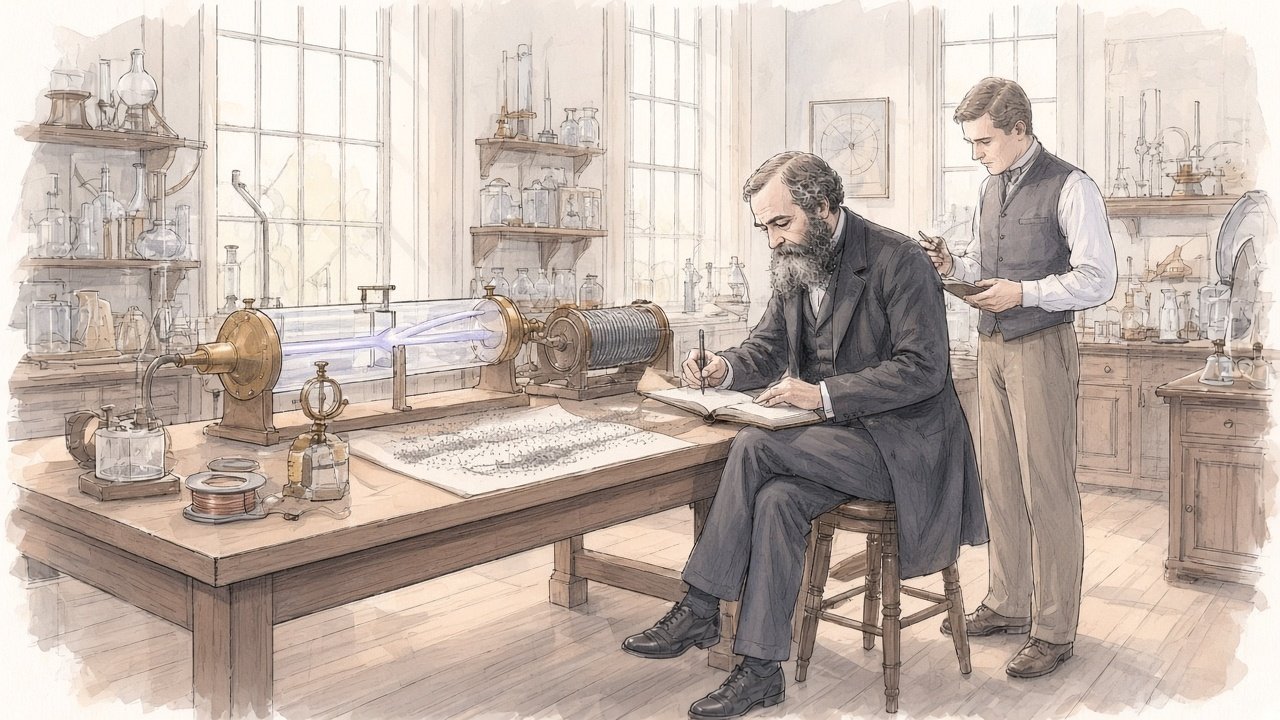
Between 1855 and 1873 the Scottish physicist James Clerk Maxwell brought the separate sciences of electricity and magnetism together into a single mathematical theory. From that theory he deduced that disturbances in the electric and magnetic fields travel through space as waves, that the speed of these waves is fixed by measurable electrical constants, and that this speed is equal to the speed of light. He concluded that light itself is an electromagnetic wave. The set of equations that express his theory, now known as Maxwell’s equations, underlies the whole of electrical engineering, radio and optics, and its structure prepared the way for the theory of relativity. This article describes the state of electrical science that Maxwell inherited, follows the development of his theory through three major papers and his Treatise on Electricity and Magnetism, explains what the equations say in physical terms, and traces the work of the physicists who completed, simplified and confirmed them.
Electricity and Magnetism before Maxwell
By the middle of the nineteenth century the study of electricity and magnetism had produced a large body of experimental laws. In the 1780s Charles-Augustin de Coulomb had shown with a torsion balance that the force between two electric charges, and between two magnetic poles, varies inversely as the square of the distance between them. In 1800 Alessandro Volta had constructed the first battery, the voltaic pile, which produced a steady electric current. In 1820 the Danish physicist Hans Christian Ørsted had found that an electric current deflects a nearby compass needle, establishing the first connection between electricity and magnetism. Within weeks André-Marie Ampère in Paris had shown that two parallel currents attract or repel each other and had developed a mathematical theory of the forces between current-carrying wires. In 1831 Michael Faraday at the Royal Institution in London discovered electromagnetic induction, the production of an electric current in a circuit by a changing magnetic field, a discovery that is described in detail in the article on Faraday and Electromagnetic Induction.
Two different ways of thinking about these phenomena coexisted. The dominant tradition on the Continent, developed by Ampère, by Carl Friedrich Gauss and above all by Wilhelm Weber in Germany, treated electrical and magnetic forces as actions at a distance between charges or current elements, analogous to Newton’s gravitation, acting instantaneously across empty space. Weber’s theory of 1846 expressed the force between two moving charges in terms of their separation, their relative velocity and their relative acceleration, and it accounted with great precision for the known laws of electrodynamics.
Faraday, who had little mathematical training, thought differently. He pictured the space around magnets and currents as filled with lines of force, which he made visible by scattering iron filings on paper above a magnet. For Faraday these lines were not merely a convenient way of describing the forces but physical states of the space itself, and he believed that electric and magnetic actions were transmitted from point to point through the intervening medium rather than across empty space at a distance. In 1845 he showed that a strong magnetic field rotates the plane of polarisation of light passing through glass, an effect now called the Faraday effect, which suggested to him a connection between magnetism and light. In 1846, in a short speculative lecture published as Thoughts on Ray-Vibrations, he suggested that light might be a vibration of the lines of force themselves. These ideas were not widely taken up, partly because Faraday could not express them in mathematical form.
The young William Thomson, later Lord Kelvin, had shown in the 1840s that Faraday’s ideas could be given mathematical expression by analogy with the flow of heat and the strains of an elastic solid. Maxwell, who corresponded with Thomson, took this approach as his starting point.
Maxwell’s Early Life
James Clerk Maxwell was born in Edinburgh on 13 June 1831, the year of Faraday’s discovery of induction. His family owned an estate at Glenlair in Kirkcudbrightshire in south-west Scotland, where he spent most of his childhood. His mother died when he was eight. He attended the Edinburgh Academy and, at the age of fourteen, wrote a paper on the drawing of oval curves with pins and thread which was presented to the Royal Society of Edinburgh. He studied at the University of Edinburgh from 1847 to 1850 and then at Cambridge, first at Peterhouse and then at Trinity College, graduating in 1854 as second wrangler in the Mathematical Tripos and sharing the Smith’s Prize with the first wrangler, Edward Routh.
Maxwell’s scientific interests were wide. In the 1850s he did fundamental work on colour vision, showing that most colours could be matched by mixtures of three primary lights, and he devised the colour top, a spinning disc with adjustable coloured sectors, to make such mixtures. In 1861 he arranged the projection of the first colour photograph, of a tartan ribbon, made by the photographer Thomas Sutton using three exposures through red, green and blue filters. His essay on the stability of Saturn’s rings, which won the Adams Prize at Cambridge in 1857, showed that the rings could not be solid or fluid but must consist of a great number of separate particles. In 1859 and 1860 he developed the kinetic theory of gases and derived the distribution of molecular velocities that now bears his name, a work that laid one of the foundations of statistical physics.
He was appointed professor of natural philosophy at Marischal College in Aberdeen in 1856, and in 1858 married Katherine Mary Dewar, the daughter of the principal of the college. When Marischal College merged with King’s College, Aberdeen, in 1860, his chair was abolished, and he moved to the chair of natural philosophy at King’s College London, where he did his most important work on electromagnetism.
On Faraday’s Lines of Force
Maxwell’s first paper on electricity, On Faraday’s Lines of Force, was read to the Cambridge Philosophical Society in 1855 and 1856. Its purpose was to give mathematical form to Faraday’s conception. Maxwell represented the lines of force by an analogy with the flow of an imaginary incompressible fluid through tubes. The direction of flow at any point corresponded to the direction of the force, and the speed of flow to its strength. Using this analogy, he showed that the known laws of electrostatics and magnetism could be expressed in terms of continuous quantities defined at every point of space, rather than in terms of forces acting directly between distant bodies.
He was careful to say that the fluid was not real. It was a device to aid the imagination and to bring the mathematical results of the action-at-a-distance theorists into a form that matched Faraday’s geometrical intuitions. In the second part of the paper he introduced a mathematical quantity that he connected with Faraday’s notion of an electrotonic state, a hidden condition of matter in a magnetic field whose changes produced induced currents. This quantity corresponds to what is now called the magnetic vector potential. Maxwell sent a copy of the paper to Faraday, who replied that he was at first almost frightened to see such mathematical force applied to the subject and then surprised to see that the subject stood it so well.
On Physical Lines of Force
Maxwell’s second major paper, On Physical Lines of Force, was published in four parts in the Philosophical Magazine in 1861 and 1862, while he was at King’s College London. In it he constructed a detailed mechanical model of the medium in which electric and magnetic effects were transmitted. Magnetic fields, he proposed, consisted of tiny rotating vortices in the medium, each spinning about an axis along the direction of the magnetic force. Adjacent vortices would rub against one another if they rotated in the same direction, so Maxwell placed between them layers of small particles which turned like idle wheels in a machine. The motion of these particles corresponded to electric current. The model reproduced the known laws of electromagnetism, including Faraday’s induction and Ampère’s forces between currents.
In the third part of the paper, published in 1862, Maxwell considered what would happen in an insulating material, a dielectric, in which the particles could not flow freely. He supposed that the medium was elastic, so that an electric force would displace the particles slightly from their positions, against a restoring force. A change in this displacement would itself constitute a brief current, which he called the displacement current. Its inclusion was essential to the consistency of the theory, since without it Ampère’s law, which relates magnetic forces to the currents that produce them, contradicted the conservation of electric charge in situations where charge was accumulating, as on the plates of a capacitor being charged.
The elasticity of the medium meant that disturbances could propagate through it as waves, just as disturbances propagate through an elastic solid. Maxwell calculated the speed of these transverse waves from the properties of the medium, which could be related to the ratio between the electromagnetic and electrostatic units of electric charge. This ratio had been measured in 1856 by Wilhelm Weber and Rudolf Kohlrausch. Using their value, Maxwell found a speed of about 310,740 kilometres per second, close to the speed of light measured by Hippolyte Fizeau in 1849, about 314,000 kilometres per second. Maxwell, who was at Glenlair when he made the calculation and did not have Fizeau’s figure to hand, wrote that the agreement was so close that one could scarcely avoid the inference that light consists in the transverse undulations of the same medium which is the cause of electric and magnetic phenomena.
A Dynamical Theory of the Electromagnetic Field
Maxwell was not content with a theory that depended on a particular mechanical model, which he regarded as provisional and in some respects implausible. In his third major paper, A Dynamical Theory of the Electromagnetic Field, read to the Royal Society in December 1864 and published in 1865, he set the vortices and idle wheels aside and derived the theory from general dynamical principles and from experimentally established laws. The paper treated the electromagnetic field as a physical system possessing energy, distributed through space, which could be stored in two forms, associated respectively with the electric and the magnetic state of the field.
The paper presented twenty equations in twenty variables, written in terms of the separate components of the various quantities along three axes, as was customary before the development of vector notation. They included equations relating the total current to the conduction current and the displacement current, expressions for the magnetic force in terms of the electromagnetic momentum, now called the vector potential, an equation expressing Ampère’s law with the displacement current, an equation giving the electromotive force on a moving conductor, relations for the electric displacement, for resistance in conductors, for free electric charge and for the continuity of charge. From these equations Maxwell derived a wave equation showing that electromagnetic disturbances propagate with a speed determined by the electrical and magnetic properties of the medium, and he showed that in empty space this speed is equal to the speed of light. He concluded that light is an electromagnetic disturbance propagated through the field according to electromagnetic laws.
Maxwell resigned from King’s College in 1865 and returned to Glenlair, where he wrote much of his later work. In 1871 he was elected the first Cavendish Professor of Experimental Physics at Cambridge and supervised the design and construction of the Cavendish Laboratory, which opened in 1874.
The Treatise on Electricity and Magnetism
In 1873 Maxwell published his Treatise on Electricity and Magnetism, a work in two volumes that sought to present the whole of electrical science from the standpoint of his field theory. It was not an easy book. It ranged over electrostatics, electrolysis, conduction, magnetism, electromagnetism and the electromagnetic theory of light, mixing experimental results, mathematical techniques and theoretical discussion, and it left many questions open, including the nature of electric charge. It nevertheless became the starting point for the next generation of physicists who studied electromagnetism.
Among the results presented in the Treatise was the prediction that electromagnetic waves carry momentum and exert pressure on surfaces that absorb or reflect them. Maxwell calculated that the pressure of sunlight on the Earth’s surface would be very small, about four milligrams of force per square metre in his units. Radiation pressure was measured in the laboratory by Pyotr Lebedev in Moscow in 1900 and by Ernest Fox Nichols and Gordon Ferrie Hull in the United States in 1901, and their results agreed with Maxwell’s prediction.
Maxwell died of abdominal cancer in Cambridge on 5 November 1879, at the age of forty-eight. He did not live to see the experimental demonstration of the electromagnetic waves he had predicted.
What the Equations Say
In the form taught today, Maxwell’s equations are four statements about two vector fields, the electric field and the magnetic field, which are defined at every point of space and at every moment of time. Each field has a magnitude and a direction at every point. The equations relate the fields to their sources, electric charges and currents, and to each other.
The first equation, often called Gauss’s law for electricity, states that electric charges are sources of the electric field. The total amount of electric field passing outward through any closed surface, which is called the electric flux, is proportional to the total charge enclosed within the surface. Field lines begin on positive charges and end on negative charges. From this law, applied to a single point charge, Coulomb’s inverse-square law of force follows directly.
The second equation, Gauss’s law for magnetism, states that there are no isolated magnetic charges. The total magnetic flux through any closed surface is always zero. Magnetic field lines do not begin or end but form closed loops or extend indefinitely. A bar magnet broken in two yields two smaller magnets each with a north and a south pole, never a separate north or south pole.
The third equation, Faraday’s law of induction, states that a magnetic field that changes in time produces an electric field that circulates around the region where the change occurs. The electromotive force around any closed loop equals the negative of the rate of change of the magnetic flux through the loop. This is the principle of the electric generator and the transformer.
The fourth equation, the Ampère–Maxwell law, states that a magnetic field circulates around any electric current and also around any electric field that changes in time. The second part of this statement is Maxwell’s displacement current. It is the term that makes the theory consistent with the conservation of charge, and it is the term that allows electromagnetic waves to exist.
The existence of waves follows from the third and fourth equations together. In empty space, far from any charges or currents, a changing magnetic field produces a changing electric field, according to Faraday’s law, and the changing electric field in turn produces a changing magnetic field, according to the Ampère–Maxwell law. The two fields sustain each other and travel together through space, at right angles to each other and to the direction of travel. The speed of travel depends only on two constants that characterise empty space, the electric permittivity and the magnetic permeability, which can be determined by measurements with charges, currents and magnets in the laboratory. The resulting speed is about 299,792 kilometres per second, the speed of light.
The theory placed no limit on the frequency of the waves. Visible light corresponds to waves with wavelengths of roughly four hundred to seven hundred billionths of a metre. Maxwell’s theory implied the possibility of waves of much longer and much shorter wavelength, invisible to the eye but of the same physical nature. Infrared and ultraviolet radiation had been discovered at the beginning of the nineteenth century by William Herschel and Johann Wilhelm Ritter, and they fitted naturally into Maxwell’s scheme. Waves of much longer wavelength, produced by electrical oscillations, were not known in Maxwell’s lifetime.
The Maxwellians
After Maxwell’s death his theory was developed by a small group of physicists who are sometimes called the Maxwellians. The most important were the English self-taught engineer Oliver Heaviside, the Irish physicist George Francis FitzGerald, and the English physicist Oliver Lodge, together with John Henry Poynting at Birmingham.
In 1884 Poynting showed how energy flows through the electromagnetic field. The rate and direction of the flow at any point are given by a quantity, now called the Poynting vector, formed from the electric and magnetic fields at that point. The result showed that the energy delivered by an electric circuit to a lamp or motor travels through the space around the wires rather than along the wires themselves, a conclusion that underlined the reality of the field.
Heaviside, working in isolation at his home in Devon, recast Maxwell’s equations between 1884 and 1885 into the compact form of four vector equations that is used today. He eliminated the potentials, which Maxwell had treated as fundamental, and wrote the equations directly in terms of the electric and magnetic fields, using the vector notation that he and the American physicist Josiah Willard Gibbs developed independently. Heaviside’s form made the symmetry between the electric and magnetic fields apparent and made the equations far easier to use. For some years the reformulated equations were known as the Hertz–Heaviside equations or the Maxwell–Heaviside equations, before the name Maxwell’s equations became standard. Heaviside also applied the theory to the transmission of telegraph and telephone signals along cables and showed how the distortion of signals could be reduced by adding inductance to the line, a technique later widely adopted.
Hertz and the Detection of Electromagnetic Waves
The decisive experimental test of Maxwell’s theory was carried out by the German physicist Heinrich Hertz at the Technical College in Karlsruhe between 1886 and 1888. Hertz generated rapid electrical oscillations by causing a spark to jump across a gap between two metal conductors connected to an induction coil. He detected the waves radiated by the oscillations with a simple receiver, a loop of wire with a small gap, across which tiny sparks appeared when the waves reached it. By reflecting the waves from a sheet of zinc on the wall of his lecture room, he set up standing waves and measured their wavelength, which was of the order of a few metres. Knowing the frequency of the oscillations from the dimensions of his circuit, he calculated their speed and found it to be comparable to the speed of light.
Hertz went on to show that the waves could be reflected, refracted by a large prism of pitch, focused by concave mirrors and polarised by a grating of parallel wires, exactly as light can be. He published his results in 1888, and they were accepted across Europe as a confirmation of Maxwell’s theory. In the following years his methods were developed by Lodge, Augusto Righi, Jagadish Chandra Bose and others, and in the 1890s Guglielmo Marconi turned them into a practical system of wireless telegraphy. That story is told in the article on Hertz, Marconi and the Invention of Radio.
The Electromagnetic Spectrum
The confirmation of Maxwell’s theory led physicists to recognise a continuous spectrum of electromagnetic radiation, extending from radio waves with wavelengths of kilometres through microwaves, infrared, visible light and ultraviolet to X-rays and gamma rays with wavelengths smaller than an atom. The X-rays discovered by Wilhelm Röntgen in 1895, whose story is told in the article on The Discovery of X-rays by Wilhelm Conrad Rontgen in 1895, were shown in 1912 by Max von Laue and his collaborators to be electromagnetic waves of very short wavelength through their diffraction by crystals. All of these forms of radiation obey the same equations and travel at the same speed in empty space.
The Ether and Relativity
Maxwell and his contemporaries assumed that electromagnetic waves, like sound or waves on water, were vibrations of a medium, the luminiferous ether, which filled all of space. The equations predicted a single definite speed for light, and it was natural to suppose that this was its speed relative to the ether. An observer moving through the ether should therefore find that light travelled at different speeds in different directions. In 1887 Albert Michelson and Edward Morley, at what is now Case Western Reserve University in Cleveland, carried out a sensitive optical experiment to detect the motion of the Earth through the ether and found no effect.
FitzGerald in 1889 and Hendrik Lorentz in 1892 proposed independently that bodies moving through the ether contract in the direction of motion by just the amount needed to conceal the effect. Lorentz developed this idea into a theory of electrons moving in the ether and found the mathematical transformations, now called the Lorentz transformations, under which Maxwell’s equations keep the same form for observers in uniform relative motion. In 1905 Albert Einstein took the further step of treating these transformations as expressions of the nature of space and time themselves, and of abandoning the ether as unnecessary. His paper on the electrodynamics of moving bodies, which founded the special theory of relativity, began with an asymmetry in the usual interpretation of Maxwell’s theory of induction. Einstein’s work is described in the article on Einstein’s Annus Mirabilis and the Theory of Special Relativity. In a sense Maxwell’s equations were already relativistic, and it was Newtonian mechanics, not electromagnetism, that had to be modified.
Quantum Electrodynamics
Maxwell’s theory treats the electromagnetic field as continuous. At the beginning of the twentieth century Max Planck and Einstein showed that the exchange of energy between radiation and matter occurs in discrete amounts, and Einstein proposed in 1905 that light itself consists of quanta, later called photons. The reconciliation of Maxwell’s field theory with quantum mechanics occupied physicists from the late 1920s to the late 1940s and culminated in quantum electrodynamics, developed by Richard Feynman, Julian Schwinger, Sin-Itiro Tomonaga and Freeman Dyson. In quantum electrodynamics the classical Maxwell equations describe the average behaviour of large numbers of photons, and they remain exact for practical purposes in every situation in which the number of photons is large, which includes radio, electrical power and almost all of optics. The broader development of quantum theory is discussed in the article on The Discovery of Quantum Mechanics and Superposition.
Maxwell’s theory also served as the model for later theories of fundamental forces. The idea that a force is carried by a field possessing energy and momentum, and that the equations governing the field follow from a principle of symmetry, was generalised in the twentieth century into the gauge theories that describe the weak and strong nuclear forces. The unification of electricity and magnetism into a single field became the prototype for the unification of the electromagnetic and weak forces achieved in the 1960s and 1970s.
The Equations in Engineering
The practical consequences of Maxwell’s equations reach into almost every branch of modern technology. Electrical power engineering rests on Faraday’s law and the Ampère–Maxwell law. A generator converts mechanical rotation into electrical energy because a coil turning in a magnetic field experiences a changing magnetic flux; a transformer changes the voltage of an alternating current because the changing current in one coil produces a changing magnetic flux in an iron core, which induces a voltage in a second coil. The design of motors, generators, transformers and transmission lines is carried out with calculations that apply Maxwell’s equations to particular geometries and materials, and the losses in long power lines, the heating of conductors and the forces between busbars in a power station all follow from them.
Radio engineering applies the wave solutions of the equations. An antenna is a conductor arranged so that oscillating currents in it radiate electromagnetic waves efficiently into space, or so that incoming waves induce currents that can be detected. The radiation pattern of an antenna, the way it sends more energy in some directions than others, is calculated from the equations, as is the behaviour of waveguides, the hollow metal tubes that carry microwaves in radar systems and particle accelerators. Mobile telephones, wireless networks, satellite links and the radio telescopes that detected the cosmic microwave background all depend on such calculations. Optical fibres guide light by total internal reflection, and the precise way in which light travels along them, including the different modes in which it can propagate, is again a solution of Maxwell’s equations for a particular arrangement of glass.
In the second half of the twentieth century the growth of digital computing made it possible to solve the equations numerically for arbitrarily complicated structures. In 1966 Kane Yee published a method for solving the time-dependent equations on a grid of points in which the electric and magnetic field components are staggered in space and time, and this finite-difference time-domain method, together with finite-element and boundary-element methods, is now used to design antennas, microwave circuits, integrated circuit interconnections, stealth aircraft and medical imaging devices. In the design of advanced microchips, where signals travel at very high frequencies along closely packed conductors, engineers must account for electromagnetic coupling between wires that would have been negligible in earlier generations of electronics.
Units and the Speed of Light
Maxwell’s identification of the speed of light with a ratio of electrical units had lasting consequences for the system of measurement itself. Throughout the nineteenth century physicists used several competing systems of electrical units, based on electrostatic or electromagnetic definitions of charge, and the ratio between them had the dimensions of a speed. Maxwell, who served on the committee of the British Association for the Advancement of Science that established practical electrical standards in the 1860s, took part in measurements of this ratio, using a balance in which the attraction between two charged plates was weighed against the repulsion between two current-carrying coils, and obtained a value close to the speed of light.
The constancy of the speed of light, which Maxwell’s equations imply and which Einstein raised to a principle, eventually became the basis for the definition of length. In 1983 the General Conference on Weights and Measures redefined the metre as the distance travelled by light in a vacuum in 1/299,792,458 of a second, fixing the speed of light at exactly 299,792,458 metres per second. The history of earlier definitions of the metre is told in the article on The Metre and the Meridian. In the revision of the International System of Units in 2019, which also redefined the kilogram as described in the article on The Kilogram That Was a Cylinder, the elementary charge was fixed at an exact value, and the magnetic constant that had previously been fixed by definition became a quantity to be measured, a change that rests directly on the structure of Maxwell’s theory.
Recognition
Maxwell’s reputation during his lifetime, though high among physicists, was not comparable to that of Kelvin or Faraday among the general public. The importance of his electromagnetic theory became widely appreciated only after Hertz’s experiments, nearly a decade after his death. In the twentieth century his standing grew steadily. The centenary of his birth in 1931 was marked by a commemorative volume to which Einstein, Max Planck and others contributed; Einstein wrote there that the change in the conception of reality brought about by Maxwell was the most profound and the most fruitful that physics had experienced since the time of Newton. A statue of Maxwell by the sculptor Alexander Stoddart was unveiled on George Street in Edinburgh in 2008, and the house in India Street where he was born is maintained by the James Clerk Maxwell Foundation. The James Clerk Maxwell Telescope on Mauna Kea in Hawaii, a submillimetre telescope that opened in 1987, bears his name.
Maxwell’s influence on later physicists was personal as well as intellectual. Einstein kept a photograph of Maxwell on the wall of his study, alongside those of Faraday and Newton, and in an essay written for the centenary of Maxwell’s birth in 1931 he described the change in the conception of reality brought about by Maxwell’s work as the most profound and fruitful that physics had experienced since the time of Newton. The quotation is given in the volume James Clerk Maxwell: A Commemoration Volume, published by Cambridge University Press in that year.
Assessment
Maxwell’s achievement had several parts. He gave mathematical form to Faraday’s physical intuition of fields, he added the displacement current that made the equations consistent and made electromagnetic waves possible, he identified light as an electromagnetic wave, and he showed how the energy of electrical systems resides in the field rather than in the charges and currents alone. His approach combined bold mechanical models with a willingness to set them aside when the underlying mathematical relations could be stated without them. The final form of his equations owed much to Heaviside, their experimental confirmation to Hertz, and their reinterpretation to Lorentz and Einstein, but the central insight that electricity, magnetism and light are aspects of a single field was Maxwell’s. Physicists of later generations, among them Einstein and Feynman, regarded it as one of the most significant developments in the history of physics.
Further Reading
The principal sources for this article include the Grokipedia entries linked in the text and the following: the biographical and archival material held by the James Clerk Maxwell Foundation in Edinburgh; Maxwell’s paper A Dynamical Theory of the Electromagnetic Field in the Philosophical Transactions of the Royal Society; and the history of the Cavendish Laboratory at Cambridge. Related articles on this site include Faraday and Electromagnetic Induction and Hertz, Marconi and the Invention of Radio.